The Untaming of the Shrewd – Sermon on Luke 16:1-13 for the Ninth Sunday after Trinity

Luke 16:1-13

In the name of Jesus. Amen.

We’ll get to the parable, but we’ll start with a little congregational participation. Ready? Pick one hand and hold it in front of you. Point your thumb toward your face and line your other fingers straight behind it like you’re going to do a karate chop. Keep your hand like that and look at me for a moment.

Imagine you’re at the grocery store to buy a snack for yourself. It could be a bag of chips, a box of cookies, or a pint of ice cream, whatever you fancy right now. No self-checkout today. You’ve handed the cashier a $20 bill, and she’s about to hand you your change. Without looking at your hand, move it into position to receive the change. Now, look at your hand. I’m guessing your palm is toward the ceiling, fingers slightly open, ready to close around the change. We’ll call that the ‘receptive’ hand.

Put your hand back in the karate chop position and keep it there again. Imagine you spot a $100 bill on a shelf in the store. No one else is around. Forget about what you would do with it. Just move your hand as if you’re reaching to take it. Look again—that’s the grasping and taking hand.

Everyone knows that hand. It is the hand of a child who snatches a toy and yells, “Mine!” It is the hand that treats everything as something to control rather than receive. That grasping hand is not new. It is as old as the Fall.

God created our hands to be the hands of a steward with open palms. First, receiving from Him; then, offering to Him. God created us in His Own image and gave us dominion over the fish of the sea, the birds of the air, the animals, and all the earth. He gave every plant for food (Gen. 1:28-30). That dominion wasn’t permission to beat creation into submission. It was entrusted to us as image-bearers, so that we would reflect the heart of our all-giving Creator.

Not only did God give all of creation to be under our dominion, He also gave us a home. He put Adam and the woman in the Garden of Eden and gave them a clear purpose, “to work it and keep it” (Gen. 2:15). The two Hebrew verbs there are the same words God used when He established the priests who were to ‘serve’ and ‘guard’ the Tabernacle (Num. 3:7-88:2618:5-6). In short, Adam wasn’t only created to be a gardener. He was created to be a priestly guardian of the sacred space of Eden. There was only one vocation in Eden, and that was the vocation of steward. God created us to receive everything from His open hand—palms up, receiving every gift of creation from His generosity. That open, receptive hand is the original stewardship hand.

Sadly, the hand rolled over. In Gen. 3, the devil suggested that God was holding out. Out of all creation, God said that one tree was off-limits. The devil lied to the woman and said that things would be better if she would eat the forbidden fruit. Suddenly, that is all her eye could see. The woman sees that the tree is good for food, a delight to the eyes, and desirable to make one wise (Gen 3:6). That desire and covetousness twisted her vision. The hands of the woman and Adam—hands that had been open to receive—those hands turned over to reach, grasp, and take.

That single motion—palm down, fingers closing around what wasn’t theirs—was the tipping point. The stewards presumed to be owners. But God never transferred ownership. Instead, they took and grasped what didn’t belong to them. They became thieves. In a sense, they stole the fruit. But the deeper theft was their attempt to take God’s place. The closing, grasping hand was the first act of original sin. It showed that they no longer trusted God, and whatever does not proceed from faith is sin (Ro. 14:23). That hand turning over and grasping what God hadn’t given was a violation of at least the 1st, 3rd, 4th, 5th, 7th, 9th, and 10th Commandments.

Now, bring that picture into the parable Jesus tells today.

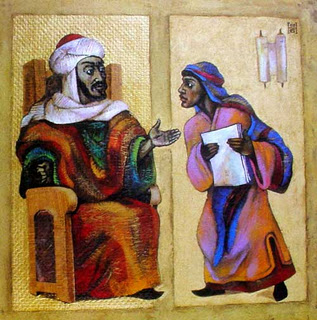
There is a rich man whose hand was always open, always giving. He entrusted his possessions to a manager. The manager’s hand was supposed to stay palm up so he could receive the master’s wealth, manage it, and return it to the owner. But the manager’s hand has already rolled over. He has been wasting what was never his. Some commentators suggest that this manager was scamming the tenants by collecting more than he was supposed to and keeping the extra for himself.

When the master calls for an accounting of the books, the manager’s closed fist is exposed, and he will be removed from his position. The manager knows himself well enough to admit that he isn’t strong enough to dig, and he’s too proud to beg. So, what does he do? He acts shrewdly and hatches a plan. He probably worked harder that afternoon than he had in years.

He calls in the debtors one by one and reduces what they actually owe without the master’s permission or authorization. The unrighteous manager is still living off the master’s open-handed generosity, still using the master’s resources. He keeps his hand turned over so he can cleverly take more—this time, from the master himself. He is using his boss’s generosity as his own personal safety net. He knows that these debtors will be singing the praises of the rich man. But they will also associate him with their debt being slashed.

Notice that when the rich man figures the whole thing out, he still doesn’t close his hand. Instead, the master commends and praises the manager—not for his theft, but for his shrewdness. The manager knew the giving nature of the rich man and bet everything on it. That’s what Jesus is praising.

Jesus is not holding him up as a moral example. The man is unrighteous. His motivation is purely self-preservation. He’s a thief, but he’s a shrewd thief. Look at the energy this little scoundrel pours into securing a few friends who will toss him bread when he’s finally out of his job. Look at how he plots, stays up late, and reworks the books for his own benefit.

What Jesus praises is the shrewd use of what belongs to another. The manager did it only for his own benefit. Jesus wants us to do it for the benefit of others. In short, Christ wants us to use what God gives and entrusts to us in shrewd ways that reveal the generosity of our heavenly Father. That’s why Jesus says, “The sons of this world are more shrewd in dealing with their own generation than the sons of light” (Lk. 16:8).

Dear saints, you have infinite treasures. You have the Gospel, the forgiveness of sins, the hope of the resurrection and the life of the world to come. You have all of that because of the open hand of our God who gives and gives and gives. He promises that you don’t have to worry about any of your needs for tomorrow because He will provide (Mt. 6:31-34). But still, we are careful, cautious, and stingy. In our selfishness we have tamed ourselves to be close-fisted. Repent.

That is the rebuke Jesus has for us today. Our closed hands are greedy and lazy. The 7th Commandment forbids both. Greed selfishly grabs. Laziness selfishly refuses to work. The virtue the Holy Spirit is after in us today is generosity. He wants us to open our hands to both freely receive and freely give. Jesus presses the point: “Make friends for yourselves by means of unrighteous wealth, so that when it fails they may receive you into the eternal dwellings”(Lk. 16:9). Eventually, money will fail. The day is coming when our hands can’t hold anything. So today, use what is already the Lord’s to make eternal friends—people who will stand with you in the Resurrection because the Gospel reached them through the resources you have stewarded.

David recognized this in our Old Testament reading (1 Chr. 29:10-15). When the people freely gave and poured out their gifts so the Temple could be built, David prayed, “All things come from You, and of Your own have we given You” (1 Chron. 29:14). Whenever and whatever we give, we are only returning what the open hand of God first placed in our hands. There is no such thing as ‘my money’ or ‘my stuff’ in the kingdom of heaven. There is only the Lord’s money and the Lord’s stuff temporarily in our care. That fact frees the fist that desires to grasp. That truth untames us and makes us shrewd. Closed hands always end in idolatry by making a (little ‘g’) god of the self and of the stuff we think we can control.

Repent and always know that Christ is the perfect Steward. His hands stayed open. Though He was rich, yet for your sake He became poor, so that you by His poverty might become rich (2 Co. 8:9). He emptied Himself. He stretched out His hands on the cross and let everything be taken. His blood, His life, His whole Self—He gave it all as pure gift. You are not just a failed steward left to dig yourself out of sin. Instead, you are a redeemed steward who has been washed, forgiven, and claimed. The Holy Spirit is still at work to turn our hands back over, palm up, open again.

Jesus wants us to have the same energy that the unjust steward showed. He wants to untame us so we shrewdly use that same intensity, that same foresight, that same willingness to stay up late and work hard for His kingdom.

You have a mind. Use it to find new ways to love your neighbor. You have a body. Use it to serve others. You have resources that are already His. Use them to make friends who will welcome you into the eternal dwellings.

Dear saints, your Master’s hand is always open. He has already given you everything that matters. You are free. Be shrewd with His gifts, and rejoice in His goodness. Amen.

The peace of God, which surpasses all understanding, will guard your hearts and minds in Christ Jesus (Php. 4:7). Amen.

Successful Steward – Sermon on 1 Corinthians 4:1-5 for the Third Sunday of Advent

1 Corinthians 4:1–5

1 This is how one should regard us, as servants of Christ and stewards of the mysteries of God. 2 Moreover, it is required of stewards that they be found faithful. 3 But with me it is a very small thing that I should be judged by you or by any human court. In fact, I do not even judge myself. 4 For I am not aware of anything against myself, but I am not thereby acquitted. It is the Lord who judges me. 5 Therefore do not pronounce judgment before the time, before the Lord comes, who will bring to light the things now hidden in darkness and will disclose the purposes of the heart. Then each one will receive his commendation from God.

In the name of Jesus. Amen.

In these days leading up to Christmas, gifts are probably taking a lot of your time, energy, and mental space. Maybe, you’re still looking for that perfect present that evens out the number of gifts and the amount you’ve spent on each individual. You might be struggling to find a spot to hide everything until you can get it all wrapped, or you’re closely following the tracking information so you can intercept the packages before they are discovered on your front step.

In this season of giving gifts, it’s good to remember that everything you have is a gift. Just two verses after this reading (1 Cor. 4:7), Paul rhetorically asks, “What do you have that you did not receive?” Everything we possess has been graciously given to us by our God and Father (Jn. 3:27). Our houses and vehicles, our food and clothing, our families and jobs are all good gifts freely given by the hand of God. He has given you your time, your talents, your body, your energy, and strength. Don’t fool yourself into thinking that you have earned anything you have. God has given it. The epistle of James says, “Every good and every perfect gift is from above coming down from the Father of lights” (Jam. 1:17).

Because everything you have is a gift, that means you are a steward or manager of those gifts. It all belongs to God, and God wants and expects you to use everything He has given you to love Him by loving your neighbor (Mk. 12:28-31). Stewards know that what they have will all eventually be returned to their Owner, and on the Last Day, you will give an account to God for how you have used those gifts (Heb. 4:13). The issue that Paul is dealing with here is about being a successful steward.

Here, Paul is specifically talking about his stewardship of his office, his vocation, of being an apostle. God made Paul a steward of the mysteries of God. That means that Paul is to preach God’s Word and write the sacred, Holy Spirit-inspired Scriptures. He recognizes that he needs to be faithful in that. But this text extends far beyond just Paul.

All stewards are required to be faithful with what they are given. Paul writes, “It is required of stewards that they be found faithful” (1 Cor. 4:2). In other words, faithfulness is the one standard by which stewards are judged. And there is great comfort in this. Stewards aren’t judged by numbers or growth or success or fame. Faithfulness is the one, and only, standard by which a stewards’ success will be determined. And the only One who can and does judge by that standard is God, the Giver of the good gifts that we have.

As Paul writes about himself here, he says, “with me it is a very small thing that I should be judged by you or by any human court” (v. 3a). It doesn’t matter how they judge him. And it doesn’t matter what anyone else thinks. In fact, Paul says that it doesn’t even matter what his own estimation is; he says, “I do not even judge myself” (v. 3b). The only thing that matters is what the Lord God judges (v. 4). In God’s timing, He will bring to light the things that are now hidden in darkness and disclose the purposes and intentions of the heart. Then, and only then, will each one receive his commendation and praise from God (v. 5).

Dear saints, there is such freedom for you here. It can be incredibly easy to get discouraged in life. We make our plans, and they don’t pan out. We struggle through our tasks at work and don’t seem to make any progress. We do our best to teach our kids and train them how they should act, but they keep disobeying. We try to provide financially for ourselves and our families, but we always seem to be behind. In all those moments, we start judging ourselves and our work by metrics that – honestly, in the end – don’t really matter.

Now, that does not mean that we shouldn’t use those metrics to improve and do better as stewards. I’m not saying that. We should always strive to be better stewards of what God has given us.

What I am saying, though, is this: At the end of the day, at the completion of a task, when we consider how well we’ve done at anything, the question we should ask is, “Have I been faithful?” In other words, “Did I do what God has given me to do? Did I use the resources and means that God provided in the best way I could?” If the answer to that is, “Yes,” then that is enough. But remember that your estimation doesn’t matter. Only God’s does.

This standard of success for stewards applies to all areas of your life. It applies to your schooling, your marriage, your career, your time, talents, and treasures because, again, all of it is a gift from God. Some of you think far worse of yourself than you really are. And, yes, some of you think far better of yourself than you actually are. The day will come when God will reveal all sorts of hidden obstacles and struggles – as well as blessings and gifts – that we didn’t have any idea were there. And then, He will be the Judge who commends or condemns. So, don’t you go jump the gun. Don’t bother with rating or grading yourself. God will take care of it when He comes.

Another pastor put it well when he said that this text gives us a “blessed uncertainty” as it concerns our success, our failure, our progress, or our lack of progress. And there are at least two reasons God wants you to have this uncertainty.

First, God wants you to be uncertain about your success because if you were confident in either direction – either how well or how poorly you had done – that becomes a distraction to you remaining faithful. If you’re always looking around to see how well or how poorly you’re doing, you’re probably not paying enough attention to what you are actually doing. God wants you to be focused on the thing He has given you to do. All you have to do is to be faithful.

Second, and more importantly, God wants you to be uncertain about your success because He wants you to be certain of only one thing – just one thing. And that is the certainty of your position in Christ alone. God wants you to be certain that you are justified because Christ Jesus has died for you. Through faith in Him, your sins are not and will not be counted against you. You have a future and a hope in Christ that is immovable. Keep your focus and attention on that because, again, that is certain.

Dear saints, the Lord, and the Lord Jesus Christ alone, judges you. And, through faith, you already know what that judgment is. You heard it in the Absolution. Jesus Himself says, “I entirely forgive you all of your sins because I have died for them.” Rejoice in that, my fellow stewards of God’s gifts. Amen.

The peace of God, which surpasses all understanding, will guard your hearts and minds in Christ Jesus. Amen.

To Your God Belongs All – Sermon on Deuteronomy 10:12-21 for the Eighteenth Sunday after Trinity

Deuteronomy 10:12-21

12 “And now, Israel, what does the Lord your God require of you, but to fear the Lord your God, to walk in all his ways, to love him, to serve the Lord your God with all your heart and with all your soul, 13 and to keep the commandments and statutes of the Lord, which I am commanding you today for your good? 14 Behold, to the Lord your God belong heaven and the heaven of heavens, the earth with all that is in it. 15 Yet the Lord set his heart in love on your fathers and chose their offspring after them, you above all peoples, as you are this day. 16 Circumcise therefore the foreskin of your heart, and be no longer stubborn. 17 For the Lord your God is God of gods and Lord of lords, the great, the mighty, and the awesome God, who is not partial and takes no bribe. 18 He executes justice for the fatherless and the widow, and loves the sojourner, giving him food and clothing. 19 Love the sojourner, therefore, for you were sojourners in the land of Egypt. 20 You shall fear the Lord your God. You shall serve him and hold fast to him, and by his name you shall swear. 21 He is your praise. He is your God, who has done for you these great and terrifying things that your eyes have seen.”

In the name of Jesus. Amen.

Don’t put the cart before the horse. When we hear this text, it is very easy to focus on all the things we are called to do because the text opens with the question: “What does the Lord your God require of you?” Then all these directives come. Fear God. Walk in His ways. Love Him. Serve Him with all your heart and with all your soul. Keep His commandments and statutes. Don’t be stubborn. Love the sojourner. Hold fast to Him. There is a lot to do there – so much, in fact, that we recognize that we have not even begun to do what God requires of us. Right away we find that we have a lot of repenting to do, and repent we should. But, again, don’t put the cart before the horse.

Notice who wants you to do all these things – the Lord your God. Six times in this text, that is God’s title – the Lord your God. And just to make sure you get it drilled into your head, you are reminded in the final verse that He is your God (v. 21).

Know, dear saints, this God of gods and Lord of lords – the One who owns heaven and the heaven of heavens, the earth with all that is in it – He is your God. He has chosen you. He could have chosen anyone, but He chose you. He did not choose you because you were bigger, stronger, smarter, more obedient, or more faithful than others. He has not chosen you because of anything you have thought, said, or done. You belong to God. You, dear saints, according to 1 Pet. 2:9, are His chosen people, His royal priesthood, His holy nation, and a people for His own possession. You are these things because the Lord God of heaven and earth has chosen you and set His heart in love on you (v. 15). He is your God because He has called you out of darkness into His marvelous light. And the Lord your God has done all of this because of what Jesus has done for you.

Jesus, your Savior, lived a perfect life. He was perfectly obedient to God. He took all your sin to the cross (1 Pet. 2:24) where God poured out all His wrath upon your sin, and not one bit of that wrath is left for you. Jesus paid it all, and He paid it all for you. Your sin had left a crimson stain, but Jesus has washed you white as snow. To God belongs heaven and the heaven of heavens, the earth and all that is in it, and Jesus has restored you to your proper place – your proper place before God and your proper place in His creation. That’s the horse that pulls the cart, and now we can turn to the cart.

As this text lays out all the things the Lord your God requires of you, it is nothing more than a call for you to be like Him and follow after His image. In other words, if we boil down all these things God calls us to be, it is a call for us to be the stewards He has created us to be.[1]

So, think back to the creation. God created Adam and Eve in His image and blessed His image-bearers saying, “Be fruitful and multiply and fill the earth and subdue it, and have dominion over the fish of the sea and over the birds of the heavens and over every living thing that moves on the earth.” Because of our sinful nature, we hear those instructions “have dominion” and “subdue” and think that we get to call all the shots and beat creation into submission so that it conforms to our will. But that wasn’t the case originally. Because Adam and Eve were created in God’s image and perfectly reflected the will and heart of the God who created and owns all things, they were simply stewards of everything God created.

As Genesis 2 closes, Adam and Eve were doing exactly what God had created them to do. They were perfectly stewarding God’s creation. They were receiving from God all that He wanted to give to them. God had created the entire universe to bless mankind, the crown of His creation. God designed them to have open hands that received all the blessings they needed for life. But then, in Genesis 3, the serpent comes slithering into the picture. He lies and convinces them that God was holding out on them and not giving them everything He had to give. After hearing this lie, Eve begins to look at things differently. Watch what her hands do. Instead of having an open hand to receive all of God’s blessings, her hand turns over to take. Both Adam and Eve take and eat. This taking betrays their identity. Instead of being stewards, they wrongly thought they were the owners, but there had been no transfer of ownership.

The creature cannot be the Creator, and the steward cannot be the Owner. Adam and Eve’s attempt to change their identity ends up destroying the perfect relationship that existed between Creator, steward, and creation. Because of that, life became hard. All creation, which God designed to be a blessing that supported life, will cause them pain and suffering. Now their work, will be filled with sweat, toil, pain, and, ultimately, death.

The interesting thing in all of this, though, is that God did not remove them from their calling and duty of being stewards. And this is where you come into the story. You, as God’s creature, are still a steward of God’s creation. Even though you daily and regularly fail in this role, it is still yours. Even though your hands turn over to reach out and take what is not yours, Jesus has come to redeem you and forgive you of all your sins. On the cross, your debt was paid. The empty tomb on Easter is the receipt (Ro. 4:25).

This means, dear saints, that you are a new creation; the old has passed away and the new has come. And now, God has entrusted you with being a steward of the Gospel which is the message of reconciliation (2 Cor. 5:17-20). With an open hand, you receive God’s forgiveness and mercy, and that open hand allows that forgiveness and mercy to also flow to others. And it is those same open hands that freely receive and freely give all of God’s other gifts too. And one of the ways that you continue in your role as a steward is by giving to the work of God’s church.

On the back of your Scripture insert, I’ve included two passages about Christian stewardship (1 Cor. 16:2 and 2 Cor. 9:6-8) and four points to consider about how to give.[2] I would encourage each of you to read through those texts and points as you consider how you steward what God has given to you. In the Old Testament, the stewardship of tithing was set at a certain amount, 10%. Now I want to be clear: there is no New Testament command on what percentage you should give to the work of God’s kingdom. Let that be between you and God. But I do want to highlight one thing from those verses.

2 Cor. 9:6 says, “Whoever sows sparingly will also reap sparingly, and whoever sows bountifully will also reap bountifully.” If you plant one tomato plant, you can only expect so many tomatoes. If you plant ten, fifty, or one hundred plants, well, you’ll get a lot more. The text goes on to tie that analogy to what you give to the church. And the interesting thing about this is what the Old Testament has to say about where those tithes end up.

Just a few chapters after our text, God talks about what was to be done with the tithes. In Dt. 14:22-26, God says that the tithes given to Him are given back to the one who brought that tithe, and it is given back as a feast. God tells His people to bring the tithe of their crops, their wine, their oil, and their herds to the Temple.[3]If the trip to the Temple was too far to bring all of it, they should sell those things and turn them into money. Then, they would go to Jerusalem and purchase whatever things they wanted to eat. Then, they would offer their tithe and eat it before God with rejoicing.

Dear saints, the gifts, offerings, and tithes you give to God are returned back to you as gifts from the Lord your God. Those gifts bless you as you come here and receive God’s mercy, and they also bless your neighbor who needs to receive that mercy and love. The offerings and gifts that you have placed on the Lord’s table will be used by God to continue to further His kingdom.

And now, Jesus, your God, invites you to come and receive a priceless treasure that could never be bought with money. He invites you to come to His table and receive His Body and blood given and shed for the forgiveness of all your sin. Come into the presence of the Lord your God. Receive and rejoice. Amen.

The peace of God, which surpasses all understanding, will guard your hearts and minds in Christ Jesus. Amen.

Christian Stewardship

1 Corinthians 16:2 

On the first day of every week, each of you is to put something aside and store it up, as he may prosper, so that there will be no collecting when I come. 

2 Corinthians 9:6–8 

The point is this: whoever sows sparingly will also reap sparingly, and whoever sows bountifully will also reap bountifully. Each one must give as he has decided in his heart, not reluctantly or under compulsion, for God loves a cheerful giver. And God is able to make all grace abound to you, so that having all sufficiency in all things at all times, you may abound in every good work.

From these two texts, we see that Christians are to give…

  1. …voluntarily & cheerfully. Giving should not be done under compulsion or grudgingly. Giving is God’s gracious call to join Him in His work.
  2. …of our first-fruits. Giving should be from the first-fruits of our labor. Our giving is what we do on the first day of the week before our other expenses are due.
  3. …proportionately. Giving is not to be an arbitrary set dollar amount each week. Instead, it is to be in accordance with ‘how we have prospered’ each week. In other words, setting aside a certain proportion (percentage) of our income for God’s work through the Church.
  4. …faithfully. We have God’s promise that He will take care of all our needs in this body and life. As we give, we are trusting God to keep that promise.

[1] The following five paragraphs are an adaptation of chapter 2 of the book Stewardship: For the Care of Souls by Pr. Nathan Meador and Pr. Heath R. Curtis.

[2] I’ve included those below under the title “Christian Stewardship.”

[3] The text says to bring the tithe to “the place that He will choose, to make His name dwell there.” I am simply condensing that because the Temple is where God chose to make His name dwell (2 Chron. 6:16-20).