Limping – Sermon on Genesis 32:22-32 for the Second Sunday of Lent

Genesis 32:22–32

22 The same night he arose and took his two wives, his two female servants, and his eleven children, and crossed the ford of the Jabbok. 23 He took them and sent them across the stream, and everything else that he had. 24 And Jacob was left alone. And a man wrestled with him until the breaking of the day. 25 When the man saw that he did not prevail against Jacob, he touched his hip socket, and Jacob’s hip was put out of joint as he wrestled with him. 26 Then he said, “Let me go, for the day has broken.” But Jacob said, “I will not let you go unless you bless me.” 27 And he said to him, “What is your name?” And he said, “Jacob.” 28 Then he said, “Your name shall no longer be called Jacob, but Israel, for you have striven with God and with men, and have prevailed.” 29 Then Jacob asked him, “Please tell me your name.” But he said, “Why is it that you ask my name?” And there he blessed him. 30 So Jacob called the name of the place Peniel, saying, “For I have seen God face to face, and yet my life has been delivered.” 31 The sun rose upon him as he passed Penuel, limping because of his hip. 32 Therefore to this day the people of Israel do not eat the sinew of the thigh that is on the hip socket, because he touched the socket of Jacob’s hip on the sinew of the thigh.

In the name of Jesus. Amen.

Everyone faces difficulties, but what do you do when something difficult stares you in the face? It probably depends on the situation. You might try to find another, easier alternative. You might try to get others to help and assist you. You might try to avoid that difficult thing altogether. A lot of times, the most difficult tasks come with the highest reward, so if you always try to avoid difficulties, you are also going to miss out on some of the greatest joys.

On the 4th of July in 2015, we were on a family trip in Colorado. We wanted to find a nice mountain hike that all of could enjoy. Our kids were 2, 4, 6, and 8 at the time. A quick search yielded a recommendation of the Hanging Lake trail. The review had some pictures that were breathtaking. It said the hike would only took an hour and claimed it was great for families. The person who wrote that review must be the 17th generation of sherpas who lead expeditions up Mt. Everest because I’ve since learned that that trail climbs 1,000 ft. (basically, 90-100 flights of stairs) over 1.2 miles. The thing that kept us going was hearing people hiking back down encouraging us, “Keep going. You’ve got a way to go still, but it’s totally worth it.” They were right. I can show you pictures after the service, but it’s one of the most stunning places I’ve seen on God’s green earth. Difficult? Absolutely. Worth all the pain and struggle? Also, yes.

God had given a promise to Abraham that the Savior first mentioned in the Garden of Eden (Gen. 3:15) would be one of his descents (Gen. 22:17). Jacob here was the third in that line. And Jacob faced difficulties his entire life, and, yes, many of those were self-inflicted. 

Jacob’s difficulties started in his mother’s womb as he wrestled with his twin brother, Esau before they were even born (Gen. 25:19-26). When they were older, Jacob took advantage of Esau’s hunger and purchased Esau’s birthright for a cup of stew (Gen. 25:29-34). Later, Jacob deceived their father, Isaac, into passing the blessing that was first given to Abraham on to him even though he was younger than Esau (Gen. 27:1-40). Because of that deception, Esau planned to kill Jacob, who had to flee (Gen. 27:41-45).

During his exile, Jacob ends up working for a guy named Laban, and his wages for seven years of work would be marrying Laban’s daughter, Rachel. But Laban tricked Jacob and gave him his daughter Leah instead of Rachel. Still, Jacob agreed to work another seven years to marry Rachel (Gen. 29:15-20). Despite all of the deception of his father-in-law, Jacob continued to work for Laban and was paid with certain portions of Laban’s flocks. But that was difficult too. Jacob had to plot against Laban throughout his employment (Gen. 30:25-43).

Finally, God told Jacob to move away from Laban and return to his origins (Gen. 31:3). But as he’s returning home, Jacob hears that Esau is marching toward him with 400 men, which was the standard size of an army in that day (Gen. 32:6). So, what does Jacob do? He prays, and I’ll summarize his prayer (Gen. 32:9-12), “Ok, God. You told me to go back home and promised to do good to me. I’m really thankful about that, but now Esau is coming, and I’m afraid that he’ll kill me. But You’ve promised to be with me. So, what’s going on?” But God doesn’t answer.

So, Jacob does what he’s always done when he is in a difficult situation. He takes matters into his own hands and starts plotting and scheming. He sends a massive, expensive gift from his flocks to Esau (Gen. 32:13-15). That’s his “plan A.” But Jacob isn’t done plotting. He also divides his family into two camps figuring, if Esau attacks one camp, the other one will be able to escape (Gen. 32:7-8). That’s Jacob’s “plan B.” Jacob also sends those two camps ahead of him across a stream while he stays behind on the other side. It almost seems like that’s his “plan C” thinking that if Esau wipes out his family at least he’ll escape so God can keep His promise. Like his grandfather Abraham did before him with Hagar and Ishmael, Jacob decides he needs to matters into his own hands so God can keep His promises.

God did have a plan to get Jacob out of this difficult situation, but God isn’t going to give Jacob a large army. It won’t be because of Jacob’s gift to Esau, or letting half of Jacob’s family escape, and God doesn’t deliver Jacob from this difficulty by anything Jacob does on his own.

Instead, God comes down. God comes down to wrestle with Jacob who, at this point, is 96 years old. Sure, Jacob lived to be 147 (see Gen. 47:28), but wrestling with anyone for an entire night, and having your hip thrown out of joint is going to take a toll on a person. So when you consider the whole context here, it seems as though God has two intentions with this wrestling. On the one hand, is seems like God is letting Jacob take out all his frustration on God Himself in a physical way. On the other hand, it seems like this wrestling is intended to make Jacob look weak. Keeping Jacob up all night isn’t enough, so God wrestles with him. And even that isn’t enough, so God also touches and dislocates Jacob’s hip socket.

The next day, when Jacob limps toward Esau, he looks so weak and pathetic that Esau runs to Jacob, and the two brothers embrace and weep together (Ex. 33:1-4).

All of this is further proof of what God says in 2 Cor. 12:9-10, “My grace is sufficient for you, for my power is made perfect in weakness.” This wrestling match left its toll on Jacob. For the rest of his life, Jacob was limping, and that limping served as a constant reminder that he had held on to God and refused to let God go until God blessed him. Every step of the rest of Jacob’s life, served as a reminder of that night when Jacob grappled with God and was blessed through it – even though that blessing came through the difficulty of limping the rest of his life.

Dear saints, I have two things for you to remember from this account. First, when you look at your life and all of God’s promises to you, remember first that you don’t need to give yourself over to bitterness or political machines or other contrived solutions to fight the difficulty and evil you face. Don’t think that God can only bring about His promises if you get your hands dirty with anger, hostility, and bitterness. God keeps His promises and is always faithful.

Second, remember that God knows what you need better than you or I do. And what you need may be a difficulty. Dear saints, whatever difficulty you have – if it’s pain or trauma or a disease that the doctors cannot treat or heal – yes, this is definitely a difficult, horrible thing that you have to face. But it is not a reason to despair and stop trusting God. Instead, it’s is a call for you to hope. In the brokenness of your flesh, remember Jesus who was broken Himself in order to crush the head of the serpent. And the day is coming when you and all who believe in Christ will be raised to a new life with no more suffering, pain, anguish, or difficulty.

Again, God’s power is made perfect in weakness. There’s no greater proof of that than in what Jesus has done for you by taking on your flesh; being beaten, mocked, whipped, and crucified; and by dying the death you and I deserve. So, in our limping, we do not lose heart, as 2 Cor. 4:16-18 says, “Though our outer self is wasting away, our inner self is being renewed day by day. For this light momentary affliction is preparing for us an eternal weight of glory beyond all comparison, as we look to not to the things that are seen but to the things unseen. For the things that are seen are transient, but the things that are unseen are eternal.” 

Dear saints, when you face difficult things and are struggling to even limp along, lean on God. Trust His promises. Jesus is there with you in your limping. Amen.

The peace of God, which surpasses all understanding, will guard your hearts and minds in Christ Jesus. Amen.
The End of Judgment – Sermon on 2 Chronicles 28:8-15 for the Thirteenth Sunday after Trinity

2 Chronicles 28:8-15

8 The men of Israel took captive 200,000 of their relatives, women, sons, and daughters. They also took much spoil from them and brought the spoil to Samaria. 9 But a prophet of the Lord was there, whose name was Oded, and he went out to meet the army that came to Samaria and said to them, “Behold, because the Lord, the God of your fathers, was angry with Judah, he gave them into your hand, but you have killed them in a rage that has reached up to heaven. 10 And now you intend to subjugate the people of Judah and Jerusalem, male and female, as your slaves. Have you not sins of your own against the Lord your God? 11Now hear me, and send back the captives from your relatives whom you have taken, for the fierce wrath of the Lord is upon you.” 

12 Certain chiefs also of the men of Ephraim, Azariah the son of Johanan, Berechiah the son of Meshillemoth, Jehizkiah the son of Shallum, and Amasa the son of Hadlai, stood up against those who were coming from the war 13 and said to them, “You shall not bring the captives in here, for you propose to bring upon us guilt against the Lord in addition to our present sins and guilt. For our guilt is already great, and there is fierce wrath against Israel.” 14 So the armed men left the captives and the spoil before the princes and all the assembly. 15 And the men who have been mentioned by name rose and took the captives, and with the spoil they clothed all who were naked among them. They clothed them, gave them sandals, provided them with food and drink, and anointed them, and carrying all the feeble among them on donkeys, they brought them to their kinsfolk at Jericho, the city of palm trees. Then they returned to Samaria.

In the name of Jesus. Amen.

To get at this text, we need to set the scene. The first three kings to rule over God’s people were Saul, David, and Solomon. King Solomon wasn’t that great, though. Despite all the wisdom, wealth, and fame that God gave him, Solomon went after the pagan gods of his many wives. So, God tells Solomon that He will take away the kingdom from Solomon’s son, Rehoboam (1 Kgs. 11:9-13). After Solomon’s death, God’s people were split into two kingdoms. There was the kingdom of Israel in the north who had wicked, unfaithful kings. And there was the kingdom of Judah in the south who had some kings who were faithful to God, but also many who were wicked. And, I have to admit, this time of the divided kingdoms is a confusing time.

All of 2 Ch. 28 is about the reign of Judah’s most wicked king, King Ahaz.[1] (And don’t confuse Ahaz with wicked King Ahab who ruled Israel about 140 years before Ahaz ruled Judah. Like I said, it’s hard to keep everything straight with two kingdoms and similar names.) Ahaz was the twelfth king of Judah and his reign began about 200 years after Israel and Judah split. During his reign, King Ahaz made sacrifices to all sorts of false gods. Scripture says he made these sacrifices under every green tree (2 Ch. 28:4). He even burned his own sons in an attempt to appease these false gods (2 Ch. 28:3). Because of his wickedness and idolatry, God sent judgment upon Ahaz and Judah through the kings and armies of Syria and Israel. These two armies came and killed 120,000 of Judah’s men of valor in one day (2 Ch. 28:5-6).

God brought this judgment upon the people of Judah so they would repent of their sin. Hosea, who was a prophet during the time of King Ahaz, wrote, “Come, let us return to the Lord; for He has torn us, that He may heal us…” (Hos. 6:1a). Dear saints, God sends judgment and punishment so that we repent and return to Him. Remember that in times of pandemics, economic trouble, terrorist activity, and when our soldiers are killed.

Now, beyond the 120,000 soldiers of Judah who were killed, the kingdom of Israel also took captive 200,000 men, women, and children and took much spoil and brought them to Israel’s capitol city which was Samaria.[2] The Israelites planned to make these captives their slaves. They were treating their relatives the same way barbarian people would treat their enemies. In the minds of these Israelites, the devastating judgment that God had doled out on the battlefield wasn’t enough. They planned to pour on more judgment by taking the people of Judah as their slaves and plundering what God had left them after their defeat.

But this obscure prophet of God named Oded stands up and basically says, “Listen, you Israelites, the reason you defeated Judah was that God was judging them through you. But now you plan on making your relatives, these fellow children of Abraham, your slaves. This is a bad idea. You Israelites aren’t any better than the people you have defeated. You have your own sins to repent of. The battle is over. Stop pouring out judgment. Send these people back before God turns His judgment upon your own heads” (2 Ch. 28:9-11).

You see, what Israel was doing to Judah happens all the time in our day. You turn on the news and see a person who was caught in some sin. Judgment has been poured out upon him – either through the court system or through that sin being made public. And what happens? Everyone starts pouring out more judgment by making that sin more public and mocking and ridiculing that person. It’s like social media was made for this very thing. God allows a sin that someone committed in the dark to come into the light, and everyone jumps on and does everything they can to spread that sin farther and farther. We see how far we can go to ruin that person’s life. We loot and pillage whatever hasn’t already been taken from that person – make him lose his job, take his friends away, and turn his family against him. We don’t think that the punishment God poured out on the battlefield was enough, so we do everything we can to add to that judgment. And we do this because we think it makes us look more righteous. We spread the sins of others as far as we can to distract from our own sins. 

My fellow failures, repent. We are all guilty of this. Any time we gossip we are doing this very thing. And I hope and pray we are all tired of it. May our conscience be a little Oded on our shoulder telling us to knock it off and repent instead of pouring out more judgment once the battle is over.

James 1:20 says, “[T]he anger of man does not produce the righteousness of God.” No matter how mad you get at the sins you see in this world, that anger does not make you righteous. That’s why we get so tired trying to make ourselves righteous; we know our little judgment doesn’t actually accomplish anything.

So, what does produce the righteousness of God? It’s the mercy and forgiveness of Jesus and His holy and perfect blood, shed for you on the cross. Christ takes all the wrath and judgment that our sins deserve to His grave, and in return He gives us the holiness and righteousness that God requires.

The voice of Oded prevailed in our text. The four guys mentioned in v. 12, whose names I won’t butcher again, they used the spoil that had been taken to clothe, feed, anoint, and return their kinsfolk to their home. These good Samaritans are a little picture of what Jesus, your Good Samaritan, does for you. Christ is your Good Samaritan (Lk. 10:23-37) who sees you in the ditch – bruised, bloodied, and left for dead. And in His mercy, He looks on you and pours out His love and forgiveness.

Dear Syrus, that brings me to you. Syrus, today you are Baptized. Today, Jesus has joined you to Himself. Through the waters that God placed upon your head, God clothed you in Christ (Gal. 3:15). Jesus saw you beat up by the guilt of your sin. But Christ cleaned your wounds by this washing of regeneration and renewal of the Holy Spirit (Tit. 3:5-6). And Jesus has carried you to the inn of His Church where He has set up an all-expenses paid account where you are cared for until He returns.

And to all you dear saints, this is true for you as well. Remember that. Remember especially that whatever care, compassion, and healing you need is already paid for by Christ. And now, Christ has called you to be merciful as He has had mercy upon you (Lk. 6:36). In our Gospel lesson (Lk. 10:23-37), after Jesus tells the Parable of the Good Samaritan, He tells the lawyer, “You go, and do likewise” (Lk. 10:37).

That’s a tough calling. There will be times when, instead of being like the world and piling judgment upon judgment, you pour out the mercy that Christ has first given you. The world will see this and take advantage of you and that mercy. But don’t let that stop you from being merciful. Don’t become embittered when they harm you and try to leave you in the ditch again. Remember the anger of man does not produce the righteousness of God. Don’t go back to your judgmental ways. 

Yes, being merciful costs you, but your account is fully covered so you don’t have to pay a thing. Instead, you can be merciful because you live in the all-inclusive inn of the holy Christian Church fully and completely paid for by your Savior who has shown you His mercy and will cover every expense for the love and care and healing and nurturing you need, from now until the day you depart this veil of tears.

Yes, there is an end to judgment, but it is only found in the mercy of Christ, your Lord and Savior. For that, God be praised. Let’s run now to His table and receive that mercy. Amen.

The peace of God, which surpasses all understanding, will guard your hearts and minds in Christ Jesus. Amen.


[1] See also 2 Kings 16 for more about King Ahaz’s reign.

[2] Most of the time you come across the name ‘Samaria’ in the Old Testament, it is referring to the capitol city of Israel. In the New Testament, it usually refers to the geographical region surrounding Samaria.

I Thirst – Sermon on John 19:28 for Good Friday

Listen here.

In the name of Jesus. Amen.

In Hosea 11:1, God says, “When Israel was a child, I loved him, and out of Egypt I called My son.” But it didn’t take long for that beloved child to start whining. Even though God had displayed His might and power to protect and deliver His people through the plagues He sent upon Egypt, three days after crossing the Red Sea the people came to the bitter waters of Marah (Ex. 15:22-26). They grumbled against Moses saying, “I thirst! What are we going to drink?”

Well, God acted for His son, Israel. God showed Moses a log and told him to toss it into those bitter waters. Moses did, the bitter water became sweet, and the thirst of Israel, God’s son, was quenched.

About one month later, God’s son, Israel, again said, “I thirst.” They had come to a place where there was no water. This time the whining was worse. The son grumbled again saying to Moses, “Why did you bring us up out of Egypt, to kill us and our children and our livestock with thirst?” But God, their loving Father, still provided. He told Moses to take his staff and strike a rock. And from that rock came water for God’s son, and his thirst was quenched again.

Tonight, Jesus, on the verge of death, cries out, “I thirst.” Jesus is God’s true, beloved, faithful, obedient Son. Jesus is the true Israel. Christ had never whined or complained no matter how hard or bitter things got for Him. He was everything that the nation of Israel wasn’t. Yet, when Jesus, the only-begotten Son of God, cries out to His Father, “I thirst,” God doesn’t move a muscle. God doesn’t jump to action.

You remember the parable of the rich man and Lazarus (Lk. 16:19-31). As he is there in torment, the rich man begs for a drop of water from Lazarus’ finger. Like that rich man, Jesus gets nothing to drink. Not even one drop.

When Jesus cries, “I thirst,” it is because He is truly parched. Jesus is true God and also true Man. He actually was thirsty. But even more than needing water for His dehydrated mouth, Jesus’ thirst is to do His Father’s will (Jn. 4:34). Christ thirsted for your salvation so that you can be God’s child. Only Jesus can truly say, “As a deer pants for flowing streams, so pants my soul for You, O God. My soul thirsts for God, for the living God” (Ps. 42:1-2a). Jesus thirsted in your place.

We thirst for things that are momentary and trivial. We thirst for the attention and approval of others. We thirst for our own glory, our own wealth, our own safety, our own selfish desires. But no matter how much we drink from the cup of our sins, our thirst is never satisfied there. That is why Jesus went to the cross. He went there because of your sin. He went to the cross to atone for your sinful thirsts.

That is why, it pleased God to do nothing for Jesus as He thirsted on the cross. It was God’s will for Jesus to drink from the bitter cup of wrath so that you could drink the sweet, living waters that Jesus gives which well up to eternal life (Jn. 4:14).

There was no water from the rock for Jesus because He was the Rock. According to 1 Cor. 10:4, Christ was the Rock that was struck in the wilderness for God’s people to drink. It happened in the wilderness for Israel, God’s son, and it still happens for you today, believer. Jesus was struck with a spear and out of that dead Rock hanging on the cross came the water and blood which give eternal life.

Jesus thirsted. He died. He rose again. And He is ascended and is now seated at God’s right hand. But Christ still thirsts. Even today He thirsts, and His thirst is for your salvation. He thirsts for you to be forgiven and receive His righteousness. Jesus’ thirst is to eternally satisfy your thirst.

So, Jesus, your Savior, invites you, “If anyone thirsts, let him come to me and drink. Whoever believes in me, as the Scripture has said, ‘Out of his heart will flow rivers of living water’” (Jn. 7:37-38).

May we drink from Him, our crucified and risen Lord and Savior. Amen.The peace of God, which surpasses all understanding, will guard your hearts and minds in Christ Jesus. Amen.

Wrestle – Sermon for the Second Sunday in Lent on Genesis 32:22-32

Listen here.

Genesis 32:22–32

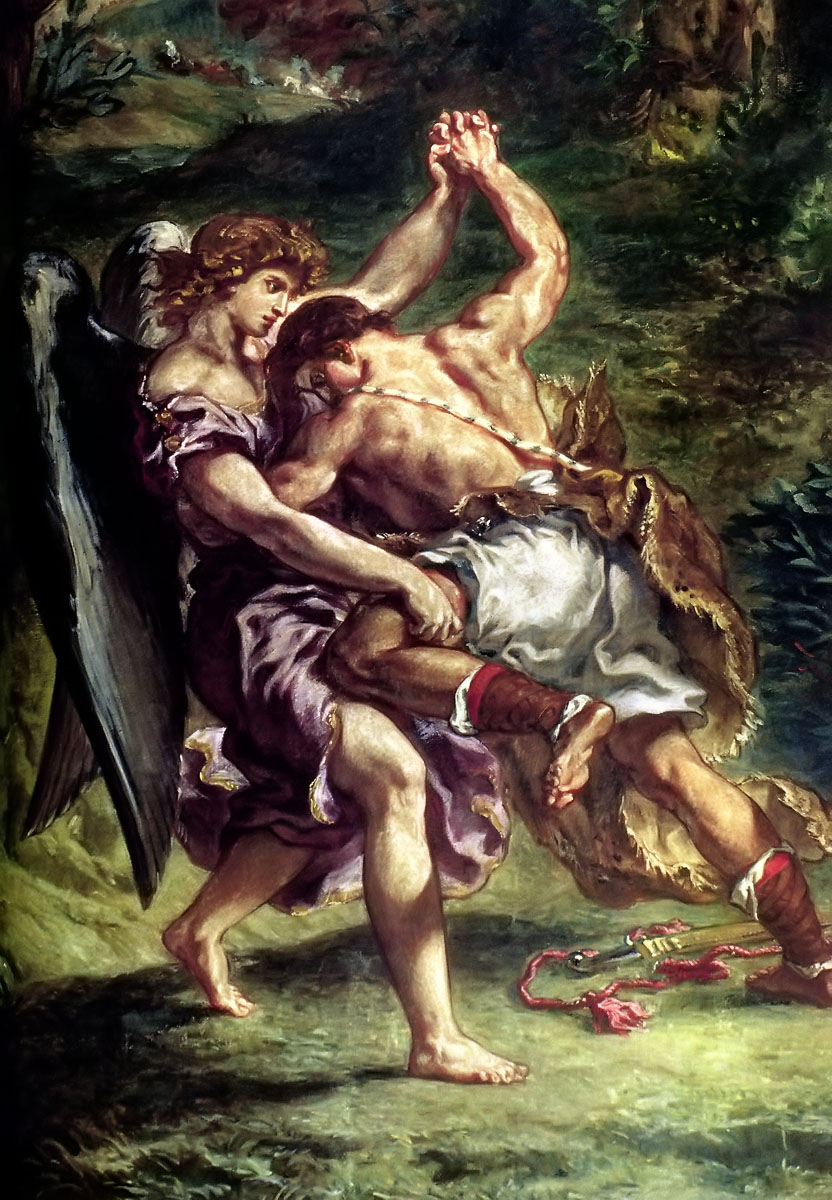
Jacob Wrestling with the Angel, Eugene Delacroix c. 186122 The same night [Jacob] arose and took his two wives, his two female servants, and his eleven children, and crossed the ford of the Jabbok. 23 He took them and sent them across the stream, and everything else that he had. 24 And Jacob was left alone. And a man wrestled with him until the breaking of the day. 25 When [he] saw that he did not prevail against [him], he touched his hip socket, and Jacob’s hip was put out of joint as he wrestled with him. 26 Then he said, “Let me go, for the day has broken.” But [he] said, “I will not let you go unless you bless me.” 27 And he said to him, “What is your name?” And he said, “Jacob.” 28 Then he said, “Your name shall no longer be called Jacob, but Israel, for you have striven with God and with men, and have prevailed.” 29 Then Jacob asked him, “Please tell me your name.” But he said, “Why is it that you ask my name?” And there he blessed him. 30 So Jacob called the name of the place Peniel, saying, “For I have seen God face to face, and yet my life has been delivered.” 31 The sun rose upon him as he passed Penuel, limping because of his hip. 32 Therefore to this day the people of Israel do not eat the sinew of the thigh that is on the hip socket, because he touched the socket of Jacob’s hip on the sinew of the thigh.

In the name of the Father and of the Son and of the Holy Spirit. Amen.

Ladies and gentlemen, welcome to the main event.

In this corner, we have a husband of two and father of eleven sons. But don’t let the fact that he is a family man fool you. He’s been a fighter all his life. Even in his mother’s womb, he was scrapping with his twin brother. He fights dirty and knows how to prey on weakness. He’s so ruthless that when that same brother was famished, he used food to steal a birthright. When his father was nearly blind, he covered himself with animal skins to steal a blessing. The meaning of his name says it all; I give you Jacob, the Deciever, son of Isaac.

And in this corner, we have a stranger. But don’t let his anonymity fool you either. He’s more powerful than any other being in all creation. When He looks defeated, watch out. He has finishing moves that will cripple you for the rest of your life. Before Abraham was, He is. The Alpha. The Omega. The Beginning and the End. I give you, the pre-incarnate Messiah – Jesus.

We are given front-row seats to this bout. Jacob has divided his family and sent them across the river. He is alone for the night to think about what will happen the next day when he will meet Esau, his brother. The last time Jacob saw any of his immediate family, his mother warned him that Esau was comforting himself with the thought of killing him (Gen. 27:42).

Suddenly, a man springs out of the bushes. And Jacob finds himself wrestling all night. Now, the Scripture doesn’t give us a very good play-by-play of the fight – at least not for the radio. V. 25 is full of ‘he’s’ and ‘him’s.’ But, the text makes it clear. Jacob prevails over Jesus (see also Hosea 12:3-4). But then, suddenly, the Man touches Jacob’s side. BAM! And Jacob’s hip is dislocated.

And the ‘he’s’ and ‘him’s’ continue in v. 26. He said, “Let me go, for the day has broken.” Who said that? Could be Jesus, but it could be Jacob. “I will not let you go unless you bless me.” Who said that? Could be Jacob, but it could be Jesus. And if it is Jesus, and I just want you to consider the possibility, Jesus is saying, “I will not let you go until you trust and believe in Me.”

Jesus asks Jacob for his name. And Jacob gives it to him, “My name is Deciever.” And Jesus says, “Your name will no longer be Deciever, but Israel,” which means ‘God fights.’

Jacob asks for the Man’s name, but he doesn’t get it. It seems as though that Jacob is still trying to be tricksy. The common thought back then was that if you knew the name of a god, you could control him. But Jacob doesn’t get the name. He doesn’t get to control Jesus.

So, what does this have to do with you? Should you be like Jacob and wrestle with God in prayer? Should you never give up until you make God answer all your prayers and bless you?

No. No, you are not stronger than God. Even though Jacob prevailed over Jesus in this wrestling match, it is clear who was in charge. At any point, Jesus could have ended the match by blasting Jacob into orbit.

For his whole life, Jacob had been relying on his own cunning and deceit. He had relied on his manipulation of others and his dirty tactics to make sure he always ended up on top. But in this wrestling match, God wanted Jacob to see that even when Jacob won, it was because of what God was doing by fighting for him. And by changing Jacob’s name to Israel, God cements that fact into Jacob’s very identity.

God fights, and He fights for you. It was God who promised our first parents that He would fight for them by sending the Seed who would crush the serpent’s head. It was God who fought against Pharaoh and delivered Israel out of bondage and slavery in Egypt. It was God who fought with the pagan nations who inhabited the Promised Land.

And it was God who took on the greatest fight of all, but in the strangest way imaginable. A Baby came to earth in a manger. That Child grew up and fought with the devil as he threw all his best moves tempting Jesus to fall into sin. Jesus beat Satan up there, but His final victory came when Jesus went to the mat of the cross facing your greatest foes.

Passion of Christ on the CrossLoaded with your sin and the sin of the whole world, He fights to the very end, to the last breath. And the fight looked lost. Jesus looked like a loser – dead, lifeless, buried. But, even in that apparent defeat, He rose victorious.

And Jesus keeps fighting. He fights for you. Jesus fights your enemies: sickness, sorrow, sin, and Satan. You may think that you face your enemies alone because God has abandoned you. He has not. You may feel like you are helpless, friendless, defenseless. You are not. You might even be tempted to believe that your worst enemy is God Himself. You would be wrong.

God is your wrestler. He is the one who fights for you. He will never leave you or forsake you. Jesus says that you are His. He has given you eternal life, and no one will snatch you from His victorious, nail-pierced hand (Jn. 10:28). Amen.

The peace of God, which surpasses all understanding, will guard your hearts and minds in Christ Jesus. Amen.