
No Half-Hearted Savior – Sermon on Matthew 22:34-46 for the Eighteenth Sunday after Trinity

Matthew 22:34-46

In the name of Jesus. Amen.

You heard it twice today, “You shall love the Lord your God with all your heart and with all your soul and with all your mind” (Mt. 22:37; cf. Dt. 6:5). You might hear “heart, soul, and mind” and think Jesus is giving you a checklist. And you might hear the “all” before each of those as a gauge to measure how much is in each tank. So, you might check the ‘love tank’ of your soul to see if it’s full or if it’s running on fumes. Or, you might think it would be beneficial to siphon some fuel from your ‘heart tank’ to make up for the deficiency in your ‘mind tank.’

That way of thinking can send you down a rabbit trail and end up missing the point Jesus is making. For one thing, when Jesus talks about your heart, soul, and mind, He’s not talking about different ingredients that make up who you are. God didn’t take one part heart, one part soul, and one part mind, mix it together, and poof—there you are. That would leave out your body. When God created Adam, the first part He fashioned was Adam’s body; then, He breathed the breath of life into Adam (Gen. 2:7). God made a body first. The love He commands here is an action that has to be done with a body.

The Bible will regularly use each of these terms—heart, soul, and mind—to talk about you as a whole. Let me walk through each of these, but we’ll spend the most time on the heart.

When we talk about someone’s heart today, it’s usually the center of emotions. But that isn’t the way the Bible talks about the heart. In both the Old and New Testament, the heart is the center of who you are. It’s the place where you understand things. The Scripture does say that the heart has emotion, but there’s also thinking. Proverbs will talk about the heart of a man planning his way (Pr. 16:9). When people grumble after Jesus absolves the man lowered from the roof before healing him, Jesus asks them, “Why do you think evil in your hearts?” (Mt. 9:4). After the shepherds visit newborn Jesus, Mary treasures up all these things, “pondering them in her heart” (Lk. 2:19). You can think of the heart as the center of who you are, the fountain of what you love and what you understand (Heb. 4:12).

Your soul is not a spare part added to your heart. Your soul is your breath and what makes you alive (Ps. 146:4; Gen. 2:7; 35:18; 1 Kgs. 17:21-22; Lk. 8:55; Jn. 19:30; Act. 7:59). Scripturally speaking, your mind doesn’t equal your brain. Your mind is where you think, but your mind also resides in the heart. In a sense, all three—heart, soul, and mind—are all of you. Your whole self.

But also know that your heart, soul, and mind don’t just sort of hang out inside of you. They move your body. Without the body, love can’t act. Don’t let the first and great command be something no one can see. You don’t keep the first and great command by feeling or thinking something about or toward God. That’s why Jesus doesn’t leave things there.

The lawyer asked for one command. Jesus gave him two. “And a second is like it: You shall love your neighbor as yourself” (Mt. 22:39). This isn’t ust a bonus command or additional hobby for people who have finished loving God. The second is like it. The love that loves God with all the heart, all the soul, and all the mind doesn’t stay there. It spills out and loves the neighbor. The mouth speaks. The hands serve. That’s how your love for God becomes something that can actually be seen.

You love God by loving the neighbor God has given you, and you do that loving with a body. The second is like the first because the first was never meant to be invisible. Love of God that never results in love of your neighbor is a false love that does not love God with the whole heart, soul, and mind. A person who withholds love from the neighbor he can see is not loving the God he cannot see (1 Jn. 4:20). The two directions of love—love toward God and love toward neighbor—hang together. On these two, Jesus says, depend all the Law and the Prophets (Mt. 22:40).

That’s why you can’t hear these words without being convicted. You know the shape and direction of this love. If the love of God is something that only stays up in your head and never gets to your hands and out to your neighbor, that’s a problem. That is sin. We have a word for that—half-hearted. The heart never put the body to work. That leads to your neighbor only getting a meager portion of love from you. Half a conversation. Half a patience. Half a mercy. 

The Law doesn’t ask you to feel warmly about God in private and then do your best toward people. The Law demands all of you, aimed at God, and landing on the person God puts next to you through what your body does. You haven’t done that, not even on your best day. Repent.

Repent and remember what God does with these two great commands. He doesn’t love you from a distance. He doesn’t just think nice things about you while He sits up in heaven. No, the Son of God became your neighbor. He took on flesh and dwelt among us (Jn. 1:14). He took a body so He could do the love and not only think it. The One who demands, “Love your neighbor,” is the God who left His throne, took a body, and became your Neighbor.

Jesus wasn’t half-hearted when He loved you. He loved you with His whole heart, whole soul, and whole mind. That whole self took a body so He could love. Christ set His face to go to Jerusalem (Lk. 9:51) knowing what was waiting there. He went anyway.

Jesus’ mind was whole. He did not scramble while these lawyers tried to test Him. He pointed them to Himself as David’s Son and David’s Lord. The Messiah stood in the flesh before them. But they refused to believe and had no answer (Mt. 22:42-45).

Jesus’ soul was whole. On the night He is betrayed, He does not desperately cling to His life. He gives it to the disciples and His Church throughout all generations saying, “This is My body. This is My blood.” A half-souled man would have been arranging an exit. Jesus doesn’t.

Christ’s heart was whole, even when He asked in the garden, “My Father, if it be possible, let this cup pass from Me” (Mt. 26:39). And when the Father made it clear that it wasn’t possible, Christ does not waver. He prayed, “Not as I will, but as You will.” Then, Christ, your Neighbor, went all the way to the cross for you and for all who have not loved either Him or each other.

That is the love you could not see, made visible. God’s love for you didn’t remain a mood He had for you up in heaven. Out of His love for you, God came down. His love for you is revealed in a body in the ditch of your sin, hands that touch what is unclean, feet that do not turn aside, a face set to go to Jerusalem and to the cross to save you (Lk. 9:51; Is. 50:7). God loved you by becoming the neighbor His command describes, and He did it with all of Himself in a body.

Because He did that, you are not left to manufacture a sham kind of love out of a divided heart, a love that stays inside and never acts. No, you now draw strength from Him. Christ did not save a slice or portion of you. Jesus took a body, and He still has it. He used His whole body to save your whole body. And He gives His body to you today, so He will raise your whole body on the Last Day.

He saves you—heart, soul, mind, eyes, fingers, knees, elbows. He forgives the eyes that have looked where they should not. He has mercy on the fingers that tried to cling to what they should have given to others. He cleanses the knees that have bowed to other things. He restores the elbows that preferred to rest rather than do the work of love. He redeemed all of that. And He will raise all of that. His plan is to have you, all of you, forever.

Dear saints, now you live a life that is shaped by the love of God who has neighbored you. You love Him because He first loved you by coming near in a body (1 Jn. 4:19).

Loving the Lord your God with your whole heart, soul, and mind and your neighbor as yourself is His will for you. No, you won’t do it perfectly. The Law will still accuse you of what is half-done. But you are not left to try to climb your way back to God. You have been redeemed and saved by His great love for you.

Dear saints, you do not have a half-hearted Savior. When God became your neighbor, He was resolute. Heart, soul, mind, and body, all of it, for you. From that strength, love God. From that strength, love the neighbor He has given you with the body He has redeemed. He will keep the whole of you—eyes, fingers, knees, elbows, heart, soul, and mind—until you arrive at the resurrection and the life of the world to come. Amen.

The peace of God, which surpasses all understanding, will guard your hearts and minds in Christ Jesus (Php. 4:7). Amen.
Saintly Geometry – Sermon on Ephesians 3:13-21 for the Sixteenth Sunday after Trinity

Ephesians 3:13-21

In the name of Jesus. Amen.

When someone is learning to ride a bike, they need to learn how to balance, how to keep up their speed, and how to stop. Those are the most basic things, but they need to learn other things too. Another dimension of riding a bike is knowing where to look. If a rider looks at the wrong thing, it can lead to a crash. There’s actually a term for it—“target fixation.” Fighter pilots in World War II had to be taught not to lock their focus on the target, or they would fly right into it. Your hands follow your eyes. Pilots, motorcycle riders, and bikers are still taught the dangers of target fixation. A bicyclist has to learn not to stare at the pothole, the mailbox, or the parked car. If they fixate on the thing they are trying to miss, they will drift straight into it. Yes, notice potholes, mailboxes, and cars. Just don’t make them the thing you look at.

Here, the Ephesians are staring at a pothole. Paul, the man who brought the Gospel to them and founded their congregation, was in prison. He’s suffering on account of the Gospel, and they can see it. They see trouble and start doing what comes naturally to all of us. They get fixated on it and start to measure the trouble. How deep is the trouble? How long will it last? Will it spread? Will they also end up in prison? Or will they face something even worse?

Paul knows they are fixated on the wrong thing, which is why he writes, “Do not lose heart over what I am suffering for you, which is for your glory” (Eph. 3:13). Paul isn’t trying to put a positive spin on his suffering or make it sound like everything is just fine. He doesn’t deny it’s happening. But he doesn’t want the Ephesians to fixate on it. He refuses to let suffering be the only thing they measure.

We naturally measure our pain. We stretch our measuring tape across the height, depth, breadth, and length of our troubles. Then we let our hearts live inside those numbers. We could produce an exact 3D rendering of our troubles because we will fixate on them for weeks or months or years. It’s no wonder we keep drifting toward them.

Notice what Paul prays for here. He drops to his knees before the Father to ask for strength for the Ephesians and for you. He asks that, according to the riches of God the Father’s glory, you would “be strengthened with power through the Holy Spirit in your inner being, so that Christ may dwell in your hearts through faith” (Eph. 3:16-17).

The first thing Paul asks for is not that his prison door would open. He prays that the people who are worried about his imprisonment would be strengthened to measure something other than suffering. And the thing he wants them to measure is too big for a weak heart to measure. They will need some help, strength, endurance, and focus to measure Christ’s love.

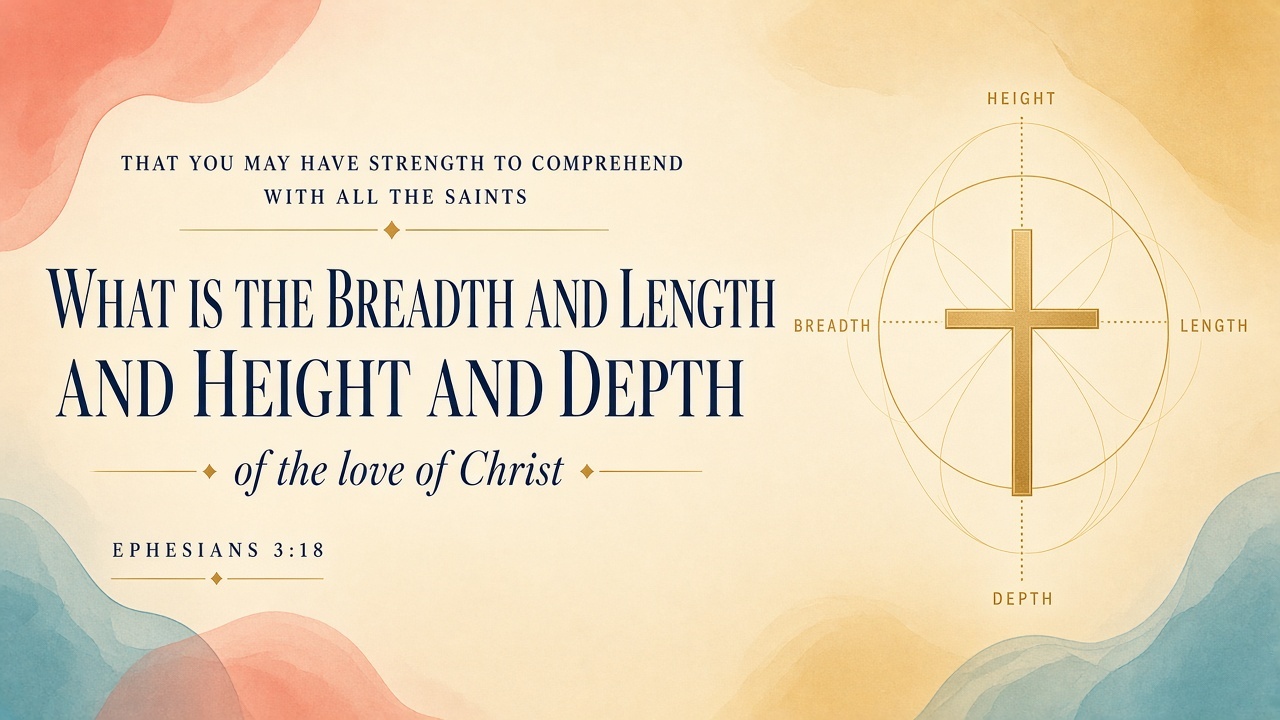
Look at v. 17-19 to see the rest of his prayer. “That you, being rooted and grounded in love, may have strength to comprehend with all the saints what is the breadth and length and height and depth, and to know the love of Christ that surpasses knowledge, that you may be filled with all the fullness of God” (Eph. 3:17-19).

God repeatedly does this in Scripture. There are several times God hands someone a measuring rod when things look hopeless. In a vision, Ezekiel is told to measure the Temple while he is in exile (Ezek. 40:3-5). Zechariah has a vision of a man measuring Jerusalem while it is still a pile of wreckage (Zech. 2:1-5). John is told to measure the Temple of God and those who worship there in the middle of tribulation (Rev. 11:1-2). When it would be natural to simply stare at the wreckage, God will tell people to, “Measure what I have claimed, even before you see it restored.” Here, Paul is handing you the same kind of rod.

So, here’s some saintly geometry for you. Four dimensions: breadth, length, height, depth. He wants them (and you) to measure the immeasurable love of Christ.

Measure its breadth. How wide is the love of Christ? His love is as wide as the world He died for. He is the Lamb of God who takes away the sin of the world (Jn. 1:29) and the propitiation—the atoning sacrifice—for our sins, and not for ours only but for the sins of the whole world (1 Jn. 2:2). No matter how far you drift, Christ’s mercy reaches wider than your wandering.

Measure its length. How long has this love been after you? Paul opened this letter by saying that, from before the foundation of the world, He chose you in Christ (Eph. 1:4). Through every year you can remember all the way to eternity, He who began a good work in you will bring it to completion at the day of Jesus Christ (Php. 1:6). This love was there from eternity past and continues with you until the Last Day. And even after the Last Day it doesn’t run out.

Measure its height. How high has He lifted you? You were dead in your trespasses and sins, but He made you alive together with Christ and seated you with Him in the heavenly places (Eph. 2:1, 5-6). Death looked like the highest wall imaginable. Christ’s love soared over it.

Measure its depth. How deep has Jesus come for you? He came all the way down to earth when He took on flesh for you. But Christ went deeper. He humbled Himself by becoming obedient to the point of death, even death on a cross (Php. 2:8).

Already, that’s a lot of measuring, and it has only scratched the surface. Paul knows that. That’s why he says that the love of Christ surpasses knowledge. Did you catch that in v. 19? Paul wants you to know something that surpasses your capacity to know—the love of Christ. He wants you to be rooted and grounded in that love. Those words—rooted and grounded—are the right words here. A tree doesn’t study to get a degree in soil science. It simply lives in the soil. Christ’s love is the soil God wants you to live in. Sink your roots deep.

Paul says you don’t take this measurement alone but “with all the saints” (Eph. 3:18). You are not the first one holding the rod. The saints who have already finished the race are not measuring their troubles anymore. They are measuring His love, and they are not disappointed.

What he prays for the Ephesians, he prays for you. He asks that God the Father would grant you strength “according to the riches of His glory” (Eph. 3:16). This strengthening happens as the Holy Spirit gives you strength and as Christ dwells in your heart through faith.

And there’s no sugarcoating here. This doesn’t make the suffering go away. Paul was still in prison when they finished reading his letter. But this saintly geometry—the breadth and length and height and depth of Christ’s love—reorients you. Look there. Your heart will follow.

“Now to Him who is able to do far more abundantly than all that we ask or think, according to the power at work within us, to Him be glory in the Church and in Christ Jesus throughout all generations, forever and ever” (Eph. 3:20-21). Amen.

The peace of God, which surpasses all understanding, will guard your hearts and minds in Christ Jesus (Php. 4:7). Amen.

Following the Shepherd – Sermon on 1 Peter 2:21-25 for the Third Sunday of Easter

1 Peter 2:21-25

Alleluia! Christ is risen! 
He is risen indeed! Alleluia!

In the name of Jesus. Amen.

This may or may not shock some of you, but I am old enough that I learned how to write in cursive in elementary school. My 2nd Grade teacher, Mrs. Ranum, would walk across the front of the classroom, lick her fingers to count out the right number of worksheets, plop them on the front desk of each row, and say, “Take one and pass the rest back.” Then we would spend time tracing those dotted lines with all the curves and loops. We’d swoop and swish across those lines again and again. All of that tracing was designed to give our young fingers and wrists the muscle memory so our letters would be legible.

Those dotted lines were the standard we all started with. But over time each of us developed our own unique style—some more legible than others. No two people have identical handwriting. 

Here in our text from 1 Peter, the apostle refers to Jesus as our “example,” and the Greek word he uses is hypogrammos. This word appears only here in the entire New Testament. Literally, it means something you write over or trace—like those dotted lines on the worksheets Mrs. Ranum handed out. When you trace something, there are many different ways to start and finish the strokes. Some are smoother than others. But the goal is always the same: your writing should resemble the the original.

Notice that Jesus is our hypogrammos in a very particular way. Peter is not calling us to trace Jesus in every way. You don’t trace Him so that you get left in the temple at age twelve, or walk on water, or multiply loaves for thousands of people, or heal the sick, or raise the dead. And it’s good that Peter isn’t calling you to trace Jesus in those ways, because you can’t do any of those things. Sure, God could do some of them through you, but none of those things are on Peter’s radar here.

Instead, the focus is to trace Jesus in the way He endured suffering—like a sheep before its shearers is silent (Is. 53:7). The verse just before our text says that when you do good and suffer for it and endure, this is a gracious thing in the sight of God (1 Pet. 2:20).

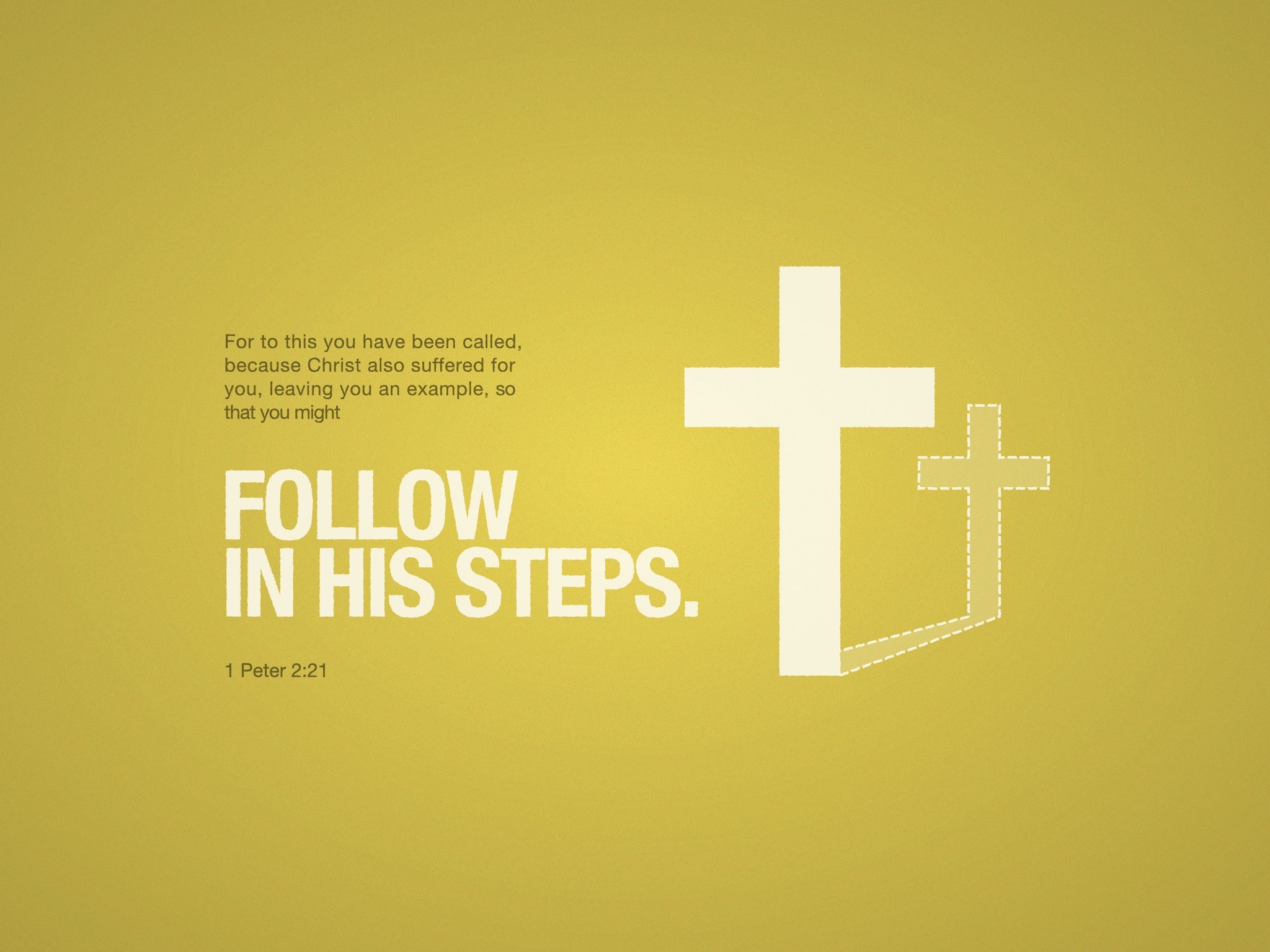
That is the kind of suffering to which you have been called. Because Christ also suffered for you, leaving you an example—a hypogrammos, a pattern to trace—so that you might follow in His steps. Jesus committed no sin, and absolutely no deceit in was found in His mouth. He spoke pure, unfiltered truth. And He suffered for it. When He was reviled, He did not revile in return. When He suffered, He didn’t threaten. He simply trusted that God would judge justly. In and through all of that, Jesus Himself bore your sins in His body on the tree, that you might die to sin and live to righteousness. By His wounds, you are healed (1 Pet. 2:21-24).

Dear saints, Peter wrote these words to Christians who felt like exiles and aliens in their own world and like scattered sheep far from home. Many of them were servants living under masters who could be harsh and unfair. For them, suffering was not theoretical. It was a daily reality. And Peter doesn’t coat it. He says plainly, “This is what you have been called to do.” Because following Jesus, your Shepherd, means walking in His steps, and those steps often lead through pain and suffering because we still live in a broken world.

But look at the pattern your Shepherd left—the hypogrammos that we are to trace. First, He was completely innocent. “He committed no sin, and no deceit was found in His mouth.” That’s an echo of the Suffering Servant song in Is. 53. Jesus didn’t deserve a single lash, a single insult, a single nail. Yet He took it all like a lamb led to the slaughter (Is. 53:7) without fighting back.

When they hurled insults at Him during His trial and on the cross, He didn’t fire back with clever comebacks or righteous anger. The soldiers mocked Him. The crowd shouted, “Crucify!” Even the thieves crucified beside Him joined in the abuse (Mt. 27:44). Yet, through all of that, Jesus remained silent. He didn’t threaten. Instead, He entrusted Himself to the One who judges justly. He prayed, “Father, forgive them” (Lk. 23:34). He handed all of His suffering over to His heavenly Father.

You and I can’t do exactly as Jesus did. We can’t do this without sin. We can’t shed holy, perfect blood to pay the price for the sins of the world. We can’t do that. But we can trace His pattern and follow His steps. We don’t have to demand our rights. Instead, we can quietly entrust ourselves to the God who sees every injustice.

Now, before we go any further, let’s be clear about what this is not. This is not a call to ignore evil. It does not mean you must stay in situations where you or your children are in danger. Peter is not giving a blank check for evil to run rampant. Instead, he is speaking to believers who are already doing good and suffering for it anyway. When the world hates you simply because you belong to Christ; when standing for truth costs you friends, or a promotion, or respect in the community—keep tracing your Shepherd’s steps. Do not repay evil with evil. Do not let bitterness take root. Instead, entrust yourself to the Judge who sees it all.

The reason we can do this is that Jesus didn’t just leave us an example. He has also given us the power to follow Him. The power of His own resurrected life. Look again at v. 24, “He Himself bore our sins in His body on the tree, that we might die to sin and live to righteousness. By His wounds you have been healed.”

Jesus is more than a model on the page. He is your Substitute. Dear saints, you have the comfort of knowing what Christ accomplished on the cross is for you and your eternal destiny. He took your wandering. He took your straying like sheep. He took your selfish instincts to either strike back or run away—He carried all of it in His own body to the cross. The stripes that should have fallen on us fell on Him. The death we deserved, He swallowed whole. And by those wounds you are healed. You are forgiven. You are made new.

That healing isn’t just a feeling in your heart. It’s a real dying and rising that happens every day. You die to sin and to the urge to lash out. You die to the desire to demand your own way and to nurse grudges. Now, you live to righteousness. You live in the freedom of those who know their Shepherd has already won the victory. So you don’t need to win or prove anything. It is done. Finished.

Whatever your suffering is—whether it’s physical, emotional, or the ache of loneliness—know that it is known by your God and Savior. Know that He isn’t ignoring you or your pain. Instead, He is using that pain to shape you to look more and more like your Shepherd.

You don’t trace those dotted lines alone. Through faith you have returned to the Shepherd and Overseer of your souls. Jesus isn’t standing at a distance shouting instructions. He is your living Shepherd who goes before you. He knows every valley because He walked through the darkest one first. He gathers you when you stray. He binds up your wounds with the same hands that still bear the scars. He leads you beside still waters even when the world feels like a raging storm.

Dear saints, the call to follow the Shepherd in suffering is not a burden meant to crush you. It is an invitation into the life Jesus has already lived for you and now lives in you by His Spirit. When you fail—and we all do—He does not cast you out. He brings you back, again and again, because His sheep hear His voice and follow Him (Jn. 10:27-28).

Dear saints, whatever suffering or injustice or hardship you face, look to your hypogrammos. Trace the steps of the One who suffered for you. Entrust yourself to the Father who judges justly. Die to sin and live to righteousness. By His wounds you have been healed. You belong to the Shepherd and Overseer of your souls. And He will not—never, not ever—lose one of His sheep. Amen.

Alleluia! Christ is risen! 
He is risen indeed! Alleluia!

The peace of God, which surpasses all understanding, will guard your hearts and minds in Christ Jesus (Php. 4:7). Amen.

Faith Waits – Sermon on Matthew 15:21-28 for the Second Sunday of Lent

Matthew 15:21-28

In the name of Jesus. Amen.

Last week, we heard how the devil slithered into the Garden of Eden to tempt the woman (Gen. 3:1-21). That worm did what he always does and tried to create space between our first parents and God’s life-giving Word. And his scheme worked. They ate from the forbidden tree and fell into sin. Satan continues to do that work today. His tactic is to drive a wedge to distance you from God and God’s promises. His goal is to get you to doubt – leaving you isolated, anxious, and alone. Today, in this Gospel reading (Mt. 15:21-28), Jesus does the exact opposite work. Our Lord and Savior draws this Canaanite woman closer and closer to Himself and to God’s promises.

This mother comes to Jesus with a real problem. Her daughter is severely oppressed by a demon. At first, it looks like Jesus is the one creating space. He ignores her cries. He says that He’s only been sent for the lost sheep of Israel. He even calls her a dog. There’s no debating that Jesus is putting her through the ringer here. It looks like she should just quit and go home with a crushed spirit. But Jesus knows exactly what He’s doing. He knows and loves this woman and her daughter. He had come to redeem them and shed His blood for all their sin, just as He has come to redeem you from yours.

To see this, let’s try an analogy: Imagine an old tin bucket. It’s corroded, dented, and has several holes. That bucket can’t hold water, which is what a bucket is designed to do. To keep that bucket from running dry, it needs to be filled constantly. Dear saints, that’s us. We leak continuously. We have an inherited rustiness from the Fall and our original sin. The worries of this world keep poking more and more punctures into us. Disappointments open new cracks. Our sinful actions open up more holes. Satan’s accusations evaporate us like a blow torch. All of this empties us and would leave us bone-dry and bouncing through the desert of this fallen world. So, what’s the fix?

Well, according to Christ, we should learn from this woman. Jesus holds her before our eyes as an example by praising her, “O woman, great is your faith” (Mt. 15:28). That should get our attention. She is an example because she plants herself right next to Jesus, the Fountain of Living Water (Jn. 4:14, 7:37-38; Rev. 21:6). Even though it looks like the stream of God’s mercy that flows from Jesus isn’t for her, she presses in closer and closer and waits for the floodgates to open.

We don’t know how long this whole event takes. Matthew doesn’t tell us how long it was between the first moment she presents her problem to when Jesus finally praises her faith. It’s only eight verses, so it doesn’t take long to read. The way Matthew records this, it was probably an extended time.

It all starts with her initial plea and silence from Jesus. But she keeps crying out. You can see it in our translation in Mt. 15:22, “she was crying.” The force behind that verb is that this was a continual thing. “Have mercy on me, O Lord, Son of David!” Nothing. No response. The woman might have thought, “Maybe He didn’t hear me.” So, she cries out again, “Have mercy on me, O Lord, Son of David!” Still nothing. This keeps happening. “Have mercy on me, O Lord, Son of David!” Eventually the disciples get tired of it all. They’re probably wondering why Jesus is ignoring her. Did He suddenly go deaf? Did too much sand blow in His ears? Eventually, it seems that the woman tries to get Jesus’ attention through the disciples because they finally chime in, “Send her away, for she is crying out after us.” We don’t know how long this all went on. It could’ve been fifteen minutes; it could’ve been several hours.

But just imagine if you were there watching all of this unfold. You hear this woman asking and asking, “Have mercy on me, O Lord, Son of David!” Suppose you took this woman off to the side and asked her, “What are you doing?” She says, “Well, I’m praying.” So, you ask, “How’s that going? Is it working? Do you think it’s going to help your little girl?” She’d say, “I don’t know. He’s not answering me right now.” You might ask, “Well, why are you still praying? He’s obviously heard you, and if He was going to answer you, don’t you think that He would have by now? Why keep making a spectacle of yourself praying the same prayer over and over again?”

I mean, that’s reasonable. That’s how we conduct ourselves in normal conversations with other people. If people keep ignoring us, we just move on and go elsewhere. But this woman doesn’t do that. I think she’d respond to a statement like that by saying, “I’m waiting. I know who He is. He is my Lord. He is kind. He has come to destroy the works of the devil (1 Jn. 3:8). There is no one else who can help me. So, I’ll just keep waiting for Him.”

Finally, of course, Jesus does help her. Not only does Christ give her what she was pleading for, He also praises her. “O woman, great is your faith!” And that’s the point. Dear saints, faith presses in closer and closer to God and His promises. Faith hears (Ro. 10:17) all the things God has promised – mercy, grace, forgiveness, redemption, deliverance, eternal life. All these things are available only from one Source and that is our giving God. So, even if God seems to be ignoring our prayers and not giving what He has promised, faith waits.

This happens all over Scripture. Think of Jacob wrestling with God all night, refusing to let go until God blessed him (Gen. 32:22-32). Consider Hannah pouring out her longing for a child year after year after year (1 Sam. 1). How many of the Psalms ask some version of, “How long, O Lord?” (Ps. 13, 6:3, 79:5, 89:46, 94:3)? Dear saints, your cries to God do not – they do not – go unheard.

Faith waits even though it isn’t easy. This extremely difficult because you know that God could immediately answer every single one of your prayers quicker than you can even snap a finger. Your merciful Father could make everything perfect in the blink of an eye. The last sentence in our text says, that woman’s daughter was healed instantly (Mt. 15:28). Christ could make everything right this instant. So, why does He make you wait? I don’t know, and I’m sorry that you have to wait. But I do know that God has promised to always give you what is good (Mt. 7:11; Ro. 8:32).

What I do know is what Scripture says. We heard in our Old Testament reading (Is. 40:27-31), “They who wait for the Lordwill renew their strength.” And notice that wording. It doesn’t say, “They who wait for the Lord will become strong.” No. They will “renew their strength.” That means that strength is going to get depleted and will need to be renewed again and again and again. Think back to the rusty, leaky bucket. When your strength is depleted, when it has trickled and poured out of you, you need to be near the Source. Eventually, God will fix all your rust and cracks and holes. But not yet. For now, God lets those remain, and He promises that He will never let you run dry. He will keep filling you. He will renew you in His timing, which is not your timing. So wait, and it’s in that waiting that faith moves and presses in closer and closer to God.

Dear saints, each day has trials, and you are not equal to the task of those trials. And God’s desire is that each day you would come to Him and rely upon Him and His strength. That’s His design. His good and gracious plan is that He will be your Source of power and strength from which you dare never get far.

Wait for Him. Christ has you in His timing and in His strength. He has put all your enemies under His feet by His death and resurrection. He knows how best to rescue you. Your God, who makes these promises to you, is faithful, and He will do it (1 Th. 5:24). So, keep praying to Him, move closer to Him, and keep patiently and faithfully waiting. Amen.

The peace of God, which surpasses all understanding, will guard your hearts and minds in Christ Jesus (Php. 4:7). Amen.
At Your Strongest – Sermon on Ephesians 6:10-20 for the Twenty-first Sunday after Trinity

Ephesians 6:10-20

10 Finally, be strong in the Lord and in the strength of his might. 11 Put on the whole armor of God, that you may be able to stand against the schemes of the devil. 12 For we do not wrestle against flesh and blood, but against the rulers, against the authorities, against the cosmic powers over this present darkness, against the spiritual forces of evil in the heavenly places. 13 Therefore take up the whole armor of God, that you may be able to withstand in the evil day, and having done all, to stand firm. 14 Stand therefore, having fastened on the belt of truth, and having put on the breastplate of righteousness, 15 and, as shoes for your feet, having put on the readiness given by the gospel of peace. 16 In all circumstances take up the shield of faith, with which you can extinguish all the flaming darts of the evil one; 17 and take the helmet of salvation, and the sword of the Spirit, which is the word of God, 18 praying at all times in the Spirit, with all prayer and supplication. To that end, keep alert with all perseverance, making supplication for all the saints, 19 and also for me, that words may be given to me in opening my mouth boldly to proclaim the mystery of the gospel, 20 for which I am an ambassador in chains, that I may declare it boldly, as I ought to speak.

In the name of Jesus. Amen.

I love this text. I’ve always loved this text, but younger me really loved this text – however, for the wrong reasons. All this talk about strength, might, armor, wrestling, and facing powerful, cosmic enemies – it gets a guy’s juices flowing. It brings out the fighter and warrior in a man. Sorry if that doesn’t resonate as much with you ladies and mothers here. Maybe, you gals will need to calm down and restrain your husbands and sons and brothers after the service, so they don’t march off to conquer Manitoba or something.

The passage tells us about a war that surrounds us every moment of every day. And it’s good that it does because we would be completely unaware of this war unless Scripture told us about it. Being oblivious to a war that surrounds you is not good. The reason we would be ignorant of this war is that it isn’t a war that we can see. As we confessed in the creed earlier, we “believe in God the Father Almighty, maker of heaven and earth, and [maker] of all things visible and invisible.”

Today, we heard how in six days God created everything we can see (Gen. 1:1-2:3), but God also created things we cannot see (Col. 1:16). And, dear saints, the enemy in the war that surrounds you is in that invisible part of God’s creation. In fact, none of your enemies exist in the visible part of creation. You do not – I repeat you do not – wrestle against flesh and blood. Instead, you wrestle against the rulers, the authorities, the cosmic powers over this present darkness, and the spiritual forces of evil in the heavenly places (Eph. 6:12). And some of you men out there are thinking, “Cool, an invisible enemy! That’ll make our victory even more impressive!”

Calm down, guys. And take heart, ladies. Because, while this text is about fighting in an invisible war against an unseeable enemy, the battle plan is straightforward and simple.

Before we can even dive into that battle plan, we have to understand where this invisible war is taking place. To be ready for battle, you have to know the battlefield. And one of the ways our enemy has made us unprepared for battle is taking this text out of its context. You might be very familiar with this text, but do you know what comes immediately before it? Maybe. But, I’ll admit, that even as your pastor and as someone who gets paid to study and teach the Scriptures, I find it easy to forget the context.

The context starts back in Eph. 5:22. Paul has been laying out the callings and duties for Christians in their vocations. Christian wives are to submit to their husbands. Christian husbands are to love their wives as Christ loved the Church. Christian children are to obey their parents. Christian parents are do bring up their children in the discipline and instruction of the Lord. And so on. It’s in that context that this passage about spiritual warfare falls.

In other words, you, Christian, need recognize that the battle described here is occurring in your everyday callings, vocations, and relationships. It’s there that you need God’s strength. It’s there that you need God’s armor because that’s where the devil and demons are attacking. They are attacking both you and those around you. Your daily life is the battlefield.

You husbands, wives, parents, and grandparents. The war is happening as you earn a living, as you keep the house, as you shuttle kids around. You kids, as you go to school, as you do your homework and chores, as you interact with your friends, the battle is taking place there.

There are two points I want to make sure you take away from this sermon, and this is the first. So, listen up: There is a spiritual war raging all around you every moment of every day, and you need to be strong and aware all the time. And that leads to right into the second point: You are at your strongest and are completely prepared for this war when you stand in the Lord’s strength and in the armor that He provides.

Right off the bat (Eph. 6:10), you are told, “be strong in the Lord.” Almost all of the popular versions of the Bible will read that way, and I understand why it’s translated that way. It’s a fine translation. But the verb there “be strong” is passive. When it’s only translated, “be strong,” you might start wondering how you go about becoming or making yourself strong.

I wish our translations read, “be strengthened in the Lord, in His mighty strength.” The text is clear. God is the One who makes you strong (Php. 4:13). Earlier in Eph. 3:16-17, Paul says that, according to the riches of His glory, God Himself grants you to be strengthened with power through the Holy Spirit so that Christ dwells in your heart through faith.

Not only does God make you strong, He also clothes you in His armor. You have the belt of truth, the breastplate of righteousness, the boots of the Gospel, the shield of faith, the helmet of salvation, and the sword of the Spirit which is the Word of God. All of that, God’s strength and God’s armor, it all comes from God’s Word. God’s Word is truth (Jn. 17:17). Christ’s righteousness is given through the Word (2 Tim. 3:16-17). The Gospel is only revealed in the Bible. Faith is given through God’s Word (Ro. 10:17). The Scriptures are what make you wise to salvation (2 Tim. 3:15; Jam. 1:21).

Strengthened by God and armed with and by His Word, you are prepared for this war. But you still might wonder, “Am I properly trained for the war? What are my duties?” Well, you aren’t told to march off to war. You also aren’t told to retreat. Instead, four times in this text, you are told what your assignment is in the battle. You are to stand (Eph. 6:11, 13-14). The picture Paul is giving is that you are a particular kind of soldier – a sentry, who stands guard over the kingdom.

The picture of this passage is this: Christian, you are God’s soldier. As God’s soldier, your responsibilities are simple. You are a sentry who guards the holy ground of God’s kingdom. And God has placed you in a particular place – where no one else is stationed. You are there to watch and to pray. In other words, when the enemy attacks, you are not supposed to go off and fight alone. No. Instead, you stay in your post. You stand in God’s strength and in the protection of His armor. And you pray. With that prayer, you call in the reinforcements of the Lord’s army.

When you see the war raging around your spouse, your children, your parents, or any neighbor – stand your ground, man your post, and pray. You, dear saints, stand in the Lord’s strength and protection. And when the battle gets in close, take up the sword of the Spirit, the Word of God. Wield that sword against the devil, and he will flee.

Psalm 35 opens with a beautiful prayer for you to use in the battle. “Contend, O Lord, with those who contend with me; fight against those who fight against me! O Lord, take hold of shield and buckler and rise for my help! Draw the spear and javelin against my pursuers! Say to my soul, ‘I am your salvation!’” Christ Himself is the One leads the charge against your enemies, and He turns over His shoulder to remind you that He is your salvation. Amen.

The peace of God, which surpasses all understanding, will guard your hearts and minds in Christ Jesus (Php. 4:7). Amen.

Waiting & Receiving – Sermon on Isaiah 40:25-31 for the Fourth Sunday of Easter

Isaiah 40:25-31

25 To whom then will you compare me, 
that I should be like him? says the Holy One. 
26 Lift up your eyes on high and see: 
who created these? 
He who brings out their host by number, 
calling them all by name; 
by the greatness of his might 
and because he is strong in power, 
not one is missing. 

27 Why do you say, O Jacob, 
and speak, O Israel, 
“My way is hidden from the Lord, 
and my right is disregarded by my God”? 
28 Have you not known? Have you not heard? 
The Lord is the everlasting God, 
the Creator of the ends of the earth. 
He does not faint or grow weary; 
his understanding is unsearchable. 
29 He gives power to the faint, 
and to him who has no might he increases strength. 
30 Even youths shall faint and be weary, 
and young men shall fall exhausted; 
31 but they who wait for the Lord shall renew their strength; 
they shall mount up with wings like eagles; 
they shall run and not be weary; 
they shall walk and not faint.

Alleluia! Christ is risen! 
He is risen indeed! Alleluia!

In the name of Jesus. Amen.

One of the greatest spiritual dangers that we all face is that, as we go through difficulties in life, we forget very obvious things – especially the fact that God loves us and is in control of all things. But it’s not as though you’ve actually forgotten it. It’s just that you don’t believe it. You don’t live your life in what you know to be true.

Smack in the middle of this text, God asks a question, and it sounds like He asks it out of frustration. “Why do you say, ‘My way is hidden from the Lord, and my right is disregarded by my God.’?” God doesn’t even wait for an answer. Instead, He addresses His question with a question. “Have you not known? Have you not heard? The Lord is the everlasting God, the Creator of the ends of the earth. He does not faint or grow weary; His understanding is unsearchable.”

Your God doesn’t wear out like you and I do. It’s not as though He needs to go sit in His lazy chair and kick His feet up to take a nap. He never encounters a situation where He isn’t quite sure what to do. We have known and we have heard that God is everlasting, that He is the Creator of the ends of the earth who does not grow faint or weary. We know that God has infinite understanding, that He gives power to the faint and strength to the weak. Our problem is that we don’t live like that is true. We encounter difficulties and live as though God does none of those things.

Dear saints, your God created every single star in the universe. Scientists guess that there are somewhere between 100-400 billion stars in our Milky Way galaxy. They don’t know the exact number, but that’s the estimate. Think about this – even if we took the small end of that estimate – if it only took God one second to name each star, 100 billion seconds is equivalent to 3,171 years, 66 days, 17 hours, and 46 minutes. And that’s just our galaxy.

Scientists estimate that there are between one to two trillion galaxies. Honestly, it wouldn’t surprise me that as we learn how to look farther we found out that the universe is even bigger than that. And it was nothing for God to create all those things. God created all of those things simply by speaking, “Let there be lights in heavens,” (Gen. 1:14) and there they were. Every one of them with a name and carefully placed in its position by your mighty God.

Now, contrast that with how God created you. When God created Adam, He didn’t simply speak. He got down into the mud and dirt and dust. He molded, formed, and shaped you from that dust and breathed into your nostrils the breath of life (Gen. 2:7). He intricately knitted you together in your mother’s womb (Ps. 139:13, 15).

Beyond that, God saved you by taking on your flesh and blood. He entered into His creation and subjected Himself to the weariness and fatigue that you endure (Jn. 4:6). Christ knew suffering and pain (Is. 53:3). Jesus did all of this to step between you and the wrath of God that you and I deserve because of our sin. He came to die and rise again in order to win you as His own.

In other words, God is much more invested in you than all the rest of creation. He’s more interested in what goes on in your life and what happens with you than with all the stars and galaxies that He calls by name. Again, we know this, but by the way we often live, it sure doesn’t look like it. Instead of waiting upon the Lord and soaring like eagles, we flap around like chickens.

I’m no expert on chickens, but the few times I’ve seen them “in flight” it’s pretty unimpressive. When they do get airborne, it’s usually because they’ve jumped as high as they can. They beat their wings – feathers flying all around. And the best they can do is just to fall less quickly. That’s the picture of us when we aren’t waiting upon the Lord. The best we can do in our own strength is fall a bit slower.

Eagles are completely different. This past Tuesday, Sarah and I just got to watch three eagles soaring in the distance. I don’t know what they were looking at, but for, maybe, five minutes they kept circling round and round. They would swoop down periodically, but then they would ascend on the invisible updrafts. The whole time we watched those eagles, none of them flapped their wings even once. They were just lifted by those updrafts. Those huge birds didn’t need to extend any effort to fly.

Dear saints, that is the picture of those who wait upon the Lord. This waiting on the Lord isn’t simply marking off time and watching the minutes and seconds tick by. This waiting is living in a confident expectation of God’s action on our behalf. This waiting is simply resting in God’s mercy which lifts us up to heaven. Romans 4:5 puts it this way, “To the one who does not work but believes in Him who justifies the ungodly, his faith is counted as righteousness.”

I’ll confess my own weakness in this. I’m not good at waiting. I don’t like doing it. I don’t have the patience I should have. Waiting is difficult, and I suspect this is true for all of us. We wrongly live as though everything around us is dependent upon our work, our effort, our wisdom. We think we have to get everything figured out on our own. It’s exhausting. Waiting might feel like we’re descending or, even, free-falling. But this waiting is waiting in faith where we receive from God, and He lifts us up.

I want to change gears for a minute to talk about this upcoming sabbatical. Dear saints, my prayer for this sabbatical is that all of us would come to a better understanding that this is God’s congregation and that He is more interested in His Word being proclaimed here than we are. I’ll confess that I start to slide into the sinful attitude that certain things are dependent on me and what I do. If that were actually the case, you, dear saints, are in deep trouble.

So, during this sabbatical, I’m going to do my best to rest. In 1 Co. 3:5-7, Paul tells the congregation in Corinth that he and other pastors are nothing. He says, “I planted, Apollos watered, but God gave the growth. So neither he who plants nor he who waters is anything, but only God who gives the growth.” This sabbatical will help all of us remember that.

God loves His church. He loves this congregation. He is more ready to give than we are to receive. So, thank you for the gift of this sabbatical so I can stop, wait, and receive from God for an extended time. I trust that God will use this time to renew and refresh me in ways that will benefit me and in ways that will benefit you.

May God remind all of us that when we are weary and exhausted that He is our strength. He is the One who lifts us up by His mercy and grace. His incomparable love carries us along. He protects and keeps us. He grows His church. He forgives our sins. He makes a place for us in eternal life through His inexhaustible love and work for us in Christ Jesus. May we all wait and receive from Him. Amen.

Alleluia! Christ is risen! 
He is risen indeed! Alleluia!

The peace of God, which surpasses all understanding, will guard your hearts and minds in Christ Jesus. Amen.

The Medicine – Sermon for Maundy Thursday

The Scripture readings for tonight’s service are Exodus 12:1-14; 1 Corinthians 11:23-32; and John 13:1-15, 34-35.

In the name of Jesus. Amen.

When a doctor gives you a prescription for medicine, it doesn’t really matter if you understand how the medicine works. It doesn’t matter if you understand how that medicine is made. You don’t need to know exactly what that medicine does in your body. The only thing that matters is that the doctor who says, “Take this. It will heal you,” is right and that you actually take it.

Tonight, your Savior, Jesus Christ, the Great Physician, has a prescription for you, and it is the medicine of immortality.

So, we have to ask, “Is Jesus’ Word trustworthy?” Yes; absolutely yes! The power of Jesus’ Word is seen when He created everything (Jn. 1:3). In the beginning, God spoke, “Let there be light,” and there was light (Gen. 1:3). The power of Jesus’ Word is on full display throughout His life. When Jesus says something, it happens – always. When He speaks to paralytics, “Take up your bed and walk,” that powerful Word heals limbs that didn’t work (Mk. 2:11-12; Jn. 5:8-9), and it happens. When Jesus says to the wind and waves, “Peace, be still,” (Mk. 4:39), it happens. When Jesus hands the disciples five loaves of bread and two fish to the disciples and says, “Use this to feed thousands of people,”(Lk. 9:16), it happens. When Lazarus has been dead in his tomb for four days and Jesus tells him, “Lazarus, come out,” (Jn. 11:43-44), he does. There’s no question that Jesus’ Word is powerful and does exactly what Jesus says.

So, when Jesus says to you tonight, “Take eat; take drink. This is for you for the forgiveness of sin,” does His Word have the power to forgive? Yes. When Jesus says, “This is My Body; this is My Blood,” does His Word have the power to make the bread and wine His Body and Blood? Yes. Do we have to understand how it works? No. Not at all. If Jesus wanted us to understand the how, He would’ve told us. But He didn’t, so we simply believe His Word.

Sure, it seems strange that eating and drinking the elements of Communion would do something spiritual like forgiving sin. Most of the things we eat are for physical benefits. We eat to fuel our body and give it the nutrients, vitamins, and minerals it needs. But eating food and having it do something spiritual sounds strange. But it shouldn’t. Remember how sin and death entered the world? Through eating the forbidden fruit. That eating was the sin that brought about both physical and spiritual sickness, death, and separation from God that has spread like a virus to all humanity (Ro. 5:12). God had warned Adam that would happen (Gen. 2:17), and God’s Word proved true (Gen. 3:6-7). So, when Jesus, the Son of God, promises that this meal will forgive sin (Mt. 26:28), His Word is also trustworthy and true.

A quick disclaimer before I go on here: I’m not a doctor, so what I’m about to say isn’t intended to be medical advice. Talk to your own healthcare professional.

When you get an ear infection, a doctor will prescribe an antibiotic to target and kill the bad bacteria. But those antibiotics will also kill the good bacteria in your gut that you need to properly digest food. When a doctor prescribes an antibiotic, he might also advise you to take a probiotic to keep all the biotics [sic.] in your body in balance. So, when you have a bacterial infection, you might end up taking two things – a prescription of antibiotics and a supplement of probiotics. Again, that’s not medical advice; talk to your healthcare provider.

Tonight, your Great Physician gives you one medicine, but it does two things. First, it fights off and rids you of the infection of sin through forgiveness. And second, it bestows, grants, and gives life. This one medicine of Jesus’ Body and Blood does both.

Listen to what Jesus says about this medicine in John 6. Jesus says that He is the living bread that comes down from heaven, so that you may eat of it and not die (Jn. 6:50). Christ says that when you eat this bread, you will live forever(Jn. 6:51). Jesus says that whoever eats His flesh and drinks His blood has eternal life (Jn. 6:54) because His flesh is true food, and His blood is true drink (Jn. 6:55). Christ says that by this eating and drinking, you abide in Him and He abides in you (Jn. 6:56).

In other words, this medicine kills your sin through forgiveness, and it nourishes and strengthens you so you love others in the same way as Jesus did. One of the prayers we use to thank God for what He gives in Communion highlights this. It goes, “We give thanks to You, Almighty God, that You have refreshed us through this gracious gift, and we ask that in Your mercy You would strengthen us through [this meal] in faith toward You and in fervent love toward one another.”

Holy Communion strengthens your love for others because it joins you to Jesus and Him to you. And this joining of you and Jesus results in love for others. And the love that Jesus has for His disciples, which is beautifully demonstrated in our Gospel reading (Jn. 13:1-15, 34-35) is a humble, sacrificial, self-giving kind of love. Think of it. The One who had shaped Adam from the soil (Gen. 2:7) now stoops to wash the soil from the feet Adam’s sons (Jn. 13:5). The One who powerfully yet intricately placed all the galaxies, stars, and planets into orbit now kneels with a water basin and a rag. The medicine of the Lord’s Supper pours that kind of love into you and strengthens you to give that same love to others. And by you having that same kind of love, Jesus says that all people will know that you are His disciples (Jn. 13:35). 

So, whenever you feel your sin, come. Receive this medicine. Whenever your love grows cold, come. Receive this medicine. 

Medicine always has a cost, and so does this medicine. But Jesus, your Great Physician, foots the bill. He absorbs the entire cost. Christ fully pays for it so you can receive it gratis. Tomorrow, you’ll hear Jesus cry out on the cross, “My God, my God, why have You forsaken Me?” (Mk. 14:34). That was the cost, and it is completely covered by Jesus.

Dear saints, you have a Great Physician who heals, who forgives, who strengthens, who increases your love, and who gives you the medicine you need to lead you unto life everlasting. Amen.

The peace of God, which surpasses all understanding, will guard your hearts and minds in Christ Jesus. Amen.

Limping – Sermon on Genesis 32:22-32 for the Second Sunday of Lent

Genesis 32:22–32

22 The same night he arose and took his two wives, his two female servants, and his eleven children, and crossed the ford of the Jabbok. 23 He took them and sent them across the stream, and everything else that he had. 24 And Jacob was left alone. And a man wrestled with him until the breaking of the day. 25 When the man saw that he did not prevail against Jacob, he touched his hip socket, and Jacob’s hip was put out of joint as he wrestled with him. 26 Then he said, “Let me go, for the day has broken.” But Jacob said, “I will not let you go unless you bless me.” 27 And he said to him, “What is your name?” And he said, “Jacob.” 28 Then he said, “Your name shall no longer be called Jacob, but Israel, for you have striven with God and with men, and have prevailed.” 29 Then Jacob asked him, “Please tell me your name.” But he said, “Why is it that you ask my name?” And there he blessed him. 30 So Jacob called the name of the place Peniel, saying, “For I have seen God face to face, and yet my life has been delivered.” 31 The sun rose upon him as he passed Penuel, limping because of his hip. 32 Therefore to this day the people of Israel do not eat the sinew of the thigh that is on the hip socket, because he touched the socket of Jacob’s hip on the sinew of the thigh.

In the name of Jesus. Amen.

Everyone faces difficulties, but what do you do when something difficult stares you in the face? It probably depends on the situation. You might try to find another, easier alternative. You might try to get others to help and assist you. You might try to avoid that difficult thing altogether. A lot of times, the most difficult tasks come with the highest reward, so if you always try to avoid difficulties, you are also going to miss out on some of the greatest joys.

On the 4th of July in 2015, we were on a family trip in Colorado. We wanted to find a nice mountain hike that all of could enjoy. Our kids were 2, 4, 6, and 8 at the time. A quick search yielded a recommendation of the Hanging Lake trail. The review had some pictures that were breathtaking. It said the hike would only took an hour and claimed it was great for families. The person who wrote that review must be the 17th generation of sherpas who lead expeditions up Mt. Everest because I’ve since learned that that trail climbs 1,000 ft. (basically, 90-100 flights of stairs) over 1.2 miles. The thing that kept us going was hearing people hiking back down encouraging us, “Keep going. You’ve got a way to go still, but it’s totally worth it.” They were right. I can show you pictures after the service, but it’s one of the most stunning places I’ve seen on God’s green earth. Difficult? Absolutely. Worth all the pain and struggle? Also, yes.

God had given a promise to Abraham that the Savior first mentioned in the Garden of Eden (Gen. 3:15) would be one of his descents (Gen. 22:17). Jacob here was the third in that line. And Jacob faced difficulties his entire life, and, yes, many of those were self-inflicted. 

Jacob’s difficulties started in his mother’s womb as he wrestled with his twin brother, Esau before they were even born (Gen. 25:19-26). When they were older, Jacob took advantage of Esau’s hunger and purchased Esau’s birthright for a cup of stew (Gen. 25:29-34). Later, Jacob deceived their father, Isaac, into passing the blessing that was first given to Abraham on to him even though he was younger than Esau (Gen. 27:1-40). Because of that deception, Esau planned to kill Jacob, who had to flee (Gen. 27:41-45).

During his exile, Jacob ends up working for a guy named Laban, and his wages for seven years of work would be marrying Laban’s daughter, Rachel. But Laban tricked Jacob and gave him his daughter Leah instead of Rachel. Still, Jacob agreed to work another seven years to marry Rachel (Gen. 29:15-20). Despite all of the deception of his father-in-law, Jacob continued to work for Laban and was paid with certain portions of Laban’s flocks. But that was difficult too. Jacob had to plot against Laban throughout his employment (Gen. 30:25-43).

Finally, God told Jacob to move away from Laban and return to his origins (Gen. 31:3). But as he’s returning home, Jacob hears that Esau is marching toward him with 400 men, which was the standard size of an army in that day (Gen. 32:6). So, what does Jacob do? He prays, and I’ll summarize his prayer (Gen. 32:9-12), “Ok, God. You told me to go back home and promised to do good to me. I’m really thankful about that, but now Esau is coming, and I’m afraid that he’ll kill me. But You’ve promised to be with me. So, what’s going on?” But God doesn’t answer.

So, Jacob does what he’s always done when he is in a difficult situation. He takes matters into his own hands and starts plotting and scheming. He sends a massive, expensive gift from his flocks to Esau (Gen. 32:13-15). That’s his “plan A.” But Jacob isn’t done plotting. He also divides his family into two camps figuring, if Esau attacks one camp, the other one will be able to escape (Gen. 32:7-8). That’s Jacob’s “plan B.” Jacob also sends those two camps ahead of him across a stream while he stays behind on the other side. It almost seems like that’s his “plan C” thinking that if Esau wipes out his family at least he’ll escape so God can keep His promise. Like his grandfather Abraham did before him with Hagar and Ishmael, Jacob decides he needs to matters into his own hands so God can keep His promises.

God did have a plan to get Jacob out of this difficult situation, but God isn’t going to give Jacob a large army. It won’t be because of Jacob’s gift to Esau, or letting half of Jacob’s family escape, and God doesn’t deliver Jacob from this difficulty by anything Jacob does on his own.

Instead, God comes down. God comes down to wrestle with Jacob who, at this point, is 96 years old. Sure, Jacob lived to be 147 (see Gen. 47:28), but wrestling with anyone for an entire night, and having your hip thrown out of joint is going to take a toll on a person. So when you consider the whole context here, it seems as though God has two intentions with this wrestling. On the one hand, is seems like God is letting Jacob take out all his frustration on God Himself in a physical way. On the other hand, it seems like this wrestling is intended to make Jacob look weak. Keeping Jacob up all night isn’t enough, so God wrestles with him. And even that isn’t enough, so God also touches and dislocates Jacob’s hip socket.

The next day, when Jacob limps toward Esau, he looks so weak and pathetic that Esau runs to Jacob, and the two brothers embrace and weep together (Ex. 33:1-4).

All of this is further proof of what God says in 2 Cor. 12:9-10, “My grace is sufficient for you, for my power is made perfect in weakness.” This wrestling match left its toll on Jacob. For the rest of his life, Jacob was limping, and that limping served as a constant reminder that he had held on to God and refused to let God go until God blessed him. Every step of the rest of Jacob’s life, served as a reminder of that night when Jacob grappled with God and was blessed through it – even though that blessing came through the difficulty of limping the rest of his life.

Dear saints, I have two things for you to remember from this account. First, when you look at your life and all of God’s promises to you, remember first that you don’t need to give yourself over to bitterness or political machines or other contrived solutions to fight the difficulty and evil you face. Don’t think that God can only bring about His promises if you get your hands dirty with anger, hostility, and bitterness. God keeps His promises and is always faithful.

Second, remember that God knows what you need better than you or I do. And what you need may be a difficulty. Dear saints, whatever difficulty you have – if it’s pain or trauma or a disease that the doctors cannot treat or heal – yes, this is definitely a difficult, horrible thing that you have to face. But it is not a reason to despair and stop trusting God. Instead, it’s is a call for you to hope. In the brokenness of your flesh, remember Jesus who was broken Himself in order to crush the head of the serpent. And the day is coming when you and all who believe in Christ will be raised to a new life with no more suffering, pain, anguish, or difficulty.

Again, God’s power is made perfect in weakness. There’s no greater proof of that than in what Jesus has done for you by taking on your flesh; being beaten, mocked, whipped, and crucified; and by dying the death you and I deserve. So, in our limping, we do not lose heart, as 2 Cor. 4:16-18 says, “Though our outer self is wasting away, our inner self is being renewed day by day. For this light momentary affliction is preparing for us an eternal weight of glory beyond all comparison, as we look to not to the things that are seen but to the things unseen. For the things that are seen are transient, but the things that are unseen are eternal.” 

Dear saints, when you face difficult things and are struggling to even limp along, lean on God. Trust His promises. Jesus is there with you in your limping. Amen.

The peace of God, which surpasses all understanding, will guard your hearts and minds in Christ Jesus. Amen.