The Pattern – Sermon on Luke 19:41-48 for the Tenth Sunday after Trinity

Luke 19:41–48

41 And when [Jesus] drew near and saw the city, he wept over it, 42 saying, “Would that you, even you, had known on this day the things that make for peace! But now they are hidden from your eyes. 43 For the days will come upon you, when your enemies will set up a barricade around you and surround you and hem you in on every side 44 and tear you down to the ground, you and your children within you. And they will not leave one stone upon another in you, because you did not know the time of your visitation.”

45 And he entered the temple and began to drive out those who sold, 46 saying to them, “It is written, ‘My house shall be a house of prayer,’ but you have made it a den of robbers.”

47 And he was teaching daily in the temple. The chief priests and the scribes and the principal men of the people were seeking to destroy him, 48 but they did not find anything they could do, for all the people were hanging on his words.

In the name of Jesus. Amen.

As the Bible traces through human history, a regular pattern develops. The pattern goes like this: God creates something. Sinful humans defile it. God cleanses it. Then, God refills it. Over and over this happens.

In Genesis 6, we are told that mankind had filled the earth (Gen. 1:28). But because of sin, mankind’s every intention was only evil continually (Gen. 6:5). But Noah found grace in the Lord’s eyes (Gen. 6:8). So, God told Noah that He was about to cleanse the earth with a flood, but Noah, his family, and the animals would be preserved on the ark. After that cleansing, God commanded Noah and his family to, “Be fruitful and multiply and fill the earth” (Gen. 9:1).

Of course, not long after the cleansing of the Flood, people defiled the earth again by not filling it. Instead, they built the tower of Babel (Gen. 11:1-9). And the pattern began again. God came down to cleanse by confusing their languages and dispersing them over the face of all the earth. God then filled the earth with His blessing to Abraham that Abraham’s Offspring would bless all nations (Gen. 15).

Later in Exodus, we see God creating a great number of people to be His own. God delivered them out of slavery in Egypt to be His chosen people and treasured possession (Ex. 19:6). But they repeatedly defiled themselves. They would grumble and complain about their lack of food (Ex. 16) and water (Ex. 17:1-7). They made the golden calf (Ex. 32). Again and again, God would cleanse them by sending punishment. And He would fill them with water and mana.

The whole book of Judges follows this pattern. People would defile themselves and the land with all sorts of sin. God would raise up their enemies and cleanse them through punishment. And God would fill them.

In our Old Testament reading (Jer. 7:1-11), we heard how even as God’s people were in the act of defiling themselves and God’s Temple, God sent Jeremiah to try to cleanse them through his preaching. Jeremiah warned the people about their sins of injustice, oppression, shedding innocent blood, and idolatry. But the people didn’t listen. They kept on defiling themselves, the land God had given them, and even of God’s house. So, God sent the Babylonians to cleanse the land by destroying Jerusalem and the Temple. Later, God allowed them to return, fill the land, and rebuild.

Creating, defiling, cleansing, filling. Over and over this happens. It’s almost like clockwork. But there is a danger with how often this pattern occurs in Scripture. That danger is this: we can too easily become complacent and nonchalant. We might be tempted to be indifferent and unconcerned about our sins and presume that God doesn’t care, “He’ll just cleanse and refill me.” Dear saints, be very careful about that kind of attitude. Don’t do it.

In our Gospel reading here, Jesus draws near to Jerusalem. If you look at the verses just prior to this text, you will see that Jesus is weeping over Jerusalem on Palm Sunday. This is one of only two times that Jesus weeps in the Gospels. The other time happened shortly before this in John 11:35 where Jesus sees the sadness and despair that His friends have over Lazarus’ death. There, of course, Jesus raises Lazarus and defeats death’s grip over His friends. And there is the sense there that Jesus goes to Jerusalem and to the cross to deal the deathblow to death.

But here, Jesus weeps over Jerusalem for an entirely different reason. Listen carefully again to what Jesus says, “Would that you, even you, had known on this day the things that make for peace! But now they are hidden from your eyes.” The only thing that would bring peace to Jerusalem, the only thing that would bring the cleansing they needed, was what Jesus would accomplish that upcoming Friday when He would go to the cross and shed His blood for the forgiveness of all their sin. But that peace was hidden from their eyes. You have to notice that. ‘Hidden’ is in the passive tense. It isn’t as though the people of Jerusalem were refusing to look for the things that made for peace. No, it’s worse than that. The things that make for peace were hidden, and they were hidden by Someone. God Himself had hidden it from their eyes.

This is what the theologians will call God’s ‘alien’ work as opposed to His natural work. Yes, God’s mercies are new every morning (Lam. 3:23). He is merciful and gracious, slow to anger, and abounding in steadfast love and faithfulness (Ex. 34:6). By His very nature, God cleanses. He forgives and restores. He fills with good things (Lk. 1:53). That is who God is by His nature. But God is not mocked. To those who repeatedly and sinfully reject the cleansing He desires to bring, God will eventually hand you over to your sin (Ro. 1:24, 26, 28). Repent.

After weeping over Jerusalem, Jesus enters the Temple to cleanse it. And every day until He was arrested, Jesus filled the Temple with His teaching. Why would He do that? If the things that make for peace were hidden from the eyes of those people, why would Jesus bother to cleanse the Temple and fill it with His teaching? He did it for you. He wants you to hear and believe that He desires to cleanse and fill you. Jesus wants you to know and to have the things that make for peace so that you repent, believe, and have the peace that only He can give.

This pattern of God creating, us defiling, God cleansing and filling has happened again here this morning. Through faith in Christ, God has made you a new creation (2 Cor. 5:17). Though you have sinned against God, He cleansed you through confession and absolution. And He is filling you with His teaching. But He is about to fill you with something even more.

Christ comes to fill you with Himself, with His Body and Blood. He comes to give you what you need to care for the people and places God has given you. Today, if you are hearing this message, the things that make for peace are not hidden from you. So, turn from your sin. Receive God’s forgiveness. Be filled with God’s Word, His mercy, and His grace. Daily hang on Jesus’ words.

In a world that is filled with the defilement of sin, receive God’s cleansing, and be filled with the Holy Spirit. Amen.

The peace of God, which surpasses all understanding, will guard your hearts and minds in Christ Jesus. Amen.
The King in the Wicked City – Sermon on Luke 18:31-43 for Quinauagesima Sunday

Luke 18:31–43

31 And taking the twelve, he said to them, “See, we are going up to Jerusalem, and everything that is written about the Son of Man by the prophets will be accomplished. 32 For he will be delivered over to the Gentiles and will be mocked and shamefully treated and spit upon. 33 And after flogging him, they will kill him, and on the third day he will rise.” 34 But they understood none of these things. This saying was hidden from them, and they did not grasp what was said. 

35 As he drew near to Jericho, a blind man was sitting by the roadside begging. 36 And hearing a crowd going by, he inquired what this meant. 37 They told him, “Jesus of Nazareth is passing by.” 38 And he cried out, “Jesus, Son of David, have mercy on me!” 39 And those who were in front rebuked him, telling him to be silent. But he cried out all the more, “Son of David, have mercy on me!” 40 And Jesus stopped and commanded him to be brought to him. And when he came near, he asked him, 41 “What do you want me to do for you?” He said, “Lord, let me recover my sight.” 42 And Jesus said to him, “Recover your sight; your faith has made you well.” 43 And immediately he recovered his sight and followed him, glorifying God. And all the people, when they saw it, gave praise to God.

In the name of Jesus. Amen.

Today, our text has us focus on two cities – Jerusalem and Jericho. Jerusalem was the city chosen by God to be the place where He would dwell with His people (1 Kgs. 8:10-11, 27-30). If anyone sinned; if God’s people were defeated in battle; if there was drought, famine, pestilence, or plague; they would pray toward God’s house in Jerusalem. God would hear their prayer and forgive (1 Kgs. 8:31-53; 9:3-5). According to Scripture, Jerusalem was a city firmly built together, and God’s people would go there to give thanks to God for all the blessings He had given them (Ps. 122:3-4). It was the city of King David, and God had promised that David’s line would never lack a man to sit on the throne as long as David’s sons walked in God’s ways (1 Kgs. 2:4).

Then, there is Jericho. God commanded His people, “Destroy Jericho. Never rebuild it. If anyone tries to rebuild it, I will consider that to be open idolatry and rebellion against Me. In fact, if someone tries to rebuild Jericho, laying the foundation will come at the cost of his firstborn, and setting up the gates will cost his youngest son,” (Jos. 6:2, 26). What happened? God led His people in battle against Jericho and its walls came tumblin’ down. But about 500 years later, Ahab was king of Israel and led God’s people into idolatry, and during Ahab’s reign, a guy named Hiel rebuilt Jericho. The foundation was laid, and his firstborn died. But Hiel kept going and set up Jericho’s gates at the cost of his youngest son (1 Kgs. 16:34). Whenever you read your Bible and come across Jericho after Joshua 6, think of it as ‘sin city’ because it is a city founded on idolatry and rebellion against God, and its very existence is wicked.

The cities of Jerusalem and Jericho could not be more different. But now, look at our text again. Jesus reminds His disciples, “Hey, we’re going up to Jerusalem. There, I’m going to be delivered to the Gentiles to be mocked, shamefully treated, spit upon, flogged, and killed just as the Scriptures said.” In other words, Jerusalem has joined with Jericho and is in open rebellion against God. But Jesus is purposefully going to Jerusalem to bear the curse of our sin (Gal. 3:3).

And to get to Jerusalem, Jesus must first pass through the wicked, cursed city of Jericho. When God gave Joshua the battle plans on how to defeat Jericho, God instructed that His people were to march around the city in silence once each day for six days then seven times on the seventh day. Then, after circling the city seven times, they shouted, and the walls of Jericho fell down flat (Jos. 6:20). Only then did they enter the city and destroyed everyone in it except Rahab and her household.

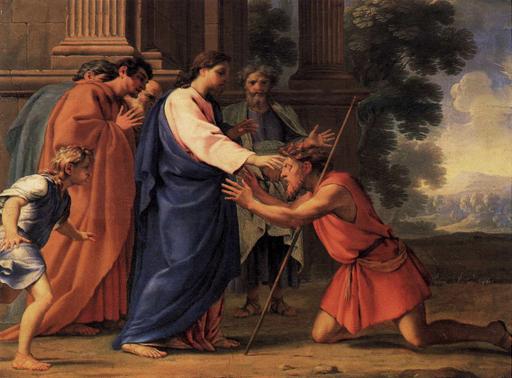
Here in Luke, it is almost as if Jesus is doing a similar thing. He is passing by (Lk. 18:36), but there is this blind man crying out, “Jesus, Son of David, have mercy on me!” Instead of quietly marching around Jericho, Jesus stops. It’s like Christ can’t help Himself. Even in the cursed city, Jesus doesn’t ignore cries for mercy because He is mercy embodied. He stops, stands still, and asks for the blind man to be brought to Him. There, in the wicked city, King Jesus, the Son of David, makes a kingly offer, “What do you want me to do for you?” Think of all the times throughout the Scriptures, a king will be pleased with someone and make an offer, “Ask me for anything, up to half my kingdom, and I will give it to you.” Here Jesus doesn’t put any limit on the request, “What do you want me to do for you?” The blind man answers, “Lord, let me recover my sight.” And Jesus says to him, “Recover your sight; your faith has made you well (lit. ‘saved you’).” Not only does the man get the sight he asks for, he gets more. Christ gives this resident of wicked Jericho life and salvation.

Dear saints, this same scene played out today just as it does every Sunday you gather here. Jesus comes into the midst of our wickedness. We beggars find ourselves in the presence of Jesus. We cry to Him for His kingly mercy, and Jesus doesn’t simply march around us and pass through. No. He hears your plea. He stops and stands still, and Christ the King answers your plea by absolving and saving you.

Jesus did that then, and He does that now because of what He is about to do in Jerusalem. Jesus could have, and maybe should have, marched around Jerusalem to destroy it with all their wicked plans for Him. But He doesn’t. Instead, He hangs still as He sheds His blood and pours out His mercy for you upon the cross.

Finally, notice the man’s response after his sight is restored. He can go wherever he wants with his new sight and salvation, but with every option open to him, he follows Jesus. The formerly blind man leaves his home in the wicked city of Jericho and follows Jesus to Jerusalem.

As we begin Lent this Wednesday, let us do the same as we follow Jesus as well. Let us abandon our wickedness and follow King Jesus to Jerusalem this Lent. He leads, and we follow with grateful hearts to Jerusalem, to the cross, and to the empty tomb on Easter.

This same King Jesus invites you now to your seat at His table, where He pours His love and mercy into you by giving you His Body and Blood given and shed for the forgiveness of all your sins. Dear saints, your faith in the crucified and risen Jesus has saved you. Amen.

The peace of God, which surpasses all understanding, will guard your hearts and minds in Christ Jesus. Amen.

The City of Peace – Sermon for the 10th Sunday of Trinity on Luke 19:41-48

Listen here.

Luke 19:41-48

41 And when he drew near and saw the city, he wept over it, 42 saying, “Would that you, even you, had known on this day the things that make for peace! But now they are hidden from your eyes. 43 For the days will come upon you, when your enemies will set up a barricade around you and surround you and hem you in on every side 44 and tear you down to the ground, you and your children within you. And they will not leave one stone upon another in you, because you did not know the time of your visitation.”

45 And he entered the temple and began to drive out those who sold, 46 saying to them, “It is written,

‘My house shall be a house of prayer,’
but you have made it a den of robbers.”

47 And he was teaching daily in the temple. The chief priests and the scribes and the principal men of the people were seeking to destroy him, 48 but they did not find anything they could do, for all the people were hanging on his words.

In the name of the Father and of the Son and of the Holy Spirit. Amen.

Palm Sunday, King Jesus rode toward Jerusalem on a borrowed donkey as shouts of, “Hosanna,” filled the air. When you ponder that event, you probably imagine smiles on the faces of the people as they wave their palms, children holding out their hands in joy and praise, the disciples proudly walking close to Jesus as part of His royal entourage, and Jesus’ face happy and pleasant as He takes it all in. But it wasn’t all joy for Jesus.

Luke tells us here that before He enters the City of Peace (which is what ‘Jerusalem’ means), Jesus weeps and laments because her residents, by and large, do not live up to their home town’s name. They do not know the things that make for peace. In a tragic twist of irony, the citizens of the City of Peace had no idea where true peace is found.

Jesus had come in the flesh to be their Immanuel, their Savior, their Messiah who would purchase and redeem them with His holy and precious blood. Christ had come to be the King from David’s line who would sit upon the throne forever. He came to remove the curse of death. But they thought He was there to release them from the Roman occupation. While that would have been delivering them, it would have been of no eternal consequence. Jesus was there to do more. However, most of the people of Jerusalem didn’t believe this. They did not know the things that make for peace.

Jesus had come to be the High Priest who offered Himself as the Lamb of God who takes away their sin and the sin of the world. He had come to be the fulfillment of all the sacrifices that pointed the people to Him. Jesus had come to be the true Temple where God met with His people with His mercy and love. But the majority of Jerusalem chose instead to make an idol out of the building of the Temple with its gold and precious stones. The chief priests, scribes, and leaders of the people didn’t want Jesus to die for their sins. They just wanted Him to die, and they wanted to be the ones who destroyed Him. They did not know the things that make for peace.

Jesus is the fulfillment of all the Old Testament offices: prophet, priest, and king. But because they had rejected their true Priest and King, Jesus weeps over the city as the true Prophet predicting destruction. He prophesizes that the City of Peace would be demolished, but His words were ignored, and His warning went unheeded. The majority of the people of Jerusalem did not know the things that make for peace.

Destruction of Jerusalem by Ercole de' RobertiAbout 40 years later, the Roman armies would come to the City of Peace and fulfill Jesus’ prophecy. In one of the most horrific events in all of history, God would send the Roman general Titus to demolish Jerusalem. The Romans would kill around one million of its residents, take enough gold from the Temple to fund the building of the Coliseum, tear the Temple down to the ground brick-by-brick and stone-by-stone, burn the city, and leave it a smoldering pile of charred rubble.

The Scriptures record this prophecy of Jesus as a warning to us. God is not mocked. Sin does not go unpunished. And because God has freely and graciously given us the things that make for peace, we must recognize and embrace them when He sends them.

Don’t fall into the devil’s temptation to embrace a peace that cannot and will not last. Don’t grow comfortable and complacent in your sin. When God doesn’t send immediate judgement upon our sin, the devil whispers in our ear that God either doesn’t really mind our sin all that much or that God won’t actually judge us.

This is what had happened to the people of Jerusalem. God’s house was to be a house of prayer. But when Jesus enters the Temple that day, He sees nothing but a Wal-Mart of religious items. So, He drives out the money changers and merchants with a whip.

Today, some churches aim to be little more than places of cheap entertainment. But even here in our congregation, how often is this sanctuary considered to be a place to come for a free cup of coffee, sit in a comfortable chair, sing a few songs, and catch up with friends?

Christ Returns in Power and GloryRepent. This isn’t a social club or just a nice place to spend a Sunday morning. This is where God comes to meet you. This is where God delivers His gifts of Word and Sacrament. This is a place of wonder as you hear the Gospel, a place of joy as you receive forgiveness, and a place of shelter in God’s presence. Here and now, God is delivering to you all the things that make for peace. Receive them. Rejoice in them. Live in them.

Eliza, today you are baptized. Today, God has connected His Word to water and washed you clean of all your sins – now and forever. Eliza, today God has joined you to Jesus’ death and resurrection and clothed you in Christ. And Eliza, God will continue to pour out upon you the things that make for peace through His holy and precious Word. Receive them and be at peace because of them.

All you saints, remember this: The things that make for peace are not always the things that feel pleasant. Because you are a sinner, the things that make for peace come through God’s Law and Gospel. When you hear God’s Law, don’t be like the people of Jeremiah’s day who hardened their hearts and didn’t know how to blush (from our OT lesson Jer. 8:4-12[esp. v. 12]).

Blush, faint, weep, and die to your sin. Repent. Stop your wickedness. Turn. Hang on Jesus’ words. Jesus has come. He has given Himself unto death to be your Savior. He has shed His holy and precious blood for you which He now gives to you who hunger and thirst for righteousness. Come. Receive. Be at peace now, and look forward to the eternal City of Peace, the heavenly Jerusalem (Heb. 12:22), which will never fall, never fade, and never be destroyed. Amen.

The peace of God, which surpasses all understanding, will guard your hearts and minds in Christ Jesus. Amen.