Rejoice in Peace – Sermon on Philippians 4:4-7 for the Fourth Sunday of Advent

Listen here.

Philippians 4:4-7

4 Rejoice in the Lord always; again I will say, rejoice. 5 Let your reasonableness be known to everyone. The Lord is at hand; 6 do not be anxious about anything, but in everything by prayer and supplication with thanksgiving let your requests be made known to God. 7 And the peace of God, which surpasses all understanding, will guard your hearts and your minds in Christ Jesus.

In the name of Jesus. Amen.

In a year that has brought sickness, hardship, loneliness, isolation, frustration, and disappointment, this is a wonderful, beautiful reminder from God’s Word to rejoice. We are usually quick to rejoice and don’t need a reminder when things are light and easy. Instead, we need to be reminded to rejoice precisely when we do not feel like rejoicing and when we feel the pain and injustices of this world. And, please know, this call to rejoice isn’t a legal requirement. It is a Gospel invitation. “Rejoice in the Lord always; again I will say rejoice.”

Now, when Paul calls us to rejoice, it is not some shallow cliché. This isn’t a, “Don’t worry; be happy” or a “Hakuna Matata.” And it isn’t as though Scripture is saying, “Well, you should be happy because things could be a lot worse.” Instead, there is real cause for rejoicing. Rejoice because the Lord, your God, your Savior, and your Redeemer is at hand. He’s right here with you now, and He is with you always bringing His mercy and love.

Yahweh, the great “I am” (Ex. 3:14); the God of Abraham, Isaac, and Jacob; your Creator who is a God merciful and gracious, slow to anger and abounding in steadfast love and faithfulness (Ex. 34:6) – this very God has come for you, born of a woman born under the Law to redeem you who were under the Law (Gal. 4:4-5). Jesus came to give His life as a ransom for you while you were still His enemy (Ro. 5:10).

Dear saints, there is enough there for an eternity of rejoicing.

Now, when Paul wrote this call to rejoice always, he was sitting in prison, yet rejoicing. Paul knew pain and injustice – from both sides of the coin. Paul was a persecutor of the Church, and after Jesus met him, Paul was a persecuted member of the church. Paul knew what it was to throw people in prison and what it was to eat prison food. And even in his low moments, he reminds us that there is reason to rejoice, and that reason is, that no matter if things are going well or not, God is on your side.

As you rejoice in the faith and confidence that God is favorable toward you, our translation says, “let your reasonableness be known to everyone.” Other translations, instead of ‘reasonableness,’ will use ‘gentleness,’ or ‘moderation.’ Unfortunately, we don’t have a good English word for it. The idea of the word there is to have nobility and authority but acting in meekness and kindness while not using your position for yourself but for the sake of serving others. The word carries the idea of having every right to demand justice for yourself but using that right to bring mercy to anyone in need. Let that kind of noble, gentleness be known to all people.

And then – it is so interesting – as we rejoice and let our noble gentleness be known to people, we are to make our requests be made known to God. “Be anxious for nothing, but in everything with prayer and supplication let your requests be made known to God.”

Being a Christian does not mean that you never have any worries. But one of the reasons you can rejoice is that you can cast all your anxieties and cares upon God (1 Pet. 5:7) by turning those worries into prayers. In other words, whenever you are worried, turn those worries into prayers, leave them at God’s feet, and let God worry about them.

One of the best examples we have of this in Scripture is how King Hezekiah responds when Jerusalem is surrounded by the army of Assyria (see Is. 36-37 and 2 Kgs. 18:13-37). The king of Assyria is marching against Jerusalem is boasting that he is going to destroy the city. He continually mocks God saying that there is no one who can save Jerusalem from his army. King Hezekiah is terrified and anxious when he hears all of this. He tears his clothes and covers himself is sackcloth and takes a letter repeating all these threats, goes to the Temple, spreads out the letter before God, and prays.

And God answers. That night, God went out and struck down 185,000 in the camp of the Assyrian army. God’s people went to bed thinking that they were about to be destroyed, but when they woke up, they found themselves delivered.

Now, this is not mean that God will instantly deliver you from any and every trouble. But He will and, in fact, He already has rescued you. Christ will bring you and His entire Church into the glories of heaven where none of the troubles of this life can enter. That day will come as surely as if it had already arrived. This is why we rejoice.

We can rejoice in the Lord because we know that He rules and reigns over all things, and, in His mercy, He uses His power for our benefit. We rejoice in the Lord because Christ has buried our sins in the emptiness of His tomb. Your sins cannot accuse you anymore; they are gone.

Rejoice in the Lord always. Not just when you’re feeling religious or pious or healthy or happy. Rejoice in whatever condition you find yourself because when you’ve had a rotten day, or when your health is in jeopardy, or when your friend has turned against you, and when your finances are upside down, in any bad situation, you are no less a citizen of heaven than when everything is going your way.

Hudson, God be praised, today you are Baptized. Through the waters of your Baptism, God has joined you to Himself. You have been joined to Jesus’ death and resurrection (Ro. 6:3-6). You have been clothed with Christ (Gal. 3:27). Just as the heavens opened above Jesus when He was baptized, heaven’s gates are now open to you. That means everything Jesus was born to do and has done is now credited to your account.

All of this is to say – Hudson, Luke, Sarah, Maddie, Brayden, and all you saints – that today is a day to rejoice just as every day is to rejoice. God’s steadfast love toward you will never cease. His mercies will never come to an and. They are new each and every morning (Lam. 3:22-23).

Hudson, and all you saints, rejoice. The Lord is at hand, and you know why He comes. He comes to be your Savior. The Jesus who is coming again is the Christ of Calvary and the Christ Child born in Bethlehem. He is the only one who can bring you peace, and that peace is so great that it surpasses all understanding.

Hudson and all you saints, the Prince of Peace is coming to pour His righteousness upon you and make you His own. Know everything else through the fact that Jesus loves you. And His love for you will never fade or fail. Amen.

The peace of God, which surpasses all understanding, will guard your hearts and minds in Christ Jesus. Amen.

Comfort Doubled – Sermon on Isaiah 40:1-8 for the Third Sunday of Advent

Listen here.

Isaiah 40:1-8

1 Comfort, comfort my people, says your God. 
2  Speak tenderly to Jerusalem, 
and cry to her 
     that her warfare is ended, 
that her iniquity is pardoned, 
     that she has received from the Lord’s hand 
double for all her sins. 

3   A voice cries: 
     “In the wilderness prepare the way of the Lord; 
make straight in the desert a highway for our God. 
4   Every valley shall be lifted up, 
and every mountain and hill be made low; 
     the uneven ground shall become level, 
and the rough places a plain. 
5   And the glory of the Lord shall be revealed, 
and all flesh shall see it together, 
for the mouth of the Lord has spoken.” 
6   A voice says, “Cry!” 
And I said, “What shall I cry?” 
     All flesh is grass, 
and all its beauty is like the flower of the field. 
7   The grass withers, the flower fades 
when the breath of the Lord blows on it; 
surely the people are grass. 
8   The grass withers, the flower fades, 
but the word of our God will stand forever.

In the name of Jesus. Amen.

I titled this sermon “Comfort Doubled,” but it maybe should have been “Infinite Comfort” because the whole text is dripping with comfort. Dear saints, whenever God comes, He comes to comfort you. Listen to what He says in v. 1 again, “Comfort, comfort my people, says your God.” These words are akin to what Jesus, who came not to call the righteous but sinners (Mt. 9:13), says in Mt. 11:28, “Come to Me, all who labor and heavy laden, and I will give you rest.” To any and all who are troubled, afflicted, and uncomfortable, God says, “Here is a double dose – two shots of comfort.”

Who gets this comfort? God’s people – whenever they are troubled. That means you. You are those for whom Christ was born. You are those whom God has claimed as His Own. You are the people for whom Christ has died. God says so Himself. He is the One who calls you, “My people,” and He is not ashamed to call Himself, “Your God.” If you play the first verse of this text backwards, God says to you, “I am your God. You are My people. And I give to you comfort on top of comfort.”

The context in which these verses were originally written helps us see just how comforting these words from God are. God has Isaiah tell Jerusalem that her warfare is ended, but when Isaiah writes these words Jerusalem isn’t even at war. Eventually, Babylon will come and besiege Jerusalem, and God’s people will be taken into exile. But even before any of that has happened, God comforts His people with the promise that her warfare will end.

Dear saints, God’s anger is but for a moment, and His favor is for a lifetime. Weeping may tarry for the night, but joy comes with the morning (Ps. 30:5). And before the suffering begins God preaches comfort to His people.

This is in line with God’s character, and we see this repeatedly in Scripture. Isaiah experienced this when God called Him to be a prophet. Isaiah saw God’s holiness and was terrified because he recognized his sinful lips. But God sent the seraph with a flaming coal to take away Isaiah’s guilt and atone for his sin (Is. 6:1-7). 

Remember how the shepherds saw the glory of God (Is. 40:5) and were terrified? But the angel assured and calmed them saying that God’s appearance in the birth of Jesus was “good news of great joy that would be for all people” (Lk. 2:10).

And even think to our Gospel lesson. John the Baptizer was sitting in a dank, dark prison cell, likely knowing that he would soon be executed. In that dark moment, John sent some of his disciples to confirm that Jesus was indeed the coming Messiah. And Jesus sends them back to John with those beautiful words of reassurance, “The blind receive their sight and the lame walk, lepers are cleansed and the deaf hear, and the dead are raised up, and the poor have good news preached to them. And blessed is the one who is not offended by me” (Mt. 11:4-6). All of these are fulfillments of what the coming Messiah would do (Is. 29:1835:5-6). John’s disciples return to John to reassure him with Jesus’ words. And after John’s disciples leave, Jesus goes on to talk to the crowd about John, and I think there is comfort for you in how Jesus speaks of John.

Think of this. After John’s disciples leave, Jesus affirms the fact that John was the prophet who was going to prepare the way of the Messiah. And Christ confirms to this large crowd that there is no one born of women who is greater than John the Baptizer. Now, here’s why you should find this comforting:

When you are in the lowest moments in life, when you have doubts and grow weak, you would be pleasantly surprised to know who was defending you even though you might not know it. While John sits alone in prison, Jesus is in front of that large crowd gushing John’s praise. Remember that. Remember that especially when you get down on yourself for your shortcomings. Know that God doesn’t think of you in low terms even though you might. You are God’s beloved child. And do not forget what Jesus says, “Whoever acknowledges me before men, I will acknowledge before My Father and before the angels” (Mt. 10:32Lk. 12:8). Dear saints be comforted. In any and every time of suffering, God brings His comforting words to you.

Ok. Back to our text from Isaiah. That final line of v. 2 may still make you scratch your head a little bit. This talk of receiving “from the Lord’s hand double for all her sins.” What is that all about? 

Be careful with what you do with that verse in your mind. Unfortunately, we are often tempted to add a word to that sentence. We read it and add, “she has received double punishment for her sins.” 

Why do we do that? Well, we all know what Scripture says, “The wages of sin is death” (Ro. 6:23). So, it is natural to think of punishment whenever we think of receiving something for our sins. But that can’t be what God means when He says His people have received double for all her sins. You wouldn’t speak tenderly and tell someone, “Your warfare is ended. Your iniquity is pardoned. And it’s ok. I’ve punished you twice for your sins.” That doesn’t fit the context.

Again, what is God giving here? Comfort. A reminder of punishment isn’t comforting. God has given double comfort. Christ came giving double for your sins.  First, He took them away which brings comfort, and second, He gave you His righteousness which brings even more comfort. 

You see, God doesn’t want you to receive any of His wrath or judgment. He doesn’t want you to pay for any of your sin.

Be comforted. Christ has come. Jesus has ended your warfare and pardoned you. You receive double from God for all your sins because your sin is already punished – not on you but on Christ. And in return, you are given Jesus’ righteousness, holiness, innocence, and good works.

This is how God’s accounting works; here is how God manages the debt of your sin. Jesus doesn’t just simply get you out of debt; He gives you an increase. In other words, imagine you stole $1,000 worth of stuff from God. Instead of simply forgiving the debt and calling it even, God gives you $1,000 more (Pr. David Petersen). That is how your God is for you.

Here is your hope, Christian. You have God’s comfort in all things. 

There is nothing sure or lasting or certain in this world. Not the trees, not the mountains, not the grass or the flowers. Only this: the Word of your God stands forever. You can be sure of that. And by that Word you are forgiven, you are justified, you are sanctified, you are glorified, you are comforted, all in Jesus, and all for Jesus‘ sake.

Heaven is on your side. Your warfare is ended. Your iniquity pardoned. And no one, not even God Himself, will charge you for your sins because His Word of comfort stands forever.

You heard it at the beginning of our service, but it bears repeating. “Rejoice in the Lord always; again, I will say, rejoice” (Php. 4:4). Rejoice, rejoice, Emmanuel, God with you, shall come to you. Amen.

The peace of God, which surpasses all understanding, will guard your hearts and minds in Christ Jesus. Amen.

At the Last – Sermon on Matthew 25:31-46 for Midweek Advent 2 2020

Listen here.

In the name of Jesus. Amen.

Your Savior, whose first coming was humble and lowly yet announced by the angels, is coming again in glory, and every eye will behold Him. His swaddling clothes will be exchanged for royal robes, and instead of lying in a manger, He will sit on His glorious throne.

Your Redeemer, whose birth was celebrated by the shepherds, is coming again for you as your Good Shepherd.

Growing up, I remember fearing the day of Christ’s return and standing before Him to be judged. I think it started as a dream, but I would often replay the scene in my head. In my mind, the final judgment consisted of Christ setting up a tent (I don’t know why it was a tent) on 8th Ave. East in Williston, North Dakota. I pictured myself waiting in line to go in that tent which opened right in front of our mailbox situated on a wagon wheel.

In my mind, I entered that tent and there was a makeshift projector screen on one of the walls. Jesus invited me in and began to replay my life on that screen, and the replay lasted just over one second. Afterward, Jesus peppered me with hundreds of questions about my conduct and actions – especially regarding my sinful behavior. Sadly, I had no answer, no excuse to offer for my sins, iniquities, and shortcomings. Sadly, the end result of this was that I was terrified of the return of my Redeemer.

God be praised, that is not how Scripture depicts Christ’s return! There will be no replay of your life, no grand inquisition, no need to offer excuses. In fact, the only thing that I can’t disprove of my imagining of the final judgment is that it won’t take place on 8th Ave. East in Williston.

Our Gospel text tonight is typically known as “The Parable of the Sheep and the Goats.” However, there is no indication that this is a parable. The way Jesus talks here, we can expect that this is exactly how it will happen.

Christ will return in His glory. All the angels will be with Him. He will sit on His glorious throne. All people will be gathered before Him, and He will separate people as a shepherd separates sheep from goats. Sheep to the right. Goats to the left.

Christian, you will hear the sweetest, kindest, most merciful and beautiful words your ears have ever heard. “Come, you who are blessed by My Father, inherit the kingdom prepared for you from the foundation of the world.”

Then, Christ will divulge before all people your good works and honor you for what you have done. Jesus will confess that you have been merciful even as God Himself is merciful. Christ will declare that you have given as you have received.

Now, we need to be clear. None of these works are the cause of God’s love for you. In fact, God loved and chose you from before the foundation of the world before you had done any good works. In His love for you, God prepared a place for you before you were born. You do not earn salvation and a place in His kingdom by works. Entrance into the kingdom is not a wage that is paid; instead, it is an invitation to be an heir.

The works that God will honor at the final judgment are simply the proof of your faith. 

God does reward good works in this life. He uses those rewards to strengthen and encourage you to continue to put off your sinful flesh. But most of His rewards are dispensed in the life to come so that you don’t grow complacent and lazy. But know this: even when God defers and delays His rewards, God takes notice of the good works because they are good and God loves them.

Dear saints, the infant Jesus who came to save you from your sins is the same King who does not and will not count your sins against you on the Last Day.

At the last, Christ will say to you, “Come, you who are blessed by my Father, inherit the kingdom prepared for you from the foundation of the world.” What a day that will be. Amen.

The peace of God, which surpasses all understanding, will guard your hearts and minds in Christ Jesus. Amen.

Now – Sermon on Jude for Midweek Advent 1 2020

Listen here.

In the name of Jesus. Amen.

The end is near. Not the end of autumn, that’s still a couple weeks away. Not the end of the pandemic, but, maybe, the vaccine will help. Not the end of the legal proceedings for the election, it’s hard to know when that will be. Not the end of 2020, but that will come too.

The end of days is near. In fact, Scripture teaches that we have been living in the last days since the ascension of Christ. In his sermon on Pentecost, Peter says that we are living in the last days (Act. 2:17). In the second verse of Hebrews, the author says that we are living in the last days. And in 1 John 2:18, John even says that it is the last hour.

As I mentioned at the beginning of the service, Advent is a time for us to think of Christ’s comings. His first coming was, of course, when He was born in Bethlehem. Jesus also continually comes to us now through His Word and Sacraments. And our Savior will come again in glory on the Last Day.

Our services this Advent will focus on Christ’s coming and the comfort that this gives us now, at the last, and unto eternity. Jesus’ return comforts us because Christ first came for us while we were sinners and His enemies. When He came to earth the first time, He came to make us His own by taking up our flesh so He could go to the cross and shed His blood for us. Now that He has done that and has made us His children, how much more will His glorious return on the Last Day be for our benefit?

Tonight, we start with the book of Jude to see the comfort that we have right now knowing that Christ will come again.

Jude is such a timely book for our day. Jude writes to those who are called, who are beloved in God the Father, and who are kept for Jesus Christ. Listen again to v. 17-19, “You must remember, beloved, the predictions of the apostles of our Lord Jesus Christ. They said to you, ‘In the last time there will be scoffers, following their own ungodly passions.’ It is these who cause divisions, worldly people, devoid of the Spirit.” Sound familiar?

We live in the age of scoffers. Think back to the first verse of the first Psalm, “Blessed is the man who walks not in the counsel of the wicked, nor stands in the way of sinners, nor sits in the seat of scoffers.” In our culture, we are way beyond sin and wickedness. Today, people celebrate wickedness and laugh at sin. When was the last time you heard someone in the media call something wicked or sinful? Those words are likely to start a firestorm if they are ever used outside of the church. We live in the age of scoffers who mock and dismiss even the idea of sin.

In our culture, what is good is labeled as wicked or hateful. If you dare to say that marriage is God uniting a man and a woman, you hear the majority of the cultural and political elite calling you bigoted, homophobic, and uneducated.

Atheism is the fastest growing religion today because it appears to offer an escape. Atheism is attractive to people today because, if there is no being higher than us, there is no accountability for sin and no judgment. And the heathen of today are terrified of judgment. They know their actions are sinful. So, they just lie to themselves and say that they will never have to answer for their sins. If we are just the highest animals who are an accident of evolution, then there is no accountability or day of reckoning. The nightly prayer of the atheist is, “Now I lay me down to sleep, I sow the seeds I’ll never reap. If I should die before I wake, oh well.”

The Christians of Jude’s day were a lot like us. They were just as dismayed at the evil that surrounded them as we are by the evil that surrounds us now. But Jude wants to remind us that evil has always surrounded God’s people.

Jude goes back before the Fall of Adam and Eve to the fall of the angels. Satan and the demons were not content to be what God had created them to be. So, they rebelled. And for their rebellion, they had an eternal fire prepared for them (Mt. 25:41). And the devil came into the garden to drag humanity, the pinnacle of God’s creation, down with him. 

Jude wants us to remember Cain. God was gracious and merciful to Cain, giving him grain from the field, but Cain rebelled. Cain murdered his brother out of jealousy. Today, God is gracious and merciful to us, giving any and every kind of food we could want and more than we could ever eat. But our culture has rebelled. And instead of killing our brothers; we murder our own children in the womb out of convenience.

Jude reminds us of the cities of Sodom and Gomorrah. They were prosperous, but they rebelled and were filled with unnatural desires. Today, our culture is filled with those same unnatural desires. Those sins are even celebrated with parades, they are even given two months of recognition. Will God send the same fire and sulfur upon our land that He sent on Sodom and Gomorrah? Or, maybe, has God already sent His judgment through fires, hurricanes, unrest, riots, and COVID? But our culture has scoffed and largely let God’s wrath against sin go unnoticed. I’d encourage you to read Amos 4:6-11 and hear of all the calamities God sent to His people. And make sure you notice the sorrow of God’s heart when they refused to repent.

We could go on and talk about Korah and his rebellion against God’s servant, Moses (Num. 16:1-331-35). Or God’s prophet Balaam (Num. 22-25) who sought to become rich by proclaiming something other than God’s Word.

Rebellion against God is all around us, in our midst, and even within ourselves. We are not content with the vocations and tasks that God has given us. We seek the world’s approval rather than God’s. We are the grumblers and the malcontents following after our own sinful desires. We are the loud-mouthed boasters showing favoritism to gain advantage for ourselves (Jud. 16). Repent. 

Do not think that God’s judgment is something to scoff at. It’s time to consider that our that current situation is the judgment of God. Repent.

Again, all of these examples from Jude serve as a reminder that evil has always surrounded God’s people. While that doesn’t sound like comfort, there actually is comfort to be found in that fact. Because despite all the rebellion against God and all the scoffing at God’s people, God sent Jesus, His beloved Son, to rescue and redeem His enemies. And that should give us hope now.

So, what are we, as God’s people, to do now, while we confronted and surrounded by all this evil? Well, listen again to Jude: 

Keep yourselves in the love of God. Continue to devote yourself to the Scriptures (Jud. 21). In His Word, Christ comes to you now, in this moment. Wait for the mercy of our Lord Jesus Christ that leads to eternal life. And have mercy on those who doubt. Save others by snatching them out of the fire hating even the garment stained by flesh (Jud. 23). Be in the world but not of the world.

Show mercy with fear. Isn’t that an interesting phrase from Jude 23? Mercy with fear. Be bold to say the hard things that need to be said. It is not loving to condone and celebrate the sins of the scoffers. As you say those hard things, even though you are saying them in love, know that you will be persecuted. But remember that persecution won’t last. From our Gospel lesson tonight, remember that Jesus said brother will deliver brother over to death, even a father his child, and children will rise against parents (Mk. 13:12). Don’t forget that Jesus promised that you will be hated for His name’s sake (Mk. 13:13). Even if it is a fearful thing to do, offer the unbelievers you encounter day after day a carrot on the end of a stick. Proclaim the truth of God’s Word, and extend the joy of God’s forgiveness and mercy that cannot be denied. 

The days are coming, and are already here, where we will probably be called to be a Shadrach, a Meshach, or an Abednego and walk through the fire. Maybe not a fiery furnace, but the fire of persecution. But know that God’s promise is that you do not, nor will you ever walk alone.

Your heavenly Father is able to keep you from stumbling. So, don’t be afraid of the persecution or of your shortcomings. Christ will – absolutely, beyond a doubt, you can take it to the bank – Christ will present you blameless before God’s presence.

To Him be glory, majesty, dominion, and authority. Now, at the last, and unto eternity. Amen.

The peace of God, which surpasses all understanding, will guard your hearts and minds in Christ Jesus. Amen.

Parting Joys – Sermon on Luke 24:44-53 for the observation of the Ascension of our Lord

Listen here.

Luke 24:44-53

44 Then he said to them, “These are my words that I spoke to you while I was still with you, that everything written about me in the Law of Moses and the Prophets and the Psalms must be fulfilled.” 45 Then he opened their minds to understand the Scriptures, 46 and said to them, “Thus it is written, that the Christ should suffer and on the third day rise from the dead, 47 and that repentance for the forgiveness of sins should be proclaimed in his name to all nations, beginning from Jerusalem. 48 You are witnesses of these things. 49And behold, I am sending the promise of my Father upon you. But stay in the city until you are clothed with power from on high.”

50 And he led them out as far as Bethany, and lifting up his hands he blessed them. 51 While he blessed them, he parted from them and was carried up into heaven. 52 And they worshiped him and returned to Jerusalem with great joy, 53 and were continually in the temple blessing God.

Alleluia! Christ is risen!
He is risen indeed! Alleluia!

In the name of Jesus. Amen.

I vividly remember many times as a child packing up the car to leave after a visit to my grandparents. We would say our goodbyes, wave as we pulled out of the driveway, and hit the road. I would only last about half an hour before my quivering lips would turn into total waterworks. I would burst into tears because I missed my grandparents so much. I’m sure the Steve Green album my parents would play in the car added to my volatile emotional state. Anyway… I’d cry for however long as my parents reassured me that, no matter what, we see my grandparents, aunts, uncles, and cousins again because we all believed in Jesus and Christians can only be parted for a brief time.

In Romeo & Juliet, when Juliet says goodnight to Romeo, she has the famous line, “Parting is such sweet sorrow.” The line basically means that there is sorrow that the lovely Juliet has to be parted from her beloved Romeo, but there is a sweetness to saying goodbye because it makes them think about the next time they will see each other.

Time to get to the point of all this: Thursday marked forty days after Jesus’ resurrection which means that was the anniversary of Christ’s ascension into heaven where He is seated “on (or ‘at’) the right hand of God the Father Almighty.” I’ve said it many times, but Jesus’ ascension is a big deal. Now, everything that Jesus did is significant, but the ascension is right up there in importance with His birth, death, and resurrection.

In our Gospel text, the disciples don’t seem to think that Jesus’ ascension meant they should have any sorrow because Jesus has departed. Instead, they have joy.

In our Epistle text from Acts [1:1-11], Luke tells us that the disciples stood in wonder and awe and amazement as they watched Jesus ascend and get taken from their sight by the cloud. There they are staring up into heaven – and I’ve always imagined they are so filled with wonder that at least one of them is drooling – they are gaping at the skies until the angel appears to them and says, “Why are you standing around looking into heaven? This Jesus who was taken up from you into heaven, will come in the same way as you saw Him go into heaven.”

In this text, Luke tells us that after Jesus ascended, the disciples worshiped Him, returned to Jerusalem with great joy – great joy – and were continually in the Temple blessing God. When Jesus left the disciples, they had joy because Jesus had opened their minds to understand the Scriptures. They knew what Jesus’ ascension meant. So, let’s get to it, what does Jesus ascension mean?

The disciples knew that Jesus had ascended to the Father’s right hand. The first thing to know about this is that the Father’s right hand is not a place. Instead, it is an office. We often use the phrase “right hand man.” It doesn’t mean that that person is always standing at someone’s right hand; it means that the authority of one person is given to another.

When Jesus sits down at God the Father’s right hand, it means that He takes an office and all the functions of that office. All the things that belong to God belong to Jesus – all rule, authority, and power. It means that Jesus is everywhere, all-powerful, all-knowing. Now because He is God, Jesus, the Son of God, had all of those things all along. But when Jesus took on flesh, He didn’t use those attributes until His ascension. The ascension is how Jesus can promise, “Behold I am with you always, even to the end of the age” (Mt. 28:20). You see, Jesus still has His body, and if He had remained on earth, we here in East Grand Forks couldn’t know if Jesus was with us if He was down in Melbourne Australia. But because Jesus is at the Father’s right hand, we can know that He is with us.

The Bible continually mentions this. In fact, there are some pastors and theologians who say that Jesus’ ascension is mentioned more in the Epistles than Jesus’ resurrection. I haven’t counted, but it would be an interesting study.

Think back, just for a minute, how the book of Acts begins (you heard it earlier). Luke the Evangelist wrote the Gospel of Luke to a guy named Theophilus. And Luke starts the book of Acts saying, “In the first book, O Theophilus, I have dealt with all that Jesus began to do and teach” (Act. 1:1) and the whole book of Acts is the record of how Jesus continues to serve, rule, grow, and reign over His Church.

The same Jesus who right now sits on the throne of the universe is the One who suffered, bled, died, and rose again for you. The Jesus who loves you in this way is the One who governs and rules over all things.

Dear Christians, while it appears that this world is full of chaos, sickness, pandemic, death, discord, and strife, the Scriptures continually testify to you that Jesus is still on the throne. He is in charge, and He promises that He works all things together for good for you who love Him and are called according to His purpose (Ro. 8:28) because He is at the Father’s right hand.

But again, we have a problem recognizing this because the devil is always trying to make us by forget that Jesus has ascended and is in charge. For example, we look around and see the world falling apart. Those who have been elected to rule are foolish, wicked, confused, dangerous, or incompetent. We see the church being persecuted and threatened all over the world. We see how people are hardly able to even speak to each other because of differing views on certain topics. We see all of this and try to wrap our heads around it and make sense of it all. We see things falling apart in our state and community with unemployment and businesses having to close their doors for the final time. We see people getting sick and dying. We see hurt, accidents, terrorism. We see people leaving the church and abandoning their faith.

Then, the devil comes and sticks our nose in all of that and says, “How can you think that Jesus is on the throne and in charge?” And we start to think that Jesus has abandoned us, that He has left us as orphans, and that we have to fend for ourselves. You see this happen in the church when people think that it is our job to spread the Gospel and grow the church because Jesus isn’t doing anything about it. That is wrong! God has not called us to be the ones to figure out how to grow the church. God has reserved that work for Himself. Yes, we are to be lights in this dark world. Yes, we are to be witnesses. Yes, we are to proclaim the Gospel by our words and actions. But we are partners with God in that. God has reserved the work of the growth of His Church to Himself. Jesus says that upon the rock of our confession that He is the Christ He will build His church and the gates of hell will never overcome it (Mt. 16:18).

With all of that in mind, I would encourage you over the next couple of days to read the book of Revelation. Do it in one sitting (it should take you less than an hour). And as you read Revelation, remember that Jesus is ascended, read it through that lens.

In a lot of ways, the book of Revelation is a commentary on Jesus’ ascension. John will write about seals and trumpets and bowls. He will see the frightful spiritual realities of this world. He will see famines, war, pestilence, and all sorts of terrible things happening. And as all of these things unfold, you start to think that the devil is in charge and running the show. But then, John gives us a glimpse of what is going on in heaven. And there, we see that Jesus, the Lamb of God who was sacrificed for our sins, is the One who is still sitting on the throne. The church is there with the all angels singing His praises. And just as you begin to get your fill of encouragement, it’s back down to the earth and it looks like things are getting worse. There’s dragons and beasts and rivers turning to blood. And just when it seems like Jesus has been dethroned, it’s back up to heaven and there is the Lamb of God still ruling, still reigning, still in control, still forgiving sins, still serving His Church. And this cycle keeps going until at last, Christ returns and heaven and earth are combined into one with Jesus still on the throne.

Finally, remember how Jesus ascended. He raised His hands in blessing. And Christ’s hands which bear the wounds He endured for your salvation are still lifted up in blessing over you today.

Dear saints, Jesus hasn’t left you because He is angry with you. Jesus is ascended to bless you and hear your prayers and present them before the Father. So, may you have joy that Jesus has ascended to rule and reign. Take heart. Have hope. Be of good courage. Your Jesus who was on the cross for you is now at the right hand of God for you, and He will stay there until He comes back for you.

Alleluia! Christ is risen!
He is risen indeed! Alleluia!

Amen.

The peace of God, which surpasses all understanding, will guard your hearts and minds in Christ Jesus. Amen.

Filled with Joy & Peace – Sermon on Romans 15:4-13 for the Second Sunday of Advent

Listen here.

Romans 15:4-13

4 For whatever was written in former days was written for our instruction, that through endurance and through the encouragement of the Scriptures we might have hope. 5 May the God of endurance and encouragement grant you to live in such harmony with one another, in accord with Christ Jesus, 6 that together you may with one voice glorify the God and Father of our Lord Jesus Christ. 7 Therefore welcome one another as Christ has welcomed you, for the glory of God.

8 For I tell you that Christ became a servant to the circumcised to show God’s truthfulness, in order to confirm the promises given to the patriarchs, 9 and in order that the Gentiles might glorify God for his mercy. As it is written,

“Therefore I will praise you among the Gentiles,
and sing to your name.”

10 And again it is said,

“Rejoice, O Gentiles, with his people.”

11 And again,

“Praise the Lord, all you Gentiles,
and let all the peoples extol him.”

12 And again Isaiah says,

“The root of Jesse will come,
even he who arises to rule the Gentiles;
in him will the Gentiles hope.”

13 May the God of hope fill you with all joy and peace in believing, so that by the power of the Holy Spirit you may abound in hope.

In the name of Jesus. Amen.

Romans 15_13 - Joy Peace and HopeOur texts today seem to have conflicting messages. This text from Romans 15 has a lot to say about endurance, encouragement, hope, harmony, joy, and peace. It’s nice. But in our Gospel lesson, when Jesus talks about the day of His return, He speaks of signs in the sun and moon and stars. He mentions the distress of nations in perplexity, the roaring of the sea and waves, and people fainting with fear and foreboding because of what is coming on the world. Our Lord declares that the powers of the heavens will be shaken.

Come on, Jesus. We don’t like that imagery, and it doesn’t fill us with joy or peace or hope. We don’t like to hear about the world coming apart at the seams. But then, we turn on the news or scroll through our social media accounts and see evidence of creation collapsing and society crumbling, and we get anxious. Our fear of the end of the world probably lies in the fact that this world is all we have experienced and known. Repent and remember this world is not all there is.

Jesus tells us about all these distressing things so that when they happen, we can be filled with all joy and peace so that we abound in hope in the midst of it all. Similar to when a patient has been physically suffering for months while the doctors only scratch their heads, once the doctors can give a diagnosis there is a sense of relief even if it is a devastating diagnosis. Jesus, the God of hope, has diagnosed the situation and tells us exactly what is going on.

Jesus told us that it would happen so when we see it we wouldn’t be afraid. Dear saints, we don’t need to be worried when we see the world collapsing. It’s like Jesus is saying, “When it looks like everything is falling apart, when all creation seems to be disintegrating, it is. It is, but don’t worry about it because nothing bad is going to happen to you. Instead, be glad because all of it means that your redemption is drawing near.”

Christ warns us so we can straighten up, raise our heads, and stand before Him when He returns. These words of Christ are exactly what we need to endure and be encouraged so that we have hope and strive to live in harmony with one another.

I’ve used this picture before, but I think it is so helpful. Imagine you are in a castle at night, and suddenly all the guards and soldiers start running to their battle stations because an army is marching to attack the fortress. The boots of that attacking force stop tramping, and you hear the shouts of commanders telling the troops to load the catapults and start banging the gates with the battering ram.Castle Besieged The castle doors and the walls are shaking. Boulders are hurled against the fortress. Windows are shattering and dust is falling from the ceiling. The floor you are standing on is rocked by the sounds of battle all around you.

Normally, you would be terrified in that situation. But not now. Not now because you are a captive in the prison of that castle. And the commander leading the invading army is Jesus coming to rescue you and all your prison mates, all your brothers and sisters in Christ. Knowing that, every crash, every clang, every shout of battle, and every wall that crumbles around you means that your release is that much closer. And as the morning sunlight peeks through the cracks of the walls, you and your fellow prisoners all know that a new day is dawning, and it is the day of your deliverance.

This world is often a beautiful place full of the good gifts of God. But remember that this world is broken and incomplete. This world is fallen and there is so much wrong with where we are. And much of what is broken, incomplete, fallen, and wrong is your own doing and my own doing. And all of this has been going on so long that you get used to it. You and I get used to sin, and we start to think that it is normal. Like a pig farmer who doesn’t notice the stink of the barn, the stench of our sin starts to not bother us anymore. Repent, but don’t despair.

The Jesus who will come again in glory has come already to bring the beginning of hope. His words and works and deeds were written for our instruction. In the Scriptures we learn that when Jesus ministered in this fallen world what was broken was made whole. What was sick was cured. Romans 15_4 What was written peace joy hope.jpgWhat was defiled was made holy. What was dead was raised. Where there were sinners, Christ brought forgiveness. And all of that was just the beginning. All of this was written to give us encouragement to endure in the hope that the healing Christ brought to the broken of this world would be ushered into the entire creation – into the new creation.
The God of hope encourages you. He wants you to endure. And He wants you to have hope. May the God of endurance and encouragement grant you that hope because it is certain and true. The sun of righteousness will rise with healing in its wings (Mal. 4:2). Straighten up. Raise your heads because your redemption draws near. May that same God, Jesus, the God of hope, fill you with all joy and peace in believing so that you abound in hope. Amen.

The peace of God, which surpasses all understanding, will guard your hearts and minds in Christ Jesus. Amen.

Easter in October – Sermon on Luke 7:11-17 for the Sixteenth Sunday after Trinity

Listen here.

Luke 7:11-17

11 Soon afterward he went to a town called Nain, and his disciples and a great crowd went with him. 12 As he drew near to the gate of the town, behold, a man who had died was being carried out, the only son of his mother, and she was a widow, and a considerable crowd from the town was with her. 13 And when the Lord saw her, he had compassion on her and said to her, “Do not weep.” 14 Then he came up and touched the bier, and the bearers stood still. And he said, “Young man, I say to you, arise.” 15 And the dead man sat up and began to speak, and Jesus gave him to his mother. 16 Fear seized them all, and they glorified God, saying, “A great prophet has arisen among us!” and “God has visited his people!” 17 And this report about him spread through the whole of Judea and all the surrounding country.

Alleluia! Christ is risen!
He is risen indeed. Alleluia!

In the name of Jesus. Amen.

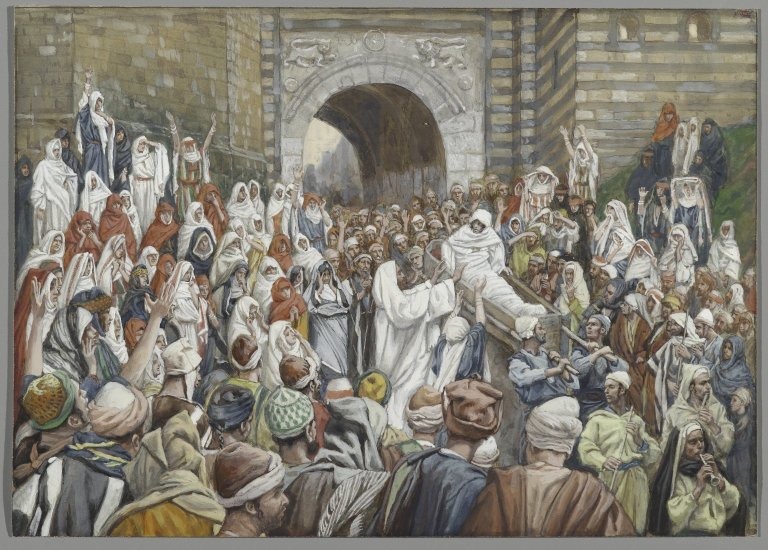
The Resurrection of the Widow's Son at NainIf Menards can have Christmas decorations out already and if the Hallmark Channel can do nonstop Christmas movies in July, then the Church can certainly have Easter in October. In fact, we have to celebrate Easter because this text screams Easter – loud and clear. But always before Easter, there is Good Friday. Before resurrection, there must be death. Good Friday sadness is a prerequisite to Easter joy. We have to see that first.
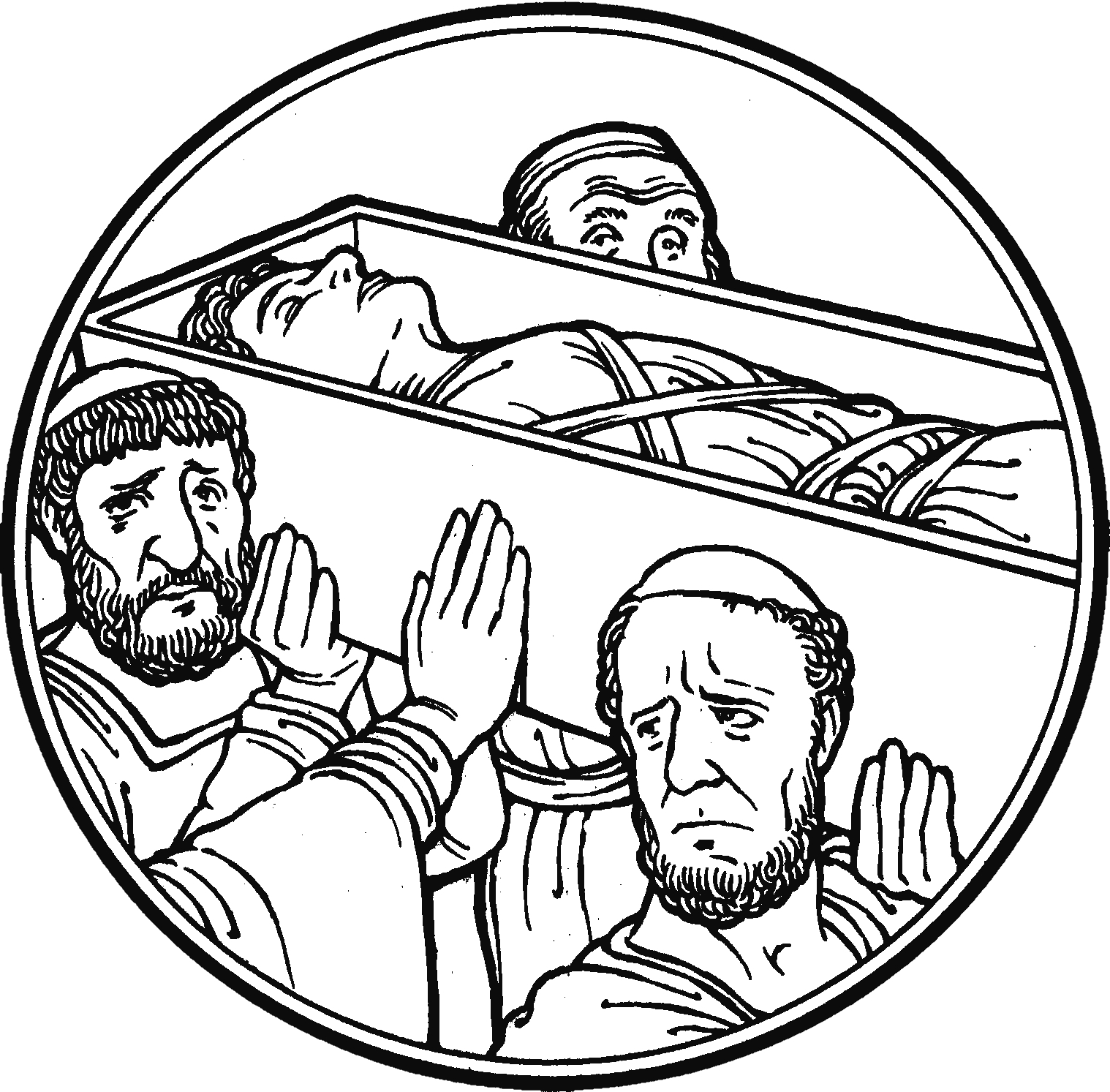
Yes, Easter joy is the climax of this text, but Good Friday sadness gets more words. Yes, the young son of this woman is raised, but Luke spends much more time telling us about the sad estate of his mother. She was a widow, but now she is really alone. This son of hers that has died is her only-begotten (μονογενής same word used in Jn. 3:16) son. A great crowd follows her sharing in her grief. Jesus sees her and speaks to her first. This woman is drowning in Good Friday grief. But Jesus He won’t allow it.

Jesus isn’t very good at funerals. He always ruins them. Remember when Jairus’ little girl died (Mt. 9:18-26; Mk. 5:22-43; Lk. 8:41-56), Jesus sees all the mourners weeping and wailing and tells them, “Go away, for the girl is not dead but sleeping,” and everyone laughs at Him. But then Jesus goes into the house, takes the girl by the hand, and says, “Little girl, get up” (Mk. 541:). And she does. Or, remember when Lazarus died. Jesus came when Lazarus’ corpse would have been ripe and stinky. Then, Christ tells them to roll the stone away from the entrance of the tomb and says, “Lazarus, come out” (Jn. 11:43). And out He comes. Finally, remember Jesus’ own funeral. Our Lord didn’t behave properly then either. Jesus leaves before His funeral is finished. He didn’t stick around in the grave long enough to have a proper burial.

Well, here in this text, Jesus ruins another funeral. Jesus is leading a great crowd. And as they reach the city of Nain, they meet another crowd who were going out of the city to bury the boy. These two throngs of people meet at the gate. Imagine this. One crowd is leaving the city and following death, and another crowd is entering the city lead by the Life of the world (Jn. 11:25, 14:6). And these two crowds get mixed up together in this bottle neck.

Proper etiquette and manners would dictate that Jesus and His crowd would step aside and allow the funeral procession to pass by. But, remember, Jesus is no good at funerals. Instead, Jesus marches right up to the front of the funeral procession. He does this, Luke tells us, because when He saw the mother He had compassion on her. Literally, Jesus’ guts were being wrenched and all twisted up inside.

He walks up to the woman and says, “Do not weep.” This sounds absolutely callous. Weeping is the right thing for this woman to be doing – her son has died. When you are saddened by the death of someone and find yourself weeping, you are doing what is right. Your actions line up with how God feels about death. Jesus, who never sinned, Himself cried when He was at the tomb of Lazarus (Jn. 11:35). Now, the text doesn’t tell us this, but I wouldn’t be surprised if Jesus had tears in His eyes as He approached the widow. Remember His guts are wrenched. But He tells her to stop crying because He is about to intervene. Jesus could have reversed the order. He could have raised the young man first, then told the mother to stop crying. But He doesn’t. He tells her to stop crying because it isn’t going to be necessary in a moment. This command to stop crying is a call for her to trust in Him.

H-70 Trinity 16 (Lu 7.11-17)Then, Jesus walks past the pallbearers, straight up to the bier, touches it, and says, “Young man, I say to you, arise,” as though He was waking up a sleepy teenager late on a Saturday morning. The boy gets up and begins to speak. I wonder what he said.

Jesus gives the boy back to his mother and everyone glorifies God saying, “A great prophet has arisen among us!” And, “God has visited His people!” They were right. God had visited His people. God had taken on flesh to deliver His people from death and sin, the sting of death (1 Cor. 15:54-56).

Dear saints, today is October 6th, but today we celebrate Easter; we celebrate the resurrection. Yes, we await the resurrection on the final day when Christ returns and raises up the dead and grants eternal life to all who believe in Him. But the resurrection has already begun. Jesus, your Savior died, but He lives. He is the first fruits of those who have fallen asleep (1 Cor. 15:20). Whenever Jesus contends with death, death looses.

And that is what you need because this morning, you were part of a funeral procession. Because you are a sinner, the stink of death hangs around you. Young and old – man, woman, and child – we all dragged some dead thing here with us today.

Is it your relationship with your spouse that is slowly dying? Is it the skeleton of disobedience to parents? What dead thing have you brought with you?

Is it the rotting remains of your finances that cause you to worry and doubt, or simply discontentment with what God has given you? Is it the cadaver of lust that flames within you? Is it the carcass of pride that is so inwardly focused that you do not notice the needs of others? What dead thing have you brought here with you?

Maybe it isn’t even your fault. Maybe it is just the fear of what might happen in the future. Maybe it is anger for how you have been wronged in the past. Maybe your dead thing is your own sick, crumbling body. What dead thing have you brought here with you?

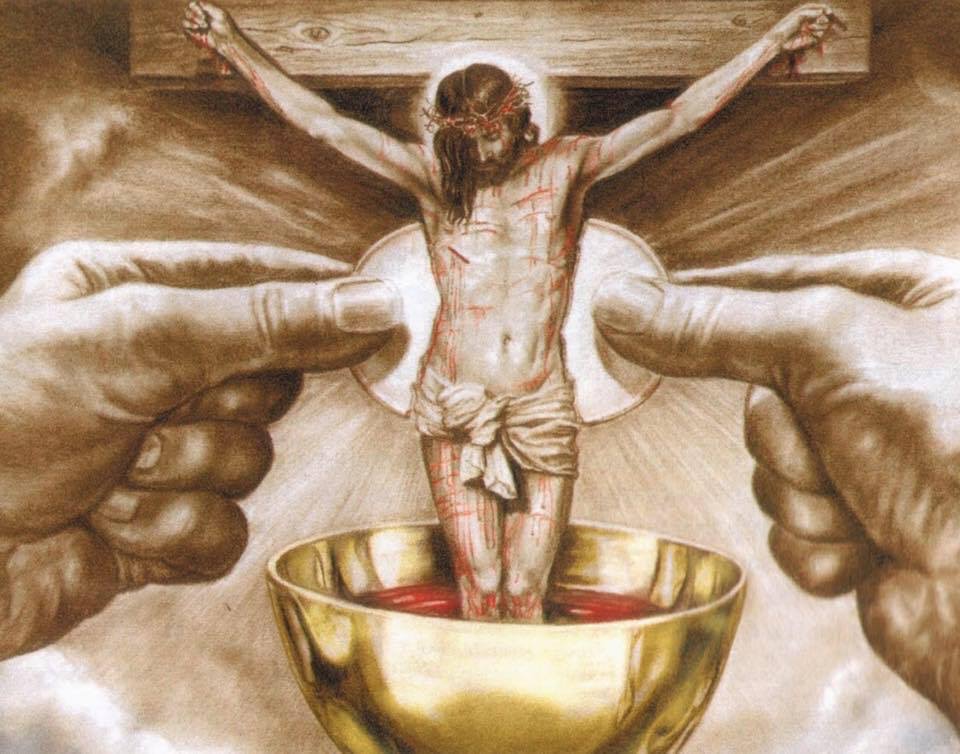
Body of Christ CommunionJesus marches toward your funeral procession, and He does not stop or yield. Jesus does not give way or defer to death. Instead, Jesus defeats death with His death and resurrection, each and every time He meets it. Jesus meets you here today as you plod along in your personal funeral procession and gives you life. Jesus meets you at this altar to give you His living Body and His life-giving Blood.

Alleluia! Christ is risen!
He is risen indeed. Alleluia!

Amen.

The peace of God, which surpasses all understanding, will guard your hearts and minds in Christ Jesus. Amen.

Feasting with Sinners – Sermon on Luke 15:1-32 for the Third Sunday after Trinity

Listen here.

In the name of Jesus. Amen.

You can take each of these parables out of their context, and they will correctly teach you about the Kingdom of God and His grace and mercy. When these parables are taken out of context, they become nice stories about how Jesus seeks out you who are lost sheep, lost coins, and lost sons, and the angels in heaven rejoice at your being brought into the fold. To view yourself as the lost sheep, coin, or son is not entirely wrong, but neither is it entirely right.

So first, let’s consider the context of these parables. The reason Jesus tells them is the grumbling of the Pharisees when Jesus is eating with and welcoming sinners. So, the point of each of the parables is to pound into our heads the joy of heaven over one sinner who receives grace. The parables show us the ludicrous feasting and joy of God’s mercy, pardon, and steadfast love over sinners.

Lost Sheep from Luke 15.jpgIn each of these parables, what is lost – the sheep, the coin, and even the son – is not valuable. That is the point of the parables. This is most apparent in the parable of the lost coin. The party the woman throws costs more than the coin that she recovered. That one sheep was worth less than the cost of the party that the shepherd threw. Even that one son was not worth the cost of the party. And don’t pish-posh that statement.

The son had told his father to drop dead. The twerp demanded that his father sell off everything. The little brat went off, blew the inheritance, and returned only when he is tired of sharing swill with swine and thinks he has a chance at getting some bread. He came sauntering back to negotiate a job for himself. Had the father brought him on as a hired hand, it would have been gracious. Restoring him to sonship is merciful. Throwing a party about the whole business is unimaginable. No, the son is not worth a party.

But that is the point. The point is that God is like an obsessive and foolish shepherd, woman, and father who loves too much. God pays for work not performed and for merchandise not delivered.

If these parables give you a picture of a God who seems reasonable, then you are reading them wrong. Your heavenly Father turned His back on His perfectly good, entirely faithful, and completely obedient Son to purchase those who killed Him. Jesus laid down His precious life for sinners.

To paraphrase our Old Testament text (Mic. 7:18-20), “Who is a God like You, pardoning iniquity and passing over transgression? You do not retain Your anger forever, because You delight in steadfast love. You have compassion on us, and You will have compassion us again and again.”

ShadenfreudeBecause of our sin, we are broken. No one wants to admit it, but we are happy when our neighbor suffers and we are sad when he rejoices. The Germans created a word for this by combining their words for ‘harm’ and ‘joy’ into one word, Schadenfreude. The worst part is we justify our Schadenfreude. We enjoy others’ pain because we figure they deserved it. We want others to get what we think is justice. But this is the opposite of compassion and is from the devil.
Satan wants justice for others. His desire is that you get the wages of your sin – death. And when we desire and demand justice, we join our voices to the serpent and receive nothing but hell and condemnation.

Like the Pharisees, we live good, respectable lives but only in an outward way. We mow our lawns and use our turn signals. We volunteer, pay our bills, and give to charities. And we think we deserve good, peaceful lives because of it. When we encounter any trouble or trial or cross, we conclude that God isn’t being fair. And worse than that, when God showers blessings on others, we figure God is rewarding bad behavior. And instead of repenting, we judge God to be unjust. We are entirely foolish for thinking so.

The Pharisees were angry at Jesus for receiving sinners, so they are damned and go home condemned. They refuse to repent. And they refuse to repent because they hate grace – even though they will never admit it. Irritation at God for accepting sinners through grace is the height of hubris and pride.

Instead of being encouraged that God forgives sinners whom we deem worse than us, we get jealous and think that God should simply accept us as we are because we are so much better than others. It is the same as saying, “I don’t need mercy, so others shouldn’t get mercy.”

Repent. The sheep, the coin, and the son are not worth the cost to restore them nor the party thrown afterwards. And, sinner, you are not worth the cost of your redemption. Let me repeat that and let it sink in: You are not worth the cost of your redemption.

But God does it anyway. How great is God’s steadfast love toward us and others?

No one is worthy of the banquet. No one is worthy to enter the feast. The feast is full of sinners accepted by God’s grace alone. Otherwise, what is Jesus doing on the cross?

The father in the parable slaughtered the fattened calf in order to celebrate the fact that Cross and Communionhe restored and received his son back into the family. Sinner, your heavenly Father has fattened up Jesus, His faithful Son, to serve as food for you who are unworthy.

Come, you poor, lame, cripple, and blind. Come, you who have no other options or choice. You and I are sinners received entirely by God’s grace without any merit or worthiness of our own.

Heavenly Father, teach us to rejoice in this and in nothing else. Amen.

The peace of God, which surpasses all understanding, will guard your hearts and minds in Christ Jesus. Amen.

A Little While – Sermon on John 16:16-22 for the Fourth Sunday of Easter

Listen here.

John 16:16-22

16 “A little while, and you will see me no longer; and again a little while, and you will see me.” 17 So some of his disciples said to one another, “What is this that he says to us, ‘A little while, and you will not see me, and again a little while, and you will see me’;and, ‘because I am going to the Father’?” 18 So they were saying, “What does he mean by ‘a little while’? We do not know what he is talking about.”

19 Jesus knew that they wanted to ask him, so he said to them, “Is this what you are asking yourselves, what I meant by saying, ‘A little while and you will not see me, and again a little while and you will see me’? 20 Truly, truly, I say to you, you will weep and lament, but the world will rejoice. You will be sorrowful, but your sorrow will turn into joy. 21 When a woman is giving birth, she has sorrow because her hour has come, but when she has delivered the baby, she no longer remembers the anguish, for joy that a human being has been born into the world. 22 So also you have sorrow now, but I will see you again, and your hearts will rejoice, and no one will take your joy from you.”

Alleluia! Christ is risen!
He is risen indeed! Alleluia!

In the name of Jesus. Amen.

Jesus says, “I’m here, but in a little while I won’t be here. Then, a little while later I’ll come back.”And the disciples are confused. They whisper to each other about this and none of them knows what this ‘a little while’ means. So, Jesus explains it to them.

First and foremost, this ‘little while’ refers to what would happen in a couple of hours. Jesus is soon to be betrayed and arrested. He will be tried, crucified, killed, and buried. Somewhere in that sequence, all of the disciples will no longer see Jesus. For most of them, it is when Jesus is arrested. For Peter, it is during Jesus’ trial while he is out by a bonfire denying he knows Jesus the third time (Lk. 22:61). And for John, it is either at the cross or at the burial. The disciples don’t see Him anymore, and they weep and lament because Jesus is dead, buried, and sealed behind the stone in the tomb.

But it is only for a little while – Friday evening and night, all day Saturday, Saturday night through Sunday afternoon before they see the resurrected Jesus once again. Again, first and foremost, this is the ‘little while’ Jesus is referring to.

But Jesus also alludes to something more. He is also speaking about His ascension, which is what Jesus was referring to when He said He was “going to the Father.” Don’t miss that part of our text. The morning of the Resurrection, Jesus appears first to Mary Magdalene. When she recognizes Jesus, Mary falls at His feet and embraces Him (Mt. 28:9), but Jesus says to her, “Do not cling to me, for I have not yet ascended to the Father; but go to my brothers and say to them, ‘I am ascending to my Father and your Father, to my God and your God.’”

So, yes, He is referring to the time that the disciples weep and lament and have sorrow between His burial and resurrection. But here, in this text with this ‘little while,’ Jesus is also referring to the time while you have sorrow between His ascension and return in glory on the last day, which means, you, dear saint, are even now living in the ‘little while’ Jesus refers to.

A Little While WaitingThis ‘little while’ has lasted nearly two thousand years and counting. Yet, two thousand years is nothing when you compare it to everything that lies ahead for you in eternity. And it is even more miniscule when you realize that it will only be a few short years before you meet Jesus face-to-face – even if you live to be one-hundred-twenty. But we still have a problem. During our pain and anguish, our difficulties and seasons of tribulation, time seems to stand still while we suffer. But we can take heart and be encouraged. Jesus says it will only be ‘a little while.’

This little phrase from Jesus – ‘a little while’ – is meant to be comforting in the midst of sorrow, pain, anguish, trials, and tribulations. First, it lets us call that trouble what it is – it is suffering and not something that God ever intended you to experience. When you suffer, you don’t have to put on a brave face and say things like, “I know other people have it worse than I do.” No. No matter how great or small, call suffering what it is – suffering. The second reason this is comforting is that you can know that your God and Savior promises that your suffering can only last ‘a little while.’

Mothers, you understand Jesus better than anyone else which is why He uses you as an example here. As a man who has never and will never give birth, and as a father who has been present at the births of all four children, I hesitate to speak too much about this – especially on Mothers’ Day. But as a pastor who has been called to preach God’s Word, I must echo what Jesus says.

Kids, your mom suffered to bring you into this world. The pain and anguish of a woman in labor is real – there is no denying it. And, mothers, Jesus knows the pain you have been through, not because He ever gave birth, but because He is the one who said that a woman’s pain in childbirth would be greatly increased after the Fall (Gen. 3:16). But when a mother has delivered the baby – and remember this is according to Jesus – she no longer remembers the anguish because of her joy that a child has been born into the world.

It is not as though her memory is erased and she forgets the pain of labor – that is not what Jesus says. Instead, her anguish is swallowed up by joy that she now has a child to love and cherish. This is the main thing Jesus is teaching us in this text. Sorrow and suffering is temporary for you, Christian. It can only last ‘a little while’ and no more.

Grace is Sufficient, suffering, new creationNow, there is no denying that your suffering is real. Some of you are currently enduring that suffering in severe ways right now. We pray that your relief will be soon and swift. But know this: God is working through those sorrows. He is using your trials to keep you close to Himself, to work virtue in you, to teach you to trust in Him. This does not mean that you should rejoice because of trials and tribulations. Instead, it is a reminder that you can rejoice in spite of and in the midst of that suffering. Like buds on a tree indicate that full blossom is coming, those troubles, trials, sorrows, and crosses are harbingers of the joy that is to come.
And if you aren’t currently going through trials right now, you will. Jesus says that you will weep and lament, and you will be sorrowful. Jesus has called you to take up your cross and follow Him. Good Friday always comes before Easter, but Easter joy always overcomes Good Friday sorrow. Resurrection always defeats death.

Christian, the crosses you have borne in the past, the crosses you bear now, and the crosses you will bear in the future will and must give way to Resurrection joy because – already and now – Christ is risen.

Pain, sorrow, trial, and tribulation is real and there is no getting around it. A slave is not above his master. If Jesus is persecuted and suffers, you will be persecuted and suffer (Jn. 15:20). And Jesus promises, “You will weep and lament, and you be sorrowful, but your sorrow will turn into joy. And no one will take your joy from you,”because Jesus has promised it will only be ‘a little while.’

Alleluia! Christ is risen!
He is risen indeed! Alleluia!

Amen.

The peace of God, which surpasses all understanding, will guard your hearts and minds in Christ Jesus. Amen.

Comfort & Rejoicing – Sermon on Matthew 11:2-11 for the Third Sunday in Advent

Listen here.

Matthew 11:2-11

Now when John heard in prison about the deeds of the Christ, he sent word by his disciples and said to him, “Are you the one who is to come, or shall we look for another?” And Jesus answered them, “Go and tell John what you hear and see: the blind receive their sight and the lame walk, lepers are cleansed and the deaf hear, and the dead are raised up, and the poor have good news preached to them. And blessed is the one who is not offended by me.”

As they went away, Jesus began to speak to the crowds concerning John: “What did you go out into the wilderness to see? A reed shaken by the wind? What then did you go out to see? A man dressed in soft clothing? Behold, those who wear soft clothing are in kings’ houses. What then did you go out to see? A prophet? Yes, I tell you, and more than a prophet. 10 This is he of whom it is written,

“‘Behold, I send my messenger before your face,
who will prepare your way before you.’

11 Truly, I say to you, among those born of women there has arisen no one greater than John the Baptist. Yet the one who is least in the kingdom of heaven is greater than he.”

In the name of Jesus. Amen.

Here we are – just over a week away from Christmas, and now we hear John the Baptizer. He is the fore-runner. He is the voice of one crying in the wilderness, “Prepare the way of the Lord.” He came tearing down mountains as he preached the Law and raising up valleys as he preached the Gospel.

John is an interesting character. He is one of only three people I can think of – Isaac, John, and Jesus – whose birth was promised from heaven before the child was even conceived (maybe you can think of more). God sent the angel Gabriel to tell Zechariah that God would open Elizabeth, his wife’s, womb; Gabriel also said that John would be filled with the Holy Spirit before he was even born (Lk. 1:15). When Mary was pregnant with Jesus and went to visit Elizabeth, Mary greeted Elizabeth, and John leapt in Elizabeth’s womb (Lk. 1:39-41).

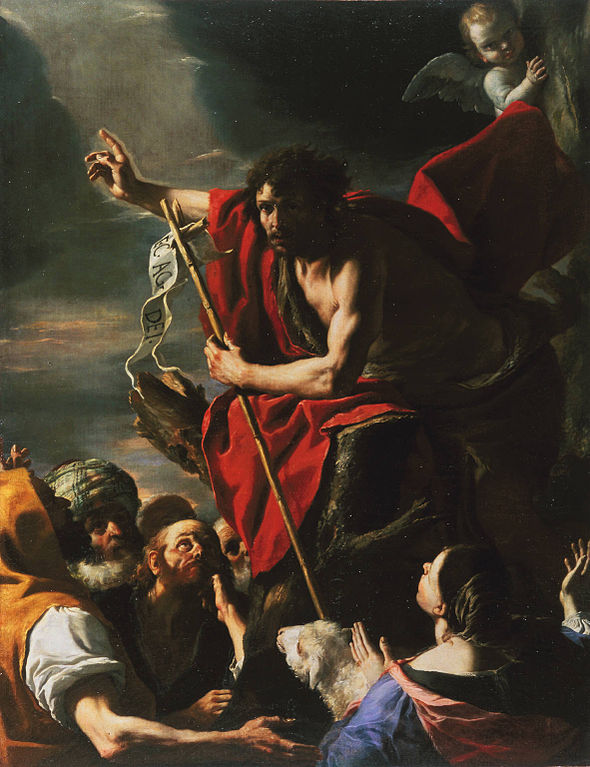
John the BaptizerJohn was born and grew up as a Nazarite, so his hair was never cut. Imagine his big, bushy beard and his long, tattered hair. John preached out in the wilderness wearing clothes made of camel hair and leather belt. He had a peculiar diet of locusts and wild honey (Mk. 1:6). Imagine having locust breath – probably even worse than coffee breath. Matthew summarizes John’s preaching as this message: “Repent for the kingdom of heaven is at hand” (Mt. 3:2). People would come out to the wilderness to hear him preach, and when he saw them he said, “You brood of vipers! Who warned you to flee from the wrath to come?” (Mt. 3:7). He would preach about the axe that was laid to the root of every tree that would cut down each tree that didn’t bear fruit and throw it into the fire (Mt. 3:10). So, John was a preacher of the Law. But still all the country of Judea and Jerusalem was going out to John and being baptized and confessing their sins (Mk. 1:4-5).

But John was also a preacher of the Gospel. He would point people to Jesus. He told them about the One who was coming after him, whose sandals he was unworthy to stoop down and untie (Mk. 1:7). He pointed to Jesus and said, “Behold the Lamb of God, who takes away the sin of the world!” (Jn. 1:29, 35-36). John was a wild man frantically calling people to repent and pointing them straight to Jesus.

But that is not the John we hear about today. In today’s Gospel, John is in prison. He had preached against the sin of Herod, and Herod didn’t like it. The John in today’s Gospel reading isn’t standing in the wilderness next to the Jordan River with his hair blowing in the wind as he preaches repentance and the Lamb of God. Instead, John is behind bars in a stuffy, dank, dark cell. And the last words we hear of John the Baptizer don’t even come directly from his mouth. His last recorded words in Scripture are a question brought by John’s disciples to Jesus. “Are you the One who is to come, or shall we look for another?”

Even John who, according to Jesus, was the greatest among those born of women, even John struggled with doubt. So, when you struggle with doubt (and please, notice, it I didn’t say ‘If you struggle with doubt’), when you struggle with doubt, know that you are sitting next to John. Maybe, you wouldn’t word your question the same way that John did. Maybe, your question is, “Is my spouse really going to rise again?” or, “Am I ever going to get better and be healed?” or, “Jesus, did You really die and rise again for me?” or, “Jesus do you really forgive me?” All of those questions also fall under John’s question, “Are you the One who is to come?”

It’s a simple ‘yes/no’ question. But Jesus, in typical Jesus fashion, doesn’t give a ‘yes/no’ answer. Instead, Jesus sends John’s disciples back with a message, “Go and tell John what you hear and see:the blind receive their sight and the lame walk, lepers are cleansed and the deaf hear, and the dead are raised up, and the poor have good news preached to them.And blessed is the one who is not offended by me.”

john-in-prison-with-disciplesJohn was anxious in prison knowing he was probably going to be executed for what he had preached. Probably, John was wondering if he had preached rightly. And Jesus’ response points John and you to the Scriptures. In particular, Jesus points John to Isaiah 35:4-6, and you have to hear the context of those verses because it shows how beautifully Jesus answers John’s question, “Are you the One who is to come?” Here it is Isaiah 35:4-6, “Say to those who have an anxious heart, ‘Be strong; fear not! Behold, your God will come with vengeance, with the recompense of God. He will come and save you.’ Then the eyes of the blind shall be opened, and the ears of the deaf unstopped; then shall the lame man leap like a deer, and the tongue of the mute sing for joy….”

Jesus directs imprisoned, anxious, troubled, doubting John and you, to the comforting promises of Scripture because the word of the Lord endures forever (Is. 40:8). The blind seeing, the deaf hearing, the lame walking, and the mute singing are evidence that God has come, and He has come to save. The comfort is notin the signs. The signs point back to the comforting news that God has come to bring salvation to you.

This is the good news, the Gospel, that John needs to hear. This is the good news that all sinners need to hear, that you need to hear. God has come. Jesus has come and saved you. christ-of-st-john-on-the-cross-salvador-daliHe opened the eyes of the blind. Christ made the deaf hear, the lame walk, and the mute to sing. All of that means that salvation has come to you who are anxious and poor in spirit. Rejoice.

Believer, you can have joy because of the comforting message that Jesus has come. He has come and saved you. Joy is not the same as happiness. Happiness and sadness cannot coexist, but joy and sadness can. Joy is not the absence of sadness or anger. Joy is confidence and contentment that God is in control and is taking care of things. Even when everything seems dark and fading, God is in control, and He has come. He has died and risen again. He has come and saved you. Amen.

The peace of God, which surpasses all understanding, will guard your hearts and minds in Christ Jesus. Amen.