A Good Day – Sermon on Genesis 22:1-14 for the Fifth Sunday of Lent

Genesis 22:1-14

1 After these things God tested Abraham and said to him, “Abraham!” And he said, “Here I am.” 2 He said, “Take your son, your only son Isaac, whom you love, and go to the land of Moriah, and offer him there as a burnt offering on one of the mountains of which I shall tell you.” 3 So Abraham rose early in the morning, saddled his donkey, and took two of his young men with him, and his son Isaac. And he cut the wood for the burnt offering and arose and went to the place of which God had told him. 4 On the third day Abraham lifted up his eyes and saw the place from afar. 5 Then Abraham said to his young men, “Stay here with the donkey; I and the boy will go over there and worship and come again to you.” 6And Abraham took the wood of the burnt offering and laid it on Isaac his son. And he took in his hand the fire and the knife. So they went both of them together. 7 And Isaac said to his father Abraham, “My father!” And he said, “Here I am, my son.” He said, “Behold, the fire and the wood, but where is the lamb for a burnt offering?” 8 Abraham said, “God will provide for himself the lamb for a burnt offering, my son.” So they went both of them together. 

9 When they came to the place of which God had told him, Abraham built the altar there and laid the wood in order and bound Isaac his son and laid him on the altar, on top of the wood. 10 Then Abraham reached out his hand and took the knife to slaughter his son. 11 But the angel of the Lord called to him from heaven and said, “Abraham, Abraham!” And he said, “Here I am.” 12 He said, “Do not lay your hand on the boy or do anything to him, for now I know that you fear God, seeing you have not withheld your son, your only son, from me.” 13 And Abraham lifted up his eyes and looked, and behold, behind him was a ram, caught in a thicket by his horns. And Abraham went and took the ram and offered it up as a burnt offering instead of his son. 14 So Abraham called the name of that place, “The Lord will provide”; as it is said to this day, “On the mount of the Lord it shall be provided.”

In the name of Jesus. Amen.

In most of our interactions with people, we typically give more weight to their commands than we do to their promises. In other words, we take commands seriously but promises, not so much. We’ve grown accustomed to people who over-promise but under-perform.

When your boss tells you he wants a certain task completed by the end of the day, that carries a lot of weight. But when your boss promises that he’ll consider your request for a new chair as soon as possible, you anticipate that there will be delays and excuses and figure you’ll probably have to ask several more times. Sadly, even children learn this. Parents will command their children to do certain things, but then when a child asks their parents to consider getting a puppy, a parent responds, “Sure, I’ll think about it,” but that may or may not happen.

The worst part of this is how it clouds how we consider God’s Word. God’s Word is consistent. His promises carry same weight as His commands. What God promises always happens. You can count on it. He is the Lord; He has spoken, and He will do it (Ezk. 24:14).

That helps us understand a little better what’s going on in this text. The biggest hurdle we have to understanding this text is the question, why is God commanding Abraham to do this? Why command the human sacrifice of Isaac? Last week we talked about the tests that God gives, and this is clearly a test. God is testing Abraham here, and this is probably the most difficult test recorded in Scripture. (Who knows? Maybe Job would argue with that statement.) 

The reason God tests always to strengthen faith. He doesn’t test you to see if you have enough willpower or inner strength. Instead, God tests faith to make it stronger. God’s tests increase steadfastness (Jam. 1:2-4), endurance, character, and hope (Ro. 5:3-5). One pastor put it nicely when he said that God gives tests to strengthen our “givable-to-ness.” His tests open us up so we can receive from God’s hands the abundance He wants to give us.

God had been making promises to Abraham for years prior to this. God called Abraham to leave his land and people (Gen. 12:1-3) so God could make a great nation out of him (Gen. 15:1-6). When Abraham was 99 years old, God promised to give Abraham a son through his wife Sarah – even though she was 90 and past the age of having children (Gen. 17:15-16). God kept giving promises. Just before this reading, God promised that Isaac would have children, and through Isaac’s children all the families of the earth would be blessed (Gen. 21:1218:18).

But now, God commands Abraham to offer Isaac as a burnt offering. God’s promise that Isaac would have children is in direct contradiction to God’s command that Isaac be sacrificed. So, what is Abraham to do? Should he believe God’s command or God’s promise? The answer is to believe both, and Abraham does. Hebrews 11:19 says, that Abraham believed that God would raise Isaac from the dead. Abraham believed God’s promises and commands – even when God’s promise and command appeared contradictory.

Now, to the text. God doesn’t just say, “Go sacrifice Isaac.” No. God lays it on thick. “Take your son, your only son Isaac, whom you love.” That, dear saints, is the first time the word ‘love’ is used in the Bible. “Take your son, your only son Isaac, whom you love, and go to the land of Moriah, and offer him there as a burnt offering on one of the mountains which I will show you.”

Abraham knew that all the animal sacrifices in the Old Testament pointed to the fact that God would accept the death of another in the place of the sinner. Abraham and all the believers in the Old Testament believed that those sacrifices were pointing forward to the Savior God had promised (Gen. 3:15) who would die in their place (Heb. 9:12).

This sacrifice (or ‘near sacrifice’) of Isaac might be the clearest portrayal of what God would do through Christ. The whole thing is parallel to what Jesus would do. Abraham is to offer his son, just like God the Father, is to offer up His beloved son, Jesus (Jn. 3:16). It takes three days for the thing to take place (Gen. 22:4Lk. 24:46). Isaac, like Jesus, carries the wood to the place where he is to be the sacrifice (Gen. 22:6Jn. 19:17). The ram that gets offered in place of Isaac is crowned with thorns (Gen. 22:13Mt. 27:19). 

When Abraham sees that ram caught in the thicket by its horns, which doesn’t happen to rams, Abraham recognizes that ram is to be sacrificed instead of Isaac. God has put that ram there, and God will accept the death of that ram in the place of Isaac. But the ram is not the actual substitute. That ram points to Jesus as the sacrifice in place of Isaac and Abraham and the whole world and for you.

Through this whole thing, God is giving Abraham an insight into what God will go through when He offers up Jesus as the sacrifice for the sin of the world.

Dear saints, as we move into Holy Week, we’re going to hear a lot of sad things. Next week, Palm Sunday, we’ll hear the Passion of Christ from Matthew. We’ll hear about the betrayal, beating, whipping, crucifying, and dying of the eternal, beloved Son of God. There will be no substitute for Jesus. He will die, and this is serious and sad like this offering of Isaac was for Abraham. But notice how Jesus talks about all of this. When Jesus spoke of Abraham in our Gospel reading today, our Lord says, “Abraham saw my day and was glad” (Jn. 8:56). Abraham rejoiced.

Abraham saw what God would do in giving His only begotten Son on the cross, and he rejoiced. Dear saints, in the days that are coming up, you’ll hear all that Christ did. Yes, it’s sad and somber, but the greatest expression of faith is that you would be glad and happy about this. Receive it all with a thankful and joyful heart. God loves you, so He loves to do this for you.

Tenali, today you are Baptized. Jesus is the one who has taken your place. This is reason to rejoice all the days of your life. Live a life filled with rejoicing in the fact that Jesus is your substitute. Tenali, and all you saints, remember that Jesus endured all His suffering with joy. It was for the joy that was set before Him that Jesus endured the cross, despising the shame (Heb. 12:2).

Joy isn’t only for Easter. Joy is found in all Christ has done for you. You have a substitute. You have a Savior. Good Friday, a glad day, indeed. Amen.

The peace of God, which surpasses all understanding, will guard your hearts and minds in Christ Jesus. Amen.

The Bearing Lamb – Sermon on John 1:19-29 for the Fourth Sunday of Advent

John 1:19–29

19 And this is the testimony of John, when the Jews sent priests and Levites from Jerusalem to ask him, “Who are you?” 20 He confessed, and did not deny, but confessed, “I am not the Christ.” 21 And they asked him, “What then? Are you Elijah?” He said, “I am not.” “Are you the Prophet?” And he answered, “No.” 22 So they said to him, “Who are you? We need to give an answer to those who sent us. What do you say about yourself?” 23 He said, “I am the voice of one crying out in the wilderness, ‘Make straight the way of the Lord,’ as the prophet Isaiah said.” 

24 (Now they had been sent from the Pharisees.) 25 They asked him, “Then why are you baptizing, if you are neither the Christ, nor Elijah, nor the Prophet?” 26 John answered them, “I baptize with water, but among you stands one you do not know, 27 even he who comes after me, the strap of whose sandal I am not worthy to untie.” 28 These things took place in Bethany across the Jordan, where John was baptizing. 

29 The next day he saw Jesus coming toward him, and said, “Behold, the Lamb of God, who takes away the sin of the world!

In the name of Jesus. Amen.

The first few verses of this text are a little frustrating. A bunch of priests and Levites come to John the Baptizer and ask him, “Who are you?” John answers with a negative statement, “I am not the Christ.” I don’t think I’ve ever had a conversation similar to this.

Imagine you’re at, say, your spouse’s company Christmas party. You don’t know many of the people there. You know a lot of names because your spouse talks about all those coworkers, but you don’t really know them. Imagine your spouse is off in a corner talking to those coworkers leaving you with the other spouses of those coworkers. Things are a little awkward, so you try to strike up a conversation with someone. You lean over and ask, “What do you do for a living?” and get the reply, “I’m not the President of the USA.” You’d probably be looking for another conversation. 

That is how John replies. But these priests and Levites have come on a mission. They’ve been sent to figure out just who John is. So, they start aiming at all sorts of targets. “Are you Elijah?” “I am not.” “Ok. Are you the prophet?” “Nope.” “Argh. Who are you? Give us something. We have to give a report.”

Finally, John opens up, “I am the voice of one crying out in the wilderness, ‘Make straight the way of the Lord,’ as the prophet Isaiah said” (Is. 40:3). There, John is doing what he was sent to do; he points people to Jesus. And John keeps talking about Jesus like an excited kid, “Among you stands One you do not know, even He who comes after me, the strap of whose sandal I am not worthy to untie.” Then, the next day, John really gets going. He sees Jesus coming toward him and says, “Behold, the Lamb of God, who takes away the sin of the world.”

That is the most beautiful sermon you could ever hear, but I want to press in on it a little bit more. The words are familiar, but just like all the words of Scripture, there is always more to learn, more glean from those simple words. Today, focus on two of those words “takes away” (in Greek is actually only one word). That translation is a bit vague and nebulous.

You might think that is referring to what Jesus does on the cross, and in a sense, that is right. Jesus brings your sins to the cross and buries them by His death. But what John the Baptizer says here is a lot more specific than our translation makes it sound.

Nearly every English translation uses the phrase, “takes away.” The word there is a common one, and in a lot of places it’s a slam dunk that it means “take away.” In Luke 6:29-30, Jesus uses this word twice. He says if someone ‘takes away’ (same word) your coat, give him your shirt as well, and if someone ‘takes away’ your goods do not demand them back. In the parable of the Sower and the Seed, Jesus talks about the seed that falls along the path and the birds come and take it away (Lk. 8:12).

But this word also can clearly mean ‘to carry’ or ‘bear’ something. Jesus uses it in that way in Mt. 16:24 where He says, “If anyone would come after Me, let him deny himself and take up (there’s the word) his cross and follow Me.” There, Jesus isn’t saying that you should first take away your cross and then follow Him. He means that you pick up your cross, that you bear the weight and load of your cross, and you follow Him. That’s the idea of what John is saying here.

And John uses this word in the present tense. John points to Jesus and says, “Behold, the Lamb of God, who is bearing the sin of the world.” Jesus is the sin-bearing Lamb of God. For about three and a half years, starting at His Baptism and ending on Good Friday, Jesus bore and carried the weight and load of the guilt and sin of humanity.

The Bible talks about your sin and my sin in a lot of different ways: darkness, death, blindness, slavery, debt, alienation from and animosity toward God. The Bible talks about your sin being dirty, stinky, rotten. But here sin is described as heavy, as a weight bearing down on your soul (see also Heb. 12:1). The sins you and I have committed and the sins that have been committed against you, Jesus bears and carries them all.

Maybe, you remember the third verse of the hymn “It Came Upon a Midnight Clear.” 
“And ye, beneath life’s crushing load
whose forms are bending low,
who walk along the climbing way,
with painful steps and slow,
look now, for glad and golden hours
come swiftly on the wing;
O rest beside the weary road,
and hear the angels sing.” 

I just wish that verse was a little more clear about why those glad and golden hours come. They come because Jesus, the Lamb of God who bears the sin of the world, has lifted that crushing load. He has taken those sins and carried them.

That load of sin, that crushing burden, is taken from you by Christ. If you read on after our text, you’ll hear why John can say this. John saw the Spirit descend like a dove and remain on Jesus at His Baptism (Jn. 1:32). From that experience of being the one who Baptized Jesus, John knew that Jesus was the One whom God had promised would crush the serpent’s head (Gen. 3:15). John knew that Jesus was the scapegoat who would bear and carry the sins of all humanity into His grave (Lev. 16:21-22), which is now and forever empty.

John knew Isaiah’s message that God would send One who would bear our griefs, carry our sorrows, and have the iniquity of us all laid on Him (Is. 53:4-5). That One is Jesus. He is the Lamb of God who bears and carries the sins of the whole world.

This call from John is for all of you, for your hears to hear, “Behold the Lamb of God who bears the sin of the world.”

You see, your sin, my sin, all sin, has a place, a location. Sin is either on you, and you have to bear and carry its guilt for all eternity, or that sin is on Christ, the Lamb of God, who has already borne it for you. Why, why, would you keep carrying it? You can, sadly, you can continue to carry your sin. If you refuse to believe in Christ, that burden can remain on you. But that would be, frankly, foolish. Jesus has carried it for you. Believe that, and be unburdened. Through faith, your sin is on Christ, and you are saved.

Dear Iris, today you are Baptized. Today, Jesus has joined you to Himself by placing His name upon you (Mt. 28:19). Iris, Jesus, the sin-bearing Lamb of God, has lifted that burden and has now clothed you in His righteousness (Gal. 3:27), and you have been born of God (Jn. 3:3, 5). Iris, continue believing that.

Iris and all you here, know and believe that God is for you. He is on your side. Christ has done what you could not do for yourself. He has borne your sins. He bore, carried, and dealt with them once for all, for you. 

So, be unburdened, Jesus has come to save you by being the sin-bearing Lamb for you. Amen.

The peace of God, which surpasses all understanding, will guard your hearts and minds in Christ Jesus. Amen.

Passover to the Lord’s Supper – Sermon on Exodus 12:1-13 & Mark 14:12-28 for Maundy Thursday

In the name of Jesus. Amen.

Before God rescued His people from slavery in the land of Egypt, He gave them a meal to celebrate their deliverance – the Passover meal. They were to take a lamb and slaughter it at twilight. God told them to take some of the blood and smear that blood on doorposts and the lintel of the houses where they would eat it. They were to eat that lamb and unleavened bread quickly and dressed to travel. That night, God passed through the land of Egypt and struck dead all the firstborn of both man and beast, but He did not enter any houses where He saw the blood of the lamb on the door. That blood was a sign that shielded God’s people from death.

It’s interesting, though, God had already set apart His people so they were not troubled by the previous plagues. Scripture tells us that the flies of the fourth plague didn’t pester the Israelites (Ex. 8:22-23). In the fifth plague, the livestock of the Egyptians died, but not the livestock of God’s people (Ex. 9:4, 7). The hail of the seventh plague didn’t fall upon the Hebrews (Ex. 9:26). Same with the darkness in the ninth plague (Ex. 10:22-23). God didn’t have His people set up any sign to keep those plagues from harming them. They didn’t need to put a fly in their window or write a “Have a nice day” in chalk on their sidewalks to be spared from those plagues. But with this final plague, God had His people set themselves apart with the sign of the blood of the lamb marking their doors.

The fact that God had His people do this not only on that day but also every year afterward was to preach an annual sermon. Each year in the Passover feast, God was reminding His people and preaching to them that the blood of a lamb protected and guarded them from His wrath and death. That blood and meal reminded the people of what God had done in the past, but it was also pointing forward to another Lamb and a better blood that would protect and shield God’s people. And that Lamb is Jesus.

But then, in our Gospel lesson tonight (Mk. 14:12-26), that Passover sermon was preached for the final time. Jesus has His disciples prepare the Passover meal, and that very night, that sermon is fulfilled. It’s no longer needed. The Passover sermon is about to become obsolete because Jesus institutes the new testament of His Supper where He gives His Body and Blood for the forgiveness of sins.

One interesting thing to notice before we move on here: In both instances, both with the Passover meal and the Lord’s Supper, God gives this meal to His people before the event actually happened. Before God passed through Egypt, God gave the Passover meal. The same thing is true in the Lord’s Supper. Before Jesus goes to the cross and gives His body unto death and sheds His blood, Jesus gives the meal of His Body and Blood for the forgiveness of your sins.

Jesus had come, and He was about to do His Father’s will. The Lamb of God, who takes away the sins of the world (Jn. 1:29) and eternally protects God’s people from the plague of death (Heb. 12:24), this Lamb had come to give Himself so that His blood can shield you and death no longer has a claim on you.

The Passover meal had served its purpose. Tomorrow, Jesus will go to the cross. And to replace the Passover meal, Jesus now gives you Holy Communion. Yes, the Lord’s Supper was instituted in the context of the Passover, but it lays aside that old meal. Many people have tried to figure out at what point during the Passover meal Jesus gives Communion as its replacement. But Scripture indicates that Jesus institutes Holy Communion as a separate thing after they had finished that final Passover meal. The Gospel of Luke especially indicates that Jesus institutes His Supper after the Passover meal was finished (Lk. 22:20). 

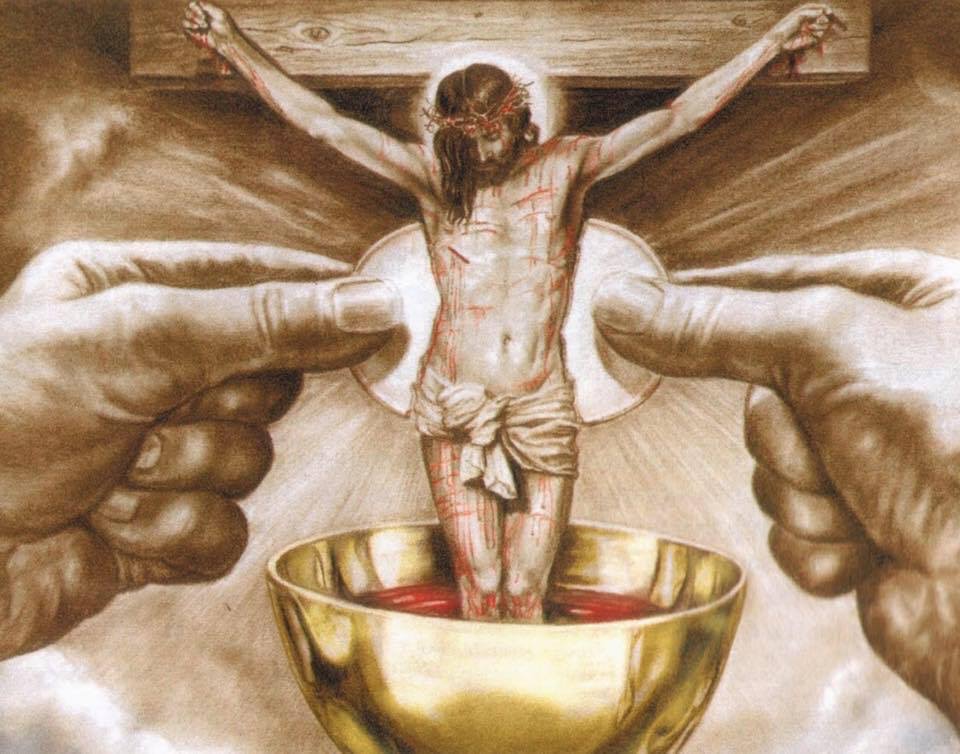
Now, instead of the Passover meal, you are to eat the bread, which Jesus says is His body, and you are to drink the cup, which Jesus says is His blood. And you do this as a remembrance of what Christ has done for you. Yes, there is remembrance in this meal, but it also delivers exactly what Christ promises it delivers. Jesus promises that in this little meal, you receive the forgiveness of your sins. And unlike the Passover meal, which was an annual thing, Jesus says to do this often in remembrance of Him (1 Cor. 11:25).

So now, Jesus invites you – yes, you – to His altar, to His table. Jesus knows what you need, and He invites you to come and receive it. This is your entry into the Holy of Holies. Here in this meal, the time and distance between you and the cross of Jesus collapses as you participate in the feast of the Lamb who was slain from the foundation of the world (1 Pet. 1:19-20). Here, your Lord gives you everything you need as you walk out of your slavery to sin and toward the Promised Land of the new heavens and earth (Rev. 21:1). Here, your sins are forgiven. Here, the Body and Blood of Christ are given for you.

So, come. Your Brother, your Lord, and your Savior invites you. Amen.The peace of God, which surpasses all understanding, will guard your hearts and minds in Christ Jesus. Amen.

The Lamb – Sermon on John 1:19-29 for the Fourth Sunday of Advent

John 1:19-29

19 And this is the testimony of John, when the Jews sent priests and Levites from Jerusalem to ask him, “Who are you?” 20 He confessed, and did not deny, but confessed, “I am not the Christ.” 21 And they asked him, “What then? Are you Elijah?” He said, “I am not.” “Are you the Prophet?” And he answered, “No.” 22 So they said to him, “Who are you? We need to give an answer to those who sent us. What do you say about yourself?” 23 He said, 

“I am the voice of one crying out in the wilderness, 
‘Make straight the way of the Lord,’ 

as the prophet Isaiah said.” 

24 (Now they had been sent from the Pharisees.) 25 They asked him, “Then why are you baptizing, if you are neither the Christ, nor Elijah, nor the Prophet?” 26 John answered them, “I baptize with water, but among you stands one you do not know, 27 even he who comes after me, the strap of whose sandal I am not worthy to untie.” 28 These things took place in Bethany across the Jordan, where John was baptizing.

29 The next day he saw Jesus coming toward him, and said, “Behold, the Lamb of God, who takes away the sin of the world!”

In the name of Jesus. Amen.

Nativity sets always include Joseph, Mary, and, of course, baby Jesus in the manger. Most will have figures that depict the shepherds and wise men (even though the wise men almost certainly did not arrive the night of Jesus’ birth). A lot of nativity sets will also incorporate animals. There might be a donkey because of the idea that Mary rode on a donkey. It very well might be that she did ride on a donkey from Nazareth to Bethlehem, but that is not recorded for us in Scripture. Nativity sets might include camels that the wise men supposedly rode, but again, even if they were there that night, Scripture doesn’t tell us if they rode on camels. But if there is one animal in a nativity set, it is probably a lamb. Of all the animals that should be part of our imagery of Christ’s birth, a lamb is at the top of the list.

Now, Jesus’ birth took place in Bethlehem which is located about five miles south of the Temple where God commanded that sacrifices be made. And the requirements for the sacrificial system at the Temple would have been immense. Each day, two lambs would be sacrificed – one in the morning and one in the evening. On top of that there were the sin offerings, peace offerings, and freewill offerings that individuals and families would bring at various times all would have required animals for sacrifice. And even beyond that, there were the animals needed for the extra sacrifices on festival days. So, all around Jerusalem, there would have been a large industry of raising animals that would be sacrificed at the Temple.

It is not a stretch to think that at least some if not most of the lambs the shepherds were tending the night of Jesus’ birth were destined to be sacrificed. It’s even possible that some of the animals who fed from the manger where Jesus was laid would also end up on the altar at the Temple. But there, in the center of it all, is Jesus – God in the flesh, the One who was born to be the one-time, forever sacrifice for your sins.

“Behold the Lamb of God who takes away the sin of the world.”

In this Gospel reading, the priests and Levites were sent to ask John the Baptizer, “Who are you?” John had been attracting massive crowds who were going out to hear his preaching and to be baptized. So, the big shot Pharisees back in Jerusalem wanted to know why John was doing what he was doing out there in the wilderness beyond the Jordan.

“Who are you, John?”

John confessed, “I am not the Christ. I am not Elijah. I am not the Prophet. I am the voice of one crying out in the wilderness, ‘Make straight the way of the Lord.’” Everything John does and says in this text points people away from himself and to Jesus, to the Savior, to the Lamb of God who takes away the sin of the world.

Dear saints, as we approach the birth of our Lord, there are all sorts of things that would grab our attention. Parties, pageants, and programs. Decorating, shopping, and wrapping. Cleaning, baking, and cooking. In the midst of the hustle and busyness of this season, don’t let your attention be grabbed only by the peripherals. Don’t be like the Pharisees, priests, and Levites who are only interested the stuff that is flashy and popular. One thing and one thing only is important this Christmas season: May you behold the Lamb of God who takes away the sin of the world.

He comes to you to take away your sin, to restore you into a right relationship with God, and to give you eternal life. Jesus comes to take away the sin of the world. That means your sin – every last bit of it – is taken away by Jesus.

This Christmas, may you be surrounded by God’s blessings – family, friends, food, gifts, and celebration. But in the midst of all of that, remember that you are secure for all eternity because of what Christ has done. He is your Savior, your Lamb of God who takes away the sin of the world. Amen.

The peace of God, which surpasses all understanding, will guard your hearts and minds in Christ Jesus. Amen.

The Shortest, Most Beautiful Sermon – Sermon on John 1:19-29 for the Fourth Sunday of Advent

Listen here.

John 1:19-29

19 And this is the testimony of John, when the Jews sent priests and Levites from Jerusalem to ask him, “Who are you?” 20 He confessed, and did not deny, but confessed, “I am not the Christ.” 21 And they asked him, “What then? Are you Elijah?” He said, “I am not.” “Are you the Prophet?” And he answered, “No.” 22 So they said to him, “Who are you? We need to give an answer to those who sent us. What do you say about yourself?” 23 He said,

“I am the voice of one crying out in the wilderness,
‘Make straight the way of the Lord,’
as the prophet Isaiah said.”

24 (Now they had been sent from the Pharisees.) 25 They asked him, “Then why are you baptizing, if you are neither the Christ, nor Elijah, nor the Prophet?” 26 John answered them, “I baptize with water, but among you stands one you do not know, 27 even he who comes after me, the strap of whose sandal I am not worthy to untie.” 28 These things took place in Bethany across the Jordan, where John was baptizing.

Lamb of God who takes away the sins of the wolrd29 The next day he saw Jesus coming toward him, and said, “Behold, the Lamb of God, who takes away the sin of the world!”

In the name of Jesus. Amen.

A more beautiful sermon has never been preached than John’s short, little sermon there: “Behold, the Lamb of God, who takes away the sin of the world!” In this Gospel text, John does exactly what he was sent by God to do. He points everyone who was there listening to him and the rest of humanity, including us, to Jesus. In that thirteen-word, one sentence sermon, John takes all the theology of the Old Testament and all of the religious practices and ceremonies and worship God had given to His people and piles it all on Jesus. Christ fulfills it all (Jn. 5:39; Lk. 24:27; Ro. 15:8; 2 Cor. 1:20).

Consider the Day of Atonement. That day was the only day that someone could enter the most holy place in the Temple. Only the high priest could enter on that one day. On that day, the people took two rams and flipped a coin to determine which one would be sacrificed and which one would be the scapegoat.

The high priest would take the scapegoat and bring it into the midst of the people, place his hands on the head of the goat, and confess all the sins of all the people over the previous year (Lev. 16:21). All their idolatry, blaspheming, and Sabbath-breaking. All their rebelliousness. All their murderous and adulterous ways. All their theft, lying, and discontentment. All those sins would be placed on the head of the goat which would then be led into the wilderness and away from the people.

Hebrews 10(:3) says, “It impossible for the blood of bulls and goats to take away sins,” but those goats could and did preach about the One who would come and take away the sins of the people. Those goats pointed the people to the Messiah who would bear the sin of the world in His body (1 Pet. 2:24). That was the point of all the sacrifices in the Old Testament – to preach about Jesus who would remove sin. When you saw any of the sacrifices – a bull or sheep or ram or pigeon burning there on the altar – you knew that animal didn’t do anything, it hadn’t committed those sins. But it pleased God to take the sins of the people and have them relocated to that animal. And as you saw that animal being killed and burned, you realize, “That should be me, but God accepts the death of another, He accepts a substitute, for my sin.”

That is what John is doing when he points to Jesus and preaches, “Behold, the lamb of God, who takes away the sin of the world.” John is saying, “Here is the One who dies in your place. Here is Jesus, the One who has all of your sin upon Himself.”

John wasn’t just preaching about the fulfillment of the Day of Atonement and the sacrifices. He was also preaching about the fulfillment of the Passover (Ex. 12). Remember, the people were slaves in Egypt, and God sends plague after plague to get Pharaoh to let His people go, but Pharaoh refuses. So, in the final plague, Exodus 12_46 - Passover Blood marking the doorpostsGod sends the angel of death to go through the land of Egypt. But God’s people were to take a lamb. They were to slaughter that lamb and smear some of the lamb’s blood on the door of their house and eat the rest of the lamb roasted that night. And when the angel would see the blood on the door, he would pass by.
Again, when John points at Jesus, he is preaching, “Here is the one whose blood marks your door and guards you from the wrath of God.”

John is preaching about the fulfillment of Abraham’s sacrifice of Isaac. For years, God had promised Abraham that He would give Abraham a child in his old age and through that child God would bless all the nations of the world. Finally, Isaac was born, but God told Abraham to offer Isaac as a burnt offering (Gen. 22). God wasn’t testing Abraham’s obedience with this crazy command; He was testing Abraham’s faith. God had promised that through Isaac, He would raise up the Messiah. And Abraham believed God’s promise that he would have great-great-great-grandchildren through Isaac even if he sacrificed Isaac on top of the mountain. Hebrews 11(:17-20) says that Abraham figured that God would raise Isaac from the dead because God had to keep His promise. Abraham believed that Isaac, the child of promise, wouldn’t stay dead. Abraham believed that God would be faithful. But God provided another way of keeping the promise. The angel stopped Abraham’s hand from sacrificing Isaac. And there in the thorns was a ram caught by its horns, and it was sacrificed in Isaac’s place. After this, Abraham named that place “God provides” because God provided Himself as the sacrifice (Gen. 22:8).

And on that very mountain, the Temple would be built. On that mountain and in that Temple, God would continually accept the death of another in place of the children of promise. And now, John says, “Here is Jesus, the Lamb of God, the one who trades places with you, sinner.”

One more. Let’s go all the way back to the Garden of Eden (Gen. 3). Adam and Eve ate the forbidden fruit. They believed the devil’s lie instead of God’s Word. Their eyes are opened, and they realized they were naked. To try and cover their shame, they sewed fig leaves together. Those leafy clothes are like every other human religion; they don’t work. They don’t cover their sin and shame – especially when God shows up. Then, when God comes into the Garden, Adam and Eve try to hide from God. God gives them all sorts of chances to repent, but their sin has made them so afraid of punishment that they continually try to hide behind the leaves of their excuses. God warns them about the curses that have come because of their sin, but He also promises that He will send the Seed of the woman who will crush the serpent’s head.

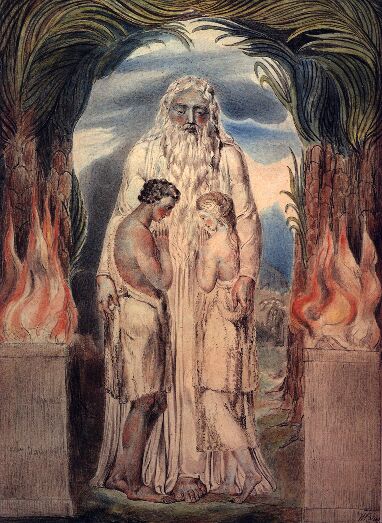
God had said that on the day Adam and Eve ate that fruit they would surly die (Gen. 2:17), but they didn’t die that day. Instead, Adam and Eve watch God take an animal, who hadn’t done anything wrong, and kill it. This was the first time in all of creation that something died. Genesis 3-21 - God made clothes from skins.jpgGod hung that animal up and stripped the skin from its lifeless body as blood stained the ground. And God wraps that skin around the shameful, sinful bodies of Adam and Eve.

Scripture doesn’t record this, but it invites us to imagine Adam and Eve watching God do all of this. And you can imagine them in their shock and horror asking God, “Is this what it takes to cover our sin and shame?” And imagine God responding, “No. This is only preaching. There is a sacrifice to come.”

That sacrifice is Jesus, God’s own Son. Prior to Jesus, all of the Scriptures tell the story of Jesus coming to be that Lamb who takes away the sin of the world. And all of the Scriptures would have you believe that God lays on Jesus the sin and iniquity of you and me and of the whole world (Is. 53:6).

This short, beautiful sermon of John takes all of these pictures and points you to Jesus as the fulfillment – not the picture. He is the One who actually bears your sin in His body. This Jesus, who knew no sin, became your sin, so that in Jesus you might become the righteousness of God (2 Cor. 5:21).

Jesus is the Lamb of God who takes away the sin of the world. Did you catch that? The sin of the world. That means this Jesus takes away your sin. God’s anger falls on Jesus, not on you. When you see Jesus on the cross, you say, “That should be me. But Jesus, my Savior, has willingly taken my place under God’s wrath so that I can take my place with Him in eternal life.”

Dear saints, this Christmas remember that Jesus is born to be your Substitute and your Savior. He, and He alone, takes away your sin now and forever. Amen.[1]

The peace of God, which surpasses all understanding, will guard your hearts and minds in Christ Jesus. Amen.

[1] I am thankful for a sermon from Pr. Bryan Wolfmueller for much of the content of this sermon.