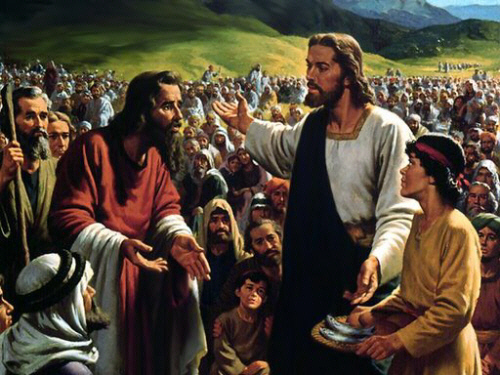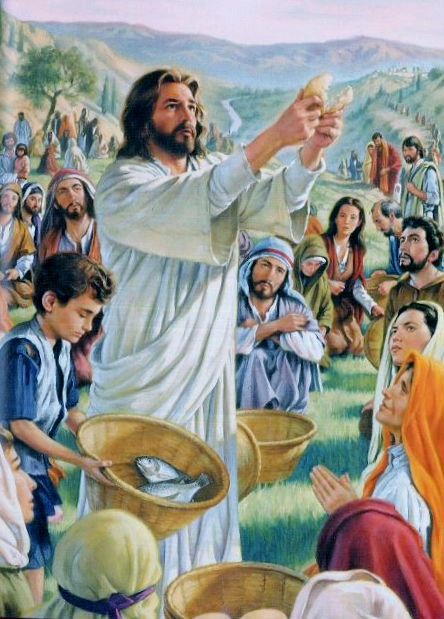
Where – Sermon on John 6:1-15 for the Fourth Sunday of Lent

John 5:1-15

1 After this Jesus went away to the other side of the Sea of Galilee, which is the Sea of Tiberias. 2 And a large crowd was following him, because they saw the signs that he was doing on the sick. 3 Jesus went up on the mountain, and there he sat down with his disciples. 4 Now the Passover, the feast of the Jews, was at hand. 5 Lifting up his eyes, then, and seeing that a large crowd was coming toward him, Jesus said to Philip, “Where are we to buy bread, so that these people may eat?” 6He said this to test him, for he himself knew what he would do. 7 Philip answered him, “Two hundred denarii worth of bread would not be enough for each of them to get a little.” 8 One of his disciples, Andrew, Simon Peter’s brother, said to him, 9 “There is a boy here who has five barley loaves and two fish, but what are they for so many?” 10 Jesus said, “Have the people sit down.” Now there was much grass in the place. So the men sat down, about five thousand in number. 11Jesus then took the loaves, and when he had given thanks, he distributed them to those who were seated. So also the fish, as much as they wanted. 12 And when they had eaten their fill, he told his disciples, “Gather up the leftover fragments, that nothing may be lost.” 13 So they gathered them up and filled twelve baskets with fragments from the five barley loaves left by those who had eaten. 14 When the people saw the sign that he had done, they said, “This is indeed the Prophet who is to come into the world!” 

15 Perceiving then that they were about to come and take him by force to make him king, Jesus withdrew again to the mountain by himself.

In the name of Jesus. Amen.

Maybe you’re like me and hate tests. I thought one of the greatest benefits of finishing my schooling was that I wouldn’t have to take any more tests. Ha! Kids, I’m sorry to burst your bubble, but if you think that the end of school means the end of tests, you’re wrong. Life is full of tests. Sure, those tests aren’t turned in to be corrected with a red pen, recorded in a book, and reflected on a report card. But there are plenty of tests throughout your life.

Specifically, God gives tests. Like it or not, God regularly gives you tests. 1 Peter 4:12 says that you should not be surprised when fiery trials come to test you. Next week, we’ll consider Gen. 22:1-14 where God tells Abraham to take his beloved son, Isaac, and offer him as a burnt offering. When Heb. 11:17 comments on that event, it says that God was testing Abraham.

Listen to these verses from James 1 because they beautifully and clearly tell us what God is doing when He gives us these tests. “Count it all joy, my brothers, when you meet trials of various kinds, for you know that the testing of your faith produces steadfastness. And let steadfastness have its full effect, that you may be perfect and complete, lacking in nothing” (Jam. 1:2-4). James goes on to say later in that chapter, “Blessed is the man who remains steadfast under trial, for when he has stood the test he will receive the crown of life, which God has promised to those who love him” (Jas. 1:12).

So, Scripture is clear that, when God gives these tests, it’s never to see if we can pass the test. God is not testing us because He needs to find out information. God isn’t up in heaven thinking, “I wonder if he’s a good enough Christian,” or, “I wonder if she really trusts Me. I’d better give a test.” No! God is not sitting up in the clouds trying to figure out if a student has learned enough. God knows everything, and He doesn’t need to put your scores in a grade book.

Instead, God tests us to produce endurance and steadfastness in us. God’s testing molds and shapes us. Those tests move us toward completion. They bring about endurance, character, and hope (Ro. 5:3-5). In other words, the tests God gives are for your benefit. Through those tests, God is stretching you and strengthening your faith.

Here in John 6, Jesus tests Philip by asking, “Where are we to buy bread, so these thousands of people may eat?” (Jn. 6:6). Again, Jesus isn’t testing Philip because it’s been a while since He recorded a score under Philip’s name. Jesus isn’t using this test to set up Philip for failure. Instead, Jesus is testing Philip to bring something about for Philip. Jesus wants to produce something in him, to work in him. When Jesus wants to do something in a person and produce something in a person, He does it perfectly.

It would be verydangerous for us to think that Jesus is trying to get Philip to fail and fall into sin. Instead, Jesus tests Philip to bring something about in Philip. And it’s clear and simple to see what Jesus wants to produce in Philip, “Hey Philip, where are we going to buy bread for these folks?” And Philip responds, “Money will not help in this situation.” That’s the thing Jesus wanted to produce in Philip. Jesus wanted Philip to know that money cannot feed this crowd. Jesus wanted Philip to know that money isn’t always the solution.

Imagine a normal day where Jesus is sitting in a house or by an evening fire or on the shore of the Sea of Galilee – it’s just Him and the disciples – and He asks Philip, “Hey Philip, do you think money can solve every problem?” Philip is no fool. He’d probably start imagining all sorts of hypothetical situations. “Money won’t help someone who’s falling down a cliff. Money wouldn’t help someone who fell out of the boat and was drowning.” I’m sure Philip would have said, “No. Money isn’t always the answer.” But Jesus isn’t asking Philip about a hypothetical situation. Jesus is asking it in real time with a real throng of hungry people surrounding them.

Generally, hunger issolved by money. To put it more accurately, generally God satisfies hunger through His gift of money. God gives you money. Then, you take your money, you go to the market, you buy food, you cook the food, and you eat it. But God hasn’t limited Himself to feeding people through money. God can make food fall down from the sky and feed millions of people (Num. 1:45-46) for forty years (Ex. 16:2-21; Josh. 5:12). If God wants to feed people that way. It isn’t a problem at all. Philip knew this, and you know this too.

Still, money can be a powerful idol. How often do find yourself in a situation, and the first thought you have is, “If I just had a little more money this wouldn’t be a problem”? Be honest! It’s probably a regular occurrence.

Thinking about money isn’t necessarily sinful. We do need to think about money because God has given it to us to be good stewards of it. But we’re too often greedy for money. We’re tempted to trust it as though it’s the solution to our problems. And for that, we repent. 

Repent, and know this: Money can never help you if God Himself does not supply it. Money is useless by itself. The only reason money has ever benefited you because Jesus gave it as a tool. 

So, in Philip’s case here, Jesus asks Philip about money to knock the idol of money out of Philip’s hand. But Jesus doesn’t leave Philip with empty hands, does He? No. Jesus empties Philip’s hands so He can put bread and fish into Philip’s hands. Philip and the disciples receive the bread and fish from Jesus’ hands and distribute it (Mt. 14:19; Lk. 9:16). The picture we have is that the disciples just keep handing out what Jesus gives them. They distribute more and more of what first came from the hand of Jesus.

The whole text makes it abundantly clear that money didn’t feed this crowd, but who did? Where did the provision come from? Jesus. Jesus is the answer. Jesus gives. Jesus distributes. Jesus provides, and not only does Jesus provide enough for the crowd; He provides enough for each of the disciples. Philip and the other disciples distribute what Jesus provided, but they still weren’t done. Jesus sends them back out into the crowd to gather up the leftovers. Leftovers? Yes. Twelve baskets worth. A basket for each disciple. Why not thirteen? Why isn’t there a basket for Jesus? At this point in the sermon, you can probably guess. Jesus doesn’t need money to provide, and He doesn’t need a basket of food.

Dear saints, when you are tested in times of need, where should you look? Our Old Testament reading (Is. 49:8-13) has the answers. Where you cry, God answers. Where you need help, God saves. Where you need certainty, God keeps you. Where you are imprisoned, God frees. Where you face darkness, God brings light. Where you hunger, God feeds. Where there is hard terrain, God makes straight. Where you face affliction, God comforts and has compassion.

So, sing for joy. The Lord has comforted His people. He has compassion on His afflicted. Amen.

The peace of God, which surpasses all understanding, will guard your hearts and minds in Christ Jesus. Amen.

Thanks & Blessing – Sermon on John 6:1-15 for the Fourth Sunday of Lent

John 6:1–15

1 After this Jesus went away to the other side of the Sea of Galilee, which is the Sea of Tiberias. 2 And a large crowd was following him, because they saw the signs that he was doing on the sick. 3 Jesus went up on the mountain, and there he sat down with his disciples. 4 Now the Passover, the feast of the Jews, was at hand. 5 Lifting up his eyes, then, and seeing that a large crowd was coming toward him, Jesus said to Philip, “Where are we to buy bread, so that these people may eat?” 6He said this to test him, for he himself knew what he would do. 7 Philip answered him, “Two hundred denarii worth of bread would not be enough for each of them to get a little.” 8 One of his disciples, Andrew, Simon Peter’s brother, said to him, 9 “There is a boy here who has five barley loaves and two fish, but what are they for so many?” 10 Jesus said, “Have the people sit down.” Now there was much grass in the place. So the men sat down, about five thousand in number. 11Jesus then took the loaves, and when he had given thanks, he distributed them to those who were seated. So also the fish, as much as they wanted. 12 And when they had eaten their fill, he told his disciples, “Gather up the leftover fragments, that nothing may be lost.” 13 So they gathered them up and filled twelve baskets with fragments from the five barley loaves left by those who had eaten. 14 When the people saw the sign that he had done, they said, “This is indeed the Prophet who is to come into the world!” 

15 Perceiving then that they were about to come and take him by force to make him king, Jesus withdrew again to the mountain by himself.

In the name of Jesus. Amen.

I have a fresh appreciation for this miracle. Last Friday, I was one of the volunteers at Sacred Heart’s Fish Fry. For about three hours, I stood along the buffet line making sure there was bread, coleslaw, tartar sauce, butter, sour cream, and lemons for people who then waited for fried fish and a baked potato. When something on the line got low, I was ready to swap out the tray or bowl and have a full one ready so the line would keep moving. I one of 64 people working that night, and in those three hours we served 1,316 people their supper.

Now, think about that. Sixty-four people, who have been organized to do particular tasks, fed just over 1,300 people in about three hours. Here, Jesus and his twelve disciples serve 5,000 men plus women and children (Mt. 14:21). In all likelihood, this was a crowd of twenty to thirty-thousand people who are fed by thirteen men doling out five barley loaves and two fish that was brought by a boy. Every person in that crowd ate as much as they wanted. And, when it was all over, the disciples gathered up twelve baskets full of leftovers.

This is easily the ‘biggest’ miracle of Jesus recorded for us in the Gospels, which might be the reason all four Gospels tell us about it. The only other miracle that even comes close would be Jesus turning water into wine at the wedding in Cana (Jn. 2:1-11). Sure, there are times when Jesus will heal many sick people who are brought to Him, but those were still one at a time miracles (Mt. 4:23-25; 8:16; Mk. 1:33-34; Lk. 4:40). This one miracle provided for tens of thousands of people all at once.

It’s no wonder, then, that the people reacted the way they did. Here is a Man who can feed people bread without needing soil or seed or rain or the right weather conditions or combines or grain elevators or flour mills or factories or bakers or truck drivers or grocers. Jesus can feed people fish without boats or bait or poles or nets or processing plants or even water. Jesus is not a politician who spouts empty promises but never delivers. He just delivers. This is the kind of guy who everyone wants to be king. So, they planned to take Jesus by force and chain Him to a throne because, sure, they were full now, but they’d be hungry again later.

Notice what everyone in this account is focused on. Phillip looks at their checkbook balance and says, “Two-hundred denarii? That’s not nearly enough.” Andrew looks at the boy’s snack and says, “This isn’t going to do it.” And the crowds – even after they are fed – they know they would be hungry again. The food Jesus provided that evening wasn’t going to be there for them tomorrow. So, they think, “If this Jesus guy can feed us like this in the wilderness, imagine what He can do if He’s the king with advisors and soldiers and tax revenue.”

We sinful creatures always seem to be fixated on our lack and desire to get more than what we have. But even when we get more, we aren’t satisfied. In his book Mere Christianity, C.S. Lewis says that the fact that we have desires means that satisfaction for those desires exists. Behind every desire – even sinful, evil desires – there is something good that is trying to be filled. The drug addict is trying to find the end of his pain or escape from sorrow. The sexually promiscuous are trying to find the good gift of companionship that God gives in marriage but fail to find it apart from marriage. Here, the crowds are doing the same thing. They want the gift of food but not in the way Jesus wants to give it.

You cannot force a gift to be given. Doing that is an attempt to twist gifts into wages, and that never works. All the things we long for and all desires we have are only filled by what God will give in the perfection of the New Creation. Because this world has fallen into sin, this world does not have the satisfaction of the desires we are seeking to fill. So, if you have unfulfilled desires, recognize you are made for another world. Stop looking to created things to fulfill your desires. Repent and instead, look to the Creator, and trust His promise to fulfill those desires. Then, be content with the good gifts God gives you in this life even as they seem to disappear.

In His infinite wisdom, God lets us see how things are used and depleted, but He doesn’t always let us always see how He supplies. None of the four Gospels tell us how the bread and fish are multiplied to feed this massive crowd. I doubt those loaves and fish grew into a massive pile that the disciples kept handing out – I think the Gospel writers would have included that. I like the suggestion that the disciples walk around with baskets of food, and each person reaches in to take some. While it appears to each individual that they are decreasing the amount of food in the basket, when the next person reaches in, there is still more. No matter how many people reach in and take, there is always more food in the basket.

Dear saints, your needs for food, house, clothing, money, health, etc. are things you can see and feel. But God doesn’t have to show you how He provides to meet those needs. He promises to meet them. So, trust His promises. You can see and feel hunger, but you can’t see the God who feeds you. You can see and feel sickness, but you can’t see the Great Physician who heals you. You can see and feel war and chaos, but you can’t see the Prince of Peace who has all authority in heaven and earth and governs all things from His throne at God’s right hand. But God supplies each of those things in ways you cannot see or understand. There are thousands of miracles that happen in your daily life. You’ve just gotten numb to seeing them because you experience them so often.

The fact that you work (in whatever job you have) and food gets to your pantry, cupboards, fridge, freezer, oven, and table is a miracle. When that food goes into your body and keeps you healthy, and when you do get sick but put nutrients, vitamins, or medicines into your body and recover, that is a miracle too. All those things – work, money, food, house, health – they are all good, miraculous gifts from God’s gracious hand. And what God gives He blesses. 

Here, we are told that Jesus gives thanks for the food before it is distributed to the crowd. In Confirmation class we recently went through the texts that recount Jesus giving the Lord’s Supper (Mt. 26:26-28; Mk. 14:22-24; Lk. 22:19-20; and 1 Cor. 11:23-25). In those texts, the Gospel writers use two phrases interchangeably. Jesus giving thanks for something is the same as Jesus blessing it. So, when you pause and take a moment to pray for your food, God is blessing that food to be a blessing for you. 1 Tim. 4:4-5 says that everything created by God is good, and nothing is to be rejected if it is received with thanksgiving because it is made holy by the Word of God and prayer. Receive with thanks the things that God gives and watch how it is blessed.

I’ll close with this: Jesus did not let the crowds take Him by force and make Him king that day, but He did allow them to take Him by force when a band of soldiers came and arrested Him. They forced Him to stand trial before Pilate and Herod. He wasn’t chained to a throne; instead, He was nailed to a cross where He shed His blood and gave His for you. Thanks be to God. Receive that gift with thanks and faith and watch how God blesses it. He blesses it and multiplies it to make you a blessing to others so that you can point them to Jesus, the One can and does fill their desires with the gift of Himself. Amen.

The peace of God, which surpasses all understanding, will guard your hearts and minds in Christ Jesus. Amen.

The King’s Test – Sermon on John 6:1-15 for the Fourth Sunday of Lent

John 6:1-15

1 After this Jesus went away to the other side of the Sea of Galilee, which is the Sea of Tiberias. 2 And a large crowd was following him, because they saw the signs that he was doing on the sick. 3 Jesus went up on the mountain, and there he sat down with his disciples. 4 Now the Passover, the feast of the Jews, was at hand. 5 Lifting up his eyes, then, and seeing that a large crowd was coming toward him, Jesus said to Philip, “Where are we to buy bread, so that these people may eat?” 6He said this to test him, for he himself knew what he would do. 7 Philip answered him, “Two hundred denarii worth of bread would not be enough for each of them to get a little.” 8 One of his disciples, Andrew, Simon Peter’s brother, said to him, 9 “There is a boy here who has five barley loaves and two fish, but what are they for so many?” 10 Jesus said, “Have the people sit down.” Now there was much grass in the place. So the men sat down, about five thousand in number. 11Jesus then took the loaves, and when he had given thanks, he distributed them to those who were seated. So also the fish, as much as they wanted. 12 And when they had eaten their fill, he told his disciples, “Gather up the leftover fragments, that nothing may be lost.” 13 So they gathered them up and filled twelve baskets with fragments from the five barley loaves left by those who had eaten. 14 When the people saw the sign that he had done, they said, “This is indeed the Prophet who is to come into the world!” 

15 Perceiving then that they were about to come and take him by force to make him king, Jesus withdrew again to the mountain by himself.

In the name of Jesus. Amen.

Jesus asks Philip, “Where are we to buy bread, so that these people may eat?” And John gives us insight as to why Jesus asks the question. It was to test Philip. Now, Jesus didn’t just find Himself in the midst of the wilderness surrounded 5,000 men plus women and children – in all likelihood a crowd of ten to twenty thousand people – with no food and sees an opportunity for a test. No, Christ sets the entire thing up.

The feeding of the 5,000 is one of the few events recorded in all four Gospels (Mt. 14:13-21; Mk. 6:30-44; Lk. 9:10-17; and Jn. 6:1-15). The picture the texts collectively paint is that Jesus intentionally draws this crowd out into the wilderness (Mk. 6:31). He takes the time to heal many of them (Mt. 14:14) and preaches late into the evening (Mk. 6:34-35). In other words, Jesus means to bring them to that desolate place where there is no food, but food is needed. On top of that, He is the King who created everything (Jn. 1:1-2, 14). Jesus can cause rain to fall in one place but not another (Am. 4:7). Throughout the entire world, Jesus was the One providing bread and food for all mankind (Ps. 145:15-16), but Christ brought this massive crowd out into the wilderness to this particular mountain in order to set this test up for Philip. And the test has one question, “Where are we to buy bread, so that these people may eat?” Jesus isn’t looking for information. He’s not asking Philip to devise a plan or order something through Door Dash. The text tells us, “[Jesus] knew what He would do” (Jn. 6:6).

Now, put yourself in Philip’s position. It isn’t hard to imagine. When was the last time you were in a seemingly impossible situation? Your bank account got low, and suddenly your car needs significant, expensive repairs. You wonder, “Where’s the money going to come from?” Your kid or your spouse gets sick, and while you are doing everything you can to care for them, you get sick too. You don’t know where you will get the strength care for yourself much less your kid. You’re in a really busy time at work, then there is a blizzard, so you have to dig yourself out and help your aging parents clear out their driveway too. You don’t know where you will find the time to do everything that needs to be done. How often do you look at your calendar or think through all the things you need to accomplish and have no idea how you are going to make it through the week? Whether it is resources and money, strength and endurance, time and skills, there are moments in your life where you are buried under the expenses, responsibilities, and tasks, and all you can see is what you don’t have.

That is why Philip fails Jesus’ test. He sees what they have, and he concludes it isn’t enough. His response is, basically, “You’re jumping the gun, Jesus. Look around. We’re in the wilderness, not the marketplace. Even if we were surrounded by stores fully stocked with bread, we don’t have enough money. Two-hundred denarii wouldn’t be enough for all of them to even get a bite.”

The test was for Philip, but Andrew, Peter’s brother, takes a shot at the exam. This is just an aside, but this text really shows how similar Andrew and Peter are. Peter will jump into situations like a madman (Mt. 14:28-29) and will speak when he should just be silent (Mk. 9:5-6). Andrew does the same when he says, “This boy has five barley loaves and two fish, but that’s not going to cut it with this crowd.”

Both Philip and Andrew fail the test even though they knew the answer. The correct answer was, “I don’t know where we will buy bread, Jesus. But I do know You are here. You have provided food in bleaker situations than this, so You’ve got it all under control.” Philip and Andrew knew that Jesus was the Messiah (Jn. 1:41). They knew He was the fulfillment of what Moses and the prophets wrote (Jn. 1:45). In other words, they both knew that Jesus was the one who rained bread from heaven and sent quail in abundance for His people in the wilderness (Ex. 16:4, 13). They knew Jesus was the one who sent the ravens to feed Elijah by the brook (1 Kgs. 17:3-7) and through the widow’s jars of oil and flour that never ran out during the drought (1 Kgs. 17:14-16). They know that God promises in Psalm 34:10 which says, “Those who seek the Lord lack no good thing.”

Both Philip and Andrew know all of this, but they still fail the test, just like you and I do. They fail, notbecause they don’t know enough, weren’t taught well, or needed to go back to Sunday School. They fail for the same reasons we do – because we are sinners. All of us sinners fail to trust God’s promises to provide everything we need. Instead, we fall into despair, weakness, unbelief, and a ‘woe-is-me’ attitude.

Dear saints, repent and then rejoice.

When God brings tests and trials your way, remember that He is with you. And because He is with you, it doesn’t matter what you have or don’t have. Jesus doesn’t need soil and seed and rain and time and the right weather conditions and combines and grain elevators and flour mills and factories and bakers and truck drivers and grocers to give people bread. Jesus doesn’t need boats and bait and poles and nets and processing plants or even water to feed people fish. Just because those are the normal methods God delivers bread and meat to us, that doesn’t mean that is the only way He does it. Jesus is always free and able to cut all of that out and give exactly what is needed when it is needed – just like He does here.

Christ provides what Philip, Andrew, and all the disciples could not buy, bake, grow, earn, catch, or deserve. He provides this meal to the crowds and enough to last His flunked disciples for days afterward.

But most importantly, Jesus lavishly pours out His mercy and grace on His sinful disciples. We see it here as He doesn’t scold them for their unbelief and sin. In fact after this, Jesus will feed another crowd – four thousand that time (Mk. 8:1-10). And right after that the disciples are with Jesus in a boat, and they realize they only have one loaf of bread, and they will worry about their lack of food again (Mk. 8:14-21).

Jesus is always in control of every situation. The crowds here are about to try and take Christ by force to make Him king, but Jesus simply withdraws. And one year later, at the next Passover, the crowds will come with force to arrest Jesus, but He will not withdraw. They will put a royal purple robe on Him, crown Him with thorns (Jn. 19:2-3), crucify Him, and place a placard above His head that says, “Jesus of Nazareth, King of the Jews” (Jn. 19:19). There, on the cross, He will give and shed His blood for the forgiveness of sinners who fail the tests.

But the cross is no test. Instead, it is where Jesus, your Savior and King, demonstrated and proved His love and mercy for you, and for all us failures. Here and now, He delivers that mercy to you as He gives you His kingly Body and His royal Blood given and shed for the forgiveness of all your sins and failures.

Dear saints, come and receive. Amen.

The peace of God, which surpasses all understanding, will guard your hearts and minds in Christ Jesus. Amen.

Leftovers – Sermon on John 6:1-15 for the Fourth Sunday in Lent

John 6:1-15

1 After this Jesus went away to the other side of the Sea of Galilee, which is the Sea of Tiberias. 2 And a large crowd was following him, because they saw the signs that he was doing on the sick. 3 Jesus went up on the mountain, and there he sat down with his disciples. 4 Now the Passover, the feast of the Jews, was at hand. 

5 Lifting up his eyes, then, and seeing that a large crowd was coming toward him, Jesus said to Philip, “Where are we to buy bread, so that these people may eat?” 6 He said this to test him, for he himself knew what he would do. 7 Philip answered him, “Two hundred denarii worth of bread would not be enough for each of them to get a little.” 8 One of his disciples, Andrew, Simon Peter’s brother, said to him, 9 “There is a boy here who has five barley loaves and two fish, but what are they for so many?” 10 Jesus said, “Have the people sit down.” Now there was much grass in the place. So the men sat down, about five thousand in number. 11Jesus then took the loaves, and when he had given thanks, he distributed them to those who were seated. So also the fish, as much as they wanted. 12 And when they had eaten their fill, he told his disciples, “Gather up the leftover fragments, that nothing may be lost.” 13 So they gathered them up and filled twelve baskets with fragments from the five barley loaves left by those who had eaten. 14 When the people saw the sign that he had done, they said, “This is indeed the Prophet who is to come into the world!” 

15 Perceiving then that they were about to come and take him by force to make him king, Jesus withdrew again to the mountain by himself.

In the name of Jesus. Amen.

Dear saints, your God isn’t stingy. He provides everything you need spiritually and physically out of the abundance of His mercy. Here in the wilderness, Jesus feeds 5,000 men plus women and children (possibly ten to twenty thousand people total) with five loaves of bread and two fish. And this text shows how Jesus is the Shepherd described in Psalm 23. 

Jesus sees this massive crowd coming toward Him. The gospel of Mark tells us that Jesus had compassion on them because they were like sheep without a shepherd, and Jesus restores their souls by teaching them many things (Mk. 6:34). But it looks like there is going to be a whole lotta want from this flock because Jesus’ sermon has gone long. The disciples get antsy and ask Jesus to send the crowd home because they are going to need to eat (Mk. 6:35-36).

But with Jesus as their Shepherd, so there will be no want. Jesus asks Philip, “Where are we going to buy bread, so that these people may eat?” Even today, feeding a crowd this size is a monumental task. We are blessed with farmers that can produce massive amounts of food. Trucks, trains, and railroads can transport goods measured in tons. Most stores still have ample supplies of bread, meat, cheese, and all sorts of goodies, but how many stores would you have to buy out to feed this many people? Plus, the people in Jesus’ day didn’t have all these luxuries, and because this crowd is out in the wilderness, the task is even more impossible. But, again, Jesus is the Shepherd, so this flock will have no want.

A young boy is there, and gives his little snack to Jesus. Our translation records Jesus saying, “Have the people sit down,” but it’s a bit more forceful than that, and sounds more like Psalm 23. Literally, Jesus tells the disciples, “Make the people sit down.” And where do these people sit down? In the green grass. And Jesus prepares a table for His flock. Jesus takes the bread and the fish, gives thanks, and distributes the food to the people as the disciples wait on them (Mk. 6:41).

None of the Gospels say anything about what the crowd drank, but their plates certainly ran over. And everyone eats their fill. Not only that, but while everyone is unbuckling their belts, Jesus sends the disciples out again with doggie bags. They gather up the leftovers and return with twelve baskets full. There is more food in the end than there was in the beginning.

We should remember that in this feeding of the 5,000, Jesus does what He had already been doing and is always doing everywhere throughout the entire world – providing food. Every day, Jesus feeds the billions of people throughout the world and throughout history (Ps. 104:27-28). The only difference here is that Jesus does it differently than He normally does. Of course, feeding this massive crowd with five loaves and two fish is a miracle and reveals that Jesus is God in the flesh. But don’t lose sight of the fact that the food you ate yesterday was also a gracious gift of God miraculously provided for you. You have just gotten used to God feeding you through your paycheck or your parents, then through a restaurant or grocery store, your fridge, and your stove.

Now, let’s reflect on this a little bit. I am tempted (and I suspect you are tempted as well, so I’ll lump you in with myself) we are tempted to divide our life into two parts – the spiritual part and the physical part. And the temptation goes like this: Jesus takes care of the spiritual part – the forgiveness and the eternal life part. But we’re tempted to think that we have to care of the physical part – the working and earning a living part, the eating part, the caring for family and friends part. We think, “Sure, I need mercy and grace for the spiritual part, but I need works and effort for the physical part.” But the result of this makes us live like atheists who don’t believe in God. We end up living as though God isn’t involved in giving us our daily bread. We wrongly think that our food is only the result of creation – soil, seeds, sun, water, etc. But that’s not true. God provides forgiveness and eternal life, but God also provides strength, work, money, bread, and physical life. Because Jesus is Lord of heaven and earth, He gives us what we need for the life to come, and He gives us what we need for this life.

It is true that the way God provides for us spiritually is different than how He provides for us physically. Salvation comes down from heaven, and bread comes up from the earth. But God is behind both. And in this Gospel text, and our Old Testament text (Ex. 16:2-21), God reminds us that He sometimes rains bread from heaven. Sometimes five loaves feed 5,000 men plus women and children. 

And notice how Jesus provided what His flock needed in this life. He used the little snack that the boy gave to provide for His sheep. Jesus wouldn’t have needed this boy’s food to feed the crowd. But He did use it, and Jesus used it to do more than was expected. Again, there were leftovers. As the crowd unbuckles their belts, Jesus sends the disciples out a second time saying, “Gather up the leftover fragments.” Christ here isn’t worried about waste. If He was worried about waste, Jesus wouldn’t have even given as much as everyone wanted, let alone enough for everyone to totally stuff their bellies. Jesus could have provided only what was needed.

But Jesus says, “Gather up the leftover fragments, that nothing may perish.” Our translation says ‘lost,’ but it is the same word Jesus uses in Jn. 3:16. In God’s infinite love, He sent His only-begotten Son so that whoever believes in Him should not ‘perish’ (same word) but have everlasting life. In other words, every last bit of what this boy gives and Jesus’ multiplication of it is used by Jesus. Even the leftovers are useful for further provision in Christ’s kingdom. Nothing of the boy’s gift or Jesus’ multiplication of it perishes.

Dear saints, the same is still true today. Because you belong to Jesus, because you have been redeemed by His death and resurrection, everything you do is used by Jesus to further His kingdom. We are always tempted to minimize what we do in our God-given callings and vocations as though it doesn’t matter or is insignificant. But it isn’t. Don’t minimize what you do as God’s children. Don’t ever think, “Well, I’m just changing a diaper when I could be doing something more spiritually significant,” or, “God doesn’t care how I empty the dishwasher or fold the laundry,” or, “What I put in the offering plate doesn’t help as much as what so-and-so puts in because they can put in a lot more.” That simply isn’t true!

Everything you do and everything you give is used by God. Jesus makes sure none of your works or gifts perish, Christian. God takes what you do, multiplies it, and uses it for the good of your neighbor and for His kingdom. Nothing you do, Christian, will ever perish because it is holy work rendered to your neighbor in service to God. No leftovers end up in the trash. All of it is used by Jesus. Amen.

The peace of God, which surpasses all understanding, will guard your hearts and minds in Christ Jesus. Amen.

Provision – Sermon on John 6:1-15 for the Fourth Sunday in Lent

Listen here.

John 6:1-15

1 After this Jesus went away to the other side of the Sea of Galilee, which is the Sea of Tiberias. 2 And a large crowd was following him, because they saw the signs that he was doing on the sick. 3 Jesus went up on the mountain, and there he sat down with his disciples. 4 Now the Passover, the feast of the Jews, was at hand. 

5 Lifting up his eyes, then, and seeing that a large crowd was coming toward him, Jesus said to Philip, “Where are we to buy bread, so that these people may eat?” 6 He said this to test him, for he himself knew what he would do. 7 Philip answered him, “Two hundred denarii worth of bread would not be enough for each of them to get a little.” 8 One of his disciples, Andrew, Simon Peter’s brother, said to him, 9 “There is a boy here who has five barley loaves and two fish, but what are they for so many?” 10 Jesus said, “Have the people sit down.” Now there was much grass in the place. So the men sat down, about five thousand in number. 11Jesus then took the loaves, and when he had given thanks, he distributed them to those who were seated. So also the fish, as much as they wanted. 12 And when they had eaten their fill, he told his disciples, “Gather up the leftover fragments, that nothing may be lost.” 13 So they gathered them up and filled twelve baskets with fragments from the five barley loaves left by those who had eaten. 14 When the people saw the sign that he had done, they said, “This is indeed the Prophet who is to come into the world!” 

15 Perceiving then that they were about to come and take him by force to make him king, Jesus withdrew again to the mountain by himself.

In the name of Jesus. Amen.

All of us Christians are tempted to divide our life into two separate, distinct parts. On one side is all the spiritual things: God, Jesus, Holy Spirit, forgiveness, going to church, reading the Bible, praying, eternal life, etc. On the other side is all the physical things that we have to deal with every day: food, clothing, money, house, chores, jobs, etc. When we do this, we figure that we need God and Jesus and mercy over here and hard work, effort, diligence, and maybe a little bit of luck over here. In this mindset, God takes care of our spiritual life, but we have to take care of ourselves and those under our protection in our physical life.

We need to stop thinking that way. That kind of division simply doesn’t exist. And when we have that dividing line in our minds, we suffer both physically and spiritually. The God who richly provides you with His mercy, love, and forgiveness is the exact same God who provides you with food, gas, a job, money, house, shoes, and toilet paper. Jesus is Lord in heaven, and He is Lord on earth. He cares for your all spiritual and all your physical needs.

We got a glimpse of this in our Old Testament reading (Ex. 16:2-21). There, the people of Israel had just been brought of Egypt by God’s mighty hand through the ten plagues which brought judgment on their Egyptian masters. God had parted the Red Sea to deliver them from Pharoah’s army. But almost right away, they begin to complain to Moses, “It’s too bad we didn’t die in Egypt where we had meat and bread. Moses, why did you bring us out in the wilderness to kill us by starvation?” Which is a ludicrous thing to say. As if Moses had brought them out of Egypt by his power! I mean, had they forgotten that it was God who delivered them from their slavery? Apparently, they had! Notice how Moses and Aaron respond to the people (Ex. 16:6-7), “At evening you shall know that it was the Lord who brought you out of the land of Egypt, and in the morning you shall see the glory of the Lord, for He has heard your grumbling against the Lord. For what are we, that you grumble against us?” 

So, God provides mana for the people. The reason it’s called ‘mana’ is that’s what the people asked. In Hebrew, “What is it?” is מָ֣ן ה֔וּא (pronounced, “man hu”). You have to love the Scriptures; v. 15 is one of my favorite, “Duh,” moments in the Bible. “When the people of Israel saw it, they said to one another, ‘What is it?’ For they did not know what it was.”

But the point we need to see is how God was providing for His people physically and spiritually. We see it in how they were to gather the mana. For five days, they were to gather just enough for that day, but on the sixth morning, they were to gather enough for the sixth and seventh day. All the other days, they were to keep nothing for the next morning. But when a few of them tried to keep some leftovers, it rotted, and got all wormy and stinky. God had promised to feed the people’s stomachs each day, but only for the day. And by taking only enough for each day, God was feeding the people’s faith. They had to trust that God would do for them tomorrow what He had done today – which, it’s important to note, is exactly what they were struggling with.

In this Gospel text, we see Jesus providing for His people spiritually by teaching the people late into the evening then providing for His people physically by multiplying the bread and fish. Every indication is that Jesus set this whole dilemma up. It isn’t as clear here in John’s Gospel, but in Mark’s account (Mk. 6:30-44) of this same event, Jesus sees the people coming and has compassion on them because they are like sheep without a shepherd. Mark tells us that Jesus begins to teach them many things, and our Lord teaches them until late into the evening (Mk. 6:35). Jesus knows what it is to be hungry (Lk. 4:2), and He could have taught them for several hours and then told them, “You know what guys it’s getting late. You should go home and get some supper, and we can pick up tomorrow.” But He doesn’t.

Another indication that Jesus set this whole thing up is His conversation with Philip (there’s sort of two of them wrapped up together, here). John tells us that Jesus, “knew what He was going to do.” But the other thing is this: Notice how Jesus words His question to Phillip, “Where are we to buy bread, so that these people may eat?” It’s specific. “Where are we to buy bread.” There are all sorts of logistical problems with trying to feed a crowd this size. But Jesus doesn’t ask, “Where are the Sam’s Clubs and Hugo’s around here with large inventories of bread?” He doesn’t ask, “How are we going to get the bread delivered? Where will we get the carts and animals get all that food into this desolate place?” He doesn’t inquire as to how they would distribute the food to all those people. Jesus asks Phillip, “Where are we to buy bread?” In other words (and I know I’m belaboring the point) Jesus is asking Phillip, “How is money going to help us here, Phillip?”

Phillip must have had the same problem that we have in dividing up his life into two categories of physical and spiritual. And Phillip apparently trusted in money as the solution to physical problems. If you’re like me, you probably think the same way. When you think through your life and all the things that could be better and make you comfortable, there is probably a dollar amount that you have in your mind that would make all your problems go away. Will the coming $1,400 of COVID money fix your problems? Probably not. So, how much do you need? $10,000? $100,000? $5 million? But even if you got that amount, what other problems would spring up that would require more? I say this to you, and I say this to myself, repent.

Phillip throws out 200 denarii as his answer. But why didn’t Phillip say 500 denarii or 800 denarii? Let’s do a little budgeting. A denarius is equal to one day’s wage. So, for the sake of making the math easier, let’s just say feeding your family cost 1/3 of a denarius per meal. Back then, they didn’t have mortgages, car payments, utility bills, or student loans. The main expense was putting food on the table. There are 5,000 men and their families who need a meal. At 1/3 of a denarius per meal that totals 1,667 denarii. But Phillip throws out 200 which isn’t even close to a logical estimate to feed a crowd this size. So, why that number; why 200?

The best guess that I have seen suggested is that is how much money Jesus and the disciples had. Now Judas, the disciple who betrayed Jesus, was the one who kept track of the moneybag (Jn. 12:613:29). But Phillip probably kept a pretty close eye on it too. Phillip knows they have 200 denarii, and it isn’t going to be enough.

The Old Testament Israelites in the wilderness only saw the barrenness around them and figured they would starve. Phillip looks at their 200 denarii and figures it won’t be enough to feed the crowd. Here’s the thing, whenever we look only at what we have, it’s never going to appear to be enough. Instead of focusing on what we have, we need to look past that and see Whom we have.

Dear saints, we have Jesus on our side. All things were made by Him (Jn. 1:3), and He spent every drop of His blood to redeem and save us while we were His enemies (Ro. 6:8-10). Don’t think for one second that He is going to leave you in a lurch either spiritually or physically.

Jesus is your Savior who taught you to pray, “Give us this day our daily bread and forgive us our trespasses as we forgive us who trespass against us.” Jesus Himself ties those two petitions together with that little word, ‘and.’ Your Savior wants you to look to Him as the provider of both your spiritual and your physical needs.

I have one final consideration for you today. The other three Gospels help shape this point (see Mt. 14:13-21Mk. 6:30-44; and Lk. 9:10-17). They tell us that Jesus feeds the 5,000 in the wilderness. In Greek, the word is where we get our word ‘arid’ which means there is not enough rain there to support vegetation. It’s desolate and barren. The same word gets used to describe the place where Jesus fasted for forty days and nights and was tempted by the devil (Mt. 4:1Mk. 1:12-13; and Lk. 4:1) – not that it was necessarily the same place.

The first temptation that the devil threw at Jesus in that arid wilderness, in that deserted place, was to turn stones into bread. Jesus refused. But now, in a deserted, arid, wilderness Jesus multiplies bread so that others can fill their bellies as full as they want. What Jesus did not do for Himself, He does for others. Christ won’t destroy rocks to put food in His own stomach. He certainly could have, but He would have been altering creation. But He will and does work within creation to multiply the bread and provide more than enough to fill the stomachs of others – even those who will reject him in the coming days (see the rest of Jn. 6).

Here’s the point, dear saints. Jesus, your Savior, came not to be served but to serve (Mt. 20:28), and He serves you. Rejoice. He has and will continue to provide for all your needs – physically and spiritually. He has and will provide everything, absolutely everything, you need for this life and the next. Amen.

The peace of God, which surpasses all understanding, will guard your hearts and minds in Christ Jesus. Amen.

Distributed – Sermon on John 6:1-15 for the Fourth Sunday of Lent

Listen here.

John 6:1–15

1 After this Jesus went away to the other side of the Sea of Galilee, which is the Sea of Tiberias. 2 And a large crowd was following him, because they saw the signs that he was doing on the sick. 3 Jesus went up on the mountain, and there he sat down with his disciples. 4 Now the Passover, the feast of the Jews, was at hand. 5 Lifting up his eyes, then, and seeing that a large crowd was coming toward him, Jesus said to Philip, “Where are we to buy bread, so that these people may eat?” 6 He said this to test him, for he himself knew what he would do. 7 Philip answered him, “Two hundred denarii worth of bread would not be enough for each of them to get a little.” 8 One of his disciples, Andrew, Simon Peter’s brother, said to him, 9 “There is a boy here who has five barley loaves and two fish, but what are they for so many?” 10 Jesus said, “Have the people sit down.” Now there was much grass in the place. So the men sat down, about five thousand in number. 11Jesus then took the loaves, and when he had given thanks, he distributed them to those who were seated. So also the fish, as much as they wanted. 12 And when they had eaten their fill, he told his disciples, “Gather up the leftover fragments, that nothing may be lost.” 13 So they gathered them up and filled twelve baskets with fragments from the five barley loaves left by those who had eaten. 14 When the people saw the sign that he had done, they said, “This is indeed the Prophet who is to come into the world!”

15 Perceiving then that they were about to come and take him by force to make him king, Jesus withdrew again to the mountain by himself.

Grace, mercy, and peace be to you from God our Father and from our Lord and Savior Jesus Christ. Amen.

The details of this text are so vivid and wonderful. Jesus and His disciples sit down near the shore of the Sea of Galilee. The Passover was near, so we know that it is a spring day and there was “much grass in the place” (v. 10). Everyone had been enjoying nice, sunny weather during this beautiful time of the year. We know that because Mark’s Gospel tells us that the grass was green (Mk. 6:39). As Jesus looks up, He sees a large crowd – five thousand men plus women and children – coming toward Him. And Jesus has this little conversation with Philip and Andrew while the crowd gathers around them.

“Philip, where are we going to buy bread, so that these people may eat?” But Philip balks at the suggestion. “Seven months’ worth of wages won’t buy enough for them to get even a little.” Andrew joins the conversation, “This kid has five loaves of barley bread and two fish, but big deal.”

So, Jesus has the people sit down, and the boy gives Jesus his little lunch. Jesus takes the loaves, gives thanks for them, and blesses them. Christ does the same with the fish. The other Gospels tell us that Jesus has the disciples distribute the food to the crowd (Mt. 14:19; Mk. 6:41; Lk. 9:16). John tells us that each person in the crowd is served, and everyone has as much bread and fish as they could eat. But neither John nor the other three Gospels, give us the details of exactly how this distribution took place. Where did the food come from? Of course, it came from Jesus. Of course, it was a miracle. But what did the miracle look like?

While Jesus was blessing the food, did the loaves and fish grow and expand and become a huge mountain of food, because that is what it would take to feed this massive crowd? Did the loaves keep multiplying so the people could see where there had been one loaf, but now there are two? Did the fish keep plopping down from the sky into the disciples’ hands as they walked through the crowd? The Scriptures don’t say.

Personally, I like to think – as some have suggested – that the disciples each go out with a basket that has some of the bread and fish inside (since we know they had twelve baskets). They walk around to the people and each person reaches in to take some of the food. And while it appears to each individual that they are depleting the amount of food in the basket, when the next person reaches in, there is still enough. And more than enough. Maybe each person was a little cautious at first and takes just a little bit, but then the disciples say, “If anyone wants more, let me know. I’ve still got some.” And they go around again.

It could be that each person took some food from the disciples, and as they take a bite every now and then, they look down and there is still more.

Maybe you have been to a camp or something where a large number of people are going to eat, and you see a sign that says, “Take all you want. Eat all you take.” Well, Jesus and the disciples didn’t have a sign like that. Because every last person in that crowd – again five thousand men plus women and children, so this is likely ten to twenty thousand people or more – everyone eats their fill. And, as the last man unbuckles his belt and as the stuffed women and children lick their fingers, Jesus sends the disciples out again. And they gather up the leftovers and fill those twelve baskets full of food.

This is a miracle, but this is also how God always works even today. Every day, you deplete things, which is something that you are probably more aware of today. You write a check or swipe your card, and you can look at your bank account and see that there is less. Think of your fridge, freezer, cupboards, and pantry. You prepare some food and eat it, and there is less then there was before.

We can see how we are consuming and depleting things, and it is easy to focus on that and worry. But what we can’t always see is how things are delivered and distributed to us.

Yes, we have jobs. We work and toil. Our paycheck is deposited, or the social security check, our tax return comes. And we notice that. But I hear people tell me of times when the logic of what they have and what is available to them simply doesn’t add up or make any sense. I have experienced this too.

In seminary, the fourth year of our learning was to do a pastoral internship, and my placement was in Salinas, CA. The congregation provided us with a place to live along with a monthly stipend that was generous, but it was the seminary’s intent that we interns would have just enough to get by. We were out in California when gas prices were extremely high (it was almost $5/gallon for a long time). During that time, we were still paying my student loans, and we had our second child. My car was broken into. All sorts of things happened that were crazy expensive. But when it was time to move back to Minnesota, my loan was completely paid off. I had purchased a new laptop to use for work. We had been blessed to be able to travel to beautiful places like Yosemite. I was able to go to a couple baseball games in Oakland and San Francisco. And just before we left California, we looked at our bank account, and had more, significantly more, in our account than when we moved there.

Yes, we had been given gifts from the members out there, and we accounted for that. But the math didn’t work. And I know how to use a calculator! There was no reason or explanation for how greatly we had been blessed except – the Lord had provided. God provided more than we could make sense or logic of.

Here’s the point: God does let us see how we use His resources and deplete them. But He doesn’talways let us see how He gives and distributes them.

Now, a lot could be said here about how you give to the church. And if things were different in our country and world right now, I would take the opportunity of this text to do so. But I don’t want to put any unneeded pressure on you. Even though this is being video-recorded, I am not some TV preacher asking for seed money for a Learjet or something ridiculous like that. But know that God loves a cheerful giver (2 Cor. 9:7), and He will not let you go hungry or lose your house because you give money to support the work of His church.

Instead today, I’d like to encourage you. You might find it easy to act like Philip or Andrew did in this text. Philip is looking to money as the solution to the problem of feeding the crowd, and he concludes that they don’t have enough. And even if they did have enough, there’s no store that would be able to supply food for a crowd this size. And Andrew mockingly looks to how little they have out there in the wilderness.

The problem with both of them is not that they didn’t know Jesus or that they didn’t trust Him. They have left everything to follow Jesus and be His disciples. Their real problem is that they are sinners, just like you and me. Their problem is that they acted the same way that we often act even though we know the story of Jesus feeding the 5,000. And because they are sinners, they, just like us, give in to the temptation to focus on various idols instead of focusing on the gracious giving of God.

And even still, Jesus provides for them. He provides what they could not buy, bake, grow, earn, or deserve. He provides them this meal and enough to last for days afterward. But most importantly, Jesus lavishly pours out on His sinful disciples His mercy and grace. We see it here as He doesn’t scold them for their sin. It will happen again. In fact, after this Jesus will feed another crowd – four thousand that time (Mk. 8:1-10). And right after that the disciples are with Jesus in a boat, and they realize they only have one loaf of bread, and they will worry again (Mk. 8:14-21). And still loving Jesus goes to the cross to shed His blood for them and for you.

Dear saints, Jesus still provides for you. May we be wise with the temporal, First Article gifts He freely gives. And may we be confident with the eternal gifts of His mercy and grace which cannot be taken away no matter what may come. Amen.

The peace of God, which surpasses all understanding, will guard your hearts and minds in Christ Jesus. Amen.

That Nothing May Perish – Sermon on John 6:1-15 for the Fourth Sunday in Lent

Listen here.

John 6:1-15

After this Jesus went away to the other side of the Sea of Galilee, which is the Sea of Tiberias. And a large crowd was following him, because they saw the signs that he was doing on the sick. Jesus went up on the mountain, and there he sat down with his disciples. Now the Passover, the feast of the Jews, was at hand.

Lifting up his eyes, then, and seeing that a large crowd was coming toward him, Jesus said to Philip, “Where are we to buy bread, so that these people may eat?” He said this to test him, for he himself knew what he would do. Philip answered him, “Two hundred denarii worth of bread would not be enough for each of them to get a little.” One of his disciples, Andrew, Simon Peter’s brother, said to him, “There is a boy here who has five barley loaves and two fish, but what are they for so many?” Jesus Feeds the 500010 Jesus said, “Have the people sit down.”Now there was much grass in the place. So the men sat down, about five thousand in number. 11 Jesus then took the loaves, and when he had given thanks, he distributed them to those who were seated. So also the fish, as much as they wanted. 12 And when they had eaten their fill, he told his disciples, “Gather up the leftover fragments, that nothing may be lost.” 13 So they gathered them up and filled twelve baskets with fragments from the five barley loaves left by those who had eaten. 14 When the people saw the sign that he had done, they said, “This is indeed the Prophet who is to come into the world!”

15 Perceiving then that they were about to come and take him by force to make him king, Jesus withdrew again to the mountain by himself.

In the name of the Father and of the Son and of the Holy Spirit. Amen.

In the feeding of the 5,000, Jesus does what He was already doing and is always doing everywhere throughout the entire world – providing food. The only difference in this instance is that Jesus does it in a way that is not normal. This is not to undermine the miraculous nature of what Jesus does here. Feeding this massive crowd with five loaves and two fish is, absolutely, a miracle and reveals that Jesus is God in the flesh. But don’t lose sight of the fact that the food you ate yesterday was also a gracious gift of God miraculously provided for you. You have just grown used to God delivering your food to you through your paycheck or your parents, then through a restaurant or grocery store, your fridge, and your stove.

Jesus multiplies the snack of a boy and feeds the masses. Everyone in the crowd reclined (v. 10 ἀναπίπτω means ‘to recline at table’ not just ‘sit’) like kings and emperors on the grass in the wilderness. They had as much food as they wanted set before them by their servers, the disciples. Even the gluttons had their fill, and there is still more leftover. God’s gracious and miraculous provision at work through Jesus is certainly the main focus of this event.

Now, I’ve preached on Jesus feeding the 5,000 eight times since I’ve been your pastor – this is the ninth. And there are two aspects of this event that I normally don’t spend too much time on for certain reasons. But the two are, I think, related. And today is the day to focus some time on them. The two aspects are the generosity of the boy and the twelve baskets leftover.

The text doesn’t spell it out for us, but I think there is no question that this boy offers his food, his five loaves and two small fish – everything he has – to Jesus and the disciples. When the Gospels show how Jesus interacted with children, there is almost no question that Jesus would have rebuked the disciples for taking this boy’s snack. And Jesus has set this whole situation up. Remember, Jesus first asks Phillip where they would buy bread for the crowds, but it was a test, “[Jesus] knew what He would do” (v. 6).

Jesus and a ChildImagine a husband and wife are discussing their serious financial troubles and debt – the car needs expensive repairs, they are behind on their mortgage, and their credit cards are already maxed. They discuss all of this privately in whispers so they don’t scare their children. But suddenly, they are startled to see their young daughter in the room. The daughter holds out a handful of coins from her piggy bank and offers it to them saying, “Here, I want to help.” That handful of change, of course, won’t put a dent in their debt. That daughter doesn’t understand the complexities of the problem, so she imagines that her parents’ problem is easily fixed by her small offering. But it is moments like this that show a beautiful childlike faith which Jesus often praises, “Whoever does not receive the kingdom of God like a child shall not enter it” (Mk. 10:15).
Again, Jesus asked Phillip about how to get bread as a test. Phillip scoffs at the thought of buying enough bread for everyone to get a little. And this boy offers his snack to Andrew who mentions the food to Jesus, but even Andrew balks at the idea that it will suffice. But the boy’s offer is genuine. He is no less trusting than the widow who gives her last two pennies in the Temple (Lk. 21:1-4). This boy gives not knowing what Jesus will do with his gift, but trusting that Jesus will use it for good. And, of course, Jesus does.

As the crowd unbuckles their belts, Jesus sends the disciples out once again saying, “Gather up the leftover fragments.”Christ here is not worried about waste. If He was worried about waste, Jesus wouldn’t have even given as much as everyone wanted. He could have provided only what was needed. But Jesus says, “Gather up the leftover fragments, that nothing may perish.”Our translation only says ‘lost,’ but it is the same word Jesus uses in John 3:16. In God’s infinite love, He sent His only-begotten so that whoever believes in Him should not perish(same word) but have everlasting life. In other words, every last bit of this boy’s gift, multiplied by Jesus is useful for Jesus’ sake in Christ’s kingdom. Nothing of the boy’s gift and Jesus’ multiplication of it perishes.

Dear saints, here is the point today. Don’t think that what you do is ever lost or left to perish. God has called you to good works, and those works are holy and useful for the furthering of God’s kingdom. Christian, God has given each of you different vocations, different callings. I use the term ‘vocation’ frequently, but it is good to have a quick summary of this term again.

Your vocation is not simply your job or career. Instead, your vocation is your God-given calling in every situation according to God’s ordering of the world. You have vocations in your family – father, mother, son, daughter, sibling, cousin, etc. You have vocations in the state – citizen, voter, neighbor, driver, doctor, patient, fellow grocery shopper, etc. And you have vocations in the church – member, deacon, trustee, president of the congregation, listener, etc.

It is good and right to be asking yourself, “Who has God put in my life right now to serve, and how am I to serve that person in light of the Ten Commandments?” Right now, I, as your pastor, have been called by God to preach, and you have been called by God to listen. The service will end, and you will be called by God to be a fellow Christian and have opportunities to pray for your brothers and sisters in Christ. You will go out to your vehicles, and you will have the vocation to be a good driver or good passenger. You will go have lunch and there will be vocations there – good cook, good eater, good customer, etc. In each of these instances, God is calling you to good works that serve your neighbor.

And do not think that any of those works you do is unimportant. God places you in each situation with a unique relationship to your neighbor to be God’s hands and feet to serve your neighbor. In each of these vocations, God is calling you to holy work. Romans 12:1 says, “I appeal to you therefore, brothers, by the mercies of God, to present your bodies as a living sacrifice, holy and acceptable to God, which is your spiritual worship.”

Jesus takes what you offer in each of those vocations and uses it for the furthering of God’s kingdom. We are always tempted to minimize what we do in our vocations as though it doesn’t matter is insignificant. “Well, I’m just changing a diaper.” “God doesn’t care how I empty the dishwasher and fold the laundry.” “What I put in the offering plate doesn’t help as much as what so-and-so puts in because they can put in a lot more.” No, everything you do is used by God, and Jesus makes sure none of your works perish, Christian. God takes what you do, multiplies it, and uses it for the good of your neighbor and for God’s kingdom. Nothing you do, Christian, will ever perish because it is holy work rendered to your neighbor in service to God.

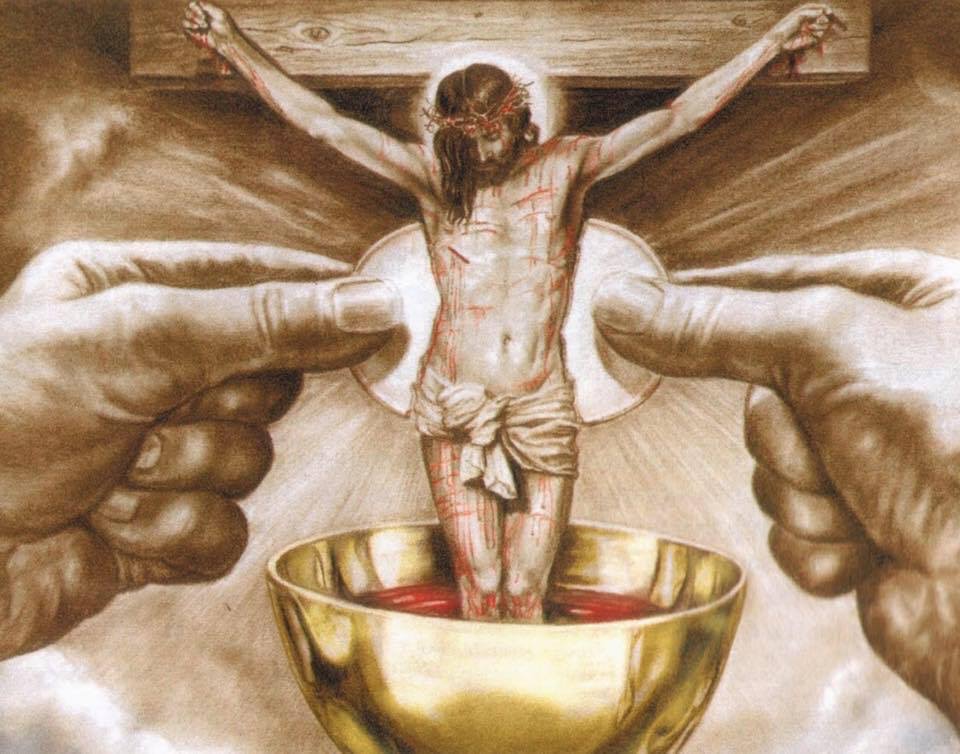
The disciples failed Jesus’ test here. They were left staring at their lack while this boy puts them to shame as he offers what he had. Yet, there is no recorded rebuke of Phillip or Andrew. Their lack of faith is forgiven and covered by Christ’s mercy just as your sins are covered. Cross and CommunionRemember, Jesus came to seek and to save you, the lost (lit.‘perishing’ Lk. 19:10), again, the same word in Jn. 3:16and v. 12. Jesus saves you, body and soul. And Jesus saves your works. Through His death and resurrection, Jesus provides more than we could imagine.

And now, to strengthen you for service in His kingdom, Christ feeds you with His Body and gives you to drink His Blood so that you are satisfied and ready to go from here to serve God by serving your neighbor. Amen.

The peace of God, which surpasses all understanding, will guard your hearts and minds in Christ Jesus. Amen.

It’s Not Enough – Sermon for the Fourth Sunday in Lent on John 6:1-15

Listen here.

John 6:1-15

1 After this Jesus went away to the other side of the Sea of Galilee, which is the Sea of Tiberias. 2 And a large crowd was following him, because they saw the signs that he was doing on the sick. 3 Jesus went up on the mountain, and there he sat down with his disciples. 4 Now the Passover, the feast of the Jews, was at hand.

5 Lifting up his eyes, then, and seeing that a large crowd was coming toward him, Jesus said to Philip, “Where are we to buy bread, so that these people may eat?” 6 He said this to test him, for he himself knew what he would do. 7 Philip answered him, “Two hundred denarii worth of bread would not be enough for each of them to get a little.” 8 One of his disciples, Andrew, Simon Peter’s brother, said to him, 9 “There is a boy here who has five barley loaves and two fish, but what are they for so many?” 10 Jesus said, “Have the people sit down.” Now there was much grass in the place. So the men sat down, about five thousand in number. 11 Jesus then took the loaves, and when he had given thanks, he distributed them to those who were seated. So also the fish, as much as they wanted. Jesus feeds the 5000 112 And when they had eaten their fill, he told his disciples, “Gather up the leftover fragments, that nothing may be lost.” 13 So they gathered them up and filled twelve baskets with fragments from the five barley loaves left by those who had eaten. 14 When the people saw the sign that he had done, they said, “This is indeed the Prophet who is to come into the world!”

15 Perceiving then that they were about to come and take him by force to make him king, Jesus withdrew again to the mountain by himself.

In the name of Jesus. Amen.

Armies can’t feed a crowd this size without preparing in advance. But Jesus knew all along what He was going to do. He knew that this boy would be there with his little snack of five loaves and two fish, and what Jesus does is absolutely remarkable. This miracle shows that Jesus doesn’t need soil and seed and rain and time and combines and grain elevators and flour mills and bakers and grocers to feed people bread. It shows that Jesus doesn’t need fishing boats and bait and nets and processing plants or even water to feed people fish.

But if we come away from this text seeing only Jesus’ power, we miss the point. Now, don’t get me wrong. This miracle certainly shows His power, that He is God in the flesh. But there is much more than simply that. This text shows us who we are as sinners and how generous God is. That is why the text tells us that Jesus set this whole situation up as a test (v. 6). Because we are sinners, we always think that what God provides isn’t enough. The disciples show how we aren’t content when God gives little, and the crowd shows how we aren’t content when God gives an abundance.

Phillip is the first to say there isn’t enough. Jesus asks, “Hey, Phillip. Know any good bakeries around here where we can buy bread for all these people?” Without even checking his pockets or asking the other disciples how much they have in their wallets, Phillip answers, “Whoa there Jesus. We don’t have enough. Two hundred day’s wages wouldn’t scratch the surface.”

Andrew chimes in as well. “This kid has five loaves and two fish. But it’s not enough. It’s just his afternoon snack.” The disciples see their lack and fall into despair.

You and I do the same. We never think we have enough. We sinfully think that we need more income to pay the bills, more time to get things done, more resources at our disposal. Like the disciples, we worry when there is a lack. We forget that we have a God who has promised to be our Father and give all that we need for this body and life. Jesus has promised, “Seek first the kingdom of God and His righteousness and all these things will be added to you” (Mt. 6:33).

So, the disciples see their lack and say, “It’s not enough.” But Jesus proves the disciples to be wrong.

Christ extravagantly feeds the whole crowd. Jesus has them lie down. Our translation says ‘sit down,’ but Jesus has them lie down like lords, kings, and emperors at a feast so they can be served. When their ancestors were fed with mana in the wilderness, they had to go out each morning and gather it up themselves (Ex. 16:2-21). But Jesus makes sure they are waited upon.

Each and every last one of them gets to stuff their face with as much food as they like. No one is told, “Look fatty, slow down. You’ve had enough.” There is always more – even for the gluttons.

But even in the midst of this abundance, the crowds say, “It’s not enough; we need more.” They see this sign and want to make Jesus their bread king. They figure that if Jesus can provide food for them to eat like royalty, they can make Him their king and they won’t ever need to worry about food or clothes or homes or anything ever again. Just put Jesus on a throne in Jerusalem and they can live the rest of their lives on easy street.

But Jesus didn’t come to be their bread king. Jesus Himself says, “It’s not enough. I will not be your bread king. I will not be your king apart from the cross.”

Jesus came to give them more than bread and fish. He desired to give them more than food, clothing, homes, shelter and protection. Jesus had come to give them, and you, Himself.

Cross and CommunionJesus came to have His back torn by a whip and His forehead sliced open by the crown of thorns. Jesus came to have His body broken. Jesus came to have His hands and feet nailed to the cross, His side run through with a spear. Jesus came to give you every last drop of His forgiving blood. Jesus came to give you eternal mercy, forgiveness, and life.

So, don’t be like the disciples who see their lack and day, “It’s not enough.” Jesus wants you to believe when you have nothing because He will certainly provide.

And don’t be like the crowds who see the abundance and say, “It’s not enough; we want more.” Jesus wants you to receive what He gives. Don’t let it spoil. Use it knowing that He will always provide more than you will ever need.

Also, don’t forget about the boy. He is the picture of faith in contrast to both the disciples and the crowds. This boy generously gives everything he has. He doesn’t know what Jesus will do with it. He doesn’t give because there is a promise that he will be blessed or rewarded. The boy simply believes that what he gives to Jesus will be used for good. And it is. Jesus multiplies what the boy gives – multiplies it and satisfies the hunger of others.

The same is true when you give, no matter how much or how little. God can and will multiply it because God knows how to multiply the gifts that you bring and satisfy the needs of others. Amen.

The peace of God, which surpasses all understanding, will guard your hearts and minds in Christ Jesus. Amen.