Bound Up – Sermon on Luke 10:23-37 for the Thirteenth Sunday after Trinity

Listen here.

Luke 10:23-37

23 Then turning to the disciples [Jesus] said privately, “Blessed are the eyes that see what you see! 24For I tell you that many prophets and kings desired to see what you see, and did not see it, and to hear what you hear, and did not hear it.”

25 And behold, a lawyer stood up to put him to the test, saying, “Teacher, what shall I do to inherit eternal life?” 26 He said to him, “What is written in the Law? How do you read it?” 27 And he answered, “You shall love the Lord your God with all your heart and with all your soul and with all your strength and with all your mind, and your neighbor as yourself.” 28 And he said to him, “You have answered correctly; do this, and you will live.” 29 But he, desiring to justify himself, said to Jesus, “And who is my neighbor?” 

30 Jesus replied, “A man was going down from Jerusalem to Jericho, and he fell among robbers, who stripped him and beat him and departed, leaving him half dead. 31 Now by chance a priest was going down that road, and when he saw him he passed by on the other side. 32 So likewise a Levite, when he came to the place and saw him, passed by on the other side. 33 But a Samaritan, as he journeyed, came to where he was, and when he saw him, he had compassion. 34 He went to him and bound up his wounds, pouring on oil and wine. Then he set him on his own animal and brought him to an inn and took care of him. 35 And the next day he took out two denarii and gave them to the innkeeper, saying, ‘Take care of him, and whatever more you spend, I will repay you when I come back.’ 36 Which of these three, do you think, proved to be a neighbor to the man who fell among the robbers?” 37 He said, “The one who showed him mercy.” And Jesus said to him, “You go, and do likewise.”

In the name of Jesus. Amen.

The whole thing started with a question intended to trap Jesus in His words. The lawyer asks, “What shall I do to inherit eternal life?” It’s a stupid question because of those first six words, “What shall I do to inherit…” There’s nothing he can do. The life he desires cannot be earned or bought or deserved. However, the lawyer is right, completely right, with his last three words. Eternal life is inherited, but inheritance is always based on birth. And everyone is entirely passive in that regard. None of you will be the Queen of England. You don’t have the right birth; it’s a title you will never be able to inherit. 

Jesus answers the silly question with a question: “What is written in the Law? How do you read it?” The lawyer gives the orthodox (ὀρθῶς v. 28) answer, “Love God perfectly, and love your neighbor perfectly.” Jesus even says, “Bingo. You’ve got it! Do this and nothing less. And you will live.” The lawyer correctly recognizes that Jesus’ response means that he is damned. The lawyer asked a Law question, got a Law answer, and recognizes the devastating results. The man had come to trap Jesus, but he finds himself trapped in his own sin. He recognizes that, under the Law, he’s toast. He looks for an escape, an out, a limit to whom he must love, so he asks, “Who is my neighbor?”

But Jesus doesn’t offer him an escape from the Law with the parable. In fact, there is no escape from the Law. The Law’s demands must be fulfilled, and, God be praised, there is One who has fulfilled the Law’s demands for you. Instead, as I’ve preached before, the parable points to another way to inherit eternal life – the way of promise (Gal. 3:18 as we heard in our Epistle text). The way to inherit eternal life isn’t by works or effort. It’s by mercy. With the parable, Jesus is pointing this scared lawyer to the inheritance that comes only by promise through the Gospel.

Jesus is the one who finds sinners not just half-dead but fully dead in sin (Eph. 2:1). He binds up the wounds of sin – both the wounds that are self-inflicted and the scars that are caused by others. He pours on the oil and wine of His Sacraments. He books you an all-inclusive room in the inn of His holy Christian Church. Jesus is the one who shows you mercy.

The point of the parable is not that we should try harder and make a better effort to love our neighbor. The parable is not teaching that we shouldn’t be prejudiced or bigoted. Of course, we shouldn’t be prejudiced or bigoted, but that isn’t the point of the parable. The point of the parable isn’t even that we should love everyone. The lawyer already knew and confessed that. So, why would Jesus tell a parable to reinforce what the lawyer already knew?

Instead, Jesus tells the parable because the lawyer has been beaten up by the Law. But the lawyer doesn’t realize – or worse, isn’t willing to admit – that he’s in the ditch dead in his sin and failure to do what the Law demands. Because this lawyer has sinned both by what he has done and by what he has left undone, he needs Jesus, the Good Samaritan who has perfectly fulfilled the Law, the show him mercy. Christ is the only One who rescues dying sinners who could not save themselves. That’s why Jesus tells the parable.

Now, after the parable is concluded Jesus says, “You go, and do likewise.” And this particular part of the text I usually don’t spend a lot of time on, and Dr. Mayor Gander, likes to point that out to me – a lot. In my defense, it is the last five words of the text. But if you are like the honorable mayor and wish I would spend more time on those words, today’s your day!

Dear saints, as we recover in the inn of the Church, we still need the Law’s instruction. We still need to our love rightly directed. And God gives us that instruction and direction in the Commandments. Christian, you do not, I repeat, do not, need the Law to save yourself. But you do need the Law to know how to respond to what Christ, the Good Samaritan, who has bound you up, has done for you.

So, with that in mind, I want to spend the rest of this sermon to talking to you about your vocation.

Whenever we talk about vocation in the Christian sense, we aren’t talking about a career. Christian vocation is all the different ways that God calls you to serve your neighbor, which means that you have many different vocations in this life.

All of your vocations are defined by a few things. First, your vocation is defined by the Ten Commandments. The lawyer was absolutely right to summarize the Law as loving God and loving your neighbor. What is often missed in our day is that we do not get to define what love is. In the Ten Commandments, God has already defined what love is. To give a quick example: men, you are called to love all women, but the love you show your wife is shaped differently than the love you show other women. Your love for all women is given shape by the 6th Commandment about not committing adultery.

Second, your vocation is defined by your relationship to your neighbor. A lot of times, we have an idea that our good works are aimed at a target. On that target are the members of our family: parents, spouses, kids, friends, coworkers, neighbors, and strangers. Typically, we think that the center of that target, the bullseye, is where God is. We think God should always be in the middle and that we should aim our good works toward Him. Then, in the next ring, depending on your age or circumstances, comes your spouse or your parents. Then the next ring is, siblings or children, then friends, then strangers.

Dear saints, I want you to chew on the idea that this picture – where God needs to be in the center, in the bullseye when you aim your good works – is wrong. God doesn’t need to be in the center of your target. He doesn’t need anything you can do or offer Him. He doesn’t need your help. You can take God out of all the circles of your target. Instead, move everyone else in. If you’re married, your spouse is the bullseye, then kids, etc. If you’re a child, your parents are the bullseye, then siblings, friends, classmates, etc.

If you are going to find God on your target, He is under the whole target. God doesn’t need your good works, but your neighbor does. Whenever you serve your neighbor, you are serving God. You can find joy in serving your neighbor because whatever you do, you are serving God by serving that needy neighbor. You see the picture?

Kids, you are called to love God by loving your neighbor by obeying your parents, by listening to your teachers, doing your homework, being respectful to adults, and by being a good friend. Adults, you are called to love God by loving your neighbor being a good husband or wife, by being a good parent, by being a hard-working employee or a good and fair boss, by paying your taxes, respecting the authorities that God has placed over you, and on and on it goes.

Third, your vocation is defined by the needs of your neighbor. Normally, this is pretty straightforward. Your boss needs you to do your tasks efficiently and with excellence. But sometimes, you need to do things that you aren’t trained to do when and if an emergency arises.

This is a weird analogy, but think of it this way. Normally, you wouldn’t walk into a hospital room and offer medical aid or advice – at least you shouldn’t. So, don’t. But pretend that a plane crashed in the church yard during the service. In an emergency like that, it would be sinful for us to continue on with our service if such a thing happened. We’d stop what we are doing and go help. Even though most of us are not doctors or nurses, we would go and do our best to be doctors and nurses and firefighters until the professionals arrived because the needs of our neighbors on that plane demanded it.

The same thing is true if someone breaks into your house and was threatening the lives of you and your family. Because of that emergency, you suddenly have the duty and vocation to be the police, judge, and, possibly, even the executioner. But remember that those are the exceptions rather than the rule. When the needs of your neighbor are immediate like that, you might need to step out of your normal vocation and fill the need because there is an emergency.

Think back to the parable. The Good Samaritan didn’t finance an all-inclusive room for everyone he met on the road that day. He didn’t put everyone on his animal or pour oil and wine on those who were well and healthy. But he did do it when the immediate needs of his neighbor demanded it. The Samaritan didn’t do any of it out of obligation; he did it, according to v. 33, out of compassion. That word, which the New Testament only uses when talking about what God has done for us in Christ, is why we know this parable is about what Jesus does for us who have been beaten up by sin and left dead in the ditch.

Dear saints, compassion is what Jesus has given you. By His incarnation and birth, the Son of God has become your brother – your own flesh and blood. He has rescued you from the ditch. He has bound you up with His grace and mercy. And He is here now to provide His forgiveness delivered to you in this Bread and Wine which is His Body and Blood as you continue to recover in the inn of His Church.

Fed and refreshed with this Sacrament, go from here and do likewise. Love your neighbor recklessly. Bind up the wounds of sin that have harmed your neighbor. Your Savior has bound you up to Himself, and He invites you to join Him in His work of binding up the wounds of your sin-sick neighbor. Amen.

The peace of God, which surpasses all understanding, will guard your hearts and minds in Christ Jesus. Amen.

Anger, Law, & Righteousness – Sermon on Matthew 5:20-26 for the Sixth Sunday after Trinity

Listen here.

Matthew 5:20-26

20 “For I tell you, unless your righteousness exceeds that of the scribes and Pharisees, you will never enter the kingdom of heaven.

21 “You have heard that it was said to those of old, ‘You shall not murder; and whoever murders will be liable to judgment.’ 22 But I say to you that everyone who is angry with his brother will be liable to judgment; whoever insults his brother will be liable to the council; and whoever says, ‘You fool!’ will be liable to the hell of fire. 23 So if you are offering your gift at the altar and there remember that your brother has something against you, 24 leave your gift there before the altar and go. First be reconciled to your brother, and then come and offer your gift. 25 Come to terms quickly with your accuser while you are going with him to court, lest your accuser hand you over to the judge, and the judge to the guard, and you be put in prison. 26 Truly, I say to you, you will never get out until you have paid the last penny.”

In the name of Jesus. Amen.

Why did You have to pick the scribes and Pharisees, Jesus? Why does our righteousness have to exceed theirs to enter the kingdom of heaven? Why couldn’t You pick the righteousness of the sinners and tax collectors that You were eating with?

The scribes and Pharisees were the good guys. They had dedicated their lives to keeping God’s law. They made up extra commandments – more than six-hundred of them. When you looked at them, you would see good and holy people who would put our lives and good works to shame. Their lives were the supreme example of the outward keeping of God’s Law. But that’s exactly where the problem lies, and that is precisely what Jesus is getting at.

The scribes and Pharisees understood the Commandments to be attainable, keep-able, obey-able. They looked at the Commandments and saw them simply on the external. They would look at a particular Commandment and think, “I’ve done that. I’ve honored God in that way.”

In some ways they had. They hadn’t murdered anyone. They kept their bodies pure from adultery. They hadn’t stolen what was someone else’s. They had an external righteousness and life, but with that external righteousness came the most dangerous thing – pride. They figured they had done well and that God should be pleased with them. But here Jesus sits at the top of the mountain (Mt. 5:1) and preaches that their external works are not enough.

Jesus shows the righteousness that is required – a righteousness that exceeds the external righteousness of the Pharisees. And here, Jesus starts with the 5th Commandment about murder. He will go on to several of the other Commandments in the verses that follow, which you can read later today and this week for your homework. But Jesus probably starts with the 5th Commandment because, of all the Commandments, this one probably seems easiest for us to keep. Most of us can say, “I’ve never killed anybody, so I’m good concerning this Commandment.” But Jesus says, “Easy there partner. Not so fast. You have heard that it was said to those of old, ‘You shall not murder; and whoever murders will be liable to judgment.’ But I say to you that everyone who is angry with his brother will be liable to judgment; whoever insults his brother will be liable to the council; and whoever says, ‘You fool!’ will be liable to the hell of fire.”

Jesus says that there is more to the Law than you realize. It isn’t enough to keep your hands from taking someone’s life. Jesus teaches that the 5th Commandment has instructions for our lips and what we say, for our minds and what we think, even for our hearts, what we feel. If you call your neighbor a ‘fool,’ if you have insulted him or her, if you’ve been angry with anyone, you’ve broken the 5th Commandment and have guilty blood on your soul. And with all the anger in our culture and society, it is a good time for us to consider this topic of anger so that we have a right mindset about it.

The Scriptures do teach us that there is a godly use of anger. Psalm 4:4 and Ephesians 4:26 both say, “Be angry and do not sin,” which means that it is possible to be angry without sinning. And Jesus is our example. He cleansed the temple, taught against the Pharisees’ hypocrisy, and endured the disciples’ repeated unbelief. All of those things did make Him angry, and the Scriptures certainly use that terminology. Jesus was angry at times, but without sin.

To understand this, it is important to make a distinction. Some will try to say, “Hate the sin, but love the sinner.” But you run into problems with that phrase when you come across verses like Psalm 11:5b which says, “[The Lord’s] … soul hates the wicked and the one who loves violence.” So, a better distinction is the difference between the anger of office and the anger of the person. I’ll explain.

Anger of office has to do with your vocation or your station in life and your calling. Think of a judge in a courtroom. To be a judge is to have an office of anger – to sentence someone to jail or give them a fine is an act of anger. But the most common example of the office of anger is what we see in parents. Parents are called to sit in an office of anger at times. When their children break the 4th Commandment to honor their parents, it is the parent’s God-given duty to be angry and discipline their children.

Parents are supposed to punish their kids when they do things that put their kids or other people in danger. If your kid runs into the street without looking for cars, you have to punish them by not letting them be outside by themselves or by restricting where they can go on their bike. That punishment is serving in an office of anger, but all of this is an anger of office not of person. In other words, you aren’t punishing your kids because you don’t like them or are angry with them; you are punishing your kids because you love them, want to protect them, and desire that they grow up to be responsible people.

In fact, disciplining your kids is one of the most loving things you can do. Listen to a few Scriptures here: Proverbs 12:1, says, “Whoever loves discipline loves knowledge, but he who hates reproof is stupid.” Or Hebrews 12:6 which says, “For the Lord disciplines the one he loves, and chastises every son whom he receives.” Good parents will follow the example of their heavenly Father in disciplining their children. And in Revelation 3:19, Jesus says, “Those whom I love, I reprove and discipline.” Even though discipline is unpleasant at the time for the one being disciplined, later “it yields the peaceful fruit of righteousness to those who have been trained by it” (Heb. 12:11).

As our culture continues to wander farther and farther from God and seeks to be free from His authority, we see other God-ordained institutions of authority are being rejected as well. As this takes place, the biblical concept of discipline and love is dangerously fading and absent, and we are seeing the evil fruits of that. Sinful and evil actions are spoken of as good and right, and anyone who calls out that sin and evil is labeled ‘intolerant,’ ‘unenlightened,’ and ‘old-fashioned.’ But we cannot give up or retreat.

We must continue to love our neighbor by calling sin ‘sin’ and evil ‘evil.’ And we must do so in loving ways that show how that sin hurts the person committing that sin and how it harms their neighbor. We need to do this in a way that encourages repentance and faith in Christ who cleanses us from every sin through His death and resurrection.

Back to the example of the office of parent, if your kids keep repeatedly breaking your rules, it can be hard to separate the anger of the office as parent and anger toward the person of your child. But, do you get the idea? I hope you do. And I hope that as you parent your children, you are able to discipline them in a way that is not being angry toward the person of your child and instead having a righteous anger of office as parent.

In this text, Jesus is talking about the anger of a person, not about the anger of office. When someone speaks poorly against us or sins against us, we get angry toward that person and our heart gets hardened toward that neighbor. When we get angry toward another person, we try to wiggle our way out of our obligation to love that person, wrongly thinking that we are exempt from the command to love them as our neighbor because we think they are our enemies. It happens to all of us, and we all need to repent because Jesus goes on, just a few verses after this text, He says, “You have heard that it was said, ‘You shall love your neighbor and hate your enemy.’ But I say to you, love your enemies and pray for those who persecute you so that you may be sons of your Father who is in heaven” (Mt. 5:43-45). Jesus does not authorize you to be angry with the people who sin against you. Instead, He has told and explicitly commanded you to love them, pray for them, do good to them, and serve them.

When Jesus talks about a righteousness that exceeds that of the scribes and Pharisees, He isn’t talking about an external keeping of the Law. Jesus demands that everything you think, say, do, and feel conforms to God’s Commandments. To have a heart completely free of anger, lust, greed, rebellion, bitterness, strife, and idolatry. A heart that is full of love for God and your neighbor. This is the righteousness that exceeds the righteousness of the scribes and Pharisees. And this means that when the Law speaks to you, you do not go to a place of pride. Instead, the Law speaks to you and you fall into despair because you know that without this exceeding righteousness, you will never enter the kingdom of heaven.

We cannot attain to this righteousness. We cannot achieve it. And the more we try – which we should – the more we know we fail and feel in our hearts our own great sinfulness and the wrath of God that we deserve. We cannot achieve this righteousness that Jesus says is required. We have to look for this righteousness outside of ourselves.

This righteousness is not found in good works and obedience to the Law. It is Jesus’ righteousness and His perfect obedience to the Law and His heavenly Father which is given to us as a gift. Christian, Scripture says that you are in Christ who “has become [for you] wisdom from God, righteousness and sanctification and redemption” (1 Cor. 1:30).

Dear saints, there is one person in the entire history of the world who could stand under the judgment of the Law and not be condemned by it – Jesus, your Lord and Savior. Yet, Jesus, who kept the Law perfectly and filled up the Law, He Himself bore the curse and condemnation of the Law, and suffered for sins He did not commit so that He could give you His righteousness and the reward it deserved. For our sake God made Jesus who knew no sin to be sin, so that in Him we might become the righteousness of God (2 Cor. 5:21). Your anger, your insults, your lust, your disobedience, your theft, your lying, your idolatry – Jesus became all of that. He took all of that upon Himself and suffered for your sins so He could give to you His keeping of the Law, His perfect obedience to God.

Through faith in Christ, you have the righteousness that exceeds the righteousness of the scribes and Pharisees. You have the perfection and righteousness that defines God’s only Son. Your sins have been erased, and you are now in Christ. All of God’s commands are fulfilled for you.

Jesus has brought you out of your slavery to the Law. You have been united to Christ’s death and resurrection. Sin no longer has dominion over you. So, consider yourselves dead to sin and alive to God in Christ Jesus (Ro. 6:11). Amen.

The peace of God, which surpasses all understanding, will guard your hearts and minds in Christ Jesus. Amen.

Differences – Sermon on Luke 16:19-31 for the First Sunday after Trinity

Listen here.

Luke 16:19–31

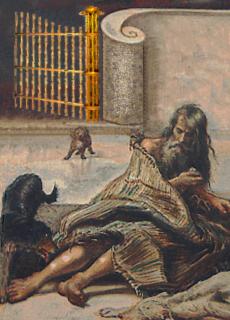
19 “There was a rich man who was clothed in purple and fine linen and who feasted sumptuously every day. 20 And at his gate was laid a poor man named Lazarus, covered with sores, 21 who desired to be fed with what fell from the rich man’s table. Moreover, even the dogs came and licked his sores.Lazarus and the Rich Man Graphic 22 The poor man died and was carried by the angels to Abraham’s side. The rich man also died and was buried, 23 and in Hades, being in torment, he lifted up his eyes and saw Abraham far off and Lazarus at his side. 24 And he called out, ‘Father Abraham, have mercy on me, and send Lazarus to dip the end of his finger in water and cool my tongue, for I am in anguish in this flame.’ 25 But Abraham said, ‘Child, remember that you in your lifetime received your good things, and Lazarus in like manner bad things; but now he is comforted here, and you are in anguish. 26 And besides all this, between us and you a great chasm has been fixed, in order that those who would pass from here to you may not be able, and none may cross from there to us.’ 27 And he said, ‘Then I beg you, father, to send him to my father’s house— 28 for I have five brothers—so that he may warn them, lest they also come into this place of torment.’ 29 But Abraham said, ‘They have Moses and the Prophets; let them hear them.’ 30 And he said, ‘No, father Abraham, but if someone goes to them from the dead, they will repent.’ 31 He said to him, ‘If they do not hear Moses and the Prophets, neither will they be convinced if someone should rise from the dead.’”
In the name of Jesus. Amen.

We’re all familiar with the phrase, “Don’t judge a book by its cover.” Well, the same could be said about characters in a parable. Jesus tells this parable with two main characters. On the one hand there is a rich man who is clothed in royal purple linens and ate the best food and on the other hand is the beggar Lazarus who was poor and had dogs licking his sores. The two men die. The rich man ends up tormented in Hades while Lazarus is comforted in heaven. The only thing these two men have in common is that they both die, so the differences between the two couldn’t be more stark. But we run into a danger if we only focus on the different economic statuses of these two. Does the rich man end up in hell because he got to enjoy blessings during his earthly life and Lazarus end up in heaven because he didn’t? Nope!

In the parable, Abraham says to the suffering rich man, “Remember that you in your lifetime received your good things, and Lazarus bad things; but now he is comforted here, and you are in anguish.” With this parable, is Jesus trying to teach us that blessings in this life mean torment for eternity? Are people saved because of their poor status in this life? Na ah.

So, we have to dig a little further to find the real difference between these two. And if we pay attention to the whole parable, the difference is as clear as the air in this sanctuary.

Nothing in the parable says the rich man is an evil, greedy glutton. There is no indication that he is a jerk who fires people all the time and is always looking for a way to maximize his profits without any consideration for others. The parable doesn’t say that. Jesus doesn’t say that that the rich man is selfish or uncharitable.

And, on the same note, nothing in the parable says that poor Lazarus was humble and virtuous. The text just says that he is poor. There are plenty of causes of poverty. Some people are poor because of an addiction. And, yes, of course, sometimes people are poor because of things outside of their control like sickness, disease, or disability. But none of those things earn eternal life for a person.

lazarus-dogsNow in the parable, Jesus does say that Lazarus is there at the man’s gate begging and desiring to be fed with what fell from the rich man’s table. Absolutely, I’ll give you that. Maybe, the rich man should be helping more and being more generous. But, why do you think Lazarus chooses to beg at this man’s gate? Could it be that Lazarus knows he has a better chance to receive something at that gate than if he went to a different gate? And let’s be brutally honest here. If you had a Lazarus camped outside your house begging day after day wouldn’t you find a way to make them move on? How long before you’d be embarrassed about that poor person asking for money when visitors came to your house?

The main point is simply this: Don’t be deceived into thinking that the reason the rich man ends up in hell and poor Lazarus in heaven is economic status. Don’t ignore your sin of coveting by thinking, “That rich jerk got what he deserved.” Being rich, having blessings, and enjoying the good things God has given you is not a sin. Whatever you have is a gift from God, and God wants you to have it. That is why God gave the 7thCommandment, “Thou shalt not steal.” God gave that commandment to protect the blessings that He has given to you.

Yes, of course, some people get rich because they are evil and wicked and greedy. But being rich is not in and of itself a sin. Don’t fall into the trap – which is so common today – don’t fall into the trap of condemning the rich simply because they are rich and praising the poor simply because they are poor. Remember, Abraham was one of, if not the, wealthiest man in the world in his day. And where does he end up in the parable? In heaven.

Now, I’ve spent a significant amount of time on this today because we are all quick to make decisions about a person by looking only at the outward aspects of individuals. The social unrest and problems we are currently seeing in our society and country are exacerbated (and please note I’m saying ‘exacerbated’) because we will look at a person outwardly – their wealth, their poverty, their skin color, their job – we look at those external things and decide what that person is worth and how we should interact with them. That needs to stop.

How we treat someone should not depend on our perception of that person. No one’s virtue or worth or value is based on their economic status, their race, their occupation, or anything like that.

Listen carefully. Everything has a price – even people. All of us are slaves to sin. In John 8:34, Jesus says, “Everyone who practices sin is a slave to sin,” and Romans 3:23 says, “All have sinned.” Lamb of God who takes away the sins of the wolrdSo, put two and two together and that means everyone is a slave to sin. But you and every person that you will ever meet, every person that has been or ever will be, every individual has been bought from slavery to sin. Every individual has been deemed and valued by God to be worth the blood of His own Son, Jesus. So, whether someone is rich or poor; whether someone is white, black, yellow, or brown; whether someone is a police officer or a rioter; whether someone is a capitalist or a Marxist; whether someone is conservative, liberal, Republican, or Democrat, remember God has paid the blood of Jesus to redeem that person from his or her slavery to sin. Amen?

I’ve taken this angle on the parable to make that point, and it is an important point for all of us to remember. But that is not the most important point for us today – not even close.

The most important point is to see the real difference between the rich man and Lazarus. The real difference is only revealed after they have both died. The rich man is over there in hell and Lazarus is over there in heaven. The rich man asks Abraham to have Lazarus raised from the dead to warn his five brothers. And Abraham says, “They have Moses and the Prophets, let them hear them.” In other words, Abraham says, “Listen rich dude, your brothers have the Bible. They don’t need someone to rise from the dead to warn them about the pain and torment you are suffering.”

And here is where the difference, the real difference between the rich man and Lazarus, comes out. The rich man says, “No, father Abraham, but if someone goes to them from the dead, they will repent.” In other words, the rich man is saying, “The active, effective, powerful, living, life-giving, life-creating Word of God isn’t good enough.”

The rich man rejected the Scriptures. He did it during his earthly life, and he continues to reject the Scriptures in eternal damnation. Even in hell, he has no remorse or repentance. By rejecting the Scriptures, the rich man had rejected and continued to reject the Savior who is revealed in the Scriptures.

The rich man had a lot of things in his earthly life, but the one thing he didn’t have was Jesus. So, please reconsider, who was more blessed in their earthly life? Was it the rich man or Lazarus? When Abraham says that all the five brothers need is the Bible, by default, what does that mean that Lazarus had in his poor, miserable life? Lazarus had the Word of God. Lazarus had true riches because he has faith if Christ. It doesn’t matter what things he did or didn’t have on earth because Lazarus had Jesus.

That is the real difference between these two.

Dear saints, you have the Scriptures. You have the true, eternal treasure that cannot be taken from you. If you have more than that (and all of us do), we can, of course, be generous with those things because we already have what is most important. We have Jesus.

In light of that, because you have Jesus, dear saints, go and be different. In a world full of fear because of pandemic, racism, riots, and anarchy, be different. Have no fear. No one and nothing can take from you what is most important.

So, live without fear. Live generously. Live with outrageous love, gratuitous generosity, and reckless compassion for those around you. Because neither death nor life, nor angels nor rulers, nor things present nor things to come, nor powers, nor height nor depth, nor anything else in all creation will be able to separate you from God’s love for you in Christ Jesus your Lord (Ro. 8:38-39). Amen.

The peace of God, which surpasses all understanding, will guard your hearts and minds in Christ Jesus. Amen.

No Conflict – Sermon on Luke 10:23-37 for the Thirteenth Sunday after Trinity

Listen here.

Today, at Christ the King, we had our first Stewardship Sunday. This sermon is slightly shorter for that reason. The presentation/catechesis on Biblical Stewardship will be available later.

Luke 10:23-37

23 Then turning to the disciples he said privately, “Blessed are the eyes that see what you see! 24 For I tell you that many prophets and kings desired to see what you see, and did not see it, and to hear what you hear, and did not hear it.”

25 And behold, a lawyer stood up to put him to the test, saying, “Teacher, what shall I do to inherit eternal life?” 26 He said to him, “What is written in the Law? How do you read it?” 27 And he answered, “You shall love the Lord your God with all your heart and with all your soul and with all your strength and with all your mind, and your neighbor as yourself.” 28 And he said to him, “You have answered correctly; do this, and you will live.” 29 But he, desiring to justify himself, said to Jesus, “And who is my neighbor?”

30 Jesus replied, “A man was going down from Jerusalem to Jericho, and he fell among robbers, who stripped him and beat him and departed, leaving him half dead. 31 Now by chance a priest was going down that road, and when he saw him he passed by on the other side. 32 So likewise a Levite, when he came to the place and saw him, passed by on the other side. 33 But a Samaritan, as he journeyed, came to where he was, and when he saw him, he had compassion. 34 He went to him and bound up his wounds, pouring on oil and wine. Then he set him on his own animal and brought him to an inn and took care of him. 35 And the next day he took out two denarii and gave them to the innkeeper, saying, ‘Take care of him, and whatever more you spend, I will repay you when I come back.’ 36 Which of these three, do you think, proved to be a neighbor to the man who fell among the robbers?” 37 He said, “The one who showed him mercy.” And Jesus said to him, “You go, and do likewise.”

Jesus Good Samaritan Icon

In the name of Jesus. Amen.

Too often, when we hear the summary of the Law, “Love the Lord with all your heart, soul, mind, and strength. And love your neighbor as yourself,” we see it as setting up an order of operations. First, love God; then second, love neighbor so long as it doesn’t conflict with loving God. That is the attitude the priest and the Levite had in the parable.

According the laws of Moses, they needed to protect themselves from becoming unclean. If they helped the man in the ditch, they might defile themselves by touching a dead person and not be able to do their priestly functions. They are essentially saying to themselves, “I feel bad for this poor guy. I will pray for him. But if I go over there and help him, I won’t be able to do the sacrifices or declare people clean and free from sin. And I have been called by God to be faithful in those works. So, if I go help this guy, I might become unable to do those things, I will be unfaithful to God.”

The priest and Levite were convinced that they couldn’t help their neighbor because they had a higher obligation to love God. Too often, we think the same way.

We avoid people who are addicted to drugs or alcohol because Scripture tells us to avoid the appearance of evil (1 Thess. 5:22), and we don’t want to tarnish our reputation as a good Christian by being around people who have vices. When people are cruel and angry because they have been absolutely broken, we avoid them because they bring out the worst in ourselves. However, we should be going out of our way to love and befriend them and earn their trust. But we don’t do that because we think we have a higher duty to God to keep ourselves righteous so we try to maintain a safe distance from people who might make us to become unrighteous and jaded.

But one of the things Jesus shows us in the parable of the Good Samaritan is this misunderstanding between loving God and loving our neighbor. This parable is a nice explanation of what we are told in 1 John 4:20 which says, “If anyone says, ‘I love God,’ and hates his brother, he is a liar; for he who does not love his brother whom he has seen cannot love God whom he has not seen.” Love of God and love of neighbor are never in conflict with each other. God wants us to show our love for Him by loving our neighbor.

We have called today “Stewardship Sunday,” and we have had a lot of focus on what God’s Word has to say about our tithes and offerings. And this text has something to say about our giving to the church as well. Just as loving our neighbor does not conflict with loving God, loving God does not conflict with loving our neighbor either.

I might be wrong on this, but I would venture to guess that the prevailing attitude about giving to the church is seen as fulfilling the first of the two great commandments – to love God. And very often, we think giving to the church is not seen as fulfilling the second – to love our neighbor. At least, this is a common accusation of the world against the church, and I don’t think we are immune to those accusations.

Maybe, you have seen different threads on social media that pop up from time to time which basically say, “If money is the root of all evil, why do they keep asking for it in church?” Never mind the fact that they aren’t quoting Scripture correctly. The verse (1 Tim. 6:10), says, “The love of money is the root of all kinds of evils…”

But also, the world will say that Christians are hypocrites because giving to the church means they don’t care about the hungry and poor. They’ll say that Christians are so busy loving God by giving money to the church that they are refusing to love their neighbor. But there is no conflict between the two.

Scripture says that all have sinned and fallen short of the glory of God. Every neighbor you come into contact with is a sinner. And what do sinners need most? Even if they are naked and starving, sinners’ greatest need to hear the Gospel. They need to hear the Word preached. They need the Sacraments. They need to be pointed to Jesus Christ, the Lamb of God who takes away the sin of the world. In other words, they need the Church.

So, Christian, see what you are doing when you give to the church. You are doing exactly what the Good Samaritan did in the parable. You are providing for the continual care of those whom Christ has redeemed. Remember, the Good Samaritan gave the innkeeper money to care for the robbed man and promised to return and pay off any expenses that weren’t covered by his initial two denarii.

After the parable concluded, Jesus asked the lawyer, “Who proved to be a neighbor to the man who fell among the robbers?”And the lawyer rightly responded, “The one who showed him mercy.” And Jesus said, “You go, and do likewise.”

Have mercy and compassion on your neighbor by making sure that they have the blessing of seeing what you see and hearing what you hear. Make sure they have a place where they can go to hear of Jesus. Where they can have their wounds bound up by Christ’s absolution. Where they can have the oil and wine of the Sacraments poured on their sinful scars. Where they can recover in the inn of the church.

Christian, you go, and do likewise. Do this, but don’t ever draw strength and assurance by how well you have loved your neighbor. Instead, draw strength to love your neighbor by how God Himself has loved and cared for you.

Good Samaritan Jesus IconBecause, first and foremost, the parable of the Good Samaritan is a picture of what Jesus has done for you. Jesus, and Jesus alone, is the Good Samaritan who has compassion. He left His throne in the glory of heaven to become your neighbor. He risks His own safety while scoundrels and robbers are roaming about. He stops to give you aid. He pours on you oil and wine. He gives up His own comfort and convenience to bring you to the inn of the holy Christian Church. And Jesus sets up an all-expenses-paid stay there promising to return. Jesus is the one who has and continues to show you mercy. Amen.

The peace of God, which surpasses all understanding, will guard your hearts and minds in Christ Jesus. Amen.


Additional thoughts on the text that were removed from the sermon:

You can’t do something to gain an inheritance. All Scripture shows that God’s people do not inherit eternal life by doing something. As our Epistle Text (Gal. 3:15-22) said, the inheritance of eternal life has always and will always come through the promise of God. The lawyer knew this. He knew exactly what he must do to have eternal life. Love God perfectly and love his neighbor perfectly which is exactly how Jesus Himself sums up the Law (Mt. 22:34-40). Jesus tells the lawyer, “Bingo! Do this, and you will live.”But Jesus might just as well have said, “Yup. Go to hell.”

And the lawyer gets it. He sees how he is stuck in his sin. The Law has exposed him for the wretched sinner that he is. The Law has left him scared and confused because he doesn’t know the Gospel. He wants an out and clamors for a loophole. He asks, “Well, who is my neighbor? Whom should I love?”

But every Sunday school student knows the answer. “Who is my neighbor?” Everyone. “Whom should I love?” Everyone and without fail. But Jesus doesn’t tell the parable to answer the question, “Who is my neighbor?” Jesus tells the parable to change the question to get the answer He wants. The point of the parable is not to teach us to love everyone. Scripture teaches that all over the place but here, not in this parable.

Instead, Jesus tells the parable because He wants to show the lawyer and you hope. Jesus wants to show you what God mercifully does for you. He wants your eyes to see and your ears to hear the Gospel.