Luke 10:23-37
23 Then turning to the disciples [Jesus] said privately, “Blessed are the eyes that see what you see! 24For I tell you that many prophets and kings desired to see what you see, and did not see it, and to hear what you hear, and did not hear it.”
25 And behold, a lawyer stood up to put him to the test, saying, “Teacher, what shall I do to inherit eternal life?” 26 He said to him, “What is written in the Law? How do you read it?” 27 And he answered, “You shall love the Lord your God with all your heart and with all your soul and with all your strength and with all your mind, and your neighbor as yourself.” 28 And he said to him, “You have answered correctly; do this, and you will live.” 29 But he, desiring to justify himself, said to Jesus, “And who is my neighbor?”
30 Jesus replied, “A man was going down from Jerusalem to Jericho, and he fell among robbers, who stripped him and beat him and departed, leaving him half dead. 31 Now by chance a priest was going down that road, and when he saw him he passed by on the other side. 32 So likewise a Levite, when he came to the place and saw him, passed by on the other side. 33 But a Samaritan, as he journeyed, came to where he was, and when he saw him, he had compassion. 34 He went to him and bound up his wounds, pouring on oil and wine. Then he set him on his own animal and brought him to an inn and took care of him. 35 And the next day he took out two denarii and gave them to the innkeeper, saying, ‘Take care of him, and whatever more you spend, I will repay you when I come back.’ 36 Which of these three, do you think, proved to be a neighbor to the man who fell among the robbers?” 37 He said, “The one who showed him mercy.” And Jesus said to him, “You go, and do likewise.”
In the name of Jesus. Amen.
The whole thing started with a question intended to trap Jesus in His words. The lawyer asks, “What shall I do to inherit eternal life?” It’s a stupid question because of those first six words, “What shall I do to inherit…” There’s nothing he can do. The life he desires cannot be earned or bought or deserved. However, the lawyer is right, completely right, with his last three words. Eternal life is inherited, but inheritance is always based on birth. And everyone is entirely passive in that regard. None of you will be the Queen of England. You don’t have the right birth; it’s a title you will never be able to inherit.
Jesus answers the silly question with a question: “What is written in the Law? How do you read it?” The lawyer gives the orthodox (ὀρθῶς v. 28) answer, “Love God perfectly, and love your neighbor perfectly.” Jesus even says, “Bingo. You’ve got it! Do this and nothing less. And you will live.” The lawyer correctly recognizes that Jesus’ response means that he is damned. The lawyer asked a Law question, got a Law answer, and recognizes the devastating results. The man had come to trap Jesus, but he finds himself trapped in his own sin. He recognizes that, under the Law, he’s toast. He looks for an escape, an out, a limit to whom he must love, so he asks, “Who is my neighbor?”
But Jesus doesn’t offer him an escape from the Law with the parable. In fact, there is no escape from the Law. The Law’s demands must be fulfilled, and, God be praised, there is One who has fulfilled the Law’s demands for you. Instead, as I’ve preached before, the parable points to another way to inherit eternal life – the way of promise (Gal. 3:18 as we heard in our Epistle text). The way to inherit eternal life isn’t by works or effort. It’s by mercy. With the parable, Jesus is pointing this scared lawyer to the inheritance that comes only by promise through the Gospel.
Jesus is the one who finds sinners not just half-dead but fully dead in sin (Eph. 2:1). He binds up the wounds of sin – both the wounds that are self-inflicted and the scars that are caused by others. He pours on the oil and wine of His Sacraments. He books you an all-inclusive room in the inn of His holy Christian Church. Jesus is the one who shows you mercy.
The point of the parable is not that we should try harder and make a better effort to love our neighbor. The parable is not teaching that we shouldn’t be prejudiced or bigoted. Of course, we shouldn’t be prejudiced or bigoted, but that isn’t the point of the parable. The point of the parable isn’t even that we should love everyone. The lawyer already knew and confessed that. So, why would Jesus tell a parable to reinforce what the lawyer already knew?
Instead, Jesus tells the parable because the lawyer has been beaten up by the Law. But the lawyer doesn’t realize – or worse, isn’t willing to admit – that he’s in the ditch dead in his sin and failure to do what the Law demands. Because this lawyer has sinned both by what he has done and by what he has left undone, he needs Jesus, the Good Samaritan who has perfectly fulfilled the Law, the show him mercy. Christ is the only One who rescues dying sinners who could not save themselves. That’s why Jesus tells the parable.
Now, after the parable is concluded Jesus says, “You go, and do likewise.” And this particular part of the text I usually don’t spend a lot of time on, and Dr. Mayor Gander, likes to point that out to me – a lot. In my defense, it is the last five words of the text. But if you are like the honorable mayor and wish I would spend more time on those words, today’s your day!
Dear saints, as we recover in the inn of the Church, we still need the Law’s instruction. We still need to our love rightly directed. And God gives us that instruction and direction in the Commandments. Christian, you do not, I repeat, do not, need the Law to save yourself. But you do need the Law to know how to respond to what Christ, the Good Samaritan, who has bound you up, has done for you.
So, with that in mind, I want to spend the rest of this sermon to talking to you about your vocation.
Whenever we talk about vocation in the Christian sense, we aren’t talking about a career. Christian vocation is all the different ways that God calls you to serve your neighbor, which means that you have many different vocations in this life.
All of your vocations are defined by a few things. First, your vocation is defined by the Ten Commandments. The lawyer was absolutely right to summarize the Law as loving God and loving your neighbor. What is often missed in our day is that we do not get to define what love is. In the Ten Commandments, God has already defined what love is. To give a quick example: men, you are called to love all women, but the love you show your wife is shaped differently than the love you show other women. Your love for all women is given shape by the 6th Commandment about not committing adultery.
Second, your vocation is defined by your relationship to your neighbor. A lot of times, we have an idea that our good works are aimed at a target. On that target are the members of our family: parents, spouses, kids, friends, coworkers, neighbors, and strangers. Typically, we think that the center of that target, the bullseye, is where God is. We think God should always be in the middle and that we should aim our good works toward Him. Then, in the next ring, depending on your age or circumstances, comes your spouse or your parents. Then the next ring is, siblings or children, then friends, then strangers.
Dear saints, I want you to chew on the idea that this picture – where God needs to be in the center, in the bullseye when you aim your good works – is wrong. God doesn’t need to be in the center of your target. He doesn’t need anything you can do or offer Him. He doesn’t need your help. You can take God out of all the circles of your target. Instead, move everyone else in. If you’re married, your spouse is the bullseye, then kids, etc. If you’re a child, your parents are the bullseye, then siblings, friends, classmates, etc.
If you are going to find God on your target, He is under the whole target. God doesn’t need your good works, but your neighbor does. Whenever you serve your neighbor, you are serving God. You can find joy in serving your neighbor because whatever you do, you are serving God by serving that needy neighbor. You see the picture?
Kids, you are called to love God by loving your neighbor by obeying your parents, by listening to your teachers, doing your homework, being respectful to adults, and by being a good friend. Adults, you are called to love God by loving your neighbor being a good husband or wife, by being a good parent, by being a hard-working employee or a good and fair boss, by paying your taxes, respecting the authorities that God has placed over you, and on and on it goes.
Third, your vocation is defined by the needs of your neighbor. Normally, this is pretty straightforward. Your boss needs you to do your tasks efficiently and with excellence. But sometimes, you need to do things that you aren’t trained to do when and if an emergency arises.
This is a weird analogy, but think of it this way. Normally, you wouldn’t walk into a hospital room and offer medical aid or advice – at least you shouldn’t. So, don’t. But pretend that a plane crashed in the church yard during the service. In an emergency like that, it would be sinful for us to continue on with our service if such a thing happened. We’d stop what we are doing and go help. Even though most of us are not doctors or nurses, we would go and do our best to be doctors and nurses and firefighters until the professionals arrived because the needs of our neighbors on that plane demanded it.
The same thing is true if someone breaks into your house and was threatening the lives of you and your family. Because of that emergency, you suddenly have the duty and vocation to be the police, judge, and, possibly, even the executioner. But remember that those are the exceptions rather than the rule. When the needs of your neighbor are immediate like that, you might need to step out of your normal vocation and fill the need because there is an emergency.
Think back to the parable. The Good Samaritan didn’t finance an all-inclusive room for everyone he met on the road that day. He didn’t put everyone on his animal or pour oil and wine on those who were well and healthy. But he did do it when the immediate needs of his neighbor demanded it. The Samaritan didn’t do any of it out of obligation; he did it, according to v. 33, out of compassion. That word, which the New Testament only uses when talking about what God has done for us in Christ, is why we know this parable is about what Jesus does for us who have been beaten up by sin and left dead in the ditch.
Dear saints, compassion is what Jesus has given you. By His incarnation and birth, the Son of God has become your brother – your own flesh and blood. He has rescued you from the ditch. He has bound you up with His grace and mercy. And He is here now to provide His forgiveness delivered to you in this Bread and Wine which is His Body and Blood as you continue to recover in the inn of His Church.
Fed and refreshed with this Sacrament, go from here and do likewise. Love your neighbor recklessly. Bind up the wounds of sin that have harmed your neighbor. Your Savior has bound you up to Himself, and He invites you to join Him in His work of binding up the wounds of your sin-sick neighbor. Amen.
The peace of God, which surpasses all understanding, will guard your hearts and minds in Christ Jesus. Amen.
 22 The poor man died and was carried by the angels to Abraham’s side. The rich man also died and was buried, 23 and in Hades, being in torment, he lifted up his eyes and saw Abraham far off and Lazarus at his side. 24 And he called out, ‘Father Abraham, have mercy on me, and send Lazarus to dip the end of his finger in water and cool my tongue, for I am in anguish in this flame.’ 25 But Abraham said, ‘Child, remember that you in your lifetime received your good things, and Lazarus in like manner bad things; but now he is comforted here, and you are in anguish. 26 And besides all this, between us and you a great chasm has been fixed, in order that those who would pass from here to you may not be able, and none may cross from there to us.’ 27 And he said, ‘Then I beg you, father, to send him to my father’s house— 28 for I have five brothers—so that he may warn them, lest they also come into this place of torment.’ 29 But Abraham said, ‘They have Moses and the Prophets; let them hear them.’ 30 And he said, ‘No, father Abraham, but if someone goes to them from the dead, they will repent.’ 31 He said to him, ‘If they do not hear Moses and the Prophets, neither will they be convinced if someone should rise from the dead.’”
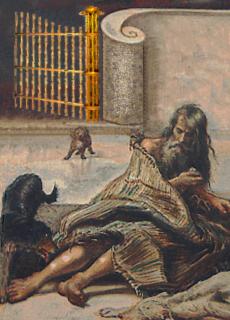 Now in the parable, Jesus does say that Lazarus is there at the man’s gate begging and desiring to be fed with what fell from the rich man’s table. Absolutely, I’ll give you that. Maybe, the rich man should be helping more and being more generous. But, why do you think Lazarus chooses to beg at this man’s gate? Could it be that Lazarus knows he has a better chance to receive something at that gate than if he went to a different gate? And let’s be brutally honest here. If you had a Lazarus camped outside your house begging day after day wouldn’t you find a way to make them move on? How long before you’d be embarrassed about that poor person asking for money when visitors came to your house?
 So, put two and two together and that means everyone is a slave to sin. But you and every person that you will ever meet, every person that has been or ever will be, every individual has been bought from slavery to sin. Every individual has been deemed and valued by God to be worth the blood of His own Son, Jesus. So, whether someone is rich or poor; whether someone is white, black, yellow, or brown; whether someone is a police officer or a rioter; whether someone is a capitalist or a Marxist; whether someone is conservative, liberal, Republican, or Democrat, remember God has paid the blood of Jesus to redeem that person from his or her slavery to sin. Amen?
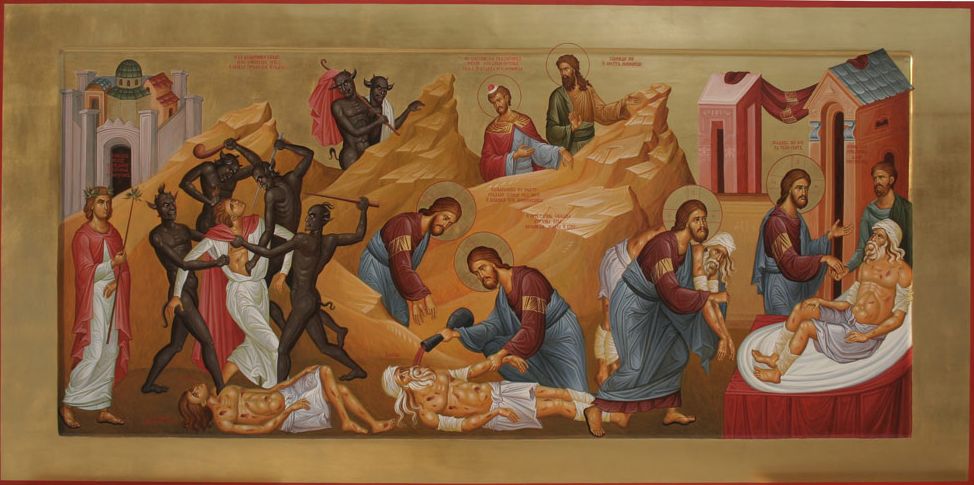 Because, first and foremost, the parable of the Good Samaritan is a picture of what Jesus has done for you. Jesus, and Jesus alone, is the Good Samaritan who has compassion. He left His throne in the glory of heaven to become your neighbor. He risks His own safety while scoundrels and robbers are roaming about. He stops to give you aid. He pours on you oil and wine. He gives up His own comfort and convenience to bring you to the inn of the holy Christian Church. And Jesus sets up an all-expenses-paid stay there promising to return. Jesus is the one who has and continues to show you mercy. Amen.
 Pastorsamwise
You must be logged in to post a comment.