
In the name of Jesus. Amen.
Good job. I know that is a hard reading, but it’s worth the effort. The accounts of our Lord’s Passion in the four Gospels are some of the most precious words ever written. I’d encourage you this week to read the other three accounts. Read Mark 14-15 one day, Luke 22-23 another day, and John 18-19 another. Reading those will prepare your heart and lips to cry out next Sunday, “He is risen indeed!”
Most of the time, we see the crucifixion of our Lord as an act of terrible injustice. Jesus – the only sinless person – is condemned to die a gruesome death. Even Pilate wrestles with the injustice as the crowds keep crying out for Jesus to be crucified (Mt. 27:15-23). He asks, “Why? What evil has he done?” But Pilate was too weak and timid to do the just thing and release Jesus, so he delivers our Lord to be crucified. There’s no question that, from a human standpoint, Jesus’ condemnation is utterly unjust.
But, in the cosmic view of things, the crucifixion, God is accomplishing the greatest act of justice ever. But this act of justice is going on ‘behind the scenes,’ so to speak. So, let me make the case for that, and you can tell me what you think after the service. We have to take a few steps back to see it clearly.
Six weeks ago, on the first Sunday of Lent, we considered Genesis 3 and the Fall. There, in the Garden of Eden, Satan tempts Adam and Eve to sin and rebel against God like he had. Why does he do that? Well, the devil knows he can’t defeat God and that he can’t be redeemed. So, the devil wants to hurt God, and the only way he can figure out how to hurt God is to come after us and try to sever us from God. So, he tempted our first parents to fall into sin, which they do. But God wasn’t about to let the devil have us. God promises to judge Satan by sending the Seed of the woman to crush his head (Gen. 3:15). In other words, God is saying, “I’m not going to let you have them. I will come and crush you.”
Now, fast-forward to Jesus’ temptation in the wilderness. In the first temptation, the devil says, “If you are the Son of God, command these stones to become bread” (Mt. 4:3; Lk. 4:3). The devil says, In a sense, the devil was saying, “You’re God. Why should you go hungry when everyone else in the world is eating? Quit trying to save these people. Let me have them.” Of course, Jesus resists all of the devil’s temptations there in the wilderness. But the Gospel of Luke has an interesting line after those temptations are finished. He says, “And when the devil had ended every temptation, he departed from [Jesus] until an opportune time” (Lk. 4:13). In other words, the devil had more temptations for Jesus.
One of those ‘opportune times’ came after Jesus told the disciples that He would suffer, be killed, and rise again. Peter rebukes Jesus saying, “Far be it from You, Lord! This shall never happen to You.” And Jesus responds to Peter, “Get behind Me, Satan!” (Mt. 16:21-23). The devil was using Peter’s love of Jesus to try to get Him to abandon His mission of going to the cross. But another ‘opportune time’ is even more explicit in our text today as Jesus is on the cross.
Look again at Matthew 27:39-44. The crowds deride Jesus saying, “You who would destroy the temple and rebuild it in three days, save yourself! If you are the Son of God, come down from the cross.” And, “He saved others, he cannot save himself. Let him come down now from the cross, and we will believe in him. He trusts in God; let God deliver him, if He desires him.”
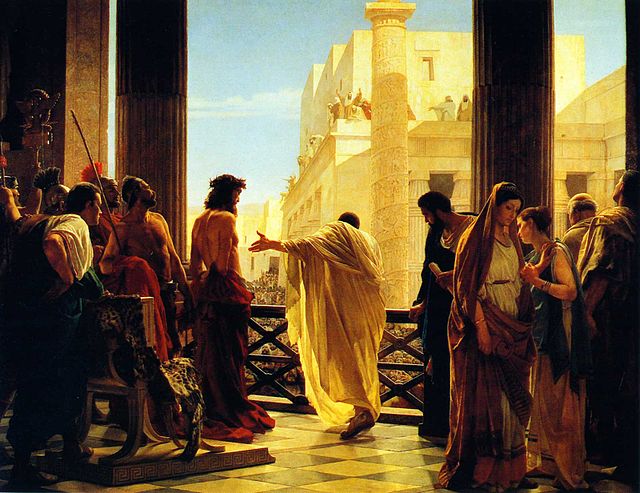
Satan was using those voices, that mocking and deriding. Picture it. There is Jesus. Naked. Beaten. Bloodied. A crown of thorns on His head. His back whipped to shreds. Nails through His hands and feet. He hangs there dying for their sins and suffering the wrath of God that they deserve. And the very people He’s doing all this for are saying these things to Him.
It’s easy to picture the devil whispering in Jesus’ ear, “Do you hear what they’re saying to you? Why are you doing this for them? You don’t have to do this! You said they would die because of their sin. I thought you are a God of justice? Let me have them. That would be fair. They don’t deserve to have you die for them. It would be just for you to abandon them.”
But Jesus resists the temptation. He wants to redeem you. It would not be just for Him to save Himself. Justice is Jesus getting back what belongs to Him. That’s you. The devil is a thief (Jn. 10:10) and a liar (Jn. 8:44), and Jesus will simply not let Satan have you.
In reality, justice is God winning you back from the clutches of sin, death, and the devil. Justice is God having you as His Own. Justice is you living under Him in His kingdom as He intended. That’s justice. And your God is a God of justice. A God of justice. A God of forgiveness. A God of grace and mercy.
This is why we regularly use 1 John 1:9 before our confession of sins. “If we confess our sins, He is faithful and just to forgive us our sins and cleanse us from all unrighteousness.”
Dear saints, your God is merciful and just (Ex. 34:6-7). Your Savior did not come down from the cross because He will not let the devil have you. In His mercy, He gives Himself for you. Christ perfectly obeyed God’s Law for you. Jesus suffers the punishment you deserve. As surely as His mercy is for you and your benefit, His justice is also for you and for your benefit. Psalm 89:14 shows us who God is, “Righteousness and justice are the foundation of Your throne; steadfast love and faithfulness go before You.” That truth is most clearly seen in the cross of Christ.
Dear saints, justice and mercy meet you this Holy Week. Jesus stays on the cross that you may be His Own. He refused to save Himself because He is determined to save you. Let His cross be your comfort and His empty tomb your sure hope, now and forever. Welcome to Holy Week. Amen.
The peace of God, which surpasses all understanding, will guard your hearts and minds in Christ Jesus (Php. 4:7). Amen.




 Jesus has arrived in Jerusalem. The Priest has come to the Temple. The Prophet has come to Mt. Zion. The King has come to His city. But most importantly the Lamb of God has come to His altar, where He would in five days breathe His last and pour out His blood for you (Pr. Wolfmueller). This is your Lord’s Passion, done and completed for you. Amen.
 King Jesus didn’t come to sit as judge. Instead, He came to be judged. He didn’t have subjects who shout, “Long live the king!” Instead, they holler, “Crucify Him!” He didn’t come to command armies. Instead, He came to be beaten by soldiers. He didn’t come to be clothed in the finest garments and crowned with gold and jewels. Instead, He came to have a robe ripped from Him and be thorns pressed into His head. He didn’t come to drink fine wine from a golden chalice. Instead, He came to be offered wine mixed with gall. He didn’t come to sit in a fine hall with nobles surrounding Him. Instead, He came to hang on a splintered cross between two thieves. He didn’t come to execute justice. Instead, He came to die an unjust death.
 But Christian, by God’s grace, you know better. You know that those are the very things that God has given and uses to complete the good work of faith that He began in you.
 Pastorsamwise
You must be logged in to post a comment.