Waiting & Receiving – Sermon on Isaiah 40:25-31 for the Fourth Sunday of Easter

Isaiah 40:25-31

25 To whom then will you compare me, 
that I should be like him? says the Holy One. 
26 Lift up your eyes on high and see: 
who created these? 
He who brings out their host by number, 
calling them all by name; 
by the greatness of his might 
and because he is strong in power, 
not one is missing. 

27 Why do you say, O Jacob, 
and speak, O Israel, 
“My way is hidden from the Lord, 
and my right is disregarded by my God”? 
28 Have you not known? Have you not heard? 
The Lord is the everlasting God, 
the Creator of the ends of the earth. 
He does not faint or grow weary; 
his understanding is unsearchable. 
29 He gives power to the faint, 
and to him who has no might he increases strength. 
30 Even youths shall faint and be weary, 
and young men shall fall exhausted; 
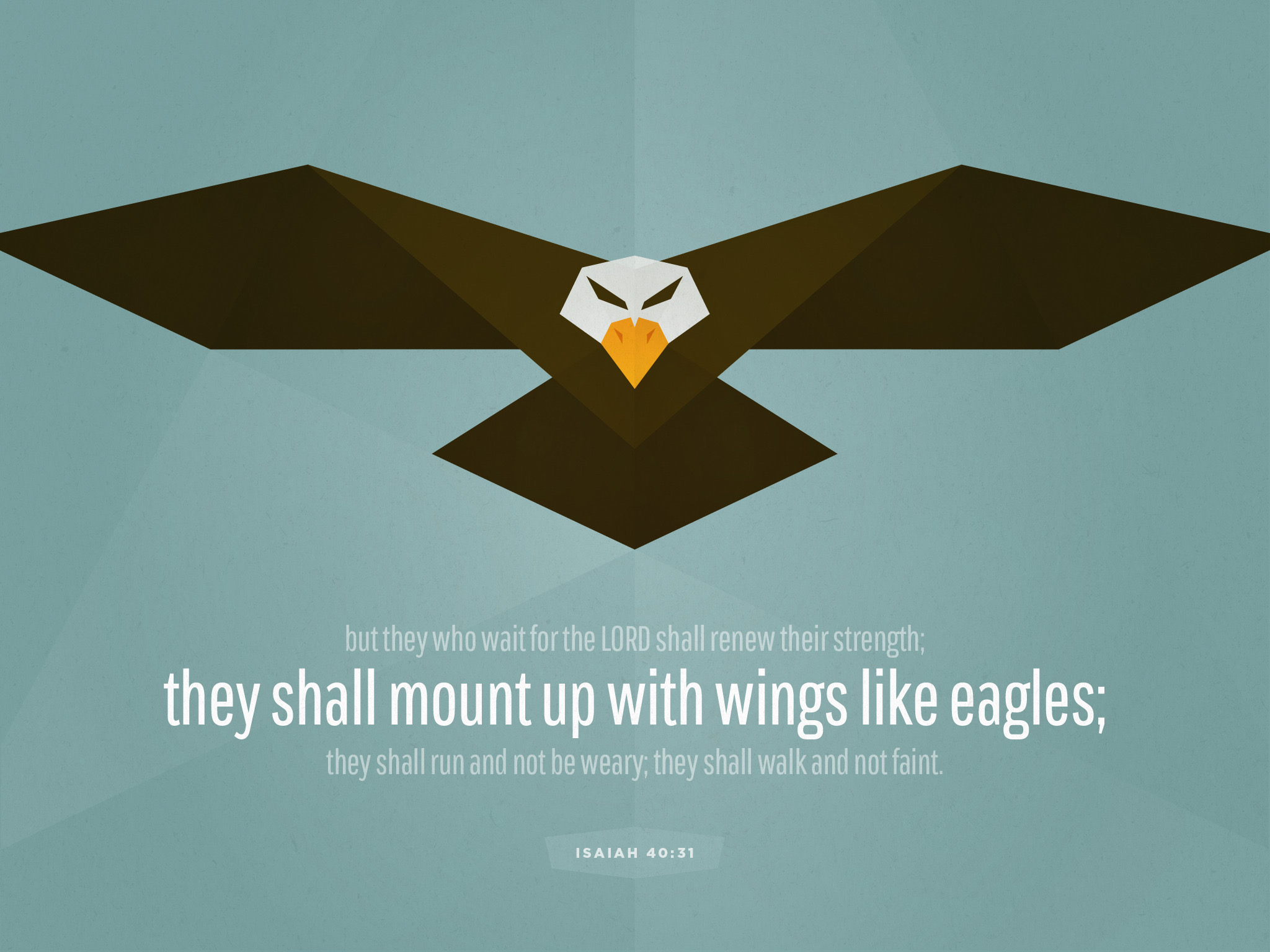
31 but they who wait for the Lord shall renew their strength; 
they shall mount up with wings like eagles; 
they shall run and not be weary; 
they shall walk and not faint.

Alleluia! Christ is risen! 
He is risen indeed! Alleluia!

In the name of Jesus. Amen.

One of the greatest spiritual dangers that we all face is that, as we go through difficulties in life, we forget very obvious things – especially the fact that God loves us and is in control of all things. But it’s not as though you’ve actually forgotten it. It’s just that you don’t believe it. You don’t live your life in what you know to be true.

Smack in the middle of this text, God asks a question, and it sounds like He asks it out of frustration. “Why do you say, ‘My way is hidden from the Lord, and my right is disregarded by my God.’?” God doesn’t even wait for an answer. Instead, He addresses His question with a question. “Have you not known? Have you not heard? The Lord is the everlasting God, the Creator of the ends of the earth. He does not faint or grow weary; His understanding is unsearchable.”

Your God doesn’t wear out like you and I do. It’s not as though He needs to go sit in His lazy chair and kick His feet up to take a nap. He never encounters a situation where He isn’t quite sure what to do. We have known and we have heard that God is everlasting, that He is the Creator of the ends of the earth who does not grow faint or weary. We know that God has infinite understanding, that He gives power to the faint and strength to the weak. Our problem is that we don’t live like that is true. We encounter difficulties and live as though God does none of those things.

Dear saints, your God created every single star in the universe. Scientists guess that there are somewhere between 100-400 billion stars in our Milky Way galaxy. They don’t know the exact number, but that’s the estimate. Think about this – even if we took the small end of that estimate – if it only took God one second to name each star, 100 billion seconds is equivalent to 3,171 years, 66 days, 17 hours, and 46 minutes. And that’s just our galaxy.

Scientists estimate that there are between one to two trillion galaxies. Honestly, it wouldn’t surprise me that as we learn how to look farther we found out that the universe is even bigger than that. And it was nothing for God to create all those things. God created all of those things simply by speaking, “Let there be lights in heavens,” (Gen. 1:14) and there they were. Every one of them with a name and carefully placed in its position by your mighty God.

Now, contrast that with how God created you. When God created Adam, He didn’t simply speak. He got down into the mud and dirt and dust. He molded, formed, and shaped you from that dust and breathed into your nostrils the breath of life (Gen. 2:7). He intricately knitted you together in your mother’s womb (Ps. 139:1315).

Beyond that, God saved you by taking on your flesh and blood. He entered into His creation and subjected Himself to the weariness and fatigue that you endure (Jn. 4:6). Christ knew suffering and pain (Is. 53:3). Jesus did all of this to step between you and the wrath of God that you and I deserve because of our sin. He came to die and rise again in order to win you as His own.

In other words, God is much more invested in you than all the rest of creation. He’s more interested in what goes on in your life and what happens with you than with all the stars and galaxies that He calls by name. Again, we know this, but by the way we often live, it sure doesn’t look like it. Instead of waiting upon the Lord and soaring like eagles, we flap around like chickens.

I’m no expert on chickens, but the few times I’ve seen them “in flight” it’s pretty unimpressive. When they do get airborne, it’s usually because they’ve jumped as high as they can. They beat their wings – feathers flying all around. And the best they can do is just to fall less quickly. That’s the picture of us when we aren’t waiting upon the Lord. The best we can do in our own strength is fall a bit slower.

Eagles are completely different. This past Tuesday, Sarah and I just got to watch three eagles soaring in the distance. I don’t know what they were looking at, but for, maybe, five minutes they kept circling round and round. They would swoop down periodically, but then they would ascend on the invisible updrafts. The whole time we watched those eagles, none of them flapped their wings even once. They were just lifted by those updrafts. Those huge birds didn’t need to extend any effort to fly.

Dear saints, that is the picture of those who wait upon the Lord. This waiting on the Lord isn’t simply marking off time and watching the minutes and seconds tick by. This waiting is living in a confident expectation of God’s action on our behalf. This waiting is simply resting in God’s mercy which lifts us up to heaven. Romans 4:5 puts it this way, “To the one who does not work but believes in Him who justifies the ungodly, his faith is counted as righteousness.”

I’ll confess my own weakness in this. I’m not good at waiting. I don’t like doing it. I don’t have the patience I should have. Waiting is difficult, and I suspect this is true for all of us. We wrongly live as though everything around us is dependent upon our work, our effort, our wisdom. We think we have to get everything figured out on our own. It’s exhausting. Waiting might feel like we’re descending or, even, free-falling. But this waiting is waiting in faith where we receive from God, and He lifts us up.

I want to change gears for a minute to talk about this upcoming sabbatical. Dear saints, my prayer for this sabbatical is that all of us would come to a better understanding that this is God’s congregation and that He is more interested in His Word being proclaimed here than we are. I’ll confess that I start to slide into the sinful attitude that certain things are dependent on me and what I do. If that were actually the case, you, dear saints, are in deep trouble.

So, during this sabbatical, I’m going to do my best to rest. In 1 Co. 3:5-7, Paul tells the congregation in Corinth that he and other pastors are nothing. He says, “I planted, Apollos watered, but God gave the growth. So neither he who plants nor he who waters is anything, but only God who gives the growth.” This sabbatical will help all of us remember that.

God loves His church. He loves this congregation. He is more ready to give than we are to receive. So, thank you for the gift of this sabbatical so I can stop, wait, and receive from God for an extended time. I trust that God will use this time to renew and refresh me in ways that will benefit me and in ways that will benefit you.

May God remind all of us that when we are weary and exhausted that He is our strength. He is the One who lifts us up by His mercy and grace. His incomparable love carries us along. He protects and keeps us. He grows His church. He forgives our sins. He makes a place for us in eternal life through His inexhaustible love and work for us in Christ Jesus. May we all wait and receive from Him. Amen.

Alleluia! Christ is risen! 
He is risen indeed! Alleluia!

The peace of God, which surpasses all understanding, will guard your hearts and minds in Christ Jesus. Amen.

Return to Comfort – Sermon on Isaiah 51:9-16 for the Twenty-fourth Sunday after Trinity

Isaiah 51:9–16

9 Awake, awake, put on strength,
O arm of the Lord; 
awake, as in days of old, 
the generations of long ago. 
Was it not you who cut Rahab in pieces, 
who pierced the dragon? 
10 Was it not you who dried up the sea, 
the waters of the great deep, 
who made the depths of the sea a way 
for the redeemed to pass over? 
11 And the ransomed of the Lord shall return 
and come to Zion with singing; 
everlasting joy shall be upon their heads; 
they shall obtain gladness and joy, 
and sorrow and sighing shall flee away. 

12 “I, I am he who comforts you; 
who are you that you are afraid of man who dies, 
of the son of man who is made like grass,
13 and have forgotten the Lord, your Maker, 
who stretched out the heavens 
and laid the foundations of the earth, 
and you fear continually all the day 
because of the wrath of the oppressor, 
when he sets himself to destroy? 
And where is the wrath of the oppressor? 
14 He who is bowed down shall speedily be released; 
he shall not die and go down to the pit, 
neither shall his bread be lacking. 
15 I am the Lord your God, 
who stirs up the sea so that its waves roar— 
the Lord of hosts is his name. 
16 And I have put my words in your mouth 
and covered you in the shadow of my hand, 
establishing the heavens 
and laying the foundations of the earth, 
and saying to Zion, ‘You are my people.’ ”

In the name of Jesus. Amen.

When a little girl wakes up in the middle of the night because she’s scared, worried, or thirsty, it’s completely natural for her to wake up her parents. Tired as those parents might be, one of them – in our house it’s usually the mom (Thanks, hon!) – one of them will get up to help that child with whatever she needs. It doesn’t matter if that girl’s need is silly, like the fear of a monster under her bed, and it doesn’t matter if her need is justified like a dirty diaper or a horrible cough. That parent will go and help.

The parent will reassure the child, “No, I looked and there isn’t a monster under your bed.” “Yes, ants are strong, but you don’t have to worry about them carrying our house away.” “Even though you’re perfectly capable of getting your own drink, I know you’re scared to go into the dark bathroom, so I’ll get a cup of water for you.” “I’ll steam up the bathroom to help you with your croupy cough.” If a child doesn’t ask his or her parents for help in that moment of fear and need, it’s strange. Something is wrong or off. Parents are able and willing to help their children. That’s part of the job description.

As kids grow and mature, they become capable of doing things on their own so they need their parents’ help less often. And that is a good thing. Parents want that for their children, so parents teach their children to zip their coat, tie their shoes, and pour a bowl of cereal for themselves. To be a functioning person, you need to be able to do those sorts of things. But there is a sadness that comes along with children becoming more capable and independent. One day, you’re walking your son into his first day of pre-school. Then, what feels like two seconds later, he’s able to drive himself everywhere. But that independence comes with a cost. It means that, instead of being home, he’ll be at practice or work or going out with friends. And when you do see him and ask how his day was, all you get is a quick, “Fine.” Part of a parent’s job is to get their kids to the point where they don’t need parents to do things for them.

Again, this independence isn’t a bad thing, but it comes with a danger. The danger is that it can lead to becoming disconnected from others. We don’t ask others to help us even though they are able and willing to. And this goes beyond asking mom or dad or whomever to help us. It also extends to asking our heavenly Father for help.

As we become more independent and capable, we also get better at lying to ourselves. We wrongly think that we reach a point where we don’t need God’s help with the little things in life, like tying our shoes or driving to work. And those lies tend to snowball.

The lie starts with thinking, “I’m mature enough that I don’t need God’s help to tie my shoes,” which leads to, “God doesn’t help me tie my shoes.” Then, that leads to thinking that God doesn’t help as we go about all the other business of our day, whether it’s commuting, studying, working, eating, and all the other daily things that make up our life.

Of course, none of that is actually true. God does help us in all of those things. He has given us brains that send messages through the nerves He has given us so the muscles and tendons He has also given us so we can tie our shoes. God is the One who created the laws of physics and gravity that cause our shoelaces to move in consistent, repeatable ways. In reality, it’s not an overstatement to say that God tied your shoes this morning. Sure, He did it through you, but God did it. It is sad how we so quickly and easily forget God’s care for us over the entirety of our lives and actions.

Another thing that causes us to forget God’s care for us is fear. Usually, we think danger causes either a fight or flight instinct in us, but what might be even more common than fight or flight is for us to freeze and do nothing. When our brain can’t calculate if it’s better to fight or flee from the danger, we freeze. And when we freeze in the face of fear, we are the most vulnerable. It’s better if that fear causes us to flee toward God, our heavenly Father, just like a child going to her parents in the middle of the night.

The reason a children wake up their parents at night is they have a fear and instinctively flee to their parents to get the help they need. And it doesn’t matter if the fear is reasonable or not. That child’s fear drives him to his parents who love, care for, and help him because he either can’t or won’t fight the monster under his bed.

It’s that kind of good and right, childlike fleeing that is going on here in Isaiah. Isaiah is running back to God his Father in the middle of the night because God is the only One who can help him. Isaiah is saying, “Wake up, God. Wake up. I need Your help. You slew the dragon before and made a highway through the sea. Wake up and help me now.”

There is a beautiful honesty in Isaiah’s prayer here. He knows what he needs, and he’s asking his heavenly Father to give it. But even as Isaiah makes this request, he doesn’t know exactly what God is going to do. None of us mortals know what God is going to do. But Isaiah honest enough to pray to God and say that he wants God to do more than He’s currently doing. Isaiah wants God to do mighty things. He is like that little kid waking up his dad, and he is confident enough to know that God is his loving Father who will take care of him and give him exactly what he needs.

Dear saints, we need to become like children again, as Isaiah does here.

It’s easy for us to spot danger. For example, we think about the future and all of the unknown things the future holds and we are filled with fear and anxiety. Stop doing that.

Scripture would have you do the opposite. Throughout Scripture, people look back to the past and think about what God has already done for them. Those mighty things God did in the past help them trust in the present that God will do similar things in the future. And that is a much better approach than thinking we have to help ourselves by molding and shaping the future on our own.

To put all this into the words Isaiah uses here: If God made everything in the beginning, can He take care of everything now and in the future? Yes, He can. If God stretched out the heavens and laid the foundations of the earth, can He do something about your life next week? Of course He can! He who made all things throughout all creation simply by speaking can certainly take care of the small fraction of creation that effects your life today, tomorrow, and sixteen years from now. In fact, He promises to. Hear again what your heavenly Father says, “I, I am He who comforts you.”

So, you children of God, return to Him. God wants you to be childlike in your trust in Him (Mt. 19:14). Because He is your heavenly Father, He is able and willing to take away both your stupid fears and your justified fears. God wants you to have that simple faith like the child who runs to his parents in the middle of the night with whatever is causing you trouble. Just like a parent’s job is to check for monsters under the bed and get a drink for her child in the middle of the night, it’s God’s job to care for every big or small, justified or silly thing that troubles you.

You are God’s children. You can be fearless in your prayers. God isn’t going to be surprised at any of them. You aren’t going to ask for something He’s never heard. You aren’t going to confess some sin that He hasn’t already forgiven for someone else. God knows how to do it, so wake Him up and ask Him for what you need.

You don’t have to be like the woman in our Gospel reading (Mt. 9:18-26) who tries to sneak something good from God. You can be much bolder than that. He is the Lord, your Maker, who stretched out the heavens and laid the foundations of the earth. None of the things that cause you worry or fear are greater than the one who comforts you, so return to Him.

In the Small Catechism, Luther offers us two prayers, one for the morning and one for the evening. Both of those prayers include the following statement that fit so well with this passage from Isaiah. The statement is this, “Into Your hands I commend myself, my body and soul, and all things.” Our family uses those prayers during our drive to school and in our devotions in the evening, and those words have been rolling around in my brain this past week. And I would encourage you to consider using those prayers as well.

You can confidently place everything about yourself and all the things around you into God’s hands. Because God is your loving Father, He’ll take care of it all. And you can do this boldly. Your heavenly Father has already given you His only begotten Son to forgive you of all your sin, what other good thing would He ever withhold from you? Nothing.

As Ro. 8;31b-32 says, “If God is for us,” and He is, “who can be against us? He who did not spare His own Son but gave Him up for us all, how will He not also with [His Son] graciously give us all things?”

Children of God, return to Him, and He will comfort you. Amen.

The peace of God, which surpasses all understanding, will guard your hearts and minds in Christ Jesus. Amen.

God Makes Room – Sermon on Luke 2:1-20 for Christmas Eve 2020

Listen here.

Luke 2:1-20

1 In those days a decree went out from Caesar Augustus that all the world should be registered. 2 This was the first registration when Quirinius was governor of Syria. 3 And all went to be registered, each to his own town. 4 And Joseph also went up from Galilee, from the town of Nazareth, to Judea, to the city of David, which is called Bethlehem, because he was of the house and lineage of David, 5 to be registered with Mary, his betrothed, who was with child. 6 And while they were there, the time came for her to give birth. 7 And she gave birth to her firstborn son and wrapped him in swaddling cloths and laid him in a manger, because there was no place for them in the inn.

8 And in the same region there were shepherds out in the field, keeping watch over their flock by night. 9And an angel of the Lord appeared to them, and the glory of the Lord shone around them, and they were filled with great fear. 10 And the angel said to them, “Fear not, for behold, I bring you good news of great joy that will be for all the people. 11 For unto you is born this day in the city of David a Savior, who is Christ the Lord. 12And this will be a sign for you: you will find a baby wrapped in swaddling cloths and lying in a manger.” 13 And suddenly there was with the angel a multitude of the heavenly host praising God and saying, 

14 “Glory to God in the highest, 
and on earth peace among men, with whom he is pleased!”

15 When the angels went away from them into heaven, the shepherds said to one another, “Let us go over to Bethlehem and see this thing that has happened, which the Lord has made known to us.” 16 And they went with haste and found Mary and Joseph, and the baby lying in a manger. 17 And when they saw it, they made known the saying that had been told them concerning this child. 18 And all who heard it wondered at what the shepherds told them.

19 But Mary treasured up all these things, pondering them in her heart. 20 And the shepherds returned, glorifying and praising God for all they had heard and seen, as it had been told them.

In the name of Jesus. Amen.

Merry Christmas!

The first twenty verses of Luke 2 are extremely well-known. Some of you might be able to recite them word for word, and many of you can probably recite them with a little help here and there. Sure, you might need a little help remembering that Quirinius was governor of Syria. (It’s a hard name to remember.) And it is good that you remember this passage. These verses record for us the most significant event in human history. The only other event that would be tied with the birth of Christ would be His death and resurrection.

But one of the problems with our familiarity with this text is just that – we are familiar with it. With that familiarity comes certain ideas that aren’t part of the text. And those things can get ingrained in our minds. Some of the beauty and brilliance of this event fades away when some common misconceptions about the event overshadow the reality. Well, tonight, I’d like to take this magnificent gem of a text and get it cleaned and polished to remove the haze of one of those misconceptions. We’re mainly going to focus on one verse of the text. And I hope and pray that you are blessed. 

The birth of Jesus takes up one verse and is simply recorded for us in v. 7, “And [Mary] gave birth to her firstborn Son and wrapped Him in swaddling cloths and laid him in a manger, because there was no place for them in the inn.”

First let’s lay out the misconception. Unfortunately, we have gotten the idea that Tom Bodett for Motel 6 didn’t leave the light on for Joseph and Mary. (I really hope most of you are old enough to get that reference; if you don’t, you didn’t listen to enough Twins games on the radio in the mid ‘90’s.) All the familiar English translations use the same word there, ‘inn,’ which gives an idea of a hotel. So, we get the idea that, by the time Joseph gets the very pregnant Mary to Bethlehem, it’s late and all the hotels were booked because so many people were there for the census. And it isn’t too hard to imagine that being the case. Anyone who has traveled with a very pregnant lady knows you have to stop for bathroom breaks – a lot of bathroom breaks. The picture in our minds is that Joseph and Mary check at all the hotels, find no rooms available, and end up staying in a stable or barn.

The problem with this is that the word that gets translated as ‘inn’ doesn’t refer to a hotel. In fact, Bethlehem was so small that the little town probably didn’t even have a hotel. Now, the word that gets translated as ‘inn’ here only occurs two other times in the New Testament. The other two times this word gets used are once by Mark and also later at the end of the Gospel of Luke. And both of those times is in the context of Jesus telling His disciples to follow a particular man to his house and say to him, “The Teacher says, ‘Where is My guest room (not ‘inn’ but ‘guest room’ – same word), where I may eat the Passover with My disciples?” (Mk. 14:14Lk. 22:11). And Jesus didn’t institute the Lord’s Supper in a hotel conference room. Also, Luke knows the typical word for an ‘inn’ or ‘hotel’; he uses it in the Parable of the Good Samaritan (Lk. 10:34), but it’s a very different word. If Luke had meant to say there were no rooms in the hotels of Bethlehem, he would have, but he doesn’t.

So, we should understand that Luke isn’t talking about hotels. Instead, when Luke says there was no room for Joseph and Mary in the ‘guest room,’ he’s telling us that the couple had arrived at a home – probably the home of one of Joseph’s relatives – but other members of Joseph’s extended family had lodged there and that there was no longer any place for them in the guest room. In fact, it might be even worse. Maybe, when Joseph and Mary get there, the pious, religious relatives learn that Mary is pregnant out of wedlock and they aren’t willing to make a place in the guest room for her even while she is in labor. So, Joseph and Mary only have one option for the birth of the Child and that was the part of the house where the animals were kept. And, just so you know, it was typical back then for houses to have a place for their animals in a lower part of the house.

Now, don’t go home and throw away your nativity sets. Please don’t. They’re good. But it would be good when you look at a Nativity set to tweak your thinking just a little bit. Add this picture to it: Joseph and Mary aren’t out in a pasture away from everything else. Instead, they are inside a full house where relatives are likely talking, eating, drinking, and laughing – just like at a family reunion. And Mary is off to the side, giving birth, wrapping Jesus in swaddling cloths, and laying Him in a feeding trough.

The Messiah, the One whom all of God’s people were waiting for, is finally born, but there is no place for Him to lay His head except for that manger.

So, play this out a little: When the company of angles come to proclaim the greatest news in all of history, they announce the birth of Jesus to the shepherds. But the shepherds aren’t the first to know about Jesus’ birth. Joseph’s family would have already known. Joseph and Mary probably tried to give an explanation to the family, but they didn’t believe that Mary was miraculously pregnant with Jesus. And, so, they did not make room for the birth and arrival of the Son of God.

Now, this is nothing new. Because of our sin, all humanity is opposed to God’s presence, and in our sin, we have no place for God. That is what we see when Adam and Eve fall into sin. They hear God walking in the garden in the cool of the day but try to hide themselves (Gen. 3:8). It’s what happens after God speaks to His people on Mt. Sinai; they hear His voice and ask Moses to tell God to not talk to them anymore (Ex. 20:18-21Dt. 18:16). It’s why the scribes and Pharisees reject Jesus even though He repeatedly proves that He is God (see esp. Mt. 26:59-66). It still happens today when people use any and every excuse to not be where Jesus is present with His gifts. In his Gospel (and you will hear these verses in a few minutes), John says it more bluntly than Luke. “He came to His own, and His own did not receive Him” (Jn. 1:11).

In the end, we see the sad reality that sinners have no place for the presence of God.

Now, please, don’t finish my sermon for me. This isn’t meant to be a guilt trip. I’m not going to give you a sales pitch appealing to you, “Please, make room for Jesus in your heart.”

Just because God took on flesh and was a helpless Infant, don’t get the impression that Jesus is a fickle, desperate god who is just waiting around for you to make room for Him. Even when He is rejected, when He is pushed out, even when the very people He came to save have no place for Him, He doesn’t twiddle His thumbs and wait for you to make room for Him. Instead, God in His great love for you makes room for Himself.

Don’t let the humility of Jesus’ birth lead you to diminish His power. Even as a little Infant, Jesus is the eternal Son of God, King of kings, Lord of lords. Rather let the humble birth of powerful Jesus lead you to recognize His great love and mercy for you.

Jesus knew what He was coming to and wasn’t surprised that there was no place for Him. But He came anyway. He came to make a room in eternity for those who did not make room for His birth. He knew that the infant hands, feet, and body that Mary swaddled up to keep Him from getting cold would be the same hands, feet, and body that would be nailed to the cross. And He did all of this voluntarily and out of love for you so that He could make an eternal place for you with Him in heaven.

That is the moral of this reading, the whole blessed idea of Christmas, and, in fact, the teaching of all Scripture. God doesn’t wait for you to make room for Him. If you don’t make room for Him, He just nestles in anyway. Whenever He comes, He comes to you to bring you His love, mercy, and forgiveness. Jesus made room in His heart for you. All of your life and salvation is not about how open you are to God rather on how He is open to you. And the the birth of your Savior shows, proves, demonstrates, and manifests how open He is to you.

And Christmas then is the time when we do nothing but watch our God come in the flesh and simply say, “Thank you.”

One more thing and then I’ll stop. Luke is a historian. He is detailed and precise. He mentions all the details about it being the first census when Quirinius was governor, etc. which helps prove the factuality of his Gospel. And Luke does this in all his writings. But notice how Luke is fairly vague in v. 7. He simply and briefly records the fact that Jesus was born and laid in a manger because there was no place in the guest room, and he leaves it at that. Luke doesn’t name names or give addresses. He doesn’t criticize, scorn, or belittle Joseph’s relatives for their rejection of Jesus. He doesn’t throw them under the bus. He simply says, there wasn’t room.

Here’s the point: It isn’t a stretch of the imagination at all to think that the very people who refused to make a place for Jesus when He was born became Christians by the time Luke wrote his Gospel. So, Luke covers their sin and doesn’t call it out. Jesus does the same for you.

Because of what Christ has done by coming to earth, being born in such a humble manner, by giving His life on the cross, and by rising again for you, your sins are removed from you as far as the east is from the west.

And God be praised. You are here tonight. You have rightly made room in your celebration tonight for the birth of the Savior who has made room for you.

People loved by God: Merry Christmas! Amen.[1]

The peace of God, which surpasses all understanding, will guard your hearts and minds in Christ Jesus. Amen.


[1] I am thankful for a sermon by Pr. Jared Melius for the direction of this sermon.