Guarded by God’s Peace – Sermon on Philippians 4:4-7 for the Fourth Sunday of Advent

Philippians 4:4-7

In the name of Jesus. Amen.

We live in the sunrise of eternity, and the New Creation is dawning. When Paul says, “The Lord is at hand,” he wasn’t just thinking that this portion of Philippians would be one of the readings on the Sunday before Christmas. He was stating a fact. Jesus’ return is at hand. It was true when Paul wrote this nearly 2,000 years ago, and it’s still true – maybe even moretrue now. If something true can become truer.

Just a few verses before our text, Paul reminds us, “[O]ur citizenship is in heaven, and from [heaven] we await a Savior, the Lord Jesus Christ, who will transform our lowly body to be like His glorious body” (Php. 3:20-21). Right now, the very thing we are waiting for – Jesus’ return from heaven to transform us – that blessed event is at hand.

Since your citizenship is in heaven and since your Lord and Savior is at hand, how are you to live? Paul answers that in these verses. Toward God, you live in joy. Toward your neighbors, you live in reasonableness. Within yourself, you live in peace. Let’s consider each of these.

“Rejoice in the Lord always; again I will say, rejoice.” Now, that’s a double command – ‘rejoice… rejoice.’ But even though it’s a command, it isn’t so much a legal requirement as it is a Gospel invitation. Joy can’t be commanded or forced. In fact, the more you try to force someone to have joy, the less joyful that person will probably be. When Paul says, “Rejoice in the Lord,” he wants you to remember Jesus and all that He has done for you because that is what brings you true, lasting, eternal joy.

Christ has made you a citizen of heaven (Php. 3:20). Because He died and rose again, you also will rise again. Because He has a risen and glorified Body, He will raise, glorify, and transform your body. As surely as the Resurrection began with Jesus, it will surely spread to you and to those you love who have died in faith (1 Co. 15:20-23). So, no matter what evil things befall you in this world, Jesus has fixed it. It’s not your responsibility to make things right. Jesus has and will take care of it. Because of that, you live toward God with joy.

Also, because of that joy, you live toward others with reasonableness. Sadly, English doesn’t have a good equivalent for the word that gets translated as ‘reasonableness’ here in Php. 4:5. Other translations will use words like ‘gentleness, forbearance, or moderation,’ but even those only convey part of the meaning.

The word refers to strength, but it’s the kind of strength that doesn’t need to impose or prove or assert itself. It’s the kind of gentle strength that Jesus shows when He’s in a boat with the disciples in Mk. 8:14-21. The disciples are all worried because they only had one loaf of bread with them in the boat. So, Jesus brings up the fact that He had fed the 5,000 with five loaves of bread and the 4,000 with seven loaves of bread and that there were many baskets of leftovers after each instance. And Christ doesn’t say, “You dunces are a real pain in my patootie,” and call down lightning from heaven to strike them. He could have. Instead, He exercises a gracious and reasonable gentleness toward them and says, “Don’t you guys get it yet?”

Dear saints, you can live with that same kind of reasonableness toward others because you know that your Savior has come to right every wrong. You don’t need to demand your pound of flesh when someone sins against you. Christ will take care of things. He’s promised. You don’t need to prove anything about your rank or place or prominence or standing. All of that is secure in Christ. It’s beyond question – even if others don’t recognize it.

Sure, the world is going to throw all sorts of trials and tribulations your way which can and will cause you anxiety. But you don’t need to be anxious or worried about any of that. Listen to v. 6 again, “Do not be anxious about anything,” again that’s a command, but it’s a Gospel invitation. “Do not be anxious about anything, but in everything by prayer and supplication with thanksgiving let your requests be made known to God.” In other words, take everything that concerns and worries you, take anything that makes you anxious, and make it your prayer. Place it in God’s hands.

Near the end of my sabbatical, I attended a service at Wittenberg Lutheran Chapel on UND’s campus because I am friends with the former pastor there, and it was his last Sunday before he started a call at a new congregation. As we chatted after the service, I mentioned something to him that I was worried about. I didn’t even use the word ‘worry’ in our conversation, but he recognized that it was something that was heavy on my heart. He listened to me go on and on about the situation. When I was finally done, he simply looked at me and said, “Christ has it.” That simple phrase was so calming. It was like the weight and burden of that situation was completely gone. His reminder, “Christ has it,” freed and released me from that worry.

Dear saints, I’d encourage you to think that way about the things that cause you worry and anxiety. Tell God about all your worries and anxieties in prayer. In a sense, those prayers delegate all your worry to God. They turn it over to Him. And after your, “Amen,” God’s response to you is, “I got it. It’s in My hands now. It’s not your problem any longer.” That, again, gives you joy toward God. It also enables that strong, gentle reasonableness toward others. And all of this allows you to have God’s in peace within yourself.

God’s peace, which surpasses all understanding, guards your heart and mind in Christ Jesus. Normally, when we think about peace, we think about a quietness and calm. We think about tranquility. The peace of God here isn’t some quiet, passive thing. Not at all. This peace guards your heart and your mind. The word ‘guard’ is a military term for soldiers who stood watch over a situation. Think of how police officers, state troopers, and other federal agents are rightly called ‘peace officers.’ From time to time, those ‘peace officers’ might have to do some violent things – like tase a criminal, do a pit maneuver on someone who is fleeing, restrain a felon, or whatever – but they do those violent things to preserve and promote peace. 

Imagine God’s peace playing whack-a-mole with anything that would come along and disturb you. Every accusation of the devil, God’s peace pounds it. Every tribulation the world throws at you, God’s peace knocks it down. Every sin you commit that troubles your conscience is tased and stopped dead in its tracks by the Lamb of God who takes away that sin (Jn. 1:29).

God’s peace guards you. It’s the stabilizing force that keeps your soul anchored in whatever turbulence the devil, the world, and your own sinful flesh would cause. This is the peace that the angels announced to the shepherds the night of Christ’s birth. “Glory to God in the highest, and on earth peace among those with whom He is pleased” (Lk. 2:14).

The Prince of Peace Himself has come in your flesh to give you peace. Jesus says, “Peace I leave with you; My peace I give to you. Not as the world gives do I give to you. Let not your hearts be troubled, neither let them be afraid” (Jn. 14:27). Jesus doesn’t just give you a fleeting emotion. No. He establishes His heavenly Kingdom on earth, and this brings you peace and joy. His joy fuels your reasonableness toward others. And that joy and reasonableness grants you peace.

Again, dear saints, we stand in the sunrise of eternity. Your Lord is at hand. Rejoice always in what Christ has done. Let your gentle strength shine before a watching world. Pour out your worries in prayer that is laced with thanksgiving for God’s faithfulness. And watch as God’s inconceivable peace guards you. It guards you like a watchtower over your soul until that glorious day of Christ’s return when anxiety is banished forever. Then, you will feast in eternal peace in His presence. Amen.

The peace of God, which surpasses all understanding, will guard your hearts and minds in Christ Jesus (Php. 4:7). Amen.

At Your Strongest – Sermon on Ephesians 6:10-20 for the Twenty-first Sunday after Trinity

Ephesians 6:10-20

10 Finally, be strong in the Lord and in the strength of his might. 11 Put on the whole armor of God, that you may be able to stand against the schemes of the devil. 12 For we do not wrestle against flesh and blood, but against the rulers, against the authorities, against the cosmic powers over this present darkness, against the spiritual forces of evil in the heavenly places. 13 Therefore take up the whole armor of God, that you may be able to withstand in the evil day, and having done all, to stand firm. 14 Stand therefore, having fastened on the belt of truth, and having put on the breastplate of righteousness, 15 and, as shoes for your feet, having put on the readiness given by the gospel of peace. 16 In all circumstances take up the shield of faith, with which you can extinguish all the flaming darts of the evil one; 17 and take the helmet of salvation, and the sword of the Spirit, which is the word of God, 18 praying at all times in the Spirit, with all prayer and supplication. To that end, keep alert with all perseverance, making supplication for all the saints, 19 and also for me, that words may be given to me in opening my mouth boldly to proclaim the mystery of the gospel, 20 for which I am an ambassador in chains, that I may declare it boldly, as I ought to speak.

In the name of Jesus. Amen.

I love this text. I’ve always loved this text, but younger me really loved this text – however, for the wrong reasons. All this talk about strength, might, armor, wrestling, and facing powerful, cosmic enemies – it gets a guy’s juices flowing. It brings out the fighter and warrior in a man. Sorry if that doesn’t resonate as much with you ladies and mothers here. Maybe, you gals will need to calm down and restrain your husbands and sons and brothers after the service, so they don’t march off to conquer Manitoba or something.

The passage tells us about a war that surrounds us every moment of every day. And it’s good that it does because we would be completely unaware of this war unless Scripture told us about it. Being oblivious to a war that surrounds you is not good. The reason we would be ignorant of this war is that it isn’t a war that we can see. As we confessed in the creed earlier, we “believe in God the Father Almighty, maker of heaven and earth, and [maker] of all things visible and invisible.”

Today, we heard how in six days God created everything we can see (Gen. 1:1-2:3), but God also created things we cannot see (Col. 1:16). And, dear saints, the enemy in the war that surrounds you is in that invisible part of God’s creation. In fact, none of your enemies exist in the visible part of creation. You do not – I repeat you do not – wrestle against flesh and blood. Instead, you wrestle against the rulers, the authorities, the cosmic powers over this present darkness, and the spiritual forces of evil in the heavenly places (Eph. 6:12). And some of you men out there are thinking, “Cool, an invisible enemy! That’ll make our victory even more impressive!”

Calm down, guys. And take heart, ladies. Because, while this text is about fighting in an invisible war against an unseeable enemy, the battle plan is straightforward and simple.

Before we can even dive into that battle plan, we have to understand where this invisible war is taking place. To be ready for battle, you have to know the battlefield. And one of the ways our enemy has made us unprepared for battle is taking this text out of its context. You might be very familiar with this text, but do you know what comes immediately before it? Maybe. But, I’ll admit, that even as your pastor and as someone who gets paid to study and teach the Scriptures, I find it easy to forget the context.

The context starts back in Eph. 5:22. Paul has been laying out the callings and duties for Christians in their vocations. Christian wives are to submit to their husbands. Christian husbands are to love their wives as Christ loved the Church. Christian children are to obey their parents. Christian parents are do bring up their children in the discipline and instruction of the Lord. And so on. It’s in that context that this passage about spiritual warfare falls.

In other words, you, Christian, need recognize that the battle described here is occurring in your everyday callings, vocations, and relationships. It’s there that you need God’s strength. It’s there that you need God’s armor because that’s where the devil and demons are attacking. They are attacking both you and those around you. Your daily life is the battlefield.

You husbands, wives, parents, and grandparents. The war is happening as you earn a living, as you keep the house, as you shuttle kids around. You kids, as you go to school, as you do your homework and chores, as you interact with your friends, the battle is taking place there.

There are two points I want to make sure you take away from this sermon, and this is the first. So, listen up: There is a spiritual war raging all around you every moment of every day, and you need to be strong and aware all the time. And that leads to right into the second point: You are at your strongest and are completely prepared for this war when you stand in the Lord’s strength and in the armor that He provides.

Right off the bat (Eph. 6:10), you are told, “be strong in the Lord.” Almost all of the popular versions of the Bible will read that way, and I understand why it’s translated that way. It’s a fine translation. But the verb there “be strong” is passive. When it’s only translated, “be strong,” you might start wondering how you go about becoming or making yourself strong.

I wish our translations read, “be strengthened in the Lord, in His mighty strength.” The text is clear. God is the One who makes you strong (Php. 4:13). Earlier in Eph. 3:16-17, Paul says that, according to the riches of His glory, God Himself grants you to be strengthened with power through the Holy Spirit so that Christ dwells in your heart through faith.

Not only does God make you strong, He also clothes you in His armor. You have the belt of truth, the breastplate of righteousness, the boots of the Gospel, the shield of faith, the helmet of salvation, and the sword of the Spirit which is the Word of God. All of that, God’s strength and God’s armor, it all comes from God’s Word. God’s Word is truth (Jn. 17:17). Christ’s righteousness is given through the Word (2 Tim. 3:16-17). The Gospel is only revealed in the Bible. Faith is given through God’s Word (Ro. 10:17). The Scriptures are what make you wise to salvation (2 Tim. 3:15Jam. 1:21).

Strengthened by God and armed with and by His Word, you are prepared for this war. But you still might wonder, “Am I properly trained for the war? What are my duties?” Well, you aren’t told to march off to war. You also aren’t told to retreat. Instead, four times in this text, you are told what your assignment is in the battle. You are to stand (Eph. 6:1113-14). The picture Paul is giving is that you are a particular kind of soldier – a sentry, who stands guard over the kingdom.

The picture of this passage is this: Christian, you are God’s soldier. As God’s soldier, your responsibilities are simple. You are a sentry who guards the holy ground of God’s kingdom. And God has placed you in a particular place – where no one else is stationed. You are there to watch and to pray. In other words, when the enemy attacks, you are not supposed to go off and fight alone. No. Instead, you stay in your post. You stand in God’s strength and in the protection of His armor. And you pray. With that prayer, you call in the reinforcements of the Lord’s army.

When you see the war raging around your spouse, your children, your parents, or any neighbor – stand your ground, man your post, and pray. You, dear saints, stand in the Lord’s strength and protection. And when the battle gets in close, take up the sword of the Spirit, the Word of God. Wield that sword against the devil, and he will flee.

Psalm 35 opens with a beautiful prayer for you to use in the battle. “Contend, O Lord, with those who contend with me; fight against those who fight against me! O Lord, take hold of shield and buckler and rise for my help! Draw the spear and javelin against my pursuers! Say to my soul, ‘I am your salvation!’” Christ Himself is the One leads the charge against your enemies, and He turns over His shoulder to remind you that He is your salvation. Amen.

The peace of God, which surpasses all understanding, will guard your hearts and minds in Christ Jesus (Php. 4:7). Amen.

Limping – Sermon on Genesis 32:22-32 for the Second Sunday of Lent

Genesis 32:22–32

22 The same night he arose and took his two wives, his two female servants, and his eleven children, and crossed the ford of the Jabbok. 23 He took them and sent them across the stream, and everything else that he had. 24 And Jacob was left alone. And a man wrestled with him until the breaking of the day. 25 When the man saw that he did not prevail against Jacob, he touched his hip socket, and Jacob’s hip was put out of joint as he wrestled with him. 26 Then he said, “Let me go, for the day has broken.” But Jacob said, “I will not let you go unless you bless me.” 27 And he said to him, “What is your name?” And he said, “Jacob.” 28 Then he said, “Your name shall no longer be called Jacob, but Israel, for you have striven with God and with men, and have prevailed.” 29 Then Jacob asked him, “Please tell me your name.” But he said, “Why is it that you ask my name?” And there he blessed him. 30 So Jacob called the name of the place Peniel, saying, “For I have seen God face to face, and yet my life has been delivered.” 31 The sun rose upon him as he passed Penuel, limping because of his hip. 32 Therefore to this day the people of Israel do not eat the sinew of the thigh that is on the hip socket, because he touched the socket of Jacob’s hip on the sinew of the thigh.

In the name of Jesus. Amen.

Everyone faces difficulties, but what do you do when something difficult stares you in the face? It probably depends on the situation. You might try to find another, easier alternative. You might try to get others to help and assist you. You might try to avoid that difficult thing altogether. A lot of times, the most difficult tasks come with the highest reward, so if you always try to avoid difficulties, you are also going to miss out on some of the greatest joys.

On the 4th of July in 2015, we were on a family trip in Colorado. We wanted to find a nice mountain hike that all of could enjoy. Our kids were 2, 4, 6, and 8 at the time. A quick search yielded a recommendation of the Hanging Lake trail. The review had some pictures that were breathtaking. It said the hike would only took an hour and claimed it was great for families. The person who wrote that review must be the 17th generation of sherpas who lead expeditions up Mt. Everest because I’ve since learned that that trail climbs 1,000 ft. (basically, 90-100 flights of stairs) over 1.2 miles. The thing that kept us going was hearing people hiking back down encouraging us, “Keep going. You’ve got a way to go still, but it’s totally worth it.” They were right. I can show you pictures after the service, but it’s one of the most stunning places I’ve seen on God’s green earth. Difficult? Absolutely. Worth all the pain and struggle? Also, yes.

God had given a promise to Abraham that the Savior first mentioned in the Garden of Eden (Gen. 3:15) would be one of his descents (Gen. 22:17). Jacob here was the third in that line. And Jacob faced difficulties his entire life, and, yes, many of those were self-inflicted. 

Jacob’s difficulties started in his mother’s womb as he wrestled with his twin brother, Esau before they were even born (Gen. 25:19-26). When they were older, Jacob took advantage of Esau’s hunger and purchased Esau’s birthright for a cup of stew (Gen. 25:29-34). Later, Jacob deceived their father, Isaac, into passing the blessing that was first given to Abraham on to him even though he was younger than Esau (Gen. 27:1-40). Because of that deception, Esau planned to kill Jacob, who had to flee (Gen. 27:41-45).

During his exile, Jacob ends up working for a guy named Laban, and his wages for seven years of work would be marrying Laban’s daughter, Rachel. But Laban tricked Jacob and gave him his daughter Leah instead of Rachel. Still, Jacob agreed to work another seven years to marry Rachel (Gen. 29:15-20). Despite all of the deception of his father-in-law, Jacob continued to work for Laban and was paid with certain portions of Laban’s flocks. But that was difficult too. Jacob had to plot against Laban throughout his employment (Gen. 30:25-43).

Finally, God told Jacob to move away from Laban and return to his origins (Gen. 31:3). But as he’s returning home, Jacob hears that Esau is marching toward him with 400 men, which was the standard size of an army in that day (Gen. 32:6). So, what does Jacob do? He prays, and I’ll summarize his prayer (Gen. 32:9-12), “Ok, God. You told me to go back home and promised to do good to me. I’m really thankful about that, but now Esau is coming, and I’m afraid that he’ll kill me. But You’ve promised to be with me. So, what’s going on?” But God doesn’t answer.

So, Jacob does what he’s always done when he is in a difficult situation. He takes matters into his own hands and starts plotting and scheming. He sends a massive, expensive gift from his flocks to Esau (Gen. 32:13-15). That’s his “plan A.” But Jacob isn’t done plotting. He also divides his family into two camps figuring, if Esau attacks one camp, the other one will be able to escape (Gen. 32:7-8). That’s Jacob’s “plan B.” Jacob also sends those two camps ahead of him across a stream while he stays behind on the other side. It almost seems like that’s his “plan C” thinking that if Esau wipes out his family at least he’ll escape so God can keep His promise. Like his grandfather Abraham did before him with Hagar and Ishmael, Jacob decides he needs to matters into his own hands so God can keep His promises.

God did have a plan to get Jacob out of this difficult situation, but God isn’t going to give Jacob a large army. It won’t be because of Jacob’s gift to Esau, or letting half of Jacob’s family escape, and God doesn’t deliver Jacob from this difficulty by anything Jacob does on his own.

Instead, God comes down. God comes down to wrestle with Jacob who, at this point, is 96 years old. Sure, Jacob lived to be 147 (see Gen. 47:28), but wrestling with anyone for an entire night, and having your hip thrown out of joint is going to take a toll on a person. So when you consider the whole context here, it seems as though God has two intentions with this wrestling. On the one hand, is seems like God is letting Jacob take out all his frustration on God Himself in a physical way. On the other hand, it seems like this wrestling is intended to make Jacob look weak. Keeping Jacob up all night isn’t enough, so God wrestles with him. And even that isn’t enough, so God also touches and dislocates Jacob’s hip socket.

The next day, when Jacob limps toward Esau, he looks so weak and pathetic that Esau runs to Jacob, and the two brothers embrace and weep together (Ex. 33:1-4).

All of this is further proof of what God says in 2 Cor. 12:9-10, “My grace is sufficient for you, for my power is made perfect in weakness.” This wrestling match left its toll on Jacob. For the rest of his life, Jacob was limping, and that limping served as a constant reminder that he had held on to God and refused to let God go until God blessed him. Every step of the rest of Jacob’s life, served as a reminder of that night when Jacob grappled with God and was blessed through it – even though that blessing came through the difficulty of limping the rest of his life.

Dear saints, I have two things for you to remember from this account. First, when you look at your life and all of God’s promises to you, remember first that you don’t need to give yourself over to bitterness or political machines or other contrived solutions to fight the difficulty and evil you face. Don’t think that God can only bring about His promises if you get your hands dirty with anger, hostility, and bitterness. God keeps His promises and is always faithful.

Second, remember that God knows what you need better than you or I do. And what you need may be a difficulty. Dear saints, whatever difficulty you have – if it’s pain or trauma or a disease that the doctors cannot treat or heal – yes, this is definitely a difficult, horrible thing that you have to face. But it is not a reason to despair and stop trusting God. Instead, it’s is a call for you to hope. In the brokenness of your flesh, remember Jesus who was broken Himself in order to crush the head of the serpent. And the day is coming when you and all who believe in Christ will be raised to a new life with no more suffering, pain, anguish, or difficulty.

Again, God’s power is made perfect in weakness. There’s no greater proof of that than in what Jesus has done for you by taking on your flesh; being beaten, mocked, whipped, and crucified; and by dying the death you and I deserve. So, in our limping, we do not lose heart, as 2 Cor. 4:16-18 says, “Though our outer self is wasting away, our inner self is being renewed day by day. For this light momentary affliction is preparing for us an eternal weight of glory beyond all comparison, as we look to not to the things that are seen but to the things unseen. For the things that are seen are transient, but the things that are unseen are eternal.” 

Dear saints, when you face difficult things and are struggling to even limp along, lean on God. Trust His promises. Jesus is there with you in your limping. Amen.

The peace of God, which surpasses all understanding, will guard your hearts and minds in Christ Jesus. Amen.

Return to Comfort – Sermon on Isaiah 51:9-16 for the Twenty-fourth Sunday after Trinity

Isaiah 51:9–16

9 Awake, awake, put on strength,
O arm of the Lord; 
awake, as in days of old, 
the generations of long ago. 
Was it not you who cut Rahab in pieces, 
who pierced the dragon? 
10 Was it not you who dried up the sea, 
the waters of the great deep, 
who made the depths of the sea a way 
for the redeemed to pass over? 
11 And the ransomed of the Lord shall return 
and come to Zion with singing; 
everlasting joy shall be upon their heads; 
they shall obtain gladness and joy, 
and sorrow and sighing shall flee away. 

12 “I, I am he who comforts you; 
who are you that you are afraid of man who dies, 
of the son of man who is made like grass,
13 and have forgotten the Lord, your Maker, 
who stretched out the heavens 
and laid the foundations of the earth, 
and you fear continually all the day 
because of the wrath of the oppressor, 
when he sets himself to destroy? 
And where is the wrath of the oppressor? 
14 He who is bowed down shall speedily be released; 
he shall not die and go down to the pit, 
neither shall his bread be lacking. 
15 I am the Lord your God, 
who stirs up the sea so that its waves roar— 
the Lord of hosts is his name. 
16 And I have put my words in your mouth 
and covered you in the shadow of my hand, 
establishing the heavens 
and laying the foundations of the earth, 
and saying to Zion, ‘You are my people.’ ”

In the name of Jesus. Amen.

When a little girl wakes up in the middle of the night because she’s scared, worried, or thirsty, it’s completely natural for her to wake up her parents. Tired as those parents might be, one of them – in our house it’s usually the mom (Thanks, hon!) – one of them will get up to help that child with whatever she needs. It doesn’t matter if that girl’s need is silly, like the fear of a monster under her bed, and it doesn’t matter if her need is justified like a dirty diaper or a horrible cough. That parent will go and help.

The parent will reassure the child, “No, I looked and there isn’t a monster under your bed.” “Yes, ants are strong, but you don’t have to worry about them carrying our house away.” “Even though you’re perfectly capable of getting your own drink, I know you’re scared to go into the dark bathroom, so I’ll get a cup of water for you.” “I’ll steam up the bathroom to help you with your croupy cough.” If a child doesn’t ask his or her parents for help in that moment of fear and need, it’s strange. Something is wrong or off. Parents are able and willing to help their children. That’s part of the job description.

As kids grow and mature, they become capable of doing things on their own so they need their parents’ help less often. And that is a good thing. Parents want that for their children, so parents teach their children to zip their coat, tie their shoes, and pour a bowl of cereal for themselves. To be a functioning person, you need to be able to do those sorts of things. But there is a sadness that comes along with children becoming more capable and independent. One day, you’re walking your son into his first day of pre-school. Then, what feels like two seconds later, he’s able to drive himself everywhere. But that independence comes with a cost. It means that, instead of being home, he’ll be at practice or work or going out with friends. And when you do see him and ask how his day was, all you get is a quick, “Fine.” Part of a parent’s job is to get their kids to the point where they don’t need parents to do things for them.

Again, this independence isn’t a bad thing, but it comes with a danger. The danger is that it can lead to becoming disconnected from others. We don’t ask others to help us even though they are able and willing to. And this goes beyond asking mom or dad or whomever to help us. It also extends to asking our heavenly Father for help.

As we become more independent and capable, we also get better at lying to ourselves. We wrongly think that we reach a point where we don’t need God’s help with the little things in life, like tying our shoes or driving to work. And those lies tend to snowball.

The lie starts with thinking, “I’m mature enough that I don’t need God’s help to tie my shoes,” which leads to, “God doesn’t help me tie my shoes.” Then, that leads to thinking that God doesn’t help as we go about all the other business of our day, whether it’s commuting, studying, working, eating, and all the other daily things that make up our life.

Of course, none of that is actually true. God does help us in all of those things. He has given us brains that send messages through the nerves He has given us so the muscles and tendons He has also given us so we can tie our shoes. God is the One who created the laws of physics and gravity that cause our shoelaces to move in consistent, repeatable ways. In reality, it’s not an overstatement to say that God tied your shoes this morning. Sure, He did it through you, but God did it. It is sad how we so quickly and easily forget God’s care for us over the entirety of our lives and actions.

Another thing that causes us to forget God’s care for us is fear. Usually, we think danger causes either a fight or flight instinct in us, but what might be even more common than fight or flight is for us to freeze and do nothing. When our brain can’t calculate if it’s better to fight or flee from the danger, we freeze. And when we freeze in the face of fear, we are the most vulnerable. It’s better if that fear causes us to flee toward God, our heavenly Father, just like a child going to her parents in the middle of the night.

The reason a children wake up their parents at night is they have a fear and instinctively flee to their parents to get the help they need. And it doesn’t matter if the fear is reasonable or not. That child’s fear drives him to his parents who love, care for, and help him because he either can’t or won’t fight the monster under his bed.

It’s that kind of good and right, childlike fleeing that is going on here in Isaiah. Isaiah is running back to God his Father in the middle of the night because God is the only One who can help him. Isaiah is saying, “Wake up, God. Wake up. I need Your help. You slew the dragon before and made a highway through the sea. Wake up and help me now.”

There is a beautiful honesty in Isaiah’s prayer here. He knows what he needs, and he’s asking his heavenly Father to give it. But even as Isaiah makes this request, he doesn’t know exactly what God is going to do. None of us mortals know what God is going to do. But Isaiah honest enough to pray to God and say that he wants God to do more than He’s currently doing. Isaiah wants God to do mighty things. He is like that little kid waking up his dad, and he is confident enough to know that God is his loving Father who will take care of him and give him exactly what he needs.

Dear saints, we need to become like children again, as Isaiah does here.

It’s easy for us to spot danger. For example, we think about the future and all of the unknown things the future holds and we are filled with fear and anxiety. Stop doing that.

Scripture would have you do the opposite. Throughout Scripture, people look back to the past and think about what God has already done for them. Those mighty things God did in the past help them trust in the present that God will do similar things in the future. And that is a much better approach than thinking we have to help ourselves by molding and shaping the future on our own.

To put all this into the words Isaiah uses here: If God made everything in the beginning, can He take care of everything now and in the future? Yes, He can. If God stretched out the heavens and laid the foundations of the earth, can He do something about your life next week? Of course He can! He who made all things throughout all creation simply by speaking can certainly take care of the small fraction of creation that effects your life today, tomorrow, and sixteen years from now. In fact, He promises to. Hear again what your heavenly Father says, “I, I am He who comforts you.”

So, you children of God, return to Him. God wants you to be childlike in your trust in Him (Mt. 19:14). Because He is your heavenly Father, He is able and willing to take away both your stupid fears and your justified fears. God wants you to have that simple faith like the child who runs to his parents in the middle of the night with whatever is causing you trouble. Just like a parent’s job is to check for monsters under the bed and get a drink for her child in the middle of the night, it’s God’s job to care for every big or small, justified or silly thing that troubles you.

You are God’s children. You can be fearless in your prayers. God isn’t going to be surprised at any of them. You aren’t going to ask for something He’s never heard. You aren’t going to confess some sin that He hasn’t already forgiven for someone else. God knows how to do it, so wake Him up and ask Him for what you need.

You don’t have to be like the woman in our Gospel reading (Mt. 9:18-26) who tries to sneak something good from God. You can be much bolder than that. He is the Lord, your Maker, who stretched out the heavens and laid the foundations of the earth. None of the things that cause you worry or fear are greater than the one who comforts you, so return to Him.

In the Small Catechism, Luther offers us two prayers, one for the morning and one for the evening. Both of those prayers include the following statement that fit so well with this passage from Isaiah. The statement is this, “Into Your hands I commend myself, my body and soul, and all things.” Our family uses those prayers during our drive to school and in our devotions in the evening, and those words have been rolling around in my brain this past week. And I would encourage you to consider using those prayers as well.

You can confidently place everything about yourself and all the things around you into God’s hands. Because God is your loving Father, He’ll take care of it all. And you can do this boldly. Your heavenly Father has already given you His only begotten Son to forgive you of all your sin, what other good thing would He ever withhold from you? Nothing.

As Ro. 8;31b-32 says, “If God is for us,” and He is, “who can be against us? He who did not spare His own Son but gave Him up for us all, how will He not also with [His Son] graciously give us all things?”

Children of God, return to Him, and He will comfort you. Amen.

The peace of God, which surpasses all understanding, will guard your hearts and minds in Christ Jesus. Amen.

Location – Sermon on Luke 18:9-14 for the Eleventh Sunday after Trinity

Luke 18:9–14

9 He also told this parable to some who trusted in themselves that they were righteous, and treated others with contempt: 10 “Two men went up into the temple to pray, one a Pharisee and the other a tax collector. 11 The Pharisee, standing by himself, prayed thus: ‘God, I thank you that I am not like other men, extortioners, unjust, adulterers, or even like this tax collector. 12 I fast twice a week; I give tithes of all that I get.’ 13 But the tax collector, standing far off, would not even lift up his eyes to heaven, but beat his breast, saying, ‘God, be merciful to me, a sinner!’ 14 I tell you, this man went down to his house justified, rather than the other. For everyone who exalts himself will be humbled, but the one who humbles himself will be exalted.”

In the name of Jesus. Amen.

Most of you are familiar with the phrase, “The three most important factors in real estate are – location, location, location.” A house here in East Grand Forks would probably be triple the cost if you moved it to Los Angeles County. For some reason, want to live there. I’ll gladly take winter.

A similar thing could be said about sin. The three most important factors about sin are – location, location, location. To be clear, I’m not talking about where sin is committed geographically. Speaking a lie to a massive crowd of people is just as damning as lying to yourself in your own mind without ever moving your lips. By referring to sin’s location here, I’m talking about where the sin resides. Sin has a place. Either sin is on you, or sin is on Jesus, the Lamb of God who takes away the sin of the world (Jn. 1:29).

We have this wrong tendency to think of sin as something abstract and floating around somewhere. There is no sin outside of the one who is committing it. Sin starts in the heart. Jesus says, “Out of the heart come evil thoughts, murder, adultery, sexual immorality, theft, false witness, slander” (Mt. 15:19). A sinner isn’t simply a person who commits sins. All people, besides Jesus, commit sin. Being a sinner means to be a person who is outside of God’s fellowship, outside the kingdom of God, someone who belongs with the demons. That is why we need Jesus to be the Savior of sinners. He changes the location of the sin. He removes it from the sinner as far as the east is from the west (Ps. 103:12).

Now, with that in mind, let’s consider the parable, which is about as straightforward as it gets. We’re told that the audience is people who are sinners with sin residing in them but still trusted in themselves and their own righteousness while treating others with contempt. Jesus also gives a clear conclusion to the parable, “Everyone who exalts himself will be humbled, but the one who humbles himself will be exalted.” But to get a fuller sense of what Jesus is teaching here we need to set the picture of what is going on in the parable. The people who originally heard this would have been familiar with what goes on in the Temple, but we probably aren’t.

Two men went up into the Temple, which is God’s house (1 Kgs. 8:13, 27), and they go for a specific purpose – to pray and worship. In English, we typically think of prayer as an individual thing. Sure, we will pray the Lord’s Prayer and say grace before a meal with others. But normally we think of prayer as an individual thing and worship as a corporate, communal thing. But the people in Jesus’ day had one word for both prayer and worship. These two men go to the place of worship at the same time. What kind of service are they attending?

They would have been at the Temple for the atonement offering, which was the only service that took place every day in the Temple, and it occurred twice each day – once at dawn and again at three in the afternoon. The service would begin by the altar for sacrifice. An unblemished lamb was slaughtered, and its blood was sprinkled on the altar following a precise ritual.

This sacrifice was a reminder of how God covered the sin, nakedness, and shame of Adam and his wife by providing garments of animal skins after they fell into sin (Gen. 3:21). It showed that God would accept the death of another in place of the sinner. As the atonement lamb was sacrificed, certain prayers were offered with the sound of silver trumpets and cymbals. The people would sing a Psalm. A priest would go into the Holy Place where he would offer incense, praying that the sacrifice would be pleasing to God. Then, when the priest entered the Holy Place with that incense, the people would offer their private prayers to God.

But the Pharisee’s prayer directly contradicted everything that was happening around him in the Temple. He thanks God that he is acceptable because of who he is and who he is not, what he has not done and what he has done. His prayer in that context would be like coming here on Good Friday and praying, “God, I’m sure glad I’m not like all these sinners around me who need Jesus to die for their sins.” It’s utterly blasphemous.

But the tax collector’s prayer harmonizes with the service in at least two very specific ways. First, when the tax collector prays, “God be merciful to me, a sinner,” he isn’t using the normal word for ‘mercy.’ Many times in the Gospels, we hear people with sickness, disease, or other affliction cry to Jesus, “Have mercy” (Mt. 15:22, 20:31; Lk. 18:38-39). That’s always a good prayer to ask God for blessings you haven’t earned and the relief that you don’t deserve. But the tax collector’s prayer uses a different word. We could translate his prayer as, “God, atone me. God, reconcile me. God, make me what I should be.” That’s the first way his prayer harmonizes with the service. He is praying that the atonement that is taking place there in the Temple and the sacrifice being offered would do what God had promised it would do and remove his sin from him (Lev. 4:35).

Second, his prayer harmonizes with the service because this tax collector recognizes that he is the sinner who needs atonement. He needs to be reconciled. He needs to have his sin, his shame, his guilt removed. Again, that’s precisely what that service was pointing to. That is what the tax collector looked to, and that is why he went down to his house justified.

Now, there is a danger in this parable. We know that the really good, moral Pharisee did not go home justified, but this sinful tax collector did. The danger that can arise for us then is to think that everything about the Pharisee is bad. Be careful with that. It is good and right to not be extortioners, unjust, adulterers. It is good to fast and give tithes. That is all good stuff. There is another side to the coin of the Pharisee’s prayer. We might be tempted to pray, “God, I thank You that I am not like other men, self-righteous, pretentious, holier-than-thou types, or even like this Pharisee. I’ve given You my heart, dedicated my life to You, and made You my Lord.” Do you see what that does? It locates our eyes off of Jesus – the One who atones for our sin (1 Jn. 2:2).

The location of your sin matches where you look. If you look to yourself, your sin is on you. If you look to Christ, your sin is gone, defeated, eternally removed.

Let me close with an analogy: Imagine you had to cross some terrifying span. Far below at the bottom of that span are all the things you fear most – snakes, rats, lava, rough seas, or sharks. You fill in whatever is scariest. But there is a bridge that spans that gap. What would you look to for confidence in crossing that gap? You’d look to the bridge. You’d see if it was well-built, sturdy, and strong. You wouldn’t look inward to see if you have enough confidence in the bridge. And you build confidence in the bridge by looking at the bridge.

So, dear saints, where are you looking? Are you looking toward things you have done – either good works or your own humility? If so, you should have no confidence whatsoever.

Look to Jesus. His sacrifice, His blood, His death, His resurrection is enough. Looking there, you go to your house justified by God’s sure and certain declaration. Amen.

The peace of God, which surpasses all understanding, will guard your hearts and minds in Christ Jesus. Amen.

Keep Asking – Sermon on John 16:23-33 for the Sixth Sunday of Easter

John 16:23–33

23 In that day you will ask nothing of me. Truly, truly, I say to you, whatever you ask of the Father in my name, he will give it to you. 24 Until now you have asked nothing in my name. Ask, and you will receive, that your joy may be full.

25 “I have said these things to you in figures of speech. The hour is coming when I will no longer speak to you in figures of speech but will tell you plainly about the Father. 26 In that day you will ask in my name, and I do not say to you that I will ask the Father on your behalf; 27 for the Father himself loves you, because you have loved me and have believed that I came from God. 28 I came from the Father and have come into the world, and now I am leaving the world and going to the Father.”

29 His disciples said, “Ah, now you are speaking plainly and not using figurative speech! 30 Now we know that you know all things and do not need anyone to question you; this is why we believe that you came from God.” 31 Jesus answered them, “Do you now believe? 32 Behold, the hour is coming, indeed it has come, when you will be scattered, each to his own home, and will leave me alone. Yet I am not alone, for the Father is with me. 33 I have said these things to you, that in me you may have peace. In the world you will have tribulation. But take heart; I have overcome the world.”

Alleluia! Christ is risen!
He is risen indeed! Alleluia!

In the name of Jesus. Amen.

In this Gospel reading, Jesus gives us a command to pray. On the night He was betrayed, Christ said to the disciples, “Until now you have asked nothing in My name. Ask, and you will receive, that your joy may be full” (Jn. 16:24). So, according to Jesus if you want full joy, ask. That’s the command. ‘Ask’ in other words, pray. And the grammar there has a durative aspect to it. It is what you are to continually do. “Keep asking.” That has a different nuance to it than the way the ESV translates it here with just the word ‘ask.’

I don’t particularly like running. I know some of you here do, God bless your soul. I don’t, but when I was in junior high and high school, I ran cross country to help get me in shape for swimming season. At meets, people would stand along the course and cheer us runners on, and it would have been very frustrating if they said, “Run.” That’s what I was already doing. Instead, they would cheer, “Keep running.” Here, Jesus is doing something similar. He’s cheering you on by commanding you to keep asking and keep praying. And we need this encouragement because prayer is work.

Lately, the devil has doubled his efforts to discourage the work of prayer. That attack of Satan comes in many ways, but I’ve noticed it most often after someone commits an evil, heinous crime, politicians and pagans will say, “Prayers aren’t enough. We need to actually do something.” And we Christians, myself included, hear that and start to get at least a little shy about what prayer does. I know I’ve been guilty at times of saying things like, “Well, all we can do is pray.” God, forgive me.

Your prayers work. They work powerfully. They are not a waste of time. In Col. 4:2, 5, Scripture says, “Continue steadfastly in prayer,” and that call comes in the middle of several instructions which Paul says are, “making the best use of the time.” Christians are to use their time wisely and prayer is a good and wise use of your time because prayer does stuff. When you are praying, you aren’t wasting time. Praying isn’t setting aside important things to take a break. Prayer is the important thing. Christian, prayer is the most powerful, impactful thing you can do. A few verses later (Col. 4:12), Paul talks about a man named Epaphras who is “always struggling on your behalf in his prayers.” Does that sound like he’s taking some time off and relaxing? Nope! He’s doing something mighty and powerful by praying.

James 5:16 says, “The prayer of a righteous person,” and, yes, that is you, Christian, “The prayer of a righteous person has great power as it is working.” Prayer accomplishes things because of the power of the One to Whom you are praying. C.S. Lewis might be the most brilliant Christian thinker of the last hundred years, but he gets something wrong about prayer. He said, “[Prayer] doesn’t change God. It changes me.” Sure, yes, prayer changes us, but prayer changes God as well. Scripture teaches that God changes course because of prayer. He does something different than what He was going to do.

James 5:17-18 says that Elijah prayed fervently that it would not rain, and for three and a half years there was no rain. Then, he prayed that it would rain, and it did (1 Kgs. 17:1; 18:42-45). God told King Hezekiah to get ready to die. But he prayed, and God added fifteen years to his life (Is. 38:1-6; 2 Kgs. 20:1-6). Through the prophet Jonah, God told the people of Nineveh that they were going to be destroyed in forty days. But they prayed, and God changed His mind and did not do it (Jon. 3). In our Old Testament reading (Num. 21:4-9), God’s people were complaining about the bread that God was literally raining down from heaven for them to eat, so He sent fiery serpents to kill them. They prayed, and God delivered them because of their prayer. I could go on, but those are all crystal-clear examples of prayer changing what God was doing.

Picture God up in heaven. He is sturdy, calm, cool, collected. He’s got all His plans laid out of how He’s going to conduct the affairs of the world for the benefit of His people. When He Baptized you and made you His child (1 Jn. 3:1-3), He invited you into His “situation room.” There He is looking over His plans, and He asks you, “What do you think we should do here? How should this be handled?” You’d respond, “Um, well, I don’t know. You’re God. Shouldn’t You have this all under control and know how to run everything?” But God says, “Come on, now. I want to know what you think. What do you suggest?” So, you say, “Well, maybe You could move that thing over there. Send someone to preach Your Word over here. Heal this person. Bless that one.” And God says, “Ok. I like it. That’s the plan.”

Now, this doesn’t limit God in any way. The effectiveness of your prayers and the foreknowledge of God is a mystery that we cannot comprehend – similar to the doctrine of the Trinity and the two natures of Christ. How can there be one God yet three Persons? How can Jesus be 100% God and 100% man? We can’t understand or comprehend those things. But Scripture teaches them, so we believe them. The same thing is true about your prayer. Well, Scripture teaches that God is sovereign; He knows what will happen and isn’t your slave. And Scripture also teaches that your prayer changes what God will do. Just because you can’t fit those two things together logically, don’t throw one of them out to make it make sense to your logic.

Instead, see these two seemingly incompatible teachings of Scripture – God’s sovereignty and the power of prayer – see them as a further proof of God’s great love for you. The reason you ask and God responds is His love for you. Back to our Gospel reading, Jesus says in v. 26-27 (I’ll paraphrase a little bit), “Ask in My name. I don’t need to ask the Father for you because the Father Himself loves you.”

This is why God wants you to pray and brings you into His situation room. When you love someone, you permit them to affect and influence your actions, decisions, and directions. Think of a father who comes home from a rough day at work where everything went wrong. He’s frustrated and discouraged. He gets home and just wants to sit in his chair and watch the game. But he gets home, and his son asks, “Daddy, can you read this book to me?” That might not fit in with the father’s plans, but he loves his son and gladly sits on his bed and reads to him. And they spend time laughing and joking together.

When you love someone, you permit and even prefer to let them change what you want to do. Instead, you do what they want. And in that sacrifice, you and the person you love find joy.

Well, God is your perfect, loving Father, and He never tires of your asking. He loves you. He knows your sin and failures. Yet, the Father loves you because you love Jesus and have been forgiven much (Lk. 7:47). So, keep praying. Keep asking. Amen.

Alleluia! Christ is risen!
He is risen indeed! Alleluia!

The peace of God, which surpasses all understanding, will guard your hearts and minds in Christ Jesus. Amen.

The Fix – Sermon on the Purpose and Disciplines of Lent (Jonah 3:1-10; 2 Peter 1:2-11; & Matthew 6:16-21)

The Scripture readings for tonight’s Ash Wednesday service are Jonah 3:1-10; 2 Peter 1:2-11; and Matthew 6:16-21.

In the name of Jesus. Amen.

At some point in our lives, we have all broken something that couldn’t be fixed. No amount of glue, duct tape, or tinkering will put it back together. And when that happens – let’s say it was grandma’s antique vase – it doesn’t matter how the vase was broken. Maybe you threw it in a fit of rage, maybe you got a little too fancy with the game of catch in the living room, or maybe you just weren’t paying enough attention and barely bumped it – it doesn’t matter how it was broken because there’s no way to fix it. It doesn’t matter if you were angry or careless or thoughtless. There it lies on the floor, and it can’t be unbroken. All the king’s horses and all the king’s men can’t put Humpty Dumpty together again. The only thing to do is sweep up the pieces and throw it in the trash.

When you think of the things you have broken by your sin – the wrong turns you have taken, the right choices you failed to make, the kind words you didn’t speak, or the wrong words you said – the devil wants to take all of that and give you a sense of hopelessness. He wants you to just stare at the thing you have broken. He likes to hold the guilt of that mess over you, fill you with grief, and constantly remind you of your guilt. He wants to leave you staring at all the shattered pieces lying there on the floor, knowing that it was all your fault.

Tonight, we begin another Lenten season, and Lent is not a time of despair and gloom. At least, it’s not meant to be. Instead, Lent is a time of new beginnings and new hope. “Lent” means “spring.” The Christian religion isn’t one that only tells you about all the things you have broken or all the wrong choices you have made. Neither is Christianity a religion that only says, “God has fixed it. He understands. So, all the mess I’ve left in my wake is no big deal.” No. The Christian religion is far more. Yes, the Christian faith shows you what you’ve broken and how you’ve broken it, but it also shows you what God has done for you in Christ to reconcile you back with God and His creation. That is one of the great benefits of Lent and why it is important.

Lent is a time to put the cross of Christ before your eyes and focus your attention upon it. What Jesus has done for you on the cross gives you the full, complete, total forgiveness of your sins. On the cross, Jesus pays the price for all of your sins and restores you. Because of the cross, God gives you His mercy and grace. You know this, but you also know that the cross can’t unsay the evil and hurtful things you have said. The cross doesn’t undo the pain and harm you have caused yourself and others. The cross doesn’t make everything perfect again – not in this life.

Sinner, because of the cross, you more time. The cross gives you a time of hope when there should only be hopelessness. In Lent, Christ’s work on the cross stands before your eyes. Because of the cross, we should have an urgency. Paul mentions this urgency in 2 Cor. 6:2, “Behold, now is the favorable time; behold, now is the day of salvation.” In Christ and His cross, you and your loved ones still have time. So, what should you do with this time?[1]

First of all [Prayer], Lent is a time to be honest. Remember what the awful sinners of Nineveh did after they heard Jonah preach, “Yet forty days and Nineveh shall be overthrown!” (Jon. 3:4). They had great sin, but they also had time – forty days. And they used that time to repentantly pray. They were honest about their sins. They confessed how they had harmed themselves and others around them. They turned from their evil ways. God saw all this and relented of the disaster He said He would do to them, and He did not do it (Jon. 3:10).

This repentance is a good sorrow and a right sadness about sin. Repentance isn’t a pleasant thing to do. But similar to when a kid falls on his bike and needs to have gravel cleaned from his scrapes and cuts, repentance is going to cleanse so the wounds can heal. The cleansing is going to hurt, but If there’s no cleansing, those wounds might never heal. So, hold out your wounds, endure the pain of the cleansing, and begin to heal.

Second [Fasting], Lent is a time to slow down. Take the quiet moments God gives you – maybe through giving up certain things to free up more time – take those moments and consider how to supplement your faith with virtue, knowledge, self-control, steadfastness, godliness, brotherly affection, and love like Peter said in our Epistle (2 Pet. 1:2-11). And notice that all these things exist only when they flow from faith. In fact, they are impossible to have without faith. When we exercise our faith with these things, the Holy Spirit strengthens our faith.

Third [Almsgiving], Lent is a time to remember where your true treasure lies. The things of this earth are going to become moth-eaten, rust, and stolen from you in an instant. But there is a way to lay up for yourself treasure in heaven where it cannot be touched by any moth, rust, or thief. Yes, there may be broken vases all around you that cannot be fixed no matter how hard you try. But the things you do in this life that support the preaching of the Gospel and the things you do that strengthen your faith and the faith of your family – all of that lays up treasure for you in heaven and draws your heart heavenward as well.

Dear saints, God has reconciled all things to Himself and has made everything right by the cross (Col. 1:20). All the wrong turns, all the times you said too much or too little, and all the things you have broken have a cost to be fixed. The price? It was the holy and precious blood of Christ, and it is a payment that has been fully made on the cross. Jesus has destroyed sin and fixed everything that we, by our sin, have broken. And the day of Christ’s return is coming. Then, and only then, will all creation be put back together. There will be no more shards of vase lying there on the floor. It will all be fixed – fixed to perfection. May that day come soon. Until then, happy Lent. Amen.

The peace of God, which surpasses all understanding, will guard your hearts and minds in Christ Jesus. Amen.


[1] What follows will play off of the ‘textbook’ answer that Lent is a time of “prayer, fasting, and almsgiving.”

A Peaceful, Quiet Life of Prayer – Sermon on 1 Timothy 2:1-6 for the Sixth Sunday of Easter

1 Timothy 2:1–6

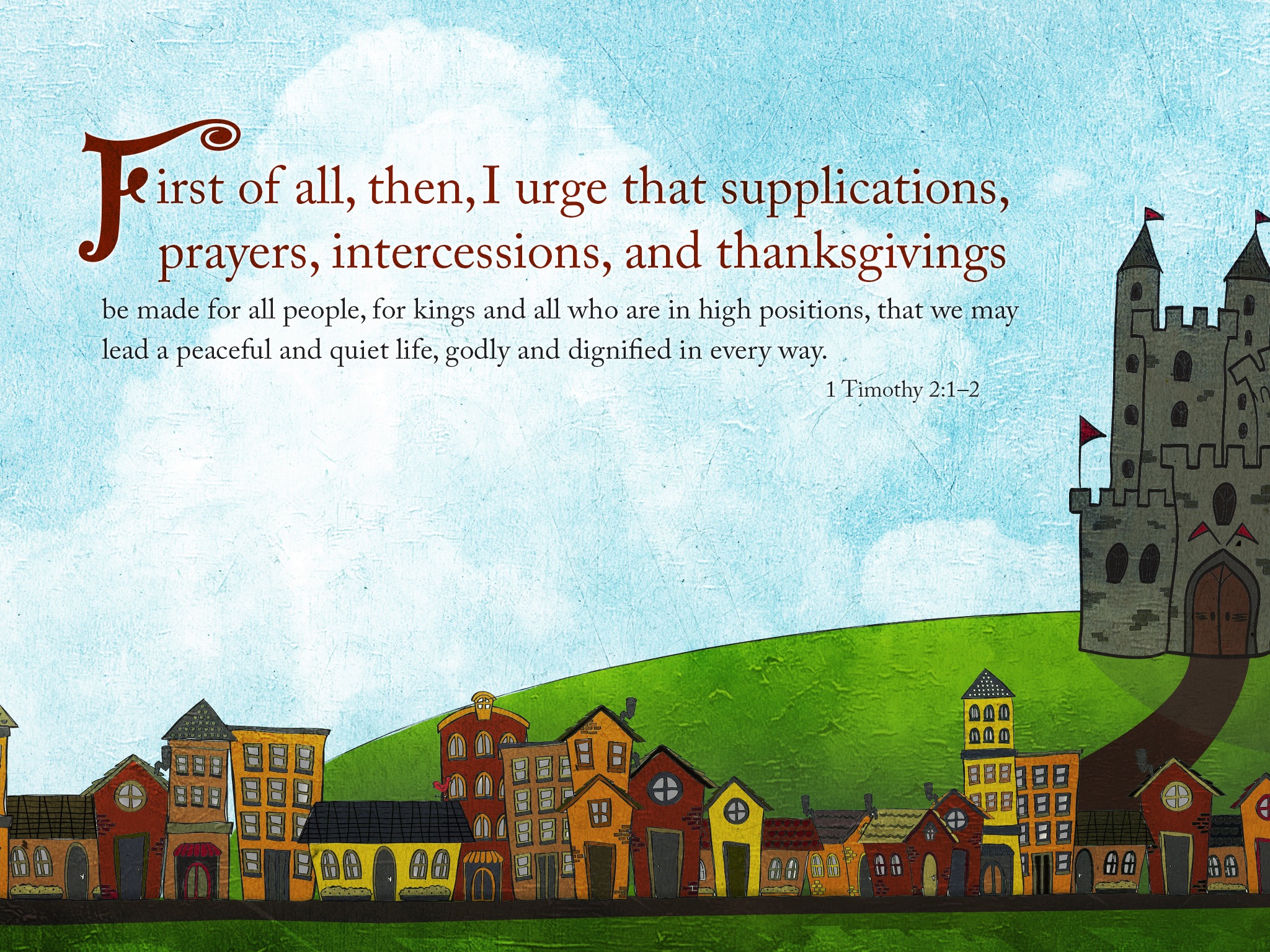
1 First of all, then, I urge that supplications, prayers, intercessions, and thanksgivings be made for all people, 2 for kings and all who are in high positions, that we may lead a peaceful and quiet life, godly and dignified in every way. 3 This is good, and it is pleasing in the sight of God our Savior, 4 who desires all people to be saved and to come to the knowledge of the truth. 5 For there is one God, and there is one mediator between God and men, the man Christ Jesus, 6 who gave himself as a ransom for all, which is the testimony given at the proper time.

Alleluia! Christ is risen!
He is risen indeed! Alleluia!

In the name of Jesus. Amen.

This should come as no surprise, but the Apostle Paul, who was inspired by the Holy Spirit to write 1 Timothy, was not an American. Here, Paul gives instructions about how a peaceful, quiet, godly, and dignified life will come about, and it isn’t through the separation of church and state. This peaceful life comes about by praying for all people, for kings, and for all who are in positions of authority. That means that Paul is instructs pastor Timothy to encourage his congregation to pray for Nero the emperor, the family and descendants of Herod, the different Roman governors who came after Pontius Pilate, and many others. In the context of our day, that means, Christian, you need to pray for your mayor; your city council and school board members; your state and national senators and representatives; the president; the judges at all levels; police and parole officers. We could go on and on and include all the bureaucrats who are appointed to positions of authority, but that would take too long.

We are to pray for those people in authority because God desires all to be saved and come to a knowledge of the truth. And just to be clear on this, Paul is, without question, saying there is a link between Christian prayers for civil authorities and the spread of the Gospel. The two go together according to this text. This really undermines the common understanding of the relationship between the church and the state, at least as it is talked about today.

In our country, it is good that the governing authorities don’t get to mandate or dictate that you be a Roman Catholic, Baptist, Methodist, or even Lutheran. Our founding fathers were wise when they wrote the Bill of Rights and decreed, “Congress shall make no law respecting an establishment of religion, or prohibiting the free exercise thereof.” But this does not mean that the Church and the State should stay in their separate corners and never have anything to do with each other. A lot more could be said about this, but the context for that would be better for a study on politics, culture, and religion – not a sermon.

For a sermon, which this is, it is better to get a Biblical perspective of how God has ordered this world for the benefit of us, His creatures. So, that’s what we are going to do.

To preserve and maintain order in creation, God has instituted the Three Estates – the Church, the Family, and the State. Through these Three Estates, God provides for His people and all creation. Now, many of you have heard me preach and teach about the Three Estates before, but it is good to be reminded of what these estates are and what they are to do.

Both the estate of the Church and the estate of the Family were established by God before the Fall into sin. God established the estate of the Church so there would be spiritual life, and spiritual life always comes through faith in God’s Word (Hab. 2:4; Ro. 1:17; Gal. 3:11; Heb. 10:38). The Church began when God told Adam to not eat of the Tree of the Knowledge of Good and Evil. As long as Adam didn’t eat that fruit, he had spiritual life through trusting God that evil was bad and if Adam gained knowledge of evil, he would surely die (Gen. 2:16-17). After the Fall, God gave the estate of the Church a new promise which was that He would send Jesus to forgive and save sinners and crush the devil’s head (Gen. 3:15). Today, the Church continues to proclaim the Gospel so more would believe in Christ, be saved, and have eternal life.

Also, before the Fall, God established the estate of the Family. The purpose of the Family is physical life. God created Adam and Eve and commanded them fill the earth and have dominion over it (Gen. 1:28-30). God loves people, He wants there to be more people, and He has given a husband and wife an important role in enlarging the number of people. God wants husbands and wives to have children and faithfully raise those children so they will grow up and have more children. The estates of the Church and Family were all that was needed before the Fall because they provided all what was necessary – spiritual life and physical life.

But we don’t live in the original goodness and perfection of creation anymore. All mankind fell into sin. Sinners will only look out for themselves. Left unchecked, sinners do whatever is right in their own eyes (Dt. 12:8; Jdg. 17:6, 21:25) and the world quickly falls into chaos and anarchy. So, after the Fall, God established the estate of the State, and just to be clear, the State is the governing authorities. Scripture is clear that every authority that exists is put in that position of authority by God (Ro. 13:1-2). Since the Fall, every emperor, every monarch, every president, prime minister, governor, legislator, judge, police officer, etc., has been put into his or her office by God Himself.

The State cannot give life, but giving life isn’t God’s purpose for the State. God gave the State to protect and preserve life in a world of sinners. In fact, we rightly recognize that the State only exists to protect and serve the estates of the Church and the Family. There will be no estate of the State in heaven. But the only way for the State to maintain order in a world of sinners is through punishment and the threat of punishment. So, it is good and right for the State to do things like setting speed limits, collecting taxes to maintain a strong police and military to protect the citizens, and have laws that allow for businesses to grow and thrive so people can have jobs that provide a living for families. The State is there to maintain peace, stability, and predictability in a world full of sinners.

The unfortunate thing about the State, and we repeatedly see this throughout history, is that the people in authority quickly let that authority go to their head. They often make life more difficult for those under their authority in all sorts of ways. That is why Paul here tells pastor Timothy to teach his congregation to pray for the authorities in the State with supplications, prayers, intercessions, and thanksgivings.

Now, with these four different words for prayer, you don’t need to get too worked up about them. They just summarize what you normally do in prayers. Supplications are prayers that you offer for others as though their problems are your problems. Prayers is the generic term that simply refers to petitioning or appealing to God. Intercessions are asking God to forgive the sins of others as though they are your own sins. Thanksgivings here doesn’t only mean that we are thankful for the authorities, though we should be; these thanksgivings are on behalf of others. We thank God for the mercies He has given to others as though He has given all those blessings to us. When things are good for others, they are good for us. In Jeremiah 29, God tells His people to seek the welfare of the city where they will be captive and exiled because it result in the welfare for God’s people in while they are in exile (Jer. 29:7). The same is true today. When those in authority are governing well and serving those under their authority, life is good.

Praying for the authorities in this way blesses us. God hears those prayers and answers them. Too often we might think that our prayers don’t actually do anything, but we are wrong. I’ve used this analogy before, but think of it this way: When a president or king is fighting a war, he has advisors. They sit around a table and strategize, consult, and plan together. Those advisors are important, and the person in charge values their input and alters his plans based on that discussion. Scripture teaches that you, Christian, you, child of God, are at that table. When God commands you to pray, He is inviting you into His war room to give your input as to how things should be handled on the battlefield. God wants your thoughts and ideas on how situations should be handled. God turns to you and asks, “My beloved child, what do you think we should do?” Your prayers are your response.

Another blessing that comes when we pray for authorities often gets overlooked. Our prayers give us a better perspective on God’s involvement in the world. God is not some divine clockmaker who just wound the gears and stepped back to let creation run on its own. No, He is deeply involved in all aspects of creation. Praying for the authorities helps remind you of that. Yes, God has given them power and control over many aspects of society and life, but who has power and control over those authorities? God Himself does.

This is why it especially important to pray for the authorities when they are governing in a way that contradicts how God would have them govern. Remember when Paul wrote these verses, Nero was the emperor. Paul says Christians should be praying for Nero, who was burning Christians to light his garden parties and would order Paul’s execution. Through your prayers for the authorities, God reminds you that they are not the ones who are ultimately in control. God is. Proverbs 21:1 says, “The king’s heart is a stream of water in the hand of the Lord; [the Lord] turns it wherever He will.” And if the authorities do evil, God Himself will hold them accountable. Remember that and your life will be a lot more peaceful and quiet, godly and dignified in every way.

Now, we’re going to abruptly change gears here. Vivian, this all brings me to you. Vivian, today you are Baptized. Today, Jesus has joined you to Himself by placing His name upon you (Mt. 28:19) and clothed you with Himself (Gal. 3:27). Vivian, in your Baptism, Jesus joined you to His death so that you have a Jesus-kind of death – in other words, a death that doesn’t last long and ends in resurrection (Ro. 6:3-11). Vivian, the God who desires all people to be saved has come and saved you. And, Vivian, as a congregation, we promise that we will pray for you that you will lead a peaceful and quiet life, godly and dignified in every way. 

Vivian, and all you saints, that life comes only because of Christ Jesus. He is the mediator between God and all mankind. The mediation He did was to give Himself on the cross, to shed His blood, and to lay down His life as a ransom for all and for you.

Dear saints, when you are surrounded by chaos and confusion on every side, call out to the Lord in prayer. He will listen and not reject your prayers (Ps. 66:19-20). And even though you will have tribulation in this world, Jesus, your Savior, has overcome the world (Jn. 16:33). May that fact give you eternal peace.

Alleluia! Christ is risen!
He is risen indeed! Alleluia!

Amen.

The peace of God, which surpasses all understanding, will guard your hearts and minds in Christ Jesus. Amen.

Father, into Your Hands I Commit My Spirit – Sermon on Luke 23:46 & Psalm 31:5 for Good Friday

In the name of Jesus. Amen.

“Then Jesus, calling out with a loud voice, said, ’Father, into Your hands I commit My Spirit.’ And having said this [Jesus] breathed His last” (Lk. 23:46).

Hebrews 10:31 tells us, “It is a fearful thing to fall into the hands of the living God.” The majority of times that the Bible talks about God stretching out His hand, it means destruction. This is why death is a fearful thing for us. The wages of sin is death (Ro. 6:23). It is appointed for a man to die once, and after that comes judgment (Heb. 9:27). Deep down, everyone knows this (Ro. 1:18-21).

Even the most hardcore atheist who wrongly thinks we are nothing more than a glob of atoms who randomly evolved knows that death is something to be avoided. Over the past few years, we have watched the absurd and, even, the evil things people will do in an attempt to avoid death. But unless Jesus returns first, we will all die (1 Thess. 4:17). And Satan uses the fact that sinners die to his advantage. Hebrews 2:14-15 says that the devil is able to hold all of humanity in bondage and slavery using only one tool, the fear of death. People try to stay alive at all costs and put even the thought of death as far away as possible. Death reminds us that we are not in control and are not in charge.

So, we have to learn from Jesus how to die. Jesus does not go into death as though He is falling into the hands of an enemy, but safely into the hands of His Father. These words of Jesus, “Father, into Your hands I commit My Spirit,” are a quote from Psalm 31:5, and by quoting it, Jesus wants us to consider the entire Psalm. Just like when you hear a line from a song or a movie and, so long as you are familiar with it, the whole song or scene comes to mind, this one line Psalm 31 would have brought the whole Psalm to the minds of those who were there at the cross.

I would encourage you to read all of Psalm 31 tonight with your family and have the crucifixion in mind. For now, hear the first five verses:

1 In You, O Lord, do I take refuge; 
let me never be put to shame; 
in Your righteousness deliver me! 
2 Incline Your ear to me; 
rescue me speedily! 
Be a rock of refuge for me, 
a strong fortress to save me! 
3 For You are my rock and my fortress; 
and for Your name’s sake You lead me and guide me; 
4 You take me out of the net they have hidden for me, 
for You are my refuge. 
5 Into Your hand I commit my spirit; 
You have redeemed me, O Lord, faithful God. 

Psalm 31:1-5 ESV

With His dying breath, Jesus commits Himself into the hands of the Father, and Christ can do this because He knows God is not angry with Him. And you, when you come to the end of your life, when you are breathing your last, you need to know this as well.

God is not angry with you. His anger over your sin has been satisfied. He has redeemed you through Jesus’ death. He has purchased and won you. Christ has paid the price for your sins. Unless you stubbornly hold on to your sins and refuse to believe that Christ has taken your place, there is no wrath, no judgment from God for you. You, Christian, you are a child of God, a child of the heavenly Father because Jesus has paid the price for your sins. You are no longer a sinner, but a one who has been redeemed and purchased by Jesus, the only-begotten Son of God.

By His blood, Jesus has washed away all your sin. You stand before God in the robe of Christ’s righteousness (Is. 61:10). For you, Christian, it is no longer a fearful thing to fall into the hands of a living God because God’s hands were nailed to the cross for you. Those are the hands that you commit yourself to.

There is therefore now no condemnation for you who are in Christ Jesus (Ro. 8:1) because your condemnation is in the past. It has already happened as Jesus died on the cross for you.

Jesus died after praying Psalm 31:5a, “Into your hands I commit my spirit.” And it is important to notice that Jesus only prays the first line because He could not pray the second line, “You have redeemed me, O Lord, faithful God.” Jesus couldn’t pray the second line because He was not redeemed; instead, He was redeeming. He was redeeming you. He was there on the cross paying the price; winning your salvation; forgiving your sins; overcoming sin, death, and the grave. He was doing all of that so you can pray all of Psalm 31:5. The entire thing. Because of what your Lord and Savior has done, you can rightly pray, “Father, into Your hands I commit my spirit; You have redeemed me, O Lord, faithful God.”

You belong to Jesus. He is your Brother and God is your Father. At the end of every day, take up these words, “Almighty God, my heavenly Father, like Jesus did before me, into Your hands I commit my spirit, for You have redeemed me, O Lord, faithful God.” And as you pray that, know that Jesus, who committed Himself into the hands of God the Father, has gone and prepared a place for you so that where Jesus is, you may be also (Jn. 14:3). Amen.[1]The peace of God, which surpasses all understanding, will guard your hearts and minds in Christ Jesus. Amen.


[1] This sermon was adapted from a sermon by Pr. Bryan Wolfmueller.

When Crumbs Become a Feast – Sermon on Matthew 15:21-28 for the Second Sunday of Lent

Matthew 15:21–28

21 And Jesus went away from there and withdrew to the district of Tyre and Sidon. 22 And behold, a Canaanite woman from that region came out and was crying, “Have mercy on me, O Lord, Son of David; my daughter is severely oppressed by a demon.” 23 But he did not answer her a word. And his disciples came and begged him, saying, “Send her away, for she is crying out after us.” 24 He answered, “I was sent only to the lost sheep of the house of Israel.” 25 But she came and knelt before him, saying, “Lord, help me.” 26 And he answered, “It is not right to take the children’s bread and throw it to the dogs.” 27 She said, “Yes, Lord, yet even the dogs eat the crumbs that fall from their masters’ table.” 28 Then Jesus answered her, “O woman, great is your faith! Be it done for you as you desire.” And her daughter was healed instantly.

In the name of Jesus. Amen.

Whenever you are reading Scripture, look for the surprises. To see the surprises in this particular text, we first have to recognize some things that are not surprising. This Canaanite mother cries out to Jesus because her daughter is severely oppressed by a demon. As harsh as this sounds, it is no surprise at all that her daughter is suffering at the hands of demons.

Jesus is in the district of Tyre and Sidon, and that region was the center of Baal worship. Baal worship, among other horrible things, included child sacrifice. Obviously, this Canaanite woman hadn’t killed her daughter as a sacrifice to Baal. But in that pagan culture, it was common to engage in occult practices and make deals with demons in order to make your fields more fruitful, to get revenge on someone, to make a person fall in love with you, and all sorts of other things. While we don’t know exactly what caused the girl to be demonized, both this woman’s background and what she says suggest that she does know, and it is very possible that it was because of something she had done. If she and her daughter were innocent regarding this demonic possession, the woman would be crying out for justice, but that isn’t what she cries out for. She cries out to Jesus for mercy. She sees her daughter’s suffering and feels guilt.

Let’s bring this to us today. Dear saints, be aware. Demons have not gone away. If you ignore their existence, it is to your own peril. Demons are real, and they are active. Even if you don’t read horoscopes, call psychic hotlines, use healing crystals or ouija boards – and don’t do those things, they are demonic and evil – but even if you don’t do those things, that doesn’t mean you aren’t opening up yourself to demons. Pornography can be a portal for demons. Getting drunk, giving in to your anger, or being lazy also opens you up to their influence (Col. 3:5-8; 2 Thess. 3:6, 11). In fact, all pet sins dabble in the demonic. We want to imagine that our sins are no big deal or excusable. They aren’t. Sin hurts both the sinner and the sinner’s immediate family. Repent. Know that Christ has defeated the demons and protects you from them. But engaging in pet sins is like dangling your bleeding foot in shark-infested waters. Don’t invite the demons into your life by continuing in those sins.

Now, that brings us to the first surprise in the text which comes in the woman’s initial prayer. She addresses Jesus as the Son of David, and that is a loaded term – especially from her. She’s a foreigner. King David never ruled over her people or her homeland. And yet there are all sorts of promises that a descendent of David would sit on the throne forever and save even the inhabitants of the pagan nations (Is. 11:10-16). And this woman believes Jesus is the Son of David who can help her and her daughter. Jesus is her last hope.

And that brings us to the second surprise. Jesus doesn’t answer her a word. Jesus is usually so quick to have mercy when called upon, but not here. More on that surprise in a minute.

First, we have to consider the disciples’ reaction to her. They pray and ask Jesus to send her away. Unfortunately, this isn’t surprising. It’s disappointing, callous, and sinful, but not surprising. They were tired of hearing her shrieking for mercy. They probably speculated that she is suffering because of her own wickedness. Their attitude and thinking toward her seems to be along the lines of, “Well of course your daughter has a demon. You’ve brought this on yourself. Jesus, if You’re not going to help her, at least tell her to take a hike.” But even though this speculation was probably correct, the disciples failed to have compassion.

Dear saints, too often we are like the disciples. We fail to have compassion on those who are suffering around us. When people are groaning under their suffering, that isn’t the time to be like Job’s ‘friend’ Zophar and say, “You’re getting what you deserve. In fact, your sins deserve even worse punishment” (see Job 11:6). Now, we cannot excuse sin or say that sin doesn’t really matter. Downplaying sin is also unmerciful. Don’t do that! There are times where we have to correct and rebuke, but when someone is crying out for mercy, rebuke is not appropriate. Point the suffering to Jesus, the Source of mercy. Comfort them with God’s promises of forgiveness and mercy in the midst their suffering. And pray that God will give you wisdom to know when to comfort and when to rebuke and correct (Jam. 1:5).

Back to Jesus’ surprisingly slow response in giving this woman mercy. First, Jesus ignores her. Then, Jesus says that He came only for the lost sheep of Israel. And finally, He calls her a dog. Yes, it’s surprising, but it shouldn’t be too surprising. Because He is God, Jesus knows this woman; He knows her daughter; He knows the struggles she and her daughter have had with this demon; and, most importantly, Jesus knows this woman’s great faith. There is no question that Jesus is putting her through the ringer, but what He is doing here is strengthening and purifying her faith.

Even though Jesus ignores her, dismisses her, and calls her a dog, she continues to dig her roots of faith deeper and deeper. You heard in our Epistle text (Ro. 5:1-5) that we can rejoice in our suffering because suffering produces endurance which produces character which produces hope. Jesus is using this woman’s suffering to strengthen her faith. Christ knows how much suffering this woman can take, and through that suffering her faith grows, matures, and gets stronger. Jesus uses her suffering for her good. That doesn’t mean that the suffering is good, but Jesus uses it to bring about good.

That leads us to the next surprise. The demon who is causing the suffering wants to destroy this woman and her daughter, but the demon utterly fails because he ends up driving her to Jesus. And Christ draws this woman in even closer to Himself.

Dear saints, when – not if but when – you suffer, flee to Christ. When you are suffering because of your sinful actions, because of the sin of others, or because God doesn’t immediately deliver you, dig your heels into God’s promises. In your prayers, remind God of what He has promised to do and hold Him to those promises. That is faith. Faith is trusting that what God has promised He will do, despite your experience.

That brings us to the final surprise. The woman says that she will be content with crumbs from Jesus table. Even though Jesus calls this woman a dog, she says, “Ok, Jesus. I’ll be a dog so long as I’m Your dog. It isn’t right for You to give me Your children’s bread. I don’t need bread. Crumbs from Your hand are all I need.” She’s content with crumbs, but here’s the surprise – she gets more than crumbs. She gets a full feast.

Jesus says, “O woman, great is your faith! Be it done for you as you desire.” This woman is one of only two people whose faith is praised by Jesus (Mt. 8:10). Jesus is the Bread of Life (Jn. 6:35). Even the crumbs that fall from Jesus’ table deliver mercy, life, and salvation. This woman gets the very thing she desired and more. Her daughter is delivered, and she receives everything Jesus came to give to sinners.

God’s mercy is of such a nature that it never falls in crumbs. God’s mercy is directly and precisely delivered to give exactly what is needed in every situation.

Right now, your Lord invites you to His table. Not to sit under it like a dog waiting for some crumbs to fall from a careless child. No, you are Jesus’ guest of honor. What you receive might look like crumbs to those who do not know what is being given. But through faith, you know that Jesus gives you a full feast of forgiveness, life, and salvation as He gives you His Body and Blood for the forgiveness of all your sins. Welcome to the feast. Amen.

The peace of God, which surpasses all understanding, will guard your hearts and minds in Christ Jesus. Amen.