Fleshly Thorns – Sermon on 2 Corinthians 11:19-12:9 for Sexagesima Sunday

2 Corinthians 11:19–12:9

19 You gladly put up with fools since you are so wise! 20 In fact, you even put up with anyone who enslaves you or exploits you or takes advantage of you or pushes himself forward or slaps you in the face. 21 To my shame I admit that we were too weak for that! 

What anyone else dares to boast about—I am speaking as a fool—I also dare to boast about. 22 Are they Hebrews? So am I. Are they Israelites? So am I. Are they Abraham’s descendants? So am I. 23 Are they servants of Christ? (I am out of my mind to talk like this.) I am more. I have worked much harder, been in prison more frequently, been flogged more severely, and been exposed to death again and again. 24 Five times I received from the Jews the forty lashes minus one. 25Three times I was beaten with rods, once I was stoned, three times I was shipwrecked, I spent a night and a day in the open sea, 26 I have been constantly on the move. I have been in danger from rivers, in danger from bandits, in danger from my own countrymen, in danger from Gentiles; in danger in the city, in danger in the country, in danger at sea; and in danger from false brothers. 27 I have labored and toiled and have often gone without sleep; I have known hunger and thirst and have often gone without food; I have been cold and naked. 28 Besides everything else, I face daily the pressure of my concern for all the churches. 29 Who is weak, and I do not feel weak? Who is led into sin, and I do not inwardly burn? 

30 If I must boast, I will boast of the things that show my weakness. 31 The God and Father of the Lord Jesus, who is to be praised forever, knows that I am not lying. 32 In Damascus the governor under King Aretas had the city of the Damascenes guarded in order to arrest me. 33 But I was lowered in a basket from a window in the wall and slipped through his hands. 

1 I must go on boasting. Although there is nothing to be gained, I will go on to visions and revelations from the Lord. 2 I know a man in Christ who fourteen years ago was caught up to the third heaven. Whether it was in the body or out of the body I do not know—God knows. 3 And I know that this man—whether in the body or apart from the body I do not know, but God knows— 4 was caught up to paradise. He heard inexpressible things, things that man is not permitted to tell. 5 I will boast about a man like that, but I will not boast about myself, except about my weaknesses. 6 Even if I should choose to boast, I would not be a fool, because I would be speaking the truth. But I refrain, so no one will think more of me than is warranted by what I do or say. 

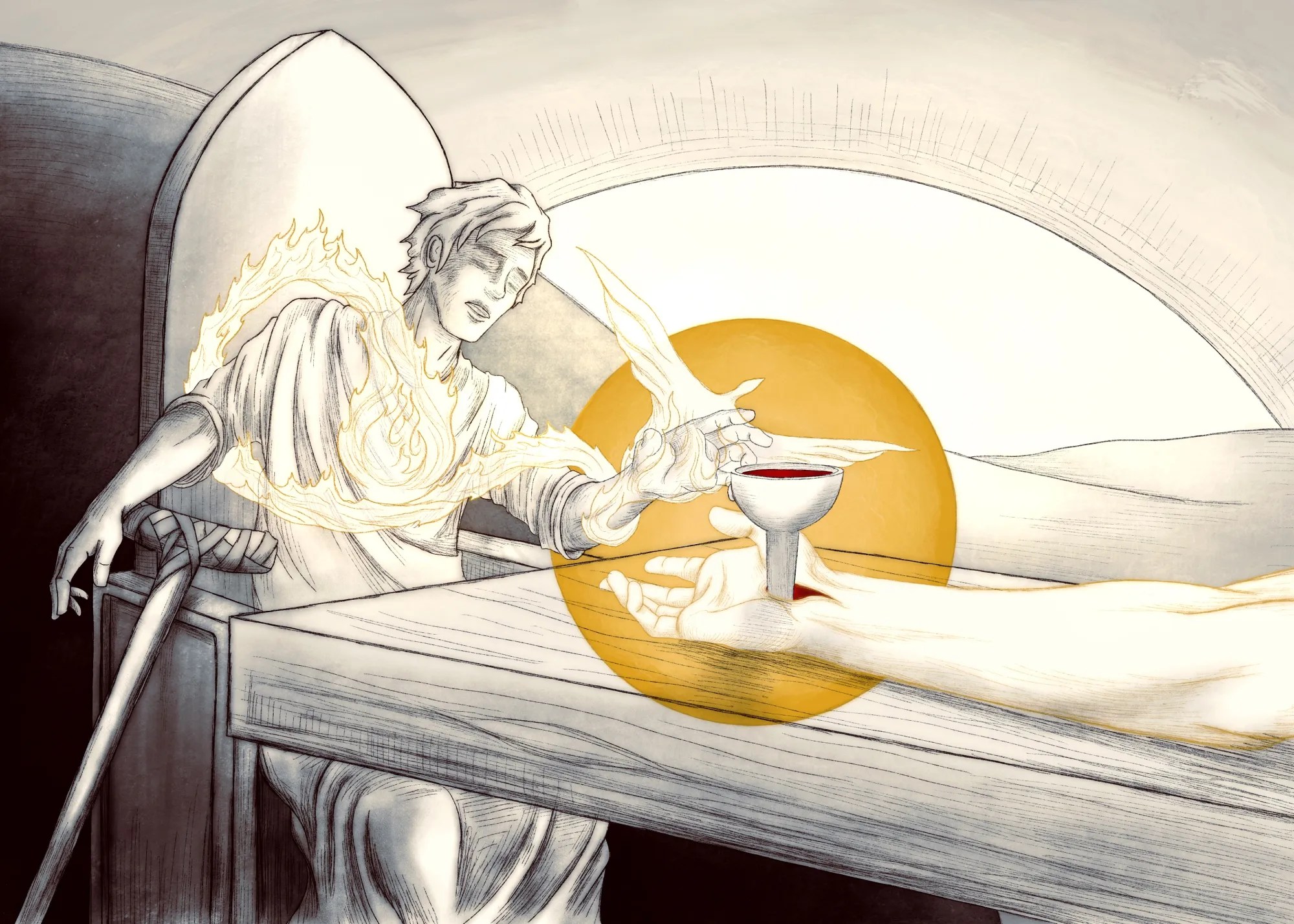
7 To keep me from becoming conceited because of these surpassingly great revelations, there was given me a thorn in my flesh, a messenger of Satan, to torment me. 8 Three times I pleaded with the Lord to take it away from me. 9 But he said to me, “My grace is sufficient for you, for my power is made perfect in weakness.” Therefore I will boast all the more gladly about my weaknesses, so that Christ’s power may rest on me.

In the name of Jesus. Amen.

This is a fairly long text, and Paul boasts about himself quite a bit here, but please notice he acknowledges that. He even calls himself a fool and madman (2 Cor. 11:21, 23) for talking like this. But still, to our northern Minnesota, Midwestern ears, a lot of this text can be a bit off-putting. Paul would probably be more ‘at home’ in a place like New York or New Jersey. But basically, all that bragging is Paul defending status as an apostle. That long list of things he endured – the beatings, lashings, shipwrecks, and dangers – all of that is Paul saying that he learned what Jesus meant when He said, “If anyone would come after Me, let him deny himself and take up his cross and follow Me” (Mt. 16:24).

Then, Paul mentions this vision that he had fourteen years before he wrote this letter, but he does it in a roundabout way. He talks about a man who was caught up into the third heaven. We don’t know what this ‘third heaven’ is other than the fact that Paul calls it ‘paradise.’ While he was there, he heard things that he isn’t allowed to speak about; in other words, the vision was just for him. That isn’t unique. In the book of Revelation, John has a similar experience; he hears the voice of seven thunders, but he isn’t allowed to write what those thunders said (Rev. 10:1-4). Now, it’s clear that the man who had the vision is Paul himself. Notice how in 2 Cor. 12:7, Paul says that he was given a thorn in the flesh to keep him from becoming conceited because of the surpassing greatness of that vision. God knew Paul’s weakness of being prideful, so to limit that pride, God gives Paul this thorn in the flesh to keep him humble.

We don’t know exactly what this thorn is. We can speculate, but we can’t say for sure. The possibility that I gravitate toward is that this thorn in Paul’s flesh was poor vision (see Act. 9:18; Gal. 6:11). But I also will admit that I lean toward that understanding because I can identify with it. I also think Paul is intentional about not saying exactly what this thorn is so that you can take his conclusion about the thorn and apply it to yourself in whatever afflictions and suffering you face. Whatever this thorn in the flesh is, it wasn’t a minor thing for Paul. He pleads and begs with Jesus three times to have it removed. This thorn, Paul’s pleading, Jesus’ response to that pleading, and Paul’s conclusion have a lot to teach us about suffering as a Christian.

The first thing to notice is that this thorn was given to Paul. So, who gave it? Well, we have some clues. That thorn is a messenger (lit. an ἄγγελος) of Satan to harass him. In other words, it is one of the devil’s demons who afflicts and torments Paul with the thorn. The devil’s intention is always to push us toward more pride and greater sin. You especially see it when the devil tempts Adam and Eve by saying, “you’ll be like God,” in the Garden of Eden (Gen. 3:5). Because of this, we might conclude it was the devil who gave this thorn, but hold on just a second. Also notice that this thorn was given in order to limit Paul’s pride and conceit. The devil wouldn’t want to do that. So, who gave Paul this thorn? We’d have to conclude God did, but God does it through the devil.

So, here’s the lesson for us: Both the thorn and the demon are evil – utterly and completely evil – but God takes those evil things and uses them for good. When Ro. 8:28 says that God works all things together for good for those who love him, it is true. Even the work and attacks of the devil can be tools in God’s hand to bring about good. We see a similar thing happen with Job. God allows the devil to afflict Job by destroying all Job’s possessions and even Job’s health (Job. 1:9-12, 2:4-6). There, the devil admits that he can’t touch anything connected with Job unless God permits it. The devil’s intention in tormenting Job with all that suffering is to get Job to curse God. But when you get to the end of the book of Job, you see that Job remains blameless and upright. God uses that affliction of the devil to increase Job’s faith, and on top of that, Job’s three “friends” get brought closer to God as well.

The devil’s intention with both Job’s suffering and Paul’s thorn in the flesh is to destroy faith and increase sin, but God uses the devil’s work to accomplish His purposes. This happens all the time, but the clearest place we see this is in the crucifixion of Jesus. The devil’s fingerprints are all over it! Judas’ betrayal, the crowds who get stirred up by the priests and elders to release the murderer Barabbas instead of Jesus (Mt. 27:20), and the high priest Caiaphas who says that Jesus should die instead of the whole nation perishing (Jn. 11:49-50), there’s no question that all of that was Satan’s work in order to kill Jesus on the cross.

But what actually happened on the cross? Did the devil win by getting Jesus pinned there? Nope! It is on the cross that Jesus crushes that worm’s head. On the cross, Jesus took the record of debt that stood against us and nailed it to the cross which completely disarmed the devil and demons and put them to open shame (Col. 2:14-15). In the crucifixion, Satan thought he was beating God, but God was using the devil’s own strategy and plan to utterly defeat Satan, to deliver you, and to win you back for Himself. God be praised!

Now, let’s draw some practical application from all of this because there are all sorts of lessons to take away from this text (more than I’m going to cover here).

First, God can and does use suffering for your benefit. You don’t have to like suffering; in fact, we long for our suffering to be over. But you can know that God is working in and through your suffering – whatever it is. Scripture doesn’t call you to rejoice because of your suffering, but it does call you to rejoice even in the midst of your suffering (Ro. 5:3-5).

Second, if you are suffering in any way, if you have some thorn, that does not mean that God is angry with you or pitted against you. Remember, Job’s suffering began because God bragged about Job to the devil (Job 1:8, 2:4). And God wasn’t angry with Paul either. It was God’s love for Paul that permitted that fleshly thorn that Paul dealt with for so long.

Third, if you are afflicted by demons, that doesn’t mean you are a bad Christian. Paul had one for fourteen years while he was proclaiming the Gospel, starting new churches, and furthering the kingdom of God. And Jesus tells Paul, “My grace is sufficient for you. I’m going to let that demon do his thing while I give you My grace. This will show My strength is working through you.”

Fourth, unanswered prayers and denied petitions do not mean that God is unhappy with you. Paul begged and pleaded three times, and Jesus said, “No.” Yes, sometimes, Jesus will release you from the things that cause you suffering, but even when He says, “No,” it is for your benefit.

Finally, look at Paul’s reaction to all of this. He doesn’t say, “I asked for this thorn to be removed, but Jesus said, ‘No,’ so I’m going to complain.” No! He says, “Therefore I will boast all the more gladly of my weaknesses, so that the power of Christ may rest upon me. I’ll be content with weaknesses, insults, hardships, persecutions, and calamities. For when I am weak, then I am strong.”

Dear saints, you are right to lament and long for your suffering to come to an end. Jesus came to rescue you from all suffering. But in your suffering, know that God is at work, and you don’t know what kind of fruit God will bring about through that suffering. Christ is right there beside you in every affliction and weakness you have. He is there present with His strength. And He comes now to strengthen you with His all-powerful Body and Blood, given and shed for you for the forgiveness of all your sins. To Him be all the glory, honor, praise, and thanks now and forever. Amen.

The peace of God, which surpasses all understanding, will guard your hearts and minds in Christ Jesus. Amen.

Humbled – Sermon on Luke 14:1-11 for the Seventeenth Sunday after Trinity

Luke 14:1-11

1 One Sabbath, when [Jesus] went to dine at the house of a ruler of the Pharisees, they were watching him carefully. 

2 And behold, there was a man before him who had dropsy. 3 And Jesus responded to the lawyers and Pharisees, saying, “Is it lawful to heal on the Sabbath, or not?” 4 But they remained silent. Then he took him and healed him and sent him away. 5 And he said to them, “Which of you, having a son or an ox that has fallen into a well on a Sabbath day, will not immediately pull him out?” 6 And they could not reply to these things. 

7 Now he told a parable to those who were invited, when he noticed how they chose the places of honor, saying to them, 8 “When you are invited by someone to a wedding feast, do not sit down in a place of honor, lest someone more distinguished than you be invited by him, 9 and he who invited you both will come and say to you, ‘Give your place to this person,’ and then you will begin with shame to take the lowest place. 10 But when you are invited, go and sit in the lowest place, so that when your host comes he may say to you, ‘Friend, move up higher.’ Then you will be honored in the presence of all who sit at table with you. 11 For everyone who exalts himself will be humbled, and he who humbles himself will be exalted.”

In the name of Jesus. Amen.

Jesus eats with all sorts of people. He eats at His friends’ house with Mary, Martha, and Lazarus (Lk. 10:38-42). He eats at His disciples’ houses. He eats in Peter’s house and Peter’s mother-in-law serves Him (Lk. 4:38-39). Jesus calls Matthew the tax collector to be His disciple and eats with him and other sinners. And you remember that the reason Jesus tells the parable of the Lost Sheep, Lost Coin, and Prodigal Son is the Pharisees accusing Jesus of welcoming and eating with sinners (Lk. 15:1-2).

We aren’t surprised that Jesus would eat with His friends and disciples. We do that too. And as Christians, we are comfortable with the fact that Jesus eats with sinners. But we might find it surprising that Jesus would even eat with Pharisees. The Pharisees were our Lord’s enemies. From the beginning of His ministry, the Pharisees were butting heads with Jesus (Lk. 5:21Jn. 5:18).

Think of the person in your class or at work that you most regularly butt heads with – no matter what you just can’t seem to get along. He takes everything you say and turns it into an accusation against you, so you’re always on your toes, always analyzing everything word out of your mouth. Being around a guy like that is exhausting. Now, if that person invited you over for dinner, you’re going to decline. (Unless they tell you that they are going to be serving dry-aged Wagyu steaks. Then, you probably go, you just don’t stay for dessert.) But as difficult as the person you are imagining is, he probably isn’t trying to find some way to get you the death sentence. That’s exactly what the Pharisees wanted for Jesus, but our Lord still repeatedly ate with the Pharisees.

Once, Jesus went to Simon the Pharisee’s house where He was anointed by the sinful woman who washed Jesus’ feet with her tears (Lk. 7:36-50). Another time, Jesus was invited to eat at a Pharisee’s house and didn’t wash His hands the way the Sabbath traditions requires (Lk. 11:37-54). When Luke finishes recording that meal, he notes that the scribes and Pharisees were lying in wait for Him, to catch Him in something He might say.

Now here, in our text, an important Pharisee has invited Jesus to his house for a Sabbath dinner. And, what d’ya know? Jesus goes. 

Now, we have to imagine this scene of everyone arriving for the fancy dinner. Luke here gives us enough details to sketch this out, but they are interspersed in the account. So, let’s bring them together into one picture. Jesus arrives at this ruling Pharisee’s swanky house. As the guests arrive, they might give a nod or a handshake to their friends, but each of them is more interested in positioning themselves to get the best seats. They are cutting in front of each other to get as close as possible to the head of the table. I don’t know how a Pharisee would save a seat – maybe he’d drink half of whatever was in the cup or lick the silverware. Who knows? But they are all claiming their spots and making sure their position is secure and no one else takes it from them. Then, their gaze turns towards Jesus.

When Jesus arrived, He wasn’t concerned with sitting in the high, prominent spots. So, we can assume that there was only one spot left at the table – the lowest. Jesus finds His place, and the eyes of all the Pharisees are on Him. If you were there and watching Jesus approach His seat, you wouldn’t notice the fine dining couch or the fancy china. The only thing that would catch your attention was this man.

Luke, the doctor, tells us that the man before Jesus has ‘dropsy.’ The term does appears in medical literature about 300 years before Jesus by a guy named Hippocrates (from whom, we get the Hippocratic oath). The word is actually two words mushed together – “water” and “appearance.” In other words, the guy was swollen, grossly bloated. It is not stretching the text at all to assume the Pharisees brought this man in so they could accuse Jesus of breaking the 3rd Commandment, “Remember the Sabbath day to keep it holy.”

Now, the Pharisees had lengthy discussions on what was and what wasn’t permitted on the Sabbath. They wrote all sorts of rules that defined what you could and couldn’t do on the day of rest. It went so far as to define where you could spit. Every other day of the week, you could spit wherever you wanted, but on the day of rest, you could only spit on rocks because spitting on soil might be watering a plant and considered work. Also in their discussions, they considered how much help you could give to a person who was sick or injured. For example, if someone had a cut you could apply a bandage to keep the wound from getting worse, but you couldn’t apply the bandage in a way that would help the person get better because that would be considered work.

These Pharisees are all closely watching as Jesus sees this man, ballooned up with disease. But Jesus turns the tables. Notice, they don’t ask Jesus a question, but He responds to the situation asking, “Is it lawful to heal on the Sabbath or not?” The Pharisees don’t say a word. Jesus heals the man. His swelling is gone. His features return to normal, and Jesus sends him away. Then, Jesus exposes the Pharisees’ hypocrisy. “Which of you, having a son or an ox that has fallen into a well on a Sabbath day, will not immediately pull him out?”After this question, the Pharisees aren’t just silent. They aren’t able to answer. With two pointed questions, Jesus humbles the Pharisees into deafening silence.

Then, our Lord throws the knock-out punch. They had been watching Jesus carefully as He approached the table, but He had been watching them too. They had been scrambling, shoving, jolting, and jockeying for the best places. It’s interesting: for all the discussion and debate the Pharisees had on what was and wasn’t considered work on the Sabbath, they didn’t debate about contending for prominent positions in their regulations. And Jesus echoes what we had in the first two verses of our Old Testament lesson (Pro. 25:6-14). Basically, if you put yourself forward as being important, you’re likely going to be humbled, and it’s going to be a public spectacle. Instead, be humble, and wait for your host to exalt you.

Now, of course, this is some solid, practical advice. Any motivational speaker could take what Jesus says here and teach a helpful lesson: Don’t strut around blowing smoke about how important you are. Instead, go about your business quietly, and your recognition will come in due time. But this isn’t a self-help seminar, and I’m not a motivational speaker.

Instead, notice what happened at this meal. Jesus, who was by far the most important person there, ended up in the lowest seat. And even though no one changed positions, Christ elevated His place back the peanut gallery to be the prominent place, and those who were at the head of the table end up in the bleachers.

Dear saints, as our Epistle lesson (Eph 4:1-6) said, “Walk in a manner worthy of your calling.” Humble. Gentle. Patient. Bearing with one another in love. Paul will say a similar thing in Php. 2:5-11, “Have this mind among yourselves, which is yours in Christ Jesus, who, though he was in the form of God, did not count equality with God a thing to be grasped, but emptied himself, by taking the form of a servant, being born in the likeness of men. And being found in human form, he humbled himself by becoming obedient to the point of death, even death on a cross.” But Jesus didn’t remain humbled and lowly in death. The text goes on, “Therefore God has highly exalted him and bestowed on him the name that is above every name, so that at the name of Jesus every knee should bow, in heaven and on earth and under the earth, and every tongue confess that Jesus Christ is Lord, to the glory of God the Father.”

Dear saints, this humbled mind is yours. You, Christian, are saved by God’s grace. Live that out. You were sinful and low, but Christ has invited you, by the cleansing of His blood, to sit at His table. He has given you the seat of honor next to Him. Through His death and resurrection, you have been raised with Him. Your life is even now hidden with Christ in God. And the day is coming when Christ who is your life appears, you also will appear with Him in glory (Col. 3:1-4). Christ will call to you, “Friend, move up higher.” And you, and all believers, will be honored in the presence of all creation. Amen.

The peace of God, which surpasses all understanding, will guard your hearts and minds in Christ Jesus. Amen.

Justified – Sermon on Luke 18:9-14 for the Eleventh Sunday after Trinity

This sermon was preached at the 2021 East Grand Forks’ Heritage Days community church service.
Because the service was held outdoors, the audio quality is sub-par.

Luke 18:9-14

9 [Jesus] also told this parable to some who trusted in themselves that they were righteous, and treated others with contempt: 10 “Two men went up into the temple to pray, one a Pharisee and the other a tax collector. 11 The Pharisee, standing by himself, prayed thus: ‘God, I thank you that I am not like other men, extortioners, unjust, adulterers, or even like this tax collector. 12 I fast twice a week; I give tithes of all that I get.’ 13 But the tax collector, standing far off, would not even lift up his eyes to heaven, but beat his breast, saying, ‘God, be merciful to me, a sinner!’ 14 I tell you, this man went down to his house justified, rather than the other. For everyone who exalts himself will be humbled, but the one who humbles himself will be exalted.”

In the name of Jesus. Amen.

A Pharisee and a tax collector go up to the Temple to pray. The Pharisee assumes a posture that we would recognize as prayer. He stands off by himself. He is likely looking up in thankfulness to God, but his eyes are busy scanning the other worshipers in the Temple, and his eyes look down in contempt for those who are there.

Now, we need to be careful about our animosity toward the Pharisee because he is simply doing what you and I do all the time. Remember, Jesus repeatedly warns against becoming like the Pharisees (Mt. 16:6-12Mk. 8:15Lk. 12:1), and Jesus wouldn’t give these warnings unless it is actually easy to become like them. But why is it easy? Why are we in danger of becoming like Pharisees?

Well, when we see others sin and when we notice the results of those sins, it confirms that good, upright behavior is beneficial to us and those around us. The stuff God calls us to do in the Ten Commandments is really good stuff, and your life is much better if you live according to God’s Commands. Think about it. When people commit adultery, do their lives get better or worse? Of course, they get worse. When people steal, they are more likely have their things stolen. If you deal drugs, your odds of getting shot, robbed, or thrown in prison are much higher.

The reality is that God didn’t just come up with a set of ten arbitrary rules. Instead, the Ten Commandments are written into the fabric of creation. When you go against the natural laws that God has woven into creation, it isn’t going to go well for you or for those around you.

And just a little side note here: Christians, we need to stand firm on the truths of the Commandments – especially that it is good to live in obedience to them. It is not loving to condone or promote the sins of others. When there is sin, we should speak of it as sin. We need to lovingly show how it hurts the individual committing that sin and how it harms those around that person.

But when you do that, you will face hostility. The world is likely going to throw Jesus’ words in your face about the speck in your neighbor’s eye and log in your own eye (Mt. 7:3-5). But don’t let them take those verses out of context! Remember, Jesus says to first remove the log in your eye so that you can see clearly and remove the speck in your neighbor’s eye. Jesus wants eyes to be free from both logs and specks. And Christ, in His mercy, has purchased forgiveness through His death and resurrection. In other words, when you point out someone’s sin, always do it in a way that points them to the freedom from and forgiveness of sin that comes only through Jesus. Amen?

Back to the Pharisee: He is there in the Temple praising himself and his own good works rather than praising God. This is so ludicrous! The Temple is the very place where God said that He would dwell with His people in order to forgive their sins. When King Solomon prayed at the dedication of the Temple, he said six times that when God’s people prayed toward the Temple that God would hear their pleas and, in His mercy, would forgive (2 Chr. 6:12-42).

But there, in the place of forgiveness, this Pharisee doesn’t want forgiveness because, in his mind, he doesn’t need forgiveness. Instead, he wants recognition, he wants accolades, he wants God’s applause. His prayer is nothing less than, “Hey, God. Look at how great I am.” Not even, “Hey, God. Look at how great You have made me.” God gets none of the credit from this Pharisee. His prayer is one of the most self-centered, self-interested, self-idolizing statements in the Scriptures.

Now, let’s consider the tax collector. The tax collector, when he looks at himself, sees nothing good, nothing worthy, nothing laudable. So, there is nothing for this tax collector to ask God for except mercy. Our translation records his prayer as, “God be merciful to me, a sinner!” But this translation is weak on two points. First, it is not just ‘a sinner’; in the original Greek he says, ‘the sinner.’ The tax collector doesn’t know about any sins except his own. Second, the translation of his prayer, ‘be merciful,’ falls a bit short here.

Throughout the Gospels, many people call to Jesus, “Lord, have mercy” (Mt. 9:2715:22Mk. 10:47Lk. 17:13). That is always an excellent prayer. Praying, “Lord, have mercy,” is asking Jesus to do exactly what He has come to do. But what the tax collector in this parable actually prays is something similar but importantly different. The tax collector prays to God (lit.), “Be propitiated to me, the sinner.”

You get to have a little vocabulary lesson today. The noun ‘propitiation’ and the verb ‘propitiate’ have never been commonly used in English, but it is an extremely important Scriptural word and concept. To ‘propitiate’ means to make an atoning sacrifice. And the tax collector prays that God would be made the atoning sacrifice for him.

Remember again, this tax collector is praying in the Temple courtyard. In the Greek translation of the Old Testament, this word, ‘propitiation,’ was also used for the mercy seat on the Ark of the Covenant – the place where the high priest would sprinkle the blood on the Day of Atonement and where God promised to meet with His people (Ex. 25:22Lev. 16). The tax collector prays that God would do that forgiveness, that mercy, that cleansing to him.

Scripture goes on to teach us that Jesus is the place where God makes the atoning sacrifice. Christ is the real mercy seat. 1 John 2:2 says, “[Jesus] is the propitiation for our sins, and not for ours only but also for the sins of the whole world.” So, when the tax collector prays, “God, be propitiated to me, the sinner,” he is praying that God would be reconciled to him by the blood of Jesus. And that is why the tax collector, who is the far greater sinner, goes home justified rather than the well-behaved Pharisee. He looks to God in faith and asks God to be exactly who God has promised to be – a merciful, forgiving God.

So, what should we learn from this parable? Of course, this parable teaches that the worst of sinners can go to heaven. We know this, but unfortunately, we can grow a little numb to it. But the main reason Jesus tells this parable is to destroy any self-righteousness and contempt we would have against other sinners.

Christ wants us to recognize are not better than other people, but, because of our sinful nature, we are always tempted to be like the Pharisee thinking the worst of others and imposing our conceived motivations behind others’ actions so we can look down on them. Stop it. Repent.

Maybe that waitress who seems to be annoyed with you was in court fighting to keep custody of her children and away from her abusive boyfriend. Maybe that driver who is completely incompetent behind the wheel is on his way home after watching his mother die. Maybe that rude, intrusive, foul-mouthed kid on the playground hasn’t gotten any love or attention from his parents in months. Don’t look down on them and treat them with contempt.

But we should also take this a step further. Remember, Jesus told this parable to those who trusted in themselves and treated others with contempt. We are so sinfully arrogant that we often take pride in being humble like the tax collector. We are mistaken if think, since the Pharisee’s pride condemns him, that it is the tax collector’s humility that sends him home justified. Too easily we switch out the good works that the Pharisee mentions – his upright living, his fasting, his tithing – with the tax collector’s humility.

When we do that, humility becomes just another good work, and we begin boasting about our humility. We quickly swap the Pharisees’ prayer with our own version, “God, I thank You that I am not like other men, self-righteous, pretentious, holier-than-thou types, or even like this Pharisee. I’ve given You my heart, dedicated my life to You, and made You my Lord.” Stop that too! A person’s humility is not what merits or earns justification.

The point Jesus is making in this parable is to not look to yourself at all. Don’t try to find some super spirituality inside of yourself – whether it’s good works or humility. The thing, the only thing, that the tax collector looks to is the mercy of Christ.

Dear saint, you look there too. Look to the cross. Look to the blood of Jesus shed for you on Calvary. Look to His death. Look to His resurrection. Look to His ascension. And know that Jesus promises that all of that is for you. Through Christ – and through Him alone – you are redeemed, forgiven, and sent to your home justified. Amen.

The peace of God, which surpasses all understanding, will guard your hearts and minds in Christ Jesus. Amen.

This sermon is a reworked, revised, and merging from sermons preached in 2019 & 2020.

A Seat at the Table – Sermon on Luke 14:1-11 for the Seventeenth Sunday after Trinity

Listen here.

Luke 14:1-11

1 One Sabbath, when [Jesus] went to dine at the house of a ruler of the Pharisees, they were watching him carefully.

2 And behold, there was a man before him who had dropsy. 3 And Jesus responded to the lawyers and Pharisees, saying, “Is it lawful to heal on the Sabbath, or not?” 4 But they remained silent. Then he took him and healed him and sent him away. 5 And he said to them, “Which of you, having a son or an ox that has fallen into a well on a Sabbath day, will not immediately pull him out?” 6 And they could not reply to these things.

7 Now he told a parable to those who were invited, when he noticed how they chose the places of honor, saying to them, 8 “When you are invited by someone to a wedding feast, do not sit down in a place of honor, lest someone more distinguished than you be invited by him, 9 and he who invited you both will come and say to you, ‘Give your place to this person,’ and then you will begin with shame to take the lowest place. 10But when you are invited, go and sit in the lowest place, so that when your host comes he may say to you, ‘Friend, move up higher.’ Then you will be honored in the presence of all who sit at table with you. 11 For everyone who exalts himself will be humbled, and he who humbles himself will be exalted.”

In the name of Jesus. Amen.

All of the Ten Commandments should do two things. First, the Commandments should expose how sinful we are and cause us to repent. Second, the Commandments should make us realize that God is good and that He is concerned for us and cares about all aspects of our lives. For example, the 5th Commandment about murder should expose our anger and hatred toward others, but it should also show you that God values your life and wants to protect it. The 7th Commandment about stealing should expose our greed and idolatry of money and stuff, but it should also show you that God wants you to have and enjoy the things He has given you. The 8th Commandment about bearing false witness should convict us of how we use our tongues to lie, gossip, and speak negatively of others, but it should also show you that God loves truth and wants to protect you from false accusations, gossip, etc. This is true of all Ten Commandments, but because this Gospel lesson focuses our attention on what Jesus does at this Sabbath feast, we are going to focus on the 3rdCommandment.

Hopefully, you have the 3rd Commandment (and all the Commandments) memorized: “Remember the Sabbath Day, to keep it holy.” While that one sentence captures the essence of the Command, there is more to it when it is given by God on Mt. Sinai. Here’s the full thing (Ex. 20:8-11):

“Remember the Sabbath day, to keep it holy. Six days you shall labor, and do all your work, but the seventh day is a Sabbath to the Lord your God. On it you shall not do any work, you, or your son, or your daughter, your male servant, or your female servant, or your livestock, or the sojourner who is within your gates. For in six days the Lord made heaven and earth, the sea, and all that is in them, and rested on the seventh day. Therefore the Lord blessed the Sabbath day and made it holy.” 

The 3rd Commandment shows God’s concern and care for us. In this Command, God guarantees a day of rest every week. And we didn’t even have to unionize to get it! As far as I know, there is no other religion where people are commanded to rest and receive. Foreigners, servants, and even animals get a day off. This rest not only makes people more productive, but it also honors and protects them. God created the universe in six days and rested on the seventh. And because we are created in God’s image, we should follow His example and have the same privilege of rest.

God’s intent with this day of rest was that we should not only rest our bodies and minds, but more importantly God wants us to use the Sabbath to find rest for our souls. The day of rest is kept holy when we concern ourselves with holy things – especially hearing God’s Word preached and explained to us (Mt. 11:28-30Act. 13:274415:21). God knows that we need to work to provide food for our bodies, so He gives us six days to do that. And God knows that we need to be fed spiritually, so He set aside the Sabbath for that as well. According to Jesus, “The Sabbath was made for man, not man for the Sabbath” (Mk. 2:27).

Truly keeping the Sabbath by resting from our regular work to hear God’s Word is a witness to God’s grace. The gift of rest that God gives in the Command reminds us that salvation is never earned or achieved by our efforts. Eternal life is always freely given and received as a gift from God. If salvation is not received as pure gift, it will always be beyond our reach and we will never have it. Now, with all of that in mind, we turn to the text.

The good and merciful Command about the Sabbath was being abused by the Pharisees. Instead of rejoicing in the rest God was giving them in the Command, these legalists took the Commandment and used it as a club to beat others over the head. A legalist is not someone who takes the Law extra seriously in order to keep it, nor is a legalist someone who avoids temptation and sin because they love God’s Law. Instead, a legalist is someone who uses the Law of God to serve himself and make others feel inferior (Rev. David Petersen).

These Pharisees were feasting on the Sabbath but ignoring the man sick with dropsy. Basically, dropsy means this man had some condition that made fluid build up making him bloated and swollen. The man would have looked gross, and his condition might have led people to believe that he was a glutton who was getting what he deserved. It is even possible that the Pharisees had invited this man to the feast in order to test Jesus and see what He would do because they were “watching [Jesus] carefully” (Lk. 14:1).

So, notice that they aren’t resting on the Sabbath at all. They are working, and their task is to catch and trap Jesus. They are taking the Sabbath feast, which was meant to be a time for everyone to bask in God’s forgiveness and mercy, and turning it into a private party where they would ridicule our Lord and pat themselves on the back for keeping God’s Law all while not lifting a finger to help this poor man. Some rest that is!

But while they are working to test Jesus, He turns the tables and puts them under the microscope by asking, “Is it lawful to heal on the Sabbath or not?” Of course, it is obviously in accordance with the Law to heal and do good to others on the Sabbath. God had even addressed this in the books of Moses (Dt. 22:1-4). In Ex. 23:4-5, God says, “If you meet your enemy’s ox or his donkey going astray, you shall bring it back to him. If you see the donkey of one who hates you lying down under its burden, you shall refrain from leaving him with it; you shall rescue it with him.” And God never says, “Go ahead and forget about it if it’s the Sabbath.” 

They knew the answer, but the Pharisees refuse to respond to Jesus’ question. So, Jesus does what He always does and heals the guy. After sending him away, Jesus asks the Pharisees, “Would you leave your son or even an ox that fell into a well on the Sabbath and not pull him out?” And still they refuse to answer. Their pride and hypocrisy is exposed, but Jesus isn’t done going after them yet. Jesus continues to run after them to give them rest. Christ wants these hard-working Pharisees to put down their labors and burdens and enter His rest. So, Jesus tells them this parable, which isn’t like most of Jesus’ parables. Instead, this particular parable is more akin to the wisdom we heard in our Old Testament Lesson (Prov. 25:6-14).

Now, we could take this parable as an etiquette lesson: Sit low and get honor by being paraded through the party to a higher seat. But that flies in the face of what Jesus is actually doing. Jesus wants to show them true humility. Pretending to be humble in order to get the praise of others is not true humility.

Notice what Jesus says is the lesson of the parable, “Everyone who exalts himself will be humbled, and he who humbles himself will be exalted.” In the parable, Jesus doesn’t give you something to do by saying, “Be humble.” Yes, pride is your problem, but you can’t overcome your pride by being humble. Even thinking that you can fix your pride is, by definition, prideful. The anecdote for your pride is not you being humble – it is grace. Grace is humbling because it is never merited or earned. Grace is pure mercy, pure love, pure gift.

The parable is really all about Jesus. It tells of Christ’s path from glory down to earth and the grave and back again (Php. 2:5-11). Jesus removed Himself from the place of honor at His Father’s right hand in order to make room for you. Jesus was humiliated. He took the form of a servant. God was found in human form. Then, when we sinners saw God in the flesh, we pinned Him to the cross. But after all this, God does the strangest thing.

He sees that Jesus’ seat is open and that you are sitting down low in the muck and mire of your sin. He invites you to move up. You are invited to sit at the table He prepares for you. He anoints your head with oil and makes sure your cup overflows (Ps. 23:5) and is never set down empty. Then, on the third day, from the lowest place, Jesus is raised up. At His name, every knee shall bow and every tongue confess that He is King of kings and Lord of lords. All of this has been done for you so that you can be honored by Jesus’ humility.

Dear sinners, we have fallen into the well of our sin, so Christ has come down into the well of sin for us. He dies in the lowest place of that well. And He invites you to step on His back, so you can get out and move to a seat of honor at His table. 

Remember how each of the first six days of creation in Genesis end by saying, “There was evening and morning”? The seventh day, the Sabbath, the day of rest doesn’t mention that. The picture is of an eternal rest with God that doesn’t end. Well, today is our Sabbath, our day of rest. God now invites you to His feast, and there is a place of honor for you here at His Table. Leave your work, your striving, your pride, and your sin. Come, there is a seat for you here at God’s table. Come and receive what you have not earned or deserved. Your God has good things for you here. Amen.

The peace of God, which surpasses all understanding, will guard your hearts and minds in Christ Jesus. Amen.

The Vineyard of Grace – Sermon for Septuagesima on Matthew 20:1-16

Listen here.

Matthew 20:1–16

1 “For the kingdom of heaven is like a master of a house who went out early in the morning to hire laborers for his vineyard. 2 After agreeing with the laborers for a denarius a day, he sent them into his vineyard. 3 And going out about the third hour he saw others standing idle in the marketplace, 4 and to them he said, ‘You go into the vineyard too, and whatever is right I will give you.’ 5 So they went. Going out again about the sixth hour and the ninth hour, he did the same. 6 And about the eleventh hour he went out and found others standing. And he said to them, ‘Why do you stand here idle all day?’ 7 They said to him, ‘Because no one has hired us.’ He said to them, ‘You go into the vineyard too.’ 8 And when evening came, the owner of the vineyard said to his foreman, ‘Call the laborers and pay them their wages, beginning with the last, up to the first.’ 9 And when those hired about the eleventh hour came, each of them received a denarius. 10 Now when those hired first came, they thought they would receive more, but each of them also received a denarius. 11 And on receiving it they grumbled at the master of the house, 12 saying, ‘These last worked only one hour, and you have made them equal to us who have borne the burden of the day and the scorching heat.’ 13 But he replied to one of them, ‘Friend, I am doing you no wrong. Did you not agree with me for a denarius? 14 Take what belongs to you and go. I choose to give to this last worker as I give to you. 15 Am I not allowed to do what I choose with what belongs to me? Or do you begrudge my generosity?’ 16 So the last will be first, and the first last.”

Hiring the Laborers in the VineyardIn the name of the Father and of the Son and of the Holy Spirit. Amen.

Too often, we forget that Jesus lived in history. Just as we have well-known stories in our day that form and shape our understanding of the world, so did Jesus and the people of His day. Today, if someone says, “I have a Cinderella story to tell you…” you know how the story will go – rags to riches. Well, in Jesus’ day, there was a famous parable that is remarkably similar to this one before us. This parable had been told during the funeral sermon of a well-known rabbi who died when he was only twenty-eight years old. The parable went like this:

A king hired laborers to work in his vineyard. After watching the men work for a couple of hours, he noticed one had a lot more ability than the rest. So, the king invited that laborer to spend the rest of the day with him eating and relaxing while the rest continued to work. At the end of the day, the king lined everyone up to pay them. The one who only worked two of the twelve hours was paid the same as those who had worked all day. The others complained. But the king replied, “This man worked with so much skill that he accomplished as much in two hours as you did in twelve. So, don’t complain; I’m being fair.”

Santa's Nughty ListThe point of this parable at the twenty-eight-year-old’s funeral was that this famous rabbi had done enough good works to go to heaven early. In other words, be good, do good, and get rewarded. Santa Claus anyone?

Now, there is a kernel of truth to that parable. It is right, proper, and just to reward good works. If you tell your kids they cannot play outside until their rooms are clean and one gets it done more quickly, it is right to not make them wait until the other is finished. The same goes for everyday life. Rewarding good works is the expected thing. It is fair and right to pay according to work done. But there is no grace in that.

Jesus’ parable this morning stands that other parable on its head. Our Lord isn’t teaching about fair wages or justice. He is teaching us about grace. Jesus retells the well-known parable, and in Jesus’ version, a bunch of lazybones who show up just before the checks are written get paid as though they had worked all day.

This is how it is in the kingdom of God. In the kingdom of God, bums who don’t work get rewarded for the work of others. But too often, we complain about this just like those in the parable.

When others are happy or blessed, we grumble and complain. We get covetous and envious. When someone gets a shiny, new toy, we think of all the reasons they don’t deserve it. We murmur to ourselves and others that they must have cheated someone else or gotten it by some undeserving means.

Because of our sin, we like generosity and mercy when we benefit, but not when others do. In our pride, we can even become embarrassed when we receive a generous gift or a simple act of kindness. Think of the rabid feminists who believe that a man opening a door for a woman is an act of micro-aggression.

We are prideful people who are always measuring. We look at our lives and works and compare them against those of the people around us, and somehow, we always end up on top. We keep score and expect God to notice. But then, when things go wrong, when we recognize our failures, our pride causes us to swing into despair. But even in our despair, we keep measuring. We know that we don’t measure up. And our despair makes us wonder if God loves us. Repent.

Repent and see the comfort of this parable. It teaches us that the kingdom of God is not a kingdom of fairness or equal pay. If that were the case, if God’s kingdom was where people got what they deserved, we would all spend eternity in hell. God’s kingdom, God’s vineyard, is a vineyard of grace.

With the Gospel, there is no room for pride or boasting in what we do because there is no doing on our part. Everything has been done by Christ, and we simply benefit because of His work. We who were dead in our sins, enemies of God, and children of wrath are raised, pardoned, and transferred into God’s kingdom.

Rescued from DeathAnd, with the Gospel, there is no room for despair. God’s love has been poured out for you to save you. In Christ, God has won your salvation on the cross. On the cross, Jesus bore the heat of the day, the heat of God’s wrath. And you, believer, get His wages.

Rejoice. The kingdom of heaven is the opposite of the kingdoms of men. You don’t earn. You don’t pay. The goods are given for free. It would drive any man-made business into the ground, but God doesn’t care. God isn’t out to make a living. He is out to give away His kingdom.

In Christ’s kingdom, grace reigns, sins are forgiven, and wretched orphans are made to be beloved children. Amen.

The peace of God, which surpasses all understanding, will guard your hearts and minds in Christ Jesus. Amen.