Don’t Worry; Go Outside – Sermon on Matthew 6:24-34 for the Fifteenth Sunday after Trinity

Matthew 6:24-34

24 “No one can serve two masters, for either he will hate the one and love the other, or he will be devoted to the one and despise the other. You cannot serve God and money.

25 “Therefore I tell you, do not be anxious about your life, what you will eat or what you will drink, nor about your body, what you will put on. Is not life more than food, and the body more than clothing? 26 Look at the birds of the air: they neither sow nor reap nor gather into barns, and yet your heavenly Father feeds them. Are you not of more value than they? 27 And which of you by being anxious can add a single hour to his span of life? 28 And why are you anxious about clothing? Consider the lilies of the field, how they grow: they neither toil nor spin, 29 yet I tell you, even Solomon in all his glory was not arrayed like one of these. 30 But if God so clothes the grass of the field, which today is alive and tomorrow is thrown into the oven, will he not much more clothe you, O you of little faith? 31 Therefore do not be anxious, saying, ‘What shall we eat?’ or ‘What shall we drink?’ or ‘What shall we wear?’ 32 For the Gentiles seek after all these things, and your heavenly Father knows that you need them all. 33 But seek first the kingdom of God and his righteousness, and all these things will be added to you.

34 “Therefore do not be anxious about tomorrow, for tomorrow will be anxious for itself. Sufficient for the day is its own trouble.”

In the name of Jesus. Amen.

If you ask anyone if they worry, I’m sure the answer would be, “Yes,” so long as that person is honest. People are worried about all sorts of things. You turn on the news and find anchors talking about wars and conflicts; high taxes and wasteful spending; poverty and greedy corporations; diseases and medicines; heatwaves and cold spells; fires and droughts and floods; and all sorts of other things.

They put all that in front of you, go to a quick commercial break, and then talk about the mental health crisis in our country. Isn’t that ironic? They produce a news broadcast, which is filled with all kinds of stories that their viewers can’t do anything about, and are shocked by reports about the amount of stress in our culture. We live in what is, probably, the safest time in history, but people are still worried about all sorts of things.

So, what can you do to improve your mental health? First, you can probably consume a lot less news than you do. Second, you can take the advice of ‘experts.’ Now, I will say that, when it comes to any health advice, it’s hard to know whom you can and cannot trust. That being said, psychologists, psychiatrists, dietitians, and doctors all seem agree that, if you are anxious or worried, it’s good for your mental health to spend more time outside. Simply getting some fresh air and being in sunlight, even if there’s cloud cover, is good for an anxious mind. If you’re worried, the common consensus and treatment plan is to start with this: Go outside.

The mental health ‘experts’ will say things like, “Studies show that going outside is good for you and reduces anxiety.” I wonder how much money has been spent and how many hours have been wasted to come up with the exact same prescription Jesus just gave when He preached this 2,000 years ago. Jesus says to you, “Do not worry/be anxious. Instead, go outside to look at birds and lilies.” But don’t just look; also, consider the birds and flowers. God cares for them without them needing to worry.

Now again, everyone has anxiety; everyone worries. We shouldn’t. Worry is a sin. Three times here, Jesus Christ, the Son of God, commands you, “Do not worry/be anxious.” I wonder if one of the reasons we struggle so much with the sin of worry is that we don’t have a right understanding of what worry even is. The word ‘worry’ isn’t in the Ten Commandments, but worry is a sin against the 1st Commandment to have no other gods, and it’s a sin against the 9th and 10th Commandments about coveting.

We wrongly think that worry is just a lack of trust. And sure, worry is a lack of trust, but that’s only small part of the sin. Worry is also something much worse and much more twisted than that. Worry is a misplaced trust. When you worry, you are placing too much trust in the wrong thing(s). Worry takes God out of the equation. Anxiety is caused when you wrongly believe God is disinterested or completely absent from every day, minute, and second your life.

As humans, God created us to have trust, to be trusting creatures. When we aren’t giving that trust to God, it isn’t that we stop trusting. There isn’t a vacuum of trust. Instead, our trust goes to the wrong things and places.

When you’re worried about your finances, you are placing too much trust in a piece of paper. You wrongly believe that the cash in your wallet or the numbers in your bank account are what feeds, clothes, and houses you. When you’re worried about getting a promotion or keeping/finding a job, or when you’re worried about what others think of you or your reputation, you are placing too much trust in someone else’s opinion of you. When you’re worried about sickness or getting a particular diagnosis, you’re placing an inordinate amount trust in doctors and medicine to be able to fix you or in your body to heal itself. When you’re worried about the weather, you’re placing too much trust in created things that are all controlled by God. In short, worry is a problem within you and within me. It’s a form of idolatry that places too much trust in the wrong things.

So, again, don’t worry; go outside. Go into creation to see the things that Jesus points you to – to birds and grass. Christ could have pointed to elephants, bears, camels, or cows. All of those things require large amounts of food to stay alive. Jesus could have said, “Look at how your heavenly Father feeds the elephants with the huge amounts of food they need.” But He doesn’t. Instead, He points you to little birds that eat seeds or berries or worms. Even though there are tens of billions of birds in God’s creation, each one of them receives that little bit of food it needs from the hand of God.

Jesus could have pointed to the beautiful, majestic mountains and how God adorns them. Or, He could have told you to look at the tall, massive trees with thousands of leaves. But He doesn’t. Christ points to lilies, and the lilies Jesus speaks about here aren’t the lilies we know from Eastertime. Those don’t grow in Galilee. The flowers Jesus refers to here are tiny and grow along the grass in the fields. They are similar to the white clover we have around here. That clover is pretty, but it isn’t something you plant. And, if you want to have the best lawn on the block, you’re going to try to get rid of clover because it’s more of a nuisance – a pretty nuisance, but still a nuisance.

The point is this: Jesus directs you to look at how your heavenly Father feeds and clothes the littlest things. Since He cares for those tiny parts of His creation, isn’t He going to take care of you? You, who are the crown of creation. You, who are much, much, much more valuable – valuable enough for God to shed His blood for you.

So, don’t worry; go outside. Look at creation to see God’s provision. But also, and more importantly, don’t worry; go outside. Go outside of yourself, outside of your mind and your sinful idolatry.

In a real sense, Jesus is calling you to take a hard, defiant stand against things that would cause you to worry and say to those things, whatever they are: “Listen, you (thing that I’m worried about). You are not my God. My God is eternal and all-powerful. My God spoke all things into existence. That same God took on flesh and blood so He could die for me, so He could pay for my sin, and so I could live forever with Him. So, listen, you dollar bill, are you really going to come and demand that I worry about you? You, pain or sickness or the grave, want me to worry about you? Why would I give you that false worship? Why would I put you in the place of God? I don’t need you because I have Jesus. He’s the Lord of heaven and earth with all authority (Mt. 28:18), and He’s promised that He uses that authority for my benefit (Eph. 1:21-23). My Lord Jesus already warned me about how you will try to get me to worship you with my worry. You aren’t worth it. My Savior said that in this world I would have trouble, but I can take heart because He has overcome the world” (Jn. 16:33).

Christian, you don’t need to worry because Jesus has come out of the grave, and He has promised that you, believer, will come out of your grave too.

Notice that Jesus doesn’t say, “There isn’t anything to worry about.” Instead, He says, “Don’t worry.” Don’t worry because your Jesus is bigger than whatever you’re worried about. And Jesus adds, “Do not be anxious about tomorrow, for tomorrow will be anxious for itself. Sufficient for the day is its own trouble.” In other words, Jesus says that He gives plenty of things for you to care about each day. Each day has its own cares. So, why bring tomorrow’s cares into today? Instead, rejoice in God’s provision today, and trust in His provision tomorrow.

Tomorrow is clouded in the unknown, but tomorrow is also clothed with God’s promises to be with you, to never leave or forsake you (Dt. 31:6Mt. 28:20), to provide all that you need, and to protect you with His power and might. God will care for you. He’s promised.

Now, that doesn’t mean that you get to be lazy or idle. Scripture is clear on that too (1 Th. 4:112 Th. 3:10Pr. 10:4). In each moment, God gives you work to do, and He has promised to bless you in that work. There’s a quote from a Swedish theologian and pastor, Bo Giertz, and I really like the way the way he balances things. He wrote, “We should of course work as if all depended on us and pray as if it all depended on Him.” Do what God has given you to do right now. But everything that falls outside the scope of what you can do right now, all of that falls into the nail-scarred hands of your merciful God.

The things that God sets before you today are the things that should have your attention. With all your strength and effort, do everything God gives you to do knowing that God promises to give you the strength you need for the future He will give you.

Dear saints, pour yourself into the tasks God gives you knowing that He loves you and promises to provide for you. He promises to give you the strength you need to face each moment. So, work and trust. And when you are worried, go outside. Look at God’s provision for the little things of creation. He values you more than birds and grass. And go outside of yourself. Dive into His promises that He delivers to you in His Word. Promises that will never fade or fail. Amen.

The peace of God, which surpasses all understanding, will guard your hearts and minds in Christ Jesus (Php. 4:7). Amen.
Where – Sermon on John 6:1-15 for the Fourth Sunday of Lent

John 5:1-15

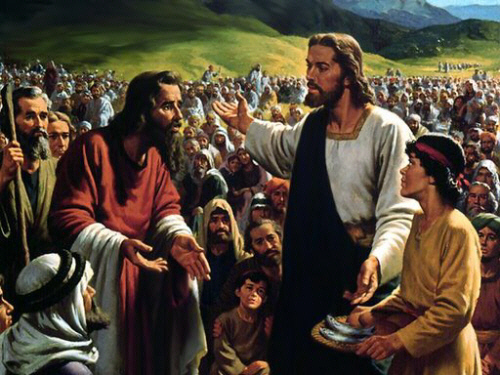
1 After this Jesus went away to the other side of the Sea of Galilee, which is the Sea of Tiberias. 2 And a large crowd was following him, because they saw the signs that he was doing on the sick. 3 Jesus went up on the mountain, and there he sat down with his disciples. 4 Now the Passover, the feast of the Jews, was at hand. 5 Lifting up his eyes, then, and seeing that a large crowd was coming toward him, Jesus said to Philip, “Where are we to buy bread, so that these people may eat?” 6He said this to test him, for he himself knew what he would do. 7 Philip answered him, “Two hundred denarii worth of bread would not be enough for each of them to get a little.” 8 One of his disciples, Andrew, Simon Peter’s brother, said to him, 9 “There is a boy here who has five barley loaves and two fish, but what are they for so many?” 10 Jesus said, “Have the people sit down.” Now there was much grass in the place. So the men sat down, about five thousand in number. 11Jesus then took the loaves, and when he had given thanks, he distributed them to those who were seated. So also the fish, as much as they wanted. 12 And when they had eaten their fill, he told his disciples, “Gather up the leftover fragments, that nothing may be lost.” 13 So they gathered them up and filled twelve baskets with fragments from the five barley loaves left by those who had eaten. 14 When the people saw the sign that he had done, they said, “This is indeed the Prophet who is to come into the world!” 

15 Perceiving then that they were about to come and take him by force to make him king, Jesus withdrew again to the mountain by himself.

In the name of Jesus. Amen.

Maybe you’re like me and hate tests. I thought one of the greatest benefits of finishing my schooling was that I wouldn’t have to take any more tests. Ha! Kids, I’m sorry to burst your bubble, but if you think that the end of school means the end of tests, you’re wrong. Life is full of tests. Sure, those tests aren’t turned in to be corrected with a red pen, recorded in a book, and reflected on a report card. But there are plenty of tests throughout your life.

Specifically, God gives tests. Like it or not, God regularly gives you tests. 1 Peter 4:12 says that you should not be surprised when fiery trials come to test you. Next week, we’ll consider Gen. 22:1-14 where God tells Abraham to take his beloved son, Isaac, and offer him as a burnt offering. When Heb. 11:17 comments on that event, it says that God was testing Abraham.

Listen to these verses from James 1 because they beautifully and clearly tell us what God is doing when He gives us these tests. “Count it all joy, my brothers, when you meet trials of various kinds, for you know that the testing of your faith produces steadfastness. And let steadfastness have its full effect, that you may be perfect and complete, lacking in nothing” (Jam. 1:2-4). James goes on to say later in that chapter, “Blessed is the man who remains steadfast under trial, for when he has stood the test he will receive the crown of life, which God has promised to those who love him” (Jas. 1:12).

So, Scripture is clear that, when God gives these tests, it’s never to see if we can pass the test. God is not testing us because He needs to find out information. God isn’t up in heaven thinking, “I wonder if he’s a good enough Christian,” or, “I wonder if she really trusts Me. I’d better give a test.” No! God is not sitting up in the clouds trying to figure out if a student has learned enough. God knows everything, and He doesn’t need to put your scores in a grade book.

Instead, God tests us to produce endurance and steadfastness in us. God’s testing molds and shapes us. Those tests move us toward completion. They bring about endurance, character, and hope (Ro. 5:3-5). In other words, the tests God gives are for your benefit. Through those tests, God is stretching you and strengthening your faith.

Here in John 6, Jesus tests Philip by asking, “Where are we to buy bread, so these thousands of people may eat?” (Jn. 6:6). Again, Jesus isn’t testing Philip because it’s been a while since He recorded a score under Philip’s name. Jesus isn’t using this test to set up Philip for failure. Instead, Jesus is testing Philip to bring something about for Philip. Jesus wants to produce something in him, to work in him. When Jesus wants to do something in a person and produce something in a person, He does it perfectly.

It would be verydangerous for us to think that Jesus is trying to get Philip to fail and fall into sin. Instead, Jesus tests Philip to bring something about in Philip. And it’s clear and simple to see what Jesus wants to produce in Philip, “Hey Philip, where are we going to buy bread for these folks?” And Philip responds, “Money will not help in this situation.” That’s the thing Jesus wanted to produce in Philip. Jesus wanted Philip to know that money cannot feed this crowd. Jesus wanted Philip to know that money isn’t always the solution.

Imagine a normal day where Jesus is sitting in a house or by an evening fire or on the shore of the Sea of Galilee – it’s just Him and the disciples – and He asks Philip, “Hey Philip, do you think money can solve every problem?” Philip is no fool. He’d probably start imagining all sorts of hypothetical situations. “Money won’t help someone who’s falling down a cliff. Money wouldn’t help someone who fell out of the boat and was drowning.” I’m sure Philip would have said, “No. Money isn’t always the answer.” But Jesus isn’t asking Philip about a hypothetical situation. Jesus is asking it in real time with a real throng of hungry people surrounding them.

Generally, hunger issolved by money. To put it more accurately, generally God satisfies hunger through His gift of money. God gives you money. Then, you take your money, you go to the market, you buy food, you cook the food, and you eat it. But God hasn’t limited Himself to feeding people through money. God can make food fall down from the sky and feed millions of people (Num. 1:45-46) for forty years (Ex. 16:2-21; Josh. 5:12). If God wants to feed people that way. It isn’t a problem at all. Philip knew this, and you know this too.

Still, money can be a powerful idol. How often do find yourself in a situation, and the first thought you have is, “If I just had a little more money this wouldn’t be a problem”? Be honest! It’s probably a regular occurrence.

Thinking about money isn’t necessarily sinful. We do need to think about money because God has given it to us to be good stewards of it. But we’re too often greedy for money. We’re tempted to trust it as though it’s the solution to our problems. And for that, we repent. 

Repent, and know this: Money can never help you if God Himself does not supply it. Money is useless by itself. The only reason money has ever benefited you because Jesus gave it as a tool. 

So, in Philip’s case here, Jesus asks Philip about money to knock the idol of money out of Philip’s hand. But Jesus doesn’t leave Philip with empty hands, does He? No. Jesus empties Philip’s hands so He can put bread and fish into Philip’s hands. Philip and the disciples receive the bread and fish from Jesus’ hands and distribute it (Mt. 14:19; Lk. 9:16). The picture we have is that the disciples just keep handing out what Jesus gives them. They distribute more and more of what first came from the hand of Jesus.

The whole text makes it abundantly clear that money didn’t feed this crowd, but who did? Where did the provision come from? Jesus. Jesus is the answer. Jesus gives. Jesus distributes. Jesus provides, and not only does Jesus provide enough for the crowd; He provides enough for each of the disciples. Philip and the other disciples distribute what Jesus provided, but they still weren’t done. Jesus sends them back out into the crowd to gather up the leftovers. Leftovers? Yes. Twelve baskets worth. A basket for each disciple. Why not thirteen? Why isn’t there a basket for Jesus? At this point in the sermon, you can probably guess. Jesus doesn’t need money to provide, and He doesn’t need a basket of food.

Dear saints, when you are tested in times of need, where should you look? Our Old Testament reading (Is. 49:8-13) has the answers. Where you cry, God answers. Where you need help, God saves. Where you need certainty, God keeps you. Where you are imprisoned, God frees. Where you face darkness, God brings light. Where you hunger, God feeds. Where there is hard terrain, God makes straight. Where you face affliction, God comforts and has compassion.

So, sing for joy. The Lord has comforted His people. He has compassion on His afflicted. Amen.

The peace of God, which surpasses all understanding, will guard your hearts and minds in Christ Jesus. Amen.

Thanks & Blessing – Sermon on John 6:1-15 for the Fourth Sunday of Lent

John 6:1–15

1 After this Jesus went away to the other side of the Sea of Galilee, which is the Sea of Tiberias. 2 And a large crowd was following him, because they saw the signs that he was doing on the sick. 3 Jesus went up on the mountain, and there he sat down with his disciples. 4 Now the Passover, the feast of the Jews, was at hand. 5 Lifting up his eyes, then, and seeing that a large crowd was coming toward him, Jesus said to Philip, “Where are we to buy bread, so that these people may eat?” 6He said this to test him, for he himself knew what he would do. 7 Philip answered him, “Two hundred denarii worth of bread would not be enough for each of them to get a little.” 8 One of his disciples, Andrew, Simon Peter’s brother, said to him, 9 “There is a boy here who has five barley loaves and two fish, but what are they for so many?” 10 Jesus said, “Have the people sit down.” Now there was much grass in the place. So the men sat down, about five thousand in number. 11Jesus then took the loaves, and when he had given thanks, he distributed them to those who were seated. So also the fish, as much as they wanted. 12 And when they had eaten their fill, he told his disciples, “Gather up the leftover fragments, that nothing may be lost.” 13 So they gathered them up and filled twelve baskets with fragments from the five barley loaves left by those who had eaten. 14 When the people saw the sign that he had done, they said, “This is indeed the Prophet who is to come into the world!” 

15 Perceiving then that they were about to come and take him by force to make him king, Jesus withdrew again to the mountain by himself.

In the name of Jesus. Amen.

I have a fresh appreciation for this miracle. Last Friday, I was one of the volunteers at Sacred Heart’s Fish Fry. For about three hours, I stood along the buffet line making sure there was bread, coleslaw, tartar sauce, butter, sour cream, and lemons for people who then waited for fried fish and a baked potato. When something on the line got low, I was ready to swap out the tray or bowl and have a full one ready so the line would keep moving. I one of 64 people working that night, and in those three hours we served 1,316 people their supper.

Now, think about that. Sixty-four people, who have been organized to do particular tasks, fed just over 1,300 people in about three hours. Here, Jesus and his twelve disciples serve 5,000 men plus women and children (Mt. 14:21). In all likelihood, this was a crowd of twenty to thirty-thousand people who are fed by thirteen men doling out five barley loaves and two fish that was brought by a boy. Every person in that crowd ate as much as they wanted. And, when it was all over, the disciples gathered up twelve baskets full of leftovers.

This is easily the ‘biggest’ miracle of Jesus recorded for us in the Gospels, which might be the reason all four Gospels tell us about it. The only other miracle that even comes close would be Jesus turning water into wine at the wedding in Cana (Jn. 2:1-11). Sure, there are times when Jesus will heal many sick people who are brought to Him, but those were still one at a time miracles (Mt. 4:23-25; 8:16; Mk. 1:33-34; Lk. 4:40). This one miracle provided for tens of thousands of people all at once.

It’s no wonder, then, that the people reacted the way they did. Here is a Man who can feed people bread without needing soil or seed or rain or the right weather conditions or combines or grain elevators or flour mills or factories or bakers or truck drivers or grocers. Jesus can feed people fish without boats or bait or poles or nets or processing plants or even water. Jesus is not a politician who spouts empty promises but never delivers. He just delivers. This is the kind of guy who everyone wants to be king. So, they planned to take Jesus by force and chain Him to a throne because, sure, they were full now, but they’d be hungry again later.

Notice what everyone in this account is focused on. Phillip looks at their checkbook balance and says, “Two-hundred denarii? That’s not nearly enough.” Andrew looks at the boy’s snack and says, “This isn’t going to do it.” And the crowds – even after they are fed – they know they would be hungry again. The food Jesus provided that evening wasn’t going to be there for them tomorrow. So, they think, “If this Jesus guy can feed us like this in the wilderness, imagine what He can do if He’s the king with advisors and soldiers and tax revenue.”

We sinful creatures always seem to be fixated on our lack and desire to get more than what we have. But even when we get more, we aren’t satisfied. In his book Mere Christianity, C.S. Lewis says that the fact that we have desires means that satisfaction for those desires exists. Behind every desire – even sinful, evil desires – there is something good that is trying to be filled. The drug addict is trying to find the end of his pain or escape from sorrow. The sexually promiscuous are trying to find the good gift of companionship that God gives in marriage but fail to find it apart from marriage. Here, the crowds are doing the same thing. They want the gift of food but not in the way Jesus wants to give it.

You cannot force a gift to be given. Doing that is an attempt to twist gifts into wages, and that never works. All the things we long for and all desires we have are only filled by what God will give in the perfection of the New Creation. Because this world has fallen into sin, this world does not have the satisfaction of the desires we are seeking to fill. So, if you have unfulfilled desires, recognize you are made for another world. Stop looking to created things to fulfill your desires. Repent and instead, look to the Creator, and trust His promise to fulfill those desires. Then, be content with the good gifts God gives you in this life even as they seem to disappear.

In His infinite wisdom, God lets us see how things are used and depleted, but He doesn’t always let us always see how He supplies. None of the four Gospels tell us how the bread and fish are multiplied to feed this massive crowd. I doubt those loaves and fish grew into a massive pile that the disciples kept handing out – I think the Gospel writers would have included that. I like the suggestion that the disciples walk around with baskets of food, and each person reaches in to take some. While it appears to each individual that they are decreasing the amount of food in the basket, when the next person reaches in, there is still more. No matter how many people reach in and take, there is always more food in the basket.

Dear saints, your needs for food, house, clothing, money, health, etc. are things you can see and feel. But God doesn’t have to show you how He provides to meet those needs. He promises to meet them. So, trust His promises. You can see and feel hunger, but you can’t see the God who feeds you. You can see and feel sickness, but you can’t see the Great Physician who heals you. You can see and feel war and chaos, but you can’t see the Prince of Peace who has all authority in heaven and earth and governs all things from His throne at God’s right hand. But God supplies each of those things in ways you cannot see or understand. There are thousands of miracles that happen in your daily life. You’ve just gotten numb to seeing them because you experience them so often.

The fact that you work (in whatever job you have) and food gets to your pantry, cupboards, fridge, freezer, oven, and table is a miracle. When that food goes into your body and keeps you healthy, and when you do get sick but put nutrients, vitamins, or medicines into your body and recover, that is a miracle too. All those things – work, money, food, house, health – they are all good, miraculous gifts from God’s gracious hand. And what God gives He blesses. 

Here, we are told that Jesus gives thanks for the food before it is distributed to the crowd. In Confirmation class we recently went through the texts that recount Jesus giving the Lord’s Supper (Mt. 26:26-28; Mk. 14:22-24; Lk. 22:19-20; and 1 Cor. 11:23-25). In those texts, the Gospel writers use two phrases interchangeably. Jesus giving thanks for something is the same as Jesus blessing it. So, when you pause and take a moment to pray for your food, God is blessing that food to be a blessing for you. 1 Tim. 4:4-5 says that everything created by God is good, and nothing is to be rejected if it is received with thanksgiving because it is made holy by the Word of God and prayer. Receive with thanks the things that God gives and watch how it is blessed.

I’ll close with this: Jesus did not let the crowds take Him by force and make Him king that day, but He did allow them to take Him by force when a band of soldiers came and arrested Him. They forced Him to stand trial before Pilate and Herod. He wasn’t chained to a throne; instead, He was nailed to a cross where He shed His blood and gave His for you. Thanks be to God. Receive that gift with thanks and faith and watch how God blesses it. He blesses it and multiplies it to make you a blessing to others so that you can point them to Jesus, the One can and does fill their desires with the gift of Himself. Amen.

The peace of God, which surpasses all understanding, will guard your hearts and minds in Christ Jesus. Amen.

The Line – Sermon on Matthew 6:24-34 for the Fifteenth Sunday after Trinity

Matthew 6:24-34

24 “No one can serve two masters, for either he will hate the one and love the other, or he will be devoted to the one and despise the other. You cannot serve God and money.

25 “Therefore I tell you, do not be anxious about your life, what you will eat or what you will drink, nor about your body, what you will put on. Is not life more than food, and the body more than clothing? 26 Look at the birds of the air: they neither sow nor reap nor gather into barns, and yet your heavenly Father feeds them. Are you not of more value than they? 27 And which of you by being anxious can add a single hour to his span of life? 28 And why are you anxious about clothing? Consider the lilies of the field, how they grow: they neither toil nor spin, 29 yet I tell you, even Solomon in all his glory was not arrayed like one of these. 30 But if God so clothes the grass of the field, which today is alive and tomorrow is thrown into the oven, will he not much more clothe you, O you of little faith? 31 Therefore do not be anxious, saying, ‘What shall we eat?’ or ‘What shall we drink?’ or ‘What shall we wear?’ 32 For the Gentiles seek after all these things, and your heavenly Father knows that you need them all. 33 But seek first the kingdom of God and his righteousness, and all these things will be added to you.

34 “Therefore do not be anxious about tomorrow, for tomorrow will be anxious for itself. Sufficient for the day is its own trouble.”

In the name of Jesus. Amen.

The things Jesus tells us to not be worried about in this text are, typically, not the things that we are actually worried about. The last time you didn’t have a meal was probably because you chose not to eat, either you are on a diet, you chose to do something other than eat, or you didn’t like the food you had on hand. You probably aren’t worried about clothing either. Your dressers and closets are likely full of clothes. Even if they are last year’s styles, they would still do what clothes are meant to do. Yes, clothes wear out, but in a pinch you could stitch together something to keep you warm and covered. You have food and clothing. And here Jesus promises that He will give you everything you need for this life as long as He wants to keep you in this life. And Jesus wants you to trust that He will do this. 

That is why Jesus harps on all of us for our worry over and over in this text. Even though we don’t typically worry about food, drink, and clothing, we certainly do worry about other things. The economy. Gas prices. Inflation. Cancer. Heart disease. The upheaval and unrest in our country and throughout the world. Those things and things like it are the things we worry about, and we try to excuse our worry about those things. But  today, Jesus says, “Do not be anxious, saying, ‘What shall we eat?’ or ‘What shall we drink?’ or ‘What shall we wear?’ For the Gentiles,” in other words, the pagans and unbelievers, “the Gentiles seek after all these things.” According to Jesus here, one of the marks of the unbeliever is worry. Yet, you and I still worry. This text gives us all ample reasons to repent. 

Notice how Jesus draws a line in the last verse. After telling us not to worry about food, drink, or clothing or anything else we need for this life, Jesus adds, “Do not be anxious about tomorrow, for tomorrow will be anxious for itself. Sufficient for the day is its own trouble.” Last week, we considered how thankfulness looks back to the good gifts of God in the past. Well, worry does the opposite. Worry looks at the unknown, bad things in the future and has a wrong belief that we have to face that future alone. Tomorrow is clouded in the unknown, but tomorrow is also clothed with the promises of God to be with us, to never leave or forsake us, to provide all that we need, and to protect us with His power and might. God will care for us. Now, that doesn’t mean that we get to be lazy or idle. But too often we sinfully think that worry is the work we need to do to face the troubles of tomorrow.

That is why Jesus draws this line for us. The things that God sets before us today are the things that should have our attention. We are to do everything God gives us to do to confront and combat those evils and troubles that we face each day. Jesus wants us to go about our business and exert our efforts while God promises to give us the strength we need for every moment of today. But when Jesus says, “Do not worry about tomorrow,” He draws a line at the end of today. Anything past that line, we are to leave in His gracious hands.

With all of Jesus’ talk about not worrying, we can fall off the other side of the horse and become sinfully passive and idle. We might be tempted to think we don’t ever have to work or do anything to combat the evils we face and think God will just take care of everything as we can just back and do nothing. Well, that isn’t right either. For example, it is a sin to pray for a hole when God has given you a shovel. God uses you as His hands and feet to combat the evils of the day, and He promises to give you the strength you need as you face those evils. And since each day has enough evil of its own, don’t let tomorrow’s evil distract you with worry from what God has given you to face today. Jesus promises that He will give you everything you need to meet the evil, ugly troubles of today. And, if He gives you another day tomorrow, He will do it again.

Our Old Testament lesson (1 Kgs. 17:8-16) is a great example of God giving what is needed to face the troubles of today. In Elijah’s days, things were bad. God’s own people had given up the faith and were worshipping Baal, the false god of fertility. So many had abandoned the faith that Elijah worries that he was the only believer left (1 Kgs. 19:10). God had sent a drought to punish Israel, but God told Elijah to live by the brook Cherith promising, “I have commanded the ravens to feed you there” (1 Kgs. 17:4). We don’t know exactly how long Elijah lived by that stream with the crows waiting on him, but as the drought went on, the brook dried out, and that is where our text picks up. God tells Elijah to go the city of Zarephath because, “I have commanded a widow there to feed you” (1 Kgs. 17:9).

For however long he lived at Cherith, Elijah had become accustomed to the ravens flying to him and providing his food because God had commanded them to feed him. Now, Elijah gets to Zarephath, but this widow isn’t like the crows who just delivered his food to him. She doesn’t come up to him and say, “There you are. Diner is at my place. God commanded me to feed you.” Not even close! Elijah watches this widow picking up a couple of sticks, asks her for a drink of water, and as the woman heads off to get it Elijah adds a bite of bread to his order. The widow doesn’t say, “No way! I can’t give you anything.” Instead, her response is, basically, “I’ve only got enough ingredients for my son and I to have a bite. I’m grabbing these sticks so we can bake it, eat, and die.” But Elijah gives her a promise from God that the flour and oil will not run out until God would send rain and provide relief from the drought (1 Kgs. 17:14, 16). For the entire three and a half years of the drought, God gave Elijah what he needed to face the evil of each of those days. Dear saints, God will provide all you need for this life until He calls you out of this veil of tears. So don’t worry.

Some of you have watched the pain that a family endures while their child is being treated for cancer. Some of you have gone through this, but for those of you who haven’t, you might think, “I could never handle that the way they handled that. I don’t have the strength.” You were right. You don’t have the strength to handle that because God hasn’t called you to face that – at least not yet. But here’s the thing. When Jesus says, “Do not worry about tomorrow,” Jesus is saying that He doesn’t want you to worry about that diagnosis coming tomorrow because it distracts you from meeting the troubles that God has called you to face today. If the day comes when God calls you to meet that evil (or any other evil), Jesus promises to give you the strength to meet that evil each and every day it is yours to endure.

You see, when you get to the end of the day and are completely worn out, remember, God designed your tank to be empty at the end of the day. So, go to sleep in peace (Ps. 4:8). And when you wake up again, be ready to face the trouble that comes your way that day because God will give you His strength to meet it then.

Dear saints, work and strive and face the evil, troubling that are before you. But draw a line at the end of the day, and don’t worry about anything past that line since you can’t do anything about it anyway. God promises that He will give you the strength to meet the evil things that come your way each and every day of your life, and He is faithful.

Above all, remember what Christ has done by taking on our flesh. Jesus Himself got hungry and thirsty and tired and hot and cold, so He knows the struggles you face. Christ endured it all without a shred of worry because He trusted that God the Father would provide the strength He needed to endure it. Even as He went to the cross, carrying all your sin of doubt and anxiety, Christ entrusted Himself to God (1 Pet. 2:23), and there on the cross Jesus provided what you needed most – His forgiving blood shed for you. On the cross, Christ overcame and defeated all the evils of every day that you face and has now opened the kingdom of heaven to you.

This means that you can face the evils of each day of your life knowing that God will give you the strength to meet those evils, and you don’t need to help Him with your worry. Without fail, Christ will give you everything you need until the day He calls you into His gracious presence. Amen.

The peace of God, which surpasses all understanding, will guard your hearts and minds in Christ Jesus. Amen.

Wilderness to the Promised Land – Sermon on Joshua 3:1-6 and Matthew 3:13, 4:1-2

Joshua 3:1-6; Matthew 3:13, 4:1-2

In the name of Jesus. Amen.

Imagine that you’re on a family road trip. You get on the freeway and have a nice conversation with your kids. As the talk starts to slow down, the kids ask if they can play some music over the stereo. After an hour of having the tunes cranked up, the kids start complaining about the songs their siblings are picking. So, you turn off the music and tell them all to take a nap, read a book, or just stare out the window. But the kids are tired of being in the car, so they revert to their favorite pastime – annoying each other. (By the way, this isn’t necessarily about my family.) After an hour of dealing with the complaints – “He’s touching me,” “Well, she’s looking at me,” “They’re breathing loud,” – you have just about had it. But you’re getting close to your destination.

It’s been several hours since you left home. You’re tired of being in the car and just want the trip to be over. But as you turn down the street of your destination, all your kids start screaming at each other. You’ve finally had enough. You tell your kids that for their punishment, you are going to fill up the gas tank and drive around for several more hours – one hour for every minute of screaming and fighting. (And, yes, I know with gas prices as high as they are, this seems completely ludicrous.)

Well, that analogy is similar to what happened when God delivered Israel out of slavery in Egypt (just don’t go too far with the details). God was bringing His people to the Promised Land. It was trip that shouldn’t have taken more than a couple of months. But God had led His people via the scenic route that included a lengthy pit stop at Mt. Sinai. After receiving God’s commands and instructions about building the Tabernacle, the people rebelled at the foot of the mountain and made the golden calf. Repeatedly on this road trip, the Israelites complained and wanted to return to Egypt and slavery because the cucumbers tasted good (Nu. 11:5). They would whine about not having food and water even though God was constantly providing for them.

To top it all off, when God’s people were on the doorstep of the land God had sworn to give them, they rebelled again. God had the people send spies into the Promised Land for forty days to have a look around (Nu. 13-14). When the spies returned, they reported that the land was fantastic, but they were terrified to enter because people who lived there were giants. Ten of the twelve spies said that entering the Promised Land was impossible even though God had promised to give it to them. This bad report from those ten spies terrified God’s people, and they refused to go forward.

So, God punished them by sending them into exile. For each of the forty days the spies were in the land, God sentenced the people to one year of exile wandering in the wilderness (Nu. 14:34). Forty days of spying and doubting that God would do what He promised meant forty years of exile. God swore that none of the people who were twenty years or older would enter the Promised Land except for Caleb and Joshua, the two faithful spies (Nu. 14:28-33). All the rest of the people would die in the wilderness, but their children would enter Canaan.

When the people learned about their punishment, some of them decided to try and conquer the Promised Land on their own. It didn’t go well. They went without the Ark of the Covenant which meant they went without God’s presence and blessing, so they were utterly defeated (Nu. 14:39-45). So, into exile went God’s people, but God went with them. For forty years, God’s people wandered in the wilderness between Canaan and Egypt. They had walked right up to their inheritance, but they didn’t believe God’s promises, which meant they had abandoned His blessing. But throughout those forty years of wandering in the wilderness, God remained faithful to His people. God was faithful even though the people continued to complain and rebel.

Finally, in tonight’s Old Testament reading (Josh. 3:1-6), the forty years of exile were over, and God brought His people into the Promised Land. As the priests carrying the Ark neared the banks, the Jordan River stood in a heap so His people could leave the wilderness and exile and enter the land flowing with milk and honey (Josh 3:12-17). Despite the people’s sin and rebellion on the way from Egypt to the Promised Land, and despite their sin during the forty years of exile, God was with His people – blessing them, forgiving them, and providing for them (Josh. 5:10-12).

We are just like the unfaithful Israelites who complained, rebelled, and bickered. Because of our sin, we wander about in the wilderness. We don’t have any word or promise from God about how long our exodus will be. But we do have the promise that a good land awaits us after our time of exile is over. Dear Christian, God has promised to give you the new heavens and new earth (Rev. 21:1). There, the same God who daily provides abundantly for all the needs of your life will abundantly provide for you for all eternity and shelter you in His presence. Jesus has gone there before you to prepare a place for you (Jn. 14:1-3). And now Jesus leads you on the way to that paradise.

In our Gospel lesson (Mt. 3:13, 4:1-2), Jesus went down into the waters of the same Jordan River that the Israelites crossed to go into the Promised Land. Jesus went to those waters to be baptized by John. There, your sins were placed upon Jesus (Jn. 1:29). But unlike the Israelites, Jesus doesn’t pass through the Jordan to enter the Promised Land. Instead, Jesus goes through the Jordan and out to the wilderness. Christ takes your sins into the wilderness and carries them back to Satan. But while out in the wilderness, your Savior finds you to lead you and travel with you on your journey to the Promised Land. He leads you to the waters of your Baptism, which grant forgiveness, life, and salvation and brings you into His kingdom.

Jesus prepared the way to the promised land for you because He is the Way (Jn. 14:6). He has opened the courts of heaven to you. Christ leads you on your pilgrim journey with His powerful, nail-scarred, forgiving hands. He brings you to where He is seated at the right hand of God the Father and where He is, there you may be also (Jn. 14:3). So, dear saints, set your minds above where your Lord and Savior is seated at the right hand of God. And when Christ, who is your life appears, then you will appear with Him in glory (Col. 3:1-4). Amen.

The peace of God, which surpasses all understanding, will guard your hearts and minds in Christ Jesus. Amen.

Today – Sermon on Matthew 6:24-34 for the Fifteenth Sunday after Trinity

Matthew 6:24-34

[Jesus says,] 24 “No one can serve two masters, for either he will hate the one and love the other, or he will be devoted to the one and despise the other. You cannot serve God and money.

25 “Therefore I tell you, do not be anxious about your life, what you will eat or what you will drink, nor about your body, what you will put on. Is not life more than food, and the body more than clothing? 26 Look at the birds of the air: they neither sow nor reap nor gather into barns, and yet your heavenly Father feeds them. Are you not of more value than they? 27 And which of you by being anxious can add a single hour to his span of life? 28 And why are you anxious about clothing? Consider the lilies of the field, how they grow: they neither toil nor spin, 29 yet I tell you, even Solomon in all his glory was not arrayed like one of these. 30 But if God so clothes the grass of the field, which today is alive and tomorrow is thrown into the oven, will he not much more clothe you, O you of little faith? 31 Therefore do not be anxious, saying, ‘What shall we eat?’ or ‘What shall we drink?’ or ‘What shall we wear?’ 32 For the Gentiles seek after all these things, and your heavenly Father knows that you need them all. 33 But seek first the kingdom of God and his righteousness, and all these things will be added to you.

34 “Therefore do not be anxious about tomorrow, for tomorrow will be anxious for itself. Sufficient for the day is its own trouble.”

In the name of Jesus. Amen.

Of all the things we humans do, there is nothing more pointless and draining than worrying and being anxious. A reasonable argument could be made that worry is a bigger waste of time than watching television, playing endless video games, or scrolling on your phone all day. Anxiety not only fills our mind and distracts us from doing productive things, it can, depending on how anxious we are, also zap us of physical energy. But now, kids, listen to me carefully: Don’t use that statement to argue with your parents when they tell you to stop wasting time watching TV or whatever. You don’t have my permission to say, “But pastor says it’s better than being worried.”

How many times have you been really worried and incredibly anxious about something, but then everything fell into place and life simply moved on? We all remember times when we have been incredibly worried, but it can be easy to forget what we were worrying about because everything worked out just fine. God gave you what you needed, and you made it through. There are other times you weren’t worried about anything, and God still gave you what you needed. So, whether you are anxious and worried or not, God provides.

Three times in this text, Jesus commands you, “Do not worry.” One other time He asks almost sarcastically, “Why do you worry?” Jesus cares a lot about us not worrying because He has an interest in your confidence and trust. He doesn’t want you to be anxious. In this text, Jesus makes two things clear: First, God wants to and does give you everything you need for life. And second, God wants you to have confidence that He will give you everything you need.

We sit in strong, solid, well-built homes that have cupboards, pantries, and refrigerators full of food. In fact, we often end up throwing perfectly good food away. We have dressers, closets, and storage bins filled with more clothes than we could ever use, but we wonder if God cares about us. Birds and grass have a lot to teach us about trusting our Creator.

God cares for the birds by feeding them. Each day, every bit of food eaten by every bird on the planet was put there by God. God knows you need food just like a bird does. He’ll make sure you have it. God cares for the flowers by clothing them more splendidly than Solomon was ever clothed. If God clothes the grass like that, He will make sure you have what you need.

We live in a world surrounded by unbelievers who are always worried about the future. The sad fact is that they think their worry actually accomplishes something. Christ doesn’t want you to live like that. Jesus says you are free to seek first the kingdom of God and His righteousness, and all these things – food, clothing, house, home, money, goods, etc. – will be given to you as well.

Listen, God promises that if your regular source of food and clothing is depleted or cut off, He will provide another one. Our Old Testament lesson (1 Kgs. 17:8-16) is a great example. God sent a drought to punish Israel during the days of Elijah, so God told Elijah to live by a brook named Cherith promising, “I have commanded the ravens to feed you there” (1 Kgs. 17:4). Scripture doesn’t say how long Elijah lived there with the crows waiting on him, but as the drought went on, the brook dried out, and that is where our text picks up. God tells Elijah to go the city of Zarephath because, “I have commanded a widow there to feed you” (1 Kgs. 17:9). That line really struck me this week. 

For however long he lived at Cherith, Elijah had become accustomed to the ravens flying to him and providing his food because God had commanded them to feed him. Now, he gets to Zarephath, but this widow doesn’t come up to him and say, “There you are. Diner is at my place. God commanded me to feed you.” Not even close! Elijah watches this widow picking up a couple of sticks and asks her for a drink of water, and the woman heads off to get it. Only then does Elijah decide to add a bite of bread to his order, and the woman doesn’t say, “No way! I can’t give you anything.” Instead, her response is, basically, “I’ve only got enough ingredients for my son and I to have a bite. I’m grabbing these sticks so we can bake it, eat, and die.” I wonder if this is how Elijah recognizes that she is the one God had commanded to feed him. Then, there is the promise that the flour and oil will not run out until God would send rain and provide relief from the drought (1 Kgs. 17:1416). Again, once Elijah’s supply of food from the ravens was gone, God provided Elijah another supply of food.

Dear saints, God will provide all you need for this life until He calls you to heaven. And in the New Creation, God will provide you with a feast of rich food for all eternity (Is. 25:6). He has promised!

Now, all of that brings us to v. 34 which is where I really want to focus our attention, and if your mind has been wandering, come back. After telling us to not be anxious about what we will eat, drink, or wear, Jesus says, “Do not be anxious about tomorrow.” Again, Jesus has given us ample reasons to not worry about food and clothing, but I honestly don’t know many, if any, people who are anxious about those things. (God has certainly blessed us!) But I do know a lot of you here are worried about what will happen tomorrow, a month from now, a year from now, and in the coming decades.

Some are worried about the virus and the variants. Some are worried about what long-term side effects the vaccines might have. Some are worried about the government becoming too authoritative. Some are worried the government isn’t doing enough to stop the virus or terrorists, and with the 20th anniversary of 9/11, some are worried about another terrorist attack on our soil. Some are worried about the world becoming more and more hostile toward Christians. All of this can pile up and make us worried about the world our kids, grandkids, and great grandkids will live in. But Jesus straight up tells us, “Do not worry about tomorrow.”

Now, I’ve been trying to figure out a way to say this succinctly since Tuesday, and I still haven’t found it. So, bear with me. When Christ commands us, “Do not worry about tomorrow,” Jesus almost gives us permission to worry about today, but it’s like we are to draw a line at the end of the day and not have any worry whatsoever about anything past that line. To be sure, Jesus tells us to not worry about our life – food, clothing, etc., but the evil and ugly things we face today are enough for us. And we are to do everything God gives us to do to confront and combat those evils each day God gives us.

Here’s what I mean, with all of Jesus’ talk about not worrying, we can fall off the other side of the horse and become sinfully passive and idle. We might be tempted to think we don’t ever have to work or do anything to combat the evils we face and think God will just take care of everything. Well, that isn’t right either. For example, it is a sin to pray for a hole when God has given you a shovel.

And since each day has enough evil of its own, don’t let tomorrow’s evil distract you with worry from the evil you face today. Jesus promises that He will give you everything you need to meet the evil, ugly challenges of today. And, if He gives you another day tomorrow, He will do it again.

For example: Some of you have watched the pain family endures while their child is being treated for cancer. Some of you have actually gone through this. But for those of you who haven’t, you might think, “I could never handle that. I don’t have the strength.” You were right. God hasn’t called you to do that – at least not yet. But Jesus doesn’t want you to worry about that diagnosis coming tomorrow because it distracts you from meeting the challenges and evil God has called you to face today. If the day comes when God calls you to meet that evil (or any evil like that), Jesus promises to give you the strength to meet that evil each and every day it is yours to endure.

You see, when you get to the end of the day and are completely worn out, remember, God designed your tank to be empty at the end of the day. So, go to sleep in peace (Ps. 4:8). And when you wake up again, be ready to face the trouble that comes your way that day.

Above all, remember what Christ has done by taking on our flesh. Jesus Himself got hungry and thirsty and tired and hot and cold, so He knows the struggles you face. He endured it all without a shred of worry because He trusted that God the Father would provide the strength He needed to endure it. Even as He went to the cross, carrying all your sin of doubt and anxiety, He entrusted Himself to God (1 Pet. 2:23), and there on the cross Jesus provided what you needed most – His forgiving blood shed for you. On the cross, Christ overcame and defeated all the evils of every day that you face and opened the kingdom of heaven to you.

So, when you face the evil of each of your todays, remember that God has promised to take care of it.Ps. 37:32-33 says, “The wicked watches for the righteous and seeks to put him to death. The Lord will not abandon [the righteous] to [the wicked’s] power or let him be condemned when he is brought to trial.” That means that none of the devil’s charges against you can stand in God’s court, and nothing that the world can throw at you will ever change that.

Dear saints, be comforted and be at peace. Your God knows what you need to face today and all your future todays. And He will provide the strength you need. He has promised. He is faithful. He will surely do it (1 Thes. 5:24). Amen.

The peace of God, which surpasses all understanding, will guard your hearts and minds in Christ Jesus. Amen.

Provision – Sermon on John 6:1-15 for the Fourth Sunday in Lent

Listen here.

John 6:1-15

1 After this Jesus went away to the other side of the Sea of Galilee, which is the Sea of Tiberias. 2 And a large crowd was following him, because they saw the signs that he was doing on the sick. 3 Jesus went up on the mountain, and there he sat down with his disciples. 4 Now the Passover, the feast of the Jews, was at hand. 

5 Lifting up his eyes, then, and seeing that a large crowd was coming toward him, Jesus said to Philip, “Where are we to buy bread, so that these people may eat?” 6 He said this to test him, for he himself knew what he would do. 7 Philip answered him, “Two hundred denarii worth of bread would not be enough for each of them to get a little.” 8 One of his disciples, Andrew, Simon Peter’s brother, said to him, 9 “There is a boy here who has five barley loaves and two fish, but what are they for so many?” 10 Jesus said, “Have the people sit down.” Now there was much grass in the place. So the men sat down, about five thousand in number. 11Jesus then took the loaves, and when he had given thanks, he distributed them to those who were seated. So also the fish, as much as they wanted. 12 And when they had eaten their fill, he told his disciples, “Gather up the leftover fragments, that nothing may be lost.” 13 So they gathered them up and filled twelve baskets with fragments from the five barley loaves left by those who had eaten. 14 When the people saw the sign that he had done, they said, “This is indeed the Prophet who is to come into the world!” 

15 Perceiving then that they were about to come and take him by force to make him king, Jesus withdrew again to the mountain by himself.

In the name of Jesus. Amen.

All of us Christians are tempted to divide our life into two separate, distinct parts. On one side is all the spiritual things: God, Jesus, Holy Spirit, forgiveness, going to church, reading the Bible, praying, eternal life, etc. On the other side is all the physical things that we have to deal with every day: food, clothing, money, house, chores, jobs, etc. When we do this, we figure that we need God and Jesus and mercy over here and hard work, effort, diligence, and maybe a little bit of luck over here. In this mindset, God takes care of our spiritual life, but we have to take care of ourselves and those under our protection in our physical life.

We need to stop thinking that way. That kind of division simply doesn’t exist. And when we have that dividing line in our minds, we suffer both physically and spiritually. The God who richly provides you with His mercy, love, and forgiveness is the exact same God who provides you with food, gas, a job, money, house, shoes, and toilet paper. Jesus is Lord in heaven, and He is Lord on earth. He cares for your all spiritual and all your physical needs.

We got a glimpse of this in our Old Testament reading (Ex. 16:2-21). There, the people of Israel had just been brought of Egypt by God’s mighty hand through the ten plagues which brought judgment on their Egyptian masters. God had parted the Red Sea to deliver them from Pharoah’s army. But almost right away, they begin to complain to Moses, “It’s too bad we didn’t die in Egypt where we had meat and bread. Moses, why did you bring us out in the wilderness to kill us by starvation?” Which is a ludicrous thing to say. As if Moses had brought them out of Egypt by his power! I mean, had they forgotten that it was God who delivered them from their slavery? Apparently, they had! Notice how Moses and Aaron respond to the people (Ex. 16:6-7), “At evening you shall know that it was the Lord who brought you out of the land of Egypt, and in the morning you shall see the glory of the Lord, for He has heard your grumbling against the Lord. For what are we, that you grumble against us?” 

So, God provides mana for the people. The reason it’s called ‘mana’ is that’s what the people asked. In Hebrew, “What is it?” is מָ֣ן ה֔וּא (pronounced, “man hu”). You have to love the Scriptures; v. 15 is one of my favorite, “Duh,” moments in the Bible. “When the people of Israel saw it, they said to one another, ‘What is it?’ For they did not know what it was.”

But the point we need to see is how God was providing for His people physically and spiritually. We see it in how they were to gather the mana. For five days, they were to gather just enough for that day, but on the sixth morning, they were to gather enough for the sixth and seventh day. All the other days, they were to keep nothing for the next morning. But when a few of them tried to keep some leftovers, it rotted, and got all wormy and stinky. God had promised to feed the people’s stomachs each day, but only for the day. And by taking only enough for each day, God was feeding the people’s faith. They had to trust that God would do for them tomorrow what He had done today – which, it’s important to note, is exactly what they were struggling with.

In this Gospel text, we see Jesus providing for His people spiritually by teaching the people late into the evening then providing for His people physically by multiplying the bread and fish. Every indication is that Jesus set this whole dilemma up. It isn’t as clear here in John’s Gospel, but in Mark’s account (Mk. 6:30-44) of this same event, Jesus sees the people coming and has compassion on them because they are like sheep without a shepherd. Mark tells us that Jesus begins to teach them many things, and our Lord teaches them until late into the evening (Mk. 6:35). Jesus knows what it is to be hungry (Lk. 4:2), and He could have taught them for several hours and then told them, “You know what guys it’s getting late. You should go home and get some supper, and we can pick up tomorrow.” But He doesn’t.

Another indication that Jesus set this whole thing up is His conversation with Philip (there’s sort of two of them wrapped up together, here). John tells us that Jesus, “knew what He was going to do.” But the other thing is this: Notice how Jesus words His question to Phillip, “Where are we to buy bread, so that these people may eat?” It’s specific. “Where are we to buy bread.” There are all sorts of logistical problems with trying to feed a crowd this size. But Jesus doesn’t ask, “Where are the Sam’s Clubs and Hugo’s around here with large inventories of bread?” He doesn’t ask, “How are we going to get the bread delivered? Where will we get the carts and animals get all that food into this desolate place?” He doesn’t inquire as to how they would distribute the food to all those people. Jesus asks Phillip, “Where are we to buy bread?” In other words (and I know I’m belaboring the point) Jesus is asking Phillip, “How is money going to help us here, Phillip?”

Phillip must have had the same problem that we have in dividing up his life into two categories of physical and spiritual. And Phillip apparently trusted in money as the solution to physical problems. If you’re like me, you probably think the same way. When you think through your life and all the things that could be better and make you comfortable, there is probably a dollar amount that you have in your mind that would make all your problems go away. Will the coming $1,400 of COVID money fix your problems? Probably not. So, how much do you need? $10,000? $100,000? $5 million? But even if you got that amount, what other problems would spring up that would require more? I say this to you, and I say this to myself, repent.

Phillip throws out 200 denarii as his answer. But why didn’t Phillip say 500 denarii or 800 denarii? Let’s do a little budgeting. A denarius is equal to one day’s wage. So, for the sake of making the math easier, let’s just say feeding your family cost 1/3 of a denarius per meal. Back then, they didn’t have mortgages, car payments, utility bills, or student loans. The main expense was putting food on the table. There are 5,000 men and their families who need a meal. At 1/3 of a denarius per meal that totals 1,667 denarii. But Phillip throws out 200 which isn’t even close to a logical estimate to feed a crowd this size. So, why that number; why 200?

The best guess that I have seen suggested is that is how much money Jesus and the disciples had. Now Judas, the disciple who betrayed Jesus, was the one who kept track of the moneybag (Jn. 12:613:29). But Phillip probably kept a pretty close eye on it too. Phillip knows they have 200 denarii, and it isn’t going to be enough.

The Old Testament Israelites in the wilderness only saw the barrenness around them and figured they would starve. Phillip looks at their 200 denarii and figures it won’t be enough to feed the crowd. Here’s the thing, whenever we look only at what we have, it’s never going to appear to be enough. Instead of focusing on what we have, we need to look past that and see Whom we have.

Dear saints, we have Jesus on our side. All things were made by Him (Jn. 1:3), and He spent every drop of His blood to redeem and save us while we were His enemies (Ro. 6:8-10). Don’t think for one second that He is going to leave you in a lurch either spiritually or physically.

Jesus is your Savior who taught you to pray, “Give us this day our daily bread and forgive us our trespasses as we forgive us who trespass against us.” Jesus Himself ties those two petitions together with that little word, ‘and.’ Your Savior wants you to look to Him as the provider of both your spiritual and your physical needs.

I have one final consideration for you today. The other three Gospels help shape this point (see Mt. 14:13-21Mk. 6:30-44; and Lk. 9:10-17). They tell us that Jesus feeds the 5,000 in the wilderness. In Greek, the word is where we get our word ‘arid’ which means there is not enough rain there to support vegetation. It’s desolate and barren. The same word gets used to describe the place where Jesus fasted for forty days and nights and was tempted by the devil (Mt. 4:1Mk. 1:12-13; and Lk. 4:1) – not that it was necessarily the same place.

The first temptation that the devil threw at Jesus in that arid wilderness, in that deserted place, was to turn stones into bread. Jesus refused. But now, in a deserted, arid, wilderness Jesus multiplies bread so that others can fill their bellies as full as they want. What Jesus did not do for Himself, He does for others. Christ won’t destroy rocks to put food in His own stomach. He certainly could have, but He would have been altering creation. But He will and does work within creation to multiply the bread and provide more than enough to fill the stomachs of others – even those who will reject him in the coming days (see the rest of Jn. 6).

Here’s the point, dear saints. Jesus, your Savior, came not to be served but to serve (Mt. 20:28), and He serves you. Rejoice. He has and will continue to provide for all your needs – physically and spiritually. He has and will provide everything, absolutely everything, you need for this life and the next. Amen.

The peace of God, which surpasses all understanding, will guard your hearts and minds in Christ Jesus. Amen.

Distributed – Sermon on John 6:1-15 for the Fourth Sunday of Lent

Listen here.

John 6:1–15

1 After this Jesus went away to the other side of the Sea of Galilee, which is the Sea of Tiberias. 2 And a large crowd was following him, because they saw the signs that he was doing on the sick. 3 Jesus went up on the mountain, and there he sat down with his disciples. 4 Now the Passover, the feast of the Jews, was at hand. 5 Lifting up his eyes, then, and seeing that a large crowd was coming toward him, Jesus said to Philip, “Where are we to buy bread, so that these people may eat?” 6 He said this to test him, for he himself knew what he would do. 7 Philip answered him, “Two hundred denarii worth of bread would not be enough for each of them to get a little.” 8 One of his disciples, Andrew, Simon Peter’s brother, said to him, 9 “There is a boy here who has five barley loaves and two fish, but what are they for so many?” 10 Jesus said, “Have the people sit down.” Now there was much grass in the place. So the men sat down, about five thousand in number. 11Jesus then took the loaves, and when he had given thanks, he distributed them to those who were seated. So also the fish, as much as they wanted. 12 And when they had eaten their fill, he told his disciples, “Gather up the leftover fragments, that nothing may be lost.” 13 So they gathered them up and filled twelve baskets with fragments from the five barley loaves left by those who had eaten. 14 When the people saw the sign that he had done, they said, “This is indeed the Prophet who is to come into the world!”

15 Perceiving then that they were about to come and take him by force to make him king, Jesus withdrew again to the mountain by himself.

Grace, mercy, and peace be to you from God our Father and from our Lord and Savior Jesus Christ. Amen.

The details of this text are so vivid and wonderful. Jesus and His disciples sit down near the shore of the Sea of Galilee. The Passover was near, so we know that it is a spring day and there was “much grass in the place” (v. 10). Everyone had been enjoying nice, sunny weather during this beautiful time of the year. We know that because Mark’s Gospel tells us that the grass was green (Mk. 6:39). As Jesus looks up, He sees a large crowd – five thousand men plus women and children – coming toward Him. And Jesus has this little conversation with Philip and Andrew while the crowd gathers around them.

“Philip, where are we going to buy bread, so that these people may eat?” But Philip balks at the suggestion. “Seven months’ worth of wages won’t buy enough for them to get even a little.” Andrew joins the conversation, “This kid has five loaves of barley bread and two fish, but big deal.”

So, Jesus has the people sit down, and the boy gives Jesus his little lunch. Jesus takes the loaves, gives thanks for them, and blesses them. Christ does the same with the fish. The other Gospels tell us that Jesus has the disciples distribute the food to the crowd (Mt. 14:19; Mk. 6:41; Lk. 9:16). John tells us that each person in the crowd is served, and everyone has as much bread and fish as they could eat. But neither John nor the other three Gospels, give us the details of exactly how this distribution took place. Where did the food come from? Of course, it came from Jesus. Of course, it was a miracle. But what did the miracle look like?

While Jesus was blessing the food, did the loaves and fish grow and expand and become a huge mountain of food, because that is what it would take to feed this massive crowd? Did the loaves keep multiplying so the people could see where there had been one loaf, but now there are two? Did the fish keep plopping down from the sky into the disciples’ hands as they walked through the crowd? The Scriptures don’t say.

Personally, I like to think – as some have suggested – that the disciples each go out with a basket that has some of the bread and fish inside (since we know they had twelve baskets). They walk around to the people and each person reaches in to take some of the food. And while it appears to each individual that they are depleting the amount of food in the basket, when the next person reaches in, there is still enough. And more than enough. Maybe each person was a little cautious at first and takes just a little bit, but then the disciples say, “If anyone wants more, let me know. I’ve still got some.” And they go around again.

It could be that each person took some food from the disciples, and as they take a bite every now and then, they look down and there is still more.

Maybe you have been to a camp or something where a large number of people are going to eat, and you see a sign that says, “Take all you want. Eat all you take.” Well, Jesus and the disciples didn’t have a sign like that. Because every last person in that crowd – again five thousand men plus women and children, so this is likely ten to twenty thousand people or more – everyone eats their fill. And, as the last man unbuckles his belt and as the stuffed women and children lick their fingers, Jesus sends the disciples out again. And they gather up the leftovers and fill those twelve baskets full of food.

This is a miracle, but this is also how God always works even today. Every day, you deplete things, which is something that you are probably more aware of today. You write a check or swipe your card, and you can look at your bank account and see that there is less. Think of your fridge, freezer, cupboards, and pantry. You prepare some food and eat it, and there is less then there was before.

We can see how we are consuming and depleting things, and it is easy to focus on that and worry. But what we can’t always see is how things are delivered and distributed to us.

Yes, we have jobs. We work and toil. Our paycheck is deposited, or the social security check, our tax return comes. And we notice that. But I hear people tell me of times when the logic of what they have and what is available to them simply doesn’t add up or make any sense. I have experienced this too.

In seminary, the fourth year of our learning was to do a pastoral internship, and my placement was in Salinas, CA. The congregation provided us with a place to live along with a monthly stipend that was generous, but it was the seminary’s intent that we interns would have just enough to get by. We were out in California when gas prices were extremely high (it was almost $5/gallon for a long time). During that time, we were still paying my student loans, and we had our second child. My car was broken into. All sorts of things happened that were crazy expensive. But when it was time to move back to Minnesota, my loan was completely paid off. I had purchased a new laptop to use for work. We had been blessed to be able to travel to beautiful places like Yosemite. I was able to go to a couple baseball games in Oakland and San Francisco. And just before we left California, we looked at our bank account, and had more, significantly more, in our account than when we moved there.

Yes, we had been given gifts from the members out there, and we accounted for that. But the math didn’t work. And I know how to use a calculator! There was no reason or explanation for how greatly we had been blessed except – the Lord had provided. God provided more than we could make sense or logic of.

Here’s the point: God does let us see how we use His resources and deplete them. But He doesn’talways let us see how He gives and distributes them.

Now, a lot could be said here about how you give to the church. And if things were different in our country and world right now, I would take the opportunity of this text to do so. But I don’t want to put any unneeded pressure on you. Even though this is being video-recorded, I am not some TV preacher asking for seed money for a Learjet or something ridiculous like that. But know that God loves a cheerful giver (2 Cor. 9:7), and He will not let you go hungry or lose your house because you give money to support the work of His church.

Instead today, I’d like to encourage you. You might find it easy to act like Philip or Andrew did in this text. Philip is looking to money as the solution to the problem of feeding the crowd, and he concludes that they don’t have enough. And even if they did have enough, there’s no store that would be able to supply food for a crowd this size. And Andrew mockingly looks to how little they have out there in the wilderness.

The problem with both of them is not that they didn’t know Jesus or that they didn’t trust Him. They have left everything to follow Jesus and be His disciples. Their real problem is that they are sinners, just like you and me. Their problem is that they acted the same way that we often act even though we know the story of Jesus feeding the 5,000. And because they are sinners, they, just like us, give in to the temptation to focus on various idols instead of focusing on the gracious giving of God.

And even still, Jesus provides for them. He provides what they could not buy, bake, grow, earn, or deserve. He provides them this meal and enough to last for days afterward. But most importantly, Jesus lavishly pours out on His sinful disciples His mercy and grace. We see it here as He doesn’t scold them for their sin. It will happen again. In fact, after this Jesus will feed another crowd – four thousand that time (Mk. 8:1-10). And right after that the disciples are with Jesus in a boat, and they realize they only have one loaf of bread, and they will worry again (Mk. 8:14-21). And still loving Jesus goes to the cross to shed His blood for them and for you.

Dear saints, Jesus still provides for you. May we be wise with the temporal, First Article gifts He freely gives. And may we be confident with the eternal gifts of His mercy and grace which cannot be taken away no matter what may come. Amen.

The peace of God, which surpasses all understanding, will guard your hearts and minds in Christ Jesus. Amen.

Anxious – Sermon on Matthew 6:24-34 for the Fifteenth Sunday after Trinity

Listen here.

Matthew 6:24–34

24 “No one can serve two masters, for either he will hate the one and love the other, or he will be devoted to the one and despise the other. You cannot serve God and money.

25 “Therefore I tell you, do not be anxious about your life, what you will eat or what you will drink, nor about your body, what you will put on. Is not life more than food, and the body more than clothing? 26 Look at the birds of the air: they neither sow nor reap nor gather into barns, and yet your heavenly Father feeds them. Are you not of more value than they? 27 And which of you by being anxious can add a single hour to his span of life? 28 And why are you anxious about clothing? Consider the lilies of the field, how they grow: they neither toil nor spin, 29 yet I tell you, even Solomon in all his glory was not arrayed like one of these. 30 But if God so clothes the grass of the field, which today is alive and tomorrow is thrown into the oven, will he not much more clothe you, O you of little faith? 31 Therefore do not be anxious, saying, ‘What shall we eat?’ or ‘What shall we drink?’ or ‘What shall we wear?’ 32 For the Gentiles seek after all these things, and your heavenly Father knows that you need them all. 33 But seek first the kingdom of God and his righteousness, and all these things will be added to you.

34 “Therefore do not be anxious about tomorrow, for tomorrow will be anxious for itself. Sufficient for the day is its own trouble.”

In the name of the Father and of the Son and of the Holy Spirit. Amen.

In 1988, Bobby McFerrin offered us “a little song [he] wrote.” He thought we “might want to sing it note for note. Don’t worry; be happy. In every life we have some trouble. hakuna-matata-don-t-worry-be-happy-1But when you worry, you make it double. Don’t worry; be happy. Woo, ooh.”

As chipper as Mr. McFerrin’s song was, apparently the ditty didn’t work because in 1994 the lovable characters, Timon and Pumbaa, came along to teach us a “wonderful phrase.” Hakuna Matata. In case you didn’t know, “it means no worries for the rest of your days. It’s [their] problem-free philosophy. Hakuna Matata.”

As catchy as those jingles are, their philosophy and approach to anxiety is terribly simplistic, and we still find ourselves getting worried.

Mothers worry when their children wander off and get lost. Fathers worry when an unexpected expense comes up and the bills pile up. Children get anxious about the first day of school with new teachers and higher expectations. The evening news and papers get your attention by reporting on the worst stories first. Television shows will end with foreboding cliffhangers to make you anxious about what will happen next week. And to get your vote, politicians have become masters at creating worry and anxiety then telling us that they are the ones who can save us. “If we don’t ban straws, the turtles are going to die.” “If we don’t reduce carbon emissions, the planet is going to die.” And both political parties are guilty of this. Years ago, it was, “If Obamacare gets passed, people will die.” Today, it’s, “If Brett Kavanaugh gets a seat on the Supreme Court, people are going to die.” Or, “If we don’t do something about the border, people are going to die. If we don’t do something about ISIS, people are going to die. If we don’t do something about taxes and the economy, people are going to die. Our country is divided, people are going to die.”

“Don’t Worry Be Happy” and “Hakuna Matata”? These seem to be nothing more than trite, naïve dismissals of the anxious world in which we live. But here, Jesus seems to be just as dismissive. He tells us, “Don’t be anxious about your life. Don’t be anxious about what you will eat, drink, or wear. Don’t be anxious about tomorrow.”Maybe Jesus lives in the same fantasy land as Bobby, Timon, and Pumbaa.

Well, there is a significant difference between Jesus’, “Don’t be anxious,”and Bobby, Timon, and Pumbaa. Jesus recognizes how serious of a sin worry and anxiety are. You see that in how this whole text is related.

First, Jesus points out that your anxiety is evidence of idolatry. He says, “No one can serve two masters, for either he will hate the one and love the other, or he will be devoted to the one and despise the other. You cannot serve God and money.”

When you have two masters, you are always going to be torn between the two because they will never fully agree on the service they require of you. FranticAnd Jesus addresses the most common master that you and I serve – possessions and stuff.

The word translated as ‘money’ here is the word ‘mammon’ which means more than ‘money.’ But since you get your stuff with money, ‘money’ is a fine translation. Jesus here is addressing your most common idol. You worship your stuff. Idolatry isn’t simply bowing down to statues. Idolatry is fearing, loving, or trusting in anything that isn’t God.

The God who created you, gives you everything you need to live, and sustains it all isn’t seen. But you can see how much money in your wallet or purse. You can look at your balance in your bank account and investments. You spend lots of time at your job. You probably know your boss and the person who signs your checks. And so, you are tempted to you trust those things rather than God who is hidden behind them all. And anxiety is the liturgy and worship that your possessions demand.

We think if we have enough we are secure, so we worry when we think we are running short. Or we think that if we have a little more money, then we’ll be happy. So, we get anxious to accrue a little more. But this is sinful idolatry, and these words from Jesus expose our lack of faith. Scripture says, “Whatever does not proceed from faith is sin.”

Repent.

Repent and then laugh at yourself. I think that is what Jesus wants us to do with our sin.

Don’t laugh because your sin doesn’t matter or isn’t serious. Your sin is deadly serious. Serious enough that Jesus will go to the cross, suffer, and die for that sin. But He also wants us to see how foolish and downright silly it is when He tells us to look at the birds and the lilies. He asks, “Do you trust God as much as a crow trusts God? Do you trust God as much as a lily trusts God?”

Birds in a nestWhen was the last time you saw a bird driving a tractor or operating a combine? A bird cannot plant and harvest like we can. But God didn’t design them to do that. He designed us to do that. Birds simply do what God designed them to do: have chicks and raise them and sing.

A bird wakes up, finds a branch, and sings the song God put into its beak. While that little bird sings, it isn’t worried about food even though it has more reason to be worried about food than we have because it doesn’t know where its food is going to come from. It can’t go into the store and buy food. The bird just sits there and sings for a while. Then, when it is hungry, it flies off and finds the food God has set out for it. Jesus says, “Those birds don’t sow or reap or gather into barns, and yet your heavenly Father feeds them.”

Did you notice that? Jesus doesn’t say, “Their heavenly Father feeds them.” He says, “Your heavenly Father feeds them.”Your Father cares enough about the birds to feed them. Jesus wasn’t born to save birds. Jesus wasn’t crucified to save birds. He did all of that for you. You are the peculiar object of God’s saving love. If He feeds birds, He is going to feed you.

Same with the lilies of the field. God hasn’t given them anything more to do than to grow and look and smell nice. God provides everything they need even though they are alive today and tomorrow are shriveled up and burned. If God clothes the grass like that, how much more will He clothe you?

Worry is useless. It doesn’t help at all. In fact, it makes things worse. Jesus hasn’t given you permission to worry. Worry is the worship that money demands. So, what should you do when you have worry and anxiety?

Philippians 4[:6]says, “Do not be anxious about anything, but in everything with prayer and supplication with thanksgiving let your requests be made known to God.”

Take your worry and turn it around don’t let it be the slavish worship you offer to your idol, money. Instead, when you are worried about anything, make it your prayer. Pray, Open Prayer Hands“God You have told me not to be anxious. You have told me not to worry. Well, I’m worried about ______. You take care of that. Help me. Protect me. Etc.” Then your worry becomes a true service to God.

God loves you. He has provided you with everything you need for eternity. In His mercy, He sent His only-begotten Son to shed His blood on the cross to make you His own so that you will live forever in His kingdom. So, there is no reason to doubt that He will take care of the things you need today or tomorrow.

And then, be free. Free to seek first the kingdom of God and His righteousness – the righteousness He delivers to you in His Word and Sacraments. Jesus has promised that all these things will be added to you. Amen.

The peace of God, which surpasses all understanding, will guard your hearts and minds in Christ Jesus. Amen.

Table for 4,000, Please? – Sermon for the Seventh Sunday of Trinity on Mark 8:1-9

Listen here.

Mark 8:1-9

In those days, when again a great crowd had gathered, and they had nothing to eat, he called his disciples to him and said to them, “I have compassion on the crowd, because they have been with me now three days and have nothing to eat. And if I send them away hungry to their homes, they will faint on the way. And some of them have come from far away.” And his disciples answered him, “How can one feed these people with bread here in this desolate place?” And he asked them, “How many loaves do you have?”They said, “Seven.” And he directed the crowd to sit down on the ground. And he took the seven loaves, and having given thanks, he broke them and gave them to his disciples to set before the people; and they set them before the crowd. And they had a few small fish. And having blessed them, he said that these also should be set before them. And they ate and were satisfied. And they took up the broken pieces left over, seven baskets full. And there were about four thousand people. And he sent them away.

In the name of the Father and of the Son and of the Holy Spirit. Amen.

The last food you ate came from God even though it didn’t come directly from God. An exception will be made if you gathered up manna in your yard this morning. If you did, let me know. I’d like to come over this afternoon, so I can have a taste before it goes bad tomorrow. Talk to me after the service.

Your food comes from God, but God in His infinite wisdom has seen fit to give you that food through a long food-pipeline. Through farmers and ranchers who grow and raise the food. Through factories and workers that process, grind, and package. Through truckers and train engineers who haul. Through construction workers who build and maintain the roads and buildings. Through plumbers, electricians, engineers, and mechanics who design, make, and keep the roads, railways, machines, and buildings working. And even through insurance agents, accountants, and computer programmers who make all the work efficient and organized.

In fact, I bet if you and I sat down and put our minds together, we could figure out how every wholesome task performed in the world ends up putting food in our mouth. (Maybe we can do that while we enjoy that manna of yours.)

Now, God doesn’t have to use this massive, intricate food-pipeline. He could feed us directly as Jesus does in this text. God is the author of all good work and a master at it all.

This crowd has been with Jesus in a desolate place for three days hearing Him teach. They were so excited to follow Him that these silly people didn’t bring any food with them. Jesus tells the disciples that He has compassion on the people because if He sends them away, they won’t make it home. Some of them will faint and die of hunger. The disciples ask, “How can one feed these people (4,000 men plus women and children [see Mt. 15:32-39]) with bread here in this desolate place?” Their question is legitimate. Even if you had the means to pay for it, I bet you’d have a hard time buying enough bread for a crowd that size if you went to Hugo’s right after the service.

But watch what Jesus does in slow motion. He becomes the master of many trades all at once. He plows, plants, harvests, threshes, grinds, and bakes bread in a moment. Then, He sails, fishes, processes, cleans, and cooks fish to give the crowd a second course.

Yes, Jesus does this with what the disciples have among themselves. So, in a small way, He works within His creation and preserves the food-pipeline. But He certainly didn’t need to use what the disciples had because when it is all said and done, there are seven baskets of leftovers. The disciples end up with more than they had at the beginning.

This is a miracle. No one can feed such a large crowd, but Jesus can and does. But this miracle of feeding the 4,000 pales in comparison to the miracle of food that will be on your plate at lunch. The same Jesus is working through hundreds if not millions of people to make sure you have a bite later when He could simply make the food appear on your plate without any of them.

You are constantly surrounded by miracles. But you have gotten so used to seeing them that you don’t see the splendor and glory of God’s provision for you.

Do you realize how miraculous farming and gardening is? You take a seed – a tiny part of something, put it in the ground, and you get more of that same thing. How many thousands and even millions of tomatoes are in a single tomato seed when God uses His creation to nurture and grow that seed? We hardly give tomato seeds a second thought. But in each of those seeds is a lifetime supply of tomatoes for you and your family. But it is a lot less work for you to simply go to the store and purchase more tomatoes.

We are too easily bored with God’s miracles. And worse, we even grow to despise God’s work among us.

We get excited when a child takes her first steps. Her body has miraculously formed and developed the muscles, bones, and tendons needed to support her frame. Her mind has learned to control all those parts of her body so she can keep her balance. But how many weeks pass before her parents are tired of keeping her from walking to the garbage can, tipping it over, and rummaging through the contents? They wish she were still stationary.

Think for a moment of the miracle of life. Your body is made up of somewhere around 35 trillion individual cells that serve various functions. If the DNA in those cells were laid out end to end, it would travel from here to the sun and back 100 times. From the moment you were conceived, the information in your DNA would fill 600,000 pages. And right now, in each of the 35 trillion cells of your body, biological “machines” are copying volumes of information into amino acids which are taken by other machines and folded in very specific ways into proteins. So, don’t let anyone tell you that you are lazy.

These miracles are going on all around you and inside of you. And as we are able to learn even more about how this all works, it will simply get more intricate and amazing. You are fearfully, wonderfully, and miraculously made. And the fact that all of this is done because of your Creator should cause you to fall on your knees in reverence and praise.

From a seed producing a plant that produces more fruit and more seeds to a child learning to walk to your cells writing and rewriting the information that keeps you alive, God keeps this creation working. But because all of this happens every day, it doesn’t capture our wonder and amazement as much as if it only happened once.[1]

The feeding of this crowd does show us that Jesus is God in the flesh. But that is not Jesus’ purpose in feeding the crowd. Jesus did not do this miracle to show the crowd that He is divine. Rather Jesus’ purpose in feeding and providing for them is His own compassion.

If Jesus provides so richly and abundantly for a crowd who got themselves into trouble by something so simply as forgetting to bring their lunch, how much more compassion will He have for you, sinner? You who are rightful recipients of death – the wages of sin – will Jesus not have compassion on you?

He does have that compassion and He has given that compassion. He has come in your flesh after your likeness. He died on the cross and shed His blood for you to give you His forgiveness and righteousness. And this same Jesus will provide for your needs in this body and life as well.

To this hungry and dying crowd of 4,000 in a desolate place, Jesus brings life on the third day. Just as He fed the people on the third day, He has risen on the third day for your justification.

So, rejoice and trust your Savior. When Jesus said, “Seek first the kingdom of God and His righteousness, and all these things…,”your food, drink, clothing, shelter, and everything you need for life, “all these things will be added to you,”He meant it. Amen.

The peace of God, which surpasses all understanding, will guard your hearts and minds in Christ Jesus. Amen.

[1]Revised from a quote by John Donne, “There is nothing that God has established in the constant course of nature, and which therefore is done everyday, but would seem a miracle, and exercise of our admiration, if it were done but once.”