The Fruit of Liberty – Sermon on Isaiah 11:1-5; Romans 1:1-7; and Luke 4:16-21 for Midweek Advent 3

Isaiah 11:1-5; Romans 1:1-7; and Luke 4:16-21

In the name of Jesus. Amen.

Our text from Isaiah 11 tonight (Is. 11:1-5) refers to a shoot, a root, and fruit that will come from a branch rising from an unexpected place – the stump of Jesse. Then, the verses that come immediately after this text (Is. 11:6-10) talk about predators lying down with things that are normally their prey, but none will be hurt or destroyed. Instead, that root of Jesse will be a glorious resting place for all nations. Now, if that portion of Isaiah makes it sound like creation will be restored, you’re hearing it right. All creation will be restored. A harvest of the fruit of liberty will spring from the stump of Jesse.

Our Epistle reading (Ro. 1:1-7) talks about this same Shoot, Jesus, being descended from David. It says that He was declared to be the Son of God in power by His resurrection (Ro. 1:3-4). So, in our reading from Is. 11, we have a picture of hope rising from barrenness, and in our reading from Ro. 1, we have a picture of power from an ancient, kingly line. Now, it might not seem like it at first, but these two pictures are completely compatible.

Many of you know this, but in case you don’t: the Jesse mentioned here in Isaiah was the father of King David. Jesse only does two things in the Bible. In 1 Sam. 16:1-11, Jesse is there when David is anointed to be king after Saul, and he is briefly mentioned in 1 Sam. 17:17-20 when he sends David to see how the fighting is going against the Philistines. David, Jesse’s son, far eclipses his father in the Bible.

That’s why that reading from Isaiah mentions the stump of Jesse and not the stump of David. Isaiah is prophesying that there will be a new David – One who is like David but who will far surpass even what David did. That One is Jesus, who will come and make all things new. The Spirit of God will rest upon Him. The Spirit of wisdom and understanding, the Spirit of counsel and might, the Spirit of knowledge and fear of Yahweh. This Jesus will be a new and greater King, greater even than David was.

King Jesus will judge the poor “with righteousness” (Is. 11:4a). Normally, when we hear about judging, it means to condemn, but here it means that King Jesus will come to make things right for the poor. King Jesus will, “decide with equity for the meek of the earth” (Is. 11:4b). Unlike the ‘equity’ we hear about today, the kind of equity Isaiah speaks about is a good thing. For the meek and powerless – King Jesus will use His power to make things right.

To summarize what Isaiah is saying in that passage: King Jesus is going to do a whole lot more than simply make the world a little bit better. He is going to defeat death and all violence. He will put an end to suffering. He will restore everything to the way it was in the unshattered bliss of the Garden of Eden.

In Luke 2, we see just how far King Jesus will go to rescue the poor. The Son of God was born not like the son of a powerful general in a mansion, or like a prince in a palace. He was born into the family of a poor carpenter in the tiny village of Bethlehem. He will preach, teach, heal, and die. But from the darkness and gloom of His grave, King Jesus will powerfully rise again (Ro. 1:4).

Now, we’re going to change gears a little bit because we have to consider the Gospel reading (Lk. 4:16-21). One Sabbath, Jesus comes to His hometown of Nazareth, where He had been raised as a Child, and He enters the synagogue. Back in those days, they used a lectionary like we do in church. Certain passages of Scripture were read at different times during the year. That day, the reading was from the prophet Isaiah, and it was Jesus’ turn to read. So, the attendant hands Jesus the scroll.

The way Luke records this, it seems like the attendant had unrolled that scroll to the reading for that day, but Jesus turned the page (I know that’s not how it works with a scroll, but you get the idea), and Jesus reads from a different passage. What He reads is mostly from Isaiah 61:1-2, which was understood to be about the Messiah. The themes of what Jesus reads are very similar to our text from Isaiah 11 tonight, but they are different.

Now, if you read Is. 61:1-2, you’ll see that Jesus does something very interesting. He reads, “The Spirit of Yahweh God is upon Me.” Remember that’s what happened at Jesus’ Baptism. The Holy Spirit descended like a dove and rested upon Him (Mt. 3:16; Jn. 1:33). He continues, “Because [Yahweh] has anointed Me.” The Hebrew word there is the where get our word ‘Messiah,’ and in Greek it would be ‘Christ.’ They both mean ‘anointed one.’ For what purpose did God anoint Jesus?

Jesus keeps reading, “To proclaim good news to the poor. He has sent Me to proclaim liberty to the captives and recovering of sight to the blind.” That part about the blind is actually from Is. 42:7 which is a few inches above what He was already reading. Then, Jesus goes back to Is. 61, “To set at liberty those who are oppressed, to proclaim the year of Yahweh’s favor.”

Then, with the reading finished, Jesus rolls up the scroll, hands it back to the attendant, and sits down, which is how they would preach in those days. (When I get older and more frail, we’ll remember this and get a preaching chair for me.) The eyes of everyone in the synagogue were fixed on Him. They’re holding their breath to hear what He will preach. But before we consider what He preached, we need to realize something.

This likely took place about one year into Jesus’ ministry. The people had heard that He had been Baptized in the Jordan. They knew that He had turned water into wine, cleansed the Temple, and had done many miracles. They hoped that He would do some of those miracles now, here in His hometown (Lk. 4:23). But Jesus doesn’t. He just sits and preaches this message: “Today this Scripture has been fulfilled in your hearing.”

There’s more interaction that takes place between the congregation and Jesus that we didn’t hear tonight. But, when Jesus is done preaching, the people drive Him out of the synagogue, out of the town, out to a cliff, and are ready to toss Him over the edge to kill Him. Now, I know I’ve preached some bad sermons in my fifteen years here, but no one has tried to throw me off a cliff afterward – not yet. Maybe, it’s just because we don’t have cliffs in this part of the world. Why do these people want to kill Jesus for His sermon?

Without a doubt, part of the reason was they recognized that Jesus was claiming to be the Messiah. But I think there was more to it than that. It was more personal. When Luke says that Jesus “began to say to them, ‘Today this Scripture has been fulfilled in your hearing’” (Lk. 4:21), that’s Luke’s shorthand way of saying he’s summarizing Jesus’ sermon. So, if it was true that the Scripture was fulfilled and good news was being proclaimed to the poor, liberty was being proclaimed to the captives, the recovering of sight was being proclaimed to the blind, and liberty being given to those who are oppressed, do you see what Jesus is calling His hearers through His sermon? He’s saying that they are the poor; they are the captive; they are the blind and the oppressed. They don’t like hearing that, so they want to get rid of Jesus.

Let’s take all of this and apply it to us. First, as we share the Gospel with others, we should be ready for the proclamation that Jesus is the Savior for the poor, captive, blind, meek, and oppressed, we should be ready for that to be rejected simply because all sinners, including us, don’t want to hear that they are those things. If you walked up to a stranger and said, “Jesus forgives you all of your sins,” yes, you are sharing the Gospel with them, but they’re probably going to be offended. They’ll probably respond, “Listen, I’m a good person. Why are you calling me a sinner? Get away from me.”

It’s better to let Christ’s light and love shine through you by being kind, gentle, and merciful and be ready to share why you are those things. Tell them, “God has been kind, loving, and forgiving to me.” With people you know better, just be patient. Eventually, they’ll tell you about their sins, even though they probably won’t use the word ‘sin.’ They’ll talk about their failures, shortcomings, or mistakes. And be ready to share how Christ covers all of those for you.

And as we wrap up this Advent series, that leads to the second way this text applies to us. When God advents (i.e. when He comes), He comes to restore you (Gen. 3:9). They day is soon coming when Christ will return to judge the living and the dead. Until then, you be humble. Be quick to repent. Be quick to believe all that God says to you. When God calls you a sinner, believe Him. When God says that He is faithful and just to forgive sinners and to cleanse them from all unrighteousness (1 Jn. 1:9), believe that too.

Dear saints, the abundant fruit of liberty, forgiveness, and life comes from a place where we would not expect it to come. From the stump of Jesse, from that seemingly dead root, God caused Jesus to sprout, grow, blossom, and bear fruit. Through Jesus, and through Him alone, you have good news. You have liberty. And you have the Lord’s favor. All of that is yours because Jesus has come and defeated sin and death by His cross and resurrection. And He is coming again to bring you to the fullness of His salvation and to eternal life. Amen.

The peace of God, which surpasses all understanding, will guard your hearts and minds in Christ Jesus. Amen.

Coming Soon – Sermon on John 1:19-29 for the Fourth Sunday of Advent

John 1:19–29

19 And this is the testimony of John, when the Jews sent priests and Levites from Jerusalem to ask him, “Who are you?” 20 He confessed, and did not deny, but confessed, “I am not the Christ.” 21 And they asked him, “What then? Are you Elijah?” He said, “I am not.” “Are you the Prophet?” And he answered, “No.” 22 So they said to him, “Who are you? We need to give an answer to those who sent us. What do you say about yourself?” 23 He said, “I am the voice of one crying out in the wilderness, ‘Make straight the way of the Lord,’ as the prophet Isaiah said.” 

24 (Now they had been sent from the Pharisees.) 25 They asked him, “Then why are you baptizing, if you are neither the Christ, nor Elijah, nor the Prophet?” 26 John answered them, “I baptize with water, but among you stands one you do not know, 27 even he who comes after me, the strap of whose sandal I am not worthy to untie.” 28 These things took place in Bethany across the Jordan, where John was baptizing. 

29 The next day he saw Jesus coming toward him, and said, “Behold, the Lamb of God, who takes away the sin of the world!

In the name of Jesus. Amen.

My college buddies and I try to get together every year. We typically meet at a lake cabin that belongs to the family of one of the guys in our group. Sometimes, we’ll joke that the only reason we invite him is that we meet at his cabin. (He’s actually a great guy.) The majority of our time is spent sitting around a campfire. Since there are at least three eagle scouts and one borderline pyromaniac in that group, building and maintaining the fire is no problem.

We sit around those huge, burning logs sharing stories late into the night, but over the years, I’ve ended up being one of the first to go to sleep. Because I’m one of the first to bed, I’m also one of the first up and get back to the firepit in the morning. When I look at the place that was a roaring fire when I went to bed, all I can see is a pile of ash. The flames are all gone. But when I get down close to that gray ash heap, I can fell there are still hot embers underneath. All it takes to get the fire going again is a paper plate, a few twigs, and a little blowing.

Throughout the Old Testament, God had made promise after promise that the Messiah and Savior would come. Like a huge bonfire, the prophetic promises burned bright and hot. But then, God stopped sending the prophets, and the flames died down. For some 400 years, there was no word from God. By all appearances, there was nothing more than an ash heap, but under those ashes were glowing embers ready to ignite anything placed on them.

Those hot coals were detected with the old priest, Zechariah. The people of Jerusalem had heard the story of how he had seen a vision while he was serving in the Temple, and after that vision he wasn’t able to speak for nine months. The strange thing is that vision and silence coincided with his old wife, Elizabeth, getting miraculously pregnant and having a son. Zechariah was only able to speak again after his son was named John, which was reportedly the name given to him in that vision (Lk. 1:2-25, 57-80). And this John grew up to be a peculiar fellow. He lived out in the desert eating grasshoppers and wild honey.

Then, the breeze started to blow on the embers. John was out in the wilderness preaching and baptizing. He would say things that others were too shy to speak. John was calling soldiers, tax collectors, and everyone to repent (Lk. 3:7-17). The religious leaders didn’t have a problem with that call to repentance. The curious thing about this call to repent was the reason John gave, “for the kingdom of God is near.” Where did John get that idea?

John’s preaching had gotten the embers glowing from beneath the ashes, and now huge crowds of people were migrating from Jerusalem, Judea, and all around the Jordan to hear this preaching and to be baptized by John (Mt. 3:5-6). Just like sticks thrown on hot embers, flames were starting to flicker once again. And that is what got the attention of the religious big wigs in Jerusalem. So, they sent a delegation to John to ask him, “Who are you?”

John confessed, “I am not the Christ. No, I’m not Elijah. No, I’m not the prophet. I am the voice of one crying out in the wilderness, ‘Make straight the way of the Lord,’ as the prophet Isaiah said.” And John goes on to say, “There is One standing among you that you don’t know, and I’m not worthy to stoop down and untie His sandals.” The flames were growing higher and hotter.

Now, Scripture doesn’t say this for sure, but I like the idea that Jesus was present in that crowd when John says, “among you stands One you do not know,” because it was the very next day that John points to Jesus and says, “Behold the Lamb of God who takes away the sin of the world.” With that preaching, the log was thrown on the flames and a new bonfire ignited.

That new fire of Jesus’ ministry brought miracles, healing, and powerful teaching. It burned brightly scattering and dispersing the darkness of demons. But after three years of Jesus’ ministry, something happened. It looked like the fire completely collapsed and the flames appeared to go out as Jesus died on the cross, but they ignited again in His glorious resurrection. By His death and resurrection, Jesus, the Lamb of God, has taken away the sin of the world. Everyone quickly check. Are you part of this world? Ok. Then Jesus has taken away your sin.

This same Jesus is now ascended into heaven where He sits at God’s right hand interceding for you and pleading your case before God the Father. There, Christ your Savior continually reminds God the Father that the wrath and punishment you deserve has been fully paid by His holy and precious blood. With His nail-scarred hands, Jesus now points to you who trust in Him and says, “That one’s sins are removed as far as the east is from the west” (Ps. 103:12).

Yes, you live some 2,000 years after Jesus died and rose again. Sure, it might look like the light of the fire of Jesus’ ministry has been reduced to nothing more than a pile of ashes. But it’s looked like that before. And our perception can be deceiving. The embers are still there and hot. Christ is not as far away as He may seems to be. He is here. Jesus stands among you. He has promised, “Where two or three are gathered in My name, there I am among them” (Mt. 18:20). He declares to you, believer, “I am with you always, to the end of the age” (Mt. 28:20). 

Jesus has come once – born in a barn in Bethlehem. He is coming again in glory and power. And He is come now. It doesn’t matter how gray the ashes appear to be in this sinful world. The embers are glowing hot and bright underneath, ready to ignite at any moment.

Lord willing (Jam. 4:15), we will gather here again tonight to celebrate and remember the birth of our Savior, the Lamb of God who takes away the sin of the world. Celebrating the birth of Jesus helps to prepare us for His second coming. Believer, He came meek and humble when He was born in Bethlehem to be the Savior. That is why the angels could sing, “Glory to God in the highest, and on earth peace among men with whom He is pleased” (Lk. 2:14). That faith prepares you to welcome Him when He comes again in glory on the Last Day.

For those who do not have faith, Jesus’ second coming will be terrifying. There will be no angel to tell you, “Fear not for I bring you tidings of great joy” (Lk. 2:10). Because, when He comes again, He will come to judge the earth (Ps. 96:13, 98:9). You who have faith, you already know the outcome of that judgment. Jesus Himself will be your defense lawyer (1 Jn. 2:1) and judge who will declare you not guilty.

For anyone here who does not have faith in Christ, I love you too much to not tell you that – if you persist in your unbelief and sin – the outcome of your judgment on that day is certain. Jesus will say to you, “Depart from Me, you cursed, into the eternal fire prepared for the devil and his angels” (Mt. 25:41). So, quit your stubborn, self-centered, self-righteous ways. Repent of your sin, and believe in Jesus. He loves you and wants you for his own.

And for you, dear saints, Jesus is here now, and He is with you always. The day of His return is coming soon. The embers are still hot and ready to ignite. Come, Lord Jesus. Amen.

The peace of God, which surpasses all understanding, will guard your hearts and minds in Christ Jesus. Amen.
No Question – Sermon on Jonah 3:1-10 for Ash Wednesday

Jonah 3:1-10

1 Then the word of the Lord came to Jonah the second time, saying, 2 “Arise, go to Nineveh, that great city, and call out against it the message that I tell you.” 3 So Jonah arose and went to Nineveh, according to the word of the Lord. Now Nineveh was an exceedingly great city, three days’ journey in breadth. 4 Jonah began to go into the city, going a day’s journey. And he called out, “Yet forty days, and Nineveh shall be overthrown!” 5 And the people of Nineveh believed God. They called for a fast and put on sackcloth, from the greatest of them to the least of them. 

6 The word reached the king of Nineveh, and he arose from his throne, removed his robe, covered himself with sackcloth, and sat in ashes. 7 And he issued a proclamation and published through Nineveh, “By the decree of the king and his nobles: Let neither man nor beast, herd nor flock, taste anything. Let them not feed or drink water, 8 but let man and beast be covered with sackcloth, and let them call out mightily to God. Let everyone turn from his evil way and from the violence that is in his hands. 9 Who knows? God may turn and relent and turn from his fierce anger, so that we may not perish.” 10 When God saw what they did, how they turned from their evil way, God relented of the disaster that he had said he would do to them, and he did not do it.

In the name of Jesus. Amen.

For several reasons, I don’t preach with props, but if I did tonight’s sermon would begin the sermon with a ‘clapperboard’ – one of those things used during the filming of movies and TV shows. “Jonah called to preach to Nineveh; take two.” “Action!”

We know about the ‘out-take.’ Instead of going to preach to Nineveh, Jonah ran the other direction. He was thrown overboard in a stormy sea, swallowed by a great sea creature, and submerged to the depths of the sea to be digested and die. It looked like Jonah’s refusal to preach to Nineveh would be his own undoing. But from the depths, Jonah prayed to God for mercy, and God heard. God answered from heaven and sent out His steadfast love and faithfulness (Ps. 51:3). God is merciful, but His mercy takes different forms in different situations. In Jonah’s case, mercy looked like being whale vomit instead of becoming whale poo.

God gave Jonah a second chance, “Arise, go to Nineveh, that great city, and call out against it the message that I tell you.” Jonah preached a one-course sermon of Law, “Yet forty days, and Nineveh shall be overthrown!” Notice what the sermon doesn’t do. It does not accuse the people of specific sins. It doesn’t name any of Nineveh’s many evils (Jon 1:2). The sermon only does one thing – it calls Nineveh’s future into question. This is just an aside: In your conversations with unbelievers, be on the lookout for opportunities to point people to the return of Christ, the final judgment, and end of the world (Act. 17:31). Those may be the windows where God will shine the light of the Gospel into the darkness of people’s hearts.

Well, Jonah’s doomsday sermon was used by the Holy Spirit to change the hearts of the Ninevites. From the greatest to the least of them, they called for a fast. Even the king of Nineveh descended from his throne to sit in sackcloth and ashes. He gave a command to all the people of Nineveh, “Fast. Don’t eat or drink. Call out mightily to God. Turn from evil and violence. Who knows? God may turn from His fierce anger against us, so we may not perish.” This wasn’t a revival, it wasn’t a reawakening, it was an initial awakening. But also notice that for the Ninevites this was a shot in the dark. At best it was a, “Maybe,” a “Let’s give this a try,” a, “What if?”

Well, their blind shot at repentance paid off. “God saw what they did, how they turned from their evil way, God relented of the disaster that He said He would do to them, and He did not do it” (Jon. 3:10).

Dear saints, as we begin this repentant season of Lent, you have something better than the preaching of Jonah. You have God’s sure and certain promise forever etched in the Scriptures, “If we confess our sins, He is faithful and just to forgive us our sins and to cleanse us from all unrighteousness” (1 Jn. 1:9). That verse is so important because it contains a promise. We can, and probably should, understand it as, “When we confess our sins, God is faithful and just to forgive us and cleanse us.” Whenever you bring your sins to God, He responds with His forgiveness and mercy.

In Greek, the word ‘confess’ is two words smashed together – ‘same’ and ‘words.’ So, when you confess something, you have the same words as someone or something else. This means that biblical confession of sins has two parts. To confess your sins, you say what God says about those sins. First, you say that those sins are horrible, they are deserving of death, they separate you from God, they harm your neighbor, they earn eternal damnation. That’s what God says about your sins, and when we confess our sins, we have those same words. That’s the first part of confession. But don’t ever stop there!

Keep saying the same words about your sin that God clearly says in His Word. Those sins have been removed from you by Jesus who became sin (2 Cor. 5:21), and God has laid your sin on Christ (Is. 53:4, 6). Those sins are died for by Christ who bore them to the grave which is now empty (Col. 2:14). Those sins are removed from you as far as the east is from the west (Ps. 103:12).

Dear saints, there is no question whatsoever about how God will respond when you confess and cry out to Him for mercy. The answer is the cross and the empty grave. Because of what Christ has done, you, sinner, are forgiven (1 Jn. 2:2). Amen.

The peace of God, which surpasses all understanding, will guard your hearts and minds in Christ Jesus. Amen.

Confident Repentance – Sermon on Hebrews 4:14-16 for the First Sunday in Lent

Listen here.

Hebrews 4:14-16

14 Since then we have a great high priest who has passed through the heavens, Jesus, the Son of God, let us hold fast our confession. 15 For we do not have a high priest who is unable to sympathize with our weaknesses, but one who in every respect has been tempted as we are, yet without sin. 16 Let us then with confidence draw near to the throne of grace, that we may receive mercy and find grace to help in time of need.

In the name of Jesus. Amen.

All three of our Scripture lessons today (Gen. 3:1-21Mt. 4:1-11; and Heb. 4:14-16) deal with temptation. First, we heard how Adam and Eve were tempted in the Garden and leapt headfirst into sin. Second, we heard how Jesus Himself was tempted in the wilderness by the devil and didn’t jump into sin. And this epistle lesson brings it all together by telling you that your Savior knows your temptations, that He is sympathetic toward your weakness in the face of those temptations, and that He is always ready to welcome you to His throne of grace. Hopefully, v. 15 is a familiar verse to you already, but I want you to hear it again. Listen carefully. “We do not have a high priest who is unable to sympathize with our weaknesses, but one who in every respect has been tempted as we are, yet without sin.”

We might hear that and just fly over it without giving it much thought. I think it is easy to have a blasé attitude toward that verse and think, “Sure, Jesus was tempted in the wilderness, but look how easily He resisted those temptations. He just quoted some Bible verses, and voilà. No big deal. After all, He’s God, and God cannot sin. The temptations I face are much more difficult.” Dear saints, be careful with that kind of thinking. To think that Jesus wasn’t tempted like we are is to essentially deny His humanity.

Jesus was indeed tempted in every way – every way – that we are tempted. And, in fact, I think v. 15here teaches us very clearly that Jesus knows what it is to be tempted even better than you and I do. Try this picture:

Imagine there are two men who are standing over a pit of sin. This pit could be any sin. It could be lust and clicking on certain websites, it could be anger toward others, it could be gluttony, it could be gossip. And I would encourage you to imagine that this pit is whatever sin you recognize most often in your own life. So, these two men are standing over the pit of sin with a cord tied around their waist. At the bottom of that pit is the devil trying to tempt these men into sin.

Neither of the men simply jump into that pit and willingly sin. So, the devil adds some weight. Satan adds five pounds to the first man’s cord. The man notices a little tug, but he knows what is at the bottom of the pit, so he resists. The devil adds another ten pounds to the cord, and the man has to compensate a bit to keep his balance, but he still resists. So, the devil adds another twenty-five pounds. The cord is digging into the man’s waist. It’s painful and difficult. And the man thinks, “Well, this is just going to keep getting harder. The struggle isn’t going to stop.” So, he simply jumps into the pit and sins. And there, please notice that I said that he ‘jumps’ into the pit. He doesn’t simply fall into the pit. Scripture does talk about ‘falling’ into sin but you only fall into sin after you jump. The man willingly and deliberately jumps in because he figures the temptation is just going to continue to get worse. I’ll explain that bit about jumping more in a bit.

Now, the second man doesn’t jump into the pit right away either. The first five and the additional ten pounds are just as noticeable to him as it was to the first man, but he doesn’t jump. The next twenty-five pounds cut into his skin just as it did the other, but he keeps fighting. So, the devil keeps adding weight. Another fifty pounds. Then, another hundred pounds. The second man is pulling with all his might against the 190 lbs. of temptation weight. He’s clutching on to a tree with every ounce of strength to keep himself out of the pit. The devil decides that a little more weight will do the trick and throws it on the end of the cord… 

But the cord snaps. And the man is left there on the ground. He’s tired and sore and injured, but he isn’t in the pit. He remains on the firm, solid ground.

Now, which of those two men knows better what it is to be tempted? The second man. The man who resisted the temptation. He fought longer and harder, and by God’s grace, he prevailed.

With that picture in your mind, listen to what Heb. 2:17-18 says about Jesus, “[Christ] had to be made like His brothers,” that’s all of us (not just the men here), “He had to be made like His brothers in every respect in order to atone for the sins of the people.” Now, listen very carefully as the text continues, “Because [Jesus] Himself has suffered when tempted, He is able to help those who are being tempted.”

Dear saints, Jesus suffered when He was tempted. When our text here says that Jesus was “tempted in every respect as we are, yet without sin,” that isn’t just referring to the types of sin that Jesus was tempted with. He knows every weight of temptation that you have experienced. He knows what it is to have that cord pulling and tugging Him. Yet, He endured the weight and allure of sin. Every cord and rope and chain of temptation that the devil used to try and pull Jesus into the pit of sin broke. So, your Savior is able and knows how to help you when you are being tempted.

Now, that brings me back to what I said in the picture where the first man jumps into the pit of sin. This little analogy should shed new light on 1 Cor. 10:13, which says, “No temptation has come upon you that is not common to man. But God is faithful, and He will not let you be tempted beyond your ability.” Stop there for just a second. Jesus knows how much weight of temptation you can handle. The cords and ropes the devil would use to tempt you will all break, they will completely snap, at the exact weight that God determines. Satan can’t use ropes of temptation that are more than you can bear. The devil does not have that ability. Back to the text, “God will not let you be tempted beyond your ability, but with the temptation [God] will also provide the way of escape, that you may be able to endure it.”

Dear saints, that is why we have to say that when we are tempted and sin, we don’t just fall into the pit. No, we jump. You and I too easily jump into the various pits of sin. And it is only after we jump that we fall. When the weight gets heavy and the struggle long, we simply jump and find ourselves in those pits of despair. We need to fight temptations because those cords will break. Scripture promises. Later in Heb. 12[:4], we hear this, “In your struggle against sin,” and the word there in Greek for ‘struggle’ is ἀνταγωνίζομαι (antagonizomai) where we get our word ‘antagonist.’ It’s interesting to know that word ἀνταγωνίζομαι is used outside of Scripture to describe a boxing match and even mortal combat – fighting to the death. So let’s use that idea. “In your mortal combat against sin, you have not yet resisted to the point of shedding your blood.” Fighting temptation isn’t just a mortal combat for your physical life; it is an eternal combat for your soul. Yet, you and I too often do not put up much of a fight. We jump into all sorts of sins. Repent.

Maybe you noticed that I titled this sermon “Confident Repentance,” and here I’ve spent all this time talking about temptations and the need to resist them. We do need to resist temptation. We need to fight against our sinful flesh. Yet, we also recognize that we keep jumping headfirst into sins over and over again. And the thing that this text would teach us is that we do not need to hide that fact before God. So, here is why you can confidently repent: you have a merciful God who can personally sympathize with your weakness when it comes to temptation and sin.

One of the saddest things we saw in our Old Testament lesson is that Adam and Eve fled from the sound of their Creator after they sinned. Then, over and over God is simply trying to get them to repent which is nothing more than telling the truth about your sin. God asks, “Where are you?” God knew where they were, and He knew what they had done. He was just trying to get them to tell the truth about their sin. God asks Adam a second question, “Who told you that you were naked? Have you eaten of the tree I commanded you to not eat?” In other words, God again just wanted Adam to speak the truth about his sin. But Adam passes the buck. Eve gets asked, “What is this that you have done?” and she blames the serpent. Parents wouldn’t accept these excuses from their children because Adam and Eve are both trying to put the blame somewhere else. It isn’t what we might call ‘true repentance.’

But also notice, there are little kernels of truth. Adam does say he ate – even though he blames his wife and, ultimately, God. Eve also admits she ate even though she blames the serpent. But God abundantly merciful and counts it as repentance. Notice the first thing God does. He punishes the devil and promises to send Jesus to crush his head.

God takes these sorry excuses and counts them as repentance, and this is way back in Genesis. So, how much more, now that Jesus has come and has been tempted in every way that you are, now that Scripture promises that because of Christ God is sympathetic to your temptations because He knows your struggles against them, how much more confidence can you have that when you repent and tell the truth about your sin you will also find mercy and forgiveness?

You can, with sure and certain confidence, approach God’s throne of grace and admit those times that the heavy weight of temptation got to you and you jumped into the pit of sin. You can confess the times where there was just a little weight – just measly fifteen or even ten pounds – and you jumped. You can even bring before God the times where there wasn’t any weight and you simply jumped into the pit.

Jesus knows your temptations, your weakness, and your failures. And He still goes to the cross for you. Jesus takes your sin upon Himself. Jesus has gone into every pit of sin into which you have jumped to rescue and redeem you. He suffered all the wrath you have earned by your sins. And now, He has ascended to the right hand of God the Father ready to hear your plea, “Have mercy on me.” And He does.

So, now, confidently repent. And hear His merciful invitation to take your seat at His table. Amen.

The peace of God, which surpasses all understanding, will guard your hearts and minds in Christ Jesus. Amen.

Guilt, Anger, and Forgiveness – Sermon on Luke 2:41-52 for the First Sunday after Epiphany

Listen here.

Luke 2:41-52

41 Now his parents went to Jerusalem every year at the Feast of the Passover. 42 And when he was twelve years old, they went up according to custom. 43 And when the feast was ended, as they were returning, the boy Jesus stayed behind in Jerusalem. His parents did not know it, 44 but supposing him to be in the group they went a day’s journey, but then they began to search for him among their relatives and acquaintances, 45and when they did not find him, they returned to Jerusalem, searching for him. 46 After three days they found him in the temple, sitting among the teachers, listening to them and asking them questions. 47 And all who heard him were amazed at his understanding and his answers. 48 And when his parents saw him, they were astonished. And his mother said to him, “Son, why have you treated us so? Behold, your father and I have been searching for you in great distress.” 49 And he said to them, “Why were you looking for me? Did you not know that I must be in my Father’s house?” 50 And they did not understand the saying that he spoke to them. 51 And he went down with them and came to Nazareth and was submissive to them. And his mother treasured up all these things in her heart. 52 And Jesus increased in wisdom and in stature and in favor with God and man.

In the name of Jesus. Amen.

I will be making some comments about what has gone on and what is going on in our country, but to do so, I’m going to lay some groundwork from this text first.

One of the most remarkable things we see in this text is the fact that God the Father put His own dear Son into the care of very fallible parents. Now, God didn’t have a choice in that. Anyone God would choose to be the parents of the Savior of the world would be fallen, sinful, people. But here we see what is probably the worst case of child neglect in all of the Scriptures.

Imagine taking your family on a long road trip – let’s say you’ve driven to Houston, Texas (I don’t know why Houston, but it’s my analogy, and I get to pick). It’s time to return home. You get everything packed up and start driving. As you travel down the road, you pray for safety and begin to have a conversation with your spouse. Your kids are in the back quietly reading, staring out the window, watching a movie, or playing on their devices. After a couple of hours, you ask your twelve-year-old a question, but there is no answer. So, you ask one of the other kids, and get a response. You don’t think it’s really a big deal that your twelve-year-old didn’t answer, so you don’t turn around to see why he is silent. Eventually, you stop for gas and snacks. The kids go to the bathroom, and you get back on the road. You try to engage with your twelve-year-old again, and still no answer. Finally, you get to the hotel in Kansas where you are planning on staying and check in. As everyone gets settled in the room, you realize your twelve-year-old isn’t there. So, you go check the lobby, the pool, and the car. Still no twelve-year-old. You ask the other kids, and they inform you that the twelve-year-old never got in the car before you left Houston.

You finally get back to Houston and find your kid in the church you attended. He’s sitting and politely listening to a Bible study. Are you going to get after your twelve-year-old for treating you badly? The whole drive back to Texas, are you going to yell at your other kids for not telling you one of their siblings wasn’t in the car? If I’m being totally honest, I might.

Well, that’s the modern equivalent of what happened in this text. Joseph and Mary completely dropped the ball, failed as parents, and are guilty of serious neglect. We can’t go soft on Joseph and Mary here. They had a serious lapse in judgment. They left the big city with their friends and family while their twelve-year-old Son stayed. They didn’t think much of it at first. They figured He must be with the group, but He wasn’t. So, back they travel to Jerusalem, search for two more days, and finally, on the third day, they find Jesus listening to the teachers and learning from them.

And hear again what Mary does. She speaks to her perfect, sinless Son in a stern tone, “Son, why have you treated us this way? Your dad and I have been worried sick about you and searching for you.” Don’t skip over that. I have little doubt that Mary felt her guilt and sin. She should have known better. She knew that Jesus was God’s miraculous Son, born to set people free from sin. He was the Messiah and Savior of the world. She was chosen by God to protect and raise the long-awaited Messiah, and she had failed. She knew her guilt. But notice what that guilt and shame does to her. Instead of owning up to it, confessing it, and repenting, she projects her guilt on to Jesus.

We all have this fight or flight instinct when our guilt is hunting us down. Unfortunately, we most often chose to fight, but it’s never a fight we can win. The best we can do is drag others down with us, but we do it anyway. The best option would be to simply say, “I’m sorry; I was wrong.” But we don’t. We attack and we try to circle the wagons around us. Repent.

All of this brings me to the events in our nation’s capitol this past week.

First of all, it was wrong. It is a shameful thing that the world was watching that happen in the greatest, most blessed nation in the history of the world. It should not have been and we are already seeing the impact on our culture. And there are a lot of questions. Who were the people who did this, and why were they doing it? But I’m not going to get into that because it doesn’t matter for the purposes of this sermon. I will simply say that we need to let the process work. As information is gathered, that will all be sorted out and those who have broken the law should be prosecuted and punished.

As Christians, we should be united in saying that what happened was wrong and we should have similar feelings about it as we did when the planes crashed into the World Trade Center on 9/11.

There has been a lot of rhetoric surrounding the storming of the Capitol. Some will say that the right is to blame, and others will point the finger back at the left and how they cheered on the various protestors over the last six months. Both sides have valid points. But here’s the deal. All of that needs to stop because it doesn’t help the situation. And as followers of Jesus, we need to be the first to shut our mouths when it comes to blaming “them” – whoever “them” is.

Jesus is clear about this. In Luke 13[:1-5], Jesus gets asked about a time when Pontius Pilate killed some Galileans while they were offering their sacrifices. The people bringing this question to Jesus are looking for Jesus to speak out against the evil of Pilate. But Jesus doesn’t have it. He responds, “Do you think that these Galileans were worse sinners… because they suffered in this way? No, I tell you; but unless you repent, you will all likewise perish.” Then, Jesus even goes further and adds, “Or those eighteen on whom the tower in Siloam fell and killed them: do you think that they were worse offenders than all the others who lived in Jerusalem? No, I tell you; but unless you repent, you will all likewise perish.”

In other words, whenever there is injustice and tragedy, your Savior calls you as an individual to repent. Whether the injustice comes from the authorities whom God has placed in those positions to keep and promote peace, or whether it is some natural disaster, whatever the case may be, the problems you see in this world should cause you and I to individually repent.

Back to Mary. In light of her pain, grief, and guilt, she blames Jesus for all of her feelings of distress. She says, “Why have You treated us so?” In other words, Mary is saying, “Jesus, you’ve made us feel bad.” And we all fall into the same trap of projecting our guilt away from ourselves. Repent.

We don’t get a free pass for our sinful feelings. We chose to feel the way we feel. We are not animals. We chose our reactions. Yes, we can be provoked and prodded, but that does not excuse us from our sinful actions and reactions. We indulge ourselves in our anger and choose to take vengeance for ourselves, while God says, “Vengeance is Mine. I will repay” (Dt. 32:35Ro. 12:19Heb. 10:30). But we aren’t content to wait for God’s action, so we take it up ourselves. And this is pride which is in violation of God’s Commands.

But now watch how Jesus responds. Jesus has to address this accusation from His mother. Mary has accused Jesus of breaking the 4th Commandment by not honoring His father and mother, so He cannot be silent. But watch what Jesus does. He does rebuke Mary and her anger toward Him, but He does it in the kindest way. He doesn’t say, “Hold on there, mom. Back up. You’re the one who is supposed to be watching out for Me.” Instead, He says, “Why were you looking for Me? Did you not know that I must be in My Father’s house?” 

In this rebuke, Jesus isn’t defending His honor; instead, He’s defending His work. He has to be sinless to be the Savior and die for the sins of the world.

So, Mary stands rebuked by God in the flesh, and thanks be to God she accepts it – to her absolute credit. She might have been tempted to snap back at Jesus, “Listen you tween, what do you mean by that?” But she doesn’t. She submits to the rebuke in humility. And notice that even though neither Mary nor Joseph fully understand what Jesus is saying (see v. 50), yet still, she submits to His correction.

Here’s the point. Jesus is your Savior, and He will rebuke you when you do wrong and have guilt, but He does it kindly and gently so that you repent and return to Him for His mercy and forgiveness. May we, when we are rebuked by Christ also accept that rebuke, repent, and receive His forgiveness and delight in His presence. And when we are wrongly accused of sin, may we follow in Jesus’ steps and not put up our fists to defend our honor. Instead, let us be calm, measured, and offer correction and forgiveness.

After this, Jesus returned to Galilee with His fallible parents and lived in submission to them. Dear saints, this shows us that God works in and through families by shedding His light of mercy and forgiveness in and through them. Parents, don’t fall into the trap of thinking that your failures and shortcomings disqualify you from being a good parent. One of the best things you can do for your kids is confess your failures, receive forgiveness from them and from Christ, and teach them that God’s grace and mercy is the most important thing in the world. And as you do that, love your spouse, hug your kids, share with them the forgiveness of Christ. That will do more for this country and the world than anything else you can do. 

Dear saints, there appears to be difficult days ahead of us. If you want to start changing the world, pour yourself into your family and those that God puts into your life. Because it isn’t great power that holds evil in check. Don’t be conformed to this world in thinking that way. Instead, be transformed by God’s Word which renews your mind (Ro. 12:2) recognizing that it is the small, everyday deeds of ordinary folk that keep the darkness at bay.

And above all, live in the free gift of forgiveness that Christ has given you. In the midst of this fallen world, keep singing the songs of Zion. May our Savior return quickly and deliver us from our exile and captivity. Amen.

The peace of God, which surpasses all understanding, will guard your hearts and minds in Christ Jesus. Amen.

When Gifts Become Idols – Sermon on John 4:46-54 for the Twenty-First Sunday after Trinity

Listen here.

John 4:46-54

46 So he came again to Cana in Galilee, where he had made the water wine. And at Capernaum there was an official whose son was ill. 47 When this man heard that Jesus had come from Judea to Galilee, he went to him and asked him to come down and heal his son, for he was at the point of death. 48 So Jesus said to him, “Unless you see signs and wonders you will not believe.” 49 The official said to him, “Sir, come down before my child dies.” 50 Jesus said to him, “Go; your son lives.” The man believed the word that Jesus spoke to him and went on his way. 51 As he was going down, his servants met him and told him that his son was recovering. 52 So he asked them the hour when he began to get better, and they said to him, “Yesterday at the seventh hour the fever left him.” 53 The father knew that was the hour when Jesus had said to him, “Your son lives.” And he himself believed, and all his household. 54 This was now the second sign that Jesus did when he had come from Judea to Galilee.

In the name of Jesus. Amen.

God loves to give us gifts. He has given us life. He has given us our families, our homes, our jobs, our cars, our money, our talents, everything. God graciously and happily gives us these things because He loves us and wants us to have good things.

Where Your Treasure IsHowever, because we are sinful and corrupt to our core, we have a tendency to turn God’s good gifts into idols. This happens all over in the Scriptures. God has given beautiful trees and precious metals and stones, but people would take those things and make images out of them into false gods and bow down and worship them. In Isaiah 44[:9-20], God mocks the people for the foolishness of idols. God says, “You foolish people will cut down a tree and take some of the wood and make a bonfire to warm yourself and bake bread. Then, you take other parts of that same tree and carve it into an idol, bow down to it, and worship it saying, ‘Deliver me, for you are my god!’” What folly to say to a hunk of wood, “You are my god.”

Well, we fallen, sinful humans do this with more than just wood and gold and jewels. We do this with our careers, our homes, our bank accounts. And – I’m going to step on some toes here – we can even do this with our family and children. That is what seems to be going on in this text before us today.

To set this all up, I need to give a summary of what has been going on from John 2 up to our text, so please stay with me (I promise it’ll be quick). This text ends with John telling us that this is the second sign recorded for us in his Gospel. The first sign was Jesus turning water into wine. After that miracle, Jesus went to Jerusalem for the Passover, and while He was there, Jesus did other signs. But John doesn’t tell us what those miracles were. John simply says that many people believed in Jesus’ name when they saw those signs (Jn. 2:23). While He is in Jerusalem, Jesus talks with Nicodemus (Jn. 3:1-21). Then, He goes out to where John had been baptizing (Jn. 3:22-36). Jesus travels into Samaria where He talks with the woman at the well, and she believes in Him because of what He says to her (Jn. 4:26, 29). And, even though Jesus doesn’t do any miracles there, the Samaritans also believe in Jesus because they heard His teaching and believed that He is the Savior of the world (Jn. 4:42). They heard Jesus teach and believed in Him as the Messiah without seeing any miracles.

Finally, in the three verses leading up to our text, John tells us that Jesus returns to Galilee, and the people welcome Him because they had seen the signs that He had done in Jerusalem. Through all of this, John is setting up two different responses to the miracles Jesus is doing. On the one hand, you have people who see the signs and recognize that those miracles of Jesus point to the fact that He is the Savior of the world. And, on the other hand, you have people who see the signs but just want the miracle worker to do something for them. For this second group, Jesus is nothing more than a good luck charm. That context is the only way Jesus’ response to this official makes sense. Now, to our text.

Jesus returns to Cana in Galilee and an official, a nobleman – he is likely some higher-up bureaucrat in Herod’s court – he comes to Jesus because his son is desperately sick and at the point of death. The official asks Jesus to come and heal his son. But, again, John’s Gospel has set us up to see that this official is part of that second group. The official sees Jesus only as a means to an end – a way to save his son from death. This official has taken God’s good gift of a child and turned that gift into an idol. The official doesn’t care one lick about Jesus except that Christ might be able to heal his son. Once Jesus heals his son, sure he might be thankful, but that’s all. His son is everything and Jesus is nothing more than a magic pill to preserve his son’s life.

Again, I think that’s the only way Jesus’ response there in v. 48 makes any sense. Our Lord says, “Unless you people,” the pronoun there is plural. It’s directed to this nobleman, but also to the other people there who want a miracle worker instead of a Savior from their sins. Jesus says, “Unless you people see signs and wonders you will not believe.”

The conversation gets more heated and confrontational from there. The official isn’t happy with what Jesus said. He commands Jesus, “Sir, come down before my child dies.” His words don’t appear to be begging and pleading; instead, they are firm and demanding. Stop and ponder that for a minute. This official was used to giving orders and having people obey. And here he has the audacity, pride, and hubris to give Jesus, God in the flesh, a command.

I’m embarrassed to admit it, but I’ve done this too. Most of you, maybe all of you, know that I was born blind in my left eye. Two years ago, I needed cataract surgery for my right eye which meant the only vision I had left was in jeopardy. When I was praying for a successful cataract surgery, my prayers were just as demanding as this official’s request. They were basically, “God, You’ve taken half my sight, and I still trust You. Now, I’m having this procedure done, and You’d better guide the surgeon so I can watch my children grow up because if I lose my sight completely…” And I’d guess you have made similar demands of God as well. Repent.

Jesus doesn’t bow to our idols and demands. If He did, it would do nothing more than reinforce our false faith in those idols. Our heart would keep going after something that can’t save us and is, in fact, harming us. God wants us to have good things, but when His gifts become idols, God has no other course of action than to bash those idols into dust to turn us back to Him. C.S. Lewis Pain QuoteThere is a quote from C. S. Lewis in your Scripture insert from his book The Problem of Pain, which I’d encourage you to read. Here’s the quote, “God whispers to us in our pleasures, speaks in our conscience, but shouts in our pain; [pain] is His megaphone to rouse a deaf world.” In other words, in His mercy, God gets our attention by allowing pain to bring us back to Him for mercy and grace.

And that is precisely what Jesus does here. He doesn’t obey or meet the official’s demands. Instead, Jesus commands him, “Go.” It’s not quite so harsh as though Jesus is saying, “Get outa here,” but Jesus makes it clear that He isn’t going to be ordered around by this man. Jesus is saying, “Listen, I’m not going to bow to your commands. You, go. Your son lives,” present tense, and it is intentionally ambiguous. Jesus says, “Your son is living; he is alive right now.” The official could interpret this as though Jesus is saying, “Go home and spend the final hours of your son’s life with him.” But John tells us that the official interprets this in a different way. He sees this as a promise. He believed the word that Jesus spoke to him and went on his way (Jn. 4:50).

Here’s the point: the official initially had his son, his own flesh and blood, as an idol. And Jesus won’t and can’t condone that official’s worship of his son. But Jesus deeply loves both the official and his son. Christ will be crucified and shed His blood for the official and that boy. So, Jesus doesn’t endorse the idolatry that the official has for his son, but neither does Jesus take away the good gift of his son. Instead, Jesus restores all things.

He heals the official’s son without bowing to the official’s demands to protect his idol. Christ removes the idol, gives a promise for faith to the official. This promise even gives the official’s entire family faith that Jesus is the Messiah. In other words, Jesus removes the idol even as He restores His gift of the son. The official has his family in a new and better way than the he had ever had before. Jesus gives the official his son as a good gift and as a brother in faith.

So, what does this mean for you? Well, a few things to take note of today:

First, always remember that Jesus can help from a distance. Yes, Christ has ascended into heaven and sits at God’s right hand with all authority in heaven and on earth given to Him. And Scripture promises that all things work together for good for those who love Him (Ro. 8:28). Christ knows your troubles and trials, and He sends His love, mercy, and forgiveness. He still saves you, forgives you, and gives you His mercy. And on the last day, He will give you everlasting life.

easte-jesus-brings-us-out-of-deathSecond, God will not leave you alone with your idols. Know that, even when you make an idol of God’s good gifts, God wants you to have what He has given you in a way that is better than you deserve or know. Even in those moments when your pain is acute and severe, God is good and is working all things together for good for those who love and trust Him. So, trust Him because He is completely worthy of your trust.

Finally, the son lives. This official’s son lives today, because his Savior, Jesus, the Son of God, lives. Dear saints, Jesus, the Son, lives, and because He lives, you do to – now and forever. Amen.

The peace of God, which surpasses all understanding, will guard your hearts and minds in Christ Jesus. Amen.

Even Now – Sermon for Ash Wednesday

Listen here.

The texts for this evening were Joel 2:12-19 and Matthew 6:16-21.

In the name of the Father and of the Son and of the Holy Spirit. Amen.

In our Old Testament lesson, God called to His people (v. 12-13), “Yet even now, return to me with all your heart with fasting, with weeping, and with mourning and rend your hearts and not your garments. Return to the Lord your God for He is gracious and merciful, slow to anger, and abounding in steadfast love; and He relents over disaster.”

Let’s break this down. “Yet even now.” Those are such beautiful words of Gospel. “Even now.” After everything you have done and left undone. After failing again and again into the same sin over and over. After refusing again and again to do the good God put you there to do for your neighbor. After you have broken trust, broken relationships, broken the hearts of those you should mend, even now, return to the one, true, holy, God.

But repeatedly in Scripture, God’s holy presence is the last place that sinners want to be. Adam and Eve hid from God’s holy presence after they had sinned and realized their nakedness. Standing in God’s holy presence, Isaiah said, “Woe to me, for I am undone.” Jonah fled from God’s holy presence when God called him to preach to Nineveh. Peter asked the holy Son of God to depart from him because he was a sinful man.

Holiness and sin cannot coexist. Just as light destroys the darkness, the brightness of holiness destroys the darkness of sin. But if we think that our sin has forever separated us from God, we are defying the very words of God in this text, “Yet even now, return to Me,” says your Holy God. This returning is repentance.

Return and repent with fasting, weeping, and mourning. Return and repent because the Lord your God is gracious and merciful, slow to anger and abounding in steadfast love.

Repentance has us saying, “Amen,” to God twice. “Amen” simply means yes, truly, absolutely, correct, right. We say “Amen” when God’s Law tells us that we are guilty of sin, when the Scriptures tell us that we deserve God’s wrath and punishment for our sins now, in this moment, and for all eternity. But repentance doesn’t stop there either.

Repentance says, “Amen,” when God speaks His Gospel over us, when God says that we are forgiven for Christ’s sake. That the suffering and death of Jesus has removed our sins as far as the east is from the west.

The first “Amen” is not easy to say. We don’t like to admit our failures and sins. We don’t like to admit that the wages our sin has earned is the bitterness, sickness, and hardships we face in this life. Instead, we blame others for the burdens we bear.

But the second “Amen” isn’t really any easier than the first. The devil and the world scream at us that the sacrifice of Jesus isn’t really enough. Our own flesh even says, “Well, it can’t be so easy as simply believing in Jesus.” But dear saints, that is when we need to say, “Shut up,” to the devil, the world, and our own flesh.

Just as God means it when He speaks the Law to say that your sins harm you and your neighbor, and more importantly that your sins separate you from Him, God also means it when He says that for the sake of Jesus He has forgiven you and blotted out your sins.

Through this Lenten season, we are going to be considering the Ten Commandments, and this will give us ample reasons to weep, lament, mourn, and rend our hearts because of our sin. However, we will also see the great gifts God is giving to us in each Commandment as well. But most importantly, we will see how Jesus has delivered us and calls us, “Even now, return to Me. Return to Me for I am gracious and merciful, slow to anger, and abounding in steadfast love.”

Your God has no pleasure in the destruction of the wicked. Instead He would have you repent. Say, “Amen,” to His Law and to His Gospel. Amen.

The peace of God, which surpasses all understanding, will guard your hearts and minds in Christ Jesus. Amen.

Repent, Rejoice, Repeat – Sermon on Romans 13:8-14 for the First Sunday in Advent

Listen here.

Romans 13:8-14

Owe no one anything, except to love each other, for the one who loves another has fulfilled the law. For the commandments, “You shall not commit adultery, You shall not murder, You shall not steal, You shall not covet,” and any other commandment, are summed up in this word: “You shall love your neighbor as yourself.” 10 Love does no wrong to a neighbor; therefore love is the fulfilling of the law.

11 Besides this you know the time, that the hour has come for you to wake from sleep. For salvation is nearer to us now than when we first believed. 12 The night is far gone; the day is at hand. So then let us cast off the works of darkness and put on the armor of light. 13 Let us walk properly as in the daytime, not in orgies and drunkenness, not in sexual immorality and sensuality, not in quarreling and jealousy. 14 But put on the Lord Jesus Christ, and make no provision for the flesh, to gratify its desires.

In the name of the Father and of the Son and of the Holy Spirit. Amen.

Think about the opening words of this text for a moment: “Owe no one anything, except to love each other.”

Beatles All You Need Is LoveAt first blush, this seems simple enough. Just follow Dave Ramsey’s advice for getting rid of your loans, car payments, and mortgage. Then live your life humming the Beatles, “All you need is love. All you need is love. All you need is love, love, love. Love is all you need.”
But before images of a debt-free, hippie-eyed, easy-peasy life fill your brain, realize what this actually means in light of what the Scriptures say love is. Love does no wrong to a neighbor. Love is patient and kind. Love does not envy or boast. Love is not arrogant or rude. Love does not insist on its own way. Love bears all things. Love hopes all things. Love endures all things. And remember, love never ends (1 Cor. 13:4-8).

So, when this text says to owe no one anything except love, it is saying that we owe one another absolutely everything because love fulfills the Law. All the Commandments, every last one of them, can be summed up with one little sentence, “Love your neighbor as yourself.”

When you think about what that simple phrase, “Owe no one anything, except to love each other,” really means, those few opening words of our text should accuse and terrify us. To the sinner those words could just as easily be, “Go to hell.” So, sinner, repent.

But Paul doesn’t seem to be throwing down the hammer of the Law here. And, in fact, he isn’t. Paul isn’t writing these words to sinners – at least they aren’t only sinners. Paul is writing these words to sinners who are Christians. So, these words are for you who believe and are walking in the way of righteousness.

Christian, since you are loved unconditionally by Christ, love one another. But how do you do that? How can you love others perfectly as the Law demands? Trying harder, being more resolute, and making promises to do better haven’t worked in the past. And it won’t work in the future. So how can you keep the Law which you have never kept before?

The only way for sinners to keep the Law is to have the Law kept for us. God be praised, this is what Christ has done.

Christ has fulfilled the Law for you. He loved you as Himself. Just as Jesus came riding into Jerusalem to lay down His life on the cross for you, He also came and was born in Bethlehem to lay down His life while holding nothing back from you.

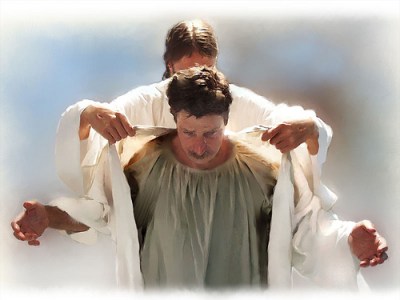
Clothed in ChristSo, as our text says, put on Christ. Clothe yourself in Him. Make His life, His obedience, His perfection your coat, your suit, your dress, your shirt, your shorts, your jeans, and your pajamas. How do you do that? Galatians 3:27 says, “As many of you as were baptized into Christ have put on Christ.”

Dear Colt, today you are Baptized. Today, Christ has connected His Word and promise of forgiveness, life, and salvation to water. So, as that water poured on to you, it didn’t simply clean your head. Instead, God’s promise is that in your Baptism, He covered you with Christ.

Colt, today you are a Christian. So, today you begin the constant life of following Christ and loving your neighbor. And this command to love your neighbor as yourself is a command that you will fail to keep. But when you fail, confess that for the sin that it is, and believe. Believe in Christ’s forgiveness remembering that Scripture declares that you are loved perfectly by Christ. Rejoice in that love. And, go, love your neighbor.

Repent. Rejoice. Repeat. Again and again and again. And this is the case for all of you who have been Baptized.

But you say, “Pastor, I keep sinning. My fallen, sinful desires have gotten in the way. I keep failing to fulfill the command to love. There has to be something more.”

Baptism 2Well, there is something more, but it isn’t anything different. Repent again. Cast off the works of darkness again. Put on Christ again. Return to the promises God made when made you His child, when you were born again of Water and the Spirit (Jn. 3:5) in your Baptism.

Repent. Rejoice. Repeat. In other words, be a Christian. Amen.

The peace of God, which surpasses all understanding, will guard your hearts and minds in Christ Jesus. Amen.

God’s New Name – Sermon for the First Sunday in Advent on Jeremiah 23:5-8 & Matthew 21:1-9

Listen here.

Jeremiah 23:5-8

5 “Behold, the days are coming, declares the Lord, when I will raise up for David a righteous Branch, and he shall reign as king and deal wisely, and shall execute justice and righteousness in the land. 6 In his days Judah will be saved, and Israel will dwell Jeremiah 23_6 Righteousnesssecurely. And this is the name by which he will be called: ‘The Lord is our righteousness.’

7 “Therefore, behold, the days are coming, declares the Lord, when they shall no longer say, ‘As the Lord lives who brought up the people of Israel out of the land of Egypt,’ 8 but ‘As the Lord lives who brought up and led the offspring of the house of Israel out of the north country and out of all the countries where he had driven them.’ Then they shall dwell in their own land.”

Matthew 21:1–9

1 Now when they drew near to Jerusalem and came to Bethphage, to the Mount of Olives, then Jesus sent two disciples, 2 saying to them, “Go into the village in front of you, and immediately you will find a donkey tied, and a colt with her. Untie them and bring them to me. 3 If anyone says anything to you, you shall say, ‘The Lord needs them,’ and he will send them at once.” 4 This took place to fulfill what was spoken by the prophet, saying,

5 “Say to the daughter of Zion, ‘
Behold, your king is coming to you,
humble, and mounted on a donkey,
on a colt, the foal of a beast of burden.’”

6 The disciples went and did as Jesus had directed them. 7 They brought the donkey and the colt and put on them their cloaks, and he sat on them. 8 Most of the crowd spread their cloaks on the road, and others cut branches from the trees and spread them on the road. 9 And the crowds that went before him and that followed him were shouting,

“Hosanna to the Son of David!
Blessed is he who comes in the name of the Lord!
Hosanna in the highest!”

jesus-triumphal-entry-palm-sunday

Grace, mercy, and peace be to you from God our Father and from our Lord and Savior, Jesus Christ. Amen.

The Exodus, when God led His people out of slavery in Egypt, was the main event of salvation in the Old Testament. The slaughter of the Passover lamb whose blood protected God’s people from the angel of death. The parting of the sea to release God’s people from the land of slavery on dry ground. The guidance of cloud by day. The protection of the pillar of fire by night. And the culmination when God gave of the Law on Mt. Sinai saying, “I am the Lord your God, who brought you out of the land of Egypt, out of the house of slavery” (Ex. 20:2). All those actions were the main celebration of the people of God. So, when God’s people called upon Him, they would name Him, “the God who brought us out of land of Egypt.”

But in today’s Old Testament text (Jeremiah 23:5-8), God declares through Jeremiah that He will be called by a new name, “the Lord is our righteousness.” God would no longer be known as the one who brought His people out of the land of Egypt because greater things were coming. God would bring about a better, more lasting deliverance. The days were coming when God would raise up for David a righteous branch. This offspring of David would reign as king. He would cause God’s people to be saved, and under Him they would dwell securely.

Our Gospel text today (Matthew 21:1-9), is the beginning of that great event. Jesus rides into Jerusalem, into the royal city. He rides toward the cross – for you.

Jesus is your Lord. He is your righteousness. He rules not over a political kingdom, but over an eternal kingdom. Jesus is the Savior that the all great events of the Exodus were pointing forward to. He is your Passover Lamb; faith points toward Him and the angel of death passes over you. He is the pillar of fire who lights your way through the darkness. He is the cloud protecting you from the scorching heat of God’s wrath. He is the one who brings you out of a foreign land full of death and sin.

Jesus’ death and resurrection stands as the central event in the history of the cosmos. The cross and empty tomb is what all of Scripture pointed forward to. God coming and reconciling you back to Himself is the story and the teaching of all the Scriptures (Jn. 5:39).

That is why the Church has its own unique calendar that centers around Jesus’ death and resurrection. Having such a calendar isn’t commanded in Scripture, but it is a helpful tool prepared Advent Wreath 1for us by the saints who have come before us. Today, this first Sunday in Advent, is the beginning of a new Church year.

Advent is not about us getting ready for Christmas to meet baby Jesus in a manger. Instead it is getting us ready for Christ’s coming in glory to judge the living and the dead. And so, we repent. We repent because Jesus will come on the Last Day to judge all mankind, and sadly for most it will be a day of terror.

But not for you, Christian. Jesus, your Savior, is your righteousness. He died to make you His own. Because of what He has done, you are declared righteous. And we, as God’s people prepare for His return by receiving Him as He comes to us in His Word and as He comes here and now in Bread and Wine given to us for the forgiveness of our sins.

And so, we join our voices with those who welcomed Him into Jerusalem, “Hosanna,” which means, “Lord, save us now.” And He does because He is our righteousness. Amen.

The peace of God, which surpasses all understanding, will guard your hearts and minds in Christ Jesus. Amen.