Matthew 5:20-26
20 “For I tell you, unless your righteousness exceeds that of the scribes and Pharisees, you will never enter the kingdom of heaven.
21 “You have heard that it was said to those of old, ‘You shall not murder; and whoever murders will be liable to judgment.’ 22 But I say to you that everyone who is angry with his brother will be liable to judgment; whoever insults his brother will be liable to the council; and whoever says, ‘You fool!’ will be liable to the hell of fire. 23 So if you are offering your gift at the altar and there remember that your brother has something against you, 24 leave your gift there before the altar and go. First be reconciled to your brother, and then come and offer your gift. 25 Come to terms quickly with your accuser while you are going with him to court, lest your accuser hand you over to the judge, and the judge to the guard, and you be put in prison. 26 Truly, I say to you, you will never get out until you have paid the last penny.”
In the name of Jesus. Amen.
Why did You have to pick the scribes and Pharisees, Jesus? Why does our righteousness have to exceed theirs to enter the kingdom of heaven? Why couldn’t You pick the righteousness of the sinners and tax collectors that You were eating with?
The scribes and Pharisees were the good guys. They had dedicated their lives to keeping God’s law. They made up extra commandments – more than six-hundred of them. When you looked at them, you would see good and holy people who would put our lives and good works to shame. Their lives were the supreme example of the outward keeping of God’s Law. But that’s exactly where the problem lies, and that is precisely what Jesus is getting at.
The scribes and Pharisees understood the Commandments to be attainable, keep-able, obey-able. They looked at the Commandments and saw them simply on the external. They would look at a particular Commandment and think, “I’ve done that. I’ve honored God in that way.”
In some ways they had. They hadn’t murdered anyone. They kept their bodies pure from adultery. They hadn’t stolen what was someone else’s. They had an external righteousness and life, but with that external righteousness came the most dangerous thing – pride. They figured they had done well and that God should be pleased with them. But here Jesus sits at the top of the mountain (Mt. 5:1) and preaches that their external works are not enough.
Jesus shows the righteousness that is required – a righteousness that exceeds the external righteousness of the Pharisees. And here, Jesus starts with the 5th Commandment about murder. He will go on to several of the other Commandments in the verses that follow, which you can read later today and this week for your homework. But Jesus probably starts with the 5th Commandment because, of all the Commandments, this one probably seems easiest for us to keep. Most of us can say, “I’ve never killed anybody, so I’m good concerning this Commandment.” But Jesus says, “Easy there partner. Not so fast. You have heard that it was said to those of old, ‘You shall not murder; and whoever murders will be liable to judgment.’ But I say to you that everyone who is angry with his brother will be liable to judgment; whoever insults his brother will be liable to the council; and whoever says, ‘You fool!’ will be liable to the hell of fire.”
Jesus says that there is more to the Law than you realize. It isn’t enough to keep your hands from taking someone’s life. Jesus teaches that the 5th Commandment has instructions for our lips and what we say, for our minds and what we think, even for our hearts, what we feel. If you call your neighbor a ‘fool,’ if you have insulted him or her, if you’ve been angry with anyone, you’ve broken the 5th Commandment and have guilty blood on your soul. And with all the anger in our culture and society, it is a good time for us to consider this topic of anger so that we have a right mindset about it.
The Scriptures do teach us that there is a godly use of anger. Psalm 4:4 and Ephesians 4:26 both say, “Be angry and do not sin,” which means that it is possible to be angry without sinning. And Jesus is our example. He cleansed the temple, taught against the Pharisees’ hypocrisy, and endured the disciples’ repeated unbelief. All of those things did make Him angry, and the Scriptures certainly use that terminology. Jesus was angry at times, but without sin.
To understand this, it is important to make a distinction. Some will try to say, “Hate the sin, but love the sinner.” But you run into problems with that phrase when you come across verses like Psalm 11:5b which says, “[The Lord’s] … soul hates the wicked and the one who loves violence.” So, a better distinction is the difference between the anger of office and the anger of the person. I’ll explain.
Anger of office has to do with your vocation or your station in life and your calling. Think of a judge in a courtroom. To be a judge is to have an office of anger – to sentence someone to jail or give them a fine is an act of anger. But the most common example of the office of anger is what we see in parents. Parents are called to sit in an office of anger at times. When their children break the 4th Commandment to honor their parents, it is the parent’s God-given duty to be angry and discipline their children.
Parents are supposed to punish their kids when they do things that put their kids or other people in danger. If your kid runs into the street without looking for cars, you have to punish them by not letting them be outside by themselves or by restricting where they can go on their bike. That punishment is serving in an office of anger, but all of this is an anger of office not of person. In other words, you aren’t punishing your kids because you don’t like them or are angry with them; you are punishing your kids because you love them, want to protect them, and desire that they grow up to be responsible people.
In fact, disciplining your kids is one of the most loving things you can do. Listen to a few Scriptures here: Proverbs 12:1, says, “Whoever loves discipline loves knowledge, but he who hates reproof is stupid.” Or Hebrews 12:6 which says, “For the Lord disciplines the one he loves, and chastises every son whom he receives.” Good parents will follow the example of their heavenly Father in disciplining their children. And in Revelation 3:19, Jesus says, “Those whom I love, I reprove and discipline.” Even though discipline is unpleasant at the time for the one being disciplined, later “it yields the peaceful fruit of righteousness to those who have been trained by it” (Heb. 12:11).
As our culture continues to wander farther and farther from God and seeks to be free from His authority, we see other God-ordained institutions of authority are being rejected as well. As this takes place, the biblical concept of discipline and love is dangerously fading and absent, and we are seeing the evil fruits of that. Sinful and evil actions are spoken of as good and right, and anyone who calls out that sin and evil is labeled ‘intolerant,’ ‘unenlightened,’ and ‘old-fashioned.’ But we cannot give up or retreat.
We must continue to love our neighbor by calling sin ‘sin’ and evil ‘evil.’ And we must do so in loving ways that show how that sin hurts the person committing that sin and how it harms their neighbor. We need to do this in a way that encourages repentance and faith in Christ who cleanses us from every sin through His death and resurrection.
Back to the example of the office of parent, if your kids keep repeatedly breaking your rules, it can be hard to separate the anger of the office as parent and anger toward the person of your child. But, do you get the idea? I hope you do. And I hope that as you parent your children, you are able to discipline them in a way that is not being angry toward the person of your child and instead having a righteous anger of office as parent.
In this text, Jesus is talking about the anger of a person, not about the anger of office. When someone speaks poorly against us or sins against us, we get angry toward that person and our heart gets hardened toward that neighbor. When we get angry toward another person, we try to wiggle our way out of our obligation to love that person, wrongly thinking that we are exempt from the command to love them as our neighbor because we think they are our enemies. It happens to all of us, and we all need to repent because Jesus goes on, just a few verses after this text, He says, “You have heard that it was said, ‘You shall love your neighbor and hate your enemy.’ But I say to you, love your enemies and pray for those who persecute you so that you may be sons of your Father who is in heaven” (Mt. 5:43-45). Jesus does not authorize you to be angry with the people who sin against you. Instead, He has told and explicitly commanded you to love them, pray for them, do good to them, and serve them.
When Jesus talks about a righteousness that exceeds that of the scribes and Pharisees, He isn’t talking about an external keeping of the Law. Jesus demands that everything you think, say, do, and feel conforms to God’s Commandments. To have a heart completely free of anger, lust, greed, rebellion, bitterness, strife, and idolatry. A heart that is full of love for God and your neighbor. This is the righteousness that exceeds the righteousness of the scribes and Pharisees. And this means that when the Law speaks to you, you do not go to a place of pride. Instead, the Law speaks to you and you fall into despair because you know that without this exceeding righteousness, you will never enter the kingdom of heaven.
We cannot attain to this righteousness. We cannot achieve it. And the more we try – which we should – the more we know we fail and feel in our hearts our own great sinfulness and the wrath of God that we deserve. We cannot achieve this righteousness that Jesus says is required. We have to look for this righteousness outside of ourselves.
This righteousness is not found in good works and obedience to the Law. It is Jesus’ righteousness and His perfect obedience to the Law and His heavenly Father which is given to us as a gift. Christian, Scripture says that you are in Christ who “has become [for you] wisdom from God, righteousness and sanctification and redemption” (1 Cor. 1:30).
Dear saints, there is one person in the entire history of the world who could stand under the judgment of the Law and not be condemned by it – Jesus, your Lord and Savior. Yet, Jesus, who kept the Law perfectly and filled up the Law, He Himself bore the curse and condemnation of the Law, and suffered for sins He did not commit so that He could give you His righteousness and the reward it deserved. For our sake God made Jesus who knew no sin to be sin, so that in Him we might become the righteousness of God (2 Cor. 5:21). Your anger, your insults, your lust, your disobedience, your theft, your lying, your idolatry – Jesus became all of that. He took all of that upon Himself and suffered for your sins so He could give to you His keeping of the Law, His perfect obedience to God.
Through faith in Christ, you have the righteousness that exceeds the righteousness of the scribes and Pharisees. You have the perfection and righteousness that defines God’s only Son. Your sins have been erased, and you are now in Christ. All of God’s commands are fulfilled for you.
Jesus has brought you out of your slavery to the Law. You have been united to Christ’s death and resurrection. Sin no longer has dominion over you. So, consider yourselves dead to sin and alive to God in Christ Jesus (Ro. 6:11). Amen.
The peace of God, which surpasses all understanding, will guard your hearts and minds in Christ Jesus. Amen.


 I have to confess, as I was doing my devotions this week, even when I had this sermon running through my mind, I got uncomfortable with some of the punishments God commanded for certain sins. But God does not owe us an explanation for His anger and wrath.
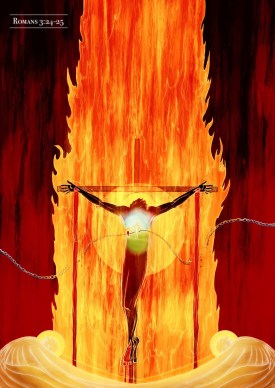 Remember, I told you that this sermon was going to be an explanation of that sentence in v. 25, “This was to show God’s righteousness, because in His divine forbearance He had passed over former sins.” What is it that showed God’s righteousness in giving us mercy? Nothing but Jesus Christ. Nothing but Jesus shedding His blood and dying on the cross. Nothing but Jesus being our propitiation – the atoning sacrifice, the mercy seat, the place where God forgives us and meets with us sinners.
 19 Therefore whoever relaxes one of the least of these commandments and teaches others to do the same will be called least in the kingdom of heaven, but whoever does them and teaches them will be called great in the kingdom of heaven. 20 For I tell you, unless your righteousness exceeds that of the scribes and Pharisees, you will never enter the kingdom of heaven.
 Sure, you aren’t Lady Macbeth yelling at the blood of Duncan to wash off your hands, but you are guilty of murder before God. You have been angry with others. You have called others, “Fool.” You have held grudges. You have refused to ask your neighbor for forgiveness. And Jesus goes on to the other Commandments as well – lust is adultery and fornication, gossip is perjury, etc.
 The Law should never be allowed to access into your ‘How do I stand before God?’ room, your ‘Am I good enough to go to heaven?’ room, your ‘Does God love me?’ room, your ‘Does God think I am a good person?’ room, or your ‘assurance of salvation’ room. The Law should never be allowed to enter those rooms because Jesus has made you as good and as righteous and as perfect as He is.
 12 “I still have many things to say to you, but you cannot bear them now. 13 When the Spirit of truth comes, he will guide you into all the truth, for he will not speak on his own authority, but whatever he hears he will speak, and he will declare to you the things that are to come. 14 He will glorify me, for he will take what is mine and declare it to you. 15 All that the Father has is mine; therefore I said that he will take what is mine and declare it to you.”
 We think that the opposite of sin is good works. So, we wrongly think our sin is something we can manage on our own. We imagine we can hide our stains by being kind to those around us. We think we can distract God from our lust, anger, pride, and selfishness with a few good works.
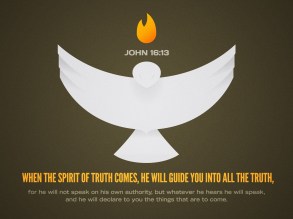 This is the Holy Spirit’s work. The Holy Spirit convicts you of sin, righteousness and judgment. The Holy Spirit takes all the work of Jesus and declares it to you. He is your Helper, Comforter, Advocate. Through Spirit’s working, He opens the Scriptures creating, sustaining, and strengthening faith and guiding you into all the truth.
 Pastorsamwise
You must be logged in to post a comment.