Origins – Sermon on Genesis 2:7-17 for the Seventh Sunday after Trinity

Genesis 2:7-17

7 [T]hen the Lord God formed the man of dust from the ground and breathed into his nostrils the breath of life, and the man became a living creature. 8 And the Lord God planted a garden in Eden, in the east, and there he put the man whom he had formed. 9 And out of the ground the Lord God made to spring up every tree that is pleasant to the sight and good for food. The tree of life was in the midst of the garden, and the tree of the knowledge of good and evil. 

10 A river flowed out of Eden to water the garden, and there it divided and became four rivers. 11 The name of the first is the Pishon. It is the one that flowed around the whole land of Havilah, where there is gold. 12 And the gold of that land is good; bdellium and onyx stone are there. 13 The name of the second river is the Gihon. It is the one that flowed around the whole land of Cush. 14 And the name of the third river is the Tigris, which flows east of Assyria. And the fourth river is the Euphrates. 

15 The Lord God took the man and put him in the garden of Eden to work it and keep it. 16 And the Lord God commanded the man, saying, “You may surely eat of every tree of the garden, 17 but of the tree of the knowledge of good and evil you shall not eat, for in the day that you eat of it you shall surely die.”

In the name of Jesus. Amen.

It should come as no surprise, but this text is fundamental and foundational to understanding who we are as God’s creatures. But to really get to the roots of who we are, we first have to understand who God is as our Creator, and this text gives us one piece of that understanding. The other piece came just before our text.

The Bible gives us two very different accounts of creation. In Genesis 1:1-2:3, God creates the sun, moon, stars, land, sky, plants, fish, birds, mankind, and all things by simply speaking. Whatever He commands comes into being. The whole account is filled with the repeated words, “And God said…. And it was so.” Then, God rests. Throughout those six days of creating and the seventh day of rest, He is simply called “God” (Heb.‘Elohim’). In that first account account of creation, we see a God who is transcendent – He is not subject to the limitations we are used to.

But then in our text here, the second account of creation, we see something remarkably different. The difference can be seen just a few verses before our text began in how Moses refers to God. No longer is He simply ‘God’ – He is the Lord God. In Hebrew, it is Yahweh God. In other words, this transcendent, powerful God has a name, and He is close and personal – especially with the head of His creation, Adam.

Yahweh puts His hands into the earth, molds the clay to form the man, and breathes life into Adam’s nostrils (Gen. 2:7). Then that immanent, personal God plants a garden for Adam (Gen. 2:8-9). After our text, Yahweh remains close to Adam by causing him to sleep and performing a surgery on him in order to create the woman. And Yahweh brings the woman to Adam as his suitable helper and joins them together in marriage so they would become one flesh by having children (Mt. 19:6; Mk. 10:9).

From these two accounts of creation, we have an important insight into God. He is mighty, powerful, and uninhibited. But He is also intimately close and involved with mankind.

Finally, after God finishes creation, He rests on the seventh day. Now, God doesn’t rest on the seventh day because He is tired. He created by merely speaking, and God speaks a lot more through the rest of Scripture but doesn’t grow tired or need a nap (Ps. 121:3-4). Instead, those two creation accounts help us understand something about that day of rest. God rests because He has set up all of creation to be His Temple where He will rest in the order and peace that He has established.

When I was younger, I imagined God created everything while He sat far away in heaven, speaking things into existence, but staying aloof somewhere way up there in heaven. But that scenario isn’t compatible with the rest of Scripture.

God’s desire is to dwell with people, the crown of His creation. The final picture Scripture gives of the eternal bliss of believers is God making His dwelling with you (Rev. 21:3). This desire of God to dwell among His creation becomes especially clear after the Fall. When God delivers His people from slavery in Egypt, He instructs them to build the Tabernacle so He can dwell in their midst (Ex. 25:8). In that Tabernacle, and later in the Temple, God says that He will walk among them (Lev. 26:12; 2 Sam. 7:6-7) just as we see He does in Gen. 3:8. To do that, God’s instructions on how to build the Temple in Jerusalem include many of the same materials, like gold and onyx stones, and the same ‘floorplans’ we read about here in the Garden of Eden.[1]

Now, that brings us to the nature of mankind. God puts Adam in the midst of that newly created Temple of Eden and gives Adam two responsibilities. Our translation says that Adam is there “to work it and keep it.” The two Hebrew words there can refer to a lot of activities, but when Scripture uses these two terms together, they most often refer to the duties and responsibilities of the priests in the sanctuary of the Tabernacle and Temple (Num. 3:7-8, 8:26, 18:5-6). In other words, this text is telling us that mankind was created to be the priest and guardian of sacred space. We were not created just to be gardeners.

On top of being priests, God set up mankind to be kings and queens over creation. God said, “Be fruitful and multiply and fill the earth and subdue it, and have dominion over the fish of the sea and over the birds of the heavens and over every living thing that moves on the earth” (Gen. 1:26-28). So, from our very origin, we were created to be priests and the royal rulers over creation with God reigning in our midst.

Of course, sadly, we did not remain in that original state. Adam and his wife failed in their priestly duties. They did not guard the Temple of Eden as they should have. Instead, they let the foul serpent defile it, and they lost their priestly roles. Instead, God sent a cherubim to take over the responsibility of guarding the way to the Tree of Life (Gen. 3:24 [see also Ezk. 28:14-16]). They also gave up their royal status over creation. Instead of having dominion over everything that creeps on the earth, they listened to what should have been under their rule; they listened to the serpent’s lies. By eating the fruit of the Tree of the Knowledge of Good and Evil, they rejected God and His ordering of the world.

But, dear saints, God has provided a way back to the Tree of Life (Rev. 22:2, 14), a way back to being what we were created to be, a way back to our origin. Jesus, the new Adam (1 Cor. 15:21-22, 45, 47), has come and crushed the serpent’s head. By His death and resurrection, Jesus has now redeemed you and made you what you were created to be. Through faith in Christ, you are a chosen race, a royal priesthood, a holy nation, a people for His Own possession (1 Pet. 2:9). This very Jesus dwells among you even now (Mt. 18:20). And, as Christ’s people, you are called to be His priests and kings and queens, guarding the sacred spaces of this congregation and your family.

So repent. Repent of the times you have chosen to neglect and abdicate your position as God’s priests and royalty. Repent of the times you have listened to the serpent’s lies and not expelled him from the good gardens where God has placed you and given you priestly and royal authority. Repent because the only fruit you have gotten from those sins is death (Ro. 6:21).

And know, as our Epistle reading (Ro. 6:19-23) promises, that you have been set free from sin and are now the servants of God who gives you fruit that leads to sanctification and life (Ro. 6:22). And know that Christ has equipped you with everything you need to be His priests and royalty. You have the full armor of God (Eph. 6:10-18) to defend against the attacks of the devil, the world, and your own sinful flesh. And you have God’s promise that He will never leave you or forsake you. In a world that is still soiled and stained with sin, Christ has brought you back into His kingdom, and He will lead you to eternal paradise with Him. Amen.The peace of God, which surpasses all understanding, will guard your hearts and minds in Christ Jesus. Amen.



[1] Gold and onyx (Gen. 2:11-12) are used to decorate the sanctuaries and priestly garments (Ex. 25:7, 11, 17, 31). The Tabernacle/Temple lampstand probably symbolizes the tree of life (Gen. 2:9; Ex. 25:31-35). Even the river flowing from Eden (Gen. 2:10) resembles Ezekiel’s Temple vision (Ezk. 47:1-12). 

Brought to Light – Sermon on John 16:5-15 for the Fifth Sunday of Easter

John 16:5–15

5 “But now I am going to him who sent me, and none of you asks me, ‘Where are you going?’ 6 But because I have said these things to you, sorrow has filled your heart. 7 Nevertheless, I tell you the truth: it is to your advantage that I go away, for if I do not go away, the Helper will not come to you. But if I go, I will send him to you. 8 And when he comes, he will convict the world concerning sin and righteousness and judgment: 9 concerning sin, because they do not believe in me; 10concerning righteousness, because I go to the Father, and you will see me no longer; 11 concerning judgment, because the ruler of this world is judged.

12 “I still have many things to say to you, but you cannot bear them now. 13 When the Spirit of truth comes, he will guide you into all the truth, for he will not speak on his own authority, but whatever he hears he will speak, and he will declare to you the things that are to come. 14 He will glorify me, for he will take what is mine and declare it to you. 15 All that the Father has is mine; therefore I said that he will take what is mine and declare it to you.”

Alleluia! Christ is risen!
He is risen indeed! Alleluia!

In the name of Jesus. Amen.

Today, Jesus teaches us about the Holy Spirit, and in this text, our Lord calls the Holy Spirit the ‘Helper’ and the ‘Spirit of Truth.’ Considering these titles and what Jesus teaches about what the Holy Spirit does, we should take a moment to pause and consider our conceptions of the Holy Spirit and see if they match up with what Scripture actually teaches.

The other day, I had to look up some information on a church’s website (it wasn’t a Lutheran church). Once I found the information I needed, I did what I normally do and looked at that the beliefs and teachings of that church. (It’s a pastor thing.) Under the congregation’s doctrine section, they talked about being filled with the Holy Spirit. They said that Christians should be “Spirit-controlled,” and the passage they cited was Eph. 5:18-19 which says to not be drunk with wine but be filled with the Spirit. There is a problem with using that passage in that way. Drunk people are not in control of themselves. They say things they wouldn’t normally say and do things they wouldn’t normally do. And by using that verse to talk about being filled by the Holy Spirit, they seem to be saying that Christians should be as unpredictable as drunks when they are filled with the Holy Spirit. The Holy Spirit is not the wild, unpredictable member of the Trinity who makes people act as though they are drunk.[1] The Holy Spirit is not a divine frat boy. Just think of the fruits of the Spirit: love, joy, peace, patience, kindness, goodness, faithfulness, gentleness, and self-control (Gal. 5:22-23). A lot of things that charismatics point to as evidence that the Holy Spirit is active and present (things like: ’holy laughter,’ being ‘slain in the spirit,’ and most of the speaking in tongues that happen today) don’t actually match up with the fruits of the Spirit – especially peace, patience, gentleness, and self-control.

Jesus gives us a very different picture of the Holy Spirit and His work. The clearest teaching about the Holy Spirit in all of Scripture is Jesus’ teaching in John 14-16. Just a few verses before our text today, Jesus says that the work of the Holy Spirit is to point people to Jesus. He says, “The Helper, the Spirit of Truth, will bear witness about Me” (Jn. 15:26). In other words, the surest way to tell if the Holy Spirit is at work is to consider if Jesus, the Son of God, is being pointed to as the Savior and Redeemer because He died and rose again for you and for all sinners. There. The Holy Spirit was at work just now!

Jesus calls the Holy Spirit “the Helper” here in our translation, but it doesn’t just mean that the Holy Spirit is your personal assistant. The word there is paraclete and means “advocate, comforter, or mediator.” It’s a legal term. You can almost think of a defense lawyer, someone who stands by you in court arguing and pleading your case. And the Holy Spirit is not some sleezy defense lawyer who tries to find loopholes in the Law. He is the Spirit of Truth and operates in the truth – more on that in a bit.

But first, we have to get one more thing straight in order to understand what the Holy Spirit does. Jesus teaches that the Holy Spirit will “convict the world concerning sin, righteousness, and judgment” (Jn. 16:8). Convicting sounds bad – especially when that convicting is in regard to sin, righteousness, and judgment. We do the math and figure at least that ⅔rd of that is bad – sin and judgment especially. And if the Spirit is convicting concerning righteousness, we know that we are not righteous. “No one is righteous, no, not one” (Ro. 3:10; Ps. 14:1-3, 53:1-3). When we hear the word ‘convict, we think of a court trial with evidence, testimony, lawyers, a judge, and jury. After the evidence and testimony is considered and the jury renders a guilty verdict, that person is now ‘convicted’ and labeled a ‘convict.’

Even though that is the normal way we use the word ‘convict’ today, that isn’t what Jesus means here at all. When Jesus uses the word ‘convict,’ He’s using it in the sense of “expose, convince, or bring to light.” And each of the things Jesus says that Holy Spirit brings to light end up being comforting and merciful works.

Jesus says that the Holy Spirit convicts the world (think everyone, not just unbelievers) concerning sin. The world is wrong about sin. Today, sins are celebrated. Rebellion and anarchy, violations of the 4thCommandment, is called “self-expression” and “living my truth.” The murder of babies in the mother’s womb, violating the 5th Commandment, is labeled “choice, freedom, and healthcare.” Adultery and fornication, violations of the 6th Commandment, are called “love.” We expect Jesus to say that the Holy Spirit convicts the world concerning sin because we are so evil, wicked, horrible, and depraved. But that’s not what Jesus says.

Instead, the Holy Spirit convicts the world concerning sin “because they do not believe in Me.” Again, the Holy Spirit is the Helper, the Paraclete, who exposes our sin so that we would flee from sin and run to Jesus for the mercy and forgiveness He has won and purchased for us by His death and resurrection. God desires that all be saved and come to the knowledge of the truth of the Gospel (1 Tim. 2:4). That’s why the Holy Spirit convicts concerning sin.

The Holy Spirit convicts the world (again everybody) concerning righteousness because Jesus is going to the Father. For those who do not have faith in Christ, the Holy Spirit brings to light what true righteousness is. Jesus has accomplished and fulfilled all righteousness (Mt. 3:15) and has gone into heaven to the Father. And for you, Christian, the Holy Spirit brings to light that you have the righteousness of Jesus through faith. The Holy Spirit operates on you so that you believe that God made Jesus, who knew no sin, to be sin in your place, so that in Jesus you are filled with the righteousness of God (2 Cor. 5:21). God sees your faith and credits it to you as righteousness (Ro. 3:21-22; Gen. 15:6). Through faith in Jesus, you Christian, have a righteousness that exceeds the righteousness that Adam and Eve had before the Fall. You have the very righteousness of Jesus Himself because He freely gives it to you through faith.

Finally, the Holy Spirit convicts the world concerning judgment because (and listen carefully) the ruler of this world (i.e. the devil himself) is judged. After the Fall, when God confronted Adam and Eve, the first judgment was directed to the devil (Gen. 3:14-15). God promised that He would send Jesus to crush his head. Jesus has done just that. Now, when bad things happen to you, you might think that you are in the crosshairs of God’s judgment. But the Holy Spirit comes and convinces you that you are not the target of God’s judgment. Satan is, and he always has been. The only reason any human is judged and condemned by God is by refusing to believe in the finished work of Jesus and the forgiveness He freely gives.

The Holy Spirit comes to you to bring to light the fact that you are not God’s enemy. God has demonstrated His love for you in that while you were still a sinner, Christ died for you (Ro. 5:8). And even when you were God’s enemy, here’s how He treated you – He reconciled you to Himself by the death of Jesus (Ro. 5:10). The Holy Spirit points you to Jesus’ words where He says that hell was not designed for you but for the devil and his angels (Mt. 25:41). The Holy Spirit brings to light that there is no condemnation for you who are in Christ Jesus (Ro. 8:1). 

The Holy Spirit, your Paraclete, does all this through the Word of God, and the Holy Spirit does this bit by bit. Here, Jesus told the apostles that He had more to say, but they could not bear those teachings then. After Jesus ascended into heaven, the Holy Spirit guided the apostles into all truth and that entire truth has been recorded for you in the Bible.

Just like the disciples, we can’t hear everything Jesus has to teach us, so the Holy Spirit continually guides us and brings all the truth to light through the Bible. This is why the Scriptures always have more to teach us. It doesn’t matter how familiar we are with a passage of Scripture, there is always more to glean, more to be brought to light. So, keep reading, keep searching, and keep learning the Scriptures your entire life. The Holy Spirit will come and declare to you all the glories of your Savior, Jesus Christ.

Alleluia! Christ is risen!
He is risen indeed! Alleluia!

Amen.

The peace of God, which surpasses all understanding, will guard your hearts and minds in Christ Jesus. Amen.


[1] On the day of Pentecost, the first Christians were mocked by being accused of being filled with new wine (Act. 2:13). Peter begins his Pentecost sermon by addressing that false accusation.

The Price – Sermon on Matthew 27:62-28:15 for the Vigil of Easter

A single cross with the reflection of an empty tomb.

Matthew 27:62-28:15

62 The next day, that is, after the day of Preparation, the chief priests and the Pharisees gathered before Pilate 63 and said, “Sir, we remember how that impostor said, while he was still alive, ‘After three days I will rise.’ 64 Therefore order the tomb to be made secure until the third day, lest his disciples go and steal him away and tell the people, ‘He has risen from the dead,’ and the last fraud will be worse than the first.” 65 Pilate said to them, “You have a guard of soldiers. Go, make it as secure as you can.” 66 So they went and made the tomb secure by sealing the stone and setting a guard. 

1 Now after the Sabbath, toward the dawn of the first day of the week, Mary Magdalene and the other Mary went to see the tomb. 2 And behold, there was a great earthquake, for an angel of the Lord descended from heaven and came and rolled back the stone and sat on it. 3 His appearance was like lightning, and his clothing white as snow. 4 And for fear of him the guards trembled and became like dead men. 5 But the angel said to the women, “Do not be afraid, for I know that you seek Jesus who was crucified. 6 He is not here, for he has risen, as he said. Come, see the place where he lay. 7 Then go quickly and tell his disciples that he has risen from the dead, and behold, he is going before you to Galilee; there you will see him. See, I have told you.” 8 So they departed quickly from the tomb with fear and great joy, and ran to tell his disciples. 9 And behold, Jesus met them and said, “Greetings!” And they came up and took hold of his feet and worshiped him. 10 Then Jesus said to them, “Do not be afraid; go and tell my brothers to go to Galilee, and there they will see me.”

11 While they were going, behold, some of the guard went into the city and told the chief priests all that had taken place. 12 And when they had assembled with the elders and taken counsel, they gave a sufficient sum of money to the soldiers 13 and said, “Tell people, ‘His disciples came by night and stole him away while we were asleep.’ 14 And if this comes to the governor’s ears, we will satisfy him and keep you out of trouble.” 15 So they took the money and did as they were directed. And this story has been spread among the Jews to this day.

Alleluia! Christ is risen!
He is risen indeed! Alleluia!

In the name of Jesus. Amen.

When Jesus died on Friday, things happened quickly and somewhat haphazardly because the Sabbath was about to begin at dusk. Joseph of Arimathea asked for the body of Jesus and laid it in his own new tomb (Mt. 27:57-61). Jesus had His Sabbath rest in that tomb from all the work that He had done (Gen. 2:2), but the chief priests and Pharisees don’t rest because they can’t rest. Instead, they work. They work like busy, busy bees. Even though it is the Sabbath day (and a high Sabbath because of the Passover), they go to Pilate and ask that a guard be set because they remember that Jesus had said He would rise after three days (Mt. 27:63-64). In a sad twist of irony, the enemies of Christ take His prediction of the resurrection more seriously than Jesus’ own disciples do.

Pilate seems to be a little annoyed by the request. He figures Jesus is dead and is no longer a threat, but here are these chief priests completely obsessed with a guy who has been crucified and is dead. So, Pilate says, “You have a guard of soldiers.” The Greek here is a little ambiguous. Pilate’s words there could be either a statement – which is how it is in our translation – or a command, “Here, have/take a guard of soldiers. Go, make it as secure as you can.”

I bring this up because it would make a difference as to which soldiers are stationed to guard the tomb. If it is a command, “Have a guard of soldiers,” it would be Roman soldiers. But if it is a statement, “You have a guard of soldiers,” then it would be soldiers from the Jewish Temple guard. I used to think that they were Roman soldiers (probably because of all the artwork I’ve seen depicts them as Roman soldiers). It could very well be that they were Roman soldiers, but I think there are enough clues to see that it is a real possibility that these guards are part of the Jewish Temple guard, and that is the assumption I’ll be using through the rest of the sermon tonight.

Toward the dawn of the first day of the week, the women go “to see the tomb” (Mt. 28:1), but they are invited by the angel to see that the place where Jesus lay and rested was now empty because Jesus has risen (Mt. 28:6). The angel sends them to tell the disciples the good news, but on the way, Jesus meets them. If you want to hear more about that exchange (which is so rich and beautiful), you’ll have to come back tomorrow morning.

While the women restart their journey to tell the disciples, the guard that had been stationed at the tomb go not to Pilate but to the chief priests and report everything that had taken place (Mt. 28:11). And the chief priests don’t accuse the soldiers of being crazy or drunk. Imagine someone came to your front door and said, “I was in the cemetery, and a guy came out of his grave,” your first reaction would not be, “Here’s some money, don’t tell anybody.” But that is what the chief priests do. They pay the guards to lie about what had happened, and it took a significant payment. Our text says, “a sufficient sum of money,” or, literally, “silver” (Mt. 28:12). That “hush silver” was the price of the soldiers’ lie. The chief priests instruct the soldiers to say, “Jesus’ disciples came while we were asleep and stole the body.”

This is why I think these soldiers were part of the Temple guard. Roman soldiers knew that falling asleep while on duty was a death sentence. Roman soldiers were well-trained and well-armed, so even lying about a bunch of fishermen being able to steal what they were guarding would be humiliating. And excuses from the chief priests would not satisfy Pilate to keep them out of trouble (Mt. 28:14), no matter how elaborate those excuses were. But the soldiers take the silver, and the “stolen body theory” spread to deny the fact of Jesus’ resurrection.

Now, all of that was to set this up: Everyone has a price. Judas’ price to betray Jesus was thirty pieces of silver (Mt. 26:15). The soldiers’ price to lie and defame their own honor was a large sum of silver (Mt. 28:12, 15). Now, ask yourself, “What is my price?” 

I don’t think anyone here would betray Jesus, like Judas did, for any amount of money. And I would guess that all of us would say that we are willing to die rather than deny Christ, but so did Peter (Mt. 26:35). We might not think that we have a price. And yet, we are all bought with a lower price for lower things.

Every time we sin, we are easily bought. We sin and despise God’s Word by skipping church and neglecting to gather with our brothers and sisters in Christ because we don’t want to pay the price of getting extra sleep on Saturday night, missing our kids’ tournament, or researching to find a church while we are on vacation. We sin and lie because we aren’t willing to pay the price of our reputation when the truth will cost us. Whenever we fall into sin, we sell our souls for the deadly wages that sin pays us (Ro. 6:23). Dear saints, repent.

Repent and know that the price of your sins has been paid by Jesus. Everyone has a price, even God. The story of Abraham and Isaac (Gen. 22:1-18) showed what kind of price, what kind of sacrifice, was needed. There, Abraham places his son on the altar, and even though God stopped the sacrifice of Isaac, it gives us an idea of the price and what kind of sacrifice needed to take place for our redemption.

God the Father took His Son, His only Son, Jesus whom He loved and sacrificed Him on Calvary. God didn’t just forgive your sin willy-nilly. No. He sent Jesus to pay the price for every sin you have committed. Your God and Lord has paid the debt you owed to Him. And because the price has been paid, you are now Jesus’ brothers and children of God.

And the resurrection proves that God has accepted the payment. Because of Jesus’ death and resurrection, you have been brought out of slavery. You have been delivered through the sea of your Baptism and through the flood of God’s wrath against your sin. You have been saved from the fiery furnace and brought to dawn of the New Creation and into the life everlasting.

And now that the, you are invited to your seat at the Lord’s table where Jesus gives you His Body and His Blood. God invites you, “Come, everyone who thirsts, come to the waters; and he who has no money, come, buy and eat! Come, buy wine and milk without money and without price” (Is. 55:1). And you have this invitation because Jesus, your crucified and risen Savior, has fully paid the price for you.

Alleluia! Christ is risen!
He is risen indeed! Alleluia!

Amen.The peace of God, which surpasses all understanding, will guard your hearts and minds in Christ Jesus. Amen.

When Crumbs Become a Feast – Sermon on Matthew 15:21-28 for the Second Sunday of Lent

Matthew 15:21–28

21 And Jesus went away from there and withdrew to the district of Tyre and Sidon. 22 And behold, a Canaanite woman from that region came out and was crying, “Have mercy on me, O Lord, Son of David; my daughter is severely oppressed by a demon.” 23 But he did not answer her a word. And his disciples came and begged him, saying, “Send her away, for she is crying out after us.” 24 He answered, “I was sent only to the lost sheep of the house of Israel.” 25 But she came and knelt before him, saying, “Lord, help me.” 26 And he answered, “It is not right to take the children’s bread and throw it to the dogs.” 27 She said, “Yes, Lord, yet even the dogs eat the crumbs that fall from their masters’ table.” 28 Then Jesus answered her, “O woman, great is your faith! Be it done for you as you desire.” And her daughter was healed instantly.

In the name of Jesus. Amen.

Whenever you are reading Scripture, look for the surprises. To see the surprises in this particular text, we first have to recognize some things that are not surprising. This Canaanite mother cries out to Jesus because her daughter is severely oppressed by a demon. As harsh as this sounds, it is no surprise at all that her daughter is suffering at the hands of demons.

Jesus is in the district of Tyre and Sidon, and that region was the center of Baal worship. Baal worship, among other horrible things, included child sacrifice. Obviously, this Canaanite woman hadn’t killed her daughter as a sacrifice to Baal. But in that pagan culture, it was common to engage in occult practices and make deals with demons in order to make your fields more fruitful, to get revenge on someone, to make a person fall in love with you, and all sorts of other things. While we don’t know exactly what caused the girl to be demonized, both this woman’s background and what she says suggest that she does know, and it is very possible that it was because of something she had done. If she and her daughter were innocent regarding this demonic possession, the woman would be crying out for justice, but that isn’t what she cries out for. She cries out to Jesus for mercy. She sees her daughter’s suffering and feels guilt.

Let’s bring this to us today. Dear saints, be aware. Demons have not gone away. If you ignore their existence, it is to your own peril. Demons are real, and they are active. Even if you don’t read horoscopes, call psychic hotlines, use healing crystals or ouija boards – and don’t do those things, they are demonic and evil – but even if you don’t do those things, that doesn’t mean you aren’t opening up yourself to demons. Pornography can be a portal for demons. Getting drunk, giving in to your anger, or being lazy also opens you up to their influence (Col. 3:5-8; 2 Thess. 3:6, 11). In fact, all pet sins dabble in the demonic. We want to imagine that our sins are no big deal or excusable. They aren’t. Sin hurts both the sinner and the sinner’s immediate family. Repent. Know that Christ has defeated the demons and protects you from them. But engaging in pet sins is like dangling your bleeding foot in shark-infested waters. Don’t invite the demons into your life by continuing in those sins.

Now, that brings us to the first surprise in the text which comes in the woman’s initial prayer. She addresses Jesus as the Son of David, and that is a loaded term – especially from her. She’s a foreigner. King David never ruled over her people or her homeland. And yet there are all sorts of promises that a descendent of David would sit on the throne forever and save even the inhabitants of the pagan nations (Is. 11:10-16). And this woman believes Jesus is the Son of David who can help her and her daughter. Jesus is her last hope.

And that brings us to the second surprise. Jesus doesn’t answer her a word. Jesus is usually so quick to have mercy when called upon, but not here. More on that surprise in a minute.

First, we have to consider the disciples’ reaction to her. They pray and ask Jesus to send her away. Unfortunately, this isn’t surprising. It’s disappointing, callous, and sinful, but not surprising. They were tired of hearing her shrieking for mercy. They probably speculated that she is suffering because of her own wickedness. Their attitude and thinking toward her seems to be along the lines of, “Well of course your daughter has a demon. You’ve brought this on yourself. Jesus, if You’re not going to help her, at least tell her to take a hike.” But even though this speculation was probably correct, the disciples failed to have compassion.

Dear saints, too often we are like the disciples. We fail to have compassion on those who are suffering around us. When people are groaning under their suffering, that isn’t the time to be like Job’s ‘friend’ Zophar and say, “You’re getting what you deserve. In fact, your sins deserve even worse punishment” (see Job 11:6). Now, we cannot excuse sin or say that sin doesn’t really matter. Downplaying sin is also unmerciful. Don’t do that! There are times where we have to correct and rebuke, but when someone is crying out for mercy, rebuke is not appropriate. Point the suffering to Jesus, the Source of mercy. Comfort them with God’s promises of forgiveness and mercy in the midst their suffering. And pray that God will give you wisdom to know when to comfort and when to rebuke and correct (Jam. 1:5).

Back to Jesus’ surprisingly slow response in giving this woman mercy. First, Jesus ignores her. Then, Jesus says that He came only for the lost sheep of Israel. And finally, He calls her a dog. Yes, it’s surprising, but it shouldn’t be too surprising. Because He is God, Jesus knows this woman; He knows her daughter; He knows the struggles she and her daughter have had with this demon; and, most importantly, Jesus knows this woman’s great faith. There is no question that Jesus is putting her through the ringer, but what He is doing here is strengthening and purifying her faith.

Even though Jesus ignores her, dismisses her, and calls her a dog, she continues to dig her roots of faith deeper and deeper. You heard in our Epistle text (Ro. 5:1-5) that we can rejoice in our suffering because suffering produces endurance which produces character which produces hope. Jesus is using this woman’s suffering to strengthen her faith. Christ knows how much suffering this woman can take, and through that suffering her faith grows, matures, and gets stronger. Jesus uses her suffering for her good. That doesn’t mean that the suffering is good, but Jesus uses it to bring about good.

That leads us to the next surprise. The demon who is causing the suffering wants to destroy this woman and her daughter, but the demon utterly fails because he ends up driving her to Jesus. And Christ draws this woman in even closer to Himself.

Dear saints, when – not if but when – you suffer, flee to Christ. When you are suffering because of your sinful actions, because of the sin of others, or because God doesn’t immediately deliver you, dig your heels into God’s promises. In your prayers, remind God of what He has promised to do and hold Him to those promises. That is faith. Faith is trusting that what God has promised He will do, despite your experience.

That brings us to the final surprise. The woman says that she will be content with crumbs from Jesus table. Even though Jesus calls this woman a dog, she says, “Ok, Jesus. I’ll be a dog so long as I’m Your dog. It isn’t right for You to give me Your children’s bread. I don’t need bread. Crumbs from Your hand are all I need.” She’s content with crumbs, but here’s the surprise – she gets more than crumbs. She gets a full feast.

Jesus says, “O woman, great is your faith! Be it done for you as you desire.” This woman is one of only two people whose faith is praised by Jesus (Mt. 8:10). Jesus is the Bread of Life (Jn. 6:35). Even the crumbs that fall from Jesus’ table deliver mercy, life, and salvation. This woman gets the very thing she desired and more. Her daughter is delivered, and she receives everything Jesus came to give to sinners.

God’s mercy is of such a nature that it never falls in crumbs. God’s mercy is directly and precisely delivered to give exactly what is needed in every situation.

Right now, your Lord invites you to His table. Not to sit under it like a dog waiting for some crumbs to fall from a careless child. No, you are Jesus’ guest of honor. What you receive might look like crumbs to those who do not know what is being given. But through faith, you know that Jesus gives you a full feast of forgiveness, life, and salvation as He gives you His Body and Blood for the forgiveness of all your sins. Welcome to the feast. Amen.

The peace of God, which surpasses all understanding, will guard your hearts and minds in Christ Jesus. Amen.
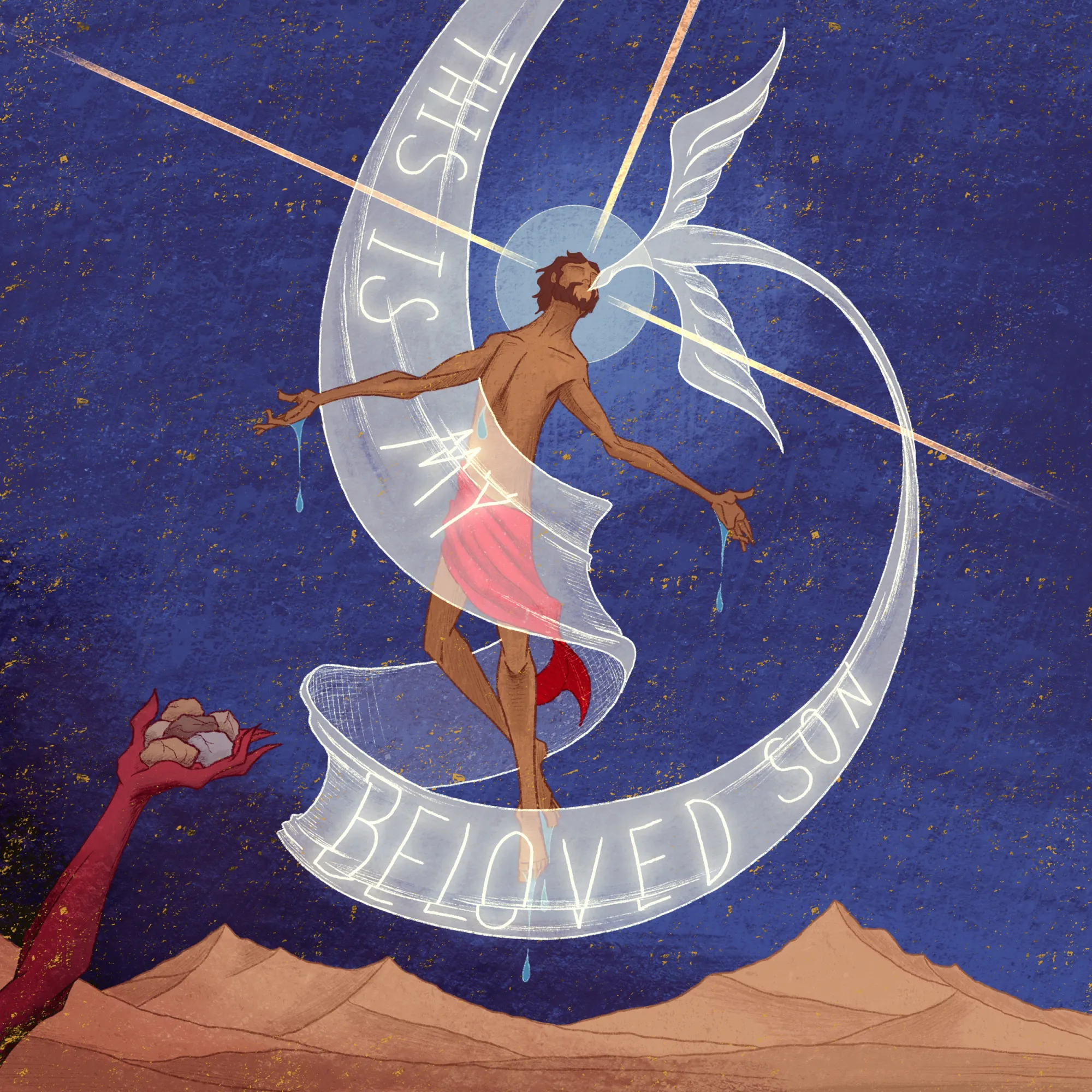
The Devil’s Playbook – Sermon on Matthew 4:1-11 for the First Sunday of Lent

Matthew 4:1–11

1 Then Jesus was led up by the Spirit into the wilderness to be tempted by the devil. 2 And after fasting forty days and forty nights, he was hungry. 3 And the tempter came and said to him, “If you are the Son of God, command these stones to become loaves of bread.” 4 But he answered, “It is written,

“‘Man shall not live by bread alone, 
but by every word that comes from the mouth of God.’ ”

5 Then the devil took him to the holy city and set him on the pinnacle of the temple 6 and said to him, “If you are the Son of God, throw yourself down, for it is written, 

“‘He will command his angels concerning you,’ 

and 

“‘On their hands they will bear you up, 
lest you strike your foot against a stone.’” 

7 Jesus said to him, “Again it is written, ‘You shall not put the Lord your God to the test.’ ” 8 Again, the devil took him to a very high mountain and showed him all the kingdoms of the world and their glory. 9 And he said to him, “All these I will give you, if you will fall down and worship me.” 10 Then Jesus said to him, “Be gone, Satan! For it is written,

“‘You shall worship the Lord your God 
and him only shall you serve.’”

11 Then the devil left him, and behold, angels came and were ministering to him.

In the name of Jesus. Amen.

For years now, you’ve heard me say that the devil has one trick up his sleeve and that is to get you to doubt God’s Word. In the luscious perfection of the Garden of Eden, the devil began his temptation by asking the woman, “Did God really say?” And in the temptation of Jesus, the devil takes the exact same approach. He begins the first two temptations with, “If you are the Son of God…” Remember, this came immediately after God the Father declared at Jesus’ Baptism, “You are My beloved Son, in whom I am well pleased” (Mk. 1:11; Mt. 3:17). So, when Satan begins, “If you are the Son of God,” he’s trying the exact same tactic he used in the Garden, “Did God really say?” Trying to cast doubt on God’s Word is the only play in the devil’s playbook, and this is helpful to know. But we need to consider this scheme of the devil more closely because he is so skilled at running this play.

Enough of you enjoy football that I’m going to try this analogy. Even if you don’t care about football, I think the analogy is still helpful, so please stick with me. Some teams will primarily use just one play called an ‘option.’ In this play, the quarterback sees where the defense is and how they move at the beginning of the play, and that will determine what he does with the ball – pass, hand it off, or keep it himself. It’s one play that has several options for success, and a skilled quarterback simply choses the best option available. This one play can be extremely effective. So, when we understand how Satan runs his one play to utilize the options he has before him, we can better defend against each of those options.

When the devil tempts us with his, “Did God really say?” he wants us to start speculating, “Why doesn’t God want me to have this thing?” whatever that thing is. There are three main answers to that speculation. One, God doesn’t actually know what I need. Two, God doesn’t want me to be happy. And three, God doesn’t have the power or ability to give that thing to me.

If any of those things are true (which, of course, they aren’t), then God isn’t worthy of our obedience or worship. And when we start speculating on those false possibilities, we begin to think that God either can’t or won’t help us. Then, we assume that we have to help ourselves, but doing that put us in the place of God which means that we fall into idolatry and sin. So, when we recognize what those temptations are doing, we can better defend against the temptation. Because the truth is: God does know what you need. He knows what you need before you ask Him (Mt. 6:8). And He promises to give it to you (Mt. 6:32). God does want you to be happy – happier than you can possibly imagine – just not necessarily in the way or in the timing you might have in mind. He doesn’t withhold any good thing from those who walk uprightly (Ps. 84:11), and He knows how to give good gifts to His children (Mt. 7:11; Ps. 85:12). And God is able and pleased to give you everything that is good for you (Lk. 12:32).

Our problem is that we don’t always recognize how simple and shortsighted we are. We don’t always know what is and isn’t good for us. Too often, we are like spoiled children who think things that are harmful to us would make us happy. God knows better than we do, and He won’t ever hold back when it comes to giving us things that are beneficial for us (1 Cor. 1:7).

With all of that in mind, let’s consider these three temptations. Jesus is starving because He hasn’t eaten for forty days. The devil runs his play, “If you are the Son of God, command these stones to become loaves of bread.” Notice how insidious this is. The devil wants Jesus to speculate, “Why doesn’t God want Me to have bread?” At that very moment, the heavenly Father was providing bread for everyone in the world. Christ is the only one who actually loves and obeys God. So, why is He starving? The devil is tempting Jesus to think that His heavenly Father either: 1) doesn’t know what He needs; 2) doesn’t want to give Jesus what He needs; or 3) isn’t able to give Jesus what He needs. Again, all of those things are false.

But Jesus doesn’t fall for the play; He doesn’t speculate. He simply responds, “Man shall not live by bread alone, but by every word that proceeds from the mouth of God” (Dt. 8:3). Jesus trusts that God can and will provide what is needed when it is needed. He doesn’t fall into the temptation.

If we stick with the football analogy, it’s second down, and the devil goes back to his same play. He takes Jesus to the pinnacle of the Temple and says, “If you are the Son of God, jump off. God has promised to send the angels to protect you.” Satan wants Jesus to test God’s ability to keep Him safe. The devil is, basically, saying, “Let’s see if God will notice when you are in danger and if he can help you when you need it.” But Jesus doesn’t need to test drive God’s protection. God has promised He will care for Him, and that is enough. So, our Lord responds, “You shall not put the Lord your God to the test” (Dt. 6:16).

Now, it’s third down, and the devil is in a bad spot. But he still runs the same play trying to get Jesus to think that God is holding out on Him. Satan shows Jesus all the kingdoms of the world and all their glory and offers them to Jesus if He will worship him. Jesus will, and does, receive all the kingdoms of the world but only after He has redeemed them by dying and rising again. But the devil wants Jesus to take that authority early. But our Lord doesn’t fall for the trick. Jesus quickly responds with Scripture again, “Be gone, Satan! For it is written, ‘You shall worship the Lord your God, and Him only shall you serve’” (Dt. 6:13). Now that He is ascended to the throne of all creation, Christ has all authority in heaven and on earth (Mt. 28:18) with all things placed under His feet (Eph. 1:21-22).

Now, let’s bring this to you. Again, the one play in the devil’s playbook is for the devil to get you to question God’s Word which leads you to speculate that God is holding out on you. Dear saints, God does not and will not ever deny you anything that is good for you. Psalm 84:11 says, “The Lord God is a sun and shield; the Lord bestows favor and honor. No good thing does He withhold from those who walk uprightly.”

Recognizing that God promises to provide and care for us is the best weapon we have to defend against temptation. The last verse of this text is so important for our fight against temptation because it clearly shows us that God wasn’t withholding anything from Jesus. At the right and proper time, God did give Jesus the bread, protection, and authority He needed and desired. “The devil left [Jesus], and behold, angels came and were ministering to Him.” And don’t think for one second that God only does this for Jesus because He does it for us sinners too.

We saw God do the same thing for Adam and Eve in our Old Testament text (Gen. 3:1-24) even after they had fallen into temptation and sinned. God gave them chance after chance to repent. Every question God asks in Gen. 3:9-13 is a merciful call to repentance because God knows that they need confession and absolution. Even when they don’t repent and confess their sins, God still gives them what they need. He gives them a promise that He will send Jesus, the Seed of the woman, to crush the head of the serpent (Gen. 3:15). Then, God instructs both the woman and Adam what life will be like now that they have brought sin into the world (Gen. 3:16-19) which will help them face the challenges ahead. There, God still promises to provide food for them. After that, God covers their nakedness and shame with animal skins (Gen. 3:21). And finally, God sends His cherubim with a flaming sword, to protect them from the horror of eating from the tree of life and living forever in sin (Gen. 3:22-24).

In all of that, God is protecting them, providing for them, loving them, and giving them everything they need for life and salvation. Dear saints, if God will do that for Adam and Eve immediately after they sinned, how much more will God do for you now that He has sent Jesus to die and rise again to redeem and purchase you?

Because of what Christ has done, you are His beloved children. Jesus, your great High Priest has been tempted in every way as you are, yet without sin. Christ knows the difficulty of facing the temptations the devil throws at you, so He has sympathy for you. And even when you fall into temptation and sin, you can draw near to His throne where you will find mercy and grace to help in time of need (Heb. 4:14-16). Amen.

The peace of God, which surpasses all understanding, will guard your hearts and minds in Christ Jesus. Amen.
No Question – Sermon on Jonah 3:1-10 for Ash Wednesday

Jonah 3:1-10

1 Then the word of the Lord came to Jonah the second time, saying, 2 “Arise, go to Nineveh, that great city, and call out against it the message that I tell you.” 3 So Jonah arose and went to Nineveh, according to the word of the Lord. Now Nineveh was an exceedingly great city, three days’ journey in breadth. 4 Jonah began to go into the city, going a day’s journey. And he called out, “Yet forty days, and Nineveh shall be overthrown!” 5 And the people of Nineveh believed God. They called for a fast and put on sackcloth, from the greatest of them to the least of them. 

6 The word reached the king of Nineveh, and he arose from his throne, removed his robe, covered himself with sackcloth, and sat in ashes. 7 And he issued a proclamation and published through Nineveh, “By the decree of the king and his nobles: Let neither man nor beast, herd nor flock, taste anything. Let them not feed or drink water, 8 but let man and beast be covered with sackcloth, and let them call out mightily to God. Let everyone turn from his evil way and from the violence that is in his hands. 9 Who knows? God may turn and relent and turn from his fierce anger, so that we may not perish.” 10 When God saw what they did, how they turned from their evil way, God relented of the disaster that he had said he would do to them, and he did not do it.

In the name of Jesus. Amen.

For several reasons, I don’t preach with props, but if I did tonight’s sermon would begin the sermon with a ‘clapperboard’ – one of those things used during the filming of movies and TV shows. “Jonah called to preach to Nineveh; take two.” “Action!”

We know about the ‘out-take.’ Instead of going to preach to Nineveh, Jonah ran the other direction. He was thrown overboard in a stormy sea, swallowed by a great sea creature, and submerged to the depths of the sea to be digested and die. It looked like Jonah’s refusal to preach to Nineveh would be his own undoing. But from the depths, Jonah prayed to God for mercy, and God heard. God answered from heaven and sent out His steadfast love and faithfulness (Ps. 51:3). God is merciful, but His mercy takes different forms in different situations. In Jonah’s case, mercy looked like being whale vomit instead of becoming whale poo.

God gave Jonah a second chance, “Arise, go to Nineveh, that great city, and call out against it the message that I tell you.” Jonah preached a one-course sermon of Law, “Yet forty days, and Nineveh shall be overthrown!” Notice what the sermon doesn’t do. It does not accuse the people of specific sins. It doesn’t name any of Nineveh’s many evils (Jon 1:2). The sermon only does one thing – it calls Nineveh’s future into question. This is just an aside: In your conversations with unbelievers, be on the lookout for opportunities to point people to the return of Christ, the final judgment, and end of the world (Act. 17:31). Those may be the windows where God will shine the light of the Gospel into the darkness of people’s hearts.

Well, Jonah’s doomsday sermon was used by the Holy Spirit to change the hearts of the Ninevites. From the greatest to the least of them, they called for a fast. Even the king of Nineveh descended from his throne to sit in sackcloth and ashes. He gave a command to all the people of Nineveh, “Fast. Don’t eat or drink. Call out mightily to God. Turn from evil and violence. Who knows? God may turn from His fierce anger against us, so we may not perish.” This wasn’t a revival, it wasn’t a reawakening, it was an initial awakening. But also notice that for the Ninevites this was a shot in the dark. At best it was a, “Maybe,” a “Let’s give this a try,” a, “What if?”

Well, their blind shot at repentance paid off. “God saw what they did, how they turned from their evil way, God relented of the disaster that He said He would do to them, and He did not do it” (Jon. 3:10).

Dear saints, as we begin this repentant season of Lent, you have something better than the preaching of Jonah. You have God’s sure and certain promise forever etched in the Scriptures, “If we confess our sins, He is faithful and just to forgive us our sins and to cleanse us from all unrighteousness” (1 Jn. 1:9). That verse is so important because it contains a promise. We can, and probably should, understand it as, “When we confess our sins, God is faithful and just to forgive us and cleanse us.” Whenever you bring your sins to God, He responds with His forgiveness and mercy.

In Greek, the word ‘confess’ is two words smashed together – ‘same’ and ‘words.’ So, when you confess something, you have the same words as someone or something else. This means that biblical confession of sins has two parts. To confess your sins, you say what God says about those sins. First, you say that those sins are horrible, they are deserving of death, they separate you from God, they harm your neighbor, they earn eternal damnation. That’s what God says about your sins, and when we confess our sins, we have those same words. That’s the first part of confession. But don’t ever stop there!

Keep saying the same words about your sin that God clearly says in His Word. Those sins have been removed from you by Jesus who became sin (2 Cor. 5:21), and God has laid your sin on Christ (Is. 53:4, 6). Those sins are died for by Christ who bore them to the grave which is now empty (Col. 2:14). Those sins are removed from you as far as the east is from the west (Ps. 103:12).

Dear saints, there is no question whatsoever about how God will respond when you confess and cry out to Him for mercy. The answer is the cross and the empty grave. Because of what Christ has done, you, sinner, are forgiven (1 Jn. 2:2). Amen.

The peace of God, which surpasses all understanding, will guard your hearts and minds in Christ Jesus. Amen.

The Non-Avengers – Sermon on Romans 12:16-21 for the Third Sunday after Epiphany

Romans 12:16-21

16 Live in harmony with one another. Do not be haughty, but associate with the lowly. Never be wise in your own sight. 17 Repay no one evil for evil, but give thought to do what is honorable in the sight of all. 18 If possible, so far as it depends on you, live peaceably with all. 19 Beloved, never avenge yourselves, but leave it to the wrath of God, for it is written, “Vengeance is mine, I will repay, says the Lord.” 20 To the contrary, “if your enemy is hungry, feed him; if he is thirsty, give him something to drink; for by so doing you will heap burning coals on his head.” 21 Do not be overcome by evil, but overcome evil with good.

In the name of Jesus. Amen.

We’re going to be spending a lot of time in this sermon thinking about vengeance, but to do that we have to establish something very basic first. Sin is bad, and the affects of sin are bad. I don’t think anyone here would disagree with that. Sin is awful, and the results of sin can be hideous. When you sin against others and know the hurt and pain you have caused, you feel terrible, and you should repent and reconcile with the person you have sinned against. And when someone sins against you, you know the injustice and pain that accompanies that too. Of course, depending on the nature and circumstances surrounding sins committed against you, that injustice will bring various levels of anger and pain that you have in response to that sin.

For example, imagine you are in the grocery store and have a shopping cart full of items and a pile of coupons. You are just a few steps away from the checkout line when someone who has an item or two quickly darts in line in front of you. That person has sinned against you. But you are only slightly perturbed and can let something like that roll off your back. You console yourself thinking how you were going to offer to let them go first anyway. Sure, you’re annoyed, but you can let it go fairly easily.

Ok now, flip the script. You are the one with only a couple items and the person who barges in front of you has the full cart and a ream of coupons. Now, you are going to be angry. And if you’ve already had a bad day and your patience has been spread very thin, you might be really angry. Maybe you will make loud sighs when their coupon doesn’t ring up the way they think it should or even say something rude to them. You might let that moment stew in your mind for the rest of the evening and next day, thinking of all sorts of ways you could have responded that would have made them feel bad.

Those responses to sin – whether you are only slightly annoyed or are angry and stewing – those responses reveal something about the nature of sin. Sin ruins things. It throws things off in the world makes the entire universe off-kilter. This is clear because it only took the one sin in the Garden to bring pain, strife, and death to all creation. Now, we’ve only known what it is to live in a world that is filled with the chaos of sin. But it is important for us to remember that when we sin and when we are sinned against, it is an injustice that brings further chaos and disorder to creation. Someone cutting in line in front of you might only affect your small corner of creation, but when you sin in response to your sphere of creation being thrown off, those effects continue to spread.

One more piece in all of this: When we see sin, injustice, and the hurt that accompanies all of that, we want to fix it. Since we are made in the image of God, we are like God and want to restore the order and justice which has been disturbed because of sin. That is what vengeance is. Vengeance isn’t necessarily a bad thing. We’ve gotten so used to the word ‘vengeance’ being used in a negative way that we think vengeance is always evil. Yes, vengeance can be evil, but look, God Himself here says, “Vengeance is Mine, I will repay.” Paul there is quoting Dt. 32:35. The same verse gets quoted again in Heb. 10:30. Throughout the Scriptures, both in the Old and New Testament, we hear that God will execute vengeance on the wicked and restore justice. In Ps. 94 and many other places in the Bible, this idea is repeated. God is just and will punish sin and make creation right again.

With all of that in our minds now, we can consider this text. Here in v. 19, Paul says, “Beloved, never avenge yourselves, but leave it to the wrath of God.” Christian, that is what you are to do. When you are wronged and sinned against, it might seem like everything in creation is against you – depending on the nature, gravity, and seriousness of the sin. But you are instructed here to not avenge yourself because executing vengeance is, typically, not your job. Instead, you are commanded to leave it to the wrath of God. “Beloved, never avenge yourselves, but leave it to the wrath of God,” and then Paul uses a very important word – ‘for.’ In other words, here is why you are not to avenge yourself, “for it is written, ‘Vengeance is Mine, I will repay, says the Lord.’” Bringing order and justice back to a broken creation is not your responsibility. Vengeance belongs to God.

You already know this, but I’ll give you an example. Since, I had you imagining yourself in a grocery store earlier, let’s stick with that setting. When you are in the store and a mom is there with her little boy who is whining, kicking, and screaming because she said, “No,” to the treat he wanted, you aren’t going to go over to that boy and punish him. It isn’t your job. You can’t go over to that boy and tell him, “Because you are acting like this, you don’t get desert tonight and will be going to bed early.” You can’t enforce that punishment. And you will be arrested if you spank the boy – as you should be. It isn’t your office to bring vengeance, justice, and punishment in that situation.

Now, of course, if it is your boy doing the exact same thing, you can and should punish him. God has placed you in a position of authority over your children to train, guide, and direct their behavior and character. Exactly how you do that is up to you since you are placed in that authority by God. An important thing here is that right after our text comes Ro. 13, and I would highly encourage you to read this text along with Ro. 13 together. In Ro. 13, Paul will say that every authority that exists is placed in that position by God, and God puts people in positions of authority to bear God’s sword of vengeance – i.e. to be the hand of God that punishes people who sin and do wrong.

Now, this is a brief but important aside: There are times when the authorities that God has put in positions to punish sin do not use that authority as they should. Sometimes, they let the guilty off with minimal or no punishment, and other times they overstep their bounds and punish the innocent. That happens. But navigating those situations falls outside the scope of this sermon. I will say that is an important thing to think through. Just know that the authorities God puts in place are responsible to God for how they use that authority, and God will judge His servants and hold them accountable for any misuse of that authority (Ro. 13:4a; Mt. 24:45-51). 

One more brief thing on this before we all get hammered by the Law: Depending on the nature of the sin against you, you can and should take legal action against others. But have your day in court. You can even ask that the court throw the book at them and punish them to the fullest extent of the law. If they do, God is working through them to execute His vengeance. Just remember that it is not for you to execute vengeance. You, Christian, are to forgive in your heart. And, yes, you can forgive and ask that the authorities punish the wrong done to you (Ro. 13:3-4).

Christian, you are not to avenge yourself. Avenging ends up being idolatry of yourself. You put yourself in the place of God and try to usurp Christ from His throne. Yes, you have enemies who sin against you, but you are not to repay their evil with your own evil. By returning evil for evil, you become as evil as the person who sinned against you. Repent.

Instead, as far as it depends on you, live peaceably with everyone. If you really want to hurt the person who hurt you, love and care for them. “If your enemy is hungry, feed him; if he is thirsty, give him something to drink,” doing that will be like heaping burning coals on his head (Ro. 12:20). Do not be overcome by evil, but overcome evil with good. In other words, Christian, be the non-avengers and leave room for God’s vengeance.

We often think that the reason we should be merciful and forgiving because God is merciful and forgiving. Scripture does teach that (e.g. Mt. 5:43-48), but not here. Here, Scripture gives a different motive for being merciful and kind to our enemies. The motivation is that God Himself will repay, and God’s punishment will far exceed any retribution and vengeance that you could ever dole out. Jesus described that punishment in our Gospel lesson (Mt. 8:1-13). Those who have done evil will be thrown into the outer darkness where there will be weeping and gnashing of teeth (Mt. 8:12).

I know this is a difficult passage and teaching. It isn’t comfortable. I know that because it convicts me of my idolatry and desire to execute vengeance, and I hope and pray it convicts you as well. Texts like this make us squirm because of the pain we feel when someone sins against us. We want to hold grudges and be the avengers. And when Scripture forbids that, we recognize that we have sinned against our enemies by not being kind to them and that means we have sinned against God.

Well, take that sin of yours. Take that guilt of carrying out your vengeance and bring it to the cross. Because on the cross, God poured out His justice upon all sin – not upon you, but upon Jesus, your Savior. There on the cross, Christ drank the cup of God’s wrath against you. Every ounce of God’s righteous anger against you was placed upon Jesus so you can receive His mercy. Know that when you confess your sins God mercifully forgives you because of what Christ has done. God’s mercy does not negate or cancel His justice. When you confess your sins, God is faithful, and God is just to forgive your sins and cleanse you from all your unrighteousness (1 Jn. 1:9). For that, God be praised. Amen.

The peace of God, which surpasses all understanding, will guard your hearts and minds in Christ Jesus. Amen.
Living Forgiveness – Sermon on Matthew 18:21-35 for the Twenty-second Sunday after Trinity

Matthew 18:21-35

21 Then Peter came up and said to him, “Lord, how often will my brother sin against me, and I forgive him? As many as seven times?” 22 Jesus said to him, “I do not say to you seven times, but seventy-seven times.

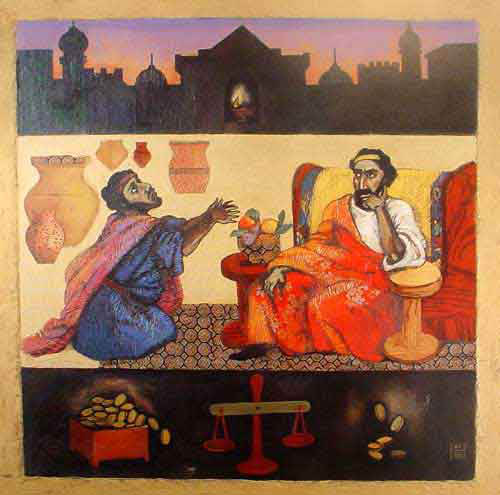
23 “Therefore the kingdom of heaven may be compared to a king who wished to settle accounts with his servants. 24 When he began to settle, one was brought to him who owed him ten thousand talents. 25 And since he could not pay, his master ordered him to be sold, with his wife and children and all that he had, and payment to be made. 26 So the servant fell on his knees, imploring him, ‘Have patience with me, and I will pay you everything.’ 27 And out of pity for him, the master of that servant released him and forgave him the debt. 28But when that same servant went out, he found one of his fellow servants who owed him a hundred denarii, and seizing him, he began to choke him, saying, ‘Pay what you owe.’ 29 So his fellow servant fell down and pleaded with him, ‘Have patience with me, and I will pay you.’ 30 He refused and went and put him in prison until he should pay the debt. 31 When his fellow servants saw what had taken place, they were greatly distressed, and they went and reported to their master all that had taken place. 32 Then his master summoned him and said to him, ‘You wicked servant! I forgave you all that debt because you pleaded with me. 33 And should not you have had mercy on your fellow servant, as I had mercy on you?’ 34 And in anger his master delivered him to the jailers, until he should pay all his debt. 35 So also my heavenly Father will do to every one of you, if you do not forgive your brother from your heart.”

In the name of Jesus. Amen.

Jesus said to Peter, “No, forgiving seven times isn’t enough. Instead, seventy-seven (or it could also be translated ‘seventy multiplied by seven’) times.” Now, Jesus doesn’t mean that you forgive and forgive and forgive, but when you get either to 76 or 489 forgivings (sic) you warn the other person, “Listen buster, you’ve only got one left.” Nope, let the forgiveness flow freely.

Before we consider the parable, we have to do some conversions. Two different servants have two different debts. Servant 1 owes the king 10,000 talents. A talent was originally a unit of weight that later became a unit of coinage, and the value of that coinage would change a lot. Most resources say that one talent is equal to twenty years of pay for the average worker. So, imagine your annual income, double it, and slap five zeros on the end of it. That’s what the first servant owed the king. Even if he lived and worked every day for 2,000 years giving every penny to the king, it would only shave off a 1% sliver off his debt.

Servant 2 owed a debt to servant 1 to the tune of 100 denarii. Now, this is still a significant amount of money. The average worker earned one denarius per day. So, we’re talking about a little over 3 months’ worth of pay. Significant yes, but a manageable amount. It is totally conceivable and reasonable that someone can pay off a debt of 100 denarii.

Now, the three main characters in the parable are obvious: the king, servant 1, and servant 2. But as we consider the parable today, I want you to imagine yourself in the roll of one of the minor characters. Imagine you are one of the other servants.

The king has called you and all the servants who owe him money to the castle. You are standing in line outside the king’s office. You compare debts with the other servants. You are a little nervous because you don’t know what the king is going to do about your debt. Now, imagine you are standing in line behind servant 1 who owed the 10,000 talents, and you know how large his debt is. He goes into the king’s office, but you don’t know what is happening behind that door. You want to catch a glimpse of servant 1 as he comes out because his demeanor will give you an indication of how it is going to go for you. If he’s smiling or skipping, you’d have a sense of relief because you’d know that the king is in a good mood and your meeting with the king might not be so bad.

Finally, the door opens. Servant 1 comes out of the king’s office, he immediately runs over to servant 2, wrings his neck, and demands that the guy pay him everything. What are you going to conclude about how his meeting with the king went? He didn’t come out in shackles to be led to the prison, but he wasn’t happy. Seeing his treatment of servant 2, you would probably assume that the king had not forgiven his debt and demanded full payment. You would probably deduce that the king gave him some time – maybe a couple of weeks or months – to pay off the debt.

Dear saints, that’s the problem of refusing to forgive.

If people don’t know what happens here in this sanctuary, the only clues they have would be to watch how you act when you aren’t here. So, as others watch you, what will they conclude about what has happened here? What would they think about your king? Would they figure that He demanded that you pay? Would they think He is gracious and merciful, or would they assume that He is a King who demands that all debts get paid?

Dear saints, God wants to be known for His goodness. God wants to be known by His mercy. God wants to be known for His willingness to freely forgive. And if you refuse to forgive those who have sinned against you, what does that say about your God and King?

All this is to say, dear saints, that you, as forgiven servants of the King, are called to live out the forgiveness you have in Christ. This can be a difficult thing because it goes against our nature to forgive. But the cure of our unforgiveness doesn’t come from being beaten down by calls to forgive. The cure for our unforgiveness is to have a right understanding the massive debt that each of us owe to God. When we wrongly think that have only a little debt of sin, we can only have a little Savior. Jesus didn’t go to the cross because you were a few bucks short of your heavenly entrance fee. He went to the cross because your sin was so great that you are too dead to even see the gates.

Sin – all sin – is against God (Ps. 51:4; 1 Cor. 8:12). Every day, you and I rack up an unimaginable, incalculable debt of sin. And when God calls you in to settle accounts what does He do? Because of Jesus’ death on the cross, God simply wipes it out. Because of Jesus, as far as God is concerned, your debt of sin never existed.

Jesus completely erased your debt by the shedding of His blood. He went to Calvary, not so you would have enough time to get your act together and become a better person. He went to raise you from your deadness in sin. When you were lost, powerless, and dead, Jesus made all – not just a portion – all of your debt His own. And on the cross, He killed and cancelled that debt. Jesus who knew no sin became sin for you (2 Cor. 5:21) and He bore all your sins in His body upon the cross (1 Pet. 2:24). And now the grave is empty. Your debt of sin has been erased in the death and resurrection of your Savior.

You are forgiven. Jesus didn’t die just to get you to a zero balance; He came to erase your debt and fill your account with His righteousness. His mercy is complete. He has paid and absorbed all your debt, and you owe Him nothing. There is absolutely nothing left for you to pay, and there is nothing you could do to even begin to pay Him back. Even the thought of paying Him back is offensive because what He has done is so complete, so wonderful, and so merciful.

Now, when your neighbor sins against you and you feel the hurt and pain of those transgressions against you, don’t reach out your hands to grab your neighbor by the throat. Instead, let the nail-scarred hands of Jesus remove your hands from around your neighbor’s throat and make you right and at peace with Him and your neighbor.

There is no denying the fact that forgiving others is a difficult thing to do. Sin is a debt, and that debt must be paid. Forgiving others is absorbing the debt that is owed to you. The pain that comes from the sins of others is real and often terrible. It is always tempting to our old nature to hold a grudge, to make them pay, to construct a prison in our minds, and to put the offender into it. But the only thing that prison will ever hold is you. Unforgiveness imprisons you in a space where there is only judgment. Dear saints, unforgiveness is hell.

To forgive means ‘to send away.’ The only way to be freed from the pain and hurt of sin that others commit against you is to forgive it, release it, and send it away.

Forgiving others does not mean you approve what they have done. Forgiveness means that the offense has hurt you, but you won’t return the pain upon them with judgment. And forgiveness isn’t a license for the other person to continue sinning. The biggest lie the devil will ever tell you is that forgiving someone will just encourage them keep sinning against you, taking advantage of you, and making you a doormat. That satanic lie is a sneaky attack on God’s forgiveness. Is God worried about His forgiveness encouraging you to sin? Nope! Absolutely not. He forgives you fully and freely.

Dear saints, God’s forgiveness of you is a living, life-giving thing. No matter how much and how often you come under His debt with your sin, God gives you His mercy and forgiveness. God remembers your sins no more (Jer. 31:34). Because of Jesus, your sins are released from you as far as the east is from the west (Ps. 103:12). God has shown you, what is good and what He requires of you. Do justice, and love mercy, and walk humbly with your God (Mic. 6:8). Let that full, free forgiveness that God has given you in Christ be the key that opens the gates of your forgiveness toward others. Amen.

The peace of God, which surpasses all understanding, will guard your hearts and minds in Christ Jesus. Amen.

Falling Up – Sermon on Luke 18:9-14 for the Eleventh Sunday after Trinity

Luke 18:9-14

9 [Jesus] also told this parable to some who trusted in themselves that they were righteous, and treated others with contempt: 10 “Two men went up into the temple to pray, one a Pharisee and the other a tax collector. 11 The Pharisee, standing by himself, prayed thus: ‘God, I thank you that I am not like other men, extortioners, unjust, adulterers, or even like this tax collector. 12 I fast twice a week; I give tithes of all that I get.’ 13 But the tax collector, standing far off, would not even lift up his eyes to heaven, but beat his breast, saying, ‘God, be merciful to me, a sinner!’ 14 I tell you, this man went down to his house justified, rather than the other. For everyone who exalts himself will be humbled, but the one who humbles himself will be exalted.”

In the name of Jesus. Amen.

Some portions of Scripture are familiar and important enough that all we need to hear is the book and chapter, and our mind recalls most of the content. For example, when you hear someone mention Psalm 23, you have all the sheep and shepherd imagery that the Psalm contains. Maybe you don’t have Psalm 23 completely memorized, but you know the general content. So, I have a pop quiz for you on this last Sunday of August, what comes to mind when you hear Genesis 3? Typically known as ‘The Fall [into Sin].’

It is somewhat unfortunate. Yes, that is when mankind and all creation became infected with sin. And because of that sin, we are born under God’s judgment and condemnation. So, yes, it is a fall. But when we label it ‘the Fall,’ we can easily forget how we fell. Mankind fell by trying to go up. Now, I’m not going to suggest that we rename that chapter in our minds, but I do want you to recognize the direction of the Fall.

God told Adam and Eve to not eat of the tree, but they decided to do it anyway. The devil asked the woman, “Did God actually say, ‘You shall not eat of any tree in the garden’?” Eve responded mostly correctly by pointing out the big downside of eating, “If we eat from it God says we will die.” (Now, she also adds not touching the tree to God’s prohibition against eating from the tree, but that’s for another time), “God told us to not eat it or we would die.” But Satan poo-poos the downside. “You won’t die; instead, your eyes will be opened, and you will be like God knowing good and evil.” The devil lies saying that the sin will only be beneficial to Adam and Eve.

The text goes on to say that the tree looked good for food, it was a delight to the eyes, and it was desired to make them wise and like God knowing good and evil. They both took and ate. They fell into sin, but they fell by trying to go upward. They rose up in pride. They exalted themselves. Believed in themselves. Trusted in themselves. They desired to rise high, up to godly and divine status. Ever since that moment, everyone who has ever been born has the same desire to exalt themselves.

Now, to the parable. Jesus tells this parable to individuals who continue in that line of thinking, they are falling up. They trusted (lit. they ‘persuaded’ or ‘convinced’ themselves) that they were righteous and treated others with contempt. That is why the two men in the parable are so different.

As the Pharisee prays, he is looking around at the lives of others – extortioners, unjust, adulterers, and tax collectors – and at his own life – his fasting and tithing. Now, all these works are, actually, good things. It is good and right to not be like the sinners that surround you, and it is good and right to do the good works that the Pharisee does. The Pharisee’s problem is not his good works. His problem is that everywhere he looks are places where he won’t find Jesus, the Righteous One, who makes sinners righteous. The Pharisee won’t find Christ by looking at his good life, and he won’t find Jesus by looking at the sins of his neighbor. All he sees is his goodness which leads him to pride. And his pride means that he goes home not justified. The Pharisee fell up. He went to the Temple of God, where God had promised to atone for sins, but the Pharisee receives no atonement.

The tax collector does go home justified. Think of all the things the tax collector could have prayed; he could have prayed, “God help me to be more like this Pharisee. Help me to live better, fast better, pray better, and tithe more.” But he doesn’t. The tax collector goes up to the Temple and sees only two things: the just demands of a holy God and his own sinfulness and depravity. He looks at himself where there is no hope and to God where the only hope lies. He sees the gap and cries out for mercy. Our translation records his prayer as, “God be merciful to me, a sinner!” This translation is weak on two points. First, it is not just ‘a sinner’; he prays, ‘the sinner.’ The only sins he sees are his own. Second, the translation of his prayer, ‘be merciful,’ falls short.

Throughout the Gospels, many people call to Jesus, “Lord, have mercy,” or in Greek, “Kyrie eleison.” They ask Jesus to do exactly what He has come to do, to be their Lord who has mercy. It’s a good prayer. But what the tax collector in this parable prays is something similar but importantly different. The tax collector prays to God (lit.), “Be propitiated to me, the sinner.”

To propitiate means to make an atoning sacrifice. And the tax collector prays that God would be made to be, that God would become the atoning sacrifice for him. In the Greek translation of the Old Testament, this word was also used for the mercy seat on the ark of the covenant. The place where the high priest would sprinkle the blood on the Day of Atonement and where God promised to meet with His people (Ex. 25:22; Lev. 16) was called by the same word. Jesus is that place where God makes the atoning sacrifice. 1 John 2:2 says, “[Jesus] is the propitiation for our sins, and not for ours only but also for the sins of the whole world.” Jesus is your Great High Priest who makes the propitiating sacrifice of Himself. 

Now, our problem is that we flip the parable upside down. We easily swap the Pharisees’ prayer with our own version, “God, I thank You that I am not like other men, self-righteous, pretentious, holier-than-thou types, or even like this Pharisee. I don’t take so much pride in my good works.” But when you do that, you are literally being the Pharisee. Repent.

The Pharisee’s problem was not his fasting or tithing, it isn’t even that he was glad that he wasn’t like the “really bad” sinners. His problem was that he trusted in those things and does not trust that Jesus will forgive him and be the propitiation for his sins. 

In the end, it is the tax collector who leaves the Temple with God having become the propitiation for his sins, so he goes down to his house justified. And that is an important point to keep in mind.

The tax collector goes home declared by God to be holy and just no matter how despicable he was. He goes home a changed man. He now goes down to his house to live out a holy life. God could have forgiven and propitiated him and swept him immediately up into heaven like Jesus did with the thief on the cross. But God doesn’t. And God hasn’t done that for you – not yet anyway. The tax collector goes home justified and that makes a difference for him, his family, his neighbors, and for the entire world. 

By God’s grace freely given through Jesus, the tax collector is exalted; he is lifted up. What Jesus says in Matthew 5 about Christians being the light of the world is fitting here. You aren’t the light of the world because you do all the good works of the Pharisee in this parable. Instead, you are forgiven and justified by Jesus who is the light of the world. That forgiveness and mercy joins you to Jesus who is the light of the world. Through the work of the Holy Spirit, you are given the gift of faith and enlightened. The Holy Spirit then places you on a lampstand so that you, the justified, give light to the whole house (Mt. 5:14-16).

Since the Fall, our thoughts have been upward, but God’s thoughts have been downward.  We sinners keep reaching for the heights, but Jesus has come down into the depths to raise you up and seat you with Him in the heavenly places (Col. 3:1-3).

Dear saints, don’t fall up. Don’t exalt your good works as though you are better than others. And don’t exalt your sinfulness as though you are better than the self-righteous because that isn’t humility either. Both of those are falling up. Instead, be exalted down. The most exalted you can be is to be one of the sinners for whom Jesus has come and given His life as a propitiation, an atoning sacrifice. And, dear saints, Christ has done this, and He has done this for you. Amen.

The peace of God, which surpasses all understanding, will guard your hearts and minds in Christ Jesus. Amen.

The Cure – Sermon on Jeremiah 8:4-12 for the Tenth Sunday after Trinity

Jeremiah 8:4-12

4 “You shall say to them, Thus says the Lord:
When men fall, do they not rise again? 
If one turns away, does he not return? 
5 Why then has this people turned away 
in perpetual backsliding? 
They hold fast to deceit; 
they refuse to return. 
6 I have paid attention and listened, 
but they have not spoken rightly; 
no man relents of his evil, 
saying, ‘What have I done?’ 
Everyone turns to his own course, 
like a horse plunging headlong into battle. 
7 Even the stork in the heavens 
knows her times, 
and the turtledove, swallow, and crane 
keep the time of their coming, 
but my people know not 
the rules of the Lord. 

8 “How can you say, ‘We are wise, 
and the law of the Lord is with us’? 
But behold, the lying pen of the scribes 
has made it into a lie. 
9 The wise men shall be put to shame; 
they shall be dismayed and taken; 
behold, they have rejected the word of the Lord, 
so what wisdom is in them? 
10 Therefore I will give their wives to others 
and their fields to conquerors, 
because from the least to the greatest 
everyone is greedy for unjust gain; 
from prophet to priest, 
everyone deals falsely. 
11 They have healed the wound of my people lightly, 
saying, ‘Peace, peace,’ when there is no peace. 
12 Were they ashamed when they committed abomination? 
No, they were not at all ashamed; 
they did not know how to blush. 
Therefore they shall fall among the fallen; 
when I punish them, they shall be overthrown, 
                                    says the Lord.

In the name of Jesus. Amen.

Imagine that you have been in severe pain for two months, so you finally go to the doctor. The doctor asks some questions, examines you, runs some tests, and orders some imaging. After all that, the doctor comes back and says that your blood tests and x-rays show that you have a bacteria that is slowly eating your bones, and if your condition is left untreated it will liquify every bone in your body within six months. We’ll call this infection I completely made up ‘osteoliquiditis.’

You reply to the doctor, “Osteoliquiditis? That sounds completely made up.” But the doctor shows you all sorts of medical journals and studies, and you learn that osteoliquiditis is, in fact, a well-researched, well-studied condition. Your doctor tells you that you can be treated, but the medication will have the side effect of lowering the levels of dopamine in your body reducing your experience of pleasure. You don’t like the sound of that, so you decide to get a second opinion. The second doctor looks over your chart and says, “Yes, this is a classic case of osteoliquiditis. But don’t listen to your first doctor. That medication should never have been approved. Yes, it kills the bacteria that causes osteoliquiditis, but do you really want to have less pleasure in your life? I don’t recommend any of my osteoliquiditis patients take that medication.” You ask, “Then, how should I treat this?” as you hope and pray this second doctor knows of a treatment that kills the bacteria with little to no side effects.

The doctor hands you a Band-Aid, and says, “Here. Put this on, it’ll help you feel better.” You can’t believe your ears and reply, “A Band-Aid for a bone-liquifying bacterial infection? Is this some magical Band-Aid?” The doctor says, “No, it’s just a regular Band-Aid. It won’t do anything to stop or slow the bacteria. But do you remember how, when you were little, your mom would put a Band-Aid on your shin after you bruised it? That Band-Aid did nothing to heal your shin, but it made you feel better because you knew someone cared. This is the same thing.” And the doctor walks out of the room. 

Now, you are left with a decision. You can go back to your first doctor and get a prescription for the pleasure-reducing medicine, or you can slap that Band-Aid on hoping for the placebo as you live out your last six months while the bacteria slowly liquifies every bone your body. So, what do you do? You open the Band-Aid, slap it on, and go about your life. Thus endeth the analogy.

This text from Jeremiah before us today is utterly depressing and almost exasperating. God Himself is mourning the unrepentance of His people. They keep falling headlong into sin and don’t get back up. They turn away, but never return. God isn’t frustrated because His people take one step forward and two steps back. No, instead, they are perpetually backsliding. They abandoned truth and desperately clung to the lies and deceit that their sin isn’t so bad and their pain and suffering wasn’t being caused by their iniquities. They went after their sins with the speed, strength, and determination of a warhorse. But you can hear God’s frustration when He says that the birds know when to migrate. They don’t need to be told to fly south before winter; they just do. Yet God’s people didn’t know the way home. The animals obey God better than the people God created to rule over nature.

What happened? How did things get so bad that God would be so despondent? Why did God’s people take the Band-Aid instead of running back to God for the treatment? Well, the text tells us exactly why. God’s people did not know the rules (lit. the ‘just decrees’) of the Lord. They claimed to be wise thinking they still had God’s Word, but the religious leaders had twisted the Scriptures into a lie. Because God’s people had rejected God’s Word, there was not even the possibility of them having wisdom. Instead of calling God’s people to turn from their sin, the leaders put a Band-Aid on a terminal disease saying, “Peace, peace,” when there was no peace. As a result, God’s people were not ashamed of their sin and did not even know how to blush.

Dear saints, we are no better. The same sins and abandoning of God’s Word in Jeremiah’s day are rampant today, and we don’t have to go outside these walls to find those sins. If we are honest, if we examine ourselves and our actions, thoughts, words, and deeds, we will find the same. Instead of being convicted of our sins, we justify our actions. Instead of turning from sin, we dive headfirst into more transgression. Instead of blushing, we thrive on the dopamine of our pet iniquities and crave after more. Repent.

Dear saints, there is only one cure for our sin and that is the sacrifice of Jesus on the cross. By His blood shed for you, you are cured of your transgressions. Your iniquity is taken away and your sin is atoned for (Is. 6:7). And by His grace, the false pleasures of sin are shown for what they really are. Your lust, greed, and pride are shown to be empty and shallow compared to the freedom that comes from God’s grace. Your idolatry, adultery, gossip, lies, and covetousness are revealed as the stinking piles of dung that they are.

So, come back. Come back to Jesus, your Great Physician, and get the medicine of immortality. Just as Christ wept over Jerusalem in our Gospel lesson (Lk. 19:41-48), Jesus weeps for your repentance that everything He has done for you would be applied to you. Christ comes and clears out the sinful cravings in your life and turns your body into a temple of the Holy Spirit (1 Cor. 6:19). To you who did not pursue righteousness, God has freely given you the righteousness that comes only by faith (Ro. 9:30) bringing you the eternal cure for all your sin.

Dear Branch, that brings me to you. Branch, today you are Baptized. Today, Jesus has joined you to Himself by placing His name upon you (Mt. 28:19) and clothed you with Himself (Gal. 3:27). Branch, in your Baptism, Jesus joined you to His death so that you have a Jesus-kind of death – in other words, a death that doesn’t last long and ends in resurrection (Ro. 6:3-11). Even though you did not seek the cure for your sin, Jesus has freely gifted all of this to you. As those waters ran down your head God healed, restored, and saved you.

So, Branch, and all of you dear saints, do not think that you can find another righteousness. There is no other cure. When you sin, and sin you will, repent and return. Learn and know and grow in God’s Word. When God’s Word tells you that you have slid back into your old ways of sin and pain, come back to Jesus for the cure. When the Scriptures reveal the evil you have in your heart, ask, “What have I done?” and flee to Christ. When there is pain and chaos all around you because of this fallen and broken world, don’t listen to the voices that say, “Peace, peace,” because Jesus is the only true peace. When you recognize the pain and evil of the abominations of sin surrounding you and within you, blush. But don’t stop there. Return to the Savior whose blood gives you the cure for all the evil, pain, and suffering in this world.

Come back to the brightness and glory of Christ’s eternal medicine and grace. Come now to God’s table of love and mercy where He gives you the cure of His Body and Blood given and shed for the forgiveness of all your sin. Amen.

The peace of God, which surpasses all understanding, will guard your hearts and minds in Christ Jesus. Amen.