Enoughness – Sermon on 2 Corinthians 3:4-11 for the Twelfth Sunday after Trinity

2 Corinthians 3:4-11

4 Such is the confidence that we have through Christ toward God. 5 Not that we are sufficient in ourselves to claim anything as coming from us, but our sufficiency is from God, 6 who has made us sufficient to be ministers of a new covenant, not of the letter but of the Spirit. For the letter kills, but the Spirit gives life. 

7 Now if the ministry of death, carved in letters on stone, came with such glory that the Israelites could not gaze at Moses’ face because of its glory, which was being brought to an end, 8 will not the ministry of the Spirit have even more glory? 9 For if there was glory in the ministry of condemnation, the ministry of righteousness must far exceed it in glory. 10 Indeed, in this case, what once had glory has come to have no glory at all, because of the glory that surpasses it. 11 For if what was being brought to an end came with glory, much more will what is permanent have glory.

In the name of Jesus. Amen.

Imagine that you received an invitation to a banquet. You get yourself ready and put on your best suit or dress. You drive to the location and enter the building to find that this banquet is a lot fancier and way more formal than you realized. The crystal chandeliers and candles cast a golden light over an exquisitely decorated room. The tables are set with fine china and crystal flutes. You look at all the other guests and discover that they are wearing either designer tuxedos with cufflinks and cummerbunds or sparkling gowns and jewelry. There you are sticking out like a pigeon in a peacock parade.

You try to mingle with the glittering guests, but they mostly ignore you. The only acknowledgement you get are cold smiles and people saying, “Oh, I love your outfit,” as they turn away laughing and asking each other, “Who’s that guy?” You pull out the invitation, and, sure enough, it’s got your name and address. But you’ve had it. It must have been a mistake. So, you start looking for an exit, one that will allow you to avoid as many people as possible.

As you’re leaving, the host of the gala approaches and calls you out by name saying, “I’m so glad you’re here. I’ve got all sorts of people I want to introduce you to.” You try to explain that you should probably leave because you don’t fit in. You point out that you aren’t as polished as everyone else there and mention how the crowd has already rejected and made fun of you. But the host simply says, “You aren’t here to be fancy. You’re here because I invited you. My choice is enough to make you belong. Just stick with me.” The rest of the evening, he takes you around the room showing you off, bragging about you, and highlighting how important you are to him. He seats you next to himself at the head table. The rest of the evening, your confidence grows. Now, you are treated with respect and honor by everyone else – not because you’ve won them over. Your importance is rooted in the host’s attitude toward you, and his opinion carries a weight that no one can challenge. It is enough.

Dear saints, such is the confidence you have through Christ toward God.

In this text, Paul is defending his office of being an apostle. There were some false teachers in the congregation at Corinth who were saying that Paul didn’t have the authority to say anything in the church. They questioned the sufficiency of Paul’s preaching. They were saying that Paul’s preaching of God’s grace through Christ was not enough. That’s why he says that God had made him sufficient to be a minister of the ‘new covenant’ of the Gospel that points people to Jesus as the Messiah (2 Cor. 3:6). And that’s why Paul goes on in v. 7-11 of this text to compare his ministry of the Gospel to Moses’ ministry under the old covenant.

Now, this would be a really good text to preach at an ordination service as a man is called by God to be a pastor. All pastors, myself included, need to recognize that when they preach, they aren’t doing it by their own authority but by the authority that God has given (1 Pet. 4:11). When God puts a pastor into a congregation, he is there to deliver God’s gifts to God’s purchased and redeemed people.

Pastors are called to speak two different words to their congregations. First, pastors are to preach ‘the letter that kills’ also called here ‘the ministry of condemnation.’ In other words, pastors are to preach the Law. And second, pastors are to preach ‘the ministry of righteousness,’ the Gospel. God sends pastors to declare that people are sinners so they can be pointed to repentance and faith in Christ. That’s the main point of this passage. But what Paul says here can be applied to other callings and vocations as well.

Dear saints, you have been called out of the darkness of your sin into God’s kingdom. You are called to be God’s hands and feet to the people around you so you can render service to them. And you can have confidence as you serve and carry out those vocations. You are not sufficient on your own. God Himself has made you sufficient. In this text, the word translated ‘sufficient’ means enough.

There are all sorts of places we might look to build confidence and find our enoughness, but there is only one legitimate source of confidence. Any other source will lead to bad outcomes. The most common place we look is inside ourselves – our abilities, our eloquence, our strengths or skills. There are certainly productive, able people who are successful at many things. The problem is that when those moments of success come and we think it’s because we’re sufficient in ourselves, pride sneaks in. We start comparing ourselves to others and look down on them. We get puffed up, and when that happens, we’re setting ourselves up for a big fall. Even when you are successful and humble, the devil will attempt to draw your attention back to yourself and your humility, and again, pride sprouts up.

If you to think that you are strong and capable on our own, you will start to think that you can handle the challenges in life by yourself. When that happens, you’ll quickly find that your own strengths and abilities fade and fail. And when you fail, it’s easy to fall into despair.  The devil wants you to be constantly looking at yourself because there you’ll see that your strength and ability isn’t enough to do all that God has called you to do. Any setback or misstep can be used by the demons to paralyze you.

But when God is the source of your confidence, and He is, then, you lack in nothing. Look at the sheer holiness and privilege of your callings – spouses, parents, children, teachers, friends. When you first recognize the massive, holy responsibilities that God has given you, you realize that these things are beyond you. And you aren’t adequate to carry those vocations out. You can’t claim anything – any ability, any strength, any eloquence, any skill – as coming from you. But God Himself has given you everything. He has won and purchased you by giving His Son, Jesus to die on the cross as your Savior. Everything you are, everything you have, every calling and responsibility has been given to you as a gift. And what God has given you is enough.

As citizens of God’s kingdom, recognize that God has given you more than enough, more you can imagine. He has given His gifts in full measure, pressed those gifts down into you to make room for more and His gifts are always running over (Lk. 6:38).

The same Holy Spirit who blew through the upper room at Pentecost now fills you with everything you need to carry out the tasks entrusted to you. The Holy Spirit who abides in and with you is like that host at the gala. He accompanies you and makes you worthy to be in His kingdom. Anyone who questions that worthiness insults Him directly and isn’t worth listening to. God Himself has made you sufficient and enough. 

By His calling, His redeeming, His grace, His sanctifying, He has made you enough. And that is enough. Dear saints, your enoughness is from God, and from God alone. So, go; boldly carry out the tasks that He has given you. Amen.

The peace of God, which surpasses all understanding, will guard your hearts and minds in Christ Jesus (Php. 4:7). Amen.

In Step with the Spirit – Sermon on Galatians 5:25-6:10 for the Fifteenth Sunday after Trinity

Galatians 5:25–6:10

25 If we live by the Spirit, let us also keep in step with the Spirit. 26 Let us not become conceited, provoking one another, envying one another. 

1 Brothers, if anyone is caught in any transgression, you who are spiritual should restore him in a spirit of gentleness. Keep watch on yourself, lest you too be tempted. 2 Bear one another’s burdens, and so fulfill the law of Christ. 3 For if anyone thinks he is something, when he is nothing, he deceives himself. 4 But let each one test his own work, and then his reason to boast will be in himself alone and not in his neighbor. 5 For each will have to bear his own load. 

6 Let the one who is taught the word share all good things with the one who teaches. 7 Do not be deceived: God is not mocked, for whatever one sows, that will he also reap. 8 For the one who sows to his own flesh will from the flesh reap corruption, but the one who sows to the Spirit will from the Spirit reap eternal life. 9 And let us not grow weary of doing good, for in due season we will reap, if we do not give up. 10 So then, as we have opportunity, let us do good to everyone, and especially to those who are of the household of faith.

In the name of Jesus. Amen.

Imagine that you are offered a choice between two pieces of property. You don’t get to build a house or start a business on this property; it’s just a piece of land for you to enjoy. The first plot is total mess. It’s filled with trash that’s gotten piled up along the rusty chain-link fence and around the scraggily, overgrown bushes. There are several rusty machines strewn haphazardly across the lot. Thistles, thorns, and nettles are all over the place. You can see huge anthills. There are wasp nests in the diseased and rotting trees which look like they’re about to fall down at any moment.

The second plot could be on the cover of a magazine. It has a new, perfectly stained wooden fence all around it. There are mature cedar and maple trees that give the property the perfect balance of sun and shade. The grass is green, thick, and meticulously maintained. It has a large garden with rich soil producing all kinds of vegetables. Colorful flowers are blossoming in all the right places. This second property is a little slice of Eden.

Now, which of the two lots would you choose to own? Which would you prefer to have at your disposal on a beautiful afternoon to sit and read a book while sipping your favorite beverage?

Maybe you wouldn’t want either. If you start to think about everything that is required to fix up the first or to maintain the second, both would require a lot of work. Maybe you’d just prefer to be neutral. In reality, there is no neutral. You cannot serve two masters (Mt. 6:24), but you will serve one.

Here, in Gal. 6:8, Paul says there are only two options for the kind of life you will have, Christian. “The one who sows to his own flesh will from the flesh reap corruption, but the one who sows to the Spirit will from the Spirit reap eternal life.” In other words, something is always being sown. It doesn’t matter if your life is currently dilapidated or flourishing – something is being sown and is contributing either to decay and disorder or to beauty and order. A harvest will come. Whatever is sown now will determine either the allure or the repulsiveness of what you harvest later.

So, what are you sowing now? Is it weeds or flowers? Thistles or produce? Chaos or beauty? Trash or nourishment? Disgust or delight? Whatever you sow, you will reap.

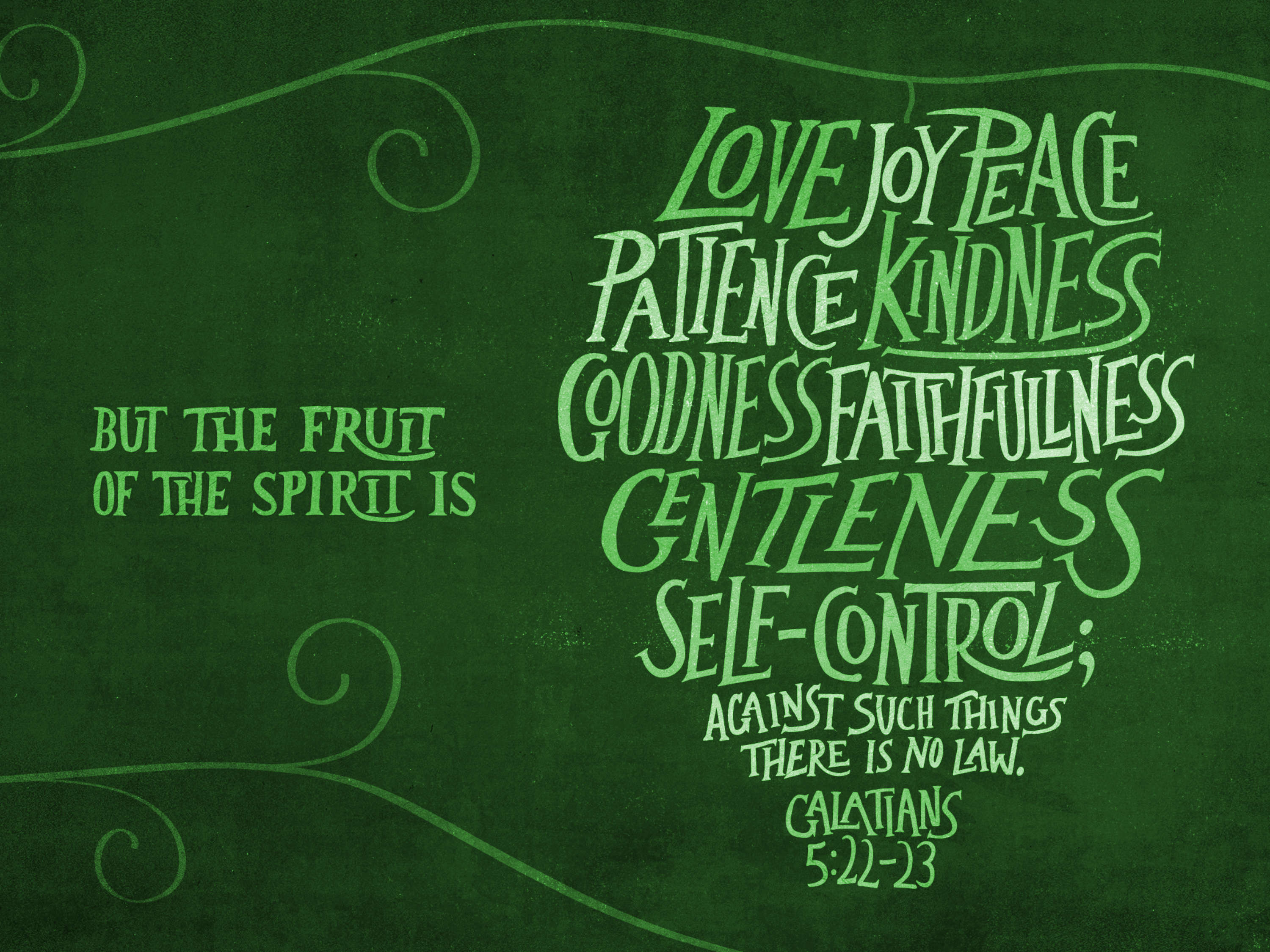
The good news is you are not alone in this sowing. You have help. Jesus says that He has come that you may have life and have it abundantly (Jn. 10:10). And Christ has given you the Holy Spirit, the Helper, who works the fruit of the Spirit within you. Jesus didn’t come to put you in neutral. Again, neutral isn’t possible. You aren’t given the Holy Spirit just so you grow. You are given the Holy Spirit so you can bear a bumper crop of the fruit of the Spirit – the fruit of love, joy, peace, patience, kindness, goodness, faithfulness, gentleness, and self-control (Gal. 5:22-23).

So, keep in step with the Spirit. Paul uses a military term there that refers to a line of soldiers marching in a row and following their commander. Paul lists several things that keep you in step with the Spirit: Restore those caught in transgression with gentleness. Keep watch on yourself. Bear the burdens of others. Share your blessings with the one who teaches God’s Word. Do not growing weary of doing good but persist. As you are given opportunity, strive to do good to everyone – especially to those who are of the household of faith (Gal. 6:1-10).

Yup, that is a lot of work. Keeping in step with the Spirit isn’t a cake-walk. But remember, you are always sowing something. Are you sowing to the flesh, which means you reap corruption? Or are you sowing to the Spirit, which will result in a harvest of limitless blessings now and eternal life in the age to come (Mk. 10:29-30)?

Now, I want to focus on one aspect of keeping in step with the Spirit because there are a couple phrases in this text that have always been a little confusing to me. In Gal. 6:2, Paul says, “Bear one another’s burdens,” but then just after in Gal. 6:5, he says, “Each will have to bear his own load.” It sounds like a contradiction.

When Paul says, “bear one another’s burdens,” he isn’t just saying that you need to just tolerate others. He’s calling you to do something that is inconvenient for you and requires a lot of effort. Bearing burdens was the task of a slave. You, believer, are to be a servant of others. Depending on the situation, that might mean bearing the financial burden of someone by giving them money or bringing them a meal while they are healing from a procedure. It might mean helping them do some work on their house. Bearing someone’s burden might simply mean listening to them as they talk about their worries and anxieties. Each situation will be different, but God has and will continue to give you the wisdom you need so you know how to go about bearing the burdens of others. So then, what do we do with Gal. 6:5, “Each will have to bear his own load”?

Paul uses two different words for ‘burden’ and ‘load.’ You can assist someone with their burden, but ultimately, they are responsible for their own load. Imagine you’re in a group hiking up a mountain. Everyone has their own pack filled with gear and supplies. But certain spots on that hike pose greater difficulty for some than others. A steep slope is easier for tall people like me, but the portions of the hike with low hanging branches are easier for short people like some of you. I’ll let you imagine other scenarios.

When others are injured or exhausted by their burden and come to places that are difficult for them, God calls you to help them get through that portion of the hike. And when you are struggling in other times and at other places, your brothers and sisters are there to assist you. Christians need each other. Yes, every Christian is ultimately responsible for his or her own load, but every Christian is also called to assist one another when the burden of that load is heavy.

Dear saints, you do this for others because you remember what Jesus has, continues, and will do for you forever. Jesus’ way with you could have been harsh. Because of your sin, because of the things you have done and left undone, Jesus could have given up on you. But He hasn’t and won’t. Jesus never wearied of doing good to and for you. He never asked, “Do I really have to heal another leper; expel another demon; forgive and save another from damnation?” He never did that. He never grew weary of you and your burdens. Not once. Not even possible. Instead, He has borne your burdens and carried your sorrows (Is. 53:4).

Christ’s way with you is always to give you His love, His peace. He always extends His patience, kindness, and gentleness. He loves to crown you with honor and glory you didn’t deserve. He loves to give you mercy and forgiveness you didn’t earn. He continually grants you peace that surpasses understanding.

So, keep in step with the Spirit because that keeps you in step with Jesus. He calls to you, “Come to Me, all who labor and are heavy laden, and I will give you rest. Take My yoke upon you, and learn from Me, for I am gentle and lowly in heart, and you will find rest for your souls. For My yoke is easy, and My burden is light”(Mt. 11:29-30).

Christ doesn’t ever promise that you will have an easy life, but He does promise to be with you through all the difficulties of this life and to bring you through (Jn. 16:33). He is with you, and He has blessed you with others to help and assist you.

Dear saints, as we sow to the Spirit, let us keep in step with the Spirit who will see us safely through. Yes, the march is hard, and the path is difficult. But keep in step with the Spirit because the harvest is coming. Amen.

The peace of God, which surpasses all understanding, will guard your hearts and minds in Christ Jesus. Amen.

Fruit – Sermon on Galatians 5:16-24 for the Fourteenth Sunday after Trinity

Galatians 5:16–24

16 But I say, walk by the Spirit, and you will not gratify the desires of the flesh. 17 For the desires of the flesh are against the Spirit, and the desires of the Spirit are against the flesh, for these are opposed to each other, to keep you from doing the things you want to do. 18 But if you are led by the Spirit, you are not under the law. 19 Now the works of the flesh are evident: sexual immorality, impurity, sensuality, 20 idolatry, sorcery, enmity, strife, jealousy, fits of anger, rivalries, dissensions, divisions, 21 envy, drunkenness, orgies, and things like these. I warn you, as I warned you before, that those who do such things will not inherit the kingdom of God. 22 But the fruit of the Spirit is love, joy, peace, patience, kindness, goodness, faithfulness, 23 gentleness, self-control; against such things there is no law. 24 And those who belong to Christ Jesus have crucified the flesh with its passions and desires.

In the name of Jesus. Amen.

Scripture uses many different metaphors when it comes to salvation and being a Christian. There are the optical metaphors of darkness vs. light (Is. 9:2; Jn. 1:5, 3:19; 1 Pet. 2:9) and blindness vs. seeing (Is. 35:5, 42:7; Act. 26:18). There are the medical metaphors of death vs. life (Eph. 2:5; Col. 2:13) and heart of stone vs. a heart of flesh (Ezk. 11:19, 36:26). Scripture uses familial metaphors of adoption (Ro. 8:15; Gal. 4:5; Eph. 1:5), being a son (Mt. 6:8-9; Lk. 15:11f) and child (1 Jn. 3:1-2). There is the metaphor of sheep and shepherd (Ps. 23; Ezk. 34-35; Jn. 10:1-18). There are many, many more, but today, we get the botanical metaphor of fruit.

The thing about fruit is that plants don’t produce fruit for themselves. The main function of a plant’s fruit is so it can reproduce. The fruit provides water and protection for the seeds of the plant. God also designed fruit to be tasty so it would be eaten, and the seed(s) in the plant is spread to produce other plants.

When this text contrasts the flesh and the Spirit, it talks about the ‘works’ of the flesh and the ‘fruit’ of the Spirit. Notice how the works of the flesh are all directed inwardly. These works are self-interested and self-serving. Paul lists 15 “works of the flesh.” The first 3 – sexual immorality, impurity, and sensuality – all have to do with carnal, bodily appetites or a desire for the flesh to assert itself over others. The next 2 – idolatry and sorcery – are sins against God, trying to put the self in place of God. The next 8 – enmity, strife, jealousy, fits of anger, rivalries, dissensions, division, and envy – are all things that separate individuals by prioritizing the self over another. And the final 2 – drunkenness and orgies – are sins of excess. Then, when Paul adds, “and things like these,” he admits that this list isn’t all the works of the flesh. He could have added more.

And Paul says all these works of the flesh are “evident.” You can see them. They are apparent, clear, plain, and obvious. It is certainly easy to see all these things in our world and in our culture. But do you suppose that Paul gives us this list so we can point out other people’s faults? No. If they’re evident, they don’t need to be pointed out. They’re out there for everyone to see. Instead, Paul wants us to see how these things are present in each of us. They are in and of our flesh. And by ‘flesh’ he doesn’t mean our skin, muscles, tissue, tendons, and bones. By ‘flesh’ here, Paul is saying that these things come from the poisonous root of our heart.

If we sinners were an apple tree, every apple we produced would be infected with disease, blight, and worms; it would be rotting, and withering. If you saw a tree like that, you wouldn’t think the problem was the individual apples. You’d know something was wrong with the tree. It has a disease that infects every branch and goes deep down to the roots. That tree needs to be torn down. In other words, we all need to repent.

There is a penalty for these works of the flesh. You don’t need to wonder if you deserve eternity in hell. You can know that you do. Scripture is crystal clear, “Those who (lit.) are doing such things will not inherit the kingdom of God” (Gal. 5:21b).

God be praised, there is a solution, a fix. Christ Jesus has come to deliver you from these works of the flesh. “Those who belong to Christ Jesus have crucified the flesh with its passions and desires” (Gal. 5:24). Christian, God has removed your heart of stone and given you a heart of flesh (Ezk. 11:19, 36:26). He has put a new spirit within you. He has given you the Holy Spirit. And the Holy Spirit produces fruit.

These nine different qualities are called ‘fruit.’ Notice that the word ‘fruit’ is singular. It’s not many fruits like the 15 works of the flesh. But these 9 fruit (sic.) of the Spirit belong together; love, joy, peace, patience, kindness, goodness, faithfulness, gentleness, and self-control. This fruit all grows on the same tree – out of you. And remember that fruit needs time to grow. It isn’t like you can manufacture this fruit artificially or mechanically. No. It needs to be planted, pruned, watered, and nourished (1 Co. 3:6-7).

Remember that the works of the flesh are evident, plain, visible. The same thing isn’t said about the fruit of the Holy Spirit. If you don’t see this fruit, continue to pray that the Holy Spirit will nourish all these things in you. The Holy Spirit will cause that fruit to grow, bloom, ripen, and spread. So, let’s just go through each of these 9 fruit individually. 

Love: This is the chief characteristic of how God is disposed toward you, believer. Scripture explicitly says that nothing can separate you from God’s love for you (Ro. 8:35, 38-39). The Spirit takes God’s love and pours it into your heart (Ro. 5:5). This love of God isn’t just warm, nice feelings; it is action evidenced by Jesus’ sacrificial love for you as He gave His life on the cross. That love of God is given to you so you can give it to others.

Joy: God’s love provides you a sure confidence about the future (Ro. 5:11). Whatever circumstances come your way, you know that you will be in eternal bliss. So, the darkness and pain of this world will cease. That brings joy as well as…

Peace: Your relationship with God is no longer filled with strife. Christ has ended your hostility toward God. You have God’s peace that surpasses understanding (Php. 4:7), and then, you can be at peace with others as well.

Patience: Because you have God’s love which gives joy and peace, you can be patient. Even though the world throws all sorts of chaotic things at you, you can patiently endure it (Ro. 8:25). And beyond that you have…

Kindness: Kindness is the active, merciful goodness that mirrors God’s kindness. You grow to forgive others as God has forgiven you (Eph. 4:32).

Goodness: The word here can also mean ‘generosity.’ Because God has infinite resources, you know that you will receive all good things from Him (Ro. 8:32). This frees you to be God’s conduit to generously give your good things to others.

Faithfulness: Again, God proves His faithfulness to you as He died for you on the cross. He is faithful to keep you from tests and temptations that are beyond your strength (1 Cor. 10:13). This creates a faithfulness in you toward others.

Gentleness: This is an interesting one. Gentleness means that you don’t get excessively angry when things are out of step with how God created the world. There are times when you will need to say hard things to others, things that cause them grief. But you say those hard things in a gentle way which produces repentance. Paul talks about this quite a bit in 2 Cor. 7:8-13. To be gentle requires the final aspect of the Spirit’s fruit…

Self-control: The Holy Spirit leads you to resist your own passions through self-control.

These nine fruit (sic.) of the Holy Spirit are under no compulsion or requirement. Unlike the works of the flesh that exclude sinners from the kingdom of God, these fruits aren’t how you earn entrance to God’s kingdom. Instead, as the Spirit has begun to create these things in you, He will bring all of it to completion (Php. 1:6).

How will the Holy Spirit cultivate this fruit? Jesus has the answer. In John 15:1-5, Jesus says, “I am the true Vine, and My Father is the Vinedresser. Every branch in Me that does not bear fruit He takes away, and every branch that does bear fruit He prunes, that it may bear more fruit. Already you are pruned,” (the ESV says ‘clean’ but it’s the same word Jesus just used). “Already you are pruned because of the Word that I have spoken to you. Abide in Me, and I in you. As the branch cannot bear fruit by itself, unless it abides in the vine, neither can you, unless you abide in Me. I am the vine; you are the branches. Whoever abides in Me and I in him, he it is that bears much fruit, for apart from Me you can do nothing.”

Dear saints, the Spirit will use Christ’s Word and create this fruit in you. Abide, remain steadfast in that Word, and this fruit will be produced. Again, if you don’t see things in your life, know that God continues to work on you, and that fruit will be there for the benefit of others. Amen.

The peace of God, which surpasses all understanding, will guard your hearts and minds in Christ Jesus. Amen.

Father, into Your Hands I Commit My Spirit – Sermon on Luke 23:46 & Psalm 31:5 for Good Friday

In the name of Jesus. Amen.

“Then Jesus, calling out with a loud voice, said, ’Father, into Your hands I commit My Spirit.’ And having said this [Jesus] breathed His last” (Lk. 23:46).

Hebrews 10:31 tells us, “It is a fearful thing to fall into the hands of the living God.” The majority of times that the Bible talks about God stretching out His hand, it means destruction. This is why death is a fearful thing for us. The wages of sin is death (Ro. 6:23). It is appointed for a man to die once, and after that comes judgment (Heb. 9:27). Deep down, everyone knows this (Ro. 1:18-21).

Even the most hardcore atheist who wrongly thinks we are nothing more than a glob of atoms who randomly evolved knows that death is something to be avoided. Over the past few years, we have watched the absurd and, even, the evil things people will do in an attempt to avoid death. But unless Jesus returns first, we will all die (1 Thess. 4:17). And Satan uses the fact that sinners die to his advantage. Hebrews 2:14-15 says that the devil is able to hold all of humanity in bondage and slavery using only one tool, the fear of death. People try to stay alive at all costs and put even the thought of death as far away as possible. Death reminds us that we are not in control and are not in charge.

So, we have to learn from Jesus how to die. Jesus does not go into death as though He is falling into the hands of an enemy, but safely into the hands of His Father. These words of Jesus, “Father, into Your hands I commit My Spirit,” are a quote from Psalm 31:5, and by quoting it, Jesus wants us to consider the entire Psalm. Just like when you hear a line from a song or a movie and, so long as you are familiar with it, the whole song or scene comes to mind, this one line Psalm 31 would have brought the whole Psalm to the minds of those who were there at the cross.

I would encourage you to read all of Psalm 31 tonight with your family and have the crucifixion in mind. For now, hear the first five verses:

1 In You, O Lord, do I take refuge; 
let me never be put to shame; 
in Your righteousness deliver me! 
2 Incline Your ear to me; 
rescue me speedily! 
Be a rock of refuge for me, 
a strong fortress to save me! 
3 For You are my rock and my fortress; 
and for Your name’s sake You lead me and guide me; 
4 You take me out of the net they have hidden for me, 
for You are my refuge. 
5 Into Your hand I commit my spirit; 
You have redeemed me, O Lord, faithful God. 

Psalm 31:1-5 ESV

With His dying breath, Jesus commits Himself into the hands of the Father, and Christ can do this because He knows God is not angry with Him. And you, when you come to the end of your life, when you are breathing your last, you need to know this as well.

God is not angry with you. His anger over your sin has been satisfied. He has redeemed you through Jesus’ death. He has purchased and won you. Christ has paid the price for your sins. Unless you stubbornly hold on to your sins and refuse to believe that Christ has taken your place, there is no wrath, no judgment from God for you. You, Christian, you are a child of God, a child of the heavenly Father because Jesus has paid the price for your sins. You are no longer a sinner, but a one who has been redeemed and purchased by Jesus, the only-begotten Son of God.

By His blood, Jesus has washed away all your sin. You stand before God in the robe of Christ’s righteousness (Is. 61:10). For you, Christian, it is no longer a fearful thing to fall into the hands of a living God because God’s hands were nailed to the cross for you. Those are the hands that you commit yourself to.

There is therefore now no condemnation for you who are in Christ Jesus (Ro. 8:1) because your condemnation is in the past. It has already happened as Jesus died on the cross for you.

Jesus died after praying Psalm 31:5a, “Into your hands I commit my spirit.” And it is important to notice that Jesus only prays the first line because He could not pray the second line, “You have redeemed me, O Lord, faithful God.” Jesus couldn’t pray the second line because He was not redeemed; instead, He was redeeming. He was redeeming you. He was there on the cross paying the price; winning your salvation; forgiving your sins; overcoming sin, death, and the grave. He was doing all of that so you can pray all of Psalm 31:5. The entire thing. Because of what your Lord and Savior has done, you can rightly pray, “Father, into Your hands I commit my spirit; You have redeemed me, O Lord, faithful God.”

You belong to Jesus. He is your Brother and God is your Father. At the end of every day, take up these words, “Almighty God, my heavenly Father, like Jesus did before me, into Your hands I commit my spirit, for You have redeemed me, O Lord, faithful God.” And as you pray that, know that Jesus, who committed Himself into the hands of God the Father, has gone and prepared a place for you so that where Jesus is, you may be also (Jn. 14:3). Amen.[1]The peace of God, which surpasses all understanding, will guard your hearts and minds in Christ Jesus. Amen.


[1] This sermon was adapted from a sermon by Pr. Bryan Wolfmueller.

A Strange Congregation – Sermon on Ezekiel 37:1-14 for the Second Sunday of Easter

Listen here.

Ezekiel 37:1-14

1 The hand of the Lord was upon me, and he brought me out in the Spirit of the Lord and set me down in the middle of the valley; it was full of bones. 2 And he led me around among them, and behold, there were very many on the surface of the valley, and behold, they were very dry. 3 And he said to me, “Son of man, can these bones live?” And I answered, “O Lord God, you know.” 4 Then he said to me, “Prophesy over these bones, and say to them, O dry bones, hear the word of the Lord. 5 Thus says the Lord God to these bones: Behold, I will cause breath to enter you, and you shall live. 6 And I will lay sinews upon you, and will cause flesh to come upon you, and cover you with skin, and put breath in you, and you shall live, and you shall know that I am the Lord.” 

7 So I prophesied as I was commanded. And as I prophesied, there was a sound, and behold, a rattling, and the bones came together, bone to its bone. 8 And I looked, and behold, there were sinews on them, and flesh had come upon them, and skin had covered them. But there was no breath in them. 9 Then he said to me, “Prophesy to the breath; prophesy, son of man, and say to the breath, Thus says the Lord God: Come from the four winds, O breath, and breathe on these slain, that they may live.” 10 So I prophesied as he commanded me, and the breath came into them, and they lived and stood on their feet, an exceedingly great army. 

11 Then he said to me, “Son of man, these bones are the whole house of Israel. Behold, they say, ‘Our bones are dried up, and our hope is lost; we are indeed cut off.’ 12 Therefore prophesy, and say to them, Thus says the Lord God: Behold, I will open your graves and raise you from your graves, O my people. And I will bring you into the land of Israel. 13 And you shall know that I am the Lord, when I open your graves, and raise you from your graves, O my people. 14 And I will put my Spirit within you, and you shall live, and I will place you in your own land. Then you shall know that I am the Lord; I have spoken, and I will do it, declares the Lord.”

Alleluia! Christ is risen!
He is risen indeed! Alleluia!

In the name of Jesus. Amen.

Ezekiel had an odd call to preach to a strange congregation. God brought Ezekiel out by the Spirit into the middle of a valley. It was full of bones, lots of bones. And these bones were dry – very dry. This congregation, maybe we could call it Dry Bones Lutheran, they weren’t loving their neighbor. They weren’t shining the love of Christ to the world. They weren’t improving day by day. They were just lying there, dead and dry.

Then God asks Ezekiel the question: “Son of man, can these bones live?” What kind of question is that? When God asks something like that, what answer can you give? Ezekiel goes the safe route, “O Lord God, You know.” That’s as secure of a reply as you can give.

Well, God gives Ezekiel a call to preach to this strange congregation. “Prophesy over these bones, and say to them, ‘O dry bones, hear the word of the Lord.’” It’s an odd call. How many times did Jesus say after His sermons, “He who has ears, let him hear”? But here, God calls Ezekiel to preach to a congregation of bare bones that don’t even have ears.

“O dry bones, hear the word of the Lord. Thus says the Lord God to these bones: Behold, I will cause breath to enter you, and you shall live. And I will lay sinews upon you, and will cause flesh to come upon you, and cover you with skin, and put breath in you, and you shall live, and you shall know that I am the Lord.”

The sermon is preached. And God’s little sermon appears to be working. There is a rattling. The toe bone connected to foot bone to ankle bone to shin bone to knee bone to leg bone to hip bone to back bone to rib bone to shoulder bone to neck bone to head bone. Now hear the Word of the Lord!

But wait a second. Bones are connected, sinews hold together, muscles have grown, and skin covers. But there is still no breath, no spirit, no life. Wasn’t the sermon supposed to be done? Well, not yet. God has more for Ezekiel to preach. “Prophesy to the breath.”

Now, pause here for just a second. In Hebrew, the word for ‘wind’ and ‘breath’ and ‘spirit’ is all the same word. Ten times in this text, that word comes up. Seven times, it is translated as ‘breath.’ In v. 9, it’s translated as ‘wind.’ But back in v. 1 and again in v. 14, it is translated as ‘Spirit’ referring to the Holy Spirit. But, again, it’s all the same word. And I think, I could be wrong, but I think there is a sense here that God is calling Ezekiel to preach a sermon to the Holy Spirit. “Prophesy, son of man, and say to the Spirit, ‘Come from the four winds and breathe on these slain that they may live.’” In other words, it could be something like, “Holy Spirit, come from the four winds and spirit (as a verb) on these slain, that they may live.”

Ezekiel preaches, and after this second sermon is preached, what do you know? God’s Word works. The Spirit comes into these lifeless bodies that just a couple moments before had been bones, dry bones. Now, they live, and they are an exceedingly great army.

Finally, God tells Ezekiel exactly what was going on. The army is the entirety of God’s people. They were complaining that their bones are dried up and they are cut off. But God promises that He will open their graves and raise them up causing life to come into them. He will bring them into their own land. He will put His Spirit into them, they will live, and they will know that God is the Lord. He promises to do this. He is faithful, and He will do it (1 Thes. 5:24).

Now, this lesson from Ezekiel is fulfilled in our Gospel lesson (Jn. 20:19-31). That first Easter evening, the disciples are all huddled together. They aren’t in a valley, but in the upper room. Sure, they aren’t dry, dead bones, but they are as good as dead because of their fear.

We know they were already afraid of suffering the same fate that Jesus suffered because Jesus said that if they persecuted Him they would be persecuted as well (Jn. 15:20). They know that Pilate had Jesus’ tomb sealed because the religious leaders were worried that the disicples would steal Christ’s body and claim that He had risen (Mt. 27:62-66Jn. 20:19). But even worse, they have heard that Jesus is alive. That might have been their biggest cause of fear because they had all abandoned Jesus when He was betrayed. They weren’t with Him during His trial and crucifixion. They don’t know what a resurrected Jesus means for them. Maybe He’s mad and is coming after them for their failure. You don’t want a Guy who can walk out of the grave as your enemy.

But then, Jesus enters the room even though the doors were locked. And what does He do for this little congregation dead in fear? He shows them His hands and side as He preaches, “Peace be with you.” That little band of dry, dead disciples come together to see Christ’s wounds and become glad. But at this point, they’re still like those bones, muscles, sinews, and skin that come together in Ezekiel. But they still have no life, no spirit.

So, Jesus has more to preach to them. And the second sermon starts the same as the first, “Peace be with you. As the Father has sent Me, even so I am sending you.” Jesus breathes on them. Christ spirits them. He gives them the Holy Spirit, just like in Ezekiel’s second sermon. But we have to pause a moment first. When Jesus says He is sending the disciples just like God the Father had sent Him, what does He mean? What are they to do?

Because God sent Jesus to do a lot of things. God sent Jesus to earth to be both God and Man. God sent Jesus to live a perfect life of obedience. God sent Jesus to preach and teach. God sent Jesus to do miracles. And most importantly, God sent Jesus to be the once-for-all sacrifice for sins. God sent Christ to be the Lamb of God who takes away the sin of the world (Jn. 1:29). God sent Jesus, who knew no sin, to be sin (2 Cor. 5:21). God sent Jesus to die on the cross for our sin and rise again for our justification (Ro. 4:25). God sent Jesus to do all of that, but Jesus isn’t saying that He is sending the disciples to do any of those things. 

That’s why Jesus gets very specific after He tells the disciples that He is sending them just as the Father had sent Him. These disciples are sent, just as Jesus had been sent, to do something very specific. Jesus says, “If you forgive the sins of any, they are forgiven them; if you withhold forgiveness from any it is withheld.”

God had sent Jesus to proclaim God’s mercy and forgiveness, and that is what Jesus is saying that He is sending the disciples to do. Jesus sends them out with the Holy Spirit to forgive sins. And this call is given, in the first place to these apostles (‘apostle’ is the term Jesus uses when He says, “I am sending you,” it’s lit.“I’m ‘apostle-ing’ you.”). And this call is extended to pastors who carry on the apostolic ministry. But this call even extends to all Christians who have been given the Holy Spirit and confess the name of Jesus.

So, what does this all mean? When we consider this Old Testament lesson and its fulfillment in our Gospel reading, what do we learn?

First off, as a pastor, that text from Ezekiel has always been comforting to me. It shows that God’s Word will always accomplish what God sends it to do. No matter how dead a congregation seems to be, God will work through His Word to bring about more than you or I could ever imagine. And just to be clear: I haven’t ever thought you are just a valley of dry bones. You were served well and faithfully by those who came before me. But even if you were nothing more than a bunch of dry bones, God’s Word working through the power of the Holy Spirit is effective to breathe life into you.

But let’s go even beyond that. Know that God has caused you to live. God has come and proclaimed the peace of Christ’s forgiveness to you. When Jesus preaches twice to the disciples, “Peace be with you,” I think the peace that we should think of is the peace of Christ’s forgiveness because that is the peace that Christ gives to all of us dry-bones sinners. Christ has given you the Holy Spirit. And Christ has also called you to be forgivers and proclaimers of that same peace in this world.

So, when people come to you and tell you about their problems, when they complain because they feel the weight of their sin, give them Christ’s peace. Proclaim that same peace to them. It doesn’t matter if they are worried about their kids, their health, their finances, their marriage, the state of the country, whatever it is, you can proclaim, “Peace be with you.” And point them to the cross. Point them to what Jesus has done to forgive them of their sins. You can do this because Jesus has called you to do so.

You see, Jesus Himself is part of the army that God has raised up. Christ became a member of those bones that seemed defeated. He went to the grave defeated. But, of course, He was raised alive, victorious over the death. And Christ has gone before you proclaiming peace to this fallen world full of sin. So, follow after Him proclaiming that same peace and forgiveness in His name.

Then watch as God raises dead, dry bones. Watch as God puts His Spirit within those who were dead in sin and know that He is the Lord. He has spoken and He will do it.

Alleluia! Christ is risen!
He is risen indeed! Alleluia!

Amen.

The peace of God, which surpasses all understanding, will guard your hearts and minds in Christ Jesus. Amen.

The Sword – Sermon on Luke 2:22-40 for the First Sunday after Christmas

Listen here.

Luke 2:22-40

22 And when the time came for their purification according to the Law of Moses, they brought him up to Jerusalem to present him to the Lord 23 (as it is written in the Law of the Lord, “Every male who first opens the womb shall be called holy to the Lord”) 24 and to offer a sacrifice according to what is said in the Law of the Lord, “a pair of turtledoves, or two young pigeons.”

25 Now there was a man in Jerusalem, whose name was Simeon, and this man was righteous and devout, waiting for the consolation of Israel, and the Holy Spirit was upon him. 26 And it had been revealed to him by the Holy Spirit that he would not see death before he had seen the Lord’s Christ. 27 Jesus presented in the Temple SimeonAnd he came in the Spirit into the temple, and when the parents brought in the child Jesus, to do for him according to the custom of the Law, 28 he took him up in his arms and blessed God and said,

29 “Lord, now you are letting your servant depart in peace,
according to your word;
30 for my eyes have seen your salvation
31 that you have prepared in the presence of all peoples,
32 a light for revelation to the Gentiles,
and for glory to your people Israel.”

33 And his father and his mother marveled at what was said about him. 34 And Simeon blessed them and said to Mary his mother, “Behold, this child is appointed for the fall and rising of many in Israel, and for a sign that is opposed 35 (and a sword will pierce through your own soul also), so that thoughts from many hearts may be revealed.”

36 And there was a prophetess, Anna, the daughter of Phanuel, of the tribe of Asher. She was advanced in years, having lived with her husband seven years from when she was a virgin, 37 and then as a widow until she was eighty-four. She did not depart from the temple, worshiping with fasting and prayer night and day. 38 And coming up at that very hour she began to give thanks to God and to speak of him to all who were waiting for the redemption of Jerusalem.

39 And when they had performed everything according to the Law of the Lord, they returned into Galilee, to their own town of Nazareth. 40 And the child grew and became strong, filled with wisdom. And the favor of God was upon him.

In the name of the Father and of the Son and of the Holy Spirit. Amen.

Merry Christmas! Today is the sixth day of Christmas, so make sure you have enough room in your house or yard for your six geese a-laying. Someone will bring them by sometime later. Probably, most people you come across think Christmas is over and done with, but not here in church. The Church is right in the middle of celebrating Christmas. In the Church, we get to enjoy Christmas until next Sunday when we remember the visit of the wise men on Epiphany.

This text today has a lot going on, and we could focus on so much. But we are going to consider mainly what Simeon says to Mary in v. 34-35. Listen to those words again, “Behold, this Child is appointed for the fall and rising of many in Israel, and for a sign that is opposed (and a sword will pierce through your own soul also), so that the thoughts from many hearts may be revealed.”

First, Jesus is appointed for the fall (or ‘ruin’ or ‘downfall’) of many. In other words, many will reject Jesus to their damnation. But Jesus is also appointed for the rising of many. That word, ‘rising,’ is the word that also gets translated as ‘resurrection’ when Jesus says, “I am the resurrection and the life”(Jn. 11:25). Many will trust in Jesus and from Him receive forgiveness, salvation, resurrection, and eternal life.

Simeon & Presentation of Jesus in the TempleThis forty-day-old Jesus is going to bring a division between believers and unbelievers. Simeon, inspired by the Holy Spirit, says this division comes because what a person does with Jesus will reveal the thoughts of their heart. The division falls in one of two ways: many will oppose and reject Jesus to their fall, to their ruin, and to their damnation, and many will trust in Him to their resurrection and eternal life.
But there is one more phrase from Simeon’s words to Mary that we haven’t touched on yet. It is the phrase in parenthesis. “A sword will pierce through your own soul also.” And this is what we are going to pull apart and consider for the rest of the sermon.

Typically, the understanding of that phrase from Simeon is understood to mean that Mary is going to be very sad when she stands at the cross and watches her Son suffer the wrath of God against all sin. Now, I don’t want in any way to diminish Mary’s sorrow at the cross. But if that is what Simeon is saying there, it is very out of place. Simeon is focusing on the division and separation that Jesus will bring between believers and non-believers. So, for him to tell Mary that she is going to be very sad at some point would be odd.

A better understanding is that Mary is going to be divided even within herself because of Jesus. Not only is Jesus going to challenge, confront, and expose those who reject Him. Jesus is also going to challenge, confront, and expose those who believe in Him and are Christians. Now, Mary is a Christian. She believes and trusts in Jesus. God had told her that she was bearing the Messiah and Savior. But Mary, and all Christians (so you too), all Christians are going to be divided within themselves because of Jesus.

And that is where this sword that Simeon talks about comes in. What is this sword? The book of Hebrews helps shed some light on Simeon’s words. Listen to this verse, you are probably familiar with it: Hebrews 4:12“For the word of God is living and active, sharper than any two-edged sword,piercing to the division of soul and of spirit, of joints and of marrow, and discerning the thoughts and intentions of the heart.”

Do you see how similar that is to Simeon’s words?

God’s Word is like a scalpel that divides between soul and spirit. Usually in English, soul and spirit are synonyms. The Bible will even use the two as synonyms (Lk. 1:46-47; 1 Pet. 3:19; Rev. 6:9). You aren’t made up of three things – body, soul, and spirit. You are made up of two things – body and soul or body and spirit. But there are times – and Heb. 4:12is one of them – where Scripture makes a distinction between your soul and your spirit.

When the Bible does make a distinction between soul and spirit, usually the soul will refer to your thoughts, emotions, personality, and inward life. Your soul is who you are. It is your personality, and it is wrapped up with your body. If your body has a traumatic injury, it changes who you are. So your soul is shaped by your past, by your upbringing, by important people in your life.

On the other hand, your spirit different. Your spirit is who you are from God’s perspective. Before you were a Christian, your spirit was dead in sin and trespasses (Eph. 2:1f), but your soul was not dead. When you were born again, your spirit was reborn. Remember when Jesus says to Nicodemus (Jn. 3:6), “That which is born of the flesh is flesh, and that which is born of the [Holy] Spirit is spirit”(also, see Ro. 8:16).

So, God causes your spirit to be born again. You are saved, reborn, renewed, forgiven, perfect, and sinless by the washing of regeneration and renewal of the Holy Spirit (Tit. 3:5). When God looks at you, He sees your spirit which has been washed and renewed. So, now, back to Heb. 4:12, the Word of God is a sword that is sharp enough to distinguish between your soul and spirit.

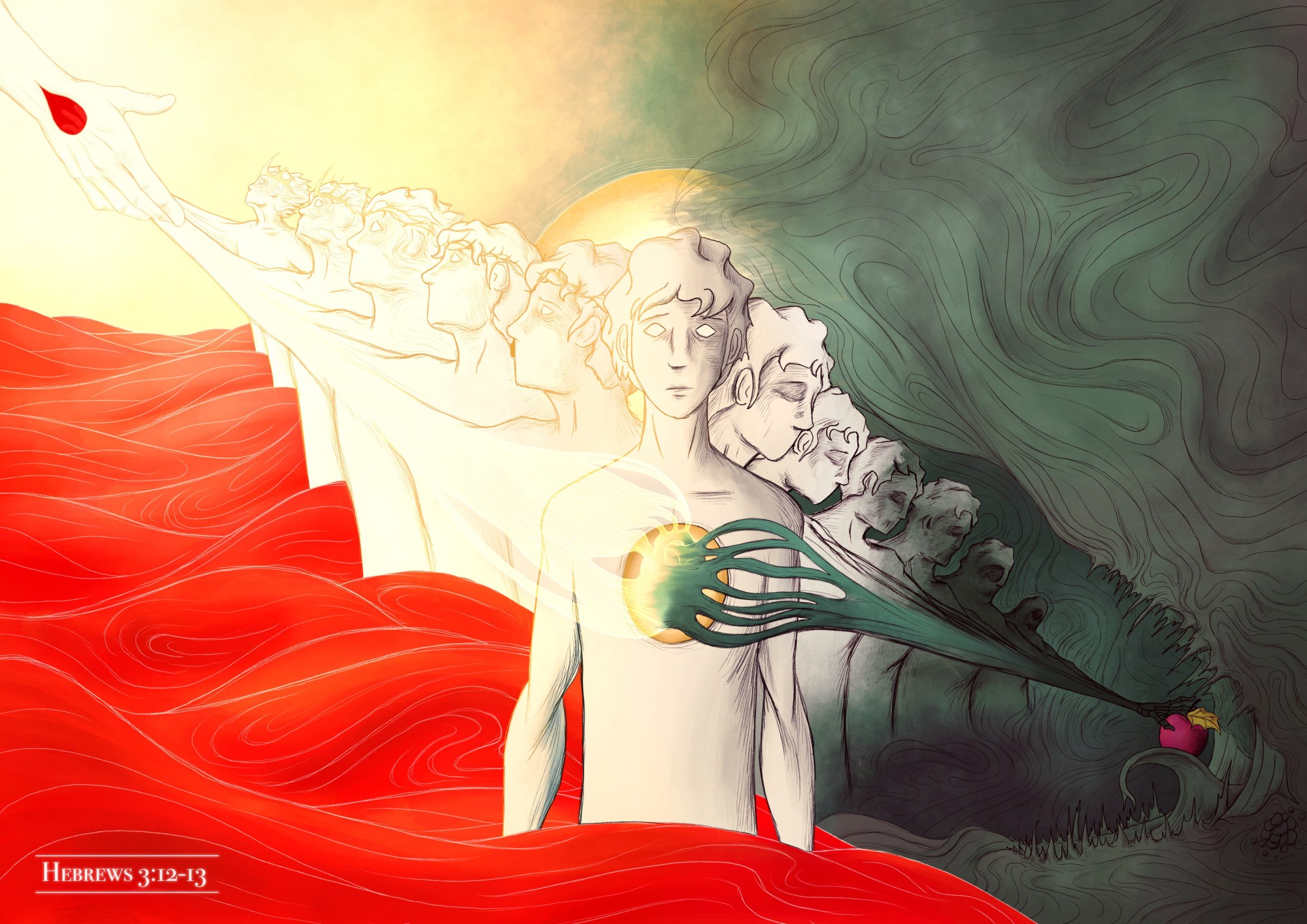
Hebrews 3_12-13 RenewedThere can be, and often is, a conflict between how God sees you in your reborn spirit and how you see yourself in your soul – your thoughts, and emotions. You have probably experienced this. Part of you, your spirit, wants to live a certain way. You want to keep God’s commands, you want to live a God-pleasing life, you want to love your neighbor, etc. But part of you, your soul, doesn’t. Your soul would rather make sure you are comfortable and doesn’t really care about what God has commanded or what would benefit others. Paul talks about this conflict in Ro. 7(:7-25)where he wants to do good, but instead he keeps doing the sinful thing that he hates.

This is why, dear Christian, you need the Word of God. The Word of God is sharper than any two-edged sword. It can cut across even your soul and spirit. The Word of God will distinguish what is right, good, and holy that has come from God. And it will distinguish what is sinful and your soul tries to hold on to but needs to let go.

In other words, the Word of God does surgery on you, Christian. Like a surgeon cutting out and removing a tumor leaving the good, healthy tissue behind, the Word of God will cut out the pollution of sin and leave behind what is good and right. Those things that you thought were normal and did all the time, but they really harm you and your neighbor, the Word of God wants to cut those things out. And those things that are right and good and come from God, the Word wants those things to remain.

Michelangelo Sculpture Quote.jpgThe artist Michelangelo (not the Ninja Turtle) used to say that when he looked at a hunk of marble, he didn’t see big rock. Instead, he saw the sculpture that he was going to free from the rest of the rock that he would eventually chip away. He would say that he wasn’t creating a sculpture, he was just getting rid of all the rock that wasn’t part of the sculpture. That is somewhat the idea in the verse from Hebrews about the Word of God doing the work of dividing soul and spirit.

So, here is the picture. You might think that you are just fine. You are better than others and don’t need forgiveness like they do. That is the rock and debris of your sinful soul. Repent of that. God’s Word is sharp and will cut away the veneer of your pride and arrogance. The Word of God will remove all of that and mold and shape you into the person God wants you to be.

Or, on the other hand, maybe you think that you are worthless and unlovable. Sometimes, you and I even imagine that those thoughts of worthlessness are a good work. But, really, that is just the other side of pride and arrogance. Repent of that too. That is not how God sees you, Christian. Jesus was not wasting His time when He died on the cross for you. He loved and valued you and was cleansing you by the shedding of His blood. So, the sharp Word of God comes along and cuts away that wrong idea that you are worthless and unlovable.

For about a month now, I’ve been inviting you to join me in 2019 to read through the entire Bible. I hope you take me up on that invitation. There will be times where it will be painful and difficult. But remember that God’s Word isn’t just a bunch of words like any other book. God’s Word is always doing what God wants it to do.

May your Lord and Savior continue His work of molding and shaping you through His Word this coming new year. Amen.

The peace of God, which surpasses all understanding, will guard your hearts and minds in Christ Jesus. Amen.