Completed – Sermon on Matthew 5:17-26 for the Sixth Sunday after Trinity

Matthew 5:17–26

17 “Do not think that I have come to abolish the Law or the Prophets; I have not come to abolish them but to fulfill them. 18 For truly, I say to you, until heaven and earth pass away, not an iota, not a dot, will pass from the Law until all is accomplished. 19 Therefore whoever relaxes one of the least of these commandments and teaches others to do the same will be called least in the kingdom of heaven, but whoever does them and teaches them will be called great in the kingdom of heaven. 20 For I tell you, unless your righteousness exceeds that of the scribes and Pharisees, you will never enter the kingdom of heaven.

21 “You have heard that it was said to those of old, ‘You shall not murder; and whoever murders will be liable to judgment.’ 22 But I say to you that everyone who is angry with his brother will be liable to judgment; whoever insults his brother will be liable to the council; and whoever says, ‘You fool!’ will be liable to the hell of fire. 23 So if you are offering your gift at the altar and there remember that your brother has something against you, 24 leave your gift there before the altar and go. First be reconciled to your brother, and then come and offer your gift. 25 Come to terms quickly with your accuser while you are going with him to court, lest your accuser hand you over to the judge, and the judge to the guard, and you be put in prison. 26 Truly, I say to you, you will never get out until you have paid the last penny.

In the name of Jesus. Amen.

This Gospel reading today is all Law. These verses begin a long section of the Sermon on the Mount where Jesus is, basically, giving a long commentary on the Ten Commandments which runs all the way to the end of chapter 5 – thirty-two verses worth of our Lord’s teaching on the Ten Commandments. Now, God’s Law, which is succinctly given to us in the Ten Commandments (Ex. 20:1-17), does a couple different things.[1] Let me just briefly tell you what they are before we focus in on one.

First and foremost, God’s Law shows us how creation works. It reveals what is good in this life. In other words, the Commandments teach you how to be happy and how to live in perfect harmony with God, harmony with your neighbor, and harmony with the rest of creation. Because God’s Law does this, you can think of it as a ‘curb,’ and keep that term in your mind because we’re going to come back to it in just a bit.

Second, because the Commandments teach us how creation works, they also show us where we are living in a way that is contrary to how creation works. The Law shows us how we have violated God’s will, how we have offended Him, and have earned His wrath because of our sin. In other words, the Law accuses us. It stands there like a perfect, clear mirror showing us what we really look like, and it isn’t a pretty picture.

As far as your salvation is concerned, this is the most important thing the Law does. It accuses you and exposes the fact that you are not what you are created to be. So, when you see yourself in the mirror of God’s Law, run to Him in repentance seeking His mercy which He freely gives to you for the sake of Jesus’ death and resurrection.

Again, as far as your salvation is concerned, this is the most important thing God’s Law does. But! Make sure you notice that the Law is only a mirror because of that first function, the ‘curb,’ which again simply shows us how God has ordered creation.

So, back to the ‘curb.’ Unless you have really poor spatial awareness, you probably don’t think about curbs very often. Maybe, you hit the curb when you’re driving your spouse’s vehicle that has a longer or wider wheelbase than you are used to, but that curb just bumps you back onto the street keeping you off the sidewalk and lawns. Typically, if you hit a curb when you’re driving, it’s no big deal. It just means you’ll need to get your tires realigned a bit sooner.

But know that there are different kinds of curbs. If you’re driving on I-29 or Hwy. 2, there aren’t what we normally call curbs, but there are those rumble strips that shake the car and make a loud noise to keep you from straying off the road. You might hit those rumble strips periodically on a curve or when the wind is blowing exceptionally hard. But there are still other curbs. If you’re driving on the freeways in the Cities, the curb might be a thick, four-foot concrete wall to keep the traffic traveling in opposite directions from colliding. Those, you avoid, and, hopefully, you’ve never hit or scraped one of them because it’ll do extensive damage to your car. Rumble strips, normal neighborhood curbs, and concrete barriers are all types of “curbs” that keep vehicles where they should be – on the road and away from danger.

Now, take that idea of those different types of curbs to God’s Law and the Ten Commandments. We might hear the 5th Commandment, “Thou shalt not kill,” and think of the curb of the 5th Command as the thick, four-foot concrete barrier. It’s big, but it’s also quite easy to avoid running into it. You can always see it and know that hitting it would cause significant damage. Because the 5th Command is so big and impending, you easily avoid it. But just because you’ve never physically murdered someone, don’t think that you’re righteous according to the 5th Command.

Here, in this Gospel text, Jesus says that the 5th Command is also a regular curb. Christ says, “Don’t relax on this command because everyone who is angry with his brother is also guilty of murder” (Mt. 5:22a). Jesus shows that the 5th Command isn’t just a concrete barrier to keep us from physically murdering someone, it’s also a curb that keeps us from being angry toward our neighbor. Again, when you’re driving your vehicle, you might bump a curb a couple times a week or once a month. But just because you don’t think much about your anger toward others doesn’t mean that God doesn’t notice. Even nudging the curb of anger toward your neighbor makes you liable to judgment and earns you an eternity in hell.

Think back to Genesis 4. Before Cain murdered Abel, God asked Cain, “Why are you angry?” (Gen. 4:6). Even though God hadn’t yet given the command, “Thou shalt not kill,” God was warning Cain there with the 5th Command because Cain was angry. But Cain blew right over the curb of anger that God had constructed and smashed into the concrete barrier of murder.

Jesus goes even further and tells us about the 5th Command rumble strips. Calling someone a fool is the same as murder (Mt. 5:22b). And Jesus still isn’t done. Christ teaches us that the 5th Command demands that if we remember that someone has something against us that we must go to them and try to reconcile, or we are violating the 5th Command (Mt. 5:23-24).

When it comes to keeping the 5th Command, it’s not enough for you to not physically murder someone or never be angry. It’s not even enough for you to never call someone a fool. You also need to seek reconciliation with others who are angry against you. Otherwise, you have 5th Commandment blood on your hands. Jesus is teaching here that you’ve run into all kinds of 5th Commandment curbs. You do it every day. And because of that, you are guilty before God and liable to His eternal judgment.

Jesus, who was the One who spoke the Ten Commandments, clearly spells out what they mean. You could say that He is giving us the “fine print” of the Commands explaining the full, complete picture of what they demand. But don’t misunderstand that either. It isn’t as though the Ten Commandments weren’t enough. They are enough. Imagine you told your teenage kid to clean the kitchen, and all he does is wipe down the exposed counters and leaves a pile of dishes by the sink. (To be clear, this is not an example from my household. My kids know better.) You come into the kitchen and see all the greasy, grimy pots and pans. You’d rightly get after him and say, “I told you to clean the kitchen. Get back in there.”

Here, when Jesus teaches us the “fine print” of the Ten Commandments, we are left with no excuse for hitting any of the curbs of any of the Commandments. Christ says, “Whoever relaxes one of the least of these commandments and teaches others to do the same will be called least in the kingdom of heaven. You need a righteousness that exceeds the goodest [sic.], most moral person you know of, or you will never enter the kingdom of heaven” (Mt. 5:19-20). And when Jesus talks about the “least command,” He is not saying that the Ten Commandments have a ranking where some are more important and some less. No! Christ is saying that the tiniest infraction of any of the Commandments, even refusing to reconcile with someone who is angry with you, makes you unrighteous and means that you are outside the kingdom of heaven. In other words, we’re all in deep, deep trouble. Repent.

Repent and know that Jesus completes and fulfills the Commands in another way than just explaining them more fully. Jesus also keeps all the Commands, all of God’s Law, perfectly and completely – for you. Every aspect of every command was perfectly obeyed by Jesus. And His obedience is yours through faith in Him.

Think of it this way: God is going to grade you on one test, and that is the test of keeping His Law, and you need to get a perfect score, 100%, never hitting any curb – ever, or you will spend eternity in hell. Even with an open book, the best, most righteous person is going to bomb that test. Maybe get a score in the teens or something. But also know God has told you that you can use a partner to take the test. Through faith, Jesus is your Partner for this final exam, and He answers every demand of the Law perfectly. Through faith in Him, His full, complete righteousness is yours. 

And now, He invites you to receive that righteousness as He gives you His righteous Body to eat, and His holy, cleansing, forgiving Blood to drink. So, come to His table and receive His perfect righteousness. Amen.

The peace of God, which surpasses all understanding, will guard your hearts and minds in Christ Jesus. Amen.


[1] The Formula and Epitome of Concord Art. VI. both talk about the three uses of the Law – 1) curb, 2) mirror, and 3) guide. This sermon is written with the understanding that the 2nd and 3rd uses of the Law are both subsets of the 1st. So, I’m not denying the 3rduse of the Law in any way. Instead, it is a clear extension of the 1st use as is the 2nd.
The Ten Words – Sermon on Exodus 20:1-17 for the Sixth Sunday after Trinity

Exodus 20:1-17

1 And God spoke all these words, saying, 

2 “I am the Lord your God, who brought you out of the land of Egypt, out of the house of slavery. 

3 “You shall have no other gods before me. 4 You shall not make for yourself a carved image, or any likeness of anything that is in heaven above, or that is in the earth beneath, or that is in the water under the earth. 5 You shall not bow down to them or serve them, for I the Lord your God am a jealous God, visiting the iniquity of the fathers on the children to the third and the fourth generation of those who hate me, 6 but showing steadfast love to thousands of those who love me and keep my commandments. 

7 “You shall not take the name of the Lord your God in vain, for the Lord will not hold him guiltless who takes his name in vain. 

8 “Remember the Sabbath day, to keep it holy. 9 Six days you shall labor, and do all your work, 10 but the seventh day is a Sabbath to the Lord your God. On it you shall not do any work, you, or your son, or your daughter, your male servant, or your female servant, or your livestock, or the sojourner who is within your gates. 11 For in six days the Lord made heaven and earth, the sea, and all that is in them, and rested on the seventh day. Therefore the Lord blessed the Sabbath day and made it holy. 

12 “Honor your father and your mother, that your days may be long in the land that the Lord your God is giving you. 

13 “You shall not murder. 

14 “You shall not commit adultery. 

15 “You shall not steal. 

16 “You shall not bear false witness against your neighbor. 

17 “You shall not covet your neighbor’s house.“You shall not covet your neighbor’s wife, or his male servant, or his female servant, or his ox, or his donkey, or anything that is your neighbor’s.”

In the name of Jesus. Amen.

Dear saints, you are familiar with this text – or, at least, you should be. We know these verses as “the Ten Commandments” – even though Scripture itself never refers to them as the Ten Commandments. (More on that in just a bit.)

We have grown used to thinking that God only gave the Ten Commandments to show us our sin so that we repent and believe in Jesus for the forgiveness of our sin. Saying that isn’t wrong – not in the least! Scripture says that one of the reasons God gave us the Law is to tell us what we must and have failed to do (Ro. 7:7-12). That’s how Luther uses them in his Small Catechism, and in his hymn on the Ten Commandments that we just sang, he does the same thing, “You have this Law to see therein / that you have not been free from sin, / but also that you clearly see / how pure toward God your life should be.” But God gave the Ten Commandments to do more than simply show us our sin.

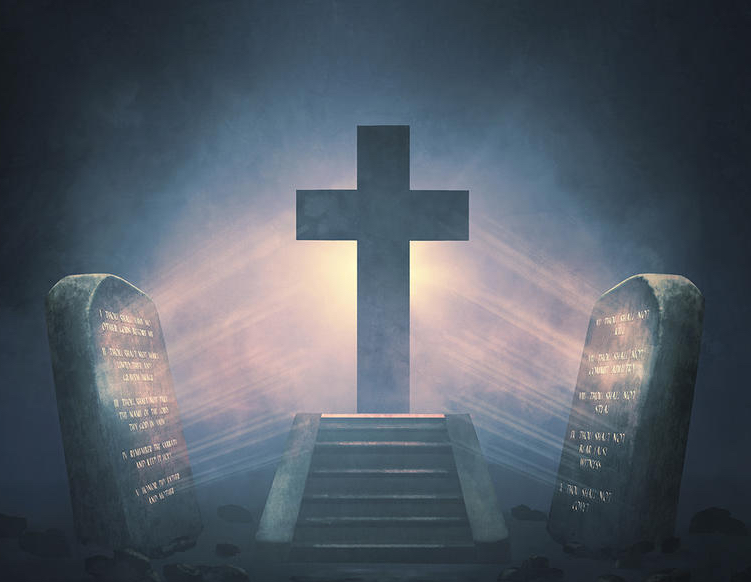
Scripture calls this text “the Ten Words” (Ex. 34:28; Dt. 4:13, 10:4). The Bible refers to them as “the Ten Words” because only one of them is actually an imperative (command) – “Honor your father and mother.” All the rest are indicative (statements). A perfectly legitimate – and, admittedly, shorthand – way to understand these verses would be, “You will have no other gods before Me…. You will not misuse My Name…. You will keep the Sabbath holy…. Honor your parents. You will not murder, commit adultery, steal, lie, covet.”

As God’s people heard these words at the base of Mt. Sinai, they would have understood three distinct things at the same time. First, they would have understood that this is what God demands they do, which is how we normally understand them. Second, they would have heard them as a description of who they are and how God sees them. Third, they would have heard these as God’s promise to work in them to make them all these things (Php. 1:6).

Think of it this way: A boy might be pestered and bullied by a girl at school so much that he finally retaliates and shoves her to the ground. (You boys, don’t do that because that’s wrong.) They boy’s parents get called to the principal’s office and learn about the altercation. When they get home, the parents send the boy to his room as punishment. Afterwards, the father goes into his son’s room for ‘the talk’ and says, “We do not shove, hit, or be mean to girls.”

Notice what that speech from the father does. First, by saying, “we,” the father is still showing his son that they are in a relationship. The son hasn’t been abandoned or disowned; they belong together and are identified together as a unit. Second, the father is also saying that as a unit, they act and behave a certain way – they don’t use physical force against girls. Also, the boy knows that his dad is forbidding him to use physical force against a girl. All three of those things get communicated at the same time. The Ten Words here work just like that.

Let’s stick with that analogy about the boy and the girl bully to get one more thing about the Ten Words across. As soon as the boy pushed the girl to the ground and saw that she was dirty, dusty, and hurt, the boy’s conscience kicked in because he knew what he had done was wrong even before he pushed her. That rule or command, “Don’t hurt girls,” was already known by the boy even if he had never been taught it. The girl’s pain simply awakened his conscience. The same thing is true for these Ten Words (Ro. 7:7-8).

Cain knew it was wrong to kill Abel (Gen. 4:1-9) even though God hadn’t given the commandment, “Thou shalt not murder,” yet. Joseph knew not lie with Potiphar’s wife (Gen. 39:7-9) even though God hadn’t given the command, “Thou shalt not commit adultery.” Esau accused Jacob of cheating him (Gen. 27:36), and Jacob accused his father-in-law, Laban, of cheating him (Gen. 31:7) even though God hadn’t given the commandment, “Thou shalt not steal.” Abraham knew it was wrong to lie about Sarah being his sister (Gen. 12:11-20, 20:1-14) even though God hadn’t given the commandment, “Thou shalt not bear false witness.”

Everyone knows to not break the commandments because God has written them into the fabric of creation and on the heart of every person (Ro. 2:15). Everyone, even atheists (Ro. 1:21-25), know that we should love God with all our heart, soul, mind, and strength (Mt. 22:37). Everyone knows that we should love our neighbor as ourselves (Mt. 22:39).

God didn’t give the Ten Words so that we would know right from wrong. People knew (and still know) right from wrong already. Some think God gave the Ten Words to limit our freedom. Not at all. They are given in the context of God having set His people free, bringing them out of Egypt and slavery (Ex. 20:2). Instead, the Ten Words show God’s people what it looks like to be the free people He has created us to be. In the world that God has made, we aren’t free to do or be anything we please. We are free when we become what we are. A caterpillar is free to become a butterfly not a walrus. The Ten Words guide us to grow up to be what we are, and what we are is the very children of God (1 Jn. 3:2; Gal. 4:1-7).

Now, in an effort to assist with that growth, here’s some advice from Luther. Take each of the Ten Words with you into prayer and ask yourself these four questions: 1. What does this teach me? 2. What does this give me? 3. What does this show me to confess? And 4. What does this teach me to pray for?

For the first, “You shall have no other gods before Me,” you could pray something like this: “Father, thank you that You teach me that You are my God. Thank you that, as my God, You give me all good things. Forgive me for the times I do not trust You to be my God. Grant me Your Holy Spirit so I would love You with all my heart, soul, mind, and strength.”

For the seventh, “Thou shalt not steal,” you could pray: “Heavenly Father thank You for giving me so many good things. Everything I have is a gift from You. Forgive me for loving and pursuing stuff more than You. Help me to use what You have given me to serve my neighbor.”

Now, all of this is to say that what is most important with regard to the Ten Words is to believe them. Romans 14:23 says, “Whatever does not proceed from faith is sin.” As you believe the Ten Words, you see that God demands that you avoid certain sins and that you do certain good works. But you also see that God is accomplishing these things in you through faith. He has begun that good work in you when you were joined to Jesus’ death and resurrection in your Baptism (Ro. 6:1-11), and, again, He will complete that good work in you (Php. 1:6).

Dear saints, God promises that He is your God who has brought you out of slavery to sin by sending Jesus, who did not abolish the Law but fulfilled it. Through faith in Him, you have a righteousness that exceeds that of the scribes and Pharisees. Because of Him and His work, you will enter the kingdom of heaven, and He invites you now to a seat at His table. Amen.

The peace of God, which surpasses all understanding, will guard your hearts and minds in Christ Jesus. Amen.

God-Shaped Love – Sermon on Luke 10:23-37 for the Thirteenth Sunday after Trinity

Luke 10:23-37

23 Then turning to the disciples he said privately, “Blessed are the eyes that see what you see! 24 For I tell you that many prophets and kings desired to see what you see, and did not see it, and to hear what you hear, and did not hear it.”

25 And behold, a lawyer stood up to put him to the test, saying, “Teacher, what shall I do to inherit eternal life?” 26 He said to him, “What is written in the Law? How do you read it?” 27 And he answered, “You shall love the Lord your God with all your heart and with all your soul and with all your strength and with all your mind, and your neighbor as yourself.” 28 And he said to him, “You have answered correctly; do this, and you will live.”

29 But he, desiring to justify himself, said to Jesus, “And who is my neighbor?” 30 Jesus replied, “A man was going down from Jerusalem to Jericho, and he fell among robbers, who stripped him and beat him and departed, leaving him half dead. 31 Now by chance a priest was going down that road, and when he saw him he passed by on the other side. 32 So likewise a Levite, when he came to the place and saw him, passed by on the other side. 33 But a Samaritan, as he journeyed, came to where he was, and when he saw him, he had compassion. 34 He went to him and bound up his wounds, pouring on oil and wine. Then he set him on his own animal and brought him to an inn and took care of him. 35 And the next day he took out two denarii and gave them to the innkeeper, saying, ‘Take care of him, and whatever more you spend, I will repay you when I come back.’ 36 Which of these three, do you think, proved to be a neighbor to the man who fell among the robbers?” 37 He said, “The one who showed him mercy.” And Jesus said to him, “You go, and do likewise.”

In the name of Jesus. Amen.

Jesus uses the parable of the Good Samaritan to teach the lawyer that he will never be saved by the Law and that he needs a Savior to have compassion on him and give him eternal life. The lawyer is the one who has been robbed, stripped, beaten, and left dead in the ditch. The Law, represented by the priest and Levite, passes by and can not and does not help him. With the parable Jesus is teaching that to be one who inherits eternal life, we must be rescued by an outsider whom we despised (Is. 53:3-4) and who owes us nothing. We sinners need a love and compassion that we could never repay from One who doesn’t even want to be repaid. This is the only way for this lawyer to be saved and the only way for any of us to inherit eternal life.

So, the parable of the Good Samaritan is about Jesus and what He does for sinners. Christ is the Good Samaritan who finds us dead in sin. He has compassion on us, comes to us, binds up our wounds, pours on oil and wine, lays us on His animal to bring us to the inn, and sets us up in an all-expenses paid room. That is the point of the parable. The parable is not telling sinners that they need to do good to everyone. The lawyer already knew that he needed to love everyone (Lk. 10:27). He knew the Law requires that he love God and neighbor perfectly. So, if you ever hear someone preaching or teaching that the purpose of this parable is to tell us to love everyone, know that you are hearing only a half-truth, and, often, half-truths are more dangerous than full lies.

Jesus is not calling us to be the Samaritan in order to be saved. Jesus is the Good Samaritan who saves us. Then, it is true that Jesus calls us to go and do likewise (Lk. 10:37). We are to be like Jesus. Christians are to be little Christs who have compassion on their neighbor because Jesus has had mercy upon us. Because we have been rescued by Christ, we have become inheritors of eternal life and children of God. This means Jesus’ call to, “Go and do likewise,” is an invitation for us to imitate Him because children are like their father.

So now, please know, I’m not going to be preaching on the main point of the parable for a bit here, but I am going to use the parable to show how we Christians, who have been saved and rescued from the ditch, are to love God by loving our neighbor.

Dear saints, we need God to shape our love, and He shapes our love by two things: First, by the Ten Commandments, and second, by our relationship to the neighbor that God puts in our life in at any given moment. Let’s flesh this out with an example:

God has called me here to be your pastor, so I have a love for you, my neighbors and members of my flock, that is shaped by the 3rd Commandment. I am here to faithfully preach and teach God’s Word to you, and you have a love for me, your neighbor, that is shaped by the 3rd Commandment to faithfully hear God’s Word as it is preached and taught. As a parent, I have a different love for my children that is shaped by 4thCommandment, so I buy them socks. Well, how it actually works in our house is I work to earn the funds so my wife can purchase our kids’ socks because she’s a lot better at finding good deals on the socks my kids like. I have no idea which socks they like. Sometimes, my 4th Commandment shaped love is to take those socks from the clothes drier and help my kids fold and organize them in their dresser. So, I have different vocations, different callings, and different kinds of love that are  shaped by the Commandments and my relationship to my neighbor. And these vocations are what any reasonable person would expect. My love as a pastor is to preach and teach the Word of God to His flock, and as a parent, I provide and care for my kids.

Now, stick with me here while I get a little absurd. It would be wrong for me, as your pastor, to come here on a Sunday morning, stand in this pulpit, and say, “No sermon today, but here are some new socks. I’ll come to your house later and help you organize your dresser.” That would be weird, right? At least, I hope you think it would be weird because it is. You still are my neighbor, and I am still commanded to love you as I love myself. But my 4th Commandment love for you is shaped differently than my 4th Commandment love for my own kids. My 4th Commandment love for you is shaped by my relationship to you. So, I am to encourage you to honor, serve, love, obey, and respect your parents and the authorities that God has placed over you. Now, this doesn’t mean that will never buy socks for you. God might change your needs so it would be good and right for me to buy you socks. But, hopefully, God won’t put you in a position like that. But if He does, let me know, and I’d be happy to buy you socks.

So, God shapes your love by the Ten Commandments, and God shapes your love based on the needs of your neighbor whom He places along your path. The English word ‘neighbor’ comes from the old word ‘nigh’ or modernized, ‘near.’ And it’s the same for Greek word used here. A neighbor one who is near to you. So, when God puts someone near to you, that is your neighbor. The priest and Levite in the parable come across the guy in the ditch and they both un-neighbor him by crossing by on the other side of the road. They refuse and reject the neighbor God has put in their life and refuse to care for his needs. They probably thought, “Everybody is my neighbor, so I’m going to go serve them.” That’s sinful. Your neighbor is the person that God puts in your life – whether you like it or not.

In our text the lawyer asks Jesus, “Who is my neighbor?” and Luke tells us that the lawyer was asking this because he desired to justify himself. So, in the context, this was a bad question with wrong motives. But that question, “Who is my neighbor?” is typically a good question for us Christians to ask. It helps us identify our neighbor and see our neighbor’s needs so our love can be shaped by the Commandments. So, think back to the parable. The Samaritan would have passed by many different people on the road that day. He probably even met the Levite and the priest at some point in his journey, but the Samaritan didn’t put them up in an all-inclusive room because their needs didn’t dictate that he needed to.

In the parable, the Samaritan had his plans for the day. He was going somewhere with some purpose, but God put this robbed, stripped, beaten, half dead dude in his path and upended whatever those plans were. And the Samaritan stepped up in compassion and mercy to meet those needs realizing, “This is the guy that God has put in my path, so I am going to help and love him.”

So, please recognize that God shapes your love and gives you callings based on nearness. This is why God calls you to have more love for your family than for friends or for strangers. The closer people are to you, the more responsibility you have to them, the more opportunity you have to do good to them, the more opportunity you have to serve them. But we often turn aside and try to find excuses to not serve the one God has put near us. Instead, we prefer to choose our neighbor. In our technological society, the devil has ample tools to keep us from showing love to the neighbor that God puts in front of us to love and serve.

Dear saints, whomever God puts near you is the one that God has put in your life for you to serve. So, serve the one God has drawn nigh to you. Let God’s Commands and God’s placing of people in your life shape your love. As a spouse, parent, child, boss, employee, teacher, student, or friend, remember that God is the one who has given you those relationships and has brought that person near you. Love that one, and let that love be shaped by the Commandments and your relationship to that neighbor.

And quickly, this is an aside, but it’s something I thought about months ago and marked this text to preach on this: Many of you have experienced the loss of spouses, siblings, parents, and friends recently. When those who are near to you have died, you still have a God-shaped love for them. Even though they have passed from this world, they are still near to you. So, when they die, your God-shaped love takes a different form or shape, and that shape is grief. Jesus Himself wept when His friend, Lazarus, died (Jn. 11:35). Grief is the shape love takes when those God has brought close to you are gone. So, grieve, but grieve as those who have hope in the resurrection (1 Th. 4:13).

Now, all of that was secondary to the parable. I want to close by returning to the main point of the parable. Again, Jesus is the Good Samaritan who proved to be a neighbor to you. And, hopefully, this idea of loving the one who is near to you gives you a deeper understanding and appreciation of Christ’s compassion for you.

Jesus is God. And because He is God, you weren’t His neighbor, but He chose to become your neighbor. The eternal, infinite Son of God took on your flesh in order to be ‘nigh’ to you. Out of pure compassion, He saw you in the ditch, dead in sin (Eph. 2:1). He chose to become your neighbor and raise you from your deadness in sin.

His love for you took the shape of Him going to the cross. He was stripped, beaten, standing under the wrath of God that you deserved because of your sin, and dead. Dead and buried in a grave. Now, He is risen. And because He has done all of that, you are His child. And He will bring you to your inheritance which is eternal life with Him. He has promised. Amen.

The peace of God, which surpasses all understanding, will guard your hearts and minds in Christ Jesus. Amen.

Pentecost Miracles – Sermon on Acts 2:1-11 for Pentecost Sunday

Acts 2:1-11

1 When the day of Pentecost arrived, they were all together in one place. 2 And suddenly there came from heaven a sound like a mighty rushing wind, and it filled the entire house where they were sitting. 3 And divided tongues as of fire appeared to them and rested on each one of them. 4 And they were all filled with the Holy Spirit and began to speak in other tongues as the Spirit gave them utterance.

5 Now there were dwelling in Jerusalem Jews, devout men from every nation under heaven. 6 And at this sound the multitude came together, and they were bewildered, because each one was hearing them speak in his own language. 7 And they were amazed and astonished, saying, “Are not all these who are speaking Galileans? 8 And how is it that we hear, each of us in his own native language? 9 Parthians and Medes and Elamites and residents of Mesopotamia, Judea and Cappadocia, Pontus and Asia, 10 Phrygia and Pamphylia, Egypt and the parts of Libya belonging to Cyrene, and visitors from Rome, 11 both Jews and proselytes, Cretans and Arabians—we hear them telling in our own tongues the mighty works of God.” 12 And all were amazed and perplexed, saying to one another, “What does this mean?” 13 But others mocking said, “They are filled with new wine.”

14 But Peter, standing with the eleven, lifted up his voice and addressed them: “Men of Judea and all who dwell in Jerusalem, let this be known to you, and give ear to my words. 15 For these people are not drunk, as you suppose, since it is only the third hour of the day. 16 But this is what was uttered through the prophet Joel:

17 “‘And in the last days it shall be, God declares,
that I will pour out my Spirit on all flesh,

and your sons and your daughters shall prophesy,
and your young men shall see visions,
and your old men shall dream dreams;

18 even on my male servants and female servants
in those days I will pour out my Spirit, and they shall prophesy.

19 And I will show wonders in the heavens above
and signs on the earth below,
blood, and fire, and vapor of smoke;

20 the sun shall be turned to darkness
and the moon to blood,
before the day of the Lord comes, the great and magnificent day.

21 And it shall come to pass that everyone who calls upon
the name of the Lord shall be saved.’”

In the name of Jesus. Amen.

To understand the significance of this text and what happened here in Acts 2, it is helpful for us to realize two things. First, Pentecost was already an important feast that had been instituted by God. And Second, the Holy Spirit was already at work in the world before this text. But let’s dive into each of those a little more. What was this feast, and what was the feast celebrating?

Pentecost was one of three Old Testament feasts that required a trip to Jerusalem. The other two were Passover and the Feast of Booths. Now, you won’t find the word “Pentecost” in the Old Testament. There, it’s usually called the “Feast of Weeks.” To understand why it eventually gets called “Pentecost,” we have to do a little math. (Yes, math in a sermon.) In Lev. 23:15-16, God tells the people to count seven weeks plus one more day after the Passover. So, you count seven weeks – 7×7=49 – plus one more day equals 50. And “Pentecost” means the 50th day. In the Jewish mind, the 50th day was a week of weeks plus one more day. So, the “Feast of Weeks”/Pentecost is a celebration of the 8th day.

And this is significant because when Genesis tells us about creation (Gen. 1:1-2:3), it counts out the first seven days, but that’s it. So, in the Jewish mind, the 8th day is the day outside of creation and the day of the new creation when we stop counting. The festival of Pentecost was a time of joy and rest because it was the end of the barley harvest (similar to our Thanksgiving holiday), and the focus of Pentecost was looking forward to the eternal rest God promised to His people.

Pentecost was also considered as the anniversary of the giving of the Law on Mt. Sinai. The idea was that Passover and the exodus from Egypt was the birth of the people of Israel, and then fifty days later, God gives the Law on Sinai which was understood as God’s marriage to His people, Israel. To see this, it is helpful to expand our understanding of what Ten Commandments are. (And if anyone is interested, we can have a brief Bible study after the service to cover this more thoroughly.)

In Exodus 20:1-17, God speaks to the whole congregation of Israel and gives the Ten Commandments. When you look through those verses, God says a lot of things, and if you take all the “you shalls” and “shall nots” there are more than ten. In fact, you get at least 13. But in Ex. 34:28 and Dt. 10:4, the Bible tells us that there are ten things there. But there is no place in Scripture where we are told how to number the things God gives there. God simply lets us figure it out, which is why there are different numberings of the Commandments.

The other important thing to know is that the Bible itself doesn’t call what God gives us in Ex. 20 “Commandments.” Scripture simply calls them the “Ten Words.” So, to get to the point quickly (again if you want more of an explanation, stick around after the service), the Jewish people count the first of the Ten Words as, “I am the Lord your God, who brought you out of the land of Egypt, out of the house of slavery.” The way they count the Ten Words, the first Word is a promise from God. God defines who He is – He is their God who delivers them. Then, in the other nine words, God gives the instructions about what His people are to be in this world because He is our God.

So, the Ten Words are understood as the wedding vows. God is the faithful husband, and His people are to be His faithful bride. And, again, Pentecost was a celebration of that. That is why the people have gathered in Jerusalem. They are celebrating because the harvest has ended, and they are looking to the eternal rest with God, their faithful husband.

The second thing that helps us understand what is happening here in Acts 2 is a right understanding that the Holy Spirit was already at work in the world before this first Day of Pentecost. Just a few examples:

In Gen. 1:2, we see that the Holy Spirit was involved in creation.

In Gen. 41:38, Pharaoh recognizes that the Holy Spirit had blessed Joseph with wisdom to interpret his dream and make plans to provide food during the upcoming famine.

In Ex. 31[:3] & 35[:21], God says that a guy named Bezalel is filled with the Holy Spirit to have artistic skill so he could make all the different pieces of the Tabernacle.

In Num 11:26-29, the Holy Spirit rests on two men named Eldad and Medad, and they begin to prophesy. (And I’ll give $100 to anyone who has twin boys, and names them Eldad and Medad. Those names mean, “God has loved,” and, “Love.”)

In Num. 24:2ff, the wicked prophet Balaam has the Holy Spirit come upon him so that he blesses Israel instead of cursing them like he intended. In Num. 27:18, Joshua, Moses’ successor, is said to have the Holy Spirit dwelling in him.

In Ps. 51:11, David’s great Psalm of confession, David prays that God would not take the Holy Spirit from him.

Is. 63:10, talks about how God’s people sinned and grieved the Holy Spirit.

In Lk. 1:35, Gabriel tells Mary that she will conceive Jesus when the Holy Spirit comes upon her. We could go on, but I hope you get the picture. The Holy Spirit was active in many ways before He came upon the disciples here in Act. 2.

To sum up: Pentecost was already a festival celebrating the eternal rest of the new creation and God being a husband to His people. And the Holy Spirit was already at work in many significant ways before this text in Acts 2. So, what is the big deal about Pentecost?

Now, Jesus has come. Christ has been born as a Man. He has suffered, shed His blood, and died. Jesus has risen again and ascended to the right hand of God the Father. Now, the Holy Spirit comes in full measure and is poured out upon His Church as the promised Comforter.

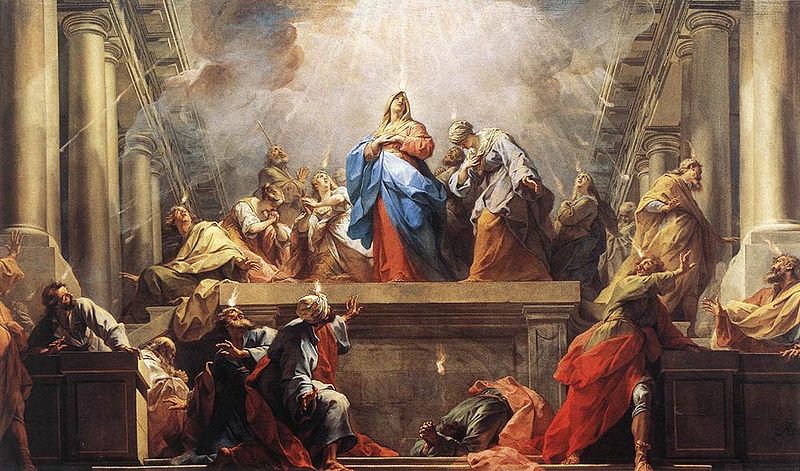
On the day of Pentecost, the Holy Spirit comes in ways that were seen and heard. The Spirit was visible in the fire that rested on the heads of those who were gathered. They had that fire rest upon them, but they were not burned or consumed like the burning bush where God appeared to Moses. And the Holy Spirit is audible first in the mighty rushing wind and then in the languages that the disciples spoke telling the mighty works of God (Act. 2:4, 11).

These miracles are significant. Remember, it was mandatory that all the Jewish males try to get to the Temple for Pentecost, so all sorts of pilgrims were gathered from all over the world to celebrate the harvest and rest God had given. And while those pilgrims are in the Temple, they hear the sound of the mighty rushing wind. V. 6 of our text says that the multitude gathered together because they heard the sound of that wind. This crowd knew it wasn’t just a normal storm, something extraordinary was hapening.

So, they come out of the Temple and hear not simply the wind, but they hear about the mighty works of God in Jesus in their native languages. And this is so spectacular because these people had just been in the Temple hearing God’s Word, but not in their native language. Hebrew was the language of the Temple, and it is likely that some of them didn’t even understand the Hebrew used in the Temple. Even though they were ethnically Jewish, they had been living for generations in other countries and didn’t know Hebrew at all or very well.

But that multitude who came together at the sound of the rushing wind did know more than one language. For them to get to Jerusalem, check into a hotel, and buy food, they had to know at least Greek, Aramaic, or Latin. These people couldn’t have been at the feast of Pentecost without at least a working knowledge of one of those languages. So, the Holy Spirit could have enabled the apostles to speak in only those four languages, and everyone there would have been able to understand. But the Holy Spirit is more gracious than that. Each person there heard in their native language the mighty works of God in Jesus.

So, here at Pentecost, the Holy Spirit reaches out to that entire multitude of pilgrims in a very personal way. The Temple was strict, everything had to be in Hebrew. But now people from every tongue are able to hear the mighty works of God in their mother’s tongue. The Holy Spirit sanctifies all those languages to carry the Gospel of Jesus Christ. This is so beautiful.

We heard in our Old Testament reading (Gen. 11:1-9) how God dispersed the inhabitants of the earth by confusing their language at the tower of Babel. Here at Pentecost, God reverses the curse of Babel, but not in the way we would expect. He doesn’t reunite the languages of the world into one language. Instead, God unites all people through the one message of the Gospel and blesses what once divided us. What used to divide humanity becomes a blessing and a variety of grace. And this multiplied grace continues into eternity. In Rev. 7:9-10, John sees a great multitude that no one could number from every nation, from all tribes and all peoples and all languages standing before the throne of God and before the Lamb. In heaven, the saints are equally perfected, but they aren’t erased of their personalities and histories.

If you want diversity, look to the Church united in faith in Jesus.

But as amazing as all these Pentecost miracles are – the wind, the tongues of fire, the speaking in a multitude of languages – these miracles have their limits. Some in that crowd figure the apostles are drunk, which is absurd. Drunk people have difficulty speaking their own language let alone fluently, coherently, and eloquently in other languages that they don’t even know. But even those who don’t accuse the apostles of being drunk only get to the point of asking the Lutheran question, “What does this mean?”

So, Peter stands up for the apostles and says that Joel 2 is being fulfilled in their presence. In these last days (Act. 2:17), the Holy Spirit is being poured out so that the wonders of heaven and mighty works of God in Christ Jesus are being shown to the multitude so that “everyone who calls upon the name of the Lord may be saved.”

That is the most significant miracle. The greatest miracle of all the spectacles of Pentecost is the salvation that is available to everyone despite their sin.

Peter will go on to preach a short sermon. Listen quickly to the main thrust of that sermon in the three verses that follow our text here. Peter preaches, “Men of Israel, hear these words: Jesus of Nazareth, a man attested to you by God with mighty works and wonders and signs that God did through Him in your midst, as you yourselves know – this Jesus, delivered up according to the definite plan and foreknowledge of God, you crucified and killed by the hands of lawless men. God raised Him up, loosing the pangs of death, because it was not possible for Him to be held by it” (Act. 2:22-24).

After Peter’s sermon is done, the multitude is convicted of their sin and asks, “What shall we do?” And Peter says, “Repent and be baptized every one of you in the name of Jesus Christ for the forgiveness of your sins, and you will receive the gift of the Holy Spirit for the promise is for you and your children and for everyone who is far off, everyone whom the Lord calls for Himself.” And 3,000 believe, are Baptized, and saved.

That is the real miracle of Pentecost. The Holy Spirit calls, gathers, enlightens, and sanctifies those who were responsible for the crucifixion of Jesus. The Holy Spirit used Peter to preach to them the Word of God – Law and Gospel. And the Holy Spirit causes them to repent, believe, and be saved.

And that miracle continues to this day. Whenever you hear the Word of God and are pointed to Jesus, there is Holy-Spirited, Pentecost work going on. Just last week, you heard how Jesus says we can tell when the Holy Spirit is working. In John 15:26 Jesus says, “When the Helper comes, whom I will send to you from the Father, the Spirit of truth, who proceeds from the Father, He will bear witness about Me.” Wherever and whenever Jesus is being proclaimed as the Savior of sinners, the Holy Spirit is at work.

Dear saints, the real miracle of Pentecost is still going on; in fact, it’s happening right now. You think your pastor is preaching to you, but I’m just the speaker producing the sound. When you hear the Gospel that declares that all your sins are forgiven and that you have peace with God because of the suffering and death of Jesus on the cross, it isn’t a mere human telling you this. That is the work of the Holy Spirit.

So, when you come to church with your sins, failures, and doubts, when you come stained and soiled by the godless world in which we live, the Holy Spirit enters into this place and opens the Scriptures to you. He brings to remembrance all that Jesus has said (Jn. 14:26). And by pointing you to Jesus, the Holy Spirit does His work of making you holy. That’s why He’s called the Holy Spirit. Yes, He is holy, but He is called the Holy Spirit because He makes you holy. He clothes you in the robe of Christ’s righteousness and sends you home at peace with God.

Dear saints, Pentecost happened. The Holy Spirit came that day nearly 2,000 years ago in Jerusalem, but Pentecost continues, and for that, God be praised. Amen.

The peace of God, which surpasses all understanding, will guard your hearts and minds in Christ Jesus. Amen.