Claimed & Filled – Sermon Exodus 20:1-17 for the Sixth Sunday after Trinity

Exodus 20:1-17

In the name of Jesus. Amen.

Once upon a time there was a perfect world. There was no death, no pain, no tribulation, no tumult. Everything was perfect because there was no sin. There were no ‘little white lies’ or gossip. No one ever said, “I promise,” because everyone only and always spoke the truth. No child retaliated against a sibling. There were no unfaithful husbands or wives because each man and woman only had eyes for his or her spouse. Not only was there no murder, there was also no fighting, no insults, no anger (Mt. 5:21-48). 

This perfection existed because everyone heard God’s Word and listened. They received every good gift from God’s hand with open hands and thankful hearts. There was no turning away from Him, no idolatry, no suspicion. God was their everything, and they were His. They trusted Him completely, loved Him above all things, and rested in Him and the gifts He freely gave. And this peace with God spread to peace with the rest of creation (Gen. 1:312:15-25).

People wanted nothing but good for their neighbor. There was no envy, no suspicion, no asking, “What’s in it for me?” Work was joyful and fruitful. Life was whole because the God who created all things was in perfect harmony with each part of His creation. Because the one relationship that matters most was perfect, everything else was perfect.

This perfect world is not a fairy tale. It was the world as God created it to be, and the Ten Commandments are simply a description of what that harmony looked like. The Commandments are not a list of arbitrary rules that God made up after suffering, death, and sin entered the world and everything had already gone wrong. They are the blueprint of creation as God designed it to function. They show us what life looks like when we are right with God which makes us right with our neighbor and right with the rest of creation.

Sin—both your own sin and the sins others commit—is what has disrupted the perfection that God created (Gen. 3:1-19Ro 5:12). Because of that sin there is now death, pain, lies, anger, betrayal, covetousness, and every brokenness that we live with every moment of every day.

Into that brokenness, God came to reclaim what was lost. He did it in the Garden when He promised to send the Seed of the Woman who would crush the serpent’s head (Gen. 3:15). He did it when He promised Abraham, Isaac, and Jacob that all the families of the world would be blessed through them (Gen. 12:322:1826:428:14). God also does it when He speaks these Ten Commandments.

The most overlooked part of the Ten Commandments is what is often referred to as the introduction, “God spoke all these words saying, ‘I am the Lord your God, who brought you out of the land of Egypt, out of the house of slavery” (Ex. 20:1-2). Notice that God doesn’t begin with rules His people must keep in order to be His people. He begins with the proclamation, the promise, “I have already claimed you because I have brought you out of slavery. I have made you Mine.” Only after that does God give them the rest of His words that shape the life of His people.

I’ve preached this before, but it bears repeating: Nowhere does the Bible refer to this portion of Scripture as “the Ten Commandments.” Instead, Scripture calls them “the Ten Words” (Ex. 34:28Dt. 10:4). Notice how, as God speaks them, it isn’t, “You must,” or, “You must not.” It is, “You shall,” and, “You shall not.” These words describe the life of one who belongs to God. This is how life will be if you belong to God.

So, when these words don’t describe us (and that will regularly be the case), that means that we aren’t living as God intends us to live. That is when we need to repent and run back to God and ask Him to rescue us from our deadness and slavery to sin (Ro. 6:1-2).

Also, notice who speaks these words. The text says, “God spoke all these words.” In Hebrew, the word for ‘God’ is Elohim, which is plural. The triune God—Father, Son, and Holy Spirit—is speaking from that mountain. The Holy Spirit is inspiring the Word. The Father is also there. But it is the Son who speaks these words with His Own voice (c.f. Ex. 3:2-412). Jude 5 explicitly says that Jesus, the Son of God, saved His people out of the land of Egypt. The very Son of God who would come to die and rise again is the One giving the Ten Commandments/Words to His people.

This changes how you hear them, doesn’t it? These are not the cold demands of some distant deity. These are the words of your Savior who loves you and has claimed you by His death and resurrection. He tells you how to live once again in perfect harmony with God and with the rest of creation.

In our Gospel reading today (Mt. 5:17-26), Jesus says, “Do not think that I have come to abolish the Law or the Prophets; I have not come to abolish them but to fulfill them” (Mt. 5:17). Jesus didn’t come to set the Commandments off to the side or to say they don’t matter. He came to fill them up, to keep them perfectly in your place. And He clearly shows us just how deep they go. It is not only murder that breaks the 5th Commandment—anger in the heart does too. It is not only adultery that breaks the 6th—lust does too. The Commandments are multifaceted. They reach into the heart. They expose us. They show us that we have not lived as the people God has claimed us to be.

That’s why the Law accuses. Because of our sin, we cannot fill what God requires. When Jesus says that He’d come to fulfill and accomplish the Law and Prophets (Mt. 5:17-18), He’s giving us a picture. Imagine that God has given each of us a five-gallon bucket and says, “Fill this bucket to the brim and overflowing with perfect obedience, with holiness, with good works done from a pure heart.” That is what He asks. But what do we do with that bucket? In our sin and weakness, we don’t fill it. Instead, we toss it around, spill its contents, and leave it empty and damaged. We turn inward and are selfish, lazy, and rebellious. We do not love God with all our heart. We do not love our neighbor as ourselves. Our buckets are dry.

But, dear saints, here is the Gospel. Jesus does not come and take the bucket away or wink and say it doesn’t matter. He does not coddle us and say the Commandments are too hard or that we should just ignore them and give up. No! He comes and fills your bucket for you.

Christ lives the perfect life of obedience in your place. Every Commandment kept from the heart, every jot and tittle fulfilled. On the cross, He takes your spilled and empty bucket from your rebellious hands and fills it Himself. He bears the shame. He bears the punishment you and I deserved. He dies the death our sin earned. He rises again and hands your bucket back to you full of His perfect obedience. That is what Jesus means when He says that He came to fulfill the law.

Now, because of what He has done, you are claimed by His Blood and filled with His righteousness. You stand before the Father not with your own empty bucket, but with Christ’s overflowing bucket (Gal. 3:27Ro. 13:14). The Father is pleased with you and proud of you for Jesus’ sake (Heb. 2:10-11).

What this means now is that the Commandments aren’t only accusations standing against you. They are also the path your Savior has already and perfectly walked for you. And they curb sin as you walk through this life and this world. They guide you as His claimed and filled people to love God and to love your neighbor. You do not keep them to earn God’s favor—you already have that in Christ. Now, you keep them because you are His, because His Spirit is at work in you, because this is the life He has given you to live.

When you hear the Commands, do not hear a bunch of impossible demands that God knows you cannot keep. Instead, hear the voice of your Savior who has already kept them for you and who now, by His Spirit, empowers you to walk in them. Because of Christ, you are dead to sin and alive to God in Christ Jesus (Ro. 6:11). Yes, repent when you fail. But also, trust that Christ has filled the bucket. And then, by grace, strive to live as the claimed and filled people you are.

You are not your own. You were bought with a price (1 Co. 6:19-20). You have been claimed out of slavery—out of the slavery of sin and death—and you have been filled with the very life of Christ. That is who you now are because that is whose you are. God has claimed you as His own, and you are filled by God with the perfection of Jesus. God be praised! Amen.

The peace of God, which surpasses all understanding, will guard your hearts and minds in Christ Jesus (Php. 4:7). Amen.
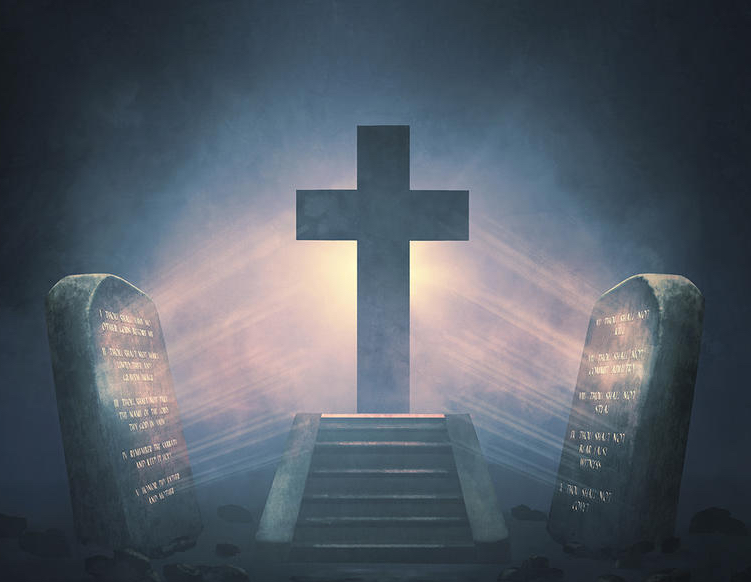
The Ten Words – Sermon on Exodus 20:1-17 for the Sixth Sunday after Trinity

Exodus 20:1-17

1 And God spoke all these words, saying, 

2 “I am the Lord your God, who brought you out of the land of Egypt, out of the house of slavery. 

3 “You shall have no other gods before me. 4 You shall not make for yourself a carved image, or any likeness of anything that is in heaven above, or that is in the earth beneath, or that is in the water under the earth. 5 You shall not bow down to them or serve them, for I the Lord your God am a jealous God, visiting the iniquity of the fathers on the children to the third and the fourth generation of those who hate me, 6 but showing steadfast love to thousands of those who love me and keep my commandments. 

7 “You shall not take the name of the Lord your God in vain, for the Lord will not hold him guiltless who takes his name in vain. 

8 “Remember the Sabbath day, to keep it holy. 9 Six days you shall labor, and do all your work, 10 but the seventh day is a Sabbath to the Lord your God. On it you shall not do any work, you, or your son, or your daughter, your male servant, or your female servant, or your livestock, or the sojourner who is within your gates. 11 For in six days the Lord made heaven and earth, the sea, and all that is in them, and rested on the seventh day. Therefore the Lord blessed the Sabbath day and made it holy. 

12 “Honor your father and your mother, that your days may be long in the land that the Lord your God is giving you. 

13 “You shall not murder. 

14 “You shall not commit adultery. 

15 “You shall not steal. 

16 “You shall not bear false witness against your neighbor. 

17 “You shall not covet your neighbor’s house.“You shall not covet your neighbor’s wife, or his male servant, or his female servant, or his ox, or his donkey, or anything that is your neighbor’s.”

In the name of Jesus. Amen.

Dear saints, you are familiar with this text – or, at least, you should be. We know these verses as “the Ten Commandments” – even though Scripture itself never refers to them as the Ten Commandments. (More on that in just a bit.)

We have grown used to thinking that God only gave the Ten Commandments to show us our sin so that we repent and believe in Jesus for the forgiveness of our sin. Saying that isn’t wrong – not in the least! Scripture says that one of the reasons God gave us the Law is to tell us what we must and have failed to do (Ro. 7:7-12). That’s how Luther uses them in his Small Catechism, and in his hymn on the Ten Commandments that we just sang, he does the same thing, “You have this Law to see therein / that you have not been free from sin, / but also that you clearly see / how pure toward God your life should be.” But God gave the Ten Commandments to do more than simply show us our sin.

Scripture calls this text “the Ten Words” (Ex. 34:28; Dt. 4:13, 10:4). The Bible refers to them as “the Ten Words” because only one of them is actually an imperative (command) – “Honor your father and mother.” All the rest are indicative (statements). A perfectly legitimate – and, admittedly, shorthand – way to understand these verses would be, “You will have no other gods before Me…. You will not misuse My Name…. You will keep the Sabbath holy…. Honor your parents. You will not murder, commit adultery, steal, lie, covet.”

As God’s people heard these words at the base of Mt. Sinai, they would have understood three distinct things at the same time. First, they would have understood that this is what God demands they do, which is how we normally understand them. Second, they would have heard them as a description of who they are and how God sees them. Third, they would have heard these as God’s promise to work in them to make them all these things (Php. 1:6).

Think of it this way: A boy might be pestered and bullied by a girl at school so much that he finally retaliates and shoves her to the ground. (You boys, don’t do that because that’s wrong.) They boy’s parents get called to the principal’s office and learn about the altercation. When they get home, the parents send the boy to his room as punishment. Afterwards, the father goes into his son’s room for ‘the talk’ and says, “We do not shove, hit, or be mean to girls.”

Notice what that speech from the father does. First, by saying, “we,” the father is still showing his son that they are in a relationship. The son hasn’t been abandoned or disowned; they belong together and are identified together as a unit. Second, the father is also saying that as a unit, they act and behave a certain way – they don’t use physical force against girls. Also, the boy knows that his dad is forbidding him to use physical force against a girl. All three of those things get communicated at the same time. The Ten Words here work just like that.

Let’s stick with that analogy about the boy and the girl bully to get one more thing about the Ten Words across. As soon as the boy pushed the girl to the ground and saw that she was dirty, dusty, and hurt, the boy’s conscience kicked in because he knew what he had done was wrong even before he pushed her. That rule or command, “Don’t hurt girls,” was already known by the boy even if he had never been taught it. The girl’s pain simply awakened his conscience. The same thing is true for these Ten Words (Ro. 7:7-8).

Cain knew it was wrong to kill Abel (Gen. 4:1-9) even though God hadn’t given the commandment, “Thou shalt not murder,” yet. Joseph knew not lie with Potiphar’s wife (Gen. 39:7-9) even though God hadn’t given the command, “Thou shalt not commit adultery.” Esau accused Jacob of cheating him (Gen. 27:36), and Jacob accused his father-in-law, Laban, of cheating him (Gen. 31:7) even though God hadn’t given the commandment, “Thou shalt not steal.” Abraham knew it was wrong to lie about Sarah being his sister (Gen. 12:11-20, 20:1-14) even though God hadn’t given the commandment, “Thou shalt not bear false witness.”

Everyone knows to not break the commandments because God has written them into the fabric of creation and on the heart of every person (Ro. 2:15). Everyone, even atheists (Ro. 1:21-25), know that we should love God with all our heart, soul, mind, and strength (Mt. 22:37). Everyone knows that we should love our neighbor as ourselves (Mt. 22:39).

God didn’t give the Ten Words so that we would know right from wrong. People knew (and still know) right from wrong already. Some think God gave the Ten Words to limit our freedom. Not at all. They are given in the context of God having set His people free, bringing them out of Egypt and slavery (Ex. 20:2). Instead, the Ten Words show God’s people what it looks like to be the free people He has created us to be. In the world that God has made, we aren’t free to do or be anything we please. We are free when we become what we are. A caterpillar is free to become a butterfly not a walrus. The Ten Words guide us to grow up to be what we are, and what we are is the very children of God (1 Jn. 3:2; Gal. 4:1-7).

Now, in an effort to assist with that growth, here’s some advice from Luther. Take each of the Ten Words with you into prayer and ask yourself these four questions: 1. What does this teach me? 2. What does this give me? 3. What does this show me to confess? And 4. What does this teach me to pray for?

For the first, “You shall have no other gods before Me,” you could pray something like this: “Father, thank you that You teach me that You are my God. Thank you that, as my God, You give me all good things. Forgive me for the times I do not trust You to be my God. Grant me Your Holy Spirit so I would love You with all my heart, soul, mind, and strength.”

For the seventh, “Thou shalt not steal,” you could pray: “Heavenly Father thank You for giving me so many good things. Everything I have is a gift from You. Forgive me for loving and pursuing stuff more than You. Help me to use what You have given me to serve my neighbor.”

Now, all of this is to say that what is most important with regard to the Ten Words is to believe them. Romans 14:23 says, “Whatever does not proceed from faith is sin.” As you believe the Ten Words, you see that God demands that you avoid certain sins and that you do certain good works. But you also see that God is accomplishing these things in you through faith. He has begun that good work in you when you were joined to Jesus’ death and resurrection in your Baptism (Ro. 6:1-11), and, again, He will complete that good work in you (Php. 1:6).

Dear saints, God promises that He is your God who has brought you out of slavery to sin by sending Jesus, who did not abolish the Law but fulfilled it. Through faith in Him, you have a righteousness that exceeds that of the scribes and Pharisees. Because of Him and His work, you will enter the kingdom of heaven, and He invites you now to a seat at His table. Amen.

The peace of God, which surpasses all understanding, will guard your hearts and minds in Christ Jesus. Amen.