21 Then Peter came up and said to him, “Lord, how often will my brother sin against me, and I forgive him? As many as seven times?” 22 Jesus said to him, “I do not say to you seven times, but seventy-seven times.
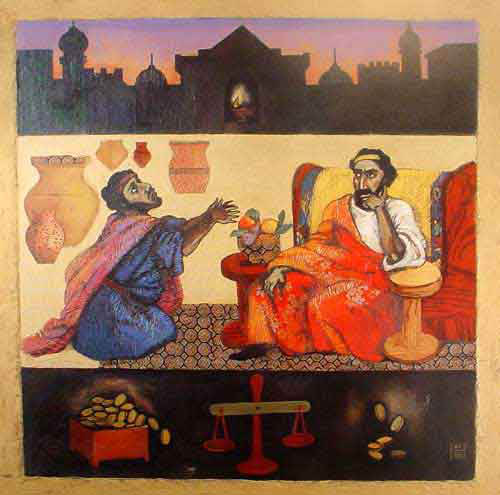
23 “Therefore the kingdom of heaven may be compared to a king who wished to settle accounts with his servants. 24When he began to settle, one was brought to him who owed him ten thousand talents. 25 And since he could not pay, his master ordered him to be sold, with his wife and children and all that he had, and payment to be made. 26 So the servant fell on his knees, imploring him, ‘Have patience with me, and I will pay you everything.’ 27 And out of pity for him, the master of that servant released him and forgave him the debt.
28 “But when that same servant went out, he found one of his fellow servants who owed him a hundred denarii, and seizing him, he began to choke him, saying, ‘Pay what you owe.’ 29So his fellow servant fell down and pleaded with him, ‘Have patience with me, and I will pay you.’ 30 He refused and went and put him in prison until he should pay the debt. 31 When his fellow servants saw what had taken place, they were greatly distressed, and they went and reported to their master all that had taken place.
32 “Then his master summoned him and said to him, ‘You wicked servant! I forgave you all that debt because you pleaded with me. 33 And should not you have had mercy on your fellow servant, as I had mercy on you?’ 34 And in anger his master delivered him to the jailers, until he should pay all his debt. 35 So also my heavenly Father will do to every one of you, if you do not forgive your brother from your heart.”
In the name of Jesus. Amen.
Jesus gives a sober warning at the end of this text. I’m going to reorder and tweak the way Jesus says it to make it crystal clear. Our Lord says, “If you do not forgive your brother from your heart, My heavenly Father will do to you what the king did to that first servant. He will demand you pay your debt and hand you over to the jailers for eternity.” Christian, you are forgiven, so you also must forgive. This is what Jesus is teaching with this parable. The parable has three scenes. And the order in which they happen is what makes Jesus’ point so powerful.
In Scene 1, the first servant (let’s call him ‘Vinnie’). Vinnie is hauled into the palace owing 10,000 talents to the king. Normally, a ‘talent’ is a unit of weight, not currency. Commentators are split on how we should understand what a talent’s value is. Some figure it’s a years’ pay; some say 20 years of wages. Either way, this is an impossible debt for an individual to pay off. After Vinnie’s debt is announced, the king commands that Vinnie, his wife, his children, and everything he has be sold. And Vinnie – notice what he begs for – he says, “Have patience with me, and I’ll pay you everything.” In other words, he asks for time. It’s ridiculous. Time? Time isn’t going to help! So, the king forgives the debt, he releases it. But debts are always paid by someone. They don’t just magically vanish. Here, the king pays. He swallows the debt and releases Vinnie. This is utter, unmerited mercy on the part of the king. End scene one.
The curtain rises and the spotlights illumine Scene 2, and we find Vinnie outside the palace. We’d expect him to be in a fantastic mood – smelling flowers and singing with birds. He’s forgiven and freed. But it sure doesn’t look like it by his actions. Vinnie spots his buddy (let’s call Vinnie’s buddy ‘Chuck’) who owed him 100 denarii, which is 100 days’ wages. That’s not an insignificant amount. But compared to what Vinnie was just forgiven – it’s pittance. Immediately, Vinnie grabs Chuck by the throat, throttles him, and demands, “Pay what you owe me.” And Chuck echoes almost word-for-word what Vinnie said in Scene 1. Chuck asks for time, but Vinnie doesn’t even give Chuck that. He has Chuck thrown into prison. Scene 2 ends with other servants informing the king how Vinnie had acted.
Now, just pause here. It’s intermission in the play of this parable. Let’s say you arrived late to the play and didn’t see Scene 1. All you know about it was that Vinnie is the character who owed 10,000 talents to the king. But you did watch all of Scene 2. What would you suppose happened in Scene 1? You would imagine that the king was still expecting Vinnie to pay the entire debt. The king must be breathing threats down Vinnie’s neck. That’s the only logical explanation. It’s the only way Vinnie’s actions are justified. And they would be just. It’s still futile; Vinnie won’t be able to choke enough throats to get out from under his debt. But at least it would make sense of his actions.
Dear saints, how many people know you are a Christian, but don’t have any idea about what goes on here? I mean, they might have an obscure idea that you’re coming here to meet with God. But they don’t necessarily know what goes on in this sanctuary between you and God while you’re here. So, ponder this: What does your Scene 2 say about the kind of God you have? Do your actions throughout the week accurately reflect on what God does here? Do people have the impression that the God you meet here is loving, kind, merciful, forgiving; or do they think your God is a harsh, cruel, punitive tyrant?
That’s all the time we have. Intermission’s over. The warning bell for Scene 3 just rang. And because we know what happened in the Scenes 1 and 2, we know exactly what’s going to happen in Scene 3. The king treats Vinnie precisely the way he deserves to be treated. Vinnie was given mercy, but he rejected that mercy by his actions. Vinnie demanded justice, so justice is what he gets. The king reinstates Vinnie’s debt, and justly so.
Dear saints, mercy has two sides. The first side of mercy is not getting what you deserve. Vinnie deserved to lose everything. He deserved to be sold with his family and possessions, but the king wanted to be merciful and not give Vinnie what he deserved. The second side of mercy is being given what you do not deserve. Vinnie had his debt forgiven and released by the king. He didn’t deserve it. I mean, Vinnie didn’t even have a grasp on how much debt he owed. Again, he had the delusion that time would help him. But the king doesn’t laugh at his idiotic request. No, the king was willing to release the debt and swallow it himself. Vinnie was given mercy, but he desperately demanded justice.
Here’s the thing: Mercy and justice are something only God can possess simultaneously. Only because of what Jesus has done on the cross can God be merciful and just to forgive and cleanse you from your sin (1 Jn. 1:9). Dear saints, God gives His mercy to you. It’s yours, but it is not something that you can keep for yourself and withhold from others. As soon as you try to hold on to God’s mercy and keep it only for yourself, you lose it. Forgiving others and being a forgiving person is not optional for a Christian. And this is hard.
Forgiving others, releasing someone from the retribution and retaliation that they deserve, is difficult. Some of you have been sinned against in ways that are so painful that I can’t even imagine. So, how do you go about being a person who forgives?
Let me give you two pastoral pieces of advice on how to be better forgivers. First, know that to forgive from the heart is something only a Christian can do, and the only reason a Christian can do it is what has happened in your Scene 1. Because of Christ’s death, God forgives your debt of sin. He separates it from you as far as the east is from the west (Ps. 103:12). The best way to grow as a forgiver is to recognize the massive debt that God has released for you.
Second, know that you aren’t going to forgive as perfectly God does. Pain and distrust will still be there. And forgiving someone does not mean that you have to become best friends. You can, and sometimes you must, forgive and still have boundaries to keep the one who has sinned against you away from you.
Forgiving is hard, but you can choose to forgive. That Holy Spirit-led choice is an act of a reborn disciple of Jesus. The emotions of pain and hurt and anger you have may slowly follow along in agreement. But, you might need to drag your emotions kicking and screaming behind you. Your emotions might take a long time to get on board with the choice to forgive. But one thing I would encourage you to do to help with that process is this: Name the sin.
If you’re angry and frustrated with someone for something, think concretely and specifically how you were sinned against. Figure out what commandment was broken when that person hurt you. We live in a sinful world. It’s naive to think that we are going make it out of here without having someone sin against us. You are going to be hurt in this world, and it will be painful. Your natural reaction to that hurt will be frustration, anger, and resentment. If you have that, name it. Name the sin that has been committed against you because then, it becomes something concrete, something you can identify. And being able to identify it, helps you realize what to do with that sin. It helps you realize that sin has been taken away by the Lamb of God.
You might be justified to want to strangle someone. But remember that God was justified to do that to you, and He didn’t. He didn’t. Instead, your God has released you and your debt for the sake of the complete payment of Jesus for your sin. He’s already done that here for you today in the Absolution, and He’s about to do it again here, at His Table. This is your Scene 1. Let that be reflected out there in your Scene 2. Amen.
The peace of God, which surpasses all understanding, will guard your hearts and minds in Christ Jesus (Php. 4:7). Amen.

 Pastorsamwise
You must be logged in to post a comment.