Live Man Walking – Sermon on Ephesians 2:1-10 for the Eleventh Sunday after Trinity

Ephesians 2:1-10

1 And you were dead in the trespasses and sins 2 in which you once walked, following the course of this world, following the prince of the power of the air, the spirit that is now at work in the sons of disobedience— 3 among whom we all once lived in the passions of our flesh, carrying out the desires of the body and the mind, and were by nature children of wrath, like the rest of mankind. 4 But God, being rich in mercy, because of the great love with which he loved us, 5 even when we were dead in our trespasses, made us alive together with Christ—by grace you have been saved— 6 and raised us up with him and seated us with him in the heavenly places in Christ Jesus, 7 so that in the coming ages he might show the immeasurable riches of his grace in kindness toward us in Christ Jesus. 8 For by grace you have been saved through faith. And this is not your own doing; it is the gift of God, 9 not a result of works, so that no one may boast. 10 For we are his workmanship, created in Christ Jesus for good works, which God prepared beforehand, that we should walk in them.

In the name of Jesus. Amen.

“Dead man walking!” That phrase originated just over 100 years ago. It was called out when a death-row inmate was being marched through the prison halls to the execution chamber. When that phrase was shouted, the inmate was, obviously, still alive, but he was as good as dead. The inevitable was soon to happen, and judgment would be carried out. Imagine how lonely that soon-to-be-executed inmate would feel hearing that phrase, “Dead man walking.” Yes, he is still breathing, still has a beating heart, still alive, and still a part of humanity. But his demise is mere moments away.

Here, in the first three verses of this text, Paul might as well be calling out, “Dead man walking!” about each of us as he describes our former life in sin. Because of our sin, every one of us was marching to our imminent demise. Hopeless, doomed, and lonely.

God created us in such a way that we are connected to each other. We have all blossomed from the root of Adam. Since the poison of sin ran through his veins, it has spread through the entire plant of humanity. And it isn’t just the fact that you and I inherited Adam’s sin and are charged with a crime that he committed. No. We all willingly march straight forward into the deadness and rebellion against God that we have inherited from Adam.

We do not become sinners by sinning. We sin because we are, by nature, sinful and unclean. We sin against God in our every thought, word, and deed. We were born revolting and fighting against every notion that we should submit ourselves to the will of God, against every idea that we should serve our neighbor. In other words, we fight against what God created us to be. That’s a losing proposition. And yes, our life in sin is that broad road that has been traveled by every member of the human race. But it is still a long, lonely road.

But – that word can be so beautiful – “but God, being rich in mercy, because of the great love with which he loved us, even when we were dead in our trespasses, made us alive” (Eph. 2:4-5). God saw our lonely, helpless, hopeless state, and, in His great love for us, He did something about it. God be praised!

The ESV does a very good job with its translation here through v. 5-6; I just want to highlight it a bit further. Notice all the withs in v. 5-6. God, because of the great love with which He loved you, has made you alive together with Christ, raised you with Christ, and seated you with Christ in the heavenly places. God saw your situation, and He has joined you to and with Jesus. Now, you are alive with, raised with, and seated with your Redeemer and Savior who is the Lord and King of all creation.

Your place in heaven is secure because what is true of Christ is now true of you who have become incorporated into and joined with Him. Dear saints, Jesus became what you are, so that He could make you what He Himself is (St. Irenaeus).

Because of Jesus, no longer are you a lost, lonely “dead man walking.” Now, you are a “live man walking.” All this is yours by God’s grace, through God-given faith. It isn’t because you have made the right sacrifices or have done enough good works. It isn’t because of your efforts, your desiring, your deserving, your trying, or even your deciding. Nope! It isn’t because of your actions or work at all.

It’s only because God has worked faith in you so that you now cry out, “God be merciful to me, the sinner” (Lk. 18:13). Through Jesus, God Himself has made you alive with Christ, raised you with Christ, and seated you with Christ. Normally, when Scripture talks about Christ being seated, it adds that He is seated at God’s right hand. Over and over again, it does this (Ps. 110:1Mt. 26:64Mk. 14:6316:19Act. 7:56Ro. 8:34Eph. 1:20Heb. 1:3).

That’s why, when we confess the creed (either Apostles’ or Nicene), we confess that Jesus is “seated at the right hand of God the Father [Almighty].” But notice here in v. 6 that when Paul announces that you are seated with Christ, he doesn’t add the phrase “at God’s right hand.” That is because God’s right hand isn’t so much a place or location. Instead, it is a position of authority and honor.

Christ has been raised from the dead and has ascended into heaven where He is seated at God’s right hand with all power and authority in heaven and on earth. You are seated with Christ in the heavenly places, and yet you remain here on earth – but still in a position of authority because you are seated with Christ. No, you aren’t all-powerful or everywhere-present like Jesus. But, you do have a share in His authority as you live here on earth. Christian, you have risen with and are seated with Christ not in such a way that you are removed from this world. Instead, you are exalted here – in this world, in this life – with the divine honor of being God’s child.

God intentionally leaves you here to exercise that authority in His creation through your good works. That’s why God has prepared those good works for you to walk in. And – this needs to be abundantly clear – the good works that God has prepared for you to walk in are not some secret thing that God hasn’t revealed to you. You don’t have to go around searching for these good works as though they are hidden. These good works are all around you. And you find them in the people that God puts right, smack dab in front of you.

You have been raised from your deadness in sin to be living men who walk in the love for both God and your neighbor that He created you to have. God has made you His ‘workmanship,’ His work of art, shining His light in a dark, evil, lonely world that is following the prince of the power of the air.

God has made you alive, raised, and seated you with Jesus so that in the coming ages He can show you the immeasurable riches of His grace in kindness toward you in Christ Jesus.

I just have to say here that a text as beautiful and full and rich as this one is barely needs anything added to it. You can just read it over and over and it is enough. But let me preach a little more and change gears here:

The shooting this past Wednesday at Annunciation Catholic School in Minneapolis that left two dead and 18 wounded is a sober reminder to us: this world is very, very evil. The devil, the prince of the power of the air, is constantly at work in the sons of disobedience (Eph. 2:2). Satan along with his demonic forces of evil constantly tempt everyone to live out the passions and desires of our flesh, and it often appears to us as though the devil’s reign of evil has no limits. But God doesn’t and won’t let the devil roam unchecked (Job 1:10122:6Mt. 12:29Col. 2:15).

Even though it seems as though we are entering into a new era of martyrdom in our country and that the persecution of Christianity is increasing and inevitable, God has not given Satan free reign. Jesus is still on the throne and the Head of all things (Eph. 1:22). Jesus is still in control – even in this dark age (Eph. 1:21). Whatever the future holds, God’s grace is, and will remain, constant.

God does not change. He knows what He is doing, and He uses martyrdoms, as painful as they are, for good (Ro. 8:28).

God has delivered those two saints, those two young martyrs, to Himself in mercy, and they are free. God has also made them an example to us that some things are more precious and valuable than living. May God, in His mercy, give us all a measure of their spirit.

We were dead, but now we are alive because of God’s grace given to us by faith. Jesus Himself is our risen and living Savior. Even if we die, we live because Jesus lives, and in Him we live too. Amen.

The peace of God, which surpasses all understanding, will guard your hearts and minds in Christ Jesus (Php. 4:7). Amen.

Location – Sermon on Luke 18:9-14 for the Eleventh Sunday after Trinity

Luke 18:9–14

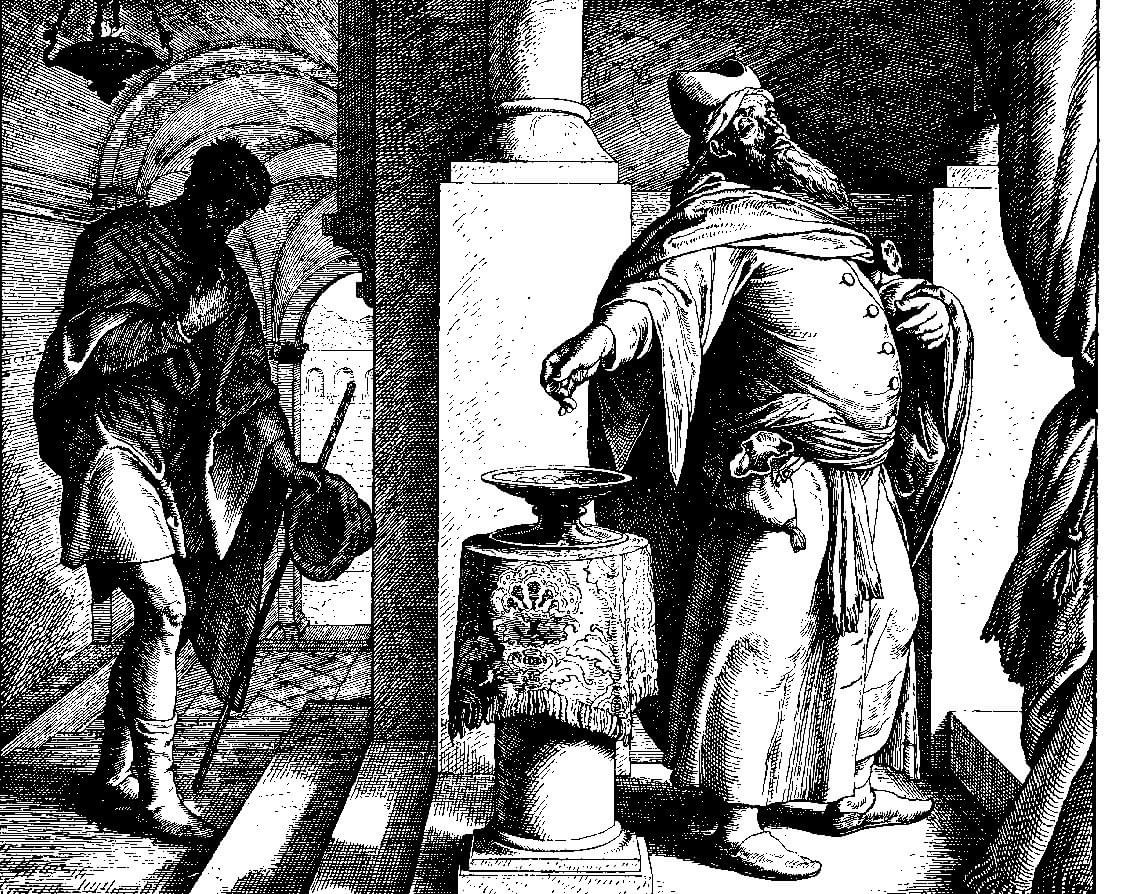
9 He also told this parable to some who trusted in themselves that they were righteous, and treated others with contempt: 10 “Two men went up into the temple to pray, one a Pharisee and the other a tax collector. 11 The Pharisee, standing by himself, prayed thus: ‘God, I thank you that I am not like other men, extortioners, unjust, adulterers, or even like this tax collector. 12 I fast twice a week; I give tithes of all that I get.’ 13 But the tax collector, standing far off, would not even lift up his eyes to heaven, but beat his breast, saying, ‘God, be merciful to me, a sinner!’ 14 I tell you, this man went down to his house justified, rather than the other. For everyone who exalts himself will be humbled, but the one who humbles himself will be exalted.”

In the name of Jesus. Amen.

Most of you are familiar with the phrase, “The three most important factors in real estate are – location, location, location.” A house here in East Grand Forks would probably be triple the cost if you moved it to Los Angeles County. For some reason, want to live there. I’ll gladly take winter.

A similar thing could be said about sin. The three most important factors about sin are – location, location, location. To be clear, I’m not talking about where sin is committed geographically. Speaking a lie to a massive crowd of people is just as damning as lying to yourself in your own mind without ever moving your lips. By referring to sin’s location here, I’m talking about where the sin resides. Sin has a place. Either sin is on you, or sin is on Jesus, the Lamb of God who takes away the sin of the world (Jn. 1:29).

We have this wrong tendency to think of sin as something abstract and floating around somewhere. There is no sin outside of the one who is committing it. Sin starts in the heart. Jesus says, “Out of the heart come evil thoughts, murder, adultery, sexual immorality, theft, false witness, slander” (Mt. 15:19). A sinner isn’t simply a person who commits sins. All people, besides Jesus, commit sin. Being a sinner means to be a person who is outside of God’s fellowship, outside the kingdom of God, someone who belongs with the demons. That is why we need Jesus to be the Savior of sinners. He changes the location of the sin. He removes it from the sinner as far as the east is from the west (Ps. 103:12).

Now, with that in mind, let’s consider the parable, which is about as straightforward as it gets. We’re told that the audience is people who are sinners with sin residing in them but still trusted in themselves and their own righteousness while treating others with contempt. Jesus also gives a clear conclusion to the parable, “Everyone who exalts himself will be humbled, but the one who humbles himself will be exalted.” But to get a fuller sense of what Jesus is teaching here we need to set the picture of what is going on in the parable. The people who originally heard this would have been familiar with what goes on in the Temple, but we probably aren’t.

Two men went up into the Temple, which is God’s house (1 Kgs. 8:13, 27), and they go for a specific purpose – to pray and worship. In English, we typically think of prayer as an individual thing. Sure, we will pray the Lord’s Prayer and say grace before a meal with others. But normally we think of prayer as an individual thing and worship as a corporate, communal thing. But the people in Jesus’ day had one word for both prayer and worship. These two men go to the place of worship at the same time. What kind of service are they attending?

They would have been at the Temple for the atonement offering, which was the only service that took place every day in the Temple, and it occurred twice each day – once at dawn and again at three in the afternoon. The service would begin by the altar for sacrifice. An unblemished lamb was slaughtered, and its blood was sprinkled on the altar following a precise ritual.

This sacrifice was a reminder of how God covered the sin, nakedness, and shame of Adam and his wife by providing garments of animal skins after they fell into sin (Gen. 3:21). It showed that God would accept the death of another in place of the sinner. As the atonement lamb was sacrificed, certain prayers were offered with the sound of silver trumpets and cymbals. The people would sing a Psalm. A priest would go into the Holy Place where he would offer incense, praying that the sacrifice would be pleasing to God. Then, when the priest entered the Holy Place with that incense, the people would offer their private prayers to God.

But the Pharisee’s prayer directly contradicted everything that was happening around him in the Temple. He thanks God that he is acceptable because of who he is and who he is not, what he has not done and what he has done. His prayer in that context would be like coming here on Good Friday and praying, “God, I’m sure glad I’m not like all these sinners around me who need Jesus to die for their sins.” It’s utterly blasphemous.

But the tax collector’s prayer harmonizes with the service in at least two very specific ways. First, when the tax collector prays, “God be merciful to me, a sinner,” he isn’t using the normal word for ‘mercy.’ Many times in the Gospels, we hear people with sickness, disease, or other affliction cry to Jesus, “Have mercy” (Mt. 15:22, 20:31; Lk. 18:38-39). That’s always a good prayer to ask God for blessings you haven’t earned and the relief that you don’t deserve. But the tax collector’s prayer uses a different word. We could translate his prayer as, “God, atone me. God, reconcile me. God, make me what I should be.” That’s the first way his prayer harmonizes with the service. He is praying that the atonement that is taking place there in the Temple and the sacrifice being offered would do what God had promised it would do and remove his sin from him (Lev. 4:35).

Second, his prayer harmonizes with the service because this tax collector recognizes that he is the sinner who needs atonement. He needs to be reconciled. He needs to have his sin, his shame, his guilt removed. Again, that’s precisely what that service was pointing to. That is what the tax collector looked to, and that is why he went down to his house justified.

Now, there is a danger in this parable. We know that the really good, moral Pharisee did not go home justified, but this sinful tax collector did. The danger that can arise for us then is to think that everything about the Pharisee is bad. Be careful with that. It is good and right to not be extortioners, unjust, adulterers. It is good to fast and give tithes. That is all good stuff. There is another side to the coin of the Pharisee’s prayer. We might be tempted to pray, “God, I thank You that I am not like other men, self-righteous, pretentious, holier-than-thou types, or even like this Pharisee. I’ve given You my heart, dedicated my life to You, and made You my Lord.” Do you see what that does? It locates our eyes off of Jesus – the One who atones for our sin (1 Jn. 2:2).

The location of your sin matches where you look. If you look to yourself, your sin is on you. If you look to Christ, your sin is gone, defeated, eternally removed.

Let me close with an analogy: Imagine you had to cross some terrifying span. Far below at the bottom of that span are all the things you fear most – snakes, rats, lava, rough seas, or sharks. You fill in whatever is scariest. But there is a bridge that spans that gap. What would you look to for confidence in crossing that gap? You’d look to the bridge. You’d see if it was well-built, sturdy, and strong. You wouldn’t look inward to see if you have enough confidence in the bridge. And you build confidence in the bridge by looking at the bridge.

So, dear saints, where are you looking? Are you looking toward things you have done – either good works or your own humility? If so, you should have no confidence whatsoever.

Look to Jesus. His sacrifice, His blood, His death, His resurrection is enough. Looking there, you go to your house justified by God’s sure and certain declaration. Amen.

The peace of God, which surpasses all understanding, will guard your hearts and minds in Christ Jesus. Amen.

Falling Up – Sermon on Luke 18:9-14 for the Eleventh Sunday after Trinity

Luke 18:9-14

9 [Jesus] also told this parable to some who trusted in themselves that they were righteous, and treated others with contempt: 10 “Two men went up into the temple to pray, one a Pharisee and the other a tax collector. 11 The Pharisee, standing by himself, prayed thus: ‘God, I thank you that I am not like other men, extortioners, unjust, adulterers, or even like this tax collector. 12 I fast twice a week; I give tithes of all that I get.’ 13 But the tax collector, standing far off, would not even lift up his eyes to heaven, but beat his breast, saying, ‘God, be merciful to me, a sinner!’ 14 I tell you, this man went down to his house justified, rather than the other. For everyone who exalts himself will be humbled, but the one who humbles himself will be exalted.”

In the name of Jesus. Amen.

Some portions of Scripture are familiar and important enough that all we need to hear is the book and chapter, and our mind recalls most of the content. For example, when you hear someone mention Psalm 23, you have all the sheep and shepherd imagery that the Psalm contains. Maybe you don’t have Psalm 23 completely memorized, but you know the general content. So, I have a pop quiz for you on this last Sunday of August, what comes to mind when you hear Genesis 3? Typically known as ‘The Fall [into Sin].’

It is somewhat unfortunate. Yes, that is when mankind and all creation became infected with sin. And because of that sin, we are born under God’s judgment and condemnation. So, yes, it is a fall. But when we label it ‘the Fall,’ we can easily forget how we fell. Mankind fell by trying to go up. Now, I’m not going to suggest that we rename that chapter in our minds, but I do want you to recognize the direction of the Fall.

God told Adam and Eve to not eat of the tree, but they decided to do it anyway. The devil asked the woman, “Did God actually say, ‘You shall not eat of any tree in the garden’?” Eve responded mostly correctly by pointing out the big downside of eating, “If we eat from it God says we will die.” (Now, she also adds not touching the tree to God’s prohibition against eating from the tree, but that’s for another time), “God told us to not eat it or we would die.” But Satan poo-poos the downside. “You won’t die; instead, your eyes will be opened, and you will be like God knowing good and evil.” The devil lies saying that the sin will only be beneficial to Adam and Eve.

The text goes on to say that the tree looked good for food, it was a delight to the eyes, and it was desired to make them wise and like God knowing good and evil. They both took and ate. They fell into sin, but they fell by trying to go upward. They rose up in pride. They exalted themselves. Believed in themselves. Trusted in themselves. They desired to rise high, up to godly and divine status. Ever since that moment, everyone who has ever been born has the same desire to exalt themselves.

Now, to the parable. Jesus tells this parable to individuals who continue in that line of thinking, they are falling up. They trusted (lit. they ‘persuaded’ or ‘convinced’ themselves) that they were righteous and treated others with contempt. That is why the two men in the parable are so different.

As the Pharisee prays, he is looking around at the lives of others – extortioners, unjust, adulterers, and tax collectors – and at his own life – his fasting and tithing. Now, all these works are, actually, good things. It is good and right to not be like the sinners that surround you, and it is good and right to do the good works that the Pharisee does. The Pharisee’s problem is not his good works. His problem is that everywhere he looks are places where he won’t find Jesus, the Righteous One, who makes sinners righteous. The Pharisee won’t find Christ by looking at his good life, and he won’t find Jesus by looking at the sins of his neighbor. All he sees is his goodness which leads him to pride. And his pride means that he goes home not justified. The Pharisee fell up. He went to the Temple of God, where God had promised to atone for sins, but the Pharisee receives no atonement.

The tax collector does go home justified. Think of all the things the tax collector could have prayed; he could have prayed, “God help me to be more like this Pharisee. Help me to live better, fast better, pray better, and tithe more.” But he doesn’t. The tax collector goes up to the Temple and sees only two things: the just demands of a holy God and his own sinfulness and depravity. He looks at himself where there is no hope and to God where the only hope lies. He sees the gap and cries out for mercy. Our translation records his prayer as, “God be merciful to me, a sinner!” This translation is weak on two points. First, it is not just ‘a sinner’; he prays, ‘the sinner.’ The only sins he sees are his own. Second, the translation of his prayer, ‘be merciful,’ falls short.

Throughout the Gospels, many people call to Jesus, “Lord, have mercy,” or in Greek, “Kyrie eleison.” They ask Jesus to do exactly what He has come to do, to be their Lord who has mercy. It’s a good prayer. But what the tax collector in this parable prays is something similar but importantly different. The tax collector prays to God (lit.), “Be propitiated to me, the sinner.”

To propitiate means to make an atoning sacrifice. And the tax collector prays that God would be made to be, that God would become the atoning sacrifice for him. In the Greek translation of the Old Testament, this word was also used for the mercy seat on the ark of the covenant. The place where the high priest would sprinkle the blood on the Day of Atonement and where God promised to meet with His people (Ex. 25:22; Lev. 16) was called by the same word. Jesus is that place where God makes the atoning sacrifice. 1 John 2:2 says, “[Jesus] is the propitiation for our sins, and not for ours only but also for the sins of the whole world.” Jesus is your Great High Priest who makes the propitiating sacrifice of Himself. 

Now, our problem is that we flip the parable upside down. We easily swap the Pharisees’ prayer with our own version, “God, I thank You that I am not like other men, self-righteous, pretentious, holier-than-thou types, or even like this Pharisee. I don’t take so much pride in my good works.” But when you do that, you are literally being the Pharisee. Repent.

The Pharisee’s problem was not his fasting or tithing, it isn’t even that he was glad that he wasn’t like the “really bad” sinners. His problem was that he trusted in those things and does not trust that Jesus will forgive him and be the propitiation for his sins. 

In the end, it is the tax collector who leaves the Temple with God having become the propitiation for his sins, so he goes down to his house justified. And that is an important point to keep in mind.

The tax collector goes home declared by God to be holy and just no matter how despicable he was. He goes home a changed man. He now goes down to his house to live out a holy life. God could have forgiven and propitiated him and swept him immediately up into heaven like Jesus did with the thief on the cross. But God doesn’t. And God hasn’t done that for you – not yet anyway. The tax collector goes home justified and that makes a difference for him, his family, his neighbors, and for the entire world. 

By God’s grace freely given through Jesus, the tax collector is exalted; he is lifted up. What Jesus says in Matthew 5 about Christians being the light of the world is fitting here. You aren’t the light of the world because you do all the good works of the Pharisee in this parable. Instead, you are forgiven and justified by Jesus who is the light of the world. That forgiveness and mercy joins you to Jesus who is the light of the world. Through the work of the Holy Spirit, you are given the gift of faith and enlightened. The Holy Spirit then places you on a lampstand so that you, the justified, give light to the whole house (Mt. 5:14-16).

Since the Fall, our thoughts have been upward, but God’s thoughts have been downward.  We sinners keep reaching for the heights, but Jesus has come down into the depths to raise you up and seat you with Him in the heavenly places (Col. 3:1-3).

Dear saints, don’t fall up. Don’t exalt your good works as though you are better than others. And don’t exalt your sinfulness as though you are better than the self-righteous because that isn’t humility either. Both of those are falling up. Instead, be exalted down. The most exalted you can be is to be one of the sinners for whom Jesus has come and given His life as a propitiation, an atoning sacrifice. And, dear saints, Christ has done this, and He has done this for you. Amen.

The peace of God, which surpasses all understanding, will guard your hearts and minds in Christ Jesus. Amen.

Justified – Sermon on Luke 18:9-14 for the Eleventh Sunday after Trinity

This sermon was preached at the 2021 East Grand Forks’ Heritage Days community church service.
Because the service was held outdoors, the audio quality is sub-par.

Luke 18:9-14

9 [Jesus] also told this parable to some who trusted in themselves that they were righteous, and treated others with contempt: 10 “Two men went up into the temple to pray, one a Pharisee and the other a tax collector. 11 The Pharisee, standing by himself, prayed thus: ‘God, I thank you that I am not like other men, extortioners, unjust, adulterers, or even like this tax collector. 12 I fast twice a week; I give tithes of all that I get.’ 13 But the tax collector, standing far off, would not even lift up his eyes to heaven, but beat his breast, saying, ‘God, be merciful to me, a sinner!’ 14 I tell you, this man went down to his house justified, rather than the other. For everyone who exalts himself will be humbled, but the one who humbles himself will be exalted.”

In the name of Jesus. Amen.

A Pharisee and a tax collector go up to the Temple to pray. The Pharisee assumes a posture that we would recognize as prayer. He stands off by himself. He is likely looking up in thankfulness to God, but his eyes are busy scanning the other worshipers in the Temple, and his eyes look down in contempt for those who are there.

Now, we need to be careful about our animosity toward the Pharisee because he is simply doing what you and I do all the time. Remember, Jesus repeatedly warns against becoming like the Pharisees (Mt. 16:6-12Mk. 8:15Lk. 12:1), and Jesus wouldn’t give these warnings unless it is actually easy to become like them. But why is it easy? Why are we in danger of becoming like Pharisees?

Well, when we see others sin and when we notice the results of those sins, it confirms that good, upright behavior is beneficial to us and those around us. The stuff God calls us to do in the Ten Commandments is really good stuff, and your life is much better if you live according to God’s Commands. Think about it. When people commit adultery, do their lives get better or worse? Of course, they get worse. When people steal, they are more likely have their things stolen. If you deal drugs, your odds of getting shot, robbed, or thrown in prison are much higher.

The reality is that God didn’t just come up with a set of ten arbitrary rules. Instead, the Ten Commandments are written into the fabric of creation. When you go against the natural laws that God has woven into creation, it isn’t going to go well for you or for those around you.

And just a little side note here: Christians, we need to stand firm on the truths of the Commandments – especially that it is good to live in obedience to them. It is not loving to condone or promote the sins of others. When there is sin, we should speak of it as sin. We need to lovingly show how it hurts the individual committing that sin and how it harms those around that person.

But when you do that, you will face hostility. The world is likely going to throw Jesus’ words in your face about the speck in your neighbor’s eye and log in your own eye (Mt. 7:3-5). But don’t let them take those verses out of context! Remember, Jesus says to first remove the log in your eye so that you can see clearly and remove the speck in your neighbor’s eye. Jesus wants eyes to be free from both logs and specks. And Christ, in His mercy, has purchased forgiveness through His death and resurrection. In other words, when you point out someone’s sin, always do it in a way that points them to the freedom from and forgiveness of sin that comes only through Jesus. Amen?

Back to the Pharisee: He is there in the Temple praising himself and his own good works rather than praising God. This is so ludicrous! The Temple is the very place where God said that He would dwell with His people in order to forgive their sins. When King Solomon prayed at the dedication of the Temple, he said six times that when God’s people prayed toward the Temple that God would hear their pleas and, in His mercy, would forgive (2 Chr. 6:12-42).

But there, in the place of forgiveness, this Pharisee doesn’t want forgiveness because, in his mind, he doesn’t need forgiveness. Instead, he wants recognition, he wants accolades, he wants God’s applause. His prayer is nothing less than, “Hey, God. Look at how great I am.” Not even, “Hey, God. Look at how great You have made me.” God gets none of the credit from this Pharisee. His prayer is one of the most self-centered, self-interested, self-idolizing statements in the Scriptures.

Now, let’s consider the tax collector. The tax collector, when he looks at himself, sees nothing good, nothing worthy, nothing laudable. So, there is nothing for this tax collector to ask God for except mercy. Our translation records his prayer as, “God be merciful to me, a sinner!” But this translation is weak on two points. First, it is not just ‘a sinner’; in the original Greek he says, ‘the sinner.’ The tax collector doesn’t know about any sins except his own. Second, the translation of his prayer, ‘be merciful,’ falls a bit short here.

Throughout the Gospels, many people call to Jesus, “Lord, have mercy” (Mt. 9:2715:22Mk. 10:47Lk. 17:13). That is always an excellent prayer. Praying, “Lord, have mercy,” is asking Jesus to do exactly what He has come to do. But what the tax collector in this parable actually prays is something similar but importantly different. The tax collector prays to God (lit.), “Be propitiated to me, the sinner.”

You get to have a little vocabulary lesson today. The noun ‘propitiation’ and the verb ‘propitiate’ have never been commonly used in English, but it is an extremely important Scriptural word and concept. To ‘propitiate’ means to make an atoning sacrifice. And the tax collector prays that God would be made the atoning sacrifice for him.

Remember again, this tax collector is praying in the Temple courtyard. In the Greek translation of the Old Testament, this word, ‘propitiation,’ was also used for the mercy seat on the Ark of the Covenant – the place where the high priest would sprinkle the blood on the Day of Atonement and where God promised to meet with His people (Ex. 25:22Lev. 16). The tax collector prays that God would do that forgiveness, that mercy, that cleansing to him.

Scripture goes on to teach us that Jesus is the place where God makes the atoning sacrifice. Christ is the real mercy seat. 1 John 2:2 says, “[Jesus] is the propitiation for our sins, and not for ours only but also for the sins of the whole world.” So, when the tax collector prays, “God, be propitiated to me, the sinner,” he is praying that God would be reconciled to him by the blood of Jesus. And that is why the tax collector, who is the far greater sinner, goes home justified rather than the well-behaved Pharisee. He looks to God in faith and asks God to be exactly who God has promised to be – a merciful, forgiving God.

So, what should we learn from this parable? Of course, this parable teaches that the worst of sinners can go to heaven. We know this, but unfortunately, we can grow a little numb to it. But the main reason Jesus tells this parable is to destroy any self-righteousness and contempt we would have against other sinners.

Christ wants us to recognize are not better than other people, but, because of our sinful nature, we are always tempted to be like the Pharisee thinking the worst of others and imposing our conceived motivations behind others’ actions so we can look down on them. Stop it. Repent.

Maybe that waitress who seems to be annoyed with you was in court fighting to keep custody of her children and away from her abusive boyfriend. Maybe that driver who is completely incompetent behind the wheel is on his way home after watching his mother die. Maybe that rude, intrusive, foul-mouthed kid on the playground hasn’t gotten any love or attention from his parents in months. Don’t look down on them and treat them with contempt.

But we should also take this a step further. Remember, Jesus told this parable to those who trusted in themselves and treated others with contempt. We are so sinfully arrogant that we often take pride in being humble like the tax collector. We are mistaken if think, since the Pharisee’s pride condemns him, that it is the tax collector’s humility that sends him home justified. Too easily we switch out the good works that the Pharisee mentions – his upright living, his fasting, his tithing – with the tax collector’s humility.

When we do that, humility becomes just another good work, and we begin boasting about our humility. We quickly swap the Pharisees’ prayer with our own version, “God, I thank You that I am not like other men, self-righteous, pretentious, holier-than-thou types, or even like this Pharisee. I’ve given You my heart, dedicated my life to You, and made You my Lord.” Stop that too! A person’s humility is not what merits or earns justification.

The point Jesus is making in this parable is to not look to yourself at all. Don’t try to find some super spirituality inside of yourself – whether it’s good works or humility. The thing, the only thing, that the tax collector looks to is the mercy of Christ.

Dear saint, you look there too. Look to the cross. Look to the blood of Jesus shed for you on Calvary. Look to His death. Look to His resurrection. Look to His ascension. And know that Jesus promises that all of that is for you. Through Christ – and through Him alone – you are redeemed, forgiven, and sent to your home justified. Amen.

The peace of God, which surpasses all understanding, will guard your hearts and minds in Christ Jesus. Amen.

This sermon is a reworked, revised, and merging from sermons preached in 2019 & 2020.

The Eyes of Prayer – Sermon on Luke 18:9-14 for the Eleventh Sunday after Trinity

Listen here.

Luke 18:9-14

9 He also told this parable to some who trusted in themselves that they were righteous, and treated others with contempt: Luke 18_9-14 - Pharisee and Tax Collector10 “Two men went up into the temple to pray, one a Pharisee and the other a tax collector. 11 The Pharisee, standing by himself, prayed thus: ‘God, I thank you that I am not like other men, extortioners, unjust, adulterers, or even like this tax collector. 12 I fast twice a week; I give tithes of all that I get.’ 13 But the tax collector, standing far off, would not even lift up his eyes to heaven, but beat his breast, saying, ‘God, be merciful to me, a sinner!’ 14 I tell you, this man went down to his house justified, rather than the other. For everyone who exalts himself will be humbled, but the one who humbles himself will be exalted.”

In the name of Jesus. Amen.

When we pray, we are taught to fold our hands, bow our heads, and close our eyes. Even though this isn’t commanded anywhere in Scripture, it is a good idea for a few reasons. One, it helps keep you from being distracted by, looking at, or fiddling with the stuff around you. Two, it focuses your attention on what you are praying. And three, it is a unique posture to place your body in which makes it a special or holy posture. You don’t typically fold your hands unless you are either praying or getting arrested. (I like to watch clips from the show Live PD, and I find it hilarious how often police officers from all over the country will tell the criminal with bags of drugs, an illegal gun, and two felony warrants, “Place your hands behind your back and interlock your fingers like you’re praying at church.”) Anyway…

I titled this sermon “The Eyes of Prayer” not to make the point that you should close your eyes when you pray – even though, again, it is a good practice. Instead, I hope this sermon encourages you to look only two places when you pray – one is your unworthiness and the other is God’s great mercy toward you.

Just like two weeks ago with the parable of the unjust steward and the merciful master, getting some context for this parable is helpful. Luke 18 opens with the parable of the persistent widow. She keeps crying out to the unrighteous judge asking for justice. The unrighteous judge finally gives her justice but only so she won’t beat him down with her constant asking (v. 2-5). The introduction to that parable says that Jesus, “told them a parable to the effect that they ought always to pray and not lose heart” (v. 1). Jesus teaches what the parable means (v. 6-8) by basically saying that if an unrighteous person will grant justice when he is continually asked, how much more will God, who is just, grant justice when His elect, beloved children cry out to Him. In fact, God will answer their cries quickly.

Now, as we turn to this parable which follows that one, we see how quickly and mercifully God answers the prayers of His elect.

A Pharisee and a tax collector go up to the Temple to pray. The Pharisee assumes a posture that we would recognize as prayer. He stands off by himself. He is likely looking up in thankfulness to God, but his eyes are also scanning the other worshipers in the Temple, and those eyes look down on the sinners who are there.

Now, we need to be careful about our animosity toward the Pharisee because he is simply doing what you and I do all the time. Remember, Jesus repeatedly warns against becoming like the Pharisees (Mt. 16:6-12; Mk. 8:15; Lk. 12:1), and Jesus wouldn’t give these warnings unless it is actually easy to become like them. Why is it easy? Why are we in danger of becoming like Pharisees?

When we look at the sins of our neighbor, much of what we see confirms that our good behavior is beneficial to us which too often leads us to pride. The stuff that God calls us to do in the Ten Commandments is really good stuff, and your life is much better if you live according to them. Think about it. When people commit adultery, do their lives get worse or better? Of course, they get worse. When people steal, they are more likely have their things stolen. If you deal drugs, your odds of getting shot, robbed, or thrown in prison are much higher.

The reality is that God didn’t just come up with a set of ten arbitrary rules. Instead, the Ten Commandments are written into the fabric of God’s creation. When you go against the natural laws of God and creation, it isn’t going to go well for you or for those around you.

And just a little side note here: Christians, we need to stand firm on the truths of the Commandments – especially that it is good to live in obedience to them. It is not loving to condone or promote people’s sins. When there is sin, we should speak of it as sin. We need to show how it hurts the individual committing that sin and how it harms those around the person committing that sin. But when you do that, the world is likely going to throw Jesus’ words in your face about the speck in your neighbor’s eye and log in your own eye (Mt. 7:3-5). But don’t let them take those verses out of context. Remember, Jesus wants to remove both the log in your eye and the speck in your neighbor’s eye by His mercy through the Gospel that Jesus has won through His death and resurrection. In other words, when you point out someone’s sin, always do it in a way that points them to the freedom from sin and forgiveness of sin that comes only through Jesus. Amen?

So, back to the Pharisee and his eyes of prayer. He is looking around at his life and the lives of others. The problem is that everywhere the Pharisee looks are places where he can’t find Jesus. The Pharisee won’t find Christ by looking at his good life, and he won’t find Jesus by looking at the sins of his neighbor. All he sees is his goodness which leads him to pride and going home not justified.

pharisee-tax-collectorThe tax collector’s eyes of prayer are much different. He doesn’t look to heaven, and he doesn’t look at the sinners around him. He stands far off from the others, likely with his face to the floor, tears flowing down his cheeks, and beating his chest. He looks two places – at himself where there is no hope and to God where the only hope lies.

The tax collector’s eyes of prayer are eyes of faith. Incredible faith! Our translation records his prayer as, “God be merciful to me, a sinner!” This is weak on two points. First, it is not just ‘a sinner’; he says, ‘thesinner.’ His eyes don’t notice anyone else’s sins – only his own. Second, the translation of his prayer, ‘be merciful,’ falls short here.

Throughout the Gospels, many people call to Jesus, “Lord, have mercy,” or in Greek, “Kyrie eleison,” which is why we sing the Kyrie after the Confession of Sin. The ten lepers call out, “Kyrie eleison” (Lk. 17:13). Two blind men early in Jesus ministry and blind Bartimeaus just before Palm Sunday cry out to Jesus, “Kyrie eleison” (Mt. 9:27; Mk. 10:47). The Canaanite woman cries out to Jesus, “Kyrie eleison,” on behalf of her demon possessed daughter (Mt. 15:22). All of those are excellent prayers. They are asking Jesus to do exactly what He has come to do. But what the tax collector in this parable prays is something similar but importantly different. The tax collector prays to God (lit.), “Be propitiated to me, the sinner.”

The noun ‘propitiation’ and the verb ‘propitiate’ have never been commonly used in English, but it is an extremely important word and concept. To propitiate means to make an atoning sacrifice. And the tax collector prays that God would be made the atoning sacrifice for him. In the Greek translation of the Old Testament, this word was also used for the mercy seat on the ark of the covenant. The place where the high priest would sprinkle the blood on the Day of Atonement and where God promised to meet with His people (Ex. 25:22; Lev. 16) was called by the same word.

Jesus is that place where God makes the atoning sacrifice. 1 John 2:2 says, “[Jesus] is the propitiation for our sins, and not for ours only but also for the sins of the whole world.” Jesus is your Great High Priest who makes the propitiating sacrifice of Himself. Hebrews 2:17 says, “[Christ] had to be made like His brothers in every respect, so that he might become a merciful and faithful high priest in the service of God, to make propitiation for the sins of the people.”

When the tax collector prays, “God, be propitiated to me, the sinner,” he is praying that God would be reconciled to him by the blood of Jesus. And that is why the tax collector, who is the far greater sinner, goes home justified rather than the well-behaved Pharisee. He looks to God in faith and asks God to be exactly who God has promised to be – a merciful, forgiving God.

Hear again what we sang before the sermon:

Trinity 11 Luke 18_9-14 - Pharisee and Tax CollectorWhen in the hour of deepest need
we know not where to look for aid;
when days and nights of anxious thought
no help or counsel yet have brought.

Then is our comfort – this alone –
that we may meet before Your throne.
To you, O faithful God, we cry
for rescue in our misery.

Dear saints, may your eyes of prayer be focused on God’s infinite mercy toward you despite your unworthiness. Know that God is always more ready to hear your prayers than you are to pray. God always gives more and better than you desire or deserve. He pours down His abundant mercy upon you. He forgives you of all the sins – every last one of those sins – that prick your conscience. He does all of this because of what Jesus has done for you. Christ has propitiated and reconciled you to God.

May our eyes of prayer be on our unworthiness and, even better, on God’s faithfulness and mercy to us because of what Christ has done. Amen.

The peace of God, which surpasses all understanding, will guard your hearts and minds in Christ Jesus. Amen.

Labor Day – Sermon on Luke 18:9-14 for the Eleventh Sunday after Trinity

Listen here.

Luke 18:9-14

He also told this parable to some who trusted in themselves that they were righteous, and treated others with contempt: H-65 Trinity 11 (Lu 18.9-14)10 “Two men went up into the temple to pray, one a Pharisee and the other a tax collector. 11 The Pharisee, standing by himself, prayed thus: ‘God, I thank you that I am not like other men, extortioners, unjust, adulterers, or even like this tax collector. 12 I fast twice a week; I give tithes of all that I get.’ 13 But the tax collector, standing far off, would not even lift up his eyes to heaven, but beat his breast, saying, ‘God, be merciful to me, a sinner!’ 14 I tell you, this man went down to his house justified, rather than the other. For everyone who exalts himself will be humbled, but the one who humbles himself will be exalted.”

In the name of Jesus. Amen.

Happy Labor Day weekend. Labor Day became an official national holiday when President Grover Cleveland signed the bill into law on June 28, 1894. I came across an article from 2017 titled, “Have we forgotten the true meaning of Labor Day?” The article claimed (and, from what I have read, it is true) that the original establishment of Labor Day was to help unify union workers and reduce the typical workday from twelve hours. It was to be a recognition of the contributions that workers have made for our country.

But, like many holidays (especially Christian/church holidays), the intention behind the celebration gets lost. Traditions grow while reasons fade. Today, most citizens look at Labor Day as just another day off. It’s commonly considered the end of summer, the weekend to close up the lake cabin, and the date after which you should no longer wear white clothing.

I’d better get to the point of all this and how it relates to Jesus’ parable before us. The Pharisee in the parable is celebrating his own personal version of Labor Day. He is there in the Temple to recognize how much his own work has contributed to… well, himself. He is there to celebrate his works and labors and how great his holiness is. Literally, Jesus says that the Pharisee prayed to himself, “God, I thank you that I am not like other men, extortioners, unjust, adulterers, or even like this tax collector. I fast twice a week; I give tithes of all that I get.” Talk about recognition of work.

The Pharisee is there in the Temple praying to himself. You have to understand that the Temple is the very place where God said that He would dwell with His people in order to forgive their sins. When Solomon prayed at the dedication of the Temple, he said six times that when God’s people prayed toward the Temple that God would hear their pleas and, in His mercy, would forgive (2 Chron. 6:12-42). But there, in the place of forgiveness, this Pharisee doesn’t want forgiveness because, in his mind, he doesn’t need forgiveness. Instead, he wants recognition, he wants accolades, he wants God’s applause. His prayer is nothing less than, “Hey, God. Look at how great I am.” Not even, “Hey, God. Look at how great You have made me.” God gets none of the credit. The Pharisee’s prayer is one of the most self-centered, self-interested, self-idolizing statements in the Scriptures.

The tax collector, on the other hand, when he looks at himself sees nothing good, nothing worthy, nothing laudable. So, there is nothing for this tax collector to pray for except mercy. And that is precisely what he receives. He goes home justified. You have to imagine what is going on behind the scenes. In heaven’s courtroom, this tax collector’s case is heard. All charges are dropped and every accusation against him is dismissed.

Isaiah 53_6 - Sin BearerThe parable does teach that the worst of sinners can go to heaven. We know this, but unfortunately, we can grow a little numb to this. But the main reason Jesus tells this parable is to destroy any self-righteousness and contempt we would have against other sinners.

We, I mean us here at Christ the King, need to take this to heart. There are people who have been raised in the church and appear to live good, decent lives who will not go to heaven. Some of our friends who regularly attend church and appear to be upstanding citizens will not go to heaven because they do not have faith in Christ. Not all pastors go to heaven. Flip this around. Some who have political views that appear, at least in our minds, to be incongruous and inconsistent with the Scriptures (either left or right) will be in heaven. Don’t be surprised if you even meet a repentant drug dealer, illegal immigrant, or abortionist in glory.

We are not better than other people, but, because of our sinful nature, we are always tempted to think the worst of others and impose our conceived motivations behind others’ actions. Stop it. Repent.

Dear saints, don’t fall into the trap that this Pharisee did. We are not better than other people – no matter how good we are. We are all equally deserving of God’s wrath and condemnation. We all need the grace and mercy of Christ which covers a multitude of sins.

Maybe that waitress who seems to be annoyed with you was in court fighting to keep custody of her children and away from her abusive boyfriend. Maybe that driver who appears completely incompetent behind the wheel is on his way home after watching his mother die. Maybe that rude, intrusive, foul-mouthed kid on the playground hasn’t gotten any attention from her parents in months. Don’t look down on them and treat them with contempt.

Sinners who come to Christ for the forgiveness they need tend to be more patient with others.

We can make a mistake and think that, because the Pharisee’s pride condemns him to hell, that it is the tax collector’s humility is what sends him home justified. A person’s humility is not what merits justification. None of us, including this tax collector, are humble enough to get to heaven. Too easily we switch out the good works that the Pharisee mentions – his upright living, his fasting, his tithing – with the tax collector’s humility. But when we do that humility becomes just another good work, and we will begin boasting about our humility. We easily swap the Pharisees’ prayer with our own version, “God, I thank You that I am not like other men, self-righteous, pretentious, holier-than-thou types, or even like this Pharisee. I’ve given You my heart, dedicated my life to You, and made You my Lord.” You might as well be praying to yourself.

The point Jesus is making in this parable is to not look inside or to yourself at all. Don’t try to find some super spirituality inside of yourself. The thing, the only thing, that the tax collector looks to is the mercy of Christ. The tax collector is there in the Temple looking to the mercy seat, to the place where God says that He would forgive and dwell with His people.

Cross and CommunionDear saint, you look there too. Look to the cross. Look to the blood of Jesus shed for you on Calvary. Look to His death. Look to His resurrection. Look to His ascension. And know that Jesus promises that all of that is for you.

In our Epistle text (1 Cor. 15:1-10), that is where you are pointed. Look to and remember the Gospel. Christ died for your sins according to the Scriptures. He was buried and rose again. Jesus appeared to the first believers. They have seen and have born witness so that you would also believe (Jn. 20:30-3121:24-25).

Don’t be like the Pharisee. Don’t look to yourself, your good works, your piety, your heart, your decisions. Don’t even seek to be like the tax collector. Instead, look to Christ and to Christ alone.

We’d better get to Communion where Christ delivers this mercy. Amen.

The peace of God, which surpasses all understanding, will guard your hearts and minds in Christ Jesus. Amen.

Messiah Complex – Sermon for the 11th Sunday of Trinity on Genesis 4:1-15

Listen here.

Genesis 4:1-15

Now Adam knew Eve his wife, and she conceived and bore Cain, saying, “I have gotten a man [with the help of] the Lord.” And again, she bore his brother Abel. Now Abel was a keeper of sheep, and Cain a worker of the ground. In the course of time Cain brought to the Lord an offering of the fruit of the ground, and Abel also brought of the firstborn of his flock and of their fat portions. And the Lord had regard for Abel and his offering, but for Cain and his offering he had no regard. So Cain was very angry, and his face fell. The Lord said to Cain, “Why are you angry, and why has your face fallen? If you do well, will you not be accepted? And if you do not do well, sin is crouching at the door. Its desire is contrary to you, but you must rule over it.”

Cain spoke to Abel his brother. And when they were in the field, Cain rose up against his brother Abel and killed him. Then the Lord said to Cain, “Where is Abel your brother?” He said, “I do not know; am I my brother’s keeper?” 10 And the Lord said, “What have you done? The voice of your brother’s blood is crying to me from the ground. 11 And now you are cursed from the ground, which has opened its mouth to receive your brother’s blood from your hand. 12 When you work the ground, it shall no longer yield to you its strength. You shall be a fugitive and a wanderer on the earth.” 13 Cain said to the Lord, “My punishment is greater than I can bear. 14 Behold, you have driven me today away from the ground, and from your face I shall be hidden. I shall be a fugitive and a wanderer on the earth, and whoever finds me will kill me.” 15 Then the Lord said to him, “Not so! If anyone kills Cain, vengeance shall be taken on him sevenfold.” And the Lord put a mark on Cain, lest any who found him should attack him.

In the name of the Father and of the Son and of the Holy Spirit. Amen.

As long as there have been siblings, there have been sibling rivalries because sin came into the world before siblings did. After Adam and Eve fell and brought the curse of sin and death upon all of humanity, God made several promises. To the serpent, God promised that He would send an offspring of the woman to crush his head. To Eve, God promised that He would greatly multiply her pain in childbirth. And to Adam, God promised that He would have to get his food by the sweat of his brow. There were several other important promises, but keep those specific promises in your mind as we consider this text today.

As life went on after the Fall, Adam and Eve experienced the reality of God’s promises. Adam had to labor, toil, and sweat among thorns and thistles to provide food for himself and his wife. Time passed, and Eve conceived. Nine months and a lot of pain later, she gave birth to her first offspring, a son whom she named Cain. Because those two promises of God were so evident and in their faces every day, Adam and Eve also believed God’s deliverance from the serpent was just as imminent. Adam, Eve, and CainThey thought, wrongly, that Cain was the promised offspring who would crush the serpent’s head.

What Eve says after Cain’s birth is not translated well in any English version. All the popular translations add words to it because the translators don’t think Eve is actually saying what she is saying. So, I added brackets around the extra words on your bulletin. Eve literally said, “I have gotten a man, the Lord” (no “with the help of”). Eve was certain that Cain was the God-promised Messiah. Adam and Eve raised Cain teaching him about the promises God had made, and over time, Cain grew to believe as his parents did that he would crush Satan’s head and deliver his family from the curse of sin. Cain had a messiah complex.

Now, somewhere in there, Adam and Eve had another son Abel. I’m sure Adam and Eve loved Abel, but they didn’t treat him the same as they treated Cain. This is seen even in Abel’s name which means ‘breath’ or ‘vapor.’ But, beyond that, Adam and Eve gave Cain the important job of working the field, but Abel was tasked with being a shepherd. This is significant because God had not yet allowed people to eat meat. So, Cain was the provider of their daily sustenance. Abel was sent into the fields to keep his eye on sheep.

Now, here is where it gets interesting. Both brothers bring offerings to God. Abel brings offerings from the firstborn of the flocks, and Cain brings offerings from his crops. God has regard for Abel’s offering but not Cain’s. Why is that? Some might say it was because Cain didn’t bring best portions of his crops. That could be, but there is probably something else going on here.

Who made the first sacrifice in the Bible? It wasn’t Adam and Eve or Cain and Abel. It was God. Remember, the first thing Adam and Eve realized after they ate the forbidden fruit was that they were naked. So, they tried to cover themselves with plants – fig leaves. It didn’t work so well. But God came and covered their nakedness and shame by slaughtering an animal and covering them with skins. Plants weren’t enough to cover Adam and Eve’s sin. Blood was needed. In fact, Scripture says, “without the shedding of blood there is no forgiveness of sins” (Heb. 9:22).

Long story short, Abel followed God’s order of offering animals for a sacrifice. But Cain, who has been raised with a Messiah complex, is doing something different. He figures he can offer God the works of his hands. But then Cain recognizes God’s rejection of his offering, gets jealous, gets warned, gets mad, gets violent, and gets punished.

You probably don’t feel too sorry for Cain. He killed his brother without remorse. Cain refused to keep Abel, the keeper of sheep. When God announces Cain’s punishment that the ground Cain works will be cursed and that Cain will be a fugitive and a homeless wanderer, you think that it is just and right. I would guess that you are not sympathetic to Cain’s statement, “My punishment is greater than I can bear.” If that is you, repent.

In every sinful heart is the same Messiah complex that Cain had. We heard another example of it in the Gospel lesson (Lk. 18:9-14). The Pharisee comes to the Temple thanking God that he isn’t like other men. The essence of his prayer is, “God, thanks for making me someone whose sins are little and whose good works are big.” This Pharisee wants God to take a good look at him and give him a high-five because he is a full bottle of Awesome Sauce. Like Cain, the Pharisee offers God a sacrifice, but God had no regard for it.

pharisee-tax-collectorYou see, the only way to approach God is through an offering, a sacrifice. Examine your life and ask yourself why you believe God will hear your prayers, why God will notice you, why God will have regard for you. But remember, you don’t get to pick which sacrifices are pleasing to God. Your good works are not enough, and your perceived lack of sin is nothing but an illusion of your own fallen mind. If you think and believe otherwise, sin isn’t just crouching at your door. Sin is your master. Repent.

Psalm 51:17says, “The sacrifices of God are a broken spirit; a broken and contrite heart, O God, you will not despise.”

Abel’s blood cried out from the ground for vengeance upon Cain’s sin. But there is a better blood that cries out to God. The blood of Jesus was shed for you upon the cross. Jesus’ nail-pierced heel has crushed the head of the devil. Jesus, the promised Messiah, offered His own body for the condemnation of your sin in place of your body. Christ’s shed blood flowed down the ground, and His blood even now cries out not for vengeance but for your forgiveness. The earth has opened its mouth to receive Jesus’ blood, and because it has, the earth now cries out to God for your forgiveness.

When you sin, when your spirit is broken, when you are crushed under the weight of your transgression, you can plead, “God be merciful to me, the sinner” (more accurate translation of Lk. 18:13). And He is. Amen.

The peace of God, which surpasses all understanding, will guard your hearts and minds in Christ Jesus. Amen.