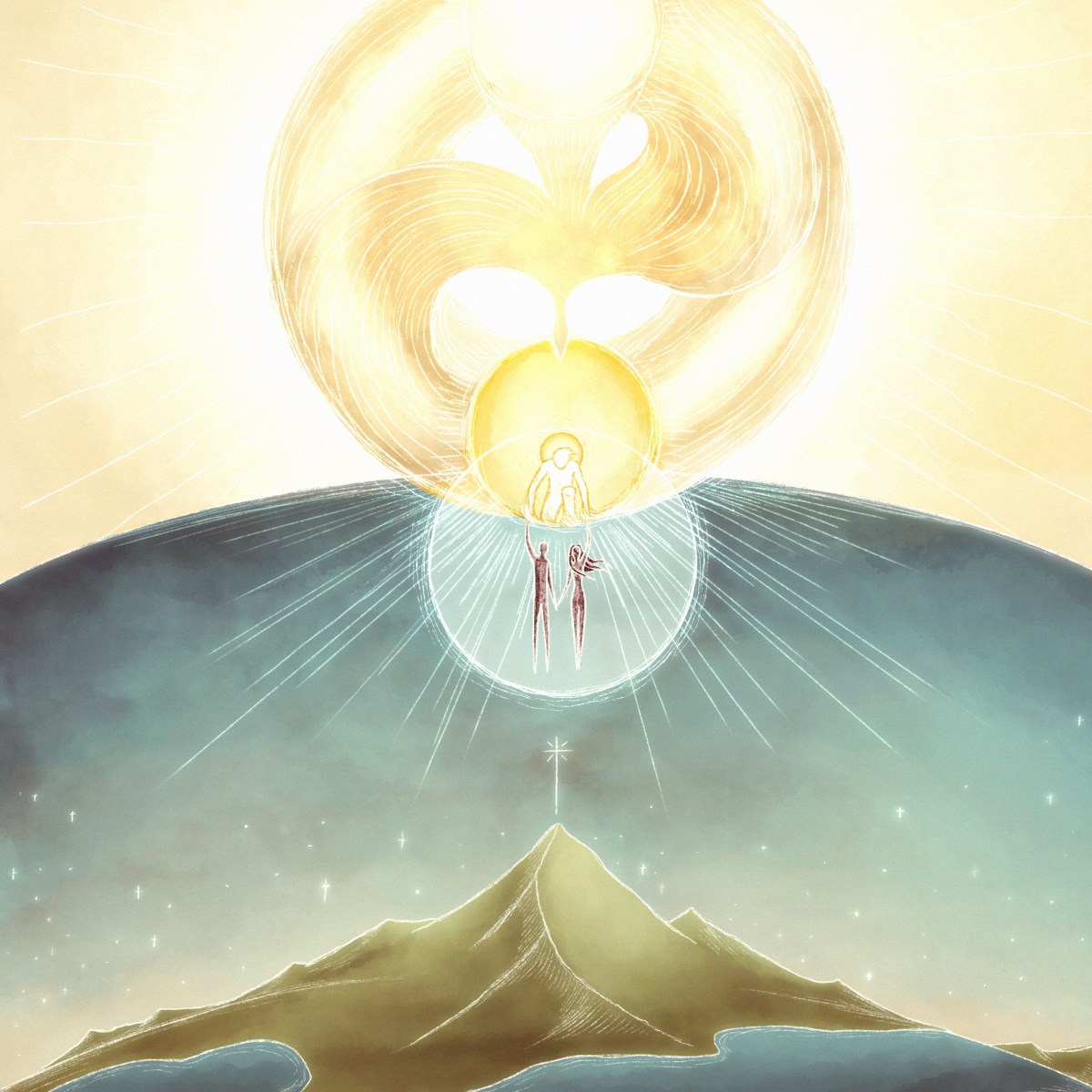
Origins – Sermon on Genesis 2:7-17 for the Seventh Sunday after Trinity

Genesis 2:7-17

7 [T]hen the Lord God formed the man of dust from the ground and breathed into his nostrils the breath of life, and the man became a living creature. 8 And the Lord God planted a garden in Eden, in the east, and there he put the man whom he had formed. 9 And out of the ground the Lord God made to spring up every tree that is pleasant to the sight and good for food. The tree of life was in the midst of the garden, and the tree of the knowledge of good and evil. 

10 A river flowed out of Eden to water the garden, and there it divided and became four rivers. 11 The name of the first is the Pishon. It is the one that flowed around the whole land of Havilah, where there is gold. 12 And the gold of that land is good; bdellium and onyx stone are there. 13 The name of the second river is the Gihon. It is the one that flowed around the whole land of Cush. 14 And the name of the third river is the Tigris, which flows east of Assyria. And the fourth river is the Euphrates. 

15 The Lord God took the man and put him in the garden of Eden to work it and keep it. 16 And the Lord God commanded the man, saying, “You may surely eat of every tree of the garden, 17 but of the tree of the knowledge of good and evil you shall not eat, for in the day that you eat of it you shall surely die.”

In the name of Jesus. Amen.

It should come as no surprise, but this text is fundamental and foundational to understanding who we are as God’s creatures. But to really get to the roots of who we are, we first have to understand who God is as our Creator, and this text gives us one piece of that understanding. The other piece came just before our text.

The Bible gives us two very different accounts of creation. In Genesis 1:1-2:3, God creates the sun, moon, stars, land, sky, plants, fish, birds, mankind, and all things by simply speaking. Whatever He commands comes into being. The whole account is filled with the repeated words, “And God said…. And it was so.” Then, God rests. Throughout those six days of creating and the seventh day of rest, He is simply called “God” (Heb.‘Elohim’). In that first account account of creation, we see a God who is transcendent – He is not subject to the limitations we are used to.

But then in our text here, the second account of creation, we see something remarkably different. The difference can be seen just a few verses before our text began in how Moses refers to God. No longer is He simply ‘God’ – He is the Lord God. In Hebrew, it is Yahweh God. In other words, this transcendent, powerful God has a name, and He is close and personal – especially with the head of His creation, Adam.

Yahweh puts His hands into the earth, molds the clay to form the man, and breathes life into Adam’s nostrils (Gen. 2:7). Then that immanent, personal God plants a garden for Adam (Gen. 2:8-9). After our text, Yahweh remains close to Adam by causing him to sleep and performing a surgery on him in order to create the woman. And Yahweh brings the woman to Adam as his suitable helper and joins them together in marriage so they would become one flesh by having children (Mt. 19:6; Mk. 10:9).

From these two accounts of creation, we have an important insight into God. He is mighty, powerful, and uninhibited. But He is also intimately close and involved with mankind.

Finally, after God finishes creation, He rests on the seventh day. Now, God doesn’t rest on the seventh day because He is tired. He created by merely speaking, and God speaks a lot more through the rest of Scripture but doesn’t grow tired or need a nap (Ps. 121:3-4). Instead, those two creation accounts help us understand something about that day of rest. God rests because He has set up all of creation to be His Temple where He will rest in the order and peace that He has established.

When I was younger, I imagined God created everything while He sat far away in heaven, speaking things into existence, but staying aloof somewhere way up there in heaven. But that scenario isn’t compatible with the rest of Scripture.

God’s desire is to dwell with people, the crown of His creation. The final picture Scripture gives of the eternal bliss of believers is God making His dwelling with you (Rev. 21:3). This desire of God to dwell among His creation becomes especially clear after the Fall. When God delivers His people from slavery in Egypt, He instructs them to build the Tabernacle so He can dwell in their midst (Ex. 25:8). In that Tabernacle, and later in the Temple, God says that He will walk among them (Lev. 26:12; 2 Sam. 7:6-7) just as we see He does in Gen. 3:8. To do that, God’s instructions on how to build the Temple in Jerusalem include many of the same materials, like gold and onyx stones, and the same ‘floorplans’ we read about here in the Garden of Eden.[1]

Now, that brings us to the nature of mankind. God puts Adam in the midst of that newly created Temple of Eden and gives Adam two responsibilities. Our translation says that Adam is there “to work it and keep it.” The two Hebrew words there can refer to a lot of activities, but when Scripture uses these two terms together, they most often refer to the duties and responsibilities of the priests in the sanctuary of the Tabernacle and Temple (Num. 3:7-8, 8:26, 18:5-6). In other words, this text is telling us that mankind was created to be the priest and guardian of sacred space. We were not created just to be gardeners.

On top of being priests, God set up mankind to be kings and queens over creation. God said, “Be fruitful and multiply and fill the earth and subdue it, and have dominion over the fish of the sea and over the birds of the heavens and over every living thing that moves on the earth” (Gen. 1:26-28). So, from our very origin, we were created to be priests and the royal rulers over creation with God reigning in our midst.

Of course, sadly, we did not remain in that original state. Adam and his wife failed in their priestly duties. They did not guard the Temple of Eden as they should have. Instead, they let the foul serpent defile it, and they lost their priestly roles. Instead, God sent a cherubim to take over the responsibility of guarding the way to the Tree of Life (Gen. 3:24 [see also Ezk. 28:14-16]). They also gave up their royal status over creation. Instead of having dominion over everything that creeps on the earth, they listened to what should have been under their rule; they listened to the serpent’s lies. By eating the fruit of the Tree of the Knowledge of Good and Evil, they rejected God and His ordering of the world.

But, dear saints, God has provided a way back to the Tree of Life (Rev. 22:2, 14), a way back to being what we were created to be, a way back to our origin. Jesus, the new Adam (1 Cor. 15:21-22, 45, 47), has come and crushed the serpent’s head. By His death and resurrection, Jesus has now redeemed you and made you what you were created to be. Through faith in Christ, you are a chosen race, a royal priesthood, a holy nation, a people for His Own possession (1 Pet. 2:9). This very Jesus dwells among you even now (Mt. 18:20). And, as Christ’s people, you are called to be His priests and kings and queens, guarding the sacred spaces of this congregation and your family.

So repent. Repent of the times you have chosen to neglect and abdicate your position as God’s priests and royalty. Repent of the times you have listened to the serpent’s lies and not expelled him from the good gardens where God has placed you and given you priestly and royal authority. Repent because the only fruit you have gotten from those sins is death (Ro. 6:21).

And know, as our Epistle reading (Ro. 6:19-23) promises, that you have been set free from sin and are now the servants of God who gives you fruit that leads to sanctification and life (Ro. 6:22). And know that Christ has equipped you with everything you need to be His priests and royalty. You have the full armor of God (Eph. 6:10-18) to defend against the attacks of the devil, the world, and your own sinful flesh. And you have God’s promise that He will never leave you or forsake you. In a world that is still soiled and stained with sin, Christ has brought you back into His kingdom, and He will lead you to eternal paradise with Him. Amen.The peace of God, which surpasses all understanding, will guard your hearts and minds in Christ Jesus. Amen.


[1] Gold and onyx (Gen. 2:11-12) are used to decorate the sanctuaries and priestly garments (Ex. 25:7, 11, 17, 31). The Tabernacle/Temple lampstand probably symbolizes the tree of life (Gen. 2:9; Ex. 25:31-35). Even the river flowing from Eden (Gen. 2:10) resembles Ezekiel’s Temple vision (Ezk. 47:1-12). 

The Worst Economy – Sermon on Romans 6:19-23 for the Seventh Sunday after Trinity

Romans 6:19-23

19 I am speaking in human terms, because of your natural limitations. For just as you once presented your members as slaves to impurity and to lawlessness leading to more lawlessness, so now present your members as slaves to righteousness leading to sanctification. 20 For when you were slaves of sin, you were free in regard to righteousness. 21 But what fruit were you getting at that time from the things of which you are now ashamed? For the end of those things is death. 22 But now that you have been set free from sin and have become slaves of God, the fruit you get leads to sanctification and its end, eternal life. 23 For the wages of sin is death, but the free gift of God is eternal life in Christ Jesus our Lord.

In the name of Jesus. Amen.

Romans 6:23 might be the most familiar verse in the whole book of Romans. Almost every evangelism class and tract you come across probably has this verse or, at least, a portion of it. “The wages of sin is death, but the free gift of God is eternal life in Christ Jesus our Lord.” It’s a good verse to point to, but the danger of that verse being so familiar is that, when it is taken out of its context, it becomes little more than a slogan. It has a lot more force when we see it in its context.

When we understand this verse apart from its context – especially the phrase, “the wages of sin is death” – we most often take it to mean that when we do sinful work, the check we cash or the payment we get is death. In other words, we do sinful works and get paid with death. Now, I want to be clear. That interpretation is true, but it can lead to some serious and dangerous drawbacks. It can feed the false notion that some sins aren’t as bad as others. “Well, I only did this little sin, so I won’t get paid as much death as that other guy who did that big sin.”

The idea that sin is the work we do and the payment we get is death doesn’t actually fit the context. Consider your job. You have a boss. You have work and tasks. And a couple times each month your boss pays you for doing the work. When we think that sin is the work we do and death is the payment we get, we lose sight of who our boss is. 

What Paul is doing here puts the focus back on the boss. Sin is not just the works we do; instead, sin is the master, the employer, the boss we serve. And your boss pays with the currency of death. Talk about a bad economy. All humanity, all of us sinners, live in the worst economy where the employer is sin, and sin pays with the currency of death.

Sin is our master until Christ redeems us, buys us, and becomes our new master. Verse 22 of this text makes this clear. “Now… you,” you, Christian, “you have been set free from sin and have become slaves of God.” That means that sin used to own you, and when sin owned you, the wages Master Sin paid were death. But now Jesus is your master.

Now, we might wonder, why would anyone work under such a master as sin? Why not unionize and chose a better master with better benefits? Well, it is because Master Sin is so deceptive, sneaky, and insidious. Master Sin seems harmless, but he is entirely treacherous. Master Sin makes demand after demand after demand, but all of these demands seem so pleasant. Master Sin makes working for him appear to be so appealing and satisfying, but it is all a façade.

When we are working for Master Sin, we feel free. It seems nice and natural. It doesn’t feel like work. Nobody sins out of duty. You don’t sin because you feel like you have to. Serving Master Sin means you just do what comes naturally. You gladly work for Master Sin because it feels good and seems to make life easier. For those outside of Christ, serving Master Sin feels like freedom. And it doesn’t seem like the wages we will be paid matter all that much. We might wrongly think we can simply make a quick change in our lives before payday rolls around and everything will be fine. Beware. That is not the picture that Scripture gives here. Sin is not simply the type of work you do. Sin is your employer, your boss, your master, your owner.

Every moment, Master Sin is sucking the life from you, but while he does that, Master Sin likes to inject good feelings and energy into you every time he takes more blood. Master Sin is sucking your life away while you are enjoying it. But eventually, Master Sin will leave you dead at his feet, sucked completely dry and eternally lifeless and condemned. Repent.

Christian, you ought to hate Master Sin and his slave wages. But remember, as you heard in our Epistle lesson last week, you have been Baptized. You don’t belong to Master Sin anymore. You are no longer his slave. “You must consider yourself dead to sin and alive to God in Christ Jesus” (Ro. 6: 11).

Christian, know Master Sin for who he is and hate him. You have been bought and freed by the death and resurrection of Christ. So now, every time Master Sin calls to you from across the plantation lines, you ought to loathe him, his wages, his chains, and his whip more and more. Plug your ears to him, and run back to your new Master, your true Master, Christ Jesus, your Savior.

You have been set free from sin and have become slaves of God. Yes, the slave wages of Master Sin is death, but the free gift, the free gift, of God is eternal life in Christ Jesus our Lord (Ro. 6:22-23). Consider Jesus, your new Master, and how He is toward you. What does He pay? He doesn’t. He doesn’t pay anything.

God doesn’t pay you. Only those who need you and your work pay you, and God doesn’t need anything you could ever give Him. God Himself says, “Who has first given to Me, that I should repay him?” (Job 41:11). God can’t pay you wages, but He can and does give you gifts. And the free gift of God is eternal life in Christ Jesus your Lord. With Christ as your master, you leave the worst economy and enter a radically new economy. Ephesians 2:6-7 says, “[God] raised us up with Him and seated us with Him in the heavenly places in Christ Jesus, so that in the coming ages He might show the immeasurable riches of His grace in kindness toward us in Christ Jesus.” You think you like God’s grace now? You ain’t seen nothin’ yet. None of us have. 

Throughout all eternity, God will show you the immeasurable riches of His grace in Christ Jesus. And these riches are incalculable. In this life, riches are always measurable. Even if you owned the whole world, your account would have a certain amount in it. Your net worth would always have a limit. But God’s gifts and riches are immeasurable because they are new every morning (Lam. 3:22). That is true now, and it is true through all eternity.

Think of that! For all eternity God will never have to show you a treasure of His grace and mercy a second time. Every one of them is new and one that you haven’t seen before. It will take an eternity of eternities for God to show you the riches of His love and kindness toward you. In our current economy in this country, it is easy to see the balance sinking lower and lower. But in God’s economy of gifts, He can show you the treasures of His mercy for trillions of trillions of years and all eternity is still before you, and nothing is diminished. There is just as much left as when you started. That is your life now in Christ Jesus, and that is your future.

So, when Master Sin comes knocking on your door whispering to you about his slave wages, send him away; tell him he can take his wages of death and shove them. And rejoice and hope in the gifts God has for you.

Your God desires to give you an infinity of riches and mercies delivered to you on account of the death and resurrection of your Lord and Savior Jesus Christ, and all of it is His free gift for you. And Jesus, your God and Savior, wants to continue to show you the treasures of His mercies now. He invites you now to His table to receive the gifts of His holy and precious Body and Blood given to you for the forgiveness of your sins. Come and receive. Amen.[1]

The peace of God, which surpasses all understanding, will guard your hearts and minds in Christ Jesus. Amen.


[1] Reworked from 2020.

Paradise, Provision, & Protection – Sermon on Genesis 2:7-25 for the Seventh Sunday after Trinity

Genesis 2:7-25

7 Then the Lord God formed the man of dust from the ground and breathed into his nostrils the breath of life, and the man became a living creature. 8 And the Lord God planted a garden in Eden, in the east, and there he put the man whom he had formed. 9 And out of the ground the Lord God made to spring up every tree that is pleasant to the sight and good for food. The tree of life was in the midst of the garden, and the tree of the knowledge of good and evil.

10 A river flowed out of Eden to water the garden, and there it divided and became four rivers. 11 The name of the first is the Pishon. It is the one that flowed around the whole land of Havilah, where there is gold. 12 And the gold of that land is good; bdellium and onyx stone are there. 13 The name of the second river is the Gihon. It is the one that flowed around the whole land of Cush. 14 And the name of the third river is the Tigris, which flows east of Assyria. And the fourth river is the Euphrates.

15 The Lord God took the man and put him in the garden of Eden to work it and keep it. 16 And the Lord God commanded the man, saying, “You may surely eat of every tree of the garden, 17 but of the tree of the knowledge of good and evil you shall not eat, for in the day that you eat of it you shall surely die.”

18 Then the Lord God said, “It is not good that the man should be alone; I will make him a helper fit for him.” 19 Now out of the ground the Lord God had formed every beast of the field and every bird of the heavens and brought them to the man to see what he would call them. And whatever the man called every living creature, that was its name. 20 The man gave names to all livestock and to the birds of the heavens and to every beast of the field. But for Adam there was not found a helper fit for him. 21 So the Lord God caused a deep sleep to fall upon the man, and while he slept took one of his ribs and closed up its place with flesh. 22 And the rib that the Lord God had taken from the man he made into a woman and brought her to the man. 23 Then the man said,

“This at last is bone of my bones
and flesh of my flesh;

she shall be called Woman,
because she was taken out of Man.”

24 Therefore a man shall leave his father and his mother and hold fast to his wife, and they shall become one flesh. 25 And the man and his wife were both naked and were not ashamed.

In the name of Jesus. Amen.

In our Gospel lesson today (Mk. 8:1-9), we heard how Jesus fed 4,000 men plus women and children (see Mt. 15:38). In that desolate place, Jesus provided a little taste of the paradise He had created mankind to enjoy. Those crowds had been listening to Jesus teach for three days and now had nothing to eat. So, Jesus temporarily removes the curse of sin. Without having to sweat and toil for their food (Gen. 3:19), Jesus provided bread and fish so the people could eat and be satisfied. Now, this text from Genesis 2 shows how God created Adam and Eve to enjoy life before they brought the curse of sin to every aspect of our lives.

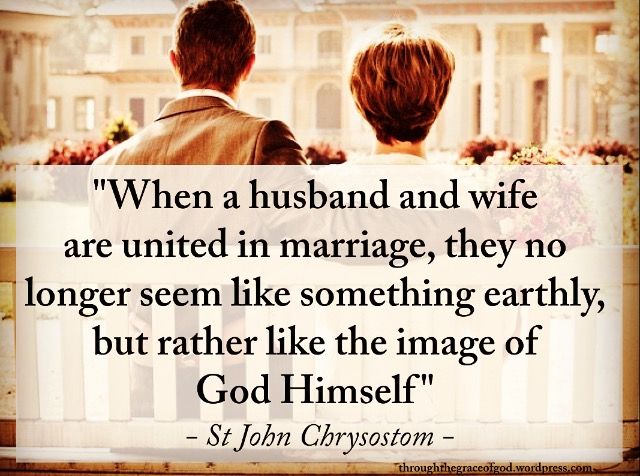
In full disclosure, I extended this lesson (originally it stops at Gen. 2:17) so we can see how God ordered creation in paradise to include two of the Three Estates. First is the Estate of the Church, second is the Estate of the Family (both of those are instituted before the Fall), and the third Estate is the Estate of the State (which was instituted after the Fall). I’ve preached on the Three Estates in the past and, if you’re interested, I can point you to some resources on this topic. But I wanted to take a little time today to focus on the second Estate, the Estate of the Family, and specifically consider the center of the family which is husband and wife living together in holy marriage.

To just briefly recall what the Three Estates are: In this lesson, we heard how God instituted the Estate of the Church when He told Adam to not eat of the Tree of the Knowledge of Good and Evil or he would die. This statement from God established the Church because you cannot be righteous without faith. Scripture repeatedly says, “the righteous shall live by faith” (Hab. 2:4; Ro. 1:17; Gal. 3:11).

Before they sinned, Adam and Eve had everything good from God because of the perfection of creation, so, to be righteous, they needed a promise of God to believe. That promise was implied when God gave the command to not eat from the Tree of the Knowledge of Good and Evil. In other words, God’s command there also included a promise which was, “Evil is bad. Trust Me on this.” So, with this command and promise, Adam and Eve could have by faith what God never intended them to have by experience. God didn’t want humanity to experience evil and death by sight, only by faith. Through the Estate of the Church, God provides eternal life. And even now, after the Fall, God provides eternal life through the Estate of the Church through faith in Christ.

The second Estate, the Estate of the Family, was also instituted by God before the Fall when God took Adam’s rib and formed Eve. God told Adam and Eve, “Be fruitful and multiply and fill the earth and subdue it” (Gen. 1:28). Even after we became sinners through the Fall, we know that God blesses and wants the Estate of the Family to continue because God repeats this command to Noah and his descendants after the Flood (Gen. 9:1). Through the Estate of the Family, God provides physical life as husbands and wives have children.

Just very briefly, the third Estate, the Estate of the State, was instituted only because of and after the Fall. There isn’t a direct passage of Scripture where God establishes the State; however, Scripture does plainly teach that the State is a good gift from God in both Romans 13:1-7 and 1 Peter 2:13-17. In those passages, Scripture teaches that the State is not a terror to good conduct but to bad and that the State carries out God’s wrath on the wrongdoer. The Estate of the State is limited in what it can do. The State cannot give life; it can only preserve and protect life through the threat of punishment.

And this means that the Estate of the State is the only one of the three that is temporary. When Christ returns, there will be no more need of the State because there will be no more sin. So much of our time today is, frankly, wasted focusing on politics and what is going on in our government. Don’t get me wrong, the State is important. The State and the authorities God has placed over us matter, and they are good gifts from God to protect life in a fallen world. But what is going on in your Family is vastly more important than anything that happens in the State. So, let’s put more of our focus and attention there.

With all of that in mind, we’ll focus now on the center of the Estate of the Family – marriage.

In Genesis 1, Scripture gives an overview of the entire creation. We see how, in six days, God created the heavens and earth – sun, moon, stars, galaxies, planets, oceans, continents, plants, birds, fish, animals, and humanity. The conclusion of each day of creation notes that there was evening and morning. Then, God rests on the seventh day, blessing and sanctifying it. The interesting thing about the seventh day is that there is no mention of evening and morning. In a very real way, the picture is that the day of blessing and rest doesn’t end. Now, in Gen. 2, the clock rewinds, and the focus shifts. Here in our text, we move from the big picture of all creation to the little world that we experience – human life. And we see that human life is centered around marriage.

Now, I want to be clear at the outset here. When I say that all human life is centered around marriage, that doesn’t mean that all people grow up in a home where a perfect husband and perfect wife have perfect kids. To be sure, sin has brought a brokenness to the Estate of the Family. God be praised if you grew up in a family with a father and mother and siblings. But even when that isn’t the case, marriage is still the center of human life. If you aren’t married or never will be married, you are here because of a marriage. Yes, some of you have been adopted into a family and are blessed through God’s invention of marriage with a father and mother. But even when that isn’t the case and you grew up without a father or a mother, your parents engaged in sex which an act of marriage. And even when someone is conceived through rape – in other words, someone has committed a grievous sin and stolen an act intended for marriage – that child is a blessing from God (Ps. 127:3). And, please, if you would like a fuller explanation on that statement or need any pastoral or professional psychiatric care if, please, please, please let me know. The many ways that family exists apart from God’s design for marriage just shows how sin has utterly broken what God designed for us.

The second half of this text (v. 18-25) is where God establishes the Estate of the Family and holy marriage. Again, in Gen. 1 we get the big picture of creation, God creates man and woman in His image (Gen. 1:26-30). But in Gen. 2:18, we get the detailed creation of man and woman and family, God creates the man first. Then, God says something totally unexpected. Over and over in the larger picture of creation, God sees what He has made and says, “It is good.” But in v. 18, God says, “It is not good that the man should be alone.” God created Adam first, and knew that Adam needed a helper compatible, complementary, and harmonizing for him.

Man alone is not good. So, God brings all the animals to Adam, and Adam gives them names. But still no suitable helper is found. God puts Adam to sleep and takes part of Adam’s side. Our translation which reads ‘rib’ is a bit polite and sterile. The Hebrew word there means ‘side’ or ‘rib cage.’ The teaching of Jewish rabbis can help explain the significance of this. God didn’t take Adam’s hair to create Eve. Then, she would have been over him. God didn’t use Adam’s feet or toes to create Eve. Then, she would have been below him. Instead, God took Adam’s side, or rib cage, so she would be next to him, beside him, and near his heart.

Take special note, please, of v. 19. God formed every beast of the field and bird of the heavens out of the ground. But Adam was created differently. Look back at Gen. 2:7. Adam, like the animals, was formed out of the dust of the ground, but God added to that dust the breath, or spirit, of life. Now, when God creates the woman, He doesn’t just gather up another bit of earth, form the woman, and breathe life into her. Instead, God takes a part of Adam and forms the woman.

So, follow me here. I know this sounds like repetition, but it isn’t, it’s building: Man alone is not good. That doesn’t mean that man alone is bad, he just isn’t good. To make mankind good, God creates a woman from man’s side to be man’s helper. By the creation of the woman, Adam is less than he was before God put him to sleep. But when Adam wakes up, he is more than he was before. After the creation of the woman, man is good. And this goodness comes about because as a married man, Adam is more than he was before. Now, he is complete, but this complementary, completeness comes from outside of himself. Only after this marriage is creation “very good” (Gen. 1:31).

All this action of God is why Jesus says that every marriage is a union that God arranges. When Jesus is asked about divorce by the Pharisees, He quotes Gen. 2:24 and says, “What God has joined together, let not man separate” (Mt. 19:6). And here is why this is important for you. To those of you who are married, and to those of you who will, one day (God willing) be married, you don’t ever have to wonder if you made a mistake along the way. When you are married and look at your spouse, you can always know that your marriage is God’s will for you. God is the One who joined you together as husband and wife. And this is also why being widowed is so painful. When a spouse dies, part of the living spouse is gone. So, God be praised that Christ has come to undo the curse of sin and death.

Also, because God joins husband and wife together, you can know that your marriage is good in the eyes of God. He joined you together, and everything that God does is good. Even when things are hard, this is a sign that your marriage is good because the devil attacks all good things that God has given. In our day, marriage is viewed cynically as some sort of outdated, antiquated institution. Sadly, a lot of people think marriage is restrictive, boring, and painful.

But study after study after study shows that marriage is much more likely to lead to fulfillment and happiness than any other alternative. All the surveys indicate that the number of couples who are happy in their marriage is extremely high. Studies also show that, even of those who are not happy in their marriage, two-thirds of them will become happy if they stay together. There’s a lot of talk today about believing science. Well, the science clearly shows that marriage is much more fulfilling, rewarding, and joy-bringing than what most people think.

Marriage is hard work, but even that is good. Any married couple can tell you this. Sometimes people think that the best marriages happen without any work or effort and when the couple is perfect and completely compatible with each other. And this leads people to think that the best marriages allow each person in that marriage be simply be themself and never change. But love, true love, doesn’t come naturally or easily. Love is work. Love is effort.

If we were perfect, sure, love would be easy. But every husband is an imperfect man, and every wife is an imperfect woman. Everyone here, including myself, we are all imperfect. Each of us is self-centered and self-absorbed. And this isn’t good. Our selfish nature hurts ourselves and those around us, and our self-centeredness never leads to more happiness for ourselves. It leads only to more pain and misery.

But know this: we are most fulfilled when we are emptied of ourselves and pour ourselves out in love and service to another person. People are happiest when they are serving and giving. And God has given no better setting to serve someone else than in marriage.

Yes, marriage is hard. The sinful self revolts against the changes and sacrifices that marriage requires. No two sinners are compatible. Any parent knows that when you put two kids together in a room, it only takes a while for the self-centeredness of each to take over. So, don’t despair if your marriage gets hard. Instead, rejoice because God loves you and has put you into the institution of marriage so you can have Him working on you through your marriage.

Finally, no consideration of marriage would be complete without the truest picture of marriage – Christ and the Church. At the end of Ephesians 5, Paul quotes v. 24 of our text, “Therefore a man shall leave his father and his mother and hold fast to his wife, and they shall become one flesh.” Then, Paul says something absolutely wonderful. He writes, “This mystery is profound, and I am saying that it refers to Christ and the Church” (Eph 5:32).

Dear saints, you are the Bride of Christ. You were formed from what Christ did on the cross. God put Jesus, your Savior, into the sleep of death. And from His pierced side, came water and blood. From that water, you are given the new birth from above, and from that innocent, forgiving blood, you are saved. God has made you to be bone of Christ’s bone, and flesh of Jesus’ flesh. Because of what Jesus has done, you can and do stand before the holy God unashamed, righteous, holy, blameless, and innocent. God be praised! Amen.

The peace of God, which surpasses all understanding, will guard your hearts and minds in Christ Jesus. Amen.

Slave Wages & Gifts – Sermon on Romans 6:19-23 for the Seventh Sunday after Trinity

Listen here.

Romans 6:19-23

19 I am speaking in human terms, because of your natural limitations. For just as you once presented your members as slaves to impurity and to lawlessness leading to more lawlessness, so now present your members as slaves to righteousness leading to sanctification. 20 For when you were slaves of sin, you were free in regard to righteousness. 21 But what fruit were you getting at that time from the things of which you are now ashamed? For the end of those things is death. 22 But now that you have been set free from sin and have become slaves of God, the fruit you get leads to sanctification and its end, eternal life. 23 For the wages of sin is death, but the free gift of God is eternal life in Christ Jesus our Lord.

In the name of Jesus. Amen.

The wages of sin is death. Scripture teaches that sin pays when you work for it, and the wages it pays is death. Probably, many of you have that passage memorized. After John 3:16, this is probably on the second tier of passages that most Christians have stored in their noggins, and most of the time we understand it in a certain way. Normally, the way we interpret this verse is that the payment we earn for committing a sin is death. And that is true. When I go out and do sin-type work, the payment I get for that is death.

But that interpretation can have some serious and even dangerous drawbacks. It can easily lead us to the wrong notion that certain sins are more serious and pay more than other, less significant sins. When people say that they are basically a good person, they make that claim because they figure their sins aren’t as bad as the sins of others. In the end, this kind of interpretation ends up with us making distinctions between this sin and that sin in an effort to self-justify ourselves. “I’m not as bad as that guy over there.”

Here, in this context, Paul is saying something more devastating than that the payment you get for doing the work of sin is death. Instead, Paul is saying that sin is not just the type of work you do, rather sin is your slave master whom you submit yourself to. The picture Paul is giving us is that your employer, your boss, your master is sin. And with Master Sin as your as your master, employer, boss, there is a particular currency that he uses to pay you and that is the currency of death.

So, let’s try this analogy: Let’s say you are looking for your first job, and you are going to be flipping burgers. It’s a respectable first job. You go to Burger King, and they will pay you $8.00/hour. During your interview at Dairy Queen, you learn that they will pay you $8.15/hour. Then you go check at McDonald’s, and they will pay you $8.50/hour. You go to Five Guys, and they will pay you $9.50/hour. (At this point, you can probably tell where I prefer to get burgers if I’m not making them myself.)

But let’s say you go to one more burger establishment, and it’s probably safest for me to make up an imaginary restaurant for this. Let’s say you go apply at Sin Burger. Sin Burger is a nice establishment. They have a clean restaurant and friendly employees. Your responsibilities are going to be the same as at any of the other locations, and the hours are just as flexible. At the end of the interview, the manager says, “If you work here, you will be killed. Your wages will be paid out with death.” The manager notices the shocked look on your face, and says, “Yes, here at Sin Burger, we don’t deal with dollars or pounds or rubles or pesos. Sin Burger only pays with the currency of death. It doesn’t matter the type of work you do – you could be a burger flipper, a fry fryer, the head of accounting, or the CEO – Sin Burger still pays only with death.”

So, would you take the job at Sin Burger? Of course not! And yet, that is what we all do. But why? Why do all humans work for a master who pays out with the currency of death?

It’s because Master Sin is so deceptive, so insidious. When sin is your master, it makes demand after demand after demand. But all of these demands seem so pleasant. Master Sin makes working for him appear to be so appealing, so satisfying. When we are obeying Master Sin, it feels free. It seems nice and natural. It doesn’t feel like work. And it doesn’t seem like the wages we will be paid with really matter all that much.

Nobody sins out of duty. You don’t sin because you feel like you have to. Serving Master Sin means you just do what comes naturally, and what is convenient. You do it because it feels good or because it seems to make your life easier. For those outside of Christ, serving Master Sin feels like freedom.

We hear, “the wages of sin is death,” but, when we think of sin as the type of work we do, we think we can simply make a change in our lives before payday rolls around. But that is not the picture that Scripture is giving here. Sin is not simply the type of work you do. Sin is your employer, your boss, your master, and even your owner.

Every moment, Master Sin is draining your blood, sucking the life from you. But while he does that, Master Sin likes to inject good feelings and energy into you every time he takes more blood. He’s sucking your life away while you are enjoying it. But eventually, Master Sin will leave you dead at his feet, sucked completely dry and eternally lifeless. You see the difference?

Repent.

Christian, we ought to hate Master Sin and his slave wages. But remember, as you heard last week, you have been Baptized. You don’t belong to Master Sin anymore; you are no longer a slave to Master Sin (Ro. 6:1-11). Identify Master Sin for who he is and hate him. You have been bought and freed by the death and resurrection of Christ. So now, every time Master Sin calls to you from across the plantation lines, you ought to hate him and his wages and his chains and his whip even more. Plug your ears to him, and run back to your new Master, your true Master, Christ your Savior.

Look at v. 22, but “now you have been set free from sin and have become slaves of God.” Yes, the slave wages of Master Sin is death, but the free gift of God is eternal life in Christ Jesus our Lord. Consider your new Master and how Christ is toward you. What does He pay?

He doesn’t. God doesn’t pay you. Only those who need you and your work pay you, and God doesn’t need anything you could ever give Him. God Himself says, “Who has first given to Me, that I should repay him? Whatever is under the whole heaven is Mine” (Job 41:11).

So, God can’t pay you wages, but He can and does give you gifts. And the free gift of God is eternal life in Christ Jesus your Lord. Consider Eph. 2:6-7 (it’s in your insert), “[Christ] raised us up with Him and seated us with Him in the heavenly places in Christ Jesus, so that in the coming ages He might show the immeasurable riches of His grace in kindness toward us in Christ Jesus.”

Think about this for a minute. God has endured the death of His Own Son to remove you from your slavery to Master Sin. And He has done that for a reason – to demonstrate and show you something. He wants to show you for all eternity the immeasurable riches of His grace in Christ Jesus. God wants to show you His riches, and these riches are incalculable. They are infinite.

In this life, riches are always measurable. Even if you owned the whole world, you could count the number of mansions you have. Your account would have a certain amount in it. Your net worth would still be finite. It might take several lifetimes to account for it all, but it would still have a limit. But God’s gifts and riches are immeasurable. His mercies are new and fresh every morning.

Think of that! For all eternity God would never have to show you a mercy or a treasure that He freely gives to you a second time. Every one of them is new and one that you haven’t seen before. God is infinite, and his mercies are infinite. it will take an eternity of eternity’s for God to show you His love and mercy toward you.

That’s what ‘infinite’ means. It means you could go on for trillions of trillions of years and yet there is still all of infinity before you and nothing is exhausted. There is as much left as when you started. God’s gifts for you are infinite. That is your life now in Christ Jesus, and that is your future.

So, when Master Sin comes and knocks on your door whispering to you about his slave wages, he wants to take away from you the gifts that Jesus would freely give to you. Send Master Sin away and rejoice and hope in the gifts God has for you.

Your God desires to give you an Infinity of riches and mercies delivered to you on account of the death and resurrection of your Lord and Savior Jesus Christ, and all of it is His free gift for you. Amen.

The peace of God, which surpasses all understanding, will guard your hearts and minds in Christ Jesus. Amen.

Eden in Desolation – Sermon on Mark 8:1-9 for the Seventh Sunday after Trinity

Listen here.

Mark 8:1-9

In those days, when again a great crowd had gathered, and they had nothing to eat, he called his disciples to him and said to them, “I have compassion on the crowd, because they have been with me now three days and have nothing to eat. And if I send them away hungry to their homes, they will faint on the way. And some of them have come from far away.” And his disciples answered him, “How can one feed these people with bread here in this desolate place?” And he asked them, “How many loaves do you have?”They said, “Seven.” And he directed the crowd to sit down on the ground. And he took the seven loaves, and having given thanks, he broke them and gave them to his disciples to set before the people; and they set them before the crowd. And they had a few small fish. And having blessed them, he said that these also should be set before them. And they ate and were satisfied. And they took up the broken pieces left over, seven baskets full. And there were about four thousand people. And he sent them away.

In the name of Jesus. Amen.

This morning, we heard how God worked so that Adam and Eve could enjoy paradise in bliss and peace (OT Lesson Gen. 2:7-17).

First, God formed the man. God breathed into man’s nostrils to make Adam a living creature. God planted a garden in Eden. God made every tree that is splendid to look at and good for food to spring up from the ground. God surrounded that garden with vibrant rivers and lands filled with gold and precious stones.Bliss of Eden

God put Adam in the garden and gave him a job – which, yes, is a good thing. Just consider how little Adam had on his work resume at the time. God gave Adam the gift of hunger so that he would have the joy and delight of eating and tasting the fruits of his labor. And God taught Adam what to eat and what not to eat.

Now, this is a bit of an aside, but it is very important. Many people have wondered why God would put the tree of the knowledge of good and evil which produced the forbidden fruit in the bliss of Eden at all. Some will say that God put it there to test Adam and Eve to see if they would be good. But if that is the case, it means that God could not make man “good” unless He gave man the choice to do evil. That would be strange for a God who truly is good and all-powerful Himself.

Scripture gives us a better understanding for the existence of the forbidden tree. Habakkuk 2:4 says, “The righteous shall live by faith.” This is true now, but it was also true before the Fall.

Think of it this way: Everything Adam and Eve knew, they knew because they saw and experienced it. But the one thing they didn’t know was evil. God put the tree of the knowledge of good and evil in the Garden because evil did exist. So Adam and Eve would have faith, God was giving a promise to believe when He commanded Adam to not eat of the tree of knowledge of good and evil. Think of it this way, when God gives that command He is saying, “Hey, Adam, there is evil and it is bad. If you find out what evil is, it won’t be good for you. Trust Me on this.”

In the end, Adam and Eve didn’t trust God. Obviously, we do not live in Eden anymore; instead, we live in desolation. desolationOur English word ‘desolation’ contains the word ‘solo,’ and that gives a sense of what ‘desolation’ means. Adam and Eve went solo. Rather than trusting God, they went solo and trusted the devil’s lie bringing sin, death, condemnation, and desolation into the world.
We might think Adam and Eve were fools to give up the paradise God created for them. But we are apples that didn’t fall far from Adam’s tree. We too choose evil instead of faith, chaos instead of perfection, and desolation instead of bliss. We live in a place of our own making. A place we contrived from our rebellious hearts. A desert rather than a garden. Instead of life, there is death. Instead of abundance, there is lack. Instead of walking with God, we are surrounded by demons.

God warns us about the penalty of doing evil, but we go solo and crave what isn’t ours. God tells us that we must tell the truth and defend the reputation of others, but we go solo by spreading gossip and slander. Because of sin – and our sin alone – we dwell in a desolate place. Repent.

But even though we turned our back on God, He did not turn His back on us. God doesn’t despise us, He doesn’t come to punish us, and He doesn’t regret the fact that He made us. Instead, God comes to have compassion on us and graciously feed us. On the third day of this excursion, Jesus says, “I have compassion on the crowd.”That word ‘compassion’ in Greek means that His intestines are tied up. A loosey-goosy translation of Jesus’ words here would be, “My gut is wrenched for these people who don’t have anything to eat.”

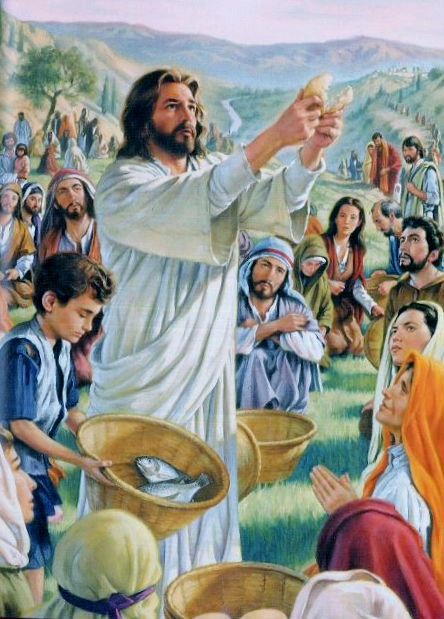
Jesus Feeds the 5000Look at what Jesus, God in the flesh does – notice the verbs. He calls the disciples. Jesus directs the crowd to sit down. He takes the bread. Christ gives thanks for the bread. He breaks the bread. He gives the bread to the disciples to set before the people. Jesus blesses the fish. He gives the fish to the disciples to set before the people. And Jesus watches them all eat until every last one of them is satisfied. Jesus continues to do this for us today.

Some of you are fully aware of the desolation you live in right now. Maybe it’s your health or a broken relationship that has left you lonely. Maybe it’s a money or job problem. Whatever it is, it doesn’t matter. Desolation stares you in the face, and you are worried. Know that Jesus is still with you to serve you with everything you need in every moment.

Do you think that when Jesus led that crowd out into the wilderness for three days, do you think that Jesus forgot they would need food? Do you think Jesus was preaching, and suddenly the light bulb turned on in the middle of His sermon and He said, “Oh, nuts. These people are going to need to eat. Oops!”? No, absolutely not! Jesus didn’t forget that they would need food.

Instead, Jesus brought them to a place of momentary need. He led them into the wilderness where they would need a miracle to provide for them. Jesus led them there for some good. We shouldn’t speculate why Jesus did this because the text doesn’t tell us exactly why Jesus did it. But Jesus deliberately brought them there where they would need Him to fully provide for them.

So, listen to this very carefully. Whether things are going well and you don’t notice anything lacking in your life or whether things are bleak and dire, by God’s grace you have everything from God that is best for you right now. Do you believe that?

Scripture says, “Give thanks in all circumstances” (1 Thess. 5:18). Give thanks for everything you have from God at all times – whether those times are good or bad. Here’s why, listen to this from Romans 8:31-32, “If God is for us, who can be against us?” And we can know that God is for us because of what Scripture says next: “He who did not spare His own Son but gave Him up for us all, how will He not also with Him graciously give us all things?” In other words, if God gives His only-begotten Son to die on the cross while you are His enemy and a sinner, He won’t hold back anything good from you now that you are adopted into His family through Jesus’ death and resurrection.

God will give us all things in the future, yes. But He also gives us all good things now. Like He did in Eden and like He did in the wilderness, Jesus even now serves us sinful, fallen people who have chosen to live in a desolate place.Communion Cross with Jesus

Jesus is here with His compassion in the midst of your desolation to bring Eden to you. He has come to be your servant by feeding you the Bread of Life from this altar. In this meal, your Savior dispenses forgiveness, life, and salvation to you. Even though we are a small crowd, Jesus has come to deliver big compassion. So, come and receive. Amen.

The peace of God, which surpasses all understanding, will guard your hearts and minds in Christ Jesus. Amen.

Table for 4,000, Please? – Sermon for the Seventh Sunday of Trinity on Mark 8:1-9

Listen here.

Mark 8:1-9

In those days, when again a great crowd had gathered, and they had nothing to eat, he called his disciples to him and said to them, “I have compassion on the crowd, because they have been with me now three days and have nothing to eat. And if I send them away hungry to their homes, they will faint on the way. And some of them have come from far away.” And his disciples answered him, “How can one feed these people with bread here in this desolate place?” And he asked them, “How many loaves do you have?”They said, “Seven.” And he directed the crowd to sit down on the ground. And he took the seven loaves, and having given thanks, he broke them and gave them to his disciples to set before the people; and they set them before the crowd. And they had a few small fish. And having blessed them, he said that these also should be set before them. And they ate and were satisfied. And they took up the broken pieces left over, seven baskets full. And there were about four thousand people. And he sent them away.

In the name of the Father and of the Son and of the Holy Spirit. Amen.

The last food you ate came from God even though it didn’t come directly from God. An exception will be made if you gathered up manna in your yard this morning. If you did, let me know. I’d like to come over this afternoon, so I can have a taste before it goes bad tomorrow. Talk to me after the service.

Your food comes from God, but God in His infinite wisdom has seen fit to give you that food through a long food-pipeline. Through farmers and ranchers who grow and raise the food. Through factories and workers that process, grind, and package. Through truckers and train engineers who haul. Through construction workers who build and maintain the roads and buildings. Through plumbers, electricians, engineers, and mechanics who design, make, and keep the roads, railways, machines, and buildings working. And even through insurance agents, accountants, and computer programmers who make all the work efficient and organized.

In fact, I bet if you and I sat down and put our minds together, we could figure out how every wholesome task performed in the world ends up putting food in our mouth. (Maybe we can do that while we enjoy that manna of yours.)

Now, God doesn’t have to use this massive, intricate food-pipeline. He could feed us directly as Jesus does in this text. God is the author of all good work and a master at it all.

This crowd has been with Jesus in a desolate place for three days hearing Him teach. They were so excited to follow Him that these silly people didn’t bring any food with them. Jesus tells the disciples that He has compassion on the people because if He sends them away, they won’t make it home. Some of them will faint and die of hunger. The disciples ask, “How can one feed these people (4,000 men plus women and children [see Mt. 15:32-39]) with bread here in this desolate place?” Their question is legitimate. Even if you had the means to pay for it, I bet you’d have a hard time buying enough bread for a crowd that size if you went to Hugo’s right after the service.

But watch what Jesus does in slow motion. He becomes the master of many trades all at once. He plows, plants, harvests, threshes, grinds, and bakes bread in a moment. Then, He sails, fishes, processes, cleans, and cooks fish to give the crowd a second course.

Yes, Jesus does this with what the disciples have among themselves. So, in a small way, He works within His creation and preserves the food-pipeline. But He certainly didn’t need to use what the disciples had because when it is all said and done, there are seven baskets of leftovers. The disciples end up with more than they had at the beginning.

This is a miracle. No one can feed such a large crowd, but Jesus can and does. But this miracle of feeding the 4,000 pales in comparison to the miracle of food that will be on your plate at lunch. The same Jesus is working through hundreds if not millions of people to make sure you have a bite later when He could simply make the food appear on your plate without any of them.

You are constantly surrounded by miracles. But you have gotten so used to seeing them that you don’t see the splendor and glory of God’s provision for you.

Do you realize how miraculous farming and gardening is? You take a seed – a tiny part of something, put it in the ground, and you get more of that same thing. How many thousands and even millions of tomatoes are in a single tomato seed when God uses His creation to nurture and grow that seed? We hardly give tomato seeds a second thought. But in each of those seeds is a lifetime supply of tomatoes for you and your family. But it is a lot less work for you to simply go to the store and purchase more tomatoes.

We are too easily bored with God’s miracles. And worse, we even grow to despise God’s work among us.

We get excited when a child takes her first steps. Her body has miraculously formed and developed the muscles, bones, and tendons needed to support her frame. Her mind has learned to control all those parts of her body so she can keep her balance. But how many weeks pass before her parents are tired of keeping her from walking to the garbage can, tipping it over, and rummaging through the contents? They wish she were still stationary.

Think for a moment of the miracle of life. Your body is made up of somewhere around 35 trillion individual cells that serve various functions. If the DNA in those cells were laid out end to end, it would travel from here to the sun and back 100 times. From the moment you were conceived, the information in your DNA would fill 600,000 pages. And right now, in each of the 35 trillion cells of your body, biological “machines” are copying volumes of information into amino acids which are taken by other machines and folded in very specific ways into proteins. So, don’t let anyone tell you that you are lazy.

These miracles are going on all around you and inside of you. And as we are able to learn even more about how this all works, it will simply get more intricate and amazing. You are fearfully, wonderfully, and miraculously made. And the fact that all of this is done because of your Creator should cause you to fall on your knees in reverence and praise.

From a seed producing a plant that produces more fruit and more seeds to a child learning to walk to your cells writing and rewriting the information that keeps you alive, God keeps this creation working. But because all of this happens every day, it doesn’t capture our wonder and amazement as much as if it only happened once.[1]

The feeding of this crowd does show us that Jesus is God in the flesh. But that is not Jesus’ purpose in feeding the crowd. Jesus did not do this miracle to show the crowd that He is divine. Rather Jesus’ purpose in feeding and providing for them is His own compassion.

If Jesus provides so richly and abundantly for a crowd who got themselves into trouble by something so simply as forgetting to bring their lunch, how much more compassion will He have for you, sinner? You who are rightful recipients of death – the wages of sin – will Jesus not have compassion on you?

He does have that compassion and He has given that compassion. He has come in your flesh after your likeness. He died on the cross and shed His blood for you to give you His forgiveness and righteousness. And this same Jesus will provide for your needs in this body and life as well.

To this hungry and dying crowd of 4,000 in a desolate place, Jesus brings life on the third day. Just as He fed the people on the third day, He has risen on the third day for your justification.

So, rejoice and trust your Savior. When Jesus said, “Seek first the kingdom of God and His righteousness, and all these things…,”your food, drink, clothing, shelter, and everything you need for life, “all these things will be added to you,”He meant it. Amen.

The peace of God, which surpasses all understanding, will guard your hearts and minds in Christ Jesus. Amen.

[1]Revised from a quote by John Donne, “There is nothing that God has established in the constant course of nature, and which therefore is done everyday, but would seem a miracle, and exercise of our admiration, if it were done but once.”