
Matthew 7:15–27
15 “Beware of false prophets, who come to you in sheep’s clothing but inwardly are ravenous wolves. 16 You will recognize them by their fruits. Are grapes gathered from thornbushes, or figs from thistles? 17 So, every healthy tree bears good fruit, but the diseased tree bears bad fruit. 18 A healthy tree cannot bear bad fruit, nor can a diseased tree bear good fruit. 19 Every tree that does not bear good fruit is cut down and thrown into the fire. 20 Thus you will recognize them by their fruits.
21 “Not everyone who says to me, ‘Lord, Lord,’ will enter the kingdom of heaven, but the one who does the will of my Father who is in heaven. 22 On that day many will say to me, ‘Lord, Lord, did we not prophesy in your name, and cast out demons in your name, and do many mighty works in your name?’ 23 And then will I declare to them, ‘I never knew you; depart from me, you workers of lawlessness.’
24 “Everyone then who hears these words of mine and does them will be like a wise man who built his house on the rock. 25 And the rain fell, and the floods came, and the winds blew and beat on that house, but it did not fall, because it had been founded on the rock. 26 And everyone who hears these words of mine and does not do them will be like a foolish man who built his house on the sand. 27 And the rain fell, and the floods came, and the winds blew and beat against that house, and it fell, and great was the fall of it.”
In the name of Jesus. Amen.
I thought about beginning this sermon by yelling, “Look out!” But I have a mic, and I don’t want to hurt anyone’s ears or cause a heart attack. Jesus’ first word in this Gospel reading really sets the tone for everything else in it. “Beware.” It’s the kind of thing you shout when someone is in imminent, immediate danger. Throughout the Gospels, the thing Jesus regularly tells Christians to beware of is false teaching. In Jesus’ opinion – which, by the way, is the only opinion that matters – the thing you need to watch out for is false teaching and incorrect doctrine taught by ravenous wolves wearing sheep’s clothing.
One of the difficulties about these false teachers is spotting and recognizing them for what they are. False teachers don’t go around wearing t-shirts or name tags that say, “False teacher.” Instead, they are cleverly camouflaged. Under their soft, wooly exterior are jaws filled with fangs that are stained with the blood of sheep. They might bleat about Jesus and call Him, “Lord, Lord.” They might strut around like sheep, casting out demons in Jesus’ name, and doing many mighty works in Jesus’ name. But, on the Last Day, Jesus will say to them, “I never knew you; depart from Me you workers of lawlessness.”
So, how are you supposed to recognize these dangerous false prophets? Well, Jesus switches pictures and imagery. Now, it isn’t wolves and sheep; instead, it’s trees and fruit. Jesus says twice, “You will recognize [false prophets] by their fruits.” Now, we need to be clear here. Usually when the Bible uses a fruit analogy, it is talking about Christians’ service of love and good works, like the fruit of the Spirit. A false prophet, a false teacher, could very well appear to have all of those fruits. But here Jesus isn’t talking about the fruit of Christians in general; instead, He’s talking about the fruit of prophets.
So, think through this: What is the fruit of an apple tree? Apples. What is the fruit of a raspberry bush? Raspberries. You don’t go to a raspberry bush looking for apples, potatoes, or beets. Now, take that to different areas of work. What is the fruit of a baker? Bread, doughnuts, pastries, and cake. What is the fruit of an auto mechanic? A fixed car. You don’t go to a baker when you need your transmission fixed.
So, what is the fruit of a prophet? Their prophesizing, in other words, their teaching. In v. 16, when Jesus is talking about grapes and thornbushes and figs and thistles, He is saying that you must judge a prophet (which is just a teacher of God’s Word) by what he teaches. It doesn’t matter if they look good, are a nice person, or speak eloquently. What that person teaches is all that matters. A diseased apple tree is going to produce bad apples, but even if it produces nice shade, it isn’t really worth anything. When Jesus says you will know a prophet by his fruit, He means that you have to evaluate a prophet by the content of his teaching, by the doctrine. A false teacher will produce rotten, worthless, evil teaching. I know v. 18 talks about bad fruit and diseased trees, but ‘rotten, evil, and worthless’ are better translations of the words Jesus uses to describe the nature of those trees and their fruit.
What that means, dear saints, is that you must, for the good of your soul, you must pay attention to and constantly evaluate what you are being taught. Don’t blindly trust whomever you hear on the radio, or who wrote a national best-seller, or who happens to be in your podcast playlist, or has a YouTube channel. Listen, and evaluate the fruit, evaluate the teaching – even if it’s a boring sermon or study on something you’ve heard a thousand times.
You have to do this because the most dangerous false teachers will be very subtle and deceptive. It might just be one little thing that slips in. But the more often you hear something, the more likely you are to believe it. In fact, it’s even possible that a false teaching might slip in without the person being aware of it. Some of the most important conversations I’ve had as a pastor have come about because I taught something that threw up a theological red flag. A person came to me, told me what they heard, and challenged me on it. Those conversations can give me a chance to clarify what I taught and go back to Scripture. They help me be more careful, clear, and thorough when I preach and teach.
So, this warning from Jesus about you needing to be on the lookout for false teaching definitely applies to me. It doesn’t matter how nice and good looking I am. It doesn’t matter how many sermons you’ve heard me eloquently preach. Don’t blindly trust me. You have to discern if what you are hearing from my lips lines up with the Bible; if it points you to Jesus as the incarnate, crucified, and risen Savior; if it calls you to repent of your sins; if it encourages you to believe in Christ; if it urges you toward love for God and your neighbor.
You have to beware because false teaching might make you feel good and give you the warm-fuzzies. But that doesn’t always mean that it is the teaching God wants you to hear. In our Old Testament lesson (Jer. 23:16-29), God says that the false prophets say things like, “It will be well with you,” and, “No disaster will come upon you.” Because of our sinful nature, false teaching is often right in line with what we want to hear. But you have to evaluate the fruit of every teacher and every teaching you encounter because when you stand before God on Judgment Day, you don’t get to claim ignorance and deception for following wrong theology. Eve didn’t get a pass in the Garden of Eden just because the serpent deceived her (Gen. 3:13; 2 Cor. 11:3; 1 Tim. 2:14).
And, I have to briefly add this: Theology is all round you. The nightly news has a theology. Gretta Thunberg and the whole climate change crowd have a theology. The commercials you see on TV, the songs you listen to, and the videos you watch all have a theology. Here, Jesus says that you must evaluate and discern the theology even of those things. I’m not necessarily saying you have to completely eliminate your intake of those things. That might be the case. But when those inputs cause you anxiety and despair, remind yourself of the true theology that Jesus is crucified, risen, has all authority in heaven and on earth, and is with you always even to the end of the age (Mt. 28:18-20).
Remember, false teaching is rotten, worthless, evil fruit. But it’s effects are more devastating than eating a bad orange. It is completely ruinous. False theology is like building a house with a foundation on sand. When the rains fall and the winds and the floods come, that house is going to have a catastrophic, disastrous fall.
But, God be praised, a house built on the foundation and rock of right, good, sound theology will withstand everything the devil and the world can throw at it. Dear saints, be wise. Eat the good fruit of sound theology. Build your house on the solid foundation of the rock of Christ. And you will never be moved. Amen.
The peace of God, which surpasses all understanding, will guard your hearts and minds in Christ Jesus. Amen.

 Out of that conversation came creation, and most importantly, out of that conversation came the creation of humanity. We get to hear that conversation in Gen. 1:26 where the Triune God says, “Let Us make man in Our image, after Our likeness.” It was so, and it was good – very good.
 One of the most amazing things is that God even gives His prophets a seat and a voice in this council. You remember when God was going to destroy Sodom and Gomorrah, and Abraham speaks up and gets God to agree to not destroy the cities if ten righteous people are found there (Gen. 18:22-33). Or, when God is going to destroy the Israelites for making the golden calf, Moses speaks up in the council and says, “God, if You go down and destroy them, the Egyptians will say that You only brought them out of slavery to destroy them.” And God relents of the disaster He had said He would bring on the people (Gen. 32:1-14).
 Now, Jesus has ascended to the right hand of the Father. Today, your Savior is talking with the Father, your Creator, and with the Holy Spirit, your Sanctifier. And do you know what they are talking about? They are talking about you and the cross. They are talking about how Jesus won your salvation there. How His blood shed there made a place in heaven for you forever. And the Holy Spirit is there, translating your prayers and interceding for you with groanings too deep for words (Ro. 8:26). The Holy Spirit whispers into your ear that you are an adopted child of God and heir with Christ. And you respond by crying, “Abba, Father” (Ro. 8:12-17).
 Beware. Do the Scriptures teach, as Roman Catholics believe, that when the pope speaks officially, his words have the same authority as the Scriptures? No. Does the Bible say, as Methodists teach, that Christians reach a point where they no longer sin? No. Does God’s Word say, as many churches say today, that baptism is the first act of obedience of a Christian? No.
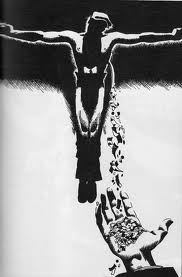 You need the good fruit of God’s Word. It is your source of life. It is your nourishment that sustains you in this life and the next. Pluck that good fruit from the cross which has become the tree of life.
 Pastorsamwise
You must be logged in to post a comment.