Ingredients of Great Faith – Sermon on Matthew 15:21-28 for the Second Sunday of Lent

Matthew 15:21–28

21 And Jesus went away from there and withdrew to the district of Tyre and Sidon. 22 And behold, a Canaanite woman from that region came out and was crying, “Have mercy on me, O Lord, Son of David; my daughter is severely oppressed by a demon.” 23 But he did not answer her a word. And his disciples came and begged him, saying, “Send her away, for she is crying out after us.” 24 He answered, “I was sent only to the lost sheep of the house of Israel.” 25 But she came and knelt before him, saying, “Lord, help me.” 26 And he answered, “It is not right to take the children’s bread and throw it to the dogs.” 27 She said, “Yes, Lord, yet even the dogs eat the crumbs that fall from their masters’ table.” 28 Then Jesus answered her, “O woman, great is your faith! Be it done for you as you desire.” And her daughter was healed instantly.

In the name of Jesus. Amen.

I want to start with an analogy that gets regularly used. Imagine two men who want to cross a frozen river with thick ice. One man doesn’t hesitate at all because he believes the ice is strong and stable. So, he gets in his ¾ ton pickup truck and drives straight across no sweat. The other man is terrified and trembling because he doesn’t trust the ice. He lays out as flat as possible to distribute his weight and crawls on his belly inch by inch and makes it to the other side. Both men had faith. The guy in the truck had a strong faith, and the guy wriggling on his belly had a weak faith. Was their success in crossing based on their faith? No. Obviously, one had an easier time than the other but they both succeeded in the goal of crossing.

Now imagine those same two men needing to cross the frozen river, but the ice is less than an inch thick. Again, the first man doesn’t hesitate at all because he believes the ice is fine, but he and his pickup plunge into the frigid river and are swept away. The other man is crawling because he’s worried about the thickness of the ice. But it doesn’t matter how careful he is. That thin ice cracks, and he’s swept away too. Now again, was their failure in crossing based on their faith? No. It was based on the thickness of the ice.

Here’s the point: Faith has an object; faith is in something. You can have a lot of faith, but if that faith is in the wrong thing it doesn’t matter how strong that faith is because the thing you believe isn’t right. The opposite is true too. You can have a tiny, little, weak faith in the right thing and that’s what matters because that thing can support that faith even though it’s weak.

For a long time now, you’ll hear people talk about being a “believer.” Ok, but a believer in what? That term is fine. The Bible uses it, but it needs more context. What is it that you believe? A newer term that seems to be gaining popularity is “a person of faith.” That one drives me nuts – as though faith is the thing that matters. Everyone has faith in something. A “person of faith” has faith in what? Honestly, an atheist is a person of faith. They are. An atheist believes that everything that exists came from nothing or believes that matter is eternal. An atheist believes, contrary to every observable fact, that the order and beauty we see in creation happened by mere chance. An atheist believes he knows enough to conclude that there is no designer or creator. Now that takes a lot of faith, but that faith is based on complete foolishness.

Christian, you can define your faith. The Creeds are excellent summaries of what you believe. The strength of your faith or the amount of your faith doesn’t matter as much because what you believe is solid, right, and true. The stronger your faith is, the better your life will be. Think back to the analogy of the two guys crossing the river: They both get across. The guy who has great faith gets across quickly and easily, but the guy who crawls still gets across.

We do want to grow in and strengthen our faith. Sometimes people will think that when Jesus calls us to have the faith of a child (Mk. 10:14-15) that He’s saying that a weak faith is fine. A child’s faith is not weak. Think about it. An infant can’t do anything on her own. But that infant has faith that simply crying will get her parents to spring into action to fix her problem – her hunger, need for a nap, or messy diaper. Infants actually have a strong faith that trusts the adults will take care of whatever needs that infant has.

Ok. All of that brings us to the text about the Canaanite woman. She is one of only two people in the Gospels who has a faith that gets praised by Jesus, “O woman, great is your faith!” (the other is in Mt. 8:10; Lk. 7:9). So, it’s good for us to consider what is it about this woman’s faith that makes it great enough that Jesus would praise it. Well, let’s consider the text.

The first ingredient of great faith is that it trusts that Jesus is the Savior of all mankind. This woman is an outsider – a Canaanite. She was part of the people that should have been eliminated because of their demonic worship. Psalm 106 talks about the failure of the Israelites to drive out the Canaanites and how that failure led to tolerating the pagan religious practices of the Canaanites. Because of that failure, the people were sacrificing their sons and daughters to the demons (Ps. 106:34-39).

It is no stretch to assume the reason this woman’s daughter was so severely possessed by a demon was because of her own actions and due to her pagan worship. If I’m wrong about that, I’ll apologize to this woman in heaven because we’ll meet her there. Now, despite all of that, this woman trusts that Jesus is herSavior and can help her and her daughter. So, she goes to Him and prays, which leads us to the second ingredient.

The second ingredient of great faith is that it is bold and persistent in prayer. This woman is unflinching. I know that it’s hard to hear how our Lord treats this woman. She cries out, and He ignores her. Jesus dismisses her and acts as though He doesn’t have anything for her. And, finally, Christ insults her by calling her a dog.

By the way, don’t let the way Jesus acts toward her make you think that Jesus is a misogynist or is racist. Look at the end of the account. Because He praises her faith, we know what He thought of all those prayers that came before. He loves this woman and her daughter. But in the middle of it the woman doesn’t know what Jesus thinks of her or her prayer. And despite the way she is treated, she keeps praying. She doesn’t let up. She keeps asking for relief and trusts that Jesus will deal with her according to His grace and mercy.

How many times have you prayed about something and it seems as though God is ignoring you or the situation gets even worse? That is not the time to stop praying. Great faith stays bold and steadfast even when it appears that God doesn’t care. Know that He does care and loves you.

The third and final ingredient of great faith is that it recognizes that God’s crumbs are more than enough. Now, getting rid of that demon was huge for the woman. It’s something she can’t do on her own. But her faith has such a high opinion of Jesus and His power that she recognizes that it’s no big deal for Him to conqueror that demon and expel it from her daughter. This woman recognizes that it is just a crumb for Jesus to completely defeat this demon who has crushed her soul, who has plunged her entire world into chaos and grief and suffering, and who has brought her all this pain and torment. It’s just a crumb. It’s no big deal for Jesus.

Dear saints, it’s nothing for Jesus to take away all your sins. He’s already done all the heavy lifting. So, it’s a simple task for Him now to forgive you, bless you, and grant you eternal life. He gives you better than crumbs. He gives you Himself to cure your soul and bring you unto eternal life with Him. Amen.

The peace of God, which surpasses all understanding, will guard your hearts and minds in Christ Jesus. Amen.
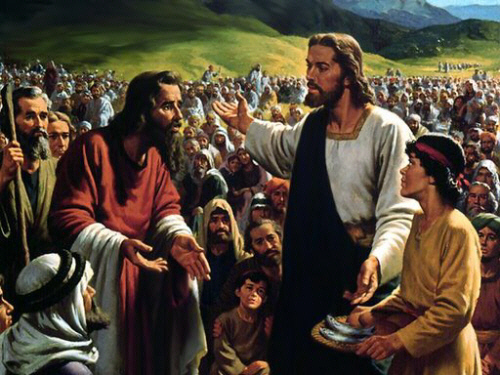
The King’s Test – Sermon on John 6:1-15 for the Fourth Sunday of Lent

John 6:1-15

1 After this Jesus went away to the other side of the Sea of Galilee, which is the Sea of Tiberias. 2 And a large crowd was following him, because they saw the signs that he was doing on the sick. 3 Jesus went up on the mountain, and there he sat down with his disciples. 4 Now the Passover, the feast of the Jews, was at hand. 5 Lifting up his eyes, then, and seeing that a large crowd was coming toward him, Jesus said to Philip, “Where are we to buy bread, so that these people may eat?” 6He said this to test him, for he himself knew what he would do. 7 Philip answered him, “Two hundred denarii worth of bread would not be enough for each of them to get a little.” 8 One of his disciples, Andrew, Simon Peter’s brother, said to him, 9 “There is a boy here who has five barley loaves and two fish, but what are they for so many?” 10 Jesus said, “Have the people sit down.” Now there was much grass in the place. So the men sat down, about five thousand in number. 11Jesus then took the loaves, and when he had given thanks, he distributed them to those who were seated. So also the fish, as much as they wanted. 12 And when they had eaten their fill, he told his disciples, “Gather up the leftover fragments, that nothing may be lost.” 13 So they gathered them up and filled twelve baskets with fragments from the five barley loaves left by those who had eaten. 14 When the people saw the sign that he had done, they said, “This is indeed the Prophet who is to come into the world!” 

15 Perceiving then that they were about to come and take him by force to make him king, Jesus withdrew again to the mountain by himself.

In the name of Jesus. Amen.

Jesus asks Philip, “Where are we to buy bread, so that these people may eat?” And John gives us insight as to why Jesus asks the question. It was to test Philip. Now, Jesus didn’t just find Himself in the midst of the wilderness surrounded 5,000 men plus women and children – in all likelihood a crowd of ten to twenty thousand people – with no food and sees an opportunity for a test. No, Christ sets the entire thing up.

The feeding of the 5,000 is one of the few events recorded in all four Gospels (Mt. 14:13-21; Mk. 6:30-44; Lk. 9:10-17; and Jn. 6:1-15). The picture the texts collectively paint is that Jesus intentionally draws this crowd out into the wilderness (Mk. 6:31). He takes the time to heal many of them (Mt. 14:14) and preaches late into the evening (Mk. 6:34-35). In other words, Jesus means to bring them to that desolate place where there is no food, but food is needed. On top of that, He is the King who created everything (Jn. 1:1-2, 14). Jesus can cause rain to fall in one place but not another (Am. 4:7). Throughout the entire world, Jesus was the One providing bread and food for all mankind (Ps. 145:15-16), but Christ brought this massive crowd out into the wilderness to this particular mountain in order to set this test up for Philip. And the test has one question, “Where are we to buy bread, so that these people may eat?” Jesus isn’t looking for information. He’s not asking Philip to devise a plan or order something through Door Dash. The text tells us, “[Jesus] knew what He would do” (Jn. 6:6).

Now, put yourself in Philip’s position. It isn’t hard to imagine. When was the last time you were in a seemingly impossible situation? Your bank account got low, and suddenly your car needs significant, expensive repairs. You wonder, “Where’s the money going to come from?” Your kid or your spouse gets sick, and while you are doing everything you can to care for them, you get sick too. You don’t know where you will get the strength care for yourself much less your kid. You’re in a really busy time at work, then there is a blizzard, so you have to dig yourself out and help your aging parents clear out their driveway too. You don’t know where you will find the time to do everything that needs to be done. How often do you look at your calendar or think through all the things you need to accomplish and have no idea how you are going to make it through the week? Whether it is resources and money, strength and endurance, time and skills, there are moments in your life where you are buried under the expenses, responsibilities, and tasks, and all you can see is what you don’t have.

That is why Philip fails Jesus’ test. He sees what they have, and he concludes it isn’t enough. His response is, basically, “You’re jumping the gun, Jesus. Look around. We’re in the wilderness, not the marketplace. Even if we were surrounded by stores fully stocked with bread, we don’t have enough money. Two-hundred denarii wouldn’t be enough for all of them to even get a bite.”

The test was for Philip, but Andrew, Peter’s brother, takes a shot at the exam. This is just an aside, but this text really shows how similar Andrew and Peter are. Peter will jump into situations like a madman (Mt. 14:28-29) and will speak when he should just be silent (Mk. 9:5-6). Andrew does the same when he says, “This boy has five barley loaves and two fish, but that’s not going to cut it with this crowd.”

Both Philip and Andrew fail the test even though they knew the answer. The correct answer was, “I don’t know where we will buy bread, Jesus. But I do know You are here. You have provided food in bleaker situations than this, so You’ve got it all under control.” Philip and Andrew knew that Jesus was the Messiah (Jn. 1:41). They knew He was the fulfillment of what Moses and the prophets wrote (Jn. 1:45). In other words, they both knew that Jesus was the one who rained bread from heaven and sent quail in abundance for His people in the wilderness (Ex. 16:4, 13). They knew Jesus was the one who sent the ravens to feed Elijah by the brook (1 Kgs. 17:3-7) and through the widow’s jars of oil and flour that never ran out during the drought (1 Kgs. 17:14-16). They know that God promises in Psalm 34:10 which says, “Those who seek the Lord lack no good thing.”

Both Philip and Andrew know all of this, but they still fail the test, just like you and I do. They fail, notbecause they don’t know enough, weren’t taught well, or needed to go back to Sunday School. They fail for the same reasons we do – because we are sinners. All of us sinners fail to trust God’s promises to provide everything we need. Instead, we fall into despair, weakness, unbelief, and a ‘woe-is-me’ attitude.

Dear saints, repent and then rejoice.

When God brings tests and trials your way, remember that He is with you. And because He is with you, it doesn’t matter what you have or don’t have. Jesus doesn’t need soil and seed and rain and time and the right weather conditions and combines and grain elevators and flour mills and factories and bakers and truck drivers and grocers to give people bread. Jesus doesn’t need boats and bait and poles and nets and processing plants or even water to feed people fish. Just because those are the normal methods God delivers bread and meat to us, that doesn’t mean that is the only way He does it. Jesus is always free and able to cut all of that out and give exactly what is needed when it is needed – just like He does here.

Christ provides what Philip, Andrew, and all the disciples could not buy, bake, grow, earn, catch, or deserve. He provides this meal to the crowds and enough to last His flunked disciples for days afterward.

But most importantly, Jesus lavishly pours out His mercy and grace on His sinful disciples. We see it here as He doesn’t scold them for their unbelief and sin. In fact after this, Jesus will feed another crowd – four thousand that time (Mk. 8:1-10). And right after that the disciples are with Jesus in a boat, and they realize they only have one loaf of bread, and they will worry about their lack of food again (Mk. 8:14-21).

Jesus is always in control of every situation. The crowds here are about to try and take Christ by force to make Him king, but Jesus simply withdraws. And one year later, at the next Passover, the crowds will come with force to arrest Jesus, but He will not withdraw. They will put a royal purple robe on Him, crown Him with thorns (Jn. 19:2-3), crucify Him, and place a placard above His head that says, “Jesus of Nazareth, King of the Jews” (Jn. 19:19). There, on the cross, He will give and shed His blood for the forgiveness of sinners who fail the tests.

But the cross is no test. Instead, it is where Jesus, your Savior and King, demonstrated and proved His love and mercy for you, and for all us failures. Here and now, He delivers that mercy to you as He gives you His kingly Body and His royal Blood given and shed for the forgiveness of all your sins and failures.

Dear saints, come and receive. Amen.

The peace of God, which surpasses all understanding, will guard your hearts and minds in Christ Jesus. Amen.

The Line – Sermon on Matthew 6:24-34 for the Fifteenth Sunday after Trinity

Matthew 6:24-34

24 “No one can serve two masters, for either he will hate the one and love the other, or he will be devoted to the one and despise the other. You cannot serve God and money.

25 “Therefore I tell you, do not be anxious about your life, what you will eat or what you will drink, nor about your body, what you will put on. Is not life more than food, and the body more than clothing? 26 Look at the birds of the air: they neither sow nor reap nor gather into barns, and yet your heavenly Father feeds them. Are you not of more value than they? 27 And which of you by being anxious can add a single hour to his span of life? 28 And why are you anxious about clothing? Consider the lilies of the field, how they grow: they neither toil nor spin, 29 yet I tell you, even Solomon in all his glory was not arrayed like one of these. 30 But if God so clothes the grass of the field, which today is alive and tomorrow is thrown into the oven, will he not much more clothe you, O you of little faith? 31 Therefore do not be anxious, saying, ‘What shall we eat?’ or ‘What shall we drink?’ or ‘What shall we wear?’ 32 For the Gentiles seek after all these things, and your heavenly Father knows that you need them all. 33 But seek first the kingdom of God and his righteousness, and all these things will be added to you.

34 “Therefore do not be anxious about tomorrow, for tomorrow will be anxious for itself. Sufficient for the day is its own trouble.”

In the name of Jesus. Amen.

The things Jesus tells us to not be worried about in this text are, typically, not the things that we are actually worried about. The last time you didn’t have a meal was probably because you chose not to eat, either you are on a diet, you chose to do something other than eat, or you didn’t like the food you had on hand. You probably aren’t worried about clothing either. Your dressers and closets are likely full of clothes. Even if they are last year’s styles, they would still do what clothes are meant to do. Yes, clothes wear out, but in a pinch you could stitch together something to keep you warm and covered. You have food and clothing. And here Jesus promises that He will give you everything you need for this life as long as He wants to keep you in this life. And Jesus wants you to trust that He will do this. 

That is why Jesus harps on all of us for our worry over and over in this text. Even though we don’t typically worry about food, drink, and clothing, we certainly do worry about other things. The economy. Gas prices. Inflation. Cancer. Heart disease. The upheaval and unrest in our country and throughout the world. Those things and things like it are the things we worry about, and we try to excuse our worry about those things. But  today, Jesus says, “Do not be anxious, saying, ‘What shall we eat?’ or ‘What shall we drink?’ or ‘What shall we wear?’ For the Gentiles,” in other words, the pagans and unbelievers, “the Gentiles seek after all these things.” According to Jesus here, one of the marks of the unbeliever is worry. Yet, you and I still worry. This text gives us all ample reasons to repent. 

Notice how Jesus draws a line in the last verse. After telling us not to worry about food, drink, or clothing or anything else we need for this life, Jesus adds, “Do not be anxious about tomorrow, for tomorrow will be anxious for itself. Sufficient for the day is its own trouble.” Last week, we considered how thankfulness looks back to the good gifts of God in the past. Well, worry does the opposite. Worry looks at the unknown, bad things in the future and has a wrong belief that we have to face that future alone. Tomorrow is clouded in the unknown, but tomorrow is also clothed with the promises of God to be with us, to never leave or forsake us, to provide all that we need, and to protect us with His power and might. God will care for us. Now, that doesn’t mean that we get to be lazy or idle. But too often we sinfully think that worry is the work we need to do to face the troubles of tomorrow.

That is why Jesus draws this line for us. The things that God sets before us today are the things that should have our attention. We are to do everything God gives us to do to confront and combat those evils and troubles that we face each day. Jesus wants us to go about our business and exert our efforts while God promises to give us the strength we need for every moment of today. But when Jesus says, “Do not worry about tomorrow,” He draws a line at the end of today. Anything past that line, we are to leave in His gracious hands.

With all of Jesus’ talk about not worrying, we can fall off the other side of the horse and become sinfully passive and idle. We might be tempted to think we don’t ever have to work or do anything to combat the evils we face and think God will just take care of everything as we can just back and do nothing. Well, that isn’t right either. For example, it is a sin to pray for a hole when God has given you a shovel. God uses you as His hands and feet to combat the evils of the day, and He promises to give you the strength you need as you face those evils. And since each day has enough evil of its own, don’t let tomorrow’s evil distract you with worry from what God has given you to face today. Jesus promises that He will give you everything you need to meet the evil, ugly troubles of today. And, if He gives you another day tomorrow, He will do it again.

Our Old Testament lesson (1 Kgs. 17:8-16) is a great example of God giving what is needed to face the troubles of today. In Elijah’s days, things were bad. God’s own people had given up the faith and were worshipping Baal, the false god of fertility. So many had abandoned the faith that Elijah worries that he was the only believer left (1 Kgs. 19:10). God had sent a drought to punish Israel, but God told Elijah to live by the brook Cherith promising, “I have commanded the ravens to feed you there” (1 Kgs. 17:4). We don’t know exactly how long Elijah lived by that stream with the crows waiting on him, but as the drought went on, the brook dried out, and that is where our text picks up. God tells Elijah to go the city of Zarephath because, “I have commanded a widow there to feed you” (1 Kgs. 17:9).

For however long he lived at Cherith, Elijah had become accustomed to the ravens flying to him and providing his food because God had commanded them to feed him. Now, Elijah gets to Zarephath, but this widow isn’t like the crows who just delivered his food to him. She doesn’t come up to him and say, “There you are. Diner is at my place. God commanded me to feed you.” Not even close! Elijah watches this widow picking up a couple of sticks, asks her for a drink of water, and as the woman heads off to get it Elijah adds a bite of bread to his order. The widow doesn’t say, “No way! I can’t give you anything.” Instead, her response is, basically, “I’ve only got enough ingredients for my son and I to have a bite. I’m grabbing these sticks so we can bake it, eat, and die.” But Elijah gives her a promise from God that the flour and oil will not run out until God would send rain and provide relief from the drought (1 Kgs. 17:14, 16). For the entire three and a half years of the drought, God gave Elijah what he needed to face the evil of each of those days. Dear saints, God will provide all you need for this life until He calls you out of this veil of tears. So don’t worry.

Some of you have watched the pain that a family endures while their child is being treated for cancer. Some of you have gone through this, but for those of you who haven’t, you might think, “I could never handle that the way they handled that. I don’t have the strength.” You were right. You don’t have the strength to handle that because God hasn’t called you to face that – at least not yet. But here’s the thing. When Jesus says, “Do not worry about tomorrow,” Jesus is saying that He doesn’t want you to worry about that diagnosis coming tomorrow because it distracts you from meeting the troubles that God has called you to face today. If the day comes when God calls you to meet that evil (or any other evil), Jesus promises to give you the strength to meet that evil each and every day it is yours to endure.

You see, when you get to the end of the day and are completely worn out, remember, God designed your tank to be empty at the end of the day. So, go to sleep in peace (Ps. 4:8). And when you wake up again, be ready to face the trouble that comes your way that day because God will give you His strength to meet it then.

Dear saints, work and strive and face the evil, troubling that are before you. But draw a line at the end of the day, and don’t worry about anything past that line since you can’t do anything about it anyway. God promises that He will give you the strength to meet the evil things that come your way each and every day of your life, and He is faithful.

Above all, remember what Christ has done by taking on our flesh. Jesus Himself got hungry and thirsty and tired and hot and cold, so He knows the struggles you face. Christ endured it all without a shred of worry because He trusted that God the Father would provide the strength He needed to endure it. Even as He went to the cross, carrying all your sin of doubt and anxiety, Christ entrusted Himself to God (1 Pet. 2:23), and there on the cross Jesus provided what you needed most – His forgiving blood shed for you. On the cross, Christ overcame and defeated all the evils of every day that you face and has now opened the kingdom of heaven to you.

This means that you can face the evils of each day of your life knowing that God will give you the strength to meet those evils, and you don’t need to help Him with your worry. Without fail, Christ will give you everything you need until the day He calls you into His gracious presence. Amen.

The peace of God, which surpasses all understanding, will guard your hearts and minds in Christ Jesus. Amen.

Fear, Love, & Trust – Sermon on Matthew 22:34-46 for the Eighteenth Sunday after Trinity

Matthew 22:34-46

34 But when the Pharisees heard that he had silenced the Sadducees, they gathered together. 35 And one of them, a lawyer, asked him a question to test him. 36 “Teacher, which is the great commandment in the Law?” 37 And he said to him, “You shall love the Lord your God with all your heart and with all your soul and with all your mind. 38 This is the great and first commandment. 39 And a second is like it: You shall love your neighbor as yourself. 40 On these two commandments depend all the Law and the Prophets.”

41 Now while the Pharisees were gathered together, Jesus asked them a question, 42 saying, “What do you think about the Christ? Whose son is he?” They said to him, “The son of David.” 43 He said to them, “How is it then that David, in the Spirit, calls him Lord, saying,

44 “The Lord said to my Lord, 

       ‘Sit at my right hand, 
until I put your enemies under your feet’?

45 “If then David calls him Lord, how is he his son?” 46 And no one was able to answer him a word, nor from that day did anyone dare to ask him any more questions.

In the name of Jesus. Amen.

Well, here they go again. Those tricksy Pharisees. Trying to catch Jesus, trying to get our Lord to say something that would get Him in trouble. Last week, it was at a banquet watching to see what Jesus would do with a sick man (Lk. 14:1-11). This week, it’s with a test question. “Teacher, which is the great commandment in the Law?”

To be honest, there isn’t really anything wrong with the lawyer’s question as it is. (More on that in a bit.) But the motive behind the question was sinful. The Pharisees wanted to catch Jesus pitting one part of God’s Word against another. It’s impossible to know exactly what they had planned to do with Jesus’ response. Maybe, they figured Jesus would say that the 1st Commandment, “Thou shalt have no other gods before Me,” was the greatest. Then, they could falsely accuse Him of teaching that profaning God’s name, dishonoring parents, murder, stealing, or lying wasn’t a big deal. Whatever their plans and thoughts were, they were trying to make Jesus look like a fool with this question about the Law.

They miscalculated. Badly.

They didn’t realize with Whom they were speaking. Jesus is the Author of the Ten Commandments. He carved them into stone tablets and declared them to Moses and all the people of Israel (Jn. 1:18). Trying to trick Jesus with a question about the Ten Commandments is like trying to trick Herman Melville with a question about Moby Dick, Mark Twain with a question about Huck Finn, C.S. Lewis with a question about Aslan, George Lucas with a question about Luke Skywalker, or Dr. Seuss with a question about the Cat in the Hat. (Hopefully, one of those combinations works for you.)

Jesus, the Author of the Law, will not let one part of His perfect will – which is expressed in the Commandments – be pitted against the rest. The Commandments are not in competition with each other. To love God with the whole heart, whole soul, and whole mind is the first and great commandment. And notice how Jesus continues. He says there is another commandment, a second commandment, that is like the first and great commandment. Love your neighbor as yourself.

Now, it is interesting in Mark’s account of this same encounter with the Pharisees Jesus says there’s no other commandment – singular – greater than these – plural (Mk. 8:31). In other words, perfect love of God and perfect love of your neighbor go together. The two are inseparably tied together and are really one commandment. On these hang all the Law and the Prophets. Love for God is demonstrated by love for the neighbor. 1 John 4:20 says, “If anyone says, ‘I love God,’ and hates his brother, he is a liar; for he who does not love his brother whom he has seen cannot love God whom he has not seen.” In other words, when you love your neighbor, you are loving God who has commanded you to love your neighbor.

Some people today will say that since Jesus distills the Commandments down to, “Love God, and love your neighbor,” that we don’t need the Commandments or any other teaching about God’s Law. Basically, they will say, “We just have to love each other.” Be careful with that. The reality is that we need the Commandments, we need the Law, to teach us what love looks like.

If you want to love God, love your neighbor, and here is what that looks like: Loving God is obeying His command to honor your father and mother by serving, obeying, and respecting them. Loving God is obeying His command to not murder your neighbor or cause him any suffering. Loving God is obeying His command to not commit adultery – which means, husbands, live a chaste life for your wife, and wives, live a chaste life for your husband. Love is not stealing, rather helping your neighbor improve and protect his property. Love is not bearing false witness and putting the most charitable construction on all that your neighbor does.

Honestly, it doesn’t matter if you think what you are doing is motivated by love; if your thoughts, words, or actions fall outside of these Commands, it is not love. In fact, we could go a step farther and say that, whenever your actions fall outside of the Ten Commandments, they are selfish and sinful actions motivated by hatred toward both God and neighbor.

Dear saints, all of this is to say, we all have a lot of reasons to repent. We do not fear, love, and trust in God above all things, and we do not love our neighbor as ourselves. We let our fear of things other than God dictate how we act. We let our love of things that are not God distract us from the God who loves us. We let our trust in things other than God draw us away from God. Again, dear saints, repent. The Law always accuses us and shows how we fail in our obligation to love God and neighbor.

Now, I said earlier that there isn’t anything wrong with the lawyer’s question about what is the greatest Command. But that question, by itself is incomplete because the Law leaves us hanging out to dry under God’s wrath and punishment. At best, the Law can only curb and deter people from sin, but that’s as far as it can go. The Law is good because it tells us what we must do, but the Law is limited because it can only reveal what we have failed to do. The Law is never helpful in saving us unless we also know the One who hung upon the cross for all our sins of failing to love God and neighbor.

That is why Jesus asks His question about the Christ. Just like in last week’s Gospel lesson, Jesus turns the tables and asks the Pharisees a question, “The Messiah, whose son is he?” And the Pharisees were right when they answered, “David’s son.” God had promised that a son of David would sit on David’s throne forever (1 Sam. 7). But David also wrote in Psalm 110:1, which is the verse that Jesus quotes, that this Son of David is also David’s Lord. So, Jesus’ question is, “How can the Messiah, David’s son, also be David’s Lord?”because a father would never call his descendent, “Lord.”

Here, Jesus is teaching the Pharisees and you that the Messiah is both God and man. Here’s why that is so important:

Because the Messiah is God, He has kept the Law perfectly. And because He is man, that keeping of the Law is for you. Jesus perfectly loved God and your neighbor in your place. And through faith, that perfect keeping of the Law is credited to you (2 Cor. 5:21).

The easiest example of this is the 4th Commandment. The Law says, “Honor thy father and mother. Love God by loving your parents as yourself.” And you are left saying, “God, I haven’t done that. I need Your help.” If the Jesus had not come to earth as a Man, God would have to say, “Well, I’m God. I don’t have a father or mother, so I can’t help you. You have to do that yourself.” But God did become a Man. Jesus had a mom and a dad. He did love and honor them perfectly. So, He can and does help you by reckoning His obedience and keeping the Commandment to your account. And this applies to each and every one of the Commandments.

Jesus, the eternal, righteous Son of God, became a Man, perfectly loved God and neighbor, died, and rose again. Through this, He has brought the Law to perfection. This might be too simplistic of an explanation, but it might help shape our thinking.

In His answer to the lawyer’s question, Jesus shows us that the Law has a divine aspect and a physical aspect – love God (divine) and love neighbor (physical). God be praised, that He has given you a Savior who is also divine and physical – God and Man. So, now, when you hear the Law and what it requires of you, you realize that you are lost and deserve God’s wrath and judgment in both body and soul. So, you cry out, “God I’m lost. I deserve punishment and death, could You take that punishment and die for me?” And because the Son of God has taken up your flesh, Jesus says, “Sure. I already have.”

Dear saints, Jesus has perfectly loved God and neighbor for you. All of His perfection and righteousness – His perfect fear, love, and trust in God – is given to you through faith. And to strengthen that faith, your Savior is here now to give you His Body and Blood for the forgiveness of all your sins. For that, God be praised. Amen.

The peace of God, which surpasses all understanding, will guard your hearts and minds in Christ Jesus. Amen.

Today – Sermon on Matthew 6:24-34 for the Fifteenth Sunday after Trinity

Matthew 6:24-34

[Jesus says,] 24 “No one can serve two masters, for either he will hate the one and love the other, or he will be devoted to the one and despise the other. You cannot serve God and money.

25 “Therefore I tell you, do not be anxious about your life, what you will eat or what you will drink, nor about your body, what you will put on. Is not life more than food, and the body more than clothing? 26 Look at the birds of the air: they neither sow nor reap nor gather into barns, and yet your heavenly Father feeds them. Are you not of more value than they? 27 And which of you by being anxious can add a single hour to his span of life? 28 And why are you anxious about clothing? Consider the lilies of the field, how they grow: they neither toil nor spin, 29 yet I tell you, even Solomon in all his glory was not arrayed like one of these. 30 But if God so clothes the grass of the field, which today is alive and tomorrow is thrown into the oven, will he not much more clothe you, O you of little faith? 31 Therefore do not be anxious, saying, ‘What shall we eat?’ or ‘What shall we drink?’ or ‘What shall we wear?’ 32 For the Gentiles seek after all these things, and your heavenly Father knows that you need them all. 33 But seek first the kingdom of God and his righteousness, and all these things will be added to you.

34 “Therefore do not be anxious about tomorrow, for tomorrow will be anxious for itself. Sufficient for the day is its own trouble.”

In the name of Jesus. Amen.

Of all the things we humans do, there is nothing more pointless and draining than worrying and being anxious. A reasonable argument could be made that worry is a bigger waste of time than watching television, playing endless video games, or scrolling on your phone all day. Anxiety not only fills our mind and distracts us from doing productive things, it can, depending on how anxious we are, also zap us of physical energy. But now, kids, listen to me carefully: Don’t use that statement to argue with your parents when they tell you to stop wasting time watching TV or whatever. You don’t have my permission to say, “But pastor says it’s better than being worried.”

How many times have you been really worried and incredibly anxious about something, but then everything fell into place and life simply moved on? We all remember times when we have been incredibly worried, but it can be easy to forget what we were worrying about because everything worked out just fine. God gave you what you needed, and you made it through. There are other times you weren’t worried about anything, and God still gave you what you needed. So, whether you are anxious and worried or not, God provides.

Three times in this text, Jesus commands you, “Do not worry.” One other time He asks almost sarcastically, “Why do you worry?” Jesus cares a lot about us not worrying because He has an interest in your confidence and trust. He doesn’t want you to be anxious. In this text, Jesus makes two things clear: First, God wants to and does give you everything you need for life. And second, God wants you to have confidence that He will give you everything you need.

We sit in strong, solid, well-built homes that have cupboards, pantries, and refrigerators full of food. In fact, we often end up throwing perfectly good food away. We have dressers, closets, and storage bins filled with more clothes than we could ever use, but we wonder if God cares about us. Birds and grass have a lot to teach us about trusting our Creator.

God cares for the birds by feeding them. Each day, every bit of food eaten by every bird on the planet was put there by God. God knows you need food just like a bird does. He’ll make sure you have it. God cares for the flowers by clothing them more splendidly than Solomon was ever clothed. If God clothes the grass like that, He will make sure you have what you need.

We live in a world surrounded by unbelievers who are always worried about the future. The sad fact is that they think their worry actually accomplishes something. Christ doesn’t want you to live like that. Jesus says you are free to seek first the kingdom of God and His righteousness, and all these things – food, clothing, house, home, money, goods, etc. – will be given to you as well.

Listen, God promises that if your regular source of food and clothing is depleted or cut off, He will provide another one. Our Old Testament lesson (1 Kgs. 17:8-16) is a great example. God sent a drought to punish Israel during the days of Elijah, so God told Elijah to live by a brook named Cherith promising, “I have commanded the ravens to feed you there” (1 Kgs. 17:4). Scripture doesn’t say how long Elijah lived there with the crows waiting on him, but as the drought went on, the brook dried out, and that is where our text picks up. God tells Elijah to go the city of Zarephath because, “I have commanded a widow there to feed you” (1 Kgs. 17:9). That line really struck me this week. 

For however long he lived at Cherith, Elijah had become accustomed to the ravens flying to him and providing his food because God had commanded them to feed him. Now, he gets to Zarephath, but this widow doesn’t come up to him and say, “There you are. Diner is at my place. God commanded me to feed you.” Not even close! Elijah watches this widow picking up a couple of sticks and asks her for a drink of water, and the woman heads off to get it. Only then does Elijah decide to add a bite of bread to his order, and the woman doesn’t say, “No way! I can’t give you anything.” Instead, her response is, basically, “I’ve only got enough ingredients for my son and I to have a bite. I’m grabbing these sticks so we can bake it, eat, and die.” I wonder if this is how Elijah recognizes that she is the one God had commanded to feed him. Then, there is the promise that the flour and oil will not run out until God would send rain and provide relief from the drought (1 Kgs. 17:1416). Again, once Elijah’s supply of food from the ravens was gone, God provided Elijah another supply of food.

Dear saints, God will provide all you need for this life until He calls you to heaven. And in the New Creation, God will provide you with a feast of rich food for all eternity (Is. 25:6). He has promised!

Now, all of that brings us to v. 34 which is where I really want to focus our attention, and if your mind has been wandering, come back. After telling us to not be anxious about what we will eat, drink, or wear, Jesus says, “Do not be anxious about tomorrow.” Again, Jesus has given us ample reasons to not worry about food and clothing, but I honestly don’t know many, if any, people who are anxious about those things. (God has certainly blessed us!) But I do know a lot of you here are worried about what will happen tomorrow, a month from now, a year from now, and in the coming decades.

Some are worried about the virus and the variants. Some are worried about what long-term side effects the vaccines might have. Some are worried about the government becoming too authoritative. Some are worried the government isn’t doing enough to stop the virus or terrorists, and with the 20th anniversary of 9/11, some are worried about another terrorist attack on our soil. Some are worried about the world becoming more and more hostile toward Christians. All of this can pile up and make us worried about the world our kids, grandkids, and great grandkids will live in. But Jesus straight up tells us, “Do not worry about tomorrow.”

Now, I’ve been trying to figure out a way to say this succinctly since Tuesday, and I still haven’t found it. So, bear with me. When Christ commands us, “Do not worry about tomorrow,” Jesus almost gives us permission to worry about today, but it’s like we are to draw a line at the end of the day and not have any worry whatsoever about anything past that line. To be sure, Jesus tells us to not worry about our life – food, clothing, etc., but the evil and ugly things we face today are enough for us. And we are to do everything God gives us to do to confront and combat those evils each day God gives us.

Here’s what I mean, with all of Jesus’ talk about not worrying, we can fall off the other side of the horse and become sinfully passive and idle. We might be tempted to think we don’t ever have to work or do anything to combat the evils we face and think God will just take care of everything. Well, that isn’t right either. For example, it is a sin to pray for a hole when God has given you a shovel.

And since each day has enough evil of its own, don’t let tomorrow’s evil distract you with worry from the evil you face today. Jesus promises that He will give you everything you need to meet the evil, ugly challenges of today. And, if He gives you another day tomorrow, He will do it again.

For example: Some of you have watched the pain family endures while their child is being treated for cancer. Some of you have actually gone through this. But for those of you who haven’t, you might think, “I could never handle that. I don’t have the strength.” You were right. God hasn’t called you to do that – at least not yet. But Jesus doesn’t want you to worry about that diagnosis coming tomorrow because it distracts you from meeting the challenges and evil God has called you to face today. If the day comes when God calls you to meet that evil (or any evil like that), Jesus promises to give you the strength to meet that evil each and every day it is yours to endure.

You see, when you get to the end of the day and are completely worn out, remember, God designed your tank to be empty at the end of the day. So, go to sleep in peace (Ps. 4:8). And when you wake up again, be ready to face the trouble that comes your way that day.

Above all, remember what Christ has done by taking on our flesh. Jesus Himself got hungry and thirsty and tired and hot and cold, so He knows the struggles you face. He endured it all without a shred of worry because He trusted that God the Father would provide the strength He needed to endure it. Even as He went to the cross, carrying all your sin of doubt and anxiety, He entrusted Himself to God (1 Pet. 2:23), and there on the cross Jesus provided what you needed most – His forgiving blood shed for you. On the cross, Christ overcame and defeated all the evils of every day that you face and opened the kingdom of heaven to you.

So, when you face the evil of each of your todays, remember that God has promised to take care of it.Ps. 37:32-33 says, “The wicked watches for the righteous and seeks to put him to death. The Lord will not abandon [the righteous] to [the wicked’s] power or let him be condemned when he is brought to trial.” That means that none of the devil’s charges against you can stand in God’s court, and nothing that the world can throw at you will ever change that.

Dear saints, be comforted and be at peace. Your God knows what you need to face today and all your future todays. And He will provide the strength you need. He has promised. He is faithful. He will surely do it (1 Thes. 5:24). Amen.

The peace of God, which surpasses all understanding, will guard your hearts and minds in Christ Jesus. Amen.