The Problem – Sermon on Matthew 25:1-13 for the Last Sunday of the Church Year

Matthew 25:1-13

1 “Then the kingdom of heaven will be like ten virgins who took their lamps and went to meet the bridegroom. 2 Five of them were foolish, and five were wise. 3 For when the foolish took their lamps, they took no oil with them, 4 but the wise took flasks of oil with their lamps. 5 As the bridegroom was delayed, they all became drowsy and slept. 6 But at midnight there was a cry, ‘Here is the bridegroom! Come out to meet him.’ 7Then all those virgins rose and trimmed their lamps. 8 And the foolish said to the wise, ‘Give us some of your oil, for our lamps are going out.’ 9 But the wise answered, saying, ‘Since there will not be enough for us and for you, go rather to the dealers and buy for yourselves.’ 10 And while they were going to buy, the bridegroom came, and those who were ready went in with him to the marriage feast, and the door was shut. 11 Afterward the other virgins came also, saying, ‘Lord, lord, open to us.’ 12 But he answered, ‘Truly, I say to you, I do not know you.’ 13 Watch therefore, for you know neither the day nor the hour.”

In the name of Jesus. Amen.

The five foolish virgins had one problem. They were “morons.” That’s literally the word Jesus uses – μωρός. So that’s how I’ll refer to them; if you have a problem with me calling them morons, you can take it up with Jesus. Being morons was their only problem. The fact that they had lamps but no oil is problematic, but their problem is that they are morons. Having an oil lamp but no oil is silly. Wicks without oil can only burn for a few seconds before disappearing in a choking mess of smoke.

We might think that the wise virgins not sharing their oil with the morons is a problem. It doesn’t seem very charitable. Why don’t the wise just offer to let the morons walk in the light of their lamps? Well, we don’t know enough about the customs of Jesus’ day to know why each girl needed to have her own lamp. And who knows? Maybe that arrangement would have been acceptable. But notice what the morons did. When the call rings out, “Here is the bridegroom! Come out to meet him,” they moronically wander away from the banquet hall to try and buy some “midnight oil.” What shop would be open at that hour?

While the morons are gone on their hopeless shopping trip, the bridegroom arrives. The five wise virgins go in to the marriage feast, and the door is shut. When the five morons finally return begging to be allowed in to the feast, they are met with the horrifying reply, “Truly, I say to you, I do not know you.”

Jesus tells this parable as a warning for us to be ready for His return. The moral of the parable is, “Watch therefore, for you know neither the day nor the hour.” Jesus will return to judge the living and the dead. But Jesus didn’t tell us when He would return. So, He commands us to watch and be ready. Wake up from your sleep today. Wake up now. When the feast begins, Jesus wants you there. Have oil. Don’t be left outside.

But now, we have a problem. Jesus doesn’t tell us what the oil is. Is it the Bible, faith, grace, the Holy Spirit, or the Sacraments? Jesus doesn’t say. But the Scriptures would indicate that it can be and is all of those. I’m open to other suggestions that you might have, but my guess is that Jesus doesn’t tell us what the oil is so that we seek after all those things because each of them – Bible, faith, grace, absolution, and the Sacraments – are kingdom of heaven things. And Christ tells us to, “Seek first the kingdom of God and His righteousness” (Mt. 6:33).

That is why you are here today. God has gathered you here around His Word and Sacrament. This is where you need to be and where you belong. In this place, you hear God’s Word, are absolved of your sins, and receive Christ’s risen Body and Blood. In this place, you are supported by your brothers and sisters in Christ, and your presence ministers to them. Here, you unite in prayer making intercessions for yourselves and others, for our nation and this world. This is how faith is given, sustained, and strengthened. The Church is the well-fortified barracks where you are fitted with the whole armor of God (Eph. 6:11). And, here, you help others prepare for the battle.

But you don’t get to stay here. You will return to the battlefield of the world. It is necessary, and it is, in fact, what God has called you to do. You are called by God to go into the world and deal with lazy coworkers and incompetent supervisors and bosses. You will have to endure your children’s temper tantrums, your spouse’s failures and shortcomings, the loneliness of a widowed house, and your relatives’ problems. You will go back to school and classes with boring teachers, pointless homework, and bullies. God calls you to face all of that even while you struggle with your own sins of anger, lust, gossip, and envy.

In each of those places, each of those callings and vocations, the devil has laid all sorts of traps and snares for you; he prowls around like a roaring lion seeking to devour you (1 Pet. 5:8). Satan attacks you in those arenas because everywhere you go, you carry God’s light to a darkened world. Christian, every relationship you have is a holy, divine calling. And because you are God’s child, everything you do has spiritual value. How you handle work, school, chores, laundry, dishes, and whatever else has both temporal and eternal consequences. That is why you come to church and get what is necessary for your salvation. But what happens here must extend to the rest of your week.

Don’t be a moron thinking that a couple hours at church each week (or two to three times each month) is enough to prepare you for what you will face out there. You need more. And parents, listen up. Your children can’t share your oil and can’t walk in the light of your lamp. Each one needs his or her own lit lamp. So, if it hasn’t been your family’s practice in the past, start today. Make the reading of Scripture, prayer, and fellowship around God’s Word together as a family your top priority each day. Fathers, God calls you to take the lead on this. Wives, if he doesn’t do it on his own, pester and nag him until he does.

Family time in the Bible doesn’t need to be complicated or fancy. Start simple. Start with the Gospel of John and read one paragraph each day. After you read, pray for your friends and family. It can be as simple as, “Bless grandma and help Phil. Amen.” Then, pray the Lord’s Prayer. That will take five minutes. You can do that. You have the time to do that. And if you don’t have enough time, rip something out of your schedule. If your job makes it impossible, quit. Find a new one – even if it means a pay cut and you have to buy a smaller, cheaper house. This is eternally serious. Your salvation and the salvation of your children depends on it. If you miss a day, don’t give up. Start again the next. Make it a habit for you and your kids to pray together on the way to school or practice or wherever. All of this will help to begin to make God’s Word part of your regular conversations as you watch and remain ready for His return.

Ok. That was the Law part of the sermon. And, I hope was a bucket of ice water to awaken you from slumber. Now, we need the Gospel. And there is one more problem to address: Now, be honest. Does this parable strike fear into you?

Honestly, if you summarize the parable, it is a story of ten silly girls who fall asleep waiting for a party. Five are able to light a lamp and get to go into the party. Five can’t, so they have to go away. And if your high school experience was like mine, if you aren’t at the party, you just end up at home sulking and feeling a bit lonely and sorry for yourself.

So, when Jesus tells us that the purpose of this parable is to get us to watch for the day of His return, why did He use this analogy of a wedding party and ten silly, sleepy girls? If being ready for His return is so important, why not tell a parable with more urgency and more horrific consequences? Why not a parable of ten fishermen – five who wear life jackets and five morons who don’t and drown when the storm comes and the boat sinks? How about ten soldiers – five who carry their sword at all times and five morons who leave their swords lying around and get slaughtered when the enemy ambushes them?

Well, that is precisely why Jesus’ parable is different. In either of the parables I just suggested, the return of Jesus is depicted as a terrible, tragic event – a storm at sea, or a sudden attack by an enemy army. But in Jesus’ parable, the thing we need to be ready for, well, it’s the greatest day ever – the day of the arrival of Jesus, the Bridegroom and Savior of all mankind. A day of feasting, joy, laughter, and blessedness for those who are ready to enter with Him. It is the very thing we are looking forward to and longing for.

Once we have worked ourselves into a tizzy about the dire urgency of Christ’s return, we need to step back, take a deep breath, and remember: Christ’s return is not something horrific that you need to be scared of. Jesus’ return means that you will be in eternal bliss, happiness, contentment, and joy. There will be no more pain, tears, or sorrow. Christ’s return is something to anticipate – more than a child anticipates the arrival of her favorite aunt and cousins. That excited expectation is what Jesus is highlighting with this parable.

Yes, this parable is a warning. Our lamps can run dry. Faith must be continually fed by God’s Word and the Sacraments. Repent. Believe. Have faith in Christ.

And yes, Jesus teaches that as the end draws near the signs of His return are alarming: wars and rumors of wars, nation rising up against nation, earthquakes, persecution, hatred, false teaching, and love growing cold (Mt. 24:4-12). But, when you see those things, remember what that means for you. Christ says it means your redemption is drawing near (Lk. 21:28). The bridegroom is coming, and you are His bride without spot, wrinkle, or blemish (Eph. 5:27).

Dear saints, this world is ending. Good riddance. You have Christ. Your redemption is secure and your eternity certain. So, look forward to that day. Stay awake. Keep eagerly anticipating and looking for the resurrection of the dead and the life of the world to come. Amen.

The peace of God, which surpasses all understanding, will guard your hearts and minds in Christ Jesus. Amen.

Today – Sermon on Matthew 6:24-34 for the Fifteenth Sunday after Trinity

Matthew 6:24-34

[Jesus says,] 24 “No one can serve two masters, for either he will hate the one and love the other, or he will be devoted to the one and despise the other. You cannot serve God and money.

25 “Therefore I tell you, do not be anxious about your life, what you will eat or what you will drink, nor about your body, what you will put on. Is not life more than food, and the body more than clothing? 26 Look at the birds of the air: they neither sow nor reap nor gather into barns, and yet your heavenly Father feeds them. Are you not of more value than they? 27 And which of you by being anxious can add a single hour to his span of life? 28 And why are you anxious about clothing? Consider the lilies of the field, how they grow: they neither toil nor spin, 29 yet I tell you, even Solomon in all his glory was not arrayed like one of these. 30 But if God so clothes the grass of the field, which today is alive and tomorrow is thrown into the oven, will he not much more clothe you, O you of little faith? 31 Therefore do not be anxious, saying, ‘What shall we eat?’ or ‘What shall we drink?’ or ‘What shall we wear?’ 32 For the Gentiles seek after all these things, and your heavenly Father knows that you need them all. 33 But seek first the kingdom of God and his righteousness, and all these things will be added to you.

34 “Therefore do not be anxious about tomorrow, for tomorrow will be anxious for itself. Sufficient for the day is its own trouble.”

In the name of Jesus. Amen.

Of all the things we humans do, there is nothing more pointless and draining than worrying and being anxious. A reasonable argument could be made that worry is a bigger waste of time than watching television, playing endless video games, or scrolling on your phone all day. Anxiety not only fills our mind and distracts us from doing productive things, it can, depending on how anxious we are, also zap us of physical energy. But now, kids, listen to me carefully: Don’t use that statement to argue with your parents when they tell you to stop wasting time watching TV or whatever. You don’t have my permission to say, “But pastor says it’s better than being worried.”

How many times have you been really worried and incredibly anxious about something, but then everything fell into place and life simply moved on? We all remember times when we have been incredibly worried, but it can be easy to forget what we were worrying about because everything worked out just fine. God gave you what you needed, and you made it through. There are other times you weren’t worried about anything, and God still gave you what you needed. So, whether you are anxious and worried or not, God provides.

Three times in this text, Jesus commands you, “Do not worry.” One other time He asks almost sarcastically, “Why do you worry?” Jesus cares a lot about us not worrying because He has an interest in your confidence and trust. He doesn’t want you to be anxious. In this text, Jesus makes two things clear: First, God wants to and does give you everything you need for life. And second, God wants you to have confidence that He will give you everything you need.

We sit in strong, solid, well-built homes that have cupboards, pantries, and refrigerators full of food. In fact, we often end up throwing perfectly good food away. We have dressers, closets, and storage bins filled with more clothes than we could ever use, but we wonder if God cares about us. Birds and grass have a lot to teach us about trusting our Creator.

God cares for the birds by feeding them. Each day, every bit of food eaten by every bird on the planet was put there by God. God knows you need food just like a bird does. He’ll make sure you have it. God cares for the flowers by clothing them more splendidly than Solomon was ever clothed. If God clothes the grass like that, He will make sure you have what you need.

We live in a world surrounded by unbelievers who are always worried about the future. The sad fact is that they think their worry actually accomplishes something. Christ doesn’t want you to live like that. Jesus says you are free to seek first the kingdom of God and His righteousness, and all these things – food, clothing, house, home, money, goods, etc. – will be given to you as well.

Listen, God promises that if your regular source of food and clothing is depleted or cut off, He will provide another one. Our Old Testament lesson (1 Kgs. 17:8-16) is a great example. God sent a drought to punish Israel during the days of Elijah, so God told Elijah to live by a brook named Cherith promising, “I have commanded the ravens to feed you there” (1 Kgs. 17:4). Scripture doesn’t say how long Elijah lived there with the crows waiting on him, but as the drought went on, the brook dried out, and that is where our text picks up. God tells Elijah to go the city of Zarephath because, “I have commanded a widow there to feed you” (1 Kgs. 17:9). That line really struck me this week. 

For however long he lived at Cherith, Elijah had become accustomed to the ravens flying to him and providing his food because God had commanded them to feed him. Now, he gets to Zarephath, but this widow doesn’t come up to him and say, “There you are. Diner is at my place. God commanded me to feed you.” Not even close! Elijah watches this widow picking up a couple of sticks and asks her for a drink of water, and the woman heads off to get it. Only then does Elijah decide to add a bite of bread to his order, and the woman doesn’t say, “No way! I can’t give you anything.” Instead, her response is, basically, “I’ve only got enough ingredients for my son and I to have a bite. I’m grabbing these sticks so we can bake it, eat, and die.” I wonder if this is how Elijah recognizes that she is the one God had commanded to feed him. Then, there is the promise that the flour and oil will not run out until God would send rain and provide relief from the drought (1 Kgs. 17:1416). Again, once Elijah’s supply of food from the ravens was gone, God provided Elijah another supply of food.

Dear saints, God will provide all you need for this life until He calls you to heaven. And in the New Creation, God will provide you with a feast of rich food for all eternity (Is. 25:6). He has promised!

Now, all of that brings us to v. 34 which is where I really want to focus our attention, and if your mind has been wandering, come back. After telling us to not be anxious about what we will eat, drink, or wear, Jesus says, “Do not be anxious about tomorrow.” Again, Jesus has given us ample reasons to not worry about food and clothing, but I honestly don’t know many, if any, people who are anxious about those things. (God has certainly blessed us!) But I do know a lot of you here are worried about what will happen tomorrow, a month from now, a year from now, and in the coming decades.

Some are worried about the virus and the variants. Some are worried about what long-term side effects the vaccines might have. Some are worried about the government becoming too authoritative. Some are worried the government isn’t doing enough to stop the virus or terrorists, and with the 20th anniversary of 9/11, some are worried about another terrorist attack on our soil. Some are worried about the world becoming more and more hostile toward Christians. All of this can pile up and make us worried about the world our kids, grandkids, and great grandkids will live in. But Jesus straight up tells us, “Do not worry about tomorrow.”

Now, I’ve been trying to figure out a way to say this succinctly since Tuesday, and I still haven’t found it. So, bear with me. When Christ commands us, “Do not worry about tomorrow,” Jesus almost gives us permission to worry about today, but it’s like we are to draw a line at the end of the day and not have any worry whatsoever about anything past that line. To be sure, Jesus tells us to not worry about our life – food, clothing, etc., but the evil and ugly things we face today are enough for us. And we are to do everything God gives us to do to confront and combat those evils each day God gives us.

Here’s what I mean, with all of Jesus’ talk about not worrying, we can fall off the other side of the horse and become sinfully passive and idle. We might be tempted to think we don’t ever have to work or do anything to combat the evils we face and think God will just take care of everything. Well, that isn’t right either. For example, it is a sin to pray for a hole when God has given you a shovel.

And since each day has enough evil of its own, don’t let tomorrow’s evil distract you with worry from the evil you face today. Jesus promises that He will give you everything you need to meet the evil, ugly challenges of today. And, if He gives you another day tomorrow, He will do it again.

For example: Some of you have watched the pain family endures while their child is being treated for cancer. Some of you have actually gone through this. But for those of you who haven’t, you might think, “I could never handle that. I don’t have the strength.” You were right. God hasn’t called you to do that – at least not yet. But Jesus doesn’t want you to worry about that diagnosis coming tomorrow because it distracts you from meeting the challenges and evil God has called you to face today. If the day comes when God calls you to meet that evil (or any evil like that), Jesus promises to give you the strength to meet that evil each and every day it is yours to endure.

You see, when you get to the end of the day and are completely worn out, remember, God designed your tank to be empty at the end of the day. So, go to sleep in peace (Ps. 4:8). And when you wake up again, be ready to face the trouble that comes your way that day.

Above all, remember what Christ has done by taking on our flesh. Jesus Himself got hungry and thirsty and tired and hot and cold, so He knows the struggles you face. He endured it all without a shred of worry because He trusted that God the Father would provide the strength He needed to endure it. Even as He went to the cross, carrying all your sin of doubt and anxiety, He entrusted Himself to God (1 Pet. 2:23), and there on the cross Jesus provided what you needed most – His forgiving blood shed for you. On the cross, Christ overcame and defeated all the evils of every day that you face and opened the kingdom of heaven to you.

So, when you face the evil of each of your todays, remember that God has promised to take care of it.Ps. 37:32-33 says, “The wicked watches for the righteous and seeks to put him to death. The Lord will not abandon [the righteous] to [the wicked’s] power or let him be condemned when he is brought to trial.” That means that none of the devil’s charges against you can stand in God’s court, and nothing that the world can throw at you will ever change that.

Dear saints, be comforted and be at peace. Your God knows what you need to face today and all your future todays. And He will provide the strength you need. He has promised. He is faithful. He will surely do it (1 Thes. 5:24). Amen.

The peace of God, which surpasses all understanding, will guard your hearts and minds in Christ Jesus. Amen.

Know-It-All Jesus – Sermon on Luke 5:1-11 for the Fifth Sunday after Trinity

Luke 5:1-11

1 On one occasion, while the crowd was pressing in on him to hear the word of God, he was standing by the lake of Gennesaret, 2 and he saw two boats by the lake, but the fishermen had gone out of them and were washing their nets. 3 Getting into one of the boats, which was Simon’s, he asked him to put out a little from the land. And he sat down and taught the people from the boat.

4 And when he had finished speaking, he said to Simon, “Put out into the deep and let down your nets for a catch.” 5 And Simon answered, “Master, we toiled all night and took nothing! But at your word I will let down the nets.” 6 And when they had done this, they enclosed a large number of fish, and their nets were breaking. 7 They signaled to their partners in the other boat to come and help them. And they came and filled both the boats, so that they began to sink. 8 But when Simon Peter saw it, he fell down at Jesus’ knees, saying, “Depart from me, for I am a sinful man, O Lord.” 9 For he and all who were with him were astonished at the catch of fish that they had taken, 10 and so also were James and John, sons of Zebedee, who were partners with Simon. And Jesus said to Simon, “Do not be afraid; from now on you will be catching men.” 11 And when they had brought their boats to land, they left everything and followed him.

In the name of Jesus. Amen.

How many miracles do you see in this text? Obviously, the huge catch of fish is one. Peter, James, and John leaving everything to follow Jesus is probably a second. But some of you might see a third miracle. How often does a man get told to go fishing and doesn’t jump at the opportunity? It’s a miracle!

One thing we need to understand when considering this text is that this is not Jesus and Peter’s first encounter – not even close. Somehow, we have gotten a view of the disciples that they just jump right on the Jesus bandwagon and follow Him wherever He goes from the start. But actually, this is the third time Jesus calls Peter to follow Him. We have to consider the other Gospels to realize this. Back in John 1, John the Baptizer sees Jesus and proclaims Him to be the Lamb of God who takes away the sin of the world (Jn. 1:29). Peter’s brother, Andrew, had been one of John’s disciples, but after John says this Andrew starts following Jesus. Andrew went and found Peter and said, “We have found the Messiah” (Jn. 1:41), so Peter also started following Jesus. The second call comes at the beginning of Mark’s Gospel where Jesus is walking along the shore of the Sea of Galilee and says to Andrew and Peter, “Follow Me, and I will make you fishers of men” (Mk. 1:17).

Now, when we come to this text, we see another different scene. Crowds are pressing in on Jesus to hear Him preach. Jesus asks Peter to help Him get a little space for preaching. (Maybe, this is the precedence for Lutherans sitting in the back rows. Give the preacher enough room to preach!) Peter stops cleaning his nets and puts the boat out a little from the land so Jesus can preach while sitting on the boat and not get trampled by the crowds.

When Jesus’ sermon is over, He tells Peter to grab his freshly cleaned nets, put the boat out into the deep waters, and have a catch. But Peter isn’t too keen on the idea. That previous night of fishing had been frustrating. All his work had led to zero fish, and now this Son of a carpenter is telling him to go out in the middle of the day and have a catch. No! Peter knows fishing. He thinks Jesus should stick to making tables and chairs and preaching. Daytime is not the time to fish, and the deep waters aren’t where you find fish. But Peter relents; he does as Jesus says almost like he is humoring this know-it-all Jesus.

Peter and Andrew row out into the deep, drop the nets, and enclose such a large number of fish that the nets begin to break. Even though this text is just twelve verses, we have to understand that it would have taken a long time of tugging and pulling and grunting to load up their boat with all these fish, and there still isn’t enough room. So, Peter and Andrew signal to their partners, James and John, to bring their boat out into the deep water and fill that second boat up until both boats begin to sink because there are so many fish.

Again, this is clearly a miracle which, you would think, would excite Peter and have him try to sign Jesus to a contract as a full partner in his fishing business. But that isn’t Peter’s reaction. He says, “Depart from me, for I am a sinful man, O Lord.”

Now, Peter had seen Jesus do miracles before this. We know that Peter had been at the wedding in Cana when Jesus turned water into wine in Jn. 2:1-11. That text tells us that when Peter and the other disciples saw the miracle they believed in Jesus. And, if you look back to Luke 4, you see that Jesus had done several other miracles. It is very possible that Peter was in the synagogue when Jesus cast out a demon (Lk. 4:31-37). After that, Jesus goes to Peter’s house and healed Peter’s mother-in-law of a fever (Lk. 4:38-39). Peter would have been there for that miracle. It’s likely that Peter was with Jesus later that same evening while Jesus healed all sorts of people who were sick (Lk. 4:40-41). Never after any of those miracles does Peter ask Jesus to leave. So, why does Peter ask Jesus to go away after this catch of fish?

Probably, it is because this miracle is taylor-made to teach Peter that he doesn’t know it all. Sure, Peter is a successful fisherman, but his knowledge and wisdom and expertise has its limits. And Peter is going to have to learn to simply trust Jesus’ word, especially when Peter enters the new vocation that Jesus is about to call him to.

With this miracle, Jesus is teaching Peter something very important about preaching. You might be wondering, “What does a massive catch of fish that nearly sinks two boats have to do with preaching?” Well, you notice at the end of this text Jesus says to Peter, “Do not be afraid; from now on you will be catching men.” In other words, this catch of fish is a set up. It is a preview of what is going to happen when Peter begins his new calling and vocation of preaching the Gospel. From this point forward, Peter is going to learn from Jesus how to be a minister of the Word.

We heard in our Epistle lesson (1 Cor. 1:18-25) that the message that Jesus is going to have Peter preach is called “the word of the cross” and is folly to those who are perishing. That Epistle text goes on to say, “Jews demand signs and Greeks seek wisdom, but we preach Christ crucified, a stumbling block to Jews and folly to Gentiles.” In other words, this new vocation that Jesus is calling Peter into – catching men with the preaching of the Gospel – it isn’t going to be flashy and impressive. It isn’t going to sound wise and knowledgeable. Instead, it’s going to sound as silly as trying to catch fish at the wrong time of day in the wrong spot when everything you would expect to work will fail. But the results, the results will be unimaginable.

And that’s what we see at Peter’s first opportunity to proclaim the Gospel after Jesus’ resurrection. On the day of Pentecost, Peter preaches a sermon that isn’t overly profound or insightful or persuasive. He simply preaches Christ crucified and risen, and 3,000 souls are saved (Act. 2:14-41). God worked through His Word on that day of Pentecost to bring in a large catch of men through the net of the Gospel, just as Jesus worked through His Word to Peter here with the catch of fish.

Dear saints, God will continue to work through that the proclamation of that Word. He has promised! While we see our country slide into greater and greater sin and unbelief, we don’t need to start figuring out how to make the Gospel more appealing to people. Again, the message of the Gospel is folly to those who are perishing. The Gospel we preach and believe is that sin separates you from God and is damnable. But God Himself has taken the punishment you deserve, and you get off scot free. And if we try to repackage the Gospel so that it doesn’t sound so foolish, it will cease being the Gospel. As a congregation, we need to do nothing more than to be faithful in proclaiming Christ crucified for sinners, and God will use that net of the Gospel (Mt. 13:47-50) to do His work.

Dear saints, you aren’t called to be like Peter in this text. I know there are a lot of sermons on this account that conclude with a challenge to leave everything behind and follow Christ. And because Peter is a towering figure in the Christian church, a lot of people have the idea that they should do as Peter does here. But honestly, the only thing Peter does in this text that all Christians should emulate is listen to Jesus – even when Jesus seems to be a know-it-all and calls you to do something that seems as ridiculous as fishing at the wrong time in the wrong place. Otherwise, there’s nothing that Peter does in this text for you to mimic.

Honestly, Peter is kind of a mess in this text. Even when he confesses his sin, he is only half right. He recognizes his sinfulness which is good, but then he asks Jesus to depart which is silly. Dear saints, when you recognize your sin, that is when you ask Jesus to come and wash away your sin.

And, no. You aren’t called to be like Peter and leave everything to follow Jesus. It is an amazing thing that Peter does this, but Jesus hasn’t called you to do that. God has put you into particular relationships where He uses you as His hands and feet to minister to the needs of your neighbor. Don’t leave those vocations and relationships. Instead, serve Jesus where you are.

Scripture is clear on this. 1 Corinthians 7:20-24 says, “Each one should remain in the condition in which he was called. Were you a bondservant when called? Do not be concerned about it. (But if you can gain your freedom, avail yourself of the opportunity.)… So, brothers, in whatever condition each was called, there let him remain with God.”

Dear saints, God needs you in the stations and vocations where He has placed you. Jesus knows how He can use you best in the kingdom of God. Jesus knew what He was doing when He placed you into your family, into this congregation, in your job, in your neighborhood. He has placed you there to be a faithful husband, wife, child, employer, worker, and neighbor. You don’t need to leave that in order to serve God more faithfully. God has placed you there to serve Him by serving those neighbors He has given you. Even if you think Jesus has made a mistake by putting you there, just trust that Jesus actually does know it all. And He will use you in the way that He sees fit.

Finally, if you want to see yourself in this text, you are the fish caught up in the net of the Gospel. You have been brought safely into the boat of the holy Christian Church by Jesus who went to the cross and shed His blood so you could be forgiven and saved. And Jesus Your Savior now calls and invites you to come to this altar and receive His Body and Blood given and shed for you for the forgiveness of your sins.

So, come. Receive. The holy Son of God does know it all, and He is here for you now and forever. Amen.

The peace of God, which surpasses all understanding, will guard your hearts and minds in Christ Jesus. Amen.
Bound Up – Sermon on Luke 10:23-37 for the Thirteenth Sunday after Trinity

Listen here.

Luke 10:23-37

23 Then turning to the disciples [Jesus] said privately, “Blessed are the eyes that see what you see! 24For I tell you that many prophets and kings desired to see what you see, and did not see it, and to hear what you hear, and did not hear it.”

25 And behold, a lawyer stood up to put him to the test, saying, “Teacher, what shall I do to inherit eternal life?” 26 He said to him, “What is written in the Law? How do you read it?” 27 And he answered, “You shall love the Lord your God with all your heart and with all your soul and with all your strength and with all your mind, and your neighbor as yourself.” 28 And he said to him, “You have answered correctly; do this, and you will live.” 29 But he, desiring to justify himself, said to Jesus, “And who is my neighbor?” 

30 Jesus replied, “A man was going down from Jerusalem to Jericho, and he fell among robbers, who stripped him and beat him and departed, leaving him half dead. 31 Now by chance a priest was going down that road, and when he saw him he passed by on the other side. 32 So likewise a Levite, when he came to the place and saw him, passed by on the other side. 33 But a Samaritan, as he journeyed, came to where he was, and when he saw him, he had compassion. 34 He went to him and bound up his wounds, pouring on oil and wine. Then he set him on his own animal and brought him to an inn and took care of him. 35 And the next day he took out two denarii and gave them to the innkeeper, saying, ‘Take care of him, and whatever more you spend, I will repay you when I come back.’ 36 Which of these three, do you think, proved to be a neighbor to the man who fell among the robbers?” 37 He said, “The one who showed him mercy.” And Jesus said to him, “You go, and do likewise.”

In the name of Jesus. Amen.

The whole thing started with a question intended to trap Jesus in His words. The lawyer asks, “What shall I do to inherit eternal life?” It’s a stupid question because of those first six words, “What shall I do to inherit…” There’s nothing he can do. The life he desires cannot be earned or bought or deserved. However, the lawyer is right, completely right, with his last three words. Eternal life is inherited, but inheritance is always based on birth. And everyone is entirely passive in that regard. None of you will be the Queen of England. You don’t have the right birth; it’s a title you will never be able to inherit. 

Jesus answers the silly question with a question: “What is written in the Law? How do you read it?” The lawyer gives the orthodox (ὀρθῶς v. 28) answer, “Love God perfectly, and love your neighbor perfectly.” Jesus even says, “Bingo. You’ve got it! Do this and nothing less. And you will live.” The lawyer correctly recognizes that Jesus’ response means that he is damned. The lawyer asked a Law question, got a Law answer, and recognizes the devastating results. The man had come to trap Jesus, but he finds himself trapped in his own sin. He recognizes that, under the Law, he’s toast. He looks for an escape, an out, a limit to whom he must love, so he asks, “Who is my neighbor?”

But Jesus doesn’t offer him an escape from the Law with the parable. In fact, there is no escape from the Law. The Law’s demands must be fulfilled, and, God be praised, there is One who has fulfilled the Law’s demands for you. Instead, as I’ve preached before, the parable points to another way to inherit eternal life – the way of promise (Gal. 3:18 as we heard in our Epistle text). The way to inherit eternal life isn’t by works or effort. It’s by mercy. With the parable, Jesus is pointing this scared lawyer to the inheritance that comes only by promise through the Gospel.

Jesus is the one who finds sinners not just half-dead but fully dead in sin (Eph. 2:1). He binds up the wounds of sin – both the wounds that are self-inflicted and the scars that are caused by others. He pours on the oil and wine of His Sacraments. He books you an all-inclusive room in the inn of His holy Christian Church. Jesus is the one who shows you mercy.

The point of the parable is not that we should try harder and make a better effort to love our neighbor. The parable is not teaching that we shouldn’t be prejudiced or bigoted. Of course, we shouldn’t be prejudiced or bigoted, but that isn’t the point of the parable. The point of the parable isn’t even that we should love everyone. The lawyer already knew and confessed that. So, why would Jesus tell a parable to reinforce what the lawyer already knew?

Instead, Jesus tells the parable because the lawyer has been beaten up by the Law. But the lawyer doesn’t realize – or worse, isn’t willing to admit – that he’s in the ditch dead in his sin and failure to do what the Law demands. Because this lawyer has sinned both by what he has done and by what he has left undone, he needs Jesus, the Good Samaritan who has perfectly fulfilled the Law, the show him mercy. Christ is the only One who rescues dying sinners who could not save themselves. That’s why Jesus tells the parable.

Now, after the parable is concluded Jesus says, “You go, and do likewise.” And this particular part of the text I usually don’t spend a lot of time on, and Dr. Mayor Gander, likes to point that out to me – a lot. In my defense, it is the last five words of the text. But if you are like the honorable mayor and wish I would spend more time on those words, today’s your day!

Dear saints, as we recover in the inn of the Church, we still need the Law’s instruction. We still need to our love rightly directed. And God gives us that instruction and direction in the Commandments. Christian, you do not, I repeat, do not, need the Law to save yourself. But you do need the Law to know how to respond to what Christ, the Good Samaritan, who has bound you up, has done for you.

So, with that in mind, I want to spend the rest of this sermon to talking to you about your vocation.

Whenever we talk about vocation in the Christian sense, we aren’t talking about a career. Christian vocation is all the different ways that God calls you to serve your neighbor, which means that you have many different vocations in this life.

All of your vocations are defined by a few things. First, your vocation is defined by the Ten Commandments. The lawyer was absolutely right to summarize the Law as loving God and loving your neighbor. What is often missed in our day is that we do not get to define what love is. In the Ten Commandments, God has already defined what love is. To give a quick example: men, you are called to love all women, but the love you show your wife is shaped differently than the love you show other women. Your love for all women is given shape by the 6th Commandment about not committing adultery.

Second, your vocation is defined by your relationship to your neighbor. A lot of times, we have an idea that our good works are aimed at a target. On that target are the members of our family: parents, spouses, kids, friends, coworkers, neighbors, and strangers. Typically, we think that the center of that target, the bullseye, is where God is. We think God should always be in the middle and that we should aim our good works toward Him. Then, in the next ring, depending on your age or circumstances, comes your spouse or your parents. Then the next ring is, siblings or children, then friends, then strangers.

Dear saints, I want you to chew on the idea that this picture – where God needs to be in the center, in the bullseye when you aim your good works – is wrong. God doesn’t need to be in the center of your target. He doesn’t need anything you can do or offer Him. He doesn’t need your help. You can take God out of all the circles of your target. Instead, move everyone else in. If you’re married, your spouse is the bullseye, then kids, etc. If you’re a child, your parents are the bullseye, then siblings, friends, classmates, etc.

If you are going to find God on your target, He is under the whole target. God doesn’t need your good works, but your neighbor does. Whenever you serve your neighbor, you are serving God. You can find joy in serving your neighbor because whatever you do, you are serving God by serving that needy neighbor. You see the picture?

Kids, you are called to love God by loving your neighbor by obeying your parents, by listening to your teachers, doing your homework, being respectful to adults, and by being a good friend. Adults, you are called to love God by loving your neighbor being a good husband or wife, by being a good parent, by being a hard-working employee or a good and fair boss, by paying your taxes, respecting the authorities that God has placed over you, and on and on it goes.

Third, your vocation is defined by the needs of your neighbor. Normally, this is pretty straightforward. Your boss needs you to do your tasks efficiently and with excellence. But sometimes, you need to do things that you aren’t trained to do when and if an emergency arises.

This is a weird analogy, but think of it this way. Normally, you wouldn’t walk into a hospital room and offer medical aid or advice – at least you shouldn’t. So, don’t. But pretend that a plane crashed in the church yard during the service. In an emergency like that, it would be sinful for us to continue on with our service if such a thing happened. We’d stop what we are doing and go help. Even though most of us are not doctors or nurses, we would go and do our best to be doctors and nurses and firefighters until the professionals arrived because the needs of our neighbors on that plane demanded it.

The same thing is true if someone breaks into your house and was threatening the lives of you and your family. Because of that emergency, you suddenly have the duty and vocation to be the police, judge, and, possibly, even the executioner. But remember that those are the exceptions rather than the rule. When the needs of your neighbor are immediate like that, you might need to step out of your normal vocation and fill the need because there is an emergency.

Think back to the parable. The Good Samaritan didn’t finance an all-inclusive room for everyone he met on the road that day. He didn’t put everyone on his animal or pour oil and wine on those who were well and healthy. But he did do it when the immediate needs of his neighbor demanded it. The Samaritan didn’t do any of it out of obligation; he did it, according to v. 33, out of compassion. That word, which the New Testament only uses when talking about what God has done for us in Christ, is why we know this parable is about what Jesus does for us who have been beaten up by sin and left dead in the ditch.

Dear saints, compassion is what Jesus has given you. By His incarnation and birth, the Son of God has become your brother – your own flesh and blood. He has rescued you from the ditch. He has bound you up with His grace and mercy. And He is here now to provide His forgiveness delivered to you in this Bread and Wine which is His Body and Blood as you continue to recover in the inn of His Church.

Fed and refreshed with this Sacrament, go from here and do likewise. Love your neighbor recklessly. Bind up the wounds of sin that have harmed your neighbor. Your Savior has bound you up to Himself, and He invites you to join Him in His work of binding up the wounds of your sin-sick neighbor. Amen.

The peace of God, which surpasses all understanding, will guard your hearts and minds in Christ Jesus. Amen.
Holy Work – Sermon on Matthew 20:1-16 for Septuagesima

Listen here.

Matthew 20:1-16

1 “For the kingdom of heaven is like a master of a house who went out early in the morning to hire laborers for his vineyard. 2 After agreeing with the laborers for a denarius a day, he sent them into his vineyard. 3 And going out about the third hour he saw others standing idle in the marketplace, 4 and to them he said, ‘You go into the vineyard too, and whatever is right I will give you.’ 5 So they went. Going out again about the sixth hour and the ninth hour, he did the same. 6 And about the eleventh hour he went out and found others standing. And he said to them, ‘Why do you stand here idle all day?’ 7 They said to him, ‘Because no one has hired us.’ He said to them, ‘You go into the vineyard too.’ 8 And when evening came, the owner of the vineyard said to his foreman, ‘Call the laborers and pay them their wages, beginning with the last, up to the first.’ 9 And when those hired about the eleventh hour came, each of them received a denarius. 10 Now when those hired first came, they thought they would receive more, but each of them also received a denarius. 11And on receiving it they grumbled at the master of the house, 12 saying, ‘These last worked only one hour, and you have made them equal to us who have borne the burden of the day and the scorching heat.’ 13 But he replied to one of them, ‘Friend, I am doing you no wrong. Did you not agree with me for a denarius? 14 Take what belongs to you and go. I choose to give to this last worker as I give to you. 15 Am I not allowed to do what I choose with what belongs to me? Or do you begrudge my generosity?’ 16 So the last will be first, and the first last.”Laborers in the Vineyard getting paid

In the name of Jesus. Amen.

To get at the main point of this parable, I’m going to borrow an analogy. Imagine two waitresses working at a small cafe by themselves. Suddenly, a man brings in eighty of his family members to celebrate an occasion, and those two waitresses have to serve this massive, unexpected crowd. One of the waitresses works hard the whole time. She does her best to get all the drinks and orders. She puts in the effort to make sure all the plates are served to the correct spots. She attempts to keep the glasses full of refills. She promptly comes to wipe up a spill. And even though she is flustered, she does all of this with a friendly smile on her face.

The other waitress is angry about the whole ordeal. She’s mad that such a large party didn’t call ahead to let them know they were coming so the restaurant could be properly staffed. She grumbles when extra napkins are requested. She intentionally lets some of the food sit for several minutes after it was prepared so that it isn’t hot when it is delivered to the table. And she interacts with the party as little as possible and pretends not to hear certain requests. This second waitress actually made the evening more difficult for the first, so difficult, in fact, that it would have been easier for the first waitress to do the whole thing herself.

When the party is ready to leave, the man who brought everyone in walks up to both waitresses and hands each of them a handsome 30% tip. Which of the two is going to complain? Right. The first. She would have preferred for the man to give her a 15 or even 10% tip so long as the second waitress got stiffed. She would rather get less if it meant that all her effort was recognized and appreciated.

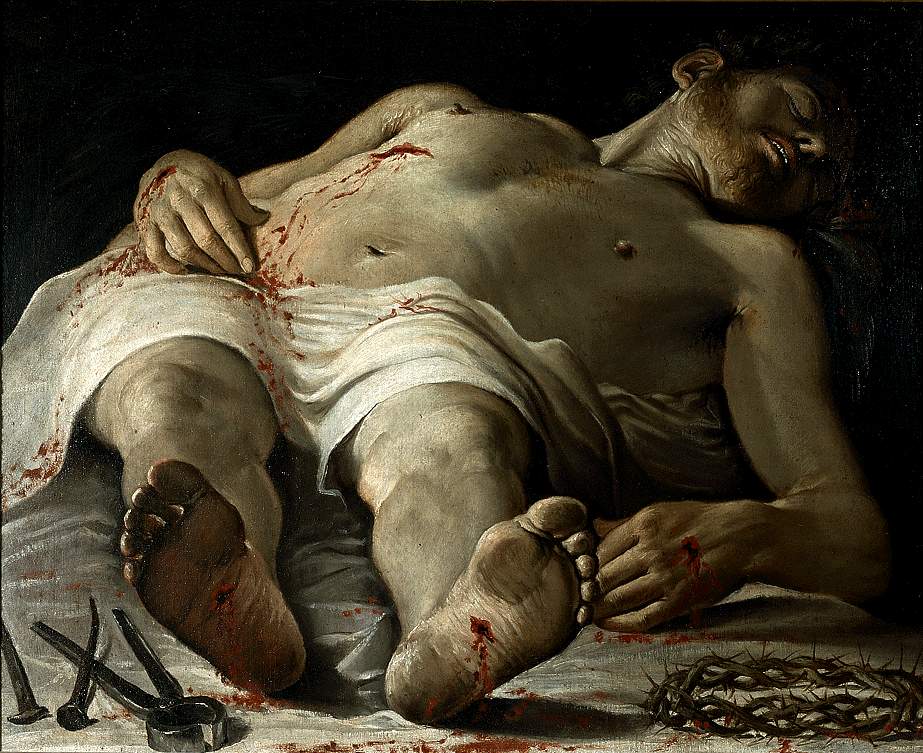
Jesus Laid in the Tomb 1Dear saints, welcome to the kingdom of heaven. In the kingdom of heaven, you are never rewarded based on your works or efforts because, if you received what you deserved, you would be sent straight to hell. In the kingdom of heaven, there are no formulas or set, hourly wages. You are given to based solely on the merits of Christ’s work for you. He is the only one who can say that He bore the burden of the day and the scorching heat. His atonement, His mercy, His grace is what you get, nothing less. Because of God’s unmerited, unearned, undeserved, unconditional love freely given to you for the sake of Christ, you are an heir of the kingdom of heaven. God be praised!

That’s the main point of the parable. The sermon could end here, but it won’t. There are other points in the parable. Yes, they are minor points, but I have four that I know will be helpful and comforting to you today. So, I’d like to draw them out a little bit. And these points all come from a small phrase in the parable from v. 6that never jumped out at me before. Notice in that verse that when the master goes out at the eleventh hour, just before the sun begins to set and working day is ending, the master finds more people standing there in the marketplace waiting to be hired and asks them, “Why do you stand here idle all day?” Did you catch it?

“All day.” It means the guys hired at the very end of the day had been there all along. I can’t tell you how many times I’ve studied, taught, and preached on this parable, but I kept missing that phrase. I had figured these guys were lazy. I thought maybe they slept in, maybe they were trying to avoid working during the hot part of the day. But that’s not the case! They were there early in the morning, at dawn, when the master first went out to hire workers. And they were there at the third and the sixth and the ninth hour when he came. Most people would have given up and gone home around the sixth hour (which is noon). But no. When the master asks why they have been standing there idle all day, they say, “Because no one has hired us.”

Here’s the first point we can draw from that: no one who got paid their denarius at the end of the day decided on their own to go work for the master. Every one of them was called and sent only by the initiative of the vineyard owner. No one volunteered themselves for labor when he came, and no one went to knock at his door to ask, “Would you hire me to work in your vineyard?” Nope. good-friday-jesus-comes-to-rescueEach of them was called, and each of them was called at the precise time the owner called them. He went and retrieved them.

So, if you are a worker in the Lord’s vineyard, if you have been called into the service of the kingdom of heaven, i.e. if you are a Christian, you were called by God. Period. He came. He gave you work to do. You didn’t seek to work for Him. God called you into His service when it pleased Him. Some, God brings in early and has them work the whole day, but for some reason – a reason known only to God – He brings others in a later, at the third, sixth, ninth, and eleventh hour. If it had pleased the master to hire all of them at dawn, he could have.

Which brings us to second point. if you think that you are one of the early hires, if you have been a Christian your whole life and faithfully carried out your vocations, if you have been tempted at times to grumble for all your hard work or tempted to pat yourself on the back for what you have accomplished, be careful. Remember that it was not you who offered up yourself to work. You were called by the grace of God. “By grace you have been saved through faith. And this is not your own doing; it is the gift of God, not a result of works, so that no one may boast. You are his workmanship, created in Christ Jesus for good works, which God prepared beforehand, that you should walk in them” (Eph. 2:8-10).

Know this. God is pleased with your work. He designed all those works for you, and He laid them all out before you to serve those who needed God’s work offered through your hands. You will be rewarded, and you will be rewarded far better than you deserve.

The third point: Maybe you think that you are one of those who were called to work late. Maybe you are saddened by how much time you wasted pursuing a life of pleasure for yourself. If you think, “How much more good could have I done if I hadn’t been so foolish? If I had been studying Scripture earlier, I could have been of better service.” Dear saint, don’t get discouraged. easte-jesus-brings-us-out-of-deathGod had a reason for bringing you in when He did. Trust His timing. He brought you into His vineyard exactly when He wanted you.

The fourth point is also along those lines, and I know it will be comforting to many of you, so listen up! If you have been praying for someone who is not in God’s vineyard, or if you have been aching for someone who was once in the vineyard but left – maybe it is a friend or relative. If it seems like your prayers and efforts have been wasted, take courage. Don’t stop praying for them. Yes, God calls some early, but some aren’t called into the vineyard until later. Some are called so late that they only arrive in time to get paid which means they do no more than receive their gracious reward. Be comforted. God has His own timing. Keep praying.

One more thing. I know the most common way the different hours that the workers get hired is understood to be a time in each individual’s life. When it is interpreted this way, the workers hired first represent people who have been Christians their entire lives. They were given faith in baptism and continued in that faith until they died. Those who were hired at the third, sixth, and ninth hour are commonly viewed as those who came to faith later in life – as youth, adults, and seniors. And those hired at the eleventh hour are the deathbed converts. That seems to be a legitimate way to understand that detail of the parable, in fact, that is how this sermon has interpreted that detail up to now.

However, remember this parable is about the kingdom of heaven. 1 John 2:18, written almost two-thousand years ago, says that it is the last hour. In the book of Revelation, we get repeated pictures of the saints who have died and entered into glory, and they are still working by praying for us (Rev. 6:9-11). Also, consider Hebrews 11 that uses the faith and deeds of the Old Testament saints to encourage us. Then, Hebrews 12[:1-2] gives us a picture of the great cloud of saints surrounding us and cheering us on to keep walking in faith. And Revelation 14:13 says that those who die in Christ are blessed because they now rest from their labors, but – and this is the point – their deeds follow them.

Considering all of that, none of us can claim to be those who worked through the heat of the day. Rejoice that God is merciful and has and will continue to give to you far better than you deserve. But also, be encouraged because this means that your labor in Christ is never wasted and is valuable work that lives on after you are gone. Think of the labor done by the authors of Scripture – Moses, David, Isaiah, Matthew, John, and Paul– their labor continues to reap results for the kingdom of God today.

Great Multitude with white robes washed in the blood of the lambAnd it isn’t just their work. Your work, done as a Christian, is holy work. Fathers and mothers, the work you do day in and day out will reap results in the lives in your children, grandchildren, and great-great-great-great grandchildren if Christ tarries. But it will also reap results in the lives of others whom you will never meet because you have shined the light of Christ to those you have met, and they will shine that light elsewhere. You Sunday school teachers, you who are praying for and encouraging our youth, you trustees who are caring for our facility, and everyone who is here encouraging another person is offering holy work that will be used by God until Christ returns. Everyone has a story of being impacted by someone else long after that person has entered into glory. So, take heart, and keep working. The labor that God has called you to is fruitful, holy work. It is holy work that God will multiply and expand. For that, God be praised. Amen.

The peace of God, which surpasses all understanding, will guard your hearts and minds in Christ Jesus. Amen.

Marvel – Sermon on Matthew 8:1-13 for the Third Sunday after Epiphany

Listen here.

Matthew 8:1-13

1 When [Jesus] came down from the mountain, great crowds followed him. 2 And behold, a leper came to him and knelt before him, saying, “Lord, if you will, you can make me clean.” 3 And Jesus stretched out his hand and touched him, saying, “I will; be clean.” And immediately his leprosy was cleansed. 4 And Jesus said to him, “See that you say nothing to anyone, but go, show yourself to the priest and offer the gift that Moses commanded, for a proof to them.”

centurion with a sick servant5 When he had entered Capernaum, a centurion came forward to him, appealing to him, 6 “Lord, my servant is lying paralyzed at home, suffering terribly.” 7 And he said to him, “I will come and heal him.” 8 But the centurion replied, “Lord, I am not worthy to have you come under my roof, but only say the word, and my servant will be healed. 9 For I too am a man under authority, with soldiers under me. And I say to one, ‘Go,’ and he goes, and to another, ‘Come,’ and he comes, and to my servant, ‘Do this,’ and he does it.” 10 When Jesus heard this, he marveled and said to those who followed him, “Truly, I tell you, with no one in Israel have I found such faith. 11 I tell you, many will come from east and west and recline at table with Abraham, Isaac, and Jacob in the kingdom of heaven, 12 while the sons of the kingdom will be thrown into the outer darkness. In that place there will be weeping and gnashing of teeth.” 13 And to the centurion Jesus said, “Go; let it be done for you as you have believed.” And the servant was healed at that very moment.

In the name of Jesus. Amen.

Today we have two very different people approaching Jesus. The first is a leper (people with leprosy are called ‘lepers’ not ‘leopards’ as some seem to think – kids and adults alike). This leper has absolutely nothing. Leprosy was a terrible skin infection that would eat away at a person’s flesh and destroy the nerves. One of the worst things about leprosy was that you could cut or burn or injure yourself and not even know it.

Leprosy did damage to a person’s body, but even worse, it damaged society. Lepers would live separately from everyone else to avoid infecting others. Even while leprosy ate away at a person’s flesh, it also ripped apart relationships – husbands and wives, parents and children. And if a leper did encounter someone who was uninfected, they would have to cry out, “Unclean! Unclean!” to avoid spreading the disease. If you heard a leper warning you of his presence, you would get out of the way to avoid becoming leprous yourself.

Contrast all of that with the second person who approaches Jesus, the centurion. Roman Centurion Armor and Shield“Centurion” was his title and meant he was a commander over one-hundred soldiers. Centurions wore impressive armor including a helmet with all the feathers sticking out of the top, a shiny breastplate, a metal skirt, and a huge shield. Like a leper, a centurion’s command was also obeyed, but not to avoid becoming one of them. A centurion could say, “Go,” and the soldier would go. “Destroy,” and they would destroy. “Kill,” and they would kill.

Roman centurions were also very religious. The Romans believed in many pagan gods, but their chief god was Jupiter, the god of the sky. They believed that Jupiter threw lightning bolts when he was angry. Romans, like many other pagan religions, believed that if you wanted something from your god, you had to offer a gift or bribe to get that god on your side like Naaman did with his silver, gold, and cloths in our Old Testament text (2 Kgs. 5:1-15). But here in this text, the centurion approaches Jesus in Capernaum with completely empty hands. His beloved servant is paralyzed and dying at home, and he can’t do anything about it. He recognizes that he has no strength, no authority, no power over the condition of his servant.

Don’t miss the significance of this. A man with his power, influence, and strength could easily replace a measly servant. All he had to do was say the word, and the soldiers under his command would find another person with better skills or more strength to be his slave. For this centurion to go to Jesus would have been a despicable display of weakness not only in the eyes of his peers but also for the soldiers under his command. More on this later. And now he approaches Jesus with no gifts, no bribes, no promises. This centurion comes with nothing but a plea, “My servant is lying at home and dying. Don’t come to my house because I am not worthy to have You under my roof. Just say the word, and he will be healed.”

Jesus marvels. And if Jesus marveled at this man’s faith, so should we. Here is “a man of strength coming in weakness, a man of wealth coming in poverty, a Gentile coming in faith” (Rev. David Petersen). With no attempt to bribe, he simply trusts in the mercy of Jesus, God in the flesh, the One with real authority and power, full of mercy and compassion.

It is no marvel that Jesus found no such faith in Israel. But instead of casting stones at them, we should ask ourselves: would Jesus find such faith among us? How often are our prayers attached to promises of living a better life, being more obedient or more faithful? How often do we try to bargain with God in order to gain His favor? Repent.

Even if from this moment on, you promised to be perfectly obedient (which is impossible), without God’s mercy you and I are still unworthy for the Lord to come under our roof. The only thing we are worthy of is to be cast into the outer darkness of hell for all eternity.

Christ of St John on the Cross Salvador DaliRepent, but do not despair. Jesus, God in the flesh, comes down from the mountain in order to save us. He is a God of mercy and grace. He comes to make the unworthy worthy and the unholy sacred. Jesus willingly approaches the untouchable leper to touch and heal. And Christ has compassion upon a centurion who appeared to have everything, but in reality, had nothing.

May we also have such faith as we approach our compassionate God who willingly and marvelously went to the cross to bear our sins. Christ was cast out of society with nothing but a cross and a crown of thorns. Though Jesus is the Lord of hosts, He did not call the angels to deliver Him as He was pinned to the cross. Instead, in love He shed His holy and precious blood to heal our souls. He bears all our sin in His body on the cross and proves that He is stronger than the devil. He shuts Satan’s mouth and triumphs over sin, death, and hell by His resurrection. He says, “Go,” to your sins and they go. He says, “Come to Me, all who labor and are heavy laden,” and you come and find rest for your soul (Mt. 11:28).

Remember, for this centurion to come to Jesus was an act of humility. He could have simply found another servant, but the centurion humbles himself to seek Jesus’ help because of his love for his servant. The centurion becomes a picture of what it means to be a Christian. His faith in Christ is manifested in love for his neighbor in a marvelous way.

The centurion is a Christ figure for his servant. Though he had power and authority, the centurion humbles himself to serve his servant. And, Christian, so do we. Through faith, we have everything since we are children of the Most High God. Yet, through love, we use our access to God in order to serve our neighbor by interceding on their behalf. Through faith, we receive treasures from above, from God. Through love we release those treasures below to our neighbors (Luther).

May our faith in Christ manifest itself in love for our neighbor so that the earth may know the mercies of our Lord and Savior, Jesus Christ. Amen.

The peace of God, which surpasses all understanding, will guard your hearts and minds in Christ Jesus. Amen.

Living in Holy Light & Being Holy Light – Sermon for Midweek Advent 3 2019

Listen here. (The first 30 seconds of tonight’s sermon were not recorded. The missed portion was simply a summary of the previous weeks’ messages.)

The texts for tonight’s service were Isaiah 60:1-5; 2 Corinthians 4:6-12; and John 1:1-14.

In the name of Jesus. Amen.

Tonight, we are continuing the theme from 1 Timothy 4:4-5, “Everything is made holy by the Word of God and prayer.” In the first of these Advent sermons, we considered how God, the Holy One, makes us holy through His Word which cleanses and sanctifies us (Jn. 15:1-5; 17:17). Last week, we saw how God initially created all things good, but nothing created was holy by itself – nothing is inherently or intrinsically holy. So, God places His holy name upon us in our Baptism which makes us holy so we can be in His presence. This not only gives us access to God’s presence, it actually makes us a temple of the Holy Spirit who dwells in us (1 Cor. 6:19). This means, Christian, that you are no longer common. Now, you are sacred.

Tonight’s sermon will give us the picture of what our sacred life looks like according to Scripture especially from the Epistle lesson (2 Cor. 4:6-12). Paul is using imagery that was very common in his day, lamps. In the verses leading up to that text, he says that the Gospel – the good news that our sins are forgiven because of Jesus’ birth, life, death, and resurrection – is a light (2 Cor. 4:1-5). Then our text picks up that image. Look at those verses while I read and comment on them:

The God who said, ‘Let light shine out of darkness,’ has shone (Where?) in our hearts. (Why?) To give the light of the knowledge of the glory of God. We have this treasure – the treasure of God’s glory – in jars of clay.

These jars of clay are the lamps people used in New Testament times. Back then, houses were lit up, not by flipping on a switch but by little clay lamps filled with olive oil. Those clay lamps (or jars) had a small hole for a wick that floated in the oil and fed the flame.

So, God’s holy presence is in us. We have the treasure of His glory and power, but that holiness, that sacredness, that power, and that glory is hidden. You can’t see it just like you couldn’t see the oil inside of that clay lamp. But you know that oil is there as long as the wick continues to burn. If you lit a wick that didn’t have any fuel feeding it, that wick would burn up quickly. But when that wick has fuel, it will burn for hours and hours. Imagine that you didn’t know about the oil in the lamp, you would be surprised at how long the wick can burn.

Back to v. 7, we have this treasure hidden in jars of clay (Why?) to show that the surpassing power belongs to God and not to us. To close out this picture, Paul says that the life we have in Christ is reveled and shown in our suffering. Listen to v. 8-9, “We are afflicted but not crushed. Perplexed, but not driven to despair. Persecuted, but not forsaken. Struck down, but not destroyed.” When we endure suffering, others are able to see this surpassing power of God because of how it is manifested.

Afflictions do not crush us. Instead, they cause us to run to God (Ps. 129:2). Things that are perplexing and confusing do not cause us to despair (Ps. 37:32-33). When we have trials, we don’t need to wonder if God loves us – He does! When we are persecuted, we can know that we are suffering the very same things that Christ did. Jesus said, “If they persecuted Me, they will persecute you” (Jn. 15:20). When we are struck down, we turn the other cheek (Mt. 5:39) because we know that our enemies cannot destroy us – Christ has promised (Mt. 10:28). We have died and our life is hidden with Christ in God (Col. 3:1-4).

You see, dear saints who have been made sacred, God’s glory and power given to you is manifested to this world in your weakness for when you are weak, then you are made strong by God’s power (2 Cor. 12:9-10). Our problem is that this is the opposite of what we normally think. In every other aspect of our lives, growing up means that we move from depending on others to becoming independent. When a child can feed herself, walk, is potty trained, able to dress herself, tie her shoes, etc., we see that she is growing up into an independent woman.

The exact opposite is true of spiritual growth. Growing up spiritually means that we become more dependent upon Christ for everything in every situation. As we mature in faith, we learn to borrow all that we need from Christ which means that we grow in holiness.

As God shines the light of the Gospel into you, that light shines out of you so that you are a light to others. Jesus puts it this way Mt. 5:14–16, “You are the light of the world. A city set on a hill cannot be hidden. Nor do people light a lamp and put it under a basket, but on a stand, and it gives light to all in the house. In the same way, let your light shine before others, so that they may see your good works and give glory to your Father who is in heaven.”

God put the light of His Gospel into you so that you would give light to the dark house of this world. Jesus commands that light within you to shine. English cannot do justice to what the Greek does there. Jesus commands the light He has placed within you to shine so that the people of this world would see your good works and give glory to your heavenly Father.

I want to conclude tonight with one more image of what living in this light looks like by considering. Proverbs 3:5-6 (and I’m going to use a translation that might be different from what you are used to[1]), “Trust in the Lord with all your heart, and do not lean on your own understanding. In all your ways know Him, so that He will straighten your paths.”

These verses picture traveling, but it isn’t the normal traveling from one place to another. It is traveling through life. Throughout your life, you travel on many different roads and paths that seem to have little or nothing to do with each other and it can feel like you aren’t getting anywhere. You go from one thing to another, but it feels like you have no destination.

But these verses invite to you to know the Lord in all your ways. What does that mean? It means that He is present with you in everything. Wherever you go, He is there with you. He is your invisible partner and companion. When you woke up this morning, He was there. When you traveled to work or school, as you ate lunch, while you drove here, He didn’t abandon you. He was right there beside you. You have had lots of little journeys today, and the Lord was with you the whole time.

All the paths of today and yesterday and six months ago, and all the paths of tomorrow and every day of your future are all one journey because God is with you every step of the way. In all your ways, know Him, see Him, expect Him. He is there walking with you leading you along the way. You don’t have to map out your own journey, you can simply trust Him because He is there making your path straight.

The biggest problem you have and that I have is that we think we are traveling by ourselves. We don’t even bother to look for Him because we don’t expect Him to be there. But there He is giving us His light, leading us, guiding us, directing us along our paths. This means that all our paths are sacred because of God’s presence.

All the little paths and bits and tasks of your life are not the story of your journey but the story of Jesus’ journey with you. Live your life in His holy light as you radiate that holy light. Amen.

The peace of God, which surpasses all understanding, will guard your hearts and minds in Christ Jesus. Amen.

[1] Translation from Rev. Dr. John Klienig.

Various Vocations – Sermon on 1 Corinthians 12:1-11 for the Tenth Sunday after Trinity

Listen here.

1 Corinthians 12:1-11

Now concerning spiritual gifts, brothers, I do not want you to be uninformed. You know that when you were pagans you were led astray to mute idols, however you were led. Therefore I want you to understand that no one speaking in the Spirit of God ever says “Jesus is accursed!” and no one can say “Jesus is Lord” except in the Holy Spirit.

Now there are varieties of gifts, but the same Spirit; and there are varieties of service, but the same Lord; and there are varieties of activities, but it is the same God who empowers them all in everyone. To each is given the manifestation of the Spirit for the common good. For to one is given through the Spirit the utterance of wisdom, and to another the utterance of knowledge according to the same Spirit, to another faith by the same Spirit, to another gifts of healing by the one Spirit, 10 to another the working of miracles, to another prophecy, to another the ability to distinguish between spirits, to another various kinds of tongues, to another the interpretation of tongues. 11 All these are empowered by one and the same Spirit, who apportions to each one individually as he wills.

In the name of the Father and of the Son and of the Holy Spirit. Amen.

How many of you would say that we are a “charismatic” church? Some of you might be thinking, “No! And thank goodness. I don’t want to part of a church where people are rolling around on the floor and babbling in tongues.” But some of you might be thinking, “We should shake things up! We could use more manifestations of the Spirit in this stuffy place.” Maybe, some of you are somewhere in the middle. Well, wherever you fall in the charismatic opinion spectrum, this sermon is for you. Technically, of course, all the sermons I preach are for you which is why they are preached from this pulpit. (That isn’t a throw-away line. Remember that for later in the sermon).

James 1 17 Gift.jpgThree times the English word ‘gifts’ came up in this text, but in Greek, Paul uses two different words that get translated as ‘gifts.’ Twice the Greek word is χάρισμα (which is singular and the plural is χαρίσματα – I’m going to try to be grammatically correct through the sermon). Χάρισμα is where we get our word ‘charismatic.’ Inv. 4, “there are varieties of gifts/χαρίσματα,” and in v. 9, he mentions the “gifts/χαρίσματα of healing…” But in v. 1, Paul uses a different word that gets translated as ‘spiritual gifts’ or ‘spiritual things.’

The New Testament uses six different words or phrases to talk bout spiritual gifts. For the sake of time, I’m not going to give you all six, but χάρισμα is the most common and means ‘gift of grace.’ And if you look through all the texts about gifts, you see that the Holy Spirit doesn’t make Christians clones of each other but there is an enormous variety of ways the Holy Spirit’s work is manifested in people.

Now, Scripture has two different lists of the gifts/χαρίσματα (1 Cor. 12:7-11, 27-30 and Ro. 12:6-8). The two lists aren’t the same, but they include: prophets and prophecy; service (διακονία where we get our word ‘deacon’); teaching; encouragement; generous giving; leadership (yes, that’s a gift of the Holy Spirit); the gift of being merciful; a word of wisdom/guidance; a word of knowledge; faith, not what we would call ‘saving faith’ but an abundant trust and confidence in God’s provision; gifts of healing – which would include physical, mental, spiritual, and psychological healing; mighty works (probably referring to exorcisms); discernment of spirits; the gift of tongues and interpretation of tongues; being an apostle is a χαρίσμα; so are helpful acts; even chastity (within marriage and outside of marriage) is a χαρίσμα. All these are the gifts/χαρίσματα that Scripture talks about. Notice that most of these aren’t the wowie-zowie things that you think about as being charismatic gifts, but this is the list that Scripture gives.

For a long time in our country, Christians have been talking about spiritual gifts. You can take inventories to try to discover what your spiritual gift is so that you use it in service to the Lord. Some people get all tied up in knots trying to figure out what their gift is so they can figure out where they should be and what they should be doing to serve the Lord. But Scripture actually teaches that wherever you are as a Christian, you are serving God. Instead of seeking to try to find out what our spiritual gift is, we should be asking ourselves, “Where has God put me?” and, “Who is the neighbor that God has given me to serve?” Or to combine the two and make it a shorter question, “What is my vocation?”

I know I’ve used the term ‘vocation’ quite a bit in the past, but it is good to be clear. When we talk about ‘vocation’ in the Scriptural sense, it means your office or your relationship to the person or people God has placed in your life at any given moment. Every moment of every day God puts you into a relationship with another person where you have different responsibilities. That is your vocation.

As a silly example, if you are in a moving car, you have one of two possible vocations. Either your vocation is to be a driver and your responsibilities are to drive safely, follow the traffic laws, don’t cause danger to others, and get to your destination safely. Or, if you aren’t the driver, your vocation is to be a passenger and your responsibilities are to not put your hands over the driver’s eyes or make the driver’s vocation more difficult than it needs to be.

Here is the good news, God gives you gifts to fulfill your vocation in every moment of every day. So, rather than filling out inventories and reading books to try to discover your spiritual gift, or your χάρισμα, simply ask yourself, “What is my vocation?” and Scripture promises that everything will fall into place.

Thinking back on that list of χαρίσματα, Scripture teaches that there is a great diversity of gifts that are given by the Holy Spirit. The Holy Spirit gives these gifts equally, but, again, He doesn’t clone people. Instead, He individualizes believers and brings out their distinctive character. Each believer represents and reflects a different aspect of the image of God which is why there is a diversity of gifts.

Trinity and Vocation.jpgAccording to our text (v. 4-7), these various gifts are given through the Holy Spirit, but the Holy Spirit doesn’t ever work alone; instead, the entire Trinity is involved. These various gifts are given by the Spirit; the varieties of service are given by the same Lord, Jesus Christ, the Son; and the varieties of activities are empowered by the same God (think Father) who empowers them all in everyone. We don’t determine what gift we receive, it’s up to our Triune God. And God will provide whatever we need to fulfill our Christian duty to our neighbor.

Paul will go on after our text to say that each member of the entire church and each congregation is part of the body of Christ. And each member is dependent upon the other members. Eyes need ears and toes and noses and hearts and livers and bladders. No part of the body can say that they don’t need the other parts. All the parts work together to do one common thing, and the most important thing is that the forgiveness of sins through Jesus’ death and resurrection, the Gospel, is proclaimed.

Back to that line that wasn’t a “throw away”: I have been called by God to be your pastor and to preach this sermon today. And God has called you here today to hear this sermon, use your Holy Spirit-given gift to listen because Jesus says, “Blessed are those who hear the Word of God and keep it” (Lk. 11:28, Rev. 1:3).

So, you might be wondering, “What are my gifts? What are my χαρίσματα?” Well, rather than focusing on what gifts we have, we should be focusing on the people that God has placed in our lives to serve. Doing this helps to shape our prayers so that we ask God for the gifts we need in any particular moment. It also helps to protect us from getting puffed up and arrogant so that we decrease and Christ increases (Jn. 3:30). First, get your priorities right. Holy Spirit open eyes new heartsDo you believe in Christ’s death and resurrection for the forgiveness of your sins? Do you trust that His blood has covered all your iniquities and transgressions? If so, praise God! Then ask, “What is my vocation/station in life? What am I called to do right now?” “What do I need now as a mother?” “What do I need now as a husband?” “As a child?” “A student?” “A customer?” “A citizen?” God has called you to those vocations and He won’t leave you in a lurch. He will give you the gifts you need. In every moment of every day, you have a particular relationship to someone else, so you are called to be God’s representative in that moment. So, ask God to give you what you need to fulfill that vocation.

God doesn’t equip us with gifts/χαρίσματα in advance, but He gives us what we need when we need it to minister to others as we serve in our vocations.

When you need to do something, you can confidently expect to receive exactly what you need to serve in the way that God has called you. Wherever God calls you He will give you whatever you need to minister to that person in that situation (Mt. 10:19-20).

Now, there is a lot here, and I need to wrap things up. So, two concluding thoughts. You, Christian, have been given unique gifts by the Holy Spirit to serve those whom God has put in your life through your various vocations. The Holy Spirit has uniquely equipped you to serve in every vocation where He has placed you. So, what are you waiting for? Don’t wait to figure out how God has gifted you because He has already called and equipped you to serve your neighbor in your vocation. Which brings me to the second conclusion.

In the opening verse of our text, Paul says that he does not want us to be ignorant about spiritual gifts. Our translation says ‘uninformed’ but the word there isn’t about a lack of information rather a lack of knowledge, so ‘ignorant’ is probably better. So, understand this, and don’t be ignorant. Paul speaks about many different gifts/χαρίσματα in our text. But Paul will go on to boil everything down to the three greatest gifts by the end of ch. 13 – faith, hope, and love. These three gifts are the most important χαρίσματα given by the Holy Spirit. The Holy Spirit has given you faith. No one can say, “Jesus is Lord,” except by the Holy Spirit. And because of that God-given faith, you have the gift/χάρισμα of hope.

Dear saints, the Holy Spirit has called you by the Gospel, enlightened you with His gifts, and will continue sanctify and preserve you in the true faith. But also remember that the greatest χάρισμα that you are given is love. Any use of your gifts without the gift, without the χάρισμα, of love is detrimental to the body of Christ. So, may you be faithful, may you be hopeful, and may you be loving as you use the other gifts He gives you as well.In Jesus’ name. Amen.[1]

The peace of God, which surpasses all understanding, will guard your hearts and minds in Christ Jesus. Amen.

[1]I am thankful for a lecture by Rev. Dr. John Kleinig titled “Heavenly Power for Earthly Service” for much of the information in this sermon.

What Are You Doing Here? – Sermon on 1 Kings 19:11-21 for the Fifth Sunday after Trinity

Listen here.

1 Kings 19:11-21

11 And [the Lord] said, “Go out and stand on the mount before the Lord.” And behold, the Lordpassed by, and a great and strong wind tore the mountains and broke in pieces the rocks before the Lord, but the Lordwas not in the wind. And after the wind an earthquake, but the Lordwas not in the earthquake. 12 And after the earthquake a fire, but the Lordwas not in the fire. And after the fire the sound of a low whisper. 13 And when Elijah heard it, he wrapped his face in his cloak and went out and stood at the entrance of the cave. What are you doing here ElijahAnd behold, there came a voice to him and said, “What are you doing here, Elijah?” 14 He said, “I have been very jealous for the Lord, the God of hosts. For the people of Israel have forsaken your covenant, thrown down your altars, and killed your prophets with the sword, and I, even I only, am left, and they seek my life, to take it away.” 15 And the Lord said to him, “Go, return on your way to the wilderness of Damascus. And when you arrive, you shall anoint Hazael to be king over Syria. 16 And Jehu the son of Nimshi you shall anoint to be king over Israel, and Elisha the son of Shaphat of Abel-meholah you shall anoint to be prophet in your place. 17 And the one who escapes from the sword of Hazael shall Jehu put to death, and the one who escapes from the sword of Jehu shall Elisha put to death. 18 Yet I will leave seven thousand in Israel, all the knees that have not bowed to Baal, and every mouth that has not kissed him.”

19 So he departed from there and found Elisha the son of Shaphat, who was plowing with twelve yoke of oxen in front of him, and he was with the twelfth. Elijah passed by him and cast his cloak upon him. 20 And he left the oxen and ran after Elijah and said, “Let me kiss my father and my mother, and then I will follow you.” And he said to him, “Go back again, for what have I done to you?” 21 And he returned from following him and took the yoke of oxen and sacrificed them and boiled their flesh with the yokes of the oxen and gave it to the people, and they ate. Then he arose and went after Elijah and assisted him.

In the name of Jesus. Amen.

When was the last time you felt like a total failure? You labored and worked and toiled and strived to complete that one monumental task. All your effort comes to an end, and the task is finished. But before you can pat yourself on the back, you look around and there is still so much to do. More to accomplish. More things that need your attention. And all you want to do is crawl into a cave and give up.

That’s where we find Elijah this morning. Fleeing, alone, scared, and hiding in a cave at Mt. Horeb (which is the same as Mt. Sinai) God asks in a low whisper, “What are you doing here, Elijah?”

Elijah had had a busy month. But even before we consider what had just happened, we have to go back even further.

Elijah first came on the scene while Ahab was king in Israel. Ahab’s wife, Queen Jezebel, had introduced worship of Baal to God’s people. They were sacrificing their own children to Baal and praising themselves for it. The people were tearing down the true God’s altars and replacing them with temple prostitutes, and they would worship their false god by fornicating with them. All the while Jezebel was ruthlessly persecuting Yahweh’s faithful prophets by murdering them.

So, God sends the prophet Elijah to King Ahab to tell him that there would be neither dew nor rain (1 Kgs. 17:1). And for three and a half years (Jam. 5:17-18), Israel had no precipitation. Finally, God sent Elijah back to Ahab and the people of Israel saying, “How long will you go limping between two different opinions? If Yahweh is God, follow Him; but if Baal is god, follow him.”

After this, Elijah challenges Baal’s prophets to a duel – mano-e-450-manos. The 450 prophets of Baal would sacrifice a bull, lay it on an altar, and call down fire from heaven, and Elijah would do the same. The prophets of Baal call out all morning to their pagan god while Elijah taunts them because there was, of course, no answer (1 Kgs. 18:27-29). Elijah prepares his bull, places it on the altar, and Yahweh, the true God, answers by completely consuming the sacrifice. Afterward, the people of Israel confess, “Yahweh is God.” Elijah took the 450 pagan prophets and slaughters them, and God, sent rain once again.

However, Queen Jezebel wasn’t pleased. She sends a messenger to Elijah swearing by her defeated, pagan gods that she will kill Elijah by the same time tomorrow (1 Kgs. 19:2). That is why Elijah is on the run here in our text. God sends an angel to give Elijah food and water. That meal provided Elijah with the strength to travel forty days to Horeb (1 Kgs. 19:3-8) where he crawls into a cave.

So, after this great victory over the pagan prophets, after God’s provision of rain, after God’s provision of food, there is Elijah standing in a cave feeling very alone and very abandoned. God rightly asks, “What are you doing here, Elijah?”

Elijah in the cave What are you doing hereListen again to Elijah’s response, “Listen God, I’ve been very jealous for You. I’ve done what You have commanded. But Your people have forsaken Your covenant. They have thrown down Your altars. And they have killed Your prophets with the sword. I’m the only faithful one left, and they are out to kill me as well.” Elijah’s response makes it sound like God had lost and that Baal had won. His answer makes it seem like no rain had fallen, and as though God had failed.

God won’t have it. Yahweh patiently but sternly whispers in Elijah’s ear, “What are you doing here, Elijah?” He sends Elijah back with work to do. “Go anoint two kings and your successor as prophet.” And God promises that He will keep and preserve not just Elijah but another seven thousand faithful people for God who have neither bowed down nor kissed Baal. And Elijah goes.

Our society isn’t so different than Israel was in the days of Elijah. We live in a society that sacrifices our children on the altars of convenience and choice. Instead of cult prostitutes, we have every deviant sexual practice imaginable being tolerated and even promoted in our schools. Jezebel isn’t threatening our lives, but we have political leaders who might as well be Jezebel. They say that if we speak out against any of the prevailing sins in our culture, we are backwards and old-fashioned Bible thumpers. They threaten that our morals and the Scripture that teaches them will be forgotten and thrown in the corner of history to gather dust.

With all those voices against us, we might be tempted to be like Elijah and flee to our cave. But what is happening in our nation now is nothing new. We are saddened that the world is driving us to the cave, but, by our silence and fear of speaking out against sin, we have voluntarily walked halfway there in the first place.

Dear Christians, repent. We cannot retreat. We cannot have the defeatist attitude that Elijah had. God still has work for us to do. God has called you to be His salt and light in this world. He desires that you be His faithful witnesses proclaiming that Christ Jesus is the Savior of the world. The world does genuinely want to destroy us, but never forget that God is faithful.

Even if it looks like the Jezebels of our day have won, they haven’t. God defeats Jezebel both physically and spiritually. God told Elijah to anoint Jehu to be king of Israel in place of Ahab and his sons. A little while later Jehu overthrows Ahab’s son who was king. Then, Jehu marches into the city and has Jezebel thrown out of a window where the dogs tear her apart and eat her flesh (2 Kgs. 9:30-37). In her life Jezebel loses in spectacular fashion physically. But even more importantly, Jezebel loses spiritually.

Jezebel had a daughter named Athaliah who married Jehoram, king of Judah. Athaliah and her husband had a son, who had a son, who had a son, and so on and so forth, who eventually a boy named Jesus was born in Bethlehem. Despite Jezebel’s hatred and animosity of Yahweh, God made her the many times over great-grandmother of Christ Jesus, the Savior of the world.

Jezebel tried to defeat God by hating Him. But God defeated Jezebel by loving her. With Jezebel’s blood coursing through His veins, Christ shed His holy and precious blood to forgive even the sins of Jezebel. On the cross, Jesus’ foot, which was formed from Jezebel’s genetic material, crushed the head of the devil and of Baal.

So, stop worrying about how things are going in this world. God is able, and has already, defeated your enemies because they are also His enemies.

“What are you doing here, Elijah?” With words that are stern yet compassionate, God calls Elijah out of his cave and gives him work to do for the kingdom of God. And today, God calls you out of your cave because He has work for you to do as well.

God hasn’t called you to go anoint kings and prophets. But He has called you to raise up your children in the faith. God has called you to proclaim and confess that He has called you out of the darkness of your caves and into His marvelous light.

And when you do crawl into your cave, God calls you through His Word, “What are you doing here?” Jesus Coming out of the TombGod will continue to defeat His enemies by raising up faithful believers from the offspring of His enemies. Scripture doesn’t promise that the Jezebels of our day will fall before our eyes. In fact, it is very likely that the voices of Jezebel will continue to grow stronger in our culture and society.

But Scripture does promise that Baal is dead and Christ is living. Jezebel has lost, and you have already won. And, you, Christian, are called to remain faithful.

“What are you doing here?” Come out of your cave, and do the work that God has called you to do. Amen.

The peace of God, which surpasses all understanding, will guard your hearts and minds inChrist Jesus. Amen.

The Gift of a Name – Sermon on Luke 16:19-31 for the First Sunday after Trinity

Listen here.

Luke 16:19-31

19 “There was a rich man who was clothed in purple and fine linen and who feasted sumptuously every day. 20 And at his gate was laid a poor man named Lazarus, covered with sores, 21 who desired to be fed with what fell from the rich man’s table. Moreover, even the dogs came and licked his sores. Lazarus and the Rich Man Graphic22 The poor man died and was carried by the angels to Abraham’s side. The rich man also died and was buried, 23 and in Hades, being in torment, he lifted up his eyes and saw Abraham far off and Lazarus at his side. 24 And he called out, ‘Father Abraham, have mercy on me, and send Lazarus to dip the end of his finger in water and cool my tongue, for I am in anguish in this flame.’ 25 But Abraham said, ‘Child, remember that you in your lifetime received your good things, and Lazarus in like manner bad things; but now he is comforted here, and you are in anguish. 26 And besides all this, between us and you a great chasm has been fixed, in order that those who would pass from here to you may not be able, and none may cross from there to us.’ 27 And he said, ‘Then I beg you, father, to send him to my father’s house— 28 for I have five brothers—so that he may warn them, lest they also come into this place of torment.’ 29 But Abraham said, ‘They have Moses and the Prophets; let them hear them.’ 30 And he said, ‘No, father Abraham, but if someone goes to them from the dead, they will repent.’ 31 He said to him, ‘If they do not hear Moses and the Prophets, neither will they be convinced if someone should rise from the dead.’”

In the name of Jesus. Amen.

Being rich is not a sin. Money can, of course, be very dangerous to faith in Christ. Jesus plainly teaches that it is difficult for the rich to enter the kingdom of heaven (Mt. 19:23-24). But the rich man does not go to hell because he was wealthy. Instead, the rich man goes to hell because he does not love God.

GreedEven though the parable doesn’t explicitly say it, we know the rich man does not love God. As our Epistle text (1 Jn. 4:16-21) says, “he who does not love his brother whom he has seen cannot love God whom he has not seen…. Whoever loves God must also love his brother” (1 Jn. 20-21). The rich man’s lack of love for Lazarus makes his lack of love for God as plain as the nose on your face.

We can go even farther and say that the rich man is put to shame by the dogs. By licking his wounds, those dogs are more compassionate toward Lazarus than the rich man who can’t even be bothered to send one of his servants to give Lazarus a crumb from his table. Again, it is not a sin to be rich – not at all. But you cannot be saved and live as unlovingly and hard-heartedly as the rich man in this parable.

The Scriptural command to love your neighbor as yourself (Lev. 19:18; Mt. 22:39) is something that everyone, even pagans, know they should do. Everyone has the duty to love and serve their neighbor – but Christians especially have this duty.

God has given you abundant blessings so that you can use your wealth to help and be generous to others. Too often when we hear exhortations to assist the poor and needy – and I include myself in this rebuke – we over-generalize and turn the poor into a category or a nameless group of people that are difficult to identify. And once we have done that, we come up with all sorts of excuses to get out of helping our neighbor.

We know we can’t feed and clothe everybody so we don’t even start. Or we think to ourselves, “Jesus said that we will always have the poor among us (Mt. 26:11), so what good can I do?” But by doing this, we make the poor merely a concept, a demographic, or an abstraction. Once we have done this, we easily dismiss God’s call to help them.

So, don’t fall into the trap. Christian, God has called you to help your neighbor, and don’t forget that your neighbor has a name. In this parable, the rich man had a poor person put into his life by God, and that poor man had a name – Lazarus. And without question, the rich man knew who Lazarus was.

As the rich man was in torment, he doesn’t say, “Abraham, can you send that guy next to you to give me a drop of water?” No. The rich man sees Lazarus’ face, knows his name, and begs, “Send Lazarus.” And more than that, the rich man has five brothers who also knew Lazarus by name. The rich man knows that, if Lazarus could go to his brothers, they would recognize Lazarus, and they would know that he had risen from the dead to warn them about his torments in hell. From those two details, we know that Lazarus was a familiar family acquaintance for the rich man and his brothers.

Here’s the point: God hasn’t commanded you to feed and provide for the whole world. You aren’t God, and, quite frankly, you can’t do that. God hasn’t called you to provide for everyone, but God has called you to provide for Lazarus. God has put you into relationships with people who have a name. And God has called you to provide for them.

Crying to GodSo, when your conscience is pricked and you feel guilt for your lack of love, first repent. Repent of your lack of love. Then, make a list of the people God has placed in your life to help, to care for, and to love starting with the people closest to you.

Take out a piece of paper and draw a circle in the middle and write down the names of your family members who live with you in that circle. God has called you to care for them first. Be faithful in your care for them. Then draw another circle around the first and list your family members who need help – maybe a grandparent or an aged parent or aunt, uncle, or cousin. Those are the first two groups of neighbors God has called you to serve and care for. 1 Timothy 5:8 says, “[I]f anyone does not provide for his relatives, and especially for members of his household, he has denied the faith and is worse than an unbeliever.”

Then draw another circle around the first two, and write down the names of the people from our congregation that need your care and support. After your family, your fellow believers, your brothers and sisters in Christ are the closest neighbors that God has put into your life to care for. Galatians 6:10 says, “[A]s we have opportunity, let us do good to everyone, and especially to those who are of the household of faith.” Your brothers and sisters in Christ need your love and care. They need you to contribute to this congregation so that they can hear the Gospel and receive God’s gifts in His Word and Sacraments. They need you to help them when they fall into hard times. So be faithful in your giving to our congregation, and God will bless those efforts. Proverbs 19:17 says, “Whoever is generous to the poor lends to the Lord, and he will repay him for his deed.”

If you still have more to give, draw another circle. Write the names of your neighbors, coworkers, and friends who also have needs. And be faithful in helping them. Then you can draw another circle and write the names of others you know who need help. Or you can write the names of organizations that help those in need – the Women’s Pregnancy Center, Northlands Rescue Mission, the food shelf, etc. Get their newsletters or go to the websites and read the names and stories of the individuals who have been helped by those efforts as well. You get the idea?

With all those names, you might be overwhelmed. So, pray for wisdom. Ask God to give you the wisdom to know when you are equipped to help and when you are not. And remember that the closer to the middle of the circle those names are, God has called you to help those individuals first. And trust that God knows how to order your life and the lives of others as well.

Now, maybe you are a Lazarus. You might be the one who needs to be cared for, and if you aren’t now, you may be in the future. If that is the case, you might wonder, “How can I show love for my neighbor? How can I provide for others when I am in need?” The answer is surprisingly simple.

In Jesus’ day, beggars were seen as offering service to God be being needy. The generous cannot be generous if there is no one to be generous to. God may call you into His service by being the one who needs to receive the generosity of others who have the means to give. So, if you have needs, let us know.

Baptism 2And never forget, Christian, that you have been given a name. Through the waters of your Baptism, God gave you your name. He has adopted you into His family. You are His child and part of the household of Jesus. The love you fail to show to those God has placed in your life is forgiven and covered by the blood of Jesus, your Savior. And God does not forget to pour out His love, mercy, forgiveness, and provision for you.

This is what the Scriptures teach. The Scriptures point you to Jesus, your Savior. It is the same Scriptures that this parable says the rich man’s brothers should look to so that they do not come to the place of eternal torment that the rich man did. Those very Scriptures all point you to the Jesus who shed His blood, died, and rose again for you.

Sinner, you are not some nameless, faceless person to God. He knows you by name. He has called you by that name, and you are His (Is. 43:1). And, dear saints, your name is written in the Lamb’s Book of Life (Rev. 3:5; 13:8). Amen.

The peace of God, which surpasses all understanding, will guard your hearts and minds in Christ Jesus. Amen.