Luke 18:9-14
9 He also told this parable to some who trusted in themselves that they were righteous, and treated others with contempt:  10 “Two men went up into the temple to pray, one a Pharisee and the other a tax collector. 11 The Pharisee, standing by himself, prayed thus: ‘God, I thank you that I am not like other men, extortioners, unjust, adulterers, or even like this tax collector. 12 I fast twice a week; I give tithes of all that I get.’ 13 But the tax collector, standing far off, would not even lift up his eyes to heaven, but beat his breast, saying, ‘God, be merciful to me, a sinner!’ 14 I tell you, this man went down to his house justified, rather than the other. For everyone who exalts himself will be humbled, but the one who humbles himself will be exalted.”
In the name of Jesus. Amen.
When we pray, we are taught to fold our hands, bow our heads, and close our eyes. Even though this isn’t commanded anywhere in Scripture, it is a good idea for a few reasons. One, it helps keep you from being distracted by, looking at, or fiddling with the stuff around you. Two, it focuses your attention on what you are praying. And three, it is a unique posture to place your body in which makes it a special or holy posture. You don’t typically fold your hands unless you are either praying or getting arrested. (I like to watch clips from the show Live PD, and I find it hilarious how often police officers from all over the country will tell the criminal with bags of drugs, an illegal gun, and two felony warrants, “Place your hands behind your back and interlock your fingers like you’re praying at church.”) Anyway…
I titled this sermon “The Eyes of Prayer” not to make the point that you should close your eyes when you pray – even though, again, it is a good practice. Instead, I hope this sermon encourages you to look only two places when you pray – one is your unworthiness and the other is God’s great mercy toward you.
Just like two weeks ago with the parable of the unjust steward and the merciful master, getting some context for this parable is helpful. Luke 18 opens with the parable of the persistent widow. She keeps crying out to the unrighteous judge asking for justice. The unrighteous judge finally gives her justice but only so she won’t beat him down with her constant asking (v. 2-5). The introduction to that parable says that Jesus, “told them a parable to the effect that they ought always to pray and not lose heart” (v. 1). Jesus teaches what the parable means (v. 6-8) by basically saying that if an unrighteous person will grant justice when he is continually asked, how much more will God, who is just, grant justice when His elect, beloved children cry out to Him. In fact, God will answer their cries quickly.
Now, as we turn to this parable which follows that one, we see how quickly and mercifully God answers the prayers of His elect.
A Pharisee and a tax collector go up to the Temple to pray. The Pharisee assumes a posture that we would recognize as prayer. He stands off by himself. He is likely looking up in thankfulness to God, but his eyes are also scanning the other worshipers in the Temple, and those eyes look down on the sinners who are there.
Now, we need to be careful about our animosity toward the Pharisee because he is simply doing what you and I do all the time. Remember, Jesus repeatedly warns against becoming like the Pharisees (Mt. 16:6-12; Mk. 8:15; Lk. 12:1), and Jesus wouldn’t give these warnings unless it is actually easy to become like them. Why is it easy? Why are we in danger of becoming like Pharisees?
When we look at the sins of our neighbor, much of what we see confirms that our good behavior is beneficial to us which too often leads us to pride. The stuff that God calls us to do in the Ten Commandments is really good stuff, and your life is much better if you live according to them. Think about it. When people commit adultery, do their lives get worse or better? Of course, they get worse. When people steal, they are more likely have their things stolen. If you deal drugs, your odds of getting shot, robbed, or thrown in prison are much higher.
The reality is that God didn’t just come up with a set of ten arbitrary rules. Instead, the Ten Commandments are written into the fabric of God’s creation. When you go against the natural laws of God and creation, it isn’t going to go well for you or for those around you.
And just a little side note here: Christians, we need to stand firm on the truths of the Commandments – especially that it is good to live in obedience to them. It is not loving to condone or promote people’s sins. When there is sin, we should speak of it as sin. We need to show how it hurts the individual committing that sin and how it harms those around the person committing that sin. But when you do that, the world is likely going to throw Jesus’ words in your face about the speck in your neighbor’s eye and log in your own eye (Mt. 7:3-5). But don’t let them take those verses out of context. Remember, Jesus wants to remove both the log in your eye and the speck in your neighbor’s eye by His mercy through the Gospel that Jesus has won through His death and resurrection. In other words, when you point out someone’s sin, always do it in a way that points them to the freedom from sin and forgiveness of sin that comes only through Jesus. Amen?
So, back to the Pharisee and his eyes of prayer. He is looking around at his life and the lives of others. The problem is that everywhere the Pharisee looks are places where he can’t find Jesus. The Pharisee won’t find Christ by looking at his good life, and he won’t find Jesus by looking at the sins of his neighbor. All he sees is his goodness which leads him to pride and going home not justified.
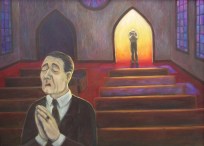 The tax collector’s eyes of prayer are much different. He doesn’t look to heaven, and he doesn’t look at the sinners around him. He stands far off from the others, likely with his face to the floor, tears flowing down his cheeks, and beating his chest. He looks two places – at himself where there is no hope and to God where the only hope lies.
The tax collector’s eyes of prayer are eyes of faith. Incredible faith! Our translation records his prayer as, “God be merciful to me, a sinner!” This is weak on two points. First, it is not just ‘a sinner’; he says, ‘thesinner.’ His eyes don’t notice anyone else’s sins – only his own. Second, the translation of his prayer, ‘be merciful,’ falls short here.
Throughout the Gospels, many people call to Jesus, “Lord, have mercy,” or in Greek, “Kyrie eleison,” which is why we sing the Kyrie after the Confession of Sin. The ten lepers call out, “Kyrie eleison” (Lk. 17:13). Two blind men early in Jesus ministry and blind Bartimeaus just before Palm Sunday cry out to Jesus, “Kyrie eleison” (Mt. 9:27; Mk. 10:47). The Canaanite woman cries out to Jesus, “Kyrie eleison,” on behalf of her demon possessed daughter (Mt. 15:22). All of those are excellent prayers. They are asking Jesus to do exactly what He has come to do. But what the tax collector in this parable prays is something similar but importantly different. The tax collector prays to God (lit.), “Be propitiated to me, the sinner.”
The noun ‘propitiation’ and the verb ‘propitiate’ have never been commonly used in English, but it is an extremely important word and concept. To propitiate means to make an atoning sacrifice. And the tax collector prays that God would be made the atoning sacrifice for him. In the Greek translation of the Old Testament, this word was also used for the mercy seat on the ark of the covenant. The place where the high priest would sprinkle the blood on the Day of Atonement and where God promised to meet with His people (Ex. 25:22; Lev. 16) was called by the same word.
Jesus is that place where God makes the atoning sacrifice. 1 John 2:2 says, “[Jesus] is the propitiation for our sins, and not for ours only but also for the sins of the whole world.” Jesus is your Great High Priest who makes the propitiating sacrifice of Himself. Hebrews 2:17 says, “[Christ] had to be made like His brothers in every respect, so that he might become a merciful and faithful high priest in the service of God, to make propitiation for the sins of the people.”
When the tax collector prays, “God, be propitiated to me, the sinner,” he is praying that God would be reconciled to him by the blood of Jesus. And that is why the tax collector, who is the far greater sinner, goes home justified rather than the well-behaved Pharisee. He looks to God in faith and asks God to be exactly who God has promised to be – a merciful, forgiving God.
Hear again what we sang before the sermon:
 When in the hour of deepest need
we know not where to look for aid;
when days and nights of anxious thought
no help or counsel yet have brought.
Then is our comfort – this alone –
that we may meet before Your throne.
To you, O faithful God, we cry
for rescue in our misery.
Dear saints, may your eyes of prayer be focused on God’s infinite mercy toward you despite your unworthiness. Know that God is always more ready to hear your prayers than you are to pray. God always gives more and better than you desire or deserve. He pours down His abundant mercy upon you. He forgives you of all the sins – every last one of those sins – that prick your conscience. He does all of this because of what Jesus has done for you. Christ has propitiated and reconciled you to God.
May our eyes of prayer be on our unworthiness and, even better, on God’s faithfulness and mercy to us because of what Christ has done. Amen.
The peace of God, which surpasses all understanding, will guard your hearts and minds in Christ Jesus. Amen.
 Pastorsamwise
You must be logged in to post a comment.