
Don’t Worry; Go Outside – Sermon on Matthew 6:24-34 for the Fifteenth Sunday after Trinity

Matthew 6:24-34

24 “No one can serve two masters, for either he will hate the one and love the other, or he will be devoted to the one and despise the other. You cannot serve God and money.

25 “Therefore I tell you, do not be anxious about your life, what you will eat or what you will drink, nor about your body, what you will put on. Is not life more than food, and the body more than clothing? 26 Look at the birds of the air: they neither sow nor reap nor gather into barns, and yet your heavenly Father feeds them. Are you not of more value than they? 27 And which of you by being anxious can add a single hour to his span of life? 28 And why are you anxious about clothing? Consider the lilies of the field, how they grow: they neither toil nor spin, 29 yet I tell you, even Solomon in all his glory was not arrayed like one of these. 30 But if God so clothes the grass of the field, which today is alive and tomorrow is thrown into the oven, will he not much more clothe you, O you of little faith? 31 Therefore do not be anxious, saying, ‘What shall we eat?’ or ‘What shall we drink?’ or ‘What shall we wear?’ 32 For the Gentiles seek after all these things, and your heavenly Father knows that you need them all. 33 But seek first the kingdom of God and his righteousness, and all these things will be added to you.

34 “Therefore do not be anxious about tomorrow, for tomorrow will be anxious for itself. Sufficient for the day is its own trouble.”

In the name of Jesus. Amen.

If you ask anyone if they worry, I’m sure the answer would be, “Yes,” so long as that person is honest. People are worried about all sorts of things. You turn on the news and find anchors talking about wars and conflicts; high taxes and wasteful spending; poverty and greedy corporations; diseases and medicines; heatwaves and cold spells; fires and droughts and floods; and all sorts of other things.

They put all that in front of you, go to a quick commercial break, and then talk about the mental health crisis in our country. Isn’t that ironic? They produce a news broadcast, which is filled with all kinds of stories that their viewers can’t do anything about, and are shocked by reports about the amount of stress in our culture. We live in what is, probably, the safest time in history, but people are still worried about all sorts of things.

So, what can you do to improve your mental health? First, you can probably consume a lot less news than you do. Second, you can take the advice of ‘experts.’ Now, I will say that, when it comes to any health advice, it’s hard to know whom you can and cannot trust. That being said, psychologists, psychiatrists, dietitians, and doctors all seem agree that, if you are anxious or worried, it’s good for your mental health to spend more time outside. Simply getting some fresh air and being in sunlight, even if there’s cloud cover, is good for an anxious mind. If you’re worried, the common consensus and treatment plan is to start with this: Go outside.

The mental health ‘experts’ will say things like, “Studies show that going outside is good for you and reduces anxiety.” I wonder how much money has been spent and how many hours have been wasted to come up with the exact same prescription Jesus just gave when He preached this 2,000 years ago. Jesus says to you, “Do not worry/be anxious. Instead, go outside to look at birds and lilies.” But don’t just look; also, consider the birds and flowers. God cares for them without them needing to worry.

Now again, everyone has anxiety; everyone worries. We shouldn’t. Worry is a sin. Three times here, Jesus Christ, the Son of God, commands you, “Do not worry/be anxious.” I wonder if one of the reasons we struggle so much with the sin of worry is that we don’t have a right understanding of what worry even is. The word ‘worry’ isn’t in the Ten Commandments, but worry is a sin against the 1st Commandment to have no other gods, and it’s a sin against the 9th and 10th Commandments about coveting.

We wrongly think that worry is just a lack of trust. And sure, worry is a lack of trust, but that’s only small part of the sin. Worry is also something much worse and much more twisted than that. Worry is a misplaced trust. When you worry, you are placing too much trust in the wrong thing(s). Worry takes God out of the equation. Anxiety is caused when you wrongly believe God is disinterested or completely absent from every day, minute, and second your life.

As humans, God created us to have trust, to be trusting creatures. When we aren’t giving that trust to God, it isn’t that we stop trusting. There isn’t a vacuum of trust. Instead, our trust goes to the wrong things and places.

When you’re worried about your finances, you are placing too much trust in a piece of paper. You wrongly believe that the cash in your wallet or the numbers in your bank account are what feeds, clothes, and houses you. When you’re worried about getting a promotion or keeping/finding a job, or when you’re worried about what others think of you or your reputation, you are placing too much trust in someone else’s opinion of you. When you’re worried about sickness or getting a particular diagnosis, you’re placing an inordinate amount trust in doctors and medicine to be able to fix you or in your body to heal itself. When you’re worried about the weather, you’re placing too much trust in created things that are all controlled by God. In short, worry is a problem within you and within me. It’s a form of idolatry that places too much trust in the wrong things.

So, again, don’t worry; go outside. Go into creation to see the things that Jesus points you to – to birds and grass. Christ could have pointed to elephants, bears, camels, or cows. All of those things require large amounts of food to stay alive. Jesus could have said, “Look at how your heavenly Father feeds the elephants with the huge amounts of food they need.” But He doesn’t. Instead, He points you to little birds that eat seeds or berries or worms. Even though there are tens of billions of birds in God’s creation, each one of them receives that little bit of food it needs from the hand of God.

Jesus could have pointed to the beautiful, majestic mountains and how God adorns them. Or, He could have told you to look at the tall, massive trees with thousands of leaves. But He doesn’t. Christ points to lilies, and the lilies Jesus speaks about here aren’t the lilies we know from Eastertime. Those don’t grow in Galilee. The flowers Jesus refers to here are tiny and grow along the grass in the fields. They are similar to the white clover we have around here. That clover is pretty, but it isn’t something you plant. And, if you want to have the best lawn on the block, you’re going to try to get rid of clover because it’s more of a nuisance – a pretty nuisance, but still a nuisance.

The point is this: Jesus directs you to look at how your heavenly Father feeds and clothes the littlest things. Since He cares for those tiny parts of His creation, isn’t He going to take care of you? You, who are the crown of creation. You, who are much, much, much more valuable – valuable enough for God to shed His blood for you.

So, don’t worry; go outside. Look at creation to see God’s provision. But also, and more importantly, don’t worry; go outside. Go outside of yourself, outside of your mind and your sinful idolatry.

In a real sense, Jesus is calling you to take a hard, defiant stand against things that would cause you to worry and say to those things, whatever they are: “Listen, you (thing that I’m worried about). You are not my God. My God is eternal and all-powerful. My God spoke all things into existence. That same God took on flesh and blood so He could die for me, so He could pay for my sin, and so I could live forever with Him. So, listen, you dollar bill, are you really going to come and demand that I worry about you? You, pain or sickness or the grave, want me to worry about you? Why would I give you that false worship? Why would I put you in the place of God? I don’t need you because I have Jesus. He’s the Lord of heaven and earth with all authority (Mt. 28:18), and He’s promised that He uses that authority for my benefit (Eph. 1:21-23). My Lord Jesus already warned me about how you will try to get me to worship you with my worry. You aren’t worth it. My Savior said that in this world I would have trouble, but I can take heart because He has overcome the world” (Jn. 16:33).

Christian, you don’t need to worry because Jesus has come out of the grave, and He has promised that you, believer, will come out of your grave too.

Notice that Jesus doesn’t say, “There isn’t anything to worry about.” Instead, He says, “Don’t worry.” Don’t worry because your Jesus is bigger than whatever you’re worried about. And Jesus adds, “Do not be anxious about tomorrow, for tomorrow will be anxious for itself. Sufficient for the day is its own trouble.” In other words, Jesus says that He gives plenty of things for you to care about each day. Each day has its own cares. So, why bring tomorrow’s cares into today? Instead, rejoice in God’s provision today, and trust in His provision tomorrow.

Tomorrow is clouded in the unknown, but tomorrow is also clothed with God’s promises to be with you, to never leave or forsake you (Dt. 31:6Mt. 28:20), to provide all that you need, and to protect you with His power and might. God will care for you. He’s promised.

Now, that doesn’t mean that you get to be lazy or idle. Scripture is clear on that too (1 Th. 4:112 Th. 3:10Pr. 10:4). In each moment, God gives you work to do, and He has promised to bless you in that work. There’s a quote from a Swedish theologian and pastor, Bo Giertz, and I really like the way the way he balances things. He wrote, “We should of course work as if all depended on us and pray as if it all depended on Him.” Do what God has given you to do right now. But everything that falls outside the scope of what you can do right now, all of that falls into the nail-scarred hands of your merciful God.

The things that God sets before you today are the things that should have your attention. With all your strength and effort, do everything God gives you to do knowing that God promises to give you the strength you need for the future He will give you.

Dear saints, pour yourself into the tasks God gives you knowing that He loves you and promises to provide for you. He promises to give you the strength you need to face each moment. So, work and trust. And when you are worried, go outside. Look at God’s provision for the little things of creation. He values you more than birds and grass. And go outside of yourself. Dive into His promises that He delivers to you in His Word. Promises that will never fade or fail. Amen.

The peace of God, which surpasses all understanding, will guard your hearts and minds in Christ Jesus (Php. 4:7). Amen.

Cleansed & Thankful – Sermon on Luke 17:11-19 for the Fourteenth Sunday after Trinity

Luke 17:11-19

11 On the way to Jerusalem he was passing along between Samaria and Galilee. 12 And as he entered a village, he was met by ten lepers, who stood at a distance 13 and lifted up their voices, saying, “Jesus, Master, have mercy on us.” 14When he saw them he said to them, “Go and show yourselves to the priests.” And as they went they were cleansed. 15Then one of them, when he saw that he was healed, turned back, praising God with a loud voice; 16 and he fell on his face at Jesus’ feet, giving him thanks. Now he was a Samaritan. 17 Then Jesus answered, “Were not ten cleansed? Where are the nine? 18 Was no one found to return and give praise to God except this foreigner?” 19 And he said to him, “Rise and go your way; your faith has made you well.”

In the name of Jesus. Amen.

Trouble will often create fellowship. After the terrorist attacks on 9/11 our country had a strong sense of unity – at least for a bit. Those of you who lived here during the ’97 flood still have that fellowship. Maybe you’ve noticed having better fellowship with your family when a loved one has gone through lengthy medical treatments or died. Everyone bands together to get stuff done.

One of the reasons Alcoholics Anonymous or other support groups are so helpful is that struggling people can meet others have gone through similar situations. People gain strength and encouragement from others who have had similar experiences and struggles. All those are good examples of trouble creating fellowship. That kind of fellowship produces unity and focus, a renewed sense of purpose and drive, and hope in the midst of sorrow. Fellowship created by and through trouble can have a powerful positive effect. 

But trouble can also create bad fellowship – really bad fellowship. I’ve heard of support groups that morph into a kind of contest where some will try to show how much more pain they have endured than the rest of the individuals in that group. Or, when a group like that only focuses on their pain and struggle, some might start to think they’ll lose their connections if they begin to heal from the pain. So, everyone gets fixated on either being or, even worse, remaining a victim in an effort to not lose that camaraderie.

It seems like that fixation on victimhood is one of the tactics the devil is using to divide our culture today. There is so much conversation about privileged and the underprivileged. The super-rich and those who aren’t. The oppressors and the oppressed. Even if you aren’t initiating those conversations, the natural, knee-jerk reaction to that kind of talk is to view people who are introducing that kind of vocabulary as the enemy, so you put up walls and barriers. Dear saints, you must fight against that urge.

As a Christian, you know that all of humanity is much more united than we are divided. Whenever you have the urge to shove others away – and it doesn’t matter who the ‘others’ are – remember two things: First, you are united with every person you meet by the trouble of sin. We are all under the curse of sin and the sentence of death because of that sin. Second, you are united with every person you meet by the mercy of God that is only found in Christ. You know from the Word of God that every person you meet is someone from whom Christ died (Jn. 1:291 Tim. 2:6). Those two points of unity are desperately needed in our society and culture today.

In this text, the ten lepers were united by the trouble of their disease. Leprosy was a chronic skin disease caused sores, numbness, and the eventual loss of limbs. Because it was so contagious, leprosy also caused isolation from family and friends. Lepers had to live apart from others. But these ten found fellowship with each other because of their common trouble. The leprosy created a tight-knit community of ten that is more remarkable than we might realize. Apparently, most of these lepers were Jewish, but at least one was a Samaritan.

This is remarkable because this community of ten wouldn’t have formed unless they shared this disease. It wasn’t even conceivable. The disdain and divide between Jews and Samaritans was even bigger than between Vikings and Packers or Red Sox and Yankees fans. Or any other divide you want to insert here. But here they are in this little community of the suffering. And they are so united they do something very interesting.

When lepers encountered people who weren’t lepers, they would cry out, “Unclean, unclean” (Lev. 13:45). But that isn’t what these ten holler when they see Jesus. Instead, with a united voice (by the way, the Gk. for ‘voice’ there is singular not plural), these ten lepers cry out, “Jesus, Master, have mercy on us!” Jesus tells them to present themselves to the priests, and the only reason a leper would do that is if they had recovered from their leprosy. It’s only as they walk away from Jesus that they are healed from their leprosy. But only one, only the Samaritan, does an about-face and returns to give thanks to Jesus.

Once the leprosy that united them was miraculously healed by Christ, the unity they had was gone, so the group splits up. The Samaritan is now united through faith to Jesus. So, of course, this cleansed Samaritan returns to the One who cleaned him. The saved returns to his Savior. What happened to the nine? Were they just too excited to get back to their families that they forgot to thank the Son of God? Who knows?

We can ask this Samaritan in the Resurrection because, dear saints, you will meet him there. You will meet him because you have also been cleansed from the leprosy of your sin, just as he was. One day, you will join him in giving thanks and worshiping at the feet of your God and Savior, Jesus Christ. Maybe that Samaritan will tell us how he went and witnessed to the other nine and will introduce us to them.

From this Samaritan, we should learn that one of the characteristics of faith is thanksgiving and being a person of thankfulness. It’s interesting when Paul listed the fruit of the Spirit in our Epistle reading (Gal. 5:16-24) that he didn’tinclude thankfulness. But based on this account of the thankful Samaritan, we do see that thankfulness is one of the ways that faith is manifest.

As the Samaritan lies with his face on the ground giving thanks at Jesus’ feet, our Lord says to him, “Rise and go your way; your faith has (lit.) saved you” (not just ‘made you well’). In other words, the Samaritan’s thankfulness is the visible manifestation of faith because giving thanks is how he recognizes and acknowledges the Source of his cleansing.

Dear saints, be people of thanks, not just people of gratitude. There’s a lot of talk about gratitude today, and gratitude is good, but thankfulness is better. The distinction between the two is this (you’ve heard me say this before): Gratitude recognizes the goodness of the thing that has been given. But thankfulness goes a step further. Thankfulness recognizes the goodness of the giver. If a daughter asks her mom for a snack and is given a bowl of ice cream, the girl can be grateful, but if mom gives her a few sticks of celery, the kid won’t be grateful because celery is gross. But that same child can be thankful with either a bowl of ice cream or disgusting celery because it comes from her mom who loves her and knows what her daughter needs.

This distinction between gratitude and thankfulness helps us understand 1 Th. 5:18 which says, “Give thanks in all circumstances.” Not all circumstances are good, so how can you give thanks? Well, because thankfulness is not gratitude. Through faith you can give thanks whether God sends you joy or sorrow, pleasure or pain, goodness or even evil. Remember Job. After all his property and children were taken from him, Job said, “Naked I came from my mother’s womb, and naked shall I return. The Lord gave, and the Lord has taken away; blessed be the name of the Lord” (Job 1:21). Even after Job’s health was taken from him and his wife told him to curse God and die, Job said, “You speak as one of the foolish women would speak. Shall we receive good from God, and shall we not receive evil?” (Job 2:10). In both instances, Scripture says, “In all this Job did not sin with his lips” (Job 1:222:10).

In moments of loss and pain, you might not be able to be grateful, but you can be thankful. If nothing else, you can give thanks to God for what He has given, even if He takes it away. Through faith, you can give thanks – even when God takes His gifts from you because you know the goodness of the God who gave and removed those gifts. Through faith, you know that His goodness doesn’t fade or change. Only through faith can you give thanks in all circumstances (1 Th. 5:18).

Dear saints, in this world you have lots of trouble (Jn. 16:33), but even in and through that trouble, God unites you into the community of His Church. Christ has delivered you from your sin by the forgiveness He won and purchased with His blood on the cross. Because of that, you aren’t just united with others by trouble. You are united by something much, much stronger. You are united by His Blood, which cleanses you from all your sin.

Live now as God’s forgiven people, united in giving Him thanks. Your gracious, cleansing God and Savior, Jesus Christ, now invites you to His table to receive that cleansing through His Body and Blood. Come. Receive. And leave here with His thanks and praise on your lips. Let that thankfulness be on your tongue as you go about your business this week and every week because that thankfulness will point others to your Savior, who has cleansed you. Amen.

The peace of God, which surpasses all understanding, will guard your hearts and minds in Christ Jesus (Php. 4:7). Amen.

The Move – Sermon on Luke 10:23-37 for the Thirteenth Sunday after Trinity

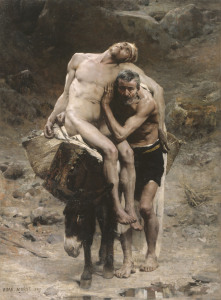
Aimé Morot (1850-1913). “Le bon Samaritain”, 1880. Huile sur toile. Musée des Beaux-Arts de la Ville de Paris, Petit Palais.

Luke 10:23-37

23 Then turning to the disciples he said privately, “Blessed are the eyes that see what you see! 24 For I tell you that many prophets and kings desired to see what you see, and did not see it, and to hear what you hear, and did not hear it.”

25 And behold, a lawyer stood up to put him to the test, saying, “Teacher, what shall I do to inherit eternal life?” 26 He said to him, “What is written in the Law? How do you read it?” 27 And he answered, “You shall love the Lord your God with all your heart and with all your soul and with all your strength and with all your mind, and your neighbor as yourself.” 28 And he said to him, “You have answered correctly; do this, and you will live.”

29 But he, desiring to justify himself, said to Jesus, “And who is my neighbor?” 30 Jesus replied, “A man was going down from Jerusalem to Jericho, and he fell among robbers, who stripped him and beat him and departed, leaving him half dead. 31 Now by chance a priest was going down that road, and when he saw him he passed by on the other side. 32So likewise a Levite, when he came to the place and saw him, passed by on the other side. 33 But a Samaritan, as he journeyed, came to where he was, and when he saw him, he had compassion. 34 He went to him and bound up his wounds, pouring on oil and wine. Then he set him on his own animal and brought him to an inn and took care of him. 35And the next day he took out two denarii and gave them to the innkeeper, saying, ‘Take care of him, and whatever more you spend, I will repay you when I come back.’ 36 Which of these three, do you think, proved to be a neighbor to the man who fell among the robbers?” 37 He said, “The one who showed him mercy.” And Jesus said to him, “You go, and do likewise.”

In the name of Jesus. Amen.

Jesus didn’t say that the priest and Levite only passed by the half-dead man in the ditch. Christ added the fact that they passed by, “on the other side,” to even further distance them from him. They moved away. Both intentionally and deliberately ‘un-neighbored’ the guy. You’ve heard me say this before, but it’s worth repeating. The reason our English word ‘neighbor’ is spelled so weird is that it comes from the word ‘nigh’ as in ‘near’ and the word for ‘dweller.’ The same thing is true for the Greek word that gets translated ‘neighbor.’ The word means near, but it refers to an individual, so it means ‘close by person.’

In the parable, the priest and Levite aren’t dealing with a gray area. “I wonder if he really needs help?” There are times you might see a person begging for money on the street, and you don’t know that person. You don’t know if giving them money is just going to aid an addiction or be a type of soft theft where they take your money and use it for something different than you intended when you gave it. In this parable, there’s no ambiguity. The situation is black and white. It’s simple. He’s been robbed, stripped, beaten, and left dying in the ditch. If he doesn’t get help, he’s going to die. So, why do the priest and Levite not only pass by, but pass by “on the other side”?

They are trying to quiet their conscience. The more distance they can put between them and this guy in the ditch, the easier it is for them to not think about him. They make a move. They move away from the guy’s need toward their own comfort. Now, this is a parable, so we can’t ask them what they thought was more important than the guy’s need. Maybe it was their schedule. Maybe it was the fact that they knew it would cost them time and money to help the guy. Maybe they just wanted to be left alone so they could have some ‘me time.’ It doesn’t matter. They move away from need of their neighbor toward their own comfort and pass by on the other side.

Then comes the Samaritan. He sees the guy, and he also makes a move. But his move is in the complete opposite direction. He moves away from his comfort toward the guy’s need. And I’m sure he would have preferred comfort. The Samaritan has things going on. He’s got a schedule to keep and a family to feed. His time is limited and valuable. He has all the same reasons and excuses the priest and Levite have. But the Samaritan sees the man, and he moves toward the need.

Jesus makes it clear that the Samaritan has compassion. The way Jesus says it is that his guts were wrenched. The Samaritan went to the man; bound up his wounds; poured on the medicine of oil and wine that he had with him; he set the guy on his own animal; brought the man to the inn; cared for him through the night; gives the innkeeper two denarii (imagine a few hundred bucks); asks the innkeeper to take care of him; and promises to return and pay off any additional expenses. That’s nine things the Samaritan does. Nine ways he moves away from his own comfort toward the guy’s need. It’s absolutely beautiful and noble. Who doesn’t want to be as generous and loving as the Samaritan?

Primarily, this parable shows us a tiny fraction of what Christ has done for you. Jesus, the eternal Son of God, made the ultimate move away from comfort and toward you in your need. Though Jesus was in the form of God, He did not count equality with God a thing to be grasped. He emptied Himself by taking the form of a servant by being born in the likeness of men. And being found in human form, He humbled Himself by becoming obedient to the point of death – even death on a cross (Php. 2:6-8).

He did all that because you needed it. The eternal Son of God made the move from His comfort toward your need. And for that, God be praised! That’s the main point of the parable. But I want to spend the rest of this sermon focusing on what Jesus says before the parable.

After the lawyer correctly summarizes the whole Law with “Love the Lord your God with your soul, strength, and mind. And love your neighbor as yourself.” Jesus says, “Do this and you will live.”

Now, when Jesus said that, I do think it was partly to show the lawyer that he was the guy left for dead in the ditch because the Law robbed and stripped him of any self-righteousness (Gal. 3:19). But, at the same time, when Jesus says, “Do this and you will live,” He is being completely straightforward. Christian, do the Law. Do God’s will. The Law is how God created you to live. The Law is how Jesus wants you to live. It isn’t how you’re saved, but it is how Jesus wants you, believer, to live (Gal. 3:21-22). Jesus wants to motivate you to also be one who moves away from comfort and toward need.

This world is full of needs, but I’m going to focus on one very specific need today because it’s a need that everyone can meet, everyone can fulfill. And that is the need of speaking the truth in a broken and fallen world and that loves lies. The martyrdom and assassination of Charlie Kirk this week is a reminder of the lengths that the demonic forces will go to silence the truth.

Christian, do not be afraid to stand on the truth. Yes, speaking the truth can come with a cost. You might offend others. You might be ridiculed and called all sorts of names. You might lose your job or friends. But, dear saints, do not let that silence you. Silence in the face of lies is nothing other than bowing at the pagan altar of comfort.

Charlie was an amazing example of someone who loved others in a way that led him to move away from comfort toward need. He intentionally went to places to talk with people who suppress truth. He would shine the light of the truth in that darkness with logic and rhetoric that few have. But his example should teach us one simple lesson: the Truth always wins.

Jesus taught us that the devil is a liar and the father of lies (Jn. 8:44). That means wherever there is falsehood, the devil and his demonic forces are at work. Dear saints, don’t give an inch to what is false. Stand on the truth. Speak the truth and know that you are not alone. God doesn’t give many people a sphere of influence as large as Charlie had, but the numbers of people you can reach don’t matter.

Even though most of us (myself included) don’t have the rhetorical and debating skills that Charlie had, those are skills that can be nurtured and strengthened. So, strengthen yours. We’ve seen how one person can influence millions of people. That’s great; for that, God be praised. But imagine what God will do through thousands of people with smaller spheres of influence use that influence to speak the truth to the people around them. You don’t need a larger audience or bigger microphone. You can simply speak to the precious lives that God has placed around you.

And as you shine the light of truth, know that, ultimately, it doesn’t matter if you win people over. That might not happen. But it’s also not your job. That task solely belongs to the Holy Spirit who alone can – and does – change hearts. Leave the results to Him. The only thing that matters that you are faithful (1 Co. 4:2-5).

Our Christian faith requires us to love our enemies and pray for those who curse and persecute us. It does not require us to stand silently in the midst of chaos, evil, savagery, and violence. That would only be a move toward comfort. Dear saints, move toward need. This world needs to hear that sin is bad, and there is forgiveness for sin because of the death and resurrection of Christ. They need to hear that life is precious from womb to tomb; that a man and a woman should get married before they do things that create children; that God created people in His image with gifts and talents that should be nurtured, strengthened, and used for the benefit of others; that criminals should be justly punished; that men are men and women are women; and all sorts of other things. Saying those things in a loving way can be difficult, but it is the loving thing to do.

So, spread the name and light of Jesus every opportunity you have and everywhere you go. With your words and actions, point others to the beautiful, the good, the orderly, the unchanging, and the unending. Because, ultimately, all of that points people to the love of God that comes only through Christ.

As you do that, remember that light has no fellowship with darkness (2 Co. 6:14). Yes, absolutely, strive to rescue others from the darkness. But, if they love the darkness rather than the light (Jn. 3:19-20), shake the dust from your feet (Lk. 9:5).

Dear saints, Jesus is your Good Samaritan who moved from comfort toward your need. You, go and do likewise (Lk. 10:37). Move away from comfort and toward the needs of your neighbor – especially toward those who have believed the devil’s lies. And as you make that move, live in the Light that will never know dusk. Amen.

The peace of God, which surpasses all understanding, will guard your hearts and minds in Christ Jesus (Php. 4:7). Amen.

What fellowship has light with darkness?

I didn’t realize it until a friend and colleague texted me this morning, but the assassination of Charlie Kirk yesterday gave me a similar feeling to what I experienced twenty-four years ago on 9/11/01 while I was attending Bible College.

I first heard of the terrorist attacks during our choir period. The director came into the room very distraught and told us there had been an explosion at the World Trade Center. That’s all we knew at that point, so we prayed and went on with practice. I foolishly dismissed the director’s concern, figuring he was merely being overdramatic.

On the way to my next class, I saw a television that revealed the carnage and destruction. I spent the rest of that day in a fog.

That evening, I sat outside a coffee shop with a few friends as we watched cars line up at the gas station. We discussed the evil and darkness of this world and felt totally inadequate to do anything about it. That conversation was a stark reminder that so many things in this world are completely outside our control. Praise God, that they are not outside of His.

God only gives each of us a certain sphere of influence, and we must be faithful in that. Over the years, I’ve come to realize that Scripture teaches that faithfulness is the only true rubric of success and only God’s determination of faithfulness matters (1 Cor. 4:2-5).

Yesterday, Charlie Kirk, a godly man who was faithful over his large, God-given sphere of influence, was assassinated – another reminder of the evil and darkness that vainly seeks to fill this world.

My fellow saints, what are we to do? Here’s where I suggest we start:

  1. Remember. “This world is very evil.” A hymn was written in the 12th century with that title. It was true then; it remains true today and every day. Read and/or sing that hymn. It’ll give you a proper, Scriptural perspective on facing the evil of this world. You can find it here.
  2. Be faithful. God hasn’t given many a sphere of influence as large as Charlie’s, but the size of our spheres doesn’t matter – only faithfulness does. Do what God puts in front of you to do with diligence, determination, strength, and zeal. Then go to your bed in peace (Ps. 4:8).
  3. Fight. Fight knowing that this fight is not against flesh and blood but against the spiritual forces of evil in the heavenly places (Eph. 6:12). No, this fight will not be won with any weapon that can do bodily harm. The war has already been won by Christ’s death and resurrection. Battles still rage, but the victory is secure. Fight the battle with the words of Truth and speak.
  4. Speak. Charlie did this with excellence and eloquence. He spoke into the darkness in ways that few of us can. But his example taught us one simple lesson: THE TRUTH ALWAYS WINS. Speak knowing you are not alone. Even though most of us (myself included) don’t have the logic and rhetoric of Charlie, it is a skill that can be nurtured and strengthened. Strengthen yours. Then, go. Drive back the evil with words of Truth. Ultimately, it doesn’t matter if you win people over. That’s not your job anyway; that task belongs to the Holy Spirit who alone can change hearts. What matters that you are faithful to the Truth.
  5. Pray. Take up the armor of God that shields you from the assaults of the enemy and place the battle squarely in the divine hands that were pierced for you. Jesus is still the Lord of hosts who rules and reigns over all things in His resurrected Body. Christ still governs all things on earth for the sake of His Church (Eph. 1:22-23).

We do not need to mourn for Charlie, and he wouldn’t want us to anyway. He has more peace and joy now than he ever had in this life, and he had plenty of both. We do mourn for his widow and children, but we do so knowing that Christ has them. We mourn for ourselves and for this world that no longer has Charlie’s light. And we mourn knowing and trusting that God determines when each individual’s race has been won (2 Tim. 4:7).

Finally (to paraphrase another person), our Christian faith requires us to love our enemies and pray for those who curse and persecute us. It does not require us to stand idly by in the midst of chaos, evil, savagery, and violence. Spread the name and light of Jesus every opportunity you have and everywhere you go.

As you do that, remember that light has no fellowship with darkness (2 Co. 6:14). Yes, absolutely, strive to rescue others from the darkness. But, if they love the darkness rather than the light, shake the dust from your feet.

Go. Live even now in the Light that will never know dusk.

Enoughness – Sermon on 2 Corinthians 3:4-11 for the Twelfth Sunday after Trinity

2 Corinthians 3:4-11

4 Such is the confidence that we have through Christ toward God. 5 Not that we are sufficient in ourselves to claim anything as coming from us, but our sufficiency is from God, 6 who has made us sufficient to be ministers of a new covenant, not of the letter but of the Spirit. For the letter kills, but the Spirit gives life. 

7 Now if the ministry of death, carved in letters on stone, came with such glory that the Israelites could not gaze at Moses’ face because of its glory, which was being brought to an end, 8 will not the ministry of the Spirit have even more glory? 9 For if there was glory in the ministry of condemnation, the ministry of righteousness must far exceed it in glory. 10 Indeed, in this case, what once had glory has come to have no glory at all, because of the glory that surpasses it. 11 For if what was being brought to an end came with glory, much more will what is permanent have glory.

In the name of Jesus. Amen.

Imagine that you received an invitation to a banquet. You get yourself ready and put on your best suit or dress. You drive to the location and enter the building to find that this banquet is a lot fancier and way more formal than you realized. The crystal chandeliers and candles cast a golden light over an exquisitely decorated room. The tables are set with fine china and crystal flutes. You look at all the other guests and discover that they are wearing either designer tuxedos with cufflinks and cummerbunds or sparkling gowns and jewelry. There you are sticking out like a pigeon in a peacock parade.

You try to mingle with the glittering guests, but they mostly ignore you. The only acknowledgement you get are cold smiles and people saying, “Oh, I love your outfit,” as they turn away laughing and asking each other, “Who’s that guy?” You pull out the invitation, and, sure enough, it’s got your name and address. But you’ve had it. It must have been a mistake. So, you start looking for an exit, one that will allow you to avoid as many people as possible.

As you’re leaving, the host of the gala approaches and calls you out by name saying, “I’m so glad you’re here. I’ve got all sorts of people I want to introduce you to.” You try to explain that you should probably leave because you don’t fit in. You point out that you aren’t as polished as everyone else there and mention how the crowd has already rejected and made fun of you. But the host simply says, “You aren’t here to be fancy. You’re here because I invited you. My choice is enough to make you belong. Just stick with me.” The rest of the evening, he takes you around the room showing you off, bragging about you, and highlighting how important you are to him. He seats you next to himself at the head table. The rest of the evening, your confidence grows. Now, you are treated with respect and honor by everyone else – not because you’ve won them over. Your importance is rooted in the host’s attitude toward you, and his opinion carries a weight that no one can challenge. It is enough.

Dear saints, such is the confidence you have through Christ toward God.

In this text, Paul is defending his office of being an apostle. There were some false teachers in the congregation at Corinth who were saying that Paul didn’t have the authority to say anything in the church. They questioned the sufficiency of Paul’s preaching. They were saying that Paul’s preaching of God’s grace through Christ was not enough. That’s why he says that God had made him sufficient to be a minister of the ‘new covenant’ of the Gospel that points people to Jesus as the Messiah (2 Cor. 3:6). And that’s why Paul goes on in v. 7-11 of this text to compare his ministry of the Gospel to Moses’ ministry under the old covenant.

Now, this would be a really good text to preach at an ordination service as a man is called by God to be a pastor. All pastors, myself included, need to recognize that when they preach, they aren’t doing it by their own authority but by the authority that God has given (1 Pet. 4:11). When God puts a pastor into a congregation, he is there to deliver God’s gifts to God’s purchased and redeemed people.

Pastors are called to speak two different words to their congregations. First, pastors are to preach ‘the letter that kills’ also called here ‘the ministry of condemnation.’ In other words, pastors are to preach the Law. And second, pastors are to preach ‘the ministry of righteousness,’ the Gospel. God sends pastors to declare that people are sinners so they can be pointed to repentance and faith in Christ. That’s the main point of this passage. But what Paul says here can be applied to other callings and vocations as well.

Dear saints, you have been called out of the darkness of your sin into God’s kingdom. You are called to be God’s hands and feet to the people around you so you can render service to them. And you can have confidence as you serve and carry out those vocations. You are not sufficient on your own. God Himself has made you sufficient. In this text, the word translated ‘sufficient’ means enough.

There are all sorts of places we might look to build confidence and find our enoughness, but there is only one legitimate source of confidence. Any other source will lead to bad outcomes. The most common place we look is inside ourselves – our abilities, our eloquence, our strengths or skills. There are certainly productive, able people who are successful at many things. The problem is that when those moments of success come and we think it’s because we’re sufficient in ourselves, pride sneaks in. We start comparing ourselves to others and look down on them. We get puffed up, and when that happens, we’re setting ourselves up for a big fall. Even when you are successful and humble, the devil will attempt to draw your attention back to yourself and your humility, and again, pride sprouts up.

If you to think that you are strong and capable on our own, you will start to think that you can handle the challenges in life by yourself. When that happens, you’ll quickly find that your own strengths and abilities fade and fail. And when you fail, it’s easy to fall into despair.  The devil wants you to be constantly looking at yourself because there you’ll see that your strength and ability isn’t enough to do all that God has called you to do. Any setback or misstep can be used by the demons to paralyze you.

But when God is the source of your confidence, and He is, then, you lack in nothing. Look at the sheer holiness and privilege of your callings – spouses, parents, children, teachers, friends. When you first recognize the massive, holy responsibilities that God has given you, you realize that these things are beyond you. And you aren’t adequate to carry those vocations out. You can’t claim anything – any ability, any strength, any eloquence, any skill – as coming from you. But God Himself has given you everything. He has won and purchased you by giving His Son, Jesus to die on the cross as your Savior. Everything you are, everything you have, every calling and responsibility has been given to you as a gift. And what God has given you is enough.

As citizens of God’s kingdom, recognize that God has given you more than enough, more you can imagine. He has given His gifts in full measure, pressed those gifts down into you to make room for more and His gifts are always running over (Lk. 6:38).

The same Holy Spirit who blew through the upper room at Pentecost now fills you with everything you need to carry out the tasks entrusted to you. The Holy Spirit who abides in and with you is like that host at the gala. He accompanies you and makes you worthy to be in His kingdom. Anyone who questions that worthiness insults Him directly and isn’t worth listening to. God Himself has made you sufficient and enough. 

By His calling, His redeeming, His grace, His sanctifying, He has made you enough. And that is enough. Dear saints, your enoughness is from God, and from God alone. So, go; boldly carry out the tasks that He has given you. Amen.

The peace of God, which surpasses all understanding, will guard your hearts and minds in Christ Jesus (Php. 4:7). Amen.