1 Now concerning the times and the seasons, brothers, you have no need to have anything written to you. 2 For you yourselves are fully aware that the day of the Lord will come like a thief in the night. 3 While people are saying, “There is peace and security,” then sudden destruction will come upon them as labor pains come upon a pregnant woman, and they will not escape. 4 But you are not in darkness, brothers, for that day to surprise you like a thief. 5 For you are all children of light, children of the day. We are not of the night or of the darkness. 6 So then let us not sleep, as others do, but let us keep awake and be sober. 7 For those who sleep, sleep at night, and those who get drunk, are drunk at night. 8 But since we belong to the day, let us be sober, having put on the breastplate of faith and love, and for a helmet the hope of salvation. 9 For God has not destined us for wrath, but to obtain salvation through our Lord Jesus Christ, 10 who died for us so that whether we are awake or asleep we might live with him. 11 Therefore encourage one another and build one another up, just as you are doing.
21 Then Peter came up and said to him, “Lord, how often will my brother sin against me, and I forgive him? As many as seven times?” 22 Jesus said to him, “I do not say to you seven times, but seventy-seven times.
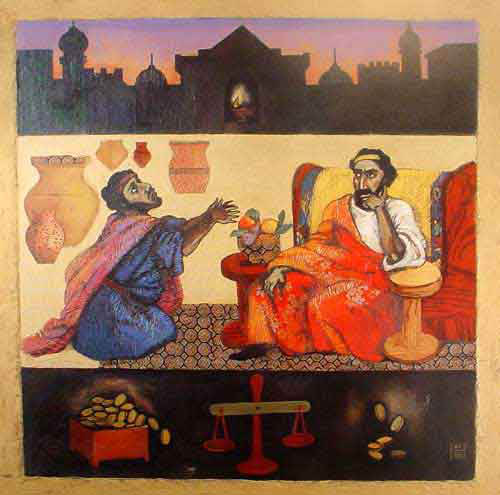
23 “Therefore the kingdom of heaven may be compared to a king who wished to settle accounts with his servants. 24When he began to settle, one was brought to him who owed him ten thousand talents. 25 And since he could not pay, his master ordered him to be sold, with his wife and children and all that he had, and payment to be made. 26 So the servant fell on his knees, imploring him, ‘Have patience with me, and I will pay you everything.’ 27 And out of pity for him, the master of that servant released him and forgave him the debt.
28 “But when that same servant went out, he found one of his fellow servants who owed him a hundred denarii, and seizing him, he began to choke him, saying, ‘Pay what you owe.’ 29So his fellow servant fell down and pleaded with him, ‘Have patience with me, and I will pay you.’ 30 He refused and went and put him in prison until he should pay the debt. 31 When his fellow servants saw what had taken place, they were greatly distressed, and they went and reported to their master all that had taken place.
32 “Then his master summoned him and said to him, ‘You wicked servant! I forgave you all that debt because you pleaded with me. 33 And should not you have had mercy on your fellow servant, as I had mercy on you?’ 34 And in anger his master delivered him to the jailers, until he should pay all his debt. 35 So also my heavenly Father will do to every one of you, if you do not forgive your brother from your heart.”
In the name of Jesus. Amen.
Jesus gives a sober warning at the end of this text. I’m going to reorder and tweak the way Jesus says it to make it crystal clear. Our Lord says, “If you do not forgive your brother from your heart, My heavenly Father will do to you what the king did to that first servant. He will demand you pay your debt and hand you over to the jailers for eternity.” Christian, you are forgiven, so you also must forgive. This is what Jesus is teaching with this parable. The parable has three scenes. And the order in which they happen is what makes Jesus’ point so powerful.
In Scene 1, the first servant (let’s call him ‘Vinnie’). Vinnie is hauled into the palace owing 10,000 talents to the king. Normally, a ‘talent’ is a unit of weight, not currency. Commentators are split on how we should understand what a talent’s value is. Some figure it’s a years’ pay; some say 20 years of wages. Either way, this is an impossible debt for an individual to pay off. After Vinnie’s debt is announced, the king commands that Vinnie, his wife, his children, and everything he has be sold. And Vinnie – notice what he begs for – he says, “Have patience with me, and I’ll pay you everything.” In other words, he asks for time. It’s ridiculous. Time? Time isn’t going to help! So, the king forgives the debt, he releases it. But debts are always paid by someone. They don’t just magically vanish. Here, the king pays. He swallows the debt and releases Vinnie. This is utter, unmerited mercy on the part of the king. End scene one.
The curtain rises and the spotlights illumine Scene 2, and we find Vinnie outside the palace. We’d expect him to be in a fantastic mood – smelling flowers and singing with birds. He’s forgiven and freed. But it sure doesn’t look like it by his actions. Vinnie spots his buddy (let’s call Vinnie’s buddy ‘Chuck’) who owed him 100 denarii, which is 100 days’ wages. That’s not an insignificant amount. But compared to what Vinnie was just forgiven – it’s pittance. Immediately, Vinnie grabs Chuck by the throat, throttles him, and demands, “Pay what you owe me.” And Chuck echoes almost word-for-word what Vinnie said in Scene 1. Chuck asks for time, but Vinnie doesn’t even give Chuck that. He has Chuck thrown into prison. Scene 2 ends with other servants informing the king how Vinnie had acted.
Now, just pause here. It’s intermission in the play of this parable. Let’s say you arrived late to the play and didn’t see Scene 1. All you know about it was that Vinnie is the character who owed 10,000 talents to the king. But you did watch all of Scene 2. What would you suppose happened in Scene 1? You would imagine that the king was still expecting Vinnie to pay the entire debt. The king must be breathing threats down Vinnie’s neck. That’s the only logical explanation. It’s the only way Vinnie’s actions are justified. And they would be just. It’s still futile; Vinnie won’t be able to choke enough throats to get out from under his debt. But at least it would make sense of his actions.
Dear saints, how many people know you are a Christian, but don’t have any idea about what goes on here? I mean, they might have an obscure idea that you’re coming here to meet with God. But they don’t necessarily know what goes on in this sanctuary between you and God while you’re here. So, ponder this: What does your Scene 2 say about the kind of God you have? Do your actions throughout the week accurately reflect on what God does here? Do people have the impression that the God you meet here is loving, kind, merciful, forgiving; or do they think your God is a harsh, cruel, punitive tyrant?
That’s all the time we have. Intermission’s over. The warning bell for Scene 3 just rang. And because we know what happened in the Scenes 1 and 2, we know exactly what’s going to happen in Scene 3. The king treats Vinnie precisely the way he deserves to be treated. Vinnie was given mercy, but he rejected that mercy by his actions. Vinnie demanded justice, so justice is what he gets. The king reinstates Vinnie’s debt, and justly so.
Dear saints, mercy has two sides. The first side of mercy is not getting what you deserve. Vinnie deserved to lose everything. He deserved to be sold with his family and possessions, but the king wanted to be merciful and not give Vinnie what he deserved. The second side of mercy is being given what you do not deserve. Vinnie had his debt forgiven and released by the king. He didn’t deserve it. I mean, Vinnie didn’t even have a grasp on how much debt he owed. Again, he had the delusion that time would help him. But the king doesn’t laugh at his idiotic request. No, the king was willing to release the debt and swallow it himself. Vinnie was given mercy, but he desperately demanded justice.
Here’s the thing: Mercy and justice are something only God can possess simultaneously. Only because of what Jesus has done on the cross can God be merciful and just to forgive and cleanse you from your sin (1 Jn. 1:9). Dear saints, God gives His mercy to you. It’s yours, but it is not something that you can keep for yourself and withhold from others. As soon as you try to hold on to God’s mercy and keep it only for yourself, you lose it. Forgiving others and being a forgiving person is not optional for a Christian. And this is hard.
Forgiving others, releasing someone from the retribution and retaliation that they deserve, is difficult. Some of you have been sinned against in ways that are so painful that I can’t even imagine. So, how do you go about being a person who forgives?
Let me give you two pastoral pieces of advice on how to be better forgivers. First, know that to forgive from the heart is something only a Christian can do, and the only reason a Christian can do it is what has happened in your Scene 1. Because of Christ’s death, God forgives your debt of sin. He separates it from you as far as the east is from the west (Ps. 103:12). The best way to grow as a forgiver is to recognize the massive debt that God has released for you.
Second, know that you aren’t going to forgive as perfectly God does. Pain and distrust will still be there. And forgiving someone does not mean that you have to become best friends. You can, and sometimes you must, forgive and still have boundaries to keep the one who has sinned against you away from you.
Forgiving is hard, but you can choose to forgive. That Holy Spirit-led choice is an act of a reborn disciple of Jesus. The emotions of pain and hurt and anger you have may slowly follow along in agreement. But, you might need to drag your emotions kicking and screaming behind you. Your emotions might take a long time to get on board with the choice to forgive. But one thing I would encourage you to do to help with that process is this: Name the sin.
If you’re angry and frustrated with someone for something, think concretely and specifically how you were sinned against. Figure out what commandment was broken when that person hurt you. We live in a sinful world. It’s naive to think that we are going make it out of here without having someone sin against us. You are going to be hurt in this world, and it will be painful. Your natural reaction to that hurt will be frustration, anger, and resentment. If you have that, name it. Name the sin that has been committed against you because then, it becomes something concrete, something you can identify. And being able to identify it, helps you realize what to do with that sin. It helps you realize that sin has been taken away by the Lamb of God.
You might be justified to want to strangle someone. But remember that God was justified to do that to you, and He didn’t. He didn’t. Instead, your God has released you and your debt for the sake of the complete payment of Jesus for your sin. He’s already done that here for you today in the Absolution, and He’s about to do it again here, at His Table. This is your Scene 1. Let that be reflected out there in your Scene 2. Amen.
The peace of God, which surpasses all understanding, will guard your hearts and minds in Christ Jesus (Php. 4:7). Amen.
10 Finally, be strong in the Lord and in the strength of his might. 11 Put on the whole armor of God, that you may be able to stand against the schemes of the devil. 12 For we do not wrestle against flesh and blood, but against the rulers, against the authorities, against the cosmic powers over this present darkness, against the spiritual forces of evil in the heavenly places. 13 Therefore take up the whole armor of God, that you may be able to withstand in the evil day, and having done all, to stand firm. 14 Stand therefore, having fastened on the belt of truth, and having put on the breastplate of righteousness, 15 and, as shoes for your feet, having put on the readiness given by the gospel of peace. 16 In all circumstances take up the shield of faith, with which you can extinguish all the flaming darts of the evil one; 17 and take the helmet of salvation, and the sword of the Spirit, which is the word of God, 18 praying at all times in the Spirit, with all prayer and supplication. To that end, keep alert with all perseverance, making supplication for all the saints, 19 and also for me, that words may be given to me in opening my mouth boldly to proclaim the mystery of the gospel, 20 for which I am an ambassador in chains, that I may declare it boldly, as I ought to speak.
In the name of Jesus. Amen.
I love this text. I’ve always loved this text, but younger me really loved this text – however, for the wrong reasons. All this talk about strength, might, armor, wrestling, and facing powerful, cosmic enemies – it gets a guy’s juices flowing. It brings out the fighter and warrior in a man. Sorry if that doesn’t resonate as much with you ladies and mothers here. Maybe, you gals will need to calm down and restrain your husbands and sons and brothers after the service, so they don’t march off to conquer Manitoba or something.
The passage tells us about a war that surrounds us every moment of every day. And it’s good that it does because we would be completely unaware of this war unless Scripture told us about it. Being oblivious to a war that surrounds you is not good. The reason we would be ignorant of this war is that it isn’t a war that we can see. As we confessed in the creed earlier, we “believe in God the Father Almighty, maker of heaven and earth, and [maker] of all things visible and invisible.”
Today, we heard how in six days God created everything we can see (Gen. 1:1-2:3), but God also created things we cannot see (Col. 1:16). And, dear saints, the enemy in the war that surrounds you is in that invisible part of God’s creation. In fact, none of your enemies exist in the visible part of creation. You do not – I repeat you do not – wrestle against flesh and blood. Instead, you wrestle against the rulers, the authorities, the cosmic powers over this present darkness, and the spiritual forces of evil in the heavenly places (Eph. 6:12). And some of you men out there are thinking, “Cool, an invisible enemy! That’ll make our victory even more impressive!”
Calm down, guys. And take heart, ladies. Because, while this text is about fighting in an invisible war against an unseeable enemy, the battle plan is straightforward and simple.
Before we can even dive into that battle plan, we have to understand where this invisible war is taking place. To be ready for battle, you have to know the battlefield. And one of the ways our enemy has made us unprepared for battle is taking this text out of its context. You might be very familiar with this text, but do you know what comes immediately before it? Maybe. But, I’ll admit, that even as your pastor and as someone who gets paid to study and teach the Scriptures, I find it easy to forget the context.
The context starts back in Eph. 5:22. Paul has been laying out the callings and duties for Christians in their vocations. Christian wives are to submit to their husbands. Christian husbands are to love their wives as Christ loved the Church. Christian children are to obey their parents. Christian parents are do bring up their children in the discipline and instruction of the Lord. And so on. It’s in that context that this passage about spiritual warfare falls.
In other words, you, Christian, need recognize that the battle described here is occurring in your everyday callings, vocations, and relationships. It’s there that you need God’s strength. It’s there that you need God’s armor because that’s where the devil and demons are attacking. They are attacking both you and those around you. Your daily life is the battlefield.
You husbands, wives, parents, and grandparents. The war is happening as you earn a living, as you keep the house, as you shuttle kids around. You kids, as you go to school, as you do your homework and chores, as you interact with your friends, the battle is taking place there.
There are two points I want to make sure you take away from this sermon, and this is the first. So, listen up: There is a spiritual war raging all around you every moment of every day, and you need to be strong and aware all the time. And that leads to right into the second point: You are at your strongest and are completely prepared for this war when you stand in the Lord’s strength and in the armor that He provides.
Right off the bat (Eph. 6:10), you are told, “be strong in the Lord.” Almost all of the popular versions of the Bible will read that way, and I understand why it’s translated that way. It’s a fine translation. But the verb there “be strong” is passive. When it’s only translated, “be strong,” you might start wondering how you go about becoming or making yourself strong.
I wish our translations read, “be strengthened in the Lord, in His mighty strength.” The text is clear. God is the One who makes you strong (Php. 4:13). Earlier in Eph. 3:16-17, Paul says that, according to the riches of His glory, God Himself grants you to be strengthened with power through the Holy Spirit so that Christ dwells in your heart through faith.
Not only does God make you strong, He also clothes you in His armor. You have the belt of truth, the breastplate of righteousness, the boots of the Gospel, the shield of faith, the helmet of salvation, and the sword of the Spirit which is the Word of God. All of that, God’s strength and God’s armor, it all comes from God’s Word. God’s Word is truth (Jn. 17:17). Christ’s righteousness is given through the Word (2 Tim. 3:16-17). The Gospel is only revealed in the Bible. Faith is given through God’s Word (Ro. 10:17). The Scriptures are what make you wise to salvation (2 Tim. 3:15; Jam. 1:21).
Strengthened by God and armed with and by His Word, you are prepared for this war. But you still might wonder, “Am I properly trained for the war? What are my duties?” Well, you aren’t told to march off to war. You also aren’t told to retreat. Instead, four times in this text, you are told what your assignment is in the battle. You are to stand (Eph. 6:11, 13-14). The picture Paul is giving is that you are a particular kind of soldier – a sentry, who stands guard over the kingdom.
The picture of this passage is this: Christian, you are God’s soldier. As God’s soldier, your responsibilities are simple. You are a sentry who guards the holy ground of God’s kingdom. And God has placed you in a particular place – where no one else is stationed. You are there to watch and to pray. In other words, when the enemy attacks, you are not supposed to go off and fight alone. No. Instead, you stay in your post. You stand in God’s strength and in the protection of His armor. And you pray. With that prayer, you call in the reinforcements of the Lord’s army.
When you see the war raging around your spouse, your children, your parents, or any neighbor – stand your ground, man your post, and pray. You, dear saints, stand in the Lord’s strength and protection. And when the battle gets in close, take up the sword of the Spirit, the Word of God. Wield that sword against the devil, and he will flee.
Psalm 35 opens with a beautiful prayer for you to use in the battle. “Contend, O Lord, with those who contend with me; fight against those who fight against me! O Lord, take hold of shield and buckler and rise for my help! Draw the spear and javelin against my pursuers! Say to my soul, ‘I am your salvation!’” Christ Himself is the One leads the charge against your enemies, and He turns over His shoulder to remind you that He is your salvation. Amen.
The peace of God, which surpasses all understanding, will guard your hearts and minds in Christ Jesus (Php. 4:7). Amen.
1 See what kind of love the Father has given to us, that we should be called children of God; and so we are. The reason why the world does not know us is that it did not know him. 2 Beloved, we are God’s children now, and what we will be has not yet appeared; but we know that when he appears we shall be like him, because we shall see him as he is. 3 And everyone who thus hopes in him purifies himself as he is pure.
In the name of Jesus. Amen.
Typically, names are given. When you’re born, you’re given a name. Whether or not you like your name, doesn’t matter. The name your parents gave you is your name. Sometimes, you are given a nickname, which you may like or dislike.
In junior high, my schoolmates called me ‘string-bean.’ I didn’t like it so much. But being over 6 ft. tall and weighing maybe 120 lbs. soaking wet, it fit. When I made the varsity swim team, I thought, “This is my chance for a cool nickname,” because no one else from my school was a swimmer. So, I tried to give myself a nickname. The movie Rudy had just come out, and the story of that weak, little football player who finally got a chance and proved himself on the field was so inspirational that I told my teammates to call me ‘Rudy.’ I even had it printed on my first varsity swimming t-shirt. Long story short, ‘Rudy’ didn’t stick, sadly. Even worse was that one of the other swimmers was dating a girl from my school. As soon as he found out that I was called ‘string bean,’ the name followed me into the pool.
The Bible has lots of names and titles for people who are saved by grace through faith in Christ – Christian (Act. 11:26), believer (Act. 5:14), child of God (Jn. 1:12-13), people of God (1 Pet. 2:9; Rev. 21:3), citizens of the kingdom of heaven/God (Php. 3:20), people belonging to the Way (Act. 9:2). I could go on and on. All of those names and titles have a different focus, and you are probably comfortable with some of those titles and names for yourself. But the Bible has another name for you. Even though it’s a name that you might not like, even though it’s a title that you wouldn’t claim for yourself, it’s a name that is true and accurate. You, Christian, are a ‘saint.’
A saint is not someone who does a lot of good works, has witnesses who can verify two miracles, and gets recognized by people wearing funny hats at the Vatican. No! To be a saint literally means to be a ‘holy one.’ And no; you aren’t holy by your own works or efforts. You aren’t holy when it comes to keeping God’s commands. You aren’t holy because of your obedience. Instead, you are made holy by grace through faith in Jesus. Christ is the Lamb of God who takes away the sin of the world (Jn. 1:29). That means Jesus takes all your sin and shame and guilt and bares it to the cross. In exchange, Jesus gives you His perfect obedience, His total righteousness, His pure holiness. Because of Christ, God makes you holy. The fact that you are a saint is God’s work – not yours.
Here in chapter 3, John wants you to see, to behold, to recognize that you are a saint. Even though the word ‘saint’ doesn’t come up in the text, there are three other terms or titles in this text that point to the fact that you are a ‘saint.’
First, you are God’s child, and John wants you to bask in the fact that God has made you His child. “See what kind of love the Father has given to us, that we…” we who are sinful and unclean, we who rebel against God, we who by nature are enemies of God, “See the love God the Father has given to us that we should be called children of God.” And John drives the point home, “And so we are” (1 Jn. 3:1).
You, dear saints, are God’s children. Jesus Himself said so. The morning of the Resurrection, shortly after Jesus finished tidying up His grave, folding up His burial cloths, and making the bed, He tells Mary Magdelene to tell the disciples, “Go to My brothers and say to them, ‘I am ascending to My Father and your Father, to My God and your God’” (Jn. 20:17).
In Hebrews 2:10, Jesus is referred to as the Founder of your salvation who brings “many sons to glory.” Then, Hebrews goes on to say, “He who sanctifies,” (in other words ‘makes holy’), “and those who are sanctified,” (in other words, ‘who are made saints’), “all have one source. That is why [Jesus] is not ashamed to call [you who are made holy] ‘brothers’” (Heb. 2:11). Since Jesus, the Son of God, is not ashamed to call you ‘brothers,’ then you also are children of God. And children inherit characteristics from their parents. Since God is holy, holy, holy (Is. 6:3) – you also are holy. You, children of God, are saints.
John goes on to acknowledge that the world doesn’t recognize you as the children of God. People can’t look at you and say, “Oh, I see you’re a Christian. You look just like your heavenly Father.” You and I don’t bear that divine resemblance because even though we are children of God, we still sin and fall short of the glory of God (Ro. 3:23). In the eyes of the world, we look like sinners, so the world doesn’t see us as children of God. But the fact that the world doesn’t recognize that we are children of God shouldn’t surprise us. The world doesn’t recognize us as children of God because it didn’t recognize Jesus as the Son of God when He came to earth.
The second term John uses to point to the fact that we are saints is “beloved” or lit. ‘loved ones.’ God has poured His love into you. And by His love, He has given you the right to be His children who are born of God (Jn. 1:12-13; 3:5). And in that love you receive grace on top of grace (Jn. 1:16). Because of Jesus, God’s love washes over you. His love makes you clean, forgiven, and sanctified, i.e. holy and sainted (1 Co. 6:11). That is what it is to be God’s beloved. As God’s loved one, you also have His promise that the day is coming when you will be like Jesus because you will see Him as He is (1 Jn. 3:2).
And it’s a good thing that we need to wait for that transformation before we look like Jesus. Can you imagine if you already had the glory of being God’s beloved child? Imagine if as soon as you were Baptized and given the gift of faith that you started to radiate like Jesus did in the Transfiguration. You face shines like the sun (Mt. 17:2), and your clothes become radiant and intensely white (Mk. 9:3). You’d probably get pulled over all the time, and the police would demand that you have more tint on your windows.
The third term John uses to ‘saint’ you is in this text is in v. 3. As you have this hope of being like Jesus when you see Him John says, “Everyone who thus hopes in Him purifies himself as He is pure.” The root of the word for ‘purifies’ and ‘pure’ is the same as ‘holy’ and ‘saint.’
This purification doesn’t happen by you doing good works and no longer sinning. This purification comes through faith and the hope you have of being like Jesus – which is, again, only by God’s love and grace. To live by grace through faith is to have this hope. The picture here is that, through faith and hope, Jesus’ purity is given and poured into you. The Old Testament had all those regular sacrifices that delivered this same purity by pointing people forward to the cleansing that comes only through Jesus’ sacrifice on the cross. Now, you have the fullness of what those were pointing to. Faith in Christ continually purifies you as Jesus Himself is pure.
Since the last time we celebrated All Saints’ Day, one of our sisters in Christ became like Jesus. On Tuesday, March 25th, Ros, who was already a saint in this life, saw Jesus as He is. She entered that great multitude around the throne of Jesus. She exited this great tribulation and got her white robe. She is now sheltered in God’s presence where Jesus will shepherd her to springs of living water (Rev. 7:9-17). Now Ros and every other believer who has gone to be with Christ surrounds us and cheers us on as we look to Jesus, the Founder and Perfector of our faith (Heb. 12:1-2).
Dear saints, behold what manner of love the Father has given unto you, that you should be called children of God – and so you are. God your Father now invites you to His Supper. God the Son comes to serve you. And God the Holy Spirit comes to continually purify you by grace through faith. This is God’s promise, and this is our hope. Amen.
The peace of God, which surpasses all understanding, will guard your hearts and minds in Christ Jesus (Php. 4:7). Amen.



 Pastorsamwise
You must be logged in to post a comment.