Mark 8:1-9
1 In those days, when again a great crowd had gathered, and they had nothing to eat, he called his disciples to him and said to them, 2 “I have compassion on the crowd, because they have been with me now three days and have nothing to eat. 3 And if I send them away hungry to their homes, they will faint on the way. And some of them have come from far away.” 4 And his disciples answered him, “How can one feed these people with bread here in this desolate place?” 5 And he asked them, “How many loaves do you have?”They said, “Seven.” 6 And he directed the crowd to sit down on the ground. And he took the seven loaves, and having given thanks, he broke them and gave them to his disciples to set before the people; and they set them before the crowd. 7 And they had a few small fish. And having blessed them, he said that these also should be set before them. 8 And they ate and were satisfied. And they took up the broken pieces left over, seven baskets full. 9 And there were about four thousand people. And he sent them away.
In the name of Jesus. Amen.
This morning, we heard how God worked so that Adam and Eve could enjoy paradise in bliss and peace (OT Lesson Gen. 2:7-17).
First, God formed the man. God breathed into man’s nostrils to make Adam a living creature. God planted a garden in Eden. God made every tree that is splendid to look at and good for food to spring up from the ground. God surrounded that garden with vibrant rivers and lands filled with gold and precious stones.
God put Adam in the garden and gave him a job – which, yes, is a good thing. Just consider how little Adam had on his work resume at the time. God gave Adam the gift of hunger so that he would have the joy and delight of eating and tasting the fruits of his labor. And God taught Adam what to eat and what not to eat.
Now, this is a bit of an aside, but it is very important. Many people have wondered why God would put the tree of the knowledge of good and evil which produced the forbidden fruit in the bliss of Eden at all. Some will say that God put it there to test Adam and Eve to see if they would be good. But if that is the case, it means that God could not make man “good” unless He gave man the choice to do evil. That would be strange for a God who truly is good and all-powerful Himself.
Scripture gives us a better understanding for the existence of the forbidden tree. Habakkuk 2:4 says, “The righteous shall live by faith.” This is true now, but it was also true before the Fall.
Think of it this way: Everything Adam and Eve knew, they knew because they saw and experienced it. But the one thing they didn’t know was evil. God put the tree of the knowledge of good and evil in the Garden because evil did exist. So Adam and Eve would have faith, God was giving a promise to believe when He commanded Adam to not eat of the tree of knowledge of good and evil. Think of it this way, when God gives that command He is saying, “Hey, Adam, there is evil and it is bad. If you find out what evil is, it won’t be good for you. Trust Me on this.”
In the end, Adam and Eve didn’t trust God. Obviously, we do not live in Eden anymore; instead, we live in desolation.  Our English word ‘desolation’ contains the word ‘solo,’ and that gives a sense of what ‘desolation’ means. Adam and Eve went solo. Rather than trusting God, they went solo and trusted the devil’s lie bringing sin, death, condemnation, and desolation into the world.
We might think Adam and Eve were fools to give up the paradise God created for them. But we are apples that didn’t fall far from Adam’s tree. We too choose evil instead of faith, chaos instead of perfection, and desolation instead of bliss. We live in a place of our own making. A place we contrived from our rebellious hearts. A desert rather than a garden. Instead of life, there is death. Instead of abundance, there is lack. Instead of walking with God, we are surrounded by demons.
God warns us about the penalty of doing evil, but we go solo and crave what isn’t ours. God tells us that we must tell the truth and defend the reputation of others, but we go solo by spreading gossip and slander. Because of sin – and our sin alone – we dwell in a desolate place. Repent.
But even though we turned our back on God, He did not turn His back on us. God doesn’t despise us, He doesn’t come to punish us, and He doesn’t regret the fact that He made us. Instead, God comes to have compassion on us and graciously feed us. On the third day of this excursion, Jesus says, “I have compassion on the crowd.”That word ‘compassion’ in Greek means that His intestines are tied up. A loosey-goosy translation of Jesus’ words here would be, “My gut is wrenched for these people who don’t have anything to eat.”
 Look at what Jesus, God in the flesh does – notice the verbs. He calls the disciples. Jesus directs the crowd to sit down. He takes the bread. Christ gives thanks for the bread. He breaks the bread. He gives the bread to the disciples to set before the people. Jesus blesses the fish. He gives the fish to the disciples to set before the people. And Jesus watches them all eat until every last one of them is satisfied. Jesus continues to do this for us today.
Some of you are fully aware of the desolation you live in right now. Maybe it’s your health or a broken relationship that has left you lonely. Maybe it’s a money or job problem. Whatever it is, it doesn’t matter. Desolation stares you in the face, and you are worried. Know that Jesus is still with you to serve you with everything you need in every moment.
Do you think that when Jesus led that crowd out into the wilderness for three days, do you think that Jesus forgot they would need food? Do you think Jesus was preaching, and suddenly the light bulb turned on in the middle of His sermon and He said, “Oh, nuts. These people are going to need to eat. Oops!”? No, absolutely not! Jesus didn’t forget that they would need food.
Instead, Jesus brought them to a place of momentary need. He led them into the wilderness where they would need a miracle to provide for them. Jesus led them there for some good. We shouldn’t speculate why Jesus did this because the text doesn’t tell us exactly why Jesus did it. But Jesus deliberately brought them there where they would need Him to fully provide for them.
So, listen to this very carefully. Whether things are going well and you don’t notice anything lacking in your life or whether things are bleak and dire, by God’s grace you have everything from God that is best for you right now. Do you believe that?
Scripture says, “Give thanks in all circumstances” (1 Thess. 5:18). Give thanks for everything you have from God at all times – whether those times are good or bad. Here’s why, listen to this from Romans 8:31-32, “If God is for us, who can be against us?” And we can know that God is for us because of what Scripture says next: “He who did not spare His own Son but gave Him up for us all, how will He not also with Him graciously give us all things?” In other words, if God gives His only-begotten Son to die on the cross while you are His enemy and a sinner, He won’t hold back anything good from you now that you are adopted into His family through Jesus’ death and resurrection.
God will give us all things in the future, yes. But He also gives us all good things now. Like He did in Eden and like He did in the wilderness, Jesus even now serves us sinful, fallen people who have chosen to live in a desolate place.
Jesus is here with His compassion in the midst of your desolation to bring Eden to you. He has come to be your servant by feeding you the Bread of Life from this altar. In this meal, your Savior dispenses forgiveness, life, and salvation to you. Even though we are a small crowd, Jesus has come to deliver big compassion. So, come and receive. Amen.
The peace of God, which surpasses all understanding, will guard your hearts and minds in Christ Jesus. Amen.
 19 Therefore whoever relaxes one of the least of these commandments and teaches others to do the same will be called least in the kingdom of heaven, but whoever does them and teaches them will be called great in the kingdom of heaven. 20 For I tell you, unless your righteousness exceeds that of the scribes and Pharisees, you will never enter the kingdom of heaven.
 Sure, you aren’t Lady Macbeth yelling at the blood of Duncan to wash off your hands, but you are guilty of murder before God. You have been angry with others. You have called others, “Fool.” You have held grudges. You have refused to ask your neighbor for forgiveness. And Jesus goes on to the other Commandments as well – lust is adultery and fornication, gossip is perjury, etc.
 The Law should never be allowed to access into your ‘How do I stand before God?’ room, your ‘Am I good enough to go to heaven?’ room, your ‘Does God love me?’ room, your ‘Does God think I am a good person?’ room, or your ‘assurance of salvation’ room. The Law should never be allowed to enter those rooms because Jesus has made you as good and as righteous and as perfect as He is.
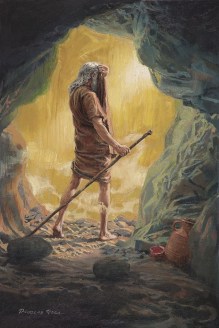 And behold, there came a voice to him and said, “What are you doing here, Elijah?” 14 He said, “I have been very jealous for the Lord, the God of hosts. For the people of Israel have forsaken your covenant, thrown down your altars, and killed your prophets with the sword, and I, even I only, am left, and they seek my life, to take it away.” 15 And the Lord said to him, “Go, return on your way to the wilderness of Damascus. And when you arrive, you shall anoint Hazael to be king over Syria. 16 And Jehu the son of Nimshi you shall anoint to be king over Israel, and Elisha the son of Shaphat of Abel-meholah you shall anoint to be prophet in your place. 17 And the one who escapes from the sword of Hazael shall Jehu put to death, and the one who escapes from the sword of Jehu shall Elisha put to death. 18 Yet I will leave seven thousand in Israel, all the knees that have not bowed to Baal, and every mouth that has not kissed him.”
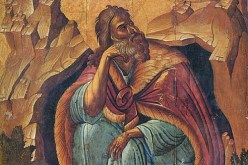 Listen again to Elijah’s response, “Listen God, I’ve been very jealous for You. I’ve done what You have commanded. But Your people have forsaken Your covenant. They have thrown down Your altars. And they have killed Your prophets with the sword. I’m the only faithful one left, and they are out to kill me as well.” Elijah’s response makes it sound like God had lost and that Baal had won. His answer makes it seem like no rain had fallen, and as though God had failed.
 God will continue to defeat His enemies by raising up faithful believers from the offspring of His enemies. Scripture doesn’t promise that the Jezebels of our day will fall before our eyes. In fact, it is very likely that the voices of Jezebel will continue to grow stronger in our culture and society.
 To get an understanding of this, we are going to start by considering what happened in our Old Testament text (Gen 50:15-21) where we heard about what happened between Joseph and his brothers after their father has died. Joseph’s brothers were afraid that Joseph would punish them because of all the wrong things they had done.
 But, Christian, this passage of Scripture is telling you that there is something even better in store for you than the end of your suffering – whatever has caused it. Paul writes in 1 Cor. 15:19, “If in Christ we have hope in this life only, we are of all people most to be pitied.” Dear saint, when you suffer, you do not simply look to the end of your pain. Instead, you are to look to the glory that is to be revealed to you. And, in fact, all of creation is groaning for this as well.
 Dear saints, the same is true of you. In Christ, God has done all the work required to give you your glory. And the day is coming when you will hear your heavenly Father’s voice, praising you for the work He has done in you (Mt. 25:21).
 In each of these parables, what is lost – the sheep, the coin, and even the son – is not valuable. That is the point of the parables. This is most apparent in the parable of the lost coin. The party the woman throws costs more than the coin that she recovered. That one sheep was worth less than the cost of the party that the shepherd threw. Even that one son was not worth the cost of the party. And don’t pish-posh that statement.
 Because of our sin, we are broken. No one wants to admit it, but we are happy when our neighbor suffers and we are sad when he rejoices. The Germans created a word for this by combining their words for ‘harm’ and ‘joy’ into one word, Schadenfreude. The worst part is we justify our Schadenfreude. We enjoy others’ pain because we figure they deserved it. We want others to get what we think is justice. But this is the opposite of compassion and is from the devil.
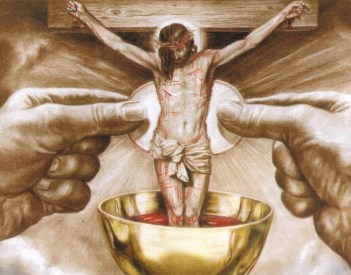 he restored and received his son back into the family. Sinner, your heavenly Father has fattened up Jesus, His faithful Son, to serve as food for you who are unworthy.
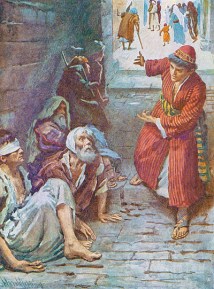 Then the master of the house became angry and said to his servant, ‘Go out quickly to the streets and lanes of the city, and bring in the poor and crippled and blind and lame.’ 22 And the servant said, ‘Sir, what you commanded has been done, and still there is room.’ 23 And the master said to the servant, ‘Go out to the highways and hedges and compel people to come in, that my house may be filled. 24 For I tell you, none of those men who were invited shall taste my banquet.’”
 So, the man has sent out this invitation without saying exactly when the banquet would begin. Then in v. 17, the preparations are finished – the food is cooked, the table is set, the decorations are hung, the wine is poured, everything is ready. The man sends his servant to tell all those who were invited, “Come, for everything is now ready.” But they all make excuses, and their excuses are lame and stupid.
 Christian, God has ushered you into His paradise. You receive the benefit of the sacrifice of Christ’s death. You are promised the resurrection. And, now, in this feast you are about to receive, God nourishes you and declares you to be the object of His love and His perfect bride.
 22 The poor man died and was carried by the angels to Abraham’s side. The rich man also died and was buried, 23 and in Hades, being in torment, he lifted up his eyes and saw Abraham far off and Lazarus at his side. 24 And he called out, ‘Father Abraham, have mercy on me, and send Lazarus to dip the end of his finger in water and cool my tongue, for I am in anguish in this flame.’ 25 But Abraham said, ‘Child, remember that you in your lifetime received your good things, and Lazarus in like manner bad things; but now he is comforted here, and you are in anguish. 26 And besides all this, between us and you a great chasm has been fixed, in order that those who would pass from here to you may not be able, and none may cross from there to us.’ 27 And he said, ‘Then I beg you, father, to send him to my father’s house— 28 for I have five brothers—so that he may warn them, lest they also come into this place of torment.’ 29 But Abraham said, ‘They have Moses and the Prophets; let them hear them.’ 30 And he said, ‘No, father Abraham, but if someone goes to them from the dead, they will repent.’ 31 He said to him, ‘If they do not hear Moses and the Prophets, neither will they be convinced if someone should rise from the dead.’”
 Even though the parable doesn’t explicitly say it, we know the rich man does not love God. As our Epistle text (1 Jn. 4:16-21) says, “he who does not love his brother whom he has seen cannot love God whom he has not seen…. Whoever loves God must also love his brother” (1 Jn. 20-21). The rich man’s lack of love for Lazarus makes his lack of love for God as plain as the nose on your face.
 So, when your conscience is pricked and you feel guilt for your lack of love, first repent. Repent of your lack of love. Then, make a list of the people God has placed in your life to help, to care for, and to love starting with the people closest to you.
 And never forget, Christian, that you have been given a name. Through the waters of your Baptism, God gave you your name. He has adopted you into His family. You are His child and part of the household of Jesus. The love you fail to show to those God has placed in your life is forgiven and covered by the blood of Jesus, your Savior. And God does not forget to pour out His love, mercy, forgiveness, and provision for you.
 1 When the day of Pentecost arrived, they were all together in one place. 2 And suddenly there came from heaven a sound like a mighty rushing wind, and it filled the entire house where they were sitting. 3 And divided tongues as of fire appeared to them and rested on each one of them. 4 And they were all filled with the Holy Spirit and began to speak in other tongues as the Spirit gave them utterance.
 We didn’t hear Peter’s whole sermon. It goes on for another fifteen verses, but I want you to hear the highlights of the whole thing. In the part of Peter’s sermon that we did hear, Peter tells the people that, if they had read their Bible, wouldn’t have been surprised at what they are hearing because it had been foretold in the prophet Joel. Then, Peter goes on to proclaim Jesus to the people.
 So you, when the Law comes and points its finger at you and declares you to be a sinner, don’t make excuses. Don’t try to turn the accusations away. Don’t try to put your own spin on it and say that at least you aren’t as bad as so-and-so. Instead, repent. Repent because the Holy Spirit wants you to know that Jesus came to save you who are lost in sin. That means that Jesus has come to save you and me.
 God given you a new heart and a new spirit. God has put His Holy Spirit within you, and He has caused you to walk in His statutes and rules. Again, God promised to do this for the sake of His name, His reputation, and your benefit because you are His.
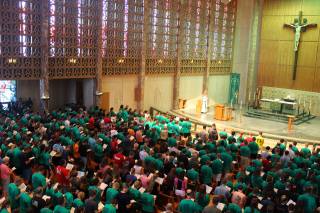 So, “Sing praises to the Lord, for He has done gloriously. Shout, and sing for joy, O inhabitant of Zion, for great in your midst is the Holy One of Israel.” The Scripture readings today have called you – in fact, they have commanded you – to sing to God five times (Ps. 98:1, 4, Is. 12:5, 6).
 Now, why does God command us to sing; isn’t speaking good enough? Apparently, no. There is a great passage in everyone’s favorite Old Testament book, Zephaniah 3:17. Listen to this, “The Lordyour God is in your midst, a mighty one who will save; he will rejoice over you with gladness; he will quiet you by his love; he will exult over you with loud singing.” It is an absolutely beautiful picture. But the reason I bring this up is that this is the one place in all the Scriptures where God sings, and the reason He sings is His joy over you.
 And Jehoshaphat appoints the front line to be – guess who – the Kohathites and the Korahites, the choir. The Lordwould fight for them, so why not have the singers be the first into battle? The army marches out behind the choir and listen to this, it’s from 2 Chron. 20:22, “And when they began to sing and praise, the Lordset an ambush against the men of Ammon [and] Moab… who had come against Judah, so that they were routed.” Through their singing, God defeated the enemies of His people.
 Pastorsamwise
You must be logged in to post a comment.