Name-Calling Savior – Sermon on John 20:1-18 for the Resurrection of Our Lord

John 20:1-18

1 Now on the first day of the week Mary Magdalene came to the tomb early, while it was still dark, and saw that the stone had been taken away from the tomb. 2 So she ran and went to Simon Peter and the other disciple, the one whom Jesus loved, and said to them, “They have taken the Lord out of the tomb, and we do not know where they have laid him.” 3 So Peter went out with the other disciple, and they were going toward the tomb. 4 Both of them were running together, but the other disciple outran Peter and reached the tomb first. 5 And stooping to look in, he saw the linen cloths lying there, but he did not go in. 6 Then Simon Peter came, following him, and went into the tomb. He saw the linen cloths lying there, 7 and the face cloth, which had been on Jesus’ head, not lying with the linen cloths but folded up in a place by itself. 8 Then the other disciple, who had reached the tomb first, also went in, and he saw and believed; 9 for as yet they did not understand the Scripture, that he must rise from the dead. 10 Then the disciples went back to their homes. 

11 But Mary stood weeping outside the tomb, and as she wept she stooped to look into the tomb. 12 And she saw two angels in white, sitting where the body of Jesus had lain, one at the head and one at the feet. 13They said to her, “Woman, why are you weeping?” She said to them, “They have taken away my Lord, and I do not know where they have laid him.” 14 Having said this, she turned around and saw Jesus standing, but she did not know that it was Jesus. 15 Jesus said to her, “Woman, why are you weeping? Whom are you seeking?” Supposing him to be the gardener, she said to him, “Sir, if you have carried him away, tell me where you have laid him, and I will take him away.” 16 Jesus said to her, “Mary.” She turned and said to him in Aramaic, “Rabboni!” (which means Teacher). 17 Jesus said to her, “Do not cling to me, for I have not yet ascended to the Father; but go to my brothers and say to them, ‘I am ascending to my Father and your Father, to my God and your God.’” 18 Mary Magdalene went and announced to the disciples, “I have seen the Lord”—and that he had said these things to her.

Alleluia! Christ is risen!
He is risen indeed! Alleluia!

In the name of Jesus. Amen.

Just as a ‘heads-up,’ I’m going to set the scene and fill out some details about Mary Magdalene as well as the events of morning of Jesus’ resurrection. I’m not making stuff up; I’ll be pulling from Scripture. If you want the references for things that I mention that aren’t in this text, ask me after the service, and I can print out the sermon with all the references.

Mary Magdalene goes to the tomb before light dawns the morning of the Resurrection, but she isn’t seeing, hearing, or thinking clearly. She is still filled with grief and sorrow from watching Jesus’ crucifixion. Mary Magdalene stood and witnessed the sad events of Good Friday at the foot of the cross (Jn. 19:25; Mk. 15:40). And the last time she had seen her Lord, He was wrapped in burial cloths before the sun set on Friday (Mt. 27:61; Mk. 15:47; Lk. 23:55-56).

But now, it’s Sunday, the first day of the week. Mary Magdalene was one of several women who went to the tomb (Mt. 28:1; Mk. 16:1; Lk. 24:10). As the women approached, they began to ask each other, “Who will roll away the stone for us from the entrance of the tomb?” But when they got there, they saw that the stone had already been rolled away by an angel who was sitting on it (Mk. 16:1-4; Mt. 28:2). It seems as though Mary Magdalene immediately ran back to the disciples as soon as she saw the open tomb.

For Mary Magdalene, the empty tomb was, initially, another reason to grieve because she thinks that someone has stolen Jesus (Jn. 20:13, 15). She runs back to tell Peter and John about it. She returns to the tomb with them while they investigate her claim (Jn. 20:3-9). They see the empty tomb and the neatly-folded burial cloths (Jn. 20:5-7). But these two disciples can’t comfort Mary because they didn’t believe that Jesus had risen; at least not at this point. In fact, the disciples won’t believe the resurrection until later that evening (Jn. 20:8b-9; Lk. 24:36-49).

Peter and John leave the tomb, but Mary stays there. And sorrow again fills her. She sees two more angles dressed in white robes sitting inside the tomb where Jesus had been laid, and she even has a conversation with them. They ask her, “Woman, why are you weeping?” And you can hear the pain in Mary Magdalene’s voice as she answers, “They have taken away my Lord, and I do not know where they have laid Him.” This conversation with the angels doesn’t help Mary believe in the Resurrection.

And I wonder what the angels thought about this conversation with Mary. They might have been a bit confused by her reply because, as Mary said this, Jesus is standing behind her.

Mary turns around and sees Jesus standing. But seeing the resurrected Jesus doesn’t give her faith. She thinks He is the gardener. And Jesus, patient Jesus, asks her the same question the angels had asked, “Woman, why are you weeping?” But Jesus adds another question, “Whom are you seeking?”  It’s almost like Jesus is saying, “Hey, it’s Me, I’m right here.” But Mary still doesn’t believe Jesus is raised. She says, “Sir, if you have carried Him away, tell me where you have laid Him, and I will take Him away.” Even this conversation with the resurrected Jesus doesn’t give her faith.

But then, everything changes when Jesus speaks her name, “Mary.” I wonder what intonation Jesus used. Did He say it with a mild rebuke, “Mary”? Did He say it with a snicker, “Mary”? Maybe, He said it with utter compassion, “Mary.”

No matter how Jesus said her name, she believes. That one word – and not just any word, but her very own name spoken by the lips and voice of her resurrected Savior – pulls her out of her grief and sorrow. This is so magnificent.

The same voice that called seven demons out her (Lk. 8:2; Mk. 16:9) now expels the demon of unbelief. The last time she had heard the voice of Jesus was when He cried out on the cross “It is finished,” (Jn. 19:30) and, “Father into Your hands I commit My spirit” (Lk. 23:46). Now, that same voice, filled with life and peace, speaks her name, “Mary.” Jesus – who had drunk the cup of God’s wrath, had all the sins of the world laid on Him, and had passed through death and the grave – He calls her by name. And Mary believes and latches herself on to Jesus as though she will never let go. But her grip on Jesus isn’t as important as His grip on her.

Jesus sends her with a message to give to the disciples, “Go to My brothers and say to them, ‘I am ascending to My Father and your Father, to My God and your God.’” Jesus can call the disciples, “My brothers,” and say this because something new has arrived. All who believe in Christ, all His disciples, all Christians, are welcomed into a new world where they are Jesus’ siblings, where God is ‘your God’ and Jesus’ Father is now ‘your Father.’

So, that very moment in the garden next to the empty tomb, Mary experienced the fulfillment of Isaiah 43:1-3. “Fear not, for I have redeemed you; I have called you by name, you are Mine. When you pass through the waters, I will be with you; and through the rivers, they shall not overwhelm you; when you walk through the fire you shall not be burned, and the flame shall not consume you. For I am the Lord your God, the Holy One of Israel, your Savior.”

I’m going to give you some Easter homework: Before you send your kids out hunting for Easter eggs, as a family, read Isaiah 43:1-3 and v. 11-18 of this text, then read Isaiah 43:1-3 again to see the parallels.

Dear saints, what Jesus did for Mary Magdalene the morning of the Resurrection, He does for you. He calls you by name. In John 10, Jesus calls Himself the Good Shepherd who lays down His life for the sheep (Jn. 10:11). In that passage, Jesus also says that He is the shepherd who, “calls His own sheep by name and leads them out” (Jn. 10:3). Jesus, your Shepherd, is the name-calling Savior. He calls you by name in your Baptism and places His name – Father, Son, and Holy Spirit – upon you (Mt. 28:19). 

Jesus is your God, your Savior. You, Christian – this could be said to each and every one of you by name – you will always have the risen Jesus. He will never leave you or forsake you. He died for you and has forgiven all your sin. Christ leads you through every trial and tribulation you face in this life. And He leads you to the resurrection. Nothing in this world will overwhelm or consume you. You belong to Him. Jesus is your Savior, Redeemer, and Brother, and God is your God.

You are His. You belong to Him. He has bought and purchased you with His holy and precious blood by dying on the cross and rising again for you.

And now, He invites you to come to His table where you will again see Him in Bread, which is His resurrected Body, and in Wine, which is His life-giving Blood. Come, taste, and see that the Lord is good (Ps. 34:8).

Alleluia! Christ is risen!
He is risen indeed! Alleluia!

Amen.

The peace of God, which surpasses all understanding, will guard your hearts and minds in Christ Jesus. Amen.

A Different King with a Different Glory – Sermon on John 12:12-19 and Matthew 26:1-27:66 for Palm Sunday

John 12:12-19 & Matthew 26:1-27:66

In the name of Jesus. Amen.[1]

October 21st and 22nd 331 BC, Alexander the Great of Greece made his triumphal entry into the city of Babylon after conquering it. And we have a historical account of Alexander’s entry into the city.[2]

While Alexander was approaching Babylon, some went up on the walls of the city to watch their new king enter, but most went out to meet him. For miles, the road into Babylon was carpeted with flowers. At regular intervals, silver altars were placed on both sides of the road heaped with frankincense and perfumes. Herds of cattle and horses were in the procession as well as lions and leopards in cages. Large choirs sang the praises of Alexander. The Babylonian cavalry marched along with all their equipment and horses. Alexander himself was surrounded by an armed guard as he rode in his chariot, and the people of the city followed him. Finally, this massive, impressive parade approached the gates, and Alexander entered the palace. Now that is a triumphal entry. Miles of people, soldiers, animals, and all sorts of pageantry following the king. It was a display of might, power, and authority.

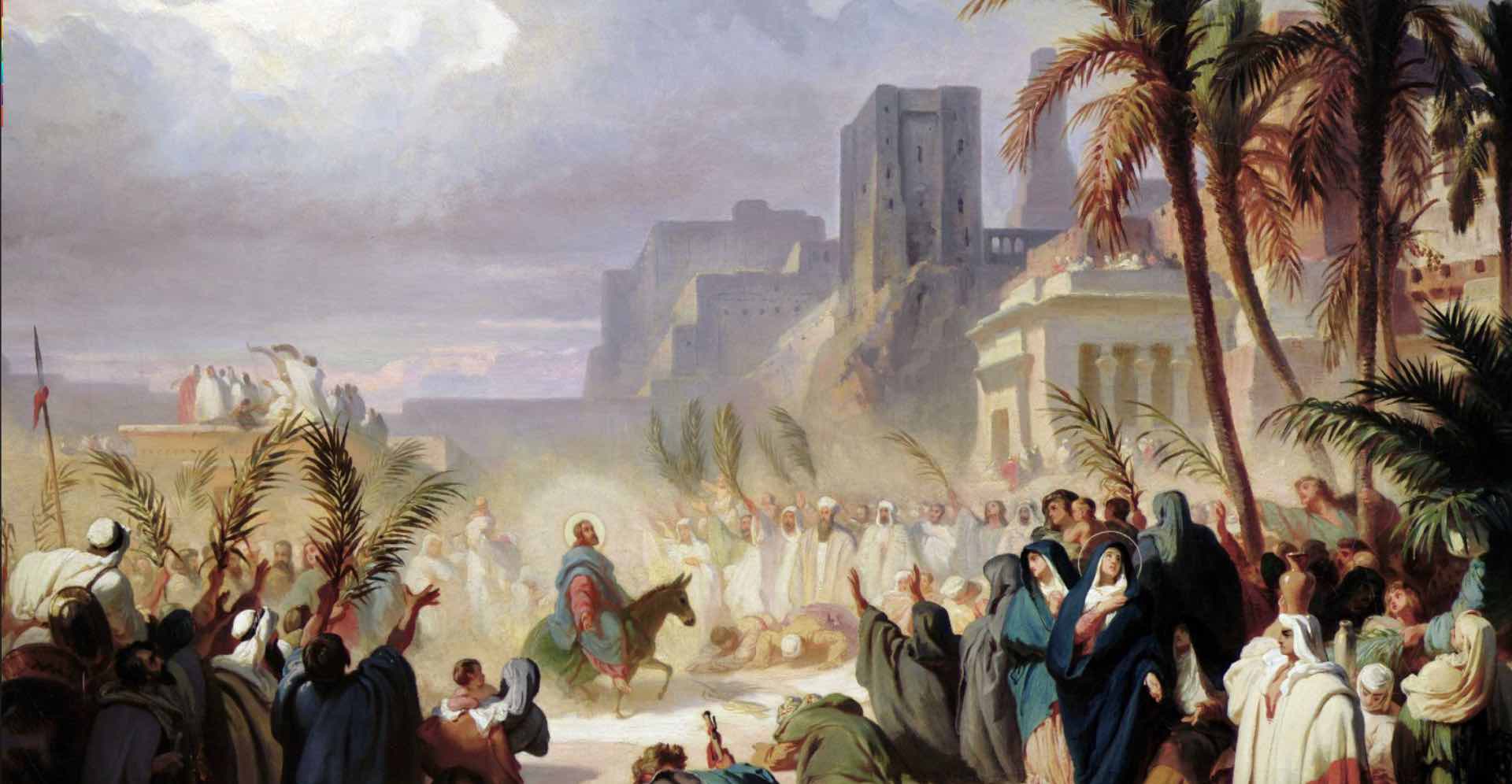
Have Alexander’s entry into Babylon in mind as you consider the entry of Jesus into Jerusalem. On Palm Sunday, the crowds went out to meet Jesus. They waved palm branches and laid them and their cloaks (Mt. 21:7) on the road before Jesus. They cried out, “Hosanna,” which means “Save us now! Blessed is he who comes in the name of the Lord, even the King of Israel!”

They find Jesus sitting – not on a chariot, war horse, camel, or elephant. Jesus sits and rides a donkey – a beast that helped people carry burdens and was used for normal, everyday work. And this fulfilled the prophecy of Zechariah 9:9, “Rejoice greatly, O daughter of Zion! Behold, your king is coming to you; righteous and having salvation is he, humble and mounted on a donkey.”

This entrance of Jesus into Jerusalem is His triumphal entry. But unlike Alexander’s entry, it is humble, lowly, and peaceful. Jesus arrives in Jerusalem as King but not as a normal king. He certainly has power, strength, and glory, but He isn’t intimidating, either to the citizens of His kingdom or to those outside His kingdom. Jesus does not come to demonstrate His might. He comes to demonstrate His love. He comes not to conquer Jerusalem or the world; instead, He comes to conquer your sin and death by His own death on the cross.

Jesus told Pilate, “My kingdom is not of this world” (Jn. 18:36). Jesus is a different kind of king with a different kind of glory. He is a king who has come to die for His subjects – for you. Christ’s glory is to be humble and take the form of a servant. Jesus is a king who is obedient to the point of death, even death on a cross (Php. 2:5-8). And the cross is His triumph. Because Jesus has given Himself unto death for you, God has highly exalted Him and given Him the name above all names. Dear saints, Jesus comes with mercy, and He comes for you. Welcome to Holy Week. Amen.

The peace of God, which surpasses all understanding, will guard your hearts and minds in Christ Jesus. Amen.


[1] This sermon has been adapted from a sermon by Pr. Bryan Wolfmueller.

[2] The account was written by Quintus Certius Rufus and can be found here.

See and Rejoice – Sermon on John 8:42-59 for the Fifth Sunday in Lent

John 8:42-59

42 Jesus said to them, “If God were your Father, you would love me, for I came from God and I am here. I came not of my own accord, but he sent me. 43 Why do you not understand what I say? It is because you cannot bear to hear my word. 44 You are of your father the devil, and your will is to do your father’s desires. He was a murderer from the beginning, and does not stand in the truth, because there is no truth in him. When he lies, he speaks out of his own character, for he is a liar and the father of lies. 45 But because I tell the truth, you do not believe me. 46 Which one of you convicts me of sin? If I tell the truth, why do you not believe me? 47Whoever is of God hears the words of God. The reason why you do not hear them is that you are not of God.”

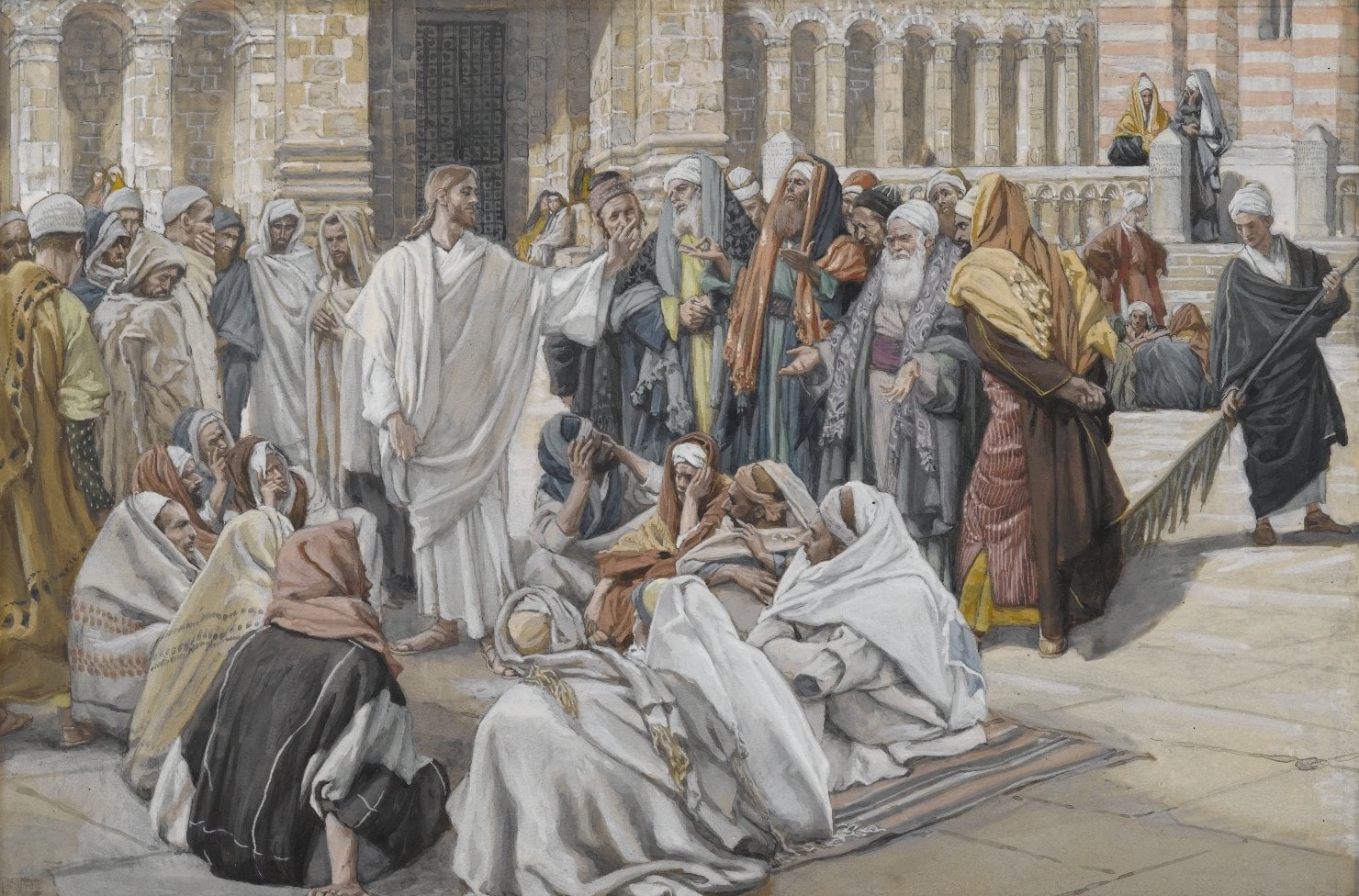
48 The Jews answered him, “Are we not right in saying that you are a Samaritan and have a demon?” 49Jesus answered, “I do not have a demon, but I honor my Father, and you dishonor me. 50 Yet I do not seek my own glory; there is One who seeks it, and he is the judge. 51 Truly, truly, I say to you, if anyone keeps my word, he will never see death.” 52 The Jews said to him, “Now we know that you have a demon! Abraham died, as did the prophets, yet you say, ‘If anyone keeps my word, he will never taste death.’ 53 Are you greater than our father Abraham, who died? And the prophets died! Who do you make yourself out to be?” 54 Jesus answered, “If I glorify myself, my glory is nothing. It is my Father who glorifies me, of whom you say, ‘He is our God.’ 55But you have not known him. I know him. If I were to say that I do not know him, I would be a liar like you, but I do know him and I keep his word. 56 Your father Abraham rejoiced that he would see my day. He saw it and was glad.” 57 So the Jews said to him, “You are not yet fifty years old, and have you seen Abraham?” 58 Jesus said to them, “Truly, truly, I say to you, before Abraham was, I am.” 59 So they picked up stones to throw at him, but Jesus hid himself and went out of the temple.

In the name of Jesus. Amen.

This portion of John is one of the high points of the four Gospels because, here, Jesus pulls back the veil and reveals Himself to be God saying, “Truly, truly, I say to you, before Abraham was, I am.” There is a whole sermon there, but it will have to wait until the next time this text rolls around. Today, we’re going to consider just two sentences from our Lord. The first reveals just how stubborn mankind is in our sin and how desperate we are to believe lies, and the second sets us up for the Scripture readings we are going to be hearing next Sunday and through Holy Week.

In the last half of v. 46, Jesus asks, “If I tell the truth, why do you not believe Me?” That question should startle us – especially because it comes from the lips of our Savior. In our fallen, sinful state, we are willing to reject the truth even when it stares us in the face. When the truth is difficult and hurts us, we would rather live by lies than change course. We have this false idea in our minds where we think that if people are presented with the facts so that the truth is crystal clear, then everybody will agree and everything will be right in the world. But that is false.

Here, Jesus, who is the Truth (Jn. 14:6), speaks the truth to the people in the Temple, but they refuse to believe and are ready to stone Him. No matter how clearly the truth is spoken or how authoritative the speaker of truth is, there are some who will simply reject it and refuse to live in reality.

Sometimes, we think that problems we face are caused by the news channels, social media suppression, or other sources of misinformation. Those things certainly don’t help. But don’t imagine that if someone waived a magic wand and made all those things disappear that, suddenly, everything would be right in the world and everyone would automatically believe the truth. People didn’t believe Jesus when He spoke the truth. And even worse, Jesus was persecuted when He spoke the truth. Dear saints, we should expect the same. In fact, that is exactly what we see today.

The reason people reject truth, especially the truth about God, is that we are by nature children of wrath (Eph. 2:3). Because of our sin, we do not and cannot love God. We cannot come to Him or understand Him. Instead, we naturally run away from Him. But God still desires to bring you back unto Himself. So, God goes out to battle and fights for you. And – it is so important to understand this – when God fights for you, yes, He is fighting against Satan and the demons, against sin and death. But even more importantly, when God fights for you, He is even fighting against you, against your sinful nature and mine.

The texts through Lent have all been about this fight. The first Sunday of Lent, we saw how Jesus fought against the devil in His temptation (Mt. 4:1-11). The second and third Sundays of Lent, we saw how Jesus fought against the demons (Mt. 15:21-28, Lk. 11:14-28). Last week, we saw how Jesus fought against the crowds who wanted Jesus to satisfy all their fleshly desires and make Him a bread king (Jn. 6:1-15). Today, there is an obvious fight between and the crowds as Jesus simply speaks truth and is rejected. The crowds were so adamant in their rejection they are ready to stone Him (Jn. 8:59). And those crowds would have killed Jesus if it had been His time to die, but it wasn’t His time – not yet. But in next week’s Gospel lesson, which will be Matthew’s account of Jesus’ passion (Mt. 26:1-27:66) and then again in the texts for Good Friday, it will be Jesus’ time to die. The same crowds will call for Jesus to be crucified. And there, on the cross, Jesus will fight the final, decisive battle against all the forces of evil.

Lent is about God fighting against evil. When we get to Easter and the Resurrection, we will celebrate Jesus’ victory. With the resurrection, Jesus reveals His victory over all evil, even the evil within you and me. Because of the resurrection, you can know that Christ has snatched you away from the kingdom of darkness and transferred you to His kingdom of light (Eph. 1:13, 1 Pet. 2:9). And as His people, we will celebrate His victory. On Easter, we will rejoice and sing, and our hearts will be glad when we celebrate the resurrection. But what will we do, and how will we react, as we hear Jesus fighting that battle? What will be our response as we see Jesus going to the cross and suffering God’s eternal wrath against our sin?

Some of you have mentioned to me how you don’t like Good Friday and Christ’s crucifixion and would much rather jump straight to Easter and the resurrection. Now, I understand the sentiment. I do. But there is no Easter joy, no resurrection gladness, apart from Good Friday. Easter cannot happen unless Jesus dies first. One of the Sunday school teachers (and I apologize, but don’t remember who it was) mentioned to me in the past couple weeks how one of their students asked why call the day of Jesus’ death ‘Good Friday.’ What is good about that? Well, today Jesus tells us.

Jesus makes a comment in v. 56 of today’s text that helps us know how to approach the texts of Holy Week and how to see His crucifixion. Jesus says, “Your father Abraham rejoiced that he would see My day. He saw it and was glad.” What is Jesus talking about there? Notice, Jesus doesn’t say that Abraham ‘believed in My day and was glad.’ No. Abraham saw it and was glad. Well, Abraham saw Jesus’ day in our Old Testament text (Gen. 22:1-14).

There, when Isaac was spared from being sacrificed, Abraham sees the ram caught in a thicket by its horns. And Abraham doesn’t have to be told anything. Immediately, Abraham takes Isaac off the wood and places the ram in Isaac’s place. Abraham sacrifices the ram instead of Isaac, Abraham’s beloved son. Through that sacrifice, God is visibly showing Abraham what He will do through Jesus, His only-begotten Son. In that text, Abraham saw what God would do in and through Jesus as He goes to the cross in your place. Abraham saw, rejoiced, and was glad.

Dear saints, as we approach the crucifixion and see Jesus’ day of victory over sin, death, the devil, and our own sinful flesh, let us see and rejoice as well. Jesus willingly goes to the cross in your place. There on Mt. Calvary, Christ wins the victory and battle for you. As we approach Holy Week, let us look to Jesus, the founder and perfector of our faith and remember that Scripture says it was “for the joy,” the joy, “that was set before Him, He endured the cross” (Heb. 12:2) for Abraham, for Isaac, for you, and for all sinners.

Dear saints, on the cross your Savior has won the battle. Christ has shed His blood and with that blood, He now cleanses your conscience from dead works to serve the living God. Come now and receive the Body and Blood of your Savior who brings you into the new covenant and to your promised, eternal inheritance (Heb. 9:14-15). Amen.

The peace of God, which surpasses all understanding, will guard your hearts and minds in Christ Jesus. Amen.
Leftovers – Sermon on John 6:1-15 for the Fourth Sunday in Lent

John 6:1-15

1 After this Jesus went away to the other side of the Sea of Galilee, which is the Sea of Tiberias. 2 And a large crowd was following him, because they saw the signs that he was doing on the sick. 3 Jesus went up on the mountain, and there he sat down with his disciples. 4 Now the Passover, the feast of the Jews, was at hand. 

5 Lifting up his eyes, then, and seeing that a large crowd was coming toward him, Jesus said to Philip, “Where are we to buy bread, so that these people may eat?” 6 He said this to test him, for he himself knew what he would do. 7 Philip answered him, “Two hundred denarii worth of bread would not be enough for each of them to get a little.” 8 One of his disciples, Andrew, Simon Peter’s brother, said to him, 9 “There is a boy here who has five barley loaves and two fish, but what are they for so many?” 10 Jesus said, “Have the people sit down.” Now there was much grass in the place. So the men sat down, about five thousand in number. 11Jesus then took the loaves, and when he had given thanks, he distributed them to those who were seated. So also the fish, as much as they wanted. 12 And when they had eaten their fill, he told his disciples, “Gather up the leftover fragments, that nothing may be lost.” 13 So they gathered them up and filled twelve baskets with fragments from the five barley loaves left by those who had eaten. 14 When the people saw the sign that he had done, they said, “This is indeed the Prophet who is to come into the world!” 

15 Perceiving then that they were about to come and take him by force to make him king, Jesus withdrew again to the mountain by himself.

In the name of Jesus. Amen.

Dear saints, your God isn’t stingy. He provides everything you need spiritually and physically out of the abundance of His mercy. Here in the wilderness, Jesus feeds 5,000 men plus women and children (possibly ten to twenty thousand people total) with five loaves of bread and two fish. And this text shows how Jesus is the Shepherd described in Psalm 23. 

Jesus sees this massive crowd coming toward Him. The gospel of Mark tells us that Jesus had compassion on them because they were like sheep without a shepherd, and Jesus restores their souls by teaching them many things (Mk. 6:34). But it looks like there is going to be a whole lotta want from this flock because Jesus’ sermon has gone long. The disciples get antsy and ask Jesus to send the crowd home because they are going to need to eat (Mk. 6:35-36).

But with Jesus as their Shepherd, so there will be no want. Jesus asks Philip, “Where are we going to buy bread, so that these people may eat?” Even today, feeding a crowd this size is a monumental task. We are blessed with farmers that can produce massive amounts of food. Trucks, trains, and railroads can transport goods measured in tons. Most stores still have ample supplies of bread, meat, cheese, and all sorts of goodies, but how many stores would you have to buy out to feed this many people? Plus, the people in Jesus’ day didn’t have all these luxuries, and because this crowd is out in the wilderness, the task is even more impossible. But, again, Jesus is the Shepherd, so this flock will have no want.

A young boy is there, and gives his little snack to Jesus. Our translation records Jesus saying, “Have the people sit down,” but it’s a bit more forceful than that, and sounds more like Psalm 23. Literally, Jesus tells the disciples, “Make the people sit down.” And where do these people sit down? In the green grass. And Jesus prepares a table for His flock. Jesus takes the bread and the fish, gives thanks, and distributes the food to the people as the disciples wait on them (Mk. 6:41).

None of the Gospels say anything about what the crowd drank, but their plates certainly ran over. And everyone eats their fill. Not only that, but while everyone is unbuckling their belts, Jesus sends the disciples out again with doggie bags. They gather up the leftovers and return with twelve baskets full. There is more food in the end than there was in the beginning.

We should remember that in this feeding of the 5,000, Jesus does what He had already been doing and is always doing everywhere throughout the entire world – providing food. Every day, Jesus feeds the billions of people throughout the world and throughout history (Ps. 104:27-28). The only difference here is that Jesus does it differently than He normally does. Of course, feeding this massive crowd with five loaves and two fish is a miracle and reveals that Jesus is God in the flesh. But don’t lose sight of the fact that the food you ate yesterday was also a gracious gift of God miraculously provided for you. You have just gotten used to God feeding you through your paycheck or your parents, then through a restaurant or grocery store, your fridge, and your stove.

Now, let’s reflect on this a little bit. I am tempted (and I suspect you are tempted as well, so I’ll lump you in with myself) we are tempted to divide our life into two parts – the spiritual part and the physical part. And the temptation goes like this: Jesus takes care of the spiritual part – the forgiveness and the eternal life part. But we’re tempted to think that we have to care of the physical part – the working and earning a living part, the eating part, the caring for family and friends part. We think, “Sure, I need mercy and grace for the spiritual part, but I need works and effort for the physical part.” But the result of this makes us live like atheists who don’t believe in God. We end up living as though God isn’t involved in giving us our daily bread. We wrongly think that our food is only the result of creation – soil, seeds, sun, water, etc. But that’s not true. God provides forgiveness and eternal life, but God also provides strength, work, money, bread, and physical life. Because Jesus is Lord of heaven and earth, He gives us what we need for the life to come, and He gives us what we need for this life.

It is true that the way God provides for us spiritually is different than how He provides for us physically. Salvation comes down from heaven, and bread comes up from the earth. But God is behind both. And in this Gospel text, and our Old Testament text (Ex. 16:2-21), God reminds us that He sometimes rains bread from heaven. Sometimes five loaves feed 5,000 men plus women and children. 

And notice how Jesus provided what His flock needed in this life. He used the little snack that the boy gave to provide for His sheep. Jesus wouldn’t have needed this boy’s food to feed the crowd. But He did use it, and Jesus used it to do more than was expected. Again, there were leftovers. As the crowd unbuckles their belts, Jesus sends the disciples out a second time saying, “Gather up the leftover fragments.” Christ here isn’t worried about waste. If He was worried about waste, Jesus wouldn’t have even given as much as everyone wanted, let alone enough for everyone to totally stuff their bellies. Jesus could have provided only what was needed.

But Jesus says, “Gather up the leftover fragments, that nothing may perish.” Our translation says ‘lost,’ but it is the same word Jesus uses in Jn. 3:16. In God’s infinite love, He sent His only-begotten Son so that whoever believes in Him should not ‘perish’ (same word) but have everlasting life. In other words, every last bit of what this boy gives and Jesus’ multiplication of it is used by Jesus. Even the leftovers are useful for further provision in Christ’s kingdom. Nothing of the boy’s gift or Jesus’ multiplication of it perishes.

Dear saints, the same is still true today. Because you belong to Jesus, because you have been redeemed by His death and resurrection, everything you do is used by Jesus to further His kingdom. We are always tempted to minimize what we do in our God-given callings and vocations as though it doesn’t matter or is insignificant. But it isn’t. Don’t minimize what you do as God’s children. Don’t ever think, “Well, I’m just changing a diaper when I could be doing something more spiritually significant,” or, “God doesn’t care how I empty the dishwasher or fold the laundry,” or, “What I put in the offering plate doesn’t help as much as what so-and-so puts in because they can put in a lot more.” That simply isn’t true!

Everything you do and everything you give is used by God. Jesus makes sure none of your works or gifts perish, Christian. God takes what you do, multiplies it, and uses it for the good of your neighbor and for His kingdom. Nothing you do, Christian, will ever perish because it is holy work rendered to your neighbor in service to God. No leftovers end up in the trash. All of it is used by Jesus. Amen.

The peace of God, which surpasses all understanding, will guard your hearts and minds in Christ Jesus. Amen.

Disturbing the Peace – Sermon on Luke 11:14-28 for the Third Sunday in Lent

Luke 11:14-28

14 Now he was casting out a demon that was mute. When the demon had gone out, the mute man spoke, and the people marveled. 15 But some of them said, “He casts out demons by Beelzebul, the prince of demons,” 16 while others, to test him, kept seeking from him a sign from heaven. 17 But he, knowing their thoughts, said to them, “Every kingdom divided against itself is laid waste, and a divided household falls. 18And if Satan also is divided against himself, how will his kingdom stand? For you say that I cast out demons by Beelzebul. 19 And if I cast out demons by Beelzebul, by whom do your sons cast them out? Therefore they will be your judges. 20 But if it is by the finger of God that I cast out demons, then the kingdom of God has come upon you. 21 When a strong man, fully armed, guards his own palace, his goods are safe; 22 but when one stronger than he attacks him and overcomes him, he takes away his armor in which he trusted and divides his spoil. 23 Whoever is not with me is against me, and whoever does not gather with me scatters.

24 “When the unclean spirit has gone out of a person, it passes through waterless places seeking rest, and finding none it says, ‘I will return to my house from which I came.’ 25 And when it comes, it finds the house swept and put in order. 26 Then it goes and brings seven other spirits more evil than itself, and they enter and dwell there. And the last state of that person is worse than the first.”

27 As he said these things, a woman in the crowd raised her voice and said to him, “Blessed is the womb that bore you, and the breasts at which you nursed!” 28 But he said, “Blessed rather are those who hear the word of God and keep it!”

In the name of Jesus. Amen.

This text is so full and rich, I could easily preach 847 sermons on it, but you’re only going to get one today. To some of you, “Sorry,” and to the rest of you, “You’re welcome.” Today, we’re mainly going to focus on the little parable that Jesus tells in v. 21-22 and then carry what we learn there to the blessing that Jesus gives to you in v. 28. But to do that, let’s quickly highlight a few things from the opening of the reading to get the context.

Jesus has cast out a demon that made a man mute. Some of the people marvel at this exorcism, but some (Mt. 12:24 tells us that they are Pharisees) say that it is only by the power of Beelzebul, which was a name for the devil, that Jesus can do this. Earlier this week, Anna asked me what text I was going to be preaching on I summarized the text. When I told her about the Pharisees’ accusation that Jesus was casting out demons by the power of demons, she said, “That’s so dumb.” Yup. And Jesus addresses the absurdity (v. 17-20). Then, He says something very important to set up the parable. “If it is by the finger of God that I cast out demons, then the kingdom of God has come upon you.” The grammar there makes it clear that Jesus says that it is, indeed, by God’s finger that He casts out demons which means that the kingdom of God has arrived. Christ the King is bringing the kingdom of God with Him as He throws out the demons He has defeated. Then, Jesus tells everyone what is going with this little parable.

“When a strong man, fully armed, guards his own palace, his goods are safe; but when one stronger than [the strong man] attacks him and overcomes him, he takes away his armor in which he trusted and divides the spoil.” Let’s dissect this. The strong man with all his armor is the devil, the palace that the devil is guarding is the entire world which is under his power, and the goods that he is guarding are all sinners. Until Christ claims us as His own, we were under the rulership of Satan and the demons. Col. 1:16 says, “[God] has delivered us from the domain of darkness and transferred us to the kingdom of his beloved Son.”

Now, please don’t misunderstand this. Typically, when we think of people demons influencing people, scenes from the movie The Exorcist come to our minds. We do see that a few times in the Gospels. In this text, the demon makes the man mute. In Mt. 17:14-15, there is a demon-possessed boy who is repeatedly thrown into fire and water. Or the man who was possessed by the demon, Legion, who lived among tombs and could not be bound (Mk. 5:2-5). But that type of extreme demonic possession is extremely rare in Scripture; in fact, it never happens in the entire Old Testament. We only see it a few times in the Gospels and a couple of times in the book of Acts (16:16-18, 19:15-16). Most of the time, the Bible links what we think of as common illness with unclean spirits (Mt. 4:24, 8:16, 10:1; Mk. 1:32-34, 6:13; Lk. 9:1; Act. 5:16, 19:12). I’ve got a whole slew of references for that, and if you’re interested, just ask me after the service.

So yes, this extreme demonic possession does happen, but it is rare. What we do regularly see, throughout Scripture, is demonic influence and temptations. Just think of Job. When the devil went after Job, it was manifest with loss of property, children, and health. Because Job’s friends and wife only see that and can’t see that the devil is behind all of this, they wrongly think that Job has some secret sin that he must confess and repent. But they’re just plain wrong.

So, for you Christians here today, remember demons are real, and they do pester us trying to get us to fall into unbelief. But normally, they do so with things that disguise their evil intent. But Scripture helps us see through their disguise. It is right to recognize that the pandemic, the divisions in our families and country, and the wars and rumors of wars[1] are all demonic. And it is right to see every stolen car; every case of cancer; and every addiction, struggle, temptation, and fear we have as a demonic attack. Recognizing this will help us do two things. One, it will drive us to prayer, and two, it will help us to have sympathy and patience when others wrong us instead of hating them.

Now, the eeriest part of this little parable is the condition of those who are guarded by the devil. Our translation reads, “his goods are safe,” which makes it sound like Jesus is saying there that the devil’s very powerful in his armor and palace. But that isn’t what Jesus is highlighting with that phrase. What Jesus says there is literally, “his goods are in peace.” The picture is that those under the control of the devil are content, safely tucked away, and quietly and lying there with no desire to leave the devil’s palace. Those who are under the control of the devil and his demons have grown so accustomed to being under his watchful eye with his strong armor that they don’t like it when they see Jesus, the stronger man, stripping the devil of all his protection and leaving him in nothing but his underwear. Those under the guardianship of Satan don’t like seeing their fellow goods are being plundered and taken away.

But, dear saints, here is the good news: Christ has come to disturb the evil, demonic peace of Satan’s kingdom. In fact, the devil has been dealt a fatal blow; his head has been crushed by Jesus, the promised Seed of Eve (Gen. 3:15). And as the days get more and more evil, that evil is a sign of Christ’s victory over all the forces of darkness. The kingdom and domain of Satan is chaotic today precisely because Christ come bringing the kingdom of God with Him. The kingdom of God disrupts the peace of the devil’s goods and brings true peace. What the crowd was witnessing in this text – and, quite frankly, what we are witnessing today – is not some demons fighting against other demons trying to see who is the strongest. Instead, we are witnessing Satan being unseated. Jesus is the stronger man who flicks away the demons with His finger and brings God’s true peace.

Dear saints, the battle is won. You are the prize, the treasure, and the spoil. Christ has come and given His life for you. His blood covers you and cleanses you as a bride adorned for her husband (Eph. 5:25-27, Rev. 21:2). The war has been won by the Word of God. The Word of God speaks you righteous and clean, which brings us to that final verse.

Jesus says, “Blessed are those who hear the Word of God and keep it.” We know what it is to hear God’s Word, but what does it mean to ‘keep’ it? A lot of times, we think to ‘keep’ God’s Word is equivalent to obeying it. Yes, of course, we absolutely should obey God’s commands. But the devil wants you to think that only those who perfectly keep God’s commands are blessed so you think this blessing of Jesus isn’t for you. In other words, Satan wants to steal this blessing from you and make you think it doesn’t really apply to you. But the devil is a liar.

The word that Jesus uses here for ‘keep’ is the exact same word Jesus used to describe what the strong man did with his goods in v. 21 – he ‘guarded’ and protected them. Jesus’ blessing reads like this, “Blessed are those who hear the Word of God and guard it.”

Dear saints, Jesus calls you to a life of faith which wars against the demons by guarding the promises God has spoken to you. So, hear God’s Word and guard it, hold on to it, and treasure it. That is precisely what you are doing now. As you sit there listening to this sermon, you are engaging in spiritual warfare, and the devil is losing. So, keep listening, keep learning, keep repenting, believing, and trusting that God is good and that He loves you and has bought and won you through Christ’s death and resurrection because He has.

The spiritual warfare you are called to is made up of the little things of hearing God’s Word, coming to church, attending Bible study, talking with your children about God, and praying. In these quiet, simple things, the devil is stripped of his armor and his goods are plundered. By hearing and guarding God’s Word, you set up a barrier and sanctuary for yourself and your children. When you hear and guard God’s Word, you are engaging the enemy and reinforcing the defenses of the saints.

It doesn’t matter how strong the forces of evil appear to be. They have lost. Jesus has come bringing His kingdom with Him. Christ flicks away the demons like flies. Their demonic peace has been disturbed by Jesus. And He has freely given you true, eternal, abiding, and everlasting peace. Amen.

The peace of God, which surpasses all understanding, will guard your hearts and minds in Christ Jesus. Amen.


[1] The wars and rumors of wars are demonic even though they are signs that Jesus gives us to be looking for His return (Mt. 24:6, Mk. 13:7) and should cause us to raise up our heads because it means our redemption is drawing near (Lk. 21:28).

When Prayer Gets Violent – Sermon on Matthew 15:21-28 for the Second Sunday in Lent

Matthew 15:21-28

21 And Jesus went away from there and withdrew to the district of Tyre and Sidon. 22 And behold, a Canaanite woman from that region came out and was crying, “Have mercy on me, O Lord, Son of David; my daughter is severely oppressed by a demon.” 23 But he did not answer her a word. And his disciples came and begged him, saying, “Send her away, for she is crying out after us.” 24 He answered, “I was sent only to the lost sheep of the house of Israel.” 25 But she came and knelt before him, saying, “Lord, help me.” 26 And he answered, “It is not right to take the children’s bread and throw it to the dogs.” 27 She said, “Yes, Lord, yet even the dogs eat the crumbs that fall from their masters’ table.” 28 Then Jesus answered her, “O woman, great is your faith! Be it done for you as you desire.” And her daughter was healed instantly.

In the name of Jesus. Amen.

In our Old Testament lesson today (Gen. 32:22-32), you heard how Jacob wrestled with God. Jacob was already tired and under a lot of stress. He was returning home after living with and working for his father-in-law for a couple decades, and he was approaching his brother Esau who had sworn to kill Jacob for taking his birthright and blessing (Gen. 27:41-42). The night before Jacob and Esau met, God came down to Jacob, and they wrestled mano a mano. Once the dust from their scuffle settled, God blessed Jacob and gave him a new name. Now, Jacob is known as ‘Israel’ which means ‘God strives.’

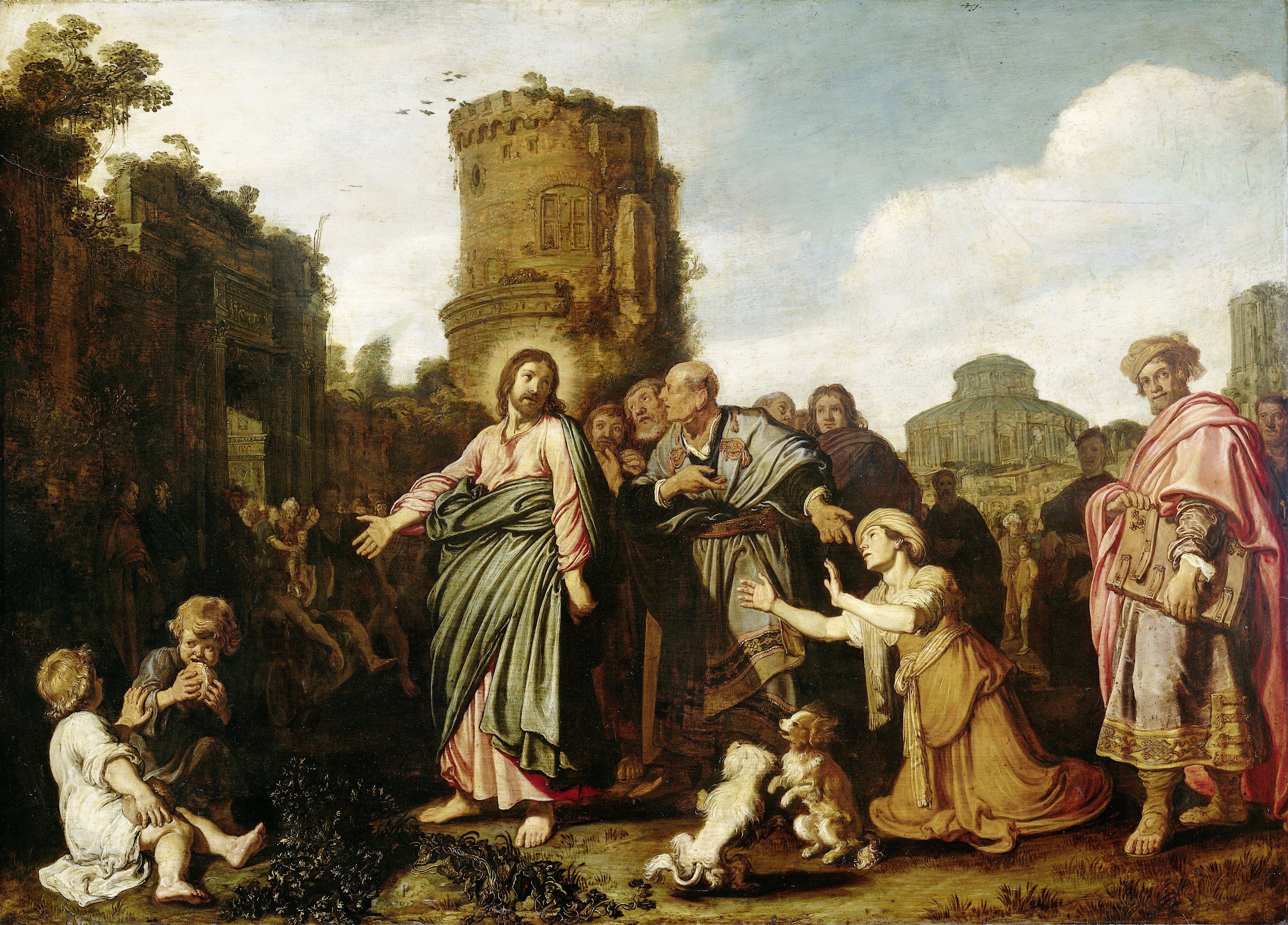
That text is a fantastic set-up for this Gospel lesson. Here, God has again descended, and Jesus wrestles with one of His creatures who, like Jacob, is already tired and afraid. This time, God’s opponent is a woman; she is a foreigner; and she is a pagan. Three strikes, so she should be out. But she approaches Jesus in great need. She comes boldly, and her prayer is violent. It doesn’t sound so violent in our translation. We heard that she is ‘crying out,’ but the Greek word there conveys the shrieking of a raven. We heard that she ‘knelt’ before Jesus, but the Greek word there is more along the lines of flung – she flung herself at Jesus feet.

Notice how she addresses Jesus with two titles: ‘Lord’ and ‘Son of David.’ In the Gospel of Matthew, only disciples address Jesus as ‘Lord.’ And she refers to Jesus as only an Israelite would with the kingly title, ‘Son of David.’ And her request isn’t for herself. Her little daughter is severely oppressed by a demon. So, her prayer checks all the right boxes. Jesus is the Lord and King. And He has come to destroy the works of the devil (1 Jn. 3:8). But Jesus acts in a way that can make us Christians feel a bit awkward.

Christ first ignores her. The disciples start praying against her and beg Jesus to send her away. Then, Jesus says, “I was sent only to the lost sheep of the house of Israel.” And when she flings herself into the dust before Jesus’ feet with a last gasp prayer, “Lord, help me,” Jesus calls her a dog. This isn’t the Jesus we are used to hearing about in the Gospels, the one who welcomes the lowly and despised, the one who heals, the one who casts out all sorts of demons.

But even though Jesus has her in a submission hold (figuratively speaking), this woman has one last punch to throw at Jesus to win this fight, and it’s a haymaker. Yes, Jesus has called her a dog, but she takes the insult. She says, in effect, “Yes Lord, I am a dog. I don’t belong or have any right to sit at Your table. I don’t deserve the bread that You feed to Your children. But if You call me a dog, I’ll be your dog. And I’ll be content with nothing more than what the dogs get. The crumbs from Your table are enough for me.”

After that statement, Jesus taps out, “O woman, great is your faith!” This is one of two times in the Gospels that Jesus praises someone’s faith (Mt. 8:5-13 is the other). “Be it done for you as you desire.” And her daughter was healed instantly.

This wrestling match between Jesus and the Canaanite woman reminds me of the parable of the unrighteous judge that Jesus tells in Lk. 18:1-6. In that parable, a woman repeatedly asks an unjust judge for justice. The judge just ignores her, but the woman keeps crying out for justice. Finally, the judge gives her what she wants because, according to the judge, the woman is beating him down with her continual requests. Luke tells us that Jesus told that parable to encourage His disciples to be persistent in their prayers because God is just and will not delay in answering.

There is no question, Jesus heard every one of this Canaanite woman’s prayers. Christ loved this woman and her daughter and had come to set them free from the oppression of demons. So, why did it take so long for Jesus to give her what she wanted, and why did He treat her like this? I think the only safe answer to those questions is, “I don’t know.” God’s ways are not our ways (Is. 55:8-9). But we can say this because Scripture clearly teaches it:

By delaying His answer to her prayer, Jesus purifies this woman’s faith. James 1:2-3 says, “Count it all joy, my brothers, when you meet trials of various kinds, for you know that the testing of your faith produces steadfastness.” And our Epistle Lesson today (Ro. 5:1-5) says that we can rejoice in our suffering because suffering produces endurance, and endurance produces character, and character produces hope. Jesus knows how much heat this woman can take, and she comes out the other side with a stronger faith than what she had before this violent wrestling match of prayer.

There is no question that Jesus sent trial after trial to this woman. But that is what makes her faith so beautiful. Rather than turning her back on Jesus for being a jerk, her roots sink in deeper. She knows there is no other help for her and her daughter. So, here is the real question. Can you trust God when, to all appearances, He ignores you? Can you trust God when the wicked prosper, when the world is falling apart, and when your loved ones die too early? Will you trust Him when He doesn’t do what you ask? Faith trusts in God even when it is contrary to experience and our fallen reason.

The greatness of the woman’s faith wasn’t in her confidence or certainty. Its greatness was in its weakness. Her faith was great not when she was crying, “Son of David have mercy on me,” but it was great when she says, “Yes, Lord. I am Your dog.” It was great then because it only wanted what He gave.

In your walk of faith, remember that God doesn’t keep every promise you can imagine. But He has, does, and will keep every promise He has made. When it appears – and please note, I said, appears – that God isn’t listening to your prayers and seems to be sending you away, have the ingenuity of this woman. When God tells you, “You are lost,” you can take God at His Word and cry to Him, “Yes, God. I’m lost; find me.” When God says, “You’re a sinner,” say, “Yes, God. I’m a sinner; save me.” When God says, “You’re dead,” cry to Him “Yes, raise me.”

Finally, don’t give up on your prayers. Keep wrestling in them. You can’t hurt God by getting too violent with your prayer. Jesus wants you, like this woman did, to continue bringing your requests to Him. Jesus says, “Ask, and it will be given to you; seek, and you will find; knock, and it will be opened to you” (Mt. 7:7). So, keep asking; keep seeking; keep knocking. God will answer in the best way and at the exact right time.

Dear saints, you can be bold in your prayers because Christ has come and restored peace between you and God; you now stand in God’s grace (Ro. 5:2). He will remember His mercy and steadfast love, and He will redeem you out of all your troubles (Ps. 25:6, 22). Amen.

The peace of God, which surpasses all understanding, will guard your hearts and minds in Christ Jesus. Amen.

The Umbrella – Sermon on Matthew 4:1-11 for the First Sunday in Lent

Matthew 4:1-11

1 Then Jesus was led up by the Spirit into the wilderness to be tempted by the devil. 2 And after fasting forty days and forty nights, he was hungry. 3 And the tempter came and said to him, “If you are the Son of God, command these stones to become loaves of bread.” 4 But he answered, “It is written,

“‘Man shall not live by bread alone, 
but by every word that comes from the mouth of God.’”

5 Then the devil took him to the holy city and set him on the pinnacle of the temple 6 and said to him, “If you are the Son of God, throw yourself down, for it is written, 

“‘He will command his angels concerning you,’ 

and 

“‘On their hands they will bear you up, 
lest you strike your foot against a stone.’” 

7 Jesus said to him, “Again it is written, ‘You shall not put the Lord your God to the test.’”

8 Again, the devil took him to a very high mountain and showed him all the kingdoms of the world and their glory. 9 And he said to him, “All these I will give you, if you will fall down and worship me.” 10 Then Jesus said to him, “Be gone, Satan! For it is written,

“‘You shall worship the Lord your God 
and him only shall you serve.’”

11 Then the devil left him, and behold, angels came and were ministering to him.

In the name of Jesus. Amen.

Generally, there are two ways to approach preaching a sermon on Jesus’ temptation. The first is to point out the tactics that Jesus used to resist temptation and encourage the hearers to employ those same tactics because we are to fight and resist temptations (Jam. 1:144:7). Those sermons can make you much more prepared than Eve was in our Old Testament lesson (Gen. 3:1-21) when the devil came asking, “Did God really say?” Preaching Jesus’ temptation that way is helpful, beneficial, and Scriptural, and I’ve taken that approach several times in the past. 

That being said, those sermons are mostly oriented toward the Law and have the potential to be dangerous. They can leave you only hearing, “Jesus is your example. Here, use the same strategies and maneuvers that Jesus used. And if you follow this plan when you face temptation, you can resist sin like Jesus.”

But when – not ‘if’ but ‘when’ – you fail and fall into sin, it can be extremely discouraging. If you only hear sermons about how Jesus is your example, it can leave you thinking that the Bible is simply a self-help book. And when your life doesn’t get better, you can start to think that the Bible isn’t really all that helpful. The devil can take sermons like that and place all your sins and failures and in front of you to tempt you into abandoning the Word of God completely. So, I’m not taking that approach today. Maybe I will the next time, but not today.

Today, I’m taking the second common approach of preaching on Jesus’ temptation which is to see that Jesus is resisting temptation for you. He is doing for you what you cannot and could not do. As Christ resists and fights against the devil, He is trusting in God where you have not. And because Jesus has done all of this for you, God credits Jesus’ victory over sin and temptation to your account through faith.

To get a better understanding of this we need to see that these are real temptations for Jesus. Honestly, these temptations don’t sound all that difficult to us. Turning rocks into food, jumping off a building without a bungee cord or parachute, and bowing down at Satan’s feet are not the temptations you and I face. But the reason each of these temptations is difficult for Jesus is that in each of them the devil is tempting Jesus to abandon His mission to be your Savior. To get at this, we’ll need an analogy:

Imagine that the Ten Commandments are a giant umbrella, and God by creating you has put you under that umbrella of His Law. You and I and all humanity live under the Law, and we don’t have a choice of getting out from under it. That is not an option. The Law is always there directing, instructing, and accusing us because we are sinners.

Now, God isn’t under that umbrella of the Law. God is outside and above the Law. Whether you like it or not, God isn’t subject to the Commandments. He can’t be. Consider the 4th Commandment, “Honor thy father and thy mother.” How is God going to keep that Command? He doesn’t have a father or mother or any authorities above Him to honor. Or consider the 7th Commandment, “Thou shalt not steal,” and the 9th and 10thCommandments about coveting. God created all things, so He already owns all things. He can’t steal or covet anything because everything is His already. So, we live under the umbrella of the Law, and God doesn’t.

But when God saw your pitiful condition under the Law and how it always accuses you, He desired to save you, the only way to do that was for Him to come next to you under the umbrella. Jesus came in the flesh to live under the Commandments next to you. This is the picture we are given in Gal. 4:4-5a, “When the fullness of time had come, God sent forth His Son, burn of a woman, born under the Law to redeem [you] who were under the Law.” You see this?

So, when Satan initially comes to tempt Jesus here, he doesn’t tempt our Lord the same way he tempts us. The devil tempts us to break specific commandments – to disrespect those who have authority over us and break the 4th Commandment, to hate and harm our neighbor and break the 5th, to lust and break the 6th, to lie and break the 8th, and so on. But none of the temptations that the devil throws at Jesus here would lead Jesus to break one of the Commandments. Satan is doing something different here.

In each of these temptations, the devil is tempting Jesus to come out from under the umbrella of the Law. Basically, each of these temptations is Satan, that worm, saying to Jesus, “You created the umbrella! You don’t belong under the Commandments. Leave the people under there, they deserve it. They’ve earned all the punishment they get under there.”

Now with that picture in our minds, let’s consider each of the temptations. If you had gone forty days without eating, the devil would tempt you by simply putting some food in front of you. But when the devil tempts Jesus here, he doesn’t put food in front of our Lord; instead, he points to a pile of rocks. That wouldn’t be tempting for you or me, but this temptation is uniquely tailored for Christ. Jesus has the power, ability, and authority to change those stones into bread. He is God after all, so those stones are His creation. If He wanted to turn them into bread, He had every right to do so. But Jesus doesn’t. He responds by quoting Dt. 8:3, “Man shall not live by bread alone, but by every word that comes from the mouth of God.”

What that passage means is that we humans must trust that God will provide our food at the proper time (Ps. 145:15). So, this temptation to turn rocks into bread is the devil saying to Jesus, “You don’t have to wait for God to give You bread. Only the sons of Adam and daughters of Eve have to wait for God to feed them.” And the devil was right. Jesus didn’t have to wait. Because Jesus is God, if He had turned those stones into bread, God would have been providing. But because Jesus is your substitute and has willingly come next to you under the umbrella, He does wait. He waits for His heavenly Father to provide food. He chooses to be patient because you and I have to be patient and wait for food to come from our heavenly Father. So, by resisting this temptation, Jesus stays with you under the umbrella.

In the second temptation, Jesus is taken to the top of the Temple and is told to jump off. This temptation sounds really strange to us because I doubt you have ever been tempted to jump off the roof of the Alerus or the Ralph. How is this tempting? It wouldn’t be for you or me, but it is for Jesus. If Jesus had jumped off the pinnacle of the Temple, which was a very public place, people would see the angels catch Him, and they would know that He was God. Jesus could get all the glory, worship, and praise that is His due as God.

But Jesus’ glory doesn’t mainly come from doing amazing things. His main glory is staying with you under the umbrella and going to the cross to be your Savior. Just before He was arrested, Jesus began His high priestly prayer, “Father, the hour has come; glorify Your Son” (Jn. 17:1). Again, the devil’s temptation here is to get Jesus to come out of the umbrella and get the glory that Jesus rightly deserves. But Jesus won’t do it. He remains with you under the umbrella because it is much more glorious to be the Savior of mankind than to be a miracle-worker.

Finally, in the third temptation, the devil takes Jesus to a high mountain, shows Him all the kingdoms of the world, and says, “I’ll give You all this if You bow down and worship me.” Remember, Jesus had come to win all the kingdoms of the world for Himself. At the very end of the Gospel of Matthew, Jesus says, “All authority in heaven and on earth has been given to Me” (Mt. 28:18). In this temptation, the devil is saying, “I can give You the kingdoms of the world right now.”

But Jesus won’t do it. Again, He stays under the umbrella. Yes, Jesus has come to reclaim the kingdoms of the world, but only after He has redeemed you by shedding His blood and dying and rising again for you.

Dear saints, Jesus has resisted temptation for you. And we know Jesus faced more temptations than these three. When Luke records Jesus’ temptation, he ends it by saying, “The devil departed from Jesus until an opportune time” (Lk. 4:13). Jesus can sympathize with your weakness because He has been tempted in every way that you are but without sin (Heb. 4:15).

One more thing about Christ’s temptation today. Notice, that Jesus was led by the Holy Spirit into the wilderness in order to be tempted by the devil (v. 1). You can take comfort in the fact that the Holy Spirit will never ever lead you into temptation because Scripture promises (Jam. 1:13). But beyond that, you can know that by facing these temptations for you, Jesus is totally and completely determined and committed to be your Savior. He did not and will not ever come out of the umbrella with you. His desire is to give you His mercy. He has brought that mercy, grace, and forgiveness to you who live under the umbrella.

So today, right now, and always You can draw near to His throne of grace with complete confidence. Because at His throne of grace you will always find His mercy and grace to help in every time of need (Heb. 4:16). Amen.

The peace of God, which surpasses all understanding, will guard your hearts and minds in Christ Jesus. Amen.
Agape – Sermon on 1 Corinthians 13:1-13 for Quinquagesima Sunday

1 Corinthians 13:1-13

1 If I speak in the tongues of men and of angels, but have not love, I am a noisy gong or a clanging cymbal. 2 And if I have prophetic powers, and understand all mysteries and all knowledge, and if I have all faith, so as to remove mountains, but have not love, I am nothing. 3 If I give away all I have, and if I deliver up my body to be burned, but have not love, I gain nothing.

4 Love is patient and kind; love does not envy or boast; it is not arrogant 5 or rude. It does not insist on its own way; it is not irritable or resentful; 6 it does not rejoice at wrongdoing, but rejoices with the truth. 7 Love bears all things, believes all things, hopes all things, endures all things.

8 Love never ends. As for prophecies, they will pass away; as for tongues, they will cease; as for knowledge, it will pass away. 9 For we know in part and we prophesy in part, 10 but when the perfect comes, the partial will pass away. 11 When I was a child, I spoke like a child, I thought like a child, I reasoned like a child. When I became a man, I gave up childish ways. 12 For now we see in a mirror dimly, but then face to face. Now I know in part; then I shall know fully, even as I have been fully known. 13 So now faith, hope, and love abide, these three; but the greatest of these is love.

In the name of Jesus. Amen.

We use the word ‘love’ to describe our attitude towards all sorts of things. You will say that you love your spouse, kids, and parents, but you also might also say that you love your dog, watching a TV show, and taking naps. For example, I love my wife, Sarah; I love my mom; and I love eating my mom’s lasagna. But those loves are not all the same, and they shouldn’t be.

In Greek, there are four different words for love. I would highly recommend a book by C. S. Lewis called The Four Loves which helps to distinguish between these four kinds of love. Today, I’ll just briefly describe each of them. And if you’re interested in learning more, read Lewis.

The first Greek word for love is storge. Probably the best English word we have for this is ‘affection.’ Storge is the most basic kind of love, but just because it is basic, don’t think that it is unimportant. Storge is the enjoyment of someone or something. Storge is the love you have for your fish and your car. Lewis rightly says that storge is the jacket that clothes the other loves.

The second Greek word for love is phileo. This is the love that is present in friendship. Phileo binds two people together but in a way that is outside of each of them. It has a focus on a common goal or interest that both individuals share. You can have storge for your friend and enjoy him/her, and you can share phileo with that friend as well as you two pursue that common goal or interest.

The third Greek word for love is eros which is romantic love between a husband and wife. Unlike phileo,which is fueled by common interests or goals that are outside of the individuals, eros is directed at the other person. Eros can truthfully say, “It’s better to be miserable with him/her than happy without him/her.”

The fourth Greek word for love is agapeAgape is the highest and most unselfish love, and it is the only love that is described here in our text. Agape loves the unlovable, the undeserving, and even the ugly. Agapegives everything and asks for nothing in return. First and foremost, agape is the love that God has for us in Christ. John 3:16 says that God loved (He agaped) the world that He gave Jesus, His only begotten Son to suffer and die for us sinners and enemies of God. Agape, this sacrificial love, is also the love that we Christians are to have toward others. 1 John 4:7-8 says, “Beloved (lit. ‘you agaped ones’), let us agape one another, for agape is from God and whoever agapes has been born of God and knows God. Anyone who does not agape does not know God because God is agape.”

Now, I wanted to walk through those different types of love because they are good distinctions to keep in mind. With the first three loves (storgephileo, and eros), there can be certain levels or temperatures of those loves. Think of the thermometer. You can have storge, or affection, for drinking cold water from a garden hose on a hot day, but you might have a stronger storge for drinking Mountain Dew. You might have phileo, or friendly love, with Sally, but a stronger phileo with Tiffany. Even in marriage, eros, that romantic love, will grow stronger as years pass. One of the problems in our culture today is that too often people will confuse strong affection (storge), or a high degree of friendship (phileo), or even sacrificial love (agape) – they’ll confuse those with romantic love (eros). Keeping them straight can help curb sins that are so rampant in our culture.

One final word about the four loves. Scripture is clear that, except for your husband (if you are a woman) or your wife (if you are a man), you must not have eros for others. It is also true that there are people that you can’t have affection (storge) or friendship (phileo) toward. Something as simple as distance or just a dislike can prevent those loves. But you can, and should, practice agape toward all – first for God then others, the good and bad, the old and the young, those close to you and far from you.

Now, with all that in mind, I’d like to turn to the text and consider the phrase, “love (agape) bears all things.” I’ve preached on this before, but it is good to cover again and let it sink in a bit further. What does it mean that love bears all things? Galatians 6:2 helps us understand this; it says, “Bear one another’s burdens, and so fulfill the law of Christ.” And that law of Christ is to love, to agape, your neighbor as yourself (Mt. 22:39).

What does this look like? Maybe you have had a conversation with someone who tells you about all sorts of difficulties in their life, and you leave that conversation feeling tired – not necessarily physically, but emotionally and spiritually. You feel tired because you are sharing that person’s burdens. This is an act of agape love that has cost you something and has truly helped the other person. Hopefully, you have experienced the relief of unburdening yourself like that. You just tell a person all the things that are difficult or stressful for you. After you unload all of that, you feel better about the situation even though nothing has changed. You’ve simply shared your burden.

Dear saints, with everything going on in the world, this is a very real, tangible way to sacrificially love others with agape. Too often, we try to get out of showing agape because we are unwilling to bear one another’s burdens. This is unloving and is, in fact, sinful. I can think of three tricks we commonly use to avoid bearing the burdens of others, but I am sure there are more.

The first trick is to simply avoid being around people. We don’t let people have access to us. We elude certain people who are always talking about their problems, and we avoid meaningful interactions. We fill our schedules so full that we are always running from one thing to the next. Even though you may be around people every waking moment, there is no time or occasion for others to have a real conversation with you. Stop that, and slow down.

The second trick is, when other people start to tell us their troubles, we may listen for a bit, but then we start telling them about our troubles. It almost turns into a contest to see who has the most stress. All this does is simply build a wall between us and their problems. I’ll talk about myself and my problems so I don’t have to deal with you and your problems.

The third trick is the most dangerous because we think it is pious. We give advice. We listen for a bit, and then we say, “Have you considered doing this?” Now, our advice might be really good. But don’t miss the point, it deflects their burden from us back on to them. It can leave the person more deflated and more burdened, and we leave the conversation thinking we’ve done something good and loving. But we aren’t bearing their burden. Remember: if that person wanted your advice… they would’ve asked for it.

Avoidance, barriers, and advice – all tricks we use to avoid bearing another’s burdens.

Consider our Gospel lesson (Lk. 18:31-43) where we saw Jesus’ agape in action when He encountered blind Bartimeaus (Mk. 10:46). Bartimaeus cries out to Jesus, “Have mercy on me!” Jesus pauses on His trek to Jerusalem, where He is going to save the whole world. He doesn’t avoid Bartimeaus; Jesus stops and listens asking him, “What do you want Me to do for you?” Bartimeaus says that he wants to receive his sight. And Jesus doesn’t start talking about Himself and the problems He is about to face in the crucifixion. And Jesus doesn’t give advice – and if anyone is in a position to give advice it’s Jesus. Jesus simply says, “Receive your sight, your faith has made you well.”

Now, at this point, consider the problems of people who are unloading their burdens on you – high blood pressure, cancer, stuff at work, depression, family problems. Unlike Jesus, we can’t simply say the word and make things better. But like Jesus we can recognize and acknowledge the brokenness in people’s lives and say, “I’m so sorry you’re going through this.” We can listen to them and pray for them, then and there. Pray for them and say, “May Jesus bless you.”

Jesus not only healed Bartimaeus’ blindness, Jesus bears his burden completely. Again, Jesus was on His way to Jerusalem where He would bear all mankind’s burdens, all your sins and iniquities. He would suffer all the consequences of sin in this world as He hung in darkness on the cross. And He carried all those burdens, every last one of them, to the grave. But Jesus wouldn’t stay there. Because of that fact, we know that whatever we suffer in this world is temporary. So whatever burdens you bear – whether they are yours or others’ – they will disappear when our Lord returns because He has taken them.

You see, the love of Jesus has already and continues to bear all things – all your sins, all your iniquities, all your transgressions, all your griefs, all your cares, all your sorrows. And when this passage says that love never ends, know what that means for you. Christ’s love for you never ends. His love embraces you and will change your mortal body into a resurrected body.

Dear saints, agape one another, but also know that in this life, your love will fall short. But God’s love for you in Christ is perfect, complete, and whole. And the day will come when you will also love perfectly. Your impatience, your cruelty, anger, pride, envy, and bitterness will disappear from your heart. What you now see in a mirror dimly will become crystal clear. God’s pure love will flow through you forever.

That’s why love is greater than faith and hope. Faith will cease because it will be replaced by sight. Hope will no longer be needed because it will be exchanged with experience. Love is the greatest because it never ends. God’s steadfast love for you in Christ never ceases. His mercies never come to an end. They are new each and every morning. Now, and unto eternity. And this love of Christ becomes our focus for the next six weeks as we turn to Lent. Amen.

The peace of God, which surpasses all understanding, will guard your hearts and minds in Christ Jesus. Amen.

Kingdom Work – Sermon on Matthew 20:1-16 for Septuagesima Sunday

Matthew 20:1-16

1 [Jesus says,] “For the kingdom of heaven is like a master of a house who went out early in the morning to hire laborers for his vineyard. 2 After agreeing with the laborers for a denarius a day, he sent them into his vineyard. 3 And going out about the third hour he saw others standing idle in the marketplace, 4 and to them he said, ‘You go into the vineyard too, and whatever is right I will give you.’ 5 So they went. Going out again about the sixth hour and the ninth hour, he did the same. 6 And about the eleventh hour he went out and found others standing. And he said to them, ‘Why do you stand here idle all day?’ 7 They said to him, ‘Because no one has hired us.’ He said to them, ‘You go into the vineyard too.’ 8 And when evening came, the owner of the vineyard said to his foreman, ‘Call the laborers and pay them their wages, beginning with the last, up to the first.’ 9 And when those hired about the eleventh hour came, each of them received a denarius. 10 Now when those hired first came, they thought they would receive more, but each of them also received a denarius. 11And on receiving it they grumbled at the master of the house, 12 saying, ‘These last worked only one hour, and you have made them equal to us who have borne the burden of the day and the scorching heat.’ 13 But he replied to one of them, ‘Friend, I am doing you no wrong. Did you not agree with me for a denarius? 14 Take what belongs to you and go. I choose to give to this last worker as I give to you. 15 Am I not allowed to do what I choose with what belongs to me? Or do you begrudge my generosity?’ 16 So the last will be first, and the first last.”

In the name of Jesus. Amen.

This parable is about the kingdom of heaven and not about the kingdom of this world. An economy where workers are given equal wages without considering how much they have contributed does not work a world filled with sinners. If any CEO operated a company this way, they would have a lot of employees but no workers, and that business would go under in short order because the funds would be gone in to time. Anyone who suggests that the Scriptures are in favor of a Marxist, Socialist economy has proven that he doesn’t know the Bible very well. Several places in Proverbs say that the sluggard will not eat. And just so you know that isn’t ‘just an Old Testament thing,’ Paul says in 2 Thess. 3:10–12, “If anyone is not willing to work, let him not eat. For we hear that some among you walk in idleness, not busy at work, but busybodies. Now such persons we command and encourage in the Lord Jesus Christ to do their work quietly and to earn their own living.”

With that in mind, we can turn to the parable.

This parable is about the kingdom of heaven which works the opposite of the kingdoms of men. In the kingdom of heaven, you don’t earn a wage, and you don’t pay for goods or services. Instead, everything in the kingdom of heaven is given away for free because Christ has done all the work and paid for it all by His death and resurrection. God can do this because He isn’t out to make a living by running a profitable business. Instead, God is only interested in giving you His kingdom for free. That’s the main point of the parable, and Jesus stresses that point with two important details.

First, notice when the vineyard owner goes out early in the morning, he bargains with the full-day workers. They agree to work for the day, and in exchange, they will receive a denarius (which, just to be clear, was the normal wage for a day’s work). That was the settled agreement. None of the other workers got a contract like that. They only get a promise. The vineyard owner promises those who were hired at the third hour, “Whatever is right I will give you” (v. 4). And the word there that gets translated ‘right’ is the Greek word for ‘just’ and ‘justice.’

At the sixth and ninth hour, the vineyard owner said the same thing to the workers. But then, notice how the schlubs who are standing idly in the marketplace at the eleventh hour (which would be about 5:00 PM our time and one hour before payday), they don’t even get a promise. The vineyard owner simply tells them, “You go into the vineyard too.” When the wages are given out, everyone gets the same – one denarius. It didn’t matter if the workers had bargained for the denarius or if they simply trusted the promise of the vineyard owner to give what was right and just or if they just went into the vineyard because the owner told them to. Everyone gets the same – one denarius.

And it is good to recognize that the denarius was a gift no matter how long each person worked. None of the workers, not a single one, took the initiative to go and work in the vineyard. No one went knocking at the owner’s door to ask for a job, and none of them volunteered to work for him when he came into the marketplace. Each of them was called at the precise time the owner called them. He went and retrieved them to come into his vineyard. 

This is God’s economy in the kingdom of heaven. And this is the way it must be if it is by grace. Nothing is earned; nothing deserved. That’s the first detail to notice. The denarius was a gift from the hand of the vineyard owner for everyone – those who worked twelve hours, who worked nine hours, or six, or three, or one.

The second detail that shows that God’s intention is to give away the kingdom for free cones at the end. Notice that those who were upset with everyone getting a denarius are sent away from the vineyard which implies that those who were grateful for what they received get to stay.

If you don’t like the fact that in the kingdom of heaven everyone gets the same, then these harsh words of judgment are for you, “Take what belongs to you and go.” In other words, you are free to leave God’s vineyard with your wages and nothing more. Just remember what your wages are. Ro. 6:23 says, “The wages of sin is death.”  If you want to, you can look at your denarius and complain to God that others, who you think haven’t worked as hard as you, have gotten the same as you. But you do so at your own peril and will be sent away from the vineyard.

The most beautiful thing in the parable is not the fact that some get overpaid, and the owner pretends like they worked the whole day and asks them to come back to the next morning. Instead, they have a new home with the gracious vineyard owner. Grace is a one-way street. Everything you have is a gift from God which has been paid for by the blood of Christ. Eternal life is given solely because of what Christ has done by dying and rising again for you. Those who don’t like it and are angry with the vineyard owner are sent away. In this way, the first become the last. 

But there is one more thing about the parable that I want to highlight. It is a minor but important point. Jesus depicts the kingdom of God as working in His vineyard. Dear saints, God has kingdom work for you to do; you are a laborer in His vineyard. I know a lot of devout Christians who are constantly trying to figure out, “What is God’s will for my life?” They have a good heart and want to serve God in meaningful ways. This is a good thing, but you don’t have to agonize yourself trying to discern what God wants you to be doing in His kingdom because Jesus has already told you where He wants you working in His vineyard.

Jesus says that the second great command is, “Love your neighbor as yourself” (Mt. 22:39). So, if you want to figure out how to serve God in any given moment, all you have to do is ask yourself, “Who is my neighbor, and what do I owe that neighbor?” If you find yourself at your job, the kingdom work that God has given you to do is to be a good employee, coworker, and provider for your household. When you are out running errands, be a good driver, help the short person reach the item on the top shelf (or, if you’re short, help me reach the stuff on the bottom shelf). Be kind and polite to the people around you. Plow your neighbor’s sidewalk or driveway. Be a good parent. Feed your kids, help them with their homework, and teach them about life. If you’re retired, spend more time praying and interceding for the needs of others. All of this is fruitful kingdom work.

Kids, do what your parents ask you to do at home. When you’re at school, be a good student and classmate and recognize that you are preparing yourself to become a productive member of society. Parents, instill that fact into your children. When they complain about their homework (the multiplication tables, the sentence diagraming, and memorizing facts about ancient Egypt or photosynthesis) when they complain that it is pointless and boring, remind them that they are doing that work not just for their teacher or for a grade, they are doing it for God. Col. 3:23 says, “Whatever you do, work heartily, as for the Lord and not for men.”

In all of those situations, you aren’t just serving your neighbor, you are serving God and doing kingdom work. It doesn’t matter how small or seemingly insignificant the task is, it is the vocation that God has called you to do.

Here’s the thing: God certainly doesn’t need you to work in His kingdom. He could do it all better Himself. He has the power, strength, and ability to do it all without you. But He has called you into His vineyard and join Him in all of these things.

I’d like to close with an illustration. Imagine a dad tells his young son, “Let’s go chop some wood.” The boy jumps at the invitation because he doesn’t even see it as work. He wants to be like his dad. He wants to be strong, swing that axe, and be productive. He would rather do that than anything else. So, the boy goes out and, of course, he stinks at it. The dad is doing all the real work. At some point, the boy gets tired, bored, discouraged, or distracted. But the dad calls the boy back to the task at hand, “No, we’re chopping wood here.” At the end of it all, the dad has produced a giant pile of wood, and the boy has only chopped a handful of little logs. The dad could have probably produced a way more logs by himself than the two of them did together because the dad had to teach his son how to swing the axe and keep calling his son back to work. But here’s the thing: the wood that the boy has chopped is used. It contributes to the needs of the family. And as long as that pile of wood that the dad and boy produced lasts, the dad is going to brag to his family and guests, “Isn’t that fire nice? Timmy helped me chop that wood. Thanks for all your work, Timmy.”

Dear saints, your Heavenly Father has called you to work with Him doing kingdom work. Going back to Col. 3:23-34, “Whatever you do, work heartily, as for the Lord and not for men,” and listen carefully now, “knowing that from the Lord you will receive the inheritance as your reward. You are serving the Lord Christ.”

The day is coming, and it is coming soon, when Jesus will return. And on that day, He will give you faithful Christians the inheritance of the vineyard. In the meantime, God will use every last bit of what you do to expand and grow His kingdom because everything you do and say is made holy and sanctified by what Christ has done for you (Ps. 18:32). Amen.

The peace of God, which surpasses all understanding, will guard your hearts and minds in Christ Jesus. Amen.

Don’t Settle – Sermon on Matthew 17:1-9 for the Transfiguration of our Lord

Matthew 17:1-9

1 And after six days Jesus took with him Peter and James, and John his brother, and led them up a high mountain by themselves. 2 And he was transfigured before them, and his face shone like the sun, and his clothes became white as light. 3 And behold, there appeared to them Moses and Elijah, talking with him. 4 And Peter said to Jesus, “Lord, it is good that we are here. If you wish, I will make three tents here, one for you and one for Moses and one for Elijah.” 5 He was still speaking when, behold, a bright cloud overshadowed them, and a voice from the cloud said, “This is my beloved Son, with whom I am well pleased; listen to him.” 

6 When the disciples heard this, they fell on their faces and were terrified. 7 But Jesus came and touched them, saying, “Rise, and have no fear.” 8 And when they lifted up their eyes, they saw no one but Jesus only. 9 And as they were coming down the mountain, Jesus commanded them, “Tell no one the vision, until the Son of Man is raised from the dead.”

In the name of Jesus. Amen.

Change is often difficult because we have to adjust. We prefer consistency over fluctuation and variation. This past Thursday morning, the temperature in East Grand Forks bottomed out at -30°F; the forecast for Tuesday indicates we’ll reach 36°F. If that prediction holds out, we will experience a 66° swing in five days. That 36°F is going to feel glorious. Kids will be begging parents to go around without coats and wearing shorts. I can already hear several of you thinking, “I can’t wait for a change in this bitterly cold weather. I’ll adjust just fine, thank you.” But the change I’m thinking of will happen next Fall. What will happen then? When October rolls around and we dip back down into the 30’s, the coats and shivers will be back because we will have gotten accustomed to 80-90° weather through the summer. Change can be rough. Those mid 30’s will feel glorious if we get there in the next couple of days, but not so much in October.

Now, I bring all of this up to set the stage for what happens at the Transfiguration of Jesus. Our text begins with a time marker, “And after six days…”, so we need a bit of context. If you look back to Mt. 16, you see that Jesus has just told His disciples that He must go to Jerusalem, suffer, be killed, and rise on the third day, and this prediction would have been about six months before the crucifixion. The disciples had been following Jesus for about two and a half years. They had gotten comfortable being around Him, seeing His miracles, listening to His teaching, and enjoying His company.

The impression we get is that Peter does not hear everything Jesus says. Peter hears the suffering and dying part, and I imagine Peter is so shocked that he doesn’t hear Jesus say He would rise again on the third day. So, when Jesus says that He is going to suffer and die, Peter doesn’t like it – not one bit. Jesus getting killed would be a very unwelcome change. So, Peter scolds Jesus for saying that He was going to die by saying, “Far be it from You, Lord! This shall never happen to you” (Mt. 16:22). And Jesus utterly rebukes Peter with His harshest words recorded in the Gospels, “Get behind me, Satan! You are a hindrance to Me. For you are not setting your mind on the things of God, but on the things of man” (Mt. 16:23).

So now, to our text. The Transfiguration takes place six days after this exchange between Jesus and Peter. Jesus brings Peter, James, and John up a high mountain by themselves, and suddenly, Jesus is transfigured. His face shines like the sun, and His clothes become dazzlingly bright and white as light. Then, Old Testament celebrities start showing up as Moses and Elijah crash the party.

Peter sees all of this and is scared (Mk. 9:6) but probably in a thrilling way. He wants to remain there with Jesus, Moses, and Elijah. Peter likes how things are there, up on that glorious mountain. Seeing the Transfiguration is probably in the top three highlights of Peter’s time with Jesus. Shiny Jesus is fantastic stuff, and it definitely beats the suffering and death Jesus predicted six days earlier. But as Moses and Elijah are there talking with Jesus, the Gospel of Luke tells us that Jesus, Moses, and Elijah are speaking about Jesus’ exodus which He was about to accomplish in Jerusalem (Lk. 9:31). Even in the shining glory of the Transfiguration, there is this talk about Jesus’ suffering and death. So, Peter says (and listen to how he focuses on location), “Lord, it is good that we are here. If you wish, I will make three tents here, one for you and one for Moses and one for Elijah.” It’s almost like Peter is saying, “Hey, things are good here! Why don’t we all just hang out here on this glorious mountain and forget about all that stuff in Jerusalem?”

But God the Father interrupts Peter’s plan. The cloud of God’s glory overshadowed them, and God said, “This is My beloved Son, with whom I am well pleased; listen to Him” (Mt. 17:5). Now, I don’t think we should only take this in the broad, general sense that Jesus’ words are important to listen to. That is, of course, true. Every Word of Christ is important, and Peter even makes that point in our Epistle lesson (2 Pet. 1:16-21). The Bible, God’s Word, is a lamp shining in the darkness of this world, and we do well to pay attention to it. But I would suggest that God’s command to listen to Jesus here is much more specific and pointed.

When God the Father interrupts Peter’s plan to make tents and remain on the mountain by saying, “Listen to My beloved Son,” God is reinforcing to Peter the fact that Jesus must go to Jerusalem, be crucified, and rise again. Peter is right that the glory on that mountain is good, but if Jesus doesn’t descend from the summit, if He doesn’t go down to Jerusalem, down to suffer, down to the cross, and down to the grave, then Jesus’ truest glory would never be revealed. The glory of the Transfiguration is good but remaining there would have been settling for something far less than the glory that Jesus revealed upon the cross.

We don’t understand the glory of Jesus’ Transfiguration until we see the crucifixion because by His cross Jesus elevates us to share in His glory. And those two events closely parallel each other. Here in the Transfiguration, Jesus’ clothes are shining white; on Calvary, they have been stripped off and soldiers gambled for them (Mt. 27:35). Today, Jesus was surrounded by Moses and Elijah. At the cross, Jesus is flanked by criminals (Mt. 27:38). At the Transfiguration, the bright cloud of God’s glory illumines everything; at Calvary darkness fills the land (Mt. 27:45). Here, God’s voice thunders from heaven declaring Jesus to be His beloved Son. There, the Roman soldier confesses that Jesus truly was the Son of God (Mk. 15:39).

While the two scenes are strikingly different, they help us understand each other. Because it was on the cross that Christ delivered you from the power of sin, death, and the devil so that you could share in His glory. Because of what Jesus has done for you by shedding His blood, you are being transfigured from one degree of glory to another (2 Cor. 3:18).

Dear saints, this life is filled with ups and downs and all the changes that come with them. We can certainly thank God for the moments where we have mountaintop experiences. They are good and glorious, but we don’t remain in them in this life. Don’t settle for those temporary moments. Another glory, a greater and eternal glory, awaits you. As it was with Jesus, so it is with you. You follow Jesus through suffering in this world and await the glory that is yours because of what Christ has done (Mt. 16:24-25).

And so, Christ comes to you now to strengthen you and assure you that He will never leave you nor forsake you. He comes now to give you His Body to eat and His Blood to drink and make full satisfaction for all of your sins. Jesus invites you to come to His altar and His table. Remove the veil over your face. Behold the glory of the Lord. And go back into the world with God’s glory radiating from you (Mt. 5:14-16) so that others may see your good works and give glory to your Father who is in heaven. Amen.

The peace of God, which surpasses all understanding, will guard your hearts and minds in Christ Jesus. Amen.