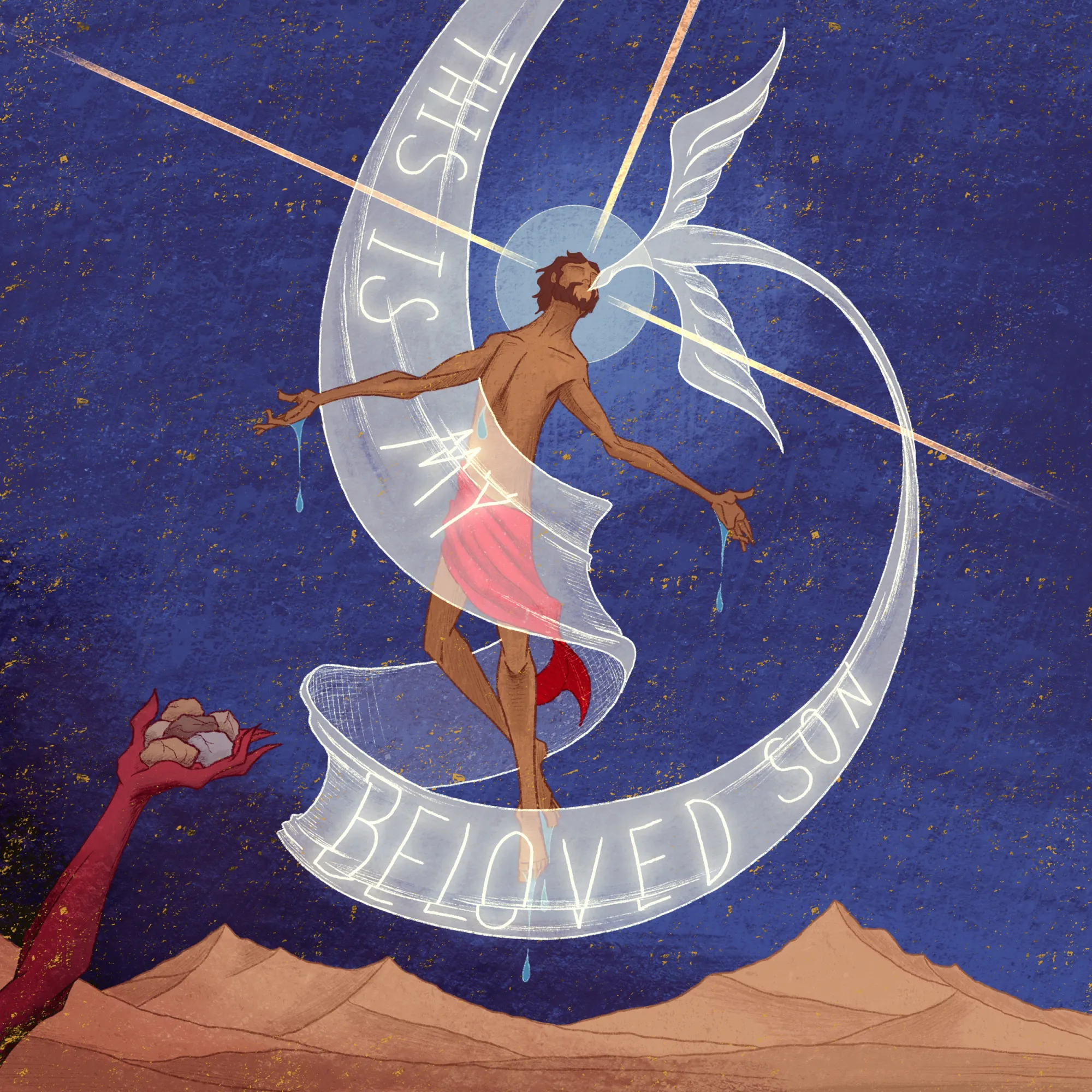
Unmuted – Sermon on Luke 11:14-28 for the Third Sunday of Lent

Luke 11:14–28

14 Now he was casting out a demon that was mute. When the demon had gone out, the mute man spoke, and the people marveled. 15 But some of them said, “He casts out demons by Beelzebul, the prince of demons,” 16 while others, to test him, kept seeking from him a sign from heaven. 17 But he, knowing their thoughts, said to them, “Every kingdom divided against itself is laid waste, and a divided household falls. 18 And if Satan also is divided against himself, how will his kingdom stand? For you say that I cast out demons by Beelzebul. 19 And if I cast out demons by Beelzebul, by whom do your sons cast them out? Therefore they will be your judges. 20 But if it is by the finger of God that I cast out demons, then the kingdom of God has come upon you. 21 When a strong man, fully armed, guards his own palace, his goods are safe; 22 but when one stronger than he attacks him and overcomes him, he takes away his armor in which he trusted and divides his spoil. 23 Whoever is not with me is against me, and whoever does not gather with me scatters.

24 “When the unclean spirit has gone out of a person, it passes through waterless places seeking rest, and finding none it says, ‘I will return to my house from which I came.’ 25 And when it comes, it finds the house swept and put in order. 26Then it goes and brings seven other spirits more evil than itself, and they enter and dwell there. And the last state of that person is worse than the first.”

27 As he said these things, a woman in the crowd raised her voice and said to him, “Blessed is the womb that bore you, and the breasts at which you nursed!” 28 But he said, “Blessed rather are those who hear the word of God and keep it!”

In the name of Jesus. Amen.

The past few weeks including today, the Scripture readings have had us considering temptation, the devil’s work, and demons. Even though we might prefer to think about other things, Jesus wants us to know about and beware of the devil and the demons. Christ takes demons seriously. Our Lord doesn’t spend a lot of time warning us about our finances, sickness, or wars. But Jesus regularly and repeatedly warns against false doctrine and against demons. So, demons will be part of our focus today because that is what the text has for us.

Almost everything we know about demons comes from the New Testament. Demons are creatures; they are fallen angels. They, just like everything else, were created by God, and we know that they were initially created good because when God looked over everything He created, He saw that it was good (Gen. 1:31). Satan, who is nothing more than the chief demon, led the rest of the demons in rebellion against God. Demons are real, powerful, malicious, and malevolent. Scripture calls them the “cosmic powers over this present darkness” and the “spiritual entities of evil” (Eph. 6:12). But even if they all worked together, they would not have more power than God. They all flee from and melt before God’s Word.

Now, I want to clear something up from the sermon last week, but I want to preface it with this: If you ever have a question about anything I preach, please feel free to talk with me about it. I am not immune from preaching incorrectly. So, if you ever hear anything from my mouth as I preach or teach that doesn’t line up with Scripture, please point it out to me. And I’ve said this before, and it’s time to say it again. If you find that I am preaching contrary to Scripture and won’t receive correction, run me out of here for the sake of your soul.

In last week’s sermon I went off script for a bit and said that the demons, “are God’s demons.” I was very politely asked about that statement, and I want to make sure that statement isn’t misunderstood. God does not direct the demons to torment us. God tempts no one with evil (Jam. 1:13). To anyone who got that impression, please forgive me. That is not what I was trying to convey, and I should have been clearer than I was. What was meant by that is that the demons are completely under God’s control, and they cannot do anything unless God allows it. We know this because even Satan had to get God’s permission to torment Job (Job 1:6-12, 2:1-6). The other thing we should see is that God can even use the attacks and assaults of demons to bring about good. God causes all things to work together for good for those who love Him and are called according to His purpose (Ro. 8:28) – even the work of demons.

Now, to this Gospel text. We don’t learn about the tactics of demons here, but we do learn about one of their objectives or goals. A demon has made a man mute. Other places in the Gospels, demons will make people throw their bodies around (Mk. 5:1-5, 9:25-27) and speak through their voices (compare Mk. 5:7, 9). Demons seem to want to influence people in certain ways. Again, here the issue is this man is unable to speak. One of the reasons demons want us to be mute is that with the heart one believes and with the mouth he confesses and is saved (Ro. 10:10).

The demons do not want us to confess or praise Christ. They want us to be silent – especially when it comes to God’s Word. Demons do not want us to speak up for the unborn, about marriage existing only between a man and a woman, or even about the God-created differences between men and women. None of those are things are “political.” If you think those are only political issues, it shows that the demons are gaining ground over your thinking about those things. Satan and the demons want us to think that moral issues are merely political issues. Dear saints, Scripture and theology should be used in all aspects of life. Abortion, marriage, and gender issues are not political issues. Not even climate change is a political issue. God promised that until Christ returns to make all things new, “seedtime and harvest, cold and heat, summer and winter, day and night, shall not cease” (Gen. 8:22). God does call us to take good care of the creation He has given us, but we cannot destroy it. We aren’t that powerful, and thinking we are is a form of idolatry. But the demons want to make us mute on a whole host of topics so they can deceive the whole world.

All of us, at times, have fallen into the demonic temptation of being mute. Instead of speaking the truth in love, we fear losing friends, offending family members, or missing out on a promotion. Instead of fearing God, we fear being called judgmental, bigoted, sexist, homophobic, etc. The world needs Christians to speak the truth out loud now more than ever.

And, dear saints, here is why you can be bold when it comes to the truth. The demons are real, terrible, malicious, and dangerous, but they are also utterly defeated. Jesus says that He casts out demons by the finger of God. By His death and resurrection, Christ has disarmed the demons and put them to open shame (Col. 2:15). Jesus is the stronger man who has defeated Satan and all of the demons. And because Christ has won the victory over them, we can easily defeat them too. James 4:7 says, “Submit yourself to God. Resist the devil and he will flee from you.”

To see how defeated the demons are, pay attention to the little parable Jesus tells in this text. He says that when a strong man (and there Jesus is referring to the devil), who is fully armed guards (and keep that word ‘guards’ in the back of your mind because it comes up again in a little bit) his house (which is the world), his goods (I.e. sinners) are safely under his lordship. But Jesus says that when one stronger than him (and Jesus is referring to Himself) comes and attacks him, Christ takes away his armor, and divides the spoil (and that is you).

Just think about that. Jesus says that He has come to rob the devil’s house and you are the spoils, the treasure, the plunder that Jesus wants to rescue out of the devil’s cellar. Christ has won, redeemed, purchased, and grabbed you from the devil’s clutches. All by the power of His finger. And Christ opens your lips to declare His praise (Ps. 51:15) and the truth. He has pulled you out of darkness and into His marvelous light.

So how do you know if you are in the kingdom of God or in the kingdom of the devil? Well, Jesus answers that. A woman says to Jesus, “Blessed is the womb that bore you, and the breasts that nursed you.” Now, Mary was certainly blessed. She is the mother of our Lord. But Jesus says, even better than being His mother is to hear the Word of God and keep it. Though you were guarded by Satan, Jesus has come and rescued you with His finger transferring you into His kingdom. Now, you keep – which is the same word Jesus used to describe what Satan, the strong man, did with his goods he guarded and kept them. Now, you keep and guard the Word that Jesus used to deliver you from Satan.

With His little finger, Jesus destroys the stronghold and armor of the devil and claims you as His own. And He will never leave you or forsake you. Instead, Christ guards and keeps you now and for all eternity. This is why keeping, guarding, confessing, being unmuted when it comes to God’s Word is so important. With the shield of faith, you are able to quench all the flaming darts of the evil one (Eph. 6:16). Your voice unmuted and you open your lips so that you can boldly proclaim the excellences of Him who called you out of darkness into His marvelous light (1 Pet. 2:9). May God grant us the boldness to speak the truth in love. Amen.

The peace of God, which surpasses all understanding, will guard your hearts and minds in Christ Jesus. Amen.

Where Is It So Written? – Sermon for Midweek Lent 2

The Scripture readings for tonight’s service are Psalm 111; Exodus 12:43-51; and Mark 14:22-25.

I. What Is the Sacrament of the Altar?

It is the true Body and Blood of our Lord Jesus Christ, under the bread and wine, given unto us Christians to eat and to drink, as it was instituted by Christ Himself.

Where is it so written?

The holy Evangelists, Matthew, Mark, and Luke, together with St. Paul, write:

“Our Lord Jesus Christ, in the night in which He was betrayed, took bread; and when He had given thanks, He broke it and gave it to His disciples saying, ‘Take, eat; this is My Body, which is given for you; this do in remembrance of Me.’

“In the same manner, also, when He had eaten, He took the cup, and when He had given thanks, He gave it to them saying, ‘Drink of it, all of you; this cup is the New Testament in My Blood, which is shed for you, and for many, for the forgiveness of sins; this do, as often as you drink, in remembrance of Me.’”

Luther’s Small Catechism

In the name of Jesus. Amen.

Imagine being in Egypt for the initial Passover (Ex. 12:1-13). Your entire family is gathered for a special meal because God is about to deliver you from slavery, and being a slave is all you have ever known. God is coming to deliver, release, and rescue you, so everyone is filled with excitement. Your enemies are about to be defeated as the angel of death passes through the land. God promises that you will be protected from the angel of death because the blood of the Passover lamb will cover you.

So, you find that perfect, year-old lamb. You kill it and take the blood of the lamb and put on the posts and over the door of your house. Then, you start cooking. You roast the lamb, set the table, and have the meal. You eat it dressed and ready to travel to the Promised Land. And the next day, you walk out of Egypt through the Red Sea with a wall of water on your right and on your left. All your enemies are being defeated behind you. You are finally delivered from bondage and slavery.

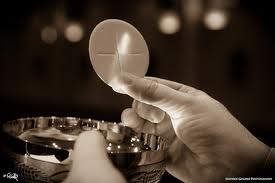
Dear saints, that is, essentially, what happens each and every time you come to the Lord’s Supper. At this altar, you are delivered out of your slavery to sin. Jesus, the lamb without blemish or spot (1 Pet. 1:18-19), has been sacrificed. His Blood marks your door, and the angel of death passes over you. You eat His Body and drink His Blood which have been given and shed for the forgiveness of your sins. All your enemies are defeated. You are rescued from your slavery to sin and death. And God ushers you into the Promised Land of the kingdom of heaven.

Whenever you have the Lord’s Supper, as you return to your seat, it is completely and utterly appropriate for you to imagine walls of water on your right and left because in the Lord’s Supper you are being delivered from slavery and ushered into God’s kingdom.

Last week, we considered the first part of the question, “What is the Sacrament of the Altar?” and how Holy Communion is Jesus’ Body and Blood given to Christians to eat and drink for the forgiveness of sins. Tonight, we are going to consider the words Jesus used to institute the Lord’s Supper a bit more. 

The words in your bulletin are a conflation of the four places in Scripture that record Jesus instituting the Lord’s Supper. By ‘conflation,’ I mean this: The four places where Scripture gives us the words of institution have slight, minor differences. The four passages are all in agreement in the essentials, and what you have printed there in the bulletin is all the actions and words of Jesus as He instituted His Supper which are taken from those four texts. If you are interested, I put together a table of the four passages and divided them into the parallel sections so you can see the similarities and differences. Through these midweek services, you will hear all four accounts. Last week, you heard Matthew; tonight, Mark; next week, Luke; and the week after, Paul in 1 Corinthians 11.

Again, even though there are minor differences, the essentials are the same. Jesus takes bread, blesses it, and gives it to the disciples to eat saying, “This is My Body.” Jesus takes the cup, blesses it, and gives it to the disciples to drink saying, “This is My Blood of the New Testament which is shed for you.”

So, what is this New Testament? When a person makes out a will or testament, he spells out who gets what after he dies. There might be times when a person will make changes to the will and what is to be done with the inheritance, but that is rare. And once he dies, that will is set in stone and cannot be changed.

Jesus’ will and testament is where and how Jesus swears to give His children everything that is His after He dies. In Holy Communion, Jesus gives you everything He has – His entire self His Body and Blood and His divine life. In other words, by Jesus’ crucifixion and death, you are made inheritors of His life which is a resurrection life. And because He made this Testament with you and has died for you, this Testament cannot be altered or changed – not even by God Himself. 

God spoke about this new testament in Jeremiah 31:33-34 where He promised to put His Word in you and write it on your hearts. He will be Your God, and you will be His people. God will forgive your iniquity and remember your sin no more.

In the Lord’s Supper, you are given your inheritance as a child of God. You are delivered, forgiven, and have the right to enter the kingdom of God because Christ Himself has given you that right.

Remember that Jesus wants to give you this gift regularly, as often as you eat and drink it. And this does something for you and for others. Whenever you partake in the Lord’s Supper, you are doing two things simultaneously. First, you are receiving this Testament where Jesus promises the forgiveness of sins. And second, you are proclaiming Jesus’ death until He comes.

1 Corinthians 11:28, which should be familiar to you, says, “As often as you eat this Bread and drink the Cup, you proclaim the Lord’s death until He comes.” In a very real way, receiving the Lord’s Supper is how you proclaim, preach, and confess Jesus’ death and resurrection to a fallen and darkened world.

As you receive His meal of forgiveness, you are strengthened in faith toward God and love toward your neighbor. Psalm 116:12 asks, “What shall I render to the Lord for all His benefits to me?” Psalm 116:13 gives the answer, “I shall lift up the cup of salvation and call on the name of the Lord.” By you receiving the Lord’s Supper, God draws others to Himself to become His people, His children. For that, God be praised. Amen.

The peace of God, which surpasses all understanding, will guard your hearts and minds in Christ Jesus. Amen.

When Crumbs Become a Feast – Sermon on Matthew 15:21-28 for the Second Sunday of Lent

Matthew 15:21–28

21 And Jesus went away from there and withdrew to the district of Tyre and Sidon. 22 And behold, a Canaanite woman from that region came out and was crying, “Have mercy on me, O Lord, Son of David; my daughter is severely oppressed by a demon.” 23 But he did not answer her a word. And his disciples came and begged him, saying, “Send her away, for she is crying out after us.” 24 He answered, “I was sent only to the lost sheep of the house of Israel.” 25 But she came and knelt before him, saying, “Lord, help me.” 26 And he answered, “It is not right to take the children’s bread and throw it to the dogs.” 27 She said, “Yes, Lord, yet even the dogs eat the crumbs that fall from their masters’ table.” 28 Then Jesus answered her, “O woman, great is your faith! Be it done for you as you desire.” And her daughter was healed instantly.

In the name of Jesus. Amen.

Whenever you are reading Scripture, look for the surprises. To see the surprises in this particular text, we first have to recognize some things that are not surprising. This Canaanite mother cries out to Jesus because her daughter is severely oppressed by a demon. As harsh as this sounds, it is no surprise at all that her daughter is suffering at the hands of demons.

Jesus is in the district of Tyre and Sidon, and that region was the center of Baal worship. Baal worship, among other horrible things, included child sacrifice. Obviously, this Canaanite woman hadn’t killed her daughter as a sacrifice to Baal. But in that pagan culture, it was common to engage in occult practices and make deals with demons in order to make your fields more fruitful, to get revenge on someone, to make a person fall in love with you, and all sorts of other things. While we don’t know exactly what caused the girl to be demonized, both this woman’s background and what she says suggest that she does know, and it is very possible that it was because of something she had done. If she and her daughter were innocent regarding this demonic possession, the woman would be crying out for justice, but that isn’t what she cries out for. She cries out to Jesus for mercy. She sees her daughter’s suffering and feels guilt.

Let’s bring this to us today. Dear saints, be aware. Demons have not gone away. If you ignore their existence, it is to your own peril. Demons are real, and they are active. Even if you don’t read horoscopes, call psychic hotlines, use healing crystals or ouija boards – and don’t do those things, they are demonic and evil – but even if you don’t do those things, that doesn’t mean you aren’t opening up yourself to demons. Pornography can be a portal for demons. Getting drunk, giving in to your anger, or being lazy also opens you up to their influence (Col. 3:5-8; 2 Thess. 3:6, 11). In fact, all pet sins dabble in the demonic. We want to imagine that our sins are no big deal or excusable. They aren’t. Sin hurts both the sinner and the sinner’s immediate family. Repent. Know that Christ has defeated the demons and protects you from them. But engaging in pet sins is like dangling your bleeding foot in shark-infested waters. Don’t invite the demons into your life by continuing in those sins.

Now, that brings us to the first surprise in the text which comes in the woman’s initial prayer. She addresses Jesus as the Son of David, and that is a loaded term – especially from her. She’s a foreigner. King David never ruled over her people or her homeland. And yet there are all sorts of promises that a descendent of David would sit on the throne forever and save even the inhabitants of the pagan nations (Is. 11:10-16). And this woman believes Jesus is the Son of David who can help her and her daughter. Jesus is her last hope.

And that brings us to the second surprise. Jesus doesn’t answer her a word. Jesus is usually so quick to have mercy when called upon, but not here. More on that surprise in a minute.

First, we have to consider the disciples’ reaction to her. They pray and ask Jesus to send her away. Unfortunately, this isn’t surprising. It’s disappointing, callous, and sinful, but not surprising. They were tired of hearing her shrieking for mercy. They probably speculated that she is suffering because of her own wickedness. Their attitude and thinking toward her seems to be along the lines of, “Well of course your daughter has a demon. You’ve brought this on yourself. Jesus, if You’re not going to help her, at least tell her to take a hike.” But even though this speculation was probably correct, the disciples failed to have compassion.

Dear saints, too often we are like the disciples. We fail to have compassion on those who are suffering around us. When people are groaning under their suffering, that isn’t the time to be like Job’s ‘friend’ Zophar and say, “You’re getting what you deserve. In fact, your sins deserve even worse punishment” (see Job 11:6). Now, we cannot excuse sin or say that sin doesn’t really matter. Downplaying sin is also unmerciful. Don’t do that! There are times where we have to correct and rebuke, but when someone is crying out for mercy, rebuke is not appropriate. Point the suffering to Jesus, the Source of mercy. Comfort them with God’s promises of forgiveness and mercy in the midst their suffering. And pray that God will give you wisdom to know when to comfort and when to rebuke and correct (Jam. 1:5).

Back to Jesus’ surprisingly slow response in giving this woman mercy. First, Jesus ignores her. Then, Jesus says that He came only for the lost sheep of Israel. And finally, He calls her a dog. Yes, it’s surprising, but it shouldn’t be too surprising. Because He is God, Jesus knows this woman; He knows her daughter; He knows the struggles she and her daughter have had with this demon; and, most importantly, Jesus knows this woman’s great faith. There is no question that Jesus is putting her through the ringer, but what He is doing here is strengthening and purifying her faith.

Even though Jesus ignores her, dismisses her, and calls her a dog, she continues to dig her roots of faith deeper and deeper. You heard in our Epistle text (Ro. 5:1-5) that we can rejoice in our suffering because suffering produces endurance which produces character which produces hope. Jesus is using this woman’s suffering to strengthen her faith. Christ knows how much suffering this woman can take, and through that suffering her faith grows, matures, and gets stronger. Jesus uses her suffering for her good. That doesn’t mean that the suffering is good, but Jesus uses it to bring about good.

That leads us to the next surprise. The demon who is causing the suffering wants to destroy this woman and her daughter, but the demon utterly fails because he ends up driving her to Jesus. And Christ draws this woman in even closer to Himself.

Dear saints, when – not if but when – you suffer, flee to Christ. When you are suffering because of your sinful actions, because of the sin of others, or because God doesn’t immediately deliver you, dig your heels into God’s promises. In your prayers, remind God of what He has promised to do and hold Him to those promises. That is faith. Faith is trusting that what God has promised He will do, despite your experience.

That brings us to the final surprise. The woman says that she will be content with crumbs from Jesus table. Even though Jesus calls this woman a dog, she says, “Ok, Jesus. I’ll be a dog so long as I’m Your dog. It isn’t right for You to give me Your children’s bread. I don’t need bread. Crumbs from Your hand are all I need.” She’s content with crumbs, but here’s the surprise – she gets more than crumbs. She gets a full feast.

Jesus says, “O woman, great is your faith! Be it done for you as you desire.” This woman is one of only two people whose faith is praised by Jesus (Mt. 8:10). Jesus is the Bread of Life (Jn. 6:35). Even the crumbs that fall from Jesus’ table deliver mercy, life, and salvation. This woman gets the very thing she desired and more. Her daughter is delivered, and she receives everything Jesus came to give to sinners.

God’s mercy is of such a nature that it never falls in crumbs. God’s mercy is directly and precisely delivered to give exactly what is needed in every situation.

Right now, your Lord invites you to His table. Not to sit under it like a dog waiting for some crumbs to fall from a careless child. No, you are Jesus’ guest of honor. What you receive might look like crumbs to those who do not know what is being given. But through faith, you know that Jesus gives you a full feast of forgiveness, life, and salvation as He gives you His Body and Blood for the forgiveness of all your sins. Welcome to the feast. Amen.

The peace of God, which surpasses all understanding, will guard your hearts and minds in Christ Jesus. Amen.

What Is the Sacrament of the Altar? – Sermon for Midweek Lent 1

The Scripture readings for tonight’s service are Psalm 23; 1 Corinthians 10:1-22; and Matthew 26:26-29.

I. What Is the Sacrament of the Altar?
It is the true Body and Blood of our Lord Jesus Christ,
under the bread and wine, given unto us Christians to eat and to drink,
as it was instituted by Christ Himself.

Luther’s Small Catechism

In the name of Jesus. Amen.

When Jesus instituted the Lord’s Supper, He gave the disciples bread which He said is His Body, and He gave the disciples the cup which He said is His Blood (Mt. 26:26-29). Next week, we will take more time to consider those words of institution. For tonight, we see that in the Lord’s Supper Jesus gives us His Body and Blood to eat and to drink. A couple of years ago when we considered Baptism during our Lenten services, we saw how Baptism is two elements put together: God’s Word and water. In the Lord’s Supper, there are three elements, factors, or ingredients: God’s Word, the elements of bread and wine, and Jesus’ Body and Blood. Those three things make up the Sacrament.

A helpful way for us to see what the Lord’s Supper is is to consider the different names we have for it: Lord’s Supper, Holy Communion, the Sacrament of the Altar, and the Eucharist.

First, we call it ‘the Lord’s Supper’ because that is what Paul calls it in 1 Cor. 11:20. It is the Lord’s Supper because it was instituted by our Lord Jesus Himself. Jesus instituted it, so He defines what it is. Jesus says it is the new covenant in His Blood which isn’t a little meal to fill bellies; instead, it delivers the gifts of His Body and Blood for the forgiveness of sins (Jer. 31:33-34).

Second, we call it ‘Holy Communion.’ Holy Communion is holy because Jesus, the holy One, gave it to us. It is holy because it delivers Jesus’ holy Body and Blood to us which then makes us holy as we receive it in faith. It is ‘Communion’ because of what you heard in our Epistle text (1 Cor. 10:1-22), “The cup of blessing that we bless, is it not a participation in the blood of Christ? The bread that we break, is it not a participation in the body of Christ?” (1 Cor. 10:16). The Greek word there for ‘participation’ is κοινωνία which means ‘fellowship’ or ‘common unity.’ Holy Communion unites us to Jesus, and when Christians are united to Jesus, they are also united to one another.

The third common term comes from the Small Catechism where Luther calls it ‘the Sacrament of the Altar.’ Even though this isn’t a term that Scripture uses, it is helpful because it highlights the fact that Jesus’ sacrificial death on the altar of the cross is given to us from the altars of His churches. What Christ accomplished on the cross, He delivers to you in the Sacrament of the Altar.

Finally, the church has also used the term ‘Eucharist’ after the Greek word for ‘thanksgiving’ which is εὐχαριστέω. Calling it ‘Eucharist’ reminds us how Jesus blessed the bread and wine by giving thanks before giving them to His disciples. It is also a reminder of our response to receiving it. We give thanks to God for giving us the gift of Jesus’ Body and Blood.

Again, because Jesus says it is His Body and Blood, the Lord’s Supper is not just a little snack we have at church before we head out the door. No, the Lord’s Supper is a heavenly meal.

In our Epistle text tonight (1 Cor. 10:1-22), we heard that after God’s people left Egypt, they all “ate the same spiritual food” (1 Cor. 11:3). For forty years, God fed His people with manna that appeared on the ground six days every week as God’s people wandered in the wilderness. Sunday through Thursday, they were to gather up enough to eat for that day. But on Friday, the sixth day, they were to gather enough for that day andfor Saturday, the Sabbath day, so they could rest on the Sabbath (Ex. 16:4-31).

The manna was the actual food that God provided to them to keep their bodies going. But the manna was providing more than just the calories they needed to live physically. The manna was also spiritual food that fed their faith by teaching them to daily trust in God’s provision and mercy. Psalm 78 remembers how God provided for His people during the exodus saying, “[God] commanded the skies above and opened the doors of heaven, and He rained down on them manna to eat and gave them the grain of heaven. Man ate of the bread of the angels; He sent them food in abundance” (Ps. 78:23-25).

The nutritional value of the Lord’s Supper wouldn’t keep our bodies going for very long because there isn’t much there, but that isn’t why Jesus gives it to us. Christ says that He gives us this heavenly meal for the forgiveness of our sins. He gives us food that feeds our souls and our faith by giving us a taste of heaven. As we receive Jesus’ Body and Blood in our mouth, we also receive the forgiveness of our sins in our heart by faith.

Now, there are some who say that simply taking Christ at His word about His Body and Blood being given in Communion is cannibalistic. They will say that when Jesus said ‘is’ what He really meant was this ‘represents’ or ‘symbolizes’ His Body and Blood. I’m not going to address that tonight, but I will in a few weeks. But I do want to say that Jesus giving His Blood to drink is pretty radical.

Right after the flood, God told Noah and his family that consuming blood was strictly forbidden because according to God, the life of the creature was in the blood (Gen. 9:4). Throughout Leviticus, God continued to forbid the consuming blood (Lev. 7:25-27; 17:10-12) saying, “The life of every creature is its blood: its blood is its life” (Lev. 17:14). There were and still are pagan cultures that dabble in demonic practices (1 Cor. 10:19-22) by drinking the blood of animals to get the power and ability of those animals. So, in the old covenant, God set apart the blood of each sacrifice to be used for atonement. By offering the lifeblood of those animals, God was showing His people that He accepted the death of another in place of the sinner.

This was pointing to Jesus. Now, Christ has come and fulfilled the old covenant and established the new covenant in His blood (Heb. 9:11-14, 10:11-14, 19-22). God accepts Jesus’ death and the shedding of His blood in place of the sinner. All the Old Testament sacrifices pointed forward to Jesus shedding His Blood and offering it to God as the one-time sacrifice for all sin. And in Holy Communion, the forbidding of consuming blood stops. Jesus gives you His blood to drink. Remember that God says, “the life is in the blood.” That means in the Lord’s Supper Jesus, the Son of God, gives you His Blood, God’s Blood, and God’s life – a life that that has conquered death and is eternal.

Dear saints, when you come to the Lord’s Supper, God prepares a table before you in the presence of your enemies (Ps. 23:5) and fills you who hunger and thirst for righteousness (Mt. 5:6) with the good things of His Body and Blood (Lk. 1:53) for the forgiveness of your sins and everlasting life. And for all of that, we give thanks. Amen.

The peace of God, which surpasses all understanding, will guard your hearts and minds in Christ Jesus. Amen.

The Devil’s Playbook – Sermon on Matthew 4:1-11 for the First Sunday of Lent

Matthew 4:1–11

1 Then Jesus was led up by the Spirit into the wilderness to be tempted by the devil. 2 And after fasting forty days and forty nights, he was hungry. 3 And the tempter came and said to him, “If you are the Son of God, command these stones to become loaves of bread.” 4 But he answered, “It is written,

“‘Man shall not live by bread alone, 
but by every word that comes from the mouth of God.’ ”

5 Then the devil took him to the holy city and set him on the pinnacle of the temple 6 and said to him, “If you are the Son of God, throw yourself down, for it is written, 

“‘He will command his angels concerning you,’ 

and 

“‘On their hands they will bear you up, 
lest you strike your foot against a stone.’” 

7 Jesus said to him, “Again it is written, ‘You shall not put the Lord your God to the test.’ ” 8 Again, the devil took him to a very high mountain and showed him all the kingdoms of the world and their glory. 9 And he said to him, “All these I will give you, if you will fall down and worship me.” 10 Then Jesus said to him, “Be gone, Satan! For it is written,

“‘You shall worship the Lord your God 
and him only shall you serve.’”

11 Then the devil left him, and behold, angels came and were ministering to him.

In the name of Jesus. Amen.

For years now, you’ve heard me say that the devil has one trick up his sleeve and that is to get you to doubt God’s Word. In the luscious perfection of the Garden of Eden, the devil began his temptation by asking the woman, “Did God really say?” And in the temptation of Jesus, the devil takes the exact same approach. He begins the first two temptations with, “If you are the Son of God…” Remember, this came immediately after God the Father declared at Jesus’ Baptism, “You are My beloved Son, in whom I am well pleased” (Mk. 1:11; Mt. 3:17). So, when Satan begins, “If you are the Son of God,” he’s trying the exact same tactic he used in the Garden, “Did God really say?” Trying to cast doubt on God’s Word is the only play in the devil’s playbook, and this is helpful to know. But we need to consider this scheme of the devil more closely because he is so skilled at running this play.

Enough of you enjoy football that I’m going to try this analogy. Even if you don’t care about football, I think the analogy is still helpful, so please stick with me. Some teams will primarily use just one play called an ‘option.’ In this play, the quarterback sees where the defense is and how they move at the beginning of the play, and that will determine what he does with the ball – pass, hand it off, or keep it himself. It’s one play that has several options for success, and a skilled quarterback simply choses the best option available. This one play can be extremely effective. So, when we understand how Satan runs his one play to utilize the options he has before him, we can better defend against each of those options.

When the devil tempts us with his, “Did God really say?” he wants us to start speculating, “Why doesn’t God want me to have this thing?” whatever that thing is. There are three main answers to that speculation. One, God doesn’t actually know what I need. Two, God doesn’t want me to be happy. And three, God doesn’t have the power or ability to give that thing to me.

If any of those things are true (which, of course, they aren’t), then God isn’t worthy of our obedience or worship. And when we start speculating on those false possibilities, we begin to think that God either can’t or won’t help us. Then, we assume that we have to help ourselves, but doing that put us in the place of God which means that we fall into idolatry and sin. So, when we recognize what those temptations are doing, we can better defend against the temptation. Because the truth is: God does know what you need. He knows what you need before you ask Him (Mt. 6:8). And He promises to give it to you (Mt. 6:32). God does want you to be happy – happier than you can possibly imagine – just not necessarily in the way or in the timing you might have in mind. He doesn’t withhold any good thing from those who walk uprightly (Ps. 84:11), and He knows how to give good gifts to His children (Mt. 7:11; Ps. 85:12). And God is able and pleased to give you everything that is good for you (Lk. 12:32).

Our problem is that we don’t always recognize how simple and shortsighted we are. We don’t always know what is and isn’t good for us. Too often, we are like spoiled children who think things that are harmful to us would make us happy. God knows better than we do, and He won’t ever hold back when it comes to giving us things that are beneficial for us (1 Cor. 1:7).

With all of that in mind, let’s consider these three temptations. Jesus is starving because He hasn’t eaten for forty days. The devil runs his play, “If you are the Son of God, command these stones to become loaves of bread.” Notice how insidious this is. The devil wants Jesus to speculate, “Why doesn’t God want Me to have bread?” At that very moment, the heavenly Father was providing bread for everyone in the world. Christ is the only one who actually loves and obeys God. So, why is He starving? The devil is tempting Jesus to think that His heavenly Father either: 1) doesn’t know what He needs; 2) doesn’t want to give Jesus what He needs; or 3) isn’t able to give Jesus what He needs. Again, all of those things are false.

But Jesus doesn’t fall for the play; He doesn’t speculate. He simply responds, “Man shall not live by bread alone, but by every word that proceeds from the mouth of God” (Dt. 8:3). Jesus trusts that God can and will provide what is needed when it is needed. He doesn’t fall into the temptation.

If we stick with the football analogy, it’s second down, and the devil goes back to his same play. He takes Jesus to the pinnacle of the Temple and says, “If you are the Son of God, jump off. God has promised to send the angels to protect you.” Satan wants Jesus to test God’s ability to keep Him safe. The devil is, basically, saying, “Let’s see if God will notice when you are in danger and if he can help you when you need it.” But Jesus doesn’t need to test drive God’s protection. God has promised He will care for Him, and that is enough. So, our Lord responds, “You shall not put the Lord your God to the test” (Dt. 6:16).

Now, it’s third down, and the devil is in a bad spot. But he still runs the same play trying to get Jesus to think that God is holding out on Him. Satan shows Jesus all the kingdoms of the world and all their glory and offers them to Jesus if He will worship him. Jesus will, and does, receive all the kingdoms of the world but only after He has redeemed them by dying and rising again. But the devil wants Jesus to take that authority early. But our Lord doesn’t fall for the trick. Jesus quickly responds with Scripture again, “Be gone, Satan! For it is written, ‘You shall worship the Lord your God, and Him only shall you serve’” (Dt. 6:13). Now that He is ascended to the throne of all creation, Christ has all authority in heaven and on earth (Mt. 28:18) with all things placed under His feet (Eph. 1:21-22).

Now, let’s bring this to you. Again, the one play in the devil’s playbook is for the devil to get you to question God’s Word which leads you to speculate that God is holding out on you. Dear saints, God does not and will not ever deny you anything that is good for you. Psalm 84:11 says, “The Lord God is a sun and shield; the Lord bestows favor and honor. No good thing does He withhold from those who walk uprightly.”

Recognizing that God promises to provide and care for us is the best weapon we have to defend against temptation. The last verse of this text is so important for our fight against temptation because it clearly shows us that God wasn’t withholding anything from Jesus. At the right and proper time, God did give Jesus the bread, protection, and authority He needed and desired. “The devil left [Jesus], and behold, angels came and were ministering to Him.” And don’t think for one second that God only does this for Jesus because He does it for us sinners too.

We saw God do the same thing for Adam and Eve in our Old Testament text (Gen. 3:1-24) even after they had fallen into temptation and sinned. God gave them chance after chance to repent. Every question God asks in Gen. 3:9-13 is a merciful call to repentance because God knows that they need confession and absolution. Even when they don’t repent and confess their sins, God still gives them what they need. He gives them a promise that He will send Jesus, the Seed of the woman, to crush the head of the serpent (Gen. 3:15). Then, God instructs both the woman and Adam what life will be like now that they have brought sin into the world (Gen. 3:16-19) which will help them face the challenges ahead. There, God still promises to provide food for them. After that, God covers their nakedness and shame with animal skins (Gen. 3:21). And finally, God sends His cherubim with a flaming sword, to protect them from the horror of eating from the tree of life and living forever in sin (Gen. 3:22-24).

In all of that, God is protecting them, providing for them, loving them, and giving them everything they need for life and salvation. Dear saints, if God will do that for Adam and Eve immediately after they sinned, how much more will God do for you now that He has sent Jesus to die and rise again to redeem and purchase you?

Because of what Christ has done, you are His beloved children. Jesus, your great High Priest has been tempted in every way as you are, yet without sin. Christ knows the difficulty of facing the temptations the devil throws at you, so He has sympathy for you. And even when you fall into temptation and sin, you can draw near to His throne where you will find mercy and grace to help in time of need (Heb. 4:14-16). Amen.

The peace of God, which surpasses all understanding, will guard your hearts and minds in Christ Jesus. Amen.

No Question – Sermon on Jonah 3:1-10 for Ash Wednesday

Jonah 3:1-10

1 Then the word of the Lord came to Jonah the second time, saying, 2 “Arise, go to Nineveh, that great city, and call out against it the message that I tell you.” 3 So Jonah arose and went to Nineveh, according to the word of the Lord. Now Nineveh was an exceedingly great city, three days’ journey in breadth. 4 Jonah began to go into the city, going a day’s journey. And he called out, “Yet forty days, and Nineveh shall be overthrown!” 5 And the people of Nineveh believed God. They called for a fast and put on sackcloth, from the greatest of them to the least of them. 

6 The word reached the king of Nineveh, and he arose from his throne, removed his robe, covered himself with sackcloth, and sat in ashes. 7 And he issued a proclamation and published through Nineveh, “By the decree of the king and his nobles: Let neither man nor beast, herd nor flock, taste anything. Let them not feed or drink water, 8 but let man and beast be covered with sackcloth, and let them call out mightily to God. Let everyone turn from his evil way and from the violence that is in his hands. 9 Who knows? God may turn and relent and turn from his fierce anger, so that we may not perish.” 10 When God saw what they did, how they turned from their evil way, God relented of the disaster that he had said he would do to them, and he did not do it.

In the name of Jesus. Amen.

For several reasons, I don’t preach with props, but if I did tonight’s sermon would begin the sermon with a ‘clapperboard’ – one of those things used during the filming of movies and TV shows. “Jonah called to preach to Nineveh; take two.” “Action!”

We know about the ‘out-take.’ Instead of going to preach to Nineveh, Jonah ran the other direction. He was thrown overboard in a stormy sea, swallowed by a great sea creature, and submerged to the depths of the sea to be digested and die. It looked like Jonah’s refusal to preach to Nineveh would be his own undoing. But from the depths, Jonah prayed to God for mercy, and God heard. God answered from heaven and sent out His steadfast love and faithfulness (Ps. 51:3). God is merciful, but His mercy takes different forms in different situations. In Jonah’s case, mercy looked like being whale vomit instead of becoming whale poo.

God gave Jonah a second chance, “Arise, go to Nineveh, that great city, and call out against it the message that I tell you.” Jonah preached a one-course sermon of Law, “Yet forty days, and Nineveh shall be overthrown!” Notice what the sermon doesn’t do. It does not accuse the people of specific sins. It doesn’t name any of Nineveh’s many evils (Jon 1:2). The sermon only does one thing – it calls Nineveh’s future into question. This is just an aside: In your conversations with unbelievers, be on the lookout for opportunities to point people to the return of Christ, the final judgment, and end of the world (Act. 17:31). Those may be the windows where God will shine the light of the Gospel into the darkness of people’s hearts.

Well, Jonah’s doomsday sermon was used by the Holy Spirit to change the hearts of the Ninevites. From the greatest to the least of them, they called for a fast. Even the king of Nineveh descended from his throne to sit in sackcloth and ashes. He gave a command to all the people of Nineveh, “Fast. Don’t eat or drink. Call out mightily to God. Turn from evil and violence. Who knows? God may turn from His fierce anger against us, so we may not perish.” This wasn’t a revival, it wasn’t a reawakening, it was an initial awakening. But also notice that for the Ninevites this was a shot in the dark. At best it was a, “Maybe,” a “Let’s give this a try,” a, “What if?”

Well, their blind shot at repentance paid off. “God saw what they did, how they turned from their evil way, God relented of the disaster that He said He would do to them, and He did not do it” (Jon. 3:10).

Dear saints, as we begin this repentant season of Lent, you have something better than the preaching of Jonah. You have God’s sure and certain promise forever etched in the Scriptures, “If we confess our sins, He is faithful and just to forgive us our sins and to cleanse us from all unrighteousness” (1 Jn. 1:9). That verse is so important because it contains a promise. We can, and probably should, understand it as, “When we confess our sins, God is faithful and just to forgive us and cleanse us.” Whenever you bring your sins to God, He responds with His forgiveness and mercy.

In Greek, the word ‘confess’ is two words smashed together – ‘same’ and ‘words.’ So, when you confess something, you have the same words as someone or something else. This means that biblical confession of sins has two parts. To confess your sins, you say what God says about those sins. First, you say that those sins are horrible, they are deserving of death, they separate you from God, they harm your neighbor, they earn eternal damnation. That’s what God says about your sins, and when we confess our sins, we have those same words. That’s the first part of confession. But don’t ever stop there!

Keep saying the same words about your sin that God clearly says in His Word. Those sins have been removed from you by Jesus who became sin (2 Cor. 5:21), and God has laid your sin on Christ (Is. 53:4, 6). Those sins are died for by Christ who bore them to the grave which is now empty (Col. 2:14). Those sins are removed from you as far as the east is from the west (Ps. 103:12).

Dear saints, there is no question whatsoever about how God will respond when you confess and cry out to Him for mercy. The answer is the cross and the empty grave. Because of what Christ has done, you, sinner, are forgiven (1 Jn. 2:2). Amen.

The peace of God, which surpasses all understanding, will guard your hearts and minds in Christ Jesus. Amen.

The King in the Wicked City – Sermon on Luke 18:31-43 for Quinauagesima Sunday

Luke 18:31–43

31 And taking the twelve, he said to them, “See, we are going up to Jerusalem, and everything that is written about the Son of Man by the prophets will be accomplished. 32 For he will be delivered over to the Gentiles and will be mocked and shamefully treated and spit upon. 33 And after flogging him, they will kill him, and on the third day he will rise.” 34 But they understood none of these things. This saying was hidden from them, and they did not grasp what was said. 

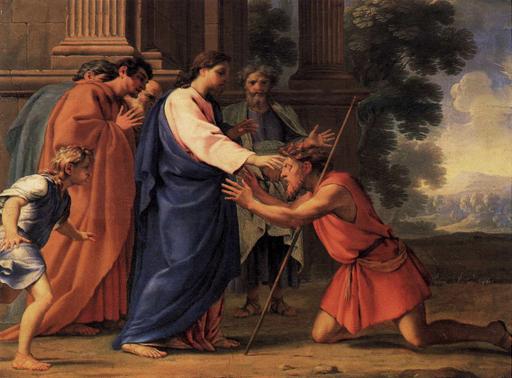
35 As he drew near to Jericho, a blind man was sitting by the roadside begging. 36 And hearing a crowd going by, he inquired what this meant. 37 They told him, “Jesus of Nazareth is passing by.” 38 And he cried out, “Jesus, Son of David, have mercy on me!” 39 And those who were in front rebuked him, telling him to be silent. But he cried out all the more, “Son of David, have mercy on me!” 40 And Jesus stopped and commanded him to be brought to him. And when he came near, he asked him, 41 “What do you want me to do for you?” He said, “Lord, let me recover my sight.” 42 And Jesus said to him, “Recover your sight; your faith has made you well.” 43 And immediately he recovered his sight and followed him, glorifying God. And all the people, when they saw it, gave praise to God.

In the name of Jesus. Amen.

Today, our text has us focus on two cities – Jerusalem and Jericho. Jerusalem was the city chosen by God to be the place where He would dwell with His people (1 Kgs. 8:10-11, 27-30). If anyone sinned; if God’s people were defeated in battle; if there was drought, famine, pestilence, or plague; they would pray toward God’s house in Jerusalem. God would hear their prayer and forgive (1 Kgs. 8:31-53; 9:3-5). According to Scripture, Jerusalem was a city firmly built together, and God’s people would go there to give thanks to God for all the blessings He had given them (Ps. 122:3-4). It was the city of King David, and God had promised that David’s line would never lack a man to sit on the throne as long as David’s sons walked in God’s ways (1 Kgs. 2:4).

Then, there is Jericho. God commanded His people, “Destroy Jericho. Never rebuild it. If anyone tries to rebuild it, I will consider that to be open idolatry and rebellion against Me. In fact, if someone tries to rebuild Jericho, laying the foundation will come at the cost of his firstborn, and setting up the gates will cost his youngest son,” (Jos. 6:2, 26). What happened? God led His people in battle against Jericho and its walls came tumblin’ down. But about 500 years later, Ahab was king of Israel and led God’s people into idolatry, and during Ahab’s reign, a guy named Hiel rebuilt Jericho. The foundation was laid, and his firstborn died. But Hiel kept going and set up Jericho’s gates at the cost of his youngest son (1 Kgs. 16:34). Whenever you read your Bible and come across Jericho after Joshua 6, think of it as ‘sin city’ because it is a city founded on idolatry and rebellion against God, and its very existence is wicked.

The cities of Jerusalem and Jericho could not be more different. But now, look at our text again. Jesus reminds His disciples, “Hey, we’re going up to Jerusalem. There, I’m going to be delivered to the Gentiles to be mocked, shamefully treated, spit upon, flogged, and killed just as the Scriptures said.” In other words, Jerusalem has joined with Jericho and is in open rebellion against God. But Jesus is purposefully going to Jerusalem to bear the curse of our sin (Gal. 3:3).

And to get to Jerusalem, Jesus must first pass through the wicked, cursed city of Jericho. When God gave Joshua the battle plans on how to defeat Jericho, God instructed that His people were to march around the city in silence once each day for six days then seven times on the seventh day. Then, after circling the city seven times, they shouted, and the walls of Jericho fell down flat (Jos. 6:20). Only then did they enter the city and destroyed everyone in it except Rahab and her household.

Here in Luke, it is almost as if Jesus is doing a similar thing. He is passing by (Lk. 18:36), but there is this blind man crying out, “Jesus, Son of David, have mercy on me!” Instead of quietly marching around Jericho, Jesus stops. It’s like Christ can’t help Himself. Even in the cursed city, Jesus doesn’t ignore cries for mercy because He is mercy embodied. He stops, stands still, and asks for the blind man to be brought to Him. There, in the wicked city, King Jesus, the Son of David, makes a kingly offer, “What do you want me to do for you?” Think of all the times throughout the Scriptures, a king will be pleased with someone and make an offer, “Ask me for anything, up to half my kingdom, and I will give it to you.” Here Jesus doesn’t put any limit on the request, “What do you want me to do for you?” The blind man answers, “Lord, let me recover my sight.” And Jesus says to him, “Recover your sight; your faith has made you well (lit. ‘saved you’).” Not only does the man get the sight he asks for, he gets more. Christ gives this resident of wicked Jericho life and salvation.

Dear saints, this same scene played out today just as it does every Sunday you gather here. Jesus comes into the midst of our wickedness. We beggars find ourselves in the presence of Jesus. We cry to Him for His kingly mercy, and Jesus doesn’t simply march around us and pass through. No. He hears your plea. He stops and stands still, and Christ the King answers your plea by absolving and saving you.

Jesus did that then, and He does that now because of what He is about to do in Jerusalem. Jesus could have, and maybe should have, marched around Jerusalem to destroy it with all their wicked plans for Him. But He doesn’t. Instead, He hangs still as He sheds His blood and pours out His mercy for you upon the cross.

Finally, notice the man’s response after his sight is restored. He can go wherever he wants with his new sight and salvation, but with every option open to him, he follows Jesus. The formerly blind man leaves his home in the wicked city of Jericho and follows Jesus to Jerusalem.

As we begin Lent this Wednesday, let us do the same as we follow Jesus as well. Let us abandon our wickedness and follow King Jesus to Jerusalem this Lent. He leads, and we follow with grateful hearts to Jerusalem, to the cross, and to the empty tomb on Easter.

This same King Jesus invites you now to your seat at His table, where He pours His love and mercy into you by giving you His Body and Blood given and shed for the forgiveness of all your sins. Dear saints, your faith in the crucified and risen Jesus has saved you. Amen.

The peace of God, which surpasses all understanding, will guard your hearts and minds in Christ Jesus. Amen.

Rooted – Sermon on Luke 8:4-15 for Sexagesima Sunday

Luke 8:4–15

And when a great crowd was gathering and people from town after town came to him, he said in a parable, “A sower went out to sow his seed. And as he sowed, some fell along the path and was trampled underfoot, and the birds of the air devoured it. And some fell on the rock, and as it grew up, it withered away, because it had no moisture. And some fell among thorns, and the thorns grew up with it and choked it. And some fell into good soil and grew and yielded a hundredfold.” As he said these things, he called out, “He who has ears to hear, let him hear.”

And when his disciples asked him what this parable meant, 10 he said, “To you it has been given to know the secrets of the kingdom of God, but for others they are in parables, so that ‘seeing they may not see, and hearing they may not understand.’ 11 Now the parable is this: The seed is the word of God. 12 The ones along the path are those who have heard; then the devil comes and takes away the word from their hearts, so that they may not believe and be saved. 13 And the ones on the rock are those who, when they hear the word, receive it with joy. But these have no root; they believe for a while, and in time of testing fall away. 14 And as for what fell among the thorns, they are those who hear, but as they go on their way they are choked by the cares and riches and pleasures of life, and their fruit does not mature. 15 As for that in the good soil, they are those who, hearing the word, hold it fast in an honest and good heart, and bear fruit with patience.

In the name of Jesus. Amen.

Today, I’m taking a different approach on how I’m preaching this text. We’ll use the parable and explanation as a lens through which we look at what is happening in this text. You’re all smart people, so I think you’ll catch on pretty quickly.

One day Jesus saw massive crowds coming toward Him. So many had come to listen to Him teach that Matthew actually lets us know that Jesus had to teach from a boat while the crowds listened from the beach (Mt. 13:1-9). But Jesus didn’t see this as just another day at the lake. No. He saw fields that were ripe unto seeding. He saw ground that was ready to be planted with God’s Word. So, Christ reached into His bag and started throwing the good Seed of God’s Word as far and wide as He possibly could.

As He taught, Jesus threw some seed on the path. He noticed that some were not paying much attention. They were nodding off or distracted by one thing or another. They could hear His voice, that wasn’t the issue. But He could tell that the Seed of the Word wasn’t sinking in. Christ wasn’t worried about this. Jesus knew He could get a harvest there, but He didn’t want the Seed to be trampled down or eaten by the birds. So, Jesus took out His plow. He called out, “He who has ears to hear, let him hear.” But even though the plow broke the soil up, it quickly went back to being impermeable. The seed just stayed on the top. And Jesus watched in grief as the birds came and devoured the precious Seed from the soil of the path.

As Jesus taught, He threw some Seed on the rocks. Christ saw that they were joyfully listening and excited to hear. But Jesus also knew their excitement would die down, their joy would fade, and they would soon face times of testing. The Seed Jesus was spreading grew up quickly, but the roots weren’t digging down because of the rocks underneath. Jesus knew the sun would soon come out with its heat. Plants need the sun and its warmth, but if those plants didn’t have roots that could find moisture, they would wither and die. So, Jesus rolled up His sleeves to pick the rock out of that soil. He called out, “He who has ears to hear, let him hear.” But the rocks just kept returning. No matter how many tons of rock Jesus removed, there was always more. And Jesus grieved as the hot sun of those trials beat down on the soil, and the plants withered away before the Word could produce fruit in that rocky soil.

As Jesus taught, He threw some seed among the thorns. Christ saw others who were listening, but those thorns threatened the growth of the precious Seed. Christ knew those listeners would go back to their homes and focus on other things – their jobs, their families, and their houses. Even though Jesus Himself had given those good gifts, He knew that soil loved those thorns more than the Word, and if those thorns weren’t plucked and picked, they would choke out the Seed of the Word. So, again, Jesus rolls up His sleeves to remove those thorns by calling out, “He who has ears to hear, let him hear.” With those words, Jesus carefully and meticulously uprooted the thorns, but they kept coming back. The Seed of God’s Word was there and growing. But Christ mourned as He watched the thorns of the cares, riches, and pleasures of life prevent that soil from producing fruit.

But there was a fourth kind of soil that did produce fruit. In fact, it produced a miraculous harvest of a hundredfold. What made this soil good? Well, we have to remember that there is no soil that is naturally and natively good. No. Jesus, the Sower always tends what He plants with His Word. Everywhere Jesus sows the Word of God will look like an unlikely place to produce fruit, but as He continues to work on the soil, He brings about a harvest by plowing, picking, and plucking the unworthy soil.

Even the twelve disciples were those bad soils. Think of Thomas as the soil of the path. Easter evening, the Gospel Seed was tossed onto Thomas. He heard that Jesus had risen from the dead, but the birds simply devoured that Seed. Thomas refused to be tilled and softened, but Jesus didn’t give up on Thomas. Christ continued to dig His plow into the hard soil of Thomas’ heart. And one week later, Thomas believed and confessed Christ as his Lord and God (Jn. 20:24-28).

Think of Peter as the rocky soil. Peter had been warned about falling into the temptation of denying Jesus three times. Peter needed to produce the fruit of fleeing temptation, but his stone-hard heart didn’t let the roots of Jesus’ warning find the moisture it needed. Peter was withered in the hot sun of that test. Three times Peter denied knowing Jesus (Jn 18:15-18, 25-27). The Seed planted in him got scorched, but Jesus hadn’t given up on Peter either. Christ continued to sow the seed of His Word and remove the rocks from Peter’s heart. Through the labor of Jesus’ sowing and tending the soil of Peter’s heart, Peter was restored and produced great fruit as he later fed, tended, and shepherded Jesus’ lambs (Jn 21:15-19).

Several of the disciples were also the thorny soil. They saw Jesus anointed with expensive ointment shortly before He was arrested and thought it was a complete waste (Mk. 14:3-9). They were choked out by the cares and riches of this life, but Christ didn’t give up on them either. Jesus continued to pull and pluck those thorns by teaching them how that anointing was preparing Him for His burial. The sad reality, though, is that for all of Jesus’ plucking and tending, the soil of Judas Iscariot’s heart still ended up being choked out by the thorns of thirty pieces of silver (Jn. 12:4; Mt. 26:14-16).

Dear saints, all of this is to say that Jesus, the Sower, doesn’t merely scatter the Seed of His Word, walk away, and only come back periodically to see what’s happened with His precious Seed. No! He is the constant gardener. He continually scatters the Seed of His Word which guides, teaches, forgives, feeds, and strengthens you. He also digs and plows to break up the hard soil. He clears the soil of rocks and thorns. Through His Word, He corrects, exhorts, and rebukes. Some of what He does is gentle. He consoles, comforts, and encourages by declaring His love, mercy, and forgiveness. And Jesus constantly guards His field to protect what He has planted (Is. 5:1-7). He does all of this, the planting, the tending, the weeding, and the guarding so that the Seed of His Word gets well-rooted to produce abundant fruit in and through you.

Dear saints, you are God’s children. Through His Word, He gives you an honest and good heart. Yes, you are attacked by the devil, threatened by temptation, and seduced by the cares and riches of this world. But by God’s grace, He will sustain you as He continues to work on you through that same holy and precious Word. May that Word be deeply rooted in each of us today and always. He who has ears to hear, let him hear. Amen.

The peace of God, which surpasses all understanding, will guard your hearts and minds in Christ Jesus. Amen.

Out of the Marketplace & into the Vineyard – Sermon on Matthew 20:1-16 for Septuagesima Sunday

Matthew 20:1–16

1 “For the kingdom of heaven is like a master of a house who went out early in the morning to hire laborers for his vineyard. 2 After agreeing with the laborers for a denarius a day, he sent them into his vineyard. 3 And going out about the third hour he saw others standing idle in the marketplace, 4 and to them he said, ‘You go into the vineyard too, and whatever is right I will give you.’ 5 So they went. Going out again about the sixth hour and the ninth hour, he did the same. 6 And about the eleventh hour he went out and found others standing. And he said to them, ‘Why do you stand here idle all day?’ 7 They said to him, ‘Because no one has hired us.’ He said to them, ‘You go into the vineyard too.’ 8 And when evening came, the owner of the vineyard said to his foreman, ‘Call the laborers and pay them their wages, beginning with the last, up to the first.’ 9 And when those hired about the eleventh hour came, each of them received a denarius. 10 Now when those hired first came, they thought they would receive more, but each of them also received a denarius. 11 And on receiving it they grumbled at the master of the house, 12 saying, ‘These last worked only one hour, and you have made them equal to us who have borne the burden of the day and the scorching heat.’ 13 But he replied to one of them, ‘Friend, I am doing you no wrong. Did you not agree with me for a denarius? 14 Take what belongs to you and go. I choose to give to this last worker as I give to you. 15 Am I not allowed to do what I choose with what belongs to me? Or do you begrudge my generosity?’ 16 So the last will be first, and the first last.”

In the name of Jesus. Amen.

Was this vineyard owner being fair, or was he being merciful? Was he being just, or was he being gracious? As I was preparing for the sermon this week, I came across several sermons that summarized the parable as a dichotomy: “Not fair, but merciful,” or, “Not just, but gracious.” If you think fairness and mercy or justice and grace do not exist together, you are wrong. Just plain wrong.

We must get one thing straight. With this parable, Jesus isn’t giving advice on how to run a business. An economic system where everyone is paid equal wages without considering how much experience they have, the skills required for the position, or the number of hours a person works has been tried. Even when whole governments try to force this type of arrangement in the country, it fails. It fails miserably, and that failure is always accompanied by a lot of suffering and death. But even in a small business, it doesn’t work. There are tons of examples of this, but I was reading about one particular company near London that tried to do this,[1]and the experiment lasted only a year before they had to abandon it and adopt a normal pay scale.

The reason this doesn’t work is companies do not have unlimited, infinite resources. Sure, they might have massive profits and huge budgets, but that doesn’t mean a business can afford to pay everyone equally. Companies always need to be taking in more money than they are spending and paying. If a company doesn’t balance its finances, it won’t be in business for long. A business should pay its employees a fair day’s wage for a fair day’s work. The economy of the marketplace needs to operate on a fair and just scale because it is always dealing in the realm of supply and demand, and supply is always limited.

Now, all of that is just basic economics. But I am not an economist, I don’t play one on TV, and didn’t I stay at a Holiday Inn last night. And this is not an economics lecture; this is a sermon. I only say all of that to set the stage so you can see that the vineyard owner is fair and just as well as merciful and gracious. Through the whole parable, this vineyard owner follows every standard of just of economics.

In Jesus’ day, you didn’t have a 9-5 job; instead, you worked while it was light until it got dark. Because Israel is geographically close to the equator, the workday throughout the year is basically consistent, 6 AM to 6 PM. We don’t have that luxury here in the bitter north. Our shortest day has about 8.5 hours of daylight, and our longest day just over 16 hours. So, this vineyard owner goes to the marketplace to hire workers just before sunrise. In Jesus’ day (and still today), people who didn’t have regular jobs would gather in a certain spot in the marketplace hoping to be hired – even if it was just for a day. The vineyard owner selects some workers and offers them the standard wage for a regular workday – one denarius. Because the arrangement is acceptable to the workers he selects, off to the vineyard they go. They have the confidence and security that they will be able to provide for their family for the day.

About the third hour of the workday, think 9 AM or during the morning coffee break, the owner goes back to the marketplace, and notice how different v. 1 and v. 3 are. In v. 1, he goes to the market to hire workers. But in v. 3, there is no mention of the owner wanting to hire more workers. He simply goes to the marketplace and sees people who are still there hoping to get a job. The owner gives them two things: an invitation and a promise. Listen carefully to what he says, “You go into the vineyard too, and whatever is right I will give you.” This group sees it as a job offer, and since they trust the owner to be a fair and just guy, they go and work in the vineyard.

The owner goes out two more times – the 6th hour (lunchtime), and the 9th hour (afternoon break) – and does the exact same thing. “You go into the vineyard too, and whatever is right I will give you.” And the owner isn’t done visiting the marketplace. He goes again at the 11th hour, right as all the other businesses are getting ready to close up. He finds even more people standing around because no one hired them. Now, the owner simply invites them, “You go into the vineyard too.” They don’t get a promise of getting what is right, fair, or just. They are simply invited to leave the marketplace and go into the vineyard.

Now, the surprises start coming in the parable. Suddenly, there’s a new character, a foreman. Think of him as the manager of the vineyard. Now, why wasn’t this manager going out to hire workers? But we don’t even have time to ponder the question because the next two surprises come so quickly. The owner tells the manager lit., “Call the workers and pay them the wage.” (Our translation makes it sound like the wages are still a secret, but the Greek is clear.) No matter when they arrived in the vineyard, they all are to receive the wageof a full day’s pay. The final surprise comes with the order in which the wage is paid out. The owner decides that the order will be the last get their denarius first and the first will get their denarius last.

Why not do it the other way? Those who agreed for a denarius could get exactly what they bargained for, and every subsequent group would get a surprise that would bring more delight because they worked fewer hours. Everyone would be happy, and it would avoid the trouble of the argument which comes at the end of the parable. We could also ask, when the owner went to the marketplace at the eleventh hour, why didn’t he just toss a denarius to those who were still there? Why go through the trouble of bringing them to the vineyard? The answer to both questions is that the owner wants his grace and mercy to be seen and witnessed by everyone in his vineyard. This vineyard is the place to be. The owner doesn’t want them to have to go back to the marketplace.

Well, the grumbling comes, “These last worked only one hour, and you have made them equal to us who have borne the burden of the day and the scorching heat.” If those grumblers had thought two seconds about what they were saying, they would have realized their complaint roughly means, “This isn’t right, fair, or just. Why are you being gracious and merciful to them? They haven’t deserved it!”

Let me paraphrase the owner’s response, “Um, excuse me? I’ve been completely fair and just with you. Remember our contract this morning? You agreed on a denarius. You have it. It’s yours. You are free to do whatever you want with what is yours. Don’t I have the freedom to do what I want with what is mine? Why does the grace I give to others irritate you? You don’t have any less because I give more to others. I understand that you want to be richer at the end of the day. That’s fine. You are. I have chosen to be poorer at the end of the day. If you don’t like that, you can take what is yours, get out of my vineyard, and go back to the marketplace.”

The parable ends there, and we are left hanging. How did the full-day workers respond? Did they leave the vineyard where the owner runs things with both justice and mercy? We don’t know.

What would you do? Or, more accurately, what are you doing?

Again, this parable is not about companies and businesses who have limited assets. This parable is about the kingdom of your God who has unlimited resources, and the vastness of His resources is only outmatched by His incalculable mercy. There is only one vineyard and one master who is fair and just as well as being merciful and gracious like this. You can certainly return to the marketplace if you want, but there you will only find justice and no mercy.

Dear saints, in the end, there is only One who has worked a full day’s shift – Jesus. Christ has borne the burden and heat of the day. He has come and did the work you could never do. He has fully kept God’s Law and was perfectly obedient to God’s Commands. You get His wages, and this is Jesus’ delight. Christ willingly went to the cross got the wrath and punishment of sin that you deserve. For the joy that was set before Him, He endured the cross for you (Heb. 12:2). Jesus wants to bring you out of the marketplace and into the vineyard. There is no better place to be, but if you don’t like the vineyard, you are free to go.

Christ Jesus invites you to remain in His vineyard and never go back to the marketplace that is empty of mercy and grace. Because of the mercy and grace of God, you are no longer workers being overpaid. You are a member of the kingdom, a child of God, and a brother or sister of Christ. You remain with Him. Not only do you get paid generously; you also have a permanent place and remain in the vineyard.

And secure in His vineyard, Jesus invites you now to a feast at His table where He will give you what is right and just as well as what is merciful and gracious. So, come. Dear saints, when you confess your sins, He is faithful and just to mercifully and graciously forgive you and cleanse you from all unrighteousness (1 Jn. 1:9). Amen.

The peace of God, which surpasses all understanding, will guard your hearts and minds in Christ Jesus. Amen.


Information on the company in London that wasn’t used:

The company started out small, just five people. The owner realized everyone was basically contributing the same, so he talked to his employees, and they all agreed to be paid the same. From the owner himself down to the office assistant, they all received the same amount which is what they all agreed was a ‘decent living wage’ for London. For a while it worked just fine, but as the company grew, this wage model caused all sorts of problems. The company needed to hire more staff because of a higher demand for their services. When they advertised a position for a software developer, they didn’t get applicants because that skill is in high demand and was typically compensated higher than the living wage the company had set. And when they advertised for more another office assistant, they were inundated with applications because the salary was much higher than other companies were offering for the same type of work. In short, the experiment lasted only one year before the company started basing their salaries on experience and expertise.


[1] “CEO Secrets: ‘We tried paying everyone the same salary. It failed.’” https://www.bbc.com/news/business-55800730

Unveiled – Sermon on Exodus 34:29-35; Matthew 17:1-9; and 2 Peter 1:16-21 for the Transfiguration of Our Lord

Exodus 34:29-35; Matthew 17:1-9; & 2 Peter 1:16-21

In the name of Jesus. Amen.

This is a glorious text, but even more glorious is that the beloved Son of God would give His life for you on the cross. Because Jesus has died for you, you, dear saints, will also shine like the sun (Mt. 13:43). To make that point, we’re going to consider all three of our Scripture readings and two other passages, 2 Cor. 3:4-18 and Mt. 13:43. A figure skater or a competitive diver will do a routine with a high degree of difficulty to get a higher score. Hopefully, my execution of the sermon will be good enough that the payoff will be worth it in the end.

A person’s face can tell you a lot. Just to be clear, I’m not talking about the mouth part of a person’s face – of course, the mouth can tell you a lot too. I’m talking about a person’s facial demeanor. Someone could be talking to you in a normal tone, but if you watch their face, you can tell if they are sad or happy, discouraged or excited, heartbroken or twitterpated. Sometimes you just enter a room, and a family member will ask, “What’s wrong?” or, “Why are you so happy?” Your word hole doesn’t have to be operating for your face to say a lot.

Between our Old Testament and Gospel readings today (Ex. 34:29-35 & Mt. 17:1-9), we heard about two different shining faces – Moses’ and Jesus’. And those two shining faces produced two very different responses.

Right before our OT text, Scripture says that Moses had been on Mt. Sinai for forty days and forty nights, and during that time he neither ate bread nor drank water (Ex. 34:28). How Moses survived that, I don’t know. Somehow, God miraculously kept Moses going. After being on a mountain for forty days and nights with nothing to eat or drink, you would expect Moses’ face to be weathered, worn, and weary. But when he arrives back in the camp, Moses’ face was shining because he had been talking with God. This made the people so afraid that they wouldn’t even approach Moses. Now, Moses admits here (because he wrote Exodus) that he had no idea that his face was shining. And this gives us a glimpse into what Moses must have seen and heard during those forty days and nights. Being in God’s presence and talking directly to God was so grand and glorious that the glory Moses saw continued to radiate from his face. And Moses was so used to being in that glory that he didn’t realize his face was shining.

In 2 Cor. 3:4-18, Paul contemplates on this. I would encourage you to read that passage later today, and you might want to turn there because we’re going to come back to it. In 2 Cor. 3:4-18, Paul says that the Law came with such splendor and glory that people were afraid to come near because of Moses’ shining face. Paul goes on to say how much more glorious is the ministry of the Gospel, and we see that glory on the Mount of Transfiguration.

Jesus goes up a high mountain with Peter, James, and John and is transfigured. His clothes become white as light. Moses and Elijah appear and are talking with Jesus. And Jesus’ face shone like the sun. Now, Scripture doesn’t give us the total lumens of Moses’ face compared to Jesus’ face. It is interesting to note that the Greek translation of our Old Testament text uses a word that means ‘glow’ to refer Moses’ face while Matthew here uses the word λάμπω (lampō) which means ‘shine’ to refer to Jesus’ face. So, Moses’ face glowed with a radiant, reflected glory, but Jesus’ face shines like the sun with its own glory.

We do know that Moses’ face was bright enough that people could see it and were afraid, but a thin veil was enough to calm their fears. But here Jesus’ face shines like the sun, and I’m pretty sure a little veil wasn’t going to do much to dim that shining. Despite the brightness and glory, notice that Peter, James, and John don’t ask Jesus to veil His face. Instead, the reaction is completely different. Peter says, “Lord, it is good that we are here. In fact, let’s stay here. I’ll make three tents – one for You, one for Moses, and one for Elijah.” But while Peter is still speaking, the bright cloud of God’s glory overshadowed them, and God the Father said, “This is My beloved Son, with whom I am well pleased; listen to Him.” This terrifies the three disciples, but Jesus came and touched them saying, “Rise, and have no fear.”

In our Epistle text (2 Pet. 1:16-21), Peter reflects on the Transfiguration about thirty years later. There, Peter says that the Transfiguration does show Jesus’ glory, but even more so, it unveils the glory of the Bible. Peter says that it is better for you to have the Scriptures than for you to have witnessed the Transfiguration because every verse of the Scriptures unveils God’s great love for you. The shining face of Jesus points us to the bright lamp of the Scriptures that shines in a dark place. But what is this dark place?

Your initial thought is probably that the lamp of the Scriptures shines in the darkness of this world. The Bible certainly does talk about the world being full of darkness and sin. Psalm 119:105 says, “Your Word is a lamp to my feet and a light to my path.” God’s Word does enlighten this dark world so that we don’t stumble or go the wrong way. But here Peter is talking about a different dark place. He says to pay careful attention to the Scriptures as “a lamp shining in a dark place until the day dawns and the morning star rises” – and catch this – “the morning star rises in your hearts.”

You see, it’s not just the world and things outside of you that are a dark place. Your heart also has a darkness that needs the light of God’s Word. Peter doesn’t use the normal word for ‘dark’ here. The word Peter uses means, “foul and repulsive from a lack of care; neglected and filthy.” Here is the picture: Our sinful hearts are a filthy, murky, dark place. And we do well to pay attention to the Word of God shining in the dirty, neglected, dark place of our heart. When we pay attention to them, the lamp of the Scriptures shines in the darkness of our heart and pierces through the filth inside us. And the Gospel also changes us.

Even though you weren’t a witness to Jesus’ Transfiguration (lit. His ‘metamorphosis’), you have something better. Back to 2 Cor. 3:18, “And we all, with unveiled face, beholding the glory of the Lord, are being transfigured (same word used for Jesus’ transfiguration though the ESV translates it as ‘transformed’) we are being transfigured into the same image from one degree of glory to another.” Even now, already in this life, Christian, you are being transfigured into the same glory that Jesus had on the mountain. God brings about that transfiguration through His Word. By God’s gracious working through His Word, you are slowly being transfigured and metamorphosized into Jesus’ glory.

God has promised that you are being transfigured. And the picture of Jesus on the mountain today is what you are heading toward by the grace of God. In Mt. 13:43, Jesus says that you who are righteous through faith in Him will shine like the sun, just like Jesus did.

So that you could shine like the sun and be like Him, Jesus went down from the mount of Transfiguration. He descended from that glorious peak, so He could ascend another mountain, Mt. Calvary, where He laid down His life for Peter, for Moses and Elijah, and for you. He did this because He loves you and wants you to be transfigured and share in His unveiled glory. Lord Jesus, come soon and bring us to that glory. Amen.

The peace of God, which surpasses all understanding, will guard your hearts and minds in Christ Jesus. Amen.