Ladies and gentlemen, the wonderful Chad Bird…
John 4:5-26 – Well, Well, Well
John 4:5–26 5 So he came to a town of Samaria called Sychar, near the field that Jacob had given to his son Joseph. 6 Jacob’s well was there; so Jesus, wearied as he was from his journey, was sitting beside the well. It was about the sixth hour.
7 A woman from Samaria came to draw water. Jesus said to her, “Give me a drink.” 8 (For his disciples had gone away into the city to buy food.) 9 The Samaritan woman said to him, “How is it that you, a Jew, ask for a drink from me, a woman of Samaria?” (For Jews have no dealings with Samaritans.) 10 Jesus answered her, “If you knew the gift of God, and who it is that is saying to you, ‘Give me a drink,’ you would have asked him, and he would have given you living water.” 11 The woman said to him, “Sir, you have nothing to draw water with, and the well is deep. Where do you get that living water? 12 Are you greater than our father Jacob? He gave us the well and drank from it himself, as did his sons and his livestock.” 13 Jesus said to her, “Everyone who drinks of this water will be thirsty again, 14 but whoever drinks of the water that I will give him will never be thirsty again. The water that I will give him will become in him a spring of water welling up to eternal life.” 15 The woman said to him, “Sir, give me this water, so that I will not be thirsty or have to come here to draw water.”
16 Jesus said to her, “Go, call your husband, and come here.” 17 The woman answered him, “I have no husband.” Jesus said to her, “You are right in saying, ‘I have no husband’; 18 for you have had five husbands, and the one you now have is not your husband. What you have said is true.” 19 The woman said to him, “Sir, I perceive that you are a prophet. 20 Our fathers worshiped on this mountain, but you say that in Jerusalem is the place where people ought to worship.” 21 Jesus said to her, “Woman, believe me, the hour is coming when neither on this mountain nor in Jerusalem will you worship the Father. 22 You worship what you do not know; we worship what we know, for salvation is from the Jews. 23 But the hour is coming, and is now here, when the true worshipers will worship the Father in spirit and truth, for the Father is seeking such people to worship him. 24 God is spirit, and those who worship him must worship in spirit and truth.” 25 The woman said to him, “I know that Messiah is coming (he who is called Christ). When he comes, he will tell us all things.” 26 Jesus said to her, “I who speak to you am he.”
In the name of Jesus. Amen.
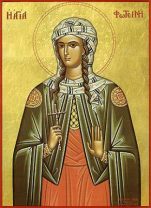 I want to begin today with a side note: Church tradition has some interesting information about this Samaritan woman. Her name is Photini which means “enlightened one.” Just after our text, Photini goes back to her village and invites everyone to come and meet Jesus who she says, “He told me all that I ever did.” The Samaritans meet Jesus and He stays there for two days. The many from the town believe in Jesus as the Savior of the world because Jesus’ words.
Church tradition then says that Photini traveled to Carthage where she continued to tell people about Jesus Christ. Apparently, she even spoke to the Roman emperor Nero’s daughter about Jesus, and Nero’s daughter became a Christian. However, Photini died as a martyr by Nero’s hand in AD 66.
Let’s look at the text:
Last week, we saw Nicodemus, a ruler of the Pharisees, coming to Jesus in the darkness of night. Nicodemus was respectable man; he would be the equivalent of a Supreme Court justice in our time. But Nicodemus comes to Jesus secretly.
Contrast that with this Samaritan woman. First of all, Samaritans integrated the worship of other false, pagan gods with worship of Yahweh (2 Kgs. 17:29-32). Secondly, she was a woman. Rabbis in Jesus’ day taught that men were not to talk to women in public – even their own wives. Third, this particular woman was also an outcast; she comes to the well well [sic] after all the other women would have been there in the cool morning to draw water. She was likely tired of everyone talking about her personal life with her five failed marriages and her current live-in boyfriend.
She comes to the well around noon, in the heat of the day to draw her water. She comes around the bend and finds Jesus sitting there on the well alone, dusty, and tired from His walking. “Give Me a drink,” Jesus says.
 The woman is surprised that Jesus, a Jewish man, would even speak to her. The Samaritans and the Jews didn’t get along. They are your typical Hatfield and McCoy feud. The Samaritans’ temple on Mt. Gerizim (the mountain that the woman refers to later) was destroyed by the Jews in 128 BC. The Samaritans retaliated a few years before Jesus was born by attacking Jerusalem and filling the temple area with the corpses of the dead. The only dealings Jews and Samaritans had were bitter and morbid.
Yet, Jesus says to the Samaritan woman, “Give Me a drink.” But Jesus is more interested in giving this woman the living water she needs than receiving the drink that His tired body needs. Jesus uses His own need to get this woman to realize her need to receive from Him. “If you knew the gift of God, and who it is that is saying to you, ‘Give Me a drink,’ you would have asked Him, and He would have given you living water.”
If she knew the gift of God, she wouldn’t be looking for fulfillment in man after man after man. If she knew the gift of God, she wouldn’t care that her neighbors had cast her out socially and that she was a complete loser in their eyes. If she knew the gift of God, nothing in this whole world would matter, except having Jesus, who gives everything.
John means for us to see this scene as a courtship scene. Now, Jesus isn’t seeking to marry this woman as we think of marriage. He wants this woman to become part of the Church which is His bride. Our marriages aren’t pictures of Christ’s relationship to us, instead the reverse is true. Jesus’ perfect, holy, faithful, grace-filled marriage to the Church is a picture of what our marriages should look like.
Sitting there on Jacob’s well is Jesus – the One greater than Jacob. Jacob had first met his beautiful bride to be, Rachel, at a well (Gen. 29:1ff; also see Gen. 24ff and Ex. 2:15-22). When Jacob saw Rachel, he wept because of her beauty. Jesus sees this woman with all of her sins and flaws, and wants her to believe in Him as the Messiah.
Jacob ended up having to work for fourteen years to marry Rachel. But Jesus, the One greater than Jacob, worked even harder enduring God’s wrath for this Samaritan woman’s sin – and all of mankind’s sin, even yours – to gain for Himself a bride, His Church.
You see, you have been more adulterous than this woman. In fact, you have whored yourself out to all sorts of sins thinking that in them you will find happiness. You are a slut seeking a husband in all the wrong places.
But there is Jesus who is always seeking to be your Husband. He is always true and faithful to you no matter how many other suitors you seek. Jesus has pledged His undying love and faithfulness to you. He invites you to drink from the well of living water which He has dug with His own hands. Though you are a sinner, in the eyes of Jesus you are the bride He desires most. He invites you to “dine at His table and drink from His cup. [In His eyes], you are the fairest of them all, for His kisses of grace have healed your scars, brightened your eyes, and transformed you from a beast to a beauty” (Chad Bird). Amen.[1]
The peace of God, which surpasses all understanding, will guard your hearts and minds in Christ Jesus. Amen.
[1] I am thankful to both a blog post by Chad Bird “Mirror, Mirror on the Wall: Jesus and the ‘Bad’ Samaritan Woman” http://birdchadlouis.wordpress.com/2014/03/18/mirror-mirror-on-the-wall-jesus-and-the-bad-samaritan-woman/ and an article by Dr. Peter J. Scaer “Jesus and the Woman at the Well: Where Mission Meets Worship” Concordia Theological Quarterly Vol. 67:1 January 2003 as inspiration for this sermon.
Mirror, Mirror, on the Wall: Jesus and the “Bad” Samaritan Woman
John 3:1-17 – Born by Water into God’s Kingdom
 John 3:1-17—Now there was a man of the Pharisees named Nicodemus, a ruler of the Jews. 2 This man came to Jesus by night and said to him, “Rabbi, we know that you are a teacher come from God, for no one can do these signs that you do unless God is with him.” 3 Jesus answered him, “Truly, truly, I say to you, unless one is born again he cannot see the kingdom of God.” 4 Nicodemus said to him, “How can a man be born when he is old? Can he enter a second time into his mother’s womb and be born?” 5 Jesus answered, “Truly, truly, I say to you, unless one is born of water and the Spirit, he cannot enter the kingdom of God. 6 That which is born of the flesh is flesh, and that which is born of the Spirit is spirit. 7 Do not marvel that I said to you, ‘You must be born again.’ 8 The wind blows where it wishes, and you hear its sound, but you do not know where it comes from or where it goes. So it is with everyone who is born of the Spirit.”
9 Nicodemus said to him, “How can these things be?” 10 Jesus answered him, “Are you the teacher of Israel and yet you do not understand these things? 11 Truly, truly, I say to you, we speak of what we know, and bear witness to what we have seen, but you do not receive our testimony. 12 If I have told you earthly things and you do not believe, how can you believe if I tell you heavenly things? 13 No one has ascended into heaven except he who descended from heaven, the Son of Man. 14 And as Moses lifted up the serpent in the wilderness, so must the Son of Man be lifted up, 15 that whoever believes in him may have eternal life.
16 “For God so loved the world, that he gave his only Son, that whoever believes in him should not perish but have eternal life. 17 For God did not send his Son into the world to condemn the world, but in order that the world might be saved through him.
In the name of Jesus. Amen.
Along with the rest of the world, we are all perishing. Like the poisonous serpents came into the camp of the Israelites (Nu. 21:4-9), the snake of sin has come and bitten everything in this world. All humanity has been stung with the sting of death, and the countdown to your death began from the moment you existed. Death is hereditary; it is written in your DNA.
As a child of Adam you are a child of sin and death. You slog through this life slowly, steadily marching towards your death. “The wages of sin is death” (Ro. 3:23). Payday is coming, and what you have earned will, finally and ultimately, come to you.
You get little pay advances of death as you journey through this life, and they all serve as reminders of what is coming. An illness is tossed into your tip jar as a reminder that one day your whole body will be broken. You find the loose change of death when someone gossips about you saying, “A real Christian would do such and such.” The world is always ready to hand you a stipend of death along the way – war, famine, and persecution. After months and years filed with despair, a parent, spouse, or sibling dies battling cancer and you hit the jackpot of death. Ultimately, your payday comes and death visits you personally.
As a child of death, you are what you are, and Nicodemus was what he was. Under the cover of the darkness of night, Nicodemus comes to talk with Jesus. He comes in wonder, for no one can do the signs that Jesus does unless God is with him. Nicodemus comes to talk with Jesus, this God-sent Sign-worker, but Nicodemus comes as an unbeliever. That is why Jesus doesn’t dilly-dally. Instead, He moves the conversation directly to the crux of the matter. “Unless you are born from above, you cannot see the kingdom of God.”
The word that gets translated again there in v. 3 almost always means “from above” only rarely does it mean again. Nicodemus wrongly thinks that Jesus means that he must enter his mother’s womb a second time to be born. That is conceivably possible (pun intended); though, I would tend to think very few mothers would allow their children to enter back into their womb a second time.
Jesus speaks to Nicodemus of a different kind of birth, a birth “from above.” But Nicodemus can only think of one type of birth, the natural type. All this talk about a birth that is “from above” is hard for Nicodemus to understand. He can’t even imagine a different type of birth. But this is not surprising because, “The natural person does not accept the things of the Spirit of God, for they are folly to him, and he is not able to understand them because they are spiritually discerned” (1 Co. 2:14).
But Jesus says exactly what this different “from above” type of birth is – a water and Spirit type of birth. Jesus speaks about baptism. Children of God are not born of natural, physical parents. They are born not of the will of flesh, nor of the will of man. They are born of the will of God (Jn. 1:13).
You did not chose to be born physically. No one consulted you about your conception. No one asked you if you were ready to be delivered into this world. But you delivered into this world you were.
In the same way, you do not chose to be born spiritually either. You are dependent upon a birth that comes only from the will of God. In your baptism, God has given you that different kind of birth, that different kind of existence.
Like Nicodemus, we ask, “How can these things be? How can water do such things?” We too come to Jesus in the darkness and night of our own sinful misunderstanding. Jesus says that baptism is not simply water, but water that is connected with the Spirit of God and the Word of God. In the waters of baptism, God gives you the kind of birth He requires. ”The wind blows where it wishes, and you hear its sound, but you do not know where it comes from or where it goes. So it is with everyone who is born of the Spirit.”
Your spiritual birth is all God’s doing. The only part you have to play in your salvation is to benefit from it. God has chosen baptism to “give life to the dead and call into existence the things that do not exist” (Ro. 4:17b). God could have chosen to do it another way, but He chose to do it through baptism – the birth from above of water and Spirit.
 So that you can have this birth, God the Father sent Jesus, His only begotten Son. Jesus was sent to live a sinless life not for Himself, but for you. Jesus was sent so that you should not perish, but have everlasting life. God sent Jesus to die the death you deserve. Jesus was paid your wages of sin. Jesus has been lifted up to die so that all who look on Him might be saved.
And so that you could be connected to Christ’s death, God gives you baptism. In your baptism, the Holy Spirit dragged your sinful flesh back to the cross to kill it. He placed you into the tomb of Christ, and you were born anew with Christ out of the hopelessness of death. Amen.
The peace of God, which surpasses all understanding, will guard your hearts and minds in Christ Jesus, now and forever. Amen.
I AM A VIOLENT MAN
Pastor Riley is always a good read.
Matthew 4:1-11 – Words
Matthew 4:1-11—Then Jesus was led up by the Spirit into the wilderness to be tempted by the devil. 2 And after fasting forty days and forty nights, he was hungry. 3 And the tempter came and said to him, “If you are the Son of God, command these stones to become loaves of bread.” 4 But he answered, “It is written,
“‘Man shall not live by bread alone,
but by every word that comes from the mouth of God.’”
5 Then the devil took him to the holy city and set him on the pinnacle of the temple 6 and said to him, “If you are the Son of God, throw yourself down, for it is written,
“‘He will command his angels concerning you,’
and
“‘On their hands they will bear you up,
lest you strike your foot against a stone.’ ”
7 Jesus said to him, “Again it is written, ‘You shall not put the Lord your God to the test.’ ” 8 Again, the devil took him to a very high mountain and showed him all the kingdoms of the world and their glory. 9 And he said to him, “All these I will give you, if you will fall down and worship me.” 10 Then Jesus said to him, “Be gone, Satan! For it is written,
“‘You shall worship the Lord your God
and him only shall you serve.’”
11 Then the devil left him, and behold, angels came and were ministering to him.
In the name of Jesus. Amen.
Find a Bible, and open it to 1 Jn. 2:16, the ESV translates it this way,”For all that is in the world—the desires of the flesh and the desires of the eyes and pride of life—is not from the Father but is from the world.” Notice how that follows the pattern of our Old Testament text: Gen. 3:6, “So when the woman saw that the tree was good for food [desires of the flesh], and that it was a delight to the eyes [desires of the eyes], and that the tree was to be desired to make one wise [pride of life]…”
Notice that because that same pattern is followed in the three temptations in our Gospel text.
Today’s Gospel text comes immediately after the account of Jesus’ baptism. The Holy Spirit who had descended upon Jesus like a dove now leads Jesus up into the wilderness in order to be tempted by the devil. Jesus looks wholly unprepared for this battle with Satan. Jesus does not go out with legions of angels to face Satan. He doesn’t even go out with His little, loyal band of disciples. Jesus is in the wilderness with no gear to help Him build shelter and find food. Jesus doesn’t even eat; instead, He fasts forty days and forty nights. In the wilderness, He is exposed and vulnerable.
But in reality, Jesus is playing offense. Jesus enters the wilderness with the only weapon that will have any effect against sin, death, and the devil. He goes out armed with the Father’s words recorded just before our text (Mt. 3:17), “This is My beloved Son, with whom I am well pleased.”
Satan comes to cast doubt on those very words of God. “If You are the Son of God.” This is the very same trick of the devil in the Garden of Eden. Gen. 3:1, “Did God actually say, ‘You shall not eat of any tree in the garden’?” Satan seeks to arouse the desires of the flesh in order to cause doubt upon the Word of God.
Satan’s words to both Eve and Jesus sound good and right, “Doesn’t God want you to have food? Do you think that if God really loved you that you go through life hungry like this?” Eve fell for the trick, and she dragged all of us into bondage from which we will never set ourselves free. But Jesus, faced with the same temptation, comes out victorious.
Jesus takes what is wrong with us – our mistrust in God’s provision, our unbelief that God will care for us, and our doubt in the promises of God – and strikes back with the promise of God, “Man shall not live by bread alone, but by every word that comes from the mouth of God.” Jesus triumphs over the desires of the flesh.
Satan takes Jesus to the pinnacle of the Temple and tries to cast doubt upon the Word of God again, “If you are the Son of God, throw Yourself down. God won’t let You get hurt. He will send His angels to protect You since You are so important.” Satan seeks to stir up the desires of the eyes. Satan tempts Jesus to see if God will really protect Him.
Jesus, again, takes what is wrong with us – our desires to see some fantastic miracle, our desires to see God act in some special way towards us – and He strikes back with the Word of God, “You shall not put the Lord your God to the text.” Jesus triumphs over the desires of the eyes.
Satan then takes Jesus to a mountain to show Him all the kingdoms of this world and their glory. Satan tells Jesus, “All these I will give you, if you will fall down and worship me.” Satan seeks to stir up the pride of life. Satan tells Jesus, “You can be king of the lot, Jesus. All the power that is mine I will put at Your disposal. The two of us together can hardly fail, if You will only do things a bit more my way” (Nagel).
But Jesus, again, takes what is wrong with us – our pride, our desire to be like God and control our own destiny – and strikes back with the Word of God, “Be gone, Satan! For it is written, ‘You shall worship the Lord your God and him only shall you serve.’“ Jesus triumphs over the pride of life.
Your Savior triumphs over the devil, the world, and sin. You have a Messiah who defeats the desires of the flesh, who casts down the desires of the eyes, who is victorious over the pride of life. And He does it all for you.
Do you see what Jesus did by winning this battle against Satan? He completely reversed the Fall of Adam and Eve. Our Epistle text (Ro. 5:12-19) says that Adam was a type of the One who was to come; that’s Jesus, the new Adam who brings life to all mankind. Look at Ro. 5:18 and let me fill in a few of the blanks there, “As Adam’s trespass led to condemnation for all men, so Christ’s act of righteousness leads to justification and life for all men.”
 Christ has defeated the enemy; He has crushed Satan’s head. And Jesus’ victory is your victory. Everything that Christ has done is credited to your account as though you have done it yourself.
You will be tempted, and you will fall into sin. However, when you fall prey to the temptations of sin flee to Jesus who has already defeated Satan. Repent and return to Christ. “[Jesus] who was tempted for you is never tempted to turn you away. [Jesus’] baptism is your baptism, His conquering of sin is your conquering of sin, His crucifixion, His resurrection, His ascension are all yours. What belongs to the Head belongs to the body, and you are the body of Christ” (Chad Bird). Amen.
The peace of God which surpasses all understanding will guard your hearts and minds in Christ Jesus. Amen.
Matthew 17:1-9 – Wherever Jesus Is, There Is God’s Glory
Matthew 17:1-9—And after six days Jesus took with him Peter and James, and John his brother, and led them up a high mountain by themselves. 2  And he was transfigured before them, and his face shone like the sun, and his clothes became white as light. 3 And behold, there appeared to them Moses and Elijah, talking with him. 4 And Peter said to Jesus, “Lord, it is good that we are here. If you wish, I will make three tents here, one for you and one for Moses and one for Elijah.” 5 He was still speaking when, behold, a bright cloud overshadowed them, and a voice from the cloud said, “This is my beloved Son, with whom I am well pleased; listen to him.”
6 When the disciples heard this, they fell on their faces and were terrified. 7 But Jesus came and touched them, saying, “Rise, and have no fear.” 8 And when they lifted up their eyes, they saw no one but Jesus only.
9 And as they were coming down the mountain, Jesus commanded them, “Tell no one the vision, until the Son of Man is raised from the dead.”
In the name of Jesus. Amen.
Today is the last Sunday before Lent begins, and today we are invited to the Mount of Transfiguration. On that mountain, God wants to reveal Jesus.
Imagine Jesus’ metamorphosis. The glory of Jesus, the Son of God, broke through His physical body. Jesus in His flesh and bone shined like the sun. Glory broke through His drab clothes so they became white as light. Jesus doesn’t cast shadows, He casts light. Imagine the signs and wonders as Moses and Elijah appear with Jesus. See the dazzling cloud emitting photons. Hear the thundering voice of God, “This is My beloved Son, with whom I am well pleased; listen to Him.”
As awesome as the Transfiguration is, do not think of this in a wrong way. Do not think that this transfigured Jesus is the real Jesus – the heavenly, glorified Jesus – and that rest of the Gospels show a drab, earthly Jesus. Don’t think that way.
Transfigured Jesus is the same Jesus who called Zacchaeus to come down from his tree. Transfigured Jesus is the same Jesus who went off by Himself to pray. Transfigured Jesus is the same Jesus who fell asleep on a cushion in the back of the boat. Transfigured Jesus is the same Jesus who sat down by a well to rest. Transfigured Jesus is the same Jesus who was wrapped in swaddling cloths and laid in a manger. Transfigured Jesus is the same Jesus who was beaten, whipped, stripped, tacked to a cross, killed, and buried.
The Transfiguration is a reminder that wherever Jesus is, there is the glory of God – even if it is hidden. The glory of God in Jesus remains even when you don’t see it. The Transfiguration is a wonderful scene and is meant to amaze you. It is meant to encourage you for what is coming through Lent.
The Transfiguration happened just six days after Jesus explained to the disciples that He must go to Jerusalem to suffer, die, and rise again. Peter had rebuked Jesus for saying that, and Jesus harshly rebuked Peter for questioning Him, “Get behind me Satan.” Jesus says He must suffer and die, and the voice of God speaking out of the cloud commands Peter and you and I to shut up and listen to Jesus.
The glory of Jesus in the Transfiguration is what is in store for you, believer. In your baptism, God clothed you in Christ (Gal. 3:27). You are God’s children now, and what you will be has not yet appeared; but know that when Jesus appears you will be like him because you shall see Him as He is (1 Jn. 3:2). When Christ who is your life appears, then you also will appear with Him in glory (Col. 3:4).
The Transfiguration reveals what Jesus does for you. The Transfiguration is meant to comfort you and sustain you reminding you what Jesus’ work is going to accomplish. That is why Jesus tells Peter, James, and John, “Tell no one the vision, until the Son of Man is raised from the dead.” But there is still another mountain to climb – Mount Calvary.
Jesus brings you to His glory by entering your shame. Jesus will clothe you in His brightness by being clothed in your sin. Jesus will make you children of God by becoming an orphan who cries out, “My God, My God, why have You forsaken Me?”
The same face that shined like the sun is the same face that will be spat upon in Jerusalem. The clothes that shined white as light will be stripped to leave Jesus dying naked. The voice that cried out, “It is finished,” also says to you even now, “Rise, and have no fear.”
Wherever Jesus speaks, there He is. Wherever Jesus has promised to be, there He is. Sometimes He appears gloriously; sometimes He is hidden. But even when Jesus’ glory is hidden, the glory remains.
 The same Jesus who was transfigured on one mountain and died on another is the Jesus here, present today. The same flesh and blood Jesus comes to you today in radiant, dazzling glory hidden in bread and wine. He has not left you as orphans wandering in this world of sin helpless, poor, and despairing. He is here.
Have a glorious Lent. Amen.
The peace of God, which surpasses all understanding, will guard your hearts and minds in Christ Jesus. Amen.
Matthew 5:33-48 – You Heard (Part II)
Matthew 5:33-48—”Again you have heard that it was said to those of old, ‘You shall not swear falsely, but shall perform to the Lord what you have sworn.’ 34 But I say to you, Do not take an oath at all, either by heaven, for it is the throne of God, 35 or by the earth, for it is his footstool, or by Jerusalem, for it is the city of the great King. 36 And do not take an oath by your head, for you cannot make one hair white or black. 37 Let what you say be simply ‘Yes’ or ‘No’; anything more than this comes from evil.
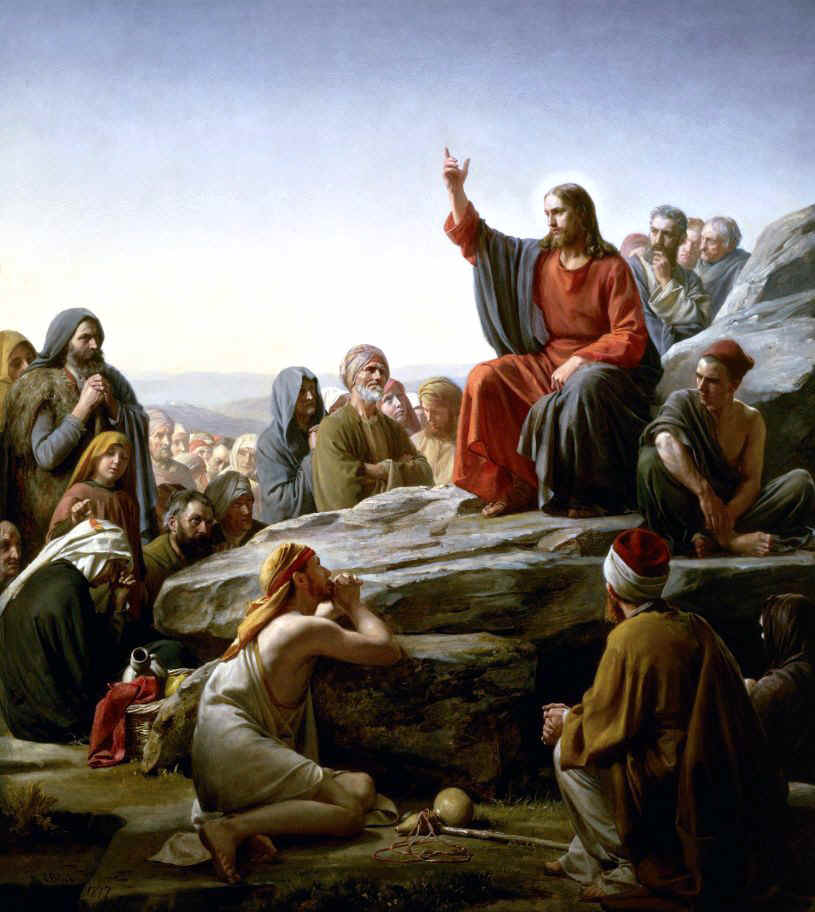
38 “You have heard that it was said, ‘An eye for an eye and a tooth for a tooth.’ 39 But I say to you, Do not resist the one who is evil. But if anyone slaps you on the right cheek, turn to him the other also. 40 And if anyone would sue you and take your tunic, let him have your cloak as well. 41 And if anyone forces you to go one mile, go with him two miles. 42 Give to the one who begs from you, and do not refuse the one who would borrow from you.
43 “You have heard that it was said, ‘You shall love your neighbor and hate your enemy.’ 44 But I say to you, Love your enemies and pray for those who persecute you, 45 so that you may be sons of your Father who is in heaven. For he makes his sun rise on the evil and on the good, and sends rain on the just and on the unjust. 46 For if you love those who love you, what reward do you have? Do not even the tax collectors do the same? 47 And if you greet only your brothers, what more are you doing than others? Do not even the Gentiles do the same? 48 You therefore must be perfect, as your heavenly Father is perfect.”
In the name of Jesus. Amen.
Jesus continues to authoritatively preach today. Some of the words of Jesus in our text have become very well known – even if they aren’t directly quoted from Jesus. “Let your ‘yes’ be ‘yes,’ and your ‘no’ be ‘no.’” “Turn the other cheek.” “Go the extra mile.” “Love your enemies.” These sayings have become clichés and have lost most if not all of their bite.
The typical response we have to these commands from Jesus is to undermine them. We try to find excuses to get around, over, or under them. We avoid them at all costs thinking, “Jesus couldn’t really expect me to be so gullible as to turn the other cheek. Jesus couldn’t really expect me and that vulnerable, could He? I’d get walked all over. Jesus couldn’t really mean to give to everyone who begs and wants to borrow, could He? If I followed Jesus’ commands here, I’d be beaten, naked, and broke. Jesus must be speaking figuratively here, right? Jesus knows that I have a right to protect myself. He knows that I have a right to my own things.”
But then Jesus has got you right where He wants you. You must remember that you are a creature, created by God, and as such you have no rights. Creatures do not have rights, plain and simple. And we resist being creatures because creatures do not have rights. In its simplest form, sin is denying our creatureliness, and making little gods out of ourselves. We, discontent with our creatureliness want to be like God. We put our fear, love, and trust in ourselves.
That is why so much of the world around us loves to accept the false teachings of the big bang, evolution, and things like that. If we are not creatures, then we are our own gods. Creatures are not their own; they are the property of their Creator. The sooner we learn that and live that out, the better.
Once we understand the truth that we are given everything – and I mean everything – as a gift, all sorts of things fall into place.
Creatures receive everything as a gift from the Creator. Your life is not your own. Your body is not your own. Your things are not your own. They are all gifts given to you by God the Father.
Based on this fact, Jesus can command you, “Do not take an oath at all. Do not take an oath by heaven, for it is the throne of God, or by the earth, for it is His footstool. Do not take an oath by your head because you cannot do even as simple a thing as make one single hair white or black.”
Jesus can command you, “Do not resist the one who is evil. If anyone wrongs you, remain vulnerable and turn the other cheek. Your cheeks are not your own anyway.”
People will take advantage of you. You will persecuted for living this way. Persecution will come in many different forms. You might not be nailed to a cross or thrown to wild animals for living this way. You might not be placed in front a firing squad. Christians in other lands have that persecution, but you will be persecuted here too. The persecution of death might be easier to face than the constant ridicule and scorn and loathsome pity that the world throws at you. You are called by God to fight the battle against the world and Satan in the persecutions that do come your way.
Jesus says that when people take advantage of you, when they persecute you, “Love your enemies and pray for those who persecute you.” Love the people who hate you because if you only love the people who love you, then you will only love yourself, and you have fallen back into the error of being your own god.
In the final words of our text, Jesus sums it all up, “You therefore must be perfect as your heavenly Father is perfect.” Pause here:
This translation of “perfect” leaves something to be desired. When Jesus hung on the cross, before He gave up His spirit,  He cried out the same word. There it gets translated, “It is finished” (Jn. 19:30). The word means “whole,” “total,” “complete.” If you want to show that you are sons and daughters of God the Father, which He has said you are, you must be “complete.”
You will never be this on your own. You will always be found lacking. But if God the Father is your Father – and He declares that He is your Father – then He will make you, His child, whole, total, and complete. God does not have children that are anything less than complete. God will make you complete in Christ. He does this now by faith alone that He gives you. This faith receives the Word of God and says, “Yes, this Word of God, both Law and Gospel, is true and good.”
Hebrews 12:2 says that Jesus is the founder (beginning) and perfecter (same word, completer) of your faith. He endured the cross that you and I nailed Him to as His sinful enemies.
When you, sinner, struck Jesus on the cheek, He turned His back to you and you whipped Him. But Jesus didn’t stop there. After He was whipped, He turned His hands and feet to sinners and received nails, then He turned His side and was pierced. Jesus turned His whole life over to you, His enemy, and was killed. While you did all of that, He prayed, “Father forgive them.” All of this He did in love for you so that you could be children of your Father who is in heaven. Amen.
May the peace of God which surpasses all understanding guard your heart and mind in Christ Jesus. Amen.
Matthew 5:21-32 – You Heard (Part I)
Listen here.
Matthew 5:21-32—“You have heard that it was said to those of old, ‘You shall not murder; and whoever murders will be liable to judgment.’ 22 But I say to you that everyone who is angry with his brother will be liable to judgment; whoever insults his brother will be liable to the council; and whoever says, ‘You fool!’ will be liable to the hell of fire. 23 So if you are offering your gift at the altar and there remember that your brother has something against you, 24 leave your gift there before the altar and go. First be reconciled to your brother, and then come and offer your gift. 25 Come to terms quickly with your accuser while you are going with him to court, lest your accuser hand you over to the judge, and the judge to the guard, and you be put in prison. 26 Truly, I say to you, you will never get out until you have paid the last penny.
27 “You have heard that it was said, ‘You shall not commit adultery.’ 28 But I say to you that everyone who looks at a woman with lustful intent has already committed adultery with her in his heart. 29 If your right eye causes you to sin, tear it out and throw it away. For it is better that you lose one of your members than that your whole body be thrown into hell. 30 And if your right hand causes you to sin, cut it off and throw it away. For it is better that you lose one of your members than that your whole body go into hell.
31 “It was also said, ‘Whoever divorces his wife, let him give her a certificate of divorce.’ 32 But I say to you that everyone who divorces his wife, except on the ground of sexual immorality, makes her commit adultery, and whoever marries a divorced woman commits adultery.”
In the name of the Father, Son, and Holy Spirit. Amen.
Fifty days after the Angel of Death passed over the land of Egypt killing every firstborn who was not protected by the blood of the lamb, God descended upon Mount Sinai (Ex. 19:1ff). God spoke to Moses, “Behold, I am coming to you in a thick cloud, that the people may hear when I speak with you.” The mountain was wrapped in smoke because Yahweh had descended upon the mountain in fire. Smoke went up like a kiln, and the whole mountain shook, and the people trembled.
God commanded that limits be set around the mountain so the people would not go up. In fact, God commanded that anyone who touched the mountain should be killed – either stoned or shot.
Then God spoke for all the people to hear, “I am Yahweh your God, who brought you out of the land of Egypt, out of the house of slavery.
- “Thou shalt have no other gods before Me.
- “Thou shalt not take the Name of the Lord thy God in vain; for the Lord will not hold him guiltless that taketh His Name in vain.
- “Remember the Sabbath day, to keep it holy.
- “Honor thy father and thy mother, that thy days may be long upon the land which the Lord thy God giveth thee.
- “Thou shalt not kill.
- “Thou shalt not commit adultery.
- “Thou shalt not steal.
- “Thou shalt not bear false witness against thy neighbor.
- “Thou shalt not covet thy neighbor’s house.
- “Thou shalt not covet thy neighbor’s wife, nor his manservant, nor his maidservant, nor his cattle, nor anything that is thy neighbor’s.”
As God spoke these words, the people were terrified. They feared the thunder, the flashes of lightning, and the sound of the trumpet of God. They said to Moses, “Do not let God speak to us, lest we die” (Ex. 20:19).
But Moses told the people, “Do not fear, for God has come to test you, that the fear of Him may be before you, that you may not sin.” The people stood far off from the mountain backing away from the presence of God, but Moses drew near to the thick darkness where God was (Ex. 20:21).
Moses and the people heard the same voice of God. They saw the same terrifying signs in the sky and on the earth. Everyone retreated from the mountain – except Moses. Moses went up to the thick darkness where God was.
Now Jesus is up on a mountain. Jesus speaks with the voice of God thundering against sin. Yes, Jesus is against sin. Some might even argue that the Son of God is harsher against sin than the Father. But all Jesus is doing is revealing God’s intention with regard to the Commandments.
The people listening to Jesus knew the Ten Commandments. They could recite them. But they had thought they could deflect the Law’s accusations off of them and remain mostly clean. But Jesus opens up the Commandments to their full condemning weight. Anger is murder. Insults condemn to hell. Looking is adultery. Divorce even causes innocent parties to sin. Jesus takes the Law and preaches it in its harshest form. Jesus uses the Law to condemn everyone.
You too are condemned by the Law Jesus preaches here. Do not think that you are not guilty of murder simply because you have not actually killed someone. You have killed in year heart many times. Do not think that because you have not had an affair that you are innocent of adultery. Do not even think that if you avoid pornography that you aren’t looking with lust. Do not think that your love for your spouse is pure. You hold grudges and do now love sacrificially. Your sin is more a part of you than you realize.
Sin is serious. Jesus says sin is serious enough that you should cut off body parts to avoid it. But you cannot cut enough of your body off. Your might be able to hide your sin so that it is not visible to others, but it is not hidden from God. You deserve hell. Your situation really is that bad. And if you don’t realize that, than Jesus has nothing to preach to you but Law.
If you can hear these words of Christ and not be pierced to the heart, if God’s holy presence on the mountain with thunder, lightning, and quaking does not strike fear into your soul, than you can go on your ignorant, merry little way. Mount Sinai is the only mountain of God for you, and it will always be covered in thick darkness. It will always thunder and shake against you.
But if Jesus’ words of Law from the mountain strike you and make you shudder, if you fear God and His wrath against your sins, then let me tell you about another mountain.
Jesus Himself quietly ascended it. Jesus climbed this mountain bearing your sins, and He hung on a cross for those sins. On Golgotha, God poured out His wrath in against your sin in thunderings, earthquakes, and darkness. Jesus endured the wrath of God against your sin so that you could stand righteous and holy before God.
Because He loves you, God will not let you remain in bondage and slavery to sin. The Law leaves you nowhere to run to, nowhere to hide. As you hear the Law, you find that God approaches with His wrath against your sin. He leaves you no escape. You find that God’s Law has backed you into death’s corner. The Law has removed any excuse for your sin and forces you to face Him.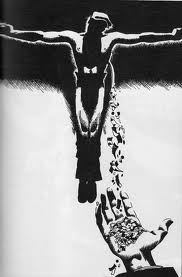
When you face Him, you find that He is the Savior from death. Fellow sinners, this is the Gospel. Jesus comes to you this morning. He comes to you to speak His words of comfort. He comes to you to say that God’s thunder is gone. The storm of wrath against sin is over, it has passed. You are no longer a slave to sin.
Remember how at Mount Sinai the people backed away from God while Moses approached the thick darkness? You see, Moses that he did not need to fear the God of thunder and thick darkness because that was the God who had delivered him and all of Israel out of Egypt out of the land of slavery. The God in the darkness was the God who passed over Egypt that night when terror and death filled the houses where no blood covered the doorposts. The God speaking His commands was the God who parted the Red Sea so the people could escape the deadly armies of Pharaoh.
Moses knew that the God hidden in thunder and darkness was the God who is “merciful and gracious, slow to anger, and abounding in steadfast love and faithfulness, keeping steadfast love for thousands, forgiving iniquity and transgression and sin” (Ex. 34:6b-7a).
When you hear Jesus preaching the Law and convicting you of sin, remember that He is the very one who suffered and died for that sin. Your sin can no longer destroy you. “Sin can no more destroy [you] than it can destroy Christ. He has answered for it all. You are free” (Dr. Norman Nagel) Amen.
May the peace of God which surpasses all understanding guard your heart and mind through faith in Christ Jesus. Amen.
Matthew 5:13-20 – You Are
Listen here.
Matthew 5:13-20—“You are the salt of the earth, but if salt has lost its taste, how shall its saltiness be restored?  It is no longer good for anything except to be thrown out and trampled under people’s feet.
14 “You are the light of the world. A city set on a hill cannot be hidden. 15 Nor do people light a lamp and put it under a basket, but on a stand, and it gives light to all in the house. 16 In the same way, let your light shine before others, so that they may see your good works and give glory to your Father who is in heaven.
17 “Do not think that I have come to abolish the Law or the Prophets; I have not come to abolish them but to fulfill them. 18 For truly, I say to you, until heaven and earth pass away, not an iota, not a dot, will pass from the Law until all is accomplished. 19 Therefore whoever relaxes one of the least of these commandments and teaches others to do the same will be called least in the kingdom of heaven, but whoever does them and teaches them will be called great in the kingdom of heaven. 20 For I tell you, unless your righteousness exceeds that of the scribes and Pharisees, you will never enter the kingdom of heaven.”
In the name of the Father, Son, and Holy Spirit. Amen.
People talk. People talk differently. Some people talk more than others, and some less. Some people talk and cannot help but be funny, and some can’t be funny no matter how hard they try. Some people talk so vividly that they paint pictures in your brain, and some talk blandly. Some people talk timidly and shyly, and some people talk with authority. When someone talks with authority, you tend to listen. But people can talk with authority even though they have absolutely no idea what they are speaking about.
I’ll admit that I have found myself talking as though I had authority about something. But I learn that the person to whom I am speaking actually is an expert. In those instances, I have learned that foot fits in my mouth very well.
In today’s Gospel text, Jesus is preaching what is known as “The Sermon on the Mount” and we will be considering the first chapter of this sermon (Mt. 5) over the next three weeks.
Before we get into the sermon, I want you to consider for a moment how the crowds of disciples respond to Jesus’ sermon. Matthew records (Mt. 7:28-29), “When Jesus completed these words, the crowds were being astonished at His teaching, for He was teaching them with the conviction that He had authority, and not as their scribes taught” (trans. Dr. Jeffrey Gibbs). Jesus speaks with authority because Jesus knows what He is talking about. Jesus could speak with authority on any subject. But in this particular portion of the sermon, Jesus is speaking about His disciples. Jesus is speaking about you, believer.
When Jesus says something about you, it is important to listen. So what is Jesus saying about you, believer? Well, to understand our text today, we need to go back a few verses to the beginning of the Sermon on the Mount – to the Beatitudes.
In the Beatitudes, Jesus gives you blessings. Listen to what He says.
“Blessed are the poor in spirit, for theirs is the kingdom of heaven.” In other words, Jesus says that people who have nothing to offer God and can never get their act together, these people are blessed. They are so blessed they are saved – the reign of heaven is theirs. All the gifts of the King – forgiveness, life, identity, community – all belong to people who have nothing to give God.
“Blessed are those who mourn, for they shall be comforted.” Jesus says that people who are sad because they see that the earth is rotting and dark, they are blessed. They are blessed because, one day, God will take all their sadness and mourning away.
“Blessed are the meek, for they shall inherit the earth.” People who are powerless are blessed because they will get to live forever in God’s new heaven and new earth.
“Blessed are those who hunger and thirst for righteousness, for they shall be satisfied.” People who know things are not right in the world are blessed. They are blessed because God will one day make it right.
Do you hear this? Well, keep listening. Jesus goes on.
“Blessed are the merciful, for they shall receive mercy.” Merciful people are blessed because they will get God’s mercy on the last day. God will cover their sins.
“Blessed are the pure in heart, for they shall see God.” People who have their hearts set on God the Father, Son and Holy Spirit and on no other false god will be blessed. They will see God face to face.
“Blessed are the peacemakers, for they shall be called sons of God.” People who make peace will be called God’s sons and daughters because God gives them peace.
“Blessed are those who are persecuted for righteousness’ sake, for theirs is the kingdom of heaven.” Jesus says that when this world hassles you and persecutes you, you are blessed. Then to make sure you know that all these blessings are for you, Jesus adds, “Blessed are you when others revile you and persecute you.” You are blessed because God’s eternal, kingly gifts belong to you.
Do you hear this? Jesus is talking to you. Jesus is talking about you. Believe Him. He speaks with authority. God does not lie. When God speaks, He only speaks the truth. Jesus, the Son of God, speaks about how things really are. In fact, God’s Word creates reality.
So now, we come to v. 13-14 and Jesus is still speaking with authority. He says, “You are the salt of the earth. You are the light of the world.” Notice, this is not a command. This is not an exhortation. This is not a scenario you are to make happen. Jesus simply says what is. Believe Him. Jesus is not yanking your chain. He is not trying to make a fool out of you. Jesus is simply saying what is. He says, “You are the salt of the earth. You are the light of the world.”
The earth is in bad shape, it leaves a bad taste in everyone’s mouth. The earth needs salt. Jesus says that you, believer, are that salt. The world is a dark place. This world needs light. Jesus says you, believer, are that light.
Even though Jesus speaks with authority you can, of course, chose to not believe Jesus. You can chose to deny the truth. But then things become pretty absurd. Jesus addresses this. He postulates, “What would happen if salt lost its taste? Well, then it is good for nothing but to be cast out and be trampled by people.” That does not sound good.
Jesus says, “You cannot hide a city on a hill.” Being residents of the Red River Valley, you may not know what hills are. They are places where the ground actually rises up kind of like the dike, but even bigger. If you built a city on one of those, it would be pretty hard to hide, right?
Jesus goes on, “How silly would it be to light a lamp in a dark house and then put a bucket over it?” Well, that would be dangerous. It would be foolish and dumb.
So, don’t be absurd. Believe Jesus when He says, “You are the salt of the earth.” Don’t be foolish and dumb. Believe Jesus when He says, “You are the light of the world.”
Jesus says you are salt and light in order to make a difference in the world. Jesus says that your good works are like light in the darkness of this world. Those good works give the world light to see what God is like. When people, believers or unbelievers, see your good works, they will give God the glory.
Jesus doesn’t give you any parameters of what good works to do. Jesus doesn’t give you any specific works to do, so the door is wide open. You don’t have to look far to find places to do good works. Maybe it will be in your own home, maybe it will be in your job, maybe it will be for a friend, maybe it will be for a total stranger – you can find good works to do all around you no matter where you are.
Jesus does give a command here. Our translation renders Jesus’ words in v. 16, “Let your light shine.” That translation makes the word ‘let’ or ‘allow’ the command. It puts the command on you. But do not think that it is somehow up to you to somehow allow your light to shine. No, Jesus’ command here is not to you – the Greek is very clear. The command is “shine,” literally “Shine the light of you.” It is a good thing that Jesus speaks His command to your light because you already know that light obeys the voice of God. When God created the world He said, “Let there be light,” and there was light (Gen. 1:3). Here Jesus, the Son of God, commands the light within you to shine, and it does.
So, even though you are part of this dark world and even though you are part of the problem, Jesus’ words still have authority. Even though your sin casts darkness all around you. Jesus is the true light who comes to the darkness of this sin-filled world (Jn. 1:4-5). Even though you love the darkness rather than the light because your deeds are evil (Jn. 3:19), Jesus says that you, believer, are the light of the world.
It is pretty easy to despair when you hear Jesus command your light to shine. It is easy to hunger and thirst for your light to shine because so often you see that it does not. It is easy to mourn and weep because you cast such long and dark shadows. It is easy to realize that you fail precisely because you are poor in spirit.
But when that happens, remember Jesus’ words. “You are blessed. You are blessed because I give you forgiveness, life, and salvation.” And believe Jesus when He declares, “You are the salt of the earth. You are the light of the world.” Amen.
May the peace of God which surpasses all understanding guard your hearts and minds in Christ Jesus, now and forever. Amen.
 Pastorsamwise
You must be logged in to post a comment.