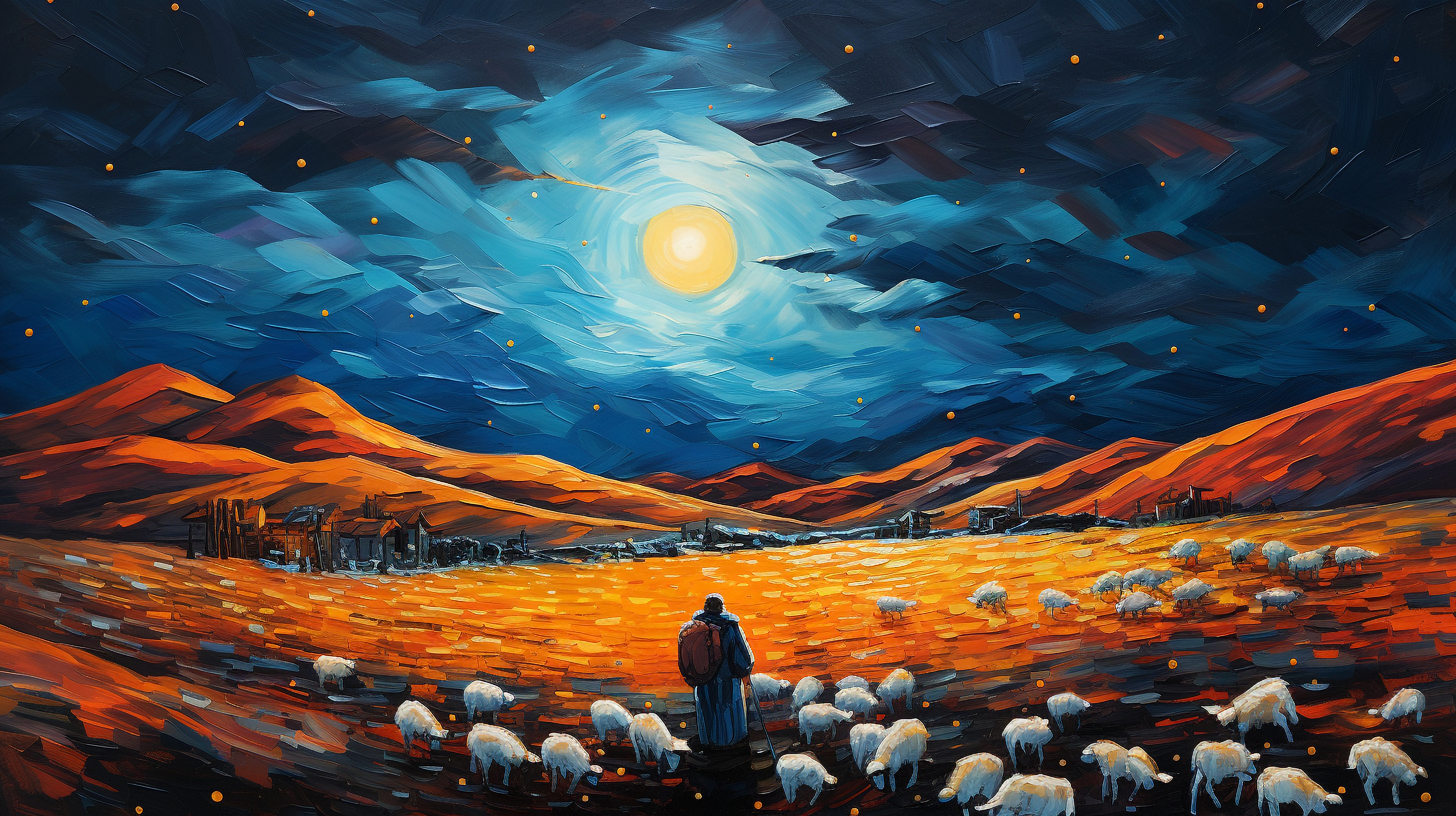
Pleased – Sermon on Luke 2:1-20 for Christmas Eve 2024

Luke 2:1–20

1 In those days a decree went out from Caesar Augustus that all the world should be registered. 2 This was the first registration when Quirinius was governor of Syria. 3 And all went to be registered, each to his own town. 4 And Joseph also went up from Galilee, from the town of Nazareth, to Judea, to the city of David, which is called Bethlehem, because he was of the house and lineage of David, 5 to be registered with Mary, his betrothed, who was with child. 6 And while they were there, the time came for her to give birth. 7 And she gave birth to her firstborn son and wrapped him in swaddling cloths and laid him in a manger, because there was no place for them in the inn. 

8 And in the same region there were shepherds out in the field, keeping watch over their flock by night. 9 And an angel of the Lord appeared to them, and the glory of the Lord shone around them, and they were filled with great fear. 10 And the angel said to them, “Fear not, for behold, I bring you good news of great joy that will be for all the people. 11 For unto you is born this day in the city of David a Savior, who is Christ the Lord. 12 And this will be a sign for you: you will find a baby wrapped in swaddling cloths and lying in a manger.” 13 And suddenly there was with the angel a multitude of the heavenly host praising God and saying, 

14 “Glory to God in the highest, 
and on earth peace among men, with whom he is pleased!” 

15 When the angels went away from them into heaven, the shepherds said to one another, “Let us go over to Bethlehem and see this thing that has happened, which the Lord has made known to us.” 16 And they went with haste and found Mary and Joseph, and the baby lying in a manger. 17 And when they saw it, they made known the saying that had been told them concerning this child. 18 And all who heard it wondered at what the shepherds told them. 19 But Mary treasured up all these things, pondering them in her heart. 20 And the shepherds returned, glorifying and praising God for all they had heard and seen, as it had been told them.

Grace, mercy, and peace is yours this night from God our Father and from our Lord, Jesus Christ. Amen.

The one thing you should learn from Christmas is that God’s greatest, most earnest desire and purpose is to be with you. That’s the “true meaning of Christmas.” Hollywood will give all sorts of other answers about what the “true meaning of Christmas” is – hope, joy, giving, family togetherness, whatever. To one degree or another, those are only related to God’s desire to be with you. Each of those things is only on the fringe of the purpose of Christmas. The birth of Jesus proves that God doesn’t want to be far away or disconnected from you. He wants to be with you. Each day. Every day. God wants to be with you, as close as possible – even within your own heart (2 Co. 1:22).

I say that because of how Luke records the event. The actual birth of Jesus only takes up a tiny fraction of the reading from Luke 2:1-20. In the first five verses, Luke tells us about the census that Caesar Augustus decreed. All the details in those verses – about Augusts, the fact that it was the first registration while Quirinius was governor in Syria, the fact that Joseph was from Nazareth but had to go to Bethlehem, etc. – all of that seems to be there because Luke wants you to know that what he records has been carefully researched. He’s paid attention to the details. He wants you to know that he got all of this exactly right.

Then, Luke simply records Christ’s birth. It is while Joseph and Mary are in Bethlehem that the time came for her to give birth. She gave birth, wrapped the Infant Jesus in swaddling cloths, and laid Him in the only place available – a manger – because there was no other place for them to be, except in that stable.

It’s remarkable, the way God inspired Luke to write this. The most important thing that has ever happened or will ever happen in all of history – the birth of Jesus – is simply stated. “She gave birth.” That’s it. The thing that gets the most focus, and what we will focus on tonight, is the announcement Jesus’ birth, which starts at v. 8.

Some shepherds are nearby watching over their flocks that night. It was an otherwise normal night for these shepherds. We don’t know how many shepherds there are, but we do know the number of angels that appear to them. At first, it’s one. One angel appears, but that angel isn’t the only thing that appears. The “glory of the Lord” also shines around the shepherds. And because of this, the shepherds are afraid. They are filled with a great (the word in Greek is μέγας), a mega fear. Why?

The source of their fear wasn’t that single angel. No, they are afraid because the glory of the Lord was shining around them. That’s the closest reference to their fear. Why would they be so afraid of God’s glory shining around them? Well, they’re afraid because even though God’s glory is a beautiful and wonderful thing, but it is only wonderful if sin isn’t part of the equation. When there is sin, we can’t stand in God’s presence. In Scripture, sinners are always terrified when they find themselves in God’s presence (Ex. 20:18; Jdg. 13:22; Is. 6:5).

Now, I’ll admit that the text doesn’t mention sin. God didn’t inspire Luke to tell us that the shepherds were filled with mega fear because they remembered that they were sinners. Sure enough. But Luke didn’t need to tell us they were afraid on account of their sin because he records what the angel tells them.

“Fear not, for behold, I bring you good news of great (there’s that word μέγας again). Good news of mega joy that will be for all people. For unto you is born this day in the city of David a Savior, who is Christ the Lord” (Lk. 2:10). 

This angel gives two reasons for the shepherds to not be afraid – the two “for” statements. The first because the angel gives to not be afraid is, “Because I bring you good news of great joy that will be for all people.” The source of this great joy is now (present tense) for these shepherds, but it’s not for the shepherds alone.

The angel makes it clear that this great joy that will be (future tense) for all people. That includes you! The good news was given to those five or ten or however many shepherds then, but the good news of mega joy continues to be given throughout the millennia. What the angel said then still echoes to all mankind, even right now, even as you are hearing it.

The second reason the angel tells them to not be afraid is, “Unto you is born this day a Savior, who is Christ the Lord.” Remember that the shepherds fear because God’s glorious presence makes them keenly aware of their sin, but the angel is quick to announce to them that there is a Savior from sin. So, let’s shorten the entire message from the angel. “Don’t be afraid; you have a Savior. He’s just been born.”

That proclamation is the solution to the shepherds’ fear. For the shepherds, the message was that very night that their Savior is born. For you here tonight, you also have nothing to fear because your Savior was born, about 2,021 years ago.

Every one of you here has a Savior. Maybe, you have believed that as long as you can remember. God be praised! Maybe, you used to believe that, but don’t believe it anymore. Maybe, you’ve never believed it. Your belief or unbelief doesn’t change the fact that your Savior is born, and I’m here tonight to tell you to believe it. Believe it because that’s how it benefits you.

Next, this one angel gives the shepherds a sign as proof that their Savior is born. They’ll find a Baby swaddled up and lying in a manger. And at the end of the text (Lk. 2:16-17), the shepherds find exactly that. There, swaddled up in a feeding trough, was the Savior of the whole world. What the angel announced to those shepherds and what that angel is announcing to you now is true. The sign proves it.

We need to go back, though, to what happens just after the shepherds hear this good news of mega joy. Right after the angel’s announcement, there appears with that one angel a huge army of the heavenly host.

The text doesn’t say that they this angel army came, arranged themselves into a choir, and began to sing. Instead, this army of angels appeared to the shepherds. From this, we are to understand that that massive troop of angels was there in that field the whole time. They just weren’t visible to the shepherds for a period, but now they are. This angelic host was present because they wanted to be there and listen to that one angel announce to the shepherds this good news of mega joy.

Angels aren’t like God. God is everywhere all the time. But angels aren’t; they aren’t omnipresent. But it is true that there are angels all around us even though we can’t see them. The Bible has all sorts of examples of angels being around people, but those people can’t see them (Num. 22:31; 1 Kg. 6:17). The night of Jesus’ birth, that angelic army choir wanted to watch as all humanity receives her King.

That angel army sings, “Glory to God in the highest, and on earth peace among men, with whom He is pleased!”

This song reveals that God is pleased with all mankind. The Greek word there for ‘pleased’ is εὐδοκία. It’s two words combined together. The first part is εὐ, which means ‘good,’ and δοκία, which means ‘thinking.’ In other words, the birth of Jesus proves that God is thinking good toward all humanity – every man, every woman, every boy, every girl. You. Everyone. God is pleased with you, and you can know this because He has sent a Savior to become one of you. That is your peace. Your peace is that you have the goodwill, the good-thinking of God in heaven.

Now, I don’t know all of you here tonight. I don’t know if all of you believe this or not. But I’m here tonight to tell you from God’s Word, from the mouth of God Himself, this message: The eternal, almighty, holy, all-powerful, all-knowing God has come to dwell among you in your flesh and blood to save you from your sin. You can believe it without a doubt.

God thinks good things about you. Even though you have sinned against Him and others whom He loves, God isn’t disappointed with you. God should be. Without a doubt He should be, but He isn’t. He isn’t shaking His head and regretting that He created you. No! He is pleased with you. He loves you. That’s why He comes to save you.

Jesus, God in the flesh, your Savior, has come to you, and that is why the angel choir sings.

Again, each one of you here tonight, if you know anything, know this: God doesn’t want to be far away or disconnected from you. He wants to be with you. Each day. Every day.

Your Savior is born. He is born to shed His blood, to redeem, to ransom, and to rescue you from your sin. God is pleased to save you, to remove your sin and my sin. He has come to remove your guilt and my guilt. That is why and how you can know that God is pleased with you. Amen.

The peace of God, which surpasses all understanding, will guard your hearts and minds in Christ Jesus. Amen.

The Battle – Sermon on Revelation 12:7-12 for the feast of St. Michael & All Angels

Revelation 12:7–12

7 Now war arose in heaven, Michael and his angels fighting against the dragon. And the dragon and his angels fought back, 8 but he was defeated, and there was no longer any place for them in heaven. 9 And the great dragon was thrown down, that ancient serpent, who is called the devil and Satan, the deceiver of the whole world—he was thrown down to the earth, and his angels were thrown down with him. 10 And I heard a loud voice in heaven, saying, “Now the salvation and the power and the kingdom of our God and the authority of his Christ have come, for the accuser of our brothers has been thrown down, who accuses them day and night before our God. 11 And they have conquered him by the blood of the Lamb and by the word of their testimony, for they loved not their lives even unto death. 12 Therefore, rejoice, O heavens and you who dwell in them! But woe to you, O earth and sea, for the devil has come down to you in great wrath, because he knows that his time is short!”

In the name of Jesus. Amen.

“Out of sight, out of mind.” Sometimes, you might use that phrase as an excuse, sometimes as a reason to procrastinate. It’s really easy to forget things that aren’t right in front of us. So, we make lists, set reminders on our phones, and put events on the calendar. Well, the Church has done exactly that for us today, September 29th, as we remember the angel, St. Michael, and all angels. Today, we remember that God has created all things, visible and invisible.

The Bible teaches a lot about angels, but it doesn’t answer every question we might have about angels and demons (which are just fallen angels). There’s a lot of garbage out there when it comes to angels. Be very discerning about what you hear, see, and read about angels. People have found that they can make a lot of money off the curiosity surrounding angels and demons. If you’re interested after the service, I can print a couple of my older sermons from a few years ago that overview what the Bible teaches about angels and demons. Today, as we consider this Epistle reading (Rev. 12:7-12), we’re mainly going to focus on the invisible, unseen battle that is currently raging around us. It’s something we need to see and recognize. We want it in our sight and on our mind because, through His Word, God gives us tremendous comfort in the midst of this battle.

The whole chapter of Revelation 12 teaches us about something that has happened and continues right now all around us. I know a lot of people think the events of Revelation are in the future, but that’s not necessarily the case. Some Christians will disagree with that. I promise I’ll show from Scripture why I firmly believe that Rev. 12 is both past and current and will continue until Christ returns.

To get a bit of context for what we heard, Rev. 12 starts with a scene of a pregnant woman who is about to give birth. The text says that her Child will rule the nations with a rod of iron (Rev. 12:5). Psalm 2 uses this same language and imagery of Jesus. In Psalm 2, the nations are raging and trying to get out from under God’s rule. In response, God sets His King and Son on the throne of Zion (Ps. 2:6-8), and He rules with a rod of iron and dashes those rebellious, earthly authorities like a clay pot (Ps. 2:9). Who is this woman about to give birth? As Christians, we know that the virgin Mary is the one who gave birth to Jesus, but this text isn’t referring to Mary. Here in Rev. 12, this woman is representative of the whole Church, all believers. The reason I say that will become clearer in a bit, so stick with me, please.

In Rev. 12 we are told that a great red dragon – in other words, the devil – is waiting there to devour Jesus immediately after He is born. But Jesus is caught up to God and to His throne (Rev. 12:5). Basically, John skips over Christ’s entire life, ministry, death, resurrection, and ascension. He does this to set up what happens to the Church. After she gives birth, the woman (who, again, is believers) flees into the wilderness where God has prepared a place for her to be protected and nourished. That’s the context for our reading.

Now, to the first verse of our text. There is war in heaven. That sounds weird. It’s heaven – a place where there is no more sorrow, crying, or pain (Rev. 21:4) – but this is what John sees. And think about this, the devil wasn’t able to devour Christ in a broken world. Not when He was an infant, not during Jesus’ life, not even in Jesus’ crucifixion and death. But he still tries to attack Jesus in heaven. Anyone with a half a brain knows that strategy isn’t going to work, but the devil’s hatred of God makes him absolutely foolish when it comes to battle strategy. Satan thinks he’ll fight to take Jesus off His heavenly throne, but the devil doesn’t get very far. King Jesus doesn’t even have to fight Himself. Instead, He sends His archangel Michael (see Jd. 9) who defeats the devil and permanently expels that worm and his angels (i.e. the demons) from heaven. God created Michael for that very purpose, and King Jesus doesn’t rob Michael of that glory. God lets Michael do his job of throwing the ancient serpent out of heaven.

Then, we hear this loud voice. Let’s walk through what this voice says. “Now the salvation and the power and the kingdom of our God and the authority of His Christ have come” (Rev. 12:10a) Think through this. We have salvation, right? Yes, of course we do! Jesus has the power and authority over all creation, right? Yes, He does! Before He ascends, Christ says, “All authority in heaven and on earth has been given to Me” (Mt. 28:18). Despite what we might experience, has the kingdom of God come? Yes! Jesus says when He casts out demons by the finger of God, that means that the kingdom of God has come (Lk. 11:20).

So, what does the loud voice from heaven say next? “The accuser of our brothers has been thrown down, who accuses them day and night before our God” (Rev. 12:10b). Remember our Gospel reading (Lk. 10:17-20). Jesus had sent the 72 disciples out to preach the arrival of the kingdom of God (Lk. 10:1-9). Our text is Jesus’ response when they return. He says that through their ministry He, “saw Satan fall like lightning from heaven” (Lk. 10:18). A couple weeks ago, we saw from Job how the devil was in heaven with the other angels accusing Job of loving God because God was nice to him (Job 1:9; 2:4-5). The devil wasn’t content to only accuse Job; he was accusing all Christians, and heaven was sick and tired of it. But now, Satan can’t do that anymore because Michael has thrown him out of heaven and God’s presence. Now, we need to hear a little more from the heavenly voice.

“And they have conquered him by the blood of the Lamb and by the word of their testimony, for they loved not their lives even unto death.” (Rev. 12:10b-11). Again, back in Lk. 10:17, the 72 disciples are excited because even the demons are subject to them in Jesus’ name. This is still true, believer. The devil and his demons are continually defeated as believers proclaim Jesus’ name. Michael has knocked him out of heaven, and God continues to kick Satan while he’s down through the feet of believers by the power of Jesus’ blood and by your witness and testimony (Ro. 16:20).

Finally, the voice from heaven concludes, “Therefore, rejoice, O heavens and you who dwell in them! But woe to you, O earth and sea, for the devil has come down to you in great wrath, because he knows that his time is short!” The victory in heaven means there is no place for the devil there anymore. But God, for reasons only He knows, hasn’t sent the devil to his final destination of the eternal fire of hell (Mt. 25:41). Not yet. The devil now has come to the earth where He viciously rages because he knows that his time is short.

That’s the end our text, but the rest of Rev. 12 shows that the woman who gave birth to the Child is still pursued by the dragon. But God protects her in the wilderness and nourishes her (Rev. 12:13-14). Every time the devil tries to destroy her, his efforts are stopped, thwarted, and defeated (Rev. 12:15-17). That’s why I said earlier that the woman isn’t Mary but the whole Church – which includes Mary, but isn’t only Mary. The devil continues his futile fight against the Church, but we believers are protected and win the victory by the blood of the Lamb.

Now, here’s what all of this means for us, and why it is such a comfort. All the troubles we face today are spiritual battles against the demons. Scripture says, “For we do not wrestle against flesh and blood, but against the rulers, against the authorities, against the cosmic powers over this present darkness, against the spiritual forces of evil in the heavenly places” (Eph. 6:12). All of those terms refer to the devil and demons. On the one hand, that verse reminds us that people are not our enemies. We do not have to fight against people because they are individuals who are loved, and whom Christ has died for. But that verse also reminds us that there is a constant spiritual battle going on all around us, and the victory has been won through our Savior, Jesus Christ. We conquer with Michael and all the heavenly host by the Blood of the Lamb.

Still, the battle rages on. We see this battle manifest itself in different ways. Abortion, public safety, the LGBTQ movement and all sorts of other topics – those are the different battle lines in the spiritual war going on all around us. Wherever our culture is fighting against God’s good order, that is where the battle lines have been drawn. And the victory doesn’t and won’t come from Congress, the White House, or through the ballot box. The victory comes at your dinner table. It comes in your home as you raise your children in the faith. It comes as you point others to Jesus, and as you faithfully carry out all your vocations. Wherever you testify about Christ, your Savior, there is the victory. The kingdom of God is strengthened and fortified as Christ is proclaimed, and it advances as unbelievers are brought into the kingdom through faith in Jesus.

Dear saints, this battle has been raging ever since the Fall into sin. Even when it appears as though the devil and his angels are gaining ground, remember that they are a defeated enemy. They cannot win. Jesus is on the throne, and He will never be removed. God calls you to be faithful. Keep confessing and testifying about Christ (Rev. 12:11). God has promised you His protection through the holy angels as you do what God gives you to do in this fight. And better than that, you have the victory through Jesus and His blood.

Your Lord, your Savior, your King, and your Captain invites you now to His Table to receive His very blood through which you gain the victory. Come and receive as He pours His mercy and forgiveness into you. Amen.

The peace of God, which surpasses all understanding, will guard your hearts and minds in Christ Jesus. Amen.

Conquered – Sermon on Luke 10:17-20 & Revelation 12:7-12 for the observation of the feast of St. Michael & All Angels

Luke 10:17-20

17 The seventy-two returned with joy, saying, “Lord, even the demons are subject to us in your name!” 18 And he said to them, “I saw Satan fall like lightning from heaven. 19 Behold, I have given you authority to tread on serpents and scorpions, and over all the power of the enemy, and nothing shall hurt you. 20Nevertheless, do not rejoice in this, that the spirits are subject to you, but rejoice that your names are written in heaven.”

In the name of Jesus. Amen.

Today, we consider the work of God through His holy angels. Some people have thoughts about angels that are more superstitious than biblical. And I have to admit that because there is so much false teaching and beliefs about angels that I tend to not preach or teach about them very much. So, let’s dive right in and consider what the Scriptures do teach about the angels. Please know that as I do this, I’ll be throwing out a lot of references; however, I won’t be giving you every reference that supports what I’m preaching. If you are interested in studying the Scriptures further about this, please ask me after the service, and I can print this sermon which has all the references.

Both the Hebrew (מַלְאָךְ) and Greek (ἄγγελος) words for “angel” mean “messenger.” Angels are spiritual beings with no physical bodies who were created during the first six days of creation. We know this because before the six days of creation there was only God (Jn. 1:1-3), and after the sixth day, God rested from all His work of creating. We can narrow the creation of angels down to one the first three days because in Job 38:4-7, God asks Job, “Where were you when I laid the foundation of the earth? … Who determined its measurements? … On what were its bases sunk or who laid its cornerstone?” There, God seems to be talking about the third day of creation when He created the land and sea. God says that as He created the land and sea, “the morning stars sang together and all the sons of God shouted for joy.” The singing of the morning stars and shouting of the sons of God were the angels because that is the same title they are given in Job 1:6.

We know that God created a huge number of angels. Heb. 12:22 says they are innumerable. The angels were all created good and holy by God (Gen. 1:31). Because they are holy, this day is called the feast of “St. Michael” and all angels. We don’t typically call angels saints, but remember that ‘saint’ simply means ‘holy one.’ The angels were created holy, and they retained their holiness. But here’s the thing: You are holy in a different and greater way. You, Christian, are holy because you have received Jesus’ holiness (is. 53:11; Eph. 1:4; Col. 1:22). Angels are holy, but not all angels remained holy. At some point before the devil tempted Adam and Eve, Satan led a significant percentage of the angels in rebellion against God and they fell. Those fallen angels, we now call demons. More on that later, but from here on, know that if I use the term ‘demons’ I am simply referring to fallen angels.

Scripture teaches that angels were present at the giving of the Ten Commandments (Dt. 33:2; Gal. 3:19). They were sent to proclaim the conception (Lk. 1:26), birth (Lk. 2:11), and resurrection of Christ (Lk. 24:5-7). In fact, angels remain at the empty tomb even after Jesus left.

There are different orders and classes of angels – Cherubim (Gen. 3:24; Ps. 80:1), Seraphim (Is. 6:2), archangels (1 Th. 4:16) are some of those. There are also greater and lesser demons (Lk. 11:15, 18-19), but Scripture doesn’t give names for them.

Even though angels are spirits, they can move and manipulate material things. They are able to take Lot and his family by the hand to get them out of Sodom before God destroyed it (Gen. 19:16). An angel would touch a pool in Jerusalem, and when people saw that the water was stirred, they would jump in to be healed (Jn. 5:4, 7). So, it may very well be that when you or someone you love has a close call that God’s angels have protected you from danger. Many Christians have stories about being helped in a particular situation by someone who suddenly appeared and wasn’t seen again. It could very well be that God sent an angel to help and defend in that moment. Also, there are times when Christians have helped someone who was in trouble, and they have a sense that something was strange or different about that encounter. It may be that an angel appeared to give an opportunity to the Christian to serve in a particular way. Heb. 13:2 says, “Do not neglect to show hospitality to strangers, for thereby some have entertained angels unawares.”

Scripture teaches that angels have power, might, and strength (Ps. 103:20; 2 Th. 1:7) which is greater than ours, and they use their strength to guard and protect us from things that would overpower us (Ps. 91:11-13). Demons are also strong. Scripture says that the devil holds unbelievers securely captive in his kingdom (Lk. 11:21-22), and believers can only withstand the attacks of Satan in the power of God (Eph. 6:10-17).

The angels’ work is to sing praises to God (Is. 6:3; Lk. 2:13) and to fight on our behalf (Ps. 104:4; Heb. 1:14); in other words, their tools are the song and the sword. A fantastic text about angels fighting on behalf of God’s people is found in 2 Kgs. 6:8-23 where Elisha and his servant get surrounded by the army of Syria during the night. Elisha’s servant is scared silly about being surrounded by this army. But Elisha says to him, “Do not be afraid, for those who are with us are more than those who are with them.” Then, God opens the eyes of Elisha’s servant so that he can see a whole host of angels with horses and chariots of fire on the mountain near them, and those angels deliver them. In that account, we see the truth of what is said in Ps. 34:7, “The angel of the Lord encamps around those who fear him and delivers them.” 

Hebrews 1:14 says that the angels are “sent out to serve for the sake of those who are to inherit salvation.” So, the angels serve you, believer, as you live out your vocations (Ps. 91:11-12), and they are present with you even as you are dying to carry your soul to heaven (Lk. 16:22). In fact, each believer has an angel (see Act. 12:15) or a whole squad of angels for protection. In Mt. 18:10, Jesus says, “See that you do not despise one of these little ones,” and I would argue Jesus is referring to all Christians, “For I tell you that in heaven their angels always see the face of my Father who is in heaven.” I hope this is a humbling and encouraging thought.

The angels who guard, protect, and serve you always behold God’s face in heaven. You can’t see God’s face, but the angels who are guarding you can because they have retained their holiness since their creation. Also, this should give you an indication of how valuable you are to God. If you see someone walking around with bunch of large, armed, and intimidating bodyguards around them, what is your impression of that person? It would get your attention. You probably wonder what sort of person that is. Well, the Creator and King of the universe has given you a squad of mighty, powerful angels to protect you.

Even though angels have might and power and help us, we should not pray to angels. Every time in Scripture that someone begins to worship an angel, the angel protests and directs worship to God (esp. Rev. 22:8-9). We can certainly pray that God would send His angels to protect us, but don’t pray to them. Also, we shouldn’t listen to angels unless they are pointing us to Jesus Christ and Him crucified. Paul  says this in Gal. 1:8, “But even if we or an angel from heaven should preach to you a gospel contrary to the one we preached to you, let him be accursed.”

Finally, and maybe most importantly, we should realize that angels are present with us right here and now as we are gathered in worship. Hebrews 12:22-24 says that in church we have “come to Mount Zion and to the city of the living God, the heavenly Jerusalem, and to innumerable angels in festal gathering…” Jesus says that the angels in heaven are joyful over one sinner who repents (Lk. 15:7, 10). As we confessed our sins earlier, a whole host of angels whom we cannot see or hear rejoiced as they heard Christ absolve and free us from our sins. Hebrews 1:14 calls angels ‘liturgizing’ spirits (most English translations will use the term ‘ministering’ but the Greek word there is λειτουργικός). So, using the liturgy is how we join our worship with the angels’ worship in heaven.

So, there is a quick overview of the Scriptural teaching of angels. Now, to what we learned specifically in our readings today.

A little context for Gospel lesson (Lk. 10:17-20) today helps. Jesus had sent these seventy-two ahead of Him to preach and heal in every town Jesus was about to go to (see Lk. 10:1-12). As He sends them, Jesus says, “Behold, I am sending you out as lambs in the midst of wolves.” Jesus says that they would be housed and fed by the people who welcomed them, and Jesus told them to heal the sick and say to the people, “The reign of God has come near to you.”

Now in our text, they are returning, and we hear them joyfully report that the demons were subject to them in Jesus’ name. They saw victories in their various spiritual battles. But Jesus says something even greater was going on that they couldn’t see. While those seventy-two were proclaiming the reign of Jesus, Christ says, “I saw Satan fall like lightening from heaven.” So, the seventy-two saw victories in battles they fought, but there was a greater defeat, a bigger conquering taking place. And we hear about that in our Epistle text (Rev. 12:7-12) where the archangel Michael was given the privilege of throwing Satan (‘Satan,’ by the way, means ‘accuser’) out of heaven. How was Satan cast down and conquered? The text is clear. Satan was cast out by the blood of the Lamb and the word of their testimony (Rev. 12:11).

Now, there are Christians who disagree with what I am about to say here, but I think we should see Jesus’ proclamation of seeing Satan falling like lightening and this text in Rev. 12:7-12 as the same event and as confirmation that the shedding of Christ’s blood and the preaching of the Gospel was what cast Satan down from heaven. This means that Satan is no longer able to accuse you before God which is what he was constantly doing day and night (Rev. 12:10). Remember how, in the book of Job, Satan was there in heaven before God by saying that the only reason Job loved God was because God was nice to him (Job 1:8-11, 2:1-5). But now, Satan has been conquered, defeated, and expelled from heaven.

However, there is also a warning at the end of that Revelation text. Satan is no longer able to accuse you before God because he has been defeated and expelled from God’s presence, but that doesn’t mean he is done accusing. The devil can’t accuse you before God anymore, but he can and does try to accuse you in your conscience, and he is very good at that. Satan will come to you here on earth and say that your sins are too many or too great to be forgiven. The accuser now roams about like a roaring lion seeking to devour you (1 Pet. 5:8), constantly whispering in your ear, “Did God really say, ‘Your sins are forgiven’?”

Dear saints, when the devil does this, he needs to be expelled from your conscience. How can you do this? How can you conquer the devil as he attacks you now? You conquer with the same weapons that Michael and the angels used – the blood of the Lamb, and the word of your testimony (Rev. 12:11).

Dear saints, when you confess your faith that Christ has been crucified and shed His blood for you, you expel Satan from your conscience and conquer over him. When the devil whispers his accusations, confess that Jesus is the Lamb of God who takes away the sins of the world (Jn. 1:29) and has conquered the devil. Tell Satan, “Christ has taken my sins. So, if you want to talk to someone about my sins, you can’t talk to me about them anymore. Jesus has taken them as His own. Christ owns them now. He has died and shed His blood for them.” And the devil will have no reply to that testimony and is conquered.

So today, dear saints, come to Jesus’ table. Come as you join with angels and archangels and with all the company of heaven singing the song of Jesus’ victory. Come, receive His body given for you and His blood shed for you for the forgiveness of your sins. And know. Know that neither death nor life, nor angels nor rulers, nor things present nor things to come, nor anything else in all creation, will be able to separate you from the love of God in Christ Jesus your Lord (Ro. 8:38-39). Satan has been conquered. He has been conquered by the blood of your Savior. Amen.

The peace of God, which surpasses all understanding, will guard your hearts and minds in Christ Jesus. Amen.[1]


[1] This sermon was reworked from 2019.

The Child Who Is the Lord – Sermon on Luke 2:1-20 for Christmas Eve 2021

In the name of Jesus. Amen.

Dear saints, merry Christmas!

The first few verses recording Jesus’ birth are nothing spectacular quite honestly. It begins with a government that wanted more taxes. So, Joseph and the very pregnant Mary travel to Bethlehem, Joseph’s hometown, to be numbered and provide a list of their property so Rome would know how much they owed. While they are there, Mary gives birth to her Son and wraps Him is swaddling clothes. Again, nothing extraordinary there.

The only thing that is peculiar is that Mary lays her Newborn in a manger, a feeding trough, because there wasn’t a more hospitable place for the infant Jesus. Quite honestly, if v. 1-7 was all that was recorded concerning Jesus’ birth, there wouldn’t be much to say. Sure, for Joseph and Mary it would have been a very anxious, fretful time, but even today all over the world poor women give birth in unusual and unsanitary conditions.

So, a baby Boy is born and laid in a manger. The only ones to notice in those first seven verses are His father and mother. The people of Bethlehem continue to sleep, and the night would have remained silent and undisturbed, but then comes the rest of the text, and v. 8-20 tell us very clearly that something extraordinary has happened.

The birth of this Child has ushered in a cosmic shift and is the most significant thing that has ever happened. The host of angels suddenly appear to shepherds. The glory of God shines, not in the Most Holy Place in the Temple, but out in the fields surrounding the little town of Bethlehem. All of it reveals that what happened that night was God joining heaven to earth.

The host of holy angels mingle with lowly shepherds. The music of heaven is now heard by men, and they are invited to join in the song. At first, the shepherds are too stunned and afraid to speak. But the angel quiets their fear saying, “Fear not, for behold, I bring you good news of great joy that will be for all the people. For unto you is born this day in the city of David a Savior, who is Christ the Lord.”

In other words, the eternal God who created heaven and earth has been born on earth as a Child to be your Savior. God is powerful enough that His voice breaks the mighty cedar trees (Ps. 29:5), and now He softly coos in His mother’s arms. The Child is the same God who appeared to the shepherd Moses in the burning bush warning Moses to not come close because His presence was too holy (Ex. 3:1-6). But now He invites shepherds to come in as close as possible and see Him lying in a manger as a helpless Child.

The incarnation and birth of Jesus isn’t about God becoming small; instead, it is about mankind becoming big. God made mankind in His own image, but here God becomes what you are – a Child of a woman – in order to make you what He is – a child of the heavenly Father. Even though the people of Bethlehem don’t take notice, heaven itself does. With one foot in heaven and another foot on earth, the company of angels sing, “Glory to God in the highest, and on earth peace among those with whom He is pleased!”

The angels are happy because the Savior of mankind has been born, and we are going to be reconciled to them. There is an interesting verse in 1 Peter 1:12 that says the Gospel, the fact that God comes to save us, is something into which angels long to look. I heard a thought this week about the joy that the angels have because of Christ’s birth that I think is really insightful and deeply rooted in Scripture. The thought is that when the angels see how God forgives, redeems, and saves mankind in Christ’s birth, death, and resurrection, the angels get to witness what love is.

You see, the angels never fell into sin or were corrupted, so they are not redeemed because they don’t need to be. They constantly experience God’s perfect love. So, when the angels see how God loves us in Christ, they see the love God has for them in action. They know how far we have fallen, and in Christ, they see the lengths to which God goes to save us. So the birth of Christ gives the angels a fuller picture of how much God loves them, and it brings them great joy.

Beloved of God, Jesus is born, and He is born to save you. God almighty sucks His thumb. His arms were tucked tightly into that manger as an infant so those same arms could be stretched out upon the cross. His head is surrounded by hay in a feeding trough so it can later be crowned with thorns. His body is swaddled and laid in a manger, so that same body could eventually be wrapped in linen cloths and laid in a tomb. And just as He did not remain the manger, neither did He remain in the grave.

In the birth of Jesus, the grace of God has appeared bringing salvation for all people. That includes you. We sinners cannot be in the presence of a holy God, but God has become a man to welcome and forgive sinners. For those willing to receive it, peace has arrived. The war is over. There is now peace between God and man. Because of what Christ has done, God is well pleased with you.

If you have ever wondered how far God would go to make you His own, first look down into the manger then look up to the cross. There is your answer.

Our next hymn asks, “What Child is this?” Well, we have the answer. This Child is Christ the King. This Child is the Word made flesh. This Child is the Christ. This Child is the Lord God Almighty who comes to forgive you, to save you, to rescue you, to deliver you, and to give you eternal life with Him.

Dear saints, Jesus is born, and He brings you His eternal peace. So, again, merry Christmas. Unto you is born this day a Savior who is Christ the Lord. Amen.

The peace of God, which surpasses all understanding, will guard your hearts and minds in Christ Jesus. Amen.

The Fear of a Fraud – Sermon on Genesis 28:10-17 for the Nineteenth Sunday after Trinity

Genesis 28:10-17

10 Jacob left Beersheba and went toward Haran. 11 And he came to a certain place and stayed there that night, because the sun had set. Taking one of the stones of the place, he put it under his head and lay down in that place to sleep. 12 And he dreamed, and behold, there was a ladder set up on the earth, and the top of it reached to heaven. And behold, the angels of God were ascending and descending on it! 13 And behold, the Lord stood above it and said, “I am the Lord, the God of Abraham your father and the God of Isaac. The land on which you lie I will give to you and to your offspring. 14 Your offspring shall be like the dust of the earth, and you shall spread abroad to the west and to the east and to the north and to the south, and in you and your offspring shall all the families of the earth be blessed. 15 Behold, I am with you and will keep you wherever you go, and will bring you back to this land. For I will not leave you until I have done what I have promised you.” 16 Then Jacob awoke from his sleep and said, “Surely the Lord is in this place, and I did not know it.” 17 And he was afraid and said, “How awesome is this place! This is none other than the house of God, and this is the gate of heaven.”

In the name of Jesus. Amen.

With a stone under his head, imagine what was going through Jacob’s mind as he lay down to sleep. We have to track what has happened in Jacob’s life up to this point. The name ‘Jacob’ name means ‘deceiver,’ and he had certainly lived up (or down) to his name (Gen. 27:36). Jacob was the younger twin of Isaac and Rebekah. Esau was the older brother by a foot (Gen. 25:25-26) because Jacob was born clinging to Esau’s heel. As the younger sibling, Jacob wasn’t in line to receive either the birthright or the blessing that God had first given to Abraham who passed it on to Isaac. Now, Esau was supposed to get them.

These two brothers grew up, and, one day, Jacob was cooking a pot of stew when Esau came home exhausted from working in the field. Esau asked Jacob for some of the soup, but Jacob didn’t act in a brotherly way. Instead, Jacob pulled off the biggest case of price-gouging in history and sold a single cup of that stew for Esau’s birthright (Gen. 25:29-34). Of course, Esau was a fool to agree to this sale (Heb. 12:16-17), but that doesn’t let Jacob off the hook for being a total jerk.

Later, when their father was old, blind, and thought he was near death, Isaac asked Esau to prepare a meal for him so he could pass God’s blessing on to Esau. Jacob’s mother, Rebekah, heard about this and told Jacob to pull a fast one over on his dad so he would get the blessing. Initially, Jacob was hesitant, but ultimately, he went along with his mom’s plan. Jacob dressed up in Esau’s clothes so he would smell like Esau. He even put animal skins on his arms so he would feel hairy like Esau in case his blind father touched him. The plan worked pretty well. At first, Isaac was skeptical because he recognized Jacob’s voice. But after Jacob lied several times, insisting he really was Esau, Isaac gave Jacob the blessing that the Messiah would come from Jacob’s descendants (Gen. 27:1-29).

After this, Esau decided he’d had enough and planned to kill Jacob after their father died. Rebekah heard about Esau’s murder plot, so she sends Jacob from their home in Beersheba to Haran (which is about 450 miles away as the crow flies) to find a wife. Our text here picks up about 50 miles into the trip, maybe two days into the journey.

So, again, imagine all the fear Jacob must have faced as he lay down. He had reason to fear because, for the first time in his life, he is away from his parents. He had reason to fear because his brother has plans to kill him. He had reason to fear because he is going to an unfamiliar land where his mother wants him to get a wife. His past is full of fraud, and his future fat with fear. And now, as the sun goes down, he has nothing to lay his head on but that rock.

Yes, the rock would have been an uncomfortable pillow, but what really made Jacob uncomfortable is his rightly guilty conscience telling him how big of a fraud he had been. Sure, in the eyes of men Jacob had gotten both the birthright and the blessing, but what about in the eyes of God? Would God honor the blessing that had been passed down to him?

Well, God came to Jacob that night and gave him the comfort he wasn’t expecting. In a dream, Jacob saw a ladder set up between heaven and earth. That ladder was the connection between the two as the angels of God ascended and descended on it. And God said to Jacob, “I am Yahweh, the God of Abraham and the God of Isaac. The land on which you lie I will give to you and to your offspring. Your offspring will spread abroad to the west, east, north, and south. And in your offspring all the families of the earth will be blessed. Jacob, I am with you and will keep you wherever you go and will bring you back to this land. For I will not leave you until I have done what I have promised you.”

In other words, God is saying, “Jacob do not be afraid. You may be a fraud, but I am not. I’m going to keep My promises. Yes, you took advantage of your brother to get the birthright, but I’m still going to give you the offspring and land I promised to give to Abraham and Isaac. Yes, you fooled your father into giving you the blessing, but he still spoke the words that I put into his mouth. So, I’m going to give you what was promised even though you received that promise deceptively and impurely. The Messiah that I swore to give to Abraham and to your father is going to come from your own body. And when the Messiah dwells in this land that I promised to give to you, heaven is going to touch earth. The Messiah, who will be your descendant, is going to unite heaven and earth, unite God and mankind, and bring my forgiveness and blessing to all the families of the earth. With His forgiveness, all mankind will have the right to ascend to the throne of God. Jacob, don’t think for one second that your fraud and deceit will make My promises void and go away. My promises are My promises. Your sin, deceit, and trickery cannot change what I have promised.”

Do you ever find yourself having similar fears as Jacob had? Do you ever worry that God’s promises aren’t really for you because you are unworthy? Do you think His blessings aren’t for you because you have too much sin and baggage? Do you see all your unfaithfulness think His mercy cannot be yours? You have confessed to have faith in Jesus in the past, but do you question if you’ve really meant it? You recognize that the sins you speak against publicly are the same sins that you privately love. You are surrounded by all sorts of evidence that you are a fake Christian and a complete fraud. You know that God can see through your façade, so you figure His promises aren’t for you.

Dear saints, do not fear. Even though you are a fraud, God is not. When you are filled with that doubt and fear, close your eyes and look for Jacob’s ladder, and you find that ladder in Christ. Jesus is the One who unites heaven and earth (Jn. 1:51). The eternal Son of God took on your flesh and blood and shed His blood which cleanses you from all your sin. This Jesus is the one who has given you the right to become children of God (Jn. 1:12). A right that you have not earned or deserved, but God Himself has stamped His seal of approval on your adoption papers with the very blood of Jesus.

It is absolutely true that those who do not believe in Jesus will be eternally condemned. But know this, the sincerity of your faith does not and cannot change the fact that Jesus died on the cross and rose again for you (1 Jn. 2:2). Your faith is not what causes your salvation. Faith is what receives that salvation. God doesn’t save you because you believed His promises purely. God saves you because He sent Jesus to be Jacob’s ladder connecting heaven and earth and reuniting God to the sinners of this world. Look to the cross. Look to the perfect work of Jesus alone.

Notice Jacob’s reaction after this vision. Notice how, in the last verse, we are told that Jacob was afraid and said, “How awesome is this place! This is none other than the house of God, and this is the gate of heaven.” All of Jacob’s fears of leaving his family, the threats of his brother, even the fear of himself because of his doubt is all removed. The only fear Jacob has left is God alone. The multitude of God’s grace promised to him brings Jacob a holy and right fear of God.

I’m going to change gears a bit here because we might find it surprising that Jacob would fear after hearing all these wonderful promises. The thing is: fear and service go together. Hebrews 2:15 teaches us that our fear of death actually causes us to become slaves of the devil. We don’t like to think about it this way, but the truth is that we end up serving what we fear. For example, if you are afraid of public shame and humiliation, you might be hesitant to share about your faith in Christ and end up serving your reputation instead of God. But there is a right fear – the fear of God. Luther’s explanation to the 1st Commandment, “Thou shalt have no other gods before Me,” is, “We should fear, love, and trust in God above all things.” And Scripture repeatedly says, “The fear of the Lord is the beginning of wisdom,” (Pr. 1:7Pr. 9:1015:33; and Mic. 6:9).

Even though we live in the safest time in all of history, there is a lot of fear today. The best explanation for why that is is that we fear things that are not worthy of our fear (Lk. 12:4-7) and we end up serving them instead of fearing and serving God alone. But when we fear God alone, He casts out all other fears (1 Jn. 4:18).

I’ll close here with a few verses that are so interesting. (I printed them on the back of the Scripture insert for you.) It’s Jer. 33:7-9 where God gives all these wonderful promises. He promises there that He will bring Judah and Israel home from their captivity. He promises to cleanse them from their sin and rebellion. He promises that their city will be a name of joy, a praise and a glory before all the nations of the earth who hear about all the good God will do for them. And here is God’s conclusion to all those promises: “they shall fear and tremble because of all the good and prosperity I will provide for them.”

Dear saints, like He did for Jacob in our text, God has a multitude of promises to love you, forgive you, care for you, deliver you, and rescue you out of every trouble. Let Him alone be your fear, and He will cast out every other fear with His love and mercy. Amen.

The peace of God, which surpasses all understanding, will guard your hearts and minds in Christ Jesus. Amen.

Expelled – Sermon on Luke 10:17-20 and Revelation 12:7-12 for the feast of St. Michael & All angels

Listen here.

Luke 10:17-20

Michael from Revelation 12-7-917 The seventy-two returned with joy, saying, “Lord, even the demons are subject to us in your name!” 18 And he said to them, “I saw Satan fall like lightning from heaven. 19 Behold, I have given you authority to tread on serpents and scorpions, and over all the power of the enemy, and nothing shall hurt you. 20 Nevertheless, do not rejoice in this, that the spirits are subject to you, but rejoice that your names are written in heaven.”

In the name of Jesus. Amen.

As I mentioned at the beginning of the service, our texts today would have us consider the work of God’s holy angels. Now, there are some who, when they talk about angels, say all sorts of things that are not biblical. And I have to admit that because there is so much false teaching and beliefs about angels that I have had a tendency to not preach or teach about them very much. So, let’s fix that by first considering what the Scriptures do teach about the angels.

The word “angel” means “messenger” in both Hebrew and Greek (מַלְאָךְ, ἄγγελος). Angels are spiritual beings who were created during the first six days of creation. We know this because before the six days of creation there was only God (Jn. 1:1-3) and after the sixth day, God rested from all His work. There is good evidence that the angels were created in the first three days because of what God says in Job 38:4-7. “Where were you when I laid the foundation of the earth? … Who determined its measurements? … On what were its bases sunk or who laid its cornerstone when the morning stars sang together and all the sons of God shouted for joy?” God seems to be talking about the third day of creation when He created the land and sea, and the singing of the morning stars and shouting of the sons of God was the angels (see also Job 1:6).

We know that God created a huge number of angels; Heb. 12:22 says they are innumerable. The angels were all created good by God (Gen. 1:31), but at some point before the devil tempted Adam and Eve, Satan led a significant number of angels in rebellion against God and they fell. Those fallen angels, we now call demons. More on that later, but from here on, know that if I use the term ‘demons’ I am simply referring to those fallen angels.

There are orders and classes of angels – Cherubim (Gen. 3:24; Ps. 80:1), Seraphim (Is. 6:2), archangels (1 Th. 4:16). There are also greater and lesser demons (Lk. 11:15, 18-19).

Even though angels are spirits, they can move and manipulate material things. They are able to take Lot and his family by the hand to get them out of Sodom before God destroyed it (Gen. 19:16). So, when you or someone you love has a close call, it very well may be that God’s angels have protected you.

Scripture teaches that angels have power and strength (Ps. 103:20; 2 Th. 1:7) which is greater than ours, and they use their strength to guard and protect us from things that would overpower us (Ps. 91:11-13). Demons are also strong. Scripture says that the devil holds unbelievers securely captive in his kingdom (Lk. 11:21-22), and believers can only withstand the attacks of Satan in the power of God (Eph. 6:10-17).

The angels’ work is to sing praises to God (Is. 6:3; Lk. 2:13) and to fight on our behalf (Ps. 104:4; Heb. 1:14); in other words, their tools are the song and the sword. A fantastic text about angels fighting on behalf of God’s people is found in 2 Kgs. 6[:8-23] where Elisha and his servant get surrounded by the army of Syria during the night. Elisha’s servant gets up early in the morning (maybe to get the newspaper or the milk or something) and sees this army surrounding the entire city. He runs inside to tell Elisha and says, “Alas, my master! What are we going to do?” But Elisha calmly says, “Do not be afraid, for those who are with us are more than those who are with them.” Elisha asks God to open the eyes of his servant so that he can see what is going on. 2 Kings 6_15-17 Angels ElishaAnd the young servant sees a huge host of angels with horses and chariots of fire all around Elisha. The Syrian army rushes in toward them. Elisha simply prays that the entire army would be struck with blindness, and they are. Then Elisha leads this blinded army straight into the capitol of Israel where they are all captured. In this account, we see the unfolding of what is said in Ps. 34:7, “The angel of the Lord encamps around those who fear him, and delivers them.”
Scripture teaches that angels are sent in particular to serve children (Mt. 18:10), believers in their vocations (Ps. 91:11-12), and those who are dying (Lk. 16:22). It is very possible that each believer has an angel or squad of angels for protection. In Mt. 18:10, Jesus says, “See that you do not despise one of these little ones. For I tell you that in heaven their angels always see the face of my Father who is in heaven” (see also Act. 12:15). And Heb. 1:14 says that the angels are “ministering spirits sent out to serve for the sake of those who are to inherit salvation.”

Scripture teaches that angels were present at the giving of the Ten Commandments at Mt. Sinai (Dt. 33:2; Gal. 3:19). Angels are sent to proclaim the conception (Lk. 1:26), birth (Lk. 2:11), and resurrection of Christ (Lk. 24:5-7). In fact, angels remain at the empty tomb even after Jesus left.

We should not pray to angels as though they are the ones responding to our prayers. Every time in Scripture that someone begins to worship an angel, the angel protests and directs worship to God (esp. Rev. 22:8-9). Also, we shouldn’t listen to angels unless they are pointing us to Jesus Christ and Him crucified. Paul plainly says in Gal. 1:8, “But even if we or an angel from heaven should preach to you a gospel contrary to the one we preached to you, let him be accursed.”

Many Christians have stories about being helped in a particular situation by someone who suddenly appeared and wasn’t seen again. It may indeed be that God sent an angel to help and defend. Also, there are times when Christians have helped someone who was in trouble, and they have a sense that something was different about that encounter. It may be than an angel appeared to give an opportunity to the Christian to serve in a particular way. Heb. 13:2 says, “Do not neglect to show hospitality to strangers, for thereby some have entertained angels unawares.”

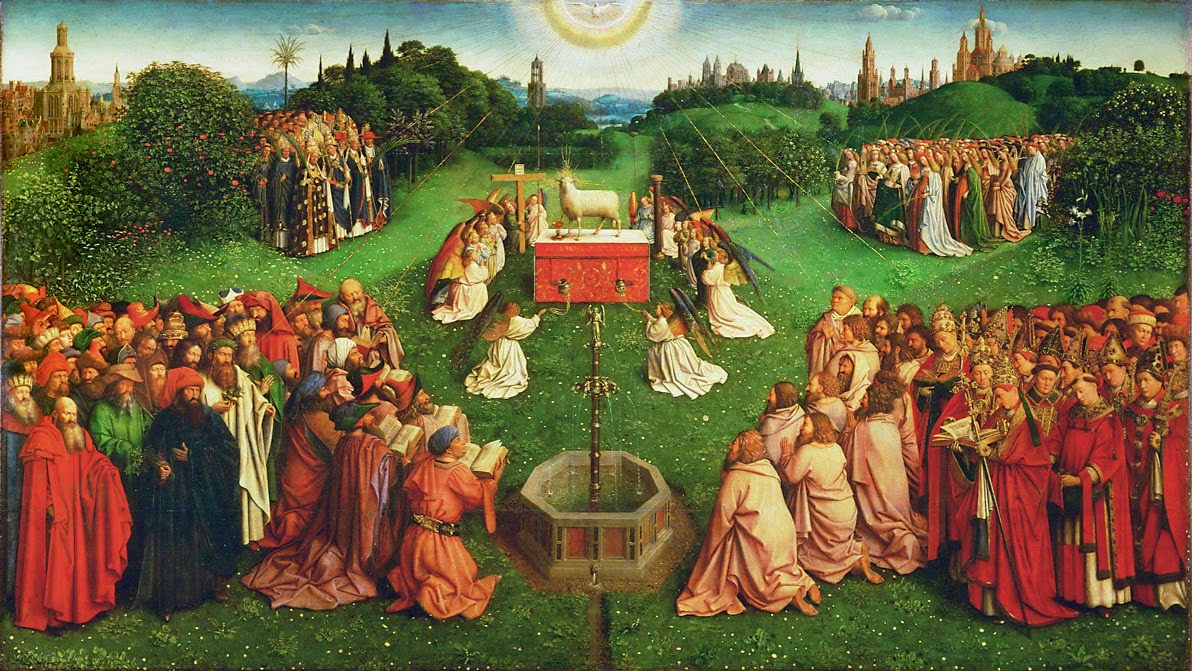
Finally, and maybe most importantly, we should realize that angels are present with us right here and now as we are gathered in worship.Wedding Feast of the Lamb Hebrews 12:22-24 says that in church we have “come to Mount Zion and to the city of the living God, the heavenly Jerusalem, and to innumerable angels in festal gathering…” Jesus says that the angels in heaven are joyful over one sinner who repents (Lk. 15:7, 10). As we confessed our sins earlier, a whole host of angels whom we cannot see or hear rejoiced as they heard Christ absolve and free us from our sins. In fact, Heb. 1:14 calls angles ‘liturgizing’ spirits (the ESV translates λειτουργικός as ‘ministering’). Using the liturgy is a way that we connect our worship with the worship of the angels in heaven, which is why we draw the words and order of our liturgy from the words of Scripture.

So, there is a quick overview of the Scriptural teaching of angels. Now, to our texts. First this Gospel lesson:

Jesus had sent these seventy-two ahead of Him to preach and heal in every town He was about to go Himself (see Lk. 10:1-12). And Jesus didn’t beat around the bush; He plainly tells them, “Behold, I am sending you out as lambs in the midst of wolves.” Their mission was already dangerous, but to top it all off, Jesus tells these lambs to march out in the midst of wolves with no resources – no moneybag, knapsack, or sandals. They would be housed and nurtured by the people who welcomed them. Jesus told them to heal the sick and say to the people, “The reign (βασιλεία) of God has come near to you.”

We hear them joyfully report that the demons – the evil, fallen angels – were subject to them in Jesus’ name. They saw victories in their various spiritual battles. But then Jesus says that something even greater was going on that they couldn’t see. While those seventy-two were proclaiming the reign of Jesus, Christ says, “I saw Satan fall like lightening from heaven.” More was going on than these seventy-two could see. It was more than just isolated, individual battles.

And in our Epistle text (Rev. 12:7-12), we heard how the archangel Michael was given the privilege of throwing Satan (‘Satan,’ by the way, means ‘accuser’), the deceiver of the whole world, Michael casts down Satandown and out of heaven. How was Satan cast down? The text is clear. Satan was cast out by the blood of the Lamb.

Now, there are Christians who would disagree with what I am about to say here, but I think we should see Jesus’ proclamation to the seventy-two of seeing Satan falling from heaven and the text in Rev. 12:7-12 as confirmation that the shedding of Christ’s blood and the preaching of the Gospel of the reign of Christ was what cast Satan down from heaven.

This means that Satan is no longer able to accuse you before God which is what he was constantly doing day and night before God in heaven (Rev. 12:10). Remember the book of Job? Satan was there in heaven accusing Job of Job’s sins before God by saying that the only reason Job loved God was because God was nice to Job (Job 1:8-11, 2:1-5). But now, Satan has been expelled from heaven, and that is good news.

However, there is also a warning at the end of that Epistle text. Satan is no longer able to accuse you before God because he has been expelled from God’s presence. But that doesn’t mean he is done accusing. The devil can’t accuse you before God anymore, but he can and does try to accuse you in your conscience, and he is very good at that. He will say that your sins are too many or too great to be forgiven. The accuser now roams about like a roaring lion seeking to devour you (1 Pet. 5:8), constantly whispering in your ear, “Did God really say, ‘Your sins are forgiven’?”

Dear saints, when the devil does this, he needs to be expelled from your conscience. How is this done? It is done with the same weapons that Michael and the angels used – the blood of the Lamb, and the word of your testimony (Rev. 12:11).

Dear saints, when you confess your faith that Christ has been crucified and shed His blood for you, you expel Satan from your conscience. When the devil whispers his accusations, confess that Jesus is the Lamb of God who takes away the sins of the world (Jn. 1:29). Tell Satan, “Christ has taken my sins. So, if you want to talk to someone about my sins, you can’t talk to me about them anymore. Jesus has taken them as His own. Christ owns them now. He has died and shed His blood for them.” And the devil has no reply to that testimony.

Church Militant and TriumphantSo today, dear saints, come to Jesus’ table and receive His body given for you. Receive His blood which was shed for you for the forgiveness of your sins knowing that neither death nor life, nor angels nor rulers, nor things present nor things to come, nor anything else in all creation, will be able to separate you from the love of God in Christ Jesus your Lord (Ro. 8:38-39).

Satan has been expelled from heaven, and he is expelled from your conscience by the blood of your Savior. In Jesus’ name. Amen.

The peace of God, which surpasses all understanding, will guard your hearts and minds in Christ Jesus. Amen.