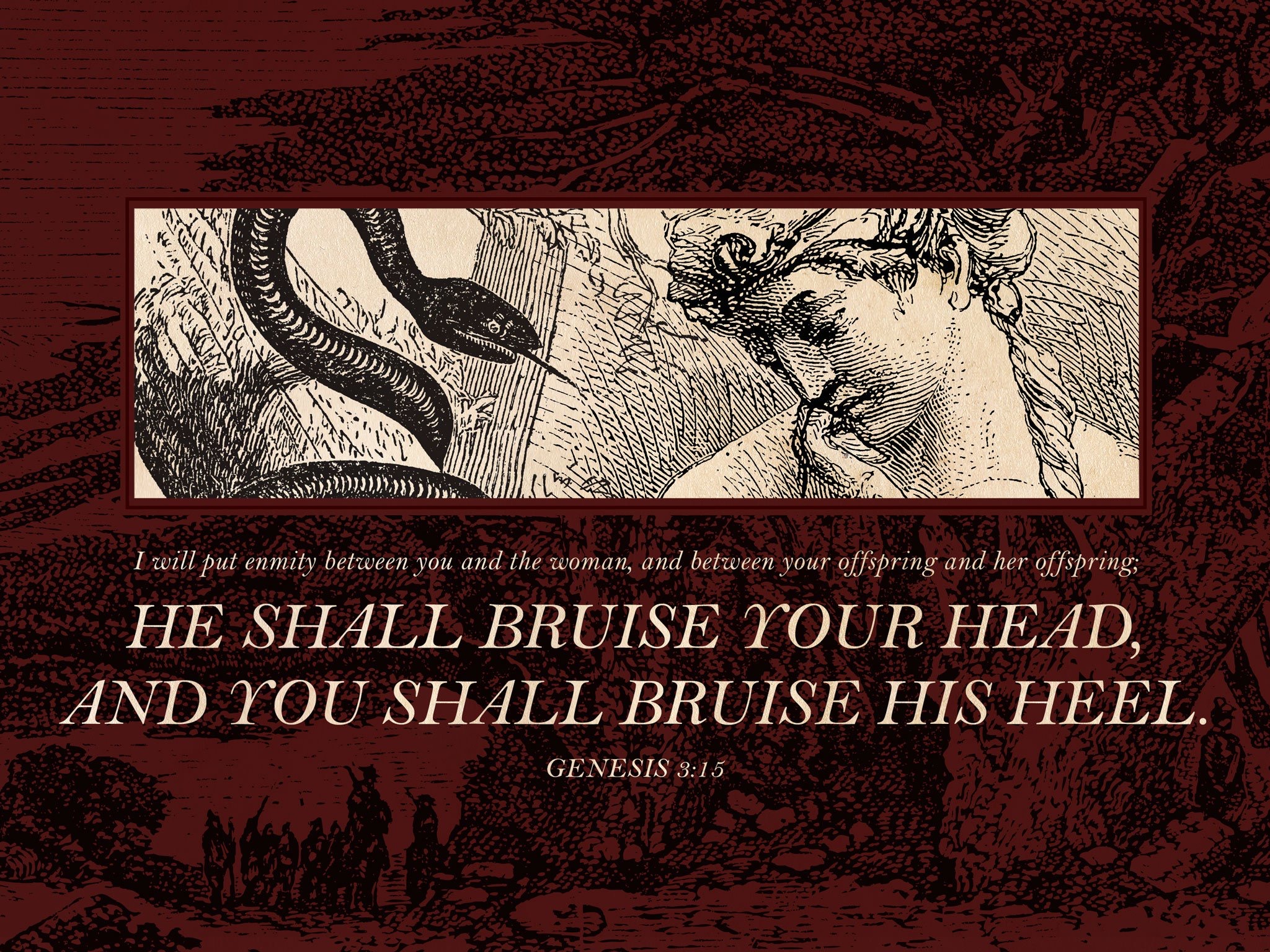
War of Words – Sermon on Genesis 3:1-21 for the First Sunday of Lent

Genesis 3:1-21

In the name of Jesus. Amen.

Genesis 3 is the first battle in the war between the devil on one side versus God and mankind on the other side. Because mankind was the crown of God’s creation, Adam and the woman were Satan’s initial target in his war against God and what He has made. And God knew what He was doing when had Moses record this chapter for us. The Holy Spirit, I suppose, could have inspired Moses to simply write, “But they ate from the forbidden tree, and that’s why everything is messed up,” and move on to Gen. 4. Instead, the Holy Spirit inspired Moses to write a detailed account of what happened. One of the reasons for that is so we can see the way the devil continues to fight against God and us. When you are fighting against someone, it’s helpful to know the weapons, tactics, strategies, and goals of your enemy so you can know how counter those attacks. So, that’s what we’re going to do as we consider this text today.

First, the devil’s weapon: He has only one. The devil couldn’t wage his war against our first parents with stones or clubs or swords or horses or tanks or guns or bombs. He couldn’t use anything physical against them because God’s creation was good – so very good, in fact, that nothing physical could harm them. The devil used the only weapon available to him, and that weapon was words.

The most important thing about us is what we believe because what we believe is the foundation of everything else in our lives. Our belief affects what we do, what we say, what we feel, and how we react. So, the devil came into the center of God’s good creation, into the garden, with words to shatter our belief and to wage his war. And the devil uses the serpent as his tool to hurl those murderous words at our first parents. The devil could’ve used anything to toss his lies at Adam and the woman. Just like an enemy could hurl a stone at a you with his arm, a slingshot, a catapult, or by dropping it from a castle wall, the stone can do harm in any of those instances, but the weapon is the same.

Satan uses the serpent here, but the devil isn’t limited to snakes when he wages war on you. He’s very imaginative and crafty with the different methods he’ll use against you. He might use a book, a video, or the news to throw his weaponized words at you to get you to doubt God and His promises. That worm could use, for example, a doctor who gives you a perfectly accurate diagnosis, “You have this disease, this cancer and you have this long to live.” That doctor might be 100% correct with that diagnosis, but that could be the method that the devil uses to hurl satanic lies at you. Remember, the Son of God, your Savior, promises that death doesn’t get the last word on you, believer. He promises, “Whoever believes in Me shall never die. [The one who believes in Me] has [already] passed from death to life” (Jn. 11:265:24).

So, words are the devil’s weapon. Now, what are his tactics and strategies as he uses that weapon? His tactic is to create space, to open just enough room for you to doubt God. Getting you to doubt God is His goal, so more on that in a minute. His tactic and strategy is to separate and distance you from God and His promises. And it doesn’t take very much space. He can slither his way into the tiniest of cracks.

As that slimy worm talks to the woman here, he presents the possibility that God is holding something back and has denied her something. He wants to open up enough space to make her think that she’s insufficient. The thing you need to notice is that God actually was holding something back from the woman and from Adam. He was withholding the knowledge of evil. God never intended us to know, let alone experience and endure, evil. But God was, as He always is, infinitely good by withholding that knowledge of evil from them.

Consider how small the crack is that the devil used to plant that tiny seed of doubt. That loathsome worm says, “You will be like God, knowing good and evil” (Gen. 3:5), and that statement was true. God Himself agrees. We didn’t read all of Gen. 3, but in the verse right after our reading ended, God says, “Behold the man has become like one of Us in knowing good and evil” (Gen. 3:22). Here’s the thing: Adam and the woman were already created in the image of God (Gen. 1:27). So, do you see how tiny the crack is – like vs. in the image? It’s a tiny difference vocabularically [sic.], but it’s a massive difference theologically.

God did not create us to be exactly like Him. He did create us to bear His image, which is much better for us. We can’t handle being like God. That’s beyond our capacity and ability. It’s too much of a burden for us. Scripture teaches that the best way to combat the devil’s tactic of distancing us from God’s promises, to prevent that space being opened up, is to be content with who we are and content with what God made us to be.

Whenever you sin (no matter what particular commandment you break), you never break only one Commandment. You always break at least two, if not three. Scripture clearly teaches this, but we don’t often think of it this way. Both Col. 3:5and Eph. 5:5 tell us that coveting (9th and 10th Commands) is idolatry (1st Command). When you covet, you are putting yourself in the place of God. Coveting is you saying, “God has messed up. That thing over there,” whatever that thing is, “should be mine over here.”

That is idolatry of self and putting yourself in the place of God. If your sin goes no further, you’ve broken two commands. But if your sin does go further, you break more. Stealing starts with you coveting something someone else owns, which is idolizing yourself, and then you actually take it. Lying starts with you coveting the truth to be something different than it actually is – which, again, is idolizing yourself. Then, you lie to make yourself look better or make your neighbor look worse than he/she is.

Contentment is the counter strategy you have to use against the devil’s tactics. In Php. 4:11-13, Paul urges us toward contentment. He says, “I have learned the secret of facing plenty and hunger, abundance and need.” That secret is contentment. When things are good, be content and don’t seek more. When things are bad, be content. Know that God is in control – even of the evil things you experience, and He promises that He will provide (Mt. 6:331 Tim. 6:6).

Again, the devil’s weapon is words, and his tactic is to create space between you and God’s promises. But that worm’s goal is to get you to doubt God. Don’t! God is no liar. God is faithful. He’s true to His Word.

So, your goal when fighting against temptation should be twofold. First, know God’s Word – more and more, better and better. And second, use that Word. 

You need to know that word extremely well. The woman ended up adding to God’s Word when she says that God didn’t allow them to touch the tree (Gen. 3:3). That wasn’t what God said. God never forbade them to touch the tree (Gen. 2:16-17). But the woman adds to God’s command, which shows that she thought God’s Word was insufficient.

Also, notice how during the temptation, Adam is absolutely silent. He doesn’t respond, interject, or interrupt. Adam doesn’t do or say anything. He just sits there and listens while this all plays out. That’s never the right approach when the devil attacks. When facing temptation, don’t be like Adam. Instead, follow your Savior’s example.

In our Gospel text (Mt. 4:1-11), Jesus counters all three of the devil’s temptations with Scripture. With the temptation to turn stones into bread, Christ quotes God’s Word that focuses on God’s promise of provision (Mt. 4:3-4Dt. 8:3). Your life doesn’t consist in temporal, earthly food. Your life comes from every word that comes from God’s mouth.

When the liar (Jn. 8:44) realizes that Jesus is using Scripture to fight back, Satan tries to use Scripture against Jesus. Think of that. The devil tries to use God’s Word against the Word of God in the Flesh (Jn. 1:14). He says, “God has promised to protect You (Ps. 91:11-12), but have You ever tested that? Jump off this building and see if it’s actually true.”

Dear saints, Satan is still doing this today. Today, he’s using all sorts of voices to pluck Scripture out of context to try to accuse you. The devil will use people who hate God and His Word to quote God’s Word at you and to accuse you of ‘not being very Christ-like.’ Don’t fooled by that. 

Yes, of course, God will protect Jesus from every trouble. But God isn’t a worthless father who will bail his kid out of every trouble that kid gets himself into. To be able to counter the slimy attacks of the worm, you need to know your Bible and know it well so that you won’t be fooled by the satanic twisting of God’s Word. So, Christ counters with Scripture, “You shall not put the Lord your God to the test”(Dt. 6:16). 

Also, notice Jesus’ response to the third temptation. Yes, He quotes Scripture, but even before He does that, our Lord simply says, “Be gone Satan.” And the devil is forced to flee (Mt. 4:11). Sometimes, you simply need to do the same thing. Tell that vile worm, “Get out of here. I’m not falling for your lies, and I don’t want to listen to them anymore.” There’s a time to tell the devil, “Be gone, you little worm.” That’s a good strategy for you to resist Satan’s attacks.

Finally, dear saints, be comforted. You will fall in this war of words. You will fall into sin. But don’t despair. You have a God who seeks you out like He seeks Adam and the woman saying, “Where are you?” (Gen. 3:9). In that moment, know that God isn’t coming after you to punish you. He’s calling you back to Himself. Be quick to acknowledge and repent of whatever sin you have. Your Savior has come. He has crushed the serpent’s head (Gen. 3:15), and He knows the temptations you face because He was tempted in every way as you are, yet without sin (Heb. 4:15). So, He sympathizes with you and your weakness. Even better, He has paid the price for your sins with His own blood (1 Pet. 1:18-19). And He clothes you, not just with animal skins (Gen. 3:21), but with the perfect, spotless robe of His righteousness (Is. 61:10Php. 3:9).

So, fight the good fight (1 Tim. 6:2). Take up the weapons of righteousness and fight against the enemy of your soul. Your Savior is returning with the sound of His war trumpet (Mt. 24:311 Co. 15:52). And in that day, you will be forever changed to be like Him (1 Jn. 3:2) – immortal, at peace, at rest, and altogether alive. Amen.

The peace of God, which surpasses all understanding, will guard your hearts and minds in Christ Jesus (Php. 4:7). Amen.

Enough – Sermon on Luke 2:22-40 for the Presentation of Our Lord

Luke 2:22–40

22 And when the time came for their purification according to the Law of Moses, they brought him up to Jerusalem to present him to the Lord 23 (as it is written in the Law of the Lord, “Every male who first opens the womb shall be called holy to the Lord”) 24 and to offer a sacrifice according to what is said in the Law of the Lord, “a pair of turtledoves, or two young pigeons.” 25 Now there was a man in Jerusalem, whose name was Simeon, and this man was righteous and devout, waiting for the consolation of Israel, and the Holy Spirit was upon him. 26 And it had been revealed to him by the Holy Spirit that he would not see death before he had seen the Lord’s Christ. 27 And he came in the Spirit into the temple, and when the parents brought in the child Jesus, to do for him according to the custom of the Law, 28 he took him up in his arms and blessed God and said, 

29 “Lord, now you are letting your servant depart in peace, 
according to your word; 
30 for my eyes have seen your salvation 
31 that you have prepared in the presence of all peoples, 
32 a light for revelation to the Gentiles, 
and for glory to your people Israel.” 

33 And his father and his mother marveled at what was said about him. 34 And Simeon blessed them and said to Mary his mother, “Behold, this child is appointed for the fall and rising of many in Israel, and for a sign that is opposed 35 (and a sword will pierce through your own soul also), so that thoughts from many hearts may be revealed.” 

36 And there was a prophetess, Anna, the daughter of Phanuel, of the tribe of Asher. She was advanced in years, having lived with her husband seven years from when she was a virgin, 37 and then as a widow until she was eighty-four. She did not depart from the temple, worshiping with fasting and prayer night and day. 38 And coming up at that very hour she began to give thanks to God and to speak of him to all who were waiting for the redemption of Jerusalem. 

39 And when they had performed everything according to the Law of the Lord, they returned into Galilee, to their own town of Nazareth. 40 And the child grew and became strong, filled with wisdom. And the favor of God was upon him.

Fleshly Thorns – Sermon on 2 Corinthians 11:19-12:9 for Sexagesima Sunday

2 Corinthians 11:19–12:9

19 You gladly put up with fools since you are so wise! 20 In fact, you even put up with anyone who enslaves you or exploits you or takes advantage of you or pushes himself forward or slaps you in the face. 21 To my shame I admit that we were too weak for that! 

What anyone else dares to boast about—I am speaking as a fool—I also dare to boast about. 22 Are they Hebrews? So am I. Are they Israelites? So am I. Are they Abraham’s descendants? So am I. 23 Are they servants of Christ? (I am out of my mind to talk like this.) I am more. I have worked much harder, been in prison more frequently, been flogged more severely, and been exposed to death again and again. 24 Five times I received from the Jews the forty lashes minus one. 25Three times I was beaten with rods, once I was stoned, three times I was shipwrecked, I spent a night and a day in the open sea, 26 I have been constantly on the move. I have been in danger from rivers, in danger from bandits, in danger from my own countrymen, in danger from Gentiles; in danger in the city, in danger in the country, in danger at sea; and in danger from false brothers. 27 I have labored and toiled and have often gone without sleep; I have known hunger and thirst and have often gone without food; I have been cold and naked. 28 Besides everything else, I face daily the pressure of my concern for all the churches. 29 Who is weak, and I do not feel weak? Who is led into sin, and I do not inwardly burn? 

30 If I must boast, I will boast of the things that show my weakness. 31 The God and Father of the Lord Jesus, who is to be praised forever, knows that I am not lying. 32 In Damascus the governor under King Aretas had the city of the Damascenes guarded in order to arrest me. 33 But I was lowered in a basket from a window in the wall and slipped through his hands. 

1 I must go on boasting. Although there is nothing to be gained, I will go on to visions and revelations from the Lord. 2 I know a man in Christ who fourteen years ago was caught up to the third heaven. Whether it was in the body or out of the body I do not know—God knows. 3 And I know that this man—whether in the body or apart from the body I do not know, but God knows— 4 was caught up to paradise. He heard inexpressible things, things that man is not permitted to tell. 5 I will boast about a man like that, but I will not boast about myself, except about my weaknesses. 6 Even if I should choose to boast, I would not be a fool, because I would be speaking the truth. But I refrain, so no one will think more of me than is warranted by what I do or say. 

7 To keep me from becoming conceited because of these surpassingly great revelations, there was given me a thorn in my flesh, a messenger of Satan, to torment me. 8 Three times I pleaded with the Lord to take it away from me. 9 But he said to me, “My grace is sufficient for you, for my power is made perfect in weakness.” Therefore I will boast all the more gladly about my weaknesses, so that Christ’s power may rest on me.

In the name of Jesus. Amen.

This is a fairly long text, and Paul boasts about himself quite a bit here, but please notice he acknowledges that. He even calls himself a fool and madman (2 Cor. 11:21, 23) for talking like this. But still, to our northern Minnesota, Midwestern ears, a lot of this text can be a bit off-putting. Paul would probably be more ‘at home’ in a place like New York or New Jersey. But basically, all that bragging is Paul defending status as an apostle. That long list of things he endured – the beatings, lashings, shipwrecks, and dangers – all of that is Paul saying that he learned what Jesus meant when He said, “If anyone would come after Me, let him deny himself and take up his cross and follow Me” (Mt. 16:24).

Then, Paul mentions this vision that he had fourteen years before he wrote this letter, but he does it in a roundabout way. He talks about a man who was caught up into the third heaven. We don’t know what this ‘third heaven’ is other than the fact that Paul calls it ‘paradise.’ While he was there, he heard things that he isn’t allowed to speak about; in other words, the vision was just for him. That isn’t unique. In the book of Revelation, John has a similar experience; he hears the voice of seven thunders, but he isn’t allowed to write what those thunders said (Rev. 10:1-4). Now, it’s clear that the man who had the vision is Paul himself. Notice how in 2 Cor. 12:7, Paul says that he was given a thorn in the flesh to keep him from becoming conceited because of the surpassing greatness of that vision. God knew Paul’s weakness of being prideful, so to limit that pride, God gives Paul this thorn in the flesh to keep him humble.

We don’t know exactly what this thorn is. We can speculate, but we can’t say for sure. The possibility that I gravitate toward is that this thorn in Paul’s flesh was poor vision (see Act. 9:18; Gal. 6:11). But I also will admit that I lean toward that understanding because I can identify with it. I also think Paul is intentional about not saying exactly what this thorn is so that you can take his conclusion about the thorn and apply it to yourself in whatever afflictions and suffering you face. Whatever this thorn in the flesh is, it wasn’t a minor thing for Paul. He pleads and begs with Jesus three times to have it removed. This thorn, Paul’s pleading, Jesus’ response to that pleading, and Paul’s conclusion have a lot to teach us about suffering as a Christian.

The first thing to notice is that this thorn was given to Paul. So, who gave it? Well, we have some clues. That thorn is a messenger (lit. an ἄγγελος) of Satan to harass him. In other words, it is one of the devil’s demons who afflicts and torments Paul with the thorn. The devil’s intention is always to push us toward more pride and greater sin. You especially see it when the devil tempts Adam and Eve by saying, “you’ll be like God,” in the Garden of Eden (Gen. 3:5). Because of this, we might conclude it was the devil who gave this thorn, but hold on just a second. Also notice that this thorn was given in order to limit Paul’s pride and conceit. The devil wouldn’t want to do that. So, who gave Paul this thorn? We’d have to conclude God did, but God does it through the devil.

So, here’s the lesson for us: Both the thorn and the demon are evil – utterly and completely evil – but God takes those evil things and uses them for good. When Ro. 8:28 says that God works all things together for good for those who love him, it is true. Even the work and attacks of the devil can be tools in God’s hand to bring about good. We see a similar thing happen with Job. God allows the devil to afflict Job by destroying all Job’s possessions and even Job’s health (Job. 1:9-12, 2:4-6). There, the devil admits that he can’t touch anything connected with Job unless God permits it. The devil’s intention in tormenting Job with all that suffering is to get Job to curse God. But when you get to the end of the book of Job, you see that Job remains blameless and upright. God uses that affliction of the devil to increase Job’s faith, and on top of that, Job’s three “friends” get brought closer to God as well.

The devil’s intention with both Job’s suffering and Paul’s thorn in the flesh is to destroy faith and increase sin, but God uses the devil’s work to accomplish His purposes. This happens all the time, but the clearest place we see this is in the crucifixion of Jesus. The devil’s fingerprints are all over it! Judas’ betrayal, the crowds who get stirred up by the priests and elders to release the murderer Barabbas instead of Jesus (Mt. 27:20), and the high priest Caiaphas who says that Jesus should die instead of the whole nation perishing (Jn. 11:49-50), there’s no question that all of that was Satan’s work in order to kill Jesus on the cross.

But what actually happened on the cross? Did the devil win by getting Jesus pinned there? Nope! It is on the cross that Jesus crushes that worm’s head. On the cross, Jesus took the record of debt that stood against us and nailed it to the cross which completely disarmed the devil and demons and put them to open shame (Col. 2:14-15). In the crucifixion, Satan thought he was beating God, but God was using the devil’s own strategy and plan to utterly defeat Satan, to deliver you, and to win you back for Himself. God be praised!

Now, let’s draw some practical application from all of this because there are all sorts of lessons to take away from this text (more than I’m going to cover here).

First, God can and does use suffering for your benefit. You don’t have to like suffering; in fact, we long for our suffering to be over. But you can know that God is working in and through your suffering – whatever it is. Scripture doesn’t call you to rejoice because of your suffering, but it does call you to rejoice even in the midst of your suffering (Ro. 5:3-5).

Second, if you are suffering in any way, if you have some thorn, that does not mean that God is angry with you or pitted against you. Remember, Job’s suffering began because God bragged about Job to the devil (Job 1:8, 2:4). And God wasn’t angry with Paul either. It was God’s love for Paul that permitted that fleshly thorn that Paul dealt with for so long.

Third, if you are afflicted by demons, that doesn’t mean you are a bad Christian. Paul had one for fourteen years while he was proclaiming the Gospel, starting new churches, and furthering the kingdom of God. And Jesus tells Paul, “My grace is sufficient for you. I’m going to let that demon do his thing while I give you My grace. This will show My strength is working through you.”

Fourth, unanswered prayers and denied petitions do not mean that God is unhappy with you. Paul begged and pleaded three times, and Jesus said, “No.” Yes, sometimes, Jesus will release you from the things that cause you suffering, but even when He says, “No,” it is for your benefit.

Finally, look at Paul’s reaction to all of this. He doesn’t say, “I asked for this thorn to be removed, but Jesus said, ‘No,’ so I’m going to complain.” No! He says, “Therefore I will boast all the more gladly of my weaknesses, so that the power of Christ may rest upon me. I’ll be content with weaknesses, insults, hardships, persecutions, and calamities. For when I am weak, then I am strong.”

Dear saints, you are right to lament and long for your suffering to come to an end. Jesus came to rescue you from all suffering. But in your suffering, know that God is at work, and you don’t know what kind of fruit God will bring about through that suffering. Christ is right there beside you in every affliction and weakness you have. He is there present with His strength. And He comes now to strengthen you with His all-powerful Body and Blood, given and shed for you for the forgiveness of all your sins. To Him be all the glory, honor, praise, and thanks now and forever. Amen.

The peace of God, which surpasses all understanding, will guard your hearts and minds in Christ Jesus. Amen.