Coming to Save – Sermon on Isaiah 35:3-7 for Quinquagesima Sunday

Isaiah 35:3–7

3 Strengthen the weak hands, 
and make firm the feeble knees. 
4 Say to those who have an anxious heart, 
“Be strong; fear not! 
Behold, your God 
will come with vengeance, 
with the recompense of God. 
He will come and save you.” 

5 Then the eyes of the blind shall be opened, 
and the ears of the deaf unstopped; 
6 then shall the lame man leap like a deer,
and the tongue of the mute sing for joy. 
For waters break forth in the wilderness, 
and streams in the desert; 
7 the burning sand shall become a pool, 
and the thirsty ground springs of water; 
in the haunt of jackals, where they lie down, 
the grass shall become reeds and rushes.

In the name of Jesus. Amen.

I promise that we’ll get to this text from Isaiah, but it will be in a roundabout way. When God commanded, “Thou shalt not steal,” He meant it. Stealing is a disruption of God’s creation. When God gives something to someone, that is where He wants it to be. That is why thieves were required to repay the ones they robbed. Throughout the Scriptures, God says that a thief must give back what was stolen, and that repayment comes with interest. If you rob someone of their money or goods but it can be recovered, God says the cost is to pay back double what was stolen (Ex. 22:4, 7). But God set a higher price for other things that were stolen – especially if they could not be recovered. If a thief stole and killed one sheep, he was required to pay back four sheep. For every unrecoverable stolen ox, the repayment was five oxen. And If you stole food, you have to pay that back sevenfold (Pr. 6:31).

The first robbery recorded in the Bible was a theft of food in the Garden of Eden. All of creation belonged to God, and He freely handed it over to the man and woman that He had created in His image. Every plant was nutritious and delicious. And God gave all the plants for food (Gen. 1:29) – except one tree, the Tree of the Knowledge of Good and Evil. That tree, like every other tree, belonged to God. It’s fruit was His, and He said, “You don’t get to eat it.” But that first couple reached out their hands, took God’s fruit, and ate it. They stole food from God.

Now, here’s the problem, how would they repay God sevenfold as the Bible requires? It’s more complex than it might sound. They couldn’t pay with more fruit from that tree. All the fruit that remained on the tree already belonged to God. And to make things worse, they couldn’t put the fruit they had eaten back because it had become part of them. The only way to restore the fruit would be for Adam and Eve to be put back on the tree. But even that repayment was impossible because now they were thieves and sinners. Because it was stolen, that fruit was cursed and infected Adam and Eve with death that was coursing through their veins.

For the seven-fold payment to be made, Adam and all his children, needed a new Adam to offer payment in their place. Jesus entered this world as that new, sinless, and perfect Adam (Ro. 5:14; 1 Cor. 15:45). Only Jesus, perfect God and perfect man, could make repayment for that theft. And that is exactly what He does.

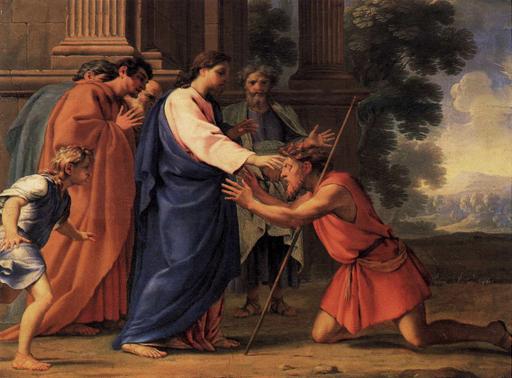
In our Gospel reading (Lk. 18:31-43), we heard how Jesus restored the sight of blind Bartimaeus (Mk. 10:46-52) on the road outside of Jericho. And Jesus did this by taking Bartimaeus’ blindness into Himself (Is. 53:4; Mt. 8:17) while also restoring his sight. That miracle, and all of Jesus’ miracles, show that Christ was removing the venom of sin and death, putting creation back together, and making the payment for that original sin and all subsequent sins. But all of Jesus’ miracles were merely a beginning of the full repayment He was about to make. Bartimaeus’ eyes eventually went blind again when he died. That is why that full, seven-fold repayment for the thievery in Gen. 3 is only made when Jesus is pinned to the cross, sheds His perfect blood, and dies. All of that brings us to this reading from Isaiah.

What is weak is to become strong. What is feeble is to become firm. To you who are anxious and troubled in heart, God says, “Be strong; fear not! Behold, your God will come with vengeance, with the recompense of God.” Normally, when sinners hear about vengeance and recompense, they are afraid and rightly so. But notice what this vengeance and recompense accomplishes – God comes to save you. He pays the debt that you owe. He has avenged your sin upon His only begotten Son. The payment has been made; your sin is atoned for (Is. 6:7).

Throughout Jesus’ ministry, He healed many more blind people besides Bartimaeus. Christ opened the ears of many who were deaf. Our Lord made many lame people walk and loosened all sorts of tongues to sing for joy. Each of those miracles were a display of Jesus’ divine power and authority to fix what sin and death had brought to creation. All of Christ’s miracles showed that He had come to undo the curse of the Fall. And yet, they aren’t the fullness of what Jesus had come to accomplish. They were limited in scope. Here, Isaiah says all the eyes of all the blind shall be opened and all the ears of all the deaf unstopped. 

Jesus didn’t just come to open a few eyes and ears. He came to open all of them. When you read through the Gospels, Jesus is doing these miracles almost constantly. But there is no doubt that there were more blind and deaf in Israel and throughout the world that didn’t get the blessing of Jesus’ miraculous touch. In other words, there is more healing, more restoring, more removal of the curse to be done than Christ accomplished through His miracles.

But now that Christ has died and risen again, now that He is seated on the throne of all creation as the New Adam at the Father’s right hand, the curse of sin and death that hangs over all creation has been paid for. Your God has come and saved. And the day is coming when the eyes of all who are in the category of ‘blind’ will be opened. All the ears of the deaf will be unstopped. All the lame shall leap like a deer. And all the mute will sing for joy because the price has been paid. It has been paid by Jesus for you. Whatever parts of the curse still lay upon you have all been taken by Jesus. Christ has redeemed you by becoming a curse for you (Gal. 3:13).

As we move into Lent this year, we are going to consider what the suffering of Christ has accomplished. Out of God’s great love for you, Christ endured all the wrath, judgment, and death you deserved because of your sins. In Christ, God came to save you. Every illness, every malady, every pain, every sorrow you experience had a price, and that price was the precious death of God’s beloved Son.

And as we go on this Lenten journey, we do it remembering the destination – eternal life with God. Take a Bible and open to the end of Isaiah 35. Just after our text, Isaiah speaks of a highway. Listen to how Isaiah describes it. Isaiah 35:8-10, “And a highway shall be there, and it shall be called the Way of Holiness; the unclean shall not pass over it. It shall belong to those who walk on the way; even if they are fools, they shall not go astray. No lion shall be there, nor shall any ravenous beast come up on it; they shall not be found there, but the redeemed shall walk there.” Pause there for a minute.

All of that is to say that God has come to save you, and He has placed you on this highway. When you pass through areas of this highway that are dreadful, don’t worry because Jesus is with you. When you pass through areas of this highway that are delightful, remember, it is only the highway. The highway has its own joys and foretastes of what is to come, but the destination lies ahead. And what is that destination?

Back to Isaiah 35:10, “And the ransomed of the Lord shall return and come to Zion with singing; everlasting joy shall be upon their heads; they shall obtain gladness and joy, and sorrow and sighing shall flee away.” In other words, the point of the highway is the destination. The Resurrection, the new creation, the life of the world to come – that is your destination, believer. Don’t forget that.

Your God has come and saved you. Your journey is secure on God’s highway. How unspeakably great will it be when we arrive at our ultimate destination? Amen.

The peace of God, which surpasses all understanding, will guard your hearts and minds in Christ Jesus. Amen.

The King in the Wicked City – Sermon on Luke 18:31-43 for Quinauagesima Sunday

Luke 18:31–43

31 And taking the twelve, he said to them, “See, we are going up to Jerusalem, and everything that is written about the Son of Man by the prophets will be accomplished. 32 For he will be delivered over to the Gentiles and will be mocked and shamefully treated and spit upon. 33 And after flogging him, they will kill him, and on the third day he will rise.” 34 But they understood none of these things. This saying was hidden from them, and they did not grasp what was said. 

35 As he drew near to Jericho, a blind man was sitting by the roadside begging. 36 And hearing a crowd going by, he inquired what this meant. 37 They told him, “Jesus of Nazareth is passing by.” 38 And he cried out, “Jesus, Son of David, have mercy on me!” 39 And those who were in front rebuked him, telling him to be silent. But he cried out all the more, “Son of David, have mercy on me!” 40 And Jesus stopped and commanded him to be brought to him. And when he came near, he asked him, 41 “What do you want me to do for you?” He said, “Lord, let me recover my sight.” 42 And Jesus said to him, “Recover your sight; your faith has made you well.” 43 And immediately he recovered his sight and followed him, glorifying God. And all the people, when they saw it, gave praise to God.

In the name of Jesus. Amen.

Today, our text has us focus on two cities – Jerusalem and Jericho. Jerusalem was the city chosen by God to be the place where He would dwell with His people (1 Kgs. 8:10-11, 27-30). If anyone sinned; if God’s people were defeated in battle; if there was drought, famine, pestilence, or plague; they would pray toward God’s house in Jerusalem. God would hear their prayer and forgive (1 Kgs. 8:31-53; 9:3-5). According to Scripture, Jerusalem was a city firmly built together, and God’s people would go there to give thanks to God for all the blessings He had given them (Ps. 122:3-4). It was the city of King David, and God had promised that David’s line would never lack a man to sit on the throne as long as David’s sons walked in God’s ways (1 Kgs. 2:4).

Then, there is Jericho. God commanded His people, “Destroy Jericho. Never rebuild it. If anyone tries to rebuild it, I will consider that to be open idolatry and rebellion against Me. In fact, if someone tries to rebuild Jericho, laying the foundation will come at the cost of his firstborn, and setting up the gates will cost his youngest son,” (Jos. 6:2, 26). What happened? God led His people in battle against Jericho and its walls came tumblin’ down. But about 500 years later, Ahab was king of Israel and led God’s people into idolatry, and during Ahab’s reign, a guy named Hiel rebuilt Jericho. The foundation was laid, and his firstborn died. But Hiel kept going and set up Jericho’s gates at the cost of his youngest son (1 Kgs. 16:34). Whenever you read your Bible and come across Jericho after Joshua 6, think of it as ‘sin city’ because it is a city founded on idolatry and rebellion against God, and its very existence is wicked.

The cities of Jerusalem and Jericho could not be more different. But now, look at our text again. Jesus reminds His disciples, “Hey, we’re going up to Jerusalem. There, I’m going to be delivered to the Gentiles to be mocked, shamefully treated, spit upon, flogged, and killed just as the Scriptures said.” In other words, Jerusalem has joined with Jericho and is in open rebellion against God. But Jesus is purposefully going to Jerusalem to bear the curse of our sin (Gal. 3:3).

And to get to Jerusalem, Jesus must first pass through the wicked, cursed city of Jericho. When God gave Joshua the battle plans on how to defeat Jericho, God instructed that His people were to march around the city in silence once each day for six days then seven times on the seventh day. Then, after circling the city seven times, they shouted, and the walls of Jericho fell down flat (Jos. 6:20). Only then did they enter the city and destroyed everyone in it except Rahab and her household.

Here in Luke, it is almost as if Jesus is doing a similar thing. He is passing by (Lk. 18:36), but there is this blind man crying out, “Jesus, Son of David, have mercy on me!” Instead of quietly marching around Jericho, Jesus stops. It’s like Christ can’t help Himself. Even in the cursed city, Jesus doesn’t ignore cries for mercy because He is mercy embodied. He stops, stands still, and asks for the blind man to be brought to Him. There, in the wicked city, King Jesus, the Son of David, makes a kingly offer, “What do you want me to do for you?” Think of all the times throughout the Scriptures, a king will be pleased with someone and make an offer, “Ask me for anything, up to half my kingdom, and I will give it to you.” Here Jesus doesn’t put any limit on the request, “What do you want me to do for you?” The blind man answers, “Lord, let me recover my sight.” And Jesus says to him, “Recover your sight; your faith has made you well (lit. ‘saved you’).” Not only does the man get the sight he asks for, he gets more. Christ gives this resident of wicked Jericho life and salvation.

Dear saints, this same scene played out today just as it does every Sunday you gather here. Jesus comes into the midst of our wickedness. We beggars find ourselves in the presence of Jesus. We cry to Him for His kingly mercy, and Jesus doesn’t simply march around us and pass through. No. He hears your plea. He stops and stands still, and Christ the King answers your plea by absolving and saving you.

Jesus did that then, and He does that now because of what He is about to do in Jerusalem. Jesus could have, and maybe should have, marched around Jerusalem to destroy it with all their wicked plans for Him. But He doesn’t. Instead, He hangs still as He sheds His blood and pours out His mercy for you upon the cross.

Finally, notice the man’s response after his sight is restored. He can go wherever he wants with his new sight and salvation, but with every option open to him, he follows Jesus. The formerly blind man leaves his home in the wicked city of Jericho and follows Jesus to Jerusalem.

As we begin Lent this Wednesday, let us do the same as we follow Jesus as well. Let us abandon our wickedness and follow King Jesus to Jerusalem this Lent. He leads, and we follow with grateful hearts to Jerusalem, to the cross, and to the empty tomb on Easter.

This same King Jesus invites you now to your seat at His table, where He pours His love and mercy into you by giving you His Body and Blood given and shed for the forgiveness of all your sins. Dear saints, your faith in the crucified and risen Jesus has saved you. Amen.

The peace of God, which surpasses all understanding, will guard your hearts and minds in Christ Jesus. Amen.