
Broken Bonds – Sermon on Mark 7:31-37 for the Twelfth Sunday after Trinity

Mark 7:31–37

31 Then he returned from the region of Tyre and went through Sidon to the Sea of Galilee, in the region of the Decapolis. 32 And they brought to him a man who was deaf and had a speech impediment, and they begged him to lay his hand on him. 33 And taking him aside from the crowd privately, he put his fingers into his ears, and after spitting touched his tongue. 34 And looking up to heaven, he sighed and said to him, “Ephphatha,” that is, “Be opened.” 35 And his ears were opened, his tongue was released, and he spoke plainly. 36 And Jesus charged them to tell no one. But the more he charged them, the more zealously they proclaimed it. 37 And they were astonished beyond measure, saying, “He has done all things well. He even makes the deaf hear and the mute speak.”

In the name of Jesus. Amen.

Imagine you’re being punished for something – it doesn’t matter what – and the punishment is that you will be sent to live on the moon, which has become a penal colony. (This is my analogy, so I get to make the rules.) You will never be allowed to return, and no one is allowed to visit you. You beg the judge for mercy, and he gives you a choice between two options.

The first option is that you can have a magic mirror, like the one from Beauty and the Beast, but it doesn’t transmit any sound. That mirror will allow you to see your spouse, kids, parents, siblings, and friends, but you can’t speak to them or hear them. And the mirror is on a ten second delay that doesn’t allow any communication. It blacks out if there are letters, so they can’t wear a shirt that says, “I love you,” or hold up a note; it also doesn’t allow any sign language, thumbs up, hand hearts, or anything like that. (Again, this is my analogy, so I can make the magic mirror do whatever I want.)

The second option the judge gives you is that you can have a magic phone that lets you talk to your family and friends whenever you want, but you will never be able to see them. Which option would you choose? I’d bet we’d all take the phone. We’d rather be able to have a conversation and communicate with our loved ones than simply look at or watch them because God created us for communion and communication – with Himself and with others. It isn’t good for man to be alone (Gen. 2:18). This is why God created us with ears to hear and mouths to speak. Besides the angels, humans are the only created things that interact with God and others through words.

In Genesis, God speaks to Adam before Adam says anything, and the first words Adam heard were, “You may surely eat of every tree of the garden, but of the tree of the knowledge of good and evil you shall not eat, for in the day that you eat of it you shall surely die” (Gen. 2:16-17). God promised to provide Adam with all the delightful food and nourishment he would need. You can think of God’s first words to Adam as a sermon, which is basically, “Listen Adam, I’ll take care of every need you have. I don’t want you to ever know what evil is. Just trust Me on this – evil is bad.” So, God created Adam to hear His Word and, by hearing that Word, Adam would trust and believe. But God also created Adam to speak.

The first recorded words of Adam in Scripture are his response to seeing the bride God made for him. “This at last is bone of my bones and flesh of my flesh; she shall be called Woman, because she was taken out of man” (Gen. 2:23). However, we know that Adam used his voice prior to that because, before God created the woman, God had Adam give names to all the animals. Genesis would be a whole lot longer if it gave us all those details. “God brought Adam a four-legged, creature with black and white stripes, and Adam called it, ‘Zebra.’” By naming the animals, we have a concrete example of how Adam is created in God’s image. Like God did with Day, Night, Heaven, Earth, and Seas (Gen. 1:5, 8, 10), Adam joins with God in naming parts of creation.

That is why, when we consider this text, we know that this deaf and mute man’s condition is so pitiful. He isn’t what God created him to be. He can’t hear or communicate like he should. But Jesus releases this man to be what he was created to be and to do what he was created to do. Christ opens His ears to hear and releases his tongue to speak. Our translation there does a decent job by using the word “released,” but the Greek is even more vivid. In Greek, the text says, “the cords of his tongue are untied.” Jesus breaks the bonds that imprisoned this man to a lonely world without any communication. With one word, “Ephphatha,” Christ, the Word made flesh, restores this man to be what God had created him to be. A man who speaks rightly and plainly. (The Greek says that he speaks ‘orthodoxly.’)

Our Epistle reading today (Ro. 10:9-17) also highlighted the importance of hearing and speaking. “Faith comes by hearing” (Ro. 10:17). God’s Word goes into your ears, and the Holy Spirit creates faith in your heart. Then, with the mouth you confess and are saved (Ro. 10:10). We are created to first hear God’s Word which creates faith. Second, we are created to confess with our mouths, pray to God, and praise Him. This is what God intended for our lives. He speaks, and we respond. Over and over. Even now, after the Fall, prayer and faith is a continual conversation with God.

When we understand how sin has bound and imprisoned both our hearing and speaking, we can start to see how far we have fallen. The things that come out of our mouth should cause us extreme grief and shame (Mt. 15:11). James 3:8-10 says that our sinful tongue is a restless evil full of deadly poison that lives in contradiction. We use our tongues to bless our Lord and Father, but then we turn around and curse people who are made in the likeness of God. This should not be so. It doesn’t help that, most of the time, the damage our tongues do to our neighbor goes unpunished. You aren’t going to be fined or jailed for gossip or so-called “little white lies.” Christian, with God’s help, you need to control your tongue and ask for mercy for the havoc your tongue causes in creation.

You also need to guard the communication you have with yourself in your mind. Philippians 4:8 says that we are to think about whatever is true, honorable, just, pure, lovely, commendable, excellent, and worthy of praise. Your mind, and the minds of others, is never a vacuum. You’re always communicating something – even if it’s only with yourself. That is why we always need to put the most charitable construction on the actions of others. When we think they are doing things for wrong motives, we are more prone to think that they do the same toward us.

Here, Jesus tells this man and the people present to not tell anyone about the miracle. Jesus will periodically do this. We don’t always know why, but we do see in other instances that, when people disobey this kind of command, Christ’s ministry is hindered (Mk. 1:45). When Jesus tells you to be silent, be silent. But, and this is me speaking here, I think we Christians have adopted the attitude that this command is for everyone all the time. But that is wrong. There are other times where Jesus will tell people to return home and declare to others how much God has done for them (Mk. 5:19).

Yes, there are times to be silent but not always. The world needs to hear what God has done; the world needs to hear God’s truth very badly. There is a phenomenon in group communication called “the Abilene paradox” which is when a group of people decide on a course of action that is contrary to the preferences of all or most of the individuals in that group.

It was named that because of a story by a guy named Jerry Harvey where a family is comfortably playing dominoes on a porch in Texas. The father-in-law thinks everyone else is bored, so he suggests they take a hot, 50-mile drive to Abilene, TX to have dinner. His wife says, “Sounds like a great idea. I haven’t been to Abilene in a long time.” Their daughter goes along with it as does the son-in-law. So, the four of them hop in the car to Abilene. The drive is miserable, hot, and dusty. The food is as bad as the drive. When they return, one of them dishonestly says, “That was a great trip, wasn’t it?” But the mother-in-law says she only went because everyone else was so enthusiastic about it. Their daughter says she wanted to keep everyone happy. The son-in-law confesses he didn’t want to go either, and the father-in-law admits he only suggested it because he thought everyone else was bored. So, the four of them sit back perplexed that they collectively decided to take a trip none of them wanted to go on. They all would have preferred to sit comfortably playing dominoes. The only thing that needed to happen to spare them the misery of that trip was for one of those four to speak up.

I wonder – and, again, this is my own speculation – if that is part of the reason our world and culture is so crazy right now. We Christians are afraid to simply confess the truth. Many people are insisting on things that are completely contrary to what is so obviously true. Just think of how often people want to redefine marriage or call a baby in a mother’s womb a cancerous tumor (yes, I actually heard someone say that), and a whole host of other insane things. The world needs us Christians to confess the truth. But too often, we are cowered into the corner and keep silent because we don’t want to rock the boat or be offensive. Christian, God has given you a mouth and voice. If you don’t use it and let the culture dictate the conversation, the world descends into chaos.

Christian, Jesus has opened your deaf ears and broken the bonds of your tongue to speak what is right, good, and true. Do that. Do it boldly. Do it lovingly. Do it with conviction.

Again, in our Epistle reading we hear, “Everyone who believes in [Jesus] will not be put to shame” (Ro. 10:11). And remember that Scripture connects believing with confessing (Ro. 10:8-9). When you speak the truth, you might be mocked, ridiculed, and told to be silent, but speaking the truth in love will never end in you being ashamed.

Dear saints, the bonds of your mute tongue and deaf ears have been broken by the Savior. Bring Christ and His work into your conversations around the coffee pot at work and in the bleachers at your kids’ games. Talk about Jesus while you eat with your children and buy groceries. Praise Him in the doctor’s office and wherever you go (Dt. 6:4-9). This is what you have been created, bought, and cleansed for. God speaks. We listen, respond, and declare that He does all things well.

Jesus is here today. He has opened your ears to hear His Word of forgiveness and mercy. He opens your mouth now to receive His Body and Blood. And Christ sends you from here with His praise on your tongue. Confess His name, proclaim His work, and declare His truth to the ends of the earth. Amen.

The peace of God, which surpasses all understanding, will guard your hearts and minds in Christ Jesus. Amen.

Charged to Silence – Sermon on Mark 7:31-37 for the Twelfth Sunday after Trinity

Mark 7:31–37

31 Then he returned from the region of Tyre and went through Sidon to the Sea of Galilee, in the region of the Decapolis. 32 And they brought to him a man who was deaf and had a speech impediment, and they begged him to lay his hand on him. 33 And taking him aside from the crowd privately, he put his fingers into his ears, and after spitting touched his tongue. 34 And looking up to heaven, he sighed and said to him, “Ephphatha,” that is, “Be opened.” 35 And his ears were opened, his tongue was released, and he spoke plainly. 36 And Jesus charged them to tell no one. But the more he charged them, the more zealously they proclaimed it. 37 And they were astonished beyond measure, saying, “He has done all things well. He even makes the deaf hear and the mute speak.”

In the name of Jesus. Amen.

The miracle is strange enough on its own. A man who is deaf and mute is brought to Jesus. Our Lord throws His fingers into the man’s ears. I know our translation says ‘put,’ but the word there is more aggressive and intrusive. It probably wasn’t comfortable for the man. But Jesus isn’t done being weird. Christ spits – exactly where, we aren’t sure. A collection of Jewish literature called the Talmud, which is an interpretation of the Old Testament, taught that saliva was a healing agent. Mark seems to indicate that Jesus’ saliva ends up on the guy’s tongue – either directly or from Jesus’ hand to his tongue. Jesus sighs and says, “Ephphatha,”which means, “Be opened,” and the guy can hear and speak. Again, strange miracle.

Why all the intrusiveness and all the ceremony? Why doesn’t Jesus just do as He had done all sorts of other times – speak the word and let the healing take place (Mt. 8:8)? Well, I don’t know. But what I can say for sure is that Jesus’ still has ‘it’ whatever ‘it’ is.

Through His Word, Jesus does amazing things. The same Jesus spoke all things into existence when He created the cosmos (Gen. 1; Jn. 1:3, 14). In the creation account, God spoke into the void and things that did not exist obeyed and came to be. Here, Jesus speaks to ears that He created but couldn’t hear anything, and they obey His command to open. He’s doing Jesus-type things – healing and fixing the brokenness that sin has brought to creation. Yes, the miracle is strange, especially the leadup to it. But what might be even more strange is what happens at the end.

Jesus tells that man to not use his newly loosened tongue to announce the healing to anyone, and He commands the crowds to be silent about it as well. In short, Jesus speaks to two different types of ears with two different responses. Christ speaks a command to deaf ears and a stuck tongue, and they obey. But then He charges hearing ears to keep their working tongues silent, but they zealously disobey (Mk. 7:36). They dismiss Christ’s Word and command.

The only clue we have to the mindset of these people who are blatantly disobeying Jesus comes from what they say, “He has done all things well. He even makes the deaf hear and the mute speak.” It sure seems like their intention is to say nice things about Jesus.

What they say is true. Jesus does do everything well. And He is good, good beyond our imagination. He has just made the deaf hear and the mute speak. That’s true too. However, we need to understand, saying nice things or saying true things can still be sinful. And we know that it is sinful here because, again, Jesus told them to not say anything about it. Exactly why Jesus told them to keep silent, we don’t know. Jesus repeatedly does this in the Gospel of Mark, and in other places where He does this and people disobey Him, we see that His ministry is hindered (Mk. 1:38-45). So, what are we to do with this?

Ecclesiastes 3:1, 7 says that there is a season for everything and a time for every matter under heaven; there is a time to keep silence, and a time to speak. And, certainly, when God commands you to keep silent, that is a time to keep silent. So today, God calls us to consider when and how we use our mouth, tongue, and voice and to regularly examine ourselves in light of the 8th Commandment: “Thou shalt not bear false witness against thy neighbor.” In the Small Catechism, Luther’s explanation of it is so good: “We should fear and love God so that we do not deceitfully lie about, betray, backbite, nor slander our neighbor, but defend him, speak well of him, and put the most charitable construction on all that he does.”

Of course, we break the 8th Commandment when we desire the truth to be different and lie. But we also break this Commandment when we hijack the truth in order to make our neighbor look bad and spread gossip. Yes, lying is bad, and we often have our conscience pricked when we lie. But gossip and tearing others down is just as bad. There are times when telling the truth is a sin and violation of this Commandment. For example, don’t tell Laura about Peter’s sin if Laura doesn’t need to know about it. You don’t like it when it happens to you. Don’t do it to others. So, don’t lie. Don’t gossip. But also know when to be silent.

We live in a world that is buzzing with communication. Technology has given you the ability chat with a person in Indonesia about a cat while you get into an argument with someone who lives in Spain about weather. With instant access to a majority of the world in our pockets, it is easy to get distracted and waste copious amounts of time communicating with people we don’t know about things that don’t matter, and when that kind of communication is happening, it is easy to use our tongues and fingers to break the 8thCommandment. So, hear this as a call to consider how you use your phone, social media, and the comments section on a news article to interact with others. You should be spending more time interacting with your family and the people around you than you do interacting with people on Insta-Snap-You-Twit-Face.

Also, in your regular in-person relationships and interactions, you need to use your God-given wisdom. Yes, absolutely, there are times when God is giving you an open door to proclaim the truth to those who blatantly deny it. There are times where you should correct, reprove, and rebuke evil and sin. But how do you go about doing it? Are you speaking the truth in love in an effort to correct the erring, or are you mocking, ridiculing, and belittling people and further turning them off to Christianity?

The tongue and all your communication has great power both for good and for evil. James spends a lot of time on this. In James 1:26-27, we read, “If anyone thinks he is religious and does not bridle his tongue but deceives his heart, this person’s religion is worthless. Religion that is pure and undefiled before God the Father is this: to visit orphans and widows in their affliction, and to keep oneself unstained from the world.” And later, in James 3:2-8, he talks about how horses are guided by a small bit in their mouths and huge ships are steered by a small rudder. In the same way the tongue is a small part of your body, but it can set a huge fire.

Dear saints, what you say and communicate and how you say and communicate it, has great power to both tear down and destroy or to build up and edify. Guard your mouth, your pen and pencil, and, yes, your typing. Guard them in such a way that you declare God’s praise (Ps. 51:15) because faith comes by hearing (Ro. 10:17).

So, dear saints, hear again that Christ Jesus has forgiven you all the sins of your tongue and fingers. Know that His shed blood has covered all your iniquity. Continue to fight against your sin, as you live in Christ’s grace, now and forever. Amen.

The peace of God, which surpasses all understanding, will guard your hearts and minds in Christ Jesus. Amen.

Opening – Sermon on Mark 7:31-37 for the Twelfth Sunday after Trinity

Listen here.

Mark 7:31-37

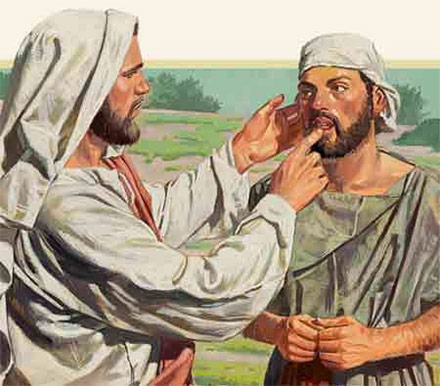
Jesus Heals the Deaf and Mute Man Mark 731 Then he returned from the region of Tyre and went through Sidon to the Sea of Galilee, in the region of the Decapolis. 32 And they brought to him a man who was deaf and had a speech impediment, and they begged him to lay his hand on him. 33 And taking him aside from the crowd privately, he put his fingers into his ears, and after spitting touched his tongue. 34 And looking up to heaven, he sighed and said to him, “Ephphatha,” that is, “Be opened.” 35 And his ears were opened, his tongue was released, and he spoke plainly. 36 And Jesus charged them to tell no one. But the more he charged them, the more zealously they proclaimed it. 37 And they were astonished beyond measure, saying, “He has done all things well. He even makes the deaf hear and the mute speak.”

In the name of Jesus. Amen.

When God created Adam from the dust of the ground, God had a purpose behind everything. God created Adam with eyes so Adam could see not just the beauty of creation but also God’s goodness, mercy, and provision. God created Adam’s limbs to work in the garden that God had given to bless and sustain Adam. God gave Adam feet and legs to walk throughout creation and be in awe and wonder at everything God had given. When God created Adam’s mouth, God gave him a tongue and vocal cords that could declare God’s praise (Ps. 51:15) and mercy (Jer. 3:12; Mk. 5:19). Every part of Adam and Eve’s bodies were created to be in harmony with God, with creation, and with each other.

Contrast God’s ordered, creative work with the work of the devil. Unlike God, the devil hates order and cannot create. Satan is completely powerless when it comes to creating anything. So, when the devil saw the order and beauty of God’s creation, the serpent went to work to bring disorder and chaos.

Satan didn’t mind if Adam and Eve had ears that hear; he just wanted to make sure they were deaf to what God really says. So, the devil’s first words recorded in Scripture are, “Did God actually say?” (Gen. 3:1). That old snake went to work at closing the ears of Adam and Eve to God’s voice. And it worked. After they ate from the tree, Adam and Eve heard the sound of God walking in the garden, and they fled from their Creator.

The devil didn’t mind if Adam and Eve had tongues that spoke. He just wanted to make sure those mouths spoke the same lies and bitterness that he has toward God. And it worked. After they ate from the tree, Adam and Eve spoke false words that blamed each other and even God Himself (Gen. 3:11-13) for the sin that they had committed with their own hands and mouths.

And still today, the devil doesn’t care if you have eyes that see. Satan wants to draw your attention to anything that will divert your eyes to God’s mercy and grace because he wants to blind you to God’s goodness. Satan wants to take your eyes off the cross where you see God’s unquestionable mercy toward you and instead focus your eyes on the wickedness, danger, and evil that surrounds you. The devil wants you to see the evil in this world and be filled with fear and worry.

No, the devil can’t create. But he can and does harm, mar, maim, spoil, disfigure, and paralyze. And the devil is effective and efficient at bringing chaos and disorder to our fallen world.

Consider how Satan has distorted your mouth which was created to speak the wonders and mercies of God, but now speaks lies and spreads gossip about your neighbor. Contemplate the ways in which Satan has closed your heart to helping and defending your neighbor who is a fellow son of Adam and daughter of Eve. Reflect on the ways your hands are tightfisted instead of generous. Think about the ways in which the devil has filled your mind with worry and anxiety instead of the peace of God.

Repent. God wants to open your eyes, ears, hands, feet, hearts, minds, and mouth and bring order once again. Consider this deaf man with a speech impediment.

Imagine what this man’s life must have been like. He had lived in a world of silence. He wasn’t able to communicate with others. Imagine his friends and family who have brought him to Jesus. Think of all the times they tried to tell him, “I love you,” but those words fell upon closed, deaf ears. This man’s family has wanted to sing God’s praise with his voice added to their chorus, but his tongue was wrenched and his mouth mute. So, they bring him to Jesus and beg Christ to lay His hand on him, and Jesus acts.

Now, with this healing, please notice first that Christ hears their prayers on behalf of this man whom they love. Dear saints, know that Jesus hears the prayers you pray on behalf of unbelievers who are deaf to God’s Word. Know that without question. But also notice Jesus doesn’t answer their begging and pleas in the way they ask Him to. Jesus doesn’t simply lay His hand upon the deaf man; instead, Jesus does more.

Jesus takes the man away from the crowd. Christ sticks His fingers into those clogged ears, spits, seizes the man’s tongue, and sighs. Actually, the text says that Jesus does more than sigh. Literally, the text says Jesus ‘groans.’ It’s the same word used in Ro. 8:22 where Scripture says that all creation groans as it waits for the revealing of the sons of God. After these things, Jesus speaks one word, “Ephphatha,” which means, “Be opened.”

Tired Jesus leaning against a treeI’ve seen a picture several times this last week floating around social media. It is Jesus leaning against a tree with His eyes closed. Christ looks exhausted. The caption says, “He must be so tired of the mess we’ve made. Forgive us, Lord, don’t give up on us!” On the one hand, I don’t like the picture combined with the caption because it implies that Jesus didn’t know and is surprised by the mess we’ve made. However, there is something very true with that picture of the weary Jesus.

Jesus is wearied by and suffers because of His interaction with us. You see, Jesus sighs before opening this man’s ears and loosening his tongue because it does take effort from our Lord. This healing is work for Him. We tend to think that performing miracles and healings is just what Jesus does. We tend to think that Jesus can do this without any real effort. Part of the reason we think that way is because most of the time, Christ speaks a word and it is done. We think that is simple, easy-peasy.

However, even the miracles where Jesus simply speaks a word, those miracles and healings are still costly work for him. We see that these miracles cost Jesus effort here when He groans. It isn’t cheap or easy for Christ to do these miracles. It costs Jesus. In every miracle, Jesus is making an exchange. He takes upon Himself the deafness, muteness, sickness, paralysis, blindness, and leprosy. He does this because He is the one who bears our griefs and carries our sorrows (Is. 53:4). And this exchange happens with every miracle.

You see, the miracles that Jesus performs – healing the deaf, blind, and lame, cleansing lepers, and providing miraculous wine and bread – are all costly. He doesn’t just send the devil away. Christ Himself suffers Satan’s abuse and attacks. Just think of His temptation in the wilderness. He gets hungry and thirsty. Jesus comes into our broken world, breathes our poisoned air, suffers our backbiting, ingratitude, and greed. He endures and resists the temptations of Satan and the demons. Christ willingly did all of this knowing full well what it will cost Him. Yet, He does it anyway.

Our Lord does this for those He heals, and He does it for you because He has compassion for you. He looks at you the same way He looked at the deaf man and the same way that we look with pity at people who are suffering. Jesus sees us as having weaknesses and disabilities, as needing help. None of this makes Him angry, but it does hurt and move Him. It causes Him to act on our behalf, to intervene, and to send His holy angels.

Christ always has compassion on those who suffer. Yes, we are certainly sinners, but we are also victims. Jesus sighs in sorrow and frustration over our confusion and self-righteousness. He sighs in grief over our sins and self-inflicted pain. He sighs in anger over that which has been done to us by the devil, by our neighbors, and even by our loved ones.

Jesus knows that getting involved with us means that we will hurt Him, that we will complicate matters, that we will betray Him in a thousand ways – but it doesn’t matter. Christ gets involved anyway. He sticks His finger in our ear. He is dirtied by the interaction. He takes our sorrow, our sin, our blame into Himself in order to heal and save us.

As unconventional as the buildup to this miracle is, the man is healed. His ears are opened, and his tongue is loosened. The crowd responds to this miracle that Jesus, “has done all things well.” But, really, they spook too soon because they hadn’t seen nothin’ [sic.] yet. Jesus has more opening to do.

Those same fingers that became full of the deaf man’s ear wax and seized the man’s tongue are the same fingers that would curl around the nails that pinned Him to the cross. The same mouth of Jesus that spits here will cry out for a drink as Jesus became parched on the tree. The same lungs that exhaled here with a groan are the same lungs that would breathe their last as Jesus gave up His spirit.

And Jesus has done all of this so He can do more than open your deaf ears or loosen your muted tongue. He did this to open to you the way that leads to eternal life with God.

As weird as this miracle is – and it certainly is – Jesus stuck His actual fingers into that man’s ears and mouth. But He comes here now to stick His actual Body and Blood into your mouth. Jesus has been crucified as a ransom for your sins. Cross and CommunionHe has bought you for Himself through His death. And now He is risen and alive for your justification (Ro. 4:25).

Jesus has opened the way to God and invites you now to His table. Jesus comes to you in this holy Supper to remove your doubt that everything He has done is for you. Jesus comes now to drive away all your evil. He comes to you placing His Body into your body. He binds you to Himself. He opens your ears to hear His Word of forgiveness and loosens your tongue so that you can confess Him clearly and be saved.

Oh, Lord Jesus, pull us out of the crowd. Open our ears to hear Your Word and receive Your love. Loosen our tongues to sing Your praise. Jesus, You have done all things well, even loving, forgiving, and saving us. Amen.

The peace of God, which surpasses all understanding, will guard your hearts and minds in Christ Jesus. Amen.

Shut, Spit, Open, Shut – Sermon on Mark 7:31-37 for the Twelfth Sunday after Trinity

Listen here.

Mark 7:31-37

31 Then he returned from the region of Tyre and went through Sidon to the Sea of Galilee, in the region of the Decapolis. H-66 Trinity 12 (Mk 7.31-37).jpeg32 And they brought to him a man who was deaf and had a speech impediment, and they begged him to lay his hand on him. 33 And taking him aside from the crowd privately, he put his fingers into his ears, and after spitting touched his tongue. 34 And looking up to heaven, he sighed and said to him, “Ephphatha,”that is, “Be opened.” 35 And his ears were opened, his tongue was released, and he spoke plainly. 36 And Jesus charged them to tell no one. But the more he charged them, the more zealously they proclaimed it. 37 And they were astonished beyond measure, saying, “He has done all things well. He even makes the deaf hear and the mute speak.”

In the name of Jesus. Amen.

If this healing sounds strange, you are reading it right. In fact, this miracle sounds even stranger in Greek. The strangeness starts with the location. Jesus is in the region of the Decapolis; in other words, He is outside of Israel and among Greek-speaking Gentiles. That is important later; keep that in mind.

While Jesus is there, a man is brought to our Lord who is deaf and has a speech impediment. I’ll probably just say ‘mute’ through the rest of the sermon since it fits with the crowd’s reaction (v. 37), and it’s one syllable instead of five. Jesus takes this man with shut ears and a shut mouth off to the side privately. He throws His fingers into the man’s ears. (It’s the same word Thomas uses after the resurrection when Thomas refuses to believe until he throws his fingers and hand into Jesus’ hands and side. It doesn’t just mean to carefully and politely poke around.) Jesus throws his fingers into the man’s ears. Jesus spits. He touches the guy’s tongue. Our text says Jesus sighs (more on that in a minute) and says one word. The man’s ears and mouth are opened. Then, Jesus immediately tells them to not say anything.

I’m not going to spend a lot of time on why Jesus tells them to not say anything. Jesus repeatedly does this in the Gospel of Mark. It isn’t reverse psychology. When people disobeyed Jesus’ commands to not publicize their miraculous healings, Jesus’ ministry is hindered (see Mk. 1:38-45).

The whole thing is strange, odd, and weird. Shut, spit, open, shut. But two other components make this whole thing strange.

First, our text says that Jesus ‘sighs.’ The Greek word that gets translated as ‘sigh’ is stronger. This is the only place where the ESV translates the word as ‘sigh.’ Elsewhere it is translated ‘groan.’ And, yes, it’s an important difference. Sighing is a usually an intentional thing. We sigh when we are weary or frustrated. Groan.jpgGroaning, however, is an involuntary response to being hurt or wounded. Every time the New Testament uses this word ‘groan’ it is from sorrow or suffering because of sin. And, in the New Testament, only four things groan – creation groans, believers groan, the Holy Spirit groans, and Jesus groans twice.

When the deaf man is brought to Jesus, our Lord does this odd ceremony of shoving His fingers into the man’s ears, spitting, touching the man’s tongue, and then He groans in pain.

What this teaches us is that these miraculous healings were not simple tricks for Jesus. They cost Him and caused Him pain. Remember Isaiah (53:4-5) says that Jesus bore our griefs and carried our sorrows. Yes, Jesus’ main work – His main miracle – His death and resurrection cost Him and caused Him pain, but so do these other miracles. When Jesus does any miracle, He is committing Himself to the cross. These miracles are not a raw display of divine power, they are all redemptive. Jesus changes places with the cripple, the lame, the blind, the dead, and here the mute and the deaf.

The second thing that is strange is the one word Jesus says, “Ephphatha.”And there are two strange things about this word. Mark translates it for us into Greek – it means ‘be opened.’ But Jesus says, “Ephphatha,”in Aramaic. Consider that. Not only do these ears not hear, but they also wouldn’t understand Aramaic. If they worked, they would have understood Greek words, not Aramaic.

The second strange thing about this word from Jesus has to do with grammar. Jesus doesn’t speak words of prayer to His Father asking Him to open the man’s ears. Jesus speaks to ears that don’t to ‘ear-y’ [sic.] things. They don’t hear. And (for you other grammar nuts) Jesus speaks a passive imperative.

We can’t hardly do this in English. After our dishwasher has run and cleaned our dishes, I can’t command it, “Be emptied.” No. I have to command my kids, “Empty the dishwasher.” Think about the last time you were stressed and worried about something and someone told you, “Calm down.” It’s a command, and it is helpful. But you need to do something. You need to take a breath, collect your thoughts, and relax. Imagine, instead of someone telling you to calm down, they just said, “Be calmed,” and you were. That’s what’s going on here.

Jesus speaks to deaf ears in a language they wouldn’t understand to be passively opened. And they are. What had been broken because of sin is put back into place by Jesus. Some rough touches, saliva, a groan, and one word is all it takes from Jesus to restore this man’s hearing and speech.

Jesus still does this. He’s doing it now. Just like in the creation, God acts by speaking. God’s words are His actions. Now, Jesus isn’t here among us in His body fixing all our physical problems. No, but we’ve got something better. Jesus is among us loosening our tongues to sing His praises. He is here opening our sin-stuffed, deaf ears to hear His absolution. easte-jesus-brings-us-out-of-deathAnd He no longer groans in pain when He does it. The price has been paid. Your forgiveness has been purchased and won on the cross.

“Be forgiven,” says Jesus to you here. And in His speaking, it is done. So, dear saints, go out in confidence not trusting in your own sufficiency, but in the sufficiency of God’s declaration, God’s proclamation, and Christ’s absolution. Amen.

The peace of God, which surpasses all understanding, will guard your hearts and minds inChrist Jesus. Amen.

Sigh – Sermon for the 12th Sunday of Trinity on Mark 7:31-37

Listen here.

Mark 7:31-37

31 Then he returned from the region of Tyre and went through Sidon to the Sea of Galilee, in the region of the Decapolis. 32 And they brought to him a man who was deaf and had a speech impediment, and they begged him to lay his hand on him. 33 And taking him aside from the crowd privately, he put his fingers into his ears, and after spitting touched his tongue. 34 And looking up to heaven, he sighed and said to him, “Ephphatha,”that is, “Be opened.” 35 And his ears were opened, his tongue was released, and he spoke plainly. 36 And Jesus charged them to tell no one. But the more he charged them, the more zealously they proclaimed it. 37 And they were astonished beyond measure, saying, “He has done all things well. He even makes the deaf hear and the mute speak.”

In the name of the Father and of the Son and of the Holy Spirit. Amen.

Most of Jesus’ miracles recorded in the Gospels are fairly sterile (if you will allow me to use that term). Christ tells a bunch of servants to fill jars with water, take some to the master of the feast, and the master wonders why the best wine was served so late. Jesus tells a paralyzed man, “Rise, pick up your bed, and go home,”and the man does. And Jesus takes bread and fish, gives thanks, hands it to His disciples, and thousands are fed. Clean, neat, tidy miracles.

Little Girl Meme GrossThis miracle, on the other hand, is odd. It’s dirty. Maybe, you even find it disgusting. Jesus takes a deaf man who has a speech impediment off to the side. He sticks His fingers into wax-filled ears. God in the flesh spits (apparently, Jesus wasn’t taught how to give a proper wet-Willy). Christ literally seizes, not just ‘touches,’ the man’s tongue. And then, Jesus looks up to heaven. Sighs. And says, “Ephphatha,” which means,“Be opened.”

Scripture says that Jesus did more miracles than are recorded for us in the Gospels (Jn. 20:30; 21:25). It could be – maybe it isn’t, but it could be – that most of Jesus’ miracles were crazy and odd like this one rather than the ‘normal’ ones God has recorded for us in the Scriptures. That might explain why in Mt. 8[:5-13]the centurion who had a paralyzed servant tells Jesus to not bother about coming into his home, but to just speak the word.

Now, imagine how it was for this man. He had lived his life in a world of silence. He wasn’t able to communicate with others. Imagine his friends and family who have brought him to Jesus. They have wanted so desperately for him to hear and rejoice in God’s Word. They wanted him to be able to hear them say that they loved him. They have wanted to sing God’s praise with his voice added to their chorus. And now, here is Jesus. A man who can do the miraculous. So, they bring him to Jesus and beg and plead Jesus to heal him. And Jesus does this?

As unconventional as it is, the man is healed. His ears are opened. He is able to speak clearly. Though the man has a new-found voice, Jesus commands this man and his family and friends to tell no one what has happened. But they don’t listen. They disobey.

The Jesus who opens deaf ears has one simple command for to their ears to hear. The command comes from the Jesus who loosened the man’s tongue, “Don’t use your tongues to tell others about this.”But they shut their ears to His command, and they open their tongues in disobedience.

They were telling people that Jesus was a miracle worker who makes the deaf hear and the mute speak. They weren’t spreading lies about Jesus, but what they were proclaiming was misleading. It seemed like a victimless crime. But here is the problem – the people who heard their message got the wrong impression of who Jesus is and what He had come to do.

Lamb of God who takes away the sins of the wolrdJesus had come to be the Lamb of God who takes away the sin of the world, not to be the audiologist who takes away the deafness of the world. Jesus had come to give eternal life through His death and resurrection, not to give a voice to the voiceless.

Jesus had a reason for telling them to keep silent about the miracle even if we don’t know exactly what that reason was. And their disobedience had consequences.

When Jesus was on trial before His crucifixion, Pilate sent Him to Herod, and Herod wanted Jesus to do some sign for him (Lk 23:6-11). When Jesus didn’t answer any of Herod’s questions or do a miracle, Herod had his soldiers treated Jesus with contempt and mocked Him. It might be that the report of these people fueled Herod’s curiosity to see Jesus the miracle worker and not Jesus the Savior.

You too, refuse to listen to God’s words and commands. Whenever you sin, you are refusing to hear God’s Word. You are choosing your own wisdom over God’s. Even when God’s command seems contrary to what is good, we must repent of our lunacy thinking that we know better than God.

But see Jesus’ grace despite their sin. Jesus knew that they would disobey Him. He knew that they would sinfully use His gifts as tools for their transgressions. Jesus looks to heaven and sighs.

Why does Jesus sigh? Well, Jesus sighs in sorrow over our sins against Him. He sighs when we act in self-righteousness. Jesus sighs grieving over our self-inflicted pain. He sighs in anger over what has been done to us by the devil, our neighbors, and even those who should love us. Jesus sighs, and yet, He acts in love and mercy.

Jesus is the friend of sinners, and He has compassion on all who suffer – no matter what that suffering is. He knows you are a transgressor and worker of iniquity, but He also knows that you are a victim.

Jesus takes and becomes sinYes, Jesus sighs and acts. He gets involved with us even though it hurts Him. He cannot help Himself. In His love and mercy, He gets bound up in the mess we make and that others have made for us. He gets entangled in our sin. In fact, He becomes sin so that we might become the righteousness of God (2 Cor. 5:21).

What Jesus did for this man, He has done for you as well. Jesus has miraculously opened your ears to hear His word of Law and Gospel. Listen to them intently. Believe what Jesus tells you in His Word because Jesus has borne your griefs. He has carried your sorrows. And even by the stripes you inflict upon Him, He heals you (Is. 53:3-5). Amen.

The peace of God, which surpasses all understanding, will guard your hearts and minds in Christ Jesus. Amen.