Limping – Sermon on Genesis 32:22-32 for the Second Sunday of Lent

Genesis 32:22–32

22 The same night he arose and took his two wives, his two female servants, and his eleven children, and crossed the ford of the Jabbok. 23 He took them and sent them across the stream, and everything else that he had. 24 And Jacob was left alone. And a man wrestled with him until the breaking of the day. 25 When the man saw that he did not prevail against Jacob, he touched his hip socket, and Jacob’s hip was put out of joint as he wrestled with him. 26 Then he said, “Let me go, for the day has broken.” But Jacob said, “I will not let you go unless you bless me.” 27 And he said to him, “What is your name?” And he said, “Jacob.” 28 Then he said, “Your name shall no longer be called Jacob, but Israel, for you have striven with God and with men, and have prevailed.” 29 Then Jacob asked him, “Please tell me your name.” But he said, “Why is it that you ask my name?” And there he blessed him. 30 So Jacob called the name of the place Peniel, saying, “For I have seen God face to face, and yet my life has been delivered.” 31 The sun rose upon him as he passed Penuel, limping because of his hip. 32 Therefore to this day the people of Israel do not eat the sinew of the thigh that is on the hip socket, because he touched the socket of Jacob’s hip on the sinew of the thigh.

In the name of Jesus. Amen.

Everyone faces difficulties, but what do you do when something difficult stares you in the face? It probably depends on the situation. You might try to find another, easier alternative. You might try to get others to help and assist you. You might try to avoid that difficult thing altogether. A lot of times, the most difficult tasks come with the highest reward, so if you always try to avoid difficulties, you are also going to miss out on some of the greatest joys.

On the 4th of July in 2015, we were on a family trip in Colorado. We wanted to find a nice mountain hike that all of could enjoy. Our kids were 2, 4, 6, and 8 at the time. A quick search yielded a recommendation of the Hanging Lake trail. The review had some pictures that were breathtaking. It said the hike would only took an hour and claimed it was great for families. The person who wrote that review must be the 17th generation of sherpas who lead expeditions up Mt. Everest because I’ve since learned that that trail climbs 1,000 ft. (basically, 90-100 flights of stairs) over 1.2 miles. The thing that kept us going was hearing people hiking back down encouraging us, “Keep going. You’ve got a way to go still, but it’s totally worth it.” They were right. I can show you pictures after the service, but it’s one of the most stunning places I’ve seen on God’s green earth. Difficult? Absolutely. Worth all the pain and struggle? Also, yes.

God had given a promise to Abraham that the Savior first mentioned in the Garden of Eden (Gen. 3:15) would be one of his descents (Gen. 22:17). Jacob here was the third in that line. And Jacob faced difficulties his entire life, and, yes, many of those were self-inflicted. 

Jacob’s difficulties started in his mother’s womb as he wrestled with his twin brother, Esau before they were even born (Gen. 25:19-26). When they were older, Jacob took advantage of Esau’s hunger and purchased Esau’s birthright for a cup of stew (Gen. 25:29-34). Later, Jacob deceived their father, Isaac, into passing the blessing that was first given to Abraham on to him even though he was younger than Esau (Gen. 27:1-40). Because of that deception, Esau planned to kill Jacob, who had to flee (Gen. 27:41-45).

During his exile, Jacob ends up working for a guy named Laban, and his wages for seven years of work would be marrying Laban’s daughter, Rachel. But Laban tricked Jacob and gave him his daughter Leah instead of Rachel. Still, Jacob agreed to work another seven years to marry Rachel (Gen. 29:15-20). Despite all of the deception of his father-in-law, Jacob continued to work for Laban and was paid with certain portions of Laban’s flocks. But that was difficult too. Jacob had to plot against Laban throughout his employment (Gen. 30:25-43).

Finally, God told Jacob to move away from Laban and return to his origins (Gen. 31:3). But as he’s returning home, Jacob hears that Esau is marching toward him with 400 men, which was the standard size of an army in that day (Gen. 32:6). So, what does Jacob do? He prays, and I’ll summarize his prayer (Gen. 32:9-12), “Ok, God. You told me to go back home and promised to do good to me. I’m really thankful about that, but now Esau is coming, and I’m afraid that he’ll kill me. But You’ve promised to be with me. So, what’s going on?” But God doesn’t answer.

So, Jacob does what he’s always done when he is in a difficult situation. He takes matters into his own hands and starts plotting and scheming. He sends a massive, expensive gift from his flocks to Esau (Gen. 32:13-15). That’s his “plan A.” But Jacob isn’t done plotting. He also divides his family into two camps figuring, if Esau attacks one camp, the other one will be able to escape (Gen. 32:7-8). That’s Jacob’s “plan B.” Jacob also sends those two camps ahead of him across a stream while he stays behind on the other side. It almost seems like that’s his “plan C” thinking that if Esau wipes out his family at least he’ll escape so God can keep His promise. Like his grandfather Abraham did before him with Hagar and Ishmael, Jacob decides he needs to matters into his own hands so God can keep His promises.

God did have a plan to get Jacob out of this difficult situation, but God isn’t going to give Jacob a large army. It won’t be because of Jacob’s gift to Esau, or letting half of Jacob’s family escape, and God doesn’t deliver Jacob from this difficulty by anything Jacob does on his own.

Instead, God comes down. God comes down to wrestle with Jacob who, at this point, is 96 years old. Sure, Jacob lived to be 147 (see Gen. 47:28), but wrestling with anyone for an entire night, and having your hip thrown out of joint is going to take a toll on a person. So when you consider the whole context here, it seems as though God has two intentions with this wrestling. On the one hand, is seems like God is letting Jacob take out all his frustration on God Himself in a physical way. On the other hand, it seems like this wrestling is intended to make Jacob look weak. Keeping Jacob up all night isn’t enough, so God wrestles with him. And even that isn’t enough, so God also touches and dislocates Jacob’s hip socket.

The next day, when Jacob limps toward Esau, he looks so weak and pathetic that Esau runs to Jacob, and the two brothers embrace and weep together (Ex. 33:1-4).

All of this is further proof of what God says in 2 Cor. 12:9-10, “My grace is sufficient for you, for my power is made perfect in weakness.” This wrestling match left its toll on Jacob. For the rest of his life, Jacob was limping, and that limping served as a constant reminder that he had held on to God and refused to let God go until God blessed him. Every step of the rest of Jacob’s life, served as a reminder of that night when Jacob grappled with God and was blessed through it – even though that blessing came through the difficulty of limping the rest of his life.

Dear saints, I have two things for you to remember from this account. First, when you look at your life and all of God’s promises to you, remember first that you don’t need to give yourself over to bitterness or political machines or other contrived solutions to fight the difficulty and evil you face. Don’t think that God can only bring about His promises if you get your hands dirty with anger, hostility, and bitterness. God keeps His promises and is always faithful.

Second, remember that God knows what you need better than you or I do. And what you need may be a difficulty. Dear saints, whatever difficulty you have – if it’s pain or trauma or a disease that the doctors cannot treat or heal – yes, this is definitely a difficult, horrible thing that you have to face. But it is not a reason to despair and stop trusting God. Instead, it’s is a call for you to hope. In the brokenness of your flesh, remember Jesus who was broken Himself in order to crush the head of the serpent. And the day is coming when you and all who believe in Christ will be raised to a new life with no more suffering, pain, anguish, or difficulty.

Again, God’s power is made perfect in weakness. There’s no greater proof of that than in what Jesus has done for you by taking on your flesh; being beaten, mocked, whipped, and crucified; and by dying the death you and I deserve. So, in our limping, we do not lose heart, as 2 Cor. 4:16-18 says, “Though our outer self is wasting away, our inner self is being renewed day by day. For this light momentary affliction is preparing for us an eternal weight of glory beyond all comparison, as we look to not to the things that are seen but to the things unseen. For the things that are seen are transient, but the things that are unseen are eternal.” 

Dear saints, when you face difficult things and are struggling to even limp along, lean on God. Trust His promises. Jesus is there with you in your limping. Amen.

The peace of God, which surpasses all understanding, will guard your hearts and minds in Christ Jesus. Amen.

Instructions for the End of the Ages – Sermon on 1 Corinthians 10:1-13 for the Ninth Sunday after Trinity

1 Corinthians 10:1-13

1 For I do not want you to be unaware, brothers, that our fathers were all under the cloud, and all passed through the sea, 2 and all were baptized into Moses in the cloud and in the sea, 3 and all ate the same spiritual food, 4 and all drank the same spiritual drink. For they drank from the spiritual Rock that followed them, and the Rock was Christ. 5 Nevertheless, with most of them God was not pleased, for they were overthrown in the wilderness.

6 Now these things took place as examples for us, that we might not desire evil as they did. 7 Do not be idolaters as some of them were; as it is written, “The people sat down to eat and drink and rose up to play.” 8 We must not indulge in sexual immorality as some of them did, and twenty-three thousand fell in a single day. 9 We must not put Christ to the test, as some of them did and were destroyed by serpents, 10 nor grumble, as some of them did and were destroyed by the Destroyer. 11 Now these things happened to them as an example, but they were written down for our instruction, on whom the end of the ages has come. 12 Therefore let anyone who thinks that he stands take heed lest he fall. 13 No temptation has overtaken you that is not common to man. God is faithful, and he will not let you be tempted beyond your ability, but with the temptation he will also provide the way of escape, that you may be able to endure it.

In the name of Jesus. Amen.

The first five verses of this text remind us that God is gracious to sinners. Paul invites us to think back to when God delivered His people out of slavery in Egypt. God protected His people from the scorching heat with the cloud. God Baptized His people in the Red Sea as He delivers them out of slavery and destroyed their enemies. And, just as an aside, please, note that. Paul calls the crossing of the Red Sea the Baptism of God’s people, and God didn’t demand that the infants be left out of that Baptism. A whole lot more could be said about v. 2, but we’ll leave that for another time.

God provided mana for His people after He delivered them from slavery. That heavenly bread provided for their physical bodies, but it also provided for them spiritually, teaching them to trust that God would provide for them each day. During the Exodus, God provided physical water for His people to drink, but it was also a spiritual refreshing. God does all these things, but then we come to a shocking statement in v. 5, “Nevertheless, with most of them God was not pleased.”

Do you remember how many of the people who passed through and the Red Sea actually reached the Promised Land? Only Joshua, Caleb, and those who were under twenty years old when they first spied out the land (Num. 14:20-35). The rest died in the wilderness as they were forced to wander for 40 years because they didn’t believe that God would bring them into the land of Canaan. But even before that happened, there were problems. In this text, Paul refers to five different times the people were tempted and rebelled against God.

The first temptation Paul mentions is in v. 6 when the people “desired evil.” It is a reference to what happened right after the people left Mt. Sinai, there were some who were tempted to go back to Egypt so they could eat meat and cucumbers (Num. 11:4-5, 31-34). I mean, seriously, cucumbers? Those foods were not evil in and of themselves. The problem was the people’s desire to go back to Egypt which meant slavery. They preferred going back to slavery over continuing to eat the food God was daily providing for them in freedom.

The second temptation to rebel that Paul refers to is the idolatry of the golden calf. The people made sacrifices to the idol and “sat down to eat and drink rose up to play” (1 Cor. 10:7, quoting Ex. 32:6). God came close to wiping out all the people, but Moses interceded for them. And God heard Moses prayer (Ex. 32:9-14).

The third temptation to rebel that Paul mentions involves sexual immorality. In Num. 25:1-18, God’s people tangled themselves up in the pagan, idolatrous, and adulterous practices with the people of Moab, and God struck down 23,000.

The fourth and fifth rebellions Paul mentions come in v. 9. The people put God to the test at the waters of Massah and Meribah (see Ex. 17:7; Dt. 16:16) when they complained that God had simply delivered them from slavery in order to kill them with thirst. And, finally, when the people complained about food again and God sent fiery serpents among them (Num. 21:4-6).

In each of those five instances, we are to see how God deals with His people who sin when they face temptation. In each of those instances, God responds with both judgment and salvation. Paul says that all five of these temptations and failings of God’s people are included in Scripture “for our instruction” and are an example for us so we are warned against falling into sin when tempted.

Because we live at the end of the ages, we need to take care that we do not become complacent or arrogant like they did. When we face the same temptations that God’s people faced during the Exodus, we need to remember that God does not let sin go unpunished. Dear saints, we can fall from grace, and we do not know when Christ will return. Because the Last Day is immanent and because we can fall from grace, we need to resist and fight against the same temptations that the Israelites faced during the Exodus.

Dear saints, this text doesn’t really have any Gospel. Don’t get me wrong, there is comfort for us here. But this text is mainly instruction for us who live at the end of the ages. So, what instructions and encouragements are here to prepare us to fight against temptation and our fallen flesh?

First, we see in all five examples of temptation, rebellion, and sin, many Israelites fell, but God always kept some from falling. In each instance, God, in His mercy, tried to save all. The only ones who fell were those who despised God’s Word and promises.

Everyone faces the same types of temptations that the Israelites faced in the Exodus. Everyone lusts – maybe not after the exact same woman or man – but everyone in this fallen flesh lusts. Everyone is tempted with anger; everyone is tempted with being untruthful; everyone is tempted with evil desires, covetousness, and idolatry; etc.

“No temptation has overtaken you that is not common to man. God is faithful, and He will not let you be tempted beyond your ability.” Ultimately, every temptation would be unbearable apart from God’s grace. But the ability to resist those temptations and the ways to escape sinning when tempted comes from God when we ask Him for it. That’s why v. 12 precedes v. 13. “Let anyone who thinks that he stands take heed lest he fall.”

Because everyone is tempted, be empathetic to those who are struggling with temptations. They are being tempted by some sin you are also inclined toward, and a little bit of sympathy can go a long way to help them resist falling into sin. Everybody is suffering and struggling with sin and temptation. All Christians are bearing crosses and pain as they struggle along in this life.

The second lesson we have here is that God knows exactly what temptations you face, and He always provides a way of escape from those temptations. There is sort of backwards comfort in the fact that God knows how disgusting and selfish you are, but He loves you anyway. You can be comforted with the knowledge that you aren’t really worse than anyone else. And the best comfort this text offers us is that God always provides ways of escape.

The third lesson in these verses is that you do not have to sin when you are being tempted. You can resist your temptations and overcome them. Temptations are going to come. Jesus says in Lk. 17:1, “Temptations to sin are sure to come.” Luther was once talked about how temptations are inevitable and offered a helpful analogy. He said, “You can’t stop the birds from flying over your head, but you can stop them from making a nest in your hair.”

In light of that, let me give you a bit of advice. Think of it as a friendly suggestion. Don’t make a law of this. If it’s helpful, great; if it isn’t, don’t worry about it. Here’s the advice:

Know what your sins are and do your best to confess them individually. And please, don’t misunderstand me here. You can’t confess every sin; that’s impossible. Ps. 19:12 says, “Who can discern his errors? Declare me innocent from hidden faults.” In other words, you are not able to recognize absolutely every sin you commit, but God hears your pleas for mercy and answers with more grace than you have confession. Please hear that again. God gives more grace (Jam. 4:6) than what you individually confess. But the sins you know and feel in your conscience, confess them individually.

Doing this will help you recognize the moments you face the greatest temptations and fail. When you do let the bird build a nest in your hair. Confessing individual sins can help you recognize if there is a pattern of being in a situation and falling into sin. Whe you see those patterns, avoid those situations. This is good and holy work that God has given you to do.

Those are the instructions and comforts. First, God deals with both judgment and mercy with those who fall into temptation, and we should too. Second, God provides ways of escape from temptations. Third, you do not have to sin; you can fight against it.

Now, it’s time for Gospel. Remember how Jesus has taught you to pray. In the Lord’s Prayer, Jesus teaches you to first pray for forgiveness then immediately pray that your Heavenly Father would not lead you into temptation. Jesus teaches you to pray this because you cannot do it yourself. Remember, Christ has been tempted in every way that you are – except without sin (Heb. 4:15). And because of the cross, God recons Christ’s righteousness and obedience as your righteousness and obedience.

Dear saints, the temptations you face are real. The sins you continually fall into are damning. Yet, God’s grace covers a multitude of sins.

Your heavenly Father does lead you, and He will never lead you into temptation (Jam. 1:13). Today, He has led you here to hear His Word. He has led to you confess your sins. God has led you to trust His forgiveness proclaimed to you for every one of your sins in the Absolution. And Your heavenly Father is leading you now to His table where He provides you Jesus’ Body and Christ’s Blood shed for you for the forgiveness of all your sins.

Dear saints, the end of the ages has come upon us. You and I cannot stand on our own. Let us all approach God’s throne of grace and believe Him when He says that His steadfast love never ceases and His mercies never come to an end. That love and mercy of God is new for you each and every morning (Lam. 3:22-23). And soon Jesus will return and deliver you to live forever with Him. Amen.

The peace of God, which surpasses all understanding, will guard your hearts and minds in Christ Jesus. Amen.

Disarmed – Sermon on Luke 11:14-28 for the Third Sunday in Lent

Listen here.

Luke 11:14-28

14 Now he was casting out a demon that was mute. When the demon had gone out, the mute man spoke, and the people marveled. 15 But some of them said, “He casts out demons by Beelzebul, the prince of demons,” 16 while others, to test him, kept seeking from him a sign from heaven. 17 But he, knowing their thoughts, said to them, “Every kingdom divided against itself is laid waste, and a divided household falls. 18And if Satan also is divided against himself, how will his kingdom stand? For you say that I cast out demons by Beelzebul. 19 And if I cast out demons by Beelzebul, by whom do your sons cast them out? Therefore they will be your judges. 20 But if it is by the finger of God that I cast out demons, then the kingdom of God has come upon you. 21 When a strong man, fully armed, guards his own palace, his goods are safe; 22 but when one stronger than he attacks him and overcomes him, he takes away his armor in which he trusted and divides his spoil. 23 Whoever is not with me is against me, and whoever does not gather with me scatters.

24 “When the unclean spirit has gone out of a person, it passes through waterless places seeking rest, and finding none it says, ‘I will return to my house from which I came.’ 25 And when it comes, it finds the house swept and put in order. 26 Then it goes and brings seven other spirits more evil than itself, and they enter and dwell there. And the last state of that person is worse than the first.”

27 As he said these things, a woman in the crowd raised her voice and said to him, “Blessed is the womb that bore you, and the breasts at which you nursed!” 28 But he said, “Blessed rather are those who hear the word of God and keep it!”

In the name of Jesus. Amen.

Jesus casts out a demon, and when the Pharisees see it (see Mt. 12:22-24), they foolishly say that Jesus is only able to cast out demons by using the power of Satan. Lord, have mercy. “Woe to those who call evil good and good evil, who put darkness for light and light for darkness, who put bitter for sweet and sweet for bitter” (Is. 5:20).

When people reject God, they also end up rejecting His standards of right and wrong, and most unfortunately they reject His mercy. But they still know that there is such a thing as right and wrong. So, they will do all sorts of mental gymnastics to fill the void of the true standards, God’s own standards, of right and wrong. And when they do this they sound like a crazy person.

This plays out in our readings this week when they show these two different reactions to God’s mighty hand at work. The ones who rightly understand God’s work are the least you would expect while those who reject God’s hand at work are those who should have recognized it. In our Old Testament lesson (Ex. 8:16-24), Pharaoh’s pagan sorcerers see the terrible plague of judgment through the gnats that were swarming all over, but they rightly conclude, “This is the finger of God.” Then here in our Gospel lesson, the Pharisees see Jesus being kind and gracious, mercifully casting out a demon by the finger of God, but they reject God’s work. Instead, they attribute Christ’s power and mercy to the workings of the devil.

If they had given it two seconds of thought, the Pharisees would have seen their accusation that Jesus is an agent of Satan is absolutely foolish – not only because Jesus is doing things that only God can do – but because their conclusion is completely devoid of any sound thinking and reason. But they didn’t think their accusation through. They prefer to stubbornly deny that Jesus is God in the flesh rather than acknowledging God’s mercy which is staring them in the face.

This darkened, thoughtless, irrational mindset is what we are seeing play out in our culture today. God is always at work in this world. But people who reject God are always inventing other explanations for what happens in creation no matter how ridiculous or ludicrous or silly it sounds. When someone is diagnosed with terminal cancer but then, suddenly, the cancer is gone, some will say, “It’s a medical miracle.” No, it’s God at work, healing and restoring that person, and Christians will rightly attribute that healing to God’s action and mercy. The more we learn about creation, the more we see how wonderfully and intricately God made all things. But atheists still attribute everything to random chance – which takes a lot more faith than believing in a creator.

The other side of this coin (I’ve been thinking about this for a few weeks, and I hope my thoughts here are coherent enough) the other side of this coin is what we are seeing in the “cancel culture.” When people reject God, they also reject His holiness and purity. They lose any and all standards of right and wrong. But they know there is such a thing as right and wrong, so they look for another, false sense of holiness and purity, of right and wrong, but they have to make it up themselves out of their own design and imagination. And this leads us to a place where there is no objective standard or mutual agreement on what is right and good and what is bad and evil.

For example, our culture celebrates and awards all sorts of sinful, vile, disgusting, and, frankly, demonic things in music, television, movies, and online while they will reject and cancel Huck FinnTo Kill a Mockingbird, Dr. Suess, the Muppets, and Mr. Potato Head. It’s why some vandalism is called ‘peaceful protests’ and some is called riots and insurrection. (And please know that I’m not promoting either. I’m just pointing out the double standard.) It’s why you will have a person condemning injecting hormones into cattle (not because of dietary concerns, but because the rights of cattle are being violated). Then, that same person will turn around and celebrate injecting hormones into boys who think they are girls and vice versa. It’s why someone will call and write their representatives to protect the eggs of bald eagles and sea turtles (which is just fine), but then march for the right to kill babies in their mothers’ wombs.

So all of that is just pointing out how made up standards of right and wrong is bad enough. But let’s take it a step further. When popular opinion is the standard for right and wrong the most devastating thing that happens is that any sense of forgiveness or mercy is gone. And this is what we are seeing. If you go against the imaginary morals determined by nothing more than popular consensus, no amount of apologizing will result in forgiveness. Whatever goes against the made up, shifting, demonic morals of popular opinion has to be cancelled because there is no absolution. Mercy becomes a completely foreign concept.

The end result of all this is that people’s actions are insane. There’s no less harsh way to say it. And the scariest thing is that most people are totally at peace living in that quagmire of folly. Jesus actually addresses how they are at peace in their backwards thoughts in the little parable He tells in v. 21-22.

Again, Jesus says there, “When a strong man, fully armed, guards his own palace, his goods are safe;but when one stronger than he attacks him and overcomes him, he takes away his armor in which he trusted and divides his spoil.”

Jesus gives us a picture of something very important. He has us imagine a strong man with lots of armor. Picture a mountain of a man, a knight or a champion, with strong, thick armor – an imposing, dangerous, well protected warrior. And he is standing in front of a palace protecting it because the goods in that palace are very important to him. And Jesus says that this strong man’s goods are “safe.” But the Greek there is a little euphemism. It literally reads his goods are ‘in peace.’ In other words, the goods that this strong man is guarding aren’t going to walk away or escape. Instead, they are ‘in peace,’ so the strong man doesn’t have to have his head on a swivel and focus on everything going on around him. Instead, he can direct all his attention to protecting his palace and goods from intruders who would take his goods away. Everything in the palace is buttoned up and he only needs to protect what he has.

But then, suddenly, a stronger man comes and attacks the strong man, strips him of his armor, and leaves the strong man with nothing but his underwear. And the stronger man is robbed of his goods and spoil. That’s the picture.

Now, remember, Jesus is saying this in the context of having just cast out a demon that made the person mute. For some reason, this type of demon was considered especially difficult to cast out. (I don’t know why, so don’t ask.) But Jesus simply casts the demon out so the man can speak. Here, in this little parable, Jesus explains what is going on when He drives out demons.

The strong man with all his armor is the devil. And the palace that the devil is guarding is the entire world which is under his power. The goods that he is guarding are all sinners – even you and me. We were under the rulership of the devil. And the eeriest part of this little parable is when Jesus says that the goods are ‘in peace.’ It’s a false peace, but the goods don’t mind that. Those under the control of the devil, according to Jesus, are in peace, safely tucked away and quietly and contentedly lying there with no desire to leave the devil’s palace.

This is the saddest part of that text, and it shows us how serious our condition is before Christ plunders us. Jesus, the stronger man, has come and is plundering the devil’s goods which were at peace. He’s rescued this demonized, mute man. But this makes the other goods that are under the devil’s control – specifically here it is the Pharisees – uneasy. They want to remain there under the control of the devil and at peace (which, again, isn’t true peace at all, but it’s what they think of as peace). They have grown so accustomed to being under the watchful eye of the devil with his armor that they don’t like it when they see the strong man stripped of all his protection and left in nothing but his underwear while their fellow goods are being plundered and taken away.

Two weeks ago, we heard how Jesus battled the devil in the wilderness when He was tempted. Jesus already demonstrated His power there when He overcame the devil’s temptations. Throughout His ministry, Jesus cast out demons and was taking back the goods that were in that false sense of peace in the devil’s palace and giving them God’s true peace that surpasses all understanding. And Jesus completely disarms of the devil when He liberates all captive sinners by His cross, death, and resurrection.

So, Jesus has defeated the devil and has taken you, the spoil, fulfilling a familiar text, Is. 53:12. Because Jesus poured out His soul to death and was numbered with the transgressors, God says, “I will divide him a portion with the many, and He shall divide the spoil with the strong.” Dear saints, the devil is completely disarmed and utterly powerless over you because of what your Savior has done.

I promised in my sermon on Wednesday night to address this. What was the armor that made the devil seem so strong and imposing? The strength of the devil, as best as we can conclude, is our sin and our guilt. That’s his armor and strength. Every time that we sin, we give the devil power over us. The devil’s power isn’t that he can do a lot of mean, evil things. We know that the devil is limited in his evil by God from the opening chapters of the book of Job. God has to remove His protection from around Job for the devil to have any access to him. And even still, God doesn’t let the devil do whatever he wants (Job 2:6). Instead, the devil’s power is the guilt of humanity. Because of God’s Law, which we sinners have broken, the devil has a just claim to own us. That is where Satan’s power lies.

But now that power is gone. Dear saints, Jesus has come and removed your sin and guilt. He has stripped away any of the devil’s accusations against you. Beelzebul, that lord of the flies and king of the dung heap, has been disarmed. Your guilt is atoned for and your sin is taken away. The devil has no armor and is completely helpless. As we often sing, “When Satan tempts [you] to despair and tells [you] of the guilt within, upward [you] look and see Him there who made an end to all [your] sin. Because the sinless Savior died, [your] sinful soul is counted free. For God the just is satisfied to look on Him and pardon [you].” You are the treasure, the spoil, that Christ has won for Himself. God be praised!

I want to close with a final thought, then, about evangelism and witnessing today. When you encounter people who reject God and His mercy and His holiness and try to replace it with their own ideas of right and wrong, there is nothing more for you to do than to be faithful to what God’s Word says. I can’t give you specific advice on how to handle each situation. But with gentleness and love, point out the truths of God’s Word.

Show others how shallow and empty it is to be in the devil’s palace. It won’t be easy. They’re not going to want to hear it. Remember, they are in peace and totally content in the palace. But you, dear saints, can show them the peace of Christ who has disarmed and stripped the devil of his armor. You can proclaim Christ’s cross and empty tomb which gives true and eternal peace with God.

And to encourage you in this, hear again how our Epistle lesson (Eph 5:1-9) closed, “At one time you were darkness, but now you are light in the Lord. Walk as children of the light (for the fruit of light is found in all that is good and right and true).” Dear saints, you are (notice this isn’t an exhortation to become something) you are light in the Lord. Faithfully walk as children of the light as you hold fast to what is good and right and true. Amen.

The peace of God, which surpasses all understanding, will guard your hearts and minds in Christ Jesus. Amen.
What Gifts or Benefits Does Baptism Bestow? – Sermon for Midweek Lent 2

Listen here.

II. What Gifts or Benefits Does Baptism Bestow?

Baptism works forgiveness of sins, delivers from death and the devil, and gives everlasting salvation to all who believe, as the word and promise of God declare.

What is this word and promise of God?

It is the word of our Lord Jesus Christ, as recorded in the last chapter of Mark: “He who has believed and has been baptized shall be saved; but he who has disbelieved shall be condemned.”

Martin Luther’s Small Catechism

In the name of Jesus. Amen.

Last week we considered how Jesus instructs His disciples to make disciples of all nations/ethnicities by baptizing them and teaching them. Since Jesus has instituted Baptism as the means to make disciples, Baptism cannot be an empty, optional thing. It is vital. We also introduced the idea that God places His Name – Father, Son, and Holy Spirit – upon us when we are Baptized. Wherever God’s name is, there is salvation. Psalm 54:1 says, “O God, save me by Your name.”

Now, as we move to the second question about Baptism and consider what gifts and benefits Baptism bestows, we see according to Scripture that Baptism works forgiveness of sins. After Peter preached on Pentecost, his listeners were convicted by the Law and asked, “What shall we do?” Peter responded, “Repent and be Baptized … for the forgiveness of your sins” (Act. 2:38). Because Baptism works the forgiveness of sins, it delivers from death and the devil (see Col. 1:13). (The idea of forgiveness being deliverance from death and the devil will be part of the sermon this Sunday.) Baptism also gives salvation to all who believe.

According to the plain words of Scripture, Baptism saves. You heard it tonight. Palin as the nose on your face, 1 Peter 3:21 says, “Baptism now saves you.” Before we get into the specifics of that text, I want to acknowledge that there are Christians (and, please, note that I truly call them Christians) who deny that Baptism saves. I’ve heard many Christians ask me, “You do know, the Bible doesn’t teach that Baptism saves, don’t you?” I point them to 1 Peter 3:21, “Baptism now saves you.” And they don’t have an answer. I have a friend who learned Greek at a Baptist college. His class translated this verse, and the professor said, “There is no denying what this verse says, ‘Baptism saves,’ but we know that isn’t what this verse means.”

That is a dangerous approach to theology and leads down a perilous road. If Scripture says, “Baptism saves,” but it doesn’t really mean, “Baptism saves,” then what other passages don’t really mean what they say? The devil loves to take little slivers of doubt like that to destroy the faith of Christians by sowing the seeds of unbelief in all sorts of texts – both Law and Gospel. Satan will whisper, “Does the Bible mean what it says, ‘By grace you have been saved through faith’ (Eph. 2:8)?  Does John 3:16 mean what it says? Did Jesus really mean it when He said, ‘I am the Way, the Truth, and the Life. No one comes to the Father except through Me’ (Jn. 14:6)? Did God really say, ‘Thou shalt not murder,’ ‘Thou shalt not commit adultery,’ or, ‘Thou shalt not bear false witness’? (Ex. 20:13-1416)?”

Now, this is a bit of an aside, but I love you too much to not address this: We could call Baptism an “apex doctrine.” Let me explain what that means. In biology, there are apex predators – the animals at the top of the food chain. For example, sharks are the top of the food chain in the ocean. Nothing hunts the sharks. So, when there is a shortage of plankton in a part of the ocean because there are high levels of mercury, the biologists will test the blood of sharks even though they are interested in learning about the plankton. Here’s why. 

Plankton will absorb the mercury, but the mercury won’t be detectable in the plankton. As you move up the food chain, mercury levels will get higher at each level. The fish that eat plankton have a little higher level of mercury. And the fish that eat the fish that eat the plankton have even higher levels. But the sharks that eat the fish that eat the fish that eat the fish that eat the plankton will have the highest concentrations of mercury. So that’s where the biologists look. They look at the apex predator because they will have levels of mercury that are detectable. Ok.

Baptism is one of the doctrines at the top of the food chain when it comes to being able to detect doctrinal poison. Little levels of poison don’t necessarily kill you right away, but there is no amount of theological poison that is safe. So, to you kids who are in middle school and high school, when you go off to college, move away from home, and look for a church, don’t necessarily pick the church that is the most fun to go to. Look at what that church believes – and look especially to what that church teaches about Baptism and I’ll add the Lord’s Supper. The ‘little’ theological problems that can be hard to see get more detectable when it comes to the church’s teaching about the Sacraments.

Ok. To 1 Peter 3. That text is so rich and dense, I’m not going to cover everything. Instead, I want to give you the context and then focus on what it says concerning Baptism. I’ll start at v. 18:

Jesus suffered once for sins, the righteous One for us unrighteous ones, that He might bring us to God. Jesus was put to death in the flesh but made alive in the spirit. What this text is saying is that Jesus rose from the dead on Easter, but before He physically came out of the tomb, He went in His spirit to hell and preached to those who were in that place of torment that they experience now. We know they have torment before Christ returns because of Jesus’ parable about the rich man and Lazarus in Lk. 16:19-31, but that is not their final destination. When Christ returns, everyone will be raised from the dead. Those who do not believe in Christ will be cast into the lake of fire that was prepared for the devil and his angels (Mt. 25:41). So, Christ went to that place of torment and proclaimed His victory over sin, death, and the devil. And Peter mentions specifically that Jesus preached to the souls who did not listen to Noah’s preaching while he built the ark. And Peter mentions them because of the point he is about to make about Noah, his family, the ark, and Baptism.

Noah and his wife and his sons and their wives, eight people in total, were brought safely through the water of the Flood (Gen. 7-8). In the Flood, God was judging unbelief and saving the faithful at the same time. And in the Flood, God uses the same ingredient or instrument to bring both judgment and salvation. It was the waters of the Flood that killed the sinful, unbelieving people, and it was the same water that raised Noah and his family above God’s judgment that came through the Flood. In the Flood, water was the instrument of both death and life.

The same is true of Baptism, and we’ll consider this more fully in two weeks when we look at Romans 6which teaches that Baptism unites us with Christ’s death and resurrection. But for tonight, see how Baptism delivers us from sin, death, and the devil by defeating them, and how it saves us. According to this verse (1 Pet. 3:21), Baptism saves because it isn’t just washing a little dirt from a person. Instead, Baptism is an appeal to God for a good conscience. And this Baptism saves because it connects us to the resurrection of Jesus Christ.

Now, some will ask the question, “Do you have to be Baptized to be saved? What about the thief on the cross. He wasn’t Baptized and Jesus said that he would be in paradise that very day.” To which we respond, that’s right. But go again to what Jesus says in Mk. 16:16, “Whoever believes and is Baptized will be saved, but whoever does not believe will be condemned.”

Notice that unbelief is the only condition that Jesus mentions with regard to being lost and condemned. Those who trust in Christ’s death and resurrection for the forgiveness of their sins are saved. Those who don’t believe aren’t – even if they are Baptized. If you do not believe in Christ, you are still in your sins. Faith in Christ is to believe that Jesus has removed your sins.

All of this is to say that you can be saved without being Baptized. Deathbed and foxhole converts are just as saved as those who are Baptized as infants and remain believers their entire life.

The main thing about saving faith is that it believes something. To simply say, “I believe,” is an incomplete confession of faith. What is it that you believe? Christians, children of God believe what God has promised them.

Remember when God promised old, childless Abraham (then Abram)? God brought Abraham outside, told Abraham to try to count the stars, and promised that Abraham’s offspring would be as numerous as the stars. God made a direct promise to Abraham there under that night sky, and Gen. 15:6 says, “[Abraham] believed the Lord, and He counted it to him as righteousness.”

God connected His promise to Abraham to something physical, the stars. And I love to imagine what the nights were like for old Abraham after that. I can picture him going out on a clear, cloudless night and seeing all the stars because there was no light pollution. How many nights, do you suppose, Abraham would remember God’s promise and start trying to count the stars? How long would he count before he realized it wasn’t possible? And then he would get tired, smile to himself, go to his bed, and fall asleep thinking, “Well, God made a promise to me. It’s hard to imagine and believe, but God promised.”

Dear saints, God has made promises to you as well. God didn’t bring you outside to look at the stars, but He did bring you to the font. In your Baptism, God promised that He washed away your sins (Act. 2:38). At the font, God promised that you who are Baptized into Christ have put on Christ (Gal. 3:27). God promised that those waters joined you to Jesus’ death and resurrection (Ro. 6:3-4Col. 2:12). There God promised that He delivered you from the domain of darkness and transferred you to the kingdom of His beloved Son (Col. 1:13-14). These are all things God has said in the Scriptures about what He did for you in your Baptism. God is true to His Word, and faith clings to and believes those promises of God.

So, when you wash your hands or face, when you take a shower, when raindrops keep falling on your head, you too can remember God’s promises to you. Everything Christ has won for you by His life, death, and resurrection was delivered to you in your Baptism by God’s decree. And God counts that faith as your righteousness. Amen.

The peace of God, which surpasses all understanding, will guard your hearts and minds in Christ Jesus. Amen.

Holy Deliverance – Sermon on Luke 18:31-43 for Quinquagesima

Listen here.

Luke 18:31-43

31 And taking the twelve, he said to them, “See, we are going up to Jerusalem, and everything that is written about the Son of Man by the prophets will be accomplished. 32 For he will be delivered over to the Gentiles and will be mocked and shamefully treated and spit upon. 33 And after flogging him, they will kill him, and on the third day he will rise.” 34 But they understood none of these things. This saying was hidden from them, and they did not grasp what was said.

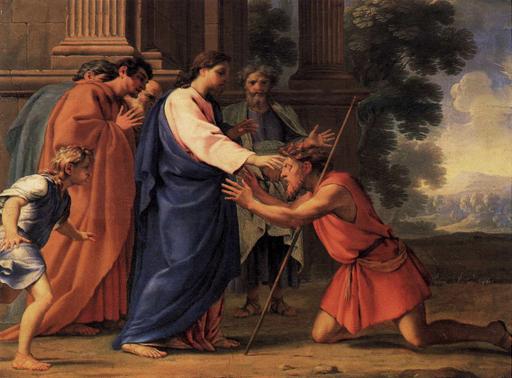
Jesus Heals Bartimeaus35 As he drew near to Jericho, a blind man was sitting by the roadside begging. 36 And hearing a crowd going by, he inquired what this meant. 37 They told him, “Jesus of Nazareth is passing by.” 38 And he cried out, “Jesus, Son of David, have mercy on me!” 39 And those who were in front rebuked him, telling him to be silent. But he cried out all the more, “Son of David, have mercy on me!” 40 And Jesus stopped and commanded him to be brought to him. And when he came near, he asked him, 41 “What do you want me to do for you?” He said, “Lord, let me recover my sight.” 42 And Jesus said to him, “Recover your sight; your faith has made you well.” 43 And immediately he recovered his sight and followed him, glorifying God. And all the people, when they saw it, gave praise to God.

In the name of Jesus. Amen.

Christ is on His way to Jerusalem. He plainly says that He is going there to fulfill everything that was written about Him in the Scriptures. He is going there to be delivered to the Gentiles, mocked, shamefully treated, spit upon, flogged, and killed. But on the third day He will rise. Jesus says this plainly and clearly. But notice how carefully Luke records the reaction of the disciples. They understood none of these things. The saying was hidden from them. And they did not grasp what was said. That’s the long, emphatic way to say, “They didn’t get it.” The text then notes that Jesus’ journey to Jerusalem takes Him through Jericho where a crowd was waiting to meet Him.

Now, Christ’s name in Greek is Ἰησοῦς and it gets brought into English as ‘Jesus.’ But if you said Jesus’ name in Hebrew it would be יְהוֹשׁוּעַ, and when that gets brought into English it is ‘Joshua.’ If I asked you what city most goes with the name Joshua, I would bet you would say Jericho. It was Joshua who “fit [sic.] the battle of Jericho.” When Joshua went to Jericho, it was to destroy and kill. Joshua and the Battle of JerichoJoshua lead God’s people marching around those thick, fortified walls for six days, and on the seventh day, the people shouted and “the walls came a-tumbilin’ down.” Afterward, they burned the fallen rubble and reduced the city to ashes.

But Joshua wasn’t done yet. He stood over the smoke and ruins of that city and pronounced a curse, “Cursed before the Lord be the man who rises up and rebuilds this city, Jericho. At the cost of his firstborn shall he lay its foundation and at the cost of his youngest son shall he set up its gates” (Josh. 6:26). Those ruins were to be a perpetual sign of God’s displeasure with the wicked inhabitants of that city. But about 500 years later, a man named Hiel, began to rebuild Jericho. And you don’t have to guess what happened. The foundation of the city was laid, and his firstborn died. And when the gates were raised, his youngest son died (1 Kgs. 16:34). It should serve as a warning to us not to mess around with what is cursed by God.

We need to remember that, as blessed as our country is, we live in a modern-day Jericho. Most people do not believe in God. Today, sins that would have caused our parents to blush with shame are celebrated. People worship their bank accounts, their careers, and their livelihood. In our land, nearly one million babies are sacrificed in abortions every year. But, while that should cause us to weep and mourn, how many more are sacrificed spiritually?

Kids are programmed by parents to aim for success in this life by getting good grades, playing hard in sports, and finding a good job. None of those things are evil by themselves. But how often are those things promoted to the neglect of teaching those children the fear and love of God? What good is any of that if those same children end up in hell? Yes, parents, give your children those good things, but make sure are secondary to faith in Jesus, the true, merciful God. No, you may not be trying to rebuild Jericho, but too often Christian parents are raising their children on cursed foundations that are protected only by cursed gates.

Repent. Repent, and know that if you are feeling the curse of your sins that the New Joshua draws near to Jericho.

The first Joshua came to curse and destroy the sinful city of Jericho, but Jesus, the new Joshua, comes to bless. Joshua came to hurt, but Jesus comes to heal. Joshua came to march around Jericho, but Jesus came to walk straight through it. Jesus came to rescue from the ruins and curse of sin and bring His holy deliverance into His heavenly kingdom. That holy deliverance will come as His own body is wrecked and the curse of our sin is laid upon Him.

So, the Lamb of God travels through Jericho. It would make sense if Jesus went through the city quickly passing by beggars on the street. Jesus is marching to do something bigger than to simply help a miserable beggar. And that is exactly what seems to be in the minds of some who are walking with Jesus. They tell one of those beggars to sit down and leave Jesus alone. But even though His eyes focused on the cross, Jesus doesn’t pass by this blind man. Jesus stands still, and He stands still to deliver holy mercy.

It is as though Jesus can’t help Himself. He never ignores cries for mercy because He is mercy embodied. Jesus stands still and tells them to bring the blind beggar to Him. And notice how Jesus treats the blind man with dignity and respect. Jesus knows he can’t see, but He goes to the blind man’s level and gives him something for his ears. He asks, “What do you want Me to do for you?” The blind man answers, “Lord, let me recover my sight.” And Jesus delivers him from his blindness.

This morning, Jesus passes through your Jericho. Christ has heard your cries for mercy too. In fact, this same scene played out today just as it does every Sunday you gather here. We beggars come into the presence of Jesus, and we cry for mercy. Jesus doesn’t turn away. Instead, He hears you. He stops and stands still. You confessed your sins, you cried out for mercy, and Christ answered you by absolving you.

Notice what Jesus does not say to the blind man. Jesus does not say, “I have made you well and restored your sight.” Instead, Jesus says, “Your faith has made you well,” or better, “Your faith has (lit.) saved you.” Yes, it was Jesus who saved him, but Jesus points the man to his God-given faith.

Remember, dear saints, that your salvation was won and purchased by Jesus on the cross some two-thousand years ago, but your salvation is not distributed there. Thank the good Lord that it isn’t distributed there because you and I weren’t there. Even if we were to go to Jerusalem today, we couldn’t be at the foot of the cross because there isn’t anything there anymore. Salvation Won and DeliveredOn the cross, Jesus did everything for your salvation. On the cross, Jesus won the victory over sin, death, and the devil. But God delivers what Jesus did on the cross to you here and now. God delivers the mercy, grace, life, and salvation of Jesus through the preaching of His Word (Ro. 10:17), through your Baptism (Ro. 6:3-11), and through the Lord’s Supper (Lk. 22:14-20). God brings His holy deliverance to you through all those things, and as you receive those gifts of God through faith, you are saved.

Finally, notice the blind man’s response. He follows Jesus. The blind man leaves his Jericho home and follows Jesus to Jerusalem. As we begin Lent this Wednesday, let us do the same as we follow Jesus by listening to His Word. Let us abandon our cursed state and follow Jesus to Jerusalem this Lent. He leads, and we follow with grateful hearts. Let Jesus lead you to Jerusalem, to the cross, and to the empty tomb on Easter. Amen.

The peace of God, which surpasses all understanding, will guard your hearts and minds in Christ Jesus. Amen.

The Last State – Sermon on Luke 11:14-28 for the Third Sunday in Lent

Listen here.
[Apologies for the poor quality of this recording, we had some known technical issues.]

Luke 11:14-28

14 Now he was casting out a demon that was mute. When the demon had gone out, the mute man spoke, and the people marveled. 15 But some of them said, “He casts out demons by Beelzebul, the prince of demons,” 16 while others, to test him, kept seeking from him a sign from heaven. 17 But he, knowing their thoughts, said to them, “Every kingdom divided against itself is laid waste, and a divided household falls.18 And if Satan also is divided against himself, how will his kingdom stand? For you say that I cast out demons by Beelzebul. 19 And if I cast out demons by Beelzebul, by whom do your sons cast them out? Therefore they will be your judges. 20 But if it is by the finger of God that I cast out demons, then the kingdom of God has come upon you. 21 When a strong man, fully armed, guards his own palace, his goods are safe; 22 but when one stronger than he attacks him and overcomes him, he takes away his armor in which he trusted and divides his spoil. 23 Whoever is not with me is against me, and whoever does not gather with me scatters.

24 “When the unclean spirit has gone out of a person, it passes through waterless places seeking rest, and finding none it says, ‘I will return to my house from which I came.’ 25 And when it comes, it finds the house swept and put in order. 26 Then it goes and brings seven other spirits more evil than itself, and they enter and dwell there. And the last state of that person is worse than the first.”

27 As he said these things, a woman in the crowd raised her voice and said to him, “Blessed is the womb that bore you, and the breasts at which you nursed!” 28 But he said, “Blessed rather are those who hear the word of God and keep it!”

In the name of the Father and of the Son and of the Holy Spirit. Amen.

These first few Sundays in Lent have a strong focus on spiritual warfare. And here Jesus is teaching us very pointedly that there is no neutral ground spiritually – there is no spiritual Switzerland. Christ says, “Whoever is not with Me is against Me, and whoever does not gather with Me scatters.”In other words, if you are not in league with Jesus and fighting againstthe devil, you are fighting with the devil.

To strengthen and encourage us in the battle, Jesus tells two short parables in this text. The first parable (in v. 21-22) describes the new reality in this world. And we have to understand this first parable because it lets us know the playing field. Jesus says, “When a strong man, fully armed, guards his own palace, his goods are safe; but when one stronger than he attacks him and overcomes him, he takes away his armor in which he trusted and divides the spoil.”

We heard about the Fall a few weeks ago. Adam and Eve brought sin into the world by rebelling against God and believing the devil rather than their Creator. When Adam and Eve fell, the devil entered his palace and the kingdom of darkness began. Satan now owned them and everyone who would be born from them – that is all of us. The armor of the devil that Jesus talks about is our sin, our guilt, and our shame. And, according to Jesus, the devil trusts in that armor. Satan thinks that because your sin and guilt is so great that he is immune from invasion and attack. He thinks his palace is impenetrable and that you are safely in his possession forever.

But Satan is wrong. Jesus, the stronger man, has stormed the devil’s castle. Christ attacked him and overcome him. Your Savior has taken away the armor that the devil thought protected him, what the devil trusted, what he thought would always be there – this is the most important part of the parable. Jesus has removed your sin, guilt, and shame which was the devil’s armor. And the devil is now weak and extremely vulnerable.

But the spiritual battle is still ongoing. The demons are defeated but they still fight against us even though they have no power and no armor. And this is what Jesus addresses in the second parable (v. 24-26). Jesus says that when a demon has gone out of a person – in other words, when someone becomes a Christian, when a person is Baptized, when they are given the gift of faith in Christ and have the Holy Spirit – that demon passes through waterless places seeking rest because it has been expelled. The demon doesn’t like that. The demon would rather be connected to that person.

Now, I need to make a quick distinction between demon possession and demon oppression. In the Gospels, we often see people who are actually possessed by demons. In cases of demonic possession, demons live inside that person and can make them mute (like in this text), throw people into fires (Mk. 9:22), or cut themselves and make them live among the tombs (Mk. 5:2-5). That is demonic possession. But just because someone isn’t possessed by a demon does not mean that they are not influenced or oppressed by demons. The main point is that you are either going to be influenced by a demon or the Holy Spirit.

So, most of you became Christians when you were baptized. The Holy Spirit came and removed the demons and their oppression from you. And those demons wander around seeking rest, but they find none. So, they come back to you, the house from which they were cast out. If that demon finds you swept and put in order, it will come back and bring seven more demons even more evil than itself and the last state is worse than the first.

So, here is the picture Jesus gives, Christian. When you came to faith, Christ drove the demons away from you, but those demons have had their eye on you ever since. They have been watching you to seek reentry. If the demon comes back and finds your house clean and (as Jesus says in the same context in Mt. 12:44) empty, it moves back in and throws an evil, sinister party, and again the last state is worse than the first.

Remember, you are either with Jesus or with the devil and demons. There is no neutral ground. Christian, as you live out your faith and devote yourself to God’s Word, Satan and the demons have no power over you. Jesus, the stronger man is with you. The Holy Spirit has filled you and the demons cannot stand the presence of His holiness. But, if you stop filling yourself with God’s Word, if you neglect the work of the Holy Spirit, you can evict Him. You can fall away. Beware and repent.

The most effective strategy, in fact the only strategy, the devil has against you is to make you think that you don’t need Jesus and His blood shed for the forgiveness of your sins. And the way that the devil does this is to harden your conscience against God’s Word. So, guard your conscience, and actively work to soften your conscience so that when you hear God’s Word, you are driven to your Savior’s mercy and grace.

Let me give you an analogy to make this point. The last few weeks, we’ve finally had temperatures above freezing. Compared to the temperatures that we had in January and February what were in the -20’s, it feels really nice. So now, when the thermometer hits 38°, our bodies are ready go out without coats, or at least much lighter coats. In the Spring 38° is glorious. But when August comes and we are used to the heat of summer, 38° makes bodies feel bitterly cold. Your conscience is similar.

Imagine each of the Commandments as a thermometer, and for this example, let’s take the 5thCommandment, “Thou shalt not murder.” Instead of numbers marking the side of the 5thCommandment thermometer, there are different sins that all fall under the 5thCommandment. Way up at the top you have a mark for genocide. A little blow that is a mark for mass murder. A little below that you have a mark for murder, then punching. And because Jesus teaches us that hatred for our neighbor is the same as murder (Mt. 5:21-22) you have a mark for that way down toward the bottom. You get the idea?

Now, all of those sins – from genocide all the way down to anger – all of them make us guilty before God. We need the shed blood of Jesus to cover all of those sins, and know, Christian, that you have that. But you still have to fight against your sinful nature in this life.

So, just think with me here, where does your conscience register on the 5thCommandment thermometer? Maybe, you are somewhere between the marks of punching and anger. The devil and the demons are at work tempting you to harden your conscience. But they don’t tempt you straight to commit genocide. Instead, they tempt you just a little higher than you already are. They tempt you to more anger. They tempt you to punching and violence. And once they have you there, they tempt you to harden yourself a little more, to go up another little step. And they do this with all the Commandments – with adultery and lust, with stealing, and lying.

But you, Christian, you need to be constantly working to soften your conscience. Let me switch to the 3rdCommandment about keeping the Sabbath holy. You’re a Christian, so going to church is simply what you do each Sunday morning. The devil isn’t going to come straight at you and say that going to church isn’t important at all. Instead, the devil will work like this:

Let’s say that one Sunday you were very legitimately sick, so you don’t go to church, but you feel bad about it in your conscience. The devil is right there telling you, “You don’t need to feel bad. You were sick, and it’s better to not risk getting other people sick. So, don’t feel bad. You listened to the sermon later, and it was boring anyway.” And so, you decide to put that little feeling of guilt and loss away. The devil has just hardened you a little bit. So, when a couple of months go by, and you wake up with a headache – something that isn’t going to get passed around to anyone else – the devil will tempt you to skip church again. A little more hardened. Then, you have that family reunion and nothing bad happened when you skipped church because of your headache – God didn’t send a bolt of lightning to smite you. And the Bible says that family is important, so you skip for that. Hardened again. The devil’s goal is to make going to church seem like one option among many options so that being in God’s house becomes nothing more than a matter of choice so that your last state is worse than the first.

Repent. Now, I do have to say that it’s not as though you should carry around guilt for missing church when you have the flu and try to do penance or something like that. No. Jesus loves you. He has disarmed the devil. He has removed your guilt, and Christ forgives you all of your sin. He remembers your sin no more. What I am saying is this: don’t give the devil a foothold. Resist his temptations to harden your conscience.

You do that by memorizing the Ten Commandments and meditating on them. Consider each of them and what Jesus says about them in the Sermon on the Mount (Mt. 5-7). In this way, your house, which is your heart, does not remain empty. Rather you are filled with the Holy Spirit through the study, consideration, and meditation of God’s Word. In this way, may your last state be better than the first. Amen.

The peace of God, which surpasses all understanding, will guard your hearts and minds in Christ Jesus. Amen.

The Oven, the Stubble, and the Sun – Sermon on Luke 21:25-36 for the Second Sunday in Advent

Listen here.

Luke 21:25-36

25 “And there will be signs in sun and moon and stars, and on the earth distress of nations in perplexity because of the roaring of the sea and the waves, 26 people fainting with fear and with foreboding of what is coming on the world. For the powers of the heavens will be shaken. 27 And then they will see the Son of Man coming in a cloud with power and great glory. Christ's Return in Glory28 Now when these things begin to take place, straighten up and raise your heads, because your redemption is drawing near.”

29And he told them a parable: “Look at the fig tree, and all the trees. 30 As soon as they come out in leaf, you see for yourselves and know that the summer is already near. 31 So also, when you see these things taking place, you know that the kingdom of God is near. 32 Truly, I say to you, this generation will not pass away until all has taken place. 33 Heaven and earth will pass away, but my words will not pass away.

34 “But watch yourselves lest your hearts be weighed down with dissipation and drunkenness and cares of this life, and that day come upon you suddenly like a trap. 35 For it will come upon all who dwell on the face of the whole earth. 36 But stay awake at all times, praying that you may have strength to escape all these things that are going to take place, and to stand before the Son of Man.”

In the name of the Father and of the Son and of the Holy Spirit. Amen.

A couple of years ago, we had some trouble with the oven in our home. For some reason, it would suddenly go into self-cleaning mode while something was being cooked. Apparently, self-cleaning mode brings your oven’s heat to somewhere between 750-1,000°F. Banana bread does not like temperatures that high. Also, apparently, my family’s lungs did not like the banana bread’s response to temperatures that high. The worst part was how long it took to extract the smoking loaf from the oven. Even after the power was cut, the oven door remained locked and the bread kept smoking until the temperature fell to whatever Whirlpool deems safe. I stood next to the oven waiting so that as soon as I heard the lock release, I could open the door and take the glowing loaf outside to finish smoldering.

I was amazed at how our normal oven was able to turn what was supposed to be tasty goodness into a block of inedible, charred ash. But God speaks of another oven that will be more intense than anything we can imagine in our Old Testament text (Mal. 4:1-6). God speaks there about the day of judgment. Listen again to the first verse: “Behold, the day is coming, burning like an oven, when all the arrogant and all evildoers will be stubble. The day that is coming shall set them ablaze, says the Lord of hosts, so that it will leave them neither root nor branch.” Now, that’s one hot oven.

Too often, it seems as though the wicked are strong, powerful, and unmovable. Too often, we think the wicked will always prosper and be better off than we poor, little Christians are. Malachi here says that our perception is that the evildoers are like strong trees with deep roots and large branches. But the burning oven of that day will incinerate them so that there will be neither root or branch left. Instead, the evil will prove to be nothing more than stubble that will burn up quickly. For those who refuse to repent, the Last Day will mean their utter destruction because the oven of God’s wrath will burn the stubble of the wicked.

As Jesus talks about this same day in our Gospel text, He doesn’t use the picture of a burning oven, but He uses similar pictures of calamity. Signs in the sun and moon and stars. Distress of nations in perplexity. Roaring of the sea and waves. People fainting with fear and foreboding because of what is coming on the world as the powers of the heavens are shaken.

We don’t like that imagery. We don’t like it when the world seems to be coming apart at the seams. Our fear probably lies in the fact that this world is all we have experienced and known. So, when we see it falling apart at an alarming rate, we get anxious. Repent. This world is not all there is.

Dear saints, we don’t need to be worried when we see the world collapsing. Jesus told us that it would happen. He gave us these signs so we would know what is actually going on. Jesus warned us so that we wouldn’t be afraid. It’s like Jesus is saying, “When it looks like everything is falling apart, when all creation seems to be disintegrating, it is. But don’t worry about it. Nothing bad is going to happen to you. Instead, be glad because all of it means that your redemption is drawing near.”

When you see signs in the sun, moon, and stars; when you see the nations in distress and perplexity; when you see the roaring of the sea and waves, people fainting with fear and foreboding; when you feel the oven heating up and see the stubble burning, remember what the Scriptures say. You are safe in the nail-scarred hands of your Savior, Jesus.

Again, as God promised in Malachi, “For you who fear My name, the sun of righteousness will rise with healing in its wings. And you will go out leaping like calves from the stall.”

So, the pictures we have, so far, of Christ’s return are an oven burning up the stubble of the wicked. But for you Christian, the picture is that the sun is rising and a new day of joy and everlasting peace is dawning. Imagine it this way:

You are in a castle at night, but suddenly all the guards and soldiers start running to the walls of the castle. They take their positions there because outside the castle walls is an army marching to attack the castle. The boots of that attacking army stop tramping, and you hear the shouts of commanders telling the troops to load the catapults and start banging away with the battering ram. Then you hear it. BOOM! The battering ram hits the castle doors and the walls shake. BOOM! A rock launched from a catapult hits its target and a couple of windows break and dust falls from the ceiling. Again and again and again BOOM!

Christ Returns in Power and GloryNormally, you would be terrified in a situation like that. But not now. Not now because you are in the prison of that castle being held captive. And the commander who is leading the army that is storming the castle is Jesus coming to save you.

Knowing that, every crash, every clang, every shout of battle, every wall that crumbles around you means that your release is closer. And you know that a new day is dawning, and it is the day of your deliverance.

Dear saints, I said it a couple of weeks ago, and I’ll say it again. This world is ending. Good riddance. Every sign pointing to the end of this world – no matter how fearful or painful it may be – is a sign of your rescue. All of them are signs pointing you to the return of your Deliverer, your King, your Savior.

The oven is heating up. The stubble is smoldering. But, dear saints, lift up your heads. The Sun is rising. A new, eternal dawn is breaking forth on the horizon. And your redemption draws near. Come, Lord Jesus. Amen.

The peace of God, which surpasses all understanding, will guard your hearts and minds in Christ Jesus. Amen.