The Sign – Sermon on Isaiah 7:10-14; Galatians 4:4-7; & Luke 1:26-38 for Midweek Advent 1 2024

Isaiah 7:10-14; Galatians 4:4-7; Luke 1:26-38

In the name of Jesus. Amen.

God’s Word always works. Sometimes, it’s instantaneous. At creation, God said, “Let there be…” and whatever God said on each of the six days of creation simply was (Gen. 1). We see this same thing in many of Jesus’ miracles. Our Lord would say, “Receive your sight,” to blind eyes (Mt. 9:28-29); “Be opened,” to deaf ears (Mk. 7:34); “Your son lives,” to a frantic father (Jn. 4:50, 53); and “Come out,” in front of the grave of dead-as-a-doornail Lazarus (Jn. 11:43). And all of things happened immediately.

However, it’s also true that God will say something, and time passes. The thing God says still happens. It just takes a while. God told Moses to go back to Egypt, deliver His people out of slavery, and bring all of them to worship Him on Mt. Sinai (Ex. 3:10-12). It happened, but it took a while (Ex. 19:1-2). God told Noah that He would send a flood to destroy all flesh (Gen. 6:13-22). That happened too, but only when enough time elapsed for Noah to build the ark and herd the animals onto it – possibly about 100 years (Gen. 5:32; 7:6). Ultimately, It doesn’t matter if God’s Word is delayed. What God says happens.

But we are impatient people. Even though time after time God has proven His faithfulness to His Word, we wrongly start to doubt and take matters into our own hands. Abraham believed God’s Word that he would be the father of many nations (Gen. 12:1-3; 15:1-6), but the delay in the fulfillment of that promise led Abraham to have a son with his wife’s servant, Hagar (Gen. 16:1-4). That momentary unbelief of Abraham, though forgiven, still has devastating repercussions to this day. You can wait and trust that God will come through on His Word (Hab. 2:3).

In our text tonight from Isaiah, King Ahaz of Judah is facing a problem. Neighboring countries are attacking Judah. The king of Israel and the king of Syria joined forces and invaded his land, they have besieged Jerusalem, but they hadn’t been able to destroy it. So, Ahaz devises a plan, but it’s a stupid plan. He asks for help from another one of his enemies, the king of Assyria, to fight against Israel and Syria. Ahaz even takes the gold out of the Temple to buy Assyria’s help (2 Kgs. 16:5-8). But God sends the prophet Isaiah to tell Ahaz that He’s in control and that Ahaz doesn’t need to fear Israel and Syria because they are nothing more than smoldering stumps (Is. 7:1-9).

That Isaiah text (Is. 7:10-14) begins when God invites Ahaz to request a sign for proof that He will deliver Judah from her enemies, and it is an open-ended invitation. Ahaz could ask for a sign as deep as Sheol or as high as heaven. In other words, Ahaz could have asked for anything. He could have been selfish and asked God for a million tons of gold to put in his treasury. But Ahaz refuses in a pious sounding way, “I will not put the Lord to the test.” Ahaz preferred to forge ahead with his own plans. He fancied the formidable Assyrian army over God’s invitation to simply trust and be firm in faith that God would deliver (Is. 7:9b). Bad idea. By rejecting that sign, Ahaz also rejected God’s Word and promise. He treated God’s Word as though it was meaningless and impractical. Ahaz had his own plans, and he didn’t want God to interfere with them.

God wasn’t fooled by Ahaz’s fake piety. But still God is merciful and will give Ahaz not just one but two signs of deliverance. One of them, which we didn’t hear, would be fulfilled in Ahaz’s lifetime (Is. 7:15-17). But the sign we did hear is more wonderful because it isn’t only a sign that Judah would be delivered from her enemies. Instead, the promise is that God would deliver all humanity because God would come and dwell among us.

“Behold, the virgin shall conceive and bear a son, and shall call His name Immanuel,” which means ‘God with us’ (Mt. 1:23). God promises that He is coming. And when He comes, He comes to deliver and save. But when God’s acts of salvation are met with unbelief, those acts become a judgment to the one who disbelieves. So, for Ahaz, Immanuel means judgment.

About 700 years later, God came through on His promise of Immanuel. In our Gospel text (Lk. 1:26-38), God sends the angel Gabriel to Mary. Gabriel announces to her that the time to fulfill that promise given to Ahaz has come. Though she is a virgin, she will conceive and bear a Son who will be the fulfillment of God’s promise to dwell with His people as well as all the other promises God had given to save His fallen creation. Mary’s response is completely different than Ahaz’s response. She seems to be filled with surprise and curiosity, “How will this be?” Gabriel simply reassures her that nothing is impossible for God (Lk. 1:37), and Mary simply trusts. “Behold, I am the servant of the Lord; let it be to me according to your word” (Lk. 1:38).

Sure, God’s promise that the virgin would conceive took a while – 700 years. But it happened at exactly the right time. God sent forth His Son, born of a woman. Born with your flesh and bone. Born to bear your sins to the cross. Born to redeem you. Born so that you could be adopted, chosen, selected into God’s family. Born so that you would be an heir of God (Gal. 4:4-7).

Dear saints, because God has already given you what is most precious to Him and most needful for you, you can believe that He won’t go back on any of His other promises to you. All of God’s promises find their ‘yes’ in Christ, in Immanuel (2 Cor. 1:20).

Jesus is God with you. And even more than that – Jesus is God for you. God is on your side. You can take His Word to the bank. Amen.

The peace of God, which surpasses all understanding, will guard your hearts and minds in Christ Jesus. Amen.


The Righteous Live by Faith – Sermon on Habakkuk 2:1-4 for Reformation Sunday

Habakkuk 2:1–4

1 I will take my stand at my watchpost 
and station myself on the tower, 
and look out to see what he will say to me, 
and what I will answer concerning my complaint. 

2 And the Lord answered me: 
“Write the vision; 
make it plain on tablets, 
so he may run who reads it. 
3 For still the vision awaits its appointed time; 
it hastens to the end—it will not lie. 
If it seems slow, wait for it; 
it will surely come; it will not delay. 
4 “Behold, his soul is puffed up; it is not upright within him, 
but the righteous shall live by his faith.

Help – Sermon on Matthew 9:1-8 for the Nineteenth Sunday after Trinity

Matthew 9:1–8

1 And getting into a boat he crossed over and came to his own city. 2 And behold, some people brought to him a paralytic, lying on a bed. And when Jesus saw their faith, he said to the paralytic, “Take heart, my son; your sins are forgiven.” 3And behold, some of the scribes said to themselves, “This man is blaspheming.” 4 But Jesus, knowing their thoughts, said, “Why do you think evil in your hearts? 5 For which is easier, to say, ‘Your sins are forgiven,’ or to say, ‘Rise and walk’? 6But that you may know that the Son of Man has authority on earth to forgive sins”—he then said to the paralytic—“Rise, pick up your bed and go home.” 7 And he rose and went home. 8 When the crowds saw it, they were afraid, and they glorified God, who had given such authority to men.

In the name of Jesus. Amen.

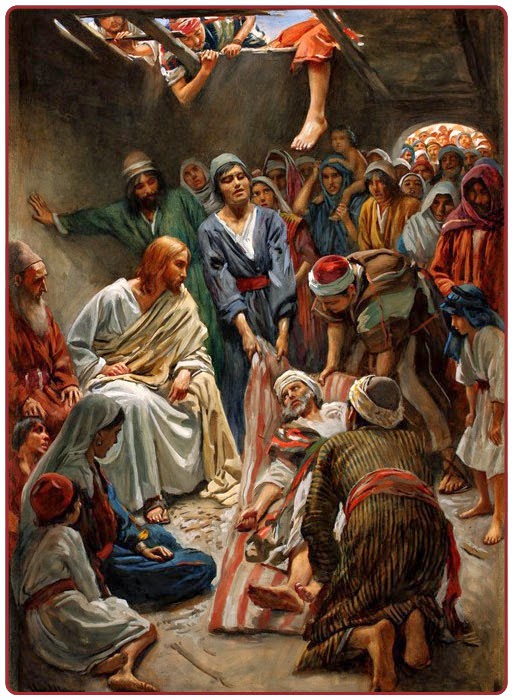
What do you suppose the friends of this paralyzed man thought when they heard Jesus? They had gone to a lot of trouble to bring him to Jesus. They had heard Jesus was at home (Mt. 9:1; Mk. 2:1), and people from all around knew that the power of God was with Jesus to heal (Lk. 5:17). We can imagine these friends going to the paralyzed man’s house and telling him, “Hey, Charles,” (he probably wasn’t named ‘Charles’ but go with me on this), “Hey Charles, Jesus is in town. We’re going to take you to Him and get you healed.”

They lift up Charles’ bed and lug him through the city streets. But when they get to where Jesus was, they find that too many people are there, and they can’t even get to the door (Mk. 2:2; Lk. 5:19). So, they take desperate measures. They lug Charles and his bed to the top of the house, tear open the roof, tie ropes on the corners of Charles’ bed, and lower him so he is before Jesus (Mk. 2:4). Charles’ friends are trying to catch their breath, wiping the sweat off of their foreheads, and giving each other tired fist bumps as they surround that gaping hole, thinking, “We did it. Jesus is going to heal our buddy so he can walk.”

But then, down in the house with dust swirling around them, Jesus looks at Charles, and Charles looks up at Jesus. And Jesus says those words, “Take heart, My son; your sins are forgiven.” I imagine those friends were thinking to themselves, “You’ve gotta be kidding me, Jesus. We brought Charles here so You could fix his body!”

We don’t actually know what the paralytics’ friends thought, but we do know what the scribes and Pharisees thought, “Jesus is a blasphemer. Only God can forgive sins” (Mk. 2:7; Lk. 5:21). They grumble. They scoff. They doubt. But Jesus knows their thoughts and hearts, just as He knew the faith and believing hearts of this man’s friends. And because Jesus knows both the faith of these friends and the grumbling of the scribes, we also know that Jesus knew the paralytic’s thoughts.

Maybe, the paralytic was initially excited at the prospect of being healed and using his limbs. But based on Jesus words to him, there is little doubt that Jesus told him exactly what he needed to hear. The first word Jesus says, “Take heart,” is the same command Jesus will give to the disciples when they are out in a huge storm in the middle of the sea. They are being beaten by the waves and wind. Jesus appears, and they think He’s a ghost. But Jesus calms them, “Take heart; it is I. Do not be afraid” (Mt. 14:27).

This paralytic man hears from Jesus the exact words he needed to hear as he was battered by legs that didn’t work and arms that couldn’t move. “Take heart, My son; your sins are forgiven.” As he was lying there before Jesus, maybe he figured Jesus would tell him how awful he had been and that his paralysis was punishment for his sin. But that’s not what Jesus says. Jesus tells him that in the midst of his suffering and horrible situation that he can be of good courage because his sins are forgiven.

Now, of course, Jesus ends up healing the man too. To silence the grumbling scribes and prove that He actually does have the authority to forgive sins, Christ heals the man.

That’s the main teaching of this text. Jesus proves that He has the authority on earth to forgive sins by healing the paralytic. And the crowds respond with fear and glorified God (notice how the text ends) who had given such authority to men. It’s plural. To men. Not just to the man, Jesus. To men.

That was true here, but it is even more evident on the evening of the Resurrection. Then, Jesus tells the disciples, “If you forgive the sins of any, they are forgiven them” (Jn. 20:23). Jesus, the One who has authority to forgive sins, delegates that authority to His Church, to all Christians. Because you have called me to be your pastor, I get to do that each Sunday morning. God uses my voice to proclaim His forgiveness to you. I get to be ‘the Absolution guy.’ It’s pretty cool. And please, don’t think I’m bragging. Believe me, I wouldn’t have the guts to say that if the Bible didn’t teach it. Forgiveness and absolution is the main point of this text.

But today, I want to draw special attention to this guy’s friends and their tenacity to help him by bringing him to Jesus. They know their friend’s need. They know Jesus is where he can get help. So, they do everything in their power to help him by bringing him to Christ.

Dear saints, you do this too. I know you do. But I’d like to point out three specific, concrete ways you do this because these things are easy to overlook. And when we overlook them, it’s easier to neglect doing them. Here are the three ways you help others by bringing them before Jesus, and they are in no particular order.

First, you help people by inviting them to church. Jesus promises to be here as we gather each and every week when He says, “Where two or three are gathered together in My name, there am I among them”(Mt. 18:20). You are eternally helping others when you bring them here, to God’s house and to the gate of heaven (Gen. 28:17) where Jesus meets them with His Word and forgiveness.

Second, you help people by praying for them. When you have an unbelieving family member or coworker who has some need. Help them by praying for them. As you lift others up in prayer, you are bringing them to and laying them before the feet of Christ. Don’t forget that. When someone is suffering, lift them up to Jesus in your prayers. Maybe Jesus won’t answer your prayers in precisely the way you expect. But He knows best how to help.

James 5:13-16 says that your prayers have great power. You don’t even have to tell the person you are praying for them. (Usually, I think letting them know you are praying for them is a good idea. But there might be times [e.g. if they are really deep in unbelief and hatred of God] you don’t. Use your God-given wisdom.) Even if they don’t share their problems with you, pray for them anyway. They might not share their struggles, but they probably tell you the ways they have been blessed. That same section of James 5 says that when someone is cheerful, you can give a prayer of thanks to God for the blessings He has provided.

Third, you help people by forgiving them. The forgiveness you have received from God frees you to forgive others when they sin against you. Christian, your gracious disposition toward them and toward the world is a way that the light of Christ shines through you (Mt. 5:14-16).

All of that brings me to you, Cooper. Cooper, today you are Baptized. Today, your parents have helped you by bringing you to Jesus who also says to you, “Take heart, My son; your sins are forgiven. I have joined you to My death and resurrection (Ro. 6:3-8). I have clothed you in My righteousness (Gal. 3:27), given you the new birth of water and the Holy Spirit (Jn. 3:3, 5) and made you My child.”

Cooper, and all you saints, you are before Jesus right now. He invites you to His Table where He feeds you with His Body and Blood for the forgiveness of all your sins. As you walk out of here today, remember that you have new life in Christ. Use your freshly given strength to help and serve your neighbor. Amen.

The peace of God, which surpasses all understanding, will guard your hearts and minds in Christ Jesus. Amen.

Given, Taken, Blessed – Sermon on Job 1:1-22 for the Sixteenth Sunday after Trinity

Job 1:1–22

In the name of Jesus. Amen.

In a sinful and broken world, no one escapes suffering (Jn. 16:33), and no one can make themself right before God. We clearly see that in the book of Job. But another thing that we see in Job is that God accomplishes His purpose, even in the midst of suffering.

Job was very blessed by God. Job had 7,000 sheep, 3,000 camels, 500 yoke of oxen, 500 female donkeys, and many servants. Job was the greatest of all the people of the east. Beyond that, Job had seven sons and three daughters. One of the things that makes Job great is all of these children. Our culture tries to make it seem like children a burden. It’s sad that today people will see parents with a lot of children and joke with them. “Oh, you must be so tired,” or, “Don’t you know about the birds and the bees?”

We need to stop that. If we are doing it ourselves or hear others doing it, we need to put an end to it. Children are a blessing; they are a heritage from God (Ps. 127:3-5). Don’t fall for the lies of Margaret Sanger and Planned Parenthood. A blessed life does not mean that you’re free of obligation to children. Children are a blessing from God and are to be embraced.

Job was the also the spiritual leader of his family. He was careful to make sure his children were raised well. The fact that Job offered sacrifices for his children points to him being a father who is raising his children in the Christian faith. There is a good reason to see that all of Job’s children are following their father in the faith, but I’ll wait until the end of the sermon to say more about that.

So, Job was very blessed in every temporal way by God. And Job was also spiritually blessed by God. Three times in the first two chapters, we are told that Job is blameless, upright, one who fears God, and turns away from evil. Two of those times, that description comes from the lips of God Himself. And let’s consider each of those briefly.

First, Job is blameless. In Hebrew, that word can also mean ‘perfect’ or ‘pure.’ This does not mean that Job is sinless. Sinless and blameless are similar words, but they aren’t identical in meaning. Job himself will say that he’s sinful (e.g. Job 13:23). So how can God say that Job is perfect, that he’s blameless? Well, this is something that God Himself gives to Job. When God says something about you, it is true. When God says that you are blameless, that makes you blameless. This blamelessness, this purity, this perfection that Job has is a gift from God.

Second, Job is upright. This isn’t talking about Job’s posture. It’s not like he went to the chiropractor regularly. Job is upright. Most of the time this word gets used in Scripture, it’s referring to God. God Himself is upright. There’s no twisted or crooked way about him. God is without fault and without error. Job is too. Again, this characteristic is something that God gives to Job. Whatever sins Job had committed, God had forgiven.

Third, Job fears God. Throughout the Bible, fearing God is linked to trusting God. The 1stCommandment in the Small Catechism is explained, “We should fear, love, and trust in God above all things.” Usually, when we think of being afraid, it means we don’t trust someone or something because it’s unsafe. But when the Bible talks about the fear of God, it is not to think that God is unsafe. It means if you turned away from God, then God becomes unsafe. When you turn to Him, then He is your Refuge and Strength (Ps. 28:8; 46:1). C.S. Lewis captures this really well in the Chronicles of Narnia. There’s a question about the character that corresponds to Jesus and if he is ‘safe,’ and the reply is, “Of course he isn’t safe, but he’s good.”

Fourth and finally, we’re told that Job turns away from evil. By the power of the Holy Spirit, Job turns away from evil things. Again, that’s what a Christian does. A Christian does not run headlong into doing sinful, evil things. Instead, a Christian turns away from them. Yes, we sin, and we sin often. But by God’s help, we strive to turn away from evil.

So, when God describes Job as blameless, upright, fearing God, and turning away from evil, God is saying that Job is a Christian. God says this about any of you who believe in Christ.

After this description of Job, we see him begin to suffer. And the cause of Job’s suffering is important. Satan is in heaven, and God starts to brag about Job to the devil. It’s almost like if a jewelry store was being robbed and the owner came out and said to the thief, “Hey, have you seen my rarest, most expensive diamond?” We don’t know why God draws attention to Job, but He does. And the devil doesn’t even bother arguing with God. The devil doesn’t push back or try to “fact-check” God, not at all. God is right. The devil and the demons have to agree with God when God says something. Make sure you recognize that. 

Instead, the devil pushes back on Job’s faith. Satan says that the only reason Job is blameless and upright is that God is nice to him. The devil says that if God takes those things away that Job will curse God to His face. Notice how arrogant the devil is. He’s basically saying, “Let me have at him and I’ll make sure that he ends up the way that I want him to be.” For reasons that I don’t understand, God lets the devil do it. Through the rest of the ch. 1, we hear what the devil does. The devil sends different calamities that take away all the blessings God had given Job.

And how does Job respond to all this loss? It’s remarkable, “Naked I came from my mother’s womb and naked I shall return. The Lord gave, and the Lord has taken away. Blessed be the name of the Lord.” Who was it that destroyed all those things? We have to say that it was the devil, and yet who allowed the devil to do that? God did. God gave the devil a long enough leash to take all those things away. And who does Job credit? He credits God. The Lord gave. The Lord has taken away. Blessed be the name of the Lord.

In ch. 2, which we didn’t read, the devil is allowed to go farther. Job hasn’t cursed God, so the devil asks God to let him go after Job’s body. And Job gets afflicted with sores all over his body. But still, Job does not curse God. You have to imagine how frustrated this made the devil. Satan figured he’d be triumphantly standing over Job while Job was groveling at his feet, but Job doesn’t even acknowledge Satan in any of his suffering. It’s absolutely remarkable. Job’s eyes, mind, and heart are fixed squarely on God even in the midst of suffering.

Job doesn’t go down the black hole of trying to figure out why he’s suffering. He simply recognizes that he is suffering, and in his suffering, Job places himself squarely in God’s gracious hands.

Christian, take note of this. Whenever you’re presented with trials, tribulations, and suffering, don’t bother with the why of your suffering. Instead, focus on Christ. 1 Pet. 4:12-13 says, “Beloved, do not be surprised at the fiery trial when it comes upon you to test you, as though something strange were happening to you. But rejoice insofar as you share Christ’s sufferings, that you may also rejoice and be glad when His glory is revealed.”

Suffering and evil are definitely related to each other, but that does not mean that suffering itself is evil. In fact, suffering is good. If you didn’t suffer when you touched a hot stove, you wouldn’t remove your hand from it. If criminals and murderers didn’t suffer with time in prison, then there’d be a lot more theft and murder.

Suffering is meant to bring about repentance and faith in Christ. Suffering isn’t evil, but that doesn’t mean that God demands that you enjoy your suffering. You are right to hope for the end of your suffering. God sent Jesus to relieve you from suffering. Christ entered into our suffering in order to bring us into His kingdom where there will be no more suffering.

Comfort in suffering comes from seeing that God has come into our world to suffer alongside of us and for us. That’s the real comfort for anyone who suffers in any way. The world sees suffering and it tries to eliminate it. So much of our world today is focused on death as the only solution to suffering. They’ll see a poor, single woman who is pregnant and say, “That baby has no chance of being happy, healthy, or successful. So, abort the baby.” The world sees a person going through horrible medical problems and says, “It’ll just be better to end that life now with a doctor assisted suicide.” The world’s only answers to suffering are barbaric.

God’s answer to suffering is that He sends Jesus, not to bring an end to the sufferer, but to defeat suffering through His suffering (1 Co. 15:54). Jesus is the “Man of Sorrows.” In your suffering you find your Savior, who has died and risen again for you, to deliver you.

What we heard today isn’t the end of Job’s story. Job gets everything back. In Job 42, we see God gave Job twice as much as he had before. There, Job has double the sheep, camels, oxen, and donkeys. But then we’re told that Job also had seven more sons and three more daughters. I told you I’d come back to it.

Now, wait a minute. Seven sons and three daughters? That’s what Job had before, isn’t it? Shouldn’t Job have had fourteen sons and six daughters? No. Job’s first ten children aren’t lost to him. This points to Job’s first ten children being saved. Job still has them, even though they died. They’ll be united with Job in the resurrection, because Job knows that his Redeemer lives. Christian, your Redeemer lives too. And like Job, your eyes shall see him and not another (Job 19:25-27). Come quickly, Lord Jesus (Rev. 22:20). Amen.

The peace of God, which surpasses all understanding, will guard your hearts and minds in Christ Jesus. Amen.

Correction – Sermon on Proverbs 9:1-10 for the Second Sunday after Trinity

Proverbs 9:1–10

1 Wisdom has built her house; 
she has hewn her seven pillars. 
2 She has slaughtered her beasts; she has mixed her wine; 
she has also set her table. 
3 She has sent out her young women to call 
from the highest places in the town, 
4 “Whoever is simple, let him turn in here!” 
To him who lacks sense she says, 
5 “Come, eat of my bread 
and drink of the wine I have mixed. 
6 Leave your simple ways, and live, 
and walk in the way of insight.” 
7 Whoever corrects a scoffer gets himself abuse, 
and he who reproves a wicked man incurs injury. 
8 Do not reprove a scoffer, or he will hate you; 
reprove a wise man, and he will love you. 
9 Give instruction to a wise man, and he will be still wiser; 
teach a righteous man, and he will increase in learning. 
10 The fear of the Lord is the beginning of wisdom, 
and the knowledge of the Holy One is insight.

In the name of Jesus. Amen.

What comes to mind when you think of a wise person? Maybe you picture an individual. Some of you see a gray-haired man with a long beard and weathered robe sitting on top of a mountain. Maybe, you think of your grandpa, dad, or a former pastor – not your current one! Maybe, when you think of a wise person, you think of characteristics and qualities. Someone who doesn’t immediately react. Someone who ponders and mulls over possibilities before responding to different questions and situations that arise.

We might think a wise person is someone very put together and successful. Someone who is well off financially and made the right career choices and investments. We build up this wise person into someone who never makes mistakes. Here’s where we need our first correction because a person who never makes mistakes is not a wise person – that’s a perfect person. Wisdom does not mean a person is always right – not even close. Instead, a wise person is someone who is good at being wrong. And what I mean by that is that a wise person is someone who listens to correction. A wise person is someone who knows they don’t know everything and is willing to be learn from their mistakes and from the experience of others.

Our text says, “Whoever corrects a scoffer gets himself abuse, and he who reproves a wicked man incurs injury. Do not reprove a scoffer, or he will hate you” (Pro. 9:7-8a). When we hear those lines, we might think that is advice to keep us from wasting our time and correcting someone who won’t take correction. In other words, we interpret that as a way to disdain others. “I pointed out his mistakes and how he was wrong, but he didn’t like it and lashed out at me. He must be a wicked scoffer because he didn’t listen to the wisdom I tried to give him.”

There is truth to that interpretation, but I don’t think that is how we should understand those verses. Instead, the Holy Spirit would correct us and have us understand those verses a diagnostic tool on ourselves when we are corrected. In other words, when someone corrects or reproves you, how do you respond? Do you lash out at that person? Do you offer up all sorts of excuses to defend your actions? Do you hate it when people correct you? If you do, you are the wicked scoffer.

Here’s why we should take it that way. Look again at what comes right after those verses, “Reprove,” same word used above, “Reprove a wise man, and he will love you. Give instruction to a wise man and he will be still wiser; teach a righteous man, and he will increase in learning” (Pro. 9:8b-9) A person who is truly wise welcomes correction when he is wrong. A wise person knows he doesn’t know everything and is willing to keep learning more and more. A wise person is even willing to be rebuked, “You messed up here.”

Now, receiving that kind of reproof and rebuke isn’t fun. No one likes being corrected. We all resist admitting that we made a mistake, sinned, or failed. But after the sting of being corrected wears off, we should step back, reflect, repent, and learn from those mistakes and sins so we can do better in the future. When we do that, we can be actually grateful for the person who rebuked us because that person has had a hand in making us better, smarter, and wiser.

That is the path of wisdom: Humbly receiving correction and rebuke. Pondering advice and reproof. And implementing changes to improve and progress toward being a better, more complete person.

Now, all of this is surface level stuff and is true for everything. It’s true for how to be a boss and manage employees; how to treat a patient; how to keep track of your finances; how to dribble a basketball; and how to sweep a floor, wash the dishes, and mow a lawn. Even the most experienced person can be corrected and improve at those tasks. Recognizing that other people have good advice and insight to make us better at those things is to be wise. The thing about that is that you could hear a lecture about this kind of thing from a TED talk, a self-improvement lecture, or a motivational speech. But this is a sermon, so let’s take this further.

First and most obviously, we need to take correction, instruction, and reproof from the Scriptures. What the Bible calls a sin is sin. When you do what God has forbidden or failed to do what God demands, recognize that as the sin that it is. When you are reading the Scriptures and realize that you need to repent, well, repent.

Remember how Adam, after he had eaten the forbidden fruit, had his eyes opened to realize his nakedness and shame. Then, Adam heard the sound of God walking in the Garden and tried to hide from God (Gen. 3:8). But God wasn’t coming to destroy Adam; He was coming to give Adam chance after chance to repent. I’ve taught this so often that you might be tired of hearing it, but we all need to hear this repeatedly.

When God calls out to Adam, “Where are you?” He is giving Adam an opportunity to repent. When God asks, “Who told you were naked? Did you eat from the tree I commanded you not to eat?” God is giving Adam a second and third opportunity to repent. Adam does finally admit his sin, but when he does, he blames God, “The woman whom You gave me, she gave me the fruit and I ate” (Gen. 3:9-12). Even though Adam barely admits his sin and even accuses God for his transgression, God still responds in mercy promising to send the Seed of the Woman who would crush the serpent’s head (Gen. 3:15).

Let me be clear, this doesn’t mean you should be like Adam. Instead, learn from his example and do better than he did. When the God says, “You are a sinner,” say, “Yes. I’m a sinner. I need Your forgiveness.” And know that God is a better forgiver than you are a sinner.

Secondly, learn from the example of the people in Scripture when they sin and are reproved. In 1 Cor. 10:1-12, Paul talks about all the things God had done for His people when He delivered them from slavery in Egypt, baptizing them as they passed through the Red Sea, and nourishing their bodies with food and water. But they still sinned. They made the golden calf, they repeatedly grumbled, and rebelled. They were judged, bitten by poisonous serpents, and destroyed by their enemies. Paul’s conclusion to all of that is, “These things happened to them as an example, but they were written for our instruction” (1 Cor. 10:11; Ro. 15:4).

Wisdom includes learning from their experiences. So, know your Bible. Learn from Abraham’s folly in trying to make God’s promises come early (Gen. 16). Be instructed by sinners like David and Peter who repented of their great sin and failures and were restored. One of the reasons Scripture records the failures of the heroes of the faith is so we would not fail, fall, and sin in the ways they did. Another reason is so we can see how God extends His abounding mercy to them, even in the midst of their failures.

Where do we get this wisdom? Our text tells us, “The fear of the Lord is the beginning of wisdom, and the knowledge of the Holy One is insight.” Here is where we need another correction. Fear comes up a lot in Scripture, but is fear a good thing or a bad thing? In many places in Scripture, fear is the thing from which Christ came to rescue us. “Fear not,” is the most common command in the Bible. You heard it in last week’s Epistle reading, “There is no fear in love, but perfect love casts out fear. For fear has to do with punishment, and whoever fears has not been perfected in love” (1 Jn. 4:18). Yet at the same time, Scripture says about God, “With You there is forgiveness that you may be feared” (Ps. 130:4). The Bible calls us to fear, and strangely we are to fear God. This can leave us confused. On one hand, we are told Jesus frees us from fear. And on the other hand, we are told to fear God. Why would God want us to fear Him?

There are two types of fear in Scripture. One is a sinful fear that runs away from God like Adam did. James talks about that kind of fear when he says that the demons believe in God and shudder (Jam. 2:19). But the right fear of God is completely different. This right fear of God is not being afraid of God. The right fear of God is spoken of in Isaiah 8:12-14 which says, “Do not call conspiracy what this people calls conspiracy, and do not fear what they fear, nor be in dread. But the Lord of hosts, Him you shall honor as holy. Let Him be your fear, and let Him be your dread. And He will become a sanctuary.”

A right understanding of the fear and love of God that Scripture talks about recognizes the two are not opposites. It’s not like the fear of the Lord is cold water that extinguishes your love for Him. No. When you fear the One who gives you His mercy, grace, and forgiveness, you are corrected and realize that there is nothing left to be afraid of. He is in control of all the other things that might cause you fear. When you rightly fear the Lord of hosts, then you will not fear what others fear because He can and will deliver you from whatever other dreadful things might come your way. Again, with your God there is forgiveness, that He may be feared (Ps. 130:4).

Finally, dear saints, God, who is Wisdom itself, calls you to come to His feast. We might think such a banquet is only for the wise and that we have to attain wisdom on our own before attending this feast. But if that is what you think, you need one more correction. God, who is Wisdom itself, calls and invites you who are simple and lack sense. God calls all of us simpletons, “Come, eat of My bread and drink the wine I have mixed. Leave your simple ways and live, and walk in the way of insight.” Amen.

The peace of God, which surpasses all understanding, will guard your hearts and minds in Christ Jesus. Amen.

The Lasting Legacy of Pentecost – Sermon on Acts 2:1-21, 36 for the Day of Pentecost

Acts 2:1–21, 36

1 When the day of Pentecost arrived, they were all together in one place. 2 And suddenly there came from heaven a sound like a mighty rushing wind, and it filled the entire house where they were sitting. 3 And divided tongues as of fire appeared to them and rested on each one of them. 4 And they were all filled with the Holy Spirit and began to speak in other tongues as the Spirit gave them utterance. 

5 Now there were dwelling in Jerusalem Jews, devout men from every nation under heaven. 6 And at this sound the multitude came together, and they were bewildered, because each one was hearing them speak in his own language. 7 And they were amazed and astonished, saying, “Are not all these who are speaking Galileans? 8 And how is it that we hear, each of us in his own native language? 9 Parthians and Medes and Elamites and residents of Mesopotamia, Judea and Cappadocia, Pontus and Asia, 10 Phrygia and Pamphylia, Egypt and the parts of Libya belonging to Cyrene, and visitors from Rome, 11 both Jews and proselytes, Cretans and Arabians—we hear them telling in our own tongues the mighty works of God.” 12 And all were amazed and perplexed, saying to one another, “What does this mean?” 13 But others mocking said, “They are filled with new wine.” 

14 But Peter, standing with the eleven, lifted up his voice and addressed them: “Men of Judea and all who dwell in Jerusalem, let this be known to you, and give ear to my words. 15 For these people are not drunk, as you suppose, since it is only the third hour of the day. 16 But this is what was uttered through the prophet Joel: 

17 “ ‘And in the last days it shall be, God declares, 
that I will pour out my Spirit on all flesh, 
and your sons and your daughters shall prophesy, 
and your young men shall see visions, 
and your old men shall dream dreams; 
18 even on my male servants and female servants 
in those days I will pour out my Spirit, and they shall prophesy. 
19 And I will show wonders in the heavens above 
and signs on the earth below, 
blood, and fire, and vapor of smoke; 
20 the sun shall be turned to darkness 
and the moon to blood, 
before the day of the Lord comes, the great and magnificent day. 
21 And it shall come to pass that everyone who calls upon the name of the Lord shall be saved.’

36 Let all the house of Israel therefore know for certain that God has made him both Lord and Christ, this Jesus whom you crucified.”

In the name of Jesus. Amen.

With all the amazing things that happened on the Day of Pentecost, it’s easy to miss the most amazing thing God did when He poured out the Holy Spirit on all flesh (Act. 2:17; Joe. 2:28-29). Our attention is so quickly and easily grabbed by the wowie-zowie things, that we get distracted from the lasting gift that God bestows with this giving of the Holy Spirit. Pentecost is about the sounds, not the sights. It’s about the audible rather than the visible. The work of the Holy Spirit is not so much in what is seen as in what is heard.

Yes, there are tongues of fire that rest on those believers, but as best as we can tell, those tongues of fire were only seen by the 120 Christian believers who had gathered together in one place (Act. 1:15). Notice, there is the sound of a mighty, rushing wind (Act. 2:2), but curtains aren’t flapping, dust isn’t flying, hats aren’t blowing down the street. It’s only the sound, and that sound fills the house where they are gathered. These 120 believers are filled with the Holy Spirit and are given the ability to speak in languages that represented every nation that existed, but they hadn’t ever learned those languages (Act. 2:5, 8-11).

It is that sound of wind that draws the bewildered multitude to the apostles (Act. 2:6). The people from all those nations weren’t drawn like moths that saw a flame; no, they were drawn by the sound. And those people heard something even more amazing. They heard those believers declaring the mighty works of God in their native languages. For some, that message led to further curiosity, “What does this mean?” But for some, it led to mocking, “They are drunk and filled with wine” (Act. 2:13).

Now, consider that accusation as I slightly modernize it. Imagine you are there in that crowd. All the people from Italy are standing around someone who’s speaking Italian, and they’re listening intently because they can understand. All the Brazilians gather around the guy speaking Portuguese. All the people from France, and 22.8% of the Canadians who speak French, are listening to someone speaking French. You hear the guy who’s speaking American,[1] and you can understand everything because it is being spoken fluently. You hear the Gospel. You are told that God came in the flesh of Jesus. You hear that He suffered, bled, died on the cross, rose again from the dead, and ascended into heaven. And you hear that Christ did all of this to forgive you of your sins and give you eternal life.

After hearing that message in American, you go over to the people who speak Portuguese (because, of course, people who speak French are rude) and you ask in one of the ‘commercial, business’ languages – either Greek, Latin, or Aramaic – what they heard. And it’s the same Gospel message. The only difference was that they heard it in Portuguese – fluent, articulate Portuguese. So, it’s clear that these Galilean hillbillies are speaking languages they didn’t know. Your conclusion would probably not be, “Oh, they must be drunk.” Getting drunk doesn’t endow a person with fluency in another language. In short, it probably wasn’t the act of speaking in other languages that elicited that accusation; instead, it was probably the content of what was being said. “You’re saying that God came to earth as a human. But He did it to die, and by that death I’m forgiven? You must be drunk.”

But the sounds of Pentecost still aren’t done. Peter stands up, and here is where we see the most amazing thing about Pentecost. Peter doesn’t stand up to perform a visible sign. He doesn’t heal the sick, cast out demons, or raise the dead. Peter stands up to speak and preach a Holy Spirit-inspired sermon to the entire crowd. That should be astounding to us.

We know Peter and what kind of man he was just fifty-three days before Pentecost. A young servant girl had simply asked Peter if he knew who Jesus was, and that led to Peter denying Jesus three times (Mk. 14:66-72). But now Peter, filled with the Holy Spirit, preaches to a crowd of over 3,000 people. And it is a bold sermon. He doesn’t hold back. He does point to Jesus with the sermon, but not with loud Gospel overtones.

I’ll just summarize his sermon. “Men of Israel, Jesus was here just a short time ago. He did all sorts of miracles, and you know about them. You know He was sent by God, yet you put Him to death. Now, we have seen Him raised from the grave. This Jesus has now ascended into heaven. He has all authority in heaven and on earth, and He will use that authority for the sake of His Church until He has put all His enemies under His feet. That’s a big problem for you because you put Him to death and are His enemy. You’re in trouble. Amen.”

It’s a sermon that would have been highly criticized in seminary because it doesn’t really contain any Gospel. How does a guy like Peter preach like that, especially because he preaching that accusation against himself? Peter knows his own guilt. The only explanation is that Peter was filled with the Holy Spirit and emboldened in a remarkable way. The sermon itself is a miracle. But then, the response to that sermon is even more miraculous.

Over 3,000 people ask, “What can we do?” Before this, the crowds had heard some amazing things and wondered what it all meant, but now? Now, they are cut to the heart (Act. 2:37), and they recognize their guilt. This is amazing because most of them probably were not present in the crowd on Good Friday crying out, “Crucify, crucify Him.” The foremost expert on the history and practices of this time, a guy named Alfred Edersheim, says that there may have been some overlap but the majority of the people there for the Day of Pentecost weren’t there for the Passover. So, Peter is addressing a crowd of hardened sinners who could have offered all sorts of excuses arguing for their innocence of Jesus’ death. But over 3,000 of them don’t. They confess and repent with a simple, “What shall we do?” (Act. 2:37).

And Peter adds a postscript to his sermon and tells them, “Repent and be baptized in the name of Jesus Christ for the forgiveness of your sins, and you will receive the gift of the Holy Spirit” (Act. 2:38). That very day, 3,000 souls were saved. 

They were given faith. They were also given and filled with the Holy Spirit. But that filling of 3,000 people with the Holy Spirit is so understated. Luke doesn’t tell us about another mightier wind that rushed even louder. No. They confess, repent, get Baptized, and are filled with the Holy Spirit. They are saved. How were they saved? Through the Holy Spirit’s work of pointing sinners to Jesus in simple preaching and through the Holy Spirit’s working through water and the Word. And through those means, the Holy Spirit creates faith.

Dear saints, that same miraculous work of the Holy Spirit through preaching continues today. In fact, that is what is happening even now. It is through God’s Word proclaimed by the mouth is this sinner that the Holy Spirit is creating, strengthening, and sustaining your faith. Right now, through God’s Word, the Holy Spirit is filling this place and pointing you to Jesus (Jn. 15:26).

Don’t think for one minute that the Holy Spirit isn’t working just because you don’t see whatever you think might be evidence of the Holy Spirit. The lasting legacy of Pentecost is that the Holy Spirit points sinners to Christ. Jesus Himself said that’s the Holy Spirit’s work (Jn. 15:26). Right here, right now, the Holy Spirit is calling, gathering, enlightening, sanctifying, and preserving you in the one true faith. He is here abundantly forgiving you of your sin. And the Holy Spirit invites you now to Jesus’ table where He will work through other means, through bread and wine which are Jesus’ Body and Blood. Come, receive, and be filled with the Holy Spirit. Amen.

The peace of God, which surpasses all understanding, will guard your hearts and minds in Christ Jesus. Amen.


[1] Yes, I know ‘American’ isn’t an official language.

Christ’s Suffering as Proof of God’s Love for Us

The Scripture readings for tonight’s service are
Psalm 85; Hosea 14:1-2; 1 John 4:17-21; and John 15:1-17.

In the name of Jesus. Amen.

I was listening to a couple of pastors talk about sermons and preaching yesterday, and one of them said something that was as insightful as it was obvious; I just hadn’t heard it put so bluntly. The pastor basically said, “Every evangelical sermon is a commentary on Genesis 3 and the Fall.” Especially lately, it seems like my sermons keep referring back to Gen. 3. First of all, if you’re sick of that, I’m sorry that I’m not sorry. And second, tonight, rather than attempting to hide it, I’m just going to embrace it because it ties so closely to our Old Testament reading (Hos. 14:1-2).

After those fateful bites of forbidden fruit, Adam and his wife’s eyes are opened, and they knew that they were naked and exposed. When they heard the sound of their Creator walking in the garden, they hid themselves from His presence. God calls out to Adam, “Where are you?” God wasn’t looking for information; instead, He was giving Adam a chance to repent and return. But Adam says that he was trying to hide from God because he was naked. In other words, he had nothing. He was exposed and afraid because there was nothing He could offer God after disobeying the command to not eat from that one tree.

But the fact that he didn’t have anything to offer God didn’t stop Adam from trying. All Adam could come up with was to offer some pitiful, evil excuses for his sin. “The woman whom You gave to be with me, she gave me fruit, and I ate” (Gen. 3:12). With those words, Adam tries to blame his wife first, but ultimately, he tries to blame God. While I’ve always found that absurd, Adam did have some logic in trying that.

Think about this for a minute: When God created, He did it through words. Because Adam was created in God’s image, his words also had power over creation. God brought every living creature to Adam and whatever he called it, that was its name (Gen. 2:19). But when Adam fell into sin, that image of God and verbal power was lost. His lips and tongue had been infected with sin and were full of lies (Ro. 3:13-14). After eating the forbidden fruit, Adam’s words didn’t have the same power over reality that they had before. Blaming God didn’t work. Those pathetic excuses failed to rectify the situation. But with his nakedness exposed, Adam figured he had nothing else to offer God.

Now, here’s where the reading from Hosea comes in because God tells us what to offer Him when we have been separated from Him due to sin. God calls His people to return to Him because they had stumbled in iniquity and were completely exposed as sinners. But notice how they called are to return – not empty, naked, and bare. They to return with something. They are given words to take with them as they return. What words are given? “Take away all iniquity.” Those are bold words for sinners to place on their lips, but there is a reason they can and should.

First of all, those words are God-given. God gives those words and wants to hear those words. Second, those words recognize the presence of sin and iniquity and transgression that needs to be dealt with. And third and most importantly, those words recognize that sin can only be removed by God Himself. And this confession, “Take away all iniquity,” is, at the same time, both the confession of the existence of sin and the confession that God needs to remove that sin, which is exactly in line with who God has promised to be.

Right after the Fall, God promised that the Seed of the woman would come and crush the serpent’s head. He did the work of covering Adam and the woman’s nakedness and shame with animal skins. He had defined Himself as a God who is merciful and gracious, slow to anger and abounding in steadfast love and faithfulness keeping steadfast love for thousands, forgiving iniquity and transgression and sin (Ex. 34:6-7). God has promised to be the Sin Absolver.

Our Psalm tonight (Ps. 85) opens by remembering how God had been favorable, restored fortunes, forgiven iniquity, covered sin, and withdrawn His wrath and anger. Then, it takes those things God had done and says, “God, do it again! Give us your favor, restore our fortunes, forgive our iniquity, cover our sin, withdraw Your wrath and anger again.”

To ask God to do all of that again assumes that God loves us even though we are sinners. But that isn’t just an assumption. God has proven that love. Jesus said, “Greater love has no one than this, that someone lay down his life for his friends.” Christ went a step beyond that. Jesus has shown and demonstrated God’s love for us, in that, while we were still sinners – not friends, but sinners and enemies of God – Christ came and died for us (Ro. 5:8). God sent His Son to suffer and be the atoning sacrifice for your sin (1 Jn. 4:10). 

Dear saints, when you return to God, you are to return with these promises, these works, these demonstrations of God’s love for you. You remind and point God back to the suffering and death of Jesus, your Savior. In His suffering and death, you have been given full, undeniable proof of God’s love for you. His love was made manifest when He sent Jesus so that you might live through Him (1 Jn. 4:9).

And this love of God produces fruit that lasts and abides (Jn. 15:16). Go and tell others about this love of God. Jesus has suffered for sin of the world (1 Jn. 4:14). Teach them the words with which God wants them to return. He is ready to hear that they are sinners, and He is eager to forgive them for the sake of Jesus’ suffering which reconciles us, returns us to God, and gives us life now and forever. Amen.

The peace of God, which surpasses all understanding, will guard your hearts and minds in Christ Jesus. Amen.

Keep Keeping – Sermon on Luke 11:14-28 for the Third Sunday of Lent

Luke 11:14–28

14 Now he was casting out a demon that was mute. When the demon had gone out, the mute man spoke, and the people marveled. 15 But some of them said, “He casts out demons by Beelzebul, the prince of demons,” 16 while others, to test him, kept seeking from him a sign from heaven. 17 But he, knowing their thoughts, said to them, “Every kingdom divided against itself is laid waste, and a divided household falls. 18 And if Satan also is divided against himself, how will his kingdom stand? For you say that I cast out demons by Beelzebul. 19 And if I cast out demons by Beelzebul, by whom do your sons cast them out? Therefore they will be your judges. 20 But if it is by the finger of God that I cast out demons, then the kingdom of God has come upon you. 21 When a strong man, fully armed, guards his own palace, his goods are safe; 22 but when one stronger than he attacks him and overcomes him, he takes away his armor in which he trusted and divides his spoil. 23 Whoever is not with me is against me, and whoever does not gather with me scatters.

24 “When the unclean spirit has gone out of a person, it passes through waterless places seeking rest, and finding none it says, ‘I will return to my house from which I came.’ 25 And when it comes, it finds the house swept and put in order. 26Then it goes and brings seven other spirits more evil than itself, and they enter and dwell there. And the last state of that person is worse than the first.”

27 As he said these things, a woman in the crowd raised her voice and said to him, “Blessed is the womb that bore you, and the breasts at which you nursed!” 28 But he said, “Blessed rather are those who hear the word of God and keep it!”

In the name of Jesus. Amen.

“Blessed are those who hear the Word of God and keep it.” That is why the demons try to make our Lord mute after He opened the lips of this mute man.

Demons are persistent. They don’t just give up and throw in the towel. Jesus casts out a demon that stopped a man’s lips from declaring God’s praise. But as soon as Jesus loosened that man’s tongue, the demons regrouped because people started wondering if Jesus was the promised Messiah and Son of David (Mt. 12:23), the One whose kingdom and throne would be established forever (2 Sam. 7:12-13; Is. 11:1-10). The demons don’t want people believing that, so they quickly marshaled together. They influenced some of the unbelievers who surrounded Jesus to accuse Jesus of casting out demons only by the power of the prince of demons.

This gives us some insight into the tactics and strategy that demons still use today. Notice, they do notattack the reality of the miracle. They do not try to minimize what happened and say that Jesus is tricking everyone. “Well, Jesus planted that mute guy. They were working together. That guy could actually speak, and Jesus just used him to make it look like He had power over demons.” That’s not what they do. Instead, Satan and the demons flip things upside down by calling evil good and good evil (Is. 5:20). Here they take a good thing, casting out a demon, and call it “evil.”

We see this same demonic relabeling of evil and good all around us today. Today, people will say that if a woman can’t murder her baby in the womb, then that woman, somehow, isn’t equal to a man. That’s demonic. Today, people will say that the rioting and stealing that goes on at various times and places in our country is a good thing because those people are oppressed. That’s demonic too. People will say that having pornographic literature in school libraries for young children is necessary so other children with mental disorders don’t kill themselves. Again, totally, completely demonic. I’m not saying that people who are arguing for those things are demons, but they are being influenced by and are tools of the demons.

The cosmic powers over this present darkness (Eph. 6:12) continue to use these tactics to silence you, Christian. The spiritual forces of evil want to mute you and your tongue so they can be at peace and go about their malicious activities. That’s what they did with the crowds here in this text, and they continue to do that in our culture today.

Again, the accusation that Jesus only has power over demons is because He is in league with the devil is completely irrational, and Jesus highlights that absurdity. But the thing to notice here is that the demons’ goal with this accusation is still the same. They want to silence, they want to mute, they want to make Jesus shut His mouth and stop talking. Jesus has set this man’s lips free, so they can’t silence the man anymore. They acquire a new target and try to silence Jesus. But they couldn’t silence Him either. So, now, they try to silence you, Christian.

Today, demons still want to silence you – especially when it comes to making distinctions between what is right and wrong, what is good and evil, what is righteous and what is sinful.

Dear saints, God’s Word has always made distinctions. In creation, God’s Word made distinctions when He separated light from darkness (Gen. 1:4), when He separated the land from the sea (Gen. 1:9-10), when He made different plants and animals each according to its kind (Gen. 1:11, 21, 24-25), and when He set mankind over it all (Gen. 1:26-27). But remember that in those separations and distinctions that God was putting creation into order. Satan and the demons work to bring disorder and chaos to the places where God has created order. There is no peace when God’s Word is silenced. That is why God was at work through Jesus, the Word who became flesh, to put things back into order and in their proper place.

This fallen world resists the order that God’s Word brings because it is influenced by demons. One of the goals of the evil one is to silence, but God is the God who speaks. Because God speaks, His people also speak. God wants you to speak and confess boldly. And what should you speak and confess?

First, God wants us to speak to Him that we are poor sinners who are by nature, sinful and unclean in thought, word, and deed. God wants us to confess that we need saving. He wants us to confess that Jesus came to bring the redemption we needed through His death and resurrection. As we speak and confess that, God listens and forgives.

Then, God sends us out as those who confess His saving name to others. God wants others to know what you know, to believe what you believe, and to receive what you have received so more lives would be set right and put back into order again. God calls you to speak. 

So, how will you respond when the forces of evil throw their accusations at you? Will you remain faithful? Will you be willing, like Elijah was, to be called the troubler of his nation (1 Kgs. 18:17)? Will you confess Jesus before others as Jesus confesses you before His Father in heaven (Mt. 10:32)? I pray that is the case for all of us because there is no peace apart from the peace that God’s Word brings.

Jesus says, “Blessed are those who hear the Word of God and keep it.” Both of those are present tense. It could be translated, “Blessed are those who are continually hearing the Word of God and are continually keeping it.” Blessed are you who hold on to the Word of God and treasure it above all other things in this life. God’s Word not only puts everything into order, it gives life here and now (Jn. 5:24; 1 Tim. 6:12), and it also gives life in the world to come. 

Dear saints, hear God’s Word and keep it. Hold on to it. Continually hear and keep keeping it. Because Jesus promises that when you stand trial before anyone – even authorities, kings, and rulers in this world – you do not need to be anxious of what you are to say because the Holy Spirit will teach you in that very hour what you are to say (Lk. 12:11-12).

So, remember that this doesn’t depend on you. It depends on God and His Word. Jesus has set you apart and made you a member of His kingdom. He has made you holy and placed you in His holy family. And He invites you now to find nourishment for your journey through this world because the tasks are beyond your own strength to handle (1 Kgs. 19:7). So, God feeds you now with supernatural food. He gives you His own Body and Blood given and shed for the forgiveness of all your sins. Here, you have what you need to keep keeping God’s Word. And here you receive all the blessings that come with it. Amen.

The peace of God, which surpasses all understanding, will guard your hearts and minds in Christ Jesus. Amen.
Ingredients of Great Faith – Sermon on Matthew 15:21-28 for the Second Sunday of Lent

Matthew 15:21–28

21 And Jesus went away from there and withdrew to the district of Tyre and Sidon. 22 And behold, a Canaanite woman from that region came out and was crying, “Have mercy on me, O Lord, Son of David; my daughter is severely oppressed by a demon.” 23 But he did not answer her a word. And his disciples came and begged him, saying, “Send her away, for she is crying out after us.” 24 He answered, “I was sent only to the lost sheep of the house of Israel.” 25 But she came and knelt before him, saying, “Lord, help me.” 26 And he answered, “It is not right to take the children’s bread and throw it to the dogs.” 27 She said, “Yes, Lord, yet even the dogs eat the crumbs that fall from their masters’ table.” 28 Then Jesus answered her, “O woman, great is your faith! Be it done for you as you desire.” And her daughter was healed instantly.

In the name of Jesus. Amen.

I want to start with an analogy that gets regularly used. Imagine two men who want to cross a frozen river with thick ice. One man doesn’t hesitate at all because he believes the ice is strong and stable. So, he gets in his ¾ ton pickup truck and drives straight across no sweat. The other man is terrified and trembling because he doesn’t trust the ice. He lays out as flat as possible to distribute his weight and crawls on his belly inch by inch and makes it to the other side. Both men had faith. The guy in the truck had a strong faith, and the guy wriggling on his belly had a weak faith. Was their success in crossing based on their faith? No. Obviously, one had an easier time than the other but they both succeeded in the goal of crossing.

Now imagine those same two men needing to cross the frozen river, but the ice is less than an inch thick. Again, the first man doesn’t hesitate at all because he believes the ice is fine, but he and his pickup plunge into the frigid river and are swept away. The other man is crawling because he’s worried about the thickness of the ice. But it doesn’t matter how careful he is. That thin ice cracks, and he’s swept away too. Now again, was their failure in crossing based on their faith? No. It was based on the thickness of the ice.

Here’s the point: Faith has an object; faith is in something. You can have a lot of faith, but if that faith is in the wrong thing it doesn’t matter how strong that faith is because the thing you believe isn’t right. The opposite is true too. You can have a tiny, little, weak faith in the right thing and that’s what matters because that thing can support that faith even though it’s weak.

For a long time now, you’ll hear people talk about being a “believer.” Ok, but a believer in what? That term is fine. The Bible uses it, but it needs more context. What is it that you believe? A newer term that seems to be gaining popularity is “a person of faith.” That one drives me nuts – as though faith is the thing that matters. Everyone has faith in something. A “person of faith” has faith in what? Honestly, an atheist is a person of faith. They are. An atheist believes that everything that exists came from nothing or believes that matter is eternal. An atheist believes, contrary to every observable fact, that the order and beauty we see in creation happened by mere chance. An atheist believes he knows enough to conclude that there is no designer or creator. Now that takes a lot of faith, but that faith is based on complete foolishness.

Christian, you can define your faith. The Creeds are excellent summaries of what you believe. The strength of your faith or the amount of your faith doesn’t matter as much because what you believe is solid, right, and true. The stronger your faith is, the better your life will be. Think back to the analogy of the two guys crossing the river: They both get across. The guy who has great faith gets across quickly and easily, but the guy who crawls still gets across.

We do want to grow in and strengthen our faith. Sometimes people will think that when Jesus calls us to have the faith of a child (Mk. 10:14-15) that He’s saying that a weak faith is fine. A child’s faith is not weak. Think about it. An infant can’t do anything on her own. But that infant has faith that simply crying will get her parents to spring into action to fix her problem – her hunger, need for a nap, or messy diaper. Infants actually have a strong faith that trusts the adults will take care of whatever needs that infant has.

Ok. All of that brings us to the text about the Canaanite woman. She is one of only two people in the Gospels who has a faith that gets praised by Jesus, “O woman, great is your faith!” (the other is in Mt. 8:10; Lk. 7:9). So, it’s good for us to consider what is it about this woman’s faith that makes it great enough that Jesus would praise it. Well, let’s consider the text.

The first ingredient of great faith is that it trusts that Jesus is the Savior of all mankind. This woman is an outsider – a Canaanite. She was part of the people that should have been eliminated because of their demonic worship. Psalm 106 talks about the failure of the Israelites to drive out the Canaanites and how that failure led to tolerating the pagan religious practices of the Canaanites. Because of that failure, the people were sacrificing their sons and daughters to the demons (Ps. 106:34-39).

It is no stretch to assume the reason this woman’s daughter was so severely possessed by a demon was because of her own actions and due to her pagan worship. If I’m wrong about that, I’ll apologize to this woman in heaven because we’ll meet her there. Now, despite all of that, this woman trusts that Jesus is herSavior and can help her and her daughter. So, she goes to Him and prays, which leads us to the second ingredient.

The second ingredient of great faith is that it is bold and persistent in prayer. This woman is unflinching. I know that it’s hard to hear how our Lord treats this woman. She cries out, and He ignores her. Jesus dismisses her and acts as though He doesn’t have anything for her. And, finally, Christ insults her by calling her a dog.

By the way, don’t let the way Jesus acts toward her make you think that Jesus is a misogynist or is racist. Look at the end of the account. Because He praises her faith, we know what He thought of all those prayers that came before. He loves this woman and her daughter. But in the middle of it the woman doesn’t know what Jesus thinks of her or her prayer. And despite the way she is treated, she keeps praying. She doesn’t let up. She keeps asking for relief and trusts that Jesus will deal with her according to His grace and mercy.

How many times have you prayed about something and it seems as though God is ignoring you or the situation gets even worse? That is not the time to stop praying. Great faith stays bold and steadfast even when it appears that God doesn’t care. Know that He does care and loves you.

The third and final ingredient of great faith is that it recognizes that God’s crumbs are more than enough. Now, getting rid of that demon was huge for the woman. It’s something she can’t do on her own. But her faith has such a high opinion of Jesus and His power that she recognizes that it’s no big deal for Him to conqueror that demon and expel it from her daughter. This woman recognizes that it is just a crumb for Jesus to completely defeat this demon who has crushed her soul, who has plunged her entire world into chaos and grief and suffering, and who has brought her all this pain and torment. It’s just a crumb. It’s no big deal for Jesus.

Dear saints, it’s nothing for Jesus to take away all your sins. He’s already done all the heavy lifting. So, it’s a simple task for Him now to forgive you, bless you, and grant you eternal life. He gives you better than crumbs. He gives you Himself to cure your soul and bring you unto eternal life with Him. Amen.

The peace of God, which surpasses all understanding, will guard your hearts and minds in Christ Jesus. Amen.

Life in the Vineyard – Sermon on Matthew 20:1-16 for Septuagesima Sunday

Matthew 20:1–16

1 “For the kingdom of heaven is like a master of a house who went out early in the morning to hire laborers for his vineyard. 2 After agreeing with the laborers for a denarius a day, he sent them into his vineyard. 3 And going out about the third hour he saw others standing idle in the marketplace, 4 and to them he said, ‘You go into the vineyard too, and whatever is right I will give you.’ 5 So they went. Going out again about the sixth hour and the ninth hour, he did the same. 6 And about the eleventh hour he went out and found others standing. And he said to them, ‘Why do you stand here idle all day?’ 7 They said to him, ‘Because no one has hired us.’ He said to them, ‘You go into the vineyard too.’ 8 And when evening came, the owner of the vineyard said to his foreman, ‘Call the laborers and pay them their wages, beginning with the last, up to the first.’ 9 And when those hired about the eleventh hour came, each of them received a denarius. 10 Now when those hired first came, they thought they would receive more, but each of them also received a denarius. 11 And on receiving it they grumbled at the master of the house, 12 saying, ‘These last worked only one hour, and you have made them equal to us who have borne the burden of the day and the scorching heat.’ 13 But he replied to one of them, ‘Friend, I am doing you no wrong. Did you not agree with me for a denarius? 14 Take what belongs to you and go. I choose to give to this last worker as I give to you. 15 Am I not allowed to do what I choose with what belongs to me? Or do you begrudge my generosity?’ 16 So the last will be first, and the first last.”

In the name of Jesus. Amen.

The Bible refers to Christians as many things. Christians are God’s sons (Ro. 8:14; Gal. 3:26), daughters (2 Cor. 6:18), children (Mt. 6:9; Ro. 8:16; 1 Jn. 3:1), and heirs (Ro. 8:17; Gal. 4:7). All Christians are called the bride of Christ (Eph 5:25-27) and the body of Christ (Ro. 12:4-5; 1 Cor. 12:27). The Bible will refer to you Christians as sheep with Jesus as your Shepherd (Jn. 10:1ff). There are all sorts of other things I could mention, but in this parable, Jesus calls you workers or laborers in God’s vineyard, and that is what we are going to focus on.

In the parable, the vineyard is the kingdom of God or the Church, the master is Jesus, and, Christian, you are in this parable as a worker who was brought into the vineyard by Jesus. Some of you were brought in early and some later, but you were all brought in by the invitation of Christ. You were brought in to the kingdom of God for a purpose.

Christ has called you into His kingdom not just to lounge around and dangle your toes in the pool while you get a tan. No, He has work for you to do. Husbands and fathers; wives and mothers; children; students; employees with a boss or business owners with staff; citizens of cities, states, and countries – all of these are tasks put in front of you as you work for God in His kingdom. There are times when the work Jesus puts in front of you is hard, difficult, and requires more strength than you can muster on your own. There are times when that work is easier. But it doesn’t matter how challenging or easy the work is, it is work in God’s kingdom.

And this parable harkens back to our origins, back to what God created us to be. Remember how it was at the beginning of creation and before the Fall? God creates everything, plants a garden, and puts Adam and Eve there so they could work it and keep it (Gen. 2:15). Those of you who have been attending our adult class Sunday mornings will, hopefully, remember this. Those two responsibilities – to work and to keep the Garden of Eden – are the same duties that God gives to the priests who served in the Tabernacle and Temple (Num. 3:7-8, 8:26, 18:5-6); the Hebrew words are the same. God didn’t just create Adam and Eve to be gardeners, they were guardians of sacred space. So, this parable refers to how God calls you to be guardians of the sacred space of His kingdom.

This vineyard, the kingdom of God, is a blessed place. Yes, there’s work to do. You have tasks and responsibilities to faithfully carry out, and at times you will struggle and even fail in those responsibilities as laborers in the vineyard. But remember, Scripture doesn’t only call you a laborer; again, you are also a child of God. As a laborer in God’s vineyard and as a child of God, you are part of the family business. Now, please know that I’m going to push past the boundaries of the parable a bit here (i.e. this goes a bit past the scope of the parable), but it is still in line with what the Scriptures teach.

In a family business, the children get all sorts of perks, freedom, and leeway that regular employees, who aren’t part of the family, don’t get. Now, I don’t know enough about vineyards to know if they regularly use tractors, but sick with me on this for a minute. Imagine a normal vineyard with a worker who crashes the tractor because he’s being careless or reckless. That guy is probably going to get fired. But if one of the vineyard owner’s own children makes the same mistake, sure he might get a lecture or not be allowed to drive the new tractor that replaces the one he broke, but he’s still going to be in the business because he’s family.

Now, what might that look like for you as a laborer in God’s vineyard? Again, as a Christian, you are working in God’s vineyard no matter what you are doing. You adults – in your job, whatever it is; in your home with your spouse and children; or in your town, state, and country – every responsibility is vineyard work that God gives you to do. You kids – at home, you empty the dishwasher, make your bed, brush your teeth; in your school, whatever subject you are studying or even being a friend to others at recess – all of that is vineyard work.

There are times you are going to mess up in that vineyard work. You’re going to burn the supper. You’re going to bomb the spelling, math, or science test. But you’re family, so there is forgiveness and mercy extended. You’re still going to be in the vineyard. Sure, you’ll have lessons to learn (and, sometimes, those lessons won’t be pleasant). You might be relegated to different tasks that better fit your abilities (see 1 Cor. 12:21-26). But you’re still in the vineyard because you’re family. Ultimately, the only failure is not learning from your mistakes and doing better the next time.

According to the parable, the thing that gets you thrown out of the vineyard is being angry with the master because of his generosity and goodness toward others (Mt. 20:13-15). But now, I have to add this just briefly: None of that is an excuse to be lazy or reckless with your labor in the vineyard. Remember, the better you work in the vineyard, the more you will benefit. So, take your work in the vineyard of God’s kingdom seriously, but also know that your place in the vineyard is safe and secure.

Ok, back inside the boundaries of the parable and to the elephant in the room – the wages. 

In the parable, the only place outside of the vineyard is the marketplace. Markets are where goods and money are exchanged. This thing costs so much, and if you don’t have enough, tough cookies. The marketplace operates only in justice. Now don’t get me wrong, justice is a good thing. We need justice, but because we are sinners, justice is a terrifying thing. God be praised that we have a God who is merciful andjust (Ro. 3:26; 1 Jn. 1:9). The marketplace is where the master of the vineyard finds his laborers and calls them out of it. Notice how the master says to the eleventh-hour workers, “Why do you stand here idle all day?” They don’t respond, “Well, we like it here.” No. The marketplace is a terrible place to be as it is presented in this parable. When the master says, “You go into the vineyard too,” they don’t respond, “Aw man, now we have to work.” They willingly and joyfully go into the vineyard.

Again, notice how the judgment in this parable is being tossed out of the vineyard because the grumblers didn’t like the master’s pay scale based on mercy and generosity. Dear saints, we want to remain in the vineyard where we are benefactors of Jesus’ death and resurrection. Because of what Jesus has done, we are in the vineyard where we get better than our sins deserve.

The parable is not just a description of the last day and final judgment. The parable is also about the life of faith. Some of you have said something like this to me, “Pastor, I don’t really like this parable. I’ve been a Christian my whole life and worked in God’s kingdom. And Jesus is saying that all I’ve done as a worker in His kingdom doesn’t really matter because anyone who converts on their deathbed or in a foxhole gets treated the same way I will. I know this is a wrong attitude, but I still don’t like what the parable teaches.” 

I’ve done my best to address that in the past, but after studying this week, I’ve got an answer that is better than what I remember sharing in the past. If you look back to the end of Mt. 19, the context of when Jesus tells this parable is also recorded in Lk. 18:18-30. Luke doesn’t record this parable, but Jesus tells this parable in the context of Peter’s little brag and question, “Jesus, we disciples have left our homes and everything and followed you. What are we going to get?” (see Mt. 19:27 & Lk. 18:28). And in Lk. 18:29-30, Jesus promises, “Truly, I say to you, there is no one who has left house or wife or brothers or parents or children, for the sake of the kingdom of God, who will not receive many times more in this time, and in the age to come eternal life.”

Did you catch that? Jesus promises eternal blessings and rewards to you in the life to come, but you also get blessings and rewards in this life for your labor in His kingdom. That’s what Jesus says. And He wouldn’t say it if it weren’t meant to be enticing to you to do the work that He has for you in His kingdom. Plus, consider this: you know what those eleventh-hour workers, who got paid the same denarius as those who worked the whole day, you know they did the next day? They got up and worked a full day in the vineyard. They got more strength, more endurance, more experience, and did what they could for the benefit of the vineyard.

Finally, and I’ll leave you with this: Remember your Christian life is work and labor in the vineyard. Jesus doesn’t tell the parable about the owner of a factory that produces sweatpants or sneakers or frozen French fries. No. It’s about a vineyard. Vineyards exist to produce wine which God gives to make glad the heart of man (Ps. 104:15). The work you do in Christ’s kingdom brings joy, rest, and feasting to you and to those around you. May we all be diligent and faithful and joyful as we live out our faith in the life of the vineyard. Amen.

The peace of God, which surpasses all understanding, will guard your hearts and minds in Christ Jesus. Amen.