The Fix – Sermon on the Purpose and Disciplines of Lent (Jonah 3:1-10; 2 Peter 1:2-11; & Matthew 6:16-21)

The Scripture readings for tonight’s Ash Wednesday service are Jonah 3:1-10; 2 Peter 1:2-11; and Matthew 6:16-21.

In the name of Jesus. Amen.

At some point in our lives, we have all broken something that couldn’t be fixed. No amount of glue, duct tape, or tinkering will put it back together. And when that happens – let’s say it was grandma’s antique vase – it doesn’t matter how the vase was broken. Maybe you threw it in a fit of rage, maybe you got a little too fancy with the game of catch in the living room, or maybe you just weren’t paying enough attention and barely bumped it – it doesn’t matter how it was broken because there’s no way to fix it. It doesn’t matter if you were angry or careless or thoughtless. There it lies on the floor, and it can’t be unbroken. All the king’s horses and all the king’s men can’t put Humpty Dumpty together again. The only thing to do is sweep up the pieces and throw it in the trash.

When you think of the things you have broken by your sin – the wrong turns you have taken, the right choices you failed to make, the kind words you didn’t speak, or the wrong words you said – the devil wants to take all of that and give you a sense of hopelessness. He wants you to just stare at the thing you have broken. He likes to hold the guilt of that mess over you, fill you with grief, and constantly remind you of your guilt. He wants to leave you staring at all the shattered pieces lying there on the floor, knowing that it was all your fault.

Tonight, we begin another Lenten season, and Lent is not a time of despair and gloom. At least, it’s not meant to be. Instead, Lent is a time of new beginnings and new hope. “Lent” means “spring.” The Christian religion isn’t one that only tells you about all the things you have broken or all the wrong choices you have made. Neither is Christianity a religion that only says, “God has fixed it. He understands. So, all the mess I’ve left in my wake is no big deal.” No. The Christian religion is far more. Yes, the Christian faith shows you what you’ve broken and how you’ve broken it, but it also shows you what God has done for you in Christ to reconcile you back with God and His creation. That is one of the great benefits of Lent and why it is important.

Lent is a time to put the cross of Christ before your eyes and focus your attention upon it. What Jesus has done for you on the cross gives you the full, complete, total forgiveness of your sins. On the cross, Jesus pays the price for all of your sins and restores you. Because of the cross, God gives you His mercy and grace. You know this, but you also know that the cross can’t unsay the evil and hurtful things you have said. The cross doesn’t undo the pain and harm you have caused yourself and others. The cross doesn’t make everything perfect again – not in this life.

Sinner, because of the cross, you more time. The cross gives you a time of hope when there should only be hopelessness. In Lent, Christ’s work on the cross stands before your eyes. Because of the cross, we should have an urgency. Paul mentions this urgency in 2 Cor. 6:2, “Behold, now is the favorable time; behold, now is the day of salvation.” In Christ and His cross, you and your loved ones still have time. So, what should you do with this time?[1]

First of all [Prayer], Lent is a time to be honest. Remember what the awful sinners of Nineveh did after they heard Jonah preach, “Yet forty days and Nineveh shall be overthrown!” (Jon. 3:4). They had great sin, but they also had time – forty days. And they used that time to repentantly pray. They were honest about their sins. They confessed how they had harmed themselves and others around them. They turned from their evil ways. God saw all this and relented of the disaster He said He would do to them, and He did not do it (Jon. 3:10).

This repentance is a good sorrow and a right sadness about sin. Repentance isn’t a pleasant thing to do. But similar to when a kid falls on his bike and needs to have gravel cleaned from his scrapes and cuts, repentance is going to cleanse so the wounds can heal. The cleansing is going to hurt, but If there’s no cleansing, those wounds might never heal. So, hold out your wounds, endure the pain of the cleansing, and begin to heal.

Second [Fasting], Lent is a time to slow down. Take the quiet moments God gives you – maybe through giving up certain things to free up more time – take those moments and consider how to supplement your faith with virtue, knowledge, self-control, steadfastness, godliness, brotherly affection, and love like Peter said in our Epistle (2 Pet. 1:2-11). And notice that all these things exist only when they flow from faith. In fact, they are impossible to have without faith. When we exercise our faith with these things, the Holy Spirit strengthens our faith.

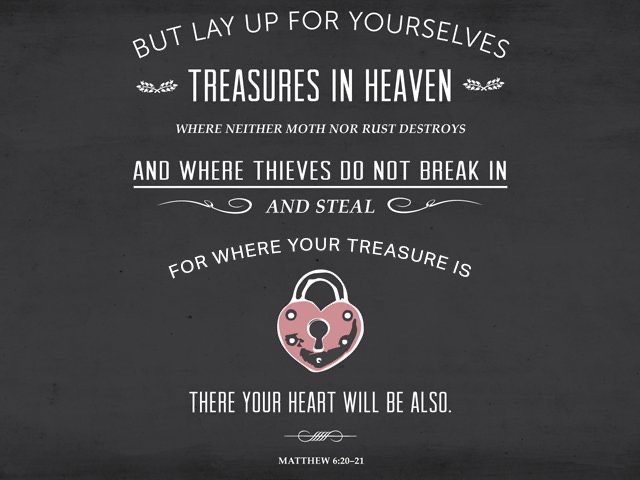
Third [Almsgiving], Lent is a time to remember where your true treasure lies. The things of this earth are going to become moth-eaten, rust, and stolen from you in an instant. But there is a way to lay up for yourself treasure in heaven where it cannot be touched by any moth, rust, or thief. Yes, there may be broken vases all around you that cannot be fixed no matter how hard you try. But the things you do in this life that support the preaching of the Gospel and the things you do that strengthen your faith and the faith of your family – all of that lays up treasure for you in heaven and draws your heart heavenward as well.

Dear saints, God has reconciled all things to Himself and has made everything right by the cross (Col. 1:20). All the wrong turns, all the times you said too much or too little, and all the things you have broken have a cost to be fixed. The price? It was the holy and precious blood of Christ, and it is a payment that has been fully made on the cross. Jesus has destroyed sin and fixed everything that we, by our sin, have broken. And the day of Christ’s return is coming. Then, and only then, will all creation be put back together. There will be no more shards of vase lying there on the floor. It will all be fixed – fixed to perfection. May that day come soon. Until then, happy Lent. Amen.

The peace of God, which surpasses all understanding, will guard your hearts and minds in Christ Jesus. Amen.


[1] What follows will play off of the ‘textbook’ answer that Lent is a time of “prayer, fasting, and almsgiving.”

The Seed – Sermon on Luke 8:4-15 for Sexagesima Sunday

Listen here.

Luke 8:4-15

1 And when a great crowd was gathering and people from town after town came to him, he said in a parable, 5 “A sower went out to sow his seed. And as he sowed, some fell along the path and was trampled underfoot, and the birds of the air devoured it. 6 And some fell on the rock, and as it grew up, it withered away, because it had no moisture. 7 And some fell among thorns, and the thorns grew up with it and choked it. 8 And some fell into good soil and grew and yielded a hundredfold.” As he said these things, he called out, “He who has ears to hear, let him hear.”

9 And when his disciples asked him what this parable meant, 10 he said, “To you it has been given to know the secrets of the kingdom of God, but for others they are in parables, so that ‘seeing they may not see, and hearing they may not understand.’ 11 Now the parable is this: The seed is the word of God. 12 The ones along the path are those who have heard; then the devil comes and takes away the word from their hearts, so that they may not believe and be saved. 13 And the ones on the rock are those who, when they hear the word, receive it with joy. But these have no root; they believe for a while, and in time of testing fall away. 14 And as for what fell among the thorns, they are those who hear, but as they go on their way they are choked by the cares and riches and pleasures of life, and their fruit does not mature. 15 As for that in the good soil, they are those who, hearing the word, hold it fast in an honest and good heart, and bear fruit with patience.”

In the name of Jesus. Amen.

This is Jesus’ first parable, so a quick note about parables is important here at the outset. We get some insight as to the reason Jesus teaches in parables when the disciples ask Jesus what the parable means. Jesus tells them, “I speak to them in parables, because seeing they do not see, and hearing they do not understand.” In short, parables are not intended to make things clearer. The parables, according to Jesus, are meant to obscure things. And here’s why:

The crowds had begun to reject Jesus’ teaching. Basically, what Jesus says He is doing is teaching these know-it-alls in riddles, so they realize just how dumb they really are (see esp. Mt. 13:10-17). You know how it is when you are around a group of people and there is a joke that you aren’t in on. You get curious and want to be ‘in.’ So you ask questions and dig deeper to be part of the ‘in’ crowd.

God be praised, the disciples fall for the bait and do exactly that. Please notice, that. These guys who have been called by Jesus to be fishers of men, even they have to ask Jesus what the parable means. When the disciples ask Jesus what He means by this parable, they are exercising and growing in their faith. They go to the right place with their misunderstanding; they go straight to Jesus. “Dude, what are you talking about?” Whenever you have doubts or questions or feel like outsiders, you do well to follow the disciples’ example here. Let’s all go to Jesus, the Word made flesh, and get things cleared up.

Honestly, this particular parable really is quite simple. And to make it idiot-proof and so we don’t get it wrong, Jesus gives us the cheat sheet. We can thank the Holy Spirit for inspiring the Gospel writers to help us dense folk today. So, since you have ears, hear what God desires you to hear.

In the parable, the seed is the Word of God. The different places where the seed falls – the path, the rocks, the thorns, and the good soil – are the various conditions of the heart. While we might be tempted to ask, “What kind of soil am I?” it is probably better to recognize that you and I are each of these types of soil at different times. And even though Jesus doesn’t explicitly say this, I think the types of soil that are presented in the parable are in a particular order. Jesus starts with what is easiest for the devil to attack and prevent fruit from being produced and moves to the types of hearts that are more difficult. So, let’s go through each of them.

First, the path, and listen most closely right now. Open your ears here for two minutes. If you don’t listen to any other part of this sermon, listen to this. The path represents those who hear the Word of God, but then, the devil comes and takes away the Word from their hearts. Look again at the end of v. 12. Our translation, the ESV, has Jesus explaining what happens to the seed on the path by saying, “so they may not believe and be saved.” Now, the ESV is a faithful translation (I wouldn’t be using it for our services if I didn’t think so), but I think the translators unintentionally mislead us a little bit here (and to be fair to the ESV, other translations do the same thing). They make it sound like there are two verbs there – ‘not believe’ and ‘not be saved.’ But, actually, there is only one verb. ‘Not believe’ is a participle and ‘not be saved’ is the verb. In other words, more literally, Jesus says, “so that having believed they may not be saved.” In other words, these people hear God’s Word, and they believe it. But before that Word can begin to grow and sprout, the devil simply snatches it away. This is the devil’s easiest attack on the Word of God. And I think we’ve all experienced this.

To my great shame, I will admit that there are times when I hear God’s Word and it goes right in one ear and out the other. For example, after I drop my kids off for school, I will listen as my phone plays one of my daily Bible readings while I drive here to work. And there are days when I get distracted by something – thinking about my day, or another driver who doesn’t come to a complete stop or use their turn signal or whatever. The reading ends, and I honestly couldn’t tell you what I heard. Other times, I’ve listened to sermons – good, solid, biblical sermons – but once the sermon is over, I couldn’t tell you what the sermon was about. Again, this is the easiest way for the devil to attack the powerful, effective Word of God. He simply snatches it away because it falls on the hard, concrete path.

People of God, when you hear God’s Word, when you read the Bible, when you sit in those chairs and hear the preaching, listen up. Do whatever it takes to pay attention. Get enough sleep on Saturday. Have some caffeine before you come. Don’t let your heart be a paved, hardened path where the devil can simply come and snatch God’s Word from you.

Now, that you’ve heard that, I hope I have your attention and you keep listening.

The second place the seed of God’s Word falls is the rock. This ground is a little more difficult for Satan. This is when we hear God’s Word and receive it with joy. But then those promises get scorched by the heat of trials. We believe the Word for a while, but when times of trouble and testing come, we abandon those promises and fall away.

How many times does God promise to be with you always, but then, when hot trials come, we think God is angry with us and has abandoned us? Trials, tribulations, and troubles are not the time to doubt God’s promises! Think about it the terms of this parable. The heat from the sun represents the trials. But it isn’t the hot sun that kills plants. If plants have good, deep roots that reach down to where the moisture is, the heat from the sun is what causes plants to grow and bear fruit.

Think of when Shadrach, Meshach, and Abednego faced death – they faced the hottest trial that anyone can encounter, literally! But they refused to let that trial wither their faith. They had roots that went down to the moisture and their faith prevailed and even flourished when Jesus walked with them in the burning fiery furnace. If you know even a little bit of church history, you know that the church typically grows when it is persecuted. Dear saints, when trials and tribulations come, that is not the time to abandon God’s promises. That is the time to sink your roots deep into them and find the moisture you need. Those trials will in fact cause you to grow and not wither away.

The third place the Word of God falls is among the thorns. The thorns are the cares and riches of this life. Jesus here is warning us that trials and tribulations aren’t the only enemy to our faith. Good gifts that God gives can also be bad for our faith. We are tempted to think that when we are comfortable and not facing trials that we will be left alone, but that isn’t the case. We cannot let our guard down when things are going well. The devil will still attack us, but this is also where he has the hardest time. Satan hasn’t been able to simply snath the promises of God away, and he hasn’t succeeded with his fiery trials. So, the devil has no other choice but to try and choke out God’s Word. But this attack takes the longest and is the hardest for him to accomplish. Here, the devil has to try to slowly introduce weeds to choke out God’s Word. He can’t do it all at once, otherwise we would recognize the attack and be on guard against it. So, he works slowly to choke out God’s Word from your heart.

This is just a reminder. Those weeds – the riches, pleasures, and cares of this life – will always be a threat and nuisance to you. Christian, there will be times where you will need to go out and pick weeds from your life. You can’t simply trim weeds. You have to pull them up by the root. Dear saints, ask yourself, “What has gotten in the way of the Word of God? What things keep me from hearing the blessings God would give me through His Word?” When Jesus talks here about the cares and riches of this life, He doesn’t get specific. Instead, He wants us to constantly assess ourselves and see what is hindering us from rejoicing in God’s Word and being participants in God’s family.

Now, we are ten days away from the beginning of Lent. Today is February 7th and Lent begins February 17th. Scripture doesn’t give specifics for each of us as to what chokes out our faith; instead, God’s Word gives us wisdom to discern what might be slowly strangling us. I am calling on you now to use that wisdom.

Lent is typically a time to remove particular hinderances to our devotion to God’s Word. The Scriptures call it fasting. Fasting is not commanded, but Jesus does assume that His disciples will fast at times (see. Mt. 6:16-18). Fasting is not a way to make God more pleased with you. God couldn’t be more pleased with you who believe that Jesus has forgiven you of all your sins. Instead, fasting is a way to uproot the thorns that the devil would use to choke out your faith. Fasting curbs your sinful, fleshly desires. Fasting, basically, tells your flesh, “You are not in charge of me.”

Lent is a time to pull out those weeds and thorns that would choke out your faith. You have ten days to consider what you might remove from your life for the forty days of Lent. Maybe, there is something that would be beneficial for you to give up in order to discipline your flesh and give extra attention to God’s Word. Again, God doesn’t command this. It’s not something you have to do, but it is a good practice. Don’t think that God will be more pleased with you if you fast. Instead, know that it is a good and beneficial discipline to deny yourself something so that thing, whatever it is, doesn’t become a choking, strangling thorn in your life of faith. Lent is a good time to pick weeds from your spiritual life.

Finally, the Word falls on good soil. Just as you, sinner, are the soil of the path, the rocks, and the thorns, you, Christian, are also the good soil. You are both and all at the same time. God’s Word comes and produces an abundance of fruit that yields a hundred-fold and provides for others.

When we hear this parable, one of the most shocking things is how the recklessly the sower throws around the seed. He throws it around willy-nilly and it lands all over the place. Well, right here at this altar, the sower is about to carefully plant the Seed of His Word deeply into you. You are about to come and receive Christ, the Word made flesh, His very Body and Blood. Let this careful, deliberate planting of God’s Word and the deliverance of God’s forgiveness of all your sins bear, let it bear the fruit of joy and love. Amen.

The peace of God, which surpasses all understanding, will guard your hearts and minds in Christ Jesus. Amen.