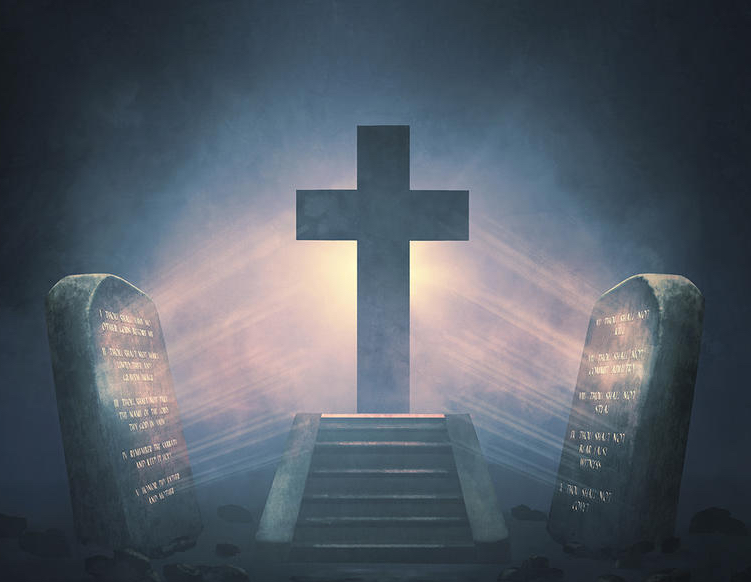
The Ten Words – Sermon on Exodus 20:1-17 for the Sixth Sunday after Trinity

Exodus 20:1-17

1 And God spoke all these words, saying, 

2 “I am the Lord your God, who brought you out of the land of Egypt, out of the house of slavery. 

3 “You shall have no other gods before me. 4 You shall not make for yourself a carved image, or any likeness of anything that is in heaven above, or that is in the earth beneath, or that is in the water under the earth. 5 You shall not bow down to them or serve them, for I the Lord your God am a jealous God, visiting the iniquity of the fathers on the children to the third and the fourth generation of those who hate me, 6 but showing steadfast love to thousands of those who love me and keep my commandments. 

7 “You shall not take the name of the Lord your God in vain, for the Lord will not hold him guiltless who takes his name in vain. 

8 “Remember the Sabbath day, to keep it holy. 9 Six days you shall labor, and do all your work, 10 but the seventh day is a Sabbath to the Lord your God. On it you shall not do any work, you, or your son, or your daughter, your male servant, or your female servant, or your livestock, or the sojourner who is within your gates. 11 For in six days the Lord made heaven and earth, the sea, and all that is in them, and rested on the seventh day. Therefore the Lord blessed the Sabbath day and made it holy. 

12 “Honor your father and your mother, that your days may be long in the land that the Lord your God is giving you. 

13 “You shall not murder. 

14 “You shall not commit adultery. 

15 “You shall not steal. 

16 “You shall not bear false witness against your neighbor. 

17 “You shall not covet your neighbor’s house.“You shall not covet your neighbor’s wife, or his male servant, or his female servant, or his ox, or his donkey, or anything that is your neighbor’s.”

In the name of Jesus. Amen.

Dear saints, you are familiar with this text – or, at least, you should be. We know these verses as “the Ten Commandments” – even though Scripture itself never refers to them as the Ten Commandments. (More on that in just a bit.)

We have grown used to thinking that God only gave the Ten Commandments to show us our sin so that we repent and believe in Jesus for the forgiveness of our sin. Saying that isn’t wrong – not in the least! Scripture says that one of the reasons God gave us the Law is to tell us what we must and have failed to do (Ro. 7:7-12). That’s how Luther uses them in his Small Catechism, and in his hymn on the Ten Commandments that we just sang, he does the same thing, “You have this Law to see therein / that you have not been free from sin, / but also that you clearly see / how pure toward God your life should be.” But God gave the Ten Commandments to do more than simply show us our sin.

Scripture calls this text “the Ten Words” (Ex. 34:28; Dt. 4:13, 10:4). The Bible refers to them as “the Ten Words” because only one of them is actually an imperative (command) – “Honor your father and mother.” All the rest are indicative (statements). A perfectly legitimate – and, admittedly, shorthand – way to understand these verses would be, “You will have no other gods before Me…. You will not misuse My Name…. You will keep the Sabbath holy…. Honor your parents. You will not murder, commit adultery, steal, lie, covet.”

As God’s people heard these words at the base of Mt. Sinai, they would have understood three distinct things at the same time. First, they would have understood that this is what God demands they do, which is how we normally understand them. Second, they would have heard them as a description of who they are and how God sees them. Third, they would have heard these as God’s promise to work in them to make them all these things (Php. 1:6).

Think of it this way: A boy might be pestered and bullied by a girl at school so much that he finally retaliates and shoves her to the ground. (You boys, don’t do that because that’s wrong.) They boy’s parents get called to the principal’s office and learn about the altercation. When they get home, the parents send the boy to his room as punishment. Afterwards, the father goes into his son’s room for ‘the talk’ and says, “We do not shove, hit, or be mean to girls.”

Notice what that speech from the father does. First, by saying, “we,” the father is still showing his son that they are in a relationship. The son hasn’t been abandoned or disowned; they belong together and are identified together as a unit. Second, the father is also saying that as a unit, they act and behave a certain way – they don’t use physical force against girls. Also, the boy knows that his dad is forbidding him to use physical force against a girl. All three of those things get communicated at the same time. The Ten Words here work just like that.

Let’s stick with that analogy about the boy and the girl bully to get one more thing about the Ten Words across. As soon as the boy pushed the girl to the ground and saw that she was dirty, dusty, and hurt, the boy’s conscience kicked in because he knew what he had done was wrong even before he pushed her. That rule or command, “Don’t hurt girls,” was already known by the boy even if he had never been taught it. The girl’s pain simply awakened his conscience. The same thing is true for these Ten Words (Ro. 7:7-8).

Cain knew it was wrong to kill Abel (Gen. 4:1-9) even though God hadn’t given the commandment, “Thou shalt not murder,” yet. Joseph knew not lie with Potiphar’s wife (Gen. 39:7-9) even though God hadn’t given the command, “Thou shalt not commit adultery.” Esau accused Jacob of cheating him (Gen. 27:36), and Jacob accused his father-in-law, Laban, of cheating him (Gen. 31:7) even though God hadn’t given the commandment, “Thou shalt not steal.” Abraham knew it was wrong to lie about Sarah being his sister (Gen. 12:11-20, 20:1-14) even though God hadn’t given the commandment, “Thou shalt not bear false witness.”

Everyone knows to not break the commandments because God has written them into the fabric of creation and on the heart of every person (Ro. 2:15). Everyone, even atheists (Ro. 1:21-25), know that we should love God with all our heart, soul, mind, and strength (Mt. 22:37). Everyone knows that we should love our neighbor as ourselves (Mt. 22:39).

God didn’t give the Ten Words so that we would know right from wrong. People knew (and still know) right from wrong already. Some think God gave the Ten Words to limit our freedom. Not at all. They are given in the context of God having set His people free, bringing them out of Egypt and slavery (Ex. 20:2). Instead, the Ten Words show God’s people what it looks like to be the free people He has created us to be. In the world that God has made, we aren’t free to do or be anything we please. We are free when we become what we are. A caterpillar is free to become a butterfly not a walrus. The Ten Words guide us to grow up to be what we are, and what we are is the very children of God (1 Jn. 3:2; Gal. 4:1-7).

Now, in an effort to assist with that growth, here’s some advice from Luther. Take each of the Ten Words with you into prayer and ask yourself these four questions: 1. What does this teach me? 2. What does this give me? 3. What does this show me to confess? And 4. What does this teach me to pray for?

For the first, “You shall have no other gods before Me,” you could pray something like this: “Father, thank you that You teach me that You are my God. Thank you that, as my God, You give me all good things. Forgive me for the times I do not trust You to be my God. Grant me Your Holy Spirit so I would love You with all my heart, soul, mind, and strength.”

For the seventh, “Thou shalt not steal,” you could pray: “Heavenly Father thank You for giving me so many good things. Everything I have is a gift from You. Forgive me for loving and pursuing stuff more than You. Help me to use what You have given me to serve my neighbor.”

Now, all of this is to say that what is most important with regard to the Ten Words is to believe them. Romans 14:23 says, “Whatever does not proceed from faith is sin.” As you believe the Ten Words, you see that God demands that you avoid certain sins and that you do certain good works. But you also see that God is accomplishing these things in you through faith. He has begun that good work in you when you were joined to Jesus’ death and resurrection in your Baptism (Ro. 6:1-11), and, again, He will complete that good work in you (Php. 1:6).

Dear saints, God promises that He is your God who has brought you out of slavery to sin by sending Jesus, who did not abolish the Law but fulfilled it. Through faith in Him, you have a righteousness that exceeds that of the scribes and Pharisees. Because of Him and His work, you will enter the kingdom of heaven, and He invites you now to a seat at His table. Amen.

The peace of God, which surpasses all understanding, will guard your hearts and minds in Christ Jesus. Amen.

Sneaky Slavery – Sermon on John 8:31-36 for Reformation Sunday

John 8:31-36

31 So Jesus said to the Jews who had believed him, “If you abide in my word, you are truly my disciples,32 and you will know the truth, and the truth will set you free.” 33 They answered him, “We are offspring of Abraham and have never been enslaved to anyone. How is it that you say, ‘You will become free’?” 34 Jesus answered them, “Truly, truly, I say to you, everyone who practices sin is a slave to sin. 35 The slave does not remain in the house forever; the son remains forever. 36 So if the Son sets you free, you will be free indeed.”

In the name of Jesus. Amen.

The crowds answered Jesus, “We are offspring of Abraham and have never been enslaved to anyone.” Right.

They must have completely forgotten their history. They had been slaves in Egypt until God delivered them from their slavery. Even when they arrived in the Promised Land, they were ruled by the Philistines, the Ammonites, the Midianites, and the Moabites. They were taken captive by the Assyrians and Babylonians. They had been under the Greeks and the Persians. And even when Jesus is talking to them here, they are under Roman authority. They had to pay taxes to Caesar and are worried that if people believe in Jesus, the Romans will come and take away their place and nation (Jn. 11:47-48). And remember, the chief priests wanted to kill Jesus, but they had to get permission from the Roman governor Pilate (Jn. 18:11). In fact, when you consider the 1,500-year history of the Jewish people, there is probably only a few hundred years where they were not in some sort of slavery to another nation or power.

But when Jesus says, “If you abide in My Word, you are truly My disciples, and you will know the truth, and the truth will set you free,” they are offended. Even though these are words of comfort and Gospel, there is an implied bit of Law here. Since the truth will (future tense) will set you free, that means that you are in bondage.

We have to recognize Jesus’ audience. He is speaking to the Jews who believed in Him. I know our translation throws in the word ‘had’ in there – “the Jews who had believed in him.” But that implies that they believed at one time but have stopped believing in Him. That isn’t what the Greek is trying to get across. The verb makes it clear.

Jesus is talking to people who do currently believe in Him, but their faith is shallow and in danger. In fact, by the end of this chapter, the faith of these people will be gone. They are offended at Jesus’ Words of Gospel and freedom. They believed in Him, maybe because of the miracles or because He was interesting to listen to. But they don’t abide, they don’t remain, in Jesus’ Word. They are a prime example of the path in Jesus’ parable of the Sower and the Seed. The Word is sown there, but the devil and demons quickly snatched it away (Mt. 13:419) because their hearts were hardened with pride.

“If you abide in My Word, you are truly My disciples, and you will know the truth, and the truth will set you free.” These are gracious words, but there is also a warning here for you and for me. That warning is this: It is possible to fall away. If you do not abide and remain in Jesus’ Word, then you are certainly not Jesus’ disciples; you will not know the truth, and you will not be free. Only those who abide and remain in Jesus’ Word are true disciples and become free.

Dear saints, Jesus might as well be speaking these very same words to you here today. You also need to abide in Jesus’ Word. You also need to know the truth which sets you free. Whether you recognize it or not, you are in bondage worse than any slavery this world can throw at you. Jesus says, “Truly, truly, I say to you, everyone who practices sin is a slave to sin.”

Sin has so infected us that we have a wrong sense of freedom. We think freedom means that we can do whatever we want whenever we want. We think freedom is a life without obligation or responsibility. That kind of existence, well, it doesn’t exist. Instead, we are captive and slaves to our sinful desires.

The Scripture readings you heard today have made this entirely clear. “All have sinned and fall short of the glory of God” (Ro. 3:23). “Everyone who practices sin is a slave to sin” (Jn. 8:34). We sin; therefore, we are slaves to sin. And you can’t just wiggle out of this saying, “Well we don’t really have a choice in the matter.” Our slavery to sin is at a higher level than that. We are slaves in our will. We deliberately chose to sin. It isn’t just weakness or mistakes. We have all ignored our conscience, and knowing exactly what we are doing, we have chosen to sin. We sin on purpose and repeatedly.

And even when we do fight against our sinful desires, which is good, we still are doing so out of slavery. Jesus’ parable of the Prodigal Son (Lk. 15:11-32) shows that there is a slavery when we rebel and try to live apart from our heavenly Father, and there is also a slavery when we try to win the approval of our heavenly Father by life of obedience.

 So, remember the younger son? He deliberately tells his father to drop dead so he can have his inheritance early. That son takes all that he has, quickly wastes it in reckless living, and has to hire himself out feeding pigs. Remember, he was longing to eat the slop he was feeding the pigs. What he thought would bring him freedom made him a slave to pigs. So, he concocts a plan to go and ask to become a servant in his dad’s house in order to get a little food in his hungry tummy. Now of course, you know the story. The father doesn’t even hear the offer of his wayward son. Instead, the father restores this little brat to be a son and throws a party.

But don’t forget about the older son. He didn’t do all the wrong things his younger brother had done. He didn’t tell his father to drop dead. He didn’t demand his inheritance be given to him so he could move away and blow it all. He didn’t end up in the pigpen. No, the older brother hadn’t done anything wrong. But that didn’t make him any less of a slave.

Instead, that older brother insists that he did all the right things. He was dutifully working in his father’s field when his despicable brother returned. And when his father came outside to compel him to come and join the party celebrating his brother’s restoration, he answered his father, “I’ve served,” notice that, “I’ve servedyou my whole life. I’ve never disobeyed your command. I’ve never wasted your money. But when this son of yours comes home, you go and kill the fattened calf for him.” And the parable ends with the father pleading with his oldest son to join the party.

We know that slavery can come from living contrary to God’s Commandments; that is entirely clear and plain as the nose on your face. But there is another slavery – a slavery that is more sneaky – and that is the slavery of the older brother and the people Jesus is speaking to in this text. That is a slavery of us trying to live in such a way that God owes us for all the good we have done. My fellow sinners, repent of that thought as well. God will never be in our debt.

In this text and in parable of the Prodigal Son, we clearly see that God doesn’t want slaves. He wants sons. Slaves don’t remain in the house forever – only sons do. 

That is why Jesus has come. The only begotten Son of God came to do His Father’s will. He came to fulfill God’s Law and to be the perfect sacrifice for your sins and free you from slavery. Yes, you sin, and that reveals your slavery. But at the same time you are also a son – redeemed, purchased, and adopted by the blood of Christ. At the same time, you are a slave and a son, a sinner and a saint.

Dear saints always remember what Jesus says, “If the Son sets you free, you will be free indeed.”Christ has. You are free. Free from the condemnation of the Law. Free from the bondage of sin. Free from the fear of death. Free from the burden of having to earn your salvation. Free from the burden of having to complete your salvation. Free to serve God and neighbor without the nagging worry of whether you’ve done it well enough. 

Jesus Christ, the eternal Son of God, has set you free by His death and resurrection. He has freely given you the gift of new life, and that comes with a happy and joyful future that will last to all eternity. If the Son sets you free – and Christ has by His death and resurrection – you will be free indeed. So, “Fear not, little flock, for it is your Father’s good pleasure to give you the kingdom,” (Lk. 12:32). Amen.

The peace of God, which surpasses all understanding, will guard your hearts and minds in Christ Jesus. Amen.

Confidence, Glory, Boldness, & Freedom – Sermon on 2 Corinthians 3:4-18 for the Twelfth Sunday after Trinity

2 Corinthians 3:4-18

4 Such is the confidence that we have through Christ toward God. 5 Not that we are sufficient in ourselves to claim anything as coming from us, but our sufficiency is from God, 6 who has made us sufficient to be ministers of a new covenant, not of the letter but of the Spirit. For the letter kills, but the Spirit gives life. 

7 Now if the ministry of death, carved in letters on stone, came with such glory that the Israelites could not gaze at Moses’ face because of its glory, which was being brought to an end, 8 will not the ministry of the Spirit have even more glory? 9 For if there was glory in the ministry of condemnation, the ministry of righteousness must far exceed it in glory. 10 Indeed, in this case, what once had glory has come to have no glory at all, because of the glory that surpasses it. 11 For if what was being brought to an end came with glory, much more will what is permanent have glory.

12 Since we have such a hope, we are very bold, 13 not like Moses, who would put a veil over his face so that the Israelites might not gaze at the outcome of what was being brought to an end. 14 But their minds were hardened. For to this day, when they read the old covenant, that same veil remains unlifted, because only through Christ is it taken away. 15 Yes, to this day whenever Moses is read a veil lies over their hearts. 16But when one turns to the Lord, the veil is removed. 17 Now the Lord is the Spirit, and where the Spirit of the Lord is, there is freedom. 18 And we all, with unveiled face, beholding the glory of the Lord, are being transformed into the same image from one degree of glory to another. For this comes from the Lord who is the Spirit.

In the name of Jesus. Amen.

This text is all about the two main doctrines (or teachings) of Scripture: the Law and the Gospel. Whenever you read the Scriptures, Law and Gospel is what you should be looking for. Put simply, the Law tells you what you must do or be judged and condemned by God. The Gospel tells you what God has done for you in Christ to forgive you for all your sins against God’s Law. Luther once put it beautifully, “The Law says, ‘Do this,’ and it is never done. [The Gospel] says, ‘Believe this,’ and everything is already done.”

Now, this text doesn’t specifically call these two doctrines ‘Law’ and ‘Gospel.’ No, this text is a lot more colorful using other terms for Law and Gospel to describe what they do and are. So, look through the verses quickly again. In v. 6, Paul calls the Law ‘the letter’ that ‘kills.’ In v. 7, Paul calls the Law ‘the ministry of death, carved in letters on stone.’ In v. 8, the Law is called ‘the ministry of condemnation.’ In v. 14, the Law is called ‘the old covenant.’ All of these terms for the Law give us a picture and understanding of what the Law does to us. In short, the Law is exposes that we are sinners who deserve nothing but death, judgment, and condemnation from God who is our holy and just Creator.

But now, listen to the terms Paul uses to for the Gospel. In v. 6, Paul calls the Gospel ‘the new covenant… of the Spirit who gives life.’ In v. 8, it is called the ‘ministry of the [Holy] Spirit.’ In v. 9, Paul says that the Gospel is ‘the ministry of righteousness.’ So, if you want life, righteousness, and freedom from sin, you don’t look to the Law. You look only to the Gospel.

But the main thing this text is showing us is just how glorious the Gospel is by comparing the glory of the Law with the glory of the Gospel.

With that in mind, let’s consider what happened when God gave the Law on Mt. Sinai (Ex. 20). Back in Exodus 19, we hear how God instructed His people to prepare themselves for the giving of the Ten Commandments. Around three months after the people had left Egypt (v. 1), God had the people consecrate themselves for three days (v. 11). God instructed the people to set up a fence around Mt. Sinai so that no one – neither man nor beast – could touch the mountain (v. 12). The third day came with glory. There was thunder and lightning. A thick cloud descended on Mt. Sinai. There was a loud trumpet blast that caused all the Israelites to tremble (v. 16). God descended on the mountain in fire, and smoke went up like a kiln. The ground was trembling, and the sound of the trumpet kept getting louder and louder (v. 19). Moses went to the top of the mountain, and God spoke all these words:

“I am the Lord your God, who brought you out of the land of Egypt, out of the house of slavery.

“Thou shalt have no other gods before Me….

“Thou shalt not take the Name of the Lord thy God in vain; for the Lord will not hold him guiltless that taketh His Name in vain.

“Remember the Sabbath day, to keep it holy….

“Honor thy father and thy mother, that thy days may be long upon the land which the Lord thy God giveth thee.

“Thou shalt not kill.

“Thou shalt not commit adultery.

“Thou shalt not steal.

“Thou shalt not bear false witness against thy neighbor.

“Thou shalt not covet thy neighbor’s house.

“Thou shalt not covet thy neighbor’s wife, nor his manservant, nor his maidservant, nor his cattle, nor anything that is thy neighbor’s” (Ex. 20:2-17).

In this way, God spoke His perfect will for His people, and the people responded to that glory with fear and terror. They asked that Moses would speak with them instead of God (Ex. 20:18-20Dt. 5:22-33; and 18:15-22). When God gave the Law, His people, who were sinners, were terrified in their conscience. They were confronted with the sins they had committed. And they understood that they were under the curse of death.

When Moses came down with the Ten Commandments written by God’s finger on stone tablets, the people saw that Moses’ face was shining. Exodus 34:29-35 tells us that his face was shining was because he had been talking with God. Whenever Moses would speak with God, he would remove the veil, and after Moses told the people what God had spoken, he would put the veil back over his face again.

So, the Law came with a glory and that glory continued to radiate from Moses’ face, but that Law brought fear and terror. It brought knowledge of God’s wrath. The Law commands and forbids, terrifies and threatens, curses and condemns.

Now, you have called me here, and God has sent me, to be your pastor. Part of that calling is for me to proclaim the Law to you. That means I have to tell you, people whom I love, things that you probably don’t want to hear. I’ve been called here to tell you that the way you handled yourself in that argument with your spouse was wrong. That you are making mistakes raising your children. That skipping church for your kid’s tournament is making an idol out of your kid and making that sport an idol for your kid. God has sent me here to tell you that you are sinfully disrespectful and rude toward your parents. That even though other people laugh, your jokes are inappropriate. That the way you talk about others when they aren’t around is sinful. That you drank too much. That you should have looked away from that show, that movie, that image. That your desires are wrong. And all these sins bring nothing but misery, destruction, and God’s wrath and judgment (Ro. 3:10-18). And I need to hear that as much as you do.

Now, we need to be absolutely clear here. The Law doesn’t condemn and judge us because the Law is bad. No. The Law is good. The Law is the perfect expression of God’s holy will for your life and for my life. The reason the Law brings condemnation and death is your sinful nature – yours and mine. The Law doesn’t causeyour condemnation; instead, it simply reveals it. Yes, the Law came with glory, but it is a glory that consumes and undoes us, like it did to the prophet Isaiah (Is. 6:5).

But there is hope for us sinners because there is something more glorious than the Law. Peter, James, and John saw the glory of the Gospel as it was manifested on the mountain of transfiguration. As those three heard Jesus talk with Moses and Elijah about His exodus the disciples were afraid, but Peter understood and confessed, “Lord, it is good to be here” (Lk. 9:30-33). The Gospel came with glory as Jesus was enthroned upon the cross. The earth trembled as Christ breathed His last and gave up His spirit. The tombs were opened and the dead were restored to life (Mt. 27:50-52). The Gospel came with glory when Christ rose from the grave as the angels proclaimed His victory over death and hell (Mt. 28:1-6). The Gospel came with glory when it spread to all nations on the day of Pentecost. The Holy Spirit was given, and people saw tongues of fire on the disciples and heard the mighty, glorious acts of God – the forgiveness of sins in Jesus’ name, salvation, and eternal life (Act. 2). 

Again, the Law tells you exactly what you must do to have eternal life (Mt. 10:17-1919:16-19), but the Law doesn’t lift a finger to help you do it. That is why, as your pastor, I am here to proclaim the Law and the Gospel. Because while the Law only condemns and accuses, the Gospel runs to you with rescue and help from heaven. The Law leaves you sinking in your sins, but the Gospel takes hold of you and lifts you to firm, solid ground. The Law leaves you naked and cold, but the Gospel clothes you with the glorious robes of Christ.

The Gospel is higher and more glorious than the Law. The Gospel declares that Jesus has finished His work to save you, and His work can’t be undone. He has taken upon Himself all the burden, all the punishment, all the wrath of God that your sins deserve. Yes, you still feel the burden of your sin, but your sin doesn’t belong to you anymore. It belongs to Christ. He is the Lamb of God who takes away the sin of the world (Jn. 1:29) – that includes your sin as well. Now, you belong to Jesus. You are safe in Christ, and you are sufficient as you stand before God. You are not in yourself but in the sufficiency that Christ has won for you. Yes, the Gospel is higher and more glorious than the Law, and we can see that in how each was given.

But what might be the greatest and most glorious distinction between the Law and the Gospel is what Paul says in v. 11 – that the Law passes away while the Gospel remains forever. “For if what was being brought to an end came with glory,” and I can’t for the life of me figure out why our text uses the word ‘was’ there. It is in the present tense. And let me paraphrase v. 11 to make it absolutely clear, “For if [the Law, which] is being brought to an end came with glory, much more will [the Gospel which] is permanent have glory.”

Dear saints, once the Law has done its work to show you what you deserve from God, you can flee from the Law to the light of Jesus who gives you what you do not deserve – mercy, forgiveness, freedom, and eternal life. God gave the Law to chase you to Jesus, who is your refuge and strength. And safe in Christ, the Law cannot touch you. You are free, totally and absolutely free, from the Law’s judgment and condemnation.

Dear saints, because of the Gospel, you are in Christ. You now behold your Savior in His glory with unveiled face. You stand in awe of your God (Is. 29:23). You have freedom. You are being transformed into the image of Christ. Because of Jesus, and Him alone, you can be confident. You share the glory of Christ. Live boldly because of what He has done for you. Live in the freedom you have as a child of God. Amen.

The peace of God, which surpasses all understanding, will guard your hearts and minds in Christ Jesus. Amen.