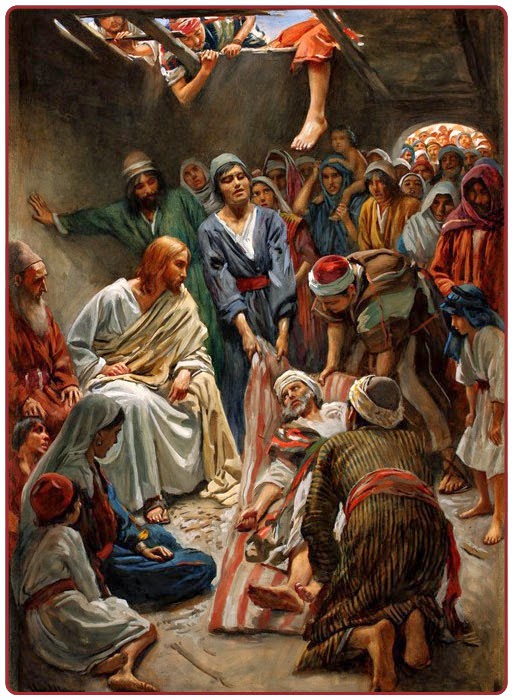
Help – Sermon on Matthew 9:1-8 for the Nineteenth Sunday after Trinity

Matthew 9:1–8

1 And getting into a boat he crossed over and came to his own city. 2 And behold, some people brought to him a paralytic, lying on a bed. And when Jesus saw their faith, he said to the paralytic, “Take heart, my son; your sins are forgiven.” 3And behold, some of the scribes said to themselves, “This man is blaspheming.” 4 But Jesus, knowing their thoughts, said, “Why do you think evil in your hearts? 5 For which is easier, to say, ‘Your sins are forgiven,’ or to say, ‘Rise and walk’? 6But that you may know that the Son of Man has authority on earth to forgive sins”—he then said to the paralytic—“Rise, pick up your bed and go home.” 7 And he rose and went home. 8 When the crowds saw it, they were afraid, and they glorified God, who had given such authority to men.

In the name of Jesus. Amen.

What do you suppose the friends of this paralyzed man thought when they heard Jesus? They had gone to a lot of trouble to bring him to Jesus. They had heard Jesus was at home (Mt. 9:1; Mk. 2:1), and people from all around knew that the power of God was with Jesus to heal (Lk. 5:17). We can imagine these friends going to the paralyzed man’s house and telling him, “Hey, Charles,” (he probably wasn’t named ‘Charles’ but go with me on this), “Hey Charles, Jesus is in town. We’re going to take you to Him and get you healed.”

They lift up Charles’ bed and lug him through the city streets. But when they get to where Jesus was, they find that too many people are there, and they can’t even get to the door (Mk. 2:2; Lk. 5:19). So, they take desperate measures. They lug Charles and his bed to the top of the house, tear open the roof, tie ropes on the corners of Charles’ bed, and lower him so he is before Jesus (Mk. 2:4). Charles’ friends are trying to catch their breath, wiping the sweat off of their foreheads, and giving each other tired fist bumps as they surround that gaping hole, thinking, “We did it. Jesus is going to heal our buddy so he can walk.”

But then, down in the house with dust swirling around them, Jesus looks at Charles, and Charles looks up at Jesus. And Jesus says those words, “Take heart, My son; your sins are forgiven.” I imagine those friends were thinking to themselves, “You’ve gotta be kidding me, Jesus. We brought Charles here so You could fix his body!”

We don’t actually know what the paralytics’ friends thought, but we do know what the scribes and Pharisees thought, “Jesus is a blasphemer. Only God can forgive sins” (Mk. 2:7; Lk. 5:21). They grumble. They scoff. They doubt. But Jesus knows their thoughts and hearts, just as He knew the faith and believing hearts of this man’s friends. And because Jesus knows both the faith of these friends and the grumbling of the scribes, we also know that Jesus knew the paralytic’s thoughts.

Maybe, the paralytic was initially excited at the prospect of being healed and using his limbs. But based on Jesus words to him, there is little doubt that Jesus told him exactly what he needed to hear. The first word Jesus says, “Take heart,” is the same command Jesus will give to the disciples when they are out in a huge storm in the middle of the sea. They are being beaten by the waves and wind. Jesus appears, and they think He’s a ghost. But Jesus calms them, “Take heart; it is I. Do not be afraid” (Mt. 14:27).

This paralytic man hears from Jesus the exact words he needed to hear as he was battered by legs that didn’t work and arms that couldn’t move. “Take heart, My son; your sins are forgiven.” As he was lying there before Jesus, maybe he figured Jesus would tell him how awful he had been and that his paralysis was punishment for his sin. But that’s not what Jesus says. Jesus tells him that in the midst of his suffering and horrible situation that he can be of good courage because his sins are forgiven.

Now, of course, Jesus ends up healing the man too. To silence the grumbling scribes and prove that He actually does have the authority to forgive sins, Christ heals the man.

That’s the main teaching of this text. Jesus proves that He has the authority on earth to forgive sins by healing the paralytic. And the crowds respond with fear and glorified God (notice how the text ends) who had given such authority to men. It’s plural. To men. Not just to the man, Jesus. To men.

That was true here, but it is even more evident on the evening of the Resurrection. Then, Jesus tells the disciples, “If you forgive the sins of any, they are forgiven them” (Jn. 20:23). Jesus, the One who has authority to forgive sins, delegates that authority to His Church, to all Christians. Because you have called me to be your pastor, I get to do that each Sunday morning. God uses my voice to proclaim His forgiveness to you. I get to be ‘the Absolution guy.’ It’s pretty cool. And please, don’t think I’m bragging. Believe me, I wouldn’t have the guts to say that if the Bible didn’t teach it. Forgiveness and absolution is the main point of this text.

But today, I want to draw special attention to this guy’s friends and their tenacity to help him by bringing him to Jesus. They know their friend’s need. They know Jesus is where he can get help. So, they do everything in their power to help him by bringing him to Christ.

Dear saints, you do this too. I know you do. But I’d like to point out three specific, concrete ways you do this because these things are easy to overlook. And when we overlook them, it’s easier to neglect doing them. Here are the three ways you help others by bringing them before Jesus, and they are in no particular order.

First, you help people by inviting them to church. Jesus promises to be here as we gather each and every week when He says, “Where two or three are gathered together in My name, there am I among them”(Mt. 18:20). You are eternally helping others when you bring them here, to God’s house and to the gate of heaven (Gen. 28:17) where Jesus meets them with His Word and forgiveness.

Second, you help people by praying for them. When you have an unbelieving family member or coworker who has some need. Help them by praying for them. As you lift others up in prayer, you are bringing them to and laying them before the feet of Christ. Don’t forget that. When someone is suffering, lift them up to Jesus in your prayers. Maybe Jesus won’t answer your prayers in precisely the way you expect. But He knows best how to help.

James 5:13-16 says that your prayers have great power. You don’t even have to tell the person you are praying for them. (Usually, I think letting them know you are praying for them is a good idea. But there might be times [e.g. if they are really deep in unbelief and hatred of God] you don’t. Use your God-given wisdom.) Even if they don’t share their problems with you, pray for them anyway. They might not share their struggles, but they probably tell you the ways they have been blessed. That same section of James 5 says that when someone is cheerful, you can give a prayer of thanks to God for the blessings He has provided.

Third, you help people by forgiving them. The forgiveness you have received from God frees you to forgive others when they sin against you. Christian, your gracious disposition toward them and toward the world is a way that the light of Christ shines through you (Mt. 5:14-16).

All of that brings me to you, Cooper. Cooper, today you are Baptized. Today, your parents have helped you by bringing you to Jesus who also says to you, “Take heart, My son; your sins are forgiven. I have joined you to My death and resurrection (Ro. 6:3-8). I have clothed you in My righteousness (Gal. 3:27), given you the new birth of water and the Holy Spirit (Jn. 3:3, 5) and made you My child.”

Cooper, and all you saints, you are before Jesus right now. He invites you to His Table where He feeds you with His Body and Blood for the forgiveness of all your sins. As you walk out of here today, remember that you have new life in Christ. Use your freshly given strength to help and serve your neighbor. Amen.

The peace of God, which surpasses all understanding, will guard your hearts and minds in Christ Jesus. Amen.

The Steward – Sermon on Luke 16:1-13 for the Ninth Sunday after Trinity

Luke 16:1–13

1 He also said to the disciples, “There was a rich man who had a manager, and charges were brought to him that this man was wasting his possessions. 2 And he called him and said to him, ‘What is this that I hear about you? Turn in the account of your management, for you can no longer be manager.’ 3 And the manager said to himself, ‘What shall I do, since my master is taking the management away from me? I am not strong enough to dig, and I am ashamed to beg. 4 I have decided what to do, so that when I am removed from management, people may receive me into their houses.’ 5 So, summoning his master’s debtors one by one, he said to the first, ‘How much do you owe my master?’ 6 He said, ‘A hundred measures of oil.’ He said to him, ‘Take your bill, and sit down quickly and write fifty.’ 7 Then he said to another, ‘And how much do you owe?’ He said, ‘A hundred measures of wheat.’ He said to him, ‘Take your bill, and write eighty.’8 The master commended the dishonest manager for his shrewdness. For the sons of this world are more shrewd in dealing with their own generation than the sons of light. 9 And I tell you, make friends for yourselves by means of unrighteous wealth, so that when it fails they may receive you into the eternal dwellings.

10 “One who is faithful in a very little is also faithful in much, and one who is dishonest in a very little is also dishonest in much. 11 If then you have not been faithful in the unrighteous wealth, who will entrust to you the true riches? 12 And if you have not been faithful in that which is another’s, who will give you that which is your own? 13 No servant can serve two masters, for either he will hate the one and love the other, or he will be devoted to the one and despise the other. You cannot serve God and money.”

In the name of Jesus. Amen.

Psalm 24 opens by saying, “The earth is the Lord’s and the fullness thereof, the world and those who dwell therein, for He has founded it upon the seas and established it upon the rivers.” Simply stated, everything and everyone belongs to God because He created it all. There is nothing you can see, hear, feel, taste, smell, or experience that isn’t God’s. It all belongs to Him.

The only reason we think the stuff we have belongs to us, and the only reason we imagine the people in our lives are ‘my husband, my wife, my kids, my parents, my friends’ is that God is so deeply generous. He is a giver. 1 John repeatedly says, “God is love” (1 Jn. 4:8, 16). In other words, if God ceased to be loving and generous, He would no longer be God. That is why you have everything and everyone you have. God loves you, and He loves to give you good gifts.

Let’s take that one step further because this isn’t true only for Christians. It’s true for everybody. Everyone is the recipient of God’s generosity. From the body they have, to the clothes they wear, to the food they eat, to the house they live in, to the people in their lives – everyone received all of it from God’s loving, generous, giving hand. The remarkable thing about all of this is that most people never have and never will acknowledge God’s provision, generosity, and love. But that doesn’t stop God from giving it.

Now, with that understanding, we can go to the parable. It’s a difficult parable because it’s one of those parables where Jesus uses the actions of a bad, sinful character to make His main point. A rich man had a manager working for him. This manager was a steward of the rich man’s accounts; he was in charge of the books. This manager was crooked enough that he had to be fired. But instead of putting him in chains to be escorted straight to prison, the rich man is generous. He tells the manager to go back to the office, assemble the books, and turn them over. In other words, the rich man, even though he has fired the steward, gives the steward the gift of time. To properly understand the lesson Jesus is teaching with the parable, our main concern is to understand what the steward does with that the rich man’s generosity.

The manager calls in the rich man’s debtors one by one, and you can imagine that they are all terrified of this meeting. They aren’t just getting a phone call from a debt collector; they get brought into his office. Each of them knows they owe these debts, so they’re afraid. And their fear plays right into the manager’s hand.

I imagine the interactions go something like this. A debtor enters the room, and the manager says, “My boss wants to know: what is your plan for this debt you have?” And you can imagine the debtor saying, “Yes. I know. I’ll try to shift things around a bit. Would it work if I got half of it to you by the end of the month and get the other half next month? I’ll do my best to get everything taken care of as soon as possible.” And the manager pretends to be compassionate and says, “Here, let’s just make this a little easier. I’ll talk the rich man down. Write a new debt here, and we’ll just call it good. Let me take some of that stress off of you.” How those conversations actually went we don’t know, but it is clear that the manager knows how to use these people and their stress to his advantage. His plan is to take care of them now so they will take care of him later – let him stay in their vacation houses after he’s left out on the street.

Is it unrighteous? Yup. Absolutely. He’s cancelling debts he has no authority over any longer. Or, to put it another way, he’s giving away someone else’s money. But here’s why it is so shrewd – the rich man, the manager’s former boss, is such a generous person that he isn’t going to reinstate those debts. The rich man is going to hear the whole town singing his praises for having lowered their debts, and if he were to reinstate them – which, by the way, he would have had every right to do – his reputation of being generous would be tarnished. The rich man would rather eat those losses than have his mercy and generosity doubted. The manager knows this about his former boss, and he bets everything on it in the hope his connection to the reduced debts will make people generous toward him later. That is what Jesus is commending.

Christ is saying with this parable that you can bet everything you have on God’s love, mercy, and generosity. Our Lord concludes the parable by saying, “Make friends for yourselves by means of unrighteous wealth, so that when (not ‘if’ but ‘when’) it fails they may receive you into the eternal dwellings.”

Now, this is one of the most difficult things that Christ said. We know from everything else Jesus says that the unrighteous wealth can’t refer to things that you get in an unrighteous way like this manager did. Jesus clearly teaches against cheating and stealing. So, I think the best understanding of what Jesus means by ‘unrighteous wealth’ is just the stuff that God gives you that doesn’t deliver you God’s mercy and forgiveness – i.e. what we would refer to as ‘1st Article gifts.’ That is all the created blessings that God the Father Almighty, Maker of heaven and earth gives to you. Yes, your money, but also your house, your job, your relationships, your time, your talents, etc. Use those things to make friends for yourself, but not just any kind of friends. Jesus here refers to the kind of friends who receive you into the eternal dwellings.

I think that is an important clue to understand what Jesus is saying here. You can give your stuff away and gain a lot of friends. But the way you get friends to dwell with for eternity is for them to become Christians. In short, Jesus is encouraging us to be as shrewd as this scoundrel of a manager and use our 1st Article gifts to promote the preaching of the Gospel.

So, what does that look like? Well, there are billions of possibilities. So, I can’t tell you exactly what to do in every situation. But I’ll try a few.

It might mean you learn that your neighbor or coworker likes a certain food that you enjoy making. So, you invite that person over to prepare your grandma’s special recipe. You invest in that relationship and invite that person to come with you to church so they can hear the Gospel and believe.

It might mean that you use your talents to make things that you can donate to an auction that supports the Women’s Pregnancy Center or Riverside so a mom who is in a bad situation can get help that will also point her to the Gospel and so Christian children can be built up through their education to be lights in the communities they will eventually live in.

And, even more simply, return a portion of God’s money that He has given and entrusted to you by putting it into the offering plate to support the preaching of the Gospel and the ministry of God’s Word that takes place here. It isn’t as though God wants you to fill the offering plate apart from Him. Instead, it is that God Himself wants to fill the offering plate through you, so you become generous, giving, and loving like He is.

And know that the unrighteous wealth Jesus talks about here isn’t just about money. It’s about all the 1stArticle gifts that God gives to you. Be a shrewd steward of everything God gives to you – your time, your talents, and your treasures – to make friends for eternity. By doing that, you become more and more conformed to the image of your giving and generous God.

As children of God and stewards of God’s gifts, be imitators of God by being merciful, loving, kind, giving, and generous. And the reason you can be generous with your 1st Article gifts is that God has given you His 2nd and 3rd Article gifts along with your 1st Article gifts. You have the true riches. You have God’s love, mercy, forgiveness, and holiness freely given to you because of what Christ has done for you by dying and rising again. Those things will never fade, fail, or diminish. They are yours, Christian, now and for all eternity. Amen.

The peace of God, which surpasses all understanding, will guard your hearts and minds in Christ Jesus. Amen.