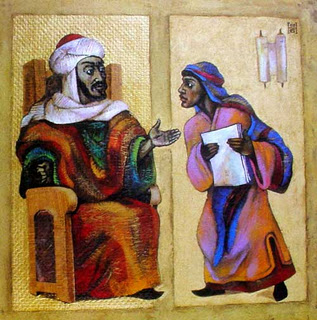
The Untaming of the Shrewd – Sermon on Luke 16:1-13 for the Ninth Sunday after Trinity

Luke 16:1-13

In the name of Jesus. Amen.

We’ll get to the parable, but we’ll start with a little congregational participation. Ready? Pick one hand and hold it in front of you. Point your thumb toward your face and line your other fingers straight behind it like you’re going to do a karate chop. Keep your hand like that and look at me for a moment.

Imagine you’re at the grocery store to buy a snack for yourself. It could be a bag of chips, a box of cookies, or a pint of ice cream, whatever you fancy right now. No self-checkout today. You’ve handed the cashier a $20 bill, and she’s about to hand you your change. Without looking at your hand, move it into position to receive the change. Now, look at your hand. I’m guessing your palm is toward the ceiling, fingers slightly open, ready to close around the change. We’ll call that the ‘receptive’ hand.

Put your hand back in the karate chop position and keep it there again. Imagine you spot a $100 bill on a shelf in the store. No one else is around. Forget about what you would do with it. Just move your hand as if you’re reaching to take it. Look again—that’s the grasping and taking hand.

Everyone knows that hand. It is the hand of a child who snatches a toy and yells, “Mine!” It is the hand that treats everything as something to control rather than receive. That grasping hand is not new. It is as old as the Fall.

God created our hands to be the hands of a steward with open palms. First, receiving from Him; then, offering to Him. God created us in His Own image and gave us dominion over the fish of the sea, the birds of the air, the animals, and all the earth. He gave every plant for food (Gen. 1:28-30). That dominion wasn’t permission to beat creation into submission. It was entrusted to us as image-bearers, so that we would reflect the heart of our all-giving Creator.

Not only did God give all of creation to be under our dominion, He also gave us a home. He put Adam and the woman in the Garden of Eden and gave them a clear purpose, “to work it and keep it” (Gen. 2:15). The two Hebrew verbs there are the same words God used when He established the priests who were to ‘serve’ and ‘guard’ the Tabernacle (Num. 3:7-88:2618:5-6). In short, Adam wasn’t only created to be a gardener. He was created to be a priestly guardian of the sacred space of Eden. There was only one vocation in Eden, and that was the vocation of steward. God created us to receive everything from His open hand—palms up, receiving every gift of creation from His generosity. That open, receptive hand is the original stewardship hand.

Sadly, the hand rolled over. In Gen. 3, the devil suggested that God was holding out. Out of all creation, God said that one tree was off-limits. The devil lied to the woman and said that things would be better if she would eat the forbidden fruit. Suddenly, that is all her eye could see. The woman sees that the tree is good for food, a delight to the eyes, and desirable to make one wise (Gen 3:6). That desire and covetousness twisted her vision. The hands of the woman and Adam—hands that had been open to receive—those hands turned over to reach, grasp, and take.

That single motion—palm down, fingers closing around what wasn’t theirs—was the tipping point. The stewards presumed to be owners. But God never transferred ownership. Instead, they took and grasped what didn’t belong to them. They became thieves. In a sense, they stole the fruit. But the deeper theft was their attempt to take God’s place. The closing, grasping hand was the first act of original sin. It showed that they no longer trusted God, and whatever does not proceed from faith is sin (Ro. 14:23). That hand turning over and grasping what God hadn’t given was a violation of at least the 1st, 3rd, 4th, 5th, 7th, 9th, and 10th Commandments.

Now, bring that picture into the parable Jesus tells today.

There is a rich man whose hand was always open, always giving. He entrusted his possessions to a manager. The manager’s hand was supposed to stay palm up so he could receive the master’s wealth, manage it, and return it to the owner. But the manager’s hand has already rolled over. He has been wasting what was never his. Some commentators suggest that this manager was scamming the tenants by collecting more than he was supposed to and keeping the extra for himself.

When the master calls for an accounting of the books, the manager’s closed fist is exposed, and he will be removed from his position. The manager knows himself well enough to admit that he isn’t strong enough to dig, and he’s too proud to beg. So, what does he do? He acts shrewdly and hatches a plan. He probably worked harder that afternoon than he had in years.

He calls in the debtors one by one and reduces what they actually owe without the master’s permission or authorization. The unrighteous manager is still living off the master’s open-handed generosity, still using the master’s resources. He keeps his hand turned over so he can cleverly take more—this time, from the master himself. He is using his boss’s generosity as his own personal safety net. He knows that these debtors will be singing the praises of the rich man. But they will also associate him with their debt being slashed.

Notice that when the rich man figures the whole thing out, he still doesn’t close his hand. Instead, the master commends and praises the manager—not for his theft, but for his shrewdness. The manager knew the giving nature of the rich man and bet everything on it. That’s what Jesus is praising.

Jesus is not holding him up as a moral example. The man is unrighteous. His motivation is purely self-preservation. He’s a thief, but he’s a shrewd thief. Look at the energy this little scoundrel pours into securing a few friends who will toss him bread when he’s finally out of his job. Look at how he plots, stays up late, and reworks the books for his own benefit.

What Jesus praises is the shrewd use of what belongs to another. The manager did it only for his own benefit. Jesus wants us to do it for the benefit of others. In short, Christ wants us to use what God gives and entrusts to us in shrewd ways that reveal the generosity of our heavenly Father. That’s why Jesus says, “The sons of this world are more shrewd in dealing with their own generation than the sons of light” (Lk. 16:8).

Dear saints, you have infinite treasures. You have the Gospel, the forgiveness of sins, the hope of the resurrection and the life of the world to come. You have all of that because of the open hand of our God who gives and gives and gives. He promises that you don’t have to worry about any of your needs for tomorrow because He will provide (Mt. 6:31-34). But still, we are careful, cautious, and stingy. In our selfishness we have tamed ourselves to be close-fisted. Repent.

That is the rebuke Jesus has for us today. Our closed hands are greedy and lazy. The 7th Commandment forbids both. Greed selfishly grabs. Laziness selfishly refuses to work. The virtue the Holy Spirit is after in us today is generosity. He wants us to open our hands to both freely receive and freely give. Jesus presses the point: “Make friends for yourselves by means of unrighteous wealth, so that when it fails they may receive you into the eternal dwellings”(Lk. 16:9). Eventually, money will fail. The day is coming when our hands can’t hold anything. So today, use what is already the Lord’s to make eternal friends—people who will stand with you in the Resurrection because the Gospel reached them through the resources you have stewarded.

David recognized this in our Old Testament reading (1 Chr. 29:10-15). When the people freely gave and poured out their gifts so the Temple could be built, David prayed, “All things come from You, and of Your own have we given You” (1 Chron. 29:14). Whenever and whatever we give, we are only returning what the open hand of God first placed in our hands. There is no such thing as ‘my money’ or ‘my stuff’ in the kingdom of heaven. There is only the Lord’s money and the Lord’s stuff temporarily in our care. That fact frees the fist that desires to grasp. That truth untames us and makes us shrewd. Closed hands always end in idolatry by making a (little ‘g’) god of the self and of the stuff we think we can control.

Repent and always know that Christ is the perfect Steward. His hands stayed open. Though He was rich, yet for your sake He became poor, so that you by His poverty might become rich (2 Co. 8:9). He emptied Himself. He stretched out His hands on the cross and let everything be taken. His blood, His life, His whole Self—He gave it all as pure gift. You are not just a failed steward left to dig yourself out of sin. Instead, you are a redeemed steward who has been washed, forgiven, and claimed. The Holy Spirit is still at work to turn our hands back over, palm up, open again.

Jesus wants us to have the same energy that the unjust steward showed. He wants to untame us so we shrewdly use that same intensity, that same foresight, that same willingness to stay up late and work hard for His kingdom.

You have a mind. Use it to find new ways to love your neighbor. You have a body. Use it to serve others. You have resources that are already His. Use them to make friends who will welcome you into the eternal dwellings.

Dear saints, your Master’s hand is always open. He has already given you everything that matters. You are free. Be shrewd with His gifts, and rejoice in His goodness. Amen.

The peace of God, which surpasses all understanding, will guard your hearts and minds in Christ Jesus (Php. 4:7). Amen.

The Steward – Sermon on Luke 16:1-13 for the Ninth Sunday after Trinity

Luke 16:1–13

1 He also said to the disciples, “There was a rich man who had a manager, and charges were brought to him that this man was wasting his possessions. 2 And he called him and said to him, ‘What is this that I hear about you? Turn in the account of your management, for you can no longer be manager.’ 3 And the manager said to himself, ‘What shall I do, since my master is taking the management away from me? I am not strong enough to dig, and I am ashamed to beg. 4 I have decided what to do, so that when I am removed from management, people may receive me into their houses.’ 5 So, summoning his master’s debtors one by one, he said to the first, ‘How much do you owe my master?’ 6 He said, ‘A hundred measures of oil.’ He said to him, ‘Take your bill, and sit down quickly and write fifty.’ 7 Then he said to another, ‘And how much do you owe?’ He said, ‘A hundred measures of wheat.’ He said to him, ‘Take your bill, and write eighty.’8 The master commended the dishonest manager for his shrewdness. For the sons of this world are more shrewd in dealing with their own generation than the sons of light. 9 And I tell you, make friends for yourselves by means of unrighteous wealth, so that when it fails they may receive you into the eternal dwellings.

10 “One who is faithful in a very little is also faithful in much, and one who is dishonest in a very little is also dishonest in much. 11 If then you have not been faithful in the unrighteous wealth, who will entrust to you the true riches? 12 And if you have not been faithful in that which is another’s, who will give you that which is your own? 13 No servant can serve two masters, for either he will hate the one and love the other, or he will be devoted to the one and despise the other. You cannot serve God and money.”

In the name of Jesus. Amen.

Psalm 24 opens by saying, “The earth is the Lord’s and the fullness thereof, the world and those who dwell therein, for He has founded it upon the seas and established it upon the rivers.” Simply stated, everything and everyone belongs to God because He created it all. There is nothing you can see, hear, feel, taste, smell, or experience that isn’t God’s. It all belongs to Him.

The only reason we think the stuff we have belongs to us, and the only reason we imagine the people in our lives are ‘my husband, my wife, my kids, my parents, my friends’ is that God is so deeply generous. He is a giver. 1 John repeatedly says, “God is love” (1 Jn. 4:8, 16). In other words, if God ceased to be loving and generous, He would no longer be God. That is why you have everything and everyone you have. God loves you, and He loves to give you good gifts.

Let’s take that one step further because this isn’t true only for Christians. It’s true for everybody. Everyone is the recipient of God’s generosity. From the body they have, to the clothes they wear, to the food they eat, to the house they live in, to the people in their lives – everyone received all of it from God’s loving, generous, giving hand. The remarkable thing about all of this is that most people never have and never will acknowledge God’s provision, generosity, and love. But that doesn’t stop God from giving it.

Now, with that understanding, we can go to the parable. It’s a difficult parable because it’s one of those parables where Jesus uses the actions of a bad, sinful character to make His main point. A rich man had a manager working for him. This manager was a steward of the rich man’s accounts; he was in charge of the books. This manager was crooked enough that he had to be fired. But instead of putting him in chains to be escorted straight to prison, the rich man is generous. He tells the manager to go back to the office, assemble the books, and turn them over. In other words, the rich man, even though he has fired the steward, gives the steward the gift of time. To properly understand the lesson Jesus is teaching with the parable, our main concern is to understand what the steward does with that the rich man’s generosity.

The manager calls in the rich man’s debtors one by one, and you can imagine that they are all terrified of this meeting. They aren’t just getting a phone call from a debt collector; they get brought into his office. Each of them knows they owe these debts, so they’re afraid. And their fear plays right into the manager’s hand.

I imagine the interactions go something like this. A debtor enters the room, and the manager says, “My boss wants to know: what is your plan for this debt you have?” And you can imagine the debtor saying, “Yes. I know. I’ll try to shift things around a bit. Would it work if I got half of it to you by the end of the month and get the other half next month? I’ll do my best to get everything taken care of as soon as possible.” And the manager pretends to be compassionate and says, “Here, let’s just make this a little easier. I’ll talk the rich man down. Write a new debt here, and we’ll just call it good. Let me take some of that stress off of you.” How those conversations actually went we don’t know, but it is clear that the manager knows how to use these people and their stress to his advantage. His plan is to take care of them now so they will take care of him later – let him stay in their vacation houses after he’s left out on the street.

Is it unrighteous? Yup. Absolutely. He’s cancelling debts he has no authority over any longer. Or, to put it another way, he’s giving away someone else’s money. But here’s why it is so shrewd – the rich man, the manager’s former boss, is such a generous person that he isn’t going to reinstate those debts. The rich man is going to hear the whole town singing his praises for having lowered their debts, and if he were to reinstate them – which, by the way, he would have had every right to do – his reputation of being generous would be tarnished. The rich man would rather eat those losses than have his mercy and generosity doubted. The manager knows this about his former boss, and he bets everything on it in the hope his connection to the reduced debts will make people generous toward him later. That is what Jesus is commending.

Christ is saying with this parable that you can bet everything you have on God’s love, mercy, and generosity. Our Lord concludes the parable by saying, “Make friends for yourselves by means of unrighteous wealth, so that when (not ‘if’ but ‘when’) it fails they may receive you into the eternal dwellings.”

Now, this is one of the most difficult things that Christ said. We know from everything else Jesus says that the unrighteous wealth can’t refer to things that you get in an unrighteous way like this manager did. Jesus clearly teaches against cheating and stealing. So, I think the best understanding of what Jesus means by ‘unrighteous wealth’ is just the stuff that God gives you that doesn’t deliver you God’s mercy and forgiveness – i.e. what we would refer to as ‘1st Article gifts.’ That is all the created blessings that God the Father Almighty, Maker of heaven and earth gives to you. Yes, your money, but also your house, your job, your relationships, your time, your talents, etc. Use those things to make friends for yourself, but not just any kind of friends. Jesus here refers to the kind of friends who receive you into the eternal dwellings.

I think that is an important clue to understand what Jesus is saying here. You can give your stuff away and gain a lot of friends. But the way you get friends to dwell with for eternity is for them to become Christians. In short, Jesus is encouraging us to be as shrewd as this scoundrel of a manager and use our 1st Article gifts to promote the preaching of the Gospel.

So, what does that look like? Well, there are billions of possibilities. So, I can’t tell you exactly what to do in every situation. But I’ll try a few.

It might mean you learn that your neighbor or coworker likes a certain food that you enjoy making. So, you invite that person over to prepare your grandma’s special recipe. You invest in that relationship and invite that person to come with you to church so they can hear the Gospel and believe.

It might mean that you use your talents to make things that you can donate to an auction that supports the Women’s Pregnancy Center or Riverside so a mom who is in a bad situation can get help that will also point her to the Gospel and so Christian children can be built up through their education to be lights in the communities they will eventually live in.

And, even more simply, return a portion of God’s money that He has given and entrusted to you by putting it into the offering plate to support the preaching of the Gospel and the ministry of God’s Word that takes place here. It isn’t as though God wants you to fill the offering plate apart from Him. Instead, it is that God Himself wants to fill the offering plate through you, so you become generous, giving, and loving like He is.

And know that the unrighteous wealth Jesus talks about here isn’t just about money. It’s about all the 1stArticle gifts that God gives to you. Be a shrewd steward of everything God gives to you – your time, your talents, and your treasures – to make friends for eternity. By doing that, you become more and more conformed to the image of your giving and generous God.

As children of God and stewards of God’s gifts, be imitators of God by being merciful, loving, kind, giving, and generous. And the reason you can be generous with your 1st Article gifts is that God has given you His 2nd and 3rd Article gifts along with your 1st Article gifts. You have the true riches. You have God’s love, mercy, forgiveness, and holiness freely given to you because of what Christ has done for you by dying and rising again. Those things will never fade, fail, or diminish. They are yours, Christian, now and for all eternity. Amen.

The peace of God, which surpasses all understanding, will guard your hearts and minds in Christ Jesus. Amen.

The Merciful Master – Sermon on Luke 16:1-13 for the Ninth Sunday after Trinity

Listen here.

Luke 16:1-13

1 He also said to the disciples, “There was a rich man who had a manager, and charges were brought to him that this man was wasting his possessions. 2 And he called him and said to him, ‘What is this that I hear about you? Turn in the account of your management, for you can no longer be manager.’ 3 And the manager said to himself, ‘What shall I do, since my master is taking the management away from me? I am not strong enough to dig, and I am ashamed to beg. 4 I have decided what to do, so that when I am removed from management, people may receive me into their houses.’ 5 So, summoning his master’s debtors one by one, he said to the first, ‘How much do you owe my master?’ 6 He said, ‘A hundred measures of oil.’ He said to him, ‘Take your bill, and sit down quickly and write fifty.’ 7 Then he said to another, ‘And how much do you owe?’ He said, ‘A hundred measures of wheat.’ He said to him, ‘Take your bill, and write eighty.’ 8 The master commended the dishonest manager for his shrewdness. For the sons of this world are more shrewd in dealing with their own generation than the sons of light. 9 And I tell you, make friends for yourselves by means of unrighteous wealth, so that when it fails they may receive you into the eternal dwellings.

10 “One who is faithful in a very little is also faithful in much, and one who is dishonest in a very little is also dishonest in much. 11 If then you have not been faithful in the unrighteous wealth, who will entrust to you the true riches? 12 And if you have not been faithful in that which is another’s, who will give you that which is your own? 13 No servant can serve two masters, for either he will hate the one and love the other, or he will be devoted to the one and despise the other. You cannot serve God and money.”

In the name of Jesus. Amen.

Today, we are going to start with three questions to help us wrap our minds around this difficult parable: First, what is the rich master commending his manager for? Second, what is the context of the parable? And, third, where does the parable end?

First question first. What is the rich master praising the wasteful, dishonest manager for? It isn’t for his dishonesty when the manager illegally lowers the bills of the debtors. Instead, the master praises the manager’s shrewdness. And this is actually in line with God’s character.

Think back to Jacob. Jacob was certainly dishonest (in fact, ‘Jacob’ means ‘deceiver’ or ‘cheater’), but Jacob was also an extremely shrewd man who took advantage of all sorts of situations to benefit himself – which is what shrewd means. When Jacob’s exhausted brother Esau came in from the field, Jacob shrewdly took advantage of the situation by selling Esau a bit of soup at the cost of Esau’s birthright. When Jacob’s father Isaac was old and blind, Jacob shrewdly took advantage of the situation by dressing up like Esau and receiving their father’s blessing. When Jacob’s father-in-law Laban was distracted, Jacob shrewdly fled with his wives and children to move back to Canaan.

While we might think that God would want to disassociate Himself with as shrewd a man as Jacob, God doesn’t. God calls Himself the God of Abraham, the God of Isaac, and the God of Jacob. In fact, twenty-three times in Scripture God calls Himself ‘the God of Jacob.’ God isn’t ashamed to be associated with the shrewd. So, again, the rich master doesn’t praise the dishonesty of the manager; he praises his shrewdness.

To the second question: What is the context of the parable? Well the first verse gives us a little bit of the context. Jesus tells this parable to the disciples. Jesus isn’t giving this parable to the masses, but only to those who have left everything to follow Him. Unbelievers might take this parable to mean that Jesus doesn’t mind if you are a scoundrel who only does things for your own benefit. That’s not the point of the parable! This parable is told to believers so that they would shrewdly know to expect, count, and bank on God’s mercy and grace.

Also, the context of this parable is all of Luke 15. In the opening of Luke 15, the Pharisees and scribes are grumbling that Jesus is receiving and eating with sinners. So, Jesus tells them the parable of the Lost Sheep, the Lost Coin, and the Prodigal Son. Notice, please, I said ‘the parable’ not ‘the parables.’ The three are, in my opinion, best understood as one parable and taken together as a single unit.

Also, each of them is terribly named. Instead of the name ‘the Lost Sheep,’ it should be called the ‘the Good Shepherd.’ Instead of the name ‘the Lost Coin,’ it should be called ‘the Persnickety Woman.’ Instead of the calling it ‘the Prodigal Son,’ it should be called ‘the Wasteful Father.’ The sheep, the coin, and the younger son are not the focal point of the parable, and they are damaged when we make them the center. Instead, it’s the goodness of the shepherd, the persistence of the woman, and the mercy of the father that should draw our attention. The same is true of this parable before us, the central point of the parable is not the dishonesty and shrewdness of the manager but the mercy of the master.

Think back for just a moment to the misnamed parable of the Prodigal Son: The father mercifully gives his younger son his share of the inheritance early, and that little brat wastefully squanders it (Lk. 15:13). We need to realize that inheritance included money, but it mainly included land. The merciful father had to sell off at least one-third of his land to give that little imp his inheritance. That means the kid frittered away several generations worth of blood, toil, and sweat while ruining his family’s name and reputation in the community. And when the funds run out, the little churl saunters back home to beg for a job from his father so he doesn’t have to eat pig slop. But the father won’t have it, not because he wants the kid eating swine slop, but because he wants his son back. The father mercifully runs to him, embraces him, dresses him up in the best cloths, and throws a party because he has welcomed his son back into the family.

That’s the context of this parable which is tied to that one. The mercy of the father there and the mercy of the master in this parable are meant to be seen together. In other words, with this parable Jesus is saying to the disciples, “Listen guys, God’s mercy really is something you can bank on. Check this out…”

Finally, and briefly, the third question to help us understand the parable: Where does it end? It’s probably best to see the parable ending with Jesus saying, “The master commended the dishonest manager for his shrewdness.” Which means that the next sentence (the second half of v. 8) is the beginning of the lesson that Jesus wants to teach us. “The sons of this world are more shrewd in dealing with their own generation than the sons of light.”

So now, with all of that in mind, let’s quickly consider the parable:

The rich man finds out that his manager is wasting his possessions, so the rich man fires the manager on the spot, but throws him a bone of mercy. The rich man could have tossed his manager straight into prison. But, instead, the merciful master sends the manager back to his office to collect the books before he turns them in. The fired manager realizes he’s in a bad spot. He’s too weak to dig and too ashamed to beg. So, the manager formulates a plan. The rich man’s debtors have no idea that the manager has been canned, so he has a small window of opportunity. He calls the debtors in “one by one” (v. 5) and lowers each person’s debt. It is interesting to note that he reduces each debt an equal amount of denarii which shows how hastily his plan was formulated. The reduction of fifty measures of oil and reduction of twenty measures of wheat both equal 500 denarii (or days’ wages).

Two other things are important here. Notice, that the manager has each debtor take the pen and write with their own hand and in their own penmanship the reduced amount (more on that in a minute). The other important thing is that the debtors go along with the reduction in their bills which indicates their suspicions aren’t raised. The manager likely told them that he had convinced the master to reduce their debts. The debtors know the master, and he isn’t a hard, unforgiving man. Instead, he has a reputation of being merciful.

So, the manager arranges the books, saunters back to headquarters, and walks straight into the master’s office blowing on the wet ink of the newly reduced debts with a wry smile on his face. The master can see that the books have been changed and realizes that the debtors know about it. He hears the whole town out in the streets singing his praises for the merciful reduction of their debts.

Luke 16 1-9 - Riojas the Shrewd ManagerThe master had every right to reinstate the debts, but he doesn’t want his reputation of being merciful to be tainted. The master would rather eat the loss than have his mercy put into doubt. So, the merciful master praises and commends the dishonest manager for his shrewdness.

By cutting the large bills of the master’s debtors, the shrewd manager went ‘all in’ on the mercy of the master, and it paid off. The manager is forever associated with the master’s mercy and the debtors will always deal kindly with him so he won’t have to dig or beg.

Again, the merciful master praises the manager for his shrewdness. The manager knew which way to fall, and he fell on the mercy of the master.

Here’s the point, dear saints. You too can always fall on the mercy of your Heavenly Father, the truest Merciful Master of all. But too often we are hesitant to do so.

God repeatedly gives you opportunities to reveal His goodness and mercy to others, but you’ve blown it. God puts you in the midst of your family with parents, siblings, cousins, and in-laws who fight, hold grudges, and speak the worst about each other. God puts you there so that you can imitate Him and be merciful and forgiving like He is, but you’ve blown those opportunities.

God puts you among children and grandchildren who aren’t grateful. Instead, they are rude, selfish, and self-absorbed. God gives you all sorts of opportunities to show unconditional love while making God your Father look good. But you’ve blown it.

God places you in a workplace or classroom where you are treated unfairly, taken advantage of, bullied, and receive all sorts of nasty behavior. God wants you to act shrewdly and do what no one else would – turn the other cheek and return all that evil for kindness and love. But you’ve blown it. Dear saints, we have all failed to use what our Merciful Master has given us to serve our neighbor because we don’t trust His mercy. Repent.

Repent, but also rejoice because you have a Savior who is just like the shrewd manager (minus the dishonesty). Jesus is the supreme Shrewd Savior, the Ultimate Trickster who took advantage of every situation to save you from sin and hell.

Satan was hungry, but not for a bowl of soup. The devil wanted to swallow all of humanity in his jaws. But Jesus, the Shrewd Savior inserted Himself into those jaws with all your sin laid upon Him (Is. 53:6). When Jesus died on that cross, all of your sins died with Him. While Satan and his minions celebrated the death and burial of Christ, Jesus strolled out of the tomb on the third day bursting the jaws of death and giving you an eternal victory.

Jesus even dealt shrewdly with God and His wrath against sinners. Christ went to the cross, covering Himself with all your sins. He managed your debt not just by reducing it, He eliminated it.

Dear saints of God, your Shrewd Savior doesn’t ask you how much oil you owe, He anoints your head with the oil of His mercy (Ps. 23:5). He doesn’t check to see how much wheat you owe. Instead, He gives you Himself as the Bread of Life (Jn. 6:51).

Christ does all of this because He is your Merciful Master and Shrewd Savior. Put your trust there, in His mercy. Amen.

The peace of God, which surpasses all understanding, will guard your hearts and minds in Christ Jesus. Amen.