From, Through, & To – Sermon on Romans 11:33-36 for Holy Trinity Sunday

Romans 11:33–36

33 Oh, the depth of the riches
and wisdom and knowledge of God!
How unsearchable are his judgments
and how inscrutable his ways! 
34 “For who has known the mind of the Lord, 
or who has been his counselor?” 
35 “Or who has given a gift to him 
that he might be repaid?” 
36 For from him and through him and to him are all things.
To him be glory forever. Amen.

In the name of the Father and of the Son and of the Holy Spirit. Amen.

Who has seen the ocean? Probably everyone has seen the ocean. If you haven’t, I can show you a picture or video after the service and, technically, you will have seen the ocean. But a picture or video doesn’t do the ocean justice. It isn’t the same as seeing it in person with your own eyes. So, how many of you have been to the ocean and have seen it, smelled it, and felt it?

Now, which ocean(s) – the Pacific, Atlantic, Indian, Arctic, Antarctic? Maybe you have seen each of them, but how much of them have you seen? Did you see a bit of it from a beach? Have you been on a boat where no land is in sight? “Water, water everywhere and not a drop to drink.” Even then, you only saw just shy of three miles of ocean before the curve of the earth pulled the rest of it away from your sight. And your field of vision only allowed you to see so much without turning your head or spinning around in circles, which, if you are prone to seasickness, is not something I would recommend. And even if you’ve been so far out to sea that no land was in sight, you can only say that you’ve skimmed the surface of the ocean – literally.

Have you seen what’s in the ocean and on its floor? Have you been able to snorkel or scuba dive to see what’s down there? How deep have you gone? Twenty, fifty, one-hundred feet? I have one friend who has dived to somewhere near that depth. As far as I know, I don’t know anyone who has been 1,000 feet below the surface of the ocean. The average depth of the ocean is about 2.3 miles deep. Some people have gone that deep. But think about the deepest part of the ocean, Challenger Deep, which is nearly 7 miles below sea level. Twelve people have walked on the moon, but only three have ever been down there.

Many people have gone up into space, orbited the planet hundreds of times, and have seen the majority of the oceans’ surface. But they haven’t been through all the oceans at all the depths to see what lies underneath the surface. So, I ask again, have you seen the ocean? Ultimately, no one can claim to have seen the oceans in their entirety. The best anyone can accurately say is, “I’ve seen a tiny fraction of the ocean.” The oceans are too big, too wide, too deep for anyone to see very much of it. But still, we wouldn’t call someone a liar if they said that they have seen the ocean. To see part of it is to truthfully say that you’ve seen it.

All of that is to set this up: These verses come at the tail end of Paul’s main theological treatise in Romans. In the first eight chapters, Romans is a thorough skimming of the surface of theology. It has dealt with the fact that no one is righteous in the way that God demands. Because of that everyone deserves death and condemnation. But God, in His mercy, has delivered the very righteousness He demands to those who have faith in Christ. By believing that God has come in the flesh of Jesus; believing that Christ suffered, bled, and died; and believing that He rose again for you, you are righteous – as righteous as Jesus is righteous. 

Then, Paul dives deeper into the depths of the theological ocean. He writes about how God delivers that faith through His gracious choosing of you. Inspired by the Holy Spirit, Paul talks about the doctrines of election and predestination. Believer, you are saved exclusively because of what God has done. Jesus has done the work to deliver, rescue, and save you from your sin. The Holy Spirit has called you through God’s Word, given you faith to believe, and will sustain your faith as He works through the Scriptures (Ro. 10:17). Your salvation is entirely based on God’s mercy (Ro. 8:29-33) and the fact that He chose you to be in Christ from before the foundation of the world (Eph. 1:4-5). The culmination of Paul’s short dive into the doctrine of predestination comes in the verse just before this text where his conclusion is, “God has consigned all to disobedience, that He may have mercy on all” (Ro. 11:32).

Now, the doctrine of predestination is a huge topic, and I’m not going to go into it today. I have preached on it the past. And if you ever have questions about it, please feel free to talk with me. (I enjoy having any theological conversations.) The only reason I mention predestination here is to set up the context of the praise that we heard in this reading. God’s mercy in delivering salvation to us unworthy sinners leads to this doxology, this song of praise that is our reading: “Oh, the depth of the riches and wisdom and knowledge of God! How unsearchable are His judgments and how inscrutable His ways!”

Whenever we study theology, no matter what branch of theology is being studied, we come to a point where we realize the simple truth that God is bigger than us. God has revealed much to us in His Word, but He hasn’t revealed everything. His riches, wisdom, and knowledge go to a depth that we cannot reach. His ways are inscrutable and inconceivable. It isn’t just that they are hard to understand they are far, far beyond our comprehension. Just like how you’ve only seen a small sliver of the ocean, but you haven’t seen the whole thing. The more I study theology and the Bible, the more I realize there is to learn. It’s a regular occurrence for me to be reading a passage and suddenly realize, “I’ve never noticed that before.” Christian, there’s always more to be learned and meditated on when it comes to theology and the Bible. More and more and more and more. And it is always a joy and delight to discover more.

Today is Holy Trinity Sunday which ends the festival half of the Church year which began in Advent. The Advent, Christmas, Epiphany, Lent, Easter, and Pentecost seasons focus on God’s work for us by coming, declaring, suffering, dying, rising, ascending, and sending the Holy Spirit. Now, on Trinity Sunday, we recognize that the work of our salvation is exclusively brought about by the plan and efforts of the one God who is Father, Son, and Holy Spirit. So, Trinity Sunday is a fitting time to pause, step back, and simply praise God for all He has done, accomplished, and delivered to us. Even though we’ve spent the past six months considering what God has done to save us, we’ve just barely scratched the surface. Even when we do it again and again, there is still more.

We can’t know God’s mind. We can’t advise Him. We can’t give or offer anything to Him. That’s why Paul closes in v. 36 with this doxology, “From Him and through Him and to Him are all things.”

Consider each of those in order. “From Him,” God the Father is the source and Creator of all things. “Through Him,” God the Son has set all things in order and gives them to us. “And to Him,” the God the Holy Spirit directs all things so they find their end and meaning in this one God.

Rejoice because this One unfathomable, inscrutable, inconceivable God took it upon Himself to create, redeem, and sanctify you. So, “to Him be glory forever.” In the name of the Father and of the Son and of the Holy Spirit. Amen.

The peace of God, which surpasses all understanding, will guard your hearts and minds in Christ Jesus. Amen.

Triune Love – Sermon on John 3:1-17 for Holy Trinity Sunday

John 3:1-17

1 Now there was a man of the Pharisees named Nicodemus, a ruler of the Jews. 2 This man came to Jesus by night and said to him, “Rabbi, we know that you are a teacher come from God, for no one can do these signs that you do unless God is with him.” 3 Jesus answered him, “Truly, truly, I say to you, unless one is born again he cannot see the kingdom of God.” 4 Nicodemus said to him, “How can a man be born when he is old? Can he enter a second time into his mother’s womb and be born?” 5 Jesus answered, “Truly, truly, I say to you, unless one is born of water and the Spirit, he cannot enter the kingdom of God. 6 That which is born of the flesh is flesh, and that which is born of the Spirit is spirit. 7 Do not marvel that I said to you, ‘You must be born again.’ 8 The wind blows where it wishes, and you hear its sound, but you do not know where it comes from or where it goes. So it is with everyone who is born of the Spirit.”

9 Nicodemus said to him, “How can these things be?” 10 Jesus answered him, “Are you the teacher of Israel and yet you do not understand these things? 11 Truly, truly, I say to you, we speak of what we know, and bear witness to what we have seen, but you do not receive our testimony. 12 If I have told you earthly things and you do not believe, how can you believe if I tell you heavenly things? 13 No one has ascended into heaven except he who descended from heaven, the Son of Man. 14 And as Moses lifted up the serpent in the wilderness, so must the Son of Man be lifted up, 15 that whoever believes in him may have eternal life.

16 “For God so loved the world, that he gave his only Son, that whoever believes in him should not perish but have eternal life. 17 For God did not send his Son into the world to condemn the world, but in order that the world might be saved through him.”

In the name of Jesus. Amen.

John 3:16 might be the most recognizable verse of all Scripture. It has, rightly, been called “the Gospel in a nutshell.” That being said, there is a common misconception about one little word of the verse – the word “so.” Most of the time, we understand “so” to mean “so much,” so we read into the verse, “God loved the world so much that He gave His only-begotten Son….” However, the Greek word that gets translated as “so” has a different nuance. It actually means, “in this way.” Here’s how it comes across in Greek, “For God loved the world in this way, that He gave His only-begotten Son, that whoever believes in Him should not perish but have eternal life.”

God the Father loved you by sending His only-begotten Son to die and rise again for you. It is one thing for a person to love you by sacrificing his own life for you. But your God goes further by giving His eternally beloved Son so that you might be saved through Him. In other words, if you ever have doubts about God’s love for you, you only need to look to the cross and empty tomb. By the concrete, historical, provable action of God sending Jesus to shed His blood, die, and rise again for you, God has loved you. That love has not, will not, and can not ever change.

In a lot of ways, that’s enough of a sermon right there, but you’re going to get more.

Today is Trinity Sunday. Scripture teaches that there is one God in three Persons and three Persons in one God. So, as Christians, we worship one God who is Father, Son, and Holy Spirit.

It’s easy for us as Christians to think that there is the God we know and love, but then there are a bunch of guys on the fringe of Christianity called “theologians.” These stuffy guys dress weirdly, have no social skills, and like talking about this thing called “the Trinity,” while go about the important things of real life. I hope this sermon is a beginning of seeing how doctrine – and specifically the doctrine of the Trinity – sparks a joy and wonder in our God who is Father, Son, and Holy Spirit.

The doctrine (or teaching) of the Trinity is the first mystery of the Christian faith. The doctrine of the Trinity is not a secret. A secret is something that you keep to yourself, and if you tell it to another person it isn’t a secret anymore. A mystery is something that, even if you say it and confess it, is still a mystery and above our comprehension.

Let’s start with a quick overview of the Trinity.

Even though the word “Trinity” is never used in Scripture, it is a concept that Scripture presents, so we believe, teach, and confess it. And the word “Trinity” is a helpful term that has been used by Christians going way back to the late 100’s AD. “Trinity” smashes two words together – tri meaning “three” and unity meaning “oneness.” This week, I came across how “Trinity” is communicated in sign language, and it is absolutely beautiful. You hold up three using your thumb, index, and middle finger on one hand behind your other hand; then, you move those fingers underneath and to the front of your other hand to hold up your single index finger.

First, let’s talk about the unity of the Trinity. In the Old Testament, God gave His people a creed to confess, and it opens like this, “Hear O Israel the Lord our God, the Lord is one” (Dt. 6:4). We Christians worship one God, yet the testimony of Scripture is that this one God is also three Persons.

The Trinity is taught in the opening chapter of the Bible (especially when we understand creation in light of the rest of the Scriptures). The very first verse of Scripture says, “In the beginning, God created the heavens and the earth.” The Hebrew word for “God” is אֱלֹהִים (Elohim) and is the most common Old Testament name for God. The interesting thing about the Hebrew word Elohim is that the word is plural in form, but throughout the Old Testament the verbs that follow Elohim are singular.

Also, at creation, you have God the Father creating, God the Holy Spirit hovering over the face of the waters, and God the Son being the Word of God that creates as it is spoken. Admittedly we only rightly understand this when we know what is taught in Jn. 1[:1-3, 14], “In the beginning was the Word, and the Word was with God, and the Word was God…. All things were made through Him, and without Him was not any thing made that was made…. And the Word became flesh and dwelt among us…” We also get to hear the Trinity having a conversation before the creation of Adam and Eve. God says (and listen to the pronouns), “Let us make man in our image, after our likeness” (Gen. 1:26). Then Scripture goes on to say (again listen to the numbers in the nouns and pronouns), “So Elohim (pl.) created man (sg.) in His (sg.) own image, in the image of Elohim (pl.) He (sg.) created him (sg.); male and female He created them (pl.)” (Gen 1:27).

This is an aside, but part of the way that mankind bears the image of God is to have more than one person of the same nature and essence. Humanity has a plurality – male and female. This is why so much of the current push to normalize transgenderism is demonic. There is no other way to say it. The transgender movement isn’t a just a rejection of the way God created a person with boy parts or girl parts. It’s also a rejection of the true God who is plurality in unity. On the one hand, I hope this gives us more compassion toward those who have been deceived by the transgender movement. And on the other hand, I hope it helps us recognize the wickedness of the satanic nature of those who promote transgenderism. As the Church, we need to start preparing ourselves now to welcome back those who have undergone hormone treatments and mutilating surgeries because many of them will eventually realize how they have been deceived. In the next five to twenty or so years, we Christians will need to be ready to give the Gospel in loving, kind ways. I know there is a lot to explore there, but we’ll leave that for another time.

Back to the Trinity.

Now, there are some who will say that the three Persons of the Trinity are simply different ways that the Bible will talk about God. In other words, they say that in the Old Testament, God is depicted as the Father, in the Gospels as the Son, and ever since as the Holy Spirit. This error was given a name, “modalism.” Modelists wrongly say that there is just one God and Father, Son, and Spirit are just different titles for that one God. However, that can’t be the case. Already, we have seen all three Persons in creation, but we also see all three Persons distinctly and individually show up at the Baptism of Jesus (Mt. 3:13-17; Mk. 1:9-11; and Lk. 3:21-22). There you have Jesus, the Son, in the Jordan River, the Holy Spirit descending on Jesus in the form of a dove, and God the Father saying, “This is My beloved Son in whom I am well pleased.”

Now, everything said so far is pretty basic, and you have hopefully heard all of that at some point in your life. But I wanted to review that before we take it a step further. Because it is only with a right understanding of the Trinity that Scripture beautifully teaches two essential, joyful, wonderful things. First, that God is love. And second, that God is just and merciful.

Scripture teaches that God is love (1 Jn. 4:8, 16), but that can only be true because of the Trinity. If God were one, He could not be love. Here’s how that works: God is eternal and has always existed. And for God to be love, there has to be an object of His love. If God were one, He could not have love as part of His essence. Love would not be essential to His being. A god who is one and not triune could think highly of himself, but that wouldn’t be love; it would be pride. But with the Trinity it is possible for God to be love. There is an eternal love of the Father for the Son and Spirit. A love of the Son for the Spirit and Father. And a love of the Spirit for the Father and Son. This perfect relationship of love has eternally existed in the one God who is Father, Son, and Holy Spirit.

So, in God Himself, there has always been an object of love. Islam and Judaism cannot say that love is essential to who God is because they do not confess the Trinity. Now after creation, that perfect, eternal love that has always existed between Father, Son, and Holy Spirit, that love flows from God to us, God’s creatures. God shares that love with us. And, again, we see this most clearly in God giving His Son to save and forgive us.

And because God is love, the blessed Trinity can be merciful and just to forgive us and cleanse us from all unrighteousness.

I’m going to pick on Islam to make this point. The false god of Islam is Allah, and the Koran radically teaches that Allah is one. In fact, the Koran intentionally makes fun of Christianity for teaching that the true God is Triune. But again, a god who is one cannot have love as part of his essence. So, for Muslims, Allah has always existed from all eternity, but he existed as a solitary being and cannot have love as part of his essence. A false god like Allah can only be just; he cannot be merciful and loving toward sinners. In short, if god were only one, the story of that one god and his creatures is the story of an all-powerful master with naughty slaves. Maybe that false god could get his slaves back into his service, but he cannot love his slaves and they certainly cannot be his children.

But the true God is Triune. That means that God is perfectly just, but He is also merciful. Because God is Triune, God can provide Himself the sacrifice for sin as Abraham tells Isaac in Gen. 22:8. Salvation can only be by grace if God is Triune. If anyone but God Himself had to provide the sacrifice and satisfaction for sin, first, it wouldn’t be enough – it would not be sufficient. And second, it wouldn’t be by grace.

And if the Holy Spirit were not God, what possible right would He have to bring us into a relationship with God. If the Holy Spirit isn’t God and just a creature, He doesn’t know the mind of God. If the Holy Spirit isn’t God, He is no more use to us than an angel.

But the Father and the Son and the Holy Spirit is God. The Son has done for us and in our place what we could not do for God. Jesus has come and been perfectly obedient to all of God’s commands. Because He is God, Jesus can render that perfect obedience to God on our behalf. And the Holy Spirit works faith in that work to the Father and Son.

Dear saints, all of this is to say that because God is triune, He can perfectly love and save you by grace. Because God is Father, Son, and Holy Spirit, you are not simply His slaves or pets. You are the object of His love. God the Father has created you out of pure love. God the Son has redeemed you out of pure love. And God the Holy Spirit has sanctified you out of pure love. You are saved and redeemed to be God’s children.

Jesus, the eternal Son of God, has come into the world not to condemn you, but in order that you might be saved through Him. Blessed be the holy Trinity. Amen.

The peace of God, which surpasses all understanding, will guard your hearts and minds in Christ Jesus. Amen.

When You Want to Know the Unknowable God – Sermon on Romans 11:33-35 for Trinity Sunday

Listen here.

Romans 11:33–36

33 Oh, the depth of the riches and wisdom and knowledge of God! How unsearchable are his judgments and how inscrutable his ways!

34 “For who has known the mind of the Lord,
or who has been his counselor?”

35 “Or who has given a gift to him
that he might be repaid?”

36 For from him and through him and to him are all things. To him be glory forever. Amen.

In the name of the Father and of the Son and of the Holy Spirit. Amen.

If someone asked you to summarize who God is, how would you do that? How long would it take; how many words would you need? Maybe you would answer with one of the three Creeds. Hopefully you have at least one (the Apostles’) or two (the Nicene) of them memorized. The Athanasian Creed, which we just confessed, is probably the best summarization of who God is according the Scriptures, but I don’t know anyone who has that beast memorized. To answer the question, “Who is God?” with one of the three Creeds is probably the most concise way, and still, to be honest, it is only arrogance that says, “I can tell you exactly who God is.”

God’s judgements are unsearchable and His ways are inscrutable, or, as one of my favorite characters from The Princess Bride would say, “Inconceivable.” Thanks, Vizzini. 1 Timothy 6:16 says that God dwells in unapproachable light. So, to say we have a handle on Him is nothing short of arrogance.

We heard in our Old Testament text (Is. 6:1-7) when Isaiah saw God in the Temple the day he was called to be God’s prophet. Later, in Isaiah 40[:22], Isaiah gives us another image of what God is like. In that text, God isn’t high on the throne surrounded by seraphim and glorious in His holiness. No, there Isaiah tells us that God sits on the circle of the earth, and all the inhabitants are like grasshoppers.

As a kid, I remember catching many grasshoppers during recess on the playground at Rickard Elementary in Williston. Back then, my fourth-grade mind wasn’t very philosophical, but I wonder what those grasshoppers knew about me. At best, they knew two things. First, that I was strong and powerful enough to hold them, and second, that I could – if I wanted to – crush and destroy them. No, I didn’t do that. How much more can we, who are like grasshoppers before the triune God, know about the nature of God?

Isaiah continues on about us grasshoppers in ch 40, “Lift up your eyes on high and see who has created [everything; God has] brought out their host by number, calling them all by name; by the greatness of His might and because He is strong in power, not one is missing” (Is. 40:26).

The God who spoke into the void and created the universe bringing light and life is much more vast and powerful and complex than we could possibly imagine. One glance at the night sky shows God’s power; one peer at a blade of grass shows His intricacy. It’s no wonder that Isaiah concluded about God, “The nations are like a drop from a bucket and are accounted as dust in the scales…. All nations are as nothing before Him, they are accounted by Him as less than nothing and emptiness” (Is. 40:15, 17).

If this is true of all the powerful nations, vast kingdoms, and mighty empires of history, how much less significant are we singular individuals who get pushed and pulled along in the crowds and throngs of people throughout history? For most of us, the past three months have been the biggest reminder that our lives are constantly threatened. We have always guarded ourselves against things that would overwhelm us. When the threats of war, a global pandemic, murder hornets, riots, and random, violent acts are part of the daily and hourly news, we are reminded that our times are not in our own hands. Our times are in God’s hands.

Every person knows that there is a higher power (Ro. 1:20-21), and that we will have to give an account to our Creator. Our conscience constantly reminds us that we are answerable to our Maker, and before Him we all stand guilty. We rightly have every reason to be afraid of God because He expects more from us than we can ever give. God calls us to be holy as He is holy (Lev. 19:2). When we hear that, we, like Isaiah, cry out, “Woe is me; for I am lost!” Repent. Repent, but do not despair.

My fellow grasshoppers, God became a grasshopper just like you. Jesus, the eternal Son of God, shows you who God is and how God is. He came claiming to be God. He said things only God can say, did things only God can do, and accepted worship that belongs only to God. The Son of God came and confronted you as a Man. “The Word became flesh, and dwelt among us” (Jn. 1:14). The eternal, all-knowing, all-powerful, everywhere-present God was seen and heard and touched (1 Jn. 1:1-2).

So, fellow grasshoppers, to know Jesus is to know God and to know what God is like – at least as best as we can possibly know Him. God became a man, went to the cross, and took the wrath and punishment that you deserve. Jesus died for the ungodly; He died for you.

In Jesus, we see best what God is like. He loves you. Even though there was nothing lovable in you and me as sinners, He loved you so that He gave His only-begotten Son. That is love. God loves the sinful and unlovable who could do nothing in return is the truest and purest form of love. God died so that your sin, which separated you from Him would be set aside and forgiven so that you could be His own children.

Through Jesus, and through Him alone, God is your Father. He is the Way, the Truth, and the Life, and no one comes to God the Father except through Christ (Jn. 14:6). God is not your Father because He is your Creator. Even though atheists reject Him as Father and Creator, they still have Him as their Creator.

The good news for us grasshoppers is that God only has forgiven children. And through Jesus, the Son of God, we have forgiveness. To reveal this knowledge to us, God the Father and God the Son have given and sent God the Holy Spirit. The Holy Spirit doesn’t point you to Himself. He gets behind you and swings you around to behold Jesus in faith. As 1 Cor. 12:3 says, “No one can say that Jesus is Lord except by the Holy Spirit.” The Holy Spirit does His work through the Scriptures. Through the Word of God, the Holy Spirit is always active, getting hold of you, pointing you to Jesus, and making you the children of the Father.

So, to know God and know what the Holy Trinity is like is to see what God does. If you want to know the unknowable God, look to His actions. That’s the best way to get to know Him. See His actions, and most importantly see His action of redeeming you through Christ.

God is bigger than our understanding and bigger than His revelation of Himself to us. We understand Him even less than grasshoppers understand the fourth grader who holds them. Even though we are often confused and baffled by God, we are not in complete and fearful ignorance. Even though God has not shown us all of Himself – how could He? – He has shown us enough of Himself to show us that there is mercy and forgiveness for us sinners.

God makes Himself known to us through His Word and delivers Himself to us in His Sacrament. There He shows us what He is like and gives to us what we need because He gives us what Christ won and purchased for us.

Even though we cannot fathom all that He is, He has shows us enough of Himself and His nature that we can know that we have been saved through and by Him. God has shown us that in Him is mercy and forgiveness for us sinners. God is only found by His revealing of Himself. We cannot go to Him, but He comes to us – to you. He shows us what He is like and gives us what Christ has achieved. And we receive Him with thankful and faithful hearts. From Him and through Him and to Him are all things. To Him be glory forever. Amen.

The peace of God, which surpasses all understanding, will guard your hearts and minds in Christ Jesus. Amen.

Before the Throne of God – Sermon for Holy Trinity Sunday on Isaiah 6:1-7

Listen here.

Isaiah 6:1-7

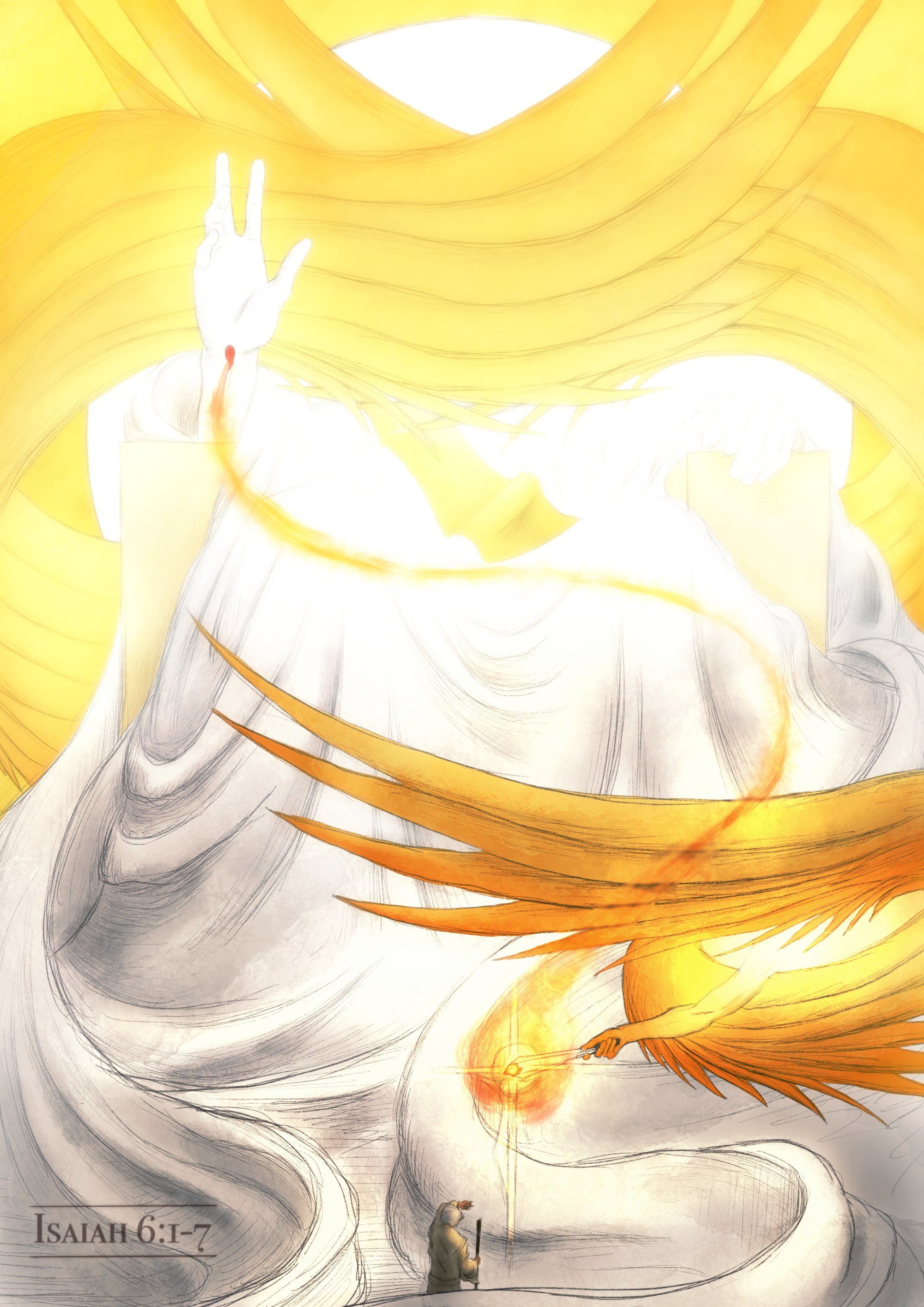
1In the year that King Uzziah died I saw the Lord sitting upon a throne, high and lifted up; and the train of his robe filled the temple. Isaiah 62Above him stood the seraphim. Each had six wings: with two he covered his face, and with two he covered his feet, and with two he flew. 3And one called to another and said:
“Holy, holy, holy is the Lordof hosts;
the whole earth is full of his glory!”

4And the foundations of the thresholds shook at the voice of him who called, and the house was filled with smoke. 5And I said: “Woe is me! For I am lost; for I am a man of unclean lips, and I dwell in the midst of a people of unclean lips; for my eyes have seen the King, the Lordof hosts!” 6Then one of the seraphim flew to me, having in his hand a burning coal that he had taken with tongs from the altar. 7And he touched my mouth and said: “Behold, this has touched your lips; your guilt is taken away, and your sin atoned for.”

In the name of the Father and of the Son and of the Holy Spirit. Amen.

Why do you come to church?

Last year, Gallop polled fifteen hundred adults[1]to see why they go to church. They gave seven options, and here is the order those options were ranked:

  1. Sermons or talks that teach me more about Scripture.
  2. Sermons or talks that help connect religion to my life.
  3. Spiritual programs geared toward my children.
  4. Lots of community outreach and volunteer opportunities.
  5. A leader who is interesting and inspiring.
  6. Social activities to get to know people in my community.
  7. Good music.

Do you notice anything missing from that list? Anyone? Bueller?

No mention of receiving forgiveness.

Each of those responses is starting with the premise that when Christians gather together they are the ones doing something. “I’m learning. I’m becoming more religious. I’m doing my duty for my children. I’m helping my community.” And each of these responses is dead wrong.

When Christians gather together to hear God’s Word, God is the One who is acting, and we are the ones being acted upon. He sends His Word to convict of sin. And God sends His Word to forgive sin. That is why we want our service to be filled with Scripture. We want everything to be centered around God’s Word – Law and Gospel.

Isaiah tells us about what happened to him while he was at church one day.

Isaiah was a normal dude. He wasn’t a priest, so Isaiah couldn’t enter the holy places of the Temple. So, Isaiah is in the courtyard of the Temple where the laity would gather to offer their sacrifices and hear the Word of God. It was how God’s people did church in Isaiah’s day.

But while he is there, God gives Isaiah this vision to see what is really happening. Isaiah sees the Lord high, lifted up, and sitting on the throne. In the Gospel of John, we are told that Isaiah saw Jesus on that throne (Jn. 12:41) with the train of His glorious robe filling the Temple.

But Jesus isn’t alone. With Him are the seraphim – glowing, fiery angels with six wings. Why six wings? God didn’t create them with unnecessaryparts, and they aren’t mutations. These angels are perfect. Perfectly created, and perfect in their conduct. The angels never sinned and didn’t need to be redeemed. But even they need to cover the parts that show their creatureliness.

Each seraph calls out, “Holy, holy, holy is Yahweh of hosts; the whole earth is full of His glory.” This threefold ‘holy’ is not just repetition. Each of these holy’s stands on its own; it could be translated, “Holy One. Holy One. Holy One.” Three distinct Holy Ones each deserving of praise. Isaiah only sees one – Jesus, but the seraphim are worshipping Three – Holy Father, Holy Son, and Holy Spirit.

Isaiah sees and hears this as he is there to worship at the Temple, and it is true for us, even though we don’t see it, every time we gather for worship as well. Every time Christians gather together, more are there than can be seen. Jesus promises that the Trinity is with even the smallest congregation (Mt. 18:20).

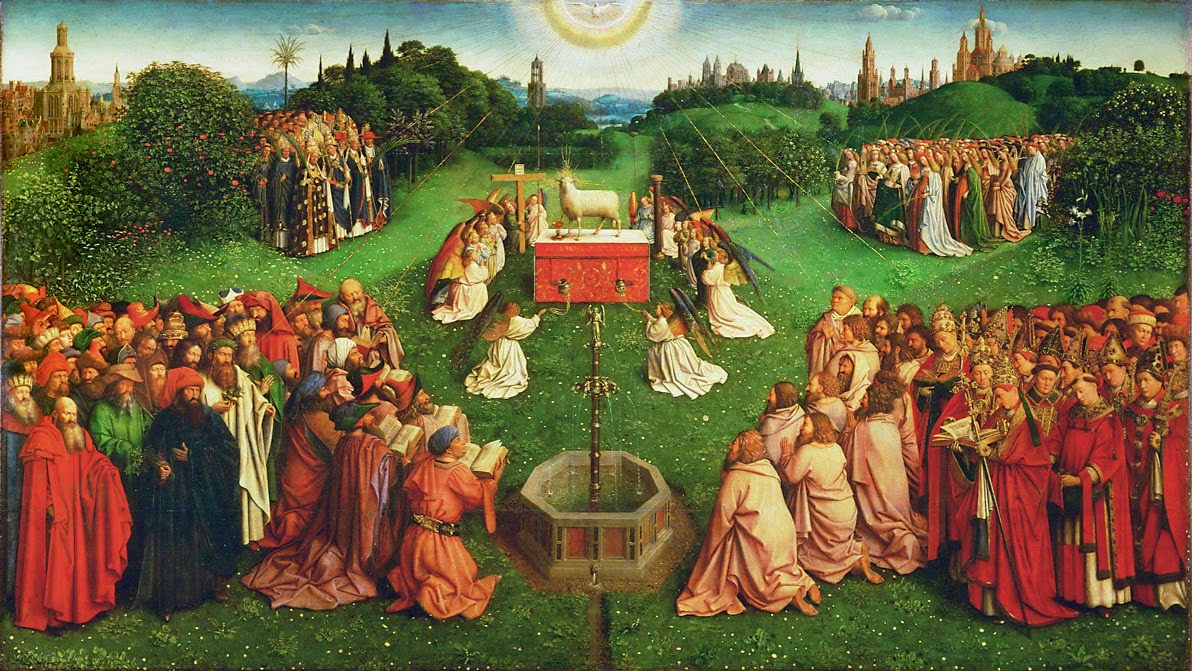
Wedding Feast of the LambHebrews 12[:22–23]tells us that there are many more here today than our eyes can see, “But you have come to Mount Zion and to the city of the living God, the heavenly Jerusalem, and to innumerable angels in festal gathering,and to the assembly of the firstborn who are enrolled in heaven, and to God, the judge of all, and to the spirits of the righteous made perfect.”

Isaiah sees what we can’t see, and he hears the worship we can’t hear. So he cries out, “Woe is me! For I am lost.” Essentially, Isaiah is saying, “I’m cooked.” Before the lofty throne of the Almighty, Eternal, Triune, Holy God, Isaiah figures God is there to punish him. How incredibly sad!

Isaiah is a Christian. He believes that God is “merciful and gracious, slow to anger, and abounding in steadfast love and faithfulness, keeping steadfast love for thousands, forgiving iniquity and transgression and sin” (Ex. 34:6-7).

If God had wanted to judge Isaiah, He could have opened up a hole in the ground and swallowed Isaiah to the pits of hell. God doesn’t toy around when it comes to executing judgment.

But Isaiah knows his sin. He knows that his sin isn’t something outside of him that sort of hovers over him. And his sin isn’t just something recorded in a divine naughty-or-nice list. Instead, Isaiah knows that his sin is on his lips, in his body, and part of who he is.

We wouldn’t have done any better than Isaiah did if we had this same encounter. We would have been just as terrified. The sins that we commit and don’t even think about would have been equally exposed. And we know that we have no excuse and no alibi when standing before the God and judge of all creation. We would rightly fear the Holy Trinity who after killing the body can throw us into hell (Mt. 10:28).

But when God appears to sinners. He isn’t there to destroy them. He is there to redeem them, forgive them, and comfort them. Jesus did not come into the world to condemn the world, but that the world might be saved through Him.

That seraph, that messenger of God, takes a burning coal from the altar and touches Isaiah’s lips, and absolves him: “See this has touched your lips; your guilt is taken away, and your sin atoned for.”

What comes right after this text is comical. We, at least I, forget that sometimes. There is the Holy, Holy, Holy, Triune God and forgiven Isaiah. And God asks a question. “Whom shall I send, and who will go for Us?” God could have just given Isaiah his marching orders, “Ok, Isaiah. Now that I’ve forgiven you, you’re going to do something for Us.”

No, God gives Isaiah a chance to confess that he is forgiven. And Isaiah does, “Here am I. Send me.” Isaiah, the man cleansed of unclean lips, is given the task of proclaiming God’s Word as God’s prophet.

And you here today, you saints, you who have come into the presence of the Holy, Holy, Holy God, you too have been cleansed. Your guilt has also been taken away. Your sin has been completely atoned for. As you leave this place, go with a clean conscience. Go and do everything that God calls you to do this week. Go be God’s salt and light in this world.

And come back. Come back next week before the throne of God to once again receive His grace, mercy, forgiveness, and love. Amen.

The peace of God, which surpasses all understanding, will guard your hearts and minds inChrist Jesus. Amen.

[1]http://news.gallup.com/poll/208529/sermon-content-appeals-churchgoers.aspx?utm_source=alert&utm_medium=email&utm_content=morelink&utm_campaign=syndication