Moved Up – Sermon on Luke 14:1-11 for the Seventeenth Sunday after Trinity

Luke 14:1-11

1 One Sabbath, when he went to dine at the house of a ruler of the Pharisees, they were watching him carefully. 2 And behold, there was a man before him who had dropsy. 3 And Jesus responded to the lawyers and Pharisees, saying, “Is it lawful to heal on the Sabbath, or not?” 4 But they remained silent. Then he took him and healed him and sent him away. 5And he said to them, “Which of you, having a son or an ox that has fallen into a well on a Sabbath day, will not immediately pull him out?” 6 And they could not reply to these things. 

7 Now he told a parable to those who were invited, when he noticed how they chose the places of honor, saying to them, 8 “When you are invited by someone to a wedding feast, do not sit down in a place of honor, lest someone more distinguished than you be invited by him, 9 and he who invited you both will come and say to you, ‘Give your place to this person,’ and then you will begin with shame to take the lowest place. 10 But when you are invited, go and sit in the lowest place, so that when your host comes he may say to you, ‘Friend, move up higher.’ Then you will be honored in the presence of all who sit at table with you. 11 For everyone who exalts himself will be humbled, and he who humbles himself will be exalted.”

In the name of Jesus. Amen.

Everyone is religious. Everyone has a belief in what is good and right and true as opposed to what is evil and wrong and false. And in the end, there aren’t hundreds of religions. There are only two. One is true. The other is false. And we can put a title on each of these religions: the true religion of the Gospel of Jesus Christ, and the false religion of the law.

The true religion of the Gospel is faith in our Lord, Jesus Christ, who is the Way, the Truth, and the Life (Jn. 14:6). This true religion believes that God is merciful. It believes that we are made right with Him because of the cross. It believes God is gracious and forgives us despite our sin against His good and holy Law. The false religion of the law wrongly imagines that we have to reconcile ourselves to God by our own works and efforts. Even though the false, pagan religions of Hinduism, Islam, Buddhism, etc. – those all serve false gods instead of the true God. But they all operate in the same manner and under the same premise. And that premise boils down to this: You need to work yourself out of the messes of this world.

In this Gospel reading, it’s that false religion of the law that Jesus is attacking because that is the religion these Pharisees. They have placed the full weight of their trust in the idea that they can make themselves right with God and the world. But their religion is weaker than a house of cards.

Before we continue, one thing needs to be crystal clear. The Pharisee heresy isn’t exclusive to Pharisees. It’s a heresy that’s in all of us. It’s our default operating system because of our sinful nature. Normally, when we think about our sinful nature, we think of it as the part of us that drives and moves us toward sinful actions. And that is true, our sinful nature certainly does that. But it does more than just that. Our sinful nature also invents our own standards, morals, and commandments that are simpler than God’s standard of total, complete perfection.

This is why the Pharisees invented and added all their extra laws to God’s Commands. For example, the Pharisees took the 3rdCommandment, “Remember the Sabbath day to keep it holy,” and because they believed in their false religion of the law, they figured, “Let’s really get after keeping the Sabbath holy to make God happy with us.” So, they added all sorts of extra rules and regulations. They decided you could only walk 2,000 cubits (or about two-thirds of a mile) on the Sabbath because walking further than that would be considered the work of travel. In a futile effort to please God, Pharisees debated if it was ok to walk in the rain on the Sabbath because if you got rain on your clothes and went inside, that could be considered the work of delivering water. I don’t know anyone who drinks water from rain-soaked clothes. I wonder why they didn’t consider walking in rain on the Sabbath the work of doing laundry.

But they would also come up with all sorts of ways to get around their additional Sabbath laws. So, with the 2,000 cubit limitation on walking, they decided that, if you considered the whole town your home, then you could walk as far as you wanted so long as you stayed in town. They decided that if you walked in the rain on the Sabbath, you could just take off your clothes before you entered your house and leave them outside because then you weren’t delivering water. Can you imagine that? “Honey, I’m home.”

Now, we can laugh at how ridiculous this is because – it is. But we do the same sorts of things. Christ is clear that, when we get angry, it is the same as murder (Mt. 5:21-22). But rather than repent of our anger and receive God’s forgiveness, we do all sorts of mental gymnastics to try to justify our breaking of the 5th Command. But the Pharisee inside each of us also does something even worse. When our conscience still bothers us because of our sin, when it isn’t quieted by our mental justification of that sin, we recruit. We recruit and gather others around us. We tell them about whatever it was that made us angry – usually, in a way to make our anger seem right and just. We do that because we want others to confirm and affirm our sin. But it doesn’t matter if you could get the entire world to agree with you. God doesn’t care about the consensus you build, no matter how large it is. If God says it’s sinful, it’s sinful. Period. End of story.

Now, all of that was to build to this point: Dear saints, God’s view of what is right or wrong, what is good or bad, and what is holy or evil – that’s the only opinion that matters. That is what Jesus is getting at in this text – especially with the parable He tells in v. 8-11.

This parable isn’t like any other parable that Jesus tells. In fact, it is so unique that it won’t appear in most lists of Jesus’ parables that you can find. But Luke clearly calls it a parable in v. 7, so a parable it is. I would guess that the confusion about it being a parable stems from the fact that, at face value, it’s an etiquette lesson of how to be a good guest at a wedding feast. Basically, don’t automatically sit yourself in a place of honor because the host might see someone who is more important than you. Then, the host is going to tell you to sit somewhere else and give the more important person the seat of honor. If that happens, you’ll end up sitting somewhere obscure because all the other good seats are taken. Instead, Jesus says to sit in a low, undesirable place so the host can honor you saying, “Hey, friend. You deserve better. I’m going to move you up here.”

Again, this is just good, wise advice. But this advice is also a parable because there is a deeper theological truth here. Discovering that truth hinges on one thing. In this “etiquette parable” whose opinion matters? The host’s. Only the host’s. It doesn’t matter if everyone else at the wedding feast thought you were the most important person there. If the host tells you another guest gets the seat of honor, it’s his feast. So, the other guy gets it.

Here’s the point. Don’t move yourself up. Instead, be moved up by God. In that parable, the host is God Himself. His opinion of you and your honor – that’s the only thing that matters. So, there are times where you have to tell the little Pharisee inside of you to shut up and stop trying to clamor for honor and recognition and accolades. The opinions of others (and even your own opinions), they don’t matter (1 Co. 4:3-5). And Jesus, the Son of God, clearly tells you what He finds honorable and shameful in the last verse of this reading. “Everyone who exalts himself will be humbled, and he who humbles himself will be exalted” (Lk. 14:11).

If you are trying to exalt yourself and be impressive by your self-chosen good works, it isn’t going to go well for you. God is going to come into the banquet hall and say to you, “No. You don’t get to sit here.” And where will that leave you? Ultimately, it’ll leave you outside and in the darkness (Mt. 22:13). Instead, sit in the lowest seat, and don’t worry if others ask, “What are you doing there? Why are you putting up with that lowly, humiliating spot?” Don’t worry about being in positions that others think are shameful. God the Host is going to come Himself and say, “Friend, why are sitting way down here? Move up higher.”

One of the things Jesus is doing with this parable is He’s giving you God’s perspective on your simple, normal, everyday callings and vocations and works. Don’t ever forget that God is the One who has put you in those vocations and given you those works. Even if they don’t look flashy or impressive to the world, they are exactly the places where God has put you and given you holy work to do. If you stop and think about it, what higher seat is there than the seat God gives you?

To understand this better, imagine two people. The first is a devout monk who has abandoned the world to live a life of holiness. He takes a vow to get up every night at 2 AM and pray for three hours. Every night, this monk deprives himself of sleep; goes into a chapel to burn incense; lies face-down on a stone floor; and earnestly prays. The second person is a mom. At 2 AM, she gets woken up by the cries of her newborn because he’s sick with a stuffed, runny nose and has a full, stinky diaper. Exhausted, she stumbles around the room. She gets her hands into the snot and poop. She cleans and comforts and feeds the child. And she spends hours to finally rock him back to sleep.

Both of them are getting up at 2 AM. Both are doing work instead of sleeping. But which one is more holy, exalted, and honorable – the monk who chose to take that vow? Or the mom who received her child from God Himself? Of course it’s the mom.

Think of Paul in today’s Epistle reading (Eph. 4:1-6). In v. 1, he wrote, “I therefore, a prisoner…” I mean how low can you get? Paul is there in prison – rats running across his feet, muck oozing down the walls, mold in the air. And Paul writes, “I a prisoner for the Lord, urge you to walk in a manner worthy of the calling to which you have been called.” Paul recognized that, even in prison, he’s the Lord’s prisoner. It wasn’t Caesar or a king or a governor. God put him there. And if God, his loving heavenly Father, put him there, what better or more honorable place could there be?

Dear saints, the religion of the Gospel is the only thing that moves you up. You don’t need all the Pharisaical nonsense that vainly tries to get God to clap for you and give you accolades. One, it’s not going to work. And two, God has already given you important, holy works to do. Those works are pleasing to Him; those works show your love for Him by showing love for your neighbor. 

So, walk in a manner worthy of the calling to which you have been called. And you’ve been called God’s friend. God’s saints. God’s holy ones. God’s children. The work God gives you is worthy and holy. So, do that work with all your might.

Dear saints, you have the true religion which is faith that God is the One who moves you up. Not yourself. Not ever yourself. You are moved up, exalted, and honored by the holy and righteous God who calls you, “Friend.” And He calls you, “Friend,” solely because of what Christ has done on the cross for you. Amen.

The peace of God, which surpasses all understanding, will guard your hearts and minds in Christ Jesus (Php. 4:7). Amen.

Follow – Sermon on Matthew 26:1-27:66 for Palm Sunday

Matthew 26:1-27:66 & John 12:12-19

In the name of Jesus. Amen.

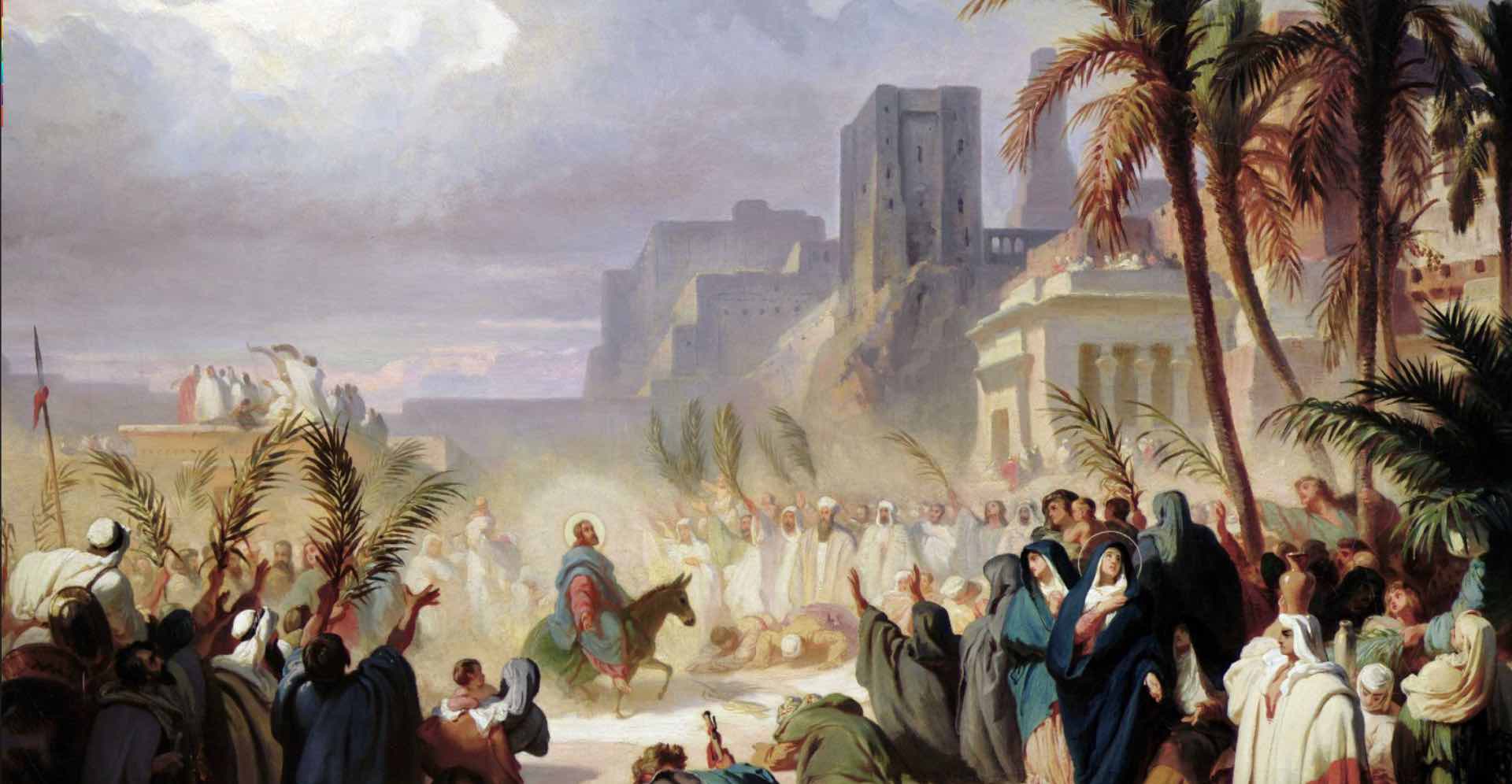
Most of you here today have known the story of Jesus’ life for as long as you can remember. For that, God be praised! You know that the Palm Sunday welcome will quickly move to the bitter account of Jesus’ Passion that we just finished reading.

But imagine that you didn’t know. Imagine attending our service and hearing all of this for the first time. Imagine all of it was new. You hear about Jesus being welcomed into Jerusalem with the shouts of, “Hosanna,” as He rides into Jerusalem on a donkey. Then, not even half an hour later, you hear about Jesus’ crucifixion. You might wonder, “What changed? How did this turn around so quickly? Why are the people who were shouting, ‘Hosanna, blessed is he who comes in the name of the Lord,’ now shouting for Jesus to be crucified?”

Hearing all of this for the first time would probably be shocking to you. But, again, you know the story of Jesus’ life. You know how it begins with Jesus being born in Bethlehem. You know how it ends with Jesus’ resurrection and ascension. Jesus knew this too.

As He rode into Jerusalem on that day nearly 2,000 years ago, Jesus knew. He knew that the palm branches that were being waved to welcome Him as the king would be followed by the whip that would be waved across His back. Jesus knew that the shouts of, “Hosanna,” would soon turn to shouts of, “Crucify.” Jesus knew that the jackets across the road would morph into the soldiers, gambling for His clothes. Riding into Jerusalem on a donkey, Jesus knew that He would ride out of Jerusalem lifeless and laid on a bier. We don’t know if Jesus heard the Pharisees saying, “The whole world is going after him.” But Jesus knew that, in a few short days, almost everyone would turn their back on Him. Christ knew that, soon, it would be just a couple of men – Joseph of Arimathea and Nicodemus (Jn. 19:38-40) – and a few women who would lay Him in the tomb.

Jesus knew all of this as He triumphantly went into Jerusalem. He wasn’t surprised by anything that happened the following Thursday or Friday. That was the reason He went into Jerusalem. Christ wasn’t surprised by the change between that Sunday and Friday. He went knowing exactly what was going to happen, knowing exactly what was going to take place, knowing that He would be betrayed, knowing that Judas mark Him as the one the soldiers should arrest, knowing that Peter would deny Him, knowing that His disciples would flee.

Jesus knew all of it. He knew that he would suffer. He knew that He would be mocked. He knew that He would be ridiculed and beaten. He knew that He would be stripped. He knew the crown of thorns would be pressed onto His head and nails driven through His hands and feet. Jesus knew all of this. Christ knew that the reason He was going to Jerusalem was so that He could suffer, die, and rise again for you (Lk. 18:31-33).

Jesus knew that He was going to bear all of humanity’s sins before God, the Judge. Jesus – the perfect, sinless Son of God, who knew no sin – He became sin so that you, through faith, might become the righteousness of God (2 Co. 5:21). And Jesus followed through with His Father’s plan to save you.

Conceivably, we could plead innocent of all the injustices that Jesus faced – the betrayal, the denial, the false accusations, the beating, the whipping, the mocking, the scorning. We weren’t there. We didn’t do those things to Him. We would probably not be convicted of killing of Jesus before any earthly judge and jury. We could honestly say that we weren’t shouting, “Crucify, crucify Him!” We weren’t calling for Barabbas to be released and innocent Jesus be crucified. We weren’t daring God by calling for the guilt Christ’s blood to be upon us and upon our children.

Dear saints, we could say Jesus did not die because of us, but please believe that He dies for us. He goes to the cross on our behalf and in our place. Isaiah says that the Lord laid on Jesus the iniquity of us all (Is. 53:6). That leaves no doubt, no question, we – you and I – are why Jesus is on the cross.

Yet, that isn’t the entire story either, is it? Out of His love for you, Jesus willingly went to the cross. He went for the joy that was set before Him (Heb. 12:2) – the joy of winning you as His own.

The eternal Son of God did not count equality with God a thing to grasp at all costs. Instead, He emptied Himself and took the form of a servant. He was born in the likeness of men. In other words, God Himself was willing to be seen in your flesh and blood. But Jesus went lower. He humbled Himself by becoming obedient to the point of death, even a cursed (Gal. 3:13) cross kind of death (Php. 2:5-8) so that you could be reconciled to Him. Dear saints, have that same mind of Christ.

Even as the whip followed the palm branches; the shouts of, “Crucify,” followed the, “Hosannas”; the gambling for Jesus’ clothes followed the coats laid out on the road; let us also follow Jesus this Holy Week.

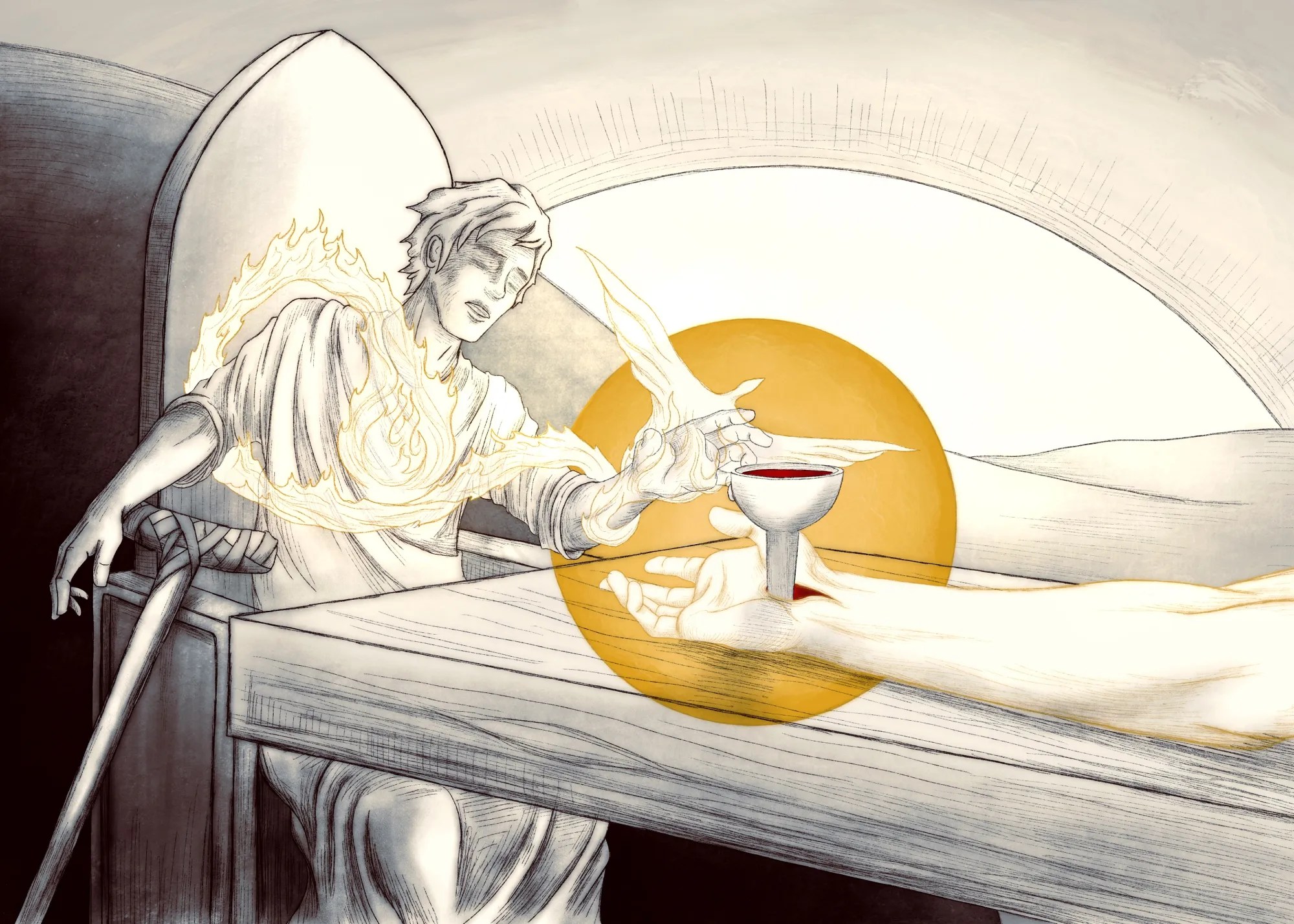
Follow Him to the upper room, where He gives His Body and Blood for the forgiveness of sins (Mt. 26:26-28). Follow Him to His trial, where He is falsely accused. Follow Jesus out to the hill of Golgotha, where He is forsaken by God (Mt. 27:46). Follow Jesus as He goes to the tomb, but let’s not stop there either.

Continue to follow Jesus out of the tomb, out of death, out of all that we deserve because of our sins. Follow Jesus, having His mind, having His humble attitude, having received His gracious love and mercy by faith. Follow Him and extend His humble, sacrificial love to others until that great day when every knee shall bow and every tongue confess that Jesus Christ is Lord. Amen.

The peace of God, which surpasses all understanding, will guard your hearts and minds in Christ Jesus. Amen.

Friend, Move up Higher – Sermon on Luke 14:1-11 for the Seventeenth Sunday after Trinity

Luke 14:1-11

In the name of Jesus. Amen.

The game is afoot. This prominent Pharisee and his friends had invited Jesus to a Sabbath dinner party. Our Lord is in hostile territory. The Pharisees want to investigate how Jesus will behave on the Sabbath, and their focus is especially on seeing if He will work because that was strictly forbidden by their additional rules. Ironically, this means that they are working by keeping a close watch on Jesus. And Luke draws our attention to this sick man, “Behold, there was a man before [Jesus] who had dropsy.”

Now, Luke doesn’t come flat out and say this, but everything points to the fact that these Pharisees have intentionally set this situation up as a trap. The clues all point to the fact that this sick man was invited so they could test Jesus and see what He would do.

The man was sick with dropsy. The term for his condition today is ‘edema.’ It means that he is retaining water which causes his limbs to swell up in a gross way. In other words, you’d visibly see that this man isn’t well. On top of that, his swelling meant that he was unclean according to Lev. 13:2. This man’s sickness would normally have meant he wouldn’t get an invite to this Sabbath meal. Again, Luke doesn’t come straight out and say it, but there’s little question that this whole situation is set up to trap Jesus. But it doesn’t go too well for the Pharisees.

Throughout the Gospels, we see that Jesus knows what people are thinking (Mt. 9:4; Mk. 2:8; Lk. 5:22; Jn. 2:24-25). So, Jesus turns the tables and traps them. Notice that He initiates the confrontation by asking, “Is it lawful to heal on the Sabbath or not?” Of course, the answer is, “Yes, it’s lawful.” There are zero biblical laws against healing on the Sabbath. The reason there aren’t laws against it is simple. Who alone can heal disease? Only God can. Sure, doctors can treat diseases, but they can’t heal them. Throughout Scripture, God doesn’t give any laws against parting the Red Sea, turning water into wine, feeding 5,000 people with five loaves and two fish, or raising the dead on the Sabbath. The Bible doesn’t have one word against doing those things because God is the only one who can do any of that.

So, the hunters become the hunted, and the trappers, the trappeese [sic.]. The Pharisees are silent. Jesus heals the man and sends him off with a body that is no longer gross and swollen. And Jesus isn’t done interrogating these folks. “Which of you, having a son or [even] an ox that has fallen into a well on the Sabbath, wouldn’t make sure to pull him or it out?” And, again, they don’t answer because they can’t. They would do that lesser thing of rescuing their son or animal from a well on the Sabbath, so of course God – who, again, is the only one who can heal – would deliver someone from a sickness and grant that relief on the Sabbath.

Then, Jesus tells a parable about seating arrangements against them. While they were watching Jesus, He had been watching them. They had all been trying to get themselves into best possible spot at the feast. They were all jockeying for positions to show everyone else how important they were. I’m sure this is not how they imagined this entrapment dinner party would play out. Jesus keeps coming at them but not to condemn them; instead, Jesus is calling them to repentance.

Yes, the Pharisees are always trying to condemn Jesus. Yes, throughout the Gospels, they are the enemies of our Lord. And yes, Jesus warns us to not become like the Pharisees. But we have to remember that Jesus died for them too. Jesus loves the Pharisees and wants them to repent, to believe in Him, and to receive His forgiveness. So, when Jesus exposes the foolishness of the Pharisees, we shouldn’t stand on the sidelines and hope they get injured. 

Remember, all of us have a little Pharisee living inside of us. Our sinful nature desires to be noticed and praised for our own goodness and holiness. The creed of the Pharisee, and all of us little Pharisees, is, “I’m a good person,” and we will do everything in our power to try and prove that to others. But if we are trying to impress others with our morality, the only accolades we will receive will be from other sinners. If we are outside of faith in Christ, the only thing we will hear from God is, “Depart from Me, you cursed workers of lawlessness, into the eternal fire prepared for the devil and his angels” (Mt. 7:23; 25:41). 

We take God’s Law and misuse it to try and make ourselves look better than others. This is completely wrong. God didn’t give the Law for us to measure how we compare to others. God has given the Law for three purposes, and we have covered the three biblical uses of God’s Law recently, but it is always good to review those.

First, God’s Law shows us how creation works. The Commandments reveal how God has ordered things in creation. The theologians will describe this first use of the Law as a ‘curb’ that keeps us from driving off the road and causing damage to us and to others. Second, because God’s Law is a curb, it also shows us how sinful we are. This second use of the Law is a ‘mirror’ that reveals how wicked, wretched, and sinful we are. It brings us to repentance and faith in Christ. Third, God’s Law is a ‘guide’ which shows us how God wants us to live and how to love Him and love our neighbor. These three uses of the Law are clearly taught in Scripture. And 1 Tim. 1:8 says, “the Law is good if one uses it lawfully.”

Our problem is that we are like the Pharisees and use the Law in other ways that are not lawful. They are outside of how God intended the Law to be used. Instead of a curb, guide, and mirror, the little Pharisee in us tries to use the Law as a ladder. We foolishly attempt to use Law as a way to climb up to God. We wrongly imagine that if we do enough good works or climb a little higher than others then God will reward us. We wrongly use the Law as a foam finger cheering ourselves on, “I’m #1.” We misuse the Law as a podium trying to claim a spot that elevates us above others. The Law wasn’t intended to do any of that, but that’s how our sinful nature tries to use the Law over and over and over. Repent.

The Law puts us in our place. Again, it shows us how creation is ordered and works. That, then, shows us how far out of step we are with what God intends us to be and drives us to Him for His mercy and forgiveness. The sooner we learn this, the better. Because the only thing that can elevate us isn’t the Law. No thing can elevate us. Only God Himself can. And when we sinners repent, turn from our wickedness, abandon our own good works, and turn to Him for our righteousness and holiness, then, and only then, we become God’s friend, and He calls us higher. He elevates us.

Here’s the thing. Once God calls you, “Friend,” it almost doesn’t matter what He says after that. He could say, “Friend, unload the dishwasher,” or, “Friend, go rake the leaves.” If God calls you, “Friend,” that’s all you need. He knows all your sin, but He comes to you today and says, “You are My friend.” And He lifts you up. That’s what the absolution is. Jesus lifts you up, out of your sin, and says to you, “Friend, move up higher.” In Holy Communion Jesus calls you higher, to sit with Him at His table. Even your death is Jesus saying to you, “Friend, move up higher because I’ve made a way for you to live forever with Me.” 

You probably know the hymn What a Friend We Have in Jesus, but do you know what Jesus sings? What a Friend I Have in You. Dear saints, Jesus, and Jesus alone, lifts you up by saying, “Friend, move up higher.” Amen.

The peace of God, which surpasses all understanding, will guard your hearts and minds in Christ Jesus. Amen.

Location – Sermon on Luke 18:9-14 for the Eleventh Sunday after Trinity

Luke 18:9–14

9 He also told this parable to some who trusted in themselves that they were righteous, and treated others with contempt: 10 “Two men went up into the temple to pray, one a Pharisee and the other a tax collector. 11 The Pharisee, standing by himself, prayed thus: ‘God, I thank you that I am not like other men, extortioners, unjust, adulterers, or even like this tax collector. 12 I fast twice a week; I give tithes of all that I get.’ 13 But the tax collector, standing far off, would not even lift up his eyes to heaven, but beat his breast, saying, ‘God, be merciful to me, a sinner!’ 14 I tell you, this man went down to his house justified, rather than the other. For everyone who exalts himself will be humbled, but the one who humbles himself will be exalted.”

In the name of Jesus. Amen.

Most of you are familiar with the phrase, “The three most important factors in real estate are – location, location, location.” A house here in East Grand Forks would probably be triple the cost if you moved it to Los Angeles County. For some reason, want to live there. I’ll gladly take winter.

A similar thing could be said about sin. The three most important factors about sin are – location, location, location. To be clear, I’m not talking about where sin is committed geographically. Speaking a lie to a massive crowd of people is just as damning as lying to yourself in your own mind without ever moving your lips. By referring to sin’s location here, I’m talking about where the sin resides. Sin has a place. Either sin is on you, or sin is on Jesus, the Lamb of God who takes away the sin of the world (Jn. 1:29).

We have this wrong tendency to think of sin as something abstract and floating around somewhere. There is no sin outside of the one who is committing it. Sin starts in the heart. Jesus says, “Out of the heart come evil thoughts, murder, adultery, sexual immorality, theft, false witness, slander” (Mt. 15:19). A sinner isn’t simply a person who commits sins. All people, besides Jesus, commit sin. Being a sinner means to be a person who is outside of God’s fellowship, outside the kingdom of God, someone who belongs with the demons. That is why we need Jesus to be the Savior of sinners. He changes the location of the sin. He removes it from the sinner as far as the east is from the west (Ps. 103:12).

Now, with that in mind, let’s consider the parable, which is about as straightforward as it gets. We’re told that the audience is people who are sinners with sin residing in them but still trusted in themselves and their own righteousness while treating others with contempt. Jesus also gives a clear conclusion to the parable, “Everyone who exalts himself will be humbled, but the one who humbles himself will be exalted.” But to get a fuller sense of what Jesus is teaching here we need to set the picture of what is going on in the parable. The people who originally heard this would have been familiar with what goes on in the Temple, but we probably aren’t.

Two men went up into the Temple, which is God’s house (1 Kgs. 8:13, 27), and they go for a specific purpose – to pray and worship. In English, we typically think of prayer as an individual thing. Sure, we will pray the Lord’s Prayer and say grace before a meal with others. But normally we think of prayer as an individual thing and worship as a corporate, communal thing. But the people in Jesus’ day had one word for both prayer and worship. These two men go to the place of worship at the same time. What kind of service are they attending?

They would have been at the Temple for the atonement offering, which was the only service that took place every day in the Temple, and it occurred twice each day – once at dawn and again at three in the afternoon. The service would begin by the altar for sacrifice. An unblemished lamb was slaughtered, and its blood was sprinkled on the altar following a precise ritual.

This sacrifice was a reminder of how God covered the sin, nakedness, and shame of Adam and his wife by providing garments of animal skins after they fell into sin (Gen. 3:21). It showed that God would accept the death of another in place of the sinner. As the atonement lamb was sacrificed, certain prayers were offered with the sound of silver trumpets and cymbals. The people would sing a Psalm. A priest would go into the Holy Place where he would offer incense, praying that the sacrifice would be pleasing to God. Then, when the priest entered the Holy Place with that incense, the people would offer their private prayers to God.

But the Pharisee’s prayer directly contradicted everything that was happening around him in the Temple. He thanks God that he is acceptable because of who he is and who he is not, what he has not done and what he has done. His prayer in that context would be like coming here on Good Friday and praying, “God, I’m sure glad I’m not like all these sinners around me who need Jesus to die for their sins.” It’s utterly blasphemous.

But the tax collector’s prayer harmonizes with the service in at least two very specific ways. First, when the tax collector prays, “God be merciful to me, a sinner,” he isn’t using the normal word for ‘mercy.’ Many times in the Gospels, we hear people with sickness, disease, or other affliction cry to Jesus, “Have mercy” (Mt. 15:22, 20:31; Lk. 18:38-39). That’s always a good prayer to ask God for blessings you haven’t earned and the relief that you don’t deserve. But the tax collector’s prayer uses a different word. We could translate his prayer as, “God, atone me. God, reconcile me. God, make me what I should be.” That’s the first way his prayer harmonizes with the service. He is praying that the atonement that is taking place there in the Temple and the sacrifice being offered would do what God had promised it would do and remove his sin from him (Lev. 4:35).

Second, his prayer harmonizes with the service because this tax collector recognizes that he is the sinner who needs atonement. He needs to be reconciled. He needs to have his sin, his shame, his guilt removed. Again, that’s precisely what that service was pointing to. That is what the tax collector looked to, and that is why he went down to his house justified.

Now, there is a danger in this parable. We know that the really good, moral Pharisee did not go home justified, but this sinful tax collector did. The danger that can arise for us then is to think that everything about the Pharisee is bad. Be careful with that. It is good and right to not be extortioners, unjust, adulterers. It is good to fast and give tithes. That is all good stuff. There is another side to the coin of the Pharisee’s prayer. We might be tempted to pray, “God, I thank You that I am not like other men, self-righteous, pretentious, holier-than-thou types, or even like this Pharisee. I’ve given You my heart, dedicated my life to You, and made You my Lord.” Do you see what that does? It locates our eyes off of Jesus – the One who atones for our sin (1 Jn. 2:2).

The location of your sin matches where you look. If you look to yourself, your sin is on you. If you look to Christ, your sin is gone, defeated, eternally removed.

Let me close with an analogy: Imagine you had to cross some terrifying span. Far below at the bottom of that span are all the things you fear most – snakes, rats, lava, rough seas, or sharks. You fill in whatever is scariest. But there is a bridge that spans that gap. What would you look to for confidence in crossing that gap? You’d look to the bridge. You’d see if it was well-built, sturdy, and strong. You wouldn’t look inward to see if you have enough confidence in the bridge. And you build confidence in the bridge by looking at the bridge.

So, dear saints, where are you looking? Are you looking toward things you have done – either good works or your own humility? If so, you should have no confidence whatsoever.

Look to Jesus. His sacrifice, His blood, His death, His resurrection is enough. Looking there, you go to your house justified by God’s sure and certain declaration. Amen.

The peace of God, which surpasses all understanding, will guard your hearts and minds in Christ Jesus. Amen.

A Different King with a Different Glory – Sermon on John 12:12-19 and Matthew 26:1-27:66 for Palm Sunday

John 12:12-19 & Matthew 26:1-27:66

In the name of Jesus. Amen.[1]

October 21st and 22nd 331 BC, Alexander the Great of Greece made his triumphal entry into the city of Babylon after conquering it. And we have a historical account of Alexander’s entry into the city.[2]

While Alexander was approaching Babylon, some went up on the walls of the city to watch their new king enter, but most went out to meet him. For miles, the road into Babylon was carpeted with flowers. At regular intervals, silver altars were placed on both sides of the road heaped with frankincense and perfumes. Herds of cattle and horses were in the procession as well as lions and leopards in cages. Large choirs sang the praises of Alexander. The Babylonian cavalry marched along with all their equipment and horses. Alexander himself was surrounded by an armed guard as he rode in his chariot, and the people of the city followed him. Finally, this massive, impressive parade approached the gates, and Alexander entered the palace. Now that is a triumphal entry. Miles of people, soldiers, animals, and all sorts of pageantry following the king. It was a display of might, power, and authority.

Have Alexander’s entry into Babylon in mind as you consider the entry of Jesus into Jerusalem. On Palm Sunday, the crowds went out to meet Jesus. They waved palm branches and laid them and their cloaks (Mt. 21:7) on the road before Jesus. They cried out, “Hosanna,” which means “Save us now! Blessed is he who comes in the name of the Lord, even the King of Israel!”

They find Jesus sitting – not on a chariot, war horse, camel, or elephant. Jesus sits and rides a donkey – a beast that helped people carry burdens and was used for normal, everyday work. And this fulfilled the prophecy of Zechariah 9:9, “Rejoice greatly, O daughter of Zion! Behold, your king is coming to you; righteous and having salvation is he, humble and mounted on a donkey.”

This entrance of Jesus into Jerusalem is His triumphal entry. But unlike Alexander’s entry, it is humble, lowly, and peaceful. Jesus arrives in Jerusalem as King but not as a normal king. He certainly has power, strength, and glory, but He isn’t intimidating, either to the citizens of His kingdom or to those outside His kingdom. Jesus does not come to demonstrate His might. He comes to demonstrate His love. He comes not to conquer Jerusalem or the world; instead, He comes to conquer your sin and death by His own death on the cross.

Jesus told Pilate, “My kingdom is not of this world” (Jn. 18:36). Jesus is a different kind of king with a different kind of glory. He is a king who has come to die for His subjects – for you. Christ’s glory is to be humble and take the form of a servant. Jesus is a king who is obedient to the point of death, even death on a cross (Php. 2:5-8). And the cross is His triumph. Because Jesus has given Himself unto death for you, God has highly exalted Him and given Him the name above all names. Dear saints, Jesus comes with mercy, and He comes for you. Welcome to Holy Week. Amen.

The peace of God, which surpasses all understanding, will guard your hearts and minds in Christ Jesus. Amen.


[1] This sermon has been adapted from a sermon by Pr. Bryan Wolfmueller.

[2] The account was written by Quintus Certius Rufus and can be found here.

Humbled – Sermon on Luke 14:1-11 for the Seventeenth Sunday after Trinity

Luke 14:1-11

1 One Sabbath, when [Jesus] went to dine at the house of a ruler of the Pharisees, they were watching him carefully. 

2 And behold, there was a man before him who had dropsy. 3 And Jesus responded to the lawyers and Pharisees, saying, “Is it lawful to heal on the Sabbath, or not?” 4 But they remained silent. Then he took him and healed him and sent him away. 5 And he said to them, “Which of you, having a son or an ox that has fallen into a well on a Sabbath day, will not immediately pull him out?” 6 And they could not reply to these things. 

7 Now he told a parable to those who were invited, when he noticed how they chose the places of honor, saying to them, 8 “When you are invited by someone to a wedding feast, do not sit down in a place of honor, lest someone more distinguished than you be invited by him, 9 and he who invited you both will come and say to you, ‘Give your place to this person,’ and then you will begin with shame to take the lowest place. 10 But when you are invited, go and sit in the lowest place, so that when your host comes he may say to you, ‘Friend, move up higher.’ Then you will be honored in the presence of all who sit at table with you. 11 For everyone who exalts himself will be humbled, and he who humbles himself will be exalted.”

In the name of Jesus. Amen.

Jesus eats with all sorts of people. He eats at His friends’ house with Mary, Martha, and Lazarus (Lk. 10:38-42). He eats at His disciples’ houses. He eats in Peter’s house and Peter’s mother-in-law serves Him (Lk. 4:38-39). Jesus calls Matthew the tax collector to be His disciple and eats with him and other sinners. And you remember that the reason Jesus tells the parable of the Lost Sheep, Lost Coin, and Prodigal Son is the Pharisees accusing Jesus of welcoming and eating with sinners (Lk. 15:1-2).

We aren’t surprised that Jesus would eat with His friends and disciples. We do that too. And as Christians, we are comfortable with the fact that Jesus eats with sinners. But we might find it surprising that Jesus would even eat with Pharisees. The Pharisees were our Lord’s enemies. From the beginning of His ministry, the Pharisees were butting heads with Jesus (Lk. 5:21Jn. 5:18).

Think of the person in your class or at work that you most regularly butt heads with – no matter what you just can’t seem to get along. He takes everything you say and turns it into an accusation against you, so you’re always on your toes, always analyzing everything word out of your mouth. Being around a guy like that is exhausting. Now, if that person invited you over for dinner, you’re going to decline. (Unless they tell you that they are going to be serving dry-aged Wagyu steaks. Then, you probably go, you just don’t stay for dessert.) But as difficult as the person you are imagining is, he probably isn’t trying to find some way to get you the death sentence. That’s exactly what the Pharisees wanted for Jesus, but our Lord still repeatedly ate with the Pharisees.

Once, Jesus went to Simon the Pharisee’s house where He was anointed by the sinful woman who washed Jesus’ feet with her tears (Lk. 7:36-50). Another time, Jesus was invited to eat at a Pharisee’s house and didn’t wash His hands the way the Sabbath traditions requires (Lk. 11:37-54). When Luke finishes recording that meal, he notes that the scribes and Pharisees were lying in wait for Him, to catch Him in something He might say.

Now here, in our text, an important Pharisee has invited Jesus to his house for a Sabbath dinner. And, what d’ya know? Jesus goes. 

Now, we have to imagine this scene of everyone arriving for the fancy dinner. Luke here gives us enough details to sketch this out, but they are interspersed in the account. So, let’s bring them together into one picture. Jesus arrives at this ruling Pharisee’s swanky house. As the guests arrive, they might give a nod or a handshake to their friends, but each of them is more interested in positioning themselves to get the best seats. They are cutting in front of each other to get as close as possible to the head of the table. I don’t know how a Pharisee would save a seat – maybe he’d drink half of whatever was in the cup or lick the silverware. Who knows? But they are all claiming their spots and making sure their position is secure and no one else takes it from them. Then, their gaze turns towards Jesus.

When Jesus arrived, He wasn’t concerned with sitting in the high, prominent spots. So, we can assume that there was only one spot left at the table – the lowest. Jesus finds His place, and the eyes of all the Pharisees are on Him. If you were there and watching Jesus approach His seat, you wouldn’t notice the fine dining couch or the fancy china. The only thing that would catch your attention was this man.

Luke, the doctor, tells us that the man before Jesus has ‘dropsy.’ The term does appears in medical literature about 300 years before Jesus by a guy named Hippocrates (from whom, we get the Hippocratic oath). The word is actually two words mushed together – “water” and “appearance.” In other words, the guy was swollen, grossly bloated. It is not stretching the text at all to assume the Pharisees brought this man in so they could accuse Jesus of breaking the 3rd Commandment, “Remember the Sabbath day to keep it holy.”

Now, the Pharisees had lengthy discussions on what was and what wasn’t permitted on the Sabbath. They wrote all sorts of rules that defined what you could and couldn’t do on the day of rest. It went so far as to define where you could spit. Every other day of the week, you could spit wherever you wanted, but on the day of rest, you could only spit on rocks because spitting on soil might be watering a plant and considered work. Also in their discussions, they considered how much help you could give to a person who was sick or injured. For example, if someone had a cut you could apply a bandage to keep the wound from getting worse, but you couldn’t apply the bandage in a way that would help the person get better because that would be considered work.

These Pharisees are all closely watching as Jesus sees this man, ballooned up with disease. But Jesus turns the tables. Notice, they don’t ask Jesus a question, but He responds to the situation asking, “Is it lawful to heal on the Sabbath or not?” The Pharisees don’t say a word. Jesus heals the man. His swelling is gone. His features return to normal, and Jesus sends him away. Then, Jesus exposes the Pharisees’ hypocrisy. “Which of you, having a son or an ox that has fallen into a well on a Sabbath day, will not immediately pull him out?”After this question, the Pharisees aren’t just silent. They aren’t able to answer. With two pointed questions, Jesus humbles the Pharisees into deafening silence.

Then, our Lord throws the knock-out punch. They had been watching Jesus carefully as He approached the table, but He had been watching them too. They had been scrambling, shoving, jolting, and jockeying for the best places. It’s interesting: for all the discussion and debate the Pharisees had on what was and wasn’t considered work on the Sabbath, they didn’t debate about contending for prominent positions in their regulations. And Jesus echoes what we had in the first two verses of our Old Testament lesson (Pro. 25:6-14). Basically, if you put yourself forward as being important, you’re likely going to be humbled, and it’s going to be a public spectacle. Instead, be humble, and wait for your host to exalt you.

Now, of course, this is some solid, practical advice. Any motivational speaker could take what Jesus says here and teach a helpful lesson: Don’t strut around blowing smoke about how important you are. Instead, go about your business quietly, and your recognition will come in due time. But this isn’t a self-help seminar, and I’m not a motivational speaker.

Instead, notice what happened at this meal. Jesus, who was by far the most important person there, ended up in the lowest seat. And even though no one changed positions, Christ elevated His place back the peanut gallery to be the prominent place, and those who were at the head of the table end up in the bleachers.

Dear saints, as our Epistle lesson (Eph 4:1-6) said, “Walk in a manner worthy of your calling.” Humble. Gentle. Patient. Bearing with one another in love. Paul will say a similar thing in Php. 2:5-11, “Have this mind among yourselves, which is yours in Christ Jesus, who, though he was in the form of God, did not count equality with God a thing to be grasped, but emptied himself, by taking the form of a servant, being born in the likeness of men. And being found in human form, he humbled himself by becoming obedient to the point of death, even death on a cross.” But Jesus didn’t remain humbled and lowly in death. The text goes on, “Therefore God has highly exalted him and bestowed on him the name that is above every name, so that at the name of Jesus every knee should bow, in heaven and on earth and under the earth, and every tongue confess that Jesus Christ is Lord, to the glory of God the Father.”

Dear saints, this humbled mind is yours. You, Christian, are saved by God’s grace. Live that out. You were sinful and low, but Christ has invited you, by the cleansing of His blood, to sit at His table. He has given you the seat of honor next to Him. Through His death and resurrection, you have been raised with Him. Your life is even now hidden with Christ in God. And the day is coming when Christ who is your life appears, you also will appear with Him in glory (Col. 3:1-4). Christ will call to you, “Friend, move up higher.” And you, and all believers, will be honored in the presence of all creation. Amen.

The peace of God, which surpasses all understanding, will guard your hearts and minds in Christ Jesus. Amen.

Justified – Sermon on Luke 18:9-14 for the Eleventh Sunday after Trinity

This sermon was preached at the 2021 East Grand Forks’ Heritage Days community church service.
Because the service was held outdoors, the audio quality is sub-par.

Luke 18:9-14

9 [Jesus] also told this parable to some who trusted in themselves that they were righteous, and treated others with contempt: 10 “Two men went up into the temple to pray, one a Pharisee and the other a tax collector. 11 The Pharisee, standing by himself, prayed thus: ‘God, I thank you that I am not like other men, extortioners, unjust, adulterers, or even like this tax collector. 12 I fast twice a week; I give tithes of all that I get.’ 13 But the tax collector, standing far off, would not even lift up his eyes to heaven, but beat his breast, saying, ‘God, be merciful to me, a sinner!’ 14 I tell you, this man went down to his house justified, rather than the other. For everyone who exalts himself will be humbled, but the one who humbles himself will be exalted.”

In the name of Jesus. Amen.

A Pharisee and a tax collector go up to the Temple to pray. The Pharisee assumes a posture that we would recognize as prayer. He stands off by himself. He is likely looking up in thankfulness to God, but his eyes are busy scanning the other worshipers in the Temple, and his eyes look down in contempt for those who are there.

Now, we need to be careful about our animosity toward the Pharisee because he is simply doing what you and I do all the time. Remember, Jesus repeatedly warns against becoming like the Pharisees (Mt. 16:6-12Mk. 8:15Lk. 12:1), and Jesus wouldn’t give these warnings unless it is actually easy to become like them. But why is it easy? Why are we in danger of becoming like Pharisees?

Well, when we see others sin and when we notice the results of those sins, it confirms that good, upright behavior is beneficial to us and those around us. The stuff God calls us to do in the Ten Commandments is really good stuff, and your life is much better if you live according to God’s Commands. Think about it. When people commit adultery, do their lives get better or worse? Of course, they get worse. When people steal, they are more likely have their things stolen. If you deal drugs, your odds of getting shot, robbed, or thrown in prison are much higher.

The reality is that God didn’t just come up with a set of ten arbitrary rules. Instead, the Ten Commandments are written into the fabric of creation. When you go against the natural laws that God has woven into creation, it isn’t going to go well for you or for those around you.

And just a little side note here: Christians, we need to stand firm on the truths of the Commandments – especially that it is good to live in obedience to them. It is not loving to condone or promote the sins of others. When there is sin, we should speak of it as sin. We need to lovingly show how it hurts the individual committing that sin and how it harms those around that person.

But when you do that, you will face hostility. The world is likely going to throw Jesus’ words in your face about the speck in your neighbor’s eye and log in your own eye (Mt. 7:3-5). But don’t let them take those verses out of context! Remember, Jesus says to first remove the log in your eye so that you can see clearly and remove the speck in your neighbor’s eye. Jesus wants eyes to be free from both logs and specks. And Christ, in His mercy, has purchased forgiveness through His death and resurrection. In other words, when you point out someone’s sin, always do it in a way that points them to the freedom from and forgiveness of sin that comes only through Jesus. Amen?

Back to the Pharisee: He is there in the Temple praising himself and his own good works rather than praising God. This is so ludicrous! The Temple is the very place where God said that He would dwell with His people in order to forgive their sins. When King Solomon prayed at the dedication of the Temple, he said six times that when God’s people prayed toward the Temple that God would hear their pleas and, in His mercy, would forgive (2 Chr. 6:12-42).

But there, in the place of forgiveness, this Pharisee doesn’t want forgiveness because, in his mind, he doesn’t need forgiveness. Instead, he wants recognition, he wants accolades, he wants God’s applause. His prayer is nothing less than, “Hey, God. Look at how great I am.” Not even, “Hey, God. Look at how great You have made me.” God gets none of the credit from this Pharisee. His prayer is one of the most self-centered, self-interested, self-idolizing statements in the Scriptures.

Now, let’s consider the tax collector. The tax collector, when he looks at himself, sees nothing good, nothing worthy, nothing laudable. So, there is nothing for this tax collector to ask God for except mercy. Our translation records his prayer as, “God be merciful to me, a sinner!” But this translation is weak on two points. First, it is not just ‘a sinner’; in the original Greek he says, ‘the sinner.’ The tax collector doesn’t know about any sins except his own. Second, the translation of his prayer, ‘be merciful,’ falls a bit short here.

Throughout the Gospels, many people call to Jesus, “Lord, have mercy” (Mt. 9:2715:22Mk. 10:47Lk. 17:13). That is always an excellent prayer. Praying, “Lord, have mercy,” is asking Jesus to do exactly what He has come to do. But what the tax collector in this parable actually prays is something similar but importantly different. The tax collector prays to God (lit.), “Be propitiated to me, the sinner.”

You get to have a little vocabulary lesson today. The noun ‘propitiation’ and the verb ‘propitiate’ have never been commonly used in English, but it is an extremely important Scriptural word and concept. To ‘propitiate’ means to make an atoning sacrifice. And the tax collector prays that God would be made the atoning sacrifice for him.

Remember again, this tax collector is praying in the Temple courtyard. In the Greek translation of the Old Testament, this word, ‘propitiation,’ was also used for the mercy seat on the Ark of the Covenant – the place where the high priest would sprinkle the blood on the Day of Atonement and where God promised to meet with His people (Ex. 25:22Lev. 16). The tax collector prays that God would do that forgiveness, that mercy, that cleansing to him.

Scripture goes on to teach us that Jesus is the place where God makes the atoning sacrifice. Christ is the real mercy seat. 1 John 2:2 says, “[Jesus] is the propitiation for our sins, and not for ours only but also for the sins of the whole world.” So, when the tax collector prays, “God, be propitiated to me, the sinner,” he is praying that God would be reconciled to him by the blood of Jesus. And that is why the tax collector, who is the far greater sinner, goes home justified rather than the well-behaved Pharisee. He looks to God in faith and asks God to be exactly who God has promised to be – a merciful, forgiving God.

So, what should we learn from this parable? Of course, this parable teaches that the worst of sinners can go to heaven. We know this, but unfortunately, we can grow a little numb to it. But the main reason Jesus tells this parable is to destroy any self-righteousness and contempt we would have against other sinners.

Christ wants us to recognize are not better than other people, but, because of our sinful nature, we are always tempted to be like the Pharisee thinking the worst of others and imposing our conceived motivations behind others’ actions so we can look down on them. Stop it. Repent.

Maybe that waitress who seems to be annoyed with you was in court fighting to keep custody of her children and away from her abusive boyfriend. Maybe that driver who is completely incompetent behind the wheel is on his way home after watching his mother die. Maybe that rude, intrusive, foul-mouthed kid on the playground hasn’t gotten any love or attention from his parents in months. Don’t look down on them and treat them with contempt.

But we should also take this a step further. Remember, Jesus told this parable to those who trusted in themselves and treated others with contempt. We are so sinfully arrogant that we often take pride in being humble like the tax collector. We are mistaken if think, since the Pharisee’s pride condemns him, that it is the tax collector’s humility that sends him home justified. Too easily we switch out the good works that the Pharisee mentions – his upright living, his fasting, his tithing – with the tax collector’s humility.

When we do that, humility becomes just another good work, and we begin boasting about our humility. We quickly swap the Pharisees’ prayer with our own version, “God, I thank You that I am not like other men, self-righteous, pretentious, holier-than-thou types, or even like this Pharisee. I’ve given You my heart, dedicated my life to You, and made You my Lord.” Stop that too! A person’s humility is not what merits or earns justification.

The point Jesus is making in this parable is to not look to yourself at all. Don’t try to find some super spirituality inside of yourself – whether it’s good works or humility. The thing, the only thing, that the tax collector looks to is the mercy of Christ.

Dear saint, you look there too. Look to the cross. Look to the blood of Jesus shed for you on Calvary. Look to His death. Look to His resurrection. Look to His ascension. And know that Jesus promises that all of that is for you. Through Christ – and through Him alone – you are redeemed, forgiven, and sent to your home justified. Amen.

The peace of God, which surpasses all understanding, will guard your hearts and minds in Christ Jesus. Amen.

This sermon is a reworked, revised, and merging from sermons preached in 2019 & 2020.

God Makes Room – Sermon on Luke 2:1-20 for Christmas Eve 2020

Listen here.

Luke 2:1-20

1 In those days a decree went out from Caesar Augustus that all the world should be registered. 2 This was the first registration when Quirinius was governor of Syria. 3 And all went to be registered, each to his own town. 4 And Joseph also went up from Galilee, from the town of Nazareth, to Judea, to the city of David, which is called Bethlehem, because he was of the house and lineage of David, 5 to be registered with Mary, his betrothed, who was with child. 6 And while they were there, the time came for her to give birth. 7 And she gave birth to her firstborn son and wrapped him in swaddling cloths and laid him in a manger, because there was no place for them in the inn.

8 And in the same region there were shepherds out in the field, keeping watch over their flock by night. 9And an angel of the Lord appeared to them, and the glory of the Lord shone around them, and they were filled with great fear. 10 And the angel said to them, “Fear not, for behold, I bring you good news of great joy that will be for all the people. 11 For unto you is born this day in the city of David a Savior, who is Christ the Lord. 12And this will be a sign for you: you will find a baby wrapped in swaddling cloths and lying in a manger.” 13 And suddenly there was with the angel a multitude of the heavenly host praising God and saying, 

14 “Glory to God in the highest, 
and on earth peace among men, with whom he is pleased!”

15 When the angels went away from them into heaven, the shepherds said to one another, “Let us go over to Bethlehem and see this thing that has happened, which the Lord has made known to us.” 16 And they went with haste and found Mary and Joseph, and the baby lying in a manger. 17 And when they saw it, they made known the saying that had been told them concerning this child. 18 And all who heard it wondered at what the shepherds told them.

19 But Mary treasured up all these things, pondering them in her heart. 20 And the shepherds returned, glorifying and praising God for all they had heard and seen, as it had been told them.

In the name of Jesus. Amen.

Merry Christmas!

The first twenty verses of Luke 2 are extremely well-known. Some of you might be able to recite them word for word, and many of you can probably recite them with a little help here and there. Sure, you might need a little help remembering that Quirinius was governor of Syria. (It’s a hard name to remember.) And it is good that you remember this passage. These verses record for us the most significant event in human history. The only other event that would be tied with the birth of Christ would be His death and resurrection.

But one of the problems with our familiarity with this text is just that – we are familiar with it. With that familiarity comes certain ideas that aren’t part of the text. And those things can get ingrained in our minds. Some of the beauty and brilliance of this event fades away when some common misconceptions about the event overshadow the reality. Well, tonight, I’d like to take this magnificent gem of a text and get it cleaned and polished to remove the haze of one of those misconceptions. We’re mainly going to focus on one verse of the text. And I hope and pray that you are blessed. 

The birth of Jesus takes up one verse and is simply recorded for us in v. 7, “And [Mary] gave birth to her firstborn Son and wrapped Him in swaddling cloths and laid him in a manger, because there was no place for them in the inn.”

First let’s lay out the misconception. Unfortunately, we have gotten the idea that Tom Bodett for Motel 6 didn’t leave the light on for Joseph and Mary. (I really hope most of you are old enough to get that reference; if you don’t, you didn’t listen to enough Twins games on the radio in the mid ‘90’s.) All the familiar English translations use the same word there, ‘inn,’ which gives an idea of a hotel. So, we get the idea that, by the time Joseph gets the very pregnant Mary to Bethlehem, it’s late and all the hotels were booked because so many people were there for the census. And it isn’t too hard to imagine that being the case. Anyone who has traveled with a very pregnant lady knows you have to stop for bathroom breaks – a lot of bathroom breaks. The picture in our minds is that Joseph and Mary check at all the hotels, find no rooms available, and end up staying in a stable or barn.

The problem with this is that the word that gets translated as ‘inn’ doesn’t refer to a hotel. In fact, Bethlehem was so small that the little town probably didn’t even have a hotel. Now, the word that gets translated as ‘inn’ here only occurs two other times in the New Testament. The other two times this word gets used are once by Mark and also later at the end of the Gospel of Luke. And both of those times is in the context of Jesus telling His disciples to follow a particular man to his house and say to him, “The Teacher says, ‘Where is My guest room (not ‘inn’ but ‘guest room’ – same word), where I may eat the Passover with My disciples?” (Mk. 14:14Lk. 22:11). And Jesus didn’t institute the Lord’s Supper in a hotel conference room. Also, Luke knows the typical word for an ‘inn’ or ‘hotel’; he uses it in the Parable of the Good Samaritan (Lk. 10:34), but it’s a very different word. If Luke had meant to say there were no rooms in the hotels of Bethlehem, he would have, but he doesn’t.

So, we should understand that Luke isn’t talking about hotels. Instead, when Luke says there was no room for Joseph and Mary in the ‘guest room,’ he’s telling us that the couple had arrived at a home – probably the home of one of Joseph’s relatives – but other members of Joseph’s extended family had lodged there and that there was no longer any place for them in the guest room. In fact, it might be even worse. Maybe, when Joseph and Mary get there, the pious, religious relatives learn that Mary is pregnant out of wedlock and they aren’t willing to make a place in the guest room for her even while she is in labor. So, Joseph and Mary only have one option for the birth of the Child and that was the part of the house where the animals were kept. And, just so you know, it was typical back then for houses to have a place for their animals in a lower part of the house.

Now, don’t go home and throw away your nativity sets. Please don’t. They’re good. But it would be good when you look at a Nativity set to tweak your thinking just a little bit. Add this picture to it: Joseph and Mary aren’t out in a pasture away from everything else. Instead, they are inside a full house where relatives are likely talking, eating, drinking, and laughing – just like at a family reunion. And Mary is off to the side, giving birth, wrapping Jesus in swaddling cloths, and laying Him in a feeding trough.

The Messiah, the One whom all of God’s people were waiting for, is finally born, but there is no place for Him to lay His head except for that manger.

So, play this out a little: When the company of angles come to proclaim the greatest news in all of history, they announce the birth of Jesus to the shepherds. But the shepherds aren’t the first to know about Jesus’ birth. Joseph’s family would have already known. Joseph and Mary probably tried to give an explanation to the family, but they didn’t believe that Mary was miraculously pregnant with Jesus. And, so, they did not make room for the birth and arrival of the Son of God.

Now, this is nothing new. Because of our sin, all humanity is opposed to God’s presence, and in our sin, we have no place for God. That is what we see when Adam and Eve fall into sin. They hear God walking in the garden in the cool of the day but try to hide themselves (Gen. 3:8). It’s what happens after God speaks to His people on Mt. Sinai; they hear His voice and ask Moses to tell God to not talk to them anymore (Ex. 20:18-21Dt. 18:16). It’s why the scribes and Pharisees reject Jesus even though He repeatedly proves that He is God (see esp. Mt. 26:59-66). It still happens today when people use any and every excuse to not be where Jesus is present with His gifts. In his Gospel (and you will hear these verses in a few minutes), John says it more bluntly than Luke. “He came to His own, and His own did not receive Him” (Jn. 1:11).

In the end, we see the sad reality that sinners have no place for the presence of God.

Now, please, don’t finish my sermon for me. This isn’t meant to be a guilt trip. I’m not going to give you a sales pitch appealing to you, “Please, make room for Jesus in your heart.”

Just because God took on flesh and was a helpless Infant, don’t get the impression that Jesus is a fickle, desperate god who is just waiting around for you to make room for Him. Even when He is rejected, when He is pushed out, even when the very people He came to save have no place for Him, He doesn’t twiddle His thumbs and wait for you to make room for Him. Instead, God in His great love for you makes room for Himself.

Don’t let the humility of Jesus’ birth lead you to diminish His power. Even as a little Infant, Jesus is the eternal Son of God, King of kings, Lord of lords. Rather let the humble birth of powerful Jesus lead you to recognize His great love and mercy for you.

Jesus knew what He was coming to and wasn’t surprised that there was no place for Him. But He came anyway. He came to make a room in eternity for those who did not make room for His birth. He knew that the infant hands, feet, and body that Mary swaddled up to keep Him from getting cold would be the same hands, feet, and body that would be nailed to the cross. And He did all of this voluntarily and out of love for you so that He could make an eternal place for you with Him in heaven.

That is the moral of this reading, the whole blessed idea of Christmas, and, in fact, the teaching of all Scripture. God doesn’t wait for you to make room for Him. If you don’t make room for Him, He just nestles in anyway. Whenever He comes, He comes to you to bring you His love, mercy, and forgiveness. Jesus made room in His heart for you. All of your life and salvation is not about how open you are to God rather on how He is open to you. And the the birth of your Savior shows, proves, demonstrates, and manifests how open He is to you.

And Christmas then is the time when we do nothing but watch our God come in the flesh and simply say, “Thank you.”

One more thing and then I’ll stop. Luke is a historian. He is detailed and precise. He mentions all the details about it being the first census when Quirinius was governor, etc. which helps prove the factuality of his Gospel. And Luke does this in all his writings. But notice how Luke is fairly vague in v. 7. He simply and briefly records the fact that Jesus was born and laid in a manger because there was no place in the guest room, and he leaves it at that. Luke doesn’t name names or give addresses. He doesn’t criticize, scorn, or belittle Joseph’s relatives for their rejection of Jesus. He doesn’t throw them under the bus. He simply says, there wasn’t room.

Here’s the point: It isn’t a stretch of the imagination at all to think that the very people who refused to make a place for Jesus when He was born became Christians by the time Luke wrote his Gospel. So, Luke covers their sin and doesn’t call it out. Jesus does the same for you.

Because of what Christ has done by coming to earth, being born in such a humble manner, by giving His life on the cross, and by rising again for you, your sins are removed from you as far as the east is from the west.

And God be praised. You are here tonight. You have rightly made room in your celebration tonight for the birth of the Savior who has made room for you.

People loved by God: Merry Christmas! Amen.[1]

The peace of God, which surpasses all understanding, will guard your hearts and minds in Christ Jesus. Amen.


[1] I am thankful for a sermon by Pr. Jared Melius for the direction of this sermon.

A Seat at the Table – Sermon on Luke 14:1-11 for the Seventeenth Sunday after Trinity

Listen here.

Luke 14:1-11

1 One Sabbath, when [Jesus] went to dine at the house of a ruler of the Pharisees, they were watching him carefully.

2 And behold, there was a man before him who had dropsy. 3 And Jesus responded to the lawyers and Pharisees, saying, “Is it lawful to heal on the Sabbath, or not?” 4 But they remained silent. Then he took him and healed him and sent him away. 5 And he said to them, “Which of you, having a son or an ox that has fallen into a well on a Sabbath day, will not immediately pull him out?” 6 And they could not reply to these things.

7 Now he told a parable to those who were invited, when he noticed how they chose the places of honor, saying to them, 8 “When you are invited by someone to a wedding feast, do not sit down in a place of honor, lest someone more distinguished than you be invited by him, 9 and he who invited you both will come and say to you, ‘Give your place to this person,’ and then you will begin with shame to take the lowest place. 10But when you are invited, go and sit in the lowest place, so that when your host comes he may say to you, ‘Friend, move up higher.’ Then you will be honored in the presence of all who sit at table with you. 11 For everyone who exalts himself will be humbled, and he who humbles himself will be exalted.”

In the name of Jesus. Amen.

All of the Ten Commandments should do two things. First, the Commandments should expose how sinful we are and cause us to repent. Second, the Commandments should make us realize that God is good and that He is concerned for us and cares about all aspects of our lives. For example, the 5th Commandment about murder should expose our anger and hatred toward others, but it should also show you that God values your life and wants to protect it. The 7th Commandment about stealing should expose our greed and idolatry of money and stuff, but it should also show you that God wants you to have and enjoy the things He has given you. The 8th Commandment about bearing false witness should convict us of how we use our tongues to lie, gossip, and speak negatively of others, but it should also show you that God loves truth and wants to protect you from false accusations, gossip, etc. This is true of all Ten Commandments, but because this Gospel lesson focuses our attention on what Jesus does at this Sabbath feast, we are going to focus on the 3rdCommandment.

Hopefully, you have the 3rd Commandment (and all the Commandments) memorized: “Remember the Sabbath Day, to keep it holy.” While that one sentence captures the essence of the Command, there is more to it when it is given by God on Mt. Sinai. Here’s the full thing (Ex. 20:8-11):

“Remember the Sabbath day, to keep it holy. Six days you shall labor, and do all your work, but the seventh day is a Sabbath to the Lord your God. On it you shall not do any work, you, or your son, or your daughter, your male servant, or your female servant, or your livestock, or the sojourner who is within your gates. For in six days the Lord made heaven and earth, the sea, and all that is in them, and rested on the seventh day. Therefore the Lord blessed the Sabbath day and made it holy.” 

The 3rd Commandment shows God’s concern and care for us. In this Command, God guarantees a day of rest every week. And we didn’t even have to unionize to get it! As far as I know, there is no other religion where people are commanded to rest and receive. Foreigners, servants, and even animals get a day off. This rest not only makes people more productive, but it also honors and protects them. God created the universe in six days and rested on the seventh. And because we are created in God’s image, we should follow His example and have the same privilege of rest.

God’s intent with this day of rest was that we should not only rest our bodies and minds, but more importantly God wants us to use the Sabbath to find rest for our souls. The day of rest is kept holy when we concern ourselves with holy things – especially hearing God’s Word preached and explained to us (Mt. 11:28-30Act. 13:274415:21). God knows that we need to work to provide food for our bodies, so He gives us six days to do that. And God knows that we need to be fed spiritually, so He set aside the Sabbath for that as well. According to Jesus, “The Sabbath was made for man, not man for the Sabbath” (Mk. 2:27).

Truly keeping the Sabbath by resting from our regular work to hear God’s Word is a witness to God’s grace. The gift of rest that God gives in the Command reminds us that salvation is never earned or achieved by our efforts. Eternal life is always freely given and received as a gift from God. If salvation is not received as pure gift, it will always be beyond our reach and we will never have it. Now, with all of that in mind, we turn to the text.

The good and merciful Command about the Sabbath was being abused by the Pharisees. Instead of rejoicing in the rest God was giving them in the Command, these legalists took the Commandment and used it as a club to beat others over the head. A legalist is not someone who takes the Law extra seriously in order to keep it, nor is a legalist someone who avoids temptation and sin because they love God’s Law. Instead, a legalist is someone who uses the Law of God to serve himself and make others feel inferior (Rev. David Petersen).

These Pharisees were feasting on the Sabbath but ignoring the man sick with dropsy. Basically, dropsy means this man had some condition that made fluid build up making him bloated and swollen. The man would have looked gross, and his condition might have led people to believe that he was a glutton who was getting what he deserved. It is even possible that the Pharisees had invited this man to the feast in order to test Jesus and see what He would do because they were “watching [Jesus] carefully” (Lk. 14:1).

So, notice that they aren’t resting on the Sabbath at all. They are working, and their task is to catch and trap Jesus. They are taking the Sabbath feast, which was meant to be a time for everyone to bask in God’s forgiveness and mercy, and turning it into a private party where they would ridicule our Lord and pat themselves on the back for keeping God’s Law all while not lifting a finger to help this poor man. Some rest that is!

But while they are working to test Jesus, He turns the tables and puts them under the microscope by asking, “Is it lawful to heal on the Sabbath or not?” Of course, it is obviously in accordance with the Law to heal and do good to others on the Sabbath. God had even addressed this in the books of Moses (Dt. 22:1-4). In Ex. 23:4-5, God says, “If you meet your enemy’s ox or his donkey going astray, you shall bring it back to him. If you see the donkey of one who hates you lying down under its burden, you shall refrain from leaving him with it; you shall rescue it with him.” And God never says, “Go ahead and forget about it if it’s the Sabbath.” 

They knew the answer, but the Pharisees refuse to respond to Jesus’ question. So, Jesus does what He always does and heals the guy. After sending him away, Jesus asks the Pharisees, “Would you leave your son or even an ox that fell into a well on the Sabbath and not pull him out?” And still they refuse to answer. Their pride and hypocrisy is exposed, but Jesus isn’t done going after them yet. Jesus continues to run after them to give them rest. Christ wants these hard-working Pharisees to put down their labors and burdens and enter His rest. So, Jesus tells them this parable, which isn’t like most of Jesus’ parables. Instead, this particular parable is more akin to the wisdom we heard in our Old Testament Lesson (Prov. 25:6-14).

Now, we could take this parable as an etiquette lesson: Sit low and get honor by being paraded through the party to a higher seat. But that flies in the face of what Jesus is actually doing. Jesus wants to show them true humility. Pretending to be humble in order to get the praise of others is not true humility.

Notice what Jesus says is the lesson of the parable, “Everyone who exalts himself will be humbled, and he who humbles himself will be exalted.” In the parable, Jesus doesn’t give you something to do by saying, “Be humble.” Yes, pride is your problem, but you can’t overcome your pride by being humble. Even thinking that you can fix your pride is, by definition, prideful. The anecdote for your pride is not you being humble – it is grace. Grace is humbling because it is never merited or earned. Grace is pure mercy, pure love, pure gift.

The parable is really all about Jesus. It tells of Christ’s path from glory down to earth and the grave and back again (Php. 2:5-11). Jesus removed Himself from the place of honor at His Father’s right hand in order to make room for you. Jesus was humiliated. He took the form of a servant. God was found in human form. Then, when we sinners saw God in the flesh, we pinned Him to the cross. But after all this, God does the strangest thing.

He sees that Jesus’ seat is open and that you are sitting down low in the muck and mire of your sin. He invites you to move up. You are invited to sit at the table He prepares for you. He anoints your head with oil and makes sure your cup overflows (Ps. 23:5) and is never set down empty. Then, on the third day, from the lowest place, Jesus is raised up. At His name, every knee shall bow and every tongue confess that He is King of kings and Lord of lords. All of this has been done for you so that you can be honored by Jesus’ humility.

Dear sinners, we have fallen into the well of our sin, so Christ has come down into the well of sin for us. He dies in the lowest place of that well. And He invites you to step on His back, so you can get out and move to a seat of honor at His table. 

Remember how each of the first six days of creation in Genesis end by saying, “There was evening and morning”? The seventh day, the Sabbath, the day of rest doesn’t mention that. The picture is of an eternal rest with God that doesn’t end. Well, today is our Sabbath, our day of rest. God now invites you to His feast, and there is a place of honor for you here at His Table. Leave your work, your striving, your pride, and your sin. Come, there is a seat for you here at God’s table. Come and receive what you have not earned or deserved. Your God has good things for you here. Amen.

The peace of God, which surpasses all understanding, will guard your hearts and minds in Christ Jesus. Amen.

Humbled for Your Redemption -Sermon on the 2nd Article of the Apostles’ Creed for Midweek Lent 2

The Scripture readings used during tonight’s service were Psalm 71; Isaiah 52:13-53:12; and Philippians 2:1-11.

Listen here.

And in Jesus Christ, His only Son, our Lord; Who was conceived by the Holy Spirit; born of the virgin Mary; suffered under Pontius Pilate; was crucified, dead and buried; He descended into hell; the third day He rose again from the dead;  He ascended into heaven; and is seated on the right hand of God the Father Almighty; from where He shall come to judge the living and the dead.

What does this mean?

I believe that Jesus Christ, true God, begotten of the Father from eternity, and also true Man, born of the virgin Mary, is my Lord; Who has redeemed me, a lost and condemned creature, bought me and freed me from all sins, from death, and from the power of the devil; not with silver and gold, but with His holy and precious blood and with His innocent sufferings and death; in order that I might be His own, live under Him in His kingdom, and serve Him in everlasting righteousness, innocence, and blessedness; even as He is risen from the dead and lives and reigns to all eternity.  This is most certainly true.

In the name of Jesus. Amen.

There are too many lords in here tonight. I’m a lord. You are a lord. You are a lord. Everyone sitting on this side of the sanctuary is a lord. Maybe you don’t feel like much of a lord. You don’t have a castle. You don’t have lands or titles or pedigree. You can’t control the economy. You can’t even control if your house has toilet paper because all the other lords have gone and purchased it all before you could get to the store.

Probably most of us don’t think we are guilty of seeing ourselves as lords. Each of us usually thinks that we are the low man on the totem pole while there is somebody else up there – in the school office, in Washington D.C., or wherever ‘there’ is. But guess again. You are a lord, and there are too many lords here and too many lords out there.

Haughty PrideA lord is not simply someone who has the final say or ultimate authority over a situation. A lord is anyone who exercises power over someone at any time. For example, you are a lord when you get into your car and drive 32 mph instead of the posted 30 mph because your time is more important than the safety of others. By the way, you are also a lord when you slow down to 27 mph in a 30 mph in order to teach a lesson to that guy driving 40 mph behind you. You are a lord when you sit down after a long day and your spouse or kids ask you for something, but you don’t feel like giving them the time or attention they desire. You are a lord when you go to the store or click your mouse to spend your money on yourself or family while ignoring the hungry and needy. Kids, you are a lord when you decide that your sibling has done something you don’t like, so you turn around and do something to them that they don’t like. Yes, there are too many lords today.

The question tonight is this: “What kind of lord are you?” In the Epistle text you heard earlier (Php. 2:1-11), Paul doesn’t ask the question directly, but the Holy Spirit would like that text to have us each answer the question, “What kind of lord am I?” And that Scripture text would have us consider ourselves in light of the Lordship of Jesus who is King of kings and Lord of lords.

As we consider the 2nd Article of the Apostles’ Creed this week and next, we are going to divide it in two parts – Jesus’ humiliation tonight and Jesus’ exaltation next week. Tonight, know this: because Jesus is Lord, the kind of Lord you have is a humble Lord.

Here is the first thing we have to understand about our Lord Jesus’ humiliation. To be humiliated or humbled, you have to start with some status. The higher you start, the more you can be humbled. So, consider Jesus. Jesus is the eternal, all-knowing, all-powerful, everywhere-present Son of God. You can’t start higher or more lord-like than that. But Jesus didn’t count equality with God a thing to be grasped or held on to.

Jesus’ lordship stands opposite to what Adam and Eve did. Remember in the Garden, Satan aroused Adam and Eve (who were given dominion [i.e. ‘lordship’] over all creation) to eat of the tree which God commanded them not to eat so that they would be like God. They took the bait and fell. Even though Jesus didn’t need to be like God (because He already was God), Jesus is patient and waits to be given that glorification, that lordship, until it pleases God to give it to Him. So, Christ chose to humble Himself.

Even though Jesus was true God and equal to God in all respects, as a man, Christ did not fully make use of His divine powers and attributes. If Jesus wanted to go somewhere, He didn’t teleport. Jesus didn’t sustain Himself by His divine power; instead, He ate food. Jesus took naps, and His feet got dirty. Yes, there are times where Jesus uses His divine power, but almost always it is for the benefit of others by healing them.

good-friday-jesus-comes-to-rescueJesus, the Son of God, emptied Himself by taking the form of a servant. He was formed and woven together in His mother’s womb, just like you were. Jesus was born just as you were born, but in a stable. The shepherds and wise men saw Him as an infant. As a helpless infant, Jesus entrusted Himself to the care of His parents who had to flee the violent, wicked hands of Herod, the lord of Jesus’ land. Jesus learned to walk, talk, and eat in Egypt. He was even potty trained there. He learned His letters and how to read after His parents moved Him to their hometown of Nazareth. Jesus grew up learning carpentry, the trade of His (earthly) father, Joseph. Lord Jesus made friends with the neighborhood kids, and He had siblings who didn’t always treat Him with kindness (Mk. 3:31-32, Jn. 7:1-5).

Jesus knew tiredness after a long day of travel (Jn. 4:6). He got hungry (Mt. 4:2). Jesus experienced disappointment of friends who betrayed Him (Lk. 22:47-48). He felt the pain of friends and family dying (Jn. 11:32-34). Jesus experienced the lure and enticement of every temptation that you face. Yet, Jesus still did not count equality with God a thing to be grasped. He did not use His divine power to remove Himself from any of those situations.

Instead, your Lord Jesus humbled Himself to the point of death, and not just any death. He humbled Himself to a cross-type death – the most painful and humiliating death ever devised for the lowest of criminals. To illustrate how humiliating Jesus’ death was, it is interesting to note that Muslims believe that Jesus was a prophet, but they don’t believe Jesus died on the cross because dying on a cross is below the dignity of a prophet. And finally, Jesus was buried in a borrowed tomb.

Dear saints, your Lord Jesus humbled Himself. You have a truly humble Lord, and Jesus, your Lord did all of this for your redemption. Yet, Christ is most God-like when He is on the cross. With all power and authority at His disposal, He lays it all aside to shed His blood for you, to die for you, to redeem you, to give you His grace and mercy, and to become your Lord.

Christian, that is the kind of Lord you have. Because you have been redeemed by your humble Lord, you are children of God and lords – with a little ‘l’ (1 Cor. 9:19, Ro. 13:8). And this world desperately needs little lords that have the humble mind of Christ. Amen.

The peace of God, which surpasses all understanding, will guard your hearts and minds in Christ Jesus. Amen.