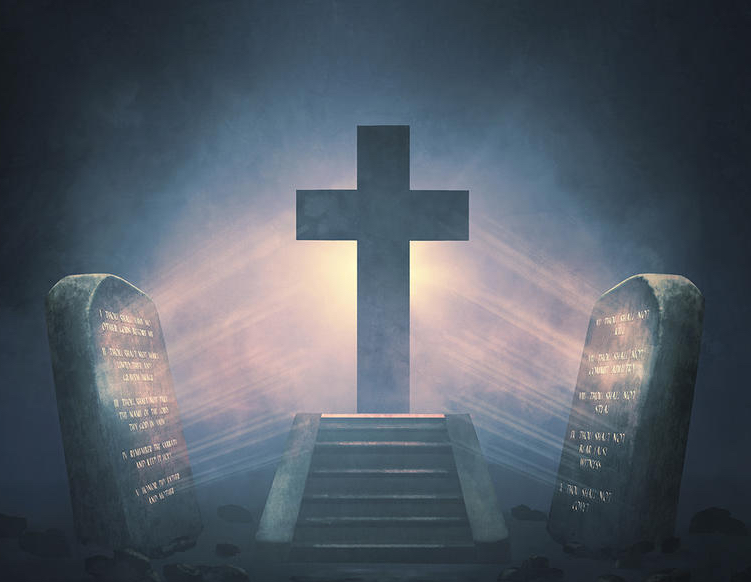
The Ten Words – Sermon on Exodus 20:1-17 for the Sixth Sunday after Trinity

Exodus 20:1-17

1 And God spoke all these words, saying, 

2 “I am the Lord your God, who brought you out of the land of Egypt, out of the house of slavery. 

3 “You shall have no other gods before me. 4 You shall not make for yourself a carved image, or any likeness of anything that is in heaven above, or that is in the earth beneath, or that is in the water under the earth. 5 You shall not bow down to them or serve them, for I the Lord your God am a jealous God, visiting the iniquity of the fathers on the children to the third and the fourth generation of those who hate me, 6 but showing steadfast love to thousands of those who love me and keep my commandments. 

7 “You shall not take the name of the Lord your God in vain, for the Lord will not hold him guiltless who takes his name in vain. 

8 “Remember the Sabbath day, to keep it holy. 9 Six days you shall labor, and do all your work, 10 but the seventh day is a Sabbath to the Lord your God. On it you shall not do any work, you, or your son, or your daughter, your male servant, or your female servant, or your livestock, or the sojourner who is within your gates. 11 For in six days the Lord made heaven and earth, the sea, and all that is in them, and rested on the seventh day. Therefore the Lord blessed the Sabbath day and made it holy. 

12 “Honor your father and your mother, that your days may be long in the land that the Lord your God is giving you. 

13 “You shall not murder. 

14 “You shall not commit adultery. 

15 “You shall not steal. 

16 “You shall not bear false witness against your neighbor. 

17 “You shall not covet your neighbor’s house.“You shall not covet your neighbor’s wife, or his male servant, or his female servant, or his ox, or his donkey, or anything that is your neighbor’s.”

In the name of Jesus. Amen.

Dear saints, you are familiar with this text – or, at least, you should be. We know these verses as “the Ten Commandments” – even though Scripture itself never refers to them as the Ten Commandments. (More on that in just a bit.)

We have grown used to thinking that God only gave the Ten Commandments to show us our sin so that we repent and believe in Jesus for the forgiveness of our sin. Saying that isn’t wrong – not in the least! Scripture says that one of the reasons God gave us the Law is to tell us what we must and have failed to do (Ro. 7:7-12). That’s how Luther uses them in his Small Catechism, and in his hymn on the Ten Commandments that we just sang, he does the same thing, “You have this Law to see therein / that you have not been free from sin, / but also that you clearly see / how pure toward God your life should be.” But God gave the Ten Commandments to do more than simply show us our sin.

Scripture calls this text “the Ten Words” (Ex. 34:28; Dt. 4:13, 10:4). The Bible refers to them as “the Ten Words” because only one of them is actually an imperative (command) – “Honor your father and mother.” All the rest are indicative (statements). A perfectly legitimate – and, admittedly, shorthand – way to understand these verses would be, “You will have no other gods before Me…. You will not misuse My Name…. You will keep the Sabbath holy…. Honor your parents. You will not murder, commit adultery, steal, lie, covet.”

As God’s people heard these words at the base of Mt. Sinai, they would have understood three distinct things at the same time. First, they would have understood that this is what God demands they do, which is how we normally understand them. Second, they would have heard them as a description of who they are and how God sees them. Third, they would have heard these as God’s promise to work in them to make them all these things (Php. 1:6).

Think of it this way: A boy might be pestered and bullied by a girl at school so much that he finally retaliates and shoves her to the ground. (You boys, don’t do that because that’s wrong.) They boy’s parents get called to the principal’s office and learn about the altercation. When they get home, the parents send the boy to his room as punishment. Afterwards, the father goes into his son’s room for ‘the talk’ and says, “We do not shove, hit, or be mean to girls.”

Notice what that speech from the father does. First, by saying, “we,” the father is still showing his son that they are in a relationship. The son hasn’t been abandoned or disowned; they belong together and are identified together as a unit. Second, the father is also saying that as a unit, they act and behave a certain way – they don’t use physical force against girls. Also, the boy knows that his dad is forbidding him to use physical force against a girl. All three of those things get communicated at the same time. The Ten Words here work just like that.

Let’s stick with that analogy about the boy and the girl bully to get one more thing about the Ten Words across. As soon as the boy pushed the girl to the ground and saw that she was dirty, dusty, and hurt, the boy’s conscience kicked in because he knew what he had done was wrong even before he pushed her. That rule or command, “Don’t hurt girls,” was already known by the boy even if he had never been taught it. The girl’s pain simply awakened his conscience. The same thing is true for these Ten Words (Ro. 7:7-8).

Cain knew it was wrong to kill Abel (Gen. 4:1-9) even though God hadn’t given the commandment, “Thou shalt not murder,” yet. Joseph knew not lie with Potiphar’s wife (Gen. 39:7-9) even though God hadn’t given the command, “Thou shalt not commit adultery.” Esau accused Jacob of cheating him (Gen. 27:36), and Jacob accused his father-in-law, Laban, of cheating him (Gen. 31:7) even though God hadn’t given the commandment, “Thou shalt not steal.” Abraham knew it was wrong to lie about Sarah being his sister (Gen. 12:11-20, 20:1-14) even though God hadn’t given the commandment, “Thou shalt not bear false witness.”

Everyone knows to not break the commandments because God has written them into the fabric of creation and on the heart of every person (Ro. 2:15). Everyone, even atheists (Ro. 1:21-25), know that we should love God with all our heart, soul, mind, and strength (Mt. 22:37). Everyone knows that we should love our neighbor as ourselves (Mt. 22:39).

God didn’t give the Ten Words so that we would know right from wrong. People knew (and still know) right from wrong already. Some think God gave the Ten Words to limit our freedom. Not at all. They are given in the context of God having set His people free, bringing them out of Egypt and slavery (Ex. 20:2). Instead, the Ten Words show God’s people what it looks like to be the free people He has created us to be. In the world that God has made, we aren’t free to do or be anything we please. We are free when we become what we are. A caterpillar is free to become a butterfly not a walrus. The Ten Words guide us to grow up to be what we are, and what we are is the very children of God (1 Jn. 3:2; Gal. 4:1-7).

Now, in an effort to assist with that growth, here’s some advice from Luther. Take each of the Ten Words with you into prayer and ask yourself these four questions: 1. What does this teach me? 2. What does this give me? 3. What does this show me to confess? And 4. What does this teach me to pray for?

For the first, “You shall have no other gods before Me,” you could pray something like this: “Father, thank you that You teach me that You are my God. Thank you that, as my God, You give me all good things. Forgive me for the times I do not trust You to be my God. Grant me Your Holy Spirit so I would love You with all my heart, soul, mind, and strength.”

For the seventh, “Thou shalt not steal,” you could pray: “Heavenly Father thank You for giving me so many good things. Everything I have is a gift from You. Forgive me for loving and pursuing stuff more than You. Help me to use what You have given me to serve my neighbor.”

Now, all of this is to say that what is most important with regard to the Ten Words is to believe them. Romans 14:23 says, “Whatever does not proceed from faith is sin.” As you believe the Ten Words, you see that God demands that you avoid certain sins and that you do certain good works. But you also see that God is accomplishing these things in you through faith. He has begun that good work in you when you were joined to Jesus’ death and resurrection in your Baptism (Ro. 6:1-11), and, again, He will complete that good work in you (Php. 1:6).

Dear saints, God promises that He is your God who has brought you out of slavery to sin by sending Jesus, who did not abolish the Law but fulfilled it. Through faith in Him, you have a righteousness that exceeds that of the scribes and Pharisees. Because of Him and His work, you will enter the kingdom of heaven, and He invites you now to a seat at His table. Amen.

The peace of God, which surpasses all understanding, will guard your hearts and minds in Christ Jesus. Amen.

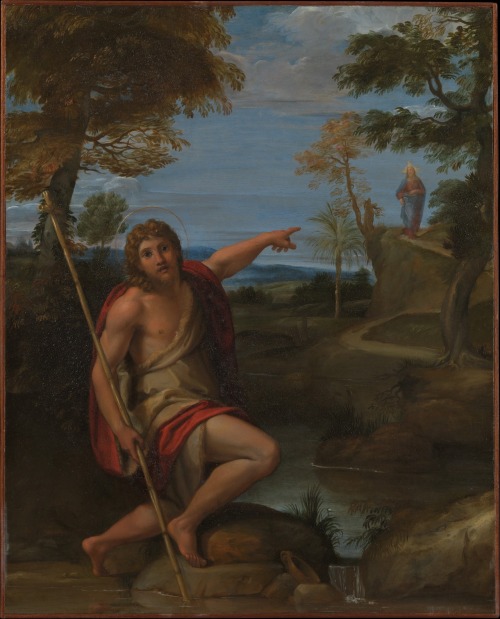
To Your God Belongs All – Sermon on Deuteronomy 10:12-21 for the Eighteenth Sunday after Trinity

Deuteronomy 10:12-21

12 “And now, Israel, what does the Lord your God require of you, but to fear the Lord your God, to walk in all his ways, to love him, to serve the Lord your God with all your heart and with all your soul, 13 and to keep the commandments and statutes of the Lord, which I am commanding you today for your good? 14 Behold, to the Lord your God belong heaven and the heaven of heavens, the earth with all that is in it. 15 Yet the Lord set his heart in love on your fathers and chose their offspring after them, you above all peoples, as you are this day. 16 Circumcise therefore the foreskin of your heart, and be no longer stubborn. 17 For the Lord your God is God of gods and Lord of lords, the great, the mighty, and the awesome God, who is not partial and takes no bribe. 18 He executes justice for the fatherless and the widow, and loves the sojourner, giving him food and clothing. 19 Love the sojourner, therefore, for you were sojourners in the land of Egypt. 20 You shall fear the Lord your God. You shall serve him and hold fast to him, and by his name you shall swear. 21 He is your praise. He is your God, who has done for you these great and terrifying things that your eyes have seen.”

In the name of Jesus. Amen.

Don’t put the cart before the horse. When we hear this text, it is very easy to focus on all the things we are called to do because the text opens with the question: “What does the Lord your God require of you?” Then all these directives come. Fear God. Walk in His ways. Love Him. Serve Him with all your heart and with all your soul. Keep His commandments and statutes. Don’t be stubborn. Love the sojourner. Hold fast to Him. There is a lot to do there – so much, in fact, that we recognize that we have not even begun to do what God requires of us. Right away we find that we have a lot of repenting to do, and repent we should. But, again, don’t put the cart before the horse.

Notice who wants you to do all these things – the Lord your God. Six times in this text, that is God’s title – the Lord your God. And just to make sure you get it drilled into your head, you are reminded in the final verse that He is your God (v. 21).

Know, dear saints, this God of gods and Lord of lords – the One who owns heaven and the heaven of heavens, the earth with all that is in it – He is your God. He has chosen you. He could have chosen anyone, but He chose you. He did not choose you because you were bigger, stronger, smarter, more obedient, or more faithful than others. He has not chosen you because of anything you have thought, said, or done. You belong to God. You, dear saints, according to 1 Pet. 2:9, are His chosen people, His royal priesthood, His holy nation, and a people for His own possession. You are these things because the Lord God of heaven and earth has chosen you and set His heart in love on you (v. 15). He is your God because He has called you out of darkness into His marvelous light. And the Lord your God has done all of this because of what Jesus has done for you.

Jesus, your Savior, lived a perfect life. He was perfectly obedient to God. He took all your sin to the cross (1 Pet. 2:24) where God poured out all His wrath upon your sin, and not one bit of that wrath is left for you. Jesus paid it all, and He paid it all for you. Your sin had left a crimson stain, but Jesus has washed you white as snow. To God belongs heaven and the heaven of heavens, the earth and all that is in it, and Jesus has restored you to your proper place – your proper place before God and your proper place in His creation. That’s the horse that pulls the cart, and now we can turn to the cart.

As this text lays out all the things the Lord your God requires of you, it is nothing more than a call for you to be like Him and follow after His image. In other words, if we boil down all these things God calls us to be, it is a call for us to be the stewards He has created us to be.[1]

So, think back to the creation. God created Adam and Eve in His image and blessed His image-bearers saying, “Be fruitful and multiply and fill the earth and subdue it, and have dominion over the fish of the sea and over the birds of the heavens and over every living thing that moves on the earth.” Because of our sinful nature, we hear those instructions “have dominion” and “subdue” and think that we get to call all the shots and beat creation into submission so that it conforms to our will. But that wasn’t the case originally. Because Adam and Eve were created in God’s image and perfectly reflected the will and heart of the God who created and owns all things, they were simply stewards of everything God created.

As Genesis 2 closes, Adam and Eve were doing exactly what God had created them to do. They were perfectly stewarding God’s creation. They were receiving from God all that He wanted to give to them. God had created the entire universe to bless mankind, the crown of His creation. God designed them to have open hands that received all the blessings they needed for life. But then, in Genesis 3, the serpent comes slithering into the picture. He lies and convinces them that God was holding out on them and not giving them everything He had to give. After hearing this lie, Eve begins to look at things differently. Watch what her hands do. Instead of having an open hand to receive all of God’s blessings, her hand turns over to take. Both Adam and Eve take and eat. This taking betrays their identity. Instead of being stewards, they wrongly thought they were the owners, but there had been no transfer of ownership.

The creature cannot be the Creator, and the steward cannot be the Owner. Adam and Eve’s attempt to change their identity ends up destroying the perfect relationship that existed between Creator, steward, and creation. Because of that, life became hard. All creation, which God designed to be a blessing that supported life, will cause them pain and suffering. Now their work, will be filled with sweat, toil, pain, and, ultimately, death.

The interesting thing in all of this, though, is that God did not remove them from their calling and duty of being stewards. And this is where you come into the story. You, as God’s creature, are still a steward of God’s creation. Even though you daily and regularly fail in this role, it is still yours. Even though your hands turn over to reach out and take what is not yours, Jesus has come to redeem you and forgive you of all your sins. On the cross, your debt was paid. The empty tomb on Easter is the receipt (Ro. 4:25).

This means, dear saints, that you are a new creation; the old has passed away and the new has come. And now, God has entrusted you with being a steward of the Gospel which is the message of reconciliation (2 Cor. 5:17-20). With an open hand, you receive God’s forgiveness and mercy, and that open hand allows that forgiveness and mercy to also flow to others. And it is those same open hands that freely receive and freely give all of God’s other gifts too. And one of the ways that you continue in your role as a steward is by giving to the work of God’s church.

On the back of your Scripture insert, I’ve included two passages about Christian stewardship (1 Cor. 16:2 and 2 Cor. 9:6-8) and four points to consider about how to give.[2] I would encourage each of you to read through those texts and points as you consider how you steward what God has given to you. In the Old Testament, the stewardship of tithing was set at a certain amount, 10%. Now I want to be clear: there is no New Testament command on what percentage you should give to the work of God’s kingdom. Let that be between you and God. But I do want to highlight one thing from those verses.

2 Cor. 9:6 says, “Whoever sows sparingly will also reap sparingly, and whoever sows bountifully will also reap bountifully.” If you plant one tomato plant, you can only expect so many tomatoes. If you plant ten, fifty, or one hundred plants, well, you’ll get a lot more. The text goes on to tie that analogy to what you give to the church. And the interesting thing about this is what the Old Testament has to say about where those tithes end up.

Just a few chapters after our text, God talks about what was to be done with the tithes. In Dt. 14:22-26, God says that the tithes given to Him are given back to the one who brought that tithe, and it is given back as a feast. God tells His people to bring the tithe of their crops, their wine, their oil, and their herds to the Temple.[3]If the trip to the Temple was too far to bring all of it, they should sell those things and turn them into money. Then, they would go to Jerusalem and purchase whatever things they wanted to eat. Then, they would offer their tithe and eat it before God with rejoicing.

Dear saints, the gifts, offerings, and tithes you give to God are returned back to you as gifts from the Lord your God. Those gifts bless you as you come here and receive God’s mercy, and they also bless your neighbor who needs to receive that mercy and love. The offerings and gifts that you have placed on the Lord’s table will be used by God to continue to further His kingdom.

And now, Jesus, your God, invites you to come and receive a priceless treasure that could never be bought with money. He invites you to come to His table and receive His Body and blood given and shed for the forgiveness of all your sin. Come into the presence of the Lord your God. Receive and rejoice. Amen.

The peace of God, which surpasses all understanding, will guard your hearts and minds in Christ Jesus. Amen.

Christian Stewardship

1 Corinthians 16:2 

On the first day of every week, each of you is to put something aside and store it up, as he may prosper, so that there will be no collecting when I come. 

2 Corinthians 9:6–8 

The point is this: whoever sows sparingly will also reap sparingly, and whoever sows bountifully will also reap bountifully. Each one must give as he has decided in his heart, not reluctantly or under compulsion, for God loves a cheerful giver. And God is able to make all grace abound to you, so that having all sufficiency in all things at all times, you may abound in every good work.

From these two texts, we see that Christians are to give…

  1. …voluntarily & cheerfully. Giving should not be done under compulsion or grudgingly. Giving is God’s gracious call to join Him in His work.
  2. …of our first-fruits. Giving should be from the first-fruits of our labor. Our giving is what we do on the first day of the week before our other expenses are due.
  3. …proportionately. Giving is not to be an arbitrary set dollar amount each week. Instead, it is to be in accordance with ‘how we have prospered’ each week. In other words, setting aside a certain proportion (percentage) of our income for God’s work through the Church.
  4. …faithfully. We have God’s promise that He will take care of all our needs in this body and life. As we give, we are trusting God to keep that promise.

[1] The following five paragraphs are an adaptation of chapter 2 of the book Stewardship: For the Care of Souls by Pr. Nathan Meador and Pr. Heath R. Curtis.

[2] I’ve included those below under the title “Christian Stewardship.”

[3] The text says to bring the tithe to “the place that He will choose, to make His name dwell there.” I am simply condensing that because the Temple is where God chose to make His name dwell (2 Chron. 6:16-20).

The Savior Who Is Not You – Sermon on John 1:19-28 for the Fourth Sunday in Advent

Listen here.

John 1:19-28

19 And this is the testimony of John, when the Jews sent priests and Levites from Jerusalem to ask him, “Who are you?” 20 He confessed, and did not deny, but confessed, “I am not the Christ.” 21 And they asked him, “What then? Are you Elijah?” He said, “I am not.” “Are you the Prophet?” And he answered, “No.” 22 So they said to him, “Who are you? We need to give an answer to those who sent us. What do you say about yourself?” 23 He said,

“I am the voice of one crying out in the wilderness,
‘Make straight the way of the Lord,’

as the prophet Isaiah said.”

John Points to Christ24 (Now they had been sent from the Pharisees.) 25 They asked him, “Then why are you baptizing, if you are neither the Christ, nor Elijah, nor the Prophet?” 26 John answered them, “I baptize with water, but among you stands one you do not know, 27 even he who comes after me, the strap of whose sandal I am not worthy to untie.” 28 These things took place in Bethany across the Jordan, where John was baptizing.
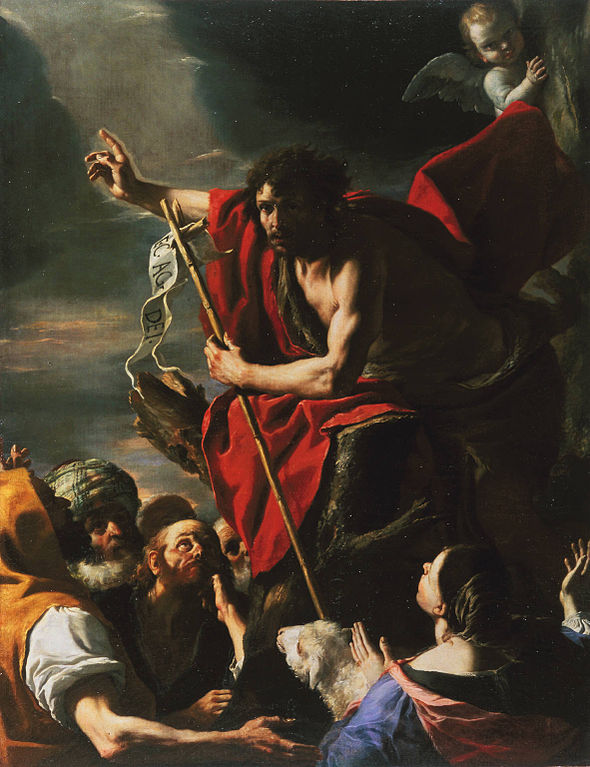
In the name of the Father and of the Son and of the Holy Spirit. Amen.

From 4th grade until I graduated High School, I spent too much time at swimming pools. Monday-Friday consisted in at least two hours of practice. And most weekends December–March and June–August were swim meets. In the summer, if my friends wanted to hang out, it usually meant we would go to the pool. Now, there are different sets of pool rules: one set for swim team members during practice and another set for everyone who comes for open swim.

I knew all the lifeguards because most of them were also on the swim team. During practice, they were teammates (even though, until I got to High School, they were much older than I was). But during open swim, they were no longer teammates. They were the authorities. I had to obey their commands and comply with their whistles. And, believe me, they made sure I got a whistle for every little infraction during open swim.

So, when I was old enough, I took the class to get my lifeguard certification so I too could get a job at the pool. I received that perforated card from the Red Cross with the words written in bold “Lifeguard Certification.” And I had ascended the ranks. I donned my white tank-top with the bold red cross, grabbed my whistle, shouldered my 50” rescue tube, and climbed to the throne of the lifeguard stand.

Now, I had authority. I could boss around the younger kids who were on the swim team when they came for open swim. I could bark commands at the college kids and adults who dared to hang on the rim of the poolside basketball hoop, run on the deck, dive in the shallow end, or take more than one bounce on the diving boards. The first few months of being on the stand, I was the Attila the Hun of lifeguards. All feared and obeyed me. (But, I’m sure, the swimmers and my fellow lifeguards thought I was ridiculous.)

The point of all that is this: Whenever we are unsure of our authority or position or status, we take every opportunity to assert ourselves to make sure that everyone around us can see that we are important, we are in charge, we have the answers. And, in our minds, those who can’t see that are just plain clueless. So, we respond to their ignorance about our greatness and importance by doubling down on insisting how important we are. The worst part is that we don’t see how sinful and stuffed with pride we have become, and we refuse to repent because we have justified ourselves in our minds.

John the BaptizerJohn the Baptizer was important. He was the forerunner of the Messiah and the last prophet. He was foretold in Scripture. He had the attention of all Judea and Jerusalem as they came out to him. And the religious authorities were sending envoys to him asking, “Who are you?” They wanted to find out exactly why John was doing what he was doing.

John could have easily persuaded and convinced everyone that he was something more than he actually was. But John confessed, and did not deny, but confessed, “I am not the Christ, not Elijah, not the prophet.”

John stayed in his God-given role, his God-given position, his God-given job, his God-given task, his God-given vocation, “I am not the Christ. I am the voice of one crying out in the wilderness, ‘Make straight the way of the Lord.’” Those two, brief confessions from John can also bring stability, peace, and joy into our lives. John confesses who he is not, and John confesses who he is. When you recognize and trust that you are not your own christ and that you have your own God-given calling and vocation, everything falls into its proper place.

You, like John, are not the Christ. Repeat after me, “I am not the Christ.” You do not have to justify yourself or your actions. Now, let me be clear, there may be times where you are falsely accused of doing wrong and you will need to set the record straight. But even in those instances, there is always some sin you have committed even if it was only a thought or wrong attitude. If we say we have nosin, we deceive ourselves and the truth is not in us (1 Jn. 1:8). So, rather than covering your tracks, rather than justifying yourself, rather than trying to be your own christ, your own savior, you are free. Free to ask for forgiveness – from God and from your neighbor.

There is freedom in saying, “I am not the Christ,” because there is a Christ, there is a Savior who is not you. Jesus, the Christ and Savior, sits at His Father’s right hand with His nail-scarred hands and feet. He vouches for you to God the Father saying, “I am the Christ. I am the Savior. I died and rose again to forgive that one there.”

So, confessing, “I am not the Christ,” brings peace and joy. But so also does John’s other statement, “I am the voice of one crying out in the wilderness…”

cropped-jesus-lamb-slain-silver-goldNow, you aren’t the voice of one crying out in the wilderness, but you are a Christian. And you are a Christian because there is a Christ. You bear His name. You are washed clean of all your sins in His blood. You hear Jesus’ Word. You pray His prayers. You live His life. You have been crucified with Christ. It is no longer you who live but Christ who lives in you (Gal. 2:20). This means that you have your own God-given calling, role, task, and vocation to carry out. So be faithful in those callings and vocations.

And rejoice. Rejoice because there is a Savior who is not you. In Him is your rest. In Him is your forgiveness. In him is your peace. “Rejoice the Lord always, again I will say rejoice. Let your reasonableness be known to everyone.” (Php. 4:4-5). You have no reason to be anxious about anything. You are the forgiven, ransomed, redeemed people of God. You have the Savior. You bear His name and have been made His royal children. And Christ the King, your Lord and Savior, He is at hand. Amen.

The peace of God, which surpasses all understanding, will guard your hearts and minds in Christ Jesus. Amen.

Children of God – Sermon for Easter 4 on 1 John 3:1-3

Listen here.

1 John 3:1–3

1See what kind of love the Father has given to us, that we should be called children of God; and so we are. The reason why the world does not know us is that it did not know him. 2Beloved, we are God’s children now, and what we will be has not yet appeared; but we know that when he appears we shall be like him, because we shall see him as he is. 3And everyone who thus hopes in him purifies himself as he is pure.

In the name of the Father and of the Son and of the Holy Spirit. Amen.

Alleluia, Christ is risen!
He is risen indeed! Alleluia!

One question repeatedly comes up in life. And though the form of the question changes, it really is the same. When you are young, the question is, “What do you want to be when you grow up?” As you grow, the question changes, “What are you going to study in college?” Later, the question gets dumbed down, “What do you do?” Eventually, it becomes, “When are your plans for retirement?” Then, when you do retire, “What do you do with all your free time?”

Can I just be honest? I hate this question. Today, when I get asked, “What do you do?” I’m tempted to tell people I’m a plumber. It wouldn’t be a lie per se because I am in the business of dealing with people’s… stuff. All kidding aside, I do love to be able to do what I do.

Anyway, this question, in its various forms, is continually asked because you are someone who is somewhere, and you will be someone doing something different somewhere else later. It’s a question of identity which is continually changing.

Well, today, this text gives an answer to the question of your identity. And it’s not just any answer – it is God’s answer.

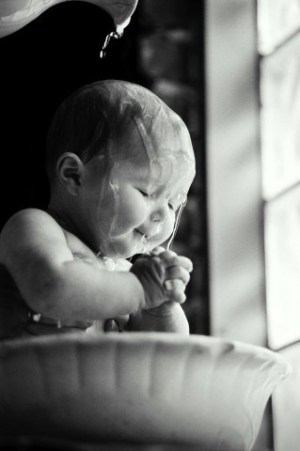
Child PrayingYou are God’s children. “See what sort of love the Father has given to us, that we should be called children of God.”
Generally, children resemble their parents. And you, Christian, know your sin. You aren’t as loving or forgiving as you should be. And you certainly aren’t perfect as your heavenly Father is perfect. So, it is easy to doubt the truth of what John says here. Maybe, it was an exceptionally windy day when that apple fell from the tree.

It’s hard to believe that you are children of God, but it’s true. Hear it again because John doesn’t want you to miss it – he emphasizes it, “See the kind of love the Father has given to us, that we should be called children of God – and so we are.”

It wasn’t easy – God making us to be His children. And yet, God, out of His great love for us, sent His only begotten Son. Jesus went to a Good Friday death on the cross and was raised that Easter morning all so that you could be God’s children. Nothing less.

Now, the world looks at you and scoffs at the idea that you are children of God. The world doesn’t know you as a child of God because, frankly, they don’t know who God is. Some think He is a type of Santa Claus who rewards those who are good and punishes those who are bad. Others think God is just an old man in the sky with old-fashioned ideas and is spiteful and full of vengeance. Their perceptions of God are wrong. And because their ideas about God are wrong, their ideas about you are wrong.

Because they do not know God as He has chosen to reveal Himself in Christ, they do not recognize you who are in Christ as the children of God.

Baptism 2So, Blair: Today, God has Baptized you. Today, God has connected His Word to water and joined you to Christ’s death and resurrection (Ro. 6:3-11). God has clothed you with Christ (Gal. 3:27). God has given you the washing of regeneration and renewal of the Holy Spirit and saved you (Tit. 3:5-7). Today, you are born again, and God has made you His beloved child.
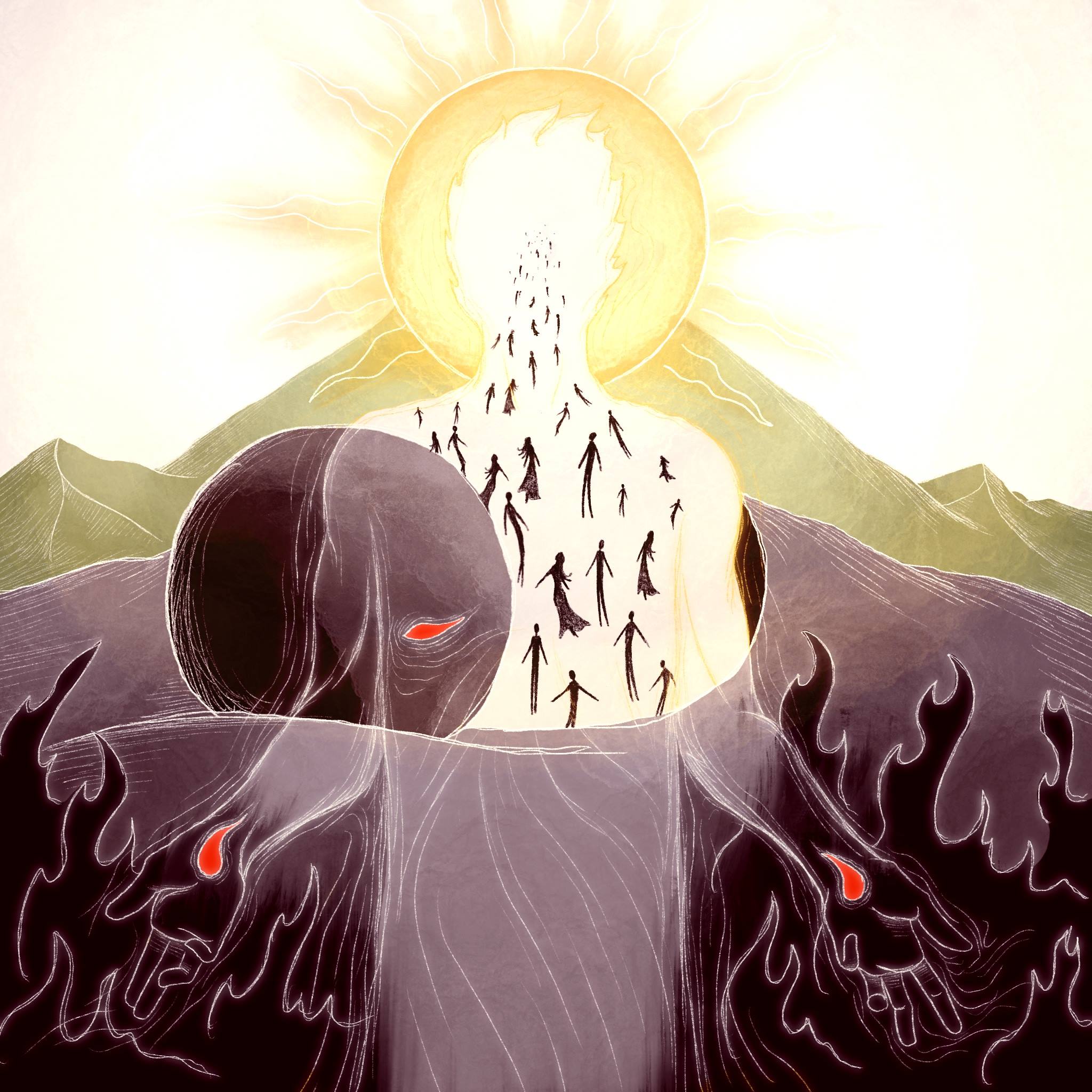
Blair, and all of you here, God has brought you out of darkness into His light. God has caused you to be reborn. You were living a lie and have been brought into the truth. So, John says it again. “Beloved, we are God’s children now.”

So, you children of God, what do you want to be when you grow up? Different questions rise from there. All sorts of specifics we would like answered. “What will I do this summer?” “Where will I be enrolled next semester?” “Will my business grow or hold steady?” “Will I get married, and to whom and when?” And some of you might even be wondering, “How much longer do I have left in this life?”

Sorry, but God doesn’t answer to those specifics. And, honestly, it is foolish to search for those answers because God hasn’t given them. But God does give the answer, the final and ultimate answer to what you, child of God, will be when you grow up.

Children of GodWhen Christ appears, you will be like Him because you will see Him as He is.

You will be like Jesus. On that day, it will be enough to see Jesus as He is. It will change you. You will be pure, perfect, and loving – just as Jesus is.

Until then, purify yourself. When you see that you are sinning and living like a child of the devil, purify yourself. Turn away from that sin. Turn away from your anger, your apathy, your self-centeredness, your gossiping, your coveting, your lust. Repent. Give that all over to the cleansing blood of Jesus and trust His forgiveness.

Instead, honor and love one another. Let us, as this little band of God’s children here at Christ the King, radiate God’s love and light in our relationships, in our homes, in our workplaces, in our community, and throughout the world.

Live as you are. Live as God’s forgiven, beloved children. Amen.

Alleluia, Christ is risen!
He is risen indeed! Alleluia!

The peace of God, which surpasses all understanding, will guard your hearts and minds inChrist Jesus. Amen.