The Door – Sermon on Matthew 25:1-13 for the Last Sunday of the Church Year

Matthew 25:1-13

1 [Jesus says,] “Then the kingdom of heaven will be like ten virgins who took their lamps and went to meet the bridegroom. 2 Five of them were foolish, and five were wise. 3 For when the foolish took their lamps, they took no oil with them, 4 but the wise took flasks of oil with their lamps. 5 As the bridegroom was delayed, they all became drowsy and slept. 6 But at midnight there was a cry, ‘Here is the bridegroom! Come out to meet him.’ 7 Then all those virgins rose and trimmed their lamps. 8 And the foolish said to the wise, ‘Give us some of your oil, for our lamps are going out.’ 9 But the wise answered, saying, ‘Since there will not be enough for us and for you, go rather to the dealers and buy for yourselves.’ 10 And while they were going to buy, the bridegroom came, and those who were ready went in with him to the marriage feast, and the door was shut. 11Afterward the other virgins came also, saying, ‘Lord, lord, open to us.’ 12 But he answered, ‘Truly, I say to you, I do not know you.’ 13 Watch therefore, for you know neither the day nor the hour.”

In the name of Jesus. Amen.

One year ago, I preached on this text. After that service, we decorated the sanctuary for the Advent and Christmas season just like we will today. The following Sunday, Lindsay, Siobhan, and Stephanie came up to do our Advent candle lighting. After they did the readings and prayer, Lindsay went to light the first candle. The wick held the flame for a fraction of a second then went out because… there was no oil in that candle. And the wick would not hold a flame.

I bring that up for two reasons: First, whoever brings out the Advent candles today, please check the oil levels so we don’t repeat that this year. The second reason I bring that up is that this parable can seem so trivial. Last year, we were perfectly capable of having our worship service without that candle being lit. We didn’t need its light or the heat created by it. We just moved on. Not having oil seems like such a minor thing. In the parable, five girls are unable to light lamps because they didn’t have oil. Did all ten virgins need to have lit lamps? Was it really that important?

Apparently, yes. In the parable, not having oil to keep a lamp lit makes the difference between being in the feast and being left out. In fact, according to Jesus, having oil makes a person wise, while not having oil makes a person a moron. That’s literally the word Jesus uses; the word translated ‘foolish’ in our text is the Greek word μωρός where we get our word ‘moron.’

Now, we don’t know enough about wedding customs in Jesus’ day to know why it was so important for all the ten virgins to have enough oil to keep a lamp lit. The groom didn’t need those lamps to be able to see his way into the marriage feast. He had already made his way through the town to get to the location. All we know is that once the groom arrives, the lamp must be lit.

Jesus teaches that there will be a final cut off point. There is a moment when your status of being in or out will not and can not change. While the five morons are off trying to buy oil from the sellers – and remember this is at midnight, so those sellers would have closed up their shops and had probably gone to bed hours earlier – while the five morons are off on their futile errand, the groom arrives. The feast starts. The door is shut. And that door will not open again. Those who aren’t ready will be left outside forever.

The coming of the groom made a division. Those who were prepared poured oil in their lamps and went into the wedding feast with him. But the morons start scrambling around trying to find oil, and when they return, they find they are out in the darkness where there is only weeping and gnashing of teeth. And the last words they hear from their Savior, the groom, are, “I don’t know you.”

Let’s consider a few things about that door that gives entrance to the wise and excludes the morons.

First, notice that when the groom arrives, those who were ready go through that door immediately (v. 10). When Jesus returns, you won’t have to do any convincing or proving of yourself. You won’t have to go somewhere to be purified. Your worthiness to enter is established. There is nothing left for you to do. Christian, your entrance is immediate. If you die today, you will be escorted by the angels directly into Jesus’ presence where your soul will await the resurrection. And if Jesus comes before you die, you will go straight into the banquet of the eternal wedding feast.

That brings me to the second thought about the door. Remember what is behind that door. It’s a wedding feast. Wedding feasts are fun. At your wedding feast, you had family, friends, classmates, and coworkers – a bunch of people who are special and important to you – they all were in the same room mingling, eating, laughing, dancing, and celebrating with you. Your wedding reception was filled with people who will probably never be in the same room again – at least not in this life. Your cousin from Nebraska, your college roommate from California, and your boss will never be in the same room again, but at your wedding feast, they all enjoyed each other’s company. Now imagine that laughter, joy, and merriment times infinity.

The third thought about this door is that it gets shut. Normally, we think about this as a horrifying thing, and for the unbeliever it is. Absolutely, it is. For those outside there will be no entering once the door is shut. But you, Christian, are not left outside. You are inside. How do you suppose Noah and his family felt about God shutting the door and closing them in the ark as the rains came down and the floods went up? They would have felt safe and secure. It’s the same for you. When God shuts that door, He will close out any bit of danger or evil so that it will never touch you.

Finally, the door being shut means that you, Christian, will be forever with Jesus. In the parable, how many entered into the wedding feast? It wasn’t just the five wise virgins. There are six. The bridegroom is inside with them, with the five wise virgins. The groom doesn’t say, “Go on in.” No, they go in with him. It’s so obvious, but don’t miss that.

Dear saints, now is the time to fill your flasks with oil! You do not know how much you will need. The five morons knew they needed oil all along. As soon as the cry went out, that was their only focus, but it was too late. Everyone knows they need oil. Get it now. Why, why would you ever think you have enough oil? 

The oil isn’t expensive – in fact it’s free! But you don’t have eternity to get the oil. There is a deadline, and you do not know when that deadline will come. Don’t procrastinate. Receive the gift of faith through the ways God has promised to give it. Go ahead and hoard it. Why would you become complacent and think you don’t need more of God’s Word, God’s mercy, God’s grace, and God’s Sacraments? 

Jesus is coming. The Bridegroom said He would return to take you to where He is. But you do not know when. Today feels like a lot like yesterday, and yesterday felt like the day before. And because Jesus didn’t come yesterday or the day before, it can be easy to think that Christ is not coming today. Don’t become a moron, repent! It is easy to fall asleep. It is easy to get distracted with many things and think the time to get oil will last forever. But it won’t.

Yes, this parable is a warning. Yes, it is a call to endure and persevere because being left outside would be horrific. But. But at the same time let’s all take a deep breath and laugh because we are waiting for a party where there is gladness, peace, and joy.

When Jesus warns about His coming, He doesn’t tell a parable about ten soldiers – five wise who always kept their swords within reach and five morons who couldn’t remember where they set their weapons down. Then, the enemy attacked, and the five morons were utterly defeated. No. It’s the parable of the ten virgins waiting for a party.

Jesus is coming, and we wait for that day with expectation, hope, and joy. And, now, Jesus your Savior comes to you to meet you at this altar to have a feast of forgiveness and mercy. Communion is the closest we will get to the party before Jesus returns. It’s a foretaste of the feast to come.

So, dear saints, come. Your bridegroom is here with you now. Trim your lamps because you have the oil of salvation. Amen.

The peace of God, which surpasses all understanding, will guard your hearts and minds in Christ Jesus. Amen.

Living Forgiveness – Sermon on Matthew 18:21-35 for the Twenty-second Sunday after Trinity

Matthew 18:21-35

21 Then Peter came up and said to him, “Lord, how often will my brother sin against me, and I forgive him? As many as seven times?” 22 Jesus said to him, “I do not say to you seven times, but seventy-seven times.

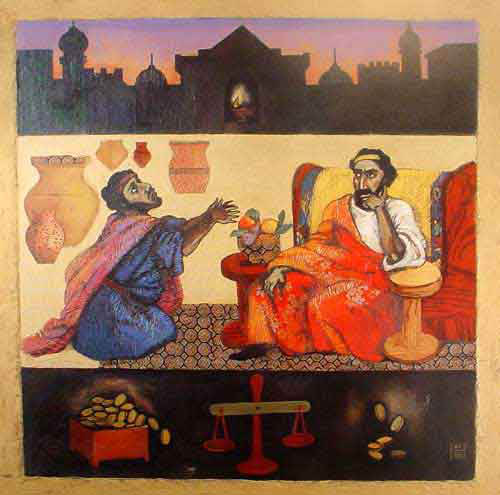
23 “Therefore the kingdom of heaven may be compared to a king who wished to settle accounts with his servants. 24 When he began to settle, one was brought to him who owed him ten thousand talents. 25 And since he could not pay, his master ordered him to be sold, with his wife and children and all that he had, and payment to be made. 26 So the servant fell on his knees, imploring him, ‘Have patience with me, and I will pay you everything.’ 27 And out of pity for him, the master of that servant released him and forgave him the debt. 28But when that same servant went out, he found one of his fellow servants who owed him a hundred denarii, and seizing him, he began to choke him, saying, ‘Pay what you owe.’ 29 So his fellow servant fell down and pleaded with him, ‘Have patience with me, and I will pay you.’ 30 He refused and went and put him in prison until he should pay the debt. 31 When his fellow servants saw what had taken place, they were greatly distressed, and they went and reported to their master all that had taken place. 32 Then his master summoned him and said to him, ‘You wicked servant! I forgave you all that debt because you pleaded with me. 33 And should not you have had mercy on your fellow servant, as I had mercy on you?’ 34 And in anger his master delivered him to the jailers, until he should pay all his debt. 35 So also my heavenly Father will do to every one of you, if you do not forgive your brother from your heart.”

In the name of Jesus. Amen.

Jesus said to Peter, “No, forgiving seven times isn’t enough. Instead, seventy-seven (or it could also be translated ‘seventy multiplied by seven’) times.” Now, Jesus doesn’t mean that you forgive and forgive and forgive, but when you get either to 76 or 489 forgivings (sic) you warn the other person, “Listen buster, you’ve only got one left.” Nope, let the forgiveness flow freely.

Before we consider the parable, we have to do some conversions. Two different servants have two different debts. Servant 1 owes the king 10,000 talents. A talent was originally a unit of weight that later became a unit of coinage, and the value of that coinage would change a lot. Most resources say that one talent is equal to twenty years of pay for the average worker. So, imagine your annual income, double it, and slap five zeros on the end of it. That’s what the first servant owed the king. Even if he lived and worked every day for 2,000 years giving every penny to the king, it would only shave off a 1% sliver off his debt.

Servant 2 owed a debt to servant 1 to the tune of 100 denarii. Now, this is still a significant amount of money. The average worker earned one denarius per day. So, we’re talking about a little over 3 months’ worth of pay. Significant yes, but a manageable amount. It is totally conceivable and reasonable that someone can pay off a debt of 100 denarii.

Now, the three main characters in the parable are obvious: the king, servant 1, and servant 2. But as we consider the parable today, I want you to imagine yourself in the roll of one of the minor characters. Imagine you are one of the other servants.

The king has called you and all the servants who owe him money to the castle. You are standing in line outside the king’s office. You compare debts with the other servants. You are a little nervous because you don’t know what the king is going to do about your debt. Now, imagine you are standing in line behind servant 1 who owed the 10,000 talents, and you know how large his debt is. He goes into the king’s office, but you don’t know what is happening behind that door. You want to catch a glimpse of servant 1 as he comes out because his demeanor will give you an indication of how it is going to go for you. If he’s smiling or skipping, you’d have a sense of relief because you’d know that the king is in a good mood and your meeting with the king might not be so bad.

Finally, the door opens. Servant 1 comes out of the king’s office, he immediately runs over to servant 2, wrings his neck, and demands that the guy pay him everything. What are you going to conclude about how his meeting with the king went? He didn’t come out in shackles to be led to the prison, but he wasn’t happy. Seeing his treatment of servant 2, you would probably assume that the king had not forgiven his debt and demanded full payment. You would probably deduce that the king gave him some time – maybe a couple of weeks or months – to pay off the debt.

Dear saints, that’s the problem of refusing to forgive.

If people don’t know what happens here in this sanctuary, the only clues they have would be to watch how you act when you aren’t here. So, as others watch you, what will they conclude about what has happened here? What would they think about your king? Would they figure that He demanded that you pay? Would they think He is gracious and merciful, or would they assume that He is a King who demands that all debts get paid?

Dear saints, God wants to be known for His goodness. God wants to be known by His mercy. God wants to be known for His willingness to freely forgive. And if you refuse to forgive those who have sinned against you, what does that say about your God and King?

All this is to say, dear saints, that you, as forgiven servants of the King, are called to live out the forgiveness you have in Christ. This can be a difficult thing because it goes against our nature to forgive. But the cure of our unforgiveness doesn’t come from being beaten down by calls to forgive. The cure for our unforgiveness is to have a right understanding the massive debt that each of us owe to God. When we wrongly think that have only a little debt of sin, we can only have a little Savior. Jesus didn’t go to the cross because you were a few bucks short of your heavenly entrance fee. He went to the cross because your sin was so great that you are too dead to even see the gates.

Sin – all sin – is against God (Ps. 51:4; 1 Cor. 8:12). Every day, you and I rack up an unimaginable, incalculable debt of sin. And when God calls you in to settle accounts what does He do? Because of Jesus’ death on the cross, God simply wipes it out. Because of Jesus, as far as God is concerned, your debt of sin never existed.

Jesus completely erased your debt by the shedding of His blood. He went to Calvary, not so you would have enough time to get your act together and become a better person. He went to raise you from your deadness in sin. When you were lost, powerless, and dead, Jesus made all – not just a portion – all of your debt His own. And on the cross, He killed and cancelled that debt. Jesus who knew no sin became sin for you (2 Cor. 5:21) and He bore all your sins in His body upon the cross (1 Pet. 2:24). And now the grave is empty. Your debt of sin has been erased in the death and resurrection of your Savior.

You are forgiven. Jesus didn’t die just to get you to a zero balance; He came to erase your debt and fill your account with His righteousness. His mercy is complete. He has paid and absorbed all your debt, and you owe Him nothing. There is absolutely nothing left for you to pay, and there is nothing you could do to even begin to pay Him back. Even the thought of paying Him back is offensive because what He has done is so complete, so wonderful, and so merciful.

Now, when your neighbor sins against you and you feel the hurt and pain of those transgressions against you, don’t reach out your hands to grab your neighbor by the throat. Instead, let the nail-scarred hands of Jesus remove your hands from around your neighbor’s throat and make you right and at peace with Him and your neighbor.

There is no denying the fact that forgiving others is a difficult thing to do. Sin is a debt, and that debt must be paid. Forgiving others is absorbing the debt that is owed to you. The pain that comes from the sins of others is real and often terrible. It is always tempting to our old nature to hold a grudge, to make them pay, to construct a prison in our minds, and to put the offender into it. But the only thing that prison will ever hold is you. Unforgiveness imprisons you in a space where there is only judgment. Dear saints, unforgiveness is hell.

To forgive means ‘to send away.’ The only way to be freed from the pain and hurt of sin that others commit against you is to forgive it, release it, and send it away.

Forgiving others does not mean you approve what they have done. Forgiveness means that the offense has hurt you, but you won’t return the pain upon them with judgment. And forgiveness isn’t a license for the other person to continue sinning. The biggest lie the devil will ever tell you is that forgiving someone will just encourage them keep sinning against you, taking advantage of you, and making you a doormat. That satanic lie is a sneaky attack on God’s forgiveness. Is God worried about His forgiveness encouraging you to sin? Nope! Absolutely not. He forgives you fully and freely.

Dear saints, God’s forgiveness of you is a living, life-giving thing. No matter how much and how often you come under His debt with your sin, God gives you His mercy and forgiveness. God remembers your sins no more (Jer. 31:34). Because of Jesus, your sins are released from you as far as the east is from the west (Ps. 103:12). God has shown you, what is good and what He requires of you. Do justice, and love mercy, and walk humbly with your God (Mic. 6:8). Let that full, free forgiveness that God has given you in Christ be the key that opens the gates of your forgiveness toward others. Amen.

The peace of God, which surpasses all understanding, will guard your hearts and minds in Christ Jesus. Amen.

Falling Up – Sermon on Luke 18:9-14 for the Eleventh Sunday after Trinity

Luke 18:9-14

9 [Jesus] also told this parable to some who trusted in themselves that they were righteous, and treated others with contempt: 10 “Two men went up into the temple to pray, one a Pharisee and the other a tax collector. 11 The Pharisee, standing by himself, prayed thus: ‘God, I thank you that I am not like other men, extortioners, unjust, adulterers, or even like this tax collector. 12 I fast twice a week; I give tithes of all that I get.’ 13 But the tax collector, standing far off, would not even lift up his eyes to heaven, but beat his breast, saying, ‘God, be merciful to me, a sinner!’ 14 I tell you, this man went down to his house justified, rather than the other. For everyone who exalts himself will be humbled, but the one who humbles himself will be exalted.”

In the name of Jesus. Amen.

Some portions of Scripture are familiar and important enough that all we need to hear is the book and chapter, and our mind recalls most of the content. For example, when you hear someone mention Psalm 23, you have all the sheep and shepherd imagery that the Psalm contains. Maybe you don’t have Psalm 23 completely memorized, but you know the general content. So, I have a pop quiz for you on this last Sunday of August, what comes to mind when you hear Genesis 3? Typically known as ‘The Fall [into Sin].’

It is somewhat unfortunate. Yes, that is when mankind and all creation became infected with sin. And because of that sin, we are born under God’s judgment and condemnation. So, yes, it is a fall. But when we label it ‘the Fall,’ we can easily forget how we fell. Mankind fell by trying to go up. Now, I’m not going to suggest that we rename that chapter in our minds, but I do want you to recognize the direction of the Fall.

God told Adam and Eve to not eat of the tree, but they decided to do it anyway. The devil asked the woman, “Did God actually say, ‘You shall not eat of any tree in the garden’?” Eve responded mostly correctly by pointing out the big downside of eating, “If we eat from it God says we will die.” (Now, she also adds not touching the tree to God’s prohibition against eating from the tree, but that’s for another time), “God told us to not eat it or we would die.” But Satan poo-poos the downside. “You won’t die; instead, your eyes will be opened, and you will be like God knowing good and evil.” The devil lies saying that the sin will only be beneficial to Adam and Eve.

The text goes on to say that the tree looked good for food, it was a delight to the eyes, and it was desired to make them wise and like God knowing good and evil. They both took and ate. They fell into sin, but they fell by trying to go upward. They rose up in pride. They exalted themselves. Believed in themselves. Trusted in themselves. They desired to rise high, up to godly and divine status. Ever since that moment, everyone who has ever been born has the same desire to exalt themselves.

Now, to the parable. Jesus tells this parable to individuals who continue in that line of thinking, they are falling up. They trusted (lit. they ‘persuaded’ or ‘convinced’ themselves) that they were righteous and treated others with contempt. That is why the two men in the parable are so different.

As the Pharisee prays, he is looking around at the lives of others – extortioners, unjust, adulterers, and tax collectors – and at his own life – his fasting and tithing. Now, all these works are, actually, good things. It is good and right to not be like the sinners that surround you, and it is good and right to do the good works that the Pharisee does. The Pharisee’s problem is not his good works. His problem is that everywhere he looks are places where he won’t find Jesus, the Righteous One, who makes sinners righteous. The Pharisee won’t find Christ by looking at his good life, and he won’t find Jesus by looking at the sins of his neighbor. All he sees is his goodness which leads him to pride. And his pride means that he goes home not justified. The Pharisee fell up. He went to the Temple of God, where God had promised to atone for sins, but the Pharisee receives no atonement.

The tax collector does go home justified. Think of all the things the tax collector could have prayed; he could have prayed, “God help me to be more like this Pharisee. Help me to live better, fast better, pray better, and tithe more.” But he doesn’t. The tax collector goes up to the Temple and sees only two things: the just demands of a holy God and his own sinfulness and depravity. He looks at himself where there is no hope and to God where the only hope lies. He sees the gap and cries out for mercy. Our translation records his prayer as, “God be merciful to me, a sinner!” This translation is weak on two points. First, it is not just ‘a sinner’; he prays, ‘the sinner.’ The only sins he sees are his own. Second, the translation of his prayer, ‘be merciful,’ falls short.

Throughout the Gospels, many people call to Jesus, “Lord, have mercy,” or in Greek, “Kyrie eleison.” They ask Jesus to do exactly what He has come to do, to be their Lord who has mercy. It’s a good prayer. But what the tax collector in this parable prays is something similar but importantly different. The tax collector prays to God (lit.), “Be propitiated to me, the sinner.”

To propitiate means to make an atoning sacrifice. And the tax collector prays that God would be made to be, that God would become the atoning sacrifice for him. In the Greek translation of the Old Testament, this word was also used for the mercy seat on the ark of the covenant. The place where the high priest would sprinkle the blood on the Day of Atonement and where God promised to meet with His people (Ex. 25:22; Lev. 16) was called by the same word. Jesus is that place where God makes the atoning sacrifice. 1 John 2:2 says, “[Jesus] is the propitiation for our sins, and not for ours only but also for the sins of the whole world.” Jesus is your Great High Priest who makes the propitiating sacrifice of Himself. 

Now, our problem is that we flip the parable upside down. We easily swap the Pharisees’ prayer with our own version, “God, I thank You that I am not like other men, self-righteous, pretentious, holier-than-thou types, or even like this Pharisee. I don’t take so much pride in my good works.” But when you do that, you are literally being the Pharisee. Repent.

The Pharisee’s problem was not his fasting or tithing, it isn’t even that he was glad that he wasn’t like the “really bad” sinners. His problem was that he trusted in those things and does not trust that Jesus will forgive him and be the propitiation for his sins. 

In the end, it is the tax collector who leaves the Temple with God having become the propitiation for his sins, so he goes down to his house justified. And that is an important point to keep in mind.

The tax collector goes home declared by God to be holy and just no matter how despicable he was. He goes home a changed man. He now goes down to his house to live out a holy life. God could have forgiven and propitiated him and swept him immediately up into heaven like Jesus did with the thief on the cross. But God doesn’t. And God hasn’t done that for you – not yet anyway. The tax collector goes home justified and that makes a difference for him, his family, his neighbors, and for the entire world. 

By God’s grace freely given through Jesus, the tax collector is exalted; he is lifted up. What Jesus says in Matthew 5 about Christians being the light of the world is fitting here. You aren’t the light of the world because you do all the good works of the Pharisee in this parable. Instead, you are forgiven and justified by Jesus who is the light of the world. That forgiveness and mercy joins you to Jesus who is the light of the world. Through the work of the Holy Spirit, you are given the gift of faith and enlightened. The Holy Spirit then places you on a lampstand so that you, the justified, give light to the whole house (Mt. 5:14-16).

Since the Fall, our thoughts have been upward, but God’s thoughts have been downward.  We sinners keep reaching for the heights, but Jesus has come down into the depths to raise you up and seat you with Him in the heavenly places (Col. 3:1-3).

Dear saints, don’t fall up. Don’t exalt your good works as though you are better than others. And don’t exalt your sinfulness as though you are better than the self-righteous because that isn’t humility either. Both of those are falling up. Instead, be exalted down. The most exalted you can be is to be one of the sinners for whom Jesus has come and given His life as a propitiation, an atoning sacrifice. And, dear saints, Christ has done this, and He has done this for you. Amen.

The peace of God, which surpasses all understanding, will guard your hearts and minds in Christ Jesus. Amen.

The Cure – Sermon on Jeremiah 8:4-12 for the Tenth Sunday after Trinity

Jeremiah 8:4-12

4 “You shall say to them, Thus says the Lord:
When men fall, do they not rise again? 
If one turns away, does he not return? 
5 Why then has this people turned away 
in perpetual backsliding? 
They hold fast to deceit; 
they refuse to return. 
6 I have paid attention and listened, 
but they have not spoken rightly; 
no man relents of his evil, 
saying, ‘What have I done?’ 
Everyone turns to his own course, 
like a horse plunging headlong into battle. 
7 Even the stork in the heavens 
knows her times, 
and the turtledove, swallow, and crane 
keep the time of their coming, 
but my people know not 
the rules of the Lord. 

8 “How can you say, ‘We are wise, 
and the law of the Lord is with us’? 
But behold, the lying pen of the scribes 
has made it into a lie. 
9 The wise men shall be put to shame; 
they shall be dismayed and taken; 
behold, they have rejected the word of the Lord, 
so what wisdom is in them? 
10 Therefore I will give their wives to others 
and their fields to conquerors, 
because from the least to the greatest 
everyone is greedy for unjust gain; 
from prophet to priest, 
everyone deals falsely. 
11 They have healed the wound of my people lightly, 
saying, ‘Peace, peace,’ when there is no peace. 
12 Were they ashamed when they committed abomination? 
No, they were not at all ashamed; 
they did not know how to blush. 
Therefore they shall fall among the fallen; 
when I punish them, they shall be overthrown, 
                                    says the Lord.

In the name of Jesus. Amen.

Imagine that you have been in severe pain for two months, so you finally go to the doctor. The doctor asks some questions, examines you, runs some tests, and orders some imaging. After all that, the doctor comes back and says that your blood tests and x-rays show that you have a bacteria that is slowly eating your bones, and if your condition is left untreated it will liquify every bone in your body within six months. We’ll call this infection I completely made up ‘osteoliquiditis.’

You reply to the doctor, “Osteoliquiditis? That sounds completely made up.” But the doctor shows you all sorts of medical journals and studies, and you learn that osteoliquiditis is, in fact, a well-researched, well-studied condition. Your doctor tells you that you can be treated, but the medication will have the side effect of lowering the levels of dopamine in your body reducing your experience of pleasure. You don’t like the sound of that, so you decide to get a second opinion. The second doctor looks over your chart and says, “Yes, this is a classic case of osteoliquiditis. But don’t listen to your first doctor. That medication should never have been approved. Yes, it kills the bacteria that causes osteoliquiditis, but do you really want to have less pleasure in your life? I don’t recommend any of my osteoliquiditis patients take that medication.” You ask, “Then, how should I treat this?” as you hope and pray this second doctor knows of a treatment that kills the bacteria with little to no side effects.

The doctor hands you a Band-Aid, and says, “Here. Put this on, it’ll help you feel better.” You can’t believe your ears and reply, “A Band-Aid for a bone-liquifying bacterial infection? Is this some magical Band-Aid?” The doctor says, “No, it’s just a regular Band-Aid. It won’t do anything to stop or slow the bacteria. But do you remember how, when you were little, your mom would put a Band-Aid on your shin after you bruised it? That Band-Aid did nothing to heal your shin, but it made you feel better because you knew someone cared. This is the same thing.” And the doctor walks out of the room. 

Now, you are left with a decision. You can go back to your first doctor and get a prescription for the pleasure-reducing medicine, or you can slap that Band-Aid on hoping for the placebo as you live out your last six months while the bacteria slowly liquifies every bone your body. So, what do you do? You open the Band-Aid, slap it on, and go about your life. Thus endeth the analogy.

This text from Jeremiah before us today is utterly depressing and almost exasperating. God Himself is mourning the unrepentance of His people. They keep falling headlong into sin and don’t get back up. They turn away, but never return. God isn’t frustrated because His people take one step forward and two steps back. No, instead, they are perpetually backsliding. They abandoned truth and desperately clung to the lies and deceit that their sin isn’t so bad and their pain and suffering wasn’t being caused by their iniquities. They went after their sins with the speed, strength, and determination of a warhorse. But you can hear God’s frustration when He says that the birds know when to migrate. They don’t need to be told to fly south before winter; they just do. Yet God’s people didn’t know the way home. The animals obey God better than the people God created to rule over nature.

What happened? How did things get so bad that God would be so despondent? Why did God’s people take the Band-Aid instead of running back to God for the treatment? Well, the text tells us exactly why. God’s people did not know the rules (lit. the ‘just decrees’) of the Lord. They claimed to be wise thinking they still had God’s Word, but the religious leaders had twisted the Scriptures into a lie. Because God’s people had rejected God’s Word, there was not even the possibility of them having wisdom. Instead of calling God’s people to turn from their sin, the leaders put a Band-Aid on a terminal disease saying, “Peace, peace,” when there was no peace. As a result, God’s people were not ashamed of their sin and did not even know how to blush.

Dear saints, we are no better. The same sins and abandoning of God’s Word in Jeremiah’s day are rampant today, and we don’t have to go outside these walls to find those sins. If we are honest, if we examine ourselves and our actions, thoughts, words, and deeds, we will find the same. Instead of being convicted of our sins, we justify our actions. Instead of turning from sin, we dive headfirst into more transgression. Instead of blushing, we thrive on the dopamine of our pet iniquities and crave after more. Repent.

Dear saints, there is only one cure for our sin and that is the sacrifice of Jesus on the cross. By His blood shed for you, you are cured of your transgressions. Your iniquity is taken away and your sin is atoned for (Is. 6:7). And by His grace, the false pleasures of sin are shown for what they really are. Your lust, greed, and pride are shown to be empty and shallow compared to the freedom that comes from God’s grace. Your idolatry, adultery, gossip, lies, and covetousness are revealed as the stinking piles of dung that they are.

So, come back. Come back to Jesus, your Great Physician, and get the medicine of immortality. Just as Christ wept over Jerusalem in our Gospel lesson (Lk. 19:41-48), Jesus weeps for your repentance that everything He has done for you would be applied to you. Christ comes and clears out the sinful cravings in your life and turns your body into a temple of the Holy Spirit (1 Cor. 6:19). To you who did not pursue righteousness, God has freely given you the righteousness that comes only by faith (Ro. 9:30) bringing you the eternal cure for all your sin.

Dear Branch, that brings me to you. Branch, today you are Baptized. Today, Jesus has joined you to Himself by placing His name upon you (Mt. 28:19) and clothed you with Himself (Gal. 3:27). Branch, in your Baptism, Jesus joined you to His death so that you have a Jesus-kind of death – in other words, a death that doesn’t last long and ends in resurrection (Ro. 6:3-11). Even though you did not seek the cure for your sin, Jesus has freely gifted all of this to you. As those waters ran down your head God healed, restored, and saved you.

So, Branch, and all of you dear saints, do not think that you can find another righteousness. There is no other cure. When you sin, and sin you will, repent and return. Learn and know and grow in God’s Word. When God’s Word tells you that you have slid back into your old ways of sin and pain, come back to Jesus for the cure. When the Scriptures reveal the evil you have in your heart, ask, “What have I done?” and flee to Christ. When there is pain and chaos all around you because of this fallen and broken world, don’t listen to the voices that say, “Peace, peace,” because Jesus is the only true peace. When you recognize the pain and evil of the abominations of sin surrounding you and within you, blush. But don’t stop there. Return to the Savior whose blood gives you the cure for all the evil, pain, and suffering in this world.

Come back to the brightness and glory of Christ’s eternal medicine and grace. Come now to God’s table of love and mercy where He gives you the cure of His Body and Blood given and shed for the forgiveness of all your sin. Amen.

The peace of God, which surpasses all understanding, will guard your hearts and minds in Christ Jesus. Amen.

The Worst Economy – Sermon on Romans 6:19-23 for the Seventh Sunday after Trinity

Romans 6:19-23

19 I am speaking in human terms, because of your natural limitations. For just as you once presented your members as slaves to impurity and to lawlessness leading to more lawlessness, so now present your members as slaves to righteousness leading to sanctification. 20 For when you were slaves of sin, you were free in regard to righteousness. 21 But what fruit were you getting at that time from the things of which you are now ashamed? For the end of those things is death. 22 But now that you have been set free from sin and have become slaves of God, the fruit you get leads to sanctification and its end, eternal life. 23 For the wages of sin is death, but the free gift of God is eternal life in Christ Jesus our Lord.

In the name of Jesus. Amen.

Romans 6:23 might be the most familiar verse in the whole book of Romans. Almost every evangelism class and tract you come across probably has this verse or, at least, a portion of it. “The wages of sin is death, but the free gift of God is eternal life in Christ Jesus our Lord.” It’s a good verse to point to, but the danger of that verse being so familiar is that, when it is taken out of its context, it becomes little more than a slogan. It has a lot more force when we see it in its context.

When we understand this verse apart from its context – especially the phrase, “the wages of sin is death” – we most often take it to mean that when we do sinful work, the check we cash or the payment we get is death. In other words, we do sinful works and get paid with death. Now, I want to be clear. That interpretation is true, but it can lead to some serious and dangerous drawbacks. It can feed the false notion that some sins aren’t as bad as others. “Well, I only did this little sin, so I won’t get paid as much death as that other guy who did that big sin.”

The idea that sin is the work we do and the payment we get is death doesn’t actually fit the context. Consider your job. You have a boss. You have work and tasks. And a couple times each month your boss pays you for doing the work. When we think that sin is the work we do and death is the payment we get, we lose sight of who our boss is. 

What Paul is doing here puts the focus back on the boss. Sin is not just the works we do; instead, sin is the master, the employer, the boss we serve. And your boss pays with the currency of death. Talk about a bad economy. All humanity, all of us sinners, live in the worst economy where the employer is sin, and sin pays with the currency of death.

Sin is our master until Christ redeems us, buys us, and becomes our new master. Verse 22 of this text makes this clear. “Now… you,” you, Christian, “you have been set free from sin and have become slaves of God.” That means that sin used to own you, and when sin owned you, the wages Master Sin paid were death. But now Jesus is your master.

Now, we might wonder, why would anyone work under such a master as sin? Why not unionize and chose a better master with better benefits? Well, it is because Master Sin is so deceptive, sneaky, and insidious. Master Sin seems harmless, but he is entirely treacherous. Master Sin makes demand after demand after demand, but all of these demands seem so pleasant. Master Sin makes working for him appear to be so appealing and satisfying, but it is all a façade.

When we are working for Master Sin, we feel free. It seems nice and natural. It doesn’t feel like work. Nobody sins out of duty. You don’t sin because you feel like you have to. Serving Master Sin means you just do what comes naturally. You gladly work for Master Sin because it feels good and seems to make life easier. For those outside of Christ, serving Master Sin feels like freedom. And it doesn’t seem like the wages we will be paid matter all that much. We might wrongly think we can simply make a quick change in our lives before payday rolls around and everything will be fine. Beware. That is not the picture that Scripture gives here. Sin is not simply the type of work you do. Sin is your employer, your boss, your master, your owner.

Every moment, Master Sin is sucking the life from you, but while he does that, Master Sin likes to inject good feelings and energy into you every time he takes more blood. Master Sin is sucking your life away while you are enjoying it. But eventually, Master Sin will leave you dead at his feet, sucked completely dry and eternally lifeless and condemned. Repent.

Christian, you ought to hate Master Sin and his slave wages. But remember, as you heard in our Epistle lesson last week, you have been Baptized. You don’t belong to Master Sin anymore. You are no longer his slave. “You must consider yourself dead to sin and alive to God in Christ Jesus” (Ro. 6: 11).

Christian, know Master Sin for who he is and hate him. You have been bought and freed by the death and resurrection of Christ. So now, every time Master Sin calls to you from across the plantation lines, you ought to loathe him, his wages, his chains, and his whip more and more. Plug your ears to him, and run back to your new Master, your true Master, Christ Jesus, your Savior.

You have been set free from sin and have become slaves of God. Yes, the slave wages of Master Sin is death, but the free gift, the free gift, of God is eternal life in Christ Jesus our Lord (Ro. 6:22-23). Consider Jesus, your new Master, and how He is toward you. What does He pay? He doesn’t. He doesn’t pay anything.

God doesn’t pay you. Only those who need you and your work pay you, and God doesn’t need anything you could ever give Him. God Himself says, “Who has first given to Me, that I should repay him?” (Job 41:11). God can’t pay you wages, but He can and does give you gifts. And the free gift of God is eternal life in Christ Jesus your Lord. With Christ as your master, you leave the worst economy and enter a radically new economy. Ephesians 2:6-7 says, “[God] raised us up with Him and seated us with Him in the heavenly places in Christ Jesus, so that in the coming ages He might show the immeasurable riches of His grace in kindness toward us in Christ Jesus.” You think you like God’s grace now? You ain’t seen nothin’ yet. None of us have. 

Throughout all eternity, God will show you the immeasurable riches of His grace in Christ Jesus. And these riches are incalculable. In this life, riches are always measurable. Even if you owned the whole world, your account would have a certain amount in it. Your net worth would always have a limit. But God’s gifts and riches are immeasurable because they are new every morning (Lam. 3:22). That is true now, and it is true through all eternity.

Think of that! For all eternity God will never have to show you a treasure of His grace and mercy a second time. Every one of them is new and one that you haven’t seen before. It will take an eternity of eternities for God to show you the riches of His love and kindness toward you. In our current economy in this country, it is easy to see the balance sinking lower and lower. But in God’s economy of gifts, He can show you the treasures of His mercy for trillions of trillions of years and all eternity is still before you, and nothing is diminished. There is just as much left as when you started. That is your life now in Christ Jesus, and that is your future.

So, when Master Sin comes knocking on your door whispering to you about his slave wages, send him away; tell him he can take his wages of death and shove them. And rejoice and hope in the gifts God has for you.

Your God desires to give you an infinity of riches and mercies delivered to you on account of the death and resurrection of your Lord and Savior Jesus Christ, and all of it is His free gift for you. And Jesus, your God and Savior, wants to continue to show you the treasures of His mercies now. He invites you now to His table to receive the gifts of His holy and precious Body and Blood given to you for the forgiveness of your sins. Come and receive. Amen.[1]

The peace of God, which surpasses all understanding, will guard your hearts and minds in Christ Jesus. Amen.


[1] Reworked from 2020.

Mercy, Judgment, & Logs – Sermon on Luke 6:36-42 for the Fourth Sunday after Trinity

Sorry for the poor audio quality this week. It is a known issue that should be resolved next week.

Luke 6:36-42

36 “Be merciful, even as your Father is merciful.

37 “Judge not, and you will not be judged; condemn not, and you will not be condemned; forgive, and you will be forgiven; 38 give, and it will be given to you. Good measure, pressed down, shaken together, running over, will be put into your lap. For with the measure you use it will be measured back to you.”

39 He also told them a parable: “Can a blind man lead a blind man? Will they not both fall into a pit? 40 A disciple is not above his teacher, but everyone when he is fully trained will be like his teacher. 41 Why do you see the speck that is in your brother’s eye, but do not notice the log that is in your own eye? 42 How can you say to your brother, ‘Brother, let me take out the speck that is in your eye,’ when you yourself do not see the log that is in your own eye? You hypocrite, first take the log out of your own eye, and then you will see clearly to take out the speck that is in your brother’s eye.”

In the name of Jesus. Amen.

Some passages of Scripture are difficult. They are not difficult because they are unclear. Typically, they’re difficult because they are clear, but we just don’t want to hear them. We would rather that God didn’t say it. Today, we have a passage that is difficult because it has to do with us being merciful and forgiving to those who sin against us, and forgiving others can be very, very hard. But this passage is also difficult because of how it is wrongfully used and interpreted. Before us today is the most misquoted, misused, and abused verse in all of holy Scripture. Jesus says, “Judge not, and you will not be judged.” This is the John 3:16 of heathens. Unbelievers love these words of our Savior, but they are totally, completely wrong if they think that these words save them from having to deal with their sin.

These days, you might find yourself in a conversation about any one of the flagrant sins in our culture. If you simply state that the Bible calls that sin a sin, you’re likely to have, “Judge not, lest you be judged,” thrown in your face. People will say this and expect you to stop talking. When Jesus says, “Judge not, and you will not be judged,” does He mean that we are to never speak about what is right and wrong? Should we never mention that there is truth and error, good and bad because doing that is making a judgment? Is that what Jesus means? The answer is simply – no. If Jesus were condemning all judging here, He would be contradicting Himself and loads of other Scripture passages.

For a minute here, imagine a world where judgment is never passed. You teachers, imagine if a student completely bombed a test and scored a 30%. If that student came up to you and said, “Jesus says, ‘Judge not,’” are you obligated to give them a perfect score, or maybe should you give them a 0%? Those of you who own businesses, if an employee never came in to work or always did crummy work and messed up everything he touched, do you have to keep him on staff as an employee and pay him because Jesus says, “Judge not”? If you get pulled over for going 100 mph on a residential street, should you just tell the officer, “Judge not,” and then drive away scot free? Is that what we should take Jesus to mean here?

Absolutely, positively not. If people in positions of authority always extended pure mercy and never judged, the world would fall apart in a few days, and no one would be safe. God in His mercy has given everyone different callings and vocations where they should and must make judgments. Just a few examples:

When it comes to doctrine, everyone is to make judgments. In Matthew 7 (which is parallel to this text), Jesus warns us, “Beware of false prophets, who come to you in sheep’s clothing but inwardly are ravenous wolves. You will recognize them by their fruits” (Mt. 7:15-16). You can’t beware of false prophets without judging their fruit – in other words, what they teach. Romans 16:17 says, “Watch out for those who cause divisions and create obstacles contrary to the doctrine you have been taught, avoid them” (see also 1 Tim. 6:3-5 and 2 Jn. 10). Jesus wants all people to be judges and make judgments when it comes to doctrine. So, dear saints, know what is and what isn’t sound doctrine.

Scripture teaches that parents have the right and duty to judge, punish, correct, and praise their child’s behavior (Eph. 6:4). On a larger scale, God has given us the gift of government and civil authorities. You can think of government officials as the parents of cities, states, and countries who are put there by God to make laws and judge and punish those who break the laws (Ro. 13:1-6).

When civil rulers punish lawbreakers, they are acting as God’s servants (Ro. 13:4). Imagine if mass-murderers were freed from punishment simply because they quoted Jesus’ words, “Judge not,” when they were in the courtroom. Laws, rules, and punishments exist in societies and countries to protect the weak. Now, in our country, God has given us the gift of being able to have a voice in who those authorities are through our ability to vote. So, Christian, you can and should judge and evaluate candidates for office before you vote for them. If a candidate’s views are inconsistent with what Scripture says is right and wrong, you should not vote for that person. But once a person is elected, they are the authority God has placed over you. And because God has placed them in authority over you, you must honor, serve, obey, love, and respect them because of their office – even if they are godless scoundrels.

I know there are a whole lot of ‘what if’s’ that could be addressed here, but I’m not going to go into all of them. Talk to me after the service. I’ll just say this: If you have an evil, tyrannical, ungodly, unjust person in a position of authority over you, Scripture says that you owe them the respect and honor that is due to them because of their office. And at that same time, you should also speak against evil things they are doing. Then, go ahead; vote them out in the next election, but in that office, recognize them as God’s gift to you.

I know this example is upside down from an evil person in a position of authority doing evil things, but our Old Testament lesson (Gen 50:15-21) helps guide us on how to balance mercy and judgment when it comes to our leaders. Joseph’s brothers figure he’s going to get them back for all the evil things they did to him, and Joseph is in a perfect position to do so. He’s the second in command in Egypt, and Jacob, Joseph’s father, has died. In other words, Joseph has no governmental or parental authority over him who will say he needs to be kind to his brothers. Because of this, Joseph’s brothers are scared, terrified. But look at Joseph’s response to their lie about what their dad said before he died. Joseph says, “Do not fear, for am I in the place of God? As for you, you meant evil against me.” Notice that Joseph doesn’t say that their plot to kill him, their throwing him in a pit, and selling him into slavery is just fine and ok. No. Joseph calls all of that what it is – evil. Isaiah 5:20 says, “Woe to those who call evil good and good evil.” Joseph is right to not mince words by saying what they did to him was good. But then Joseph recognizes and confesses that God was at work even behind their evil, sinful acts to bring about good and to save them all.

So Jesus isn’t condemning all judging here, but what is Jesus teaching us when He says, “Judge not, and you shall not be judged. Condemn not, and you will not be condemned”? It all hangs and hinges on what Jesus says both before and after. “Be merciful, even as your Father is merciful. Forgive, and you will be forgiven.” Notice first of all that to be merciful and forgiving, there has to be a judgment – that sin is sin. But that judgment isn’t your judgment, it’s God’s judgment. You are simply confessing and saying the same thing as God says about sin. And then, Jesus calls you to extend forgiveness and mercy when it comes to that sin.

Confession consists of two parts. The first part of confessing our sins is that we bring those sins before God and say what God says about those sins: That they are sins. That they have harmed our relationship with God. That they have hurt others and ourselves. That is the first part of confession. The second part, which ends up being the most important part of confession, is that we confess that those sins are atoned for by Jesus. That Jesus, by His death and resurrection, has covered those sins, removed them from us as far as the east is from the west (Ps. 103:12), tread those sins under His foot, and cast those sins into the depths of the sea (Mic. 7:19).

Basically today, Jesus is teaching us the second great commandment, “Love your neighbor as yourself” (Lev. 19:19, Mt. 22:39). Every one of us has sinned, and we desperately desire that our sin would be covered up by mercy. So, if you desire mercy from someone when you sin against them, you should also extend that same mercy to them when they sin against you.

You disciples of Jesus, you Christian, are not above your Teacher, but you are to be like your Teacher. Don’t try to remove God from His seat when it comes to judging and punishing the sin of others because God Himself didn’t stay in the seat of judgment when it came to your sin. Remember, God showed His love for you in that while you and I were still sinners, Christ came down from heaven and died for us (Ro. 5:8). And please know that God’s forgiveness of you isn’t based upon your forgiveness of others. There is forgiveness even for your sins of un-forgiveness.

So, how do we go about our lives in a world that is filled with sin – both our own sin and the sin of people who hurt us? Galatians 6:1 says, “If anyone is caught in any transgression, you who are spiritual should restore him,” and you can’t restore a transgressor without calling their sin out. But please also know that verse goes on to say, “[you] should restore him in a spirit of gentleness. Keep watch on yourself, lest you too be tempted.”

Dear saints, remember that you have had plenty of logs in your eye. Repent. Confess your sins and receive the forgiveness and mercy of God. And as God has been merciful to you, extend that same mercy to others as well. When you see the speck in your neighbor’s eye, make sure you tell them about the Savior who removed the log from your eye. If I’ve said it once, I’ve said it a hundred times, Jesus wants eyes that are free from both logs and specks.

That is why He left His throne. To remove the log in your eye, Jesus came down to be placed on the log of the cross. And on that splintered timber, Jesus shed His holy and precious blood that covers your sin and the sin of others. Go, be merciful knowing that God’s mercy is sufficient for you. Amen.

The peace of God, which surpasses all understanding, will guard your hearts and minds in Christ Jesus. Amen.

Triune Forgiveness – Sermon on Isaiah 6:1-7 for Holy Trinity Sunday

Isaiah 6:1-7

1 In the year that King Uzziah died I saw the Lord sitting upon a throne, high and lifted up; and the train of his robe filled the temple. 2 Above him stood the seraphim. Each had six wings: with two he covered his face, and with two he covered his feet, and with two he flew. 3 And one called to another and said: 

“Holy, holy, holy is the Lord of hosts; 
the whole earth is full of his glory!” 

4 And the foundations of the thresholds shook at the voice of him who called, and the house was filled with smoke. 5 And I said: “Woe is me! For I am lost; for I am a man of unclean lips, and I dwell in the midst of a people of unclean lips; for my eyes have seen the King, the Lord of hosts!” 

6 Then one of the seraphim flew to me, having in his hand a burning coal that he had taken with tongs from the altar. 7 And he touched my mouth and said: “Behold, this has touched your lips; your guilt is taken away, and your sin atoned for.”

In the name of Jesus. Amen.

Today, I have five observations to consider from this text.

1. What Isaiah sees is remarkable but not unique. Isaiah had this vision of God when he was in the Temple. But it’s important to note that Isaiah was not the high priest, so this vision didn’t take place while Isaiah was in the Most Holy Place. Isaiah wasn’t even a priest, so this vision couldn’t have been when Isaiah was in the Holy Place either. Isaiah was a prophet called by God, but he was normal guy. In other words, Isaiah would have been in the courtyard of the Temple with all the other regular worshippers. You can basically think of this vision as what Isaiah sees when he goes to Church. He’s normal guy in a normal place at a normal time, but what he sees is extraordinary. 

Dear saints, there are things going on around us right now that we cannot see or hear. But just because our senses don’t pick them up doesn’t mean they are any less real than the things we can perceive with our senses. The Bible teaches that there are angels all around us all the time protecting us and ministering to us. Jesus Himself teaches us that He is present with us and seated on His throne with all authority in heaven and earth (Mt. 28:18, 20; 18:20). And that is always true whether you are at church or not. 

But when you are in church, the same things Isaiah saw in this vision are here and present with you. Hebrews 12:22-24 says, “You have come to Mount Zion and to the city of the living God, the heavenly Jerusalem, and to innumerable angels in festal gathering, and to the assembly of the firstborn who are enrolled in heaven, and to God, the judge of all, and to the spirits of the righteous made perfect, and to Jesus, the mediator of a new covenant.” In other words, here in this sanctuary you are in God’s domain. The angels and archangels, the seraphim and cherubim are all here. Surrounding you are all God’s people, Christians from every time and age, present here worshipping, glorifying, and praising God with you. You can’t see them, but that doesn’t make their presence any less real.

What Isaiah sees here is always true when God’s people gather together. In other words, it isn’t as though God was normally far, far away, but then, one time, He came close enough for Isaiah to see Him. No Isaiah simply is allowed to see the reality of God’s presence which was and is normally invisible. Dear saints, when you come into this place, see with your ears. The triune God – Father, Son, and Holy Spirit – along with all the angels and all the saints of all time are present right here with us.

2. Notice this reality that Isaiah sees. Isaiah sees the Lord sitting upon a throne. And Scripture leaves us no doubt. Isaiah sees Jesus. The Gospel of John spells it out. Isaiah sees Jesus, the eternal Son of God and the second Person of the Trinity (Jn. 12:36-41). Above Jesus, Isaiah sees the seraphim. These are one of the types of angels that Scripture tells us about. Their name means ‘burning ones.’ These angels have six wings. Two of the wings are used to cover the seraph’s face; two cover the seraph’s feet; and two are used to fly. Now, the interesting thing is that these seraphim are already holy. The don’t have any sin, but even they need to cover their creatureliness before the awesome holiness of God.

That brings us to their song. The seraphs sing, “Holy, holy, holy is the Lord of armies; the whole earth is full of His glory.” Their song is repetitive, three holy’s. It is true that the Hebrew language will use repetition for emphasis. God is holy, holy, holy. But those three holies could also be translated as, “Holy One, Holy One, Holy One.” Three holy Ones – again, Father, Son, and Holy Spirit. The angels are praising one God, but three distinct holy Ones. Now, Isaiah can only see the Son, but he hears the praise of each Person of the Trinity. And we know that all three persons of the Trinity are there because just after our text, the triune God asks, “Whom shall I [sg.] send, and who will go for Us [pl.]?”

3. Look at Isaiah’s response. Standing in the presence of the holy Trinity, Isaiah is terrified. Isaiah says, “Woe is me! For I am lost; for I am a man of unclean lips, and I dwell in the midst of a people of unclean lips.” We need to dissect this a little bit. Notice that Isaiah starts with a conclusion before moving to his confession. Isaiah’s conclusion is, “Woe is me! For I am lost.” That’s his understanding of the situation and what he thinks is going to happen to him. But his conclusion is wrong. It’s wrong not only because that isn’t what happens, but it’s also wrong because it is a denial of who God is.

When Isaiah says, “I am lost,” thinks he is about to be cut off and damned. He figures God has finally come to judge him and condemn him to hell. This is wrong and, frankly, disappointing. Remember Isaiah was in the Temple. The Scriptures clearly teach that the whole purpose of the Temple, the reason it was there, was so God could dwell among His people and forgive their sins (2 Chr. 6:21, 27). God had defined Himself as the God who is merciful and gracious slow to anger and abounding in steadfast love and faithfulness… forgiving iniquity and transgression and sin (Ex. 34:6-7).

Imagine coming to church. You hear the absolution. In the sermon, you are pointed to Jesus as the Lamb of God who takes away your sin. You receive the Body and Blood of Jesus for the forgiveness of your sins. Then, you have a vision like Isaiah’s and your response is, “Well, I’m going to hell.” That’s ludicrous, but that’s Isaiah’s conclusion here! Dear saints, the whole point of everything we do here at church is to remove any doubt and increase your faith that God has forgiven all of your sins – every last one of them – for the sake of Jesus’ death and resurrection. As disappointing as Isaiah’s conclusion is, we would probably do the same. Repent. God isn’t lying to you when He delivers His grace and mercy to you here in this place. You are forgiven, made holy, continually given the perfect righteousness of Christ. Amen?

Now, Isaiah’s confession and recognition is right. He is a sinner. He does have unclean lips, and the people around him have unclean lips. This means he deserves God’s wrath and judgment, but His conclusion is still false.

4. Isaiah’s guilt has a location. Sin isn’t just floating around as some nebulous, philosophical idea. No. Isaiah recognizes his sinful lips. But didn’t Isaiah have sinful feet? What about corrupt eyes? A lustful groin? An idolatrous heart? So, why does Isaiah focus on his lips?

The best guess is that the devil somehow knew God was about to call Isaiah to be a prophet. To be a prophet requires the use of your lips and mouth to speak the Word of God. So, Satan probably made extra effort that day to point Isaiah to how he sinfully used his lips to make Isaiah feel guilt and shame with the very instrument God would use Isaiah to minister.

The devil does this all the time. He will point out the sin and iniquity of the very gifts God wants us to use in fulfilling our callings and vocations in service to Him and our neighbor. This is true for all Christians, but today I want to address you fathers since I won’t be here next week.

Fathers, first of all, happy Fathers’ Day a week early. You fathers, the devil will do this to you. Satan will try to point you to your failures as a husband and father. And it will be easy for him to do this because you do fail. Sometimes, you are too harsh; other times you have been too lax in disciplining your children. You don’t show the kindness and love you should, and you have not been the father God intends you to be. But those sins do not disqualify you from being a father to your children. One of the most important things fathers can teach their children is confessing when you sin and asking for forgiveness. Again, your failures do notdisqualify you from being a father. Fathers, if you are still alive and still have children, God calls you to be a father. And God will equip and enable you to be exactly the father that your children need. Which brings us to the fifth and final observation.

5. The glory of the triune God is His forgiveness and mercy. Because there is one God and three Persons – because God is Father, Son, and Holy Spirit – God is both just and merciful, both just and loving. If God were only one, this couldn’t be the case. But because God is Father, Son, and Holy Spirit, God the Son can satisfy God’s just demands, and He has. Jesus has done for you what you could not do for God. Jesus renders His perfect obedience to the Father, and the Holy Spirit delivers to you the peace of forgiveness in Christ as He works on you through the Scriptures. Just don’t think that the Father is the only member of the Trinity who is just, that the Son is the only member who is loving and merciful, and that the Holy Spirit is the only member who works out your salvation. That isn’t the case either.

Dear saints, what God did for Isaiah, He does for you as well. It wasn’t the coal that removed Isaiah’s sin. It was God’s promise. Yes, God attached that promise to the coal which made it the instrument that delivered that promise to Isaiah. But God’s promise is attached to more things than that one coal that burned up millennia ago. God has attached His promise of mercy and forgiveness to the water of your Baptism. When those waters touched your body, your guilt was taken away, and your sin atoned for. When you heard the absolution earlier, those words entered your ear, and your guilt was taken away, and your sin atoned for. When you eat and drink the Body and Blood of Christ, your guilt is taken away and your sin atoned for.

God the Father, Son, and Holy Spirit is here today to bring you His mercy and grace freely given because of Christ. You are clean, and God sends you from here back out into the world with a free, spotless conscience (Heb. 10:19-25). Amen.

The peace of God, which surpasses all understanding, will guard your hearts and minds in Christ Jesus. Amen.

Never-Ceasing Mercy – Sermon on Lamentations 3:22-33 for the Fourth Sunday of Easter

Lamentations 3:22-33

22 The steadfast love of the Lord never ceases; 
his mercies never come to an end; 

23 they are new every morning; 
great is your faithfulness. 

24 “The Lord is my portion,” says my soul, 
“therefore I will hope in him.” 

25 The Lord is good to those who wait for him, 
to the soul who seeks him. 

26 It is good that one should wait quietly 
for the salvation of the Lord. 

27 It is good for a man that he bear 
the yoke in his youth. 

28 Let him sit alone in silence 
when it is laid on him; 

29 let him put his mouth in the dust— 
there may yet be hope; 

30 let him give his cheek to the one who strikes, 
and let him be filled with insults. 

31 For the Lord will not 
cast off forever, 

32 but, though he cause grief, he will have compassion 
according to the abundance of his steadfast love; 

33 for he does not afflict from his heart 
or grieve the children of men.

Alleluia! Christ is risen!
He is risen indeed! Alleluia!

In the name of Jesus. Amen.

I mentioned the name of this Sunday at the beginning of the service; does anyone remember what today is called? (Yes, “Make a joyful noise,” Sunday.) So, why, on a day where we are making joyful noises, are we listening to a sermon from Lamentations, the book of the Bible whose name contradicts the name of the Sunday? Why even bother with Lamentations? I’m glad you asked.

The book of Lamentations was written by the prophet Jeremiah and is basically a funeral hymnal with five dirges; each chapter is its own song. But whose funeral is Jeremiah writing about? It is the funeral of God’s people. The Babylonian empire has come. Jerusalem has been destroyed. The leaders of Judah have been taken into exile. The Temple has been torn down and left in charred ruins. And the Ark of the Covenant, the place where God had promised to meet with His people, was gone. God’s punishment of His people has been severe.

Jeremiah, the weeping prophet, begins the book, “How lonely sits the city that was full of people!” (Lam. 1:1). He says that Jerusalem had been “the perfection of beauty” but is now the laughingstock of the world (Lam. 2:15). God’s punishment against the sins of idolatry, wickedness, and injustice that were so prevalent among His people has come, and it stinks. And Jeremiah calls on the people to recognize that God’s intention with this punishment is to bring the people to repentance. God longs for His people to confess their sins and be forgiven. All this punishment isn’t just to make God’s people uncomfortable and miserable; instead, this suffering is meant to heal and restore them.

So, Jeremiah paints this pathetic picture about the suffering of God’s people. He asks that God would see all their suffering under the punishment of their sins. Then, Jeremiah just sits back and waits….

Jeremiah can wait because he knows, “though [the Lord] cause grief, He will have compassion according to the abundance of His steadfast love; for He does not afflict from His heart or grieve the children of men” (Lev. 3:32-33). Dear saints, the only rescue from God’s wrath against sin is found in the very nature of God Himself. Let me say that again in case you missed it:

The only rescue from God’s wrath against sin is found in the very nature of God Himself. That is why there is hope throughout the funeral songs of Lamentations. The reason for this hope is that God’s steadfast love never ceases, and His mercies never – never ever – come to an end. They are new each and every morning. Great is His faithfulness (Lam. 3:22-23). That is why Jeremiah can wait for God, and that is why, in the midst of suffering and sorrow, you can too. “The Lord is good to those who wait for Him, to the soul who seeks Him. It is good that one should wait quietly for the salvation of the Lord” (Lam. 3:25-26). “[God’s] anger is but for a moment, and His favor is for a lifetime. Weeping may tarry for the night, but joy comes with the morning” (Ps. 30:5).

Dear saints, whenever you face suffering, whether it is because of your sin and God’s punishment or whether you are suffering because of the devil’s attacks or whether you are simply suffering because of this fallen, broken world, whenever you face suffering that is not the time to run from God; that is the time to run toHim. His steadfast love, mercy, faithfulness, and compassion is your hope.

Whenever you face trials, tribulations, hardships, and suffering, it is always, always, a call to faith. When we suffer, we try to look for answers, answers to questions like: Is God punishing me for some sin; if so, what is that sin? Is Satan tormenting me? Am I suffering because of the evil that surrounds me? We look for answers to those questions, but in the midst of suffering, both the cause of our suffering and the answers to those questions are often hidden from us. Remember Jesus, even in the midst of His suffering on the cross, asks the why question. “My God, My God, why? Why have You forsaken Me?” (Mk. 15:34).

In the book of Job, we see Job looking for those same answers. Job’s friends are all insisting that Job must have some secret sin that he needs to confess. But we know that isn’t the case. Repeatedly in the book of Job, God says that Job is righteous, blameless, and upright (Job. 1:8; 2:3). But God does allow the devil to cause Job great suffering – the loss of all his property and even the death of his children. God knows that Job can handle and navigate all of that and still retain his faith (Job 2:6). And of course, Job does. He continues to trust in God’s mercy and grace. And at the end of it all, Job is restored (Job 42:10-17), and his faith is strengthened.

Now, in the case of God’s people in Jeremiah’s day, God’s people were suffering because God was sending the punishment for their sins and calling His people to repent. Even when you are suffering because of your sins, it is a call to faith. Repentance always requires faith. You don’t repent or bring your sins to God, unless you know there is the possibility of forgiveness. Otherwise, you simply try to hide your sins, pass the blame to others, or ignore them all together. But none of those options ever work.

To repent and confess your sins is always an act of faith. Both repentance and confession is simply believing and saying what God says about your sins. First, you say that those sins have angered God and harmed your relationship with Him. They have brought God’s anger and wrath. Typically, we don’t have a problem with that part of confession and repentance. We know that. But the other part of repentance and confession is to continue saying what God says about those sins – that they are taken by Jesus (Jn. 1:29). That the wrath those sins deserve has been poured out upon Christ as He hung on the cross (1 Thess. 1:10). That those sins are removed form you as far as the east is from the west (Ps. 103:12).

So, again, whenever you face trials, tribulations, and suffering, faith and trust is always the proper response. In suffering, God doesn’t always give you answers to all the questions you have, but He does always give you promises.

Most importantly, God has given you the promise of His grace and mercy. God has sent His own Son, Jesus Christ. Jesus bore the yoke of our sins (Lam. 3:27; Is. 53:6, 12). Jesus put His mouth in the dust (Lam. 3:29) when He took on your humanity. He gave His cheek to be struck (Lk. 22:63). Christ took the insults that belonged to you. And on Good Friday, as darkness covered the face of the earth, Christ cried out, “My God, My God, why have You forsaken Me?” (Mk. 15:34). There, in that moment, God forsook His own Son so you could be accepted as God’s own child. But God did not reject Jesus forever.

When Jesus cries out, “It is finished,” (Jn. 19:30) on the cross, God’s wrath against sin was done, completed, and ended. The resurrection proves that God accepted the offering Christ made for you.

Dear saints, God’s anger has an end. God’s anger ended with the death of Christ. The only way God’s anger could continue against your sin is if you continually reject what Jesus has done for you. Those who are lost in their sins and spend eternity in hell are those who reject God’s mercy in Christ.

But, dear Christian, that isn’t you. You trust in God’s mercy. You repent, confess, and receive forgiveness for all your sins. For you, God’s wrath and punishment, what the theologians call God’s ‘alien work’ – in other words, what God doesn’t naturally do – has come to an end. You live and abide in His mercy.

 And His mercy is even more certain than the rising of the sun. Mercy is who God is and how God is toward you who believe in Christ.

Alleluia! Christ is risen!
He is risen indeed! Alleluia!

Amen.

The peace of God, which surpasses all understanding, will guard your hearts and minds in Christ Jesus. Amen.

Today in Paradise – Sermon on Luke 23:39-43 for Good Friday

In the name of Jesus. Amen.

The disciples, James and John, had asked Jesus if they could sit at His right and left when Jesus entered His glory, but Jesus told them that they didn’t know what they were asking. Besides that, Jesus said that it wasn’t His to grant, and the heavenly Father had already determined who would have those seats of honor (Mk. 10:35-40). In a few minutes, we will hear who gets those positions – two criminals one on Jesus’ right and another on His left (Mk. 15:27; Lk. 23:33).

At first, both of these condemned men mock Jesus as they hang there with Christ on their own crosses (Mk. 15:32). But something happens as the thief on the right watches Jesus suffer. This thief hears Jesus’ words as He hangs on the cross. Maybe, it was when he heard Jesus say, “Father, forgive them, for they know not what they do” (Lk. 23:34). And faith sprouts in that criminal’s heart. He is converted and is a Christian.

Now, instead of mocking Jesus, he prays to Jesus. And his prayer sounds absurd, “Jesus, remember me when You come into Your kingdom.” Here Jesus is beaten, bloodied, stricken, stripped, hanging, and dying on a cross. He is about as far from obtaining a kingdom as you could possibly be. But through faith this thief knows that Jesus isn’t done. He knows that the cross won’t be the end of Jesus. Somehow, and this can only be by the working of the Holy Spirit, this man believes that death won’t be the end of Jesus. He is a king who is coming into His kingdom. And even in that moment this thief believes that Jesus is a Savior who can save him from the condemnation that is the due reward for his deeds (Lk. 23:41).

Jesus looks at him and says, “Truly, I say to you, today you will be with me in Paradise.”

And when Jesus dies, His body is run through with a spear, taken down from the cross, and laid in the grave. But Jesus’ soul goes to be with the Father in heaven, and the thief goes with Him. Jesus and this thief meet up that very day in Paradise. Scripture says that to be away from the body is to be present with the Lord (2 Cor. 5:8). 

The separation of body and soul that Jesus and this criminal experience when they die is the same separation that you and I will face unless Jesus returns first. Our body will go to the grave, and our soul will go to be with the Lord. But when Jesus returns, He will put you back together. Your body will be raised from the grave. Your soul will be rejoined to your body, and you will live forever. This is our hope and comfort.

But there is something more comforting to learn from the thief on the cross, and it is this: You are saved, not by your works, but by God’s grace. You are justified, not by your deeds, but by God’s promise. You are delivered, not by your efforts, but by God’s mercy. And this is only possible because Jesus takes all your sin and suffers in your place on the cross.

That thief’s story preaches this to you today. He lived a life that earned him capital punishment. But the Holy Spirit got a hold of him. He believed and was converted. And he’s right into heaven. 

The thief isn’t saved because of his works, deeds, or efforts! Even if he wanted to do a good work, he wouldn’t have been able because his hands and feet are nailed to a cross. All he had to face the judgment of God was the promise of Jesus, and that was enough for him. And it is enough for you.

When you stand before God’s holiness and perfection to be judged, there is nothing you can offer – no excuse, no self-justification, no good work. Nothing. 

You have nothing except the promise of Jesus. And, again, that is enough. Jesus says to this condemned criminal, “Truly, today you will be with Me in Paradise.” And Christ says the same to you, dear saint. “Truly, you will be with Me in Paradise.” Amen.

The peace of God, which surpasses all understanding, will guard your hearts and minds in Christ Jesus. Amen.

Passover to the Lord’s Supper – Sermon on Exodus 12:1-13 & Mark 14:12-28 for Maundy Thursday

In the name of Jesus. Amen.

Before God rescued His people from slavery in the land of Egypt, He gave them a meal to celebrate their deliverance – the Passover meal. They were to take a lamb and slaughter it at twilight. God told them to take some of the blood and smear that blood on doorposts and the lintel of the houses where they would eat it. They were to eat that lamb and unleavened bread quickly and dressed to travel. That night, God passed through the land of Egypt and struck dead all the firstborn of both man and beast, but He did not enter any houses where He saw the blood of the lamb on the door. That blood was a sign that shielded God’s people from death.

It’s interesting, though, God had already set apart His people so they were not troubled by the previous plagues. Scripture tells us that the flies of the fourth plague didn’t pester the Israelites (Ex. 8:22-23). In the fifth plague, the livestock of the Egyptians died, but not the livestock of God’s people (Ex. 9:4, 7). The hail of the seventh plague didn’t fall upon the Hebrews (Ex. 9:26). Same with the darkness in the ninth plague (Ex. 10:22-23). God didn’t have His people set up any sign to keep those plagues from harming them. They didn’t need to put a fly in their window or write a “Have a nice day” in chalk on their sidewalks to be spared from those plagues. But with this final plague, God had His people set themselves apart with the sign of the blood of the lamb marking their doors.

The fact that God had His people do this not only on that day but also every year afterward was to preach an annual sermon. Each year in the Passover feast, God was reminding His people and preaching to them that the blood of a lamb protected and guarded them from His wrath and death. That blood and meal reminded the people of what God had done in the past, but it was also pointing forward to another Lamb and a better blood that would protect and shield God’s people. And that Lamb is Jesus.

But then, in our Gospel lesson tonight (Mk. 14:12-26), that Passover sermon was preached for the final time. Jesus has His disciples prepare the Passover meal, and that very night, that sermon is fulfilled. It’s no longer needed. The Passover sermon is about to become obsolete because Jesus institutes the new testament of His Supper where He gives His Body and Blood for the forgiveness of sins.

One interesting thing to notice before we move on here: In both instances, both with the Passover meal and the Lord’s Supper, God gives this meal to His people before the event actually happened. Before God passed through Egypt, God gave the Passover meal. The same thing is true in the Lord’s Supper. Before Jesus goes to the cross and gives His body unto death and sheds His blood, Jesus gives the meal of His Body and Blood for the forgiveness of your sins.

Jesus had come, and He was about to do His Father’s will. The Lamb of God, who takes away the sins of the world (Jn. 1:29) and eternally protects God’s people from the plague of death (Heb. 12:24), this Lamb had come to give Himself so that His blood can shield you and death no longer has a claim on you.

The Passover meal had served its purpose. Tomorrow, Jesus will go to the cross. And to replace the Passover meal, Jesus now gives you Holy Communion. Yes, the Lord’s Supper was instituted in the context of the Passover, but it lays aside that old meal. Many people have tried to figure out at what point during the Passover meal Jesus gives Communion as its replacement. But Scripture indicates that Jesus institutes Holy Communion as a separate thing after they had finished that final Passover meal. The Gospel of Luke especially indicates that Jesus institutes His Supper after the Passover meal was finished (Lk. 22:20). 

Now, instead of the Passover meal, you are to eat the bread, which Jesus says is His body, and you are to drink the cup, which Jesus says is His blood. And you do this as a remembrance of what Christ has done for you. Yes, there is remembrance in this meal, but it also delivers exactly what Christ promises it delivers. Jesus promises that in this little meal, you receive the forgiveness of your sins. And unlike the Passover meal, which was an annual thing, Jesus says to do this often in remembrance of Him (1 Cor. 11:25).

So now, Jesus invites you – yes, you – to His altar, to His table. Jesus knows what you need, and He invites you to come and receive it. This is your entry into the Holy of Holies. Here in this meal, the time and distance between you and the cross of Jesus collapses as you participate in the feast of the Lamb who was slain from the foundation of the world (1 Pet. 1:19-20). Here, your Lord gives you everything you need as you walk out of your slavery to sin and toward the Promised Land of the new heavens and earth (Rev. 21:1). Here, your sins are forgiven. Here, the Body and Blood of Christ are given for you.

So, come. Your Brother, your Lord, and your Savior invites you. Amen.The peace of God, which surpasses all understanding, will guard your hearts and minds in Christ Jesus. Amen.