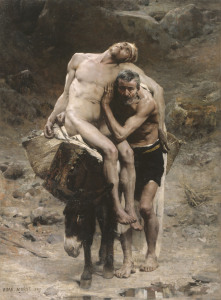
The Move – Sermon on Luke 10:23-37 for the Thirteenth Sunday after Trinity

Aimé Morot (1850-1913). “Le bon Samaritain”, 1880. Huile sur toile. Musée des Beaux-Arts de la Ville de Paris, Petit Palais.

Luke 10:23-37

23 Then turning to the disciples he said privately, “Blessed are the eyes that see what you see! 24 For I tell you that many prophets and kings desired to see what you see, and did not see it, and to hear what you hear, and did not hear it.”

25 And behold, a lawyer stood up to put him to the test, saying, “Teacher, what shall I do to inherit eternal life?” 26 He said to him, “What is written in the Law? How do you read it?” 27 And he answered, “You shall love the Lord your God with all your heart and with all your soul and with all your strength and with all your mind, and your neighbor as yourself.” 28 And he said to him, “You have answered correctly; do this, and you will live.”

29 But he, desiring to justify himself, said to Jesus, “And who is my neighbor?” 30 Jesus replied, “A man was going down from Jerusalem to Jericho, and he fell among robbers, who stripped him and beat him and departed, leaving him half dead. 31 Now by chance a priest was going down that road, and when he saw him he passed by on the other side. 32So likewise a Levite, when he came to the place and saw him, passed by on the other side. 33 But a Samaritan, as he journeyed, came to where he was, and when he saw him, he had compassion. 34 He went to him and bound up his wounds, pouring on oil and wine. Then he set him on his own animal and brought him to an inn and took care of him. 35And the next day he took out two denarii and gave them to the innkeeper, saying, ‘Take care of him, and whatever more you spend, I will repay you when I come back.’ 36 Which of these three, do you think, proved to be a neighbor to the man who fell among the robbers?” 37 He said, “The one who showed him mercy.” And Jesus said to him, “You go, and do likewise.”

In the name of Jesus. Amen.

Jesus didn’t say that the priest and Levite only passed by the half-dead man in the ditch. Christ added the fact that they passed by, “on the other side,” to even further distance them from him. They moved away. Both intentionally and deliberately ‘un-neighbored’ the guy. You’ve heard me say this before, but it’s worth repeating. The reason our English word ‘neighbor’ is spelled so weird is that it comes from the word ‘nigh’ as in ‘near’ and the word for ‘dweller.’ The same thing is true for the Greek word that gets translated ‘neighbor.’ The word means near, but it refers to an individual, so it means ‘close by person.’

In the parable, the priest and Levite aren’t dealing with a gray area. “I wonder if he really needs help?” There are times you might see a person begging for money on the street, and you don’t know that person. You don’t know if giving them money is just going to aid an addiction or be a type of soft theft where they take your money and use it for something different than you intended when you gave it. In this parable, there’s no ambiguity. The situation is black and white. It’s simple. He’s been robbed, stripped, beaten, and left dying in the ditch. If he doesn’t get help, he’s going to die. So, why do the priest and Levite not only pass by, but pass by “on the other side”?

They are trying to quiet their conscience. The more distance they can put between them and this guy in the ditch, the easier it is for them to not think about him. They make a move. They move away from the guy’s need toward their own comfort. Now, this is a parable, so we can’t ask them what they thought was more important than the guy’s need. Maybe it was their schedule. Maybe it was the fact that they knew it would cost them time and money to help the guy. Maybe they just wanted to be left alone so they could have some ‘me time.’ It doesn’t matter. They move away from need of their neighbor toward their own comfort and pass by on the other side.

Then comes the Samaritan. He sees the guy, and he also makes a move. But his move is in the complete opposite direction. He moves away from his comfort toward the guy’s need. And I’m sure he would have preferred comfort. The Samaritan has things going on. He’s got a schedule to keep and a family to feed. His time is limited and valuable. He has all the same reasons and excuses the priest and Levite have. But the Samaritan sees the man, and he moves toward the need.

Jesus makes it clear that the Samaritan has compassion. The way Jesus says it is that his guts were wrenched. The Samaritan went to the man; bound up his wounds; poured on the medicine of oil and wine that he had with him; he set the guy on his own animal; brought the man to the inn; cared for him through the night; gives the innkeeper two denarii (imagine a few hundred bucks); asks the innkeeper to take care of him; and promises to return and pay off any additional expenses. That’s nine things the Samaritan does. Nine ways he moves away from his own comfort toward the guy’s need. It’s absolutely beautiful and noble. Who doesn’t want to be as generous and loving as the Samaritan?

Primarily, this parable shows us a tiny fraction of what Christ has done for you. Jesus, the eternal Son of God, made the ultimate move away from comfort and toward you in your need. Though Jesus was in the form of God, He did not count equality with God a thing to be grasped. He emptied Himself by taking the form of a servant by being born in the likeness of men. And being found in human form, He humbled Himself by becoming obedient to the point of death – even death on a cross (Php. 2:6-8).

He did all that because you needed it. The eternal Son of God made the move from His comfort toward your need. And for that, God be praised! That’s the main point of the parable. But I want to spend the rest of this sermon focusing on what Jesus says before the parable.

After the lawyer correctly summarizes the whole Law with “Love the Lord your God with your soul, strength, and mind. And love your neighbor as yourself.” Jesus says, “Do this and you will live.”

Now, when Jesus said that, I do think it was partly to show the lawyer that he was the guy left for dead in the ditch because the Law robbed and stripped him of any self-righteousness (Gal. 3:19). But, at the same time, when Jesus says, “Do this and you will live,” He is being completely straightforward. Christian, do the Law. Do God’s will. The Law is how God created you to live. The Law is how Jesus wants you to live. It isn’t how you’re saved, but it is how Jesus wants you, believer, to live (Gal. 3:21-22). Jesus wants to motivate you to also be one who moves away from comfort and toward need.

This world is full of needs, but I’m going to focus on one very specific need today because it’s a need that everyone can meet, everyone can fulfill. And that is the need of speaking the truth in a broken and fallen world and that loves lies. The martyrdom and assassination of Charlie Kirk this week is a reminder of the lengths that the demonic forces will go to silence the truth.

Christian, do not be afraid to stand on the truth. Yes, speaking the truth can come with a cost. You might offend others. You might be ridiculed and called all sorts of names. You might lose your job or friends. But, dear saints, do not let that silence you. Silence in the face of lies is nothing other than bowing at the pagan altar of comfort.

Charlie was an amazing example of someone who loved others in a way that led him to move away from comfort toward need. He intentionally went to places to talk with people who suppress truth. He would shine the light of the truth in that darkness with logic and rhetoric that few have. But his example should teach us one simple lesson: the Truth always wins.

Jesus taught us that the devil is a liar and the father of lies (Jn. 8:44). That means wherever there is falsehood, the devil and his demonic forces are at work. Dear saints, don’t give an inch to what is false. Stand on the truth. Speak the truth and know that you are not alone. God doesn’t give many people a sphere of influence as large as Charlie had, but the numbers of people you can reach don’t matter.

Even though most of us (myself included) don’t have the rhetorical and debating skills that Charlie had, those are skills that can be nurtured and strengthened. So, strengthen yours. We’ve seen how one person can influence millions of people. That’s great; for that, God be praised. But imagine what God will do through thousands of people with smaller spheres of influence use that influence to speak the truth to the people around them. You don’t need a larger audience or bigger microphone. You can simply speak to the precious lives that God has placed around you.

And as you shine the light of truth, know that, ultimately, it doesn’t matter if you win people over. That might not happen. But it’s also not your job. That task solely belongs to the Holy Spirit who alone can – and does – change hearts. Leave the results to Him. The only thing that matters that you are faithful (1 Co. 4:2-5).

Our Christian faith requires us to love our enemies and pray for those who curse and persecute us. It does not require us to stand silently in the midst of chaos, evil, savagery, and violence. That would only be a move toward comfort. Dear saints, move toward need. This world needs to hear that sin is bad, and there is forgiveness for sin because of the death and resurrection of Christ. They need to hear that life is precious from womb to tomb; that a man and a woman should get married before they do things that create children; that God created people in His image with gifts and talents that should be nurtured, strengthened, and used for the benefit of others; that criminals should be justly punished; that men are men and women are women; and all sorts of other things. Saying those things in a loving way can be difficult, but it is the loving thing to do.

So, spread the name and light of Jesus every opportunity you have and everywhere you go. With your words and actions, point others to the beautiful, the good, the orderly, the unchanging, and the unending. Because, ultimately, all of that points people to the love of God that comes only through Christ.

As you do that, remember that light has no fellowship with darkness (2 Co. 6:14). Yes, absolutely, strive to rescue others from the darkness. But, if they love the darkness rather than the light (Jn. 3:19-20), shake the dust from your feet (Lk. 9:5).

Dear saints, Jesus is your Good Samaritan who moved from comfort toward your need. You, go and do likewise (Lk. 10:37). Move away from comfort and toward the needs of your neighbor – especially toward those who have believed the devil’s lies. And as you make that move, live in the Light that will never know dusk. Amen.

The peace of God, which surpasses all understanding, will guard your hearts and minds in Christ Jesus (Php. 4:7). Amen.

Nigh-Liver – Sermon on Luke 10:23-37 for the Thirteenth Sunday after Trinity

Luke 10:23–37

23 Then turning to the disciples he said privately, “Blessed are the eyes that see what you see! 24 For I tell you that many prophets and kings desired to see what you see, and did not see it, and to hear what you hear, and did not hear it.”

25 And behold, a lawyer stood up to put him to the test, saying, “Teacher, what shall I do to inherit eternal life?” 26 He said to him, “What is written in the Law? How do you read it?” 27 And he answered, “You shall love the Lord your God with all your heart and with all your soul and with all your strength and with all your mind, and your neighbor as yourself.” 28 And he said to him, “You have answered correctly; do this, and you will live.”

29 But he, desiring to justify himself, said to Jesus, “And who is my neighbor?” 30 Jesus replied, “A man was going down from Jerusalem to Jericho, and he fell among robbers, who stripped him and beat him and departed, leaving him half dead. 31 Now by chance a priest was going down that road, and when he saw him he passed by on the other side. 32So likewise a Levite, when he came to the place and saw him, passed by on the other side. 33 But a Samaritan, as he journeyed, came to where he was, and when he saw him, he had compassion. 34 He went to him and bound up his wounds, pouring on oil and wine. Then he set him on his own animal and brought him to an inn and took care of him. 35And the next day he took out two denarii and gave them to the innkeeper, saying, ‘Take care of him, and whatever more you spend, I will repay you when I come back.’ 36 Which of these three, do you think, proved to be a neighbor to the man who fell among the robbers?” 37 He said, “The one who showed him mercy.” And Jesus said to him, “You go, and do likewise.”

In the name of Jesus. Amen.

You need the right tool for the right job. If you need to fix your glasses, a hammer isn’t going to help you. Sure, you might need to insert a pointy piece of metal hardware into the frame of your glasses, but it’s going to be a screw and not a nail. In fact, when you’re trying to fix a pair of glasses, it isn’t even enough to have a screwdriver. You need the right kind of screwdriver – one that is tiny and difficult for my not-so-dexterous hands to manipulate. That’s why, for me, the right tool for fixing my glasses isn’t a tiny screwdriver; it’s an optician.

The lawyer who comes to Jesus is undertaking a worthy task – desiring to have eternal life, but he is using the wrong tool. Not only does he not have the right tool in his tool chest, he doesn’t even understand of what kind of tool he needs. He thinks salvation is something he can do and achieve for himself. That’s why his question is, “Teacher, what shall I do to inherit eternal life?” Jesus gives him perfect, correct instructions for earning eternal life by pointing him only to the Law. Love God perfectly and love your neighbor perfectly. Do this, and you will live (Lk. 10:26-28; see also Ps. 15).

The lawyer’s response to this is interesting. He doesn’t ask, “Who is God?” That would be ridiculous. He also doesn’t ask, “How do I love God?” Instead, he asks, “Why is my neighbor?” That question reveals something. Apparently, the lawyer thinks that already loves God perfectly. It’s only the second part of the equation that befuddles him. He is looking for an ‘out.’ He wants a limit on the extent of the command to love others. But there is no limit on this command. You cannot love God whom you have not seen if you don’t love your neighbor whom you have seen (1 Jn. 4:20).

In the context of this conversation between Jesus and the lawyer, that question is absurd. The word ‘neighbor’ defines itself. In at least Greek, Hebrew, Latin, German, and English, the word for ‘neighbor’ has more to do with location than anything else. In each of those languages (probably in others too), ‘neighbor’ means the person close to you. The English word neighbor is spelled so weird because it comes from two middle-English words smooshed together: nigh – as in ‘near,’ and gebur which means ‘dweller.’ Your neighbor is anyone who dwells near you. Or, to explain the title of the sermon, your neighbor is the one who lives nigh unto you – a nigh-liver.

Now, the lawyer asks the question because he’s trying to get out from under the command to love his neighbor as himself. He wants a limit to the love that is required of him because, presumably, he wants to keep lying to himself about being worthy of inheriting eternal life. But in general, the question, “Who is my neighbor?” is something we Christians should have in our minds constantly – not because we’re looking for information or identification of our neighbor. Rather, we should be asking that question so we recognize all of the targets of love that God places in front of us. Because we don’t get to pick and choose our neighbors. God gives them to us.

In the parable, God ‘neighbors’ the robbed, stripped, beaten, left-half-dead man to three people. God plops this needy guy in the path of the priest and the Levite. However, both of them intentionally and deliberately try to un-neighbor him. They move to the other side of the road to create distance between them and the wretch in the ditch.

Of course, if the situation had been reversed and either the priest or the Levite had been robbed, beaten, and left for dead, they would have desired help from anyone who passed by. Everyone who gets into trouble or danger is glad to receive help from anyone. That’s the most basic meaning of the command, “Love your neighbor as yourself.”

But the third guy, the Samaritan, is an outsider. Jews and Samaritans hated each other. But this Samaritan recognizes that God has neighbored this man to him, and he uses, what appears to be, unlimited resources to care for him. He binds up the man’s wounds and pours on oil and wine. He bears the burden of lifting the man onto his own animal and walking to town and cares for the man overnight. He pays for two more nights so the man can stay in the inn. And on top of that, he sets up an all-expenses paid account for any charges or costs the man would rack up between the time the Samaritan leaves and comes back. 

We misunderstand this parable if we think it is teaching us who our neighbor is. Sure, the lawyer had asked who his neighbor is, but Jesus uses the parable to show what it is to be a neighbor, a nigh-liver. To be a neighbor is to show mercy. The mercy of the Samaritan had no limits. And that is why the Samaritan is such a clear picture of Christ. Jesus proves to be a neighbor. The eternal Son of God descended from His heavenly throne, took on flesh, and dwelt among us in order to neighbor us and shower His mercy upon us.

Everyone gives you an opportunity to show love. But you aren’t called to love everyone the same way. If you try to feed every single person you come across (whether they need it or not) but that comes at the cost of feeding your own children, that’s a problem. 1 Timothy 5:8 says, “If anyone does not provide for his relatives, and especially for members of his household, he has denied the faith and is worse than an unbeliever.”

Other portions of Scripture are helpful in this as well. Galatians 6:10 says, “So then, as we have opportunity, let us do good to everyone, and especially to those who are of the household of faith.” Yes, you are to love everyone whom God puts along your path, but even in that there is a hierarchy. You are to care for those God puts closest to you first. And your closest neighbors are those in your immediate family – your spouse, your parents, your children. After that is the people in this congregation who have been made your brothers and sisters in Christ. Next come the people who live next to you on your block and your coworkers, boss, and friends. Finally, anyone else that God puts along your path and causes to live nigh to you.

When you think of those two great commands, “Love God with all your heart, soul, mind, and strength, and love your neighbor as yourself,” think of a dart board. What is the bullseye? You might think that God should be there, so you aim all your good works toward God. But that is wrong. God doesn’t need to be the center of your target. He doesn’t need anything from you, and you can’t give Him anything (Job 35:7, 41:11). Instead, it’s the people God places closest to you who are the center of your target. Think of God as being underneath the entire target. Christian, you love God by loving the neighbors that He has given you (1 Jn. 4:20).

Dear Banks, that brings me to you. Banks, in Jesus, God has neighbored you. Today, you are Baptized. Today, Jesus has joined you to Himself by placing His name upon you (Mt. 28:19) and clothed you in His righteousness (Gal. 3:27). Banks, you have been born of God; remain in the faith which overcomes the world (1 Jn. 5:4). Banks, God has neighbored you to us and us to you. As your brothers and sisters in Christ, we will share with you the mercy God has given us so that you can be filled with His mercy and share it with others as well.

Banks and all you saints, receive the mercy of Jesus who has neighbored you. He comes to your rescue. He binds up your wounds. He pours on the medicine of immortality. He sets up an all-expenses paid account for you in the inn of the Church. Everything you need is covered and paid for. So, let the mercy He has given you spill over to other nigh-livers that God places in your life. Amen.

The peace of God, which surpasses all understanding, will guard your hearts and minds in Christ Jesus. Amen.

Depend – Sermon on Matthew 22:34-46 for the Eighteenth Sunday after Trinity

Matthew 22:34–46

34 But when the Pharisees heard that he had silenced the Sadducees, they gathered together. 35 And one of them, a lawyer, asked him a question to test him. 36 “Teacher, which is the great commandment in the Law?” 37 And he said to him, “You shall love the Lord your God with all your heart and with all your soul and with all your mind. 38 This is the great and first commandment. 39 And a second is like it: You shall love your neighbor as yourself. 40 On these two commandments depend all the Law and the Prophets.”

41 Now while the Pharisees were gathered together, Jesus asked them a question, 42 saying, “What do you think about the Christ? Whose son is he?” They said to him, “The son of David.” 43 He said to them, “How is it then that David, in the Spirit, calls him Lord, saying,

44 “‘The Lord said to my Lord, 
“Sit at my right hand, 
until I put your enemies under your feet” ’?

45 If then David calls him Lord, how is he his son?” 46 And no one was able to answer him a word, nor from that day did anyone dare to ask him any more questions.

In the name of Jesus. Amen.

This Gospel reading takes place on Holy Tuesday. In other words, it is just a few days before Jesus will be crucified, and what we heard is Jesus’ last public teaching until He preaches the seven last words from the cross. The Pharisees and Sadducees are asking our Lord three questions to try to entangle Him in His words (Mt. 22:15). They want Jesus to say something they can use against Him and kill Him. The first two questions they asked were about paying taxes and the resurrection. But Jesus answers both questions so skillfully that they can’t find a way to accuse Him.

Our text begins with their third and final trick question that comes from a sleezy lawyer. “Teacher, what is the great commandment in the Law?” It seems as though the intent of this question is to get Jesus to put one of the Commandments above the others, and when He does that, they will say that He teaches that the other nine aren’t as important. But they end up looking like fools. It was Jesus’ finger that carved those words into the stone tablets and His voice that spoke them on Mt. Sinai. Jesus is the Author of the Commandments, and they are all important.

So, Jesus answers the question, “The great Commandment is this: love God with everything you’ve got and love your neighbor as yourself. On these two commandments depend all the Law and the Prophets.” In other words, Jesus is saying, “All the Commandments matter. All of them are the greatest. They all demand that you love God and love your neighbor. All the Commandments depend on these two.” Jesus is clear here, and Scripture is clear elsewhere that what the Commandments require of us is to love. Love is the fulfilling of the Law (Ro. 13:10b). In every situation, you are to love God and love your neighbor. And it is important to spend some time on this because there is a lot of unnecessary confusion about what love looks like. A pastor friend of mine (Pr. Bryan Wolfmueller) put together a list that helps to define and shape what love looks like. And this list is biblical and, I think, very helpful.

First, love is shaped by the Ten Commandments. Love does not mean that there are no other Commandments. No, the Commandments define what love is. Love depends on the Commandments. If you are fornicating and committing adultery, you cannot presume to say that it’s ok because, “We love each other.” Adultery is always unloving.

Second, love is shaped by our vocation or our station in life. Everyone has several vocations, so I’ll use myself as an example here. Some of my vocations are husband, father, pastor, a child of my parents, a friend, etc. In each of those vocations, I am called to love. But what that love looks like depends on those different vocations. For example, part of my love as a father includes providing for my family. So, I earn a living so my wife can go and buy socks for our kids. As a pastor, my love looks different. It looks like faithfully preaching and teaching God’s Word to you, the flock that God has entrusted into my care. My vocation as a pastor does not require me to buy socks for all of you. Pastors are not called to provide socks for their congregations. But that, then, leads us to the third thing that shapes our love.

Our love is also shaped by the needs of our neighbor. If one of you, who aren’t part of my family, needs socks and can’t get them for yourself, my love for you would be to give you socks. Even if the only reason I know you and your need socks is that I’m your pastor, I’m not giving you socks because I’m your pastor. I’m giving you socks because I am your brother in Christ. And if I needed socks, I would want one of you to give me socks if you have the means and resources to provide them. In that instance, I’m loving you as I would love myself. (I think this is the most I’ve ever used the word ‘socks’ in a sermon, but I’m done now.)

That leads us to the fourth thing that shapes our love which is the gifts God has given us. God gives us stuff, skills, and talents so we can use them to love and serve our neighbor. If God has made you successful and given you a lot of money, use those resources to love your neighbor. If God has given you the talent of being good at cooking, you love your neighbor by cooking. If God has given you good mind for math, you can love your neighbor as an engineer or an accountant. The beautiful thing about this one is that the gifts God gives you can help you love your neighbor across different vocations. A person who is good at math can be a good accountant. He can earn a good living and provide for his family and, at the same time, love and serve his clients who need someone to keep their books.

Just briefly here, our neighbor’s need might mean that we have to love our neighbor in a way that we aren’t gifted. Imagine a meteor hit the church during this service. We don’t have an ER doctor here, but we do have an optometrist, a medical student, nurses, and EMTs who are gifted in knowing how the body works and how to heal. They should be the ones who go to the people who are most injured and help them. And if more people are injured, those of us who aren’t gifted in that way are called to do the best we can even though that kind of love is usually reserved for doctors and nurses. Our neighbor’s need trumps how we are gifted. Especially in an emergency, we love and serve others based on their needs rather than our love depending on our gifts. And when the ambulances get here, we who don’t know as much about first aid should step aside and let the professionals use their gifts to serve the people in need.

So, the first four things that shape our love are: 1) the Ten Commandments; 2) our vocation; 3) our neighbor’s need; and 4) our gifts. All of that is fairly obvious and reasonable. But there is another thing that shapes our love, and this last one is one that our culture fights against (for several reasons). But this one is also important to consider. The fifth thing that shapes our love is our neighbor’s sin, and this is where things can get tricky and difficult. But this is also where Jesus’ summary of the Ten Commandments – love God with everything and love your neighbor as yourself – is helpful. And God gives you wisdom to help navigate this.

Imagine you know someone who is addicted to fentanyl, your calling is still crystal clear: you are called to love that person. But now what is that love going to look like? Is it loving to just step aside and let them keep killing themselves by using that fentanyl? No, it isn’t. Their sin against themselves might even mean that you need to break one of the Commandments in order to love them. You might need to steal their fentanyl even though stealing is sin and a violation against the 7th Commandment.

Now, please recognize that the Ten Commandments are still the primary thing that shapes and defines our love. But because of your neighbor’s sin, you break the 7th Commandment about stealing in order for you to keep the 5th Commandment which calls you to do your neighbor no bodily harm, but help and defend him in every need. This is why knowing the Commandments is so important. And, again, your vocation still plays into this too. You aren’t called to travel to San Francisco, Seattle, or Portland and steal fentanyl from all the addicts in those places.

Our neighbor’s sin can hinder the ways we love them. Parents, when your children are breaking the 4thCommandment and not obeying you, your love for them looks like disciplining them; it isn’t what you want to do, but you are called to do it (Pro. 22:15; 23:13; Heb. 12:11). If you have abusive parents, you are still called to keep the 4th Commandment and honor them, but their sin could mean you have to disobey them if they demand you do something contrary to God’s Word. If your cousin, Stacy, is getting married, your love normally looks like going to her wedding and celebrating with her. But if she is breaking the 6th Commandment by trying to be married to another woman, your love for her means not going to the wedding because that would embolden her in her sin against the 6th Commandment. Yes, this is hard and difficult. Yes, this is uncomfortable. Yes, it is even confusing. You are always called to love, but sin can put constraints on love.

And that brings us to the second part of our text which is the question Jesus asks the people who are trying to trip Him up. Jesus turns the discussion to the identity of the Messiah. The Savior is David’s Ancestor and also David’s Lord. The way this is possible is that Jesus is the fully Divine, eternal Son of God and fully human. Christ is God and Man.

Your Savior’s love for you was fully shaped by the Ten Commandments, which Jesus kept perfectly. His vocation was to be the Messiah and shed His blood and bear the punishment for the sins of all humanity because that was our need. He was gifted with everything necessary to be the Savior. And He navigated our sin in such a way that He perfectly loved God by loving us and bearing our sin to the cross. Now, He is risen and lives and reigns on the throne of all creation for eternity. 

Your eternal life totally depends upon what Jesus, the Son of God and Son of David, has done. God be praised that He has done all things well (Mk. 7:37). Amen.

The peace of God, which surpasses all understanding, will guard your hearts and minds in Christ Jesus. Amen.

Hirelings – Sermon on John 10:11-18 for the Third Sunday of Easter

John 10:11–18

11 “I am the good shepherd. The good shepherd lays down his life for the sheep. 12 He who is a hired hand and not a shepherd, who does not own the sheep, sees the wolf coming and leaves the sheep and flees, and the wolf snatches them and scatters them. 13 He flees because he is a hired hand and cares nothing for the sheep. 14 I am the good shepherd. I know my own and my own know me, 15 just as the Father knows me and I know the Father; and I lay down my life for the sheep. 16 And I have other sheep that are not of this fold. I must bring them also, and they will listen to my voice. So there will be one flock, one shepherd. 17 For this reason the Father loves me, because I lay down my life that I may take it up again. 18 No one takes it from me, but I lay it down of my own accord. I have authority to lay it down, and I have authority to take it up again. This charge I have received from my Father.”

Alleluia! Christ is risen!
He is risen indeed! Alleluia!

In the name of Jesus. Amen.

When Jesus calls Himself the Good Shepherd it means more than how we use the term ‘good’ today. We often use the word ‘good’ in such a subjective or comparative way. A six-year-old might be a ‘good’ baseball player because he can field a ground ball four out of ten times, but he’s only ‘good’ when you compare him to other six-year-olds who let nine out of every ten grounders roll between their legs. That six-year-old is not ‘good’ when you compare him to some high school players, who can field +90% of the ground balls that come their way. Jesus is not the good shepherd because He is better than other shepherds.

Another misconception we have about Jesus being the Good Shepherd is that we think Jesus means He is the nice shepherd. When Jesus says He is the Good Shepherd, He doesn’t simply mean that He is the nice shepherd. Of course, Jesus is nice, and there is a sort of sentimental comfort of God being our Shepherd. A lot of the imagery of Psalm 23 as well as the parable in Luke 15:3-7 of the shepherd who seeks out his lost sheep offers that comfort. But when Jesus calls Himself the Good Shepherd here in John 10, He is offering another comfort, a deeper comfort.

Throughout human history, shepherds have kept sheep for their wool and their meat. The first shepherd in Scripture was Abel. At least one of the reasons Abel kept sheep was to offer them as a sacrifice to God (Gen. 4:2-5). Today, shepherds keep sheep to put food on the table and a roof over the heads of their family by sheering sheep and slaughtering them for food. So, a “good shepherd” is someone who is successful in making money off of his sheep. We can be thankful that Jesus is not a good shepherd in that way.

When Jesus says that He is the Good Shepherd, He defines what makes Him the Good Shepherd. The Good Shepherd lays down His life for the sheep. Imagine if a cattle rancher said, “I am the good rancher, and I will die for my cows.” You would not call that rancher ‘good.’ You’d call him a lunatic and fool. In fact, that is the response of the crowd who heard Jesus call Himself the Good Shepherd. Their initial reaction, which comes just after our text ends, is that Jesus is insane and has a demon (Jn. 10:20). That’s a double whammy.

Jesus is the Good Shepherd because He is uniquely qualified to be the Shepherd of sinful sheep. It is perfectly legitimate to translate the word Jesus uses there as ‘good,’ but it means more than that. The word means, “right, fitting, true, beautiful, and competent.” I think one of the best ways to get the idea across is, actually, to consider the creation account in Genesis 1-2. Throughout the days of creation, God would look at what He had made and would see that it was “good.” Then, at the end of the sixth day, God looks at everything that He created and sees that it is “very good” (Gen. 1:31).

In creation, God orders everything by His Word. Days 1-3 God creates spaces by His Word, and days 4-6 God fills those spaces by His Word. You can think of it as God creating shelves on days 1-3, and God filling those shelves days 4-6. Day one, God creates light and time; then on day four, God fills it with sun, moon, and stars. Day two, God creates the atmosphere and waters; then on day five, God fills those spaces with birds and fish. Day three, God creates land and plants; then on day six, God fills the space with animals and mankind. And through all this, God creates things that are distinct from each other. God separates the seas from the land (Gen. 1:9-10). God put the sun, moon, and stars into the sky. And each of those are designed to do the same thing but for different purposes. The sun rules the day and the moon and stars rule the night (Gen. 1:16). He created the birds to fill the skies, the fish to fill the waters, and the animals to fill the land (Gen. 1:20-23). Everything had its place and purpose according to God’s Word and design.

Genesis 2:4-25 circles back to the sixth day and zooms in on the creation of Adam and the woman to give us a fuller picture. After God breathed into Adam’s nostrils and made him a living creature but before God created the woman, God says something important, “It is not good that the man should be alone” (Gen. 2:18). Adam was not complete without a wife. Adam could not be what God created him to be without the woman. So, God takes Adam’s side and forms the woman. This was good for Adam, for the woman, for us as their offspring, and for all creation.

After this, creation is complete, and God looks at everything He created and says it is all, “very good,” which is the same word[1] Jesus to describe Himself as the Good Shepherd. All of this is to say that goodness, according to the Scriptures, is to be well ordered according to the Word of God.

Bring all of that to Jesus calling Himself the Good Shepherd. Jesus is the Good Shepherd because He restores the order and relationship between Him and the sheep as well as the relationship His sheep have with the rest of creation. Christ, the Good Shepherd and the Word who became flesh, fixes the chaos and disorder that sin introduced into creation and brings order and peace back into creation, and He does this by His death and resurrection.

Now, all of that was to set this up: Jesus talks about the “hired hand.” Christ saw a problem with those hirelings. They were fleeing when they saw the wolf because they didn’t care for the sheep (Jn. 10:12-13).  The verses before our Old Testament reading (Ezk. 34:11-16) tell us more about the environment under those hirelings and the problems they created (see Ezk. 34:1-10). There, the shepherds are the spiritual and political leaders who failed in their function because they didn’t take care of the sheep. Instead of feeding them, they were eating the sheep. They were not seeking the strayed or binding up the injured which meant that God’s sheep were scattered over the face of the earth.

Because of that, God promised that He Himself will be the Shepherd of His sheep. And that is precisely what Jesus does. He seeks out His flock, rescues them, brings them into their own land. He feeds them with good pasture, binds up the injured, and strengthens the weak. Jesus is the Good Shepherd who restores the proper order for His sheep. That is the main point of this text. Jesus, the Good Shepherd, restores the order that was broken because of sin and the hirelings who cared nothing for the sheep.

Today, though, we are going to go a step further. The hirelings Jesus talks about here aren’t bad merely for the fact that they are hirelings. No. Those hirelings were bad because they were fallen, sinful, and cared about themselves in such a way that they could not and did not care about the sheep. Those hirelings were out of step with how God had ordered creation. But Jesus has come to restore that order by making you right with Him and right with creation.

Dear saints, just as God created the woman to be a helper fit for Adam, God calls you to your proper place in His creation. Our Epistle reading (1 Pet. 2:21-25) points to this. It says that we are under the Good Shepherd and Overseer of our souls, and we are to follow His example (1 Pet. 2:21) and in His steps in the places He has set us.

We are all hirelings. As your pastor, I’m a hireling. The word “pastor” means “shepherd.” Jesus is your Good Shepherd, your Good Pastor, and Christ has called me here to be a good, faithful under-shepherd. If I fail to be that, God will remove me for your sake.

But the roles of hirelings go further than pastors and their congregations. Parents, you are hirelings too. You aren’t the Source of food and shelter for your family – God is. But you, as a hireling, are to do what God has called you to do in your work, in our society, and in your home to join with God in feeding, protecting, and providing for your family. The same is true for you kids. You are to listen to your parents. Learn from them. Obey them and make their job easier. In other words, honor your father and mother (Ex. 20:12). In every interaction and every relationship you have with others, God has called you to be His hirelings assisting Him as He shepherds His flock. You have your proper place and function within creation because you, as Jesus’ sheep, have been redeemed and restored by the Good Shepherd.

Dear saints, you are hirelings, so be good, right, fitting, competent hirelings. In a world full of evil wicked hirelings who care nothing for the sheep, faithfully do what God puts in front of you to do.

Christ, the Good Shepherd, has laid down His life and has taken it up again. He invites you to join Him in His work of shepherding those entrusted to your care. And always remember that He Himself has finished the work of redeeming you. He Himself bore your sins in His body on the cross, that you might die to sin and live to righteousness (1 Pet. 2:24), so that you would resume your proper place in creation. By Jesus’ wounds you have been healed both now and forever.

Alleluia! Christ is risen!
He is risen indeed! Alleluia!

Amen.

The peace of God, which surpasses all understanding, will guard your hearts and minds in Christ Jesus. Amen.


[1] When it is translated from Hebrew to Greek.

God-Shaped Love – Sermon on Luke 10:23-37 for the Thirteenth Sunday after Trinity

Luke 10:23-37

23 Then turning to the disciples he said privately, “Blessed are the eyes that see what you see! 24 For I tell you that many prophets and kings desired to see what you see, and did not see it, and to hear what you hear, and did not hear it.”

25 And behold, a lawyer stood up to put him to the test, saying, “Teacher, what shall I do to inherit eternal life?” 26 He said to him, “What is written in the Law? How do you read it?” 27 And he answered, “You shall love the Lord your God with all your heart and with all your soul and with all your strength and with all your mind, and your neighbor as yourself.” 28 And he said to him, “You have answered correctly; do this, and you will live.”

29 But he, desiring to justify himself, said to Jesus, “And who is my neighbor?” 30 Jesus replied, “A man was going down from Jerusalem to Jericho, and he fell among robbers, who stripped him and beat him and departed, leaving him half dead. 31 Now by chance a priest was going down that road, and when he saw him he passed by on the other side. 32 So likewise a Levite, when he came to the place and saw him, passed by on the other side. 33 But a Samaritan, as he journeyed, came to where he was, and when he saw him, he had compassion. 34 He went to him and bound up his wounds, pouring on oil and wine. Then he set him on his own animal and brought him to an inn and took care of him. 35 And the next day he took out two denarii and gave them to the innkeeper, saying, ‘Take care of him, and whatever more you spend, I will repay you when I come back.’ 36 Which of these three, do you think, proved to be a neighbor to the man who fell among the robbers?” 37 He said, “The one who showed him mercy.” And Jesus said to him, “You go, and do likewise.”

In the name of Jesus. Amen.

Jesus uses the parable of the Good Samaritan to teach the lawyer that he will never be saved by the Law and that he needs a Savior to have compassion on him and give him eternal life. The lawyer is the one who has been robbed, stripped, beaten, and left dead in the ditch. The Law, represented by the priest and Levite, passes by and can not and does not help him. With the parable Jesus is teaching that to be one who inherits eternal life, we must be rescued by an outsider whom we despised (Is. 53:3-4) and who owes us nothing. We sinners need a love and compassion that we could never repay from One who doesn’t even want to be repaid. This is the only way for this lawyer to be saved and the only way for any of us to inherit eternal life.

So, the parable of the Good Samaritan is about Jesus and what He does for sinners. Christ is the Good Samaritan who finds us dead in sin. He has compassion on us, comes to us, binds up our wounds, pours on oil and wine, lays us on His animal to bring us to the inn, and sets us up in an all-expenses paid room. That is the point of the parable. The parable is not telling sinners that they need to do good to everyone. The lawyer already knew that he needed to love everyone (Lk. 10:27). He knew the Law requires that he love God and neighbor perfectly. So, if you ever hear someone preaching or teaching that the purpose of this parable is to tell us to love everyone, know that you are hearing only a half-truth, and, often, half-truths are more dangerous than full lies.

Jesus is not calling us to be the Samaritan in order to be saved. Jesus is the Good Samaritan who saves us. Then, it is true that Jesus calls us to go and do likewise (Lk. 10:37). We are to be like Jesus. Christians are to be little Christs who have compassion on their neighbor because Jesus has had mercy upon us. Because we have been rescued by Christ, we have become inheritors of eternal life and children of God. This means Jesus’ call to, “Go and do likewise,” is an invitation for us to imitate Him because children are like their father.

So now, please know, I’m not going to be preaching on the main point of the parable for a bit here, but I am going to use the parable to show how we Christians, who have been saved and rescued from the ditch, are to love God by loving our neighbor.

Dear saints, we need God to shape our love, and He shapes our love by two things: First, by the Ten Commandments, and second, by our relationship to the neighbor that God puts in our life in at any given moment. Let’s flesh this out with an example:

God has called me here to be your pastor, so I have a love for you, my neighbors and members of my flock, that is shaped by the 3rd Commandment. I am here to faithfully preach and teach God’s Word to you, and you have a love for me, your neighbor, that is shaped by the 3rd Commandment to faithfully hear God’s Word as it is preached and taught. As a parent, I have a different love for my children that is shaped by 4thCommandment, so I buy them socks. Well, how it actually works in our house is I work to earn the funds so my wife can purchase our kids’ socks because she’s a lot better at finding good deals on the socks my kids like. I have no idea which socks they like. Sometimes, my 4th Commandment shaped love is to take those socks from the clothes drier and help my kids fold and organize them in their dresser. So, I have different vocations, different callings, and different kinds of love that are  shaped by the Commandments and my relationship to my neighbor. And these vocations are what any reasonable person would expect. My love as a pastor is to preach and teach the Word of God to His flock, and as a parent, I provide and care for my kids.

Now, stick with me here while I get a little absurd. It would be wrong for me, as your pastor, to come here on a Sunday morning, stand in this pulpit, and say, “No sermon today, but here are some new socks. I’ll come to your house later and help you organize your dresser.” That would be weird, right? At least, I hope you think it would be weird because it is. You still are my neighbor, and I am still commanded to love you as I love myself. But my 4th Commandment love for you is shaped differently than my 4th Commandment love for my own kids. My 4th Commandment love for you is shaped by my relationship to you. So, I am to encourage you to honor, serve, love, obey, and respect your parents and the authorities that God has placed over you. Now, this doesn’t mean that will never buy socks for you. God might change your needs so it would be good and right for me to buy you socks. But, hopefully, God won’t put you in a position like that. But if He does, let me know, and I’d be happy to buy you socks.

So, God shapes your love by the Ten Commandments, and God shapes your love based on the needs of your neighbor whom He places along your path. The English word ‘neighbor’ comes from the old word ‘nigh’ or modernized, ‘near.’ And it’s the same for Greek word used here. A neighbor one who is near to you. So, when God puts someone near to you, that is your neighbor. The priest and Levite in the parable come across the guy in the ditch and they both un-neighbor him by crossing by on the other side of the road. They refuse and reject the neighbor God has put in their life and refuse to care for his needs. They probably thought, “Everybody is my neighbor, so I’m going to go serve them.” That’s sinful. Your neighbor is the person that God puts in your life – whether you like it or not.

In our text the lawyer asks Jesus, “Who is my neighbor?” and Luke tells us that the lawyer was asking this because he desired to justify himself. So, in the context, this was a bad question with wrong motives. But that question, “Who is my neighbor?” is typically a good question for us Christians to ask. It helps us identify our neighbor and see our neighbor’s needs so our love can be shaped by the Commandments. So, think back to the parable. The Samaritan would have passed by many different people on the road that day. He probably even met the Levite and the priest at some point in his journey, but the Samaritan didn’t put them up in an all-inclusive room because their needs didn’t dictate that he needed to.

In the parable, the Samaritan had his plans for the day. He was going somewhere with some purpose, but God put this robbed, stripped, beaten, half dead dude in his path and upended whatever those plans were. And the Samaritan stepped up in compassion and mercy to meet those needs realizing, “This is the guy that God has put in my path, so I am going to help and love him.”

So, please recognize that God shapes your love and gives you callings based on nearness. This is why God calls you to have more love for your family than for friends or for strangers. The closer people are to you, the more responsibility you have to them, the more opportunity you have to do good to them, the more opportunity you have to serve them. But we often turn aside and try to find excuses to not serve the one God has put near us. Instead, we prefer to choose our neighbor. In our technological society, the devil has ample tools to keep us from showing love to the neighbor that God puts in front of us to love and serve.

Dear saints, whomever God puts near you is the one that God has put in your life for you to serve. So, serve the one God has drawn nigh to you. Let God’s Commands and God’s placing of people in your life shape your love. As a spouse, parent, child, boss, employee, teacher, student, or friend, remember that God is the one who has given you those relationships and has brought that person near you. Love that one, and let that love be shaped by the Commandments and your relationship to that neighbor.

And quickly, this is an aside, but it’s something I thought about months ago and marked this text to preach on this: Many of you have experienced the loss of spouses, siblings, parents, and friends recently. When those who are near to you have died, you still have a God-shaped love for them. Even though they have passed from this world, they are still near to you. So, when they die, your God-shaped love takes a different form or shape, and that shape is grief. Jesus Himself wept when His friend, Lazarus, died (Jn. 11:35). Grief is the shape love takes when those God has brought close to you are gone. So, grieve, but grieve as those who have hope in the resurrection (1 Th. 4:13).

Now, all of that was secondary to the parable. I want to close by returning to the main point of the parable. Again, Jesus is the Good Samaritan who proved to be a neighbor to you. And, hopefully, this idea of loving the one who is near to you gives you a deeper understanding and appreciation of Christ’s compassion for you.

Jesus is God. And because He is God, you weren’t His neighbor, but He chose to become your neighbor. The eternal, infinite Son of God took on your flesh in order to be ‘nigh’ to you. Out of pure compassion, He saw you in the ditch, dead in sin (Eph. 2:1). He chose to become your neighbor and raise you from your deadness in sin.

His love for you took the shape of Him going to the cross. He was stripped, beaten, standing under the wrath of God that you deserved because of your sin, and dead. Dead and buried in a grave. Now, He is risen. And because He has done all of that, you are His child. And He will bring you to your inheritance which is eternal life with Him. He has promised. Amen.

The peace of God, which surpasses all understanding, will guard your hearts and minds in Christ Jesus. Amen.

Bound Up – Sermon on Luke 10:23-37 for the Thirteenth Sunday after Trinity

Listen here.

Luke 10:23-37

23 Then turning to the disciples [Jesus] said privately, “Blessed are the eyes that see what you see! 24For I tell you that many prophets and kings desired to see what you see, and did not see it, and to hear what you hear, and did not hear it.”

25 And behold, a lawyer stood up to put him to the test, saying, “Teacher, what shall I do to inherit eternal life?” 26 He said to him, “What is written in the Law? How do you read it?” 27 And he answered, “You shall love the Lord your God with all your heart and with all your soul and with all your strength and with all your mind, and your neighbor as yourself.” 28 And he said to him, “You have answered correctly; do this, and you will live.” 29 But he, desiring to justify himself, said to Jesus, “And who is my neighbor?” 

30 Jesus replied, “A man was going down from Jerusalem to Jericho, and he fell among robbers, who stripped him and beat him and departed, leaving him half dead. 31 Now by chance a priest was going down that road, and when he saw him he passed by on the other side. 32 So likewise a Levite, when he came to the place and saw him, passed by on the other side. 33 But a Samaritan, as he journeyed, came to where he was, and when he saw him, he had compassion. 34 He went to him and bound up his wounds, pouring on oil and wine. Then he set him on his own animal and brought him to an inn and took care of him. 35 And the next day he took out two denarii and gave them to the innkeeper, saying, ‘Take care of him, and whatever more you spend, I will repay you when I come back.’ 36 Which of these three, do you think, proved to be a neighbor to the man who fell among the robbers?” 37 He said, “The one who showed him mercy.” And Jesus said to him, “You go, and do likewise.”

In the name of Jesus. Amen.

The whole thing started with a question intended to trap Jesus in His words. The lawyer asks, “What shall I do to inherit eternal life?” It’s a stupid question because of those first six words, “What shall I do to inherit…” There’s nothing he can do. The life he desires cannot be earned or bought or deserved. However, the lawyer is right, completely right, with his last three words. Eternal life is inherited, but inheritance is always based on birth. And everyone is entirely passive in that regard. None of you will be the Queen of England. You don’t have the right birth; it’s a title you will never be able to inherit. 

Jesus answers the silly question with a question: “What is written in the Law? How do you read it?” The lawyer gives the orthodox (ὀρθῶς v. 28) answer, “Love God perfectly, and love your neighbor perfectly.” Jesus even says, “Bingo. You’ve got it! Do this and nothing less. And you will live.” The lawyer correctly recognizes that Jesus’ response means that he is damned. The lawyer asked a Law question, got a Law answer, and recognizes the devastating results. The man had come to trap Jesus, but he finds himself trapped in his own sin. He recognizes that, under the Law, he’s toast. He looks for an escape, an out, a limit to whom he must love, so he asks, “Who is my neighbor?”

But Jesus doesn’t offer him an escape from the Law with the parable. In fact, there is no escape from the Law. The Law’s demands must be fulfilled, and, God be praised, there is One who has fulfilled the Law’s demands for you. Instead, as I’ve preached before, the parable points to another way to inherit eternal life – the way of promise (Gal. 3:18 as we heard in our Epistle text). The way to inherit eternal life isn’t by works or effort. It’s by mercy. With the parable, Jesus is pointing this scared lawyer to the inheritance that comes only by promise through the Gospel.

Jesus is the one who finds sinners not just half-dead but fully dead in sin (Eph. 2:1). He binds up the wounds of sin – both the wounds that are self-inflicted and the scars that are caused by others. He pours on the oil and wine of His Sacraments. He books you an all-inclusive room in the inn of His holy Christian Church. Jesus is the one who shows you mercy.

The point of the parable is not that we should try harder and make a better effort to love our neighbor. The parable is not teaching that we shouldn’t be prejudiced or bigoted. Of course, we shouldn’t be prejudiced or bigoted, but that isn’t the point of the parable. The point of the parable isn’t even that we should love everyone. The lawyer already knew and confessed that. So, why would Jesus tell a parable to reinforce what the lawyer already knew?

Instead, Jesus tells the parable because the lawyer has been beaten up by the Law. But the lawyer doesn’t realize – or worse, isn’t willing to admit – that he’s in the ditch dead in his sin and failure to do what the Law demands. Because this lawyer has sinned both by what he has done and by what he has left undone, he needs Jesus, the Good Samaritan who has perfectly fulfilled the Law, the show him mercy. Christ is the only One who rescues dying sinners who could not save themselves. That’s why Jesus tells the parable.

Now, after the parable is concluded Jesus says, “You go, and do likewise.” And this particular part of the text I usually don’t spend a lot of time on, and Dr. Mayor Gander, likes to point that out to me – a lot. In my defense, it is the last five words of the text. But if you are like the honorable mayor and wish I would spend more time on those words, today’s your day!

Dear saints, as we recover in the inn of the Church, we still need the Law’s instruction. We still need to our love rightly directed. And God gives us that instruction and direction in the Commandments. Christian, you do not, I repeat, do not, need the Law to save yourself. But you do need the Law to know how to respond to what Christ, the Good Samaritan, who has bound you up, has done for you.

So, with that in mind, I want to spend the rest of this sermon to talking to you about your vocation.

Whenever we talk about vocation in the Christian sense, we aren’t talking about a career. Christian vocation is all the different ways that God calls you to serve your neighbor, which means that you have many different vocations in this life.

All of your vocations are defined by a few things. First, your vocation is defined by the Ten Commandments. The lawyer was absolutely right to summarize the Law as loving God and loving your neighbor. What is often missed in our day is that we do not get to define what love is. In the Ten Commandments, God has already defined what love is. To give a quick example: men, you are called to love all women, but the love you show your wife is shaped differently than the love you show other women. Your love for all women is given shape by the 6th Commandment about not committing adultery.

Second, your vocation is defined by your relationship to your neighbor. A lot of times, we have an idea that our good works are aimed at a target. On that target are the members of our family: parents, spouses, kids, friends, coworkers, neighbors, and strangers. Typically, we think that the center of that target, the bullseye, is where God is. We think God should always be in the middle and that we should aim our good works toward Him. Then, in the next ring, depending on your age or circumstances, comes your spouse or your parents. Then the next ring is, siblings or children, then friends, then strangers.

Dear saints, I want you to chew on the idea that this picture – where God needs to be in the center, in the bullseye when you aim your good works – is wrong. God doesn’t need to be in the center of your target. He doesn’t need anything you can do or offer Him. He doesn’t need your help. You can take God out of all the circles of your target. Instead, move everyone else in. If you’re married, your spouse is the bullseye, then kids, etc. If you’re a child, your parents are the bullseye, then siblings, friends, classmates, etc.

If you are going to find God on your target, He is under the whole target. God doesn’t need your good works, but your neighbor does. Whenever you serve your neighbor, you are serving God. You can find joy in serving your neighbor because whatever you do, you are serving God by serving that needy neighbor. You see the picture?

Kids, you are called to love God by loving your neighbor by obeying your parents, by listening to your teachers, doing your homework, being respectful to adults, and by being a good friend. Adults, you are called to love God by loving your neighbor being a good husband or wife, by being a good parent, by being a hard-working employee or a good and fair boss, by paying your taxes, respecting the authorities that God has placed over you, and on and on it goes.

Third, your vocation is defined by the needs of your neighbor. Normally, this is pretty straightforward. Your boss needs you to do your tasks efficiently and with excellence. But sometimes, you need to do things that you aren’t trained to do when and if an emergency arises.

This is a weird analogy, but think of it this way. Normally, you wouldn’t walk into a hospital room and offer medical aid or advice – at least you shouldn’t. So, don’t. But pretend that a plane crashed in the church yard during the service. In an emergency like that, it would be sinful for us to continue on with our service if such a thing happened. We’d stop what we are doing and go help. Even though most of us are not doctors or nurses, we would go and do our best to be doctors and nurses and firefighters until the professionals arrived because the needs of our neighbors on that plane demanded it.

The same thing is true if someone breaks into your house and was threatening the lives of you and your family. Because of that emergency, you suddenly have the duty and vocation to be the police, judge, and, possibly, even the executioner. But remember that those are the exceptions rather than the rule. When the needs of your neighbor are immediate like that, you might need to step out of your normal vocation and fill the need because there is an emergency.

Think back to the parable. The Good Samaritan didn’t finance an all-inclusive room for everyone he met on the road that day. He didn’t put everyone on his animal or pour oil and wine on those who were well and healthy. But he did do it when the immediate needs of his neighbor demanded it. The Samaritan didn’t do any of it out of obligation; he did it, according to v. 33, out of compassion. That word, which the New Testament only uses when talking about what God has done for us in Christ, is why we know this parable is about what Jesus does for us who have been beaten up by sin and left dead in the ditch.

Dear saints, compassion is what Jesus has given you. By His incarnation and birth, the Son of God has become your brother – your own flesh and blood. He has rescued you from the ditch. He has bound you up with His grace and mercy. And He is here now to provide His forgiveness delivered to you in this Bread and Wine which is His Body and Blood as you continue to recover in the inn of His Church.

Fed and refreshed with this Sacrament, go from here and do likewise. Love your neighbor recklessly. Bind up the wounds of sin that have harmed your neighbor. Your Savior has bound you up to Himself, and He invites you to join Him in His work of binding up the wounds of your sin-sick neighbor. Amen.

The peace of God, which surpasses all understanding, will guard your hearts and minds in Christ Jesus. Amen.

Marvel – Sermon on Matthew 8:1-13 for the Third Sunday after Epiphany

Listen here.

Matthew 8:1-13

1 When [Jesus] came down from the mountain, great crowds followed him. 2 And behold, a leper came to him and knelt before him, saying, “Lord, if you will, you can make me clean.” 3 And Jesus stretched out his hand and touched him, saying, “I will; be clean.” And immediately his leprosy was cleansed. 4 And Jesus said to him, “See that you say nothing to anyone, but go, show yourself to the priest and offer the gift that Moses commanded, for a proof to them.”

centurion with a sick servant5 When he had entered Capernaum, a centurion came forward to him, appealing to him, 6 “Lord, my servant is lying paralyzed at home, suffering terribly.” 7 And he said to him, “I will come and heal him.” 8 But the centurion replied, “Lord, I am not worthy to have you come under my roof, but only say the word, and my servant will be healed. 9 For I too am a man under authority, with soldiers under me. And I say to one, ‘Go,’ and he goes, and to another, ‘Come,’ and he comes, and to my servant, ‘Do this,’ and he does it.” 10 When Jesus heard this, he marveled and said to those who followed him, “Truly, I tell you, with no one in Israel have I found such faith. 11 I tell you, many will come from east and west and recline at table with Abraham, Isaac, and Jacob in the kingdom of heaven, 12 while the sons of the kingdom will be thrown into the outer darkness. In that place there will be weeping and gnashing of teeth.” 13 And to the centurion Jesus said, “Go; let it be done for you as you have believed.” And the servant was healed at that very moment.

In the name of Jesus. Amen.

Today we have two very different people approaching Jesus. The first is a leper (people with leprosy are called ‘lepers’ not ‘leopards’ as some seem to think – kids and adults alike). This leper has absolutely nothing. Leprosy was a terrible skin infection that would eat away at a person’s flesh and destroy the nerves. One of the worst things about leprosy was that you could cut or burn or injure yourself and not even know it.

Leprosy did damage to a person’s body, but even worse, it damaged society. Lepers would live separately from everyone else to avoid infecting others. Even while leprosy ate away at a person’s flesh, it also ripped apart relationships – husbands and wives, parents and children. And if a leper did encounter someone who was uninfected, they would have to cry out, “Unclean! Unclean!” to avoid spreading the disease. If you heard a leper warning you of his presence, you would get out of the way to avoid becoming leprous yourself.

Contrast all of that with the second person who approaches Jesus, the centurion. Roman Centurion Armor and Shield“Centurion” was his title and meant he was a commander over one-hundred soldiers. Centurions wore impressive armor including a helmet with all the feathers sticking out of the top, a shiny breastplate, a metal skirt, and a huge shield. Like a leper, a centurion’s command was also obeyed, but not to avoid becoming one of them. A centurion could say, “Go,” and the soldier would go. “Destroy,” and they would destroy. “Kill,” and they would kill.

Roman centurions were also very religious. The Romans believed in many pagan gods, but their chief god was Jupiter, the god of the sky. They believed that Jupiter threw lightning bolts when he was angry. Romans, like many other pagan religions, believed that if you wanted something from your god, you had to offer a gift or bribe to get that god on your side like Naaman did with his silver, gold, and cloths in our Old Testament text (2 Kgs. 5:1-15). But here in this text, the centurion approaches Jesus in Capernaum with completely empty hands. His beloved servant is paralyzed and dying at home, and he can’t do anything about it. He recognizes that he has no strength, no authority, no power over the condition of his servant.

Don’t miss the significance of this. A man with his power, influence, and strength could easily replace a measly servant. All he had to do was say the word, and the soldiers under his command would find another person with better skills or more strength to be his slave. For this centurion to go to Jesus would have been a despicable display of weakness not only in the eyes of his peers but also for the soldiers under his command. More on this later. And now he approaches Jesus with no gifts, no bribes, no promises. This centurion comes with nothing but a plea, “My servant is lying at home and dying. Don’t come to my house because I am not worthy to have You under my roof. Just say the word, and he will be healed.”

Jesus marvels. And if Jesus marveled at this man’s faith, so should we. Here is “a man of strength coming in weakness, a man of wealth coming in poverty, a Gentile coming in faith” (Rev. David Petersen). With no attempt to bribe, he simply trusts in the mercy of Jesus, God in the flesh, the One with real authority and power, full of mercy and compassion.

It is no marvel that Jesus found no such faith in Israel. But instead of casting stones at them, we should ask ourselves: would Jesus find such faith among us? How often are our prayers attached to promises of living a better life, being more obedient or more faithful? How often do we try to bargain with God in order to gain His favor? Repent.

Even if from this moment on, you promised to be perfectly obedient (which is impossible), without God’s mercy you and I are still unworthy for the Lord to come under our roof. The only thing we are worthy of is to be cast into the outer darkness of hell for all eternity.

Christ of St John on the Cross Salvador DaliRepent, but do not despair. Jesus, God in the flesh, comes down from the mountain in order to save us. He is a God of mercy and grace. He comes to make the unworthy worthy and the unholy sacred. Jesus willingly approaches the untouchable leper to touch and heal. And Christ has compassion upon a centurion who appeared to have everything, but in reality, had nothing.

May we also have such faith as we approach our compassionate God who willingly and marvelously went to the cross to bear our sins. Christ was cast out of society with nothing but a cross and a crown of thorns. Though Jesus is the Lord of hosts, He did not call the angels to deliver Him as He was pinned to the cross. Instead, in love He shed His holy and precious blood to heal our souls. He bears all our sin in His body on the cross and proves that He is stronger than the devil. He shuts Satan’s mouth and triumphs over sin, death, and hell by His resurrection. He says, “Go,” to your sins and they go. He says, “Come to Me, all who labor and are heavy laden,” and you come and find rest for your soul (Mt. 11:28).

Remember, for this centurion to come to Jesus was an act of humility. He could have simply found another servant, but the centurion humbles himself to seek Jesus’ help because of his love for his servant. The centurion becomes a picture of what it means to be a Christian. His faith in Christ is manifested in love for his neighbor in a marvelous way.

The centurion is a Christ figure for his servant. Though he had power and authority, the centurion humbles himself to serve his servant. And, Christian, so do we. Through faith, we have everything since we are children of the Most High God. Yet, through love, we use our access to God in order to serve our neighbor by interceding on their behalf. Through faith, we receive treasures from above, from God. Through love we release those treasures below to our neighbors (Luther).

May our faith in Christ manifest itself in love for our neighbor so that the earth may know the mercies of our Lord and Savior, Jesus Christ. Amen.

The peace of God, which surpasses all understanding, will guard your hearts and minds in Christ Jesus. Amen.

Love Bears All Things – Sermon on 1 Corinthians 13:1-13 for Quinquagesima.

Listen here.

1 Corinthians 13:1-13

If I speak in the tongues of men and of angels, but have not love, I am a noisy gong or a clanging cymbal. And if I have prophetic powers, and understand all mysteries and all knowledge, and if I have all faith, so as to remove mountains, but have not love, I am nothing. If I give away all I have, and if I deliver up my body to be burned, but have not love, I gain nothing.

Love is patient and kind; love does not envy or boast; it is not arrogant or rude. It does not insist on its own way; it is not irritable or resentful; it does not rejoice at wrongdoing, but rejoices with the truth. Love bears all things, believes all things, hopes all things, endures all things.

Love never ends. As for prophecies, they will pass away; as for tongues, they will cease; as for knowledge, it will pass away. For we know in part and we prophesy in part, 10 but when the perfect comes, the partial will pass away. 11 When I was a child, I spoke like a child, I thought like a child, I reasoned like a child. When I became a man, I gave up childish ways. 12 For now we see in a mirror dimly, but then face to face. Now I know in part; then I shall know fully, even as I have been fully known. 13 So now faith, hope, and love abide, these three; but the greatest of these is love.

In the name of the Father and of the Son and of the Holy Spirit. Amen.

If you’re like me, you’re looking for ways to do things more efficiently and make life easier. You’re searching for ways to lessen your burdens. A better system for your workflow. A quicker route from here to there. Ways to make dinner faster. Every mom I know is ready to get out from the burden of folding laundry. Well, a machine called the FoldiMate is for you; it doesn’t come out until late this year, and it’ll cost you about $1,000. We’re always looking for ways to make life easier, be more productive, and most of all to lessen our burdens. While a lot of good has come from technology and machines and processes that lessen our burdens, there are some things that we just have to deal with because some burdens cannot be lessened.

This chapter of Scripture tells us about one area of our lives that will always be hard – loving others. Love isn’t easy. Love is, in fact, work. Love is patient. Love is kind. Love does not envy or boast. Love is not arrogant or rude. Love does not insist on its own way. Love is not irritable or resentful. Love does not rejoice at wrongdoing but rejoices with the truth. Love never ends. These clear words of Scripture obliterate much of what our society calls ‘love’ today.

1 Corinthians 13 7 - Love Bears All ThingsBut today, I want to focus on one phrase from this text about love; it is the first phrase from v. 7, “Love bears all things.” Remember, that the second great commandment is to “love your neighbor as yourself” (Mt. 22:39). Paul writes in Gal. 6:2, “Bear one another’s burdens, and so fulfill the law of Christ.” One aspect of love is to bear another’s burdens. And there is no way to make bearing others’ burdens less burdensome.

I remember when I was in seminary things were pretty hectic during my second year. I had four hours of class every morning, and to keep our finances in order, I worked each afternoon. Sarah and I had been married for about a year and a half, so I was still adjusting to being a husband who wanted to provide for his wife (even though she was the main bread-winner). I would come home tired, have dinner, study my Greek and Hebrew, and write papers. Sarah was pregnant with Elijah, and I knew that, after he was born, I would have to cut back on my hours at work in order to take care of him and keep up with my studies. But I didn’t know how we would make everything work. The stress of it all was weighing down on me. So, one day, I went to one of my professors and I spent the better part of an hour unloading all my worries on him. And do you know what he did? He listened.

He didn’t say much. When he did speak, it was to let me know that he was hearing what I said as I continued to spew about my situation. When I was done, he didn’t give me extra time to turn in homework for his classes. He didn’t tell me about how he went through a similar time in his life. And he didn’t give me advice about how to manage my time better. He didn’t really do anything but hear me out.

So, when I left his office, nothing had changed. In fact, things should have probably been worse because I had taken a precious hour that I could have used for studying. But I left his office feeling better. You know why? Because, in a real sense, he was now carrying some of my burden. He loved me and allowed me to transfer my stress to him.

Maybe, you have had a similar experience – either unloading your own or listening to someone else’s burdens. Maybe you have come away from a conversation with someone who is facing all sorts of difficulties in their life, you come away from that conversation and you feel tired – not physically, but emotionally or spiritually. You feel tired because you are sharing that person’s burdens. This is an act of love that has cost you something, but it has truly helped the other person.

Stress.jpgWhich brings me back to where we started about looking for ways to make life easier. Too often, we try to make our own lives easier by avoiding the Scriptural command to bear one another’s burdens. But this is unloving, and it is, in fact, sinful. I can think of three tricks we commonly use to avoid bearing the burdens of others, but I am sure there are more (if you know more, let me know after the service).
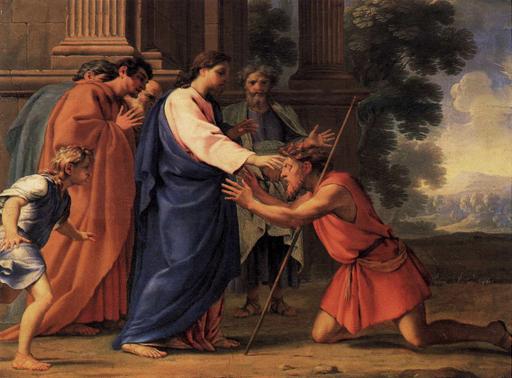
The first trick is to simply avoid being around people. We don’t let people have access to us. And I’m not only talking about avoiding certain people who seem to always be unloading on us. We often go farther and avoid meaningful interactions with others as much as possible. We have schedules that are so full that we are running from one thing to the next. Even though you may be around people every waking moment, there is not really time or occasion for others to have a real conversation with you. So, the first trick is avoidance.

The second trick is, when other people start to tell us their troubles, we may listen for a bit, but then we start telling them our troubles. We interrupt and tell them how bad things are for us. It can almost become a contest about who has the most stress. And this trick is simply building a wall between us and their problems. I’ll talk about myself and my problems so I don’t have to deal with you and your problems. So, the second trick is putting a barrier between us and others’ burdens.

The third trick is the most dangerous because we think it is pious or virtuous. We give advice. We listen for a bit, and then we say, “Have you considered doing this?” Or even worse, we tell them what to think. “You should look at this as an opportunity for God to teach you something.” That may be right and correct and our advice might be really good – which is why we think it is so pious. But don’t miss the point, it deflects their burden from us back on to them. It can leave the person more deflated and more burdened, and we leave the conversation thinking we’ve done something good and loving. But we aren’t bearing their burden. And remember, if they wanted your advice… they would’ve asked for it.

Avoidance, barriers, and advice – all tricks we use to avoid bearing another’s burdens.

Jesus Heals BartimeausWe heard about love in action in our Gospel lesson (Lk. 18:31-43). Jesus encountered blind Bartimeaus (Mk. 10:46). Bartimaeus cries out to Jesus, “Have mercy on me!” Jesus pauses on His important trek up to Jerusalem, where He is going to save the whole world. He stops to listen to Bartimeaus asking him, “What do you want me to do for you?”Bartimeaus says that he wants to receive his sight. And Jesus doesn’t start talking about Himself and the problems He is about to face even though Jesus’ burden is going to be much more than blindness. And Jesus doesn’t give advice – and if anyone is in a position to give advice it’s Jesus. Jesus simply says, “Receive your sight, your faith has made you well.”By doing this, please note, Jesus recognizes that Bartimaeus’ blindness is bad.


Now, at this point, insert whatever problem you have, or the problems of people who are unloading their burdens on you – high blood pressure, diabetes, cancer, fatigue, depression, being bullied – these things are not natural and are a product of the devil. Unlike Jesus, we can’t simply say the word and make things better. But we can, like Jesus recognize and acknowledge the brokenness in people’s lives and say, “I’m sorry. I’m sorry you’re going through this.” Another way to show love to those who share their burdens with us is to simply listen. Listen, and ask, “How can I pray for you?” Then, pray for them then and there. Pray for them and say, “May Jesus bless you.”

hebrews-12_1-2.jpg
Jesus not only healed Bartimaeus’ blindness, Jesus bears his burden completely. Jesus was on His way to Jerusalem where He would bear all mankind’s burdens, all your sins and iniquities. He would suffer all the consequences of sin in this world as He hung in darkness on the cross. And He carried all those burdens, every last one, to the grave. But He wouldn’t stay there. Because of that, because we await the Resurrection, we know that whatever we suffer in this world is temporary. So whatever burdens you bear – whether they are yours or others’ – they will disappear when our Lord returns.

You see, the love of Jesus has already and continues to bear all things – all your sins, all your iniquities, all your transgressions, all your griefs, all your cares, all your sorrows. And this becomes our focus for the next six weeks. Amen.

The peace of God, which surpasses all understanding, will guard your hearts and minds in Christ Jesus. Amen.


From Commandment to Creed – Sermon on Matthew 22:34-46 for the Eighteenth Sunday after Trinity

Listen here.

Matthew 22:34-46

34 But when the Pharisees heard that he had silenced the Sadducees, they gathered together. 35 And one of them, a lawyer, asked him a question to test him. 36 “Teacher, which is the great commandment in the Law?” 37 And he said to him, “You shall love the Lord your God with all your heart and with all your soul and with all your mind. 38 This is the great and first commandment. 39 And a second is like it: You shall love your neighbor as yourself. 40 On these two commandments depend all the Law and the Prophets.”

41 Now while the Pharisees were gathered together, Jesus asked them a question, 42 saying,“What do you think about the Christ? Whose son is he?”They said to him, “The son of David.” 43 He said to them, “How is it then that David, in the Spirit, calls him Lord, saying,

Psalm 110_1 Footstool44 “The Lord said to my Lord,
‘Sit at my right hand,
until I put your enemies under your feet’?

45 “If then David calls him Lord, how is he his son?” 46 And no one was able to answer him a word, nor from that day did anyone dare to ask him any more questions.

In the name Jesus. Amen.

This Gospel text drops us right into the middle of a conversation that Jesus had in the Temple on the Tuesday of Holy Week with the very people who want to destroy Him. The Pharisees and Sadducees are all trying to trap Jesus and entangle Him in His words. Their purpose is to make either the crowds or the authorities (they don’t care which) turn against Him so they can kill Him and be rid of Him and His preaching.

The first two questions they put to Jesus are about paying taxes and about the resurrection. Both of these questions are designed to take one part of God’s Word and make it contradict another part. And both questions appear to have no good answer. The leaders think that no matter how Jesus answers their question, they will have Him. But they are wrong. Jesus answers both questions leaving them dumbfounded.

Our text begins with the third question. One of the Pharisees, a lawyer, asked Jesus a question, again to test and to trap Jesus in His words.“Teacher, which is the great commandment in the Law?” The purpose of this question is to figure out which Commandment Jesus thinks is most important so that they can find a commandment set against it.

But again, this is absolutely foolish because Jesus knows there is no contradiction in the Law. He is the one who wrote the Law.

Jesus answers, “You shall love the Lord your God with all your heart and with all your soul and with all your mind. This is the great and first commandment.And the second is like it: you shall love your neighbor as yourself. On these two commandments depend all the Law and prophets.”

Now, it is interesting in Mark’s account of this same event, the same questioning, that Jesus says there’s no other commandment (singular) greater than these (plural). Perfect love of God and perfect love of your neighbor go together. It is one commandment. The two are inseparably tied together. Love for God is demonstrated by love for the neighbor.

1 John 4_20-21 Love God and Neighbor


1 John 4:20 
says, “If anyone says, ‘I love God,’ and hates his brother, he is a liar; for he who does not love his brother whom he has seen cannot love God whom he has not seen.”And Jesus says in Matthew 25(:40) that the acts of love that you do toward your neighbor you do toward God. “As you did to the least of these, you did also to Me.”In other words, when you love your neighbor, you are loving God.

So, think about that for a moment. When you are helping, supporting, encouraging your spouse, you are serving both God and your spouse. You are loving both God and neighbor. When you feed your kids, when you obey your parents, when you do your homework, you are serving your neighbor and thereby serving God. Telling the truth, living a caste life, returning a lost wallet or purse instead of stealing, being content with what you have instead of coveting – all of these actions are service to God and your neighbor. Whoever is your neighbor, whoever God puts in your life at any given moment, that is the one whom God wants you to love. And when you love that neighbor, whoever it may be, you are loving God.

While that is so very beautiful, if we stop to think about it, this command to love God and neighbor demands everything of us. And we realize how fallen and sinful we are. This command shows us our desperate need for God to come and rescue us.

With His answer, with His preaching of the Law to love both God and neighbor, Jesus cuts down these people who are trying to trap Him, and He cuts you and I down as well because our sin is exposed. We do not love enough. We never have, and we never will.

But notice Jesus doesn’t take the conversation in that direction. He doesn’t ask them, “How are you doing with loving God and your neighbor?” Jesus doesn’t continue to have a conversation about the Law.

Instead, Jesus moves away from questions about the Law to the Creed. The Law is good and important. It shows us the nature and will of God, but the Law always shows us our sin. The Law tells us what we must do, but it always tells us what we have failed to do.

But the Creed shows us how God is toward us. The Creed isn’t about what we must do, it is the Gospel. It is what God has done for us. In the Creed, we confess that God is the Father who created us sent His Son who redeemed us and gives us the Holy Spirit who sanctifies us and makes us holy.

So, Jesus moves away from the Law to the Creed. He asks them, “The Messiah, whose son is he?”And they were right when they say, “David’s son.”God had promised to send David a son who would sit on David’s throne forever (1 Sam. 7). But David also wrote in Psalm 110:1, which is the verse that Jesus quotes, that this Son is also David’s Lord. So, Jesus’ question is, “How can the Messiah, David’s son, also be David’s Lord?”because a father would never call his descendent, “Lord.”

Now stay with me here: The reason Jesus asks this is that He is teaching the Pharisees, the crowds, and you that the Messiah is both God and man.

Because the Messiah is both God and man, He has kept the Law for you. Jesus perfectly loved God and your neighbor for you. And through faith, Jesus declares that what He has done perfectly, you have done as well (2 Cor. 5:21).

The Law says, “Honor thy father and mother. Love them as yourself.” And you are left saying, “God, I haven’t done that. I need Your help.” If it weren’t for the Creed, if the Messiah weren’t man, God would have to say, “Well, I’m God. I don’t have a father or mother, so I can’t help you. You have to do that yourself.” But God did become a man. Jesus had a mom and a dad. He did love and honor them perfectly. So, He can and does help you. And you can apply this to each and every one of the Commandments.

But most importantly, when you hear the law and know that you have sinned, you know that you deserve death. You deserve the eternal wrath and judgment of God. So, you pray, “God I’m lost. I deserve only death, could You die for me?” Because God has taken up your nature, God says, “Sure. I already have.”

Communion Cross with JesusStop playing games with the Law, there is no contradiction in it. Instead, believe. Believe that Christ has come for you. He has given His life for you. God has purchased you with His own blood (Act. 20:28). He has removed the curse of the Law from you because He has perfectly kept the Law for you. And He gives you His perfection, His righteousness, His holiness.
And, now, He invites you to have your faith strengthened. He invites you to receive His perfect Body and His holy Blood in Bread and Wine. He invites you to come and taste that He is good. Amen.

The peace of God, which surpasses all understanding, will guard your hearts and minds in Christ Jesus. Amen.

The One Who Shows You Mercy – Sermon on Luke 10:23-37 for the Thirteenth Sunday after Trinity

Listen here.

Luke 10:23-37

23 Then turning to the disciples he said privately, “Blessed are the eyes that see what you see! 24 For I tell you that many prophets and kings desired to see what you see, and did not see it, and to hear what you hear, and did not hear it.”

25 And behold, a lawyer stood up to put him to the test, saying, “Teacher, what shall I do to inherit eternal life?” 26 He said to him, “What is written in the Law? How do you read it?” 27 And he answered, “You shall love the Lord your God with all your heart and with all your soul and with all your strength and with all your mind, and your neighbor as yourself.” 28 And he said to him, “You have answered correctly; do this, and you will live.” 29 But he, desiring to justify himself, said to Jesus, “And who is my neighbor?”

30 Jesus replied, “A man was going down from Jerusalem to Jericho, and he fell among robbers, who stripped him and beat him and departed, leaving him half dead. 31 Now by chance a priest was going down that road, and when he saw him he passed by on the other side. Jesus Good Samaritan Icon32 So likewise a Levite, when he came to the place and saw him, passed by on the other side. 33 But a Samaritan, as he journeyed, came to where he was, and when he saw him, he had compassion. 34 He went to him and bound up his wounds, pouring on oil and wine. Then he set him on his own animal and brought him to an inn and took care of him. 35 And the next day he took out two denarii and gave them to the innkeeper, saying, ‘Take care of him, and whatever more you spend, I will repay you when I come back.’ 36 Which of these three, do you think, proved to be a neighbor to the man who fell among the robbers?” 37 He said, “The one who showed him mercy.” And Jesus said to him, “You go, and do likewise.”

In the name of the Father and of the Son and of the Holy Spirit. Amen.

This parable is arguably the most well-known parable Jesus ever told. That being said, it is also one of the most misinterpreted and misused parables. Today, may your eyes and ears be blessed as Jesus tells you what many prophets and kings desired to see and hear but did not. Holy Spirit, open our eyes and unplug our ears to Christ’s mercy.

This lawyer, this guy who knows the Old Testament forwards and backwards, asks Jesus, “What must I do to inherit eternal life?” This is a stupid question. You don’t do something to gain an inheritance.

All Scripture shows that God’s people do not inherit eternal life by doing something. As our Epistle Text (Gal. 3:15-22) said, the inheritance of eternal life has always and will always come through the promise of God.

The lawyer knew exactly what he must do to have eternal life. He must do the Law, and his understanding of the Law is correct. Love God perfectly; love your neighbor perfectly. It’s exactly how Jesus sums up the Law elsewhere (Mt. 22:34-40). Jesus tells the lawyer, “Bingo! Do this, and you will live.”But Jesus might just as well have said, “Yup. Go to hell.”

And the lawyer gets it. He is stuck in his own death. The Law has exposed him for the wretched sinner that he is. The Law has left him scared and confused because he doesn’t know the Gospel; it’s completely foreign to him. He wants an out and clamors for a loophole. He asks, “Well, who is my neighbor? Whom should I love?”

But every Sunday school student knows the answer. “Who is my neighbor?” Everyone. “Whom should I love?” Everyone and without fail. But Jesus doesn’t tell the parable to answer the question, “Who is my neighbor?” Jesus tells the parable to change the question to get the answer He wants. The point of the parable is not to teach us to love everyone. Scripture teaches that all over the place but not in this parable.

Instead, Jesus tells the parable because He wants to show the lawyer and you hope. Jesus wants to show you what God mercifully does for you. He wants your eyes to see and your ears to hear the Gospel.

With all that in mind, consider the parable: The road from Jerusalem to Jericho is downhill the whole way. The man in the parable is constantly going down. And as he goes down, he falls among thieves who rob, strip, beat, and leave him for dead.

A priest happens to come across him, but when he sees the poor sap, he moves to the other side of the road. A Levite spots him as well and does the same. They don’t bind up his wounds. They don’t offer to find someone else to help. They don’t even stand a safe distance and speak comforting words to him as he dies. Instead, the two most respected religious people in Jesus’ day are unwilling to give a second look to the wretch in the ditch.

They know God’s Word, but they are able to justify leaving the guy in the mud and blood. “If God allowed this to happen to him, it must have been for a reason.” Or, “He must have been hanging out with the wrong crowd.” Or, “If I help this guy, I’ll be unclean and won’t be able to perform my duties in the Temple and people won’t have their spiritual needs met.” They won’t let this looser distract them from their calling.

This beaten, bloodied man is despised and rejected by his own people who turn their faces from him (Is. 52:14; 53:2-4).

But then comes the hero – the man of the hour. But he is a Samaritan. He’s a looser and outcast just like the man in the ditch. And this looser ministers to his fellow looser.

He goes down into the ditch. He binds up the wounds. He puts ointment, oil, and wine on the lacerations. He hefts the guy onto his own animal, giving up his own comfort. He is delayed and intruded upon. Whatever appointment or meeting he was journeying to doesn’t matter anymore. The only thing that matters is the stripped, bleeding man.

The Samaritan brings the guy to a hotel and watches over him through the night. In the morning, he makes his way to the front desk and books the room indefinitely.

He tells the staff, “Bill everything to my room. That bloodied guy I brought in here last night, whatever he needs Is on my tab. If he needs doctors or nurses, I’ll cover it. If he needs a ride, get an Uber on me. If he consumes the mini bar fifteen times, I’m good for it. I’ll be back to pay for it all.”

The parable completed, Jesus looks at the lawyer and asks, “Who proved to be a neighbor to the man who fell among the robbers?”

Again, if this parable is teaching us to love everyone, then Jesus is a bad teacher and is asking the wrong question. “Who proved to be a neighbor to the man who fell among the robbers?”

Jesus is setting the lawyer up. Christ is not calling the lawyer to be like the Samaritan. Jesus wants the lawyer to see that he is the man in the ditch. Jesus wants the lawyer to desire the care, compassion, reckless love, and mercy that the Samaritan shows in the parable because that is exactly what Jesus has come to do for him and for you. Jesus is the one who shows mercy.

Good Samaritan Jesus IconChrist has come to find you. He has bound up your wounds. Jesus has poured out His healing, life-giving blood for you. Jesus nurses you in your brokenness. He has ascended into heaven and has promised to come back and pay for everything you need.

In order to be saved, you don’t need to be merciful; you need mercy. You don’t need to love your neighbor; you need to be loved. You need to receive the Jesus who has come to give you every last bit of His mercy.

That is what the parable means. Our text ends with Jesus saying, “You, go and do likewise.”And Jesus means that too. What Jesus has poured into you, let it spill out and bless others. Amen.

The peace of God, which surpasses all understanding, will guard your hearts and minds in Christ Jesus. Amen.