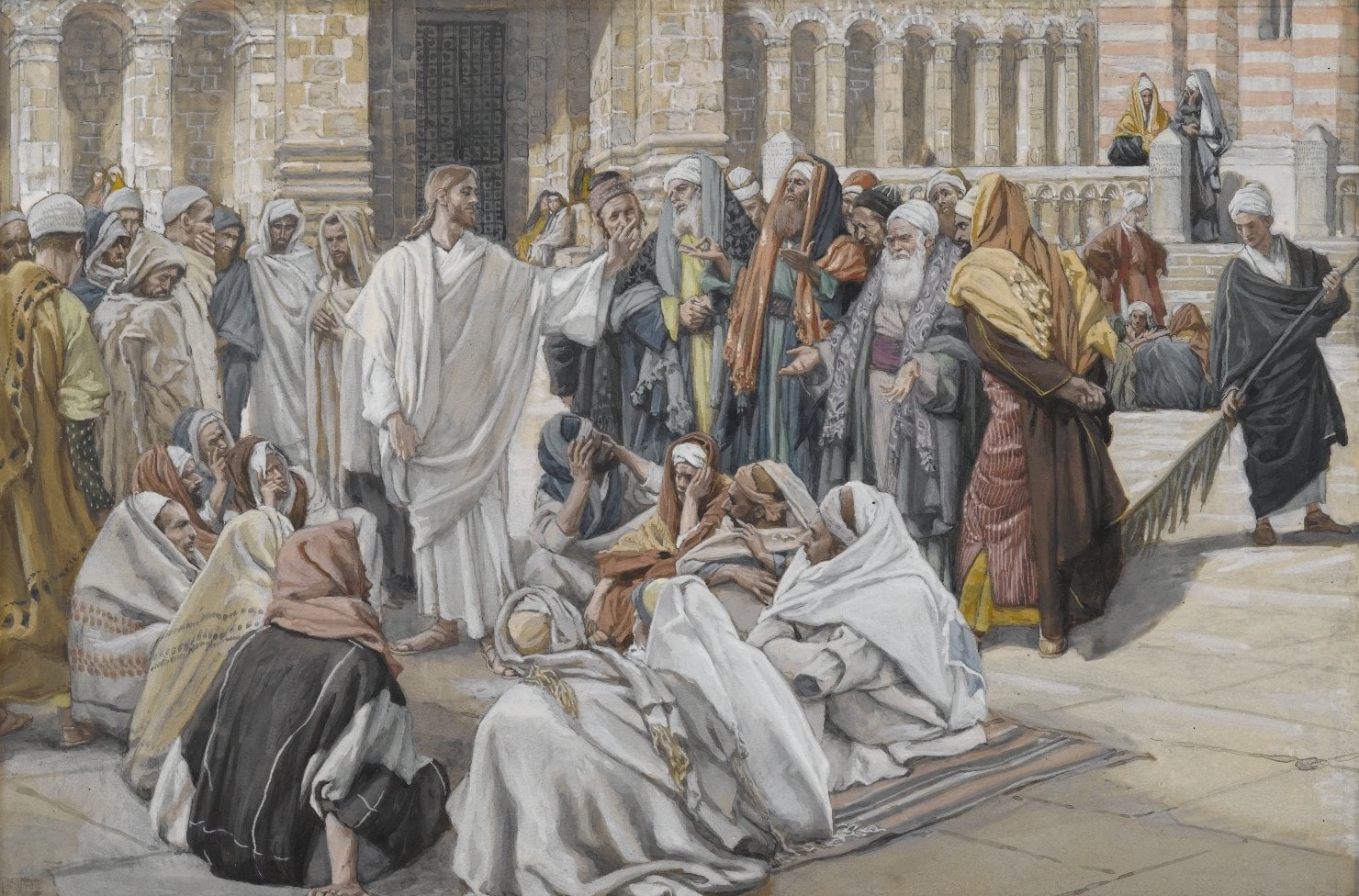
John 8:42-59
42 Jesus said to them, “If God were your Father, you would love me, for I came from God and I am here. I came not of my own accord, but he sent me. 43 Why do you not understand what I say? It is because you cannot bear to hear my word. 44 You are of your father the devil, and your will is to do your father’s desires. He was a murderer from the beginning, and does not stand in the truth, because there is no truth in him. When he lies, he speaks out of his own character, for he is a liar and the father of lies. 45 But because I tell the truth, you do not believe me. 46 Which one of you convicts me of sin? If I tell the truth, why do you not believe me? 47Whoever is of God hears the words of God. The reason why you do not hear them is that you are not of God.”
48 The Jews answered him, “Are we not right in saying that you are a Samaritan and have a demon?” 49Jesus answered, “I do not have a demon, but I honor my Father, and you dishonor me. 50 Yet I do not seek my own glory; there is One who seeks it, and he is the judge. 51 Truly, truly, I say to you, if anyone keeps my word, he will never see death.” 52 The Jews said to him, “Now we know that you have a demon! Abraham died, as did the prophets, yet you say, ‘If anyone keeps my word, he will never taste death.’ 53 Are you greater than our father Abraham, who died? And the prophets died! Who do you make yourself out to be?” 54 Jesus answered, “If I glorify myself, my glory is nothing. It is my Father who glorifies me, of whom you say, ‘He is our God.’ 55But you have not known him. I know him. If I were to say that I do not know him, I would be a liar like you, but I do know him and I keep his word. 56 Your father Abraham rejoiced that he would see my day. He saw it and was glad.” 57 So the Jews said to him, “You are not yet fifty years old, and have you seen Abraham?” 58 Jesus said to them, “Truly, truly, I say to you, before Abraham was, I am.” 59 So they picked up stones to throw at him, but Jesus hid himself and went out of the temple.
In the name of Jesus. Amen.
This portion of John is one of the high points of the four Gospels because, here, Jesus pulls back the veil and reveals Himself to be God saying, “Truly, truly, I say to you, before Abraham was, I am.” There is a whole sermon there, but it will have to wait until the next time this text rolls around. Today, we’re going to consider just two sentences from our Lord. The first reveals just how stubborn mankind is in our sin and how desperate we are to believe lies, and the second sets us up for the Scripture readings we are going to be hearing next Sunday and through Holy Week.
In the last half of v. 46, Jesus asks, “If I tell the truth, why do you not believe Me?” That question should startle us – especially because it comes from the lips of our Savior. In our fallen, sinful state, we are willing to reject the truth even when it stares us in the face. When the truth is difficult and hurts us, we would rather live by lies than change course. We have this false idea in our minds where we think that if people are presented with the facts so that the truth is crystal clear, then everybody will agree and everything will be right in the world. But that is false.
Here, Jesus, who is the Truth (Jn. 14:6), speaks the truth to the people in the Temple, but they refuse to believe and are ready to stone Him. No matter how clearly the truth is spoken or how authoritative the speaker of truth is, there are some who will simply reject it and refuse to live in reality.
Sometimes, we think that problems we face are caused by the news channels, social media suppression, or other sources of misinformation. Those things certainly don’t help. But don’t imagine that if someone waived a magic wand and made all those things disappear that, suddenly, everything would be right in the world and everyone would automatically believe the truth. People didn’t believe Jesus when He spoke the truth. And even worse, Jesus was persecuted when He spoke the truth. Dear saints, we should expect the same. In fact, that is exactly what we see today.
The reason people reject truth, especially the truth about God, is that we are by nature children of wrath (Eph. 2:3). Because of our sin, we do not and cannot love God. We cannot come to Him or understand Him. Instead, we naturally run away from Him. But God still desires to bring you back unto Himself. So, God goes out to battle and fights for you. And – it is so important to understand this – when God fights for you, yes, He is fighting against Satan and the demons, against sin and death. But even more importantly, when God fights for you, He is even fighting against you, against your sinful nature and mine.
The texts through Lent have all been about this fight. The first Sunday of Lent, we saw how Jesus fought against the devil in His temptation (Mt. 4:1-11). The second and third Sundays of Lent, we saw how Jesus fought against the demons (Mt. 15:21-28, Lk. 11:14-28). Last week, we saw how Jesus fought against the crowds who wanted Jesus to satisfy all their fleshly desires and make Him a bread king (Jn. 6:1-15). Today, there is an obvious fight between and the crowds as Jesus simply speaks truth and is rejected. The crowds were so adamant in their rejection they are ready to stone Him (Jn. 8:59). And those crowds would have killed Jesus if it had been His time to die, but it wasn’t His time – not yet. But in next week’s Gospel lesson, which will be Matthew’s account of Jesus’ passion (Mt. 26:1-27:66) and then again in the texts for Good Friday, it will be Jesus’ time to die. The same crowds will call for Jesus to be crucified. And there, on the cross, Jesus will fight the final, decisive battle against all the forces of evil.
Lent is about God fighting against evil. When we get to Easter and the Resurrection, we will celebrate Jesus’ victory. With the resurrection, Jesus reveals His victory over all evil, even the evil within you and me. Because of the resurrection, you can know that Christ has snatched you away from the kingdom of darkness and transferred you to His kingdom of light (Eph. 1:13, 1 Pet. 2:9). And as His people, we will celebrate His victory. On Easter, we will rejoice and sing, and our hearts will be glad when we celebrate the resurrection. But what will we do, and how will we react, as we hear Jesus fighting that battle? What will be our response as we see Jesus going to the cross and suffering God’s eternal wrath against our sin?
Some of you have mentioned to me how you don’t like Good Friday and Christ’s crucifixion and would much rather jump straight to Easter and the resurrection. Now, I understand the sentiment. I do. But there is no Easter joy, no resurrection gladness, apart from Good Friday. Easter cannot happen unless Jesus dies first. One of the Sunday school teachers (and I apologize, but don’t remember who it was) mentioned to me in the past couple weeks how one of their students asked why call the day of Jesus’ death ‘Good Friday.’ What is good about that? Well, today Jesus tells us.
Jesus makes a comment in v. 56 of today’s text that helps us know how to approach the texts of Holy Week and how to see His crucifixion. Jesus says, “Your father Abraham rejoiced that he would see My day. He saw it and was glad.” What is Jesus talking about there? Notice, Jesus doesn’t say that Abraham ‘believed in My day and was glad.’ No. Abraham saw it and was glad. Well, Abraham saw Jesus’ day in our Old Testament text (Gen. 22:1-14).
There, when Isaac was spared from being sacrificed, Abraham sees the ram caught in a thicket by its horns. And Abraham doesn’t have to be told anything. Immediately, Abraham takes Isaac off the wood and places the ram in Isaac’s place. Abraham sacrifices the ram instead of Isaac, Abraham’s beloved son. Through that sacrifice, God is visibly showing Abraham what He will do through Jesus, His only-begotten Son. In that text, Abraham saw what God would do in and through Jesus as He goes to the cross in your place. Abraham saw, rejoiced, and was glad.
Dear saints, as we approach the crucifixion and see Jesus’ day of victory over sin, death, the devil, and our own sinful flesh, let us see and rejoice as well. Jesus willingly goes to the cross in your place. There on Mt. Calvary, Christ wins the victory and battle for you. As we approach Holy Week, let us look to Jesus, the founder and perfector of our faith and remember that Scripture says it was “for the joy,” the joy, “that was set before Him, He endured the cross” (Heb. 12:2) for Abraham, for Isaac, for you, and for all sinners.
Dear saints, on the cross your Savior has won the battle. Christ has shed His blood and with that blood, He now cleanses your conscience from dead works to serve the living God. Come now and receive the Body and Blood of your Savior who brings you into the new covenant and to your promised, eternal inheritance (Heb. 9:14-15). Amen.
The peace of God, which surpasses all understanding, will guard your hearts and minds in Christ Jesus. Amen.
 Pastorsamwise
You must be logged in to post a comment.