“Then Jesus, calling out with a loud voice, said, ’Father, into Your hands I commit My Spirit.’ And having said this [Jesus] breathed His last” (Lk. 23:46).
Hebrews 10:31 tells us, “It is a fearful thing to fall into the hands of the living God.” The majority of times that the Bible talks about God stretching out His hand, it means destruction. This is why death is a fearful thing for us. The wages of sin is death (Ro. 6:23). It is appointed for a man to die once, and after that comes judgment (Heb. 9:27). Deep down, everyone knows this (Ro. 1:18-21).
Even the most hardcore atheist who wrongly thinks we are nothing more than a glob of atoms who randomly evolved knows that death is something to be avoided. Over the past few years, we have watched the absurd and, even, the evil things people will do in an attempt to avoid death. But unless Jesus returns first, we will all die (1 Thess. 4:17). And Satan uses the fact that sinners die to his advantage. Hebrews 2:14-15 says that the devil is able to hold all of humanity in bondage and slavery using only one tool, the fear of death. People try to stay alive at all costs and put even the thought of death as far away as possible. Death reminds us that we are not in control and are not in charge.
So, we have to learn from Jesus how to die. Jesus does not go into death as though He is falling into the hands of an enemy, but safely into the hands of His Father. These words of Jesus, “Father, into Your hands I commit My Spirit,” are a quote from Psalm 31:5, and by quoting it, Jesus wants us to consider the entire Psalm. Just like when you hear a line from a song or a movie and, so long as you are familiar with it, the whole song or scene comes to mind, this one line Psalm 31 would have brought the whole Psalm to the minds of those who were there at the cross.
I would encourage you to read all of Psalm 31 tonight with your family and have the crucifixion in mind. For now, hear the first five verses:
1 In You, O Lord, do I take refuge; let me never be put to shame; in Your righteousness deliver me! 2 Incline Your ear to me; rescue me speedily! Be a rock of refuge for me, a strong fortress to save me! 3 For You are my rock and my fortress; and for Your name’s sake You lead me and guide me; 4 You take me out of the net they have hidden for me, for You are my refuge. 5 Into Your hand I commit my spirit; You have redeemed me, O Lord, faithful God.
Psalm 31:1-5 ESV
With His dying breath, Jesus commits Himself into the hands of the Father, and Christ can do this because He knows God is not angry with Him. And you, when you come to the end of your life, when you are breathing your last, you need to know this as well.
God is not angry with you. His anger over your sin has been satisfied. He has redeemed you through Jesus’ death. He has purchased and won you. Christ has paid the price for your sins. Unless you stubbornly hold on to your sins and refuse to believe that Christ has taken your place, there is no wrath, no judgment from God for you. You, Christian, you are a child of God, a child of the heavenly Father because Jesus has paid the price for your sins. You are no longer a sinner, but a one who has been redeemed and purchased by Jesus, the only-begotten Son of God.
By His blood, Jesus has washed away all your sin. You stand before God in the robe of Christ’s righteousness (Is. 61:10). For you, Christian, it is no longer a fearful thing to fall into the hands of a living God because God’s hands were nailed to the cross for you. Those are the hands that you commit yourself to.
There is therefore now no condemnation for you who are in Christ Jesus (Ro. 8:1) because your condemnation is in the past. It has already happened as Jesus died on the cross for you.
Jesus died after praying Psalm 31:5a, “Into your hands I commit my spirit.” And it is important to notice that Jesus only prays the first line because He could not pray the second line, “You have redeemed me, O Lord, faithful God.” Jesus couldn’t pray the second line because He was not redeemed; instead, He was redeeming. He was redeeming you. He was there on the cross paying the price; winning your salvation; forgiving your sins; overcoming sin, death, and the grave. He was doing all of that so you can pray all of Psalm 31:5. The entire thing. Because of what your Lord and Savior has done, you can rightly pray, “Father, into Your hands I commit my spirit; You have redeemed me, O Lord, faithful God.”
You belong to Jesus. He is your Brother and God is your Father. At the end of every day, take up these words, “Almighty God, my heavenly Father, like Jesus did before me, into Your hands I commit my spirit, for You have redeemed me, O Lord, faithful God.” And as you pray that, know that Jesus, who committed Himself into the hands of God the Father, has gone and prepared a place for you so that where Jesus is, you may be also (Jn. 14:3). Amen.[1]The peace of God, which surpasses all understanding, will guard your hearts and minds in Christ Jesus. Amen.
[1] This sermon was adapted from a sermon by Pr. Bryan Wolfmueller.
21 And Jesus went away from there and withdrew to the district of Tyre and Sidon. 22 And behold, a Canaanite woman from that region came out and was crying, “Have mercy on me, O Lord, Son of David; my daughter is severely oppressed by a demon.” 23 But he did not answer her a word. And his disciples came and begged him, saying, “Send her away, for she is crying out after us.” 24 He answered, “I was sent only to the lost sheep of the house of Israel.” 25 But she came and knelt before him, saying, “Lord, help me.” 26 And he answered, “It is not right to take the children’s bread and throw it to the dogs.” 27 She said, “Yes, Lord, yet even the dogs eat the crumbs that fall from their masters’ table.” 28 Then Jesus answered her, “O woman, great is your faith! Be it done for you as you desire.” And her daughter was healed instantly.
In the name of Jesus. Amen.
Whenever you are reading Scripture, look for the surprises. To see the surprises in this particular text, we first have to recognize some things that are not surprising. This Canaanite mother cries out to Jesus because her daughter is severely oppressed by a demon. As harsh as this sounds, it is no surprise at all that her daughter is suffering at the hands of demons.
Jesus is in the district of Tyre and Sidon, and that region was the center of Baal worship. Baal worship, among other horrible things, included child sacrifice. Obviously, this Canaanite woman hadn’t killed her daughter as a sacrifice to Baal. But in that pagan culture, it was common to engage in occult practices and make deals with demons in order to make your fields more fruitful, to get revenge on someone, to make a person fall in love with you, and all sorts of other things. While we don’t know exactly what caused the girl to be demonized, both this woman’s background and what she says suggest that she does know, and it is very possible that it was because of something she had done. If she and her daughter were innocent regarding this demonic possession, the woman would be crying out for justice, but that isn’t what she cries out for. She cries out to Jesus for mercy. She sees her daughter’s suffering and feels guilt.
Let’s bring this to us today. Dear saints, be aware. Demons have not gone away. If you ignore their existence, it is to your own peril. Demons are real, and they are active. Even if you don’t read horoscopes, call psychic hotlines, use healing crystals or ouija boards – and don’t do those things, they are demonic and evil – but even if you don’t do those things, that doesn’t mean you aren’t opening up yourself to demons. Pornography can be a portal for demons. Getting drunk, giving in to your anger, or being lazy also opens you up to their influence (Col. 3:5-8; 2 Thess. 3:6, 11). In fact, all pet sins dabble in the demonic. We want to imagine that our sins are no big deal or excusable. They aren’t. Sin hurts both the sinner and the sinner’s immediate family. Repent. Know that Christ has defeated the demons and protects you from them. But engaging in pet sins is like dangling your bleeding foot in shark-infested waters. Don’t invite the demons into your life by continuing in those sins.
Now, that brings us to the first surprise in the text which comes in the woman’s initial prayer. She addresses Jesus as the Son of David, and that is a loaded term – especially from her. She’s a foreigner. King David never ruled over her people or her homeland. And yet there are all sorts of promises that a descendent of David would sit on the throne forever and save even the inhabitants of the pagan nations (Is. 11:10-16). And this woman believes Jesus is the Son of David who can help her and her daughter. Jesus is her last hope.
And that brings us to the second surprise. Jesus doesn’t answer her a word. Jesus is usually so quick to have mercy when called upon, but not here. More on that surprise in a minute.
First, we have to consider the disciples’ reaction to her. They pray and ask Jesus to send her away. Unfortunately, this isn’t surprising. It’s disappointing, callous, and sinful, but not surprising. They were tired of hearing her shrieking for mercy. They probably speculated that she is suffering because of her own wickedness. Their attitude and thinking toward her seems to be along the lines of, “Well of course your daughter has a demon. You’ve brought this on yourself. Jesus, if You’re not going to help her, at least tell her to take a hike.” But even though this speculation was probably correct, the disciples failed to have compassion.
Dear saints, too often we are like the disciples. We fail to have compassion on those who are suffering around us. When people are groaning under their suffering, that isn’t the time to be like Job’s ‘friend’ Zophar and say, “You’re getting what you deserve. In fact, your sins deserve even worse punishment” (see Job 11:6). Now, we cannot excuse sin or say that sin doesn’t really matter. Downplaying sin is also unmerciful. Don’t do that! There are times where we have to correct and rebuke, but when someone is crying out for mercy, rebuke is not appropriate. Point the suffering to Jesus, the Source of mercy. Comfort them with God’s promises of forgiveness and mercy in the midst their suffering. And pray that God will give you wisdom to know when to comfort and when to rebuke and correct (Jam. 1:5).
Back to Jesus’ surprisingly slow response in giving this woman mercy. First, Jesus ignores her. Then, Jesus says that He came only for the lost sheep of Israel. And finally, He calls her a dog. Yes, it’s surprising, but it shouldn’t be too surprising. Because He is God, Jesus knows this woman; He knows her daughter; He knows the struggles she and her daughter have had with this demon; and, most importantly, Jesus knows this woman’s great faith. There is no question that Jesus is putting her through the ringer, but what He is doing here is strengthening and purifying her faith.
Even though Jesus ignores her, dismisses her, and calls her a dog, she continues to dig her roots of faith deeper and deeper. You heard in our Epistle text (Ro. 5:1-5) that we can rejoice in our suffering because suffering produces endurance which produces character which produces hope. Jesus is using this woman’s suffering to strengthen her faith. Christ knows how much suffering this woman can take, and through that suffering her faith grows, matures, and gets stronger. Jesus uses her suffering for her good. That doesn’t mean that the suffering is good, but Jesus uses it to bring about good.
That leads us to the next surprise. The demon who is causing the suffering wants to destroy this woman and her daughter, but the demon utterly fails because he ends up driving her to Jesus. And Christ draws this woman in even closer to Himself.
Dear saints, when – not if but when – you suffer, flee to Christ. When you are suffering because of your sinful actions, because of the sin of others, or because God doesn’t immediately deliver you, dig your heels into God’s promises. In your prayers, remind God of what He has promised to do and hold Him to those promises. That is faith. Faith is trusting that what God has promised He will do, despite your experience.
That brings us to the final surprise. The woman says that she will be content with crumbs from Jesus table. Even though Jesus calls this woman a dog, she says, “Ok, Jesus. I’ll be a dog so long as I’m Your dog. It isn’t right for You to give me Your children’s bread. I don’t need bread. Crumbs from Your hand are all I need.” She’s content with crumbs, but here’s the surprise – she gets more than crumbs. She gets a full feast.
Jesus says, “O woman, great is your faith! Be it done for you as you desire.” This woman is one of only two people whose faith is praised by Jesus (Mt. 8:10). Jesus is the Bread of Life (Jn. 6:35). Even the crumbs that fall from Jesus’ table deliver mercy, life, and salvation. This woman gets the very thing she desired and more. Her daughter is delivered, and she receives everything Jesus came to give to sinners.
God’s mercy is of such a nature that it never falls in crumbs. God’s mercy is directly and precisely delivered to give exactly what is needed in every situation.
Right now, your Lord invites you to His table. Not to sit under it like a dog waiting for some crumbs to fall from a careless child. No, you are Jesus’ guest of honor. What you receive might look like crumbs to those who do not know what is being given. But through faith, you know that Jesus gives you a full feast of forgiveness, life, and salvation as He gives you His Body and Blood for the forgiveness of all your sins. Welcome to the feast. Amen.
The peace of God, which surpasses all understanding, will guard your hearts and minds in Christ Jesus. Amen.
1 On the third day there was a wedding at Cana in Galilee, and the mother of Jesus was there. 2 Jesus also was invited to the wedding with his disciples. 3 When the wine ran out, the mother of Jesus said to him, “They have no wine.” 4 And Jesus said to her, “Woman, what does this have to do with me? My hour has not yet come.” 5 His mother said to the servants, “Do whatever he tells you.” 6 Now there were six stone water jars there for the Jewish rites of purification, each holding twenty or thirty gallons. 7 Jesus said to the servants, “Fill the jars with water.” And they filled them up to the brim. 8 And he said to them, “Now draw some out and take it to the master of the feast.” So they took it. 9 When the master of the feast tasted the water now become wine, and did not know where it came from (though the servants who had drawn the water knew), the master of the feast called the bridegroom 10 and said to him, “Everyone serves the good wine first, and when people have become drunk, then the poor wine. But you have kept the good wine until now.” 11 This, the first of his signs, Jesus did at Cana in Galilee, and manifested his glory. And his disciples believed in him.
In the name of Jesus. Amen.
This text is so rich; it’s a pile of treasure for preachers. This whole week, I felt like Scrooge McDuck taking a daily swim in all the wealth.
The main point of the text is that Jesus supplies more mercifully and abundantly than we can ask or imagine (Eph. 3:20). Christ manifests His glory by turning 120-180 gallons of water into wine for a bunch of people who are drunk. Most English translations have the master of the feast say in v. 10, “Everyone serves the good wine first, and when people have drunk freely, then the poor wine.” Every other place that word gets used in the New Testament (Lk. 12:45; Eph. 5:18; 1 Th. 5:7; and Rev. 17:2), it is a reference to drinking too much alcohol and is condemned. Do not – I repeat, DO NOT – take this text to mean that Jesus is ok with getting drunk. Instead, see that in turning water into wine, Jesus is giving sinful people good things they do not deserve and cannot fully appreciate. That is the definition and nature of mercy, and God’s glory is to give mercy (Jn. 1:14).
My fellow failures, Jesus gives you the full forgiveness of your sins even though He knows that you will turn around and fall into the same sin tomorrow. And when you fall into the same sin over and over, repent, and confess again. Jesus will answer with His mercy again. That is the main point of this text.
But there are many other gems here. We could consider how Jesus removes all human efforts to purify ourselves. He makes the stone jars that are there for man-made purification rites hold wine instead of water. Or, we could spend a lot of time talking about how much God loves marriage and weddings. Jesus makes sure that the celebration of the union of man and woman as husband and wife keeps going by providing for the feast. God created marriage, He blesses marriage, and He sustains joy in marriage.
Again, this text is a treasure-trove for preachers. But today, we are going to consider what this text has to preach to us about prayer. Yes, Jesus turning water into wine has a lot to teach us about prayer, so let’s get to that.
In Jesus’ day, wedding feasts would last several days, typically a whole week. At some point during this feast,[1] the wine runs out. The custom in Jesus’ day was for the groom and his family to pay for the wedding and the feast that followed. But here, Mary steps in, “They have no wine.” The wine wasn’t Mary’s responsibility. It isn’t one of her kids getting married; if it were, she would have told Jesus, “We have no wine.” But she says, “They have no wine.”
Having no wine is a fairly trivial thing and something we probably wouldn’t think Jesus would get involved in. It isn’t like someone is demon possessed, leprous, blind, lame, or dead. Those are typically the times Jesus steps in for a miracle. Even in the feeding of the five and four thousand, Jesus is concerned that the people won’t make it home because they will faint on the way. No one is in physical or spiritual danger at this feast because they ran out of wine.
Now that being said, running out of wine at a wedding feast in that culture would mean public humiliation and disgrace. It’s impossible to make a direct equivalent between the customs of Jesus’ day and ours, but here’s my best shot. Imagine you get invited to a wedding. You love the couple and excited for their marriage, and you RSVP indicating that you would like the bone-in tomahawk ribeye (rare, of course) and chicken cordon bleu for the reception. (And yes, that would be a really fancy wedding reception.) But after the wedding, you go to where the reception is supposed to be only to find out the party has been cancelled because the couple didn’t pay the caterer and venue, so the doors are locked. For the rest of your life, you would remember that the wedding gift you bought for the couple was way too expensive. (In saying that, I’m assuming the custom is to buy a gift that is similar to the amount spent on the reception.)
Again, Mary has or nothing to do with this quandary of the wine running out. But here, she presents this problem to Jesus as though she is responsible for keeping the feast kept going. And Jesus initially responds, “What is that to you and to Me. My hour has not yet come.” In the Gospel of John, Jesus’ hour is His Passion and cross (see Jn. 12:23, 27; 17:1). In other words, according to Jesus, fixing this problem will cost Jesus His life – eventually. (There is a whole sermon there too.)
Even though His response sounds rude, Mary trusts that Jesus will do what is right and good. So, she steps in a little further telling the servants, “Do whatever He tells you.” Jesus directs the servants to fill the six jars full of water, and He miraculously turns them into wine. This would be equivalent to between 750 and 900 bottles of wine. Jesus steps in because Mary had stepped in seeking Jesus’ help in a problem that is fairly minor and more of a luxury than a need, and Jesus responds with abundance. And this is where the text has something to say about prayer – or, even more importantly, the grace and mercy of our God who answers prayer.
Only a few people know where the wine came from. The servants, the disciples, and Mary knew, but no one else at the feast did. The master of the feast, the guests, and the groom didn’t know the Source of the wine. For the most part, the miracle is done in secret. As best as we can tell, the groom has no clue about the embarrassment and shame he was spared because Mary stepped in by her prayer, and Jesus stepped in to answer her petition. So, here are the two things this text teaches us about prayer.
First, we benefit from the prayers of others when they step in and intercede for us. Dear saints, we are like the groom in this account. The way John records this miracle, the groom is a necessary character, but he’s almost invisible. The groom doesn’t say or do anything except listen to the master of the feast call him an idiot for serving the good wine to guests who can’t appreciate it. The groom goes stumbling through the wedding feast unaware of what is happening behind the scenes and completely dependent on the prayers of others who interceded for him. He simply benefits from Jesus’ miraculous provision because Mary stepped in and prayed.
Now, I don’t think you and I can even begin to imagine how many millions of people have stepped in and prayed for us, maybe not by name, but with a general prayer that God has answered in a way that blesses you. If we could see how God answers those prayers through governing all of creation; by commanding His angel armies to protect and defend us; and by using His infinite power, wisdom, and might to cause all things to work together for our good (Ro. 8:28), if we could see all of that, we would fall on our faces in humility and praise.
And the second thought on prayer from this text is that we should pray for others because Jesus steps in by answering our prayers with His grace, mercy, and abundant provision. Each week in our corporate prayer we pray for all sorts of people we will never meet. We pray that they would hear God’s Word taught and preached; that God would protect families, husbands, wives, children, widows, and orphans; that God would provide our nation with good leaders, good economic conditions, and good laws; that God would heal those who are sick; etc. I don’t know what your thought is about that prayer, but I would encourage you to imagine it as all of us going into battle together. As we pray corporately, we aren’t individual soldiers fighting on our own. We are a while squad or battalion fighting a spiritual battle together as one. So, each week, listen to that prayer, and as it concludes with, “Lord, in Your mercy…” you pray with me, “hear our prayer.”
And as you go through your week, be a soldier fighting the spiritual battles around you through prayer. When you hear of someone in need, pray for them. It can be as simple as, “Lord, have mercy.” When you hear that something good has happened, pray, “God be praised.”
Don’t be concerned with how trivial or silly your prayer might sound to God. In Romans 8:26, Paul says that none of us, and he includes himself in this, none of us know how to pray as we should, but the Holy Spirit intercedes for us with groanings too deep for words. God loves to hear your prayers, the Holy Spirit loves to interpret those prayers, and the almighty God of armies will always answer those prayers in the way He knows is best.
Dear saints, God gives better than we deserve and better than we can even appreciate. And He invites you now to come to this altar where He will do another miracle by giving you His very Body and Blood for the forgiveness of your sin. Here, Christ gives better than you deserve and more than you can appreciate. Come to His table and receive a foretaste of the great wedding feast to come. Amen.
The peace of God, which surpasses all understanding, will guard your hearts and minds in Christ Jesus. Amen.
[1] We don’t know how many days had elapsed during this wedding feast before the wine ran out. When John talks about “the third day” in v. 1, he’s making a connection to the sixth day of creation when God created mankind and instituted marriage. If you go back to John 1, you see John start to number days. Day 1 – Jn. 1:19-28. Day 2 – Jn. 2:29-34. Day 3 – Jn. 1:35-42. Day 4 – Jn. 1:43-51. Day 6 begins in our text with the phrase “on the third day” (i.e. ‘after, but including, day four’).
4 Rejoice in the Lord always; again I will say, rejoice. 5 Let your reasonableness be known to everyone. The Lord is at hand; 6 do not be anxious about anything, but in everything by prayer and supplication with thanksgiving let your requests be made known to God. 7 And the peace of God, which surpasses all understanding, will guard your hearts and your minds in Christ Jesus.
In the name of Jesus. Amen.
Before I share a quote with you, I want to be clear on something: I am a Vikings fan, through and through. Have been and will be all my life. I feel like I need to say that because the quote comes from the former Green Bay Packers coach, Vince Lombardi. In 1967, the Packers’ kick returner, Travis Williams, scored a touchdown and danced in the endzone to celebrate. As he returned to the sideline, Lombardi told his excited rookie, “Travis, the next time you make it to the endzone, act like you’ve been there before.”
Now, I share that quote to help us get to the meaning of one particular word in this text; it’s in v. 5, “Let your reasonableness (the Greek word there is pronounced epieikēs) be known to everyone.” There really isn’t a good English equivalent for epieikēs, which is utterly unfortunate. Other translations will use words like gentleness, graciousness, and moderation, but each of those only convey one part of the word’s meaning. Epieikēs – refers to a strength that doesn’t need to prove anything to other people because that strength is accompanied with gentleness, meekness, and humility. We could compare it to scoring a touchdown, calmly handing the ball to the ref, and heading to the sidelines to get ready for the next play. A player who does that is confident enough to know that he has the strength and ability to find his way into the endzone again so he can be humble.
Now, all of that was to simply convey the meaning of epieikēs. When Paul wrote Philippians, he wasn’t writing to a football team, so let’s get to what this means for us Christians.
Dear saints, “Rejoice in the Lord always; again I will say, rejoice.” The life of a Christian is a life of rejoicing. Why can you be joyful always? Because you are a sinner who deserves nothing but God’s punishment, but that is not what God has given you. Instead, you have a Savior. Jesus, the eternal Son of God, has come in the flesh. He has taken your place. He lived a perfect, sinless life for you. He is the Lamb of God who takes away your sin (Jn. 1:29) and brings it to the cross where He endured the punishment that you deserved because of your sin (2 Cor. 5:21).
And in place of your sin, Jesus has fully forgiven you and has given you His perfect righteousness. When God looks at you, He sees His holy, beloved Son (Gal. 3:27). Nothing can take that away from you – not sickness, not financial troubles, not pesky relatives, not greedy politicians. Neither death nor life, nor angels nor rulers, nor things present nor things to come, nor powers, nor height nor depth, nor anything else in all creation, will be able to separate you from the love of God in Christ Jesus your Lord (Ro. 8:38-39). Now, that is reason to rejoice.
In your rejoicing, let that epieikēs – that confident, humble, gentle strength – be evident to everyone you encounter because Jesus, your Savior, is at hand. Christian, Jesus is coming back, and He will bring justice and righteousness. You don’t have to prove or assert yourself. You don’t have to make everything right in a fallen world. Jesus will come and do that. Just a few verses before our text, we are told that “our citizenship is in heaven, and from [heaven] we await a Savior, the Lord Jesus Christ” (Php. 3:20). So, when you face any type of adversity in this world, you can have a moderated, calm kindness and gentleness because you stand in the strength of Jesus who is going to fix everything that is broken and make everything right.
Yes, this world is going to throw all sorts of trials, tribulations, and adversities at you that will make you worried and anxious. But this text tells us what to do with those worries so our humble, gentle strength – our epieikēs – continues to be known to everyone. Turn those anxieties into your prayers. Whatever makes you worried and anxious, doesn’t need to dictate how you act. Instead, hand that thing over to God in prayer. God promises to take care of that thing in the way that is best for you and for those around you (Ro. 8:28).
Christian, the almighty, all-powerful God and Creator of all things is also your Redeemer. Rejoice! He freely gives you His salvation. In Isaiah 30:15, God makes a promise to you that explains why you can have this epieikēs; He says, “In returning and rest you shall be saved; in quietness and in trust shall be your strength.”
Dear saints, in Jesus you are sons and daughters of God and have the victory over every evil because His death on the cross has delivered you (1 Cor. 15:57). “Christ’s resurrection guarantees the victory of [you,] His brothers and sisters. Christ’s second coming brings the final fulfillment. And Christ, [your] Lord, is at hand.”[1] Amen.
The peace of God, which surpasses all understanding, will guard your hearts and minds in Christ Jesus. Amen.
Today’s sermon was abbreviated due to our Sunday School Christmas program.
[1] Rev. Dr. Normal Nagel. Selected Sermons of Norman Nagel. Concordia Publishing House, 2004. p. 27
9 [Jesus] also told this parable to some who trusted in themselves that they were righteous, and treated others with contempt: 10 “Two men went up into the temple to pray, one a Pharisee and the other a tax collector. 11 The Pharisee, standing by himself, prayed thus: ‘God, I thank you that I am not like other men, extortioners, unjust, adulterers, or even like this tax collector. 12 I fast twice a week; I give tithes of all that I get.’ 13 But the tax collector, standing far off, would not even lift up his eyes to heaven, but beat his breast, saying, ‘God, be merciful to me, a sinner!’ 14 I tell you, this man went down to his house justified, rather than the other. For everyone who exalts himself will be humbled, but the one who humbles himself will be exalted.”
In the name of Jesus. Amen.
Some portions of Scripture are familiar and important enough that all we need to hear is the book and chapter, and our mind recalls most of the content. For example, when you hear someone mention Psalm 23, you have all the sheep and shepherd imagery that the Psalm contains. Maybe you don’t have Psalm 23 completely memorized, but you know the general content. So, I have a pop quiz for you on this last Sunday of August, what comes to mind when you hear Genesis 3? Typically known as ‘The Fall [into Sin].’
It is somewhat unfortunate. Yes, that is when mankind and all creation became infected with sin. And because of that sin, we are born under God’s judgment and condemnation. So, yes, it is a fall. But when we label it ‘the Fall,’ we can easily forget how we fell. Mankind fell by trying to go up. Now, I’m not going to suggest that we rename that chapter in our minds, but I do want you to recognize the direction of the Fall.
God told Adam and Eve to not eat of the tree, but they decided to do it anyway. The devil asked the woman, “Did God actually say, ‘You shall not eat of any tree in the garden’?” Eve responded mostly correctly by pointing out the big downside of eating, “If we eat from it God says we will die.” (Now, she also adds not touching the tree to God’s prohibition against eating from the tree, but that’s for another time), “God told us to not eat it or we would die.” But Satan poo-poos the downside. “You won’t die; instead, your eyes will be opened, and you will be like God knowing good and evil.” The devil lies saying that the sin will only be beneficial to Adam and Eve.
The text goes on to say that the tree looked good for food, it was a delight to the eyes, and it was desired to make them wise and like God knowing good and evil. They both took and ate. They fell into sin, but they fell by trying to go upward. They rose up in pride. They exalted themselves. Believed in themselves. Trusted in themselves. They desired to rise high, up to godly and divine status. Ever since that moment, everyone who has ever been born has the same desire to exalt themselves.
Now, to the parable. Jesus tells this parable to individuals who continue in that line of thinking, they are falling up. They trusted (lit. they ‘persuaded’ or ‘convinced’ themselves) that they were righteous and treated others with contempt. That is why the two men in the parable are so different.
As the Pharisee prays, he is looking around at the lives of others – extortioners, unjust, adulterers, and tax collectors – and at his own life – his fasting and tithing. Now, all these works are, actually, good things. It is good and right to not be like the sinners that surround you, and it is good and right to do the good works that the Pharisee does. The Pharisee’s problem is not his good works. His problem is that everywhere he looks are places where he won’t find Jesus, the Righteous One, who makes sinners righteous. The Pharisee won’t find Christ by looking at his good life, and he won’t find Jesus by looking at the sins of his neighbor. All he sees is his goodness which leads him to pride. And his pride means that he goes home not justified. The Pharisee fell up. He went to the Temple of God, where God had promised to atone for sins, but the Pharisee receives no atonement.
The tax collector does go home justified. Think of all the things the tax collector could have prayed; he could have prayed, “God help me to be more like this Pharisee. Help me to live better, fast better, pray better, and tithe more.” But he doesn’t. The tax collector goes up to the Temple and sees only two things: the just demands of a holy God and his own sinfulness and depravity. He looks at himself where there is no hope and to God where the only hope lies. He sees the gap and cries out for mercy. Our translation records his prayer as, “God be merciful to me, a sinner!” This translation is weak on two points. First, it is not just ‘a sinner’; he prays, ‘the sinner.’ The only sins he sees are his own. Second, the translation of his prayer, ‘be merciful,’ falls short.
Throughout the Gospels, many people call to Jesus, “Lord, have mercy,” or in Greek, “Kyrie eleison.” They ask Jesus to do exactly what He has come to do, to be their Lord who has mercy. It’s a good prayer. But what the tax collector in this parable prays is something similar but importantly different. The tax collector prays to God (lit.), “Be propitiated to me, the sinner.”
To propitiate means to make an atoning sacrifice. And the tax collector prays that God would be made to be, that God would become the atoning sacrifice for him. In the Greek translation of the Old Testament, this word was also used for the mercy seat on the ark of the covenant. The place where the high priest would sprinkle the blood on the Day of Atonement and where God promised to meet with His people (Ex. 25:22; Lev. 16) was called by the same word. Jesus is that place where God makes the atoning sacrifice. 1 John 2:2 says, “[Jesus] is the propitiation for our sins, and not for ours only but also for the sins of the whole world.” Jesus is your Great High Priest who makes the propitiating sacrifice of Himself.
Now, our problem is that we flip the parable upside down. We easily swap the Pharisees’ prayer with our own version, “God, I thank You that I am not like other men, self-righteous, pretentious, holier-than-thou types, or even like this Pharisee. I don’t take so much pride in my good works.” But when you do that, you are literally being the Pharisee. Repent.
The Pharisee’s problem was not his fasting or tithing, it isn’t even that he was glad that he wasn’t like the “really bad” sinners. His problem was that he trusted in those things and does not trust that Jesus will forgive him and be the propitiation for his sins.
In the end, it is the tax collector who leaves the Temple with God having become the propitiation for his sins, so he goes down to his house justified. And that is an important point to keep in mind.
The tax collector goes home declared by God to be holy and just no matter how despicable he was. He goes home a changed man. He now goes down to his house to live out a holy life. God could have forgiven and propitiated him and swept him immediately up into heaven like Jesus did with the thief on the cross. But God doesn’t. And God hasn’t done that for you – not yet anyway. The tax collector goes home justified and that makes a difference for him, his family, his neighbors, and for the entire world.
By God’s grace freely given through Jesus, the tax collector is exalted; he is lifted up. What Jesus says in Matthew 5 about Christians being the light of the world is fitting here. You aren’t the light of the world because you do all the good works of the Pharisee in this parable. Instead, you are forgiven and justified by Jesus who is the light of the world. That forgiveness and mercy joins you to Jesus who is the light of the world. Through the work of the Holy Spirit, you are given the gift of faith and enlightened. The Holy Spirit then places you on a lampstand so that you, the justified, give light to the whole house (Mt. 5:14-16).
Since the Fall, our thoughts have been upward, but God’s thoughts have been downward. We sinners keep reaching for the heights, but Jesus has come down into the depths to raise you up and seat you with Him in the heavenly places (Col. 3:1-3).
Dear saints, don’t fall up. Don’t exalt your good works as though you are better than others. And don’t exalt your sinfulness as though you are better than the self-righteous because that isn’t humility either. Both of those are falling up. Instead, be exalted down. The most exalted you can be is to be one of the sinners for whom Jesus has come and given His life as a propitiation, an atoning sacrifice. And, dear saints, Christ has done this, and He has done this for you. Amen.
The peace of God, which surpasses all understanding, will guard your hearts and minds in Christ Jesus. Amen.
23 [Jesus says,] “In that day you will ask nothing of me. Truly, truly, I say to you, whatever you ask of the Father in my name, he will give it to you. 24 Until now you have asked nothing in my name. Ask, and you will receive, that your joy may be full.
25 “I have said these things to you in figures of speech. The hour is coming when I will no longer speak to you in figures of speech but will tell you plainly about the Father. 26 In that day you will ask in my name, and I do not say to you that I will ask the Father on your behalf; 27 for the Father himself loves you, because you have loved me and have believed that I came from God. 28 I came from the Father and have come into the world, and now I am leaving the world and going to the Father.”
29 His disciples said, “Ah, now you are speaking plainly and not using figurative speech! 30 Now we know that you know all things and do not need anyone to question you; this is why we believe that you came from God.” 31 Jesus answered them, “Do you now believe? 32 Behold, the hour is coming, indeed it has come, when you will be scattered, each to his own home, and will leave me alone. Yet I am not alone, for the Father is with me. 33 I have said these things to you, that in me you may have peace. In the world you will have tribulation. But take heart; I have overcome the world.”
Alleluia! Christ is risen! He is risen indeed! Alleluia!
In the name of Jesus. Amen.
I’m a complete sucker for advertisements. My wife will confirm this. If I hear about a product, a service, or food on one of my favorite podcasts or on social media and the ad makes that thing even slightly appealing, I’m probably going to give it a try. Well, in this text, Jesus gives the best advertisement for prayer in all the Scriptures. Jesus says, “Truly, truly, I say to you, whatever you ask of the Father in My name, He will give it to you. Until now you have asked nothing in My name. Ask, and you will receive, that your joy may be full.”
Jesus means what He says here. Whatever you ask of God the Father in Jesus’ name, God will give it to you, so ask and you will receive. But we sinful humans take this statement from Jesus and tend to fall into one of two errors.
Some fall into the name-it-and-claim-it error. Some will preach that this statement of Jesus means that God will give you whatever you want. All you have to do is ask and believe enough. And it’s no wonder that those types of preachers are popular on television and make a lot of money preaching that. They’re wrong. And if you want that type of preaching, you’ll have to find another preacher because that isn’t what Jesus is teaches.
Jesus says that whatever you ask of the Father, in Jesus’ name, God will give it to you. This does not mean that throwing a quick, “in Jesus’ name,” to the end of your prayers is the magical “abracadabra” that gets God’s attention and make Him your slave so He must do your bidding. No. We have a sinful nature that does not desire the right things. So, if you pray for $500 M, if you really want it, and if you ask for it in Jesus’ name, that doesn’t mean that God is obligated to give it to you. (More on this later.) To pray in Jesus’ name is to pray according to Jesus’ will.
That leads us to the other error. And, in my opinion, this is more common among us (myself included). Too often, we have a fatalistic approach to our prayer, and here’s what I mean by that. We know that God is omniscient. He knows everything; He knows everything that will happen – past, present, and future. And we know that God is omnipotent, or all-powerful, and He rules over everything. Those are important truths that the Scriptures teach. But when we take those doctrines with us into prayer, we can come to the wrong conclusion that our prayer isn’t going to do any good or change anything because God has already determined what He will do and will do it no matter how we pray. But that line of thinking makes prayer pointless because our prayers won’t change anything. Well, that view is also just plain wrong.
The Bible teaches the opposite. Christian, when you pray, you pray as a child of God, and God reacts to your council and input on what is going on in the world. Picture it this way: When a president or king is fighting a war, he has advisors. They sit around a table and strategize, consult, and plan together. Those advisors are important, and the person in charge values their input and alters his plans based on that discussion.
Scripture teaches that you, Christian, you, child of God, are at that table. When God commands you to pray, He is inviting you into His war room to give your input as to how things should be handled on the battlefield. God wants your thoughts and ideas on how situations should be handled. God turns to you and asks, “My beloved child, what do you think we should do?” And your prayers are your response.
For your sermon homework today, you can chose one of three optional assignments (you’ll get extra credit if you do all three): The first would be to read Gen. 18:22 to the end of the chapter. There, God lets Abraham know about the judgment He is going to rain down on Sodom and Gomorrah. And Abraham intercedes for those cities and negotiates with God in prayer. Through Abraham’s intercession, God agrees to not destroy those cities if He finds ten righteous people there (Gen. 18:17-33). Prayer works.
Your second optional assignment is to reread our Old Testament lesson (Num. 21:4-9). There, God’s people sinfully complain about being in the wilderness and about the mana and quail that God daily provided for them. When God sends the fiery serpents to punish and judge them, the people ask Moses to intercede and pray for them. And God answers Moses’ prayer by providing the bronze serpent. And if anyone was bitten by the venomous snakes, they could look at the bronze serpent and be saved from death. Moses’ prayer worked and saved lives.
Your third optional assignment is to read Jonah 3. There, the people of Nineveh have heard Jonah preach about God’s impending judgment for their sins. After they hear that sermon, the king of Nineveh orders all the Ninevites to pray as a last resort. The king says, “Everyone needs to fast, pray, repent, and stop being evil. Who knows? Maybe God will relent of the disaster and judgment He is bringing upon us.” The Ninevites pray, and God responds by changing His mind. Jonah 3:10 says that prayer worked, “God relented of the disaster that He had said He would do to them, and He did not do it.”
I could have you look at a whole bunch of texts, but the reason I mention those three is because of the different degrees of proximity between the one praying and those being prayed for. Abraham prays that God would be merciful toward the people of Sodom and Gomorrah even though Abraham has no connection to their sin, and God responds. Moses prays for God to be merciful to the sinners all around him, and God responds. The king of Nineveh prays for God to be merciful to him (and, yes, the sinners around him), and God responds.
It is true that God always knows what is best to do, but when we pray, we are at the table as God’s advisors and counselors. He desires your input through your prayers. Now, I promised you that I’d come back to this. Again, God hasn’t bound Himself to answer every prayer exactly how we pray for it.
As a congregation, we’ve been praying for our dear sister, Phyllis. We’ve asked God to heal her and give her strength. Nine days ago, she died and is now with the Lord. But God has answered and is answeringour prayers. When Christ returns, Phyllis will rise again. Her body and soul will be put back together, and she will live eternally with no more pain, sorrow, tears, fatigue, etc. We have prayed and interceded for her. We have asked in Jesus’ name, and we are receiving the answers to those prayers. Maybe it isn’t the timing we wanted or in the way we wanted. But God always works all things together for good for those who love Him and are called according to His purpose (Ro. 8:28). He has promised!
Remember, even Jesus had one of His prayers denied initially. Jesus prayed to not go to the cross, “Father, if it is possible, let this cup pass from Me” (Mt. 26:39). That prayer from Jesus, your Savior, was the most futile and impossible prayer that has ever been prayed or will ever be prayed. Jesus’ death was the only answer for our sin. But God listened to Jesus’ prayer, and He loved to hear it. Jesus prayed that prayer without sinning, and God still answered Jesus’ prayer because Christ also prayed, “Nevertheless, not as I will, but as You will.”
Dear saints, don’t ever be embarrassed about praying to God for trivial and simple things. If you want something, it doesn’t matter how small or silly it is, pray for it. Whenever you ask God for something, you’re going to the right Source! You are asking your merciful, loving, generous, and kind heavenly Father for what you want. God will listen to your prayers and answer them to mold and shape what happens in this world, and He will use your prayers to help mold and shape you. Psalm 37:4 says, “Delight yourself in the Lord, and He will give you the desires of your heart.” When the Lord is what you want and desire, when His good gifts are the object of your delight, you have everything you want and desire.
So, pray. Prayer is your ultimate weapon against evil. Prayer is your defense spiritually and physically. Your prayers spring God into action with His divine power. So, be people of prayer, and if you haven’t been praying, start.
Before I conclude here, I want to give you three quick and easy prayers to put in your back pocket. I’ve preached this before, but it bears repeating. I think one of the best ways to be more regular and faithful in prayer is simply to do it more often, and these three little prayers can help with that. It might not feel like these prayers are important, but they absolutely are.
The first little prayer is for whenever you see something good happen. Pray, “God be praised.” It is good and right for you to verbally and mentally acknowledge and recognize that that good thing, whatever it is, has come from God.
The second little prayer is for whenever you see something bad or evil. Pray, “Lord, have mercy.” This is a perfect prayer in the face of any evil or disaster because God always desires to give you His mercy.
The third and final little prayer is for whenever you are making plans or looking to the future. Pray, “Lord willing,” or “If the Lord wills” (see Jam. 4:13-15). I think one of the most important lessons God was teaching us through COVID was a reminder that we are not in control. And I sincerely hope and pray we all take that lesson seriously. That prayer will help you remember that everything is in God’s merciful hands.
Dear saints, you have the ear of the One who created and rules all things. Jesus promises that whatever you ask in His name, God will give to you. So, pray and watch how God acts for your good and for the good of others. Amen.
Alleluia! Christ is risen! He is risen indeed! Alleluia!
The peace of God, which surpasses all understanding, will guard your hearts and minds in Christ Jesus. Amen.
21 And Jesus went away from there and withdrew to the district of Tyre and Sidon. 22 And behold, a Canaanite woman from that region came out and was crying, “Have mercy on me, O Lord, Son of David; my daughter is severely oppressed by a demon.” 23 But he did not answer her a word. And his disciples came and begged him, saying, “Send her away, for she is crying out after us.” 24 He answered, “I was sent only to the lost sheep of the house of Israel.” 25 But she came and knelt before him, saying, “Lord, help me.” 26 And he answered, “It is not right to take the children’s bread and throw it to the dogs.” 27 She said, “Yes, Lord, yet even the dogs eat the crumbs that fall from their masters’ table.” 28 Then Jesus answered her, “O woman, great is your faith! Be it done for you as you desire.” And her daughter was healed instantly.
In the name of Jesus. Amen.
In our Old Testament lesson today (Gen. 32:22-32), you heard how Jacob wrestled with God. Jacob was already tired and under a lot of stress. He was returning home after living with and working for his father-in-law for a couple decades, and he was approaching his brother Esau who had sworn to kill Jacob for taking his birthright and blessing (Gen. 27:41-42). The night before Jacob and Esau met, God came down to Jacob, and they wrestled mano a mano. Once the dust from their scuffle settled, God blessed Jacob and gave him a new name. Now, Jacob is known as ‘Israel’ which means ‘God strives.’
That text is a fantastic set-up for this Gospel lesson. Here, God has again descended, and Jesus wrestles with one of His creatures who, like Jacob, is already tired and afraid. This time, God’s opponent is a woman; she is a foreigner; and she is a pagan. Three strikes, so she should be out. But she approaches Jesus in great need. She comes boldly, and her prayer is violent. It doesn’t sound so violent in our translation. We heard that she is ‘crying out,’ but the Greek word there conveys the shrieking of a raven. We heard that she ‘knelt’ before Jesus, but the Greek word there is more along the lines of flung – she flung herself at Jesus feet.
Notice how she addresses Jesus with two titles: ‘Lord’ and ‘Son of David.’ In the Gospel of Matthew, only disciples address Jesus as ‘Lord.’ And she refers to Jesus as only an Israelite would with the kingly title, ‘Son of David.’ And her request isn’t for herself. Her little daughter is severely oppressed by a demon. So, her prayer checks all the right boxes. Jesus is the Lord and King. And He has come to destroy the works of the devil (1 Jn. 3:8). But Jesus acts in a way that can make us Christians feel a bit awkward.
Christ first ignores her. The disciples start praying against her and beg Jesus to send her away. Then, Jesus says, “I was sent only to the lost sheep of the house of Israel.” And when she flings herself into the dust before Jesus’ feet with a last gasp prayer, “Lord, help me,” Jesus calls her a dog. This isn’t the Jesus we are used to hearing about in the Gospels, the one who welcomes the lowly and despised, the one who heals, the one who casts out all sorts of demons.
But even though Jesus has her in a submission hold (figuratively speaking), this woman has one last punch to throw at Jesus to win this fight, and it’s a haymaker. Yes, Jesus has called her a dog, but she takes the insult. She says, in effect, “Yes Lord, I am a dog. I don’t belong or have any right to sit at Your table. I don’t deserve the bread that You feed to Your children. But if You call me a dog, I’ll be your dog. And I’ll be content with nothing more than what the dogs get. The crumbs from Your table are enough for me.”
After that statement, Jesus taps out, “O woman, great is your faith!” This is one of two times in the Gospels that Jesus praises someone’s faith (Mt. 8:5-13 is the other). “Be it done for you as you desire.” And her daughter was healed instantly.
This wrestling match between Jesus and the Canaanite woman reminds me of the parable of the unrighteous judge that Jesus tells in Lk. 18:1-6. In that parable, a woman repeatedly asks an unjust judge for justice. The judge just ignores her, but the woman keeps crying out for justice. Finally, the judge gives her what she wants because, according to the judge, the woman is beating him down with her continual requests. Luke tells us that Jesus told that parable to encourage His disciples to be persistent in their prayers because God is just and will not delay in answering.
There is no question, Jesus heard every one of this Canaanite woman’s prayers. Christ loved this woman and her daughter and had come to set them free from the oppression of demons. So, why did it take so long for Jesus to give her what she wanted, and why did He treat her like this? I think the only safe answer to those questions is, “I don’t know.” God’s ways are not our ways (Is. 55:8-9). But we can say this because Scripture clearly teaches it:
By delaying His answer to her prayer, Jesus purifies this woman’s faith. James 1:2-3 says, “Count it all joy, my brothers, when you meet trials of various kinds, for you know that the testing of your faith produces steadfastness.” And our Epistle Lesson today (Ro. 5:1-5) says that we can rejoice in our suffering because suffering produces endurance, and endurance produces character, and character produces hope. Jesus knows how much heat this woman can take, and she comes out the other side with a stronger faith than what she had before this violent wrestling match of prayer.
There is no question that Jesus sent trial after trial to this woman. But that is what makes her faith so beautiful. Rather than turning her back on Jesus for being a jerk, her roots sink in deeper. She knows there is no other help for her and her daughter. So, here is the real question. Can you trust God when, to all appearances, He ignores you? Can you trust God when the wicked prosper, when the world is falling apart, and when your loved ones die too early? Will you trust Him when He doesn’t do what you ask? Faith trusts in God even when it is contrary to experience and our fallen reason.
The greatness of the woman’s faith wasn’t in her confidence or certainty. Its greatness was in its weakness. Her faith was great not when she was crying, “Son of David have mercy on me,” but it was great when she says, “Yes, Lord. I am Your dog.” It was great then because it only wanted what He gave.
In your walk of faith, remember that God doesn’t keep every promise you can imagine. But He has, does, and will keep every promise He has made. When it appears – and please note, I said, appears – that God isn’t listening to your prayers and seems to be sending you away, have the ingenuity of this woman. When God tells you, “You are lost,” you can take God at His Word and cry to Him, “Yes, God. I’m lost; find me.” When God says, “You’re a sinner,” say, “Yes, God. I’m a sinner; save me.” When God says, “You’re dead,” cry to Him “Yes, raise me.”
Finally, don’t give up on your prayers. Keep wrestling in them. You can’t hurt God by getting too violent with your prayer. Jesus wants you, like this woman did, to continue bringing your requests to Him. Jesus says, “Ask, and it will be given to you; seek, and you will find; knock, and it will be opened to you” (Mt. 7:7). So, keep asking; keep seeking; keep knocking. God will answer in the best way and at the exact right time.
Dear saints, you can be bold in your prayers because Christ has come and restored peace between you and God; you now stand in God’s grace (Ro. 5:2). He will remember His mercy and steadfast love, and He will redeem you out of all your troubles (Ps. 25:6, 22). Amen.
The peace of God, which surpasses all understanding, will guard your hearts and minds in Christ Jesus. Amen.
5 In the days of Herod, king of Judea, there was a priest named Zechariah, of the division of Abijah. And he had a wife from the daughters of Aaron, and her name was Elizabeth. 6 And they were both righteous before God, walking blamelessly in all the commandments and statutes of the Lord. 7 But they had no child, because Elizabeth was barren, and both were advanced in years.
8 Now while he was serving as priest before God when his division was on duty, 9 according to the custom of the priesthood, he was chosen by lot to enter the temple of the Lord and burn incense. 10 And the whole multitude of the people were praying outside at the hour of incense. 11 And there appeared to him an angel of the Lord standing on the right side of the altar of incense. 12 And Zechariah was troubled when he saw him, and fear fell upon him. 13 But the angel said to him, “Do not be afraid, Zechariah, for your prayer has been heard, and your wife Elizabeth will bear you a son, and you shall call his name John. 14 And you will have joy and gladness, and many will rejoice at his birth, 15 for he will be great before the Lord. And he must not drink wine or strong drink, and he will be filled with the Holy Spirit, even from his mother’s womb. 16 And he will turn many of the children of Israel to the Lord their God, 17 and he will go before him in the spirit and power of Elijah, to turn the hearts of the fathers to the children, and the disobedient to the wisdom of the just, to make ready for the Lord a people prepared.”
18 And Zechariah said to the angel, “How shall I know this? For I am an old man, and my wife is advanced in years.” 19 And the angel answered him, “I am Gabriel. I stand in the presence of God, and I was sent to speak to you and to bring you this good news. 20 And behold, you will be silent and unable to speak until the day that these things take place, because you did not believe my words, which will be fulfilled in their time.” 21 And the people were waiting for Zechariah, and they were wondering at his delay in the temple. 22And when he came out, he was unable to speak to them, and they realized that he had seen a vision in the temple. And he kept making signs to them and remained mute. 23 And when his time of service was ended, he went to his home.
24 After these days his wife Elizabeth conceived, and for five months she kept herself hidden, saying, 25“Thus the Lord has done for me in the days when he looked on me, to take away my reproach among people.”
In the name of Jesus. Amen.
Zechariah and Elizabeth were an ideal couple. They were both righteous before God. In other words, they both had faith in God’s promises to send the Messiah who would crush the serpent’s head and deliver all God’s people (Gen. 3:15; Is. 9:14). They both walked blamelessly in keeping the commandments and statues of the Lord. But this dear couple had to walk the sad road of infertility. They had no child.
It is interesting how often Scripture will introduce a new era of salvation history with a barren womb. The beginning of God’s chosen people who would be the lineage of the Messiah begins with Sarah’s barren womb which would bring forth Isaac. In the age of the kings, the focus is on Hannah’s barren womb which would bring forth the prophet and king-anointer, Samuel. Now here, at the time of the Messiah, God will bring the forerunner and proclaimer of the Messiah from Elizabeth’s barren womb. And the Messiah Himself will come from the virgin womb of Mary.
As Zechariah is serving in the Temple, he is given all these wonderful promises about the child he and Elizabeth will bear, but he doubts. “How shall I know this? For I am an old man, and my wife is advanced in years.” It’s ironic that Zechariah doubts like this. After all, Zechariah’s name means, “God remembers.” Apparently, Zechariah didn’t live up to his name. He didn’t remember that God remembers. Somehow, this righteous and blameless man didn’t remember how God had acted for Abraham and Sarah with the birth of Isaac and for Elkanah and Hannah with the birth of Samuel. Zechariah didn’t remember, but God did. God remembered His merciful promises to deliver mankind from sin and death. God remembered His mercy and steadfast love (Ps. 25:6-7). Whenever Scripture talks about God remembering, it isn’t simply that a bit of information had been momentarily lost in God’s mind and suddenly found. No. When God remembers, He acts.
God sent the angel Gabriel to Zechariah that day in the Temple to announce that God was going to act and bring about the long-promised salvation. God was about to send John the Baptizer, the one whom God promised would come in the spirit and power of Elijah to prepare God’s people for the coming of the Savior (Mal. 4:5-6). But Zechariah, God’s priest, doubted and was made silent for his unbelief.
Dear saints, too often we are like Zechariah. We have been made God’s royal priests (1 Pet. 2:9). In His mercy, God has chosen you to do priestly work – to pray, to train your children in the Scriptures, and to proclaim God’s goodness and mercy to everyone you meet. You and I have every reason to be bold and confident in everything we do because of God’s promises to us. But too often we find ourselves doubting. Doubting that God has and will deliver us. Doubting that we have been justified by grace through faith. Doubting that we have peace with God. Doubting that we have access to God’s grace. All of this doubt grieves the Holy Spirit. And our doubt mutes us from proclaiming God’s love to others.
Like Zechariah, we may forget, but God does not forget. Instead, God continues to act. He has sent Jesus, the Messiah who is our Great High Priest (Heb. 4:14) and the Lamb of God who takes away the sin of the world (Jn. 1:29).
Jesus came and used His voice to bless, to pray, to teach, and the gather sinners. Our guiltless Christ was silent before His accusers and went to an unjust death in your place. There, from the cross, Jesus uttered the greatest blessing any priest could speak, “Father, forgive them, for they know not what they do” (Lk. 23:34). Now, Jesus sits at God’s right hand as your intercessor and advocate.
In Advent, we focus on Jesus’ coming. He came in humility at His birth in Bethlehem. He comes in humility now in His Word and Sacraments. And He will come again in glory on the Last Day. So, as we wait, let us remember His mercy never comes to an end but is new each and every morning. And He gives us better than we ask or think.
We ask for comfort from our wounded consciences, and He gives comfort on top of comfort (Is. 40:2). We ask Him to help is in our earthly trials, and He gives us an eternal Kingdom. We ask for help to endure pain, disease, and sickness, and He gives us the promise of full and complete healing in the resurrection on the Last Day.
Dear saints, whenever we consider the Child whose birth we will soon celebrate, let the answer to “What Child is this?” always be, “This is Christ the King whom angels sing.” And may our voices join with theirs now and for all eternity because He who has promised is faithful and He will surely do it. Amen.
The peace of God, which surpasses all understanding, will guard your hearts and minds in Christ Jesus. Amen.
This sermon was preached at the 2021 East Grand Forks’ Heritage Days community church service. Because the service was held outdoors, the audio quality is sub-par.
Luke 18:9-14
9 [Jesus] also told this parable to some who trusted in themselves that they were righteous, and treated others with contempt: 10 “Two men went up into the temple to pray, one a Pharisee and the other a tax collector. 11 The Pharisee, standing by himself, prayed thus: ‘God, I thank you that I am not like other men, extortioners, unjust, adulterers, or even like this tax collector. 12 I fast twice a week; I give tithes of all that I get.’ 13 But the tax collector, standing far off, would not even lift up his eyes to heaven, but beat his breast, saying, ‘God, be merciful to me, a sinner!’ 14 I tell you, this man went down to his house justified, rather than the other. For everyone who exalts himself will be humbled, but the one who humbles himself will be exalted.”
In the name of Jesus. Amen.
A Pharisee and a tax collector go up to the Temple to pray. The Pharisee assumes a posture that we would recognize as prayer. He stands off by himself. He is likely looking up in thankfulness to God, but his eyes are busy scanning the other worshipers in the Temple, and his eyes look down in contempt for those who are there.
Now, we need to be careful about our animosity toward the Pharisee because he is simply doing what you and I do all the time. Remember, Jesus repeatedly warns against becoming like the Pharisees (Mt. 16:6-12; Mk. 8:15; Lk. 12:1), and Jesus wouldn’t give these warnings unless it is actually easy to become like them. But why is it easy? Why are we in danger of becoming like Pharisees?
Well, when we see others sin and when we notice the results of those sins, it confirms that good, upright behavior is beneficial to us and those around us. The stuff God calls us to do in the Ten Commandments is really good stuff, and your life is much better if you live according to God’s Commands. Think about it. When people commit adultery, do their lives get better or worse? Of course, they get worse. When people steal, they are more likely have their things stolen. If you deal drugs, your odds of getting shot, robbed, or thrown in prison are much higher.
The reality is that God didn’t just come up with a set of ten arbitrary rules. Instead, the Ten Commandments are written into the fabric of creation. When you go against the natural laws that God has woven into creation, it isn’t going to go well for you or for those around you.
And just a little side note here: Christians, we need to stand firm on the truths of the Commandments – especially that it is good to live in obedience to them. It is not loving to condone or promote the sins of others. When there is sin, we should speak of it as sin. We need to lovingly show how it hurts the individual committing that sin and how it harms those around that person.
But when you do that, you will face hostility. The world is likely going to throw Jesus’ words in your face about the speck in your neighbor’s eye and log in your own eye (Mt. 7:3-5). But don’t let them take those verses out of context! Remember, Jesus says to first remove the log in your eye so that you can see clearly and remove the speck in your neighbor’s eye. Jesus wants eyes to be free from both logs and specks. And Christ, in His mercy, has purchased forgiveness through His death and resurrection. In other words, when you point out someone’s sin, always do it in a way that points them to the freedom from and forgiveness of sin that comes only through Jesus. Amen?
Back to the Pharisee: He is there in the Temple praising himself and his own good works rather than praising God. This is so ludicrous! The Temple is the very place where God said that He would dwell with His people in order to forgive their sins. When King Solomon prayed at the dedication of the Temple, he said six times that when God’s people prayed toward the Temple that God would hear their pleas and, in His mercy, would forgive (2 Chr. 6:12-42).
But there, in the place of forgiveness, this Pharisee doesn’t want forgiveness because, in his mind, he doesn’t need forgiveness. Instead, he wants recognition, he wants accolades, he wants God’s applause. His prayer is nothing less than, “Hey, God. Look at how great I am.” Not even, “Hey, God. Look at how great You have made me.” God gets none of the credit from this Pharisee. His prayer is one of the most self-centered, self-interested, self-idolizing statements in the Scriptures.
Now, let’s consider the tax collector. The tax collector, when he looks at himself, sees nothing good, nothing worthy, nothing laudable. So, there is nothing for this tax collector to ask God for except mercy. Our translation records his prayer as, “God be merciful to me, a sinner!” But this translation is weak on two points. First, it is not just ‘a sinner’; in the original Greek he says, ‘the sinner.’ The tax collector doesn’t know about any sins except his own. Second, the translation of his prayer, ‘be merciful,’ falls a bit short here.
Throughout the Gospels, many people call to Jesus, “Lord, have mercy” (Mt. 9:27, 15:22; Mk. 10:47; Lk. 17:13). That is always an excellent prayer. Praying, “Lord, have mercy,” is asking Jesus to do exactly what He has come to do. But what the tax collector in this parable actually prays is something similar but importantly different. The tax collector prays to God (lit.), “Be propitiated to me, the sinner.”
You get to have a little vocabulary lesson today. The noun ‘propitiation’ and the verb ‘propitiate’ have never been commonly used in English, but it is an extremely important Scriptural word and concept. To ‘propitiate’ means to make an atoning sacrifice. And the tax collector prays that God would be made the atoning sacrifice for him.
Remember again, this tax collector is praying in the Temple courtyard. In the Greek translation of the Old Testament, this word, ‘propitiation,’ was also used for the mercy seat on the Ark of the Covenant – the place where the high priest would sprinkle the blood on the Day of Atonement and where God promised to meet with His people (Ex. 25:22; Lev. 16). The tax collector prays that God would do that forgiveness, that mercy, that cleansing to him.
Scripture goes on to teach us that Jesus is the place where God makes the atoning sacrifice. Christ is the real mercy seat. 1 John 2:2 says, “[Jesus] is the propitiation for our sins, and not for ours only but also for the sins of the whole world.” So, when the tax collector prays, “God, be propitiated to me, the sinner,” he is praying that God would be reconciled to him by the blood of Jesus. And that is why the tax collector, who is the far greater sinner, goes home justified rather than the well-behaved Pharisee. He looks to God in faith and asks God to be exactly who God has promised to be – a merciful, forgiving God.
So, what should we learn from this parable? Of course, this parable teaches that the worst of sinners can go to heaven. We know this, but unfortunately, we can grow a little numb to it. But the main reason Jesus tells this parable is to destroy any self-righteousness and contempt we would have against other sinners.
Christ wants us to recognize are not better than other people, but, because of our sinful nature, we are always tempted to be like the Pharisee thinking the worst of others and imposing our conceived motivations behind others’ actions so we can look down on them. Stop it. Repent.
Maybe that waitress who seems to be annoyed with you was in court fighting to keep custody of her children and away from her abusive boyfriend. Maybe that driver who is completely incompetent behind the wheel is on his way home after watching his mother die. Maybe that rude, intrusive, foul-mouthed kid on the playground hasn’t gotten any love or attention from his parents in months. Don’t look down on them and treat them with contempt.
But we should also take this a step further. Remember, Jesus told this parable to those who trusted in themselves and treated others with contempt. We are so sinfully arrogant that we often take pride in being humble like the tax collector. We are mistaken if think, since the Pharisee’s pride condemns him, that it is the tax collector’s humility that sends him home justified. Too easily we switch out the good works that the Pharisee mentions – his upright living, his fasting, his tithing – with the tax collector’s humility.
When we do that, humility becomes just another good work, and we begin boasting about our humility. We quickly swap the Pharisees’ prayer with our own version, “God, I thank You that I am not like other men, self-righteous, pretentious, holier-than-thou types, or even like this Pharisee. I’ve given You my heart, dedicated my life to You, and made You my Lord.” Stop that too! A person’s humility is not what merits or earns justification.
The point Jesus is making in this parable is to not look to yourself at all. Don’t try to find some super spirituality inside of yourself – whether it’s good works or humility. The thing, the only thing, that the tax collector looks to is the mercy of Christ.
Dear saint, you look there too. Look to the cross. Look to the blood of Jesus shed for you on Calvary. Look to His death. Look to His resurrection. Look to His ascension. And know that Jesus promises that all of that is for you. Through Christ – and through Him alone – you are redeemed, forgiven, and sent to your home justified. Amen.
The peace of God, which surpasses all understanding, will guard your hearts and minds in Christ Jesus. Amen.
This sermon is a reworked, revised, and merging from sermons preached in 2019 & 2020.
21 And Jesus went away from there and withdrew to the district of Tyre and Sidon. 22 And behold, a Canaanite woman from that region came out and was crying, “Have mercy on me, O Lord, Son of David; my daughter is severely oppressed by a demon.” 23 But he did not answer her a word. And his disciples came and begged him, saying, “Send her away, for she is crying out after us.” 24 He answered, “I was sent only to the lost sheep of the house of Israel.” 25 But she came and knelt before him, saying, “Lord, help me.” 26 And he answered, “It is not right to take the children’s bread and throw it to the dogs.” 27 She said, “Yes, Lord, yet even the dogs eat the crumbs that fall from their masters’ table.” 28 Then Jesus answered her, “O woman, great is your faith! Be it done for you as you desire.” And her daughter was healed instantly.
In the name of Jesus. Amen.
No one likes being insulted. I remember playing kickball in 7th grade and kicking a home run. One of the 8th grade girls on the other team complained to her teammates about not getting me out. I can still hear her saying, “Come on guys, we can’t even get string bean out!” It hurt, but, in her defense, calling me ‘string bean’ was probably accurate. I think I had just reached 6’ 2”, probably weighed all of 120 lbs. when soaking wet, and was as coordinated as a linguini noodle. And if I remember right, it wasn’t a home run because it was some high, majestic kick that cleared a fence. The ball probably made it to the outfield and they tried to throw it at me a couple times, but I was too skinny of a target. Back then, I was basically two dimensional.
Insulting words can hurt from certain people’s lips, but there are times words can feel insulting and we should not be offended because those words are simply true. A prime example of this is when God Himself doles out insults in Scripture. Jesus said that He came to call not the righteous, but sinners (Mt. 9:13). Yes, Jesus came for everyone, so Jesus is calling all of us ‘sinners.’ Jesus says that He came to seek and save the lost (Lk. 19:10), that means you and I are the ‘lost.’ When you read Ro. 3[:10b-18] there is a whole series of insults for all people. Here’s a few for you: no one understands, no one seeks for God, together they have become worthless, no one does good, their throat is an open grave, the venom of asps is under their lips, their mouth is full of curses and bitterness, their feet are swift to shed blood, in their paths are ruin and misery, the way of peace they have not known, there is no fear of God before their eyes.
In our text today, we have this Canaanite woman whose daughter is severely oppressed by a demon; she gets ignored, rejected, and even insulted by Jesus. But then Christ holds her up before us as an example of great faith because she continues to beg and pray to Jesus – the only One who can help her. In fact, she is only one of two people in all the Gospels whose faith is praised by Jesus. The other person whose faith is praised by Jesus is the Gentile centurion who had a sick servant (Mt. 8:5-13). Not even the disciples, who were personally called by Jesus, get praised for their faith. Because she has great faith, she has something to teach us. As Christians and disciples of Jesus, we should always learn from Christ, and here today, Jesus tells us to be learners and disciples of this Canaanite woman.
So, settle down class. Let’s all learn from our guest lecturer visiting us from the Canaanite School of Beggary.
This Canaanite woman comes to Jesus asking for mercy because, again, her daughter was severely oppressed by a demon. She is going to the right place – to Jesus – and asking Him to do exactly what He came to do. 1 John 3:8 says, “The reason the Son of God appeared was to destroy the works of the devil.” But what does Jesus do? “He did not answer her a word.”
According to this woman’s experience Jesus is completely ignoring her. But rather than letting her experience discourage her so that she goes away, she keeps crying out. She cries out so much that the disciples become embarrassed and tell Jesus to send her away. Not only is her experience with Jesus harsh, but this foreign Rabbi’s disciples are actually praying against her. And notice that still Jesus doesn’t address her. He answers the disciples. “I was sent only to the lost sheep of Israel.”
So now, this woman is not only fighting against her experience, she is also fighting against the disciples’ prayers and Jesus’ own words. When Jesus says that He’s only sent for Israel, it is reasonable to think that Jesus is saying that He was not sent for her. But she fights against what reason would say and stubbornly clings to her hope in Jesus. She kneels before Jesus and gives Him a command, “Lord, help me.” Finally, Jesus gives her some attention, but it’s devastating. He replies, “It is not right to take the children’s bread and throw it to the dogs.” And that is as insulting as it sounds.
I think it’s safe to say that if most people heard Jesus say this to them, they’d be looking for another god. But this woman knows there is no other help for her, so look what she does. She takes the insult, holds on to it for dear life and says, “Yes, Lord.” Then our translation, the ESV, does something weird here (so do all English translations); they translate the next word as ‘yet.’ Some other translations will use the word ‘but.’ (I think I understand why all the English translations use ‘yet’ or ‘but’ as their translation.) But the word there means ‘for.’ It’s one of the most common words in the New Testament, and of the 1,009 times it’s used in the New Testament this is the only place the ESV translates it as ‘yet.’ The problem with using ‘yet’ or ‘but’ is that it sounds like she is disagreeing with Jesus. She isn’t disagreeing with Jesus. Instead, she agrees with him. She confesses that she is a dog. “Yes, Lord, for even the dogs eat the crumbs that fall from their masters’ table.”
Basically, she is saying, “Ok, Jesus. You call me a dog? Then a dog is what I am. I don’t need the bread You give to Your children. You’re correct. It isn’t right to give Your children’s bread to a dog like me. Treat me like a dog and I’ll be more than content to get the crumbs that dogs get. The crumbs that the children drop without realizing it are enough for me.”
I think the first lesson we learn in the Canaanite School of Beggars is that we can be bold in our prayers.
I love what Luther says when he preached on this text. (I included this quote in your bulletin insert.) “When we feel in our conscience that God reproaches us as sinners and judges us unworthy of the kingdom of heaven, then we experience hell and think that we are eternally lost. Whoever has this woman’s ingenuity should catch God in His own judgment and say, ‘Yes. Lord, it is true. I am a sinner and unworthy of Your grace. Nevertheless, You have promised forgiveness to sinners.’”
Dear saints, have the ingenuity of this woman. When God’s Law comes to you and says, “You are lost,” we take God at His Word and cry to Him. “Yes, God. I’m lost. Find me.” When God’s Law says, “You’re a sinner,” we say, “Yes, God. I’m a sinner. Save me” (Mt. 9:13). When God says, “You’re dead,” we cry to Him “Raise me.” And we can be bold when we pray these things. God has promised to do these things for the lost, the sinner, and the dead in sin. So we can take those promises, hold them in front of God’s face, and demand that He be true to His Word.
We actually had a little debate about this in our family this past week. I ran through this idea during our Bible time, and my family had a consensus that we should add a ‘please’ to these prayers. I’m glad my family has manners, but there might be times when we get frustrated with God because He appears to be continually denying our prayers for things He has promised to give us. In this text, it appears that Jesus isn’t going to answer this woman’s prayer.
Now, this whole event with might have lasted an hour or it might have been as short as fifteen minutes. But there is no denying that Jesus puts this woman through the ringer. In our lives, there may be times where it might seem that God is denying our prayers for days or weeks or years. Don’t stop praying. Grab God’s promises and hold them in front of His face like this Canaanite woman did. That’s faith, and Jesus praises that faith.
When the disciples ask Jesus to teach them how to pray, Jesus gives them the Lord’s Prayer. There isn’t one, “Please,” in that prayer. All the petitions of the Lord’s Prayer are imperatives – they’re commands. “Make Your name holy. Bring Your kingdom. Do Your will. Give us our daily bread.” Even the petition, “Forgive us our trespasses,” is a command. “Don’t lead us into temptation. Deliver us from evil.” Every last one of them is a command addressed to your Heavenly Father. Dear saints, be bold when you pray. Hold God to His promises. Like Jacob in our Old Testament lesson (Gen. 32:22-32), don’t let God go until He blesses you. According to Jesus, that is great faith.
Also, you can be consistent and constant in your prayers. After being bold in our prayers, I think that’s the other important lesson we should learn from the Canaanite School of Beggary. God wants you to annoy Him with your prayers. In fact, Jesus teaches two parables to this effect. The first one is in Luke 11[:5-8]. The parable is about a guy who knocks at his neighbor’s door at midnight asking for some bread to give to a guest who has just showed up. And because the guy keeps knocking the neighbor will get out of his bed, get dressed, and find some bread to give to him.
The other parable is Lk. 18[:1-7] where a widow keeps going to a judge to ask for justice. And the judge gets so tired of her asking, he finally gives her what she wants so she doesn’t beat him down with her continual requests.
This text is those two parables played out in real life. She keeps going to Jesus until He gives her what she needs.
Dear saints, like this Canaanite woman, you can take God’s insults because we are all beggars before God. And even when God seems indifferent, when He seems distant, and even when He insults you, you can keep asking boldly. You can do all this because God has sent His Son Jesus to die and rise again for you.
Because Jesus has done this, He has taken us beggars and made us His children. God is your Father, and He won’t let His reputation as your Father be tarnished. He will answer your prayers. It is His good pleasure to give you the kingdom (Lk. 12:32). He will remember His mercy and steadfast love for you. Amen.
The peace of God, which surpasses all understanding, will guard your hearts and minds in Christ Jesus. Amen.


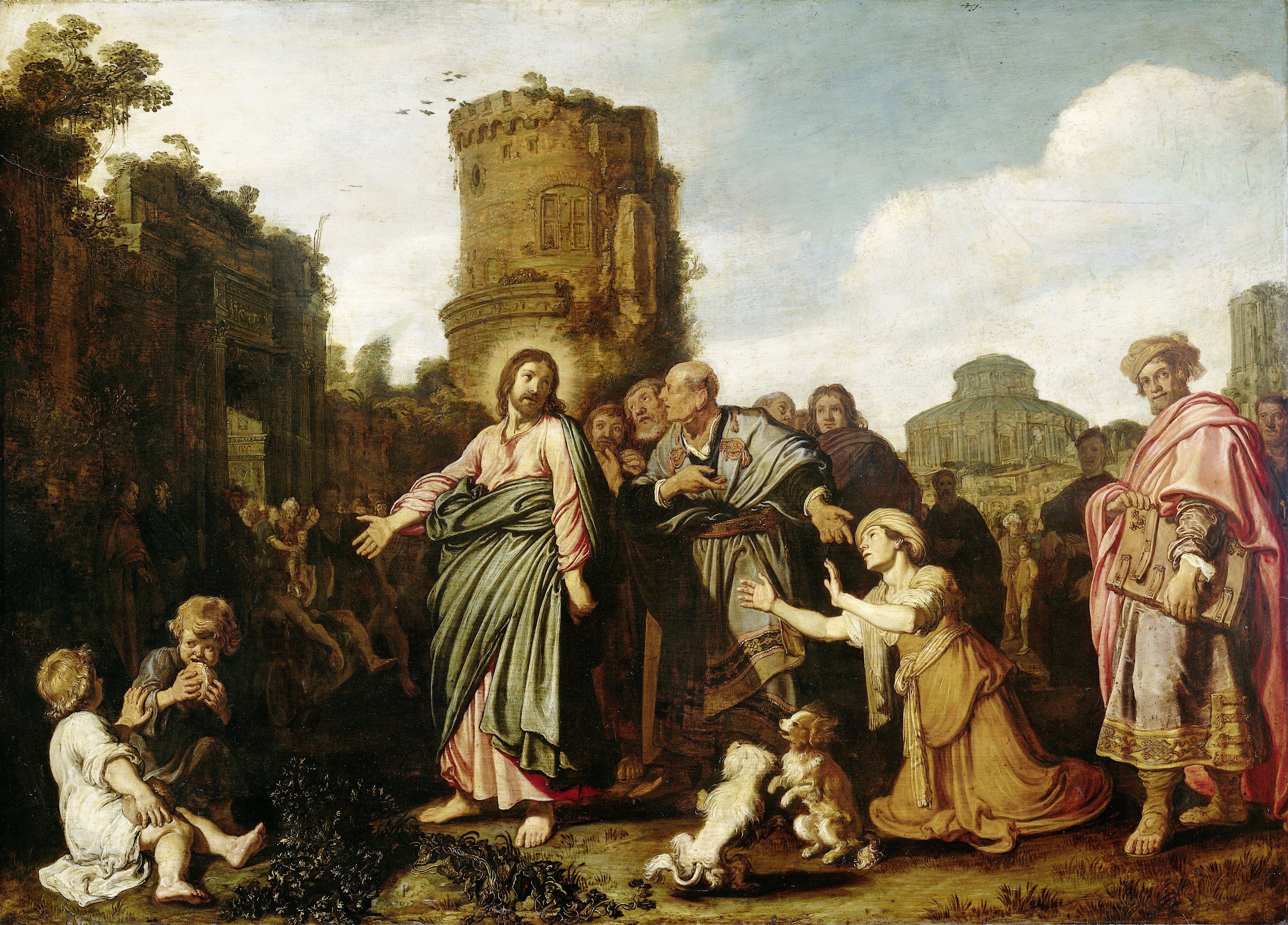


 Pastorsamwise
You must be logged in to post a comment.